Prison and White People

This first ran on Splice Today.
_______

After the first season of Orange Is the New Black, some writers like Yasmin Nair criticized the show for its focus on, and subtle bias towards, white women, especially towards star Piper Chapman (Taylor Schilling). The second season addresses these complaints head on. In episode eight, Piper gets a furlough to visit her dying grandmother, despite the fact that many other prisoners, mostly black, have been refused furloughs to see ill loved ones. Piper becomes the (understandable) target of much resentment, and after getting angrier and angrier, she stands up in the cafeteria, apologizes on behalf of white people everywhere, tells them that even though her grandmother is white, she still loves her, and encourages her tormentors to “shut the fuck up.” After which, Suzanne (Uzo Duba), on behalf of the other inmates and (presumably) the viewing audience, throws cake at this privileged, whiny little ass. End of moral.

But in the book on which the memoir is based, Piper didn’t actually get furlough. She asked to see her grandmother die, but the state said, “no.” Piper in real life certainly was middle-class, and privileged in many ways—not many ex-prisoners go on to write famous memoirs that get turned into hit TV series.  But the privilege presented on the show in episode eight, what she’s punished for, wasn’t actually a privilege she had. On the contrary, she was, in this matter, treated just like every other prisoner; with callous, bland disregard and petty authoritarian vindictiveness.

You could say that this doesn’t really matter; the dramatic point is that Piper is middle-class and white and is therefore better off than her cellmates. The incident in the cafeteria demonstrates that; why nitpick about details?

I think it’s worth nitpicking about details, though, because the moral here about Piper’s privilege is a little confused. Specifically, the show seems in many instances so eager to pull Piper down a peg, and to show that she’s privileged, that it can elide the fact that, white as she is, she’s in prison. Moreover, she’s in prison on a decade-old charge of having transported heroin. She committed a pretty low-level crime a while back, and so she’s taken away from her family and robbed of her freedom. She may be privileged in comparison to some of the people in prison with her, but compared to many viewers (and not just white ones) her life, as chronicled in the show, sucks.

This isn’t to say that race is irrelevant. But for the real Piper, racism did not allow her to go see her grandmother: racism prevented her from seeing her grandmother. Racism was used against her, not in the sense that she was discriminated against because she was white, but because the mechanisms and institutions built to police black people ended up policing her.

Racism against black people has been used as an excuse to target certain white people throughout the history of the U.S. White abolitionists who opposed slavery were subject to violence along with blacks in the Cincinnati riots of 1836. During Reconstruction, Northerners who supported black rights could be attacked and killed—The KKK killed white and black civil rights workers. Gone With the Wind gleefully recounts the murder of a Yankee official during Reconstruction who dared tell black people they could marry whites. For that matter, whites who did want to marry blacks, like Richard Loving, faced harassment and discrimination. Even beyond that, Ta-Nehisi Coates points out that politicians who’ve been associated with black causes, whether the Republican Party before the Civil War or the Democratic Party in more recent years, have been subject to racist attacks. As Coates says, “Abraham Lincoln’s light skin did not save him from a racist political attack, any more than it saved him from a racist assassination plot.”

Piper (in real life and in the TV show) wasn’t a civil rights worker or a political figure. But the fact remains that our prison system, the largest in the world, has been justified and sustained by a cultural commitment to policing people of color. As many historians have argued, the war on crime was inaugurated by politicians like Barry Goldwater and Richard Nixon, who argued that civil rights demonstrations and movements were leading to a breakdown of law and order, the solution for which was more cops and more prisons. The result was an ongoing rhetoric of race-baiting around crime and imprisonment, exemplified by George H.W. Bush’s notorious 1988 Willie Horton ad. That rhetoric in turn fueled a 700 percent growth in prison population between 1970 and 2005.

In 2010 blacks were incarcerated at a rate of 2207 per 100,000 people and Latinos at the rate of 966 per 100,000, as opposed to only 380 per 100,000 for whites.

Nonetheless, there are still a lot of white people in prison: white males were 32.9 percent of the prison population in 2008, as opposed to 35.4 percent black males.  And a large number of those whites were in prison for the same reason as blacks—because America, in an excess of racial panic, has built a massive drug war and a massive prison system in an effort to police and control black people. America’s prison system disproportionately affects black people, through sentencing disparities for crack and other systemic biases. But the drug war machinery sometimes, almost incidentally, catches white people in its gears as well. The white rate of incarceration in the U.S., at 380 per 100,000, is still in the top 20 incarceration rates worldwide, and is twice as high as rates in England and Wales.

Since the moment it enshrined slavery in its Constitution, American authoritarianism has been built upon racism. Piper may be privileged in some ways, but at least for a while that racist authoritarianism has gotten her by the blonde locks as surely as it’s got her cellmates. Once you’ve built your prison, you can put anyone in it. Which is just one way that racism has made America less free, especially for black people, but not for them alone.
 

large_rsz_suzanne

Decoding Turing: Queer Superhero

2014, THE IMITATION GAME

 
Genre Conventions

Socially awkward, personally abrasive, math-obsessed, “agnostic about violence,” and gay—Alan Turing makes for an unlikely superhero. Yet the recent Oscar-winning film The Imitation Game gives us a biography largely assembled from tropes native to that genre: an origin story involving childhood trauma and the loss of loved ones, unusual gifts bringing extraordinary power, social persecution, and grave moral dilemmas.

Turing builds a “universal machine” — an “electrical brain” that “could solve any problem.” It was not just the largest or fastest or smartest computer, but the first — an entirely new kind of thing. The British military used the device to break the “unbreakable” code of the Nazi enigma machine. But that only created a new problem — how to use the intelligence they acquired. For the utility of breaking the code depended crucially on the Nazis never realizing that the code had been broken. Each time the Allies used the decrypted information to intervene militarily, they risked losing the advantage they had gained. Turing and his team used “Christopher” to decode the messages; then they had to calculate the odds and decide which Nazi attacks to thwart — and which to let go ahead: “Statistical analysis. The minimum number of acts it will take to win the war. The maximum before the Germans get suspicious.” Their intelligence made possible, among other things, the victory at Stalingrad and the invasion of Normandy; it is thought to have shortened the war by as much as two years. They saved millions of lives, and may have literally rescued the world from tyranny. But in the process, they deliberately allowed many thousands of people to die, soldiers and civilians.

The film rather overdramatizes this dilemma. Literally the first set of messages the excited cryptographers decipher concerns a u-boat attack, and as it happens, one young code-breaker has a brother serving aboard a targeted ship. Obviously the first impulse is to rush to save him, but Turing refuses. “Let the u-boats sink the convoy,” he advises. “Our job is not to save one convoy. Our job is to win the war. . . . Sometimes we can’t do what feels good. Sometimes you have to do what is logical.” With horror the rest of the group slowly realizes that he is right. The ships go down, the brother dies. The scene is meant, I think, to call into question to morality of the whole exercise. But it serves just as well as a justification. It is because they are willing to sacrifice their own loved ones that they have the right to sacrifice others. Their “blood-soaked calculus” allows for no special cases.

Turing makes sacrifices of his own, but of a different sort. Realizing that his engagement to fellow code-puzzler, Joan Clarke puts her at risk, he breaks it off. He begins, “You need to get far away from me” — but then, realizing that he cannot explain why without revealing MI-6 secrets and putting her at greater risk, he changes tack: “I don’t . . . care for you. I never did. I just needed you to break Enigma. I’ve done that now. So you can go.” The irony here is double: The engagement is a cover story, but he is covering for her (to maintain independence from her parents), not her for him (to hide his homosexuality). And second, it is precisely because he cares for her that he must leave her.

The scene mirrors the final and most heroic scene of the 2002 Spiderman film. Over the course of the movie, a lonely nerd, Peter Parker, becomes a wisecracking superhero, defeats the Green Goblin, and finally wins the love of “the girl next door, Mary Jane Watson — the woman I’ve loved since before I even liked girls.” But Parker is weighed down by guilt. He caused the death of his Uncle Ben by a sin of omission; he directly caused the death of his best friend’s father; and he has repeatedly put the people he loves — Mary Jane and Aunt May, in particular — in mortal danger. At the end, Mary Jane realizes that Peter is the “one man who’s always been there for me.” She confesses that she loves him.

The whole movie has built toward this point. We are told in the very first scene that “this, like any story worth telling, is all about a girl.” Peter has spent years vying for her attention, and now, at last, he has his chance.

“I will always be your friend. . . ,” he says. “That’s all I have to give.”

She cries, and he walks away.

It’s a bold way to end the film, the boy getting — but then not getting — the girl, choosing heroism over happiness. By the logic of Spiderman, Peter Parker did the right thing; in The Imitation Game, however, Turing does not come across so well. He seems, instead, unnecessarily, if also somewhat unconvincingly, cruel. Joan, who loves him, probably more than anyone else does, slaps him across the face and says, “You really are a monster.”

She is not alone in the assessment. Others call him “irascible,” “inhuman,” and “an arrogant bastard.” His young colleague, debating the fate of his doomed brother, demands: “Who the hell do you think you are? . . . You’re not God, Alan. You don’t get to decide who lives and who dies.”

“Yes, we do,” Turing replies. “No one else can.”

Later Turing recalls this exchange. “Was I God?” he asks. “No, because God didn’t win the war. We did.”

But what did they become by doing so? Turing offers his confession, and then poses the question to a police detective: “So tell me. What am I? Am I a machine? Am I a person? Am I a war hero? Am I a criminal?”

Like Frank Miller’s Commissioner Gordon 1 in The Dark Knight Returns, the policeman concludes: “I can’t judge you.”

“Well, then,” Turing sighs, disappointed and resigned, “You are no help to me at all.”

Stay Weird

The parallels to superhero stories are numerous and fairly apparent. Peter Parker and Batman have already been mentioned. And with Benedict Cumberbatch playing Alan Turing, comparisons to Sherlock Holmes are inevitable. The willingness to calculate odds and sacrifice thousands to save millions clearly echoes Ozymandias’ scheme in Watchmen — at a somewhat smaller scale, admittedly, but on the other hand, in the real world, so in that sense the stakes are infinitely higher. In fact, there is a bit of every obsessed, lonely scientist — from Dr. Frankenstein to Dr. Doom — in the figure of Alan Turing. (In one scene he rants: “You will never understand the importance of what I have created here!”) And then there is the fact, sadly central to the story, that like Marvel’s mutants, Turing was a member of a persecuted minority.2

Of course it is extremely unlikely that those responsible for the film intended Turing’s story to echo Peter Parker’s, Adrien Veidt’s, or the Charles Xavier’s. And, given the late date of the de-classification of Turing’s war record, it is positively impossible that Stan Lee, Alan Moore, and company based their science hero fictions on Turing’s science hero reality.

But, while some of the similarities are superficial, others are surprisingly deep. Turing’s dilemmas, for example — accepting responsibilities that put loved ones at risk, or sacrificing many lives so that many others might live — are just the sort of decisions certain morally unlucky people have to make. In particular kinds of stories, such people may be heroes, but in others they are villains, and in some they are pitiable, tragic victims. However, the most important parallel, I think, between The Imitation Game and the superhero genre is in the treatment of difference. Each views difference as both a burden and a blessing, and celebrates as heroes those who use their gifts to serve, not merely themselves, but humanity more broadly — in other words, those who in expressing their difference also remind us of what we all share in common.

“No one normal could have done [what you did],” Joan tells Alan. “This morning I took a train though a city that wouldn’t exist were it not for you. . . . Do you wish you could have been normal? The world is an infinitely better place because you were not.”

Alan Turing was a homosexual at a time when homosexuality was not only disapproved of, but also a statutory offense. After the war, when his secret was discovered, he was fired from his job, disgraced in the papers. He was arrested, tried, and convicted of Gross Indecency — the same charge that sent Oscar Wilde to jail half a century before. Rather than go to prison, Turing agrees to a course of “hormonal therapy” — “Chemical castration to cure me of my homosexual predilections.” The film shows him shaking, stammering, losing focus. He was unable to complete a crossword puzzle, much less continue his work in mathematics. After a year of such treatment, he committed suicide.

The film suggests — or rather, it insists — that Turing’s homosexuality was specifically tied to his genius. His difference — sexually, socially, psychologically — is stressed throughout. He is unpopular at school, imperious with colleagues, insubordinate to his superiors. He does not especially like, or even care to understand, other people — and he does not care if they like or understand him. Others in society, such as bullying schoolmates and intruding policemen, treat his intellect as being suspicious in itself. (In fact, it was his intellect that leads to the discovery of his criminal sexuality. The police — responding to a burglary in which nothing was missing, and meeting there a Cambridge professor with a classified war record — initially suspect espionage.) But Turing is “an odd duck,” even when compared to his intellectual peers, and this oddness, this queerness, is what sets his thinking apart from theirs. He is maddeningly literal, unconcerned with convention, dismayed by social niceties. He is strange because he sees things differently, and it is that difference of perception that lets him attack unsolvable problems from new angles.3

Was that difference in perspective related to his sexuality, whether as cause or as consequence? We can’t say for certain, but surely it might have been. Turing, as the movie shows, developed his interest in codes at the same time that he discovered his attraction for other boys. And then, decades later, the effort to cure his homosexuality also robbed him of his genius.

The Imitation Game
offers a moral, and to make sure we don’t miss it, we hear it three times, from three different characters. It supplies the last line of dialogue: “Sometimes it’s the people who no one imagines anything of who do the things that no one can imagine.”

Of course Alan Turing was not a superhero, for the simple reason that there are no superheroes. (“Superheroes didn’t win the war. . . ,” he might say.) Turing was a real human being. Whatever The Imitation Game may have gotten wrong about him (and I am in no position to judge), it got at least this much right: The world was infinitely better because Alan Turing was not normal. And it cost him his life.
______

1.– In The Dark Knight Returns, Commissioner Gordon tries to explain his relationship to Batman by talking about Pearl Harbor: “A few years back, I was reading a news magazine — A lot of people with a lot of evidence said the Roosevelt knew Pearl was going to be attacked — and that he let it happen. . . . I couldn’t stop thinking how horrible that would be. . .and how Pearl was what got us off our duffs in time to stop the Axis. But
a lot of innocent men died. But we won the war. It bounced back andforth in my head until I realized I couldn’t judge it. It was too big. He was too big. . . .”

2.– Writing in the Hooded Utilitarian, Noah Berlatsky has noted that, in many of its particulars, the whole superhero concept is pretty gay: “To begin with, super-heroes generally have a secret life, a ‘secret identity,’ that they can’t talk about even to their closest friends and
relations. In other words, they are all closeted. And what’s in that closet? A hypermasculine, muscle-bound body, swathed in day-glo tights; an uber-manly man whose physical tussles with the bad guys preclude any meaningful relationship with the leading lady. Out of costume, on the other hand, the hero is a feminized sissy-boy, whose painful secret prevents him from having any meaningful relationship with the leading
lady. Either way, what looked like iconic maleness starts to look, from up close, rather queer. And that’s not even getting into the whole boy sidekick thing.”

3.– Turing tells his interrogator, “Of course machines can’t think as people do. A machine is different than a person. Of course it thinks differently.” But then, he notes, how astonishingly different people are
from each other, and concludes, rhetorically: “What’s the point of variation if not to say that we think differently?”

The Future Will Be Televised

Last week I suggested that a TV show about time travel didn’t have to be completely stupid. This week I want to suggest that it could also be entertaining. Here’s a script treatment for a pilot to such a would-be non-completely-stupid yet-potentially-entertaining series. Interested TV producers should mail stacks of 1960s-era $100 bills to my home address.

“Remote Control”

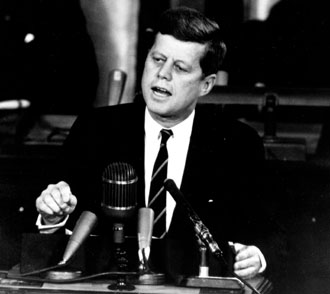
Zoom slowly out from historical footage of President Kennedy’s May 25, 1961 Address to Congress: “I believe that this nation should commit itself to achieving the goal, before this decade is out, of landing a man on the moon and returning him safely to the earth. No single space project in this period will be more impressive to mankind, or more important for the long-range exploration of space.”

2015:

Remy is the granddaughter of two scientists who worked for NASA in the early years of the space race. Both died before she was born, so she is surprised to receive a visit from Connor, a lawyer executing her grandmother’s secret will. To receive the money left to her, Remy has to fulfill one obligation: exhume her grandmother’s coffin and store it in her house for one year.

1961:

Lora, Remy’s grandmother, is leading a small group of politicians and military officers into an airport hanger, promising them that what they are about to see will change everything.

In a second location, scientists lean over a control board in hectic preparation. They include Art, the handsome if good-humoredly arrogant team leader, and Tom, a comparative wall-flower. (Either could be Remy’s future grandfather.)

Lora throws open the door to the hangar to reveal: an anti-climatically empty hanger. Or almost empty. She directs the men to a line of folding chairs situated in front of small crate, drops her purse, and picks up a phone hanging from a pillar: “We’re ready.”

Art is on the other end, and the control room bursts into activity.

In the hangar, all eyes are on the crate. The moment intensifies until . . . the crate is still just sitting there. The observers are getting impatient. Lora snaps at Art.

Tom just solved the problem–they’re connected.

Lora looks at the crate: still nothing. She’s about to speak when she hears a crash through the phone and then jerks around as the crate crashes open a second later. A very non-anthropomorphic robot breaks out: it rolls on multiple wheels, extends an array of praying mantis-like arms, and swivels a camera eye at the startled observers.

The control panel’s central video screen shows the observers as the scientists control the robot’s movements. Tom mumbles something about theatrics: there won’t be any crates to smash on the moon. Art agrees, but politicians like a good show; that’s why he put Lora on the main stage.

Lora introduces LURC-er 1, a remote controlled robot designed for lunar exploration. The president has promised the world America will be on the moon by the end of the decade—which is impossible. How do you build a life-sustaining environment strong enough to withstand outer space and then make it lightweight enough to be rocketed out of the Earth’s gravity while still carrying enough food, water, and oxygen to keep even one human being alive? This will not happen in our lifetime’s or even our grandchildren’s lifetimes. But rocketing a robot to the moon is comparatively simple. LURC-er 1 rolls forward.

2015:

Remy and Connor watch as the coffin is dug up. When they open it, both are relieved to find not a desiccated corpse but a male mannequin dressed in a 60s-era business suit.

It and the coffin are trucked to Remy’s house and left in her empty garage.  Connor says he will have to check in occasionally to confirm that the coffin remains in the house. The terms of the will are vague on this point, and he’s hinting that he might like to stop by more often than legally required. There’s some definite mutual attraction here.

1961:

Lora bounds into the control with the news: the observers were impressed, and project funding is guaranteed. Applause and celebration—including a lingering hug from Art. Tom looks away: “We still haven’t figured out the time delay.” This draws Lora’s attention away from Art. She could have sworn she heard the crate shattering through the control room speakers before it shattered in the hangar—but of course that’s impossible, and she laughs it off. Tom looks shocked. He mumbles something and starts poking at the controls. Art ignores him and draws Lora to an adjourning room where once alone they kiss.

2015:

Remy is woken by a faint noise downstairs. She finds her phone, preps it to dial 911, and arranges her keys in her other fist so they protrude as weapons. She turns on lights as she investigates the house, but finds nothing. Before giving up and going back upstairs, she checks the door to the garage: it’s unlocked. She opens it and hits the light but nothing has changed; the coffin is still sitting in the middle of the empty garage. She almost leaves but then walks to the coffin. She opens the lid: the mannequin is gone.

1961:

At night, Art is walking Lora to her car where they say goodnight with another kiss. Once inside she realizes she doesn’t have her keys—which are in her purse.

Lora enters the hangar where she left her purse earlier. She finds it and then hears a noise from one of the darkened areas. She notices that the folding chairs and broken crate haven’t moved—but the robot is gone. She explores and soon comes face to camera-eye with LURCer 1. It reaches a claw slowly toward her. She wants to smile, but can’t: “Art? Is that you?” The robot shakes its camera head “No.”

2015:

Connor wakes up to his phone ringing. It’s Remy explaining that the mannequin is gone and accusing him of playing some kind of game with her. Connor swears he knows nothing.

Remy hangs up angry. She is standing in her kitchen now when she hears something loud from upstairs. She dials 911 and reports an intruder in her house. She grabs her keys again and shouts warning that the police are coming as she walks upstairs. She sees a figure in a darkened corner. She throws on a light ready to punch, but it’s just the lifeless mannequin posed in a standing position. She approaches it cautiously. It remains frozen. She leans closer until her face is inches from it. A tense pause. Nothing happens.

1961:

The next morning, Lora, Tom and Art are back to work in the control room. Lora asks who was operating with LURCer last night, but they both deny it, and the panel recorded no activity. Tom is smiling though. He sits at the controls, saying he thinks he’s figured out the time delay. He activates LURCer and the screen shows the folding chairs and broken crate in the hangar. Why is it so dark? And where is everyone? Art is on the phone to the crew stationed in the hangar.

In the hangar, the crew is positioning the dormant LURCer; the crate and chairs are gone.

Art thinks Tom must have rolled the robot into the wrong area of the hangar somehow, but exploring reveals nothing. Lora’s face changes as she recognizes what is happening. She tells Tom to turn around—to turn LURCer around. When he does, Lora is looking back at them through the video screen. Are they watching a tape? The panel registers a live feed. Lora leans closer to the panel and speaks in sync with her lips moving silently on the screen: “Art? Is that you?” Tom looks at her, then operates LURCer: her image moves left and right as he shakes the camera “No.”

2015:

A police officer has finished taking Remy’s statement as two others report that the house and grounds are clear. Connor arrives, upset and apologizing. He explains that he is only following directives sent to him by an anonymous client. The police offer to remove the mannequin, but discover it’s surprisingly heavy. It topples rigidly onto its back on the upstairs landing. Remy tells them to leave it, and the officer assures her they will be patrolling all night and to call for any reason. Remy throws Connor out too, but first he gives her an envelope: the first payment, pre-sealed by the employer. She rips it open and stacks of $100 bills spill out. Remy watches at the window as Connor and the last police car pull away. She’s holding the bills and notices that they look unused but the design is wrong; they’re from the 1960s. A hand grabs her arm. She spins as a speaker behind the mannequin’s motionless lips says, “Remy, it’s me.”

1961:

Lora, Tom and Art are alone in the hangar with LURCer. Art has sent everyone else home. He checks that the door is locked, before Tom explains. The “delay” was due to the system he invented to synchronize signals between the control room and LURCer.  It was just supposed to solve a technical issue, but the adjustment he made this morning proves that the signals traveled back and forth from a point in the past. He just invented time travel.

Although Tom has overthrown all of physics, Art points out that the technology has no practical application. They built LURCer two months ago, and so that’s as far back as they can send signals.  Lora disagrees. Can’t the signals move forward in time? Isn’t that how she heard the crate break? The signals were traveling one second into the future. Why not send them further? How far is the range? It would only be possible if LURCer is maintained in the future too, either by their future selves or someone else. They leave the hangar, ready to find out.

2015:

Remy backs away from the mannequin. “What’s wrong?” it asks. She tells it take off its mask so she can see his face. “You know this isn’t a mask.” Remy flees as it moves toward her and then suddenly stops. “Oh,” it says and turns and vanishes into the kitchen. Remy waits, bewildered, then tentatively follows. She turns the corner to see it studying her wall calendar. It reads the date aloud and then looks at her. It says the date again. She nods. She flinches as it moves toward her again, but then it walks past her and heads upstairs. She follows it to her study where it is writing on a piece of paper at her desk. It seals the sheet into an envelope and hands it to her. “Hide this in one of your books.” It points at the wall of bookcases and then starts downstairs again. “What is it?”“The password. Have you called Connor yet?” “Password to what?” “I’m going back to the coffin now.” Remy leans over the banister as it descends. “Why do you want me to call Connor?” It pauses at the bottom. “And, Remy, remember.” It looks expressionlessly up at her. “Don’t trust me.” It vanishes around the corner.

1961:

Lora, Art and Tom sit at the control panel. They have no way to calibrate time distance, so Tom takes a guess—somewhere between a few seconds and a few millennia. To their shock, the signal is received. They’re connected. But the screen is black. Stranger, the new input doesn’t match their equipment—way more data than they can process. And the motor controls aren’t right either. They can’t get the wheels to engage properly. What has happened to LURCer?

2015:

Connor pulls up in front of Remy’s house and runs up the steps. She is waiting at the door: “Who are you working for?” He swears he doesn’t know and explains how his client handled everything through the mail. He never met or even spoke to anyone. Remy eventually accepts he’s telling the truth and starts to shut the door—when Connor asks if anything else happened. Did the intruder come back? Remy doesn’t answer, but clearly it has. He asks to come out, to stay somewhere else tonight, at a hotel—but then Remy opens the door and invites him. “You need to see this.”

1961:

They give up trying to work the motor controls. Did someone redesign LURCer? If so, at least the data they’re receiving will provide schematics for them to match the upgrade. The screen suddenly brightens as a lid lifts. Two faces look down at the camera. It’s Remy and Tom. “Who the hell are they?”

2015:

Remy and Tom hear noises as they approach the garage. As they enter, the coffin is jerking spastically, then stops. It jerks once more, then stops again.  After a nervous moment, they open the lid and look down at the mannequin’s face.

1961:

Remy and Connor vanish as the screen goes dead. The signal has cut off.

In the hanger, LURCer comes alive and starts rolling outside.

They try reconnecting, but it’s as if the future LURCer is gone, or is being blocked, like a busy signal.

LURCer enters their building.

They continue trying controls and debating what just happened—when LURCer bursts into the control room. They step back. Who’s controlling it? It rolls toward them. Then stops. One of its arms extends to the floor and begins to scratch. Lora approaches—Art tries to hold her back—but she shrugs him off and kneels to study the scratches. They’re Morse code. “H-E-L-P.” One of the other arms has begun scratching and Tom reads it: “M-E.” Art reads the third arm: “K-I-L-L.” And Lora moves to read the fourth: “P-O-T-I-S.” What is Potis? Lora looks into the robot’s camera. “You want us to help you kill the President of the United States?” All the arms begin scratching again. They each read a letter: “Y” “E” “S.” They stand back as the arms keep scratching and scratching the same word over and over: YES YES YES YES YES

End on a slow zoom into historical footage of Kennedy’s Address to Congress: “Now it is time to take longer strides—time for a great new American enterprise—time for this nation to take a clearly leading role in space achievement, which in many ways may hold the key to our future on earth.”

kennedy

The Unwitting Supremacist

With friends like these, who needs enemies? Last week, outspoken proponent of diversity Heidi MacDonald used her platform to belittle and mock some of the biggest meanest bullies in comics: people who want to talk about racism.

How much do you know about the Mahou Shounen Breakfast Club (MSBC) controversy? If it’s nothing, congratulations on living your best life; you can, if you want, catch up on it here. (We’ll wait.) If you are familiar with MSBC, please set aside for the moment your take. One of the few undisputed facts of the whole debacle is that its creators decided not to make their comic anymore. The impetus of MacDonald’s post, as she describes it, was to use her capacity “as a reporter to investigate if their decision was justified.” Well, stop the press, Vicki Vale. Their decision was entirely within their rights as creators, and is therefore justified no matter what you or me or anyone else thinks about it.

I mean, don’t get me wrong. I have a lot of opinions on both the comic (which doesn’t strike me as cultural appropriation) and the creators’ decision to quit (which I find ridiculous). But those are not journalism. MacDonald’s post is what is known as a hot take, and it is made up of her total misunderstanding of both cultural appropriation as a concept and one person’s blog post that went up after the comic was cancelled. Along the way, she asserts that manga appropriated Walt Disney(?) and Robert Louis Stevenson(??), and accuses Jem Yoshioka, the aforementioned blogger, who is of Japanese descent, of being dismissive of Japanese culture. Whatever you might think about all that, it sure as shit isn’t reporting. The fact that the author sees it as such comports neatly with her central claim, which is that champion of equality Heidi MacDonald knows racism, and this ain’t it.

*  *  *

Anyone can have an opinion. But it’s inappropriate to position yourself as a cheerleader for people from one or more demographics to which you don’t belong, disparage their opinions, displace them with your own, and then act as if you’re doing them a favor. If you do so in your capacity as editor, it is not just distasteful; it is an abuse of power. It is being a fucking bully.

While there are many examples of this behavior in comics, let’s zoom in on a case study from the world of High Literature. If you can even bear to get pulled into another insider-y saga, I’d like to share an illustrious tale about Times Literary Supplement editor Toby Lichtig. About two weeks ago, the Los Angeles Review of Books ran his remarkable essay on gender inequity in the literary magazine milieu. Lichtig wrote with great news for me and my fellow women writers: he has thought deeply about our struggle, and he wants us to know it’s going great.

lichtig

Hey girl. Just want u to know ur doing great. xo, Toby

Lichtig’s essay, like MacDonald’s post, is inside baseball at its worst. It is, variously, a takedown of a takedown of the London Review of Books; a piece that somehow both denies and accounts for the lack of women in literary criticism; and a wrongheaded critique of one frustrated woman writer, Katherine Angel, and her ilk for writing “casually” about gender (which I guess is what passes for a sick burn in British English). Despite its casualness, Lichtig frames Angel’s writing as a violent attack:

I’d like to make a small case for the magazine at which I work—the Times Literary Supplement—one of the publications so casually attacked by Angel as bastions of androcentricity. I say “casually” because Angel’s main focus of attack was the LRB, and she only offered a sideswipe at the TLS. And I also say “casually” because some of her writing on the subject was indeed casual. (emphasis mine)

Lichtig’s essay also describes a “sort of ‘blah’ that habitually creeps into writing about” gender inequity. By “blah” he means unfair generalizations, which he perceives Angel’s essay and just in general (lol). In the spirit of specificity, Lichtig waxes on about how each and every literary magazine is a super special snowflake (…sound familiar yet?). He takes a close look at numbers that aren’t really so different from one another. He even explains how statistics could never truly account for the True Celebration of Womanhood that was TLS’s recent Susan Sontag issue. Or something?

TL;DR: NOT ALL MEN. But reaching past the essay’s fundamental pettiness, it is a fascinating cultural document. In Lichtig, we have an associate editor of a magazine who elected himself to speak not just on behalf of that publication, but for the experience of all women in the literary world. Standing behind him, we have his employer, the Times Literary Supplement, which (presumably) thought that having him speak in this way sounded like a good idea. And finally there’s the LARB, the publication that deemed it fit to print. The final product is some 4,000 words of egregious mansplaining implicitly endorsed by one of the most reputable literary publications in the world.

It is important to realize that the struggle of women writers is not Lichtig’s real subject. His subject is his misguided opinion on the struggle of women writers, and in disguising that as objective truth he is not altogether artless. His opening paragraphs are a master class in how to put a woman’s exact words into scare quotes. And there is real rhetorical sophistication in his invocation of feminist icon Mary Beard, his TLS colleague, whom he quotes twice. In the world of Lichtig’s essay, it is only women—including Katherine Angel, LRB editor Mary-Kay Wilmers, novelist Kathryn Heyman (whose name Lichtig misspells twice), and Beard herself—who commit acts of sexism against other women. Kind of like saying that someone of Japanese descent is being dismissive of Japanese culture, if you can see where I’m going with this.

What’s really galling about the essay is not Lichtig’s tactics (gross as they are) or his ideas (which are really nothing new), but the patronizing way in which he positions himself as a cheerleader for women in the literary world even as he discounts their experience and opinions:

Portraying the situation as intractable and representing the literary world as a male-dominated monolith against which women can only bang their heads or give up can be counterproductive, leading not to resistance but resignation. Rather than argue that literary editors are “perpetuating” gender disparity, better to look at the historical facts: we have made great progress in redressing “the shocking paucity of women of authority and expertise” in most areas of our culture over the past 200 years, and we should rededicate ourselves to continuing that progress, rather than blaming literary publications for slowing it down.

These words speak to me, not with the message they’re meant to convey, but as an artifact of the time in which I write. Lichtig’s paternalistic pep talk, his complete mischaracterization of another thoughtful essay (on which his own is supposedly based), his half-baked historicism, and his self-congratulation are all too familiar. I see it all the time in comics. (Shoutout to The Comics Journal!) Today, I happen to be talking about The Beat.

*  *  *

Call them the unwitting supremacists. “Awareness” will always and forever pour forth from the mouths of well-meaning people like Toby Lichtig and Heidi MacDonald. But the inequities they seek to redress by definition demand their thoughts should count less. They require fewer proclamations of “awareness” and more ongoing, concrete editorial action and opportunities to cede the floor to other voices.

Lichtig, for one, could GAF about voices. Wearing the mantle of editorial authority, he only seeks to ease our worried minds. “We [editors] notice the gender divide,” he writes. “We think and talk about it regularly. And it is, I think, this awareness that is key to things changing.”

Reader, I humbly submit to you, here towards the end of an essay that has long since surpassed take-level meta, that awareness is not the key to change. Awareness is an abstraction, or worse, an illusion. Sometimes, as in MacDonald’s piece, awareness is wielded as both a talisman and a weapon—and then it’s closer to a lie. I guess it’d be one thing if it only powered bloated blog posts and ill-considered essays, but the sad historical fact is that it permeates everything from editorial policies to dismissive emails and tweets—all manner of communiqués, public and private, from people with cultural capital who earnestly believe themselves to be proponents of change. It is, to use Lichtig’s word, casual sexism and racism, and it is often culturally and institutionally supported, if not explicitly endorsed.

Back to MacDonald’s post. “If you have been reading my writings for any amount of time, you know that I’m a fan of multicultural diversity, and of multiple viewpoints and creators of every sex, religion, creed, race and sexual orientation getting a chance to tell their stories,” she writes. “I’m also a huge fan of cultural context for stories that examine how the preconceptions of a work of art are reflected in the execution. But I never want to see these criticisms used to PROACTIVELY SILENCE ART.”

Those capital letters are the author’s, and they are used throughout her screed, along with boldface and incredulous subheadings, to convey her utter indignation that people started a conversation about cultural appropriation in some comic she has officially deemed OK. Like Lichtig, MacDonald frequently describes critique as violent attack. She casts critics of MSBC as enemies of good art and bullies who “silenced” its creators. And even as she ascribes to them this incredible power, she mocks them as overly sensitive, irrational people whose claims are no more than “hurt feelings.” This rhetorical hypocrisy will sound familiar to anyone who has a passing familiarity with indie comics criticism. Political correctness is killing comics, or so they say. What it amounts to is a bunch of hubbub that sounds like it’s supporting diversity, but works diligently to protect the status quo. And what is getting lost—and, worse, derided—are the actual voices that were marginalized in the first place.

What is silencing? A lot of people in comics seem confused, so let me be plain: silencing is using your platform to punch down. It involves, in MacDonald’s post as in posts at other prominent comics sites, characterizing conversations about racism (or any given -ism or phobia) as censorship and/or irrational bullying. When someone called bullshit on MacDonald’s post, she said, “We need to do better. If we want to fight the cultural ascendance of ONE viewpoint—the white male cis viewpoint—we can’t let weak arguments define our position.” Then MacDonald said, to another person, “I am an equal opportunity jerk.”

Her language is reminiscent of every comics asshole ever who has refused to examine their own bias. The difference is that MacDonald thinks she’s doing it in the name of diversity—which is, I think, worse. It’s no accident that equal-opportunity offenders always ALWAYS offend certain people. When those people try to then explain where they are coming from, that is not attacking or policing comics. It is straight-up self-defense.

Anyone who has tried to follow the MSBC controversy as it has unfolded knows how difficult it is to see past mainstream coverage on The Beat and Bleeding Cool. To wade through the primary sources is a ridiculous exercise that’s emblematic of the dearth of prominent platforms available to divergent perspectives. Gatekeepers like MacDonald are not yet convinced of those critics’ humanity, instead casting them as anon trolls, proponents of callout culture, or bullies who aren’t even personally invested in comics.

MacDonald got some blowback for her piece, which she acknowledged in an addendum to her post that reaffirms her own imagined cultural awareness. (Har har.) Meanwhile, Jem Yoshioka, the blogger MacDonald mocked and diminished—and whose post, whether or not you agree with it, was respectful, thoughtful, and kind—has received at least one death threat from GamerGate. Such are the stakes of trying to carve out a place for yourself to exist in this crazy world: you’re threatened with extinction, or else laughed at even as you’re imbued with the magical power to kill comics with your thoughts. This milieu is unacceptable and depressing, but not hopeless. One thing I know: downstream voices on Twitter, Tumblr and elsewhere are punching up and speaking out. It won’t always have to be for survival. Someday it will feel like victory.

Voices from the Archive: Caroline Small on Female Comics Creators

As I mentioned yesterday, Kelly Thompson is running a poll to make a list of the best female comics creators. I thought I’d reproduce one of Caroline Small’s comments on this topic from some time back. She’s responding to the late Kim Thompson. (The back and forth was actually on another site…click through to the thread if you want all the ins and outs.)

I’m guessing nobody’s still reading this thread but I’m going to do something contrarian and agree with Kim — although for reasons he might not like. I think he’s absolutely correct that any discussion like this is problematic without some discussion of the values that make work “great.” But to me, the reason that is so important is because, if the history of women’s writing is any comparison, the work of women cartoonists, considered altogether and on its own terms, without reference to the historical criteria used to evaluate (mostly male) cartoonists, may in fact challenge the assumptions and criteria that we use to evaluate the work that’s been done so far.

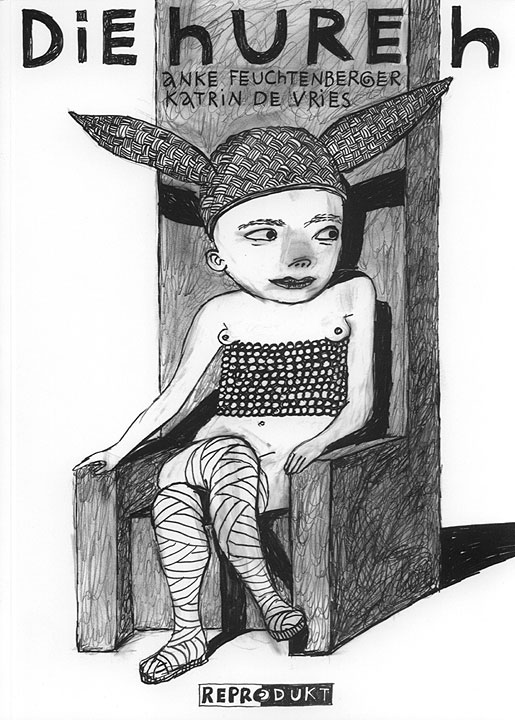
I’m a known partisan for Anke Feuchtenberger’s marvelous work. Having recently been introduced to Charlotte Salomon’s work I anticipate a similar feeling to emerge.

But a lot of people say artists like Feuchtenberger and Salomon are not “cartoonists” because they don’t work in quite the same aesthetic tradition as the ones in your list, Kim — even though Feuchtenberger at least describes herself as a cartoonist. When I start from their work as my aesthetic benchmark, more women emerge: Ana Hatherly, Elisa Galvez, Dominique Goblet.

The aesthetic tradition of “classical cartooning” (?) unfortunately hasn’t coincided historically with a very welcoming environment for women, one where we have lots of role models and fellow travelers to smooth the path, to provide encouragement and motivation and inspiration, and to create a sense of shared voice. That’s why I’m resistant to the 60-year metric. It doesn’t let the best work by women who have come of age after the advances of recent decades — advances Fantagraphics was part of — come to the surface for critical examination. I think if we limit ourselves to that historical precedent, we can’t, say, evaluate the work of innovative cartoonists like Cathy Malkusian or Lauren Weinstein in the context established by cartoonists like Feuchtenberger and Salomon. And I think reading them that way, instead of against, say, Herge or Herriman, leads to fascinating insights about the cartooning aesthetic and its possibilities — the comparison made me like Malkusian and Weinstein’s work much more than I did before I approached in from that perspective. It remains an open question what such comparisons would yield for reading Alison Bechdel or Lynda Barry or other women who work in the more traditional cartooning aesthetic.

Maybe it will in fact be 60 years before we can accurately say who the greatest women cartoonists will be, but I don’t think we should be afraid of recognizing and celebrating the work of women cartoonists as “great” until that time has passed. That’s largely abdicating any role that critics and criticism can play in making the environment of cartooning in the broad sense more nourishing for women cartoonists. If we need to codify and celebrate and advocate a separate tradition of “women’s cartooning” with its own aesthetic and cultural criteria in order to be able to roar these women’s names as greats in comics, then so be it. I think Herriman can stand the competition. Maybe we need another word for “comics artist” than just “cartoonist.” But what I think is sexist is the demand that women work in that tradition and only that tradition in order to be considered great.


9783931377861

Best Women Comic Creators

Kelly Thompson is running a poll to find the greatest female comics creators. You should go vote if you haven’t.

Here’s my list fwiw, from most best to slightly less best (they’re all writer/artists.)

1.Ariel Schrag
2.Edie Fake
3.Ai Yazawa
4.Remedios Varo
5.Lilli Carré
6.Moto Hagio
7.Tove Jansson
8.Rumiko Takahashi
9.Kara Walker
10.Marley

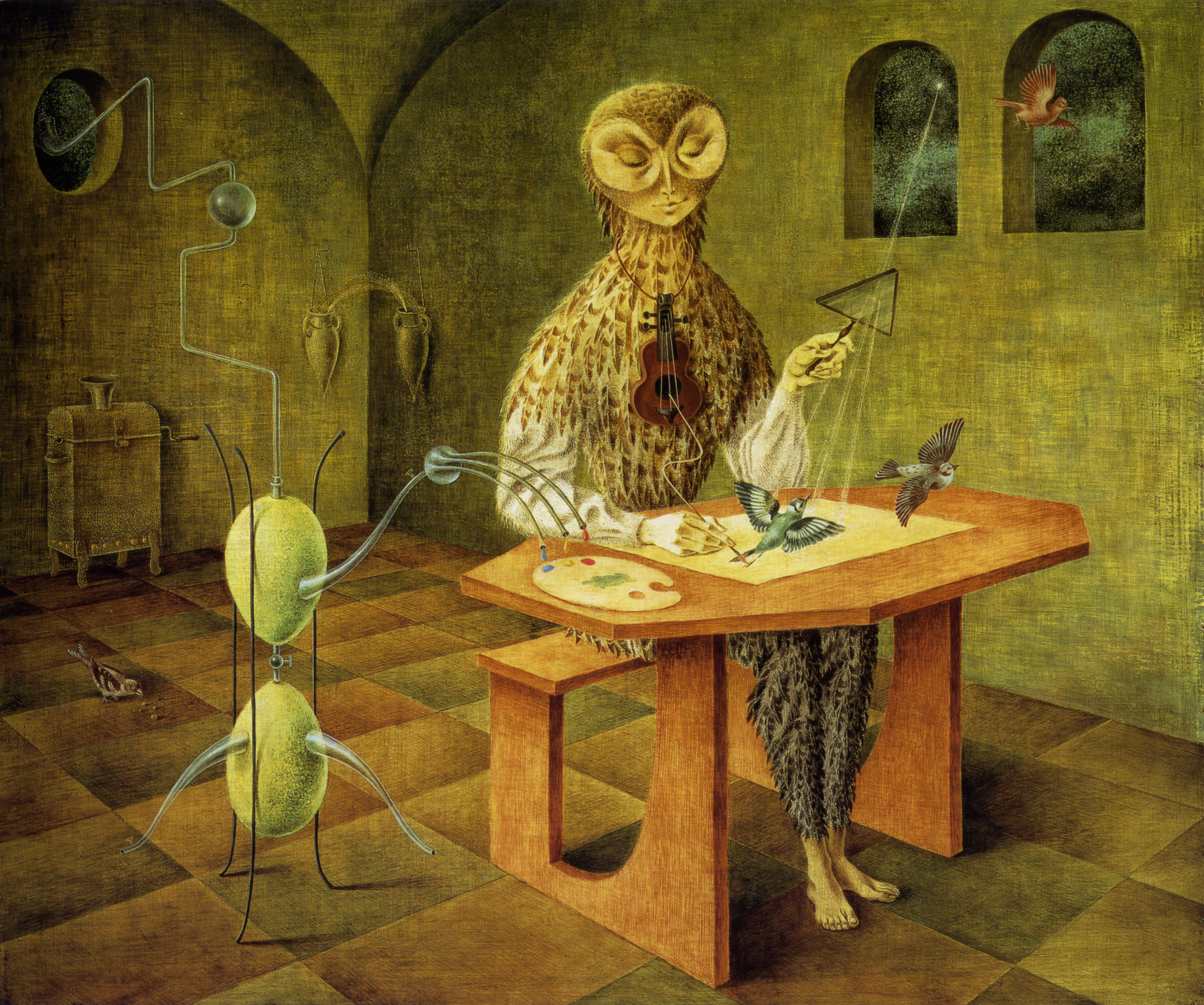
I tried not to think about this too, too much, since I tend to think these lists are pretty arbitrary anyway. Edie Fake uses the pronoun he, but he’s told me he identifies as a woman, so I think it makes sense to include him. Remdios Varo and Kara Walker aren’t usually thought of as comics people, but I think they’re work can both be seen in the tradition of cartooning. Lilli Carré’s most amazing work in comics is arguably in the gallery setting as well. Marley isn’t much known, but I adore it…and I think my essay about her may be the one Comixology column I haven’t brought over to HU? Maybe I’ll post it here tomorrow.

None of these are superhero creators or webcomics folks, so I doubt any of them will make the final CBR list (except maybe Rumiko Takahashi?), which I think will be tilted to capes and a Kate Beaton or two. I suspect Gail Simone will top the writers list…not sure who would win the artists? Amanda Connor maybe?

Folks might be interested in the list of female comics artists who made HU’s all time greatest list a few years back. Feel free to list your picks below if you’re so moved (but vote in the real poll too!)
 

Remedios_Varo_(388484001)

Where Angels Fear to Tread: Constantine, Promethea, and the Fool

Part One: Constantine

1969 ends with a surprise—the seventies.

In its last three pages, Alan Moore and Kevin O’Neill’s Century: 1969 suddenly departs from the eponymous year and drops us, without warning, a decade further on.  The bright, LSD Technicolor has washed out of London, replaced with a heroin gray that never even fades to black, but only to darker and sootier grays.  The place seems desolate, desperate, depressed, a throwback to the Ingsoc years, but without a Big Brother to blame.  The Basement, a “Beat Club,” “where the Rutles first played London, apparently,” is now Debasement, a seedy punk bar where at closing time they probably don’t bother to sweep up the broken glass.  The sixties, so hopeful at the peak, seemed to promise the world.  The seventies promised nothing, and delivered.  Nihilism is all the rage.

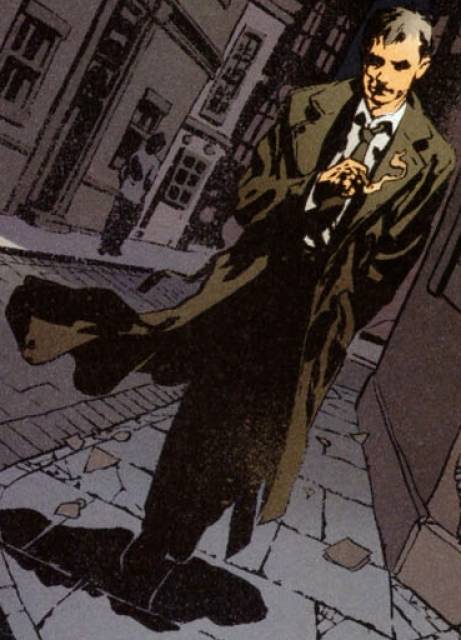
Another change as well:  There’s an old man, who looks like a young man.  Or is he a young man, who looks old beyond his years?  He sits alone, slumped at a table, dejected.  He has short, slightly spiky hair—more Richard Hell than Billy Idol—and he hasn’t shaved in a couple of days.  He wears a suit that was probably pretty sharp when he put it on, but now looks like he slept in it—and, over that, a dingy trench coat.  We know he is Allan Quartermain, but there at the end, I would swear he is John Constantine.

He may well be both.

We’ve seen this trick before.  Warren Ellis and John Cassaday’s Planetary, chapter seven (“To be in England, in the Summertime”), begins by announcing the death of a Constantine stand-in named John Carter.  “Who’s John Carter?” Elijah Snow asks.

“Old friend of ours,” Jakita says.  “Had serious connections in the occult underground.  Real player in the eighties.”

“The word,” the Drummer cuts in, “. . . is scumbag.”

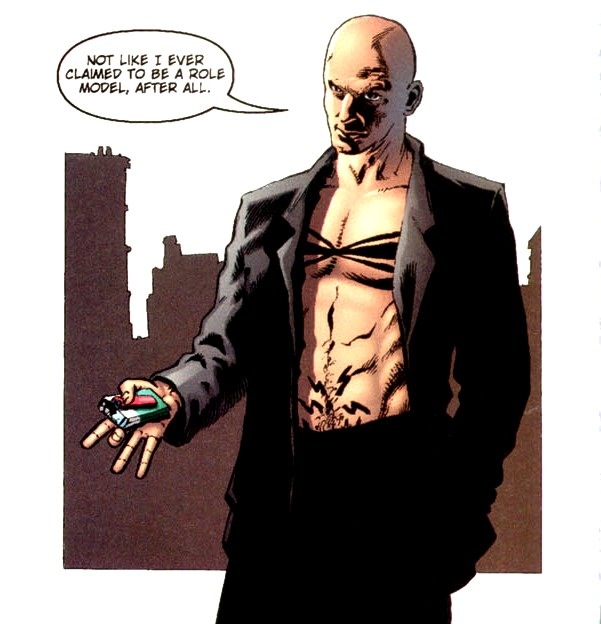
We turn the page and we see him, in Jakita’s memory, slightly unkempt hair, cynical expression, trench coat.  He is lighting a cigarette.  By the end, we learn that Carter/Constantine is not really dead.  He shows up, head shaved, the moon forming a halo behind him.  When he takes off the trench coat, we see that he’s wearing a black sports jacket and no shirt underneath.  Large, bold, black tattoos adorn his chest.  Suddenly Jack Carter isn’t John Constantine anymore; he’s Spider Jerusalem instead.

“The eighties are long over,” he says.  “Time to move on.  Time to be someone else.”

He walks away, into the darkness, leaving behind the smallest drift of smoke, twisting like a question mark.

Both of these stories are, in their way, stories about stories.  The League of Extraordinary Gentlemen began by assembling a Victorian superhero team—Quatermain, Wilhelmina Murray, Captain Nemo, Mr. Hyde, the Invisible Man—and filling their world with fictions borrowed from other fictions.  Subsequent volumes in the series have followed the key characters as the years progressed and they grew old—or, in some cases, thanks to a Fountain of Youth, did not.  Moore, then, does what he does best, simultaneously deploying adventure story tropes and commenting upon them.

Ellis does something similar in Planetary, where a team of “mystery archaeologists” tries to uncover “the secret history of the twentieth century,” and thus encounters alternate-world versions of superheroes, movie monsters, pulp adventurers, mad scientists, and other pop-culture figures.  Here, too, the stories are critiqued even as they are told.

Moore borrowed Quatermain, but invented Constantine; Ellis borrowed Constantine, but invented Jerusalem.  The transition—Quatermain, Constantine, Jerusalem—is interesting in several respects.  For one thing, it is broadly in keeping with important aspects of each’s character’s story.

Allan Quartermain, whom Alan Moore once dismissed as “just another white imperialist out to exploit the natives” becomes, in the League‘s story, something more and something else.  When we first find him he is a heroin addict, old and pathetic, strung out, filthy, and waiting to die.  It takes a woman in danger to bring him back to his old self.  And yet he doesn’t remain his old self.  He grows tender, broadens, changes.  He comes to respect Miss Murray as an equal, then to love her, then to love, also, the androgynous and immortal Orlando.  He travels to a magic pool and comes back a young man, posing as his own son.  He is no longer the “old” Quartermain at all.  Alan Moore thus reinvents Allan Quatermain.  And Allan Quatermain reinvents himself.
1873271-jack_4

Constantine, as a kind of magical con artist, lives by his wits.  He is constantly adapting, constantly improvising.  The central conflict of Hellblazer is that of the individual, a mere human, confronting powers much greater than himself—heaven, hell, and Margaret Thatcher.  The question the series poses, taken as a whole, is how much of a bastard can one be and remain a decent sort of guy?  Or, at times: How much of a bastard does one have to be?  Of course, the temptation—for John and for his writers—is always to push it too far.  The challenge for the writer is to stay true to the character; the challenge for John Constantine is to stay true to himself.
Jack_Carter_Planetary_004

Transmetropolitan poses many of the same questions, the same challenges.  Spider Jerusalem is a rogue journalist, a cyberpunk Hunter S. Thompson, determined to tell the truth and consequences be damned.  The story he’s pursuing, or a crucial part of it, concerns the persecution of the “Transient” community, a rather cultish group who alters their genetics to become part alien.  In other words, Transmetropolitan is about the relationship between integrity and autonomy, and in particular the defense of the second being required for the preservation of the first.

A theme uniting the two transitions—Quartermain to Constantine, Constantine to Jerusalem—is the idea that heroic characters are expressions of the cultural needs of their eras.  Thus Jakita’s explanation for the “faintly ridiculous” appearance of the Vertigo heroes:  “They’re eighties people.”  And furthermore, they’re English:  “England was a scary place.  No wonder it produced a scary culture.”  Thus, also, Alan Moore’s observation in his introduction to The Dark Knight Returns:  “[H]eroes are starting to become rather a problem.  They aren’t what they used to be. . . or rather they are, and therein lies the heart of the difficulty.”  He goes on to explain:  “The world about us has changed and is continually changing at an ever-accelerating pace.  So have we.”  However, despite advances in technical knowledge and social conscience, “comic books have largely had to plod along with the same old muscle-bound oafs spouting the same old muscle-bound platitudes while attempting to dismember each other.”  Changing times, he says, demand “new themes, new insights, new dramatic situations.”  Our heroes have to change.

The personal tension in 1969—between Mina, Allan, and Orlando—largely hinges on their different approaches to adapting to the new times.  Mina is somewhat desperately trying to adopt the most up-to-date dress and slang, an affectation that her teammates find ridiculous.  It’s easier for Allan, at least on the surface, as men’s fashions are more stable (witness the iconic trench coat) and the culture is more forgiving to men as they age—not that he ages, exactly.  But Mina, perhaps because of her earlier, less idyllic experiences with immortals, has picked up on something deeper.  She fears obsolescence, becoming “fossilised as a Victorian freak” in a world that will grow increasingly alien.  For Orlando it is different.  Orlando is always changing—names, sexes, allegiances; even her history is subject to revision—and Orlando is never changing.  He, or she, is a constant throughout history, always present where the drama unfolds, cynical and self-centered past the point of narcissism.  Whatever tragedy he may witness, we can be sure that he will be counted among the survivors.  Fashions change, ideas changes, and Orlando will take them up, or not, as it suits her.  His very mercurial nature is a kind of constancy; whatever else happens, Orlando will adapt and survive.  There is a stable center beneath the shifting appearances, the momentary attachments.  And so, in the  shadows and grime of the seventies, as they discuss Mina’s disappearance and the end of their League, it is naturally Orlando who gets up and leaves.  Quatermain remains, unsure what else he could do.


Part Two: The Fool

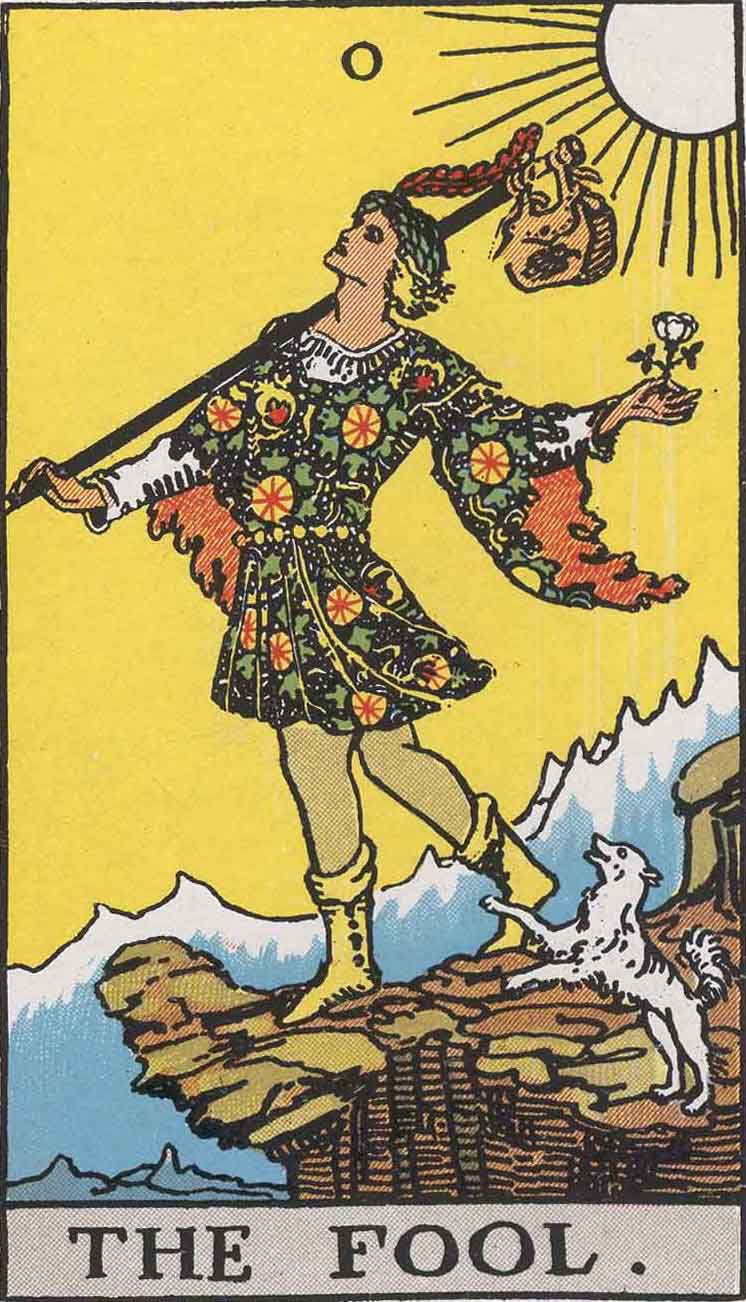
In Books of Magic, Neil Gaiman and Paul Johnson present Constantine as an archetype drawn from the Tarot.  Dressed as the Fool, he mocks, and riddles, and provokes.
RWS_Tarot_00_Fool

The occultist Arthur Edward Waite wrote of the Fool:

“With light step, as if earth and its trammels had little power to restrain him, a young man in gorgeous vestments pauses at the brink of a precipice among the great heights of the world; he surveys the blue distance before him – its expanse of sky rather than the prospect below. . . .  The edge which opens on the depth has no terror; it is as if angels were waiting to uphold him, if it came about that he leaped from the height.  His countenance is full of intelligence and expectant dream. . . .  He is the spirit in search of experience.”

Johannes Fiebig and Evelin Bürger add that the card’s number, Zero, “indicated a very personal bottom line, the self, the starting point from which everything else flows.  This is the beginning and the end of that which makes you a unique person.”  They advise: “You must have the courage to face the future, even if you cannot predict or determine the future in advance.  You must have the courage to walk your own path and to be open, even if your back isn’t covered, and even if conventional wisdom and common sense suggest otherwise.”
p2fool

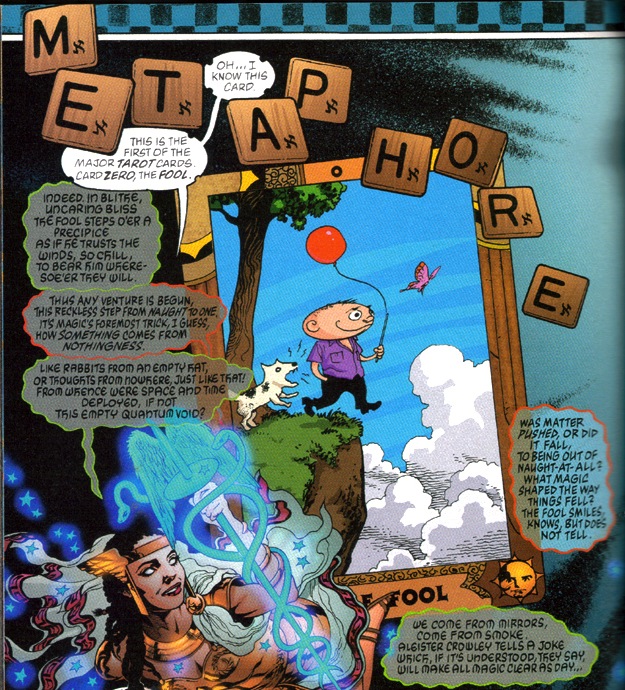
In Promethea, Alan Moore, Constantine’s creator and a practicing magician himself, describes the Fool in verse:

“Indeed in blithe, uncaring bliss

The Fool steps o’er a precipice

As if he trusts the winds, so chill,

To bear him wheresoe’er they will.


Thus any venture is begun,

This reckless step from naught to one.

It’s magic’s foremost trick, I guess,

How something comes from nothingness.”

In some depictions, the Fool is accompanied by a bird (perhaps representing freedom) or a butterfly (transformation).  Moore’s Promethea and Gaiman’s Books of Magic—stories of quests, in which a novice is introduced into the world of magic—both show the butterfly in their versions, or in the first case, a Promethea moth.  Moore’s Fool seems to be following it over the edge.

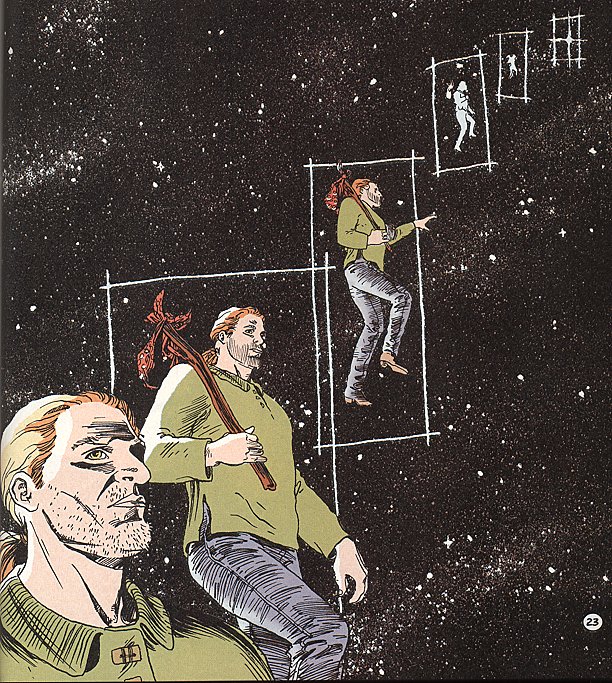
Gaiman has made use of the Fool before.  In the Sandman series, Destruction, who has long ago abdicated his responsibilities, decides he cannot stay in the home he has made for himself since abandoning his realm.

“What will you do now?” Dream asks.

“I will make the most of what I’ve got. I shall live out my days doing what I have to do, one day at a time.  Life, like time, is a journey through darkness.”

A few pages later, Dream inquires again, “You are going now?”

“Yes.”

“Where?”

“Oh, out there, somewhere.  Up, out.”

We see him, carrying a stick with a bundle knotted at the end, walking up into space, until he is as small and as bright as a star.  It is the Fool, stepping over the edge at last, and rising rather than falling.
destruction6

Destruction, like the Fool, has a dog for a companion. “Barnabas can be a bit of a pain,” Destruction says, “and he has no poetry in his soul, but he means well.”  In the Tarot, the dog represents caution, prudence, and common sense; he sounds a warning as the Fool approaches the cliff.  It is fitting that Destruction, or the man who was once Destruction, when he steps into the sky, leaves the dog behind, on firm ground.

The theme of transformation—”time to be someone else”—is in fact the moral of Neil Gaiman’s Sandman series:  “One must change or die.”  Destruction decides to change; Morpheus, to die.

Constantine’s greatest trick was probably surviving for as long as he did.  He is after all, just a working-class bloke with a habit of getting in over his head.  If he could be said to have powers at all, they would consist chiefly of arrogance, recklessness, a certain rakish charm, and a large measure of pure blind luck, along with knowing a little of magic and a lot of people.  It is, in fact, precisely the same qualities that get him into trouble and get him out of it.

As William Blake wrote in his “Proverbs of Hell”:

“A fool who would persist in his folly becomes wise.

Folly is the cloak of knavery.”

The Fool is a knave by another name.  “Not John,” Constantine’s end-of-everything doppelganger tells Tim Hunter, “But Jack . . .   Jack Fool. . . .  A Jack-a-Napes when I tell riddles and merry tales; Jack Pudding, when I play my pranks. . . .”  And the jack in a deck of cards is sometimes also called the knave.

This knave, cloaked in folly, knows more than he says.  Moore writes:

“What magic shaped the way things fell?

The Fool smiles, knows, but does not tell.”

When young Tim Hunter asks the Constantine-Fool, “I’m meant to be learning about magic.  What have you got to tell me?”  The reply is a feint of ignorance:  “Me, good sir?  What do I know of magic?  Why, nothing, my masters.  Nothing at all.”  But as he speaks, as he tells them he has nothing to say, he is at the same moment creating and then juggling balls of white flame—literally playing with fire.  Is he brazenly lying, or is he hinting at a deeper truth—that there is daring but no wisdom, that magic is a question of will rather than knowledge?  Is it skill or is it luck?  Constantine’s brand of magical bluffing suggests that the two often amount to much the same thing.  The only trick is not losing your nerve until you see it through to the end, whatever that may be.


Part Three:  Promethea

In Snakes and Ladders, Alan Moore tells of seeing John Constantine in a sandwich shop: “He looks at me.  He nods, and smiles, and walks away.”  (He smiles, knows, and does not tell.)

“Years later,” Moore continues,”in another place, he steps out from the dark and speaks to me.  He whispers:  ‘I’ll tell you the ultimate secret of magic.'”  We see him, cigarette in hand, and a slight, mischievous smile.  Moore leans toward him, listening.

“‘Any cunt could do it’,” Constantine says.

The casual manner is a pose.  Constantine promises to tell us a secret—or more, the secret—then seems not to, but actually does.  It’s not just showmanship, it’s illustrative.  It is itself a part of the secret—the smiling, knowing, telling, not telling.  (“What do I know of magic?  Why, nothing….  Nothing at all.“)  It’s a coded language, a teasing performance full of double meanings.  The profanity is part of it as well.  “[The] profane and scared are both one,” Moore writes.  Cunt, you understand:  Is it literal or metaphorical?  And what is the difference?

Moore’s Promethea is another story of an artist conjuring a fictional character into reality.  A young student, Sophie Bangs, is researching a mythical figure who recurs in stories throughout the history of literature.  What she discovers is that

“Promethea was a real little girl who lived in 5th century Roman Egypt.  Her father was a hermetic scholar. . . sort of like a magician.  A Christian mob killed him. . . But the gods intervened, taking his daughter into their world of myth and fiction, The Immateria.  Promethea became a living story, growing up in the realm that all dreams and stories come from.  Sometimes, she’d wander into the imagination of mortals. . . .  Some of them, taken over by this powerful living idea, even physically became Promethea. . . .  See, anyone with imagination and enough enthusiasm for the character can bring her through from the Immateria, by thinking themselves or others into the role.”

Sophie becomes the latest incarnation of Promethea, leading her—and therefore, also, the reader—on a instructive quest to learn about magic, or at least the basics of Alan Moore’s theory of it.  Some of what she learns helps to elucidate the meaning of Constantine’s secret.

The magician Jack Faust instructs her:  “The vessel between woman’s thighs is the cup’s highest aspect.  The chalice.  The grail of divine compassion.”  Later, they have sex, and he continues:

“Magicians,  irrespective of their gender, are male.  Their symbol is the wand, the male member, because they are that which seeks to penetrate the mystery.  But once they succeed—then they become magic. They become the mystery, become that which is penetrated. They become female.”

This is all rather literal in the story.  Writers and artists, their pens and pencils serving as their wands, approach a woman who is not only mythic but myth itself, who is imaginary and who represents imagination.  Those who are most successful, at least one man included, then actually become her.

Later, Sophie encounters a female Aleister Crowley, who reiterates Faust’s point: “Here, magicians become magic itself.  The penetrator becomes the penetrated.  Male becomes female.”

Sex is magic, magic is creation.  Magic is about transformation, change.  But it is also about unity, and the unity of opposites in particular—illusion and reality, male and female, virgin and whore, sacred and profane.  Something doesn’t just come from nothing: the emptiness contains everything within it already.  Zero means nothing, but it is also the number of infinite potential.  Transformation is also a revelation, and the revelation transforms.  Magic is a system, a system of meanings, perhaps of essences—but it is an unstable system, a destabilizing system.  That is why it is transgressive.  That is why it is dangerous.

And in a sense it is dangerous whether it exists or not.  Magic may not be real in the way that toothbrushes and parking meters are.  But stories are real; symbols are real.  They may only exist in the mind, or in the culture, but they have real effects.  Tampering with the symbols, Moore argues repeatedly, changes consciousness, changes the meaning of things.  If this idea is even remotely correct—and for these purposes it makes no difference whether we conceive of the process as “magic,” as Moore does, or simply as “art”—then the project of re-imagining our heroes takes on new importance, and greater urgency.  It’s not just about having better comics, but about finding new ways of seeing the world, and new ways of being in it.  Changing ideas changes the world.  It’s just a matter of imagination, and having the nerve to take the first step.

When Sophie next encounters Crowley he is dressed as the Fool, sitting at the bottom of an ornate staircase reaching to the heavens.  At the top, he tells her, one can “behold the vision of God, face to face.” Crowley, the gloomy Fool, waits uncertainly, despondently.  “I’ve always been sitting undecidedly here,” he says.  But also, he says, “I’ve always been there,” up above.  “You go ahead,” he tells Sophie. “Good luck with God.”

God turns out to be the moment of creation:  “Something from nothing.  One from none. . . .  Always here. Always now. . . .  One perfect moment, when everything happens.”  Implicit in that moment is the unity of all Being.  “All one.  All God. . . .  We are each other.  And we are God. . . .  And God is one.  And one is next to nothing.”  There, in that bliss of oneness and that barely-there heaven, along with everything else, is (again) the Fool—the familiar image this time, the one taken from the Tarot.  Satchel over his shoulder, dog barking behind him, his next step will take him over the ledge.  Perhaps there is some slight resemblance to Crowley.

And from that ultimate height, one finds another edge.  Looking down one sees the universe, arrayed like the Kabbalah.  Sophie steps over, and falls back into our world.