When should a comic series end?

wm001

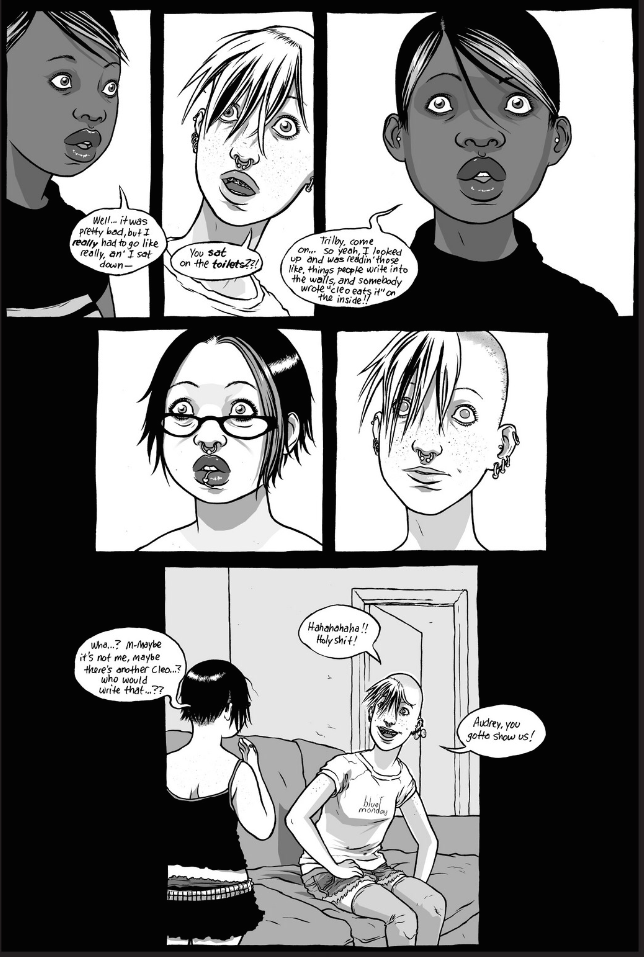
A few months ago, Ross Campbell posted an update to his blog about his ongoing comic series, Wet Moon. After reassuring readers that he was making progress on the seventh installment, he shared the news that volume eight will likely be the last. “I’ll be calling it quits after that, at least for a while,” he writes. And though he hints at the possibility of some kind of spin-off, Campbell seems pretty clear about his need for creative breathing room away from Wet Moon, and perhaps even some closure. His remarks are what prompted my question this week: when and under what circumstances should a comic series end?

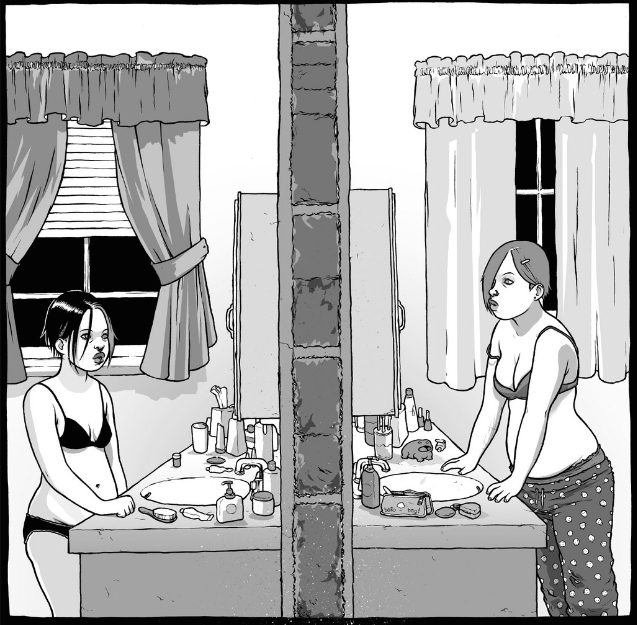
Oni Press first began publishing Campbell’s series in 2005, so as he mentions in his post, it’s been nearly a decade since Cleo, Trilby, Audrey, and Mara started their first year at the art school in their hometown of Wet Moon, somewhere in the Deep South. The comic’s young aspiring poets, playwrights, and illustrators are chain-smoking goths and metal heads, young vegan swamp things who hang out in coffee shops and indie video stores between classes. Not surprisingly, a sense of panic, self-questioning, and irrepressible curiosity underscores their transition from high school to college. Even more interesting, though, is how Campbell’s narrative and aesthetic style values intersectionality in ways that the characters themselves are still struggling to appreciate. In the generous curves and angles of their bodies, gender, race, sexuality, ability, and regional identities are alternatively extolled and effaced according to the shifting cultural attitudes and language of youth. Elements of horror and mystery add even more energy to comic’s coming-of-age drama.

wm003

Having just read the six volumes of Wet Moon on a weekend binge last year, Cleo and the other characters are new friends of mine. I’m still in the early swoon of fandom and quite satisfied to linger here a while before venturing into more scholarly analysis. But Campbell has lived with the story for ten years or more, and his discomfort with this fact can be instructive for those of us who study comics. His post concludes:

i don’t know if it’ll be career suicide to end Wet Moon, but it seems like the right thing to do. i love the characters but i’ve felt more and more crushed underneath all the storylines i’ve woven together, i feel like i’m paying for the decisions my 24-year-old self made, and i need to wipe the slate clean and move on. other reasons are i feel like i’m always trying to repurpose Wet Moon to fit with myself as i get older and change as a person, people change a lot in 10 years, and also that with each new book, WM gets more and more inaccessible, i don’t want it to become like long-running superhero comics or those Japanese comics that you’re interested in until you find out they’re 25 volumes long and counting. bleh.

Campbell’s concerns could easily apply to any form of storytelling with recurring characters, from Sherlock Holmes mysteries to daytime soaps or the prequels and sequels of Star Wars. Yet comics struggle with the pleasures and burdens of serialization in distinctive ways. The form’s most popular genres, such as the long-running superhero comics that Campbell references, are often bound to the creative decisions of the past and to the fans who want to keep it that way. As Danny Fingeroth explains, “We learn and grow – we change – from experience. For the most part, serialized fictional characters do not. This is at once a great strength and a terrific weakness for them.” Clearly the same can be said of their creators too.

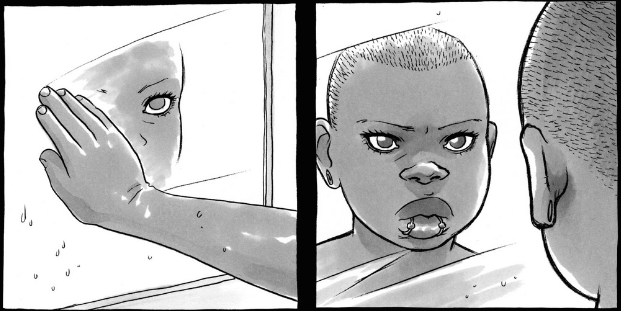
Campbell cites the complex continuity in Wet Moon and the related issue of inaccessibility, along with his own personal growth as reasons to risk what could be “career suicide.” (Given his recent work on TMNT, the weekly updates to Shadoweyes, and everything else he’s done, I don’t see that happening.) But Wet Moon offers its own evidence of the rewards that can come with taking such a risk. Consider the way Cleo’s friend Mara slowly sheds her brooding intensity over the course of the series along with her nose rings, leather mini-skirts and black lipstick. “Just felt like it,” she says to Audrey in book 3, but Mara’s journal reflects her frustration with a life in which everyone seems to be changing except her: “i took out a lot of my piercings too, it seemed like the right thing to do, i was getting sick of them… sometimes lately i feel like i don’t know who i am anymore. i know that sounds totally lame and emo or whatever, but it’s true and i can’t lie about it.” If being able to see people like Mara learn and grow and change from their experience means that the series won’t last for 25 volumes and counting, then I guess – to borrow a phrase from both Campbell and his serialized fictional character, it does seem like “the right thing to do.”

wm002

Writer Brian K. Vaughan puts it another way:

Most people who love comics, we’re used to things like Spider-Man and Batman, things that have an illusion of a third act. There will never really be a last Spider-Man story or a last Batman story, even though people have tried it. It’ll never really end. And we get spoiled that way. But I think finales are what give stories their meaning. The stories need endings because all of our lives have endings.

When I think of a series that ended on a high note, Neil Gaiman’s work on Sandman comes to mind (although he has produced spin-offs and a new mini-series since the mid-1990s), not to mention Vaughan’s own Ex-Machina and Y The Last Man. On the other hand, I think Aaron McGruder’s social and political interests developed as a cartoonist during his time on The Boondocks in ways that did not reflect well on the quality of the strip. And I wonder about a series like The Walking Dead now that the television adaptation has become more well known than the comic. While superhero comics are obviously relevant here too, I’m more interested in creator-owned titles or story arcs created by a single writer and/or artist who is inextricably linked to the series’ identity.

So let’s talk about endings. Which creators or titles get them right? Where are the missed opportunities? We could even consider the larger implications of Campbell’s concerns about the inaccessibility of long-running serials or Vaughan’s suggestion that comics storytelling can sometimes suffer without the sense of finality that endings provide.

Ape vs. Man

dawn_of_the_planet_of_the_apes_42291


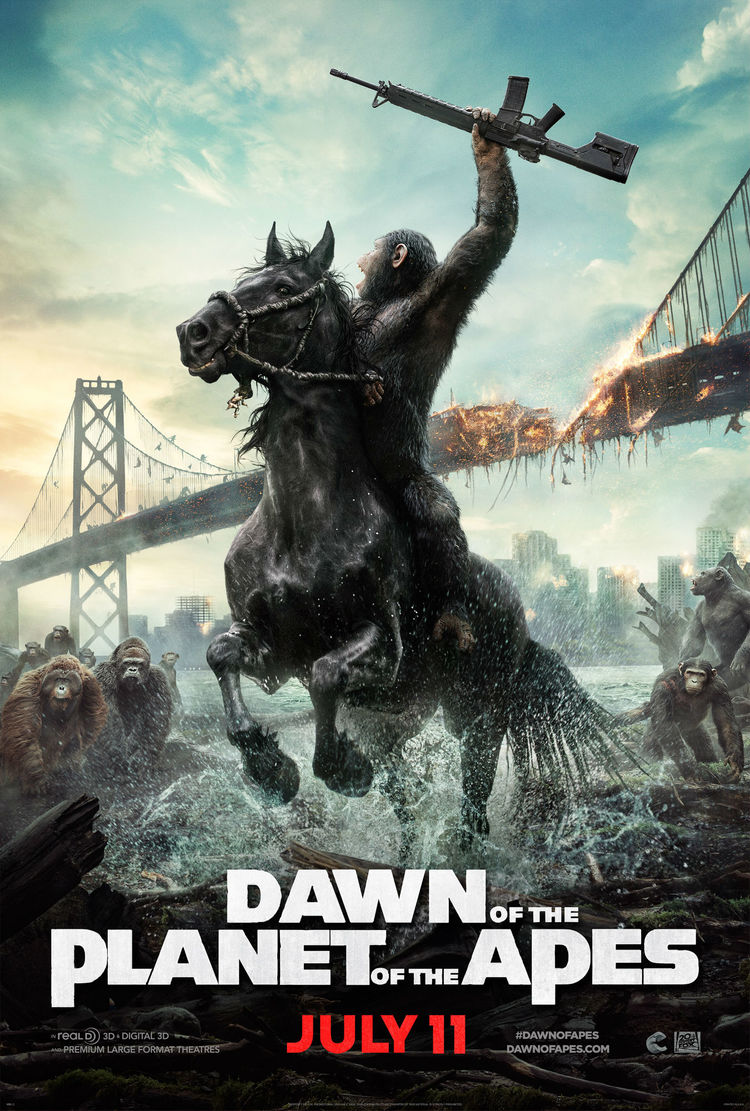
This summer’s non-superhero blockbusters are by and large a paean to anthropomorphism. Though if your options are talking robots, talking turtles, or apes eager to read a trade paperback of Charles Burns’s Black Hole, you’d do well to go with the comic book-loving apes and never look back. It isn’t “Battlestar Galactica,” but with humanity mostly destroyed and attempting to rebuild a home on what is, for all intents and purposes, a “foreign” planet, this franchise could be the space opera stand-in of your J. J. Abrams-weary dreams.

Dawn of the Planet of the Apes opens with soundbites of distressing global news broadcasts. An animated map charts the worldwide spread of Simian Flu, an airborne pathogen created by scientists to enhance ape intelligence that accidentally wiped out mankind. Individuals have a 1 in 500 chance of survival though containment seems unlikely. This initial sequence is similar to that of Dawn’s blockbuster neighbor to the north Edge of Tomorrow, and serves to bring viewers who may have skipped 2011’s Rise of the Planet of the Apes up to speed with our imminent extinction.

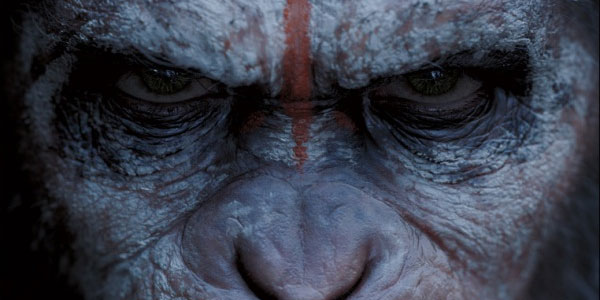
Ten years have passed since we last saw Caesar (Andy Serkis) claim Muir Woods as the home of enlightened apekind. The first shot set in the present is an extreme close up of his eyes, minutes before a hunt, that could have been plucked from the cutting room floor of The Good, the Bad and the Ugly. Adult apes track and chase live game as a group, relying on each other for protection from predators, while young apes remain at the homestead, learning the alphabet and the first law of ape robotics: ape not kill ape.

As for the humans, Dawn would have you believe the only people in San Francisco who survived the outbreak were genetically immune Tea Party supporters and Jason Clarke’s family (Keri Russell and Kodi Smit-McPhee). This film, like its predecessor, does not hide its disdain for the intolerant sectors of mankind. We made this bed, it says. And dammit, we’re going to lie with our uncharged iPads in it.

Frequently, Dawn’s humans are portrayed as frightened, gun-wielding children willing to slay the unfamiliar without a second thought. Gary Oldman plays Dreyfus, a man who read the words wrong and concluded with great responsibility came great need for sustainable power at any cost. He is the de facto leader of the human colony, whose crowded marketplace and heavily clotheslined sky make it appear like a live-action rendering of Agrabah.

Unfortunately, the colony is almost out of fuel. Malcolm, played by Jason Clarke, is therefore tasked with restoring a small dam located on ape territory. The goal is to generate enough hydroelectric power to maintain some semblance of human civilization. What follows is a zig-zag progression/regression of trust between humans and apes. While Malcolm and Caesar gradually develop a healthy rapport, individual members on either side grow increasingly distrustful of one another.

Unknown to the apes, Dreyfus has granted Malcolm a mere three days in which to fix the dam under the threat of launching an all-out military offensive should he fail to return. During that time, the film is often free of speech, with the majority of apes depending on sign language to communicate.

Among the many fascinating aspects of ape culture is the organic nature of its sonic reality. Theirs is a technologically devoid society. The apes have grunting and chest beating; we have strategically placed CDs by The Band. They have the slap of ape palm against tree branch; we have the rumble of automobiles and the clack of gunfire. It all seems so natural to them, existence. When a human member of the dam repair party confesses what he finds terrifying about the apes — that they don’t need power, they don’t need heat, that these advantages make them superior to man — the effect is more than a little disquieting. Dawn forces viewers to grapple with the uneasy anachronism of accepting superiority in the creature from which they evolved.

Some critics have compared the film’s quest toward peace to conflicts in the Middle East. Cited is the struggle between people who have lost everything and are desperate to hold on to what sliver remains and apes who have gained everything and are loath to lose it. However, this parallel would suggest $170 million was spent on a film in which humanity is Hamas, fitted with its own suicide bomber, demanding a right of return. Or ISIS staking claim to the Mosul Dam. While this train of thought leads to endlessly entertaining possibilities, it’s clear the humans are far from the heroes of this film– they are barely the humans; desperation has left so little intact.

To that end, while Dawn is eager to establish Caeser and Malcolm as peace-driven leaders of their factions, it develops its antagonists with equal fervor. Koba, a laboratory ape subjected to experimentation, cannot see past his former abusers and longs to destroy all humans. Both Koba and Dreyfus are easy enough to understand: If you can take something using violence — planetary dominance, in this case — why waste time figuring out whether now is the right moment to do so?

Their differences contribute as much to the deterioration of ape-human relations as their similarities. Human interaction frequently takes place via intimate one-on-one exchanges. Delicate, isolated scenes involving Malcolm and Dreyfus, Malcolm and his wife, Malcolm and his son. Conversely, virtually all ape conversations are carried out before the entire group. This communal forum serves as setting to one of the most haunting ape-to-ape encounters in the film. When Caesar informs his clan that the humans will finish their work on the dam and then leave, Koba, confounded, points to one scar on his body after the other saying the words, “Human. Work. Human. Work.”

Once Koba discovers Dreyfus’s plan to exterminate the apes he organizes a raid of the human colony. His vehemence is a thing of wonder, culminating in a 360-degree tank turret POV worthy of prestige season. All expected action tropes are present and accounted for in Dawn’s 130 minutes. The storming of a stronghold. A beautifully filmed stealth mission in a collapsing house. A final battle in a compromised structure. Primary characters falling to their deaths. There’s even the chance, 20 years later, to once more hear Gary Oldman yell the word “EVERYONE,” though this time into a megaphone. What makes Dawn different from its blockbuster ilk is the ability to craft a wide range of emotional effects due to its moral ambiguity. Director Matt Reeves, a man committed to the z-axis of his visuals, consistently steers the audience away from the binary of cheering for man or ape. This is Caeser’s film. It ends as it started: on an extreme close up of the ape’s eyes. We do as he says, and for now that is follow.


Is Survival Always the Best Option? Pessimism, Anti-Natalism and Bloodchildren

This is part of a roundtable on the work of Octavia Butler. The index to the roundtable is here.
__________

If we count not only the unusually severe harms that anybody could endure, but also the quite routine ones of ordinary human life, then we find that matters are still worse for cheery procreators. It shows that they play Russian roulette with a fully loaded gun — aimed, of course, not at their own heads, but at those of their future offspring. – David Benatar, Better Never to Have Been, p. 92

Benatar’s anti-natalism is not likely to capture the popular imagination any time, soon; probably never, I’d wager. What kind of person accepts that it would be for the best should humanity stop reproducing? But a few metaphysical defeatists do indeed take some solace in it, at least by discovering a comrade in bleakness who attempts rational arguments for our shared existential plight – justifications that aren’t reducible to some mere psychological fracture. The psychologistic dismissals of pessimism are widespread, most recently and disappointingly exemplified by writer Nic Pizzolatto in his TV series, True Detective. Disappointing, because Pizzolatto clearly shares my love for the most ontologically downtrodden horror author working today, Thomas Ligotti. Nevertheless, after 7 hours of episodes that dismantle straight guy Marty Hart’s ideas of family, hard work and law as delusional distractions which keep him from confronting the abysmal punchlines consistently delivered by pessimistic funny man Rust Cohle, and despite having the latter nearly quote Ligotti verbatim at times, Pizzolatto betrays all of this with a denouement that makes the show into little more than religious propaganda hidden in a blighted form. Rust has a metaphysical conversion in the finale after a near death visitation by his dead daughter and father: he begins to see little rays of hope peeking out of the darkness of the nighttime sky. Turns out it was the trauma of losing a child and of not having reconciled with his father – genetically, a future deadend and an unresolved past – that lead to those previously expressed dark thoughts, and not, say, facing the objective ramifications of the eternal perspective, or sub specie aeternitatis, which can only reveal an end to humanity, its concerns and all its artifacts. Rust and the audience need no longer worry about such ramifications with the hope of continuing as an immortal soul. Ligotti refers to such pessimistic flimflam as a “façade of ruins, a trompe l’oeil of bleakness.” (Ligotti, p. 147)
children-men-poster

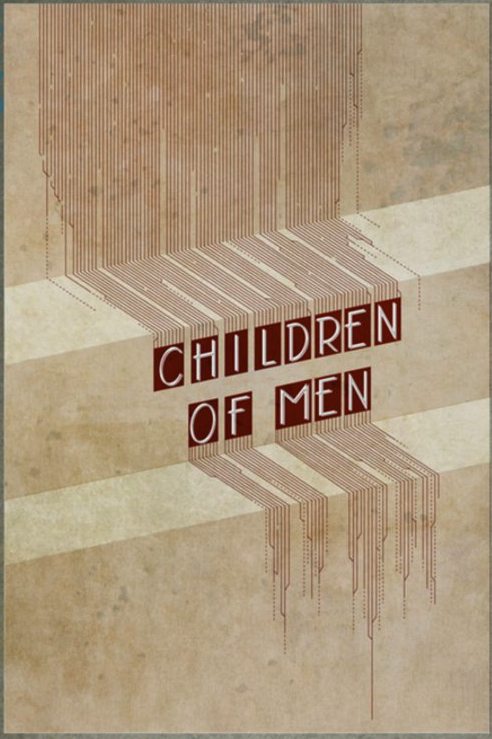
Another shell game with hope is played out in Alfonso Cuarón’s Children of Men where an inexplicable apocalyptic plague has resulted in universal infertility. Regarding anti-natalism, Peter Singer naïvely wonders, “If we would all agree to have ourselves sterilized then no sacrifices would be required — we could party our way into extinction!” Instead, the film offers a more psychologically plausible scenario: With humanity facing its true endgame, the last generation behaves like a coyote chewing through its ensnared limb, only to realize that each of its limbs is equally trapped. There’s no shared hedonistic spirit, where the world turns into one big Burning Man festival, rather the state (England) erects more barriers, whereby the more privileged, based on the same old fears of class and race, try desperately to reduce the possibilities of the less fortunate ruining whatever pleasures are left in the one thing everyone is forced to share, a moribund genetic fate. Shit never stops running down hill. What the film suggests is that thanatopobia is part of our psychological foundation. “To subdue our death anxiety, we have trumped up a world to deceive ourselves into believing that we will persist – if only symbolically – beyond the breakdown of our bodies.” (Ligotti, p. 159) When we can no longer postpone reflecting on the nothingness of the final true death to some future progeny, we can no longer rely on the comforts of a symbolic immortality. The film suggests we would behave like caged animals. But, then, one of those rays of hope shows up in the form of a pregnant woman, suggesting the human race isn’t finished yet. After which, the story becomes one of a formerly defeatist protagonist making sacrifices for the benefit of some future society that he hopes (with his re-discovered faith) will be better than the current one. The ending is ambivalent enough that the materially inclined need not feel betrayed like we were with True Detective, but it still gives the viewer an emotional escape hatch (unsurprising, I suppose, if you already knew that the book on which the movie was based is by a devout Anglican).

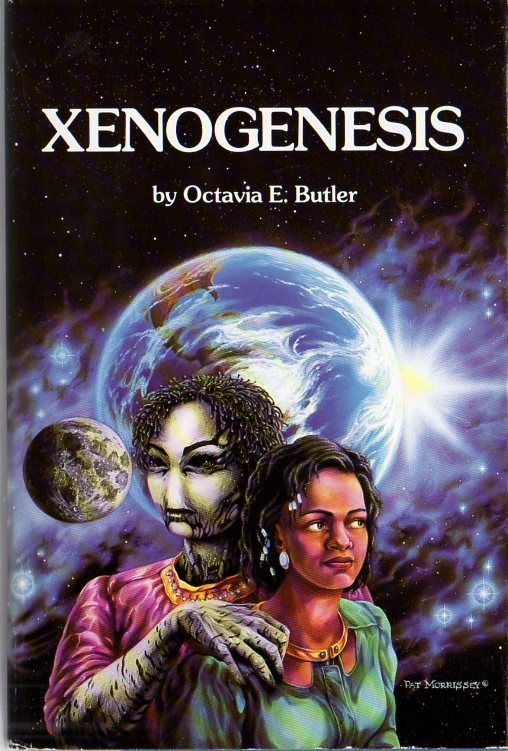
Likewise, thanatophobia – the maternal instinct being the relevant strain here – is the structuring motivation running through Octavia Butler’s tale of survival at any cost, Xenogenesis (aka Lilith’s Brood). After a nutwing contingent of ideologues wipes out most of the life on Earth with nuclear bombs, the few remaining humans are “rescued” by the Oankali, a parasitical species of date-raping colonialists with grotesque worm-like sensors all over their bodies who solve most of their problems with the evolved ability of genetic manipulation, a biologically inherited eugenics. Their means of survival is, like capitalism or the culture industry, to consume qua incorporation all the different beings and materials they find across the universe into their own genetic history, making the new more of the same.

What’s particularly interesting about Butler’s take on the alien invasion trope is that she focuses on a human collaborator, Lilith, and not the heroic figure of the resistance fighter. Not that there’s much possibility for resistance once Lilith is awakened from her stasis, hundreds of years after the nuclear winter. The aliens have rebuilt much of the Earth’s topography and restructured the humans to suit their expansionist goals, which amount to serving the Earth as food to their massive living spaceships and propagating a new strain of the Oankali species using the human gene pool as a reproduction machine. Use it all up and move on. The only two forms of rebellion left to the humans are bitching a lot among themselves and a noncompliance that will result in an eventual death that’s not much more than long-form suicide. Lilith chooses the symbolic immortality of humanity by helping her fellow Terrans accept the idea of humanity becoming one more admixture to the collective genetic memory of the Oankali.
xenogenesis-cover

But I doubt Butler would agree with my negative description of the Oankali, since she rationalizes most of their oppressive behavior as the story progresses.  However objectionable they may at first seem, they look much more like a perfectly harmonic anarchy of superheroes by the end of the series. Thus, what begins as the subjugation of humanity turns out to be its salvation. The Oankali understand each other, other living beings and the world around them on precognitive levels, genetically and materially. They don’t need the muddying mediation of language, since they can objectively tell if no means yes. Humans might be cognitively confused, but the Oankali can see the essential truth underneath. Butler is clearly sympathetic to their collectivism, setting it up as a utopian vantage point, her sub specie aeternitatis, from which to critique what she considers humanity’s defining problem, the human contradiction. That is, humans have a biological characteristic for being hierarchical, which is seen in many other animals, too, but it results in stuff like nuclear warfare when reinforced – rather than, as Jdahya explains, “guided” – by the other major human feature, intelligence. (p. 41, Xenogenesis)

There’s a good bit of Jean-Jacques Rousseau’s early pessimism in how the Oankali (and Butler, evidently) perceive humans. His version of our fall from grace: When humans were closest to our animalistic predecessors, as natural man, lacking reflection, we simply existed in the present, moment to moment, like all animals. Even though there was a natural hierarchy, some serving as food for others, all animals, including early man, remained in a satisfied state of blissful ignorance. Worms don’t think about how awful their lives under the domination of birds; both simply do what they do. But once self-consciousness set in with the development of language, humans were capable of considering whether we’re better off now than previously and of making plans. This is time consciousness, which meant that we began to think about what things were like and what they may be like in the future, providing us with the faculty of perfectibility. Perfectibility relies on a perpetual dissatisfaction with our present situation based on comparisons to our past and imagined future selves and to other humans. This alienation from the present is what led, on the one hand, to the development of, say, moral thought or imagining a better polity, and, on the other, to the fear of death, or “our subjugation to the opinion of others [that] paves the way for direct political subjugation.” (p. 69, Dienstag, whose interpretation of Rousseau I follow here)

Rousseau mused about utopian arrangements that would help shelter modern man from time consciousness, where we might rediscover the authenticity of natural man, no longer feeling enslaved to the opinions of others. But, because we can’t forget all the knowledge that’s been acquired over our history, nor can we rid ourselves of temporality, he was highly doubtful that that we could ever return to primeval happiness. But aren’t the Oankali just such a fantasy of an advanced civilization that lives in an animalistic present? Their genetic telepathy makes language otiose while giving them a complete awareness of everything around them. Because of that link, they exist in a natural collective state that is inherently cooperative and anti-competitive. They don’t use tools, but they’ve plenty of organic technology, which is capable of the most advanced scientific feats, such as space travel. And because of their genetic memory across generations as well as a control of aging, they have no anxiety about death. Perfectibility is a matter of adapting to and merging with the surrounding organic forms – of tuning into their present environment, not being alienated from it.
bloodchild-cover

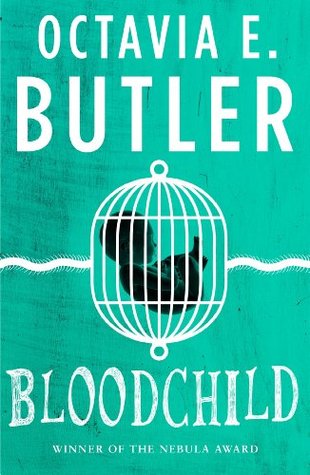
Using the Oankali as an impossible fantasy for perfecting humanity seems to me at odds with the story’s other major theme, moral responsibility for the subjugated. This is why the trilogy begins to lose ideological steam as Butler becomes increasingly interested in the alien culture itself (focusing on Lilith’s brood and Oankali politics) in lieu of how the humans behave under its dominion. Making substantive points about collaboration becomes difficult when human survivors ultimately should be thanking Lilith for being their Moses to an eternal Oankali paradise. Consequently, I prefer the short story, “Bloodchild,” which Butler wrote while doing research for the trilogy. It explores many of the same themes without the wish fulfilling distractions: The Tlic, an intelligent insect-reptile hybrid with scorpion tails bond with human boys early in their life as a way of preparing them to be symbiotic incubators for the alien species’ vein-munching larvae. (Males are used as hosts, because females are needed to birth enough males to meet Tlic demand.) Humans have once again fucked up everything sometime in the past – this time, by making Earth into some slave-based dystopia. So some refugees found their way to the Tlic’s planet, where the master-slave relation proved more agreeable than back home. As in Xenogenesis, the humans survived only through a diminishment of their humanity. However, there is no potential for perfectibility by becoming part of the Tlic’s reproductive process. They have pretty much the same contradiction that we do.

It’s a coming of age story in which the adolescent Gan is getting ready to have T’Gatoi, an important Tlic bureaucrat and longterm family friend, implant her larval eggs into his bloodstream. His mother, Lien, agreed to this long ago, his father was a host before him (he carried T’Gatoi), and Gan has been raised to accept it as his purpose. The family gets plenty of food and privileges through their relation with T’Gatoi. Gan only begins to question his fate after witnessing the way the little Tlic grubs, ready to be delivered, begin to feed on their host until they can be moved to the corpse of an indigenous beast. This bloody act of physically substituting one body for another helps him realize that his existence is reduced to being a host animal. He seriously considers suicide to prevent himself from being either a mere means for T’Gatoi or the living dead existence of his brother, Qui, who’s resigned to wandering about the preserve on which they live, high on the narcotic egg juice that the Tlic supply to keep the humans living long and pacified lives. But if he doesn’t serve as host, his sister Hoa will; in fact, she even wants to. To save his sister from such a fate, he recommits himself to the task. However, he doesn’t explain it (in first person) as a mere sacrifice on his part, but as a personal desire: “[T’Gatoi:] ‘But you came to me … to save Hoa.’ [Gan:] ‘Yes.’ I leaned my forehead against her. She was cool velvet, deceptively soft. ‘And to keep you for myself.’” (Loc 340) Despite Butler’s insistence in the afterword (Loc 364) that this is a story about love, not slavery, the differential power involved makes her interpretation about as reasonable as a non-ideological romance between Sally Hemings and Thomas Jefferson.

Similarly, when Lien shows signs of depression at having provided her children for Tlic reproduction, T’Gatoi responds by drugging her, using a sting of the Tlic’s tail and insisting that she drink more egg juice. No matter that T’Gatoi and Lien grew up together, the friendship, just like all forms of love between the two species, is corrupt and not to be completely trusted, regardless of how either side might interpret the relation. The dominating to dominated class hierarchy won’t allow anything more. Hardly limited to a slave economy, Butler makes a much better case against hierarchical discrepancies in this short story than she manages in the entire trilogy that followed. That’s because without a utopian interpretation of the alien superiors here, subjugated choice (qua love) is potently problematized, and the effects of domination are critiqued.

Although “Bloodchild” is a perfectly miserable gem that encourages a properly depressive reaction, it still focuses, just like every other example discussed so far, on the will to survive through a high sacrificial cost of some sort (in the case of Gan’s family, basic human dignity). When it comes to sowing the seeds for the future of humanity, our moral options, in fiction and for most people, are limited by a perverse optimism, which Ligotti (p. 154) summarizes as Frankenstein’s Oath: “We, as licensed protectors of the species and members in good standing of the master-class of the race, by the power invested in us by those who wish to survive and reproduce, vow to enforce the fiction that life is worth having and worth living come hell or irreparable brain damage.” As the aforementioned Benatar suggests, this Pollyannaism is justified by the low expectations of humans, sub specie humanitatis. We’re quite good at adapting to suffering and, like Gan, accommodating oppressive beliefs as our own when we have so little real choice. As he puts it, “we would not take slaves’ endorsement of their enslavement as a justification for their enslavement, particularly if we could point to some rationally questionable psychological phenomenon that explained the slaves’ contentment.” (p. 100, Benatar) He argues for another moral possibility, which should come as no surprise if you read the epigraph.
benatar-table

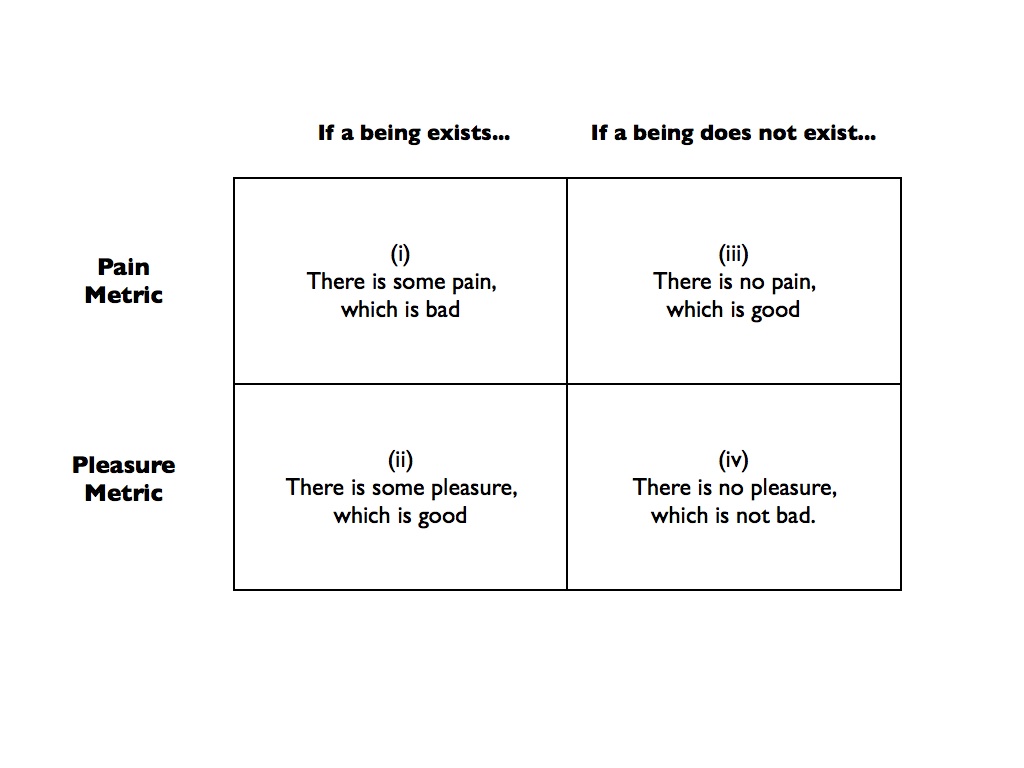
Regarding future-life cases 1 – i.e., the potential lives of people yet to be born and who are presently non-existent – Benatar makes the case for a fundamental asymmetry in how we evaluate whether it’s good or bad to bring them into existence such that the moral view is that we never should. In one scenario, Lilith brings X into existence, in which case we would say that X experiencing pain is bad and X’s experiencing pleasure is good. That’s agreeable enough, I think, but the problem comes in when we consider what happens should Lilith choose to not bring X into existence. The absence of pain is good even without X to enjoy it. That is, independently of any pleasure, it’s better to not have X than to have X in pain. However, pleasure doesn’t work out in an equally symmetrical fashion. The absence of pleasure isn’t bad unless X exists to be deprived of it. And since X doesn’t exist in this scenario, there’s nothing bad (but nothing good, either) about non-X not experiencing pleasure (since no one’s missing anything). It would be neither better nor worse to not have X who will experience no pleasure than to have X will experience some pleasure. Because it’s good to avoid bringing into the world whatever inevitable amount of suffering that will befall X by not having X, and nothing bad (nor good) would occur should Lilith not have X, she shouldn’t have X, nor should she ever have an X or Y or Z. The same goes for all of us humans, as well as the Tlic, but probably not for the Oankali, since pain isn’t really such a bad thing for them. Therefore, the collaborators in Xenogenesis and “Bloodchild” are not doing humanity any favors by doing whatever’s necessary to survive. They’re actually bringing unnecessary harm into the world, particularly since humanity continues only under the “thumb”/tentacle/tarsus of alien oppressors.

Benatar’s argument isn’t likely to convince the optimistic majority as it leads to some really uncomfortable positions, such as a pro-death view of abortion (women shouldn’t just have a legal right to choose, but should always use that right to abort) and that we should let the species die out even in the absence of extraterrestrial domination. And it has received some stiff philosophical challenges. However, he does offer intuitive support for his asymmetry by showing how it provides a basis for other more commonly accepted asymmetries. For example, most people probably share the view that we have a duty to not bring babies into the world that we know will greatly suffer (such as a fetus that tests positive with an incurable degenerative disease), but not the inverse duty to bring happy people into the world (there’s certainly nothing immoral about a kind and caring couple deciding to not have children). Benatar’s asymmetry provides a possible reason: It’s good not to have children with incurably painful diseases, but neither bad, nor good for children who don’t exist to not experience happiness – i.e., the couple who decides to not have a child isn’t depriving a non-entity of happiness. But, even if that doesn’t sound plausible, the argument is refreshing just because it runs counter to the popular temptation to justify whatever moral position one has with a just-so story from evolutionary psychology. Could there be an ethical view less biologically adaptive than anti-natalism? If for no other reason, I appreciate the effort.
we-who-are-about-to-cover

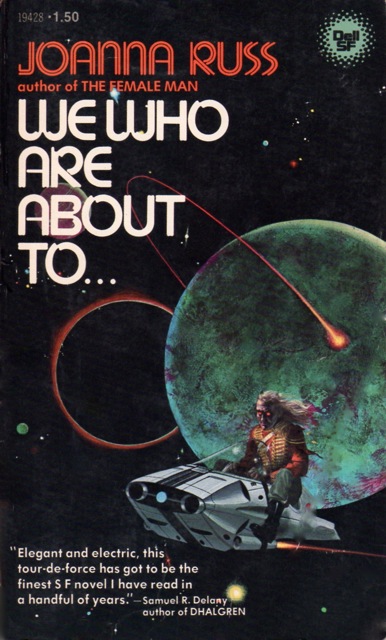
Showing sympathy for Benatar’s conclusion is Joanna Russ’ heroine, Elaine, in the relentlessly anti-utopian We Who Are About To …. With no hope of being rescued, she lets her fellow castaways know what she thinks about their plan to rebuild civilization on the planet where they’ve crashed:

All right, so you think you have the chance of a snowball in hell. Maybe you do. But I think that some kinds of survival are damned idiotic. Do you want your children to live in the Old Stone Age? Do you want them to forget how to read? Do you want to lose your teeth? Do you want your great-grandchildren to die at thirty? That’s obscene. (p. 14)

Taking a poke at stories like “Bloodchild” where humans fleeing from Earth always manage to discover advanced alien civilizations on other planets, this new planet is a barely hospitable environment with no signs of mental life, civilized or otherwise. There are so few women and men that all the others are not going to allow Elaine (or anyone else) to opt out of reproduction. The central struggle in the book is, as Samuel Delany discusses in his introduction, whether quality of life or reproduction provides purpose to our existence. Insisting on a right to die, she’s forced to kill all but two of the group, because they chose suicide. Elaine isn’t just skeptical like Rousseau that we could revert back to the state of natural man, she has no desire to do such a thing, fearing what a return to a natural hierarchy would likely mean:

You must understand that the patriarchy is coming back, has returned (in fact) in two days. By no design. You must understand that I have no music, no books, no friends, no love. No civilization without industrialization! I’m very much afraid of death. But I must. I must. I must. Deliver me from the body of this. This body. This damned life. (p. 21)

Once alone, Elaine records her final thoughts into a recorder (the narrative conceit of the book) as she starves in a cave, waiting for the proper moment to use a poison capsule. In place of the thanatophobic maternal instinct or Stockholm syndrome as love or a utopian dream that justifies a suffering existence, this is a violent stand for human and, more specifically, female dignity.

~~~~~~~~~~~~~~~~~~~~~~~~~~~~~~~~~~~~~~~~~~~~~~~~~

Footnotes:

1. Present-life cases involve the continuance of a life, the cessation of which involves a different threshold for suffering from the one regarding whether a life should never be started.

References:

Benatar, David (2008), Better Never to Have Been: The Harm of Coming into Existence. Oxford University Press.

Butler, Octavia (1996), Bloodchild and Other Stories. Open Road Integrated Media.

Butler, Octavia (1987, 1988, 1989), Xenogenesis. Guild America Books.

Dienstag, Joshua Foa (2006), Pessimism: Philosophy, Ethic, Spirit , Chapter 2. Princeton University Press.

Ligotti, Thomas (2010), “Sick to Death” in The Conspiracy against the Human Race, p. 147-167. Hippocampus Press.

Russ, Joanna (1976), We Who Are About To …. Wesleyan University Press.

Other Notes:

Children of Men poster is by Noah Hornstein.

Benatar diagram was borrowed from here, which also has a summary of the argument should mine not be sufficiently clear.

Finally, ‘Loc’ refers to the location in a an ebook edition I have of Bloodchild. This is different from the page numbers.

What is the Ape to Man?

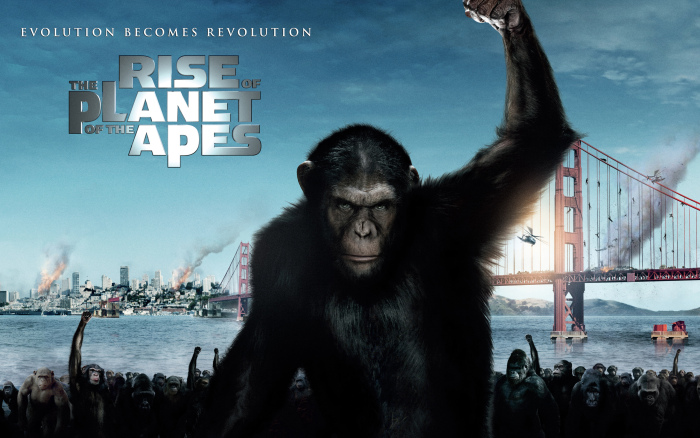
rise poster

 
Friedrich Nietzsche’s alter ego, Zarathustra, answers: “A laughing-stock, a thing of shame.”

Chernin Entertainment and 20th Century Fox answer: “About $170 million.” That’s the budget for Dawn of the Planet of the Apes, almost double the price tag of its predecessor, Rise of the Planet of the Apes, which grossed $176M in 2011.

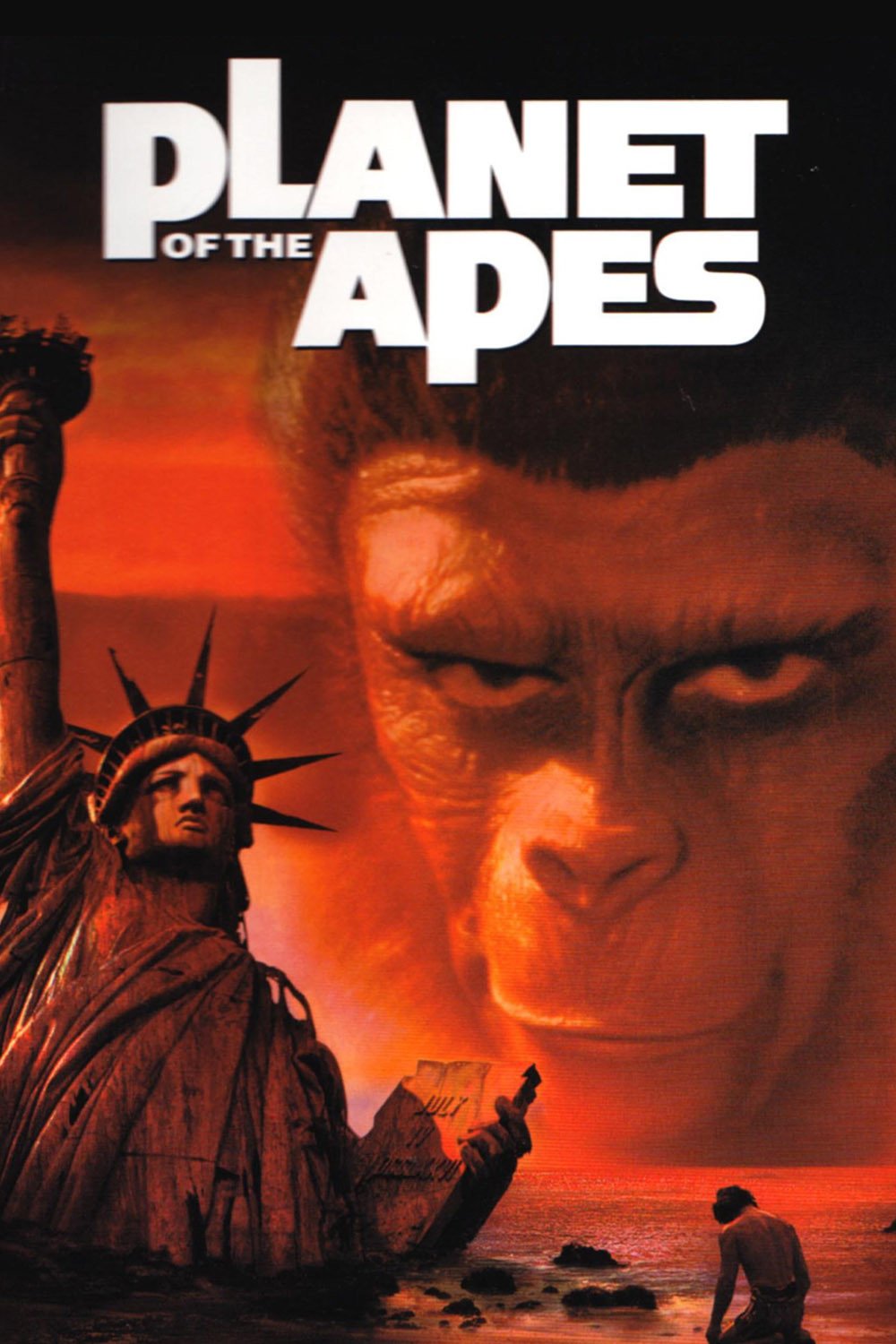
Or I should say its most immediate predecessor. The original Planet of the Apes was released in 1968 (with a quaint budget under $6M and gross of $26M). It was based on Pierre Boulle’s 1963 French novel La Planète des singes, but that’s not where the evolutionary ladder begins either.

Rise ends with mad scientist James Franco’s creation, a genetically altered super-ape, escaping to the wilds of the Redwood forest to father his own race. That’s how Victor Frankenstein’s creature wanted to end his origin story too. Either way, the creature is humanity’s first “arch-enemy,” the term he uses when Victor refuses to manufacture him a mate. The no-longer-mad doctor fears “a race of devils would be propagated upon the earth, who might make the very existence of the species of man a condition precarious and full of terror.”

Mary Shelley’s evolved imagination was pure fantasy in 1817, but Darwin made the terror real for Victorians. H. G. Wells named humanity’s predator the “Coming Beast,” describing “some now humble creature” that “Nature is, in unsuspected obscurity, equipping . . . with wider possibilities of appetite, endurance, or destruction, to rise in the fullness of time and sweep homo away.”
 

2011_rise_of_the_planet_of_the_apes-wide

 
That fullness of time arrives regularly in Hollywood. If not apes, then zombies, aliens or androids are always propagating and making humanity’s condition precarious and terror filled. Some scientists take that last threat, the robopocalypse, seriously.

Cambridge’s Centre for the Study of Existential Risk worries about the evolutionary threat of artificial intelligence: “we risk yielding control over the planet to intelligences that are simply indifferent to us . . . just ask gorillas how it feels to compete for resources with the most intelligent species—the reason they are going extinct is not (on the whole) because humans are actively hostile towards them, but because we control the environment in ways that are detrimental to their continuing survival.”

That’s also the plot of Dawn of the Planet of the Apes. The super-virus that decimated the human population between films is one of those unintended consequences popular in mad scientist plots. Mira Sorvino accidentally breeds an army of six-foot cockroaches after ending a cockroach-spread epidemic in Mimic. Emma Thompson cures cancer in I Am Legend, and next thing vampires rule Manhattan. James Franco’s genetic tampering would have turned everyone into super-geniuses. Or at least everyone who could afford his corporation’s new designer drug. If they’d had a chance to market it, the sequel would have been called Rise of the Planet of the Ubermensch.

No new breed ever cares about its predecessor. “And just the same shall man be to the Superman,” continues Zarathustra, “a laughing-stock, a thing of shame.” And yet Superman and his species of superheroes were born to battle such Coming Beasts. The Fantastic Four kept a subterranean world of monsters from rising up in their first issue. Atlanteans would have swept humanity away if the Human Torch hadn’t doused Namor’s Golden Age attacks. Blade is still staunching the destructive appetites of our vampire competitors. Every comic book is a survival of the fittest, ending with a superman at the top of the food chain.

But screenwriters Mark Bomback, Rick Jaffa and Amanda Silver include no super-saviors in Dawn. The hero type is usually a literal or metaphorical cross-breed who absorbs the threat of the racial other and reverses it to save humanity. Thus cyborg Arnold Schwarzenegger thwarts Skynet, and the Man of Steel thwarts General Zod’s Kryptonian invasion. Dawn would need an ape-man like Tarzan, but instead it’s the super-ape Caesar who was raised by humans and saves his people from us.

Which is a pretty compelling reversal of the formula. The supervillain is Koba, an ape so scared (literally and metaphorically) by humans that his hatred turns him into one. By the end, Caesar says he’s no longer an ape. He’s been completely absorbed by human hatred.

But there’s one flaw in the film’s evolutionary theory. It could have been titled Dawn of the Planet of the Patriarchy. I understand that actual ape culture is male-dominated, but these are scifi apes. They can talk and drive tanks. Surely there’s room for females somewhere in the hierarchy. The lone female ape character, Caesar’s jewelry-wearing wife, lies around giving birth and needing antibiotics. But would every female uber-ape accept the role of stay-at-home mom while the males go off to war?

The human cast is worse. Keri Russell, the lone female Home sapiens character, spends the movie saying things like, “I should come along in case someone gets hurt and needs a nurse!” She also prepares and serves food for her male campers. I was a part-time stay-at-home dad for years and still do a share of cooking and Band-Aid applying for my campers. But if faced with an ape-ocalypse, my wife and I would divvy up the guns too.

No intelligent species can ignore the skill sets of half its population. Not if the species wants to survive. And the humans in Dawn won’t. If you missed the first movie, there was a brief mention of a space mission to Mars. Those astronauts are scheduled to return (minus Charlton Heston) in July 2016, and I think we all know what Darwin is plotting for them.
 

14128062486 (1)

Staging Slavery

This first ran on Splice Today.
________________

I was both surprised and delighted 12 Years a Slave won the Oscar for Best Picture. Some, however, were gnashing their teeth. Jonathan Rosenbaum, for example called 12 Years “an arthouse exploitation gift to masochistic guilty liberals hungry for history lessons,” while John Demetry at CityArts argues that the film denies Northup specificity or consciousness, turning him into “a cypher representing Black hopelessness.” Both argue that other films are more insightful and respectful in their treatment of slavery—and in particular, both mention Charles Burnett’s 1996 film Nightjohn, which has almost no popular profile and which, like 12 Years, was created by a black director.

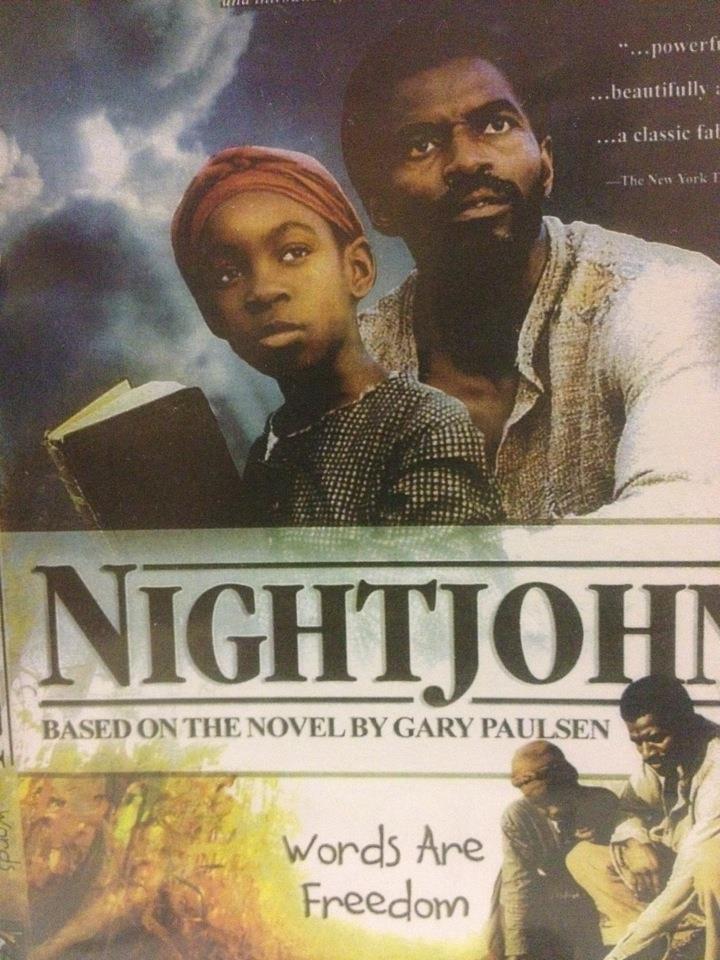
There’s no doubt that Nightjohn is distinct from other slavery films in a number of intriguing ways. Originally screened as a TV movie on the Disney Channel, it embraces the smaller-scale, living-room format. The plot centers on Sarny (Allison Jones), a young, avidly curious girl whose life as a slave is transformed by her owners’ purchase of Nightjohn (Carl Lumbly), who offers to teach her to read.

Putting literacy at the center of the story allows Burnett to avoid many of the standard slavery tropes. Though there are violent scenes in the movie, the main drama is not around physical endurance or resistance, as in Glory, Amistad, 12 Years, or the less well-known Sankofa. Instead, the drama is about intellectual achievement as a reclamation or assertion of self. Reading means that Sarny can write passes to help friends escape; it means she can manipulate white people to her own advantage and to the advantage of her community. Knowledge is power, and if slaves can learn to read, they can obtain that power.

Nightjohn, a runaway who had made it to the North, returned into slavery to teach other slaves to read. This recalls Beverly Jenkins’ Indigo (also from 1996), in which the protagonists’ father, a freeman, agrees to become a slave to marry the woman he loves. In both cases, the moral is not self-abnegation, but rather self-assertion—an insistence that slavery is not the most important truth, and does not define black people. They are not just victims, but human beings who, even in extremis, can pursue human goals such as knowledge, teaching, or love.

Yet, for all its focus on intellectual development, the interiority that Nightjohn imagines is an oddly public and dramatic one. Sarny’s lessons, for example, coalesce all at once while she is in church reading the Bible—suddenly the individual letters fall into place, and ta-dah! she can read. The moment is so powerful that she starts to cry, and the white minister thinks she’s been saved. “Yes, I am saved,” she agrees when asked, and is then baptized. The scene is equates, or conflates, the ability to read with religious salvation or awakening, making the attainment of reading a kind of mystical right of passage, complete with ceremonial trappings.

Along the same lines, the climactic scene of the film occurs, again, in church, in front of the entire community. Sarny’s owner, Clel Waller (Beau Bridges) threatens to start shooting slaves until one of them tells him who has written the passes for two escapees. Sarny defuses the situation by obliquely threatening to expose the fact that Clel’s wife has been committing adultery with the town doctor. Sarny knows about the affair because she was the one who carried notes back and forth; her ability to read gives her a weapon.

These scenes are meant to demonstrate that private knowledge is not merely private; learning to read for the slaves is a political act, with political ramifications. And yet, those political ramifications are actually somewhat undermined by the rank implausibility of the set pieces. People don’t actually learn to read all at once. Blackmail can be effective if applied cleverly and surreptitiously, but flaunting his spouse’s adultery in the face of a man with a gun pointed at you is not likely to result in a positive outcome. In his enthusiastic review of the film, Jonathan Rosenbaum characterized the movie as a kind of “fairy tale.” But the departures from realism here feel less like magic or dream logic, and more like standard film contrivance—drama for the sake of drama, and/or for the sake of communicating the requisite moral at sufficient volume that it can be deciphered in the nosebleed seats.

The didactic staginess is perhaps appropriate for a film about teaching. But it’s also somewhat disappointing, not least because it’s so familiar. Movies about slavery—whether Amistad or Glory, 12 Years a Slave or even Django Unchained—all have about them a sense of the educational spectacle as growth experience. There are probably a number of reasons for this. Films (even TV movies) are wedded to their status as events; it’s hard for a movie to resist the urge to be larger than life. Slavery is so intimately linked to ongoing racial disparities, and so relatively little explored on screen, that the impulse to say something definitive must be nearly overwhelming. Whatever the combination of factors is, though, the fact is that most movies about the subject are couched to some significant degree as “history lessons,” to use Rosenbaum’s dismissive characterization of 12 Years. And as a result the people in the films tend to turn into tropes, or icons, or curriculum enhancements. Like Nightjohn telling Sarny that the “A” is standing on its own two feet, the symbolic message can erase individuality and ambiguity, so that the letter means its image rather than all the things it can spell.
 

night-john1

12 Years a Slave as Torture Porn

This first ran on Splice Today.
_________________

Cultural critics and politicians have long worried that media violence would lead to real-life anti-social behavior. Earlier this month, Armond White, CityArts film critic, may have provided an unexpected confirmation of those fears. White was so incensed by the very violent 12 Years a Slave that, according to a number of witnesses, he allegedly shouted obscenities at its director Steve McQueen during the New York Film Critics Circle awards ceremony.

White denies he was heckling, and I don’t want to go into the pros and cons of the expulsion, but I do want to discuss more about violence and its effects, an issue that’s at the heart of White’s loathing of 12 Years A Slave. In his review of the film, White says that 12 Years, about a Northern black man who is kidnapped and sold into slavery, confuses “[b]rutality, violence, and misery… with history.” He argues that director McQueen is interested in “sado-masochistic display,” and compares the results to The Exorcist and torture porn films like Hostel and Saw. For White, the film is detestable because it focuses unrelentingly on violence as violence; “This is less a drama than an inhumane analysis,” he thunders, and is especially angry that there’s no sign that the protagonist, Solomon Northup (Chiwetel Ejiofor) has “spiritual resource or political drive.” He concludes, “Patsey’s completely unfathomable longing for death is just art-world cynicism. McQueen’s “sympathy” lacks appropriate disgust and outrage but basks in repulsion and pity–including close-up wounds and oblivion.”

This discussion of Patsey (Lupita Nyong‘o) seems at first quite confusing. There is nothing “unfathomable” about her despair; in the narrative, she’s a slave who is constantly raped by her owner, causing the jealous mistress of the house to beat and torment her relentlessly. She is violated and abused over and over; it’s not at all difficult to imagine that she might long for death. For that matter, in Amistad, which White admires greatly (it was his best film of 1997) there is an almost exactly parallel situation, in which a woman faced with the horrors of the middle passage kills herself and her baby by falling over the side of the ship. Why is her decision fathomable, while Patsey’s is not?

I think that what White is reacting to is the way that violence is or is not framed as meaningful. Spielberg (who White adores) is a filmmaker of compulsive—one might even say facile—lucidity. He is careful to tell you again and again why something happened, and how it fits into the narrative.

Amistad shows numerous examples of violence, including whippings, drownings, stabbings, forced starvation, torture, and on and on—the body count, which includes dozens dead, is substantially higher than 12 Years. But all of these incidents of violence are carefully placed in a recognizable framework. The slave uprising and the murder of the white sailors that open the film, is a straightforward revenge story, nestled comfortably in Hollywood convention. The violence against the slaves is told in flashback in the course of the film’s extensive courtroom drama; it is evidence presented to sway the court and (presumably) the movie viewers. Any confusing bit (why did the slavers choose to drown so many of the slaves they planned to sell?) is carefully examined and explained in the course of cross-examinations. Even the suicide of the woman mentioned earlier is girded round with sense—she exchanges a glance with Cinque (Djimon Hounsou) before she goes over the edge, and he nods at her meaningfully, as if to validate and interpret her choice for the viewers. Similarly, Spielberg at first does not translate the Africans’ dialogue so that the violence done by and to them is (for most Western viewers at least) unspoken and uninterpretable. But as you go along the film interprets (directly and metaphorically) and contains the violence, until all of it is crystalline. By this alchemy, violence becomes empathy and triumph. The story of the injustice and violence done to the crew is told in order to win them the understanding of the court/movie audience, which in turn opens the gates to freedom—from slavery then and, by implication, from inequity now.

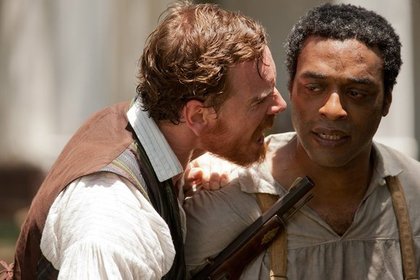
12 Years A Slave, as White says, does not make violence so fathomable. In one of the movie’s most striking scenes, Northup’s owner attempts to hang him. He’s interrupted and driven off by a man acting on behalf of Northup’s former owner, Ford, who has not been fully paid for Northup. The interrupter then goes off to fetch Ford. Even though the hanging has been stopped, no one bothers to cut Northup down. Instead he stands there for an indeterminate, endless time, his feet shuffling on the ground, choking, as McQueen’s camera watches mercilessly and the life on the plantation goes on around him, the only respite being when another slave scurries up furtively to give him a drink of water.

Eventually, Ford arrives and releases Northup, but there is never any explanation for the torture he underwent. It has no meaning except itself; the image of it, the length, the spectacle, overwhelms the narrative. Violence here is only violence. Similarly, Northup’s kidnapping and ordeal is not presented as leading to a politically hopeful or uplifting end. Northup does not gain by witnessing the violence, and it isn’t clear how the viewer gains either. Nothing, as White says, is presented “in order to verify and make bearable the otherwise dehumanizing tales.” White insists that “Art elates and edifies,” but violence in 12 Years A Slave does neither. It just sits there, an open wound, and when you it ends, you’re not enriched or educated. You’re depleted. Violence makes you less, not more.

One example of that torture-porn genre with which White dismissively groups 12 Years is a 2009 horror film called Martyrs. The plot centers on a quasi-religious conspiracy of torture. The brutalizers believe that inflicting pain on innocents will beatify those innocents, and transform them into saints, who will then, before death, offer a profound message to the world. White argues that 12 Years “accustoms moviegoers to violence and brutality” because it sadistically refuses to make its violence speak. Martyrs, though, suggests that people are accustomed to violence not through exposure, per se, but through narrative rationalization. Making violence speak—as evidence, as uplift, as spur to empathy—justifies it and excuses it. 12 Years refuses to make violence part of a bigger story. It doesn’t want you to see violence and feel elated or edified, like the torturers in Martyrs who whip their victims in the name of catharsis. Rather, 12 Years wants you to look at violence and say, with White, “I wish I never saw it.”
 

large_STA12FILM1_397402k

Utilitarian Review 7/12/14

On HU

Robert Jones, Jr. on giving up on mainstream comics.

Matt Thorn with a brief note on Ursula K. Le Guin’s Left Hand of Darkness.

Alexis Pauline Gumbs on Octavia Butler as uncomfortable foremother.

A.Y. Daring on wound as identity in Kindred.

Julian Chambliss looks at what scholars study when they study Octavia Butler.

Me on Octavia Butler’s mediocre prose and why it matters.

Chris Gavaler on how Fantax shows that the French know their way around super-hero violence.

I think we’ve got a couple more Octavia Butler posts next week, but then that’s it, and we’ll be back to regular old posting!
 
Utilitarians Everywhere

At Salon I have 19 songs that show that Jimi Hendrix was not a token.

At the Atlantic I argue that Elvis invented nothing and stole nothing.

At Splice Today I write about the great conservative novel, Gone With the Wind.
 
Other Links

Jeet Heer on Harold Gray and the limits of conservative anti-racism.

Armond White on the mediocrity of Roger Ebert.

Elias Leight on new albums by Joe and Trey Songz.
 
ANNIE_Sunday_LOA420802-lo1-650x412