Deepened Absorption – Eloge de l’amour

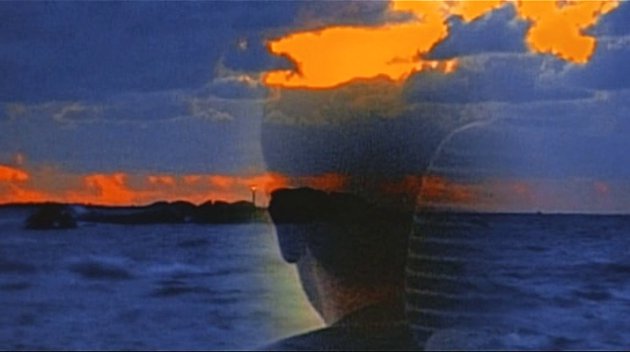
Eloge de L’Amour, as the title suggests, has the feel or tone of a eulogy: a meditation on cinema, love and art. The story is completely non-linear and incredibly dense. Each scene, every image in fact, contains so much information that it becomes impossible to decode even on several viewings and through different (French and Scottish) cultural positions.
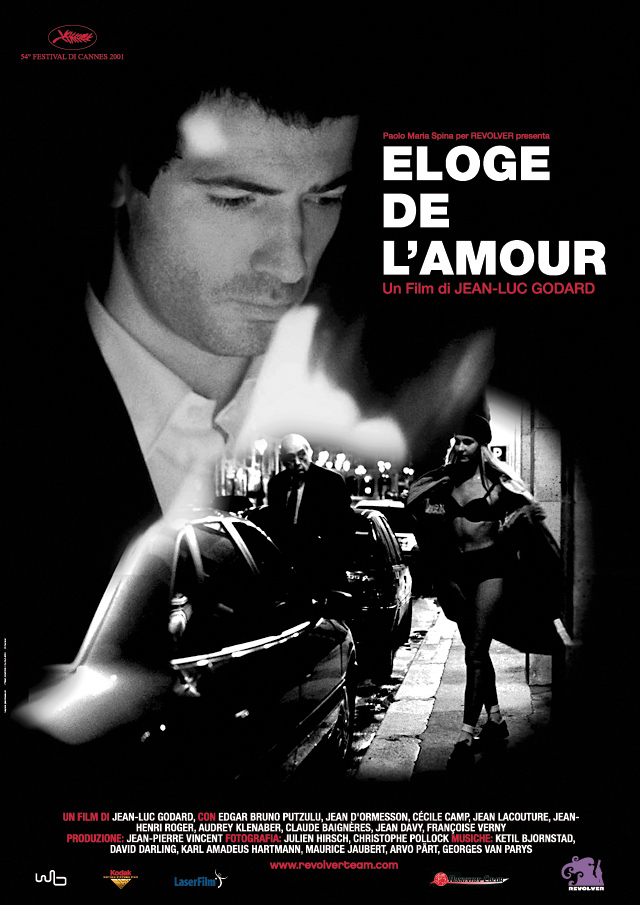
Perhaps the plot is simply a vehicle here for Godard’s concerns that the corporate capitalist monster will destroy cinema, destroy humankind and destroy love.

The film is beautifully shot but deliberately difficult to follow: the first half is filmed in lush black and white and supposedly concerns a project about the four phases of love (meeting, attraction, separation, reconciliation) while the second part takes place earlier and is shot in saturated digital colour. But the digital experimentation of video juxtaposed with the nostalgic black and white film is just one of many filmic ideas explored in metalevels. In the film’s hermetic inner world, Godard asks a lot of the viewer: referring to American cinema, to his own oeuvre and to history and to all stories and their possibilities.
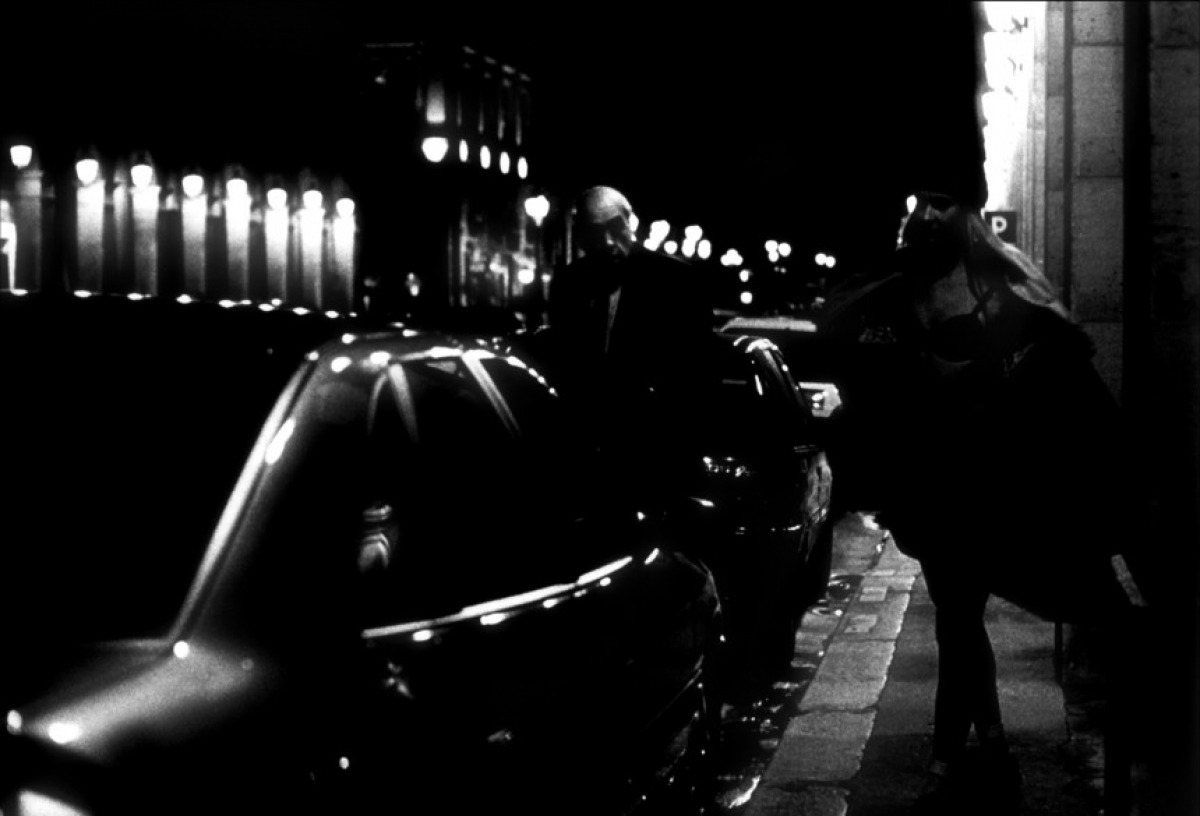

Released in 2001, the film is aggressively anti-American (as if the corporations and the USA were conflated), accusatory, and even suggests that Americans have no past of their own, no history. Possibly Godard is referring to mythologizing and to re-examining the past or reinventing the self. Certainly America encompasses both North and South, and taken separately the points the characters make seem trivial, even petty, particularly the attack on Steven Spielberg for Schindler’s List.

The subjects Godard addresses: the Holocaust, the French resistance, corporate control, are still raw, but there is a deliberate distancing: if clarity surfaces, then narratives are overlaid, obscuring, obfuscating, thus making immediate comprehension impossible yet deepening absorption.

There can be no doubting Godard’s cinematic mastery and technique: this is a hauntingly beautiful film. Yet the actors do not act like actors, they seem different even from real people and the narrative fragments, the characters mutter philosophical aphorisms such as: “there is no death… when it comes there is always a sense of self… moi… moi.” Connecting textual elements seem out of sequence, out of phase and out of synch and blank, black screens appear at random.

It sounds convoluted, and indeed it is, but the soundtrack is filled with sweet piano and strings and somehow through multilayered mumblings, Eloge de L’Amour elicits powerful emotions and the effect is overwhelming.

John Chalmers is one-half of the duo known as “Metaphrog,” along with Sandra Marrs.
______________
The index to the Godard roundtable is here.
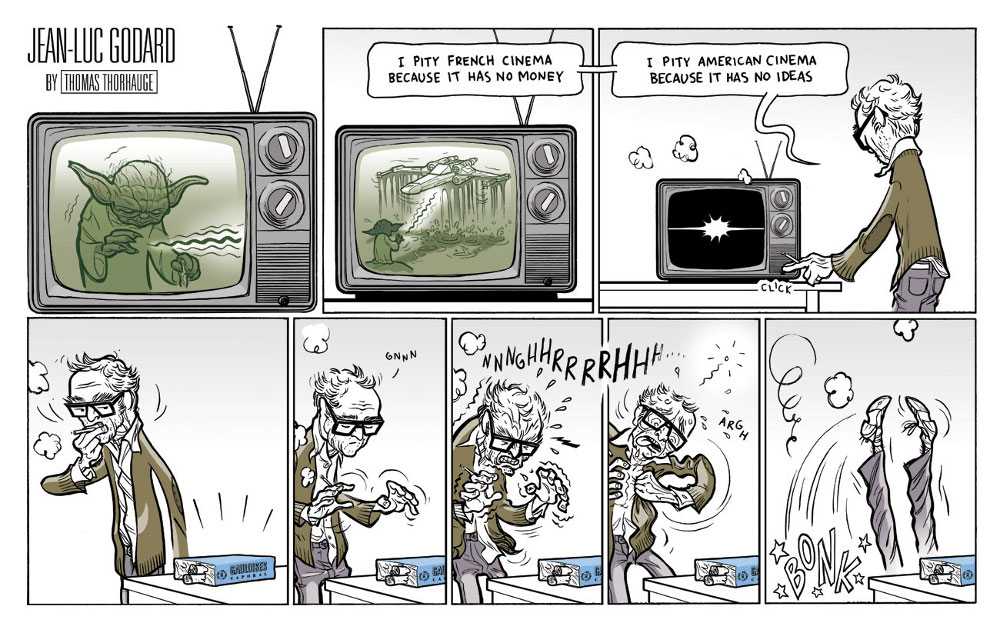
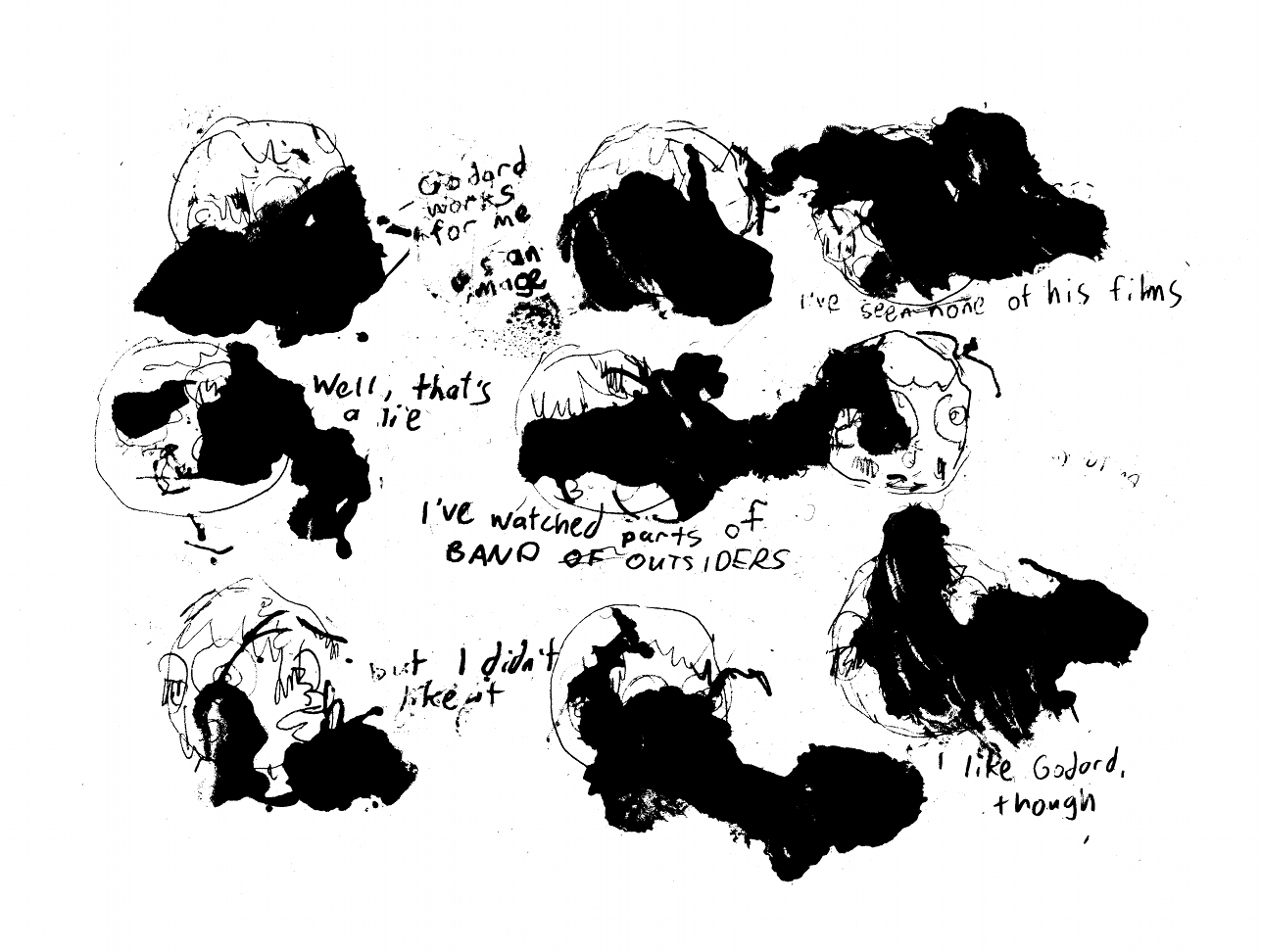
$%$#^% the Cinema!

Thomas Thorhauge is a Danish cartoonist. He translated this cartoon into English for this roundtable; the original Danish version was part of his “True Story” strip, which ran last year in the weekly film section of Copenhagen daily Politiken. His concept was to illustrate authentic quotes from film personalities in whatever way he found interesting, funny or resonant.

Please note: the quote included is authentic.
___________
The index to the Godard roundtable is here.
“Qu’est-ce que c’est Godard?” Roundtable Index

Chronological Index of Contributions
 
Jason OVERBY, “Overby vs. Godard”
 
Roundtable Introduction, “Bonne fête, M. Godard!”
 
Robert Stanley MARTIN, N’est-ce pas dégueulasse?: A Reading of Jean-Luc Godard’s Weekend
 
Thomas THORHAUGE, $%$#^% the Cinema!
 
John CHALMERS with Sandra MARRS, Deepened Absorption – Eloge de l’amour
 
Craig FISCHER, La Chinoise and Marxist Sheep
 
Charles REECE, One Plus One, or the Ruse of Analogy
 
David GEHRIG, A Film Shot in the Back

Charles REECE, Craig FISCHER, Andrei MOLOTIU,, Brecht vs. Godard

Noah BERLATSKY, Images of Asses

Robert Stanley MARTIN, A Dance to the Music of Youth, A Review of Godard’s Band of Outsiders

Noah BERLATSKY, Betatown

Domingos ISABELINHO, Contempt: A Visual Reading and Other Loose Ends

Warren CRAGHEAD, A Bout De Souffle (Breathless)

(This page will be updated throughout the roundtable as contributions are posted.)

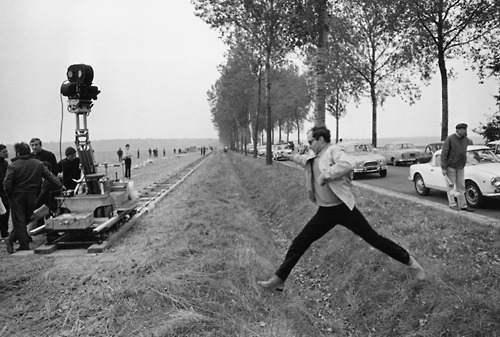
Bonne fête, M. Godard!

Jean-Luc Godard celebrated his 81st birthday on Saturday, December 3. Last year, for his 80th, he got a font. This year, the Internet rather quietly (and capitalistically) observed the occasion: Criterion’s Facebook feed sent me to their summary page. The New York Times reviewed Histoire(s) du Cinema, and alerted me to its US DVD release on this Tuesday (Dec 6). Theaters announced special screenings. Assorted cinephile bloggers wished him well, of course, with the expected “best Godard films” lists and links to clips, my favorite of which was this short film entitled “Meeting Woody Allen”, which I’d not known about previously.

Here at HU, he gets a roundtable. Bon Anniversaire!

Godard is, perhaps more than any other filmmaker besides his contemporary and friend Luis Buñuel, driven by ideas – ideas of what the cinema is and what it is for, ideas about society and subjectivity, ideas about love and art. For many movie lovers, his work is excessively abstract, even opaque; his characters, distant and cold; his dialogue stylized, melodramatic. But to be a fan of Godard is to recognize the idea of humanity in his abstracted depiction of it, and to feel so much passion for the idea that the abstraction can stand in for traditional characterization and plotting without any loss of affect.

Perhaps more than any other filmmaker besides David Lynch, Godard is masterful with metatext, with constructing layers of meaning, with crafting signification from juxtapositions and the interplay of images, themes and words. For me at least, Godard’s own historical moment is always one layer of this metatext – perhaps the most important layer – the ideas in his films are French ideas, ideas fomented in the aftermath of war and occupation and in the tensions of the Cold War and its propagandistic ideological context. The images in his films are refracted through a French glass. “Godard” is a tapestry woven from Sartre and Bazin and Balzac and Buñuel and Lacan and Levi-Strauss and Althusser and Barthes and Langlois and Flaubert and Malraux. Godard, personally reclusive, enigmatic, and even secretive, became in his work a precipitation of the 20th century’s arguably most vibrant intellectual-artistic movement.

More than any other director most people have ever heard of, Godard is himself an idea – an idea of Art, an idea of commitment to Art, an idea of purpose for Art. Like many other French directors, he is in love with the idiosyncratic expression of “l’humanité”, witty and eccentric. Throughout his oeuvre he turned the rabidly individualistic notion of the “auteur” on its head: although his vision is uncompromising and uniquely his, it is impersonal and philosophical, concerned with humanity as a collective, with common humanity, human society, the conflict between man and society — and the necessity of subjective eccentricity, of Art and of desire, as an antidote, a balm, a cry in the wilderness first of post-war existential trauma and then of late Capitalism. Unlike Truffaut or Hitchcock or Scorsese, Godard is neither a personality nor even a body of work; Godard is a figura for art itself.

The title of this roundtable, “Qu’est-ce que c’est Godard?”, is a loose reference to the final line of Godard’s first film, Breathless: “Qu’est-ce que c’est, ‘dégueulasse’?” The quote is always a source of confusion for English translators — there is no English translation that captures the rich ambiguity of the French “dégueulasse.” Translations always end up resolving the multiplicity of meaning in the scene. “Godard”, like “dégueulasse”, is ambiguous and multiple, idiomatic, and somewhat impossible to translate. Each translation says as much about the translator as it does about the original. So will it be with this roundtable. Jouissez sans entraves!

*A couple of people have commented on the use of “Bonne fête” to mean “happy birthday”. It’s apparently Canadian only and doesn’t sound quite right to Continental Francophones. But I’m American — I’m sure my accent is even worse than my word choice!

Roundtable Contributors

Visit the Roundtable Index for a running list as contributions are posted.

Love, Marriage, and Eulogies

This first ran on Splice Today.
______________________

My father-in-law died a little while back, and we drove the 10 hours to Appalachia for the funeral. He’d had brain cancer for about a year, and was unable to stand up or to recognize his daughter for months, so it wasn’t a surprise.

What was a surprise was that my mother-in-law asked me to deliver the eulogy. You might think she asked because I knew Fred well. And you’d be wrong. Fred wasn’t an especially easy person to know, and in the 10 years I’d been married to his daughter, we certainly hadn’t become close. I think he liked me well enough—my wife did me the favor of dating some real losers while she was in college (the guy who urinated in the salad bar at Denny’s is especially memorable), so I had a low bar to clear in impressing the in-laws. I probably did know the single most important thing about him, which is that he loved his grandson, my son, more than anything in the world. But even so, I was an odd choice for the eulogy, at least if what you wanted was someone who had a lot to say about the deceased.

So why me? Well, it’s not a mystery or anything. My wife’s family is a fairly taciturn lot; I, on the other hand, write for a living, and have to some extent inherited the irritating public pushiness of my Semitic ancestors. They picked me to do it because they figured I’d be willing. And maybe because they thought I could get through it without crying. And because I’m family.

They were right; I was willing, and I figured I could probably make it through without crying, and I’m family. So I parked my Jewish butt up at the front of the little Baptist church (which Fred would never have been caught in alive) and listened to the preachers sing the bluegrass songs that Fred loved, and make carneyesque demands that we all join the congregation, which he would have hated. And then I gave the eulogy, mostly composed of stories my wife and her mom had told me. I talked about how he would let our son drive the truck when he was two years old. He’d sit on Fred’s lap, and Fred would let him steer. And my wife and I would say, “Gah! Don’t do that!” And he’d completely ignore us. Which was one of his talents.

Of course, that story about the truck isn’t just my father-in-law’s anecdote; it’s my anecdote too. So while in one sense it’s true that I didn’t know him all that well, in another, I did know him because we shared the same stories and loved the same people. Or, to put it another way, I am married to his daughter.

Which is a thing about marriage that I think people tend to downplay. Marriage is often advertised as an expression of love between two people. Which it is, partly. But the expression of love is much less about declarations of devotion and much more about being part of each other’s lives. That’s why the gay marriage debate has rightly focused on topics like visitation rights in hospitals; marriage is much less about having kids, or having sex, or being in love than it is about being there. In a lot of ways, at least in my experience, it’s not love that leads to marriage so much as the other way around. It’s your life together that makes your love.

And in this case that love is my father-in-law. When my wife and I got married, he took a bunch of photos and cut my head off in every one, as if in some muted protest. When my son was born at home, he came up to help clean, and while my wife and I collapsed in the bedroom, he picked the newborn up and held onto him for hours, despite the desperate efforts of my mother-in-law to pry her grandson free. He was part of my life. One of the gifts my marriage gave me was the chance to tell him goodbye.

Utilitarian Review 2/3/11

On HU

This week’s featured archive post, Richard Cook looks at portrayals of East Asians in comics covers.

James Romberger on Fantagraphics new Alex Toth collection.

I talk about superheroes, the good, the powerful, and Ben Saunders’ book Do The Gods Wear Capes?

Tom Crippen curates another gallery of work by illustrator and cartoonist Bob Binks.

We highlight some comments by Monika Bartyzel on Bella, Buffy, Katniss, femininity and feminism.

I talk about feminism, love, and obedience in the film Ella, Enchanted.

Erica Friedman on the sublimely pretentious gittery of food manga.
 
Utilitarians Everywhere

At the Atlantic I talk about the new film Shame, and why porn is less offensive than male angst.

At Splice I explain why I may vote for Mitt Romney in the Republican primary.

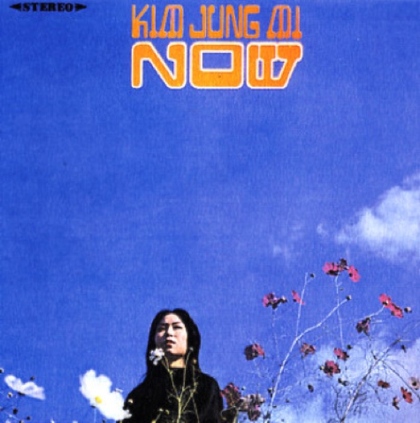
And also at Splice I review the 70s Korean psych rock classic Now, by Kim Jung Mi.

 
Other Links

Excerpts from Marc Singer’s new book on Grant Morrison.

Eleanor Barkhorn on how Twilight finally lost her.

Tucker Stone blogs through TCJ #38.

And more Tucker, this time with high quality industry snark.