Eat, Drink, Read Manga

I am a foodie. You rolled your eyes just now, didn’t you? I don’t blame you. Everyone is claiming to be a “foodie” these days, from your brother-in-law who just discovered white truffle oil (Gordon Ramsay says that’s sooo last year….) to your Mom who found an ethnic restaurant in town with dishes whose names she can’t pronounce. (“Mom, it says ‘salad’.”)

I am not the kind of foodie that drifts from one trendy flavor to another (seriously, mangosteen is over) at all. I’m the kind of foodie who loves food. I mean, I just like to eat. Think less Ted Allen, more Homer Simpson.

It is often said offhandedly that there is “manga for everyone,” but until recently, that was largely not true in English. There was manga for everyone if by “everyone” you meant everyone 12-18 years old or so. Now that the manga bubble has burst, manga publishers, searching for an audience that actually has money to spend on books – and prefers books to downloads – have stumbled on the niche adult manga market. Which means we’re actually getting manga these days more suited to adult tastes. Today we’re talking four food and drink manga that can help train your mind and palate and give you an instant one-upsmanship with your non-manga-reading foodie friends. Welcome to Pretentious Gittery in Food and Drink the Manga Way.


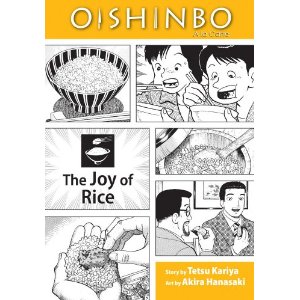
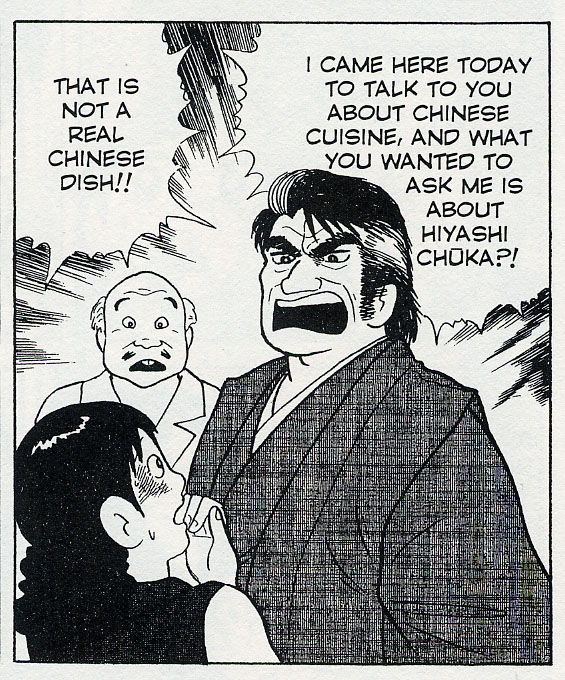
Oishinbo has the be the first course. Any rube can tell you that they taste the difference between regular California short-grain rice and Koshihikari rice grown and imported from Japan, but Oishinbo will help you to discuss the difference in the more pretentious terms. Was the storage area dry enough? Where was the water used for cooking from?

Wrapped in an equally entertaining and annoying tale about rival newspapers and rival father and son food experts, Oishinbo in Japan was begun in 1983, and is now up to 104 collected volumes. Written by Tetsu Kariya, with art by Akira Hanasaki, Oishinbo is not a cooking manga. It is a food manga. It is about the experience of eating food, and often covers the subtle differences that husbandry, farming, storage, shipping and preparation can have on that experience. In America, a few select chapters have been collected into an ala carte’ selection, focused around specific food areas. Sushi and Sashimi, Rice, Gyoza and Ramen, Sake, Traditional Japanese cuisine, Vegetables, Pub Food…each volume picks and chooses from chapters published over the last 30 years. By the end of the American volumes, you’re sorely tempted to go out and try ramen at your favorite local place, just to complain about the use of food coloring and MSG.


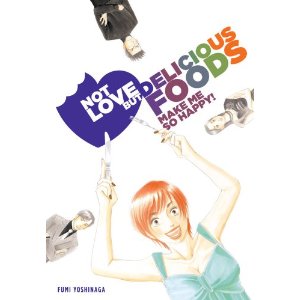
If you find the tone of one-upsmanship too harsh in Oishinbo, then try a more feminine touch with Not Love, But Delicious Foods Makes Me So Happy by Fumi Yoshinaga. Yoshinaga presents this foodalogue as an amusingly insulting candid autobiography of her life and the food she eats.  Where Hanasaki’s art has improved over the last 30 years, Yoshinaga’s art starts at levels far exceeding anything you’ll see in Oishinbo. The people are drawn both beautifully (and less so,) but the food is always gorgeous. Her relationships with the people in her life are organized by their ability to appreciate food. Of all the books on food and drink that I have read, this one most closely approximates my own foodie existence.  Yoshinaga’s take on food is approachable, but her focus on texture and mingling of flavors are both things that Americans particularly, are bad at and so, become an accessible first step into pretentious gittery.

The inevitable next step after reading Not Love is to hop on over to Yelp and start reviewing your favorite restaurants.  Don’t forget to discuss the Bolognese sauce at your favorite Italian restaurant as “authentic” even if you’ve never been to Italy, much less Bologna.


Now that you’ve taken your first steps into being a pretentious git about food, it’s time to get ready for the big guns of pretentious gittery – Wine.

Is there any area of food or drink that has such a well-established pedigree for encouraging pretentious gittery as wine? Perhaps, but even those who don’t know anything about food or drink shudder at the thought of being seated with a person who “knows a lot about wine.”

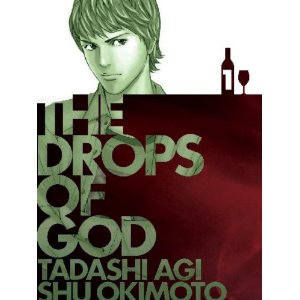
Tadashi Agi’s Drops of God has been so influential in forming, educating and influencing the Asian wine market that long before it was translated into English, this manga had articles written about it in the Wall St. Journal and the New York Times. In fact, so grown up and pretentious is this series, that the New York Times actually deigned to allow this manga on their “Graphic Novels Worthy of Being Gifts” List this year.

Once again wrapped in a story about a rivalry, and a quest for the greatest wines on earth, Drops of God allows the audience to learn the importance of decanting, about village wines, terroir and other things that no one else at the table cares about, really, as long as the wine tastes good. If your family member or friend actually does know a thing or two about wine, don’t expect to impress them with this manga. They already know this stuff and are unlikely to be moved by a comic book. More importantly, the manga itself addresses the pressure that wine snobbery places on everyday people and provides a brilliant tip to glean the credit while knowing nothing. If you’re not a wine drinker, this manga will be a hard read. Everyone eats food…not everyone drinks wine.  But if you’re starting to get into wine and can taste the difference between a  Merlot and a Cabernet, or a family member or friend is in that space, this is a good way to bump up pretension to expertise in a fun way.


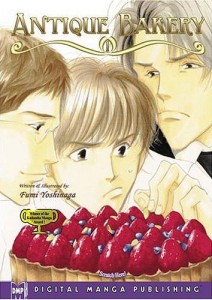
Last, after all of our food and drink, we turn to dessert, and back once again to Fumi Yoshinaga with Antique Bakery. Unlike the rest of the manga here, the pretentious gittery in Antique Bakery is not the actual story, it is merely decoration on the plate. Nonetheless, if you can’t stand to not be a git about the cream used in your choux à la crème (or, shu cream, if your pretentious gittery leans toward Japan, rather than France,) this manga makes a perfect ending to your meal.

The goal here today is not to bore your friends and family (although that outcome is probably inevitable) but to indulge your brain along with your tastebuds.

To end, I want to share with you a real story about pretentious gittery.

I was at someone’s house and they poured me a glass of wine that, they said, had a distinct scent of tobacco and traces of mushroom. I took a sip and said, “You’re right, it smells like an old man bar and tastes like a moldy basement.”

I may never become a good pretentious git about wine, but I’m great at being a pretentious git about manga. ^_^ These manga are perfect for the inner pretentious git in you.


Cinderella, Feminist

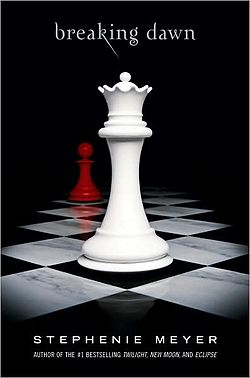
We’ve been having an interesting discussion over the past week or so about Twilight, the Hunger Games, and the place of empowerment in feminism. Specifically, does a feminist heroine need to be empowered and in control of her own life? Or is the experience of disempowerment — including passivity (or selflessness) and irrationality (or emotional sensitivity) — valuable in itself? Or to put it another way, is feminism’s goal to integrate women into the male world on equal terms, or is it’s goal to change the world in accordance with female experiences?

The 2004 film Ella, Enchanted has an interesting take on these questions. Based on a (better than either Twilight or the Hunger Games) book by Gail Levine, the movie is a reworking of the Cinderella legend. Ella (Anne Hathaway) is as an infant visited by her incompetent fairy godmother Lucinda (Vivica Fox). The godmother gives Ella the gift of obedience.

As Ella’s mother instantly recognizes, and as Ella herself learns as she grows older, the gift is not really a gift, but a curse. Ella has to do everything anyone tells her to do. If her mother tells her to practice her music lessons, she has to practice her music lessons. If she’s told to shovel cake into her mouth, she shovels cake into her mouth. More painfully, after her mother dies and Ella’s evil stepsister discovers her secret, she is forced to perform a series of ever-more-terrible tasks — giving away the broach her mother handed her on her death bed; stealing from a store; and finally, insulting her best friend and telling her she will never see her again.

The film, in other words, is one long treatise about the dangers of disempowerment; the traditionally female virtue of obedience is presented as a kind of fierce and unrelenting slavery. The film, in this sense, is clearly, and strongly, in favor of empowerment — not least in the way in which it takes pains to demonstrate that, while Ella is controlled by her curse, she is not defined by it. Whenever she can, Ella thinks her way around her obedience — when an antagonist tells her “bite me!”, young Ella obliges instantly; older and told to gather bouquets for her stepsisters, she smirkingly collects poison ivy. Moreover, it is not Ella’s obedience, but her feisty independence and her refusal to be charmed by his beauty or rank which attracts the romantic lead, Prince Charmont (Hugh Dancy.)

And yet…is it so clear that Ella is not what she is because of her obedience? The narrator at one point says that Ella’s gift is actually what gave her strength of mind — it is the ordeal of having to obey everyone all the time that made her so determined to think for herself. Even more telling, one of the ways in which Ella has most conspicuously thought for herself is in her political views. She doesn’t like the prince because his uncle’s government has been systematically enslaving other races — ogres, giants, and elves. Ella makes the link quite explicit for the viewer in a discussion with the prince (who is not in on her secret.) After seeing some giants being forced to work in the fields, Ella tells him: “No one should be forced to do anything they don’t want to. Take it from somebody who knows.”

The dichotomy here between obedience-as-a-curse (slavery) and obedience-as-a-gift (source of wisdom and character) can perhaps be traced to the fairy tale source material. As I said, this is a retelling of Cinderella, and a retelling in a feminist vein. The original tale is about a woman being saved by marriage and love; the new tale wants to be a story of an independent woman. At many moments, you can see the fissures. For example, the climactic scene involves a (quite entertainingly silly) battle with a horde of ninja-knights. Prince Charmont battles ferociously — and so, too, does Ella, who has not previously shown any particular capacity for battle (except in one scene where someone ordered her to fight skillfully, that is.) Diagetically, there’s no reason for her to be able to defeat trained warriors; it’s just thrown in to make her look empowered and equal. As such, it comes across (for all its obvious goofiness) as almost condescending. You want empowerment; okay, we don’t really believe in it, but we figure you’re easily satisfied. Here you go.

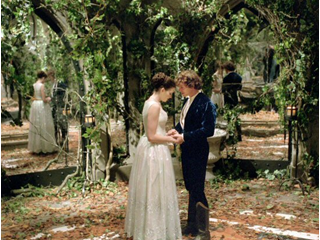
The tension between Cinderella and Ella is perhaps most apparent, though, at the film’s emotional climax. Prince Charmont’s evil uncle Edgar (Cary Elwes) finds out Ella’s secret and orders her to stab the Prince through the heart at the moment when he asks her to marry him. Despite desperate attempts to escape, Ella has no choice — and as he asks her, she raises the knife. But…a miracle occurs. The strength of her true love releases her from her curse, and she lets the knife drop to the floor as she weeps in relief.

The movie makes some effort to suggest that the breaking of the curse is the result of Ella’s will-power, rather than of true love per se. But…well, come on, now. It’s true love. And even if you insist that it’s true-love-providing-incentive-for-will-power, you’ve still got some explaining to do. After all, as I mentioned, obedience made Ella break off her friendship with her closest friend whom she had known for years. Why wasn’t her love for that friend enough to break the command, while the love for some guy she’d known about a week was? However it’s parsed, heterosexual romantic love, and, indeed, the offer of marriage, is what breaks the spell. Which makes it hard to shake off the sense that the reason Ella is no longer under compulsion to all the world is because she’s under compulsion to one man in particular. And, indeed, Ella at the film’s end is not her own person, but a bride. Her signature achievement is not becoming a lawyer (like her elf friend) or ruling a kingdom (like Charmont. Instead, it’s marrying the king, and influencing him through her love to be a better man and a better ruler.

It would be possible to see these tensions as a sign of the film’s failure to shake off the Cinderella’s stories gushy romance of disempowerment; Ella is more empowered than Cinderella, but she’s not truly empowered.

I think, though, you could also see the ambiguity as a potentially more thoughtful conclusion. When the film goes for empowerment-for-empowerment’s sake in essentially male terms — beating up ninjas — it seems crass and stupid. It’s at its best when it reaches for an empowerment that learns from, rather than entirely rejecting, the Cinderella story. That fairy tale, after all, is about both the injustice of slavery and the beauty of love. Both of those insights, it seems to me, come out of distinctively female experience, and so it makes sense that Ella, Enchanted build its feminism — not perfectly, but still with some conviction and heart — on both.


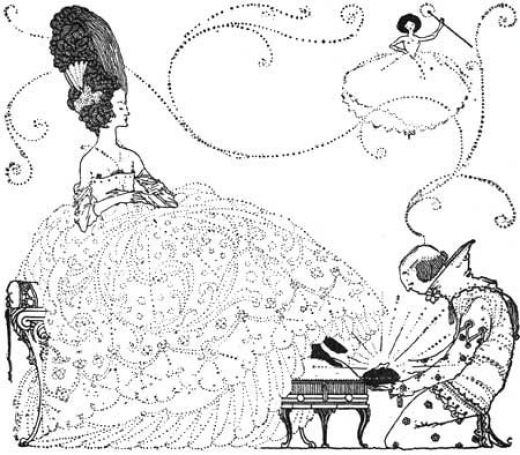
Gratuitous Harry Clarke illustration, because Harry Clarke is bad ass.

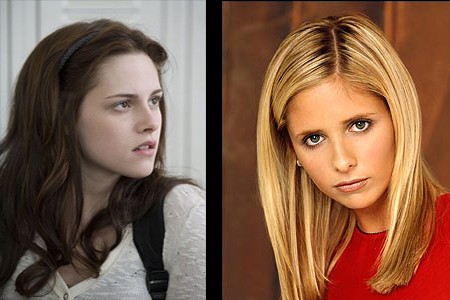
Monika Bartyzel on Bella, Buffy, Katniss, and Femininity

I linked this article by Monika Bartyzel last week. Monika showed up in comments here and has had a bunch of interesting thoughts. I thought I’d highlight some of them here.

This is Monika’s first comment.

I was quite surprised to see the responses to your piece. They seemed to decide that you have some sort of antiquated view of men and women, rather than note that the piece is speaking in stereotypical generalities. I thought you brought up an interesting and important alternative to consider.

I’m sick of the arguments against Bella because I’ve yet to see one that doesn’t try to morph the facts to fit the argument. Any agency or personality that Bella has is removed before arguments fly against her. Likewise, any blemishes sported by characters like Katniss or Buffy are dulled. The tough girls are coded in perfect terms, and Bella is made into the perfect loser. Essentially, they’re perfect because all faults can be forgiven by the overall package. People hate the romance and Meyer’s writing, so she doesn’t receive the same privilege.

Even in Amber’s piece, the similarities between K and Bella are obvious. If we boil all of this YA entertainment into checklist points, the girls are not all that different. No amount of bad writing, Mormon values, or indignation changes that.

What I thought was fascinating about Bella was that as much as the book journey was about Edward, it ultimately became about her. I completely disagree with: “Contra Berlatsky, it is laughable to read Bella’s desire for Edward as secondary to her desire to be a vampire—if Edward died, would Bella want to become undead? I think not.” She most definitely would. In fact, some might argue that Edward’s appeal is infinitely enhanced by how much his world helps Bella find her identity. The confused human klutz becomes the calm, impressively controlled vampire. Humanity was a banana peel that always kept her off-kilter.

I think there is a certain.. allergy to femininity because of its implications. Classic definitions of femininity certainly have their place, but I think many of us see that as problematic because of how those notions are fostered by the suffocating media presence around us. It is hard, if not impossible, to signify “natural” moments of femininity because of how much shlock girls get taught from an early age. I often see women act in ways that clash with their own personal ideologies, but are right in-line with the plentiful stereotypical characterizations we’re fed.

So perhaps it’s not so much a matter of hating the feminine, but mistrusting it, and finding it problematic in today’s social environment. But it’s still something we need to consider.

Also: It’d be interesting to talk about how strength fires up forgiveness. The stronger a heroine is, no matter how well or poorly she’s written, the more likely we are to forgive problematic aspects that surround her. Most Buffy fans seem to all-out deny the darker side of Buffy’s world (stalker boyfriends, forgiveness of killers, etc). With Katniss, we get a strong heroine who is literally kept out of a hearing about her life while literally watching her skin melt off, who has no choice about where and how to live, is pressured into having children she doesn’t feel comfortable having, is in a romance that still doesn’t inspire her to say “love”. She seems to never be in control of herself. If no one watched/read either Buffy or Hunger Games, it’d be easy to turn off the populace by the same methods used to turn Bella into a complete fool.

btw: I’ve got to thank you for that 2009 piece, which I hadn’t seen before. I had completely forgotten about the hideous storyline that condemned Buffy’s strength and made Riley morally superior with his blood-prostitute ways. (Much like the other Xander gem when killing a frat-massacring Anya would make Buffy cruel, but trying to help Angel made her foolish and selfish.) I imagine that I find it easy to see Buffy’s weaknesses and Bella’s strengths for this very reason.

And here’s a follow up.

I agree about Buffy. Perhaps for a little while in the beginning she was allowed to revel in her strength, but there was so much condemnation in that show. Since Xander most often lobbed the bullshit condemnation, I just funneled my hatred into him rather than the show. He seemed to act like some sort of condescending moral compass that always emotionally beat her down with flawed, self-serving opinions. There IS one moment where Buffy really flourished in her strength though – Prophecy Girl when she killed the Master. After she was resuscitated, she seemed downright gleeful about her role as a slayer. Unfortunately, the beginning of Season 2 took that all away and re-coded her as being severely emotionally damaged by the whole thing.

Funny, I was just going to type about Katniss’ failure to feel much of anything except loyalty/protectiveness and aggravation/anger … but that once again makes her more like Bella. She just gets “better” reasons to feel it, whereas Bella’s are much more realistic to people today.

I think it’s said in the book, but it’s definitely in the movie that Bella tells Edward she wants to marry him because of how she finally feels like herself. “This wasn’t a choice between you and Jacob. It was between who I should be and who I am. I’ve always felt out of step. Like literally stumbling through my life. I’ve never felt normal, because I’m not normal, and I don’t wanna be. I’ve had to face death and loss and pain in your world, but I’ve also never felt stronger, like more real, more myself, because it’s my world too. It’s where I belong.” And then she specifically says it’s not just about him. It’s just that these points get muddled in the Edward lust.

Yes, I think Bella is attracted to that familial life, but I think that the audience is even more. Twilight might be ridiculous and in some ways problematic, but it fills holes. If your familial life is traumatic or nonexistant, you can go into the books feel the warmth of the family. If you have relationship problems, you can get swept up in the love. More than anything, the Saga speaks to the dissatisfaction and emptiness in life, or most distinctly, offers a really defined sense of reliability. The Cullens are honest and reliable without condemnations about how people live their lives; they love their family no matter what crazy choices they (Edward, Alice, etc) might make. I think that probably appeals to the readership just as much as the romance. (I know that to be true for some friends of mine who like the series.) Of course, it also means exacerbating expectations of love to inhuman forms.

And yes, there is a real problem with how loathed Bella is. If she was just immediately dismissed as problematic with a list of reasons and that was the end of the story, fine. She is far from an ideal heroine. However, the vehemence against her is strange, and not at all in line with how she’s presented in either the books or the films. I think that’s partly due to people taking up the argument from other’s opinions and not reading for themselves, and maybe some of it is the anger towards Meyer’s style making any positive point irrelevant? I don’t know…

Robert Binks: More Works by an Unassuming Master ( part 2 )


Welcome to part two of the second round of posts devoted to Robert Binks and his work. All our posts to date can be found here, and Mr. Binks’ illustrations for the poet Ogden Nash are gathered here. All the works in this post are © CBC/Bob Binks.

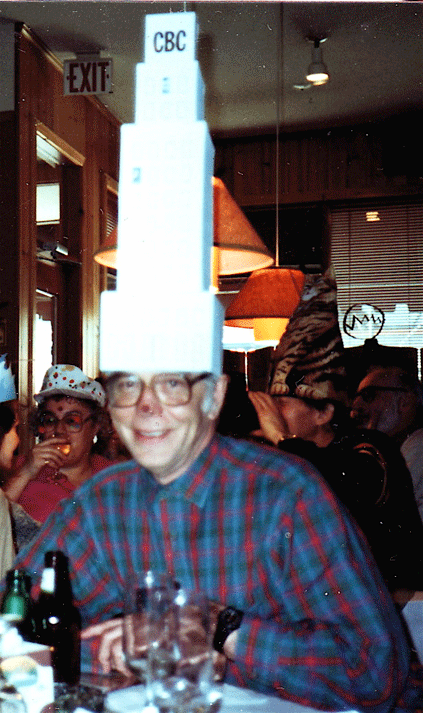
Let’s start with a look at Mr. Binks and hat design. He models the work himself, along with a clown nose for added high spirits:
  

“This hat celebrates a new CBC building to be erected,” Mr. Binks writes by email. The occasion was lunch in 1984 for CBC graphic designers.

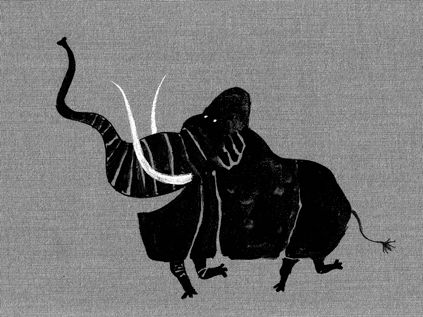
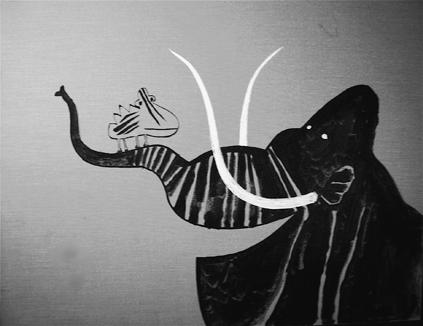
Now two illustrations Mr. Binks drew for broadcast around 1960, during the era of black-and-white television. They were part of a story called “The Frolicking Mastodon.”

“The drawings were done in India ink on beige window blind with added white paint,” Mr. Binks writes.

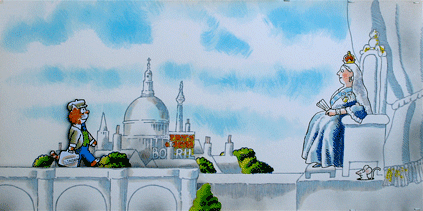
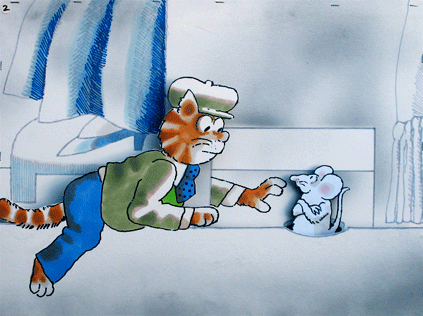
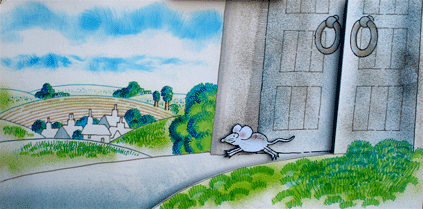
The next three works were done about 1980 as part of a story broadcast on the CBC children’s show Mr. Dressup. The story’s set-up is simple: Queen Victoria hires a cat to rid her palace of mice.

“In contrast to this world of high tech that we now live in, we created simple animated solutions by moving cut-out shapes,” Mr. Binks says. “The stagehand at the back of the graphic would move the magnetized cat cutout along a felt pen line that determines the action. The camera follows the action of the cat as it crosses the bridge along the path to visit Queen Victoria.”

“The stagehand moves the magnetized mouse up out of the hole.”

“Part of the castle door is on another level to allow the mouse to appear and travel down the path following a curved line.”

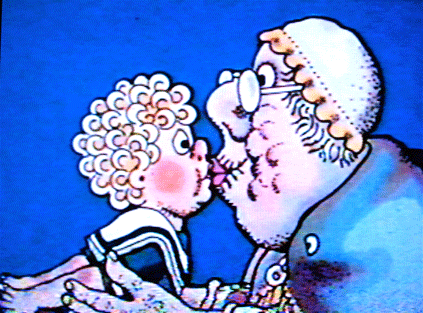
Next, three panels belonging to a feature created during the mid-1970s for the CBC television program Such Is Life. Their collective title is “Strange Beliefs of Children.”

Mr. Binks: “The animation was preshot by myself on an animation stand. This was a simple animation technique where I used paper cut-outs and I double framed each shot.”

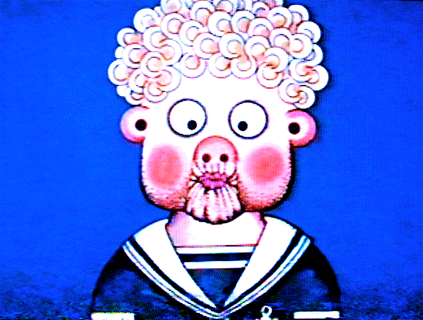
The first two center on the longstanding trepidation felt by little boys over contact with their grandmothers’ insistent, wrinkled mouths.


In the first shot, “the little boy was moved up to Grandma’s mouth by moving her long arms,” Mr. Binks writes. Then “a match dissolve changes the little boy’s normal lips to puckered lips. The eyes go from normal to crosseyed.” And that is what happens to the poor blighters. The CBC was on the case all those years ago.The next picture also addresses a widespread problem:

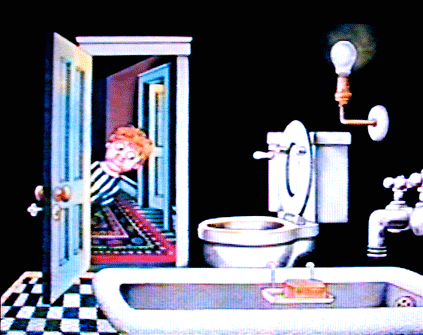
The boy is about to encounter something horrible. From the script: “There’s this thing which lives in the toilet and likes it and when you go in the night and flush the toilet it wakes the thing up. So you’d better hurry getting out of there — but this kid was too slow.”

Mr. Binks used a series of cutouts to show the boy flushing the toilet, then being seized and dragged into the toilet by a wormlike creature with a suction-cup head.

So this is what the CBC wants to show young people! Mr. Binks notes that his nephew, when small, was given a look at the sequence and suffered nightmares as a result. “As an adult he still has vivid memories and requested a copy,” Mr. Binks adds, which tells us something about the bizarre power of nostalgia.

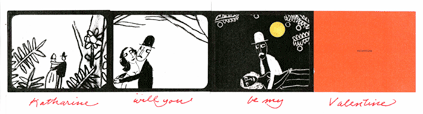
Finally, a foldout Valentine’s card Mr. Binks made around 1980. Its recipient, of course, was his wife, Katharine. It’s a lovely piece of work, even in the miniaturized form we must settle for here:

Next week: A dog and cows!

Force For Good

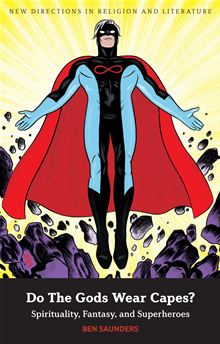
I’ve recently finished reading Ben Saunders’ book, Do the Gods Wear Capes?: Spirituality, Fantasy, and Superheroes. It’s a really enjoyable study. The chapter on the Marston/Peter run on Wonder Woman in particular filled me with bitter envy; I wish I had written it, or that if I had it would have been done so thoughtfully.

Anyway, perhaps in recompense for my blighted hopes, I thought I’d talk a little about the non Marston-Peter parts of the book and about some differences I have with it. In doing so, I’m going to refer to Ben as “Ben”, because we’ve been corresponding, and so it feels weird to call him by his last name. Hopefully he won’t resent this or other liberties.

So as the title of the book implies Do the Gods Wear Capes? looks at superheroes in terms of religion. However, Ben is not (thank God) adding to the dreary discourse which attempts to validate superheroes by asserting that they are modern myths. Rather, he makes the much more interesting claim that superheroes are myths about modernity. To quote his conclusion at some length:

Superheroes do not render sacred concepts in secular terms for a skeptical modern audience, as is sometimes claimed. They do something more interesting; they deconstruct the oppositions between sacred and secular, religion and science, god and man, the infinite and the finite, by means of an impossible synthesis. They are therefore fantasy solutions to some of the central dichotomies of modernity itself. A cynic might conclude that the suspension of disbelief required to enjoy such fantasies applies no less to their unlikely depictions of ethical perfection as it does to the spectacle of men and women who can fly, climb walls, and see through satellites. But, less cynically, we might instead interpret these stories as testaments to the strength of not just our will-to-power, but also of our will-to-love — our will-to-kindness, concern and decency. The dream of the superhero is not just a dream of flying, not just a dream about men and women who wield the powers of the gods. It’s also a dream about men and women who never give up the struggle to be good. W.B. Yeats once wrote, “in dreams begin responsibilities.” But perhaps possibilities of all kinds begin in dreams. And perhaps among these possibilities there is still the prospect of a spiritual awakening — even from within the skeptical, rationalist, materialist assumptions of modernity.

Ben works this theory through in terms of a number of characters…but he starts, logically enough, with Superman. For Ben, Superman isn’t defined as the quintessence of strength or the quintessence of power — rather he’s defined by “essential goodness”. Various creators have attempted to struggle with what “essential goodness” means in various ways. Ben talks about the early Siegel/Schuster issues, in which Superman beat up capitalists, suggesting an uneasy antagonism between the good and the democratic/capitalist institutions of the United States. In the 1950s, Ben says, Superman comics linked “the good” and the United States in a more straightforward manner (“Turth, Justice, and the American Way!”) Later, in the 70s and 80s, creators who worked on Superman struggled with his establishment image. For instance, Ben points to the Eliot S! Maggin story “Must There Be a Superman?” in which Superman is told by the Guardians of the Universe that his presence on earth is hurting the moral development of humanity, and in which he is confronted with the moral dilemma of how, or whether, to encourage migrant farm workers to organize.

People often argue that superheroes are dumb because they’re simplistic; because they create a bone-headed binary between good and evil. Ben’s argument is that, in fact, Superman stories have traditionally not so much asserted as investigated this binary. In the light of late modernity, as religion has faded, Superman asks “how can human beings be good?”

Ben finds one of the most effective answers in the Morrison/Quiteley All-Star Superman, in which Superman-as-reporter=Clark-Kent visits Lex Luthor in prison. Luthor spends the entire visit boasting about his greatness and threatening Superman and so forth. Unbeknownst to Luthor, though, riots and chaos are breaking out in the prison around him, and Superman-as-Clark has to save his life repeatedly. Ben concludes:

At such poignant moments, we see that only Luthor’s vanity could allow him to think of Superman as his enemy. In fact, Superman is his gentle savior — so gentle that even as he preserves Luthor’s life, Superman allows him to maintain his illusions of power and control. Thus, through Luthor, we see that Superman’s devotion to humanity is such that even the worst of us will always be treated with infinite patience and compassion. The results are both funny and moving, and leave the reader in no doubt as to the most incredible aspect of Superman’s character. Few human beings are ever so good. This, perhaps, is the final, paradoxical lesson that we can draw from the 70 years and more of Superman’s adventures — that it may be easier to fly, to see through walls, and to outrace a speeding bullet, than it is to love your enemy.

The sentence that most stays with me from that paragraph is this: “Few human beings are ever so good.” I like it’s simple wistfulness, and I like the way it suggests that, while few are, some might be — that goodness is, after all, something we can share with Superman. Being good isn’t a fantasy. It’s something people can strive for.

But while I like that sentiment, I also feel it’s perhaps a little misleading. Because while human beings can be good, they can’t actually be good in the way that Superman is being good in Ben’s description. The goodness Superman offers, in Ben’s telling, is the goodness of providing complete physical protection while simultaneously allowing the object of that protection to not know what is happening. Obviously there’s a metaphorical sense in which this could happen — anonymous charity, for example. But, in the first place, we’re not reading about anonymous charitable donations, and part of the reason we’re not reading about anonymous charitable donations is, surely, because we would rather watch Superman exercise his many, many superabilities. And, in the second place, even the “anonymous charity” analogy is a vision of the good dependent on a disproportion of power.

Ben is attempting to disaggregate. He looks for the most essential superquality, and that quality is goodness. All the others — strength, speed, flight, superbreath, and on and on — are just gilding on the basic concept. Superman is not about the powers. He’s about the good.

But what if, instead, he’s about both? Or what if, even, the good is essentially one of his powers? Tom Crippen suggests something like this in his own take on Superman and modernity.

Superman has a fine temperament and a lovely smile. It’s not a question of him personally being cold. I saw him on the cover of a kids’ book of math problems, or possibly it was a display ad for an insurance company. But he was taking off into the air and looking delighted about it, and why not? The reaction was perfectly right for him. He’s agreeable and fun loving; that’s not the whole of his personality, but the stuff is in there. It’s there along with all the other qualities the best sort of personality would have. You can assume the presence of all of them, whatever they are; they’re implied, and any of them can surface. If Superman flies off looking keen and determined, that suits him too. So the problem isn’t so much that Superman himself is pompous, either in his icon form or as a continuing-story character. It’s that, as a character, he seems like an afterthought to himself. Everything about him is derived in such a straight line from the central premise—this man is super—that there’s not much point to experiencing him.

Tom sums up the point by saying that Superman, “By definition, by being super, he is the best of whatever comparison he finds himself in. If he is one of two large men, he is the best—that is, strongest—of the two of them.”
By the same token, there are two good people in a room, Superman is the most good.

And part of the reason he is the most good, I think, is because he is also the most strong. The goodness of Superman can’t be disaggregated from the superness; the two are intertwined, and that intertwining has meaning. If the ultimate good is the ultimate force, then it seems logical to conclude that goodness and force rely upon each other.

Here’s another take on force and heroism from Simone Weill’s The Iliad, Or The Poem of Force.

Force, in the hands of another, exercises over the soul the same tyranny that extreme hunger does, for it possesses, and in perpetuo, the power of life and death. Its rule, moreover, is as cold and hard as the rule of inert matter. The man who knows himself weaker than another is more alone in the heart of a city than a man lost in a desert…

Force is as pitiless to the man who possesses it, or thinks he does, as it is to its victims; the second it crushes, the first it intoxicates. The truth is, nobody really possesses it. The human race is not divided up, in the Iliad, into conquered persons, slaves, suppliants, on the one hand, and conquerors and chiefs on the other. In this poem there is not a single man who does not at one time or another have to bow his neck to force.

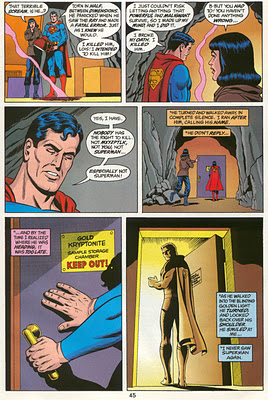
There is one Superman tale I can think of that captures some of Weill’s insight into force. That would be Alan Moore and Curt Swan’s “Whatever Happened to the Man of Tomorrow?” In this “imaginary” story, Superman deliberately kills an overpowering enemy..and then, in expiation, exposes himself to gold kryptonite, destroying his powers. Here, force and goodness are definitively separated; the first, as Weill suggests, must be cast off if the second is to survive. But when force disappears, so does Superman. What’s left is a good man who is not a superhero — a good man who decisively declares “Superman was overrated. Too wrapped up in himself. Thought the world couldn’t get along without him.” At that point, the comic ends. Superman is still supergood, but he can no longer perform superfeats…and the superfeats were, as it turns out, the point.

I think Ben would respond to this by saying that superhero comics have confronted these very issues — that they explicitly question the goodness of power. Ben talks about this most directly in his last chapter, which focuses on Iron Man (aka Tony Stark). Ben notes that from his inception, Iron Man expressed

ambivalence towards technology — desired as a source of power, but feared and resented, as the cause of a crippling dependency for those who rely upon it…. [This is a] fundamental element of the original version of the Iron Man character — built into his armor, we might say, in the form of his chest plate, which is not only the main energy source for the suit, but also prevents the inoperable fragments of shrapnel embedded in his chest during his days in Vietnam from reaching his heart and killing him. Tony Stark’s very life depends on this piece of equipment; consequently, he can never remove it, amking it a resonant symbol of the double-edged nature of his techno-dependence, as well as a literal barrier to intimacy.

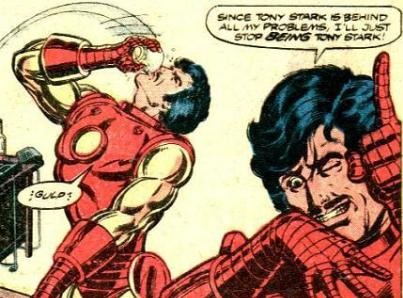
Ben argues that this ambivalence about technology — ultimately an ambivalence about power and humanity’s wielding of power — cryztallized in a 1979 storyline by David Michelinie, Bob Layton, and John Romita, Jr. known as Demon in a Bottle. The story centered on Stark’s effort to get out of the armaments industry, and the government’s subsequent plot to take over control of his company. In addition, the arc follows Tony’s struggles with alcoholism. In the story, Ben argues, dependence on alcohol and dependence on technology are linked. Both alcohol and the Iron Man suit are technologies of control; alcohol providing the illusion of control over one’s own emotional state, the suit providing the illusion of control over….well, everything else.

The cure for both forms of dependency, it turns out, is to acknowledge that the fantasies of radical independence — absolute power, total control, complete self-reliance — are just that: fantasies. The answer to the problem of negative dependence is therefore not the pursuit of independence…but the radical acceptance of interdependence.

In a virtuoso move, Ben then links this realization to the ideology of Alcoholics Anonymous — an ideology which Ben argues is specifically focused on modernity’s obsession with control and power. Leslie Farber, a psychoanalyst whose theories were central to AA, is quoted by Ben as follows:

“Nietzsche, I believe, was not as interested in theological arguments about the disappearance of the divine will in our lives as he was in the consequences of its disappearance. Today the evidence is in. Out of disbelief we have impudently assumed that all of life is subject to our will. And the disasters that have come from willing what cannot be willed have not at all brought us to some modesty about our presumptions.

For AA, of course, the solution to this solipsistic mania for control is to put one’s faith in a nondenominational higher power — to acknowledge that one does not have the ultimate power over one’s own life, much less over the world. Ben links this realization to a Warren Ellis/Adi Granov Iron Man story from 2005, in which Stark experiences something like a crisis of faith, and is able to go on only by acknowledging the limits of his own power and knowledge. Stark in this story does not know that he is doing the right thing…but his uncertainty is itself the (ambivalent, uncertain, but still) sign of his goodness. Like a recovering alcoholic (which Stark is), the acknowledgment of his own limits allows him to function, and to function for good.

The problem, though, is precisely with the “function”. AA critiques alcohol as a technology of (false) control. But the solution it offers is a solution — which is to say, it is a technology itself. The 12-step program is a program, a system, a utilitarian fix. It specifically brackets content (what exactly is that higher power?) in the interest of getting the alcoholic back to becoming a functional member of society. As Ben says, AA does not insist on the existence of God, but rather “insists on the necessity of the God concept.” God is not a transcendent hope; he’s a convenient tool, like a socket wrench.

Tony Stark does not, then, take off his suit of armor to find vulnerability and connection; he takes off his suit of armor to put on a bigger, badder, better suit of armor. The acknowledgment of his dependence and powerlessness is not the beginning of a different kind of story. Tony Stark does not change his life; he is still committed to an existence where he gets up, suits up, and shoots bad guys in the face with repulsor rays. The change for Stark is simply a retooling; humility is a necessary pit stop on the way to greater feats of godlike power. The means, in this case, justify the end. AA is a part of, not a solution to, the technological pragmatism of modernity, in which even god is valued solely as a cog in an ever-more-functional machine.

That’s the case for superhero comics as well, I think. Ben is right when he sees superheroes as a myth of modernity. But I think he’s overly-optimistic when he sees in that myth a hopeful sign of a possible spiritual reawakening. Rather, it seems to me that superhero comics suggest not modernity’s possible salvation, but its depressing limits. For both superheroes and modernity are genres in which the good waits upon the powerful.

Utilitarian Review 11/27/11

On HU

I posted two related reviews: one of Bjork’s recent album Biophilia and one of the soundtrack to the 1979 BBC series Life on Earth.

Sina Evil discussed Robert Kirby and gay alternative comics.

Kailyn Kent reviews the Lyonel Feininger exhibit at the Whitney.

I posted a free merengue mix download.

Tom Crippen posted a gallery of work by illustrator and cartoonist Robert Binks.

And the rest of the week was off for eating turkey and celebrating imperialism.

Also, there’s been a fun discussion of twilight and feminism going on all week.
 
Utilitarians Everywhere

At Splice Today I talk about delivering the eulogy for my father in law.
 

Genius, Clarified


CLICK ON IMAGES TO ENLARGE

Greg Sadowski and Fantagraphics’ Setting the Standard is perhaps the best book on Alex Toth that has been published thus far, because it represents the complete body of Toth’s 1950s work for Standard Comics, reproduced as closely as possible to its original printed color form (1). Toth did his art with the intent that it be colored and so, even though the colorists at the time ignored the artist’s color notations and most often made uninspired color choices, still the art can only be considered complete in the form for which it was intended. For this volume, editor/designer Greg Sadowski meticulously cleaned up the pages of the original comic books.

Sadowski takes a straightforward, comprehensive approach and so Setting the Standard can rest comfortably on the bookshelf next to Fantagraphics’ other excellent recent collections of essential comics such as Hal Foster’s Prince Valiant, Roy Crane’s Captain Easy and Buz Sawyer and Carl Barks’ Disney epics. The Valiant and Easy volumes set a high bar for the reproduction of classic, beautifully colored Sunday strip pages, but comic books present a different set of difficulties, due to cheap, misaligned printing and often perfunctory coloring.

Recoloring might help, but as can be seen by various reprints where older works have been slathered with airbrushy digital effects, restraint is to be desired. Some options are the semi-faithful recoloring that Barks recieves in the handsome, just released Lost in the Andes, or the recoloring that Sadowski has been having Marie Severin do for his Bernard Krigstein books, though these approaches are dependent on access to clean copies of the black and white art. For Setting the Standard, Sadowski went back to the source to provide another practical model for the reproduction of old school four-color comics.

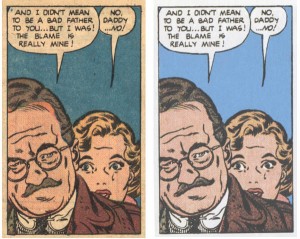
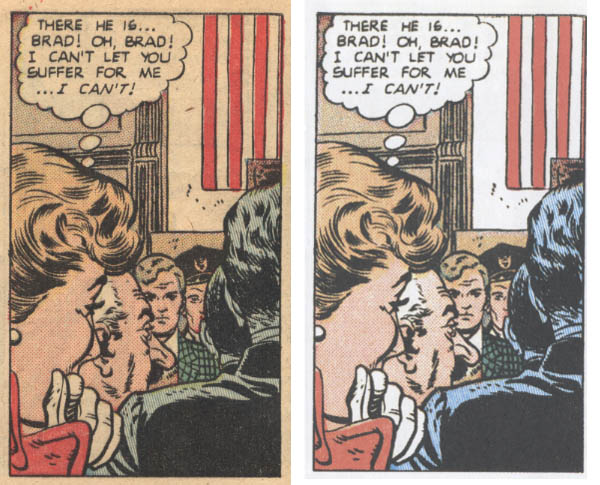
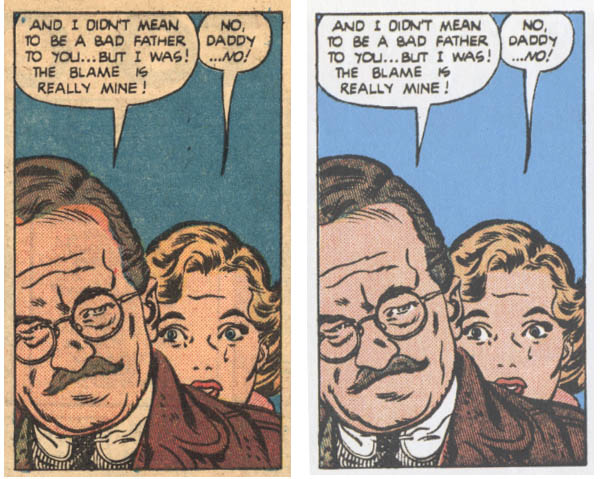
I have Best Romance #5 which contains Toth’s first job for Standard, “My Stolen Kisses”, which is also the first story in the Fantagraphics book.  This particular comic is dog-eared and scotch-taped but the color is actually not badly registered, however,  comparisons of panels from it and from the collection still show the effort that Sadowski put in:
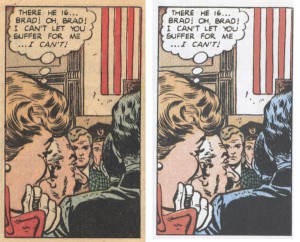
Left: panels from the original comic. Right: Sadowski's cleanups

Sadowski painstakingly corrected the images where the color in the original comics was off-register, minimized the bleed-through of “ghost” images from the printing on the reverse sides of the pages (in some cases he replaced mottled single color backgrounds with clean areas of color) and restored the areas around the images and behind most of the lettering from the color of decomposing newsprint to white—daunting efforts when one considers that he did some 400 pages worth.

The stories themselves are not stellar, but that was “standard” for the time. This type of presentation is effective for the work of non-writing art stylists of 4-color comic books such as Toth, who all worked with scripts that were rarely intended to be more than cheap pulp entertainment; the onus was largely on the artists to make the material resonate. Here we are treated to many tales that are dignified only by Toth’s determination to wring feeling from them.

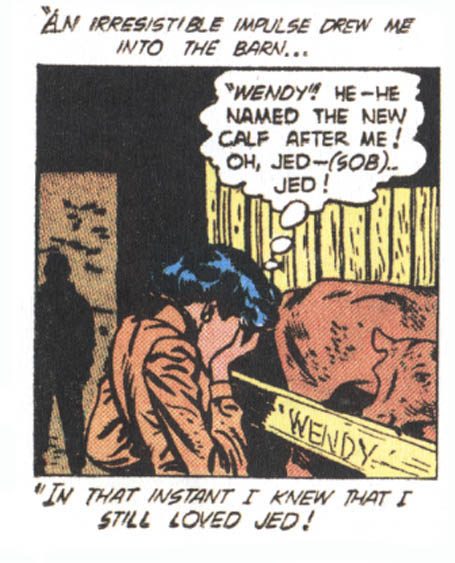
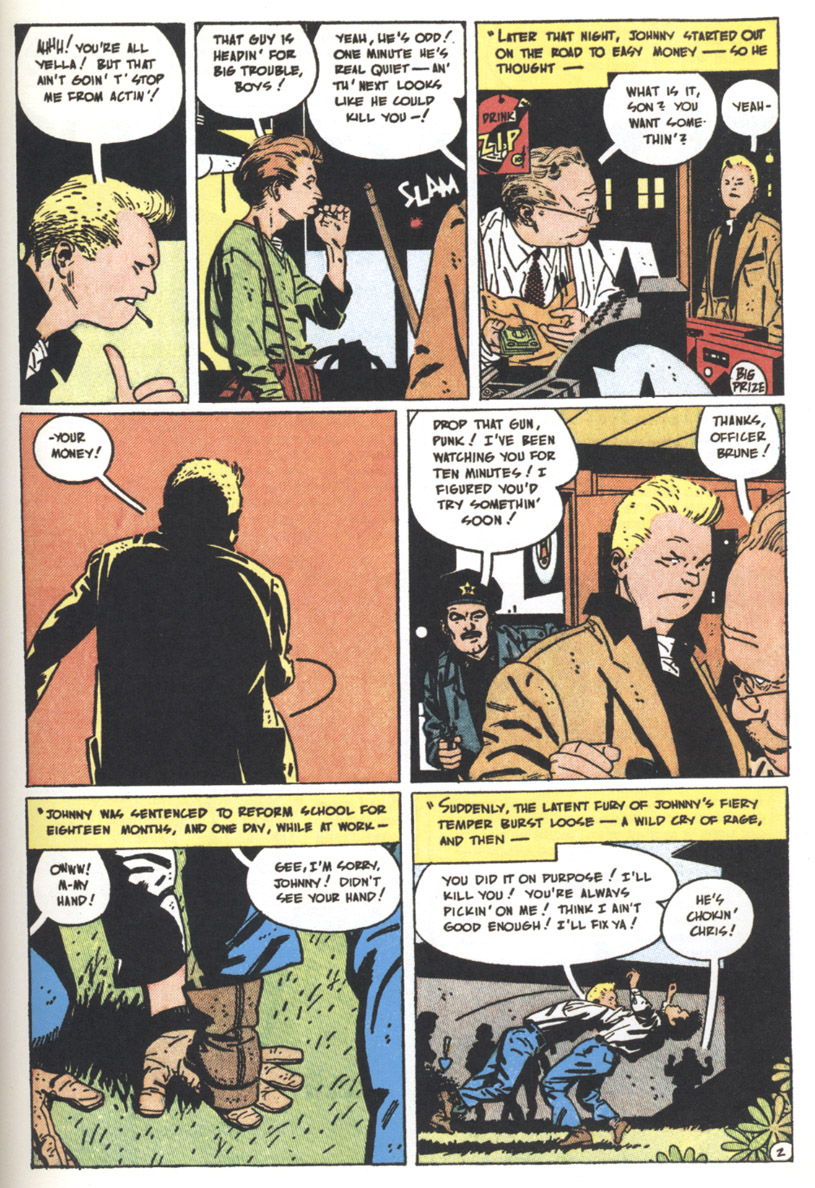
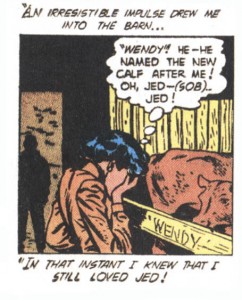
Even the best stories here are redolent of the banal false consciousness of 1950s America. They are mostly forgettable junk—humans prevail over the world domination plans of implausibly gullible aliens, foolish criminals get their just desserts, a woman is charmed when her suitor names a cow after her:
Or, they can be offensive junk: vengeful soldiers bury dehumanized “gooks” alive with a bulldozer, a woman struggles to prove to her husband that she can do better housework in order to preserve her marriage.

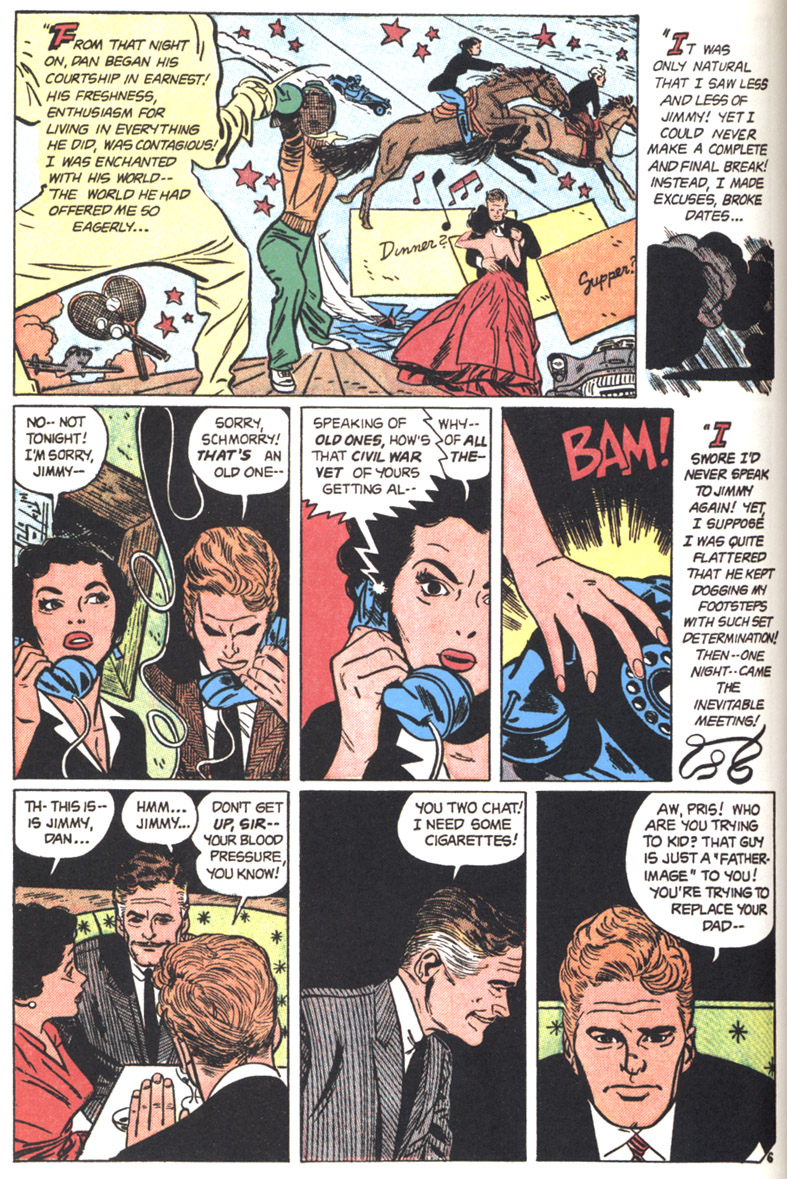
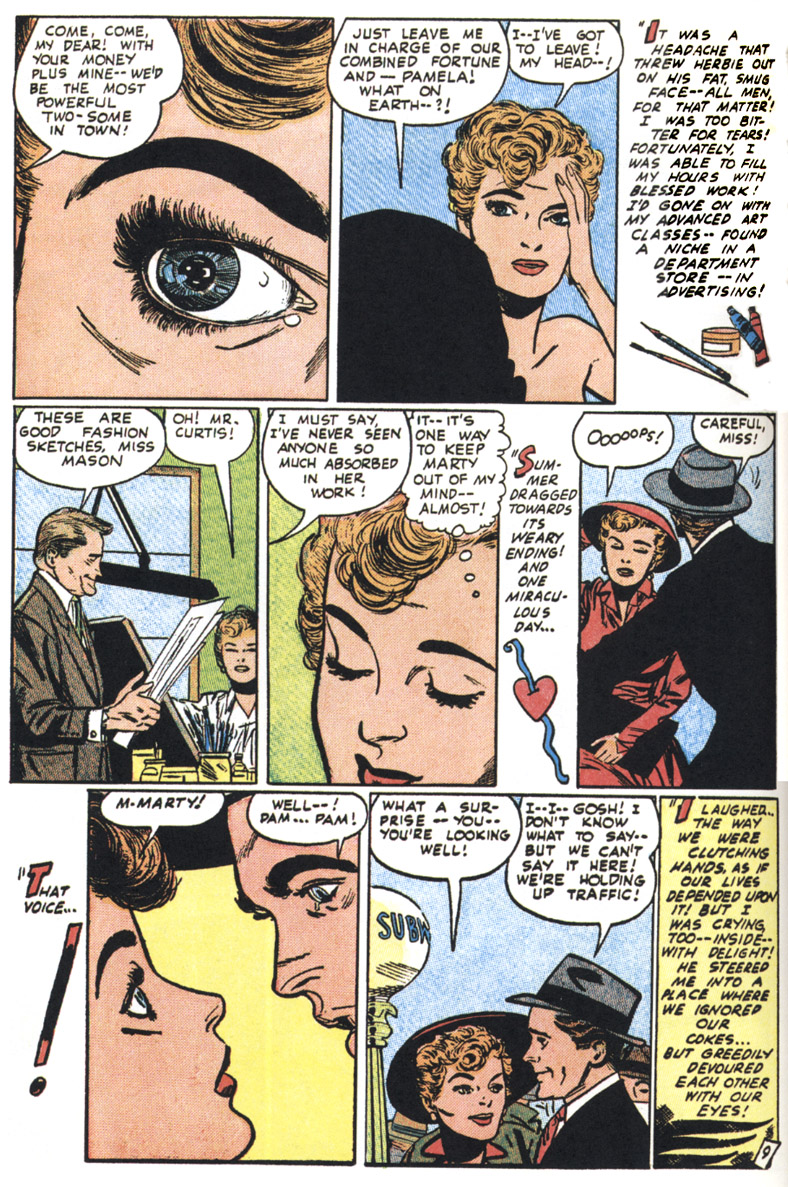
Toth’s oft-cited praise for the Standard scripts of Kim Aamodt falls flat when one actually reads them. A story described as one of Aamodt’s best portrays a woman torn between an older and a younger man. The dilemma is resolved when the older man bows out because “you kids…belong together.” Okay, it’s efficiently written and it is a great art job:
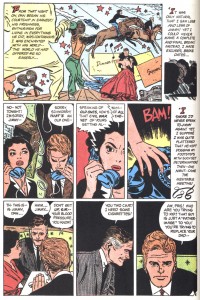
Page with my favorite Toth montage, from Man of My Heart

But, as in the other stories here, women are not allowed to make their own decisions. More so than Toth’s other assignments, the romance comics do give the artist a chance to draw a range of emotions and choreograph more intimate stagings, but they are also intended to program young girls to be subservient. In most cases, it is only that Toth drew these stories that elevates them from a justified place in the dustbin of comics history.

There are a few interesting stories though and thanks to Toth, many passages of thoughtful comics storytelling. The romance work is often brilliantly articulated and visualized with glamorous drawings that rival those of the illustrators famous for depictions of beautiful women who inspired Toth’s interpretations, Al Parker and Jon Whitcomb.

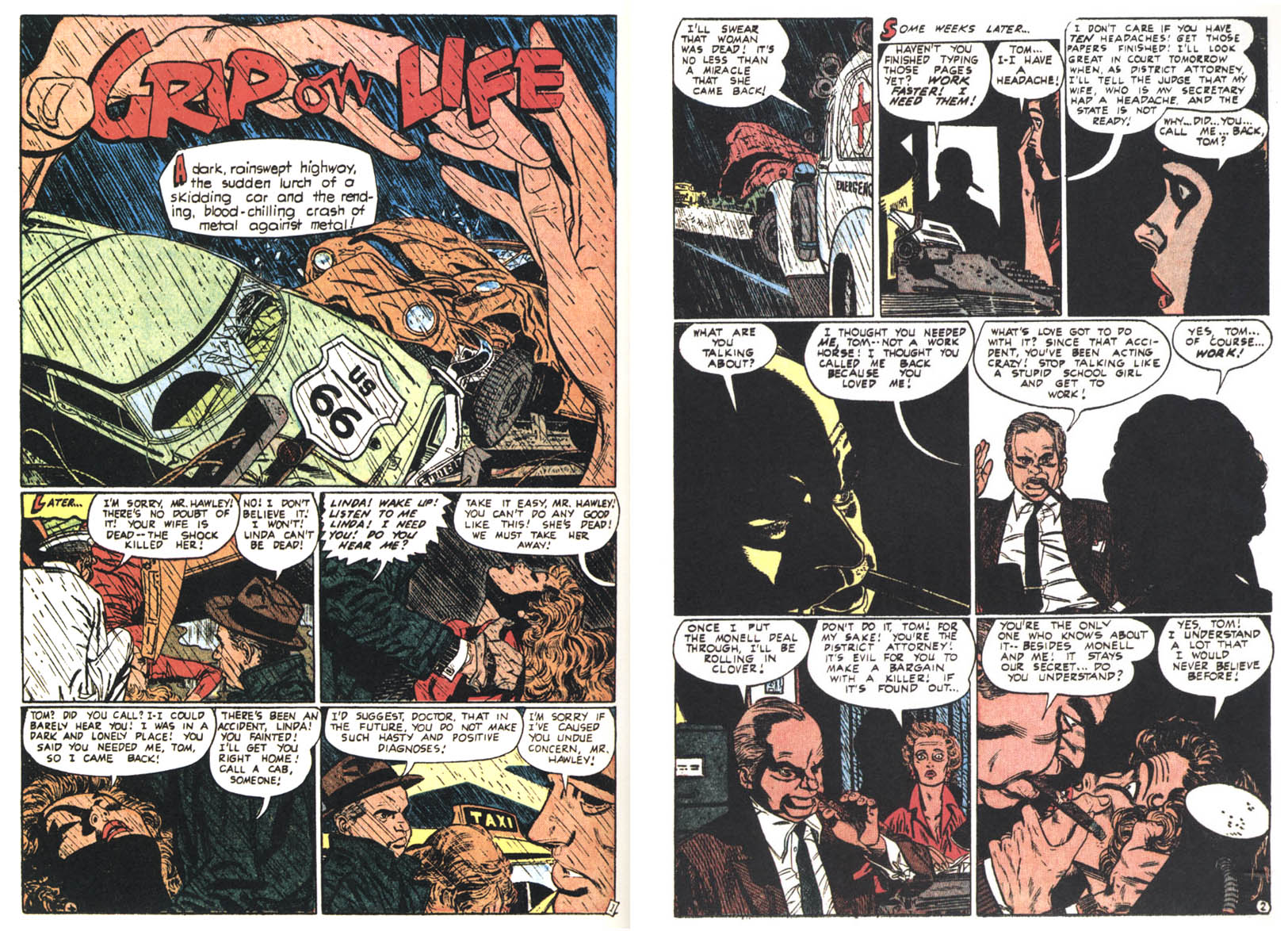
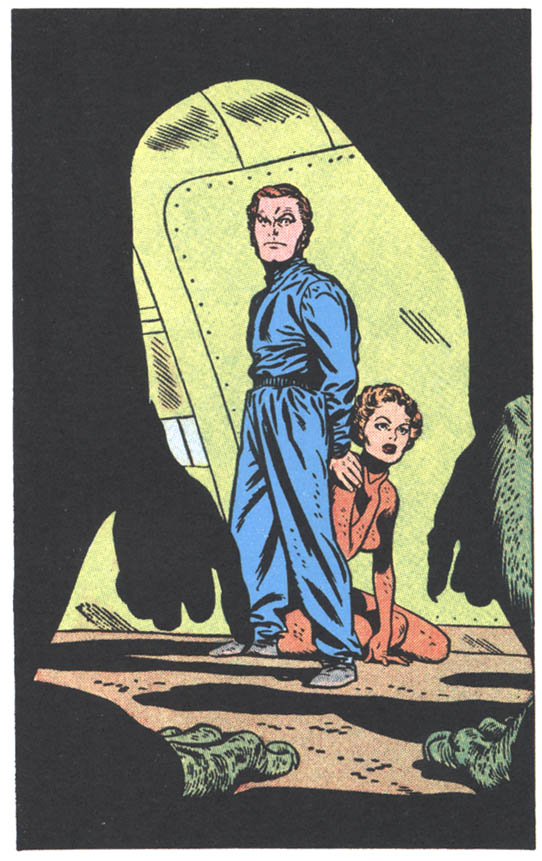
Toth’s handling of horror and suspense is intuitive, sometimes harrowing and exhibits his more radical inventions. “Grip On Life” is one story that sticks with me; it is a brutal rendering of an abusive husband who brings his wife back from the dead to serve him. Here and also in the shadowy peripheries of “The Shoremouth Horror” and “Galloping Chad Burgess”, Toth’s compositions are partially obscured and his extremes of emotion barely glimpsed.
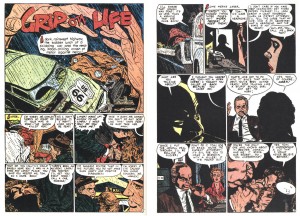
A simultaneously realistic and abstract splash leads to atypically explicit abuse

IDW’s Toth biography proves its value as a companion to collections like this. In examining Genius, Isolated‘s appended timeline of published work for this period, one begins to see the progression of Toth’s efforts to address the critique of DC production ace Sol Harrison: “You don’t know what to leave out.” One sees the artist vacillating over years as he goes back and forth from clutter to simplicity and back and forth again.  1952 sees him end his first tenure at DC Comics with some beautifully realized collaborations with inker Sy Barry including the affecting “Queen of the Snows”, to move on to these works for Standard and his concurrent collaborations with Harvey Kurtzman at EC.

The three EC stories are spread over the same three years Toth was at Standard and form a learning curve of themselves. Kurtzman’s practice was much more sophisticated than anyone else Toth ever worked with and it seems that he absorbed a lot of storytelling information from acting in the subservient role that Kurtzman’s autonomy demanded of his artists. In the first, “Dying City” from 1951, Kurtzman inked Toth’s pencils and Toth appreciated that the inking “simplified my drawings and dropped in some blacks that I hadn’t even figured on. He made it simple, and powerful.”
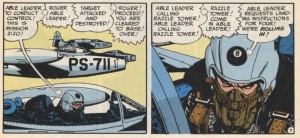
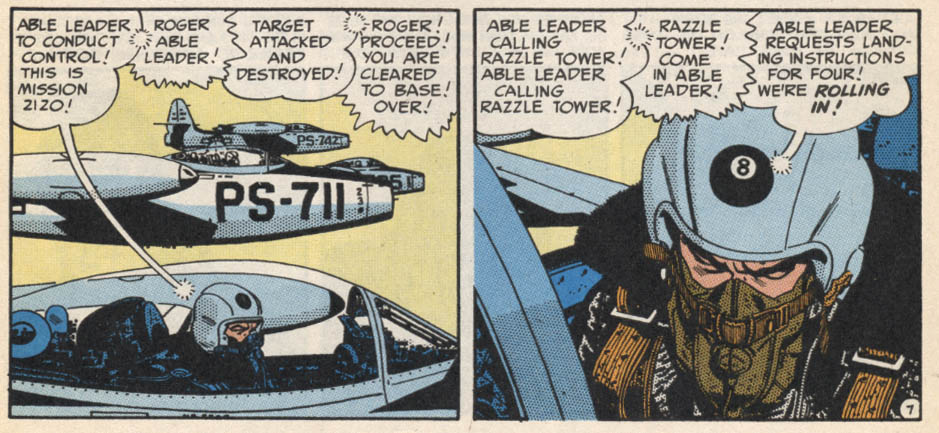
Thunderjet, 1952: together, Kurtzman and Toth achieve a high level of realism.

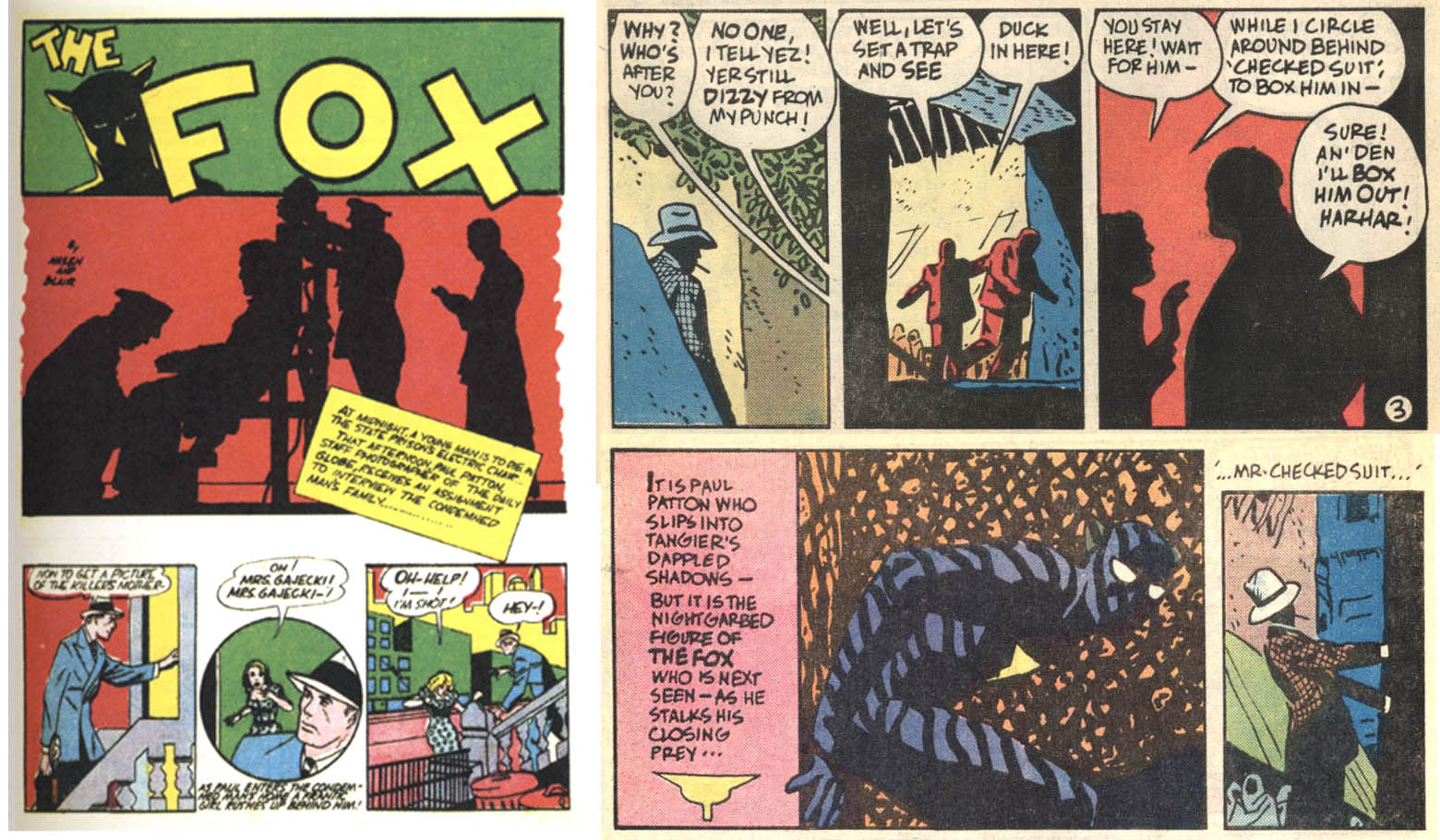
Kurtzman knew his stuff and Toth took the lesson on board, to the point that he alienated Kurtzman on their third co-effort two years later by dropping in some blacks that his writer/designer/editor hadn’t figured on in “F-86 Sabre Jet”, 1953. To further the narrative intent, Toth’s silhouettes accentuate the disorientation experienced by the pilot protagonist (2).

At Standard, with a sympathetic art director/ inker in the person of Mike Peppe and with publishers who seemed to appreciate the value of Toth’s efforts, in the space of a few years profound changes take place in the artist. In particular, he has an epiphany of idiosyncratic simplicity in 1952 with his interpretation of the unfortunately now-anonymously written “The Crushed Gardenia”, which allows him to transcend his influences and find his own most pure style.
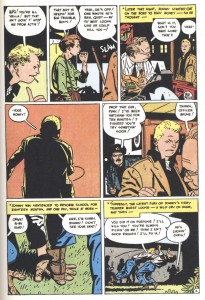
The Crushed Gardenia

The storytelling and drawing in this story is minimalist and oblique, with extremely cropped images in panels that are clearly designed with the interrelationships of the whole page compositions in mind. It furthers a tendency for distortion seen earlier, for example in the misproportioned splash of “Triumph Over Terror”:
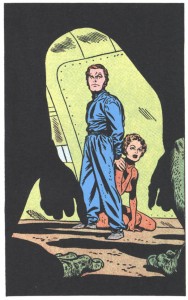
Um, that's weird

The characters in “The Crushed Gardenia” have squarish heads with the features crushed into the center, which remind me of Milton Caniff’s year or so on Terry and the Pirates where everyone takes on what I’ll call a Flip Corkin aspect: compressed figures with boxy heads.
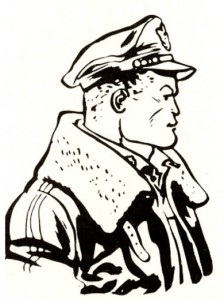
Caniff's Flip Corkin

The art in “The Crushed Gardenia” is so freshly reductive that it looks as if it might have been drawn yesterday, but a few months later Toth is drawing the densely composed “Geronimo Joe” which reflects the influence of Albert Dorne, later still the elaborately detailed “Lonesome for Kisses” which begins to resemble Neal Adams(!). There are plenty of experiments throughout the Standard stories, but the attenuated drawing of “The Crushed Gardenia”, that represents Toth at his most innovative, will hardly rear its head again until the 1960s.

Toth’s Standard period ends when he is conscripted into the Army, where he formulates his more elegant mature style in his solo Jon Fury strips for his post’s newsletter. After his discharge, he works on book-length stories for Dell and is forced to simplify further, at times drawing with a breezy, nearly generic realism, sans experimentation, then in the early 1960s he begins working for DC again and the drawings become more muscular, the panels become overstuffed with detail. This clutter may have been dictated by Toth’s DC editors, but Sol Harrison must have been scratching his head. Soon though, as the decade progresses through to the cusp of the seventies, Toth will hone it down.

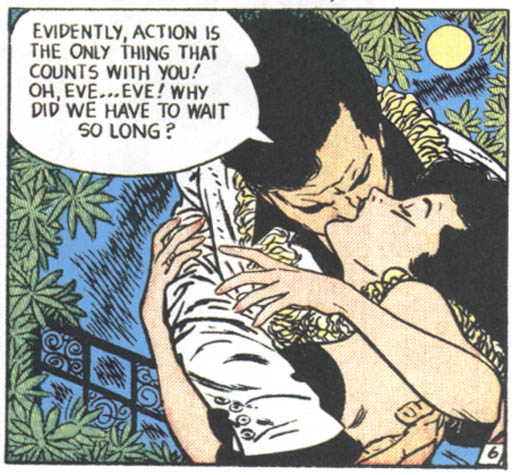
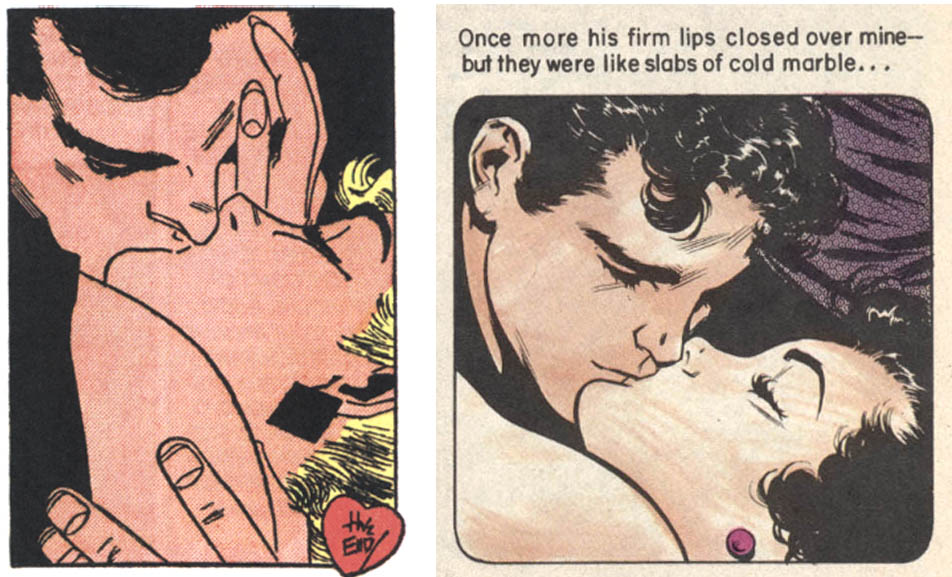
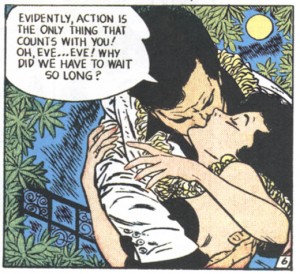
Back at Standard, Mike Peppe is one of Toth’s better inkers and he does a credible job on such concisely pencilled stories as “The Eggbeaters”, “Geronimo Joe”, “Free My Heart” and “The House That Jackdaw Built”. Still, the greatest stylistic cohesion is seen in the instances where Toth inks and letters his own pages such as in “The Crushed Gardenia”, “I Fooled My Heart” and “Too Many Cooks”. But it was Toth’s romance work that was most influential to his contemporaries; John Romita and Ross Andru are noted here, but also for example one can see echoes of Toth’s “I Want Him Back” from Intimate Love #22, 1953 in Frank Frazetta’s Standard romance tale “Empty Heart” from Personal Love #28, 1954:
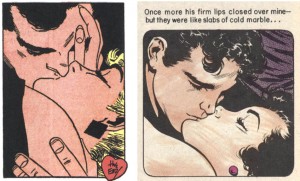
Toth and Frazetta did some hella good kissing scenes

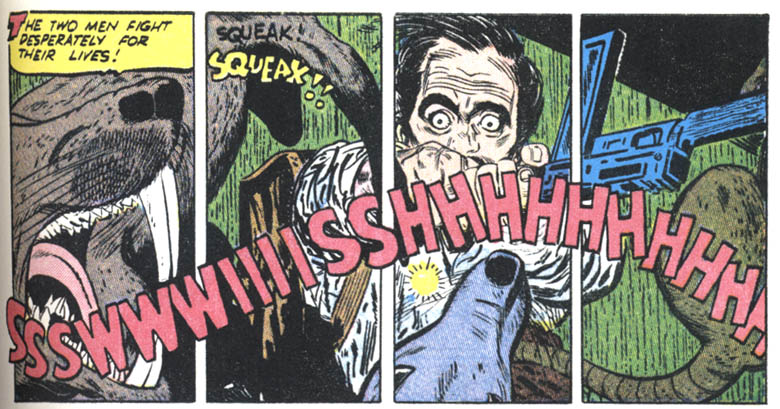
I’m not claiming this is a swipe, but the first time I saw the Frazetta panel years ago, I immediately thought he’d been looking at Toth. I am inclined to think that Toth exhibits some influence himself, from Bernard Krigstein, in the linear qualities of “The Mask of Graffenwehr” and “Images of Sand”. Then, there is the odd 4-panel split image in “The Phantom Ship”:
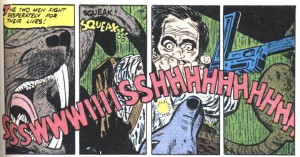
The singular tier

This compound panel is a single image broken to imply the passage of time between the individual component panels; the sound effect superimposed on the whole thusly becomes more protracted and the frenzied scene takes on the qualities of an epic battle. It’s a very unusual effect that resembles Krigstein and probes into areas later explored by Steranko. Toth did a romance story with Peppe, “I Do…” in 1955 for Atlas that also has some layouts that remind me of Krigstein.

I had believed that a clue to Mike Peppe’s inking was that it was he who would ink noses with a line along the edge of the nostril that defines a plane between the side of the nose and the underside of the nostril. It is present in the stories attributed to Peppe and it looks wrong to me….it wasn’t something that Toth would do, I thought.
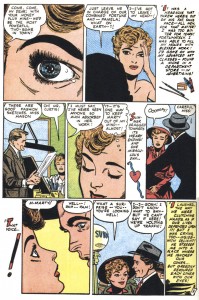
Inked by Peppe, with too-sharp nostrils

Yet in “I Want Him Back”, which Toth signed alone and so is thought to have inked, there’s lines on the nostrils! And maybe I’m crazy, but the main figure in the opening panel of that story looks to me like someone else drew it. Perhaps Toth didn’t ink everything in some of the stories he is credited with?  Or, maybe there were editorial changes to his work?

Toth inked five full stories and a few odd pages here. Apart from the two episodes of Joe Yank, which are inked by his best DC inker Sy Barry (with the main characters’ faces reworked by Art Saaf), the rest are credited or attributed to Mike Peppe and John Celardo.  The hands of Mike Sekowsky and Mike Esposito are noted as present in some of the many stories attributed to Peppe; the book also mentions Ross Andru as a possible inking assist, plus I believe I see Carmine Infantino in a few places as well. I noticed this previously in Greg Theakston’s two-volume black and white Standard collections Toth: Edge of Genius, but I was unable to get Infantino to confirm or deny this when I asked him at a con a few years ago. Some of these questions may be addressed now that this work is readily available to be absorbed by the public and comics scholars.

In Setting the Standard, the choice of supporting material is excellent. The fairly comprehensive interview with Toth from Graphic Story Magazine (and later, The Comics Journal #98) is reprinted with a new selection of reproductions, including appropriate pages by artists who influenced Toth such as Irwin Hasen:
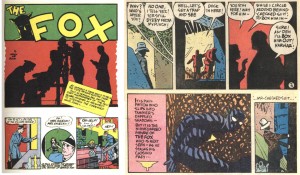
Left: the Hasen repro. Right: my scan of Toth's much later, very Golden Ageish and Hasenesque version of the character

The stories are also annotated in the back with a selection of relevant or at least semi-relevant quotes from Toth’s letters (3).

In the end, interpretive cartoonists such as Toth must be judged by the quality of their realizations of the scripts they were given, good or bad. Isolated or excerpted pages don’t give any idea of the work; only whole stories can provide the intended reading experience. In Sadowski’s book, Toth’s work speaks for itself and the artist likewise. The book’s assemblage and design are very well done to make a package which is pulpy but tasteful, not cheap nor overly slick, not high/low cute or old-boy sentimental. It provides a complete and important body of work by a great cartoonist.

___________________________________________________

Footnotes

1. My other favorite Toth book is Manuel Auad’s One for the Road, which collects all of the black and white comics Toth did for Pete Millar’s 1960s hot rod magazines, which I like for similar reasons: it collects an entire body of often-outstanding comics from obscure periodicals, that would be exceedingly difficult and expensive to track down, which can now be read/appreciated in their entirety. Similar collections of Toth’s Warren and DC Comics work should now be published.

2. I only found one mistake, one that has been replicating in Toth books for a while: Frontline Combat # 12 is actually dated May/June 1953, rather than November 1952 as it is listed in Jim Vandeboncoeur’s Toth index; when corrected, “F-89 Sabre Jet” comes after “The Crushed Gardenia” in the timeline. Their proper placement clarifies Toth’s progression; that is, apart from the possibility that either story was held for a time in inventory by their editors.

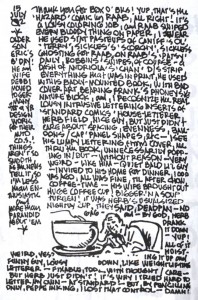
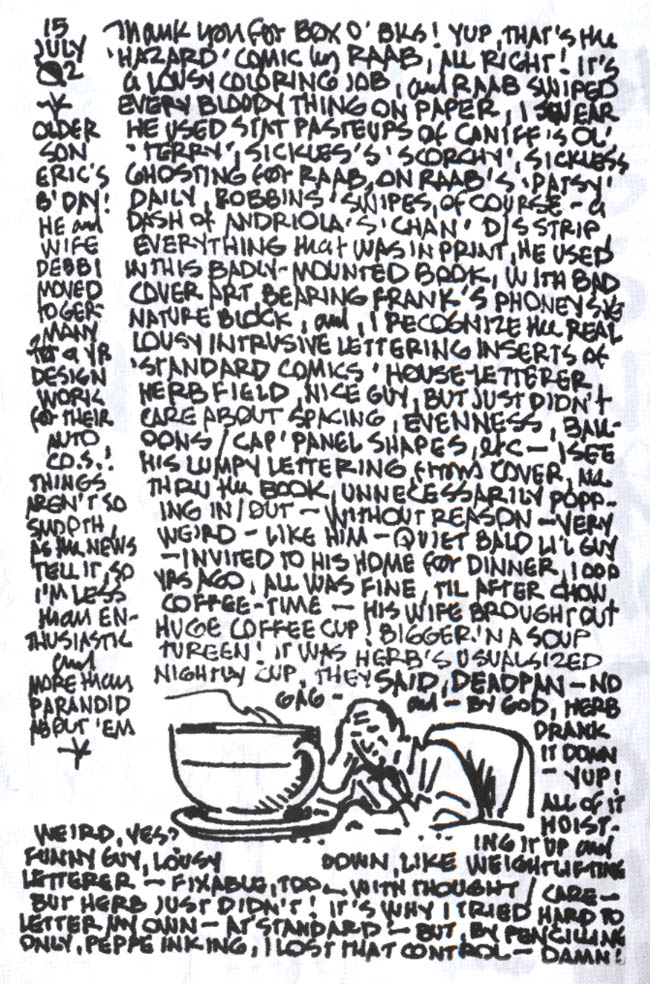
3. In Setting the Standard there are references to Toth’s annoyance with the efforts of Standard’s chief letterer Herb Fields. In researching this article, I came upon a letter in John Hitchcock’s compendium of his Toth postcards, Dear John, which amusingly depicts and describes a visit the artist had with Fields: