Just a note that in honor of our great American tradition of reckless expansion and genocide, and in a flagrant provocation to our foreign readers, we will be taking off Thursday and Friday. We will be back, well stuffed and with nationalistic hubris refortified, on Monday. See you then!
Robert Binks: More Works by an Unassuming Master ( part 1 )
Welcome to a second round of posts devoted to the artist Robert Binks. (The first series can be found here, and scans of his illustrations of poems by Ogden Nash are here.) During his half century as a professional cartoonist and illustrator, Robert Binks produced works of remarkable imagination, skill and charm. Now retired, he produces equally remarkable paintings and sculptures. We’re very happy to be presenting more samples of his work.
For this series of posts the artist himself chose the pictures and their order. Works done by Mr. Binks while on staff to the Canadian Broadcasting Corp. are © CBC/Bob Binks. His private works are © Bob Binks.
******
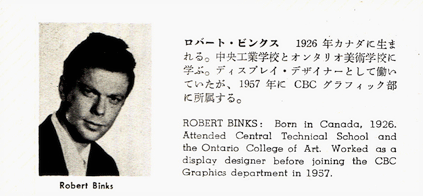
Robert Binks in his mid-30s, as presented in a Japanese graphic art magazine called Idea. The article appeared in 1961 and was about the graphic artists of the CBC, where Mr. Binks had been working for four years.
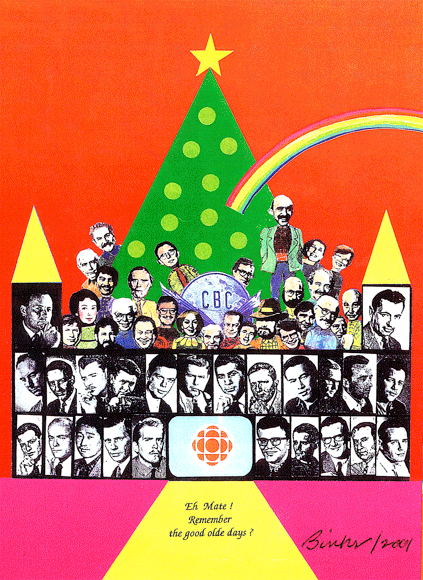
Below is a Christmas card, designed by Mr. Binks, that went out to active and retired CBC graphic designers in 2001. Mr. Binks himself had retired 10 years before, but he produced quite an extravaganza.
The photos are all of CBC designers. The black-and-white photos are from the issue of Idea mentioned above. You’ll see that Mr. Binks’ 1961 picture pops up just to the left of the CBC emblem. Of his CBC days, Mr. Binks recalls: “As designers we produced promotional slides, illustrated stories, title credits and animations. We were encouraged to be inventive and think outside the box.”
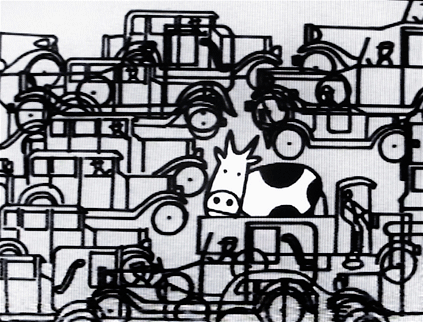
Now what can only be called a characteristic theme. Mr. Binks finds something funny about cows, especially cows that show up where they don’t belong.
The work above is from the project that got Mr. Binks started on the theme, an animation sequence for a program called All About Toronto. “In 1964 or so, back in the days of black-and-white television, I illustrated a story of a cow threatened by the bustle of the big city,” he wrote to me by email. “For this scene black line graphic cells were panned in opposite directions to create a busy traffic effect. To make the cow stand out visually, white cel paint was added.” (For more of Mr. Binks’ cow efforts, look at the posts here and here.)
I think the drawing is beautifully composed. The right-angled shapes and occasional rounded shapes and the patches of space and the busy parts — they’re all crowded together, but modulated and placed so that somehow they fit. The traffic’s busyness jumps at you, but there’s no jangle and your eye isn’t overwhelmed.
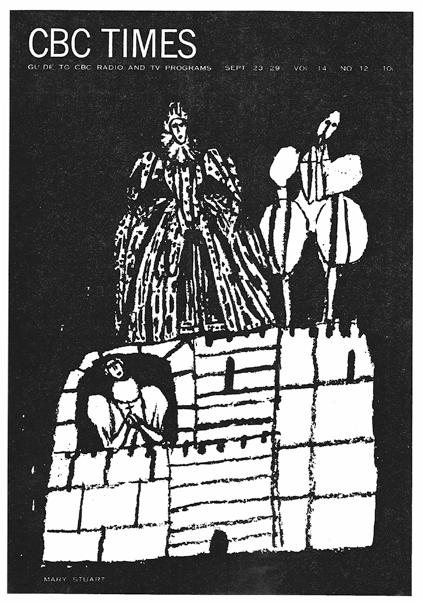
Below is a CBC Times cover depicting the CBC drama, Mary Stuart, Queen of Scots, circa 1961:
The late ’50s and early ’60s saw a lot of faux-naif treatments of high European art, or at least that’s my impression from album covers and theater programs of those days. This Mary Stuart is an especially nice example.
The picture is mocking but also wistful, a combination that I associate with such works. The figures here look like rag dolls locked into a high-vaulted drama that they don’t understand and that nobody else understands either. Mary Stuart emotes, hands clasped and head tilted. The Elizabethan gentleman sags and his head lists, as opposed to tilting. Elizabeth dangles. They’re all grouped around Loch Leven Castle, which is bone-white, and behind them is the black.
The drawing displays two traits that pop up in Mr. Binks’ work. There’s the patch of intricate patterning (Queen Elizabeth’s gown) and the block formed by repeated primary shapes (in this case, Loch Leven). Typically, the block seems to be pulling upward, as is the case here because of the way the shapes within the castle are arranged.
I think the arrangement of the castle’s shapes creates a grace note. The center pile of narrow rectangles abuts a pile of taller, bigger rectangles just to the right. The clash throws into relief the black gap between the two columns, and this gap acts as a line that runs straight up the castle to where Queen E’s foot is planted next to that of the listing gentleman.
To the left of the line, Loch Leven tilts away; to the right, the castle is a bit steadier. So the gap acts as a fault line, and the fault is elaborated on by the positioning of the two fgures. Queen E’s body tilts one way, the gentleman’s head and shoulders sag the other. Subliminally the two of them seem to be toppling away from each other. For what it’s worth, I find this effect underlines the sense of helplessness mentioned above. It’s part of the mocking undercurrent associated with presenting the high historical drama in a faux-childish way.
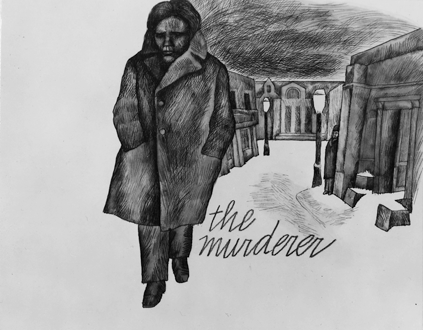
A promo slide graphic for a CBC drama, The Murderer, circa 1962:
The drawing is heavier than usual for Mr. Binks. “This graphic was done in an acrylic water color technique with India ink detail,” Mr. Binks wrote by email. “I was trying for a heavy dramatic feeling.” The characteristically lopsided, playful composition of the buildings takes up much less space than it normally would in one of his pictures, and the foreground figure, looking haunted, is broader faced and more somber than is typical of a Binks figure. The touch that looks most like the artist’s usual work is the popping out of the background figure, who is presumably on the main character’s trail.
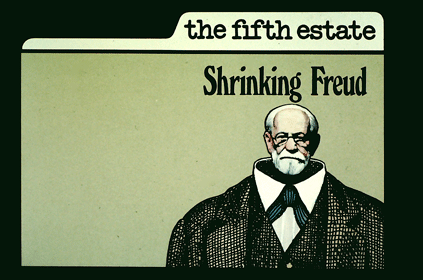
Next, from 1985, a background graphic used for The Fifth Estate, a public affairs program. On screen the host stood to one side of the image.
Shrinking Freud is an example of how Mr. Binks will sometimes play with the pride of place that normally goes to head or features. The eye falls inward from the giant collar and shoulders to find the miniature Freud head.
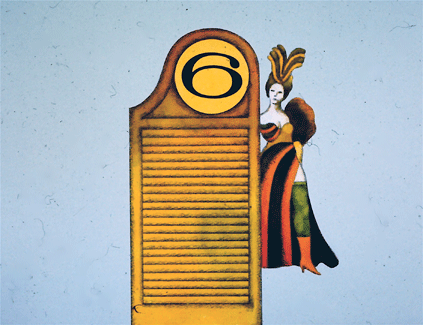
A subtler form of the trick is played by this station break graphic that Mr. Binks designed for Channel Six Toronto, a CBC television station, circa 1975. It shows a saloon door, a show girl and the station’s number. The 6 in its oval, planted atop a column, is like a face that turns out not to be a face; instead the only face in sight, also oval, turns out to be smaller off to one side:
The picture gives the viewer’s eye a strong anchor because the saloon door and show girl, standing side by side, form a vertical block that firms up the center of the picture. But at the same time that block is full of stylistic mismatches that somehow liven up the eye. They’re tricks similar to the head switcheroos mentioned above.
For example, the tight, horizontal rectangles in the door pull away from the big oval at its top, and the number itself is both prominent and a bit too high up for the eye to fall on it comfortably.
The number’s curves and the curves of the woman’s feathers are close together and therefore link up. But the number’s curves are horizontal and the feathers’ are vertical, so the two sets of curves pull against each other. And the feathers themselves push away from each, one set pointing left and the other right.
The symmetry of the feathers’ two arcs bounces against a lopsided echo further down, where a hulking set of curves (the woman’s dress) pushes off to the right.
As noted, these discordancies stimulate the eye instead of baffling it. But why that is I cannot say.
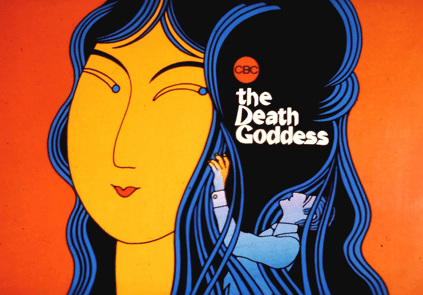
Circa 1982, a promotion graphic for a CBC drama, The Death Goddess. Mr. Binks writes “I used a photographic clear cel with black detail.”
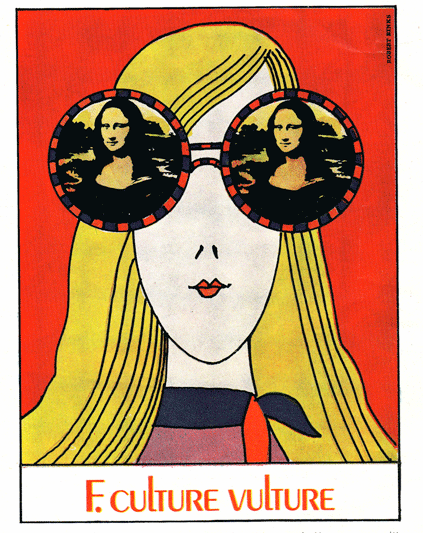
Here’s a non-CBC work. In the mid-1960s Mr. Binks freelanced this illustration for Chatelaine magazine. He describes the subject matter as “a young woman’s first solo trip to Europe.”
As with Shrinking Freud and the Channel 6 promo, there’s a disrupted face at the center of the drawing. Which is a heavy way of talking about a charming picture, but bear with me. Where the girl’s eyes should be, she disappears and one of the most famous faces in the world looks back, but miniaturized and doubled.
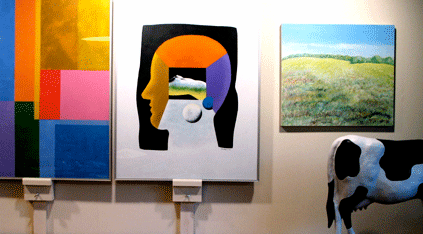
Finally, three of Mr. Binks’ post-retirement paintings, all displayed in his home. The right-hand painting and the accompanying cow sculpture were combined by Mr. Binks into a work called “Cowgratulations,” which can be seen in the post here.
Next week: a black-and-white mastodon and color animation sequences about a fairy tale cat and the frightening beliefs of childhood. Be there!
Music For Middle-Brow Snobs: Corazón Duro
A merengue download mix. Download Corazón Duro here.
1. Cierra Tu Puño — Johnny Ventura
2. Ay Cuca — Felix del Rosario y Sus Magos
3. Ya Me Canse — Olga Tañón
4. Desde Que La Vi — Los Hermanos Rosario
5. Cabecita Loca — Gisselle
6. El Jarro Pichao — Wilfrido Vargas
7. Un Dia En New York — Los Hermanos Rosario
8. Dime — Ashley
9. Corazón Duro — Alex Bueno
10. Soy Un Hombre Felix — Fernando Villalona
11. Mi Amor Campesino — Milly Y Los Vecinos
12. Yo Se Lo Que Quiere El Negro — Belkis y Las Chican
13. Cojelo Ahi — Anthony Santos
Lyonel Feininger At the Edge of the World
Amidst the chaos of New York Comic Con weekend, Desert Island held a kids-oriented, indie comics event at the Whitney Museum of American Art. The children of New York’s young well-to-do families perused colorful booklets and questioned the authors about their work, while collecting pages of a screen-printed (and laboriously produced) ‘coloring-book.’ Occasional bursts of doodled sex or vomit made it through the content filter and into a child’s hands, restoring an earnestly subversive-ness to the art experience.
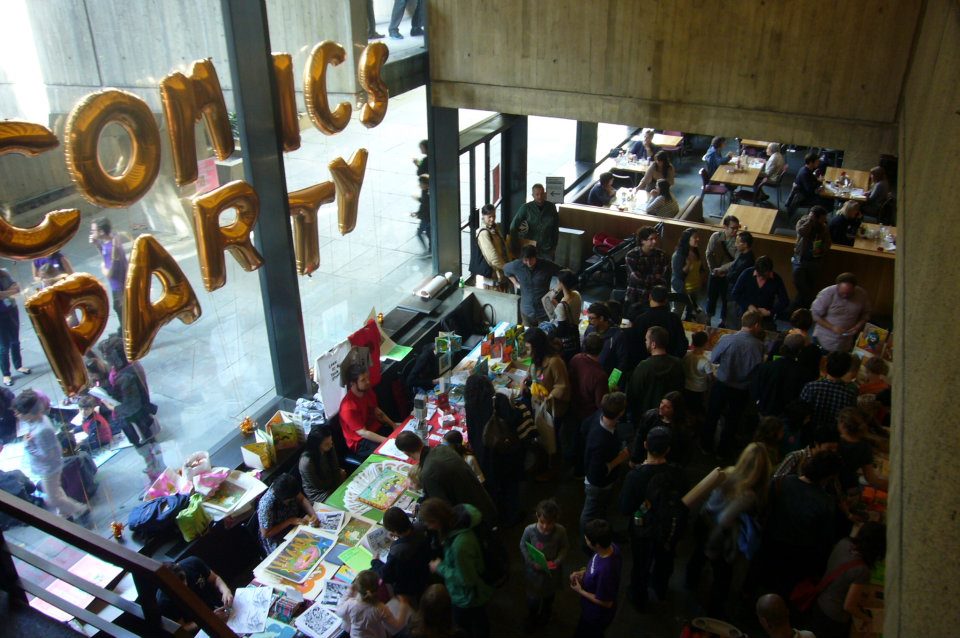
Courtesy of John Meijas
The event tied into the last day of a remarkable retrospective of the work of Lyonel Feininger, subtitled “At the Edge of the World.” Feininger is celebrated in Germany, where he spent most of his artistic career. However, he was born, died, and identified himself as an American—and juggled both an American and German national identities during both world wars. He is best known for a crucial misinterpretation of cubism, developing a romantic, conservative style while the art-world grew more abstract, nihilistic and fragmented. Feininger was successful—he was embraced by the Expressionists, and taught at the Bauhaus. I expect that every major museum of modern art has a Feininger in its collection, but his ‘Prismism’ proved more curious than influential. The Whitney’s resurrection of Feininger didn’t so much revoke previous dismissals as shift the focus away from Prismism to other facets of his work.
In addition to his paintings, “At the Edge of the World” showcased Feininger’s cartoons, photographs, prints, music and wooden carvings. Yet its obvious that Feininger didn’t consider these works as seriously. In a bid to restore Feininger as a relevant artist, the Whitney told a story that Feininger wouldn’t have told about himself. I’m also not sure it’s a story the art-world would have told until recently. The Whitney uses his cartoons and carvings to validate the rosy nostalgism of Feininger’s painting, yet the paintings justify the presence of the cartoons and carvings in the museum. The event is structured like a biographical wunderkammer—a cabinet of curiosities, a history museum. And comics, long eschewed and appropriated by fine-art, are represented on world-class gallery walls and showcased through a series of tie-in events, like talks featuring Art Spiegelman, Gary Panter and Chris Ware, and “Zine Festival.”
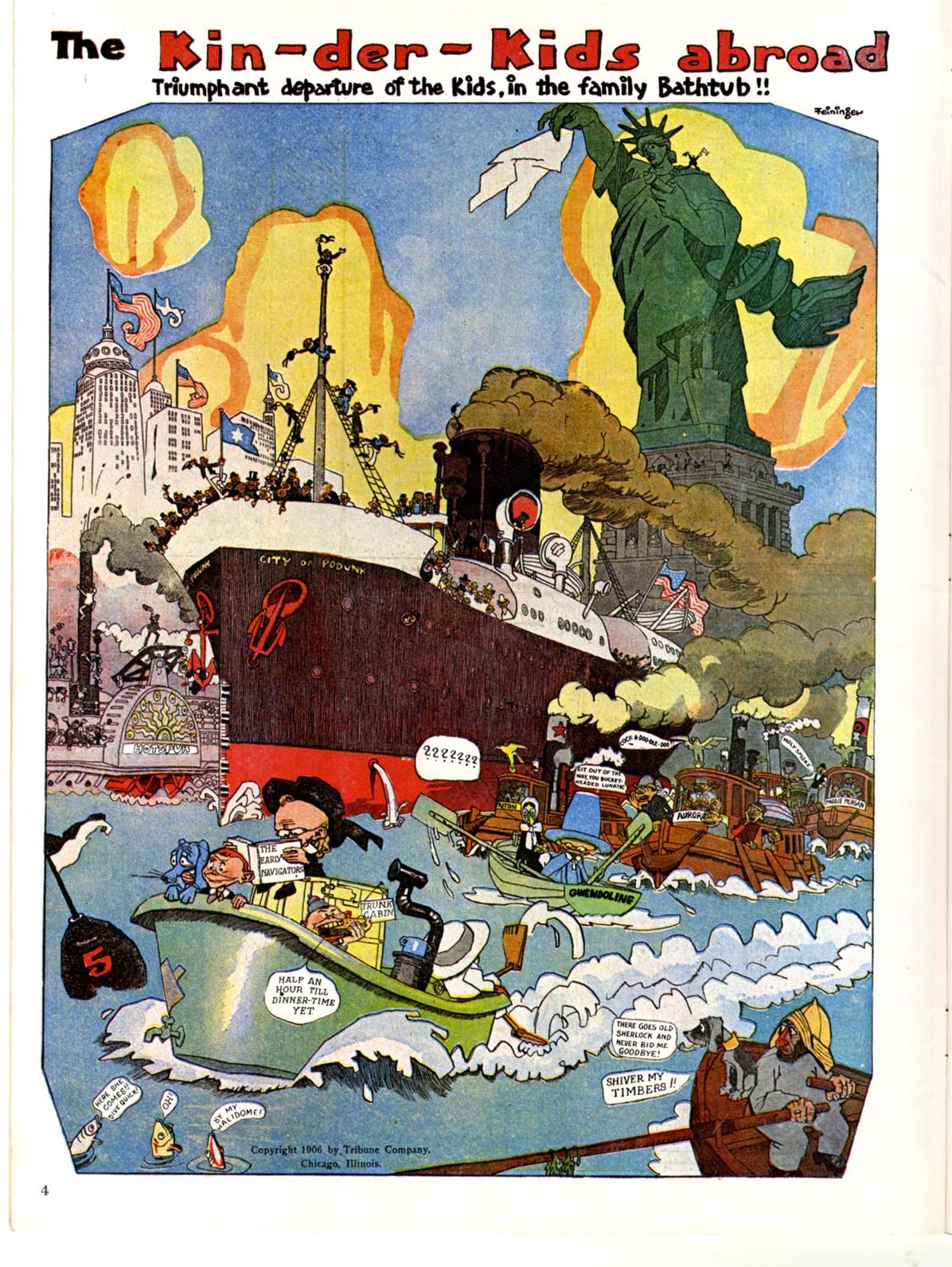
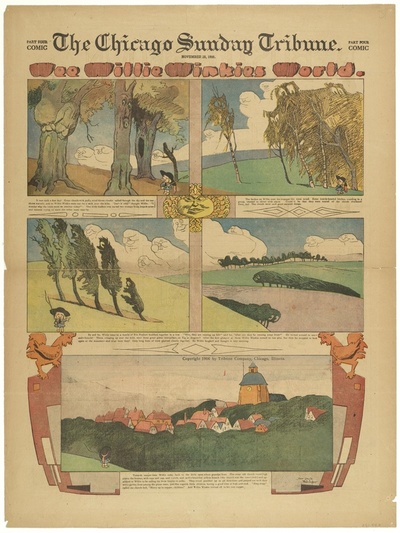
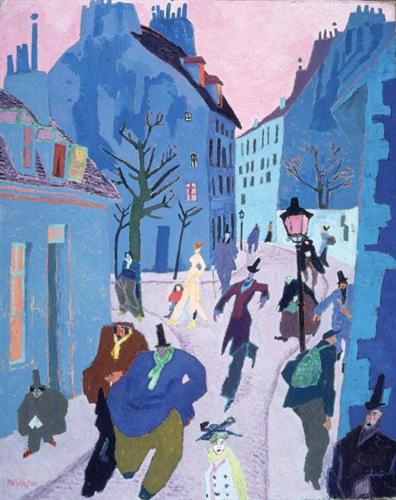
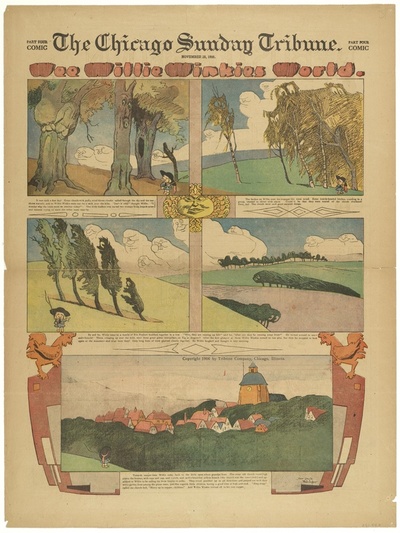
The day I visited, the show was packed with the families from “Zine Festival” downstairs. Young volunteers guided kids through a comics-making workshop in the retrospective’s chain of galleries, re-contextualizing the entire show, for a single day, in terms of Feininger’s cartooning. Feininger is celebrated in the comics world for his brief but mesmerizing turn with the Chicago Sunday Tribune at the turn of the century. The playful, eerie power of “Wee Willie Winkie’s World” and “The Kin-der-Kids” carries over into the best of his canvasses. His early paintings greatly resemble his comics, and later Disney concept art to boot.
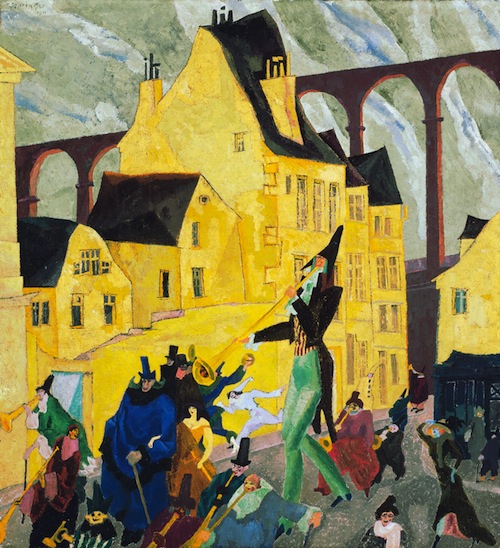
“Carnival in Arcueil”, Courtesy of Art Institute of Chicago
Yet Feininger never returned to making comics after less than a year with the Tribune, (the grueling work-load partly to blame,) and after discovering cubism, grew disinterested with cartooning and weeded its influence from his work. The best of his late-career cityscapes capture the anthropomorphic zaniness of his beginnings, but are drained of their dark charm.
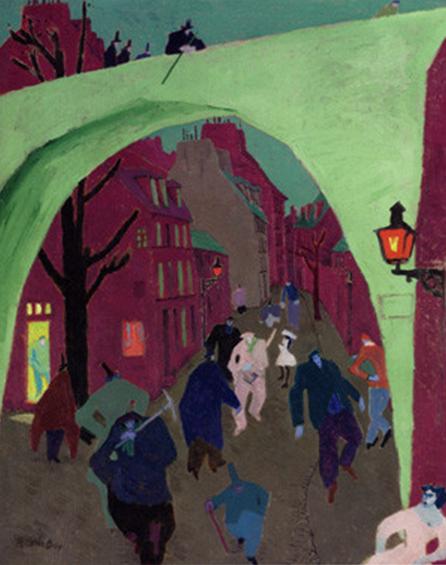
“The Green Bridge
It’s not revolutionary to order a retrospective through a chronological chain of galleries. What was strange was to feature his earliest work in by far the largest and most dramatic room, and run his mature paintings through narrower, middle galleries. Feininger’s career also didn’t come full-circle, but the last gallery spills back into the first like a bout of wishful thinking, allowing attendees to begin and end the retrospective with Feininger’s village paintings. Only the comics gallery is located outside of this artistic trajectory, in the architectural equivalent of a backstory— after passing the first few examples of his provincial scenes, visitors ‘step back’ from the room to learn what Feininger did before painting, and then continue on. This sidelining was necessary to protect the newsprint from light exposure, but downplays the importance of cartooning in his artistic development. His comics were presented more like a period of proto-artistry than the origin of his career.
From a fine-art perspective, this made sense—comics brings its own historic and media-specific baggage that the show wasn’t equipped to address. The Whitney limited the tangent of their inclusion through the size of the room, and limited the think-work of curating them by simply ‘rehanging’ the selections from the “Masters of American Comics,” show and catalogue, a wonder of outside-comics PR that ensured the pages’ inclusion at all. The showcasing of the broadsheets demonstrated their cultural relevance, sophistication, and artistic qualities— yet not suitable as the ‘first’ room of the show, and first period of his career.
While they are not showcased as his first true ‘artwork,’ Feininger’s comics were central to the curator’s strategy to salvage Feininger as a relevant artist. The inclusion of his Sunday pages and wooden toys, long considered low-brow and craft media, shifted the focus of his repertoire from his half-cubist ‘Prismist’ paintings to the brilliance of his caricatures, and his complicated understanding of nostalgia.
The brightly painted, provincial wooden village dubbed “The City at the Edge of the World” was set up in a large, illuminated case halfway through the show, which attendees circumnambulated in a dark room. Unlike the comics room, it was unavoidable when walking from one side of the show to the other. The attendee behavior became a spectacle in its own right, people gasping and pressing their faces and hands up against the glass—a little like kids at a toyshop window. It would have been nice to have seen similar dramatic touches applied to the dim comics gallery, and might have inspired visitors to have viewed it with the same wonder. It would have been strange if they had used a sibling comic-shop model to have played on the nostalgism of the carvings and Feininger’s work—or even placed them in the same ‘fun’ room. I don’t mean to say that the gushes of attention ‘The City’ received were unmerited. It’s unfair to say that the carvings stole the show, as they provided its title in the first place, and were literally its centerpiece.
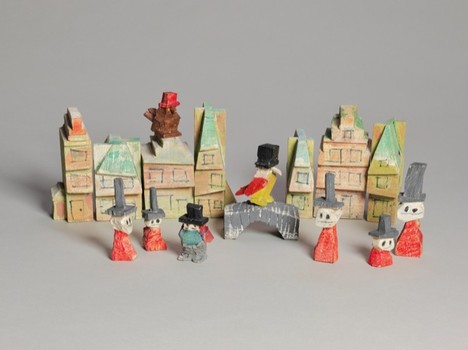
Courtesy of Art Institute of Chicago
“The City at the Edge of the World” is a lovely and touching work, complete with a humble back-story. Feininger carved it with few pretensions for his children. Feininger’s nostalgic and reactionary longings in his paintings sometimes feel a little inappropriate, like an oblivious friend at a delicate social gathering. Compared with the war-time anxieties his Expressionist or Cubist contemporaries expressed through their work, Feininger’s concerns feel a little rude, or beside the point. Feininger refused to depict his times, painting mid-nineteenth century villagers, light-showered gothic cathedrals and seascapes. Just as a funeral is a social venue for certain behaviors and meditations, painting was (is?) a social venue for aesthetic and philosophical confrontation, which Bauhaus and Die Brucke membership aside, Feininger only halfway participated in. (He actively participated in ‘painting as a decorative or nostalgic activity.’ This tradition of painting is alive and well today.)
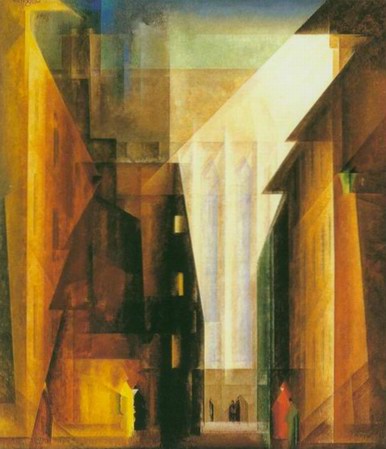
“Church of the Minorities II’
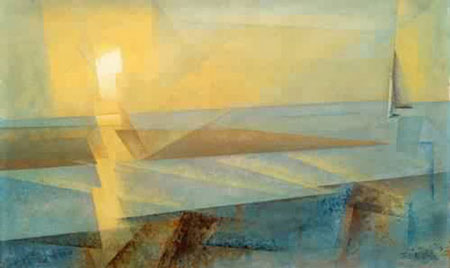
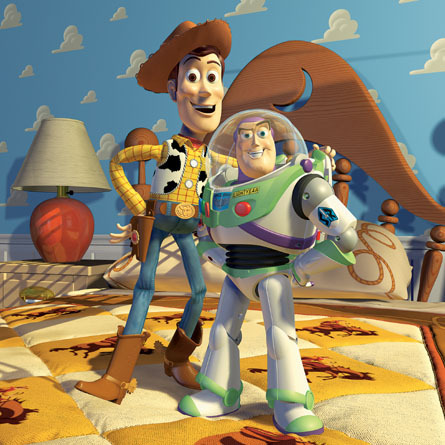
Toy-making has never been a venue for the kind of anxious explorations that Feininger refused to paint. Personal and cultural understandings of ‘toy’ also sync nicely with Feininger’s nostalgic and reactionary focus. ‘The City’ feels spontaneous but conceptually well-developed. When displayed in a museum as culturally relevant, artistically sophisticated works, his toys articulate a self-aware kind of nostalagizing and provincial romanticism. Feininger was whittling away during the rise of industrial and commercial toy production, when the tradition of carving risked being pushed off ‘the Edge of the World.’ While Feininger never intended the carvings to be showcased in a major art museum, they poignantly ask the viewer to simultaneously fantasize about childhood and eras past, and think about how these nostalgias are inextricably linked. It reminds me of another, wildly successful and honest assessment of the impulse to nostalagize.
And in a fatigued art world, obsessed with the auctioning off and display of increasingly obscure works by name-brand hero-artists, I think this ‘honesty about nostalgia’ is incredibly refreshing. The art-world is giving in to nostalgia as well. Without a seductive history behind a work of art, people are innately drawn to the figurative and the narrative, just as babies intuitively like to look at faces. If no one knows the direction to go from post-modernism, why not go the route of romanticism and human connection? It’s strongly connected to what people are fundamentally, universally interested in.
Feininger is an exceptionally good figure drawer and rampant anthropomorphizer. More than that, he is a brilliant cartoonist–his nostalgia feels more sinister than secure. He captures the eerie feeling of twilight, the bigness of a small town — feelings lost growing up, and misremembered with a rosy lens. The key to Feininger’s vision is found in his ‘Wee Willie Winkie’s World’ pages. Feininger has an startling memory for the specific breed of unassignable, atmospheric darkness that accompanied childhood.
Right now, Feininger is an apt candidate for resurrection. The figurative focus of his early, village paintings compliments the art world’s nostalgic longings and interest in characters, but in a way that complicates them. The carvings make his subject matter honest, while the comics showcase what is exceptional about his brand of nostalagizing. And the retrospective format is already a character based show: a historic museum, a biography, and often a little kitschy. Finally, the comics room was underdeveloped, but is a testament that the value of Art, cynically expressed as an auction value, depends more on the stories of success and rarity and mystery that surround an object, rather than what kind of object it is. Comics and toys make a lot of money at the block too.
From the comics perspective, his Sunday Pages came off really well, even given the necessarily dim and appendixical room . Attendees discussed them in small groups, and spent a significant amount of time reading through them.
There’s a curatorial urban legend that states that people only spend around seven seconds observing a piece—the number increases or decreases based on how easy the piece is to analyze and look at. Additionally, a wall can be an uninviting space for comics browsing (I’m thinking of the tediously unimaginative R. Crumb’s Genesis show.) However, comics have an advantage in that people know how to read them. Visitors spent a minute or two on each one, and once presented with the ‘punch’ of its ending, stepped back, thought, and “hmphed” at it. Or laughed. Or discussed it with their friend.
Isolated in their side-gallery, the comics raised questions that the show wasn’t willing to answer—they were truthfully a respectfully included, unexpanded footnote. Viewers might have wondered if most comics were this large and beautiful in 1906. Or, how long have comics existed? If visitors didn’t trace the dates on the labels, it would have been hard to figure out when he had drawn these pages, and what their relationship to his painting was. While I was standing over a group of kids drawing comics underneath one painting, a woman walked over to address the volunteer. “Excuse me,” she said, “I was looking at the comics over there, and was interested in knowing when the speech bubble was invented.” Without missing a beat, the volunteer replied, “I think it was invented by Marvel Comics.”

Gay Ghetto Comics 2: Robert Kirby
Sina Evil is a comics artist, best known for his self-published autobiographical comics series BoyCrazyBoy. He is also completing aPhD on the history of queer comics. He is a huge fan of the Golden Age Wonder Woman. His website is www.boycrazyboy.com.
This is the second of two posts on Gay Ghetto Comics. The first is here. Portions of this post were delivered as a talk at “Materiality & Virtuality: A Conference on Comics” at Leeds Art Gallery on Friday 18th November 2011.
________________________
Throughout the 1980s and into the 1990s various queer people felt alienated from the “official” gay and lesbian community and culture – but nevertheless desired some sort of gay community/culture. Among them were cartoonists who felt that their work did not “fit in” with the glossy, mainstream gay magazines. Inspired by the burgeoning zine culture’s “do-it-yourself” ideals, these new LGBT cartoonists began to produce and distribute their work through self-published comics or small independent presses. These cartoonists were critical of homophobia, but far less interested in affirming a sense of shared gay identity and community. Instead they tended to focus on their personal lives and identities, critiqued mainstream gay culture as conformist and commercialized, and created alternative visions of gay life and culture.
Robert Kirby was one of the pioneers of this new queer cartooning when he published the queer alternative comics anthology Strange Looking Exile in 1990, which ran for 5 issues, and was followed by another anthology, Boy Trouble, in 1994.
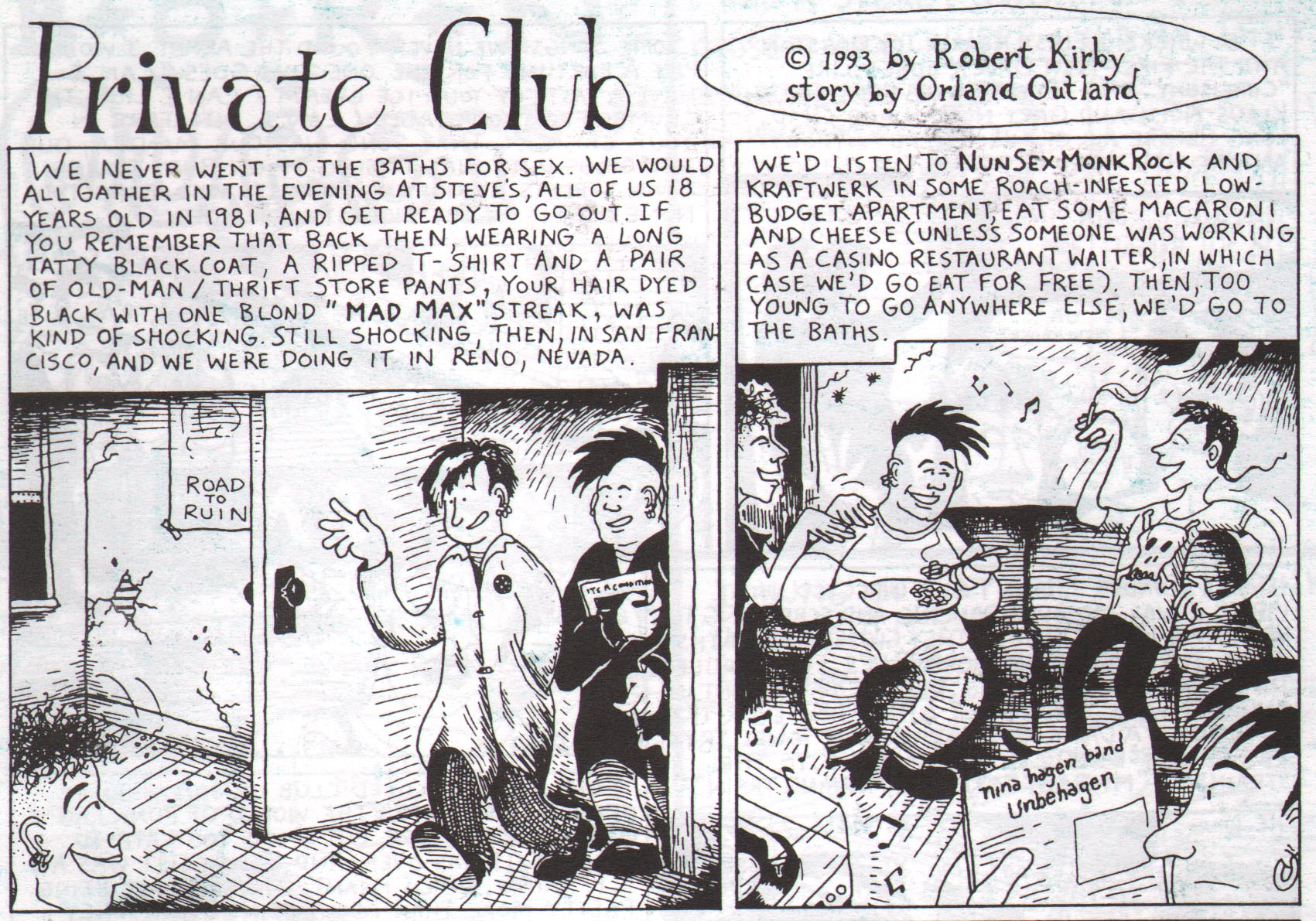
I will now discuss Kirby’s story “Private Club”. The story was adapted to comics form by Kirby from a short autobiographical prose story by Orland Outland. Although not written by Kirby himself, “Private Club” nevertheless typifies many of Kirby’s own concerns as a writer, and his representation of community and “belonging” in his comics.
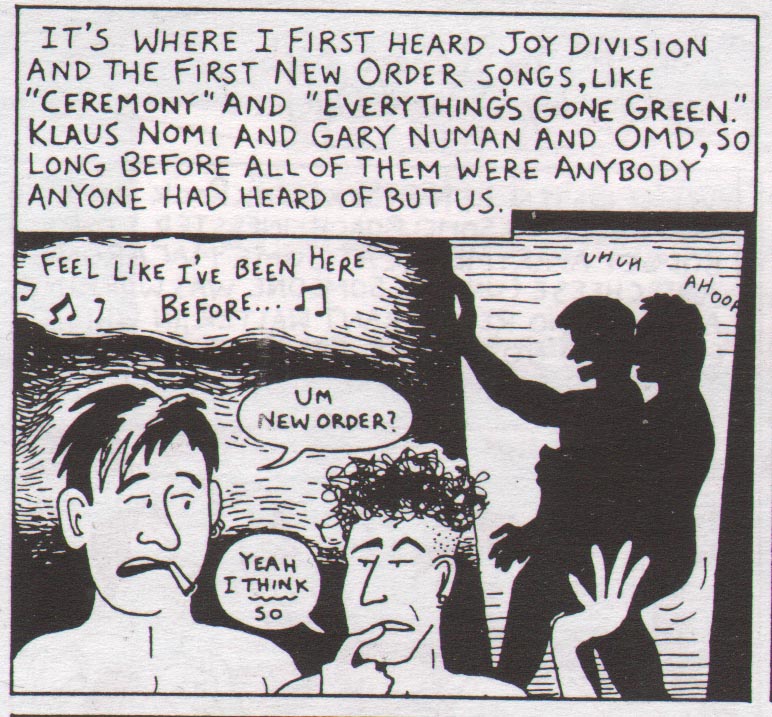
The story is narrated by Orland himself – a middle-aged gay man, a former punk, he reminisces about going to gay baths with his teenage friends in the early 1980s in Reno, Nevada. These teenage queers, too young to get into gay bars, would go to the baths not for sex but “for the music.” Orland describes how a DJ in the baths at San Francisco was making tapes of “the best music in the world” which he would send to the club baths in Reno. The young protagonists of “Private Club” are portrayed as awkward and unsure of themselves, afraid of the highly sexually charged gay subculture, but also more focused on having fun with their friends and enjoying music.
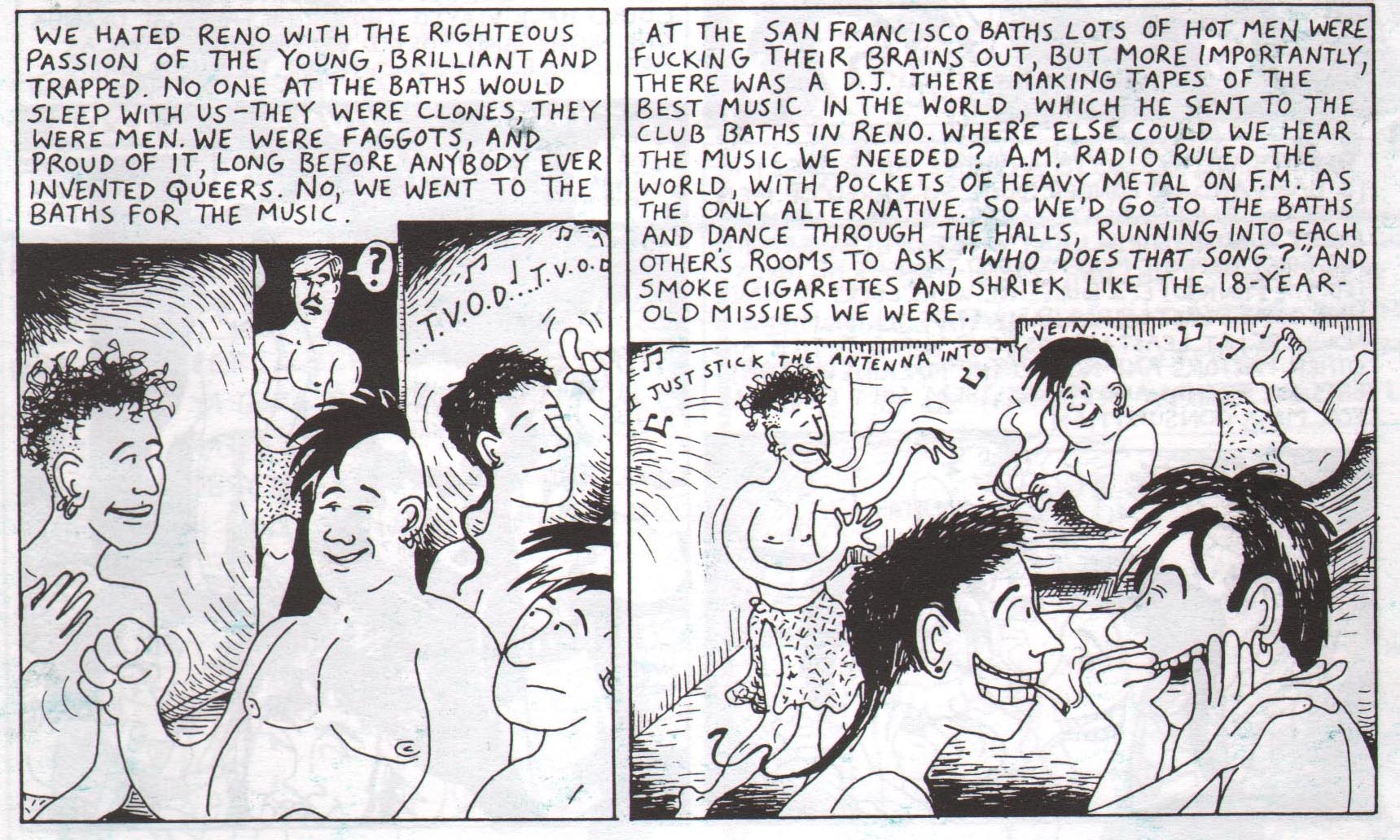
Throughout the strip the narrator’s alienation from “mainstream” gay scenes is highlighted. He and his friends are rejected by the majority of the gay men who frequented the baths in his hometown in Reno, Nevada: “No one at the baths would sleep with us – they were clones, they were men.”
The young punks themselves reject this rejection, emphasizing their difference from the other gay men, turning their difference into a badge of honour: “We were faggots, and proud of it, long before anybody invented queers.” In one panel Kirby depicts Orland and his friends dancing and singing along gleefully to “T.V.O.D.” by synth-punk act The Normal, while a muscular, mustachioed gay man peers from behind a wall in the baths, bemused and annoyed at being interrupted while cruising and having sex.
The teenage faggots’ behaviour is an example of what Michel de Certeau describes as “tactics” in his book The Practice of Everyday Life. De Certeau aims to outline the way individuals unconsciously navigate the everyday and distinguishes between what he calls “strategies” and “tactics”. Strategies are employed by institutions and structures of power who are the “producers” of culture, and seek to control ordinary people; on the other hand, Certeau sees individuals as “consumers” who use “tactics” to negotiate some sense of agency in environments defined by the producers’ strategies. A classic example of “tactics”, described by de Certeau, is the secretary who “poaches” time and materials from her boring office job to write a love letter – on company time and using the institution’s resources. This illustrates Certeau’s argument that everyday life works by a process of poaching on the territory of others, using the rules and products that already exist in culture in a way that is influenced, but never wholly determined, by those rules and products.
Like Certeau’s “tactical” secretary, the young faggots of Outland and Kirby’s strip use the space of the gay baths for something the institution does not intend the space to be used for, transforming parts of it into their own “private club” – as the story’s title implies, a private space (albeit in semi-public) where these teenage punks have the freedom to be themselves, listen to their favourite punk/synth-rock music, “smoke cigarettes, and shriek like the 18-year-old missies we were.” By appropriating space in this way the young faggots create for themselves a different kind of “community”, an alternative reality.
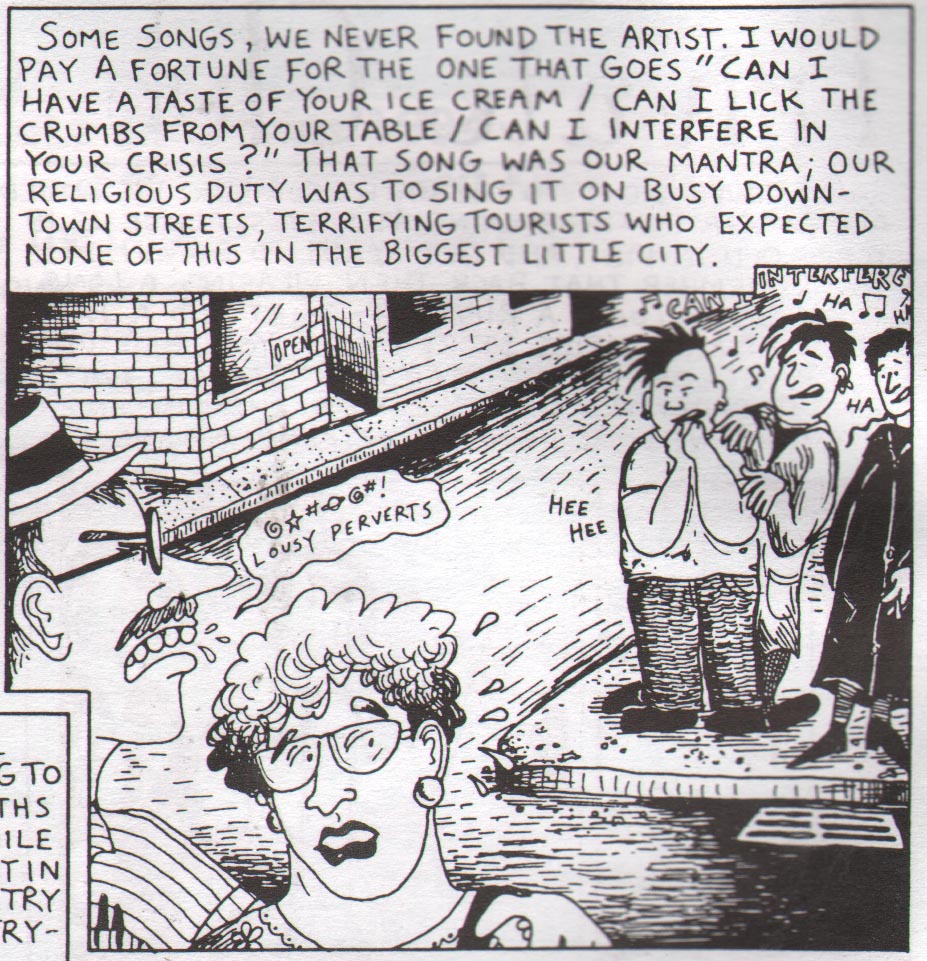
This alternative reality is one that contrasts with the young punks’ repressive, heteronormative surroundings in Reno – in one panel Orland and his friends are depicted standing on a street corner, delighting in singing offensive punk lyrics loudly in an effort to frighten heterosexual passersby – another example of Certeauian “poaching.”
However the young faggots also seem to enjoy interfering and disrupting the “normal,” everyday rules of the game at the gay baths, “poaching” on the territory staked out by the sexually confident community of “clones” that are the club’s primary clientele.
This disruption is manifested through their sloppy, “punk” appearance and their decidedly unsculpted bodies, which contrast with the more groomed and “worked-out” looks favoured on the mainstream gay scene, defying mainstream gay culture’s normalizing disciplinary regimes.
A further disruption of the bath’s status quo is the young faggots’ ebullient enjoyment of “unusual,” punk music, and their playfully effeminate “camping,” which contrasts with the more “serious,” “tough” and “masculine” postures adopted by the majority of the bath’s visitors.
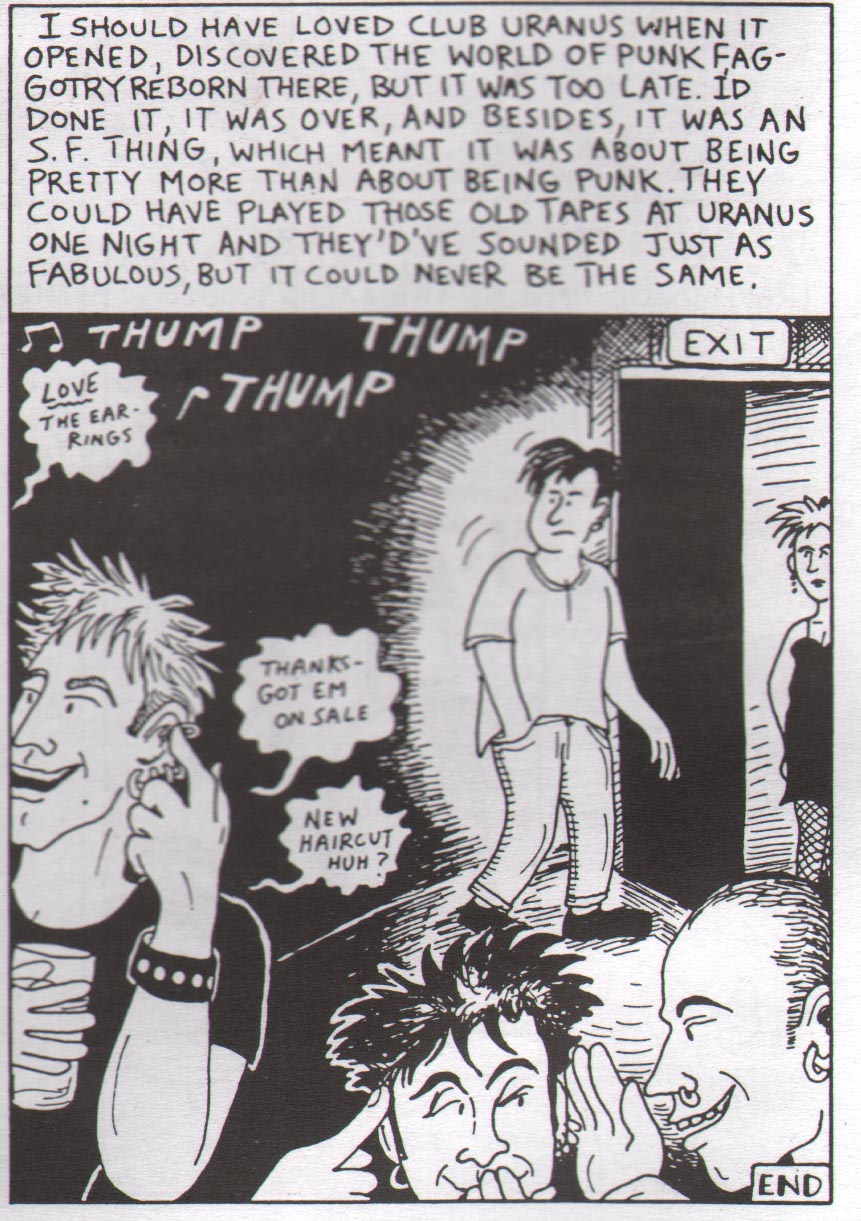
The strip’s protagonist, Orland, describes the baths as “our secret world” of “punk fags in the middle of nowhere,” and distinguishes his friends from the “gay clones.” The story closes in the present day, with Orland visiting Club Uranus, a gay punk rock club in San Francisco; Orland notes that although in theory he should have loved this club, in fact he experiences it as a sanitized, commercialized version of the more amorphous, less official space he had “poached” and shared with his friends.
Kirby portrays Club Uranus as populated by handsome athletic gay men sporting fashionable tight T-shirts, spiky haircuts and trendy piercings, discussing their accessories (“Love the earrings”/”Thanks – got ‘em on sale”) – the narrative caption reiterates that in contrast to the “private club” of Orland’s youth, commercial “punk” clubs are “about being pretty more than about being punk” – San Franciscan queer punks are represented simply as another kind of gay “clone”, another commodified, conformist gay identity.
In my interview with Kirby he described himself as, at one time, feeling like “a square peg surrounded by many round holes” (interview, Minneapolis, Minnesota August 18th 2008) – and this is how he represents Orland, the protagonist of “Private Club” – alienated not only from the gay mainstream “clones” but also from the gay punk scene which in theory he “should” feel a part of; the story, then, like many of Kirby’s comics, emphasizes the tensions and conflicts inherent in the notion of community.
At the same time, “Private Club” suggests that a kind of postmodern experience of community is possible and indeed valuable – the strip emphasizes the importance of Orland’s teenage bonds with his punk faggot friends, and in some ways – and for a necessarily brief time – this friendship group, Orland’s “private club”, does operate as an ideal(ized) community where the young punks’ difference from their heteronormative small town and from the norms of gay culture can be celebrated and enjoyed.
Many familiar elements of gay alternative cartoonists’ representation of mainstream gay culture are present in “Private Club”: “Mainstream” gay men (whether in repressive small towns or metropolitan gay ghettoes) are represented as vacuous, body fascist, and conformist, and are visually represented (on the whole) as slim, athletic, and fashionable in a commercial, “mainstream” way. They are akin to the types of gay characters prominent in comics like Troy, Joe Boy, Kyle’s Bed & Breakfast and Chelsea Boys, but in “Private Bath” they are background characters and figures of mockery, in contrast with the punky young faggots who are the story’s protagonists. The young protagonists’ “punk” gay identities are also posited as an alternative to mainstream gay identity – this is a kind of queer identity built around references to “alternative” fashion, music and taste. Characters like the young punks of “Private Bath” (re)appear as protagonists throughout Kirby’s oeuvre, and can also be found in the work of many of the other gay alternative cartoonists who began publishing their comics independently from the 1990s to the present day.
Life on Earth; Life on Bjork
I’m reprinting two related reviews; the first appeared on Madeloud; the second on Splice Today.
_______________________
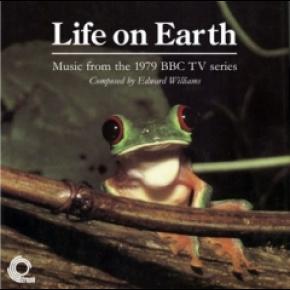
Edward Williams – Life on Earth: Music From the 1979 BBC TV Series
I actually cried when I missed an episode of the David Attenborough BBC mini-series Life on Earth.. I was in middle school at the time, and my family watched the show religiously every week, but I had a swim meet, and we’d just forgotten. Worse, it was the reptile episode. I loved reptiles.
It’s hard to believe I remember all that now, three decades later. I remember, too, that much as I loved the show, the end of each segment was thoroughly disturbing; you’d watch these wonderful, strange animals for an hour, learn about their habits and their lives, and then, at the end, David Attenborough would explain in his matter-of-fact, British voice, how man’s relentless expansion was inevitably going to kill them all.
And yeah, I remember the soundtrack too. Not the melodies or anything, but the broad outlines of the music; quiet, translucent, and fey; chamber music to contemplate extinction by. It’s bizarre how clearly the show comes back to me while listening to this newly released reissue of music from the series. The plangent woodwinds, the splashes of strings, the dischords that never resolve but just drift away — I can see the water dropping into the pond, or the butterfly coming out of its cocoon, or the hummingbird wings slowed down so that Attenborough could count the beats.
Obviously, I’m older at this point, and while the music seemed sui generis back then, it now fits into a recognizable context— which is to say, composer Edward Williams loves, loves, loves him some Debussy. But even so, there’s a strangeness and a humor here that’s hard to resist. The wonderfully named track “The Sex Life of Ferns” starts with a light percussive patter, as if all those spores are nervously shuffling their bits in anticipation; then, towards the end, there’s a lazily triumphant woodwind, and you can imagine various leafy greens rustling in a satisfied manner as the sun sinks low in the distance. “Big Mammals” has a slow, swaying lope with just a touch of Tarzan jungle drum, so you can almost see those big trunks swaying. And then there are the lovely albeit somewhat unfortunate Orientalisms on “Japanese Macaques.” It’s all so melancholically precious, or so preciously melancholy. I don’t know if Donovan ever saw Life on Earth, but if he did, he would have understood.
Perhaps my favorite track is the final one, taken from the last episode in the series, “Man.” I pretty much hated “Man” at the time; I wanted to see reptiles biting things and frogs jumping, and elephants trundling, so a bunch of people walking through cities was just not what I was parked on the couch for. Yet, despite my disinterest, Attenborough’s final words have remained with me for most of my life, and it was a jolt to hear his narration excerpted here. “The fact remains that man has an unprecedented control over the world and everything in it. And so, whether he likes it or not, what happens next is largely up to him.” The music for the finale is an odd duel between a inspiring fanfare and a mournful little solo violin theme. Eventually the fanfare seems to win out…but in the last second or two it trails off weirdly, as if embarrassed. It’s an appropriately uncanny moment. In this mini-series and album, life doesn’t so much dominate the planet as haunt it, passing across the surface of the earth like a shadow, or an oddly vivid memory.
_____________
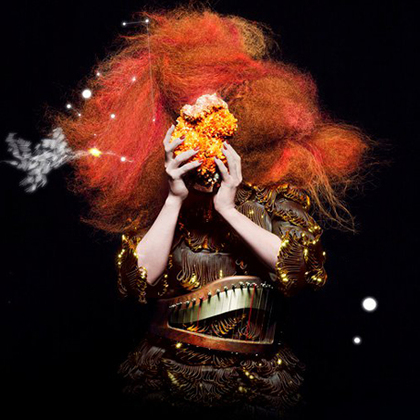
Bjork: Biophilia
Bjork is Bjork. Over the years she’s become one of those artists who is a genre unto herself. Though she’s got connections to the fey new folk movement and links to the fey end of New Age electronica and an affinity for other fey Icelandic post-rock romantics like Sigur Ros, the truth is that when you listen to any of them and Bjork, she becomes the meme and they become the iteration. Or, to put it another way, they all sound like Bjork more than Bjork sounds like them. You can compare her to whoever till your hair turns pixie polycolors, but Bjork is not post-rock folk electronica. She’s Bjork.
Which is why her latest effort, Biophilia, gave me a start. Not that it’s different from her past releases—if you’ve heard Vespertine(2001), or Medulla (2004), or Volta (2007), you’ve got a good idea what to expect from Biophilia. It’s just that all of a sudden, the Bjork sound didn’t sound like Bjork. It sounded like Edward Williams’ music for the David Attenborough mini-series Life on Earth.
What made me think of Williams’ quiet, Debussy-like score are no doubt Biophilia’s lyrics. You can get the gist from the song titles: “Moon,” “Crystalline” and “Solstice.” The album is post-rock folk electronica for the natural world. You listen to its plangent blips and murmurs and visualize plants opening or birds’ wings beating in motion so slow you can see each feather shudder. Nature, in Bjork and Williams, is figured as a series of disturbingly vivid tableau arranged for uncanny contemplation. At the beginning of “Hollow,” the echoey, arthymic keyboard sounds patter forward, then pause, then patter forward, then pause, like a small furry creature scuttling across the ground towards food. “Moon”‘s plucked lilt could be the background for a butterfly slowly coming out of its cocoon. “Thunderbolt” is even more explicit: “Staring at water’s edge/Cold frost on my twig/My mind in whirls/Wandering around desire/…Craving miracles.” Then at the end of the song, the electronics start burping like a series of frog calls. Suddenly Bjork isn’t Bjork. She’s library music for a nature special. How did that happen?
“Virus” seems like an attempt to explain the process. “Like a mushroom on a tree trunk/as the protein transmutates/as I knock on your skin/and I am in,” Bjork sings in her usual hoarse, soaring precious diva style as the music drips and clinks, water falling on chimes. Nature is both a smooth vision on the eye and an ominous visitor moving under the skin. Nothing is really itself. “My sweet adversary,” Bjork calls her lover/disease, as the distanced music and its surface prettiness turn her into an aestheticized transient shadow. If you watch nature, and nature is you, then you are both inside and outside, a ghost infection haunting yourself. At that point, you can hardly be surprised when you become something else, even if that something else is a 30-year-old BBC miniseries.
Or, for that matter, an up-to-the-minute pomo marketing endeavor. Biophilia is as detached from its identity as Bjork is from hers. It isn’t really an album so much as a nexus for related products, including a series of apps for every song and a range of multimedia live shows some of which, apparently, include National Geographic imagery. Still, as I lack the funds, the technology, and the interest to pursue the album through its metastasizing iterations, I’m happy that my brain has instead decided to attach the soundtrack to my own hazy memories of creepily perfect nature specials past. I hate to admit it, but Bjork as Bjork was beginning to get a little boring. Bjork as mushroom with David Attenborough narration, though, is a thought to cheer every phylum.
Utilitarian Review 11/19/11
On HU
In our Featured Archive post this week, James Romberger discusses the critique of Christianity in the work of artist David Wojnarowicz.”
I talk about decadent viewers and decadent villains in 13 Assassins.
Sina Evil on Gay Ghetto comics.
I reviewed Marston/Peter Wonder Woman #25.
Robert Stanley Martin on Julian Barnes’ Sense of an Ending.
Nadim Damluji interviews Craig Thompson about Habibi and Orientalism.
I compare Kyrli Bonfiglioli’s All the Tea in China to Peter Carey’s The True History of the Kelly Gang.
I talk about Bella, Katniss and (fear of?) femininity. (Caroline Small makes a special guest appearance.)
I explain why Obama is no Khruschev.
Utilitarians Everywhere
At the Atlantic, I had a post about Twilight and the Hunger Games.
At Splice Today I argue that Herman Cain’s campaign does not mean that ideology has trumped racism.
Also at Splice I talk about frame stories and narrative in How To Train Your Dragon. (Also why it’s better than Harry Potter.)
Other Links
Shanenon Garrity asks various folks (including me) what comics adaptations they would and would not like to see.
Ty Templeton’s blog is really entertaining.
Rod Dreher on empathy and justice in light of the Penn State scandal.
Tucker Stone with a long interview with Mark Waid.