
In an attempt to get through the first 20 issues of Elfquest in less than a year and a half, I’ll be tackling issues #3 and #4 today. As always, you can read along at elfquest.com if you don’t have the paper issues.
Monthly Stumblings # 9: Hergé
Tintin au Congo (Tintin in the Congo) by Georges Remi (aka Hergé)
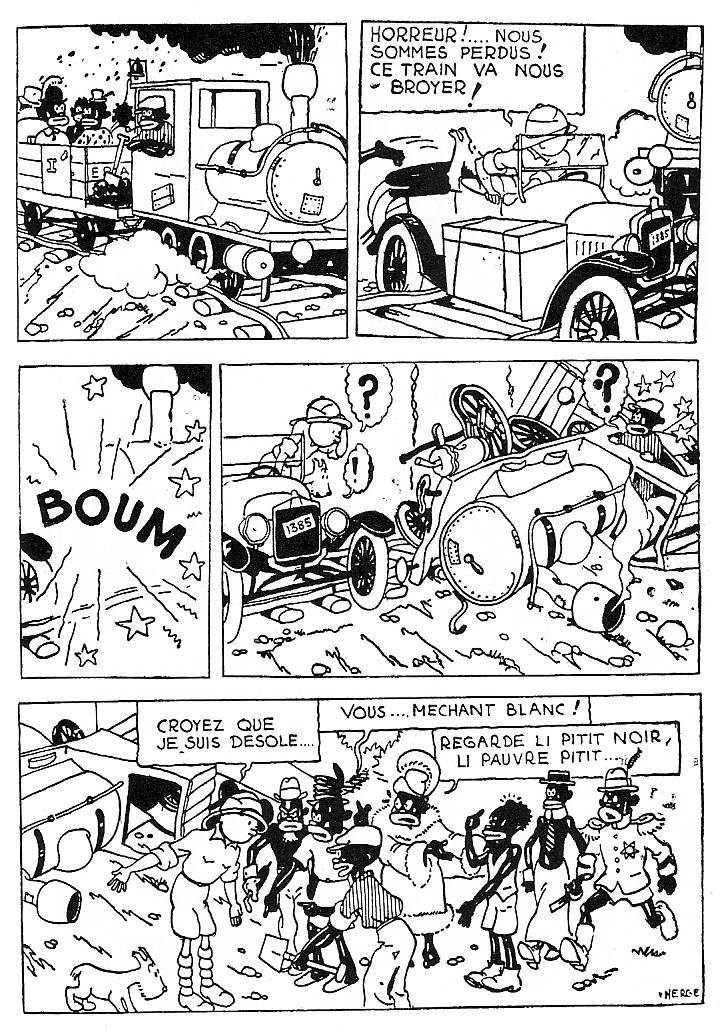
Reproduced above is page 32 of Tintin au Congo published in the children’s supplement of the Belgian newspaper Le Vingtième Siècle (the twentieth century), “Le petit vingtième” (the small twentieth), September 18, 1930. Tintin au Congo was serialized in “Le petit vingtième” from June 5, 1930 to June 11, 1931 (110 pages in toto). The album (or graphic novel if you will) was published in 1931. Tintin au Congo is Tintin’s second adventure.
Utilitarian Review 1/22/11
On HU
Kinukitty was underwhelmed by much yaoi.
Sean Michael Robinson discussed Manga! Manga! and interviewed its writer, Frederik Schodt.
Ng Suat Tong introduced the awards for the Best Online Comics Criticism.
The final list of Best Online Comics Criticism.
Bill Randall, one of the judges of the Best Online Comics Criticism, discussed the list and his choices.
I talked about two of my favorite pieces of comics criticism from last year.
Vom Marlowe discussed the use of ink in Kouga’s Loveless.
Caroline Small talked about sequence (or the lack thereof) in Saul Steinberg’s Passport.
Alex Buchet looked at the influence of editorial and panel cartoons on the English language.
Utilitarians Everywhere
At Splice Today I explain why Michael Chabon is not necessarily more thoughtful than Barack Obama.
This, indeed, seems to be the cause of part of Chabon’s dyspepsia. Artists, especially successful artists like Chabon, receive such fulsome praise that I think they can occasionally mistake themselves for priests. Which is maybe why he felt qualified to proclaim with such certainty that heaven isn’t real and that death is just absence. To suggest otherwise is a stylistic error—rectifiable only by transforming the clumsy words of the President through the magical gifts of a real writer.
Also at Splice, I discuss the Meads of Asphodel’s anti-Christian Broadway black metal.
I do have a hideous attraction/repulsion for show tunes, and I think it makes sense to think of them as the music of the Antichrist. Especially if the show tunes are written by Andrew Lloyd Weber. And I dare anyone to listen to the second half of the song “Addicted to Christ” without having major Jesus Christ Superstar flashbacks. There’s a lonely horn that wanted to be jazz but had its soul stolen by music theater, and then a choral refugee starts singing like a chipper thespian—“Who is God? I am God? Are you God? But what God? I’m no God, it’s my God.” Soon enough we’ve got contrapuntal voices reciting bitter lyrics in an uplifting back and forth (First cheerful voice: “God hates you all!” Cheerful choral response: “Circumcise!”) And after not too long, again like Lloyd Weber, we launch into some classic rocky concept-album strut. Even the end, with a more traditional metal vocalist and a heavier roar, still has the busy crescendos and prog-rock shifts that strongly suggest Vegas.
Other Links
Sean T. Collins argues that Dirk Deppey’s column ran out of gas at the end, and that tcj.com is an embarrassment. It’s a thoughtful piece; if you scroll down you can see me doing some arguing in comments.
This made me want to try those old Rachel Pollack Doom Patrol issues again.
Strange Windows: Keeping Up with the Goonses (part 6)
This is part six of our look at comics, cartoons and language– today focusing on panel and editorial cartoons
“When I saw them together at the beach, that’s when the light bulb switched on: they were having an affair!

The origin of this metaphor– the light bulb moment– for a sudden realisation or a bright idea, I’ve been unable to pin down– but it definitely comes from comics. Note that the newspaper comic strip and the electric light bulb both came about around the same time…
However, another fine old comic strip depiction– that of sawing wood to indicate snoring:
Continue reading
In praise of Saul Steinberg
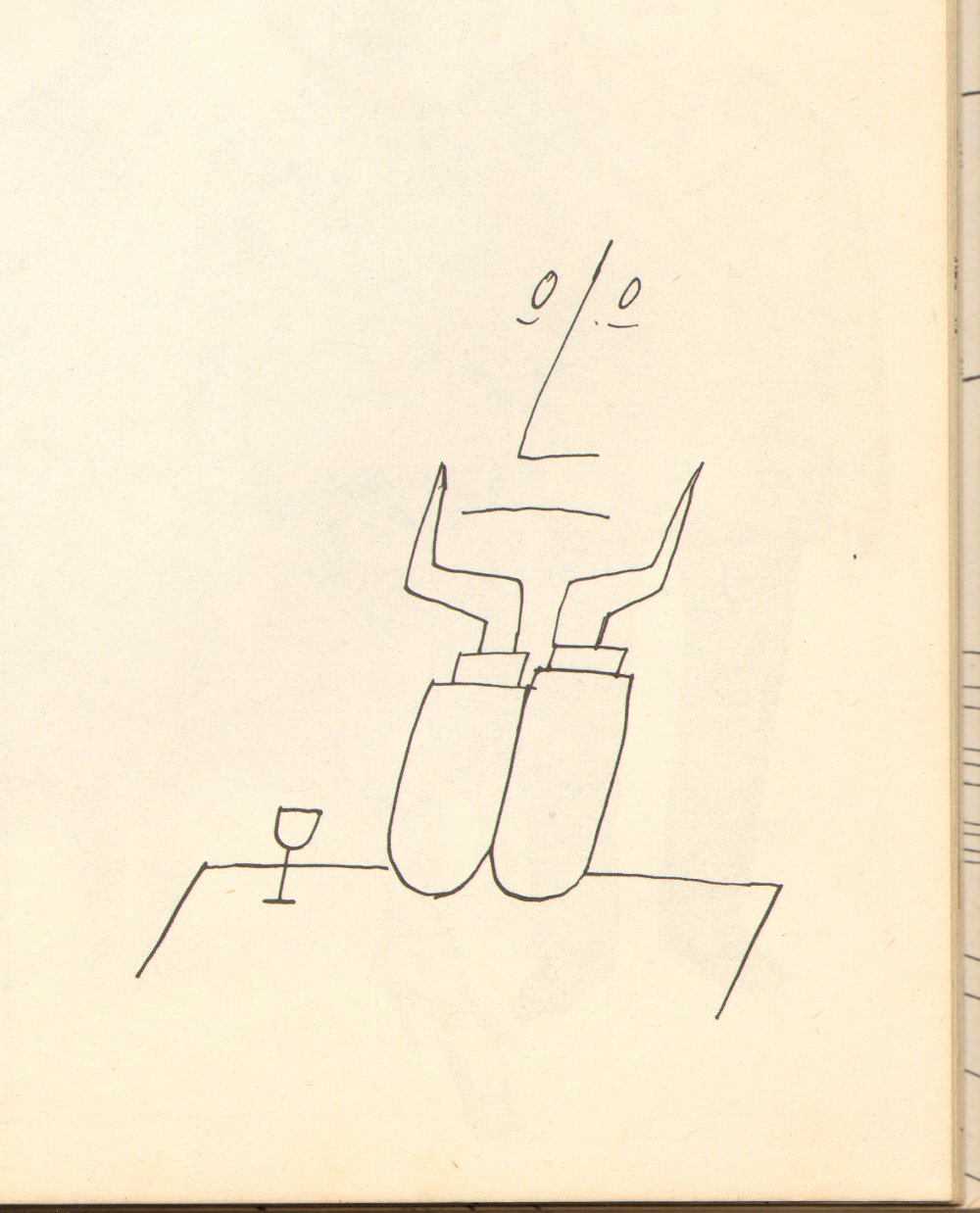
(Please click on all images — they’re much easier to see in the big versions.)
Over at The Panelists, in the comments to Derik’s really terrific post on Blaise Larmee’s Magic Forest, I’ve been harassing Charles Hatfield a bit about the theoretical status of “sequence” in comics studies. For me, the importance of sequence is always overstated in a way that I think limits what the term “comics” can be appropriately applied to and, even worse, emphasizes one subset of elements within comics – the sequential, narrative ones – at the expense of the metaphorical and structural aspects I find more interesting.
Loveless Ink
This is an exploration of how Kouga’s inks and composition show character and mood in the first volume of Loveless. The art style shifts with point of view and interactions, building into a powerful visual language.
I have mixed feelings about Loveless. It’s a hot mess in a lot of ways. The story contains horrible child abuse of various kinds, including some that is institutionalized and some that is family, various reprehensible relationships, some seriously broken people, a couple of sociopaths, BDSM themes (both consensual and not), dubious portayals of motives of people who ought to be villains but might not be, amnesia, innapropriate information about sexuality, and some of the most heartbreaking and beautiful characters I’ve ever read.
All this in a cat boy story about preteens. Oh, manga.
Continue reading
Best Online Comics Criticism 2010: Kibbitzing
I had no involvement in the selection of this year’s Best Online Comics Criticism. And I don’t plan to talk directly about the list here. Except to point out that it is fatally flawed. Because I’m not on it, damn it.
I did think I’d take this opportunity, though, to talk about two of my own favorite pieces of comics criticism from last year.