Gluey Tart: The Way to Heaven

way to heaven

The Way to Heaven, Yamimaru Enjin, 2009, Digital Manga Publishing

Why don’t I like this book? Well, for starters, the backward E in Heaven. Let me share my thought process with you. I said, good lord, that’s a beautiful cover. Those young men are gorgeous. Must read pretty book! What’s it about? Oh, who cares! What lovely art! Why the hell is the first E in Heaven backward, though?

I found that E annoying, and I should have resisted the lure of pretty tie-boy and gone with my initial misgivings. (I’m drawn to the tie itself, not just the prettyboy wearing it; the color, the rendering – it’s a very nice tie. It’s the best thing about the manga, so I urge you to take another look and fully enjoy it.) Unlike the guys in this story, though, I haven’t been plucked from my painful personal drama by a hot and annoyingly playful alien who agrees to give me another chance by allowing me to go back in time for an additional fraction of a second for every test tube I can fill with blood or semen. Looking deep into my heart, I find that I’m really, really OK with that, though.

I’m sorry, I can’t advance the narrative because I keep going back to that damned E. You know what it reminds me of? The logo for Angel, a sort of proggy glam rock band from the 70s. I had pictures of them on my wall and was especially enamored of Punky Meadows.

angel

In fact, this picture right here might have been the initial building block of my lifetime interest in prettyboys. This post is starting to have a monumental, historical sort of feel, isn’t it? Wow. I feel so close to all of you right now. I hope you’ve enjoyed this sharing thing as much as I have. Anyway, I used to have an Angel t-shirt that pleased me immeasurably, partly because I really liked Angel, but mostly because the logo reads the same upside down as it does right-side up.

angel

I drew it on my notebooks and stuff. Nifty, isn’t it? Well, you, The Way to Heaven, are no Angel logo.

Where does this book go so wrong? It isn’t like the plot isn’t clinically insane. There’s the afore-mentioned gathering of fluids. Also, the alien riffs on Sailor Moon. (This gets pointed out, by the mangaka or by the translator, but I was already on it because, in the spirit of over-sharing I’ve just established, yes, I read the whole Sailor Moon series – and no, I can’t explain myself; it’s just one of those things, like Us Magazine and peach Fresca). The drawing is nice throughout, and the two main characters fall in love, just like they’re supposed to. By the way, one of them gets turned into a vampire, all the better to collect the blood, and the other one gets turned into a werewolf (not that he ever turns into a wolf or uses any werewolf powers), the better to collect the semen. Wait. Huh? Don’t ask me – I don’t know.

Here’s a plot sketch. A former boxer, who was forced to quit the sport because of an eye injury, walks across a pedestrian bridge and falls off it while trying to rescue a puppy. Pretty tie-boy sees this happening and tries to save him. They both go overboard and get hit by a truck. A lovely alien lady, who’s been sent to save the earth by setting up an energy recycling system, tells them she’s chosen them for her pilot project. For every vial of blood and semen they collect, she’ll let them go back in time a fraction of a second from “ground zero.” That setup didn’t push any buttons for me – I mostly was just upset because it looked like the dog died. Also, I don’t know – going out and collecting vials of blood and semen for a really, really long time (especially when it’s made clear that semen-guy would rather not – which doesn’t seem like the wrong response, I don’t think) – not sexy. Just isn’t. I realize there are no absolutes in what people find erotic, or in anything else, really, but – this isn’t an especially hot setup, is it? Maybe I’m missing something.

Or maybe that’s supposed to be the funny part. Because the back of the book says “The Way to Heaven passes through comedy, drama, and steamy passion on its way to spiritual Shangri-La!” I assume they mean Shangri-La as in finding true love after a life spent searching, rather than in the sense of the Nazis looking for an ancient master race that hadn’t been ruined by Buddhism. Although, who knows, really. I wouldn’t put anything past this book, and to tell you the truth (since we’re sharing so much already in this post), I had kind of stopped paying strict attention by the time I got to the end. So maybe they slipped some kind of Raiders of the Lost Ark subplot in there and I just missed it.

So. There are plot complications, but the boys find true love. The set up and plot complications made it impossible for me, however, to give a damn. I mostly just wanted the book to end – and, there, at least, it did deliver. If what I’ve described sounds like just the thing to you, I’d suggest you run over to Amazon.com and buy it now because even though it was just released in February, it seems to be out of print. While you’re there, you might want to read the five-star reviews, which compare this to The Matrix. It doesn’t especially remind me of The Matrix, but I didn’t especially like that, either, so maybe this book was just a bad fit for me. The art is certainly pretty, and there is sex and romance. Either way, go in peace.

You’re a Decent Church-Going Adolescent, Charlie Brown

Charles Schulz
Schulz’s Youth

The publishing world is doing right by Charles Schulz; virtually everything the man did is making its way back into print. So now, alongside Fantagraphics’ steady reissue of all the Peanuts strips, we also have available a wealth of side-projects. That includes this series of cartoons which Schulz drew in the ‘50s and early ‘60s for Youth, a magazine aimed at religious teens in the Church of God (Anderson) movement, with which Schulz himself was affiliated.

The content of the strips doesn’t seem especially promising — I mean, cartoons about church socials and god-fearing teenagers? That sounds pretty dull even by the unexacting standards of The Lockhorns or Marmaduke. But Schulz is an expert at finding the point where the bland meets the loopy. And besides, he clearly has a real, albeit wry, love for the world of the faithful, in which cosmic themes and mundane concerns wander confusedly about each other until their heads conk together. “The topic before the panel tonight is ‘What do you think it was that was bugging ol’pharoah?’” declares one puzzled-but-earnest-looking youth. “My girl and I have a religious problem, Mom. She says Ah-Men and I say Ay-Men,” explains another. A third tells a young woman, “Last night, just before I went to sleep, I prayed that if I asked you for a date, you’d accept… Sort of puts you on the spot, doesn’t it?” A fourth stands up clutching a notebook and, as the characters around him stare forward with blankly bemused expressions, declares “The minutes of the last meeting were read and accepted. Isn’t that wonderful? That sort of gets me right here!”

That last is a perfect Schulz non-joke — the funny bit isn’t so much a punchline as an aphasiac misfiring of neurons. But for all its genius, the timing feels a bit off. In his Peanuts strips, Schulz was working towards perfecting an idiosyncratic mastery of comic flow — obscure, methodically unfolding in-jokes delayed from panel-to-panel; offhand, mistimed punchlines followed by flat expressions of exasperation; space-slapstick-space-space. Schulz tries to cram this effortlessly wrong-footed approach into a single panel, but it doesn’t quite work. What he ends up with instead are really long captions, which take a moment — or sometimes several moments — too long to detonate. And not in a good way.

Still, there’s no cloud that doesn’t have its pot of silver lining, as Linus might say. At the time he was working on these cartoons in the ‘50s, Schulz had not simplified his drawing as much as he would in later years. The larger format, and the use of full-sized people instead of children gave him a chance to really strut his stuff, and he enjoys it fully. You can almost feel his delight in some of the scenes which feature six year-olds being instructed by teenagers. The adolescent’s whole body is folded at the waist and knees; if the teacher stood up, he’d be (a) about twice times the height of an actual adult human and (b) completely unable to fit in the panel. The kids, of course, all have enormous heads and quizzical expressions. It’s a look at what would have happened if one of those off-camera adults in Peanuts had ever been squashed down to fit in the strip.

As this suggests, many of the best moments here rely on playing with scale in a way that was more or less impossible in Schulz’s regular feature. Everywhere lanky teenagers stretch up to the ceiling or drape out across furniture in a rush of long, fluid pen lines — in one gag a diminutive mother is forced to hurdle her sons’ surreally extended appendages in order to get from one side of the living room to the other. In another panel elegant enough to make Hank Ketcham jealous, a teen lies on his back with his legs extended way, way up in the air. He’s talking on the phone, and the gracefully curving cord contrasts with the slightly wavy motion lines extending from the boy’s shoe, which has fallen off his foot. “Could you hold the line for just a moment?” he asks. “I think I’m about to be hit on the head with my own shoe.” Or there’s the one with the over-sized African mask which seems about to swallow its wearer’s entire torso (as far as I can tell, from the gag, the mask is there entirely because Schulz felt like drawing it.) Or, my absolute favorite, a picture of a teen shouting off into the distance “Okay! All set for the wieners!” Beside him, and dwarfing him, is an illustration of an absurdly gargantuan, semi-stylized fire, set against a quietly spectacular night-time background of slanting brush strokes and blots(.

Toward the back of the book is a separate group of cartoons, again with a church theme, but this time featuring children. It’s from 1965, when Schulz was at the height of his powers, and the problems he had working in single-panel strips have largely evaporated. The art is pared back, and a couple of the captions still drag a bit. But, for the most part, the writing has the whimsical, absurdist economy of Charlie Brown’s best gags. Indeed, the panels are almost indistinguishable from Schulz’s more famous work. You can easily see Linus extending his hand and walking across a room declaring, “Hi! I’ve just been told that I am one of God’s children…who are you?” or Sally furrowing her brow in frustration as she exclaims “Just when I was getting strong enough to be able to defend myself, they start telling me about sharing!” Nobody writes cynical/sweet fuddy-duddy koans like Schulz. Someday, no doubt, we’ll get a book of his margin doodles, and they’ll be great too.

__________
This review first ran in the Comics Journal.

Utilitarian Review 11/7/09

On HU

Most Utilitarian energy this week was spent Black and White and Startlingly Offensive All Over our roundtable on race. Extra thanks to Steven Grant for his guest contribution.

Also of roundtable-related interest, Supergirl artist Jamal Igle stopped by in comments (he’s got a couple of comments, so scroll down.)

Almost buried in all the roundtable activity, I had a brief post explaining why Jeet Heer is wrong, wrong, wrong about what should be done with the Comics Journal.

And finally this week’s mix, featuring disco and Amerie and Thai pop is available for download.

Off HU

Bert Stabler has posted an email conversation between the two of us about Slavoj Zizek, self-identity, and the gender of god. If abstruse, confusingly formatted philosophical discourse is your cup of tea, this just might be your divine non-tea aporia/emporia. Here’s a bit from Bert:

You’e right, it’s definitely all about love– love cannot be easily dissociated from sin. It’s almost the only reason to keep a transcendent God– so that there’s some magic wall that keeps His fecundity and violence from being similar to our own. That magic wall became the death of Christ– it’s almost as if what died on the cross was not only the certainty of a transcendent dimension, but also the banal self-identiity of the tangible world. Take that, equivocal/univocal/paradoxical academic philosophers!

My review of John Ronson’s book Men Who Stare At Goats (now a major motion picture, as they say) is online at Splice Today.

But is evil less evil just because it’s ridiculous? One of the most diabolical scenes in the book doesn’t occur in a torture chamber or in a warzone, but in a friendly interview with Christopher Cerf, a longtime writer of Sesame Street songs like “Put Down the Ducky.” Some of Cerf’s jingles seem to have been used in interrogations, and he and music supervisor Danny Epstein joke and riff on the idiocy of the military (“Put Down the Ducky” could be used to interrogate members of the Ba’ath Party, they suggest) and the possibility of collecting royalties from the government. As Ronson notes, though, “The conversation seemed to be shifting uneasily between satire and a genuine desire to make some money.” Cerf and Epstein, in short, think the government is ridiculous and the war on terror a joke, but their humor has no moral edge. They don’t care that their songs, intended for children, are being used to torture human beings; on the contrary, they’d like to turn a profit on that torture. Their laughter is what James Baldwin called “the laughter of those who consider themselves at a safe remove from all the wretched, for whom the pain of the living is not real.”

I have an interview with 33 1/3 series editor David Barker over at Madeloud.

My mixed review of Sokai Stilhed’s latest album is up on Madeloud as well.

A review of Amerie’s new album is at Metropulse.

And a brief review of Stephen Asma’s book On Monsters is at the Chicago Reader.

Other Links

Nina Stone’s review of Gotham Sirens, complete with sticky mess is pretty fabulous.

It was nice to see Robert Stanley Martin giving Lilli Carre some props. She should be more appreciated.

I kind of doubt I’d actually like this Captain America comic all that much, but Sean Collins’ enthusiastic review of it is entertaining.

Similarly I’m still not that big a fan of J.H. Williams, but Jog’s heartfelt appreciation of him is hard to deny as a labor of love.

Rich Watson begs for DC to take simple steps to make JLA suck less.

And finally, I’m sure no one cares and that it just shows my own poor fashion sense, but I think Rihanna looks great, damn it.

Music For Middle-Brow Snobs: Electric Building Look Young Love

Disco, Amerie, and a little Thai pop.

1. Pamela Bowden — Ma tum hai ruk tummai (How to Make Love) (E Nang Dance)
2. Amerie — Tell Me You Love Me (In Love and War)
3. Amerie — Heard ‘Em All (In Love and War)
4. Amerie — Dangerous (In Love and War)
5. Amerie — Higher (In Love and War)
6. Ultramagnetic MCs — Ego Trippin’ (Critical Breakdown)
7. A Taste of Honey — You (Anthology)
8. First Choice — The Player (Philly Golden Classics)
9. Chic — My Feet Keep Dancing (Risque)
10. Universal Robot Band — Dance and Shake Your Tambourine (Master of the Masterpiece vol. 2 — The Best of Patrick Adams)
11. The Kids — Hupendi Muziki Wangu? (You Don’t Like My Music?) (Horse Meat Disco)
12. Pamela Bowden — Sao Earn ror ruk (Electric Building Look Young Love) (E-nang Dance)

Download Electric Building Look Young Love.

And last week’s download if you missed it is here.

Gene Yang’s American Born Chinese: A Few Observations

(Black and White and Startlingly Offensive All Over – Part 5)

Readers looking for reviews, synopses and reading guides pertaining to Gene Yang’s American Born Chinese should head straight to the links above.

(1) Gene Yang’s comic concerns an American-born Chinese boy called, Jing Wang, and his journey of self-discovery through the largely white American landscape of his new high school. It has been described as a personal though not autobiographical work, the creation of which helped the author work through a number of problems.

I asked an Asian American friend who collects Yang’s art why he enjoyed American Born Chinese. He wrote back saying:

“For me, growing up Chinese in the US (and specifically, a very white town), I could relate to Gene (as the story is somewhat autobiographical). I enjoyed everything about the story: I’m a sucker for Monkey King, I liked how the three stories converged at the end…even the horrible racist caricature, something I would normally take great offense to, I thought worked well in the context of the story…I think the book resonates with anyone who has felt like an “other”…so it’s not necessarily specific to ABCs. I’ve met Gene and had some nice talks with him…Derek Kirk Kim said that ABC is a book he wish was around when he was a kid…so I’m happy for all the kids now, like my daughter, who have a book like ABC as part of their library”

I should add here that I found Yang’s book largely unprofitable both emotionally and intellectually speaking when I read it a few years back and my impression has changed little following my current reappraisal.

It is, however, notable for its close examination of the complex relationship between Asian Americans and their Eastern and Western heritage. Yang’s alteration of a famous segment from Wu Chengen’s Journey to the West (to fit in with his Catholic faith) is probably representative of this aspect of his comic. Kristy Valenti’s interview with Gene Yang in The Comics Journal #284 explains some of his motivations:

“There have already been a lot of adaptations of the Monkey King story…it’s almost like a genre in and of itself, adaptations of Journey to the West. When I was doing research on on the Monkey King, I realized this and I thought I couldn’t bring anything new to the table…I decided to approach it from an Asian-American outlook. And the way I decided to do that is by combining the two foundational stories from these two different cultures: the Monkey King story and the story of Christ…I would say it’s more C.S. Lewis-y than what you would find in medieval Catholicism.”

and later…

“…in the final scene, Jin is still speaking in English even though Wei-Chen’s speaking in Chinese….for me personally a lot of it is about finding who you are, having the definition of who you are be informed by both Western and Eastern cultures and making something new out of it. I think that’s what Asian-Americans are in the midst of doing right now…I think for Asian-Americans the temptation is to completely deny the Asian side, the Eastern side. And when you do that, you make the legends and the mythologies and the culture of your parents into these stereotypes. So that’s why I had the Monkey King become Chin-Kee.”
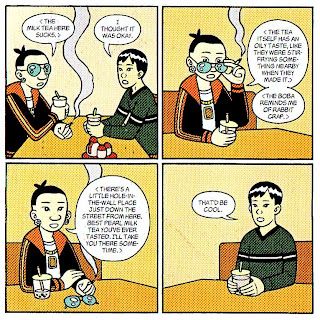
I don’t know if Journey to the West can be described as “the” foundational story of the Chinese people but it is certainly one of the most important works of classical Chinese literature. Here are some scenes from Yang’s comic juxtaposed with corresponding episodes from a famous adaptation:

[The following images are from a low quality English-Chinese bootleg translation. The original comic was published by the Shanghai Fine Arts Publishing House.]

Over the course of his comic, Yang not only relates his slightly altered version of the origins of the Monkey King (otherwise known as the Monkey God in many parts of Asia) but also transforms Monkey into a distant cousin of his protagonist – a caricature of all things Chinese.
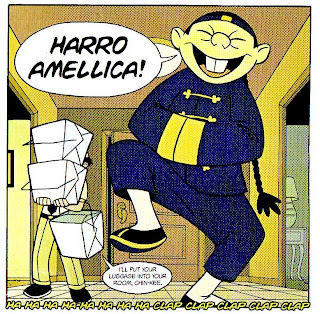
This cousin, Chin-Kee, represents Jin Wang’s grotesque view of his Asian heritage as well as his acceptance of various stereotypical views promulgated by Western society. It is only following Jin Wang’s epiphany at the close of Yang’s comic that Chin-Kee’s true and more illustrious identity is revealed.

(2) As would be expected, the liberal use of racial slurs (“chink”, “nip” etc) by Asian Americans and white Americans (both in Yang’s comic and in reality) is something which occurs rarely in Chinese majority nations. The former group probably feel they are in the process of reclaiming such terminology in the way African Americans have sought to reclaim the word “nigger”. I can’t say that I find this approach particularly useful but then again, I’m not Asian American. If anything, it’s a bit jarring for me to hear these terms strewn about generously in conversations or in on-line chat rooms.

In Singapore (where I live), the racial slurs are directed at other minority races (Caucasians, Malays, Indians and even mainland Chinese). Singapore is an ethnically diverse country where the lingua franca is English and the population over 70% Chinese. Approximately one third of its population of 5 million has foreign citizenship, a factor which has led in recent years to growing social tension. It has to be said though that the situation is considerably less acute than the discrimination directed against foreigners in South Korea (which is more racially homogeneous) as described in a recent New York Times article concerning a South Korean woman and her Indian boyfriend.

For better or worse, Singapore has long had strict laws against racial incitement as demonstrated by the recent arrest of a number of bloggers for racist content on their websites. The bloggers were Chinese and their targets Malay (who constitute 15% of the population).

For some, this would be justification enough for William Gibson’s somewhat exaggerated and completely unrelated article on Singapore for Wired magazine (“Disney Land with the Death Penalty”) where he writes, “…and you come to suspect that the reason you see so few actual police [in Singapore] is that people here all have, to quote William Burroughs, “the policeman inside.” Of course in this case, the police were having a ball of a time on-line.

Singapore’s Minister for Law reiterated this stance in a Q & A at the New York State Bar Association (NYSBA) Rule of Law Plenary Session in October 2009:

“Freedom of choice must include the right to make bad choices. But where it impacts society, and where it impacts on key aspects, say for example, stability, society should have a right to have a say. Let me explain that by specific reference to an illustration. Let’s say, hate speech on the internet or publications. If anyone stood up and said I am expressing or I am exercising my right of free speech by saying that “all Jews are hateful”, or “all Muslims are bad’, we will arrest and charge him. Because for us, that freedom of expression does not extend to this sort of hate speech where violence against a particular ethnicity or religion or belief can be encouraged. And we have charged people for putting up such notices. We are particularly sensitive about it in our Chinese, Muslim, Hindu context. People have been charged for putting up notices against one or the other ethnic communities where it goes beyond some expression of opinion to incite them towards violence.”

(3) These are moves which would meet with strong resistance in a liberal Western society. While Yang directs a large amount of his ire at Patrick Oliphant in the pages of his book, there is no indication that he would deny Oliphant the right to disseminate his brand of “racism”.

Over the course of American Born Chinese, Yang not only names his racially challenged high school after Oliphant…

…but also quotes directly from one of Oliphant’s offending editorial cartoons.

Oliphant is of course well known for using racial caricatures in his cartoons. In this case, his animosity was directed at the Chinese Communist Party (CCP).

Oliphant’s cartoon is objectively offensive and designed as such. In fact, the only adequate gauge for its effectiveness lies in its ability to draw a response from its target (in this case, not so much the CCP which could care less but Chinese in general). Its ability to draw the knowing nods of the majority of Americans who have a deep antipathy towards the CCP is of course important but hardly newsworthy and hence only a small measure of its success.

Controversy is mother’s milk to the political cartoonist. This is amply demonstrated in an article for the New York Times by Francis X. Clines who writes:

“Mr. Oliphant feels that the ”confrontational art” of political cartooning needs a boost from provocative work like Mr. Genn’s if it is to survive the homogenizing pressures of American culture. ”We are drowning in political correctness and somebody’s got to kill it,” he said. ”It’s the ruination of my business,” he added, citing individual newspapers that withhold his more controversial work or quickly apologize for it when the first complaint is lodged.”

And later…

“Mr. Oliphant’s inclination is to pick on everyone and never apologize for what he does. ”You have to get mad in this business, work yourself up to a boil once a day,” he said, as if this precious work dynamic can only be dulled by trying to keep in mind the multiple sensitivities of his variegated audience.”

It must be said though that such cartoons are as demanding on the satirical and artistic abilities of the cartoonist as drawing a large, beautifully cross-hatched penis on the editorial page of the New York Times.

It is not too difficult to see why Oliphant’s cartoon was seen to be threatening by some Asians living in America – that is, individuals with a vested interest in making the U.S. a more accommodating place for Asians. For the majority of Chinese throughout the world, however, Oliphant’s cartoon may simply confirm deep seated prejudices against Caucasians and the West.

[Not a political cartoon but a famous soap advertisement poster.]

With the passage of time, such cartoons may come to be seen as a marginally useful cultural and historical markers. Just as the Africans in Tintin in the Congo or Ebony in Will Eisner’s The Spirit continue to provide silent rebukes several decades down the line, such cartoons highlight the failings of a significant number of modern day political cartoonists. This is a form which consistently elevates superficiality and sensationalism over depth and intelligence. I for one will not mourn its passing.
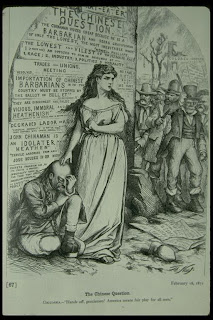
[A positive image by a slightly more enlightened cartoonist, Thomas Nast.]

______________
Update by Noah: The whole racism roundtable is here.

I Demand More Patriotic Comics, Damn It (Black and White and Startlingly Offensive All Over)

We’ve had a lot of interesting comments on the race and comics roundtable, some of which point in similar directions — so rather than going through and saying the same thing over and over, I thought I’d try to hit some main points in this post.

So to start with, I thought I’d address a point Uland brought up:

lso, we live in a Western Republic, founded by Europeans and still majority European ( not for long, I know). That entertainment and art follow, I don’t think we should be surprised by.

It’s not like we’re willing to go to Ireland and demand that they adapt the way they tell stories to make Eastern European immigrants feel more culturally powerful than they are.

This is more or less, I think, a variation on Pat Buchanan’s, “Traditional Americans Are Losing Their Nation, (though without the apocalyptic vision and the implicit clal to arms that makes Buchanan’s stance here truly execrable.) Basically, the argument is that we, as a nation, are white; that’s our cultural heritage, our true American European self, and so it’s natural to focus on that. Other traditions, or people, are extraneous to who we really are.

Andrew Sullivan had a fine rebuttal of this position:

From its very beginning, after all, America was a profoundly black country as well.
This took a while for an Englishman to grasp upon arriving here, because it’s so easy to carry with you all the subconscious cultural baggage you grew up with. England, after all, is deeply Anglo-Saxon. It makes some sense to refer to England’s roots and ethnic identity as white, its language as English, its inheritance as a deep mixture of Northern European peoples – the Angles and the Saxons and the Normans and the Celts. And superficially, English-speaking white Americans might seem in the same cultural boat as white English people, dealing with a relatively new multiculturalism in an increasingly diverse and multi-racial society. And at first blush, you almost sink into that lazy and stupid assumption, especially if you arrive in Boston, as I did, and carried all the usual European prejudices, as I did.
The English, lulled by their marination in American pop culture from infancy, and beguiled by the same language, can live out their days in this country never actually noting that it is an alien land – stranger than you might have ever imagined, crueler than you realized, but somehow also more inspiring than you ever thought possible. This is the America I am trying to make my home, after 25 years. It is not the America of Pat Buchanan’s or John Derbyshire’s fantasies.
It struck me almost at once, if only in the music I heard all around me – and then in so many other linguistic, cultural, rhetorical, spiritual ways: white Americans do not realize how black they are. Even their whiteness is partly scavenged from the fear of – and attraction to – its opposite. Even something as stereotypically white as American Catholicism, I discovered to my amazement, was also black from the very start. (Yes, those Maryland slaves. If you’ve never been to a Gospel Mass in an ancient black Catholic parish, try it some time.)

And it’s not just that America’s black. America’s also Amerindian. And, of course, and very much so when you’re talking about comics, Jewish. In short, America is it’s own culture — and what’s most distinctly American about it is its syncretism. There’s nobody more American, as just one example, than Rosa Parks. Hers is a tale of the plucky salt of the earth overcoming the unjust vagaries of the fascist state. What’s more American than that?

So the plea for comics to stop being so unutterably, lamely pale isn’t a plea for them to be less American. It’s a suggestion that they be *more* American.

So why does it matter if comics are more American. Who cares? Uland puts it this way:

I know black comic fans. They’re nerds, just like a lot of white fans. I think to suggest to them that they require a black superhero, or a black creator to feel some kind of connection to that material is pretty insulting, and it’s just not evident. You can’t say that if comics were more minority friendly, more minorities would be involved. By that logic, white people, as a rule would be far more interested in comics than they are. They’re not. Comics are for children, slightly fucked up adults, or slightly pretentious fucked up adults.

Ed Howard comes at it from a different place, but arrives at a similar conclusion:

Modern superhero comics, with few enough exceptions, are pretty dismal affairs that don’t really address anything of substance, and where any kind of risk-taking or experimentation is pretty soundly discouraged, for all sorts of economic reasons. Why should race be any different? I mean, if we’re talking about Supergirl, as the last post in this roundtable did, doesn’t a book like that have broader limitations and failings than just the failure to represent ethnic diversity properly? It’s rearranging the deck chairs on the Titanic.

For both Uland and Ed, comics are essentially debased and irrelevant. Talking about race is therefore pointless, because only a select few fucked up individuals are going to read them anyway.

But…if everyone agrees that mainstream comics are an (ahem) ghetto of mediocrity…how did that happen? Why are they like that?

Let’s take a brief detour, and talk about another extremely white genre — country music. It’s not a secret especially why country is largely white. It’s because of systematic racism and segregation in the early part of the 20th century, when the genre was formed — and of the split between hillbilly and race records which was explicitly segregationist. It’s persisted because of genre coherence, white populism, and (I presume) black alienation because of white populism. It isn’t about dictats handed down from on high, necessarily, but it is about racism, and a history of racism.

Now, even though country was born out of segregation, it wasn’t actually European. It’s roots were as much in the blues and jazz as in Irish or European folk song, and even it’s instrumentation and vocal styles (from the banjo to Jimmie Rodgers) were integrated. And that’s where a lot of the genre’s energy came from; form a mixing of white and black styles which produced western swing and bluegrass and hillbilly boogie and rockabilly. After rock took over most of the syncretic energy of white pop, though, country kind of flailed, turning more and more to nostalgia, unable to assimilate the changes in black music (like rap) that were leading the way for pop. And as a result you got a lot of really shitty music (country is kind of trying in various ways now to make peace with black pop, and I think country radio is more listenable at the moment than it’s been in some time.)

The point of all that, I’d argue, at least, is that comics aren’t so insular that any discussion of race is irrelevant. Rather, they’re insular because they have, for a really long time now, more or less deliberately cut themselves off from vast swathes of audience and inspiration.

Steven Grant in his contribution to the roundtable says:

white male heroes must be heroic at all times. I never got that pressure when writing minority or female characters; they were “allowed” (mainly by lower editorial expectations, I think) to make more human decisions for more human reasons. It wasn’t that editors were either specifically racist or felt those characters should have greater emotional latitude.

Steven’s point is that expectation are lower for non-white characters, which is no doubt true. But I wonder if part of what he was experiencing was also just the kind of opening up of possibilities you can get when you start having conversations or interactions with other folks. Writing about somebody who is not all white all the time isn’t a big step, but it is a step towards the kind of cultural interplay that gave us bluegrass, and jazz, and fusion, and graffitti, and blaxploitation, and manga, and, for that matter, in many ways, Superman. That’s where the most exciting American creative endeavors have come from, always.

In this sense, Uland is precisely and staggeringly wrong when he claims that if people liked their own culture best, then there would be more white people reading comics. On the contrary, white Americans don’t read comics because *it’s not their culture.* It’s too white; it’s too boring; it’s too irrelevant and male and stodgy. White Americans, like all Americans, prefer things like, oh, say, pop music or rap music — art that mixes and matches influences and perspectives in exciting ways; that uses that mixing as a spur to the imagination.

In short, comics appeal to nobody and are irrelevant because they appeal to nobody, and are irrelevant. They sit there staring at their navels, and, as a result, the only folks who want to engage with them are people who want to sit around staring at their navels. This isn’t a problem for the culture at large — it’s not a “oh, no, comics are racist — it’s unjust!” On the contrary, it’s a problem *for comics.* When Vom Marlowe talks about being turned off by the blinding paleness of mainstream comics, she’s not talking as a member of the PC police, spoiling everyone’s fun. She’s talking as *a potential fan*, someone who has an interest in the medium and who feels excluded because the world she lives in and cares about and likes to interact with is being gratuitously ignored. And you know what? Most people feel like that, which is why comics are continuing their ongoing downward spiral into ever more pointlessly insular clusterfuckery.

Racism: Two-Fisted Solutions in the Mighty Marvel Manner (Black and White and Startlingly Offensive All Over)

Superheroes solve problems by hitting them very hard. This strategy works will enough when they’re fighting mad scientists, robots, or radioactive dinosaurs, but it doesn’t seem particularly well-suited for persistent social ills like racism. How are superheroes supposed to deal with a problem that has no specific face to punch? The answer, of course, is to give racism a face.

By the 1960s, the Civil Rights Movement had gained a great deal of political and social influence, but racism was still widespread. With so much national attention focused on race relations, it was only a matter of time before Marvel attempted to address the issue within the pages of its superhero books. Marvel had prided itself on publishing the superhero stories of “our” universe, completely unlike the silly, fantastical universe of DC Comics. And since many of the staffers and creators at Marvel were Jewish guys from New York City, it’s not surprising that they were firmly in favor of racial equality.

The first Marvel comic that specifically dealt with racism was Fantastic Four #21 (1963). Co-written by Stan Lee and Jack Kirby, this story pitted the FF against the ruthless Hate-Monger!

Fantastic Four,Racism

It’s not a bad costume for a racist: there’s the KKK pointed hood, some chain-mail (racists love references to the Teutonic Knights), a torch for lighting crosses, and a gun for shooting minorities. All set! The story begins with the FF up to their usual hijinks, but their fun is interrupted by the Thing who’s pissed that a mysterious figure known as the Hate-Monger is stirring up racial tension in New York City. Invisible Girl doesn’t think the FF should get involved because she’s a selfish jerk who’s never heard of Martin Niemöller. But she gets overruled by the boys and off they go to confront the Hate-Monger, currently mongering hate in Manhattan.

FF 21 page 6 panel 4

Racist he may be, but you have to admit he puts on an elaborate outdoor performance. The crowd is instantly swayed by his words, and they begin to attack nearby foreigners, though given the limitations of Kirby’s style, I’m not quite sure how they can tell this guy is a foreigner.

Fantastic Four,Racism
Maybe only foreigners wear bright blue suits? When the FF intervenes, the Hate-Monger blasts them with his Hate Ray, which causes them to start fighting amongst themselves. Apparently, hate isn’t so much a product of a bad upbringing as a product of evil science. The Hate-Monger plans to keep the FF busy with their in-fighting while he foments an anti-American revolution in the made-up country of San Gusto.

Fantastic Four,Racism

Obviously, anti-Americanism has to the be the product of vile evil-doers using Hate Rays. It couldn’t possibly be blowback from years of American interventionism. Speaking of which, Colonel Nick Fury comes up with a convoluted scheme to get the Fantastic Four to San Gusto so they can crush this hateful uprising. After beating on the rebels for a bit, Mr. Fantastic stumbles upon the Hate-Monger’s base and figures out the bad guy’s master plan (it involves bouncing hate beams off the moon. Yes, really.) and then he cures himself and his teammates with anti-hate pills (Yes, really). Then the FF and Nick Fury kick the crap out of the Hate-Monger’s stormtroopers. When the Hate-Monger tries to use his Hate Ray, the Invisible Girl forces him to blast his own men, who immediately shoot him dead. Poetic justice strikes again! But there’s one last question to answer: who is the Hate-Monger?

Fantastic Four,Racism

So let’s recap: Adolph Hitler survived World War II, reinvented himself as a super-villain named the Hate-Monger, and used his Hate Ray to start an anti-American revolution in a banana republic so he could use that country as a base to beam hate to the rest of the world. And by killing Hitler, the Fantastic Four solved the problem of racism … for three years.

Marvel dealt with the issue of race relations again in Avengers #32-33 (1966), by Stan Lee and Don Heck. The story begins with a hate group called the Sons of the Serpent, an obvious send-up of the KKK, viciously attacking a foreigner in a dark alley. And because I read Fantastic Four #21 first, I know that this man is a foreigner because he wears a tacky suit.

Photobucket

Meanwhile, Goliath has increased his size to ten feet tall but he’s now stuck at that height. Needless to say, this makes relations with his girlfriend the Wasp somewhat difficult. After several pages of whiny self-pity someone gets the bright idea to call another scientist to see if he can help. And so Dr. Bill Foster is introduced to the Marvel readership, and he’s black! At first, I thought it was cool that Marvel would introduce a black scientist and not comment on his race, but a few pages later that’s exactly what they do. While walking home from Goliath’s laboratory, Dr. Foster is ambushed and beaten up by the Sons of the Serpent. This leads to the obligatory righteous indignation from the hero. The dramatic pause before announcing the name of his team is a nice touch.

Photobucket

After sending Bill Foster home, Goliath meets up with the Avengers and they decide to investigate the Sons. At the same time, the sinister General Chen from an unnamed country that’s clearly China is arriving in New York, where he plans to give a speech at the United Nations. Issue 32 wraps up with Captain America captured by the Sons of the Serpent.

On a side note, some of you may have heard of a certain comics blogger, who shall go unnamed, with this crazy notion that old superhero comics were kinda queer. But I dare him to find anything homoerotic about the opening splash page of Avengers #33!

Photobucket

Okay, so maybe Captain America is pinned spread-eagle against a wall while a serpent-themed villain gloats with orgasmic glee while holding a phallic-shaped object. But other than that, where’s the gay?

With Cap as a hostage, the Sons of the Serpent plan to force the Avengers to speak out in their favor, knowing that the fickle public will immediately do whatever C-list heroes tell them to do. Meanwhile, the inscrutable General Chen plans to use the activities of the Sons to discredit the United States at the UN.

Photobucket

Note that the American diplomats are not so much concerned with the actual crimes of the Sons as they are with the fact that the crimes make the U.S. look bad to the rest of the world (over a decade earlier, the Justice Department expressed similar worries when it submitted an amicus brief to the Supreme Court when it was considering Brown vs. Board of Education of Topeka. The brief cited a statement by then Secretary of State Dean Acheson, who asserted that racial discrimination “gives unfriendly governments the most effective kind of ammunition for their propaganda warfare, … and jeopardizes the effective maintenance of our moral leadership of the free and democratic nations of the world.)” (The full amicus brief can be found here).

Getting back to the story, Goliath and the Wasp arrive at the big press conference where they’re supposed to offer allegiance to the Sons, but they stall for time while fellow Avenger Hawkeye goes to rescue Captain America. The story gets a bit wonky for a bit, but it eventually ends with the Avengers beating the crap out of the Sons and capturing their leader. And who is the leader of America’s worst hate group? It’s the nefarious General Chen!

Photobucket

Photobucket

So the Chinese are to blame! Some of you may be thinking that it’s nonsensical to blame Asians for the racial conflict between whites and blacks, but you’re forgetting that the Chinese are Communists. That means they’re bad.

After reading these two stories back-to-back, I noticed three common factors in how they approached racial conflict. The first is that they are exclusively concerned with how progressive white men respond to violent racism. After all, both the Fantastic Four and the Avengers are composed entirely of white guys with one token girl apiece. The only notable minority character is Bill Foster, but he’s little more than a Noble Black Men who gets assaulted, thus providing a motive for the Avengers to get involved. The comics also draw an unambiguous distinction between the law-abiding, racially tolerant (white) heroes and the racist villains.

Both stories also portray the source of American racism as foreign. In Fantastic Four, racist violence is sparked by none other than Adolph freakin’ Hitler. In Avengers, a general from Red China foments racism to make America look bad. This leads naturally to the conclusion that racism itself is foreign to America. Now I’m sure that Stan Lee and friends were well aware that racism existed in the U.S. long before Hitler or Red China came along. But it’s not a part of what they portray as the “real” America. To put it differently, as a rule America is tolerant and equal; racism must be an exception to this rule because it’s inherently un-American.

Another factor in both stories is that crowds display racist behavior only after they’ve been influenced by external forces. In Avengers, the Sons of the Serpent attempt to sway the public through a popular superhero team. In Fantastic Four, the external manipulation is technological. There’s an implicit rejection of the argument that racism can arise from ideas held by the majority. Instead, the public in Marvel America is fairly tolerant unless a foreign group manipulates them. This reinforces the idea that racism is alien to American society.

To sum up, these comics create a dichotomy between the majority of white Americans, who are tolerant and law-abiding under normal circumstances, and a minority of violent racists. The white superheroes, in particular, embody the highest values of America. The racists are fringe extremists, linked with hostile nations and totalitarian ideologies.

I think most people would agree that this treatment of racism is simplistic, at best. But the target audience for these books is children, and an argument can certainly be made that concrete examples of heroes beating the crap out of racist villains discourages racism in young, impressionable readers. And if racism really was limited to violent loudmouths, then there would be nothing wrong with these comics at all.

But these comics are problematic exactly because racism is a far more ubiquitous than mob violence and secret societies. Racism is a system that permeates numerous institutions and social structures, and an individual doesn’t necessarily need to have racist attitudes in order to perpetuate racial inequality. Take housing segregation as an example. American neighborhoods remain deeply segregated along racial lines. Yet most white homeowners (and realtors) are not card-carrying members of the KKK. They participate in a system that excludes blacks from white neighborhoods due to indifference rather than hate. And because many whites rarely come into contact with blacks on a regular basis, they aren’t even aware of any racial injustice (check out Noah’s review of “Sundown Towns” for more on this).*

Comics that associates racism exclusively with Nazis or similar extremists while ignoring the far more significant impact of systemic racism are not providing a valuable moral lesson. Rather, they encourage readers to pat their own progressive backs while doing nothing to actually challenge a system that sustains racial inequality. According to these comics, if you condemn hate groups and don’t go around assaulting immigrants, then you’re not a racist. And if you’re not a racist, then somebody else is to blame for the pervasive effects of racism. And when the vast majority of Americans refuse to assume any responsibility for problems like segregated neighborhoods, these problems never get addressed.

Superheroes solve problems by hitting them very hard. But when it comes to racism, Captain America might have to smack around a lot more people than usual. It’s much more comforting to just blame it all on Hitler.

*Thanks to Noah for the links

____________
Update by Noah: You can read the whole roundtable here.