Zombie: A Mindless Affair

I’m going to be in an art show on October 23. Here are the details:

Zombie: A Mindless Affair
Curated by: Edra Soto

Also Project Wall Space:Irene Perez
ZOMBIE ARTISTS:
C Through Outfit (Erik Brown, Catie Olsen, Carl Warnik and Dawn Reed)
Deborah Boardman
Nate Lee
Jason Mena
Mindy Rose Schwartz
Amanda Browder
Derek Chan
Christopher Simkins
Christopher Smith
Ann Toebbe
Harold Mendez
Paul Nudd
Noah Berlatsky
Vladimir Kharitonsky
Dan Peters
Gretel Garcia
Susannah Kite Strang
Rachel Hewitt
Corinne Halbert
Bert Stabler
Beatriz Monteavaro
Miguel Cortez
Edra Soto
Candace Briceno
Death by Design Co. (Teena McClelland and Michelle Maynard)
The Wiener Girls (Sydney Croskery and Katey Rafanello)
Betsy Odum
Jen Thomas and Bobby Lively
Chris Hammes
Andrea Jablonski
Jeff Libersher

ABOUT: Zombie: A Mindless Affair

Celebrations that invite us to observe a historical occurrence are still strongly practiced in contemporary culture. Halloween, as celebrated is America, profoundly depicts the strongest features from gothic and horror literature, film, TV, and graphic arts. Among the repertoire of traditional characters, the zombie distinguishes itself for possessing the biology and behavior of a normal human being, yet lacks consciousness. This exhibition uses the vernacular of the mythological zombie as a starting point to engage in ideas of death, mindlessness and symbolisms for the occult and inexplicable. The term zombie also intends to address issues referring to the mindless self in a social spectrum: leading and following; acts of automatism and fanatic behaviors.

From 6:30-7:00pm on opening night:
Join author Scott Kenemore, artist Mindy Rose Schuartz and collaborators Teena McClelland and Michelle Maynard from Death by Design Co. in conversation. They will talk about the darkness that enlightens their work. Screening of the film made by Death by Design Co. immediately after the conversation. Moderated by Edra Soto

Opening Friday October 23 from 6pm-10pm
October 23 – November 21, 2009

ANTENA
1765 S. Laflin St.
Chicago IL 60608
www.antenapilsen.com
antenapilsen (at) gmail.com
_______

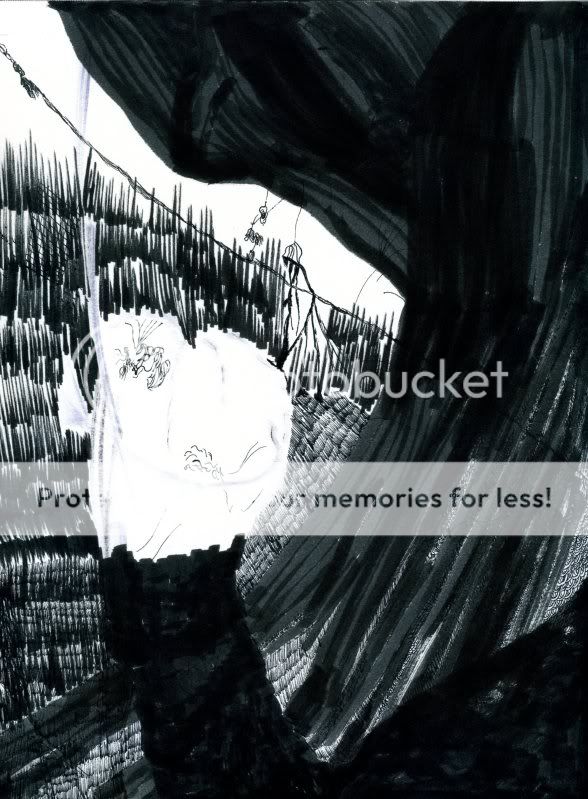
And, hey, here’s the piece I’m showing for those not in the Chicago area (it’s better in person…no, really! Trust me!)

Sequential Surrender Monkey: The Case Against Tin Tin

1. Slapstick

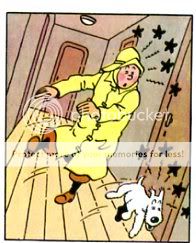
Rereading Tin Tin, what struck me most was just how French it is (or how Belgian, I guess.) Everything’s just so darn greasepaint-precious. “Ooooh hooo hooo…the cursing captain…he fall down and bump ze head! Oh stop — the Thompson Twins, they’re hats, they are pulled down over their eyes so only ze bristley mustachios are showing! Oh, ze little doggie, he is drunk!” In Asterix, the physical humor is explosive and go-for-broke; when you hit the roman soldier, he rockets out of his sandals in a riot of motion lines and explosive puffs; when he lands in the next panels on his head, you get to watch his toes violently twitching. In Tin Tin, on the other hand, the slapstick almost seems to be in quotes, like you’re watching mimes. Motion lines are little curlicues, and the bashed tend to look startled and dizzy rather than actually bashed about. If Asterix is analogous to Bugs Bunny, Tin Tin is Disney; skilled, tasteful, and kind of boring.

2. Characterization

A Wikipedia entry on Tin Tin compares Herge’s characters to Dickens’. It’s not a comparison that serves Herge well. Dickens did use caricature, but those caricatures are multi-layered, encompassing both biting satire and a knowing humanism. In Bleak House, for example, Richard Carstone’s rationalizations around money are both funny and tragic, and feed naturally into his gradual embitterment. Or there’s this passage from the same novel:

“There has been only one child in the Smallweed family for several generations. Little old men and women there have been, but no child, until Mr. Smallweed’s grandmother, now living, became weak in her intellect and fell (for the first time) into a childish state. With such infantine graces as a total want of observation, memory, understanding, and interest, and an eternal disposition to fall asleep over the fire and into it, Mr. Smallweed’s grandmother has undoubtedly brightened the family.”

The Smallweeds here are a very particular kind of stultified; enlivened by the one senile figure in their midst. The joke comes out of that specific contrast.

Herge’s caricature’s on the other hand, seem much more broad and tired. Captain Haddock is a sailor who curses and drinks too much. Professor Calculus is an absent-minded (and deaf) professor. The Thompson twins are bumbling cops. Those are the jokes, and they were pretty old, I have no doubt, even 50 years ago when Herge was writing these. Not that they’re handled poorly or that they aren’t often funny or surprising…but overall, and especially if you read a bunch of them in a row, they start to feel decidedly thin. The truth is that Herge’s penchant for racist caricature and easy anti-semitism wasn’t an accident; virtually all his characters are based around easy stereotypes and fusty gags; it’s just that making fun of sailors looks more innocuous these days than ridiculing the stupidity of black people or the avarice of Jews. Fagin is offensive as well, of course, but he’s also got enough depth and texture that you feel that there’s something to him beyond the anti-semitism…or at least that the anti-semitism is somewhat textured. But when Herge uses a stereotype, as he almost always does, the stereotype is pretty much all there is happening.

3. Art

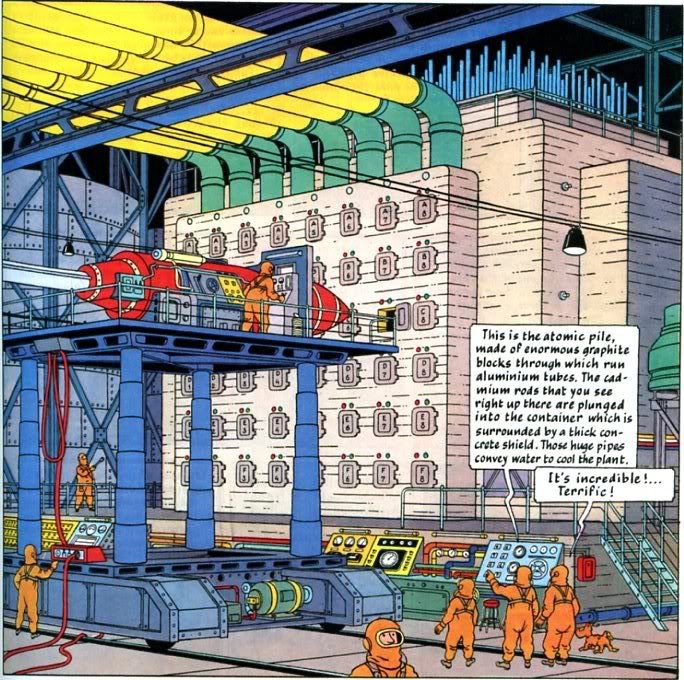
Herge’s obviously a very skilled illustrator, with an amazing facility and capacity for rendering detail. And in the abstract, I can certainly appreciate a complicated tour de force like this:

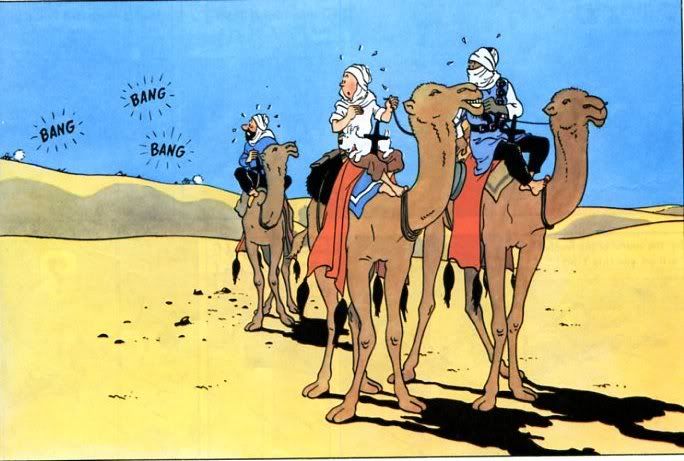
But in terms of visceral appeal, though, his art just doesn’t do that much for me. The cleanness and perfection of it, the evennness of the lines; it almost seems produced by machine. For example, compare Herge’s camels:

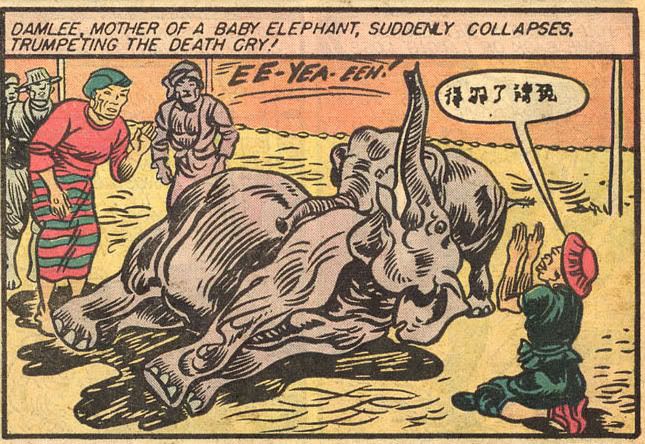
with Harry G. Peter’s elephants.

Herge’s drawing is much more correct anatomically, but it’s also much less fun to look at. The camels are too smooth; they have the same weight as everything else. They might as well be boxes, for all the character they have. The bits of personality — the one camels’ smile, the other camel’s knowing look — actually comes across as irritatingly smug. Again, it feels Disneyfied to me — a lack of personality gilded with cutesiness.

4. Layout

Given his status as one of the great figures in comics, it’s amazing how little interest Herge seems to have in the page as an aesthetic unit. He does vary panel sizes to accommodate action, and so he can fit big objects like planes:

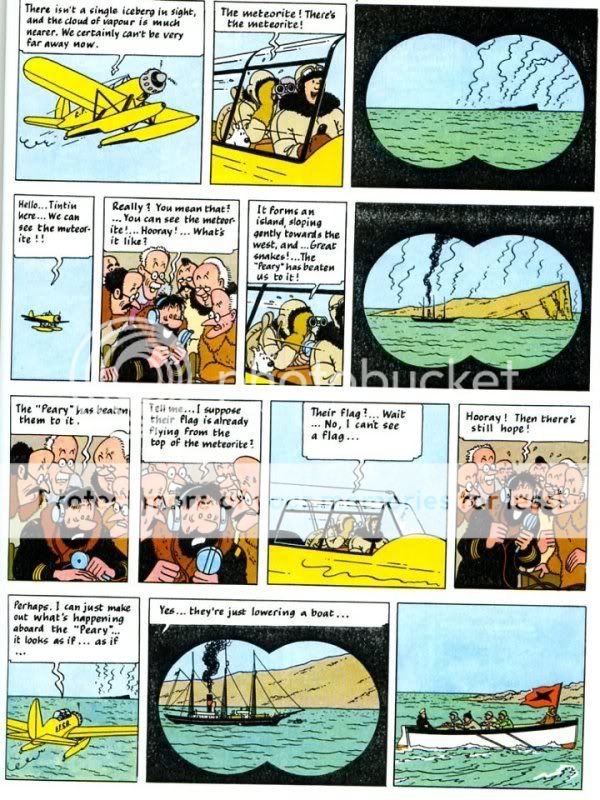
And he will use bigger splash panels for effect, as with the camel image above. But in terms of unifying an entire page….he just doesn’t bother. Look at this for example:

The most striking visual motif on the page is the binocular frame. It’s used in three panels…but that’s pretty much all that can be said for it. Those three images aren’t balanced out in any particular way that I can see; they’re just placed on the page at the point where they logically occur in the narrative.

You really see this in the use of text as well, which sometimes just overwhelms the pictures.

That’s gratuitous as well; that text is just restating things you already know. It’s off-putting, ugly, and unnecessary. I don’t think it’s laziness, — Herge is never less than entirely professional and meticulous, and writing out all those words was probably actually a fairly irritating task. But it does suggest that he doesn’t have much of an eye for, or interest in, design.

_____________________

Overall, then, Herge’s perfectionism and professionalism, which are impressive in small doses, become irritating and burdensome the more you realize that that’s all he has to offer. I remember being a bit bored by them as a kid, and as an adult…I’m maybe even more bored by them. The plots bop along, and there are still some excellent gags: the Thompson twins bizarre affliction — whereby their hair grows excessively fast and changes myriad hues, is visually spectacular and completely ridiculous. And I had forgotten how weird and disturbing some of the dream sequences are. Tin Tin turning into a giant bottle of wine with his head as the cork which Captain Haddock tries to twist out; the weird fever dream of a prophet grasping a picture of a giant spider — such moments come close to thematizing the oppressively flat unreality of Herge’s world. Mostly, though, that flat unreality isn’t disturbing or affecting. It’s just flat.

_______________

You can read the entire roundtable here.

Sequential Surrender Monkey: Le Petit Vampire fait du Kung Fu!

little vampire

Le Petit Vampire fait du Kung Fu!, Joann Sfar, 2000, Guy Delcort Productions
or, if you prefer,
The Little Vampire Does Kung Fu!, Joann Sfar, 2003, Simon & Schuster
(because, despite the offensive roundtable title, we at the Hooded Utilitarian are all about ensuring your happiness and comfort)

I started reading French comics in high school (which was eons and ages ago, I will freely admit), at the suggestion of my French teacher. Magazines, too. Asterix and Paris Match. I haven’t picked up the latter in a while (although as a sheltered Midwestern teen in the Age Before Internet, damn, it did help to open my eyes to a few things), but Asterix, written by René Goscinny and illustrated by Albert Uderzo, certainly holds up. I have a small stack of French comics that I love, but I no longer read French very often, or very well. I do love me some Paris Vogue, but the secret to fashion magazines is to do the opposite of what you do with Playboy and never, ever read the articles, because that will make you want to kill yourself and take everyone you can reach with you.

So, approaching this roundtable, I had to do some thinking. I hate that. There are a couple of Little Vampire books I prefer to this one (although it does feature nunchucks, the eating and subsequent disgorgement of a small child by monsters, and a bizarre Jewish Zen parable, so I obviously do like it quite a bit), and there is a less amusing but still palatable Le Grand Vampire series, and there’s Donjon, an awesome series by Sfar and Lewis Trondheim. (You are, perhaps, noticing a theme in my post-high school French comics reading. Vampires and dungeons. I will also admit to suffering a certain amount of Goth-damage.) I am writing about the kung fu book, though, rather than any of these other books, because I had an auxiliary English copy of it that I could actually find. I have auxiliary English copies of a number of the vampire books (vampires both big and small), but they have vanished. Poof. Perhaps they flew out the window one windy evening to fly into the dark night sky and skulk around the dense and forbidding Carpathian forest with the wolves, remarking about the children of the night and the beautiful music they make. I wish them well. Fly and be free, big and little vampires!

It is only a minor setback, really; the sort of small frustration we all deal with every day. We do have the kung fu book in English, which means I can figure out what’s going on without getting out my dictionary, and it is in fact a pretty neat book, so off we go.

The plot is bland and soothing, like blancmange. A little boy, Michael, is visited late at night by his friend, the Little Vampire, and the Little Vampire’s posse, three monsters (my favorite is the Frankenstein-ish Marguerite, who loves poop). Michael explains that he’s being bullied at school by a loutish brat named Jeffrey and says he wishes the kid would die. Then the Little Vampire whisks Jeffrey away to his haunted castle so they can visit Rabbi Soloman, the kung fu master. Rabbi Soloman tells Jeffrey he’s left his kung fu book tied to the back of a dragon on top of an Angkor Wat-like temple, just through that door at the end of the hall, and that if Michael will bring him the book they’ll be set. Off Michael goes, getting his butt kicked repeatedly by monkeys, the temple itself (it is hard to climb and he keeps falling off), and by the dragon itself. Eventually, Michael gets smarter and better and he gets the book. Which of course says, “If you have managed to steal this book from the dragon, you are very skilled at kung fu. This book will teach you nothing more.” Because, you know, the only Zen on the mountain is the Zen you bring there. Anyway, now that Michael is all confident and proud and ready to take on the world and shit, he and the Little Vampire find out that the monsters went off and ate Jeffrey.

Zut alors!

The Little Vampire does what anyone would do when faced with this situation – he makes the monsters cough up all the Jeffrey bits, and then they sew him back together. Then they go off looking for a magician to reanimate him. That doesn’t go entirely smoothly, as anyone who’s ever read any cautionary tale about magic would predict. But the ghostly pirate dude who’s kind of in charge takes pity on the boys and lets them off with time served. He gives the little boy, little vampire, and variously sized monsters the means for fixing Jeffrey. This involves what is without doubt my favorite panels of the book:

little vampire]

Moo!

The next day at school, Michael, now a kung fu master, picks a fight with Jeffrey, who remembers nothing of the previous night’s romp. And Jeffrey kicks his ass. It all works out, though, because the girl Jeffrey has a crush on beats Jeffrey up and nurses Michael’s wounds. So, the moral of the story is that it’s better to be an overconfident idiot than an actual martial arts expert. A lesson for all times, really.

Now, I know what you’re saying. “That’s a bit gluey, isn’t it? I can’t read that much treacle; I have blood sugar issues.” Fair enough. The bit at the end makes me gag, and not in a good way. I think the parts are better than the sum thereof, though, and some of the gags are worth the cutesy ending. The monsters coughing up the little boy they ate, for instance – that’s the kind of priceless I’m after. And the cow. God, I love the cow. So, there you go – the other side of Joann Sfar. (Assuming you read Vom Marlowe’s post Monday on The Rabbi’s Cat.)I hope you are moved to go forth and consume French vampire comics, in the language of your choosing.

Sequential Surrender Monkey (Part 3 of 5): Rupert and Mulot’s Le Tricheur

Hi all, Derik of MadInkBeard here. Thanks to Noah for inviting me to participate. For this roundtable, I thought I’d write about a bande dessinee that hasn’t been translated into English (I am such a comics nerd that I actually self-improved on my two years of high school French just so I could read French bd and write about it). The comics (or should I say bande dessinee) duo of Florent Ruppert and Jerome Mulot have made only two appearances in English: a two page spread in Kramer’s Ergot 7 and also a short comic (“The Pharaohs of Egypt”) that was translated at the Words Without Borders site. The latter does give a decent example of their work: long strings of word balloons, protagonists that tend to be less than savory, long sequences of McCloudian “moment-to-moment” transitions with a close attention to body language and movement, dry humor, and layouts that mix really large panels with long sequences of small panels.

I first learned of their work from Bart Beaty’s column at The Comics Reporter where he’s raved about their first two books Safari Monseigneur and Panier de Singe. Le Tricheur (L’Assocation, 2008) is their fourth book. In comparison with the earlier works of theirs I’ve seen, it is a fairly tightly organized narrative set within a detective/police/heist genre framework. The story is told non-linearly through multiple timelines. In a timeline that is in the “present”, a police detective interviews four characters: a private detective (“Short Hair”), an art collector (“Batman” because he wears a Batman shirt), a gallery owner (“Tie”), and his niece (“Handbag”). (Yes, all the characters are given names based on some aspect of their physical appearance.) The longer parts of the book take place in an earlier time and show these characters and their companions through a sequence of actions that are part heist, part revenge play, part art project. The logic, meaning, and interrelation of all the events in the story reveal themselves slowly. Each time I reread it (I’m at my fourth or fifth time through) more elements click into place, more layers start to make sense (admittedly, part of this may have been the accretion of vocabulary words as I looked them up and began to remember them).

The police interview scenes provide the only dialogue or narration in the book (excepting the final epilogue). Ruppert and Mulot make use of long strings of word balloons floating above the characters in tall panels. While most comic artists, when using long conversations, try to mix in changing views of the characters or setting and attempts at body language or facial expression, here, the dialogue is the focus. The characters serve as little more than indicators of who is speaking in the panels. One interesting use they make of these long strings of word balloons is branching off a balloon that acts as a kind of aside to the main string of dialogue.


An “aside balloon”. This is one of the smaller dialogue panels, most are much taller (this is an unusually tall book).

Mixed between these conversations are longer scenes taking place previous to the police interviews. These scenes are told without words of narration or dialogue and tend to use a large number of panels to show characters acting with great detail. Where the interview scenes are all dialogue, these scenes are all action. I say “action” more in the sense of movement and acting than in the “action movie” sense, though, this being a heist type story, it does feature its share of violence (and one completely absurd gun fight).

Most of the action scenes have the quality of animation: using numerous small panels in a sequence of unvarying composition where the only change is the movement of the characters. The artists attention to body language and posture is impressive and expressive, particularly in light of the complete lack of facial expressions. You see, the artists don’t draw faces. The characters all have a kind of wide V line on their face, like eyebrows except more in the center. This cuts off the possibility for facial expression, putting that much more emphasis on the body language. (It also tends to give all the characters an vaguely angry look.) The expression possible without facial expressions or close-ups (they don’t use them) or even variable angles (none of those either) on the characters is quite impressive, all due, no doubt, to the body language in the drawings.

The viewpoint on the characters is set at a consistent visual distance: they are always the same size on the page. When it is necessary or desirable to show more of the background or set the scene, the artists simply enlarge the panel, including the use of the unconventional (in the West at least) “L” shaped panel (see below). This changing panel size on a fixed scene emphasizes the sense of the panel as a window on the world, a small cropped segment of vision which hides all that is outside of view, all that remains unseen and unsaid. This feeling is quite apt for the story itself which slowly reveals flashes of motivation and background outside of the immediately seen actions. You have to pay attention to the small panels, important events pass in a single panel, and many events are elucidated only through earlier or later events/words.


Characters (Hat, Handbag, and Cap) stay the same. Framing changes with panel size.

The relationship between the dialogue scenes and the pantomime scenes is vaguely ambiguous. Are the pantomime scenes the visual representation of the dialogue? Are they thus colored by the narrator? Or are they completely separate, objective views of events which gain some elucidation through the dialogue–dialogue which is not necessarily true. The title “Le Tricheur” is literally, “the cheat,” and there is a certain amount of tricking and game playing going on here. As the story unwinds through the dialogue, the majority of the events seen in the book are revealed as part of a grand plan of the gallery owner, Tie. He has hired almost all the other characters and given them orders as to what they should be doing.

Ruppert and Mulot’s drawing style is all thin, almost scratchy lines, reminiscent of an etching (yet without that gray glow seen in works like those of Frederic Coche). They use no solid blacks and very little tone or texture, yet everything has a realistic appearance. Characters are naturalistic and proportional. Backgrounds are rather simple line drawings, setting and re-setting the scenes in large panels, yet only sketched out by a few brief lines in the smaller panels.


I love the way they draw the strip club in this scene with all the lines representing lights.

What we learn (yes, I’m spoiling it for you, you can skip this paragraph) is that the gallery owner is doing all this as a kind of art project, promotion for his gallery, and revenge scenario. Two hoodlums, named “Hat” and “Cap” (I’m translating these names), are hired to perform strange activities on their own or with the gallery owner’s niece (“Handbag”). Many of these activities bear some close metaphorical resemblance to a series of paintings in the gallery which the owner (“Tie”) shows to his “friend” “Batman” (he wears a Batman t-shirt). Two private detectives (“Beard” and “Short Hair”) are hired to follow and photograph the two hoodlums, thus creating a photographic record of their activities. The story culminates with Hat and Cap breaking into the gallery to steal paintings and kill “Batman”, all of which is recorded by the security cameras. In this way, the gallery owner organizes these activities but also creates an inter-related visual document revolving around the paintings in the gallery and the gallery itself, with twofold goal of art production and revenge.

The comic “Le Tricheur” becomes, in a way, another level of this interaction/documentation as if the comic itself is part of the whole series of actions and representations of actions that fill the book, with Ruppert and Mulot as the real orchestrators of the whole scheme. This image of the two artists as schemers fits with the image of them seen in some of their other projects. For instance, for this year’s Angouleme festival they organized a collective project with 20 other comic artist called “Maison Close.” Wherein they created a scene (a house of prostitution), drew all the background images, and organized the participation of the other artist. All the participants (including the two organizers who act as the proprietors of the house) drew themselves (or their comics stand-in (ie Trondheim as the bird-self from his autobiographical works)) into various interactions with each other on top of the existing backgrounds. If you’re interested in see more of their work, you might visit their website.

(See all the this roundtable’s posts.)

Sequential Surrender Monkey (Part 2of 5): The Rabbi’s Cat

(or the HU Bande Dessinée Roundtable Part 2)

I admit it. I bought this for the cat. I read this for the cat. And I don’t really care about much except the cat.

The Rabbi’s Cat by Joann Sfar

Color by Brigitte Findakly
Translated by Alexis Siegel and Anjali Singh

This is an odd little book. It’s sort of a parable style story about a talking animal who has adventures and learns things. In the spirit of the parable, perhaps, it doesn’t make a hell of a lot of sense. Or maybe it’s just too French for me.

There’s this cat, drawn with wonderful inky spontaneity and rough enthusiasm, who eats a parrot and thus learns to talk. The cat happens to live with a rabbi and his daughter in Algeria. As soon as he learns to talk, the cat denies killing or eating the parrot, and thus begins the philosophical discussion of the purpose of having speech. Why have speech if all you do is lie? Or, as the cat does later, tell only those truths that cause pain?

Honestly, I didn’t care. I like philosophy just fine. I’ve read Aristotle and Aquinas and the Baghavad Gita and those lot, and I’m sure they would have been improved by the addition of a cranky and silver-shadowy-gray Oriental Shorthair with Views. And yet, to me, the cat was everything and the philosophy was nothing.

The funny and eccentric art kept me reading, for the most part, but I was sometimes bogged down by arguments and parables, much as the cat appeared to be. Sometimes he would weary of the talk and try to get back to his mistress to be petted or convince her to give him a fish, and I confess, I think he had the right approach.

The cat gains speech and loses it, follows the rabbi, learns of people and religion, laws and rules, different religions, reads, and hangs out with the rabbi’s cousin’s lion. I liked the lion. And the cousin, who liked to go around threatening anti-Semitic waiters with his rifle and his lion.

There’s a bit about a guy with plays what seems to be a banjo and another part that’s about shopping on forbidden days, but I just wanted to know if the cat would get his mistress to love him and care for him and feed him milk. I am a shallow creature, I suppose.

The art is delightful for the most part, and the story is strange and puzzling with those sharp turns fairy tales make, and I’m not sorry I read it. But it does feel very French. Or perhaps Italian, in the style of Calvino’s Italian Folktales. Which isn’t bad. At all. I’m sure.

It’s just that I don’t really feel like being enlightened. I want to sprawl around instead. Lazy as the cat. Who is portrayed as pretty wise in the book, so who knows.

Update by Noah: You can see the entire roundtable so far here.

Sequential Surrender Monkey (Part 1 of 5)

(or the HU Bande Dessinée Roundtable Part 1)
(or Noah wrote it and Kinukitty meowed in approval, so don’t ask me what the title means.)

This is the first entry in the Hooded Utilitarian BD Roundtable. Vom Marlowe, Derik Badman, Kinukitty and Noah will be along later in the week with their own articles on various European comics.

I wrote the following article in the early 90s. It has never been published and the yellowing manuscript has been sitting in a dark closet for the last two decades.

The first third of the article is presented below (with some editing). The latter parts of the article concern two other books in the series namely, Fever in Ubricand and The Tower. Both of these are far superior to The Great Wall of Samaris and show off Benoît Peeters’ and François Schuiten’s abilities to a much greater extent. Anyone who has the slightest interest in European comics owes it to themselves to check them out if they haven’t already.

Second hand copies of The Great Walls of Samaris go for about $40 to $100 at on-line second hand book retailers. NBM has been publishing the albums in the series at a slow pace. I suspect that they aren’t big sellers for them as they’ve never been reprinted. Still, they are to be congratulated for printing and translating them at all. The latest books in the series to be translated are Brusel and The Invisible Frontier Volumes 1 and 2 both of which are still in print.

François Schuiten received the Grand Prix de la ville d’Angoulême in 2002.

Philosophical Cities (Part 1): The Great Walls of Samaris

The English speaking world was introduced to the comics of the Belgian artist, François Schuiten, nearly 30 years ago. His first album, Aux médianes de Cymbiola (Heavy Metal 1981-82; created with Claude Renard) was done as a sort of graduation piece from Saint-Luc. His short stories have been published in the pages of Pilote and Metal Hurlant, among them the acclaimed Carapaces. It is, however, upon his more recent work on Les Cités Obscures (co-authored with writer Benoît Peeters) that his fame rests.

Parables are designed to simplify, persuade and to communicate spiritual truths. To a certain extent, the stories in Les Cités Obscures seek to do just that. These albums represent intriguing introductions to a world of ideas and are sparkling illustrations of basic philosophical tenets. The architectural motifs which can be found throughout the series are not merely functional but highly expressive of the societies which produced them. The architectural content of the buildings illuminate the personalities of the people who inhabit them and provide valuable clues as to the meaning of these tales.

Les Murailles De Samaris
(The Great Walls of Samaris, English edition published by NBM in 1987) is the first album in the series and like the other albums, it is steeped in allegory.

It concerns the latest exploratory mission from the city of Xhystos to the enigmatic city of Samaris. Xhystos is an Art Nouveau fantasy with twisting, organic architectural forms and heavy ornamentation: a lounge seems to suggest a tribute to Victor Horta’s Hotel van Eetvelde; buildings are framed by metal girders and stanchions bent into shapes reminiscent of Hector Guimard’s Metro entrances.

Indeed Schuiten’s sensibilities permeate the entire album with Art Nouveau furniture, floor patterns and book covers. The city, however, is monstrously huge and impersonal; overcrowded but underpopulated. “Stifling” is the way one citizen descirbes it. The flamboyance and complexity of the buildings embody the values of its inhabitants who, while aesthetically astute, appear superficial and careless.

At the story’s start, the protagonist, Franz, is invited to undertake a mission to Samaris to dispel the fears and questions which are circulating among the citizens of Xhystos about the city. He accepts but his reasons for doing so are a mystery even to himself. His overwhelming fascination with Samaris belies a surface attraction for wealth and position. Though rejected by friends because of the dangerous nature of his mission, his mind is filled only with the promise of the unknown.

Franz reaches the strange and bewitching city after a journey across vast wastelands via train, altiplane and boat. His observations concerning the city and its inhabitants provide a wealth of useful information for readers interested in unraveling the conundrum the authors have set before them. For one, Samaris sports elements of the Romanesque, Classicism, Neo-Classicism and Art Nouveau. As Franz describes:

“Many different architectural styles seemed to merge together, as if the city had conserved traces of all the civilizations she had sheltered.”

Samaris is shrouded in mystery: a constant humming pervades the entire city; walls lie behind open windows; secret alleys open up in unexpected places and familiar buildings with similar details appear along unexplored paths. Her inhabitants wander aimlessly through the streets following routines which are never departed from. By his own account, Franz’s faculties are similarly dulled as soon as he enters the city. A woman named, Carla, who he meets everyday at the same time and the same place bears a striking resemblance to Anna’s sister, Clara, who has been presumed lost on a previous mission to Samaris. Yet Franz fails to recognize her and has absolutely no idea why they meet at all. Their conversations are at once banal, strained and repetitive.

This last point proves useful in deciphering the theme of Peeters’ and Schuiten’s tale for it seems to be a direct reference to what Martin Heidegger called “idle talk”. Arne D. Naess describes it as a situation in which:

“… talker and listener do not stand in any genuine personal relation or in any intimate relation to what is talked about…”

Gradually, Franz comes to “look and act” like all the other “lethargic wanderers” of Samaris. He pursues his mission with all the zeal of a sloth and becomes increasingly disenchanted with his discoveries. This reflects what Heidegger called “curiosity” which is described by Naess as:

“… a form of distraction, a need for the “new”, a need for something “different”, without real interest or capability of wonder.”

Realizing this and rousing himself by an act of will, Franz decides to leave the city with Carla. The violent scene that ensues when she refuses to comply reinvigorates him and leads to a renewed determination to find out the inner workings of Samaris.

What he discovers is at once shocking and horrifying – a rude awakening from a lifetime’s slumber and a revelation which brings new meaning to all his future dealings. For behind Samaris is a vast labyrinthine complex where the streets circulate according to his needs and where buildings are mere facades. Her inhabitants are two dimensional cut-outs committed to sustaining an illusion solely for him. The city represents a world of lies and alienation; a deterministic society as depicted by a clockwork town.

With this penultimate revelation, an echo of Søren Kierkegaard’s “three spheres of existence” or “stages in life’s way” may be perceived. The first is an aesthetic stage (Xhystos’s Art Nouveau) where one lives “for the moment” and develops one’s skills. It is a life symbolized by the casual love affair which ends in despair (a situation which Franz has found himself in). The next stage is characterized by an ethical life where one shows commitment and duty (the routine existence and comparatively sober architecture of Samaris) which results in the recognition of one’s shortcomings. The final religious stage is left undepicted but not without reason.

At the centre of Samaris, Franz discovers an ancient tome filled with images of the “sprawling” Drosera, a carnivorous plant upon which Samaris has been based. Here is a metaphor within a metaphor, the interpretation of which becomes clear only with the demystification of the rest of the author’s imagery.

Franz escapes from Samaris but returns only to social and political rejection in the city of Xhystos. The pattern of existence within that city no longer holds its charms for him. His friends and lover have never existed and in a final revelation he discovers that the citizens of Xhystos are little better than those of Samaris, puppets controlled from without by some impersonal force. The story ends with Franz stumbling back to Samaris, “the city [he] should never have left to begin with”.

The Great Walls of Samaris paints a picture of utter hopelessness and an eternity of searching. There are no answers given to Franz’ dilemma. Certainly, Samaris does not hold the key for Franz would only be returning to superficial friends and trivial, monotonous pastimes. Samaris represents a kind of existence described by Heidegger as inauthentic and anonymous (ethical stage). It is a world where people try to hide the “nothingness” of existence or the non-reality of its possibilities behind the mask of daily concerns (Nicola Abbagnano). Heidegger saw an escape from this in a recognition and embracement of death, and through this the acceptance of “the possibility of the impossibility of existence” thus leading to the appropriation of the authentic existence (religious stage).

This authentic existence, however, remains undefined by Peeters and Schuiten. In fact, the authors have rejected all firm ideas as to what exactly constitutes this state. Hence the complete absence of all religious edifices and acceptable alternatives in Samaris. Kierkegaard found his answer in Christianity and the acceptance of salvation through faith and not by works. A humanistic existentialist might devote himself to revolution and social change but Franz, like so many others, must continue his search.

When Franz fully comprehends the nullity of his existence in Samaris, his response is one of “dread” (“the sentiment of the possible”), a situation which leads to the apprehension of a “common destiny to which all men are subject”. His return to Samaris at the end of the story demonstrates the methodological importance and consequences of an awareness of death and its associated feeling of dread. From Abbagnano’s concise commentary on these two factors:

“…they offer to him, therefore, the possibility of remaining faithful to his destiny and of freely accepting the necessity that all men share in common. In this fidelity consists the historicity of existence, which is the repetition of tradition, the return to the possibilities from which existence had earlier been constituted, the wanting for the future what has been in the past.”

This statement becomes meaningful if one recalls the diverse architectural styles in Samaris and the quotations from the ancient tome Franz discovers at the centre of the city. In Peeters’ own words, Samaris is “free from impurities”, “will have always been and will always be” and will “seize the images” of those she has captured. She is “never changing yet always different” and her roots will always grow “further and further”.

Thus Franz’s returns to Samaris constitutes a faithfulness to the common destiny shared by all men since Samaris, as judged by her architectural content and characteristics, encapsulates the history of man. This last point in itself represents an interesting idea for it suggests that mankind’s existence has hitherto been singularly inauthentic.

Allegory is not an unfamiliar tool in the realms of existentialist thought. Kierkegaard created a series of books under various pseudonyms (embodiments of the aesthete, the ethical person and the religious person) to fully express his ideas on the three stages of life. Writers such as Albert Camus have chartered similar territory in The Rebel and The Outsider, dwelling mainly on the ultimate futility of one’s efforts, “the absurdity of existence” and the meaningless of life.

This would appear to be the message of The Great Walls of Samaris if one fails to consider the themes of the authors’ later albums…(cont’d)

Update by Noah: You can see the entire roundtable so far here.

Music For Middle-Brow Snobs: A Yoke of Oxen

Psychy droniness and such.

1. Fathmount — A Yoke of Oxen (Anthology of Experimental Chinese Music)
2. Michio Kurihara — The Wind’s Twelve Quarters (Sunset Notes)
3. Mariah Carey — H.A.T.E.U. (Memoir of an Imperfect Angel)
4. Magic Hour — Jonathan and Charles (Will They Turn You On Or Will They Turn on You)
5. Sonic Youth — The Diamond Sea (Washing Machine)
6. Nadja — No Cure for the Lonely (When I See the Sun Always Shines on TV)
7. Burmese — Lady Killer (A Mere Shadow and Reminiscence of Humanity)
8. Li Jianhong — Sod (Anthology of Experimental Chinese Music)
9. Artur Rubinstein — Chopin: Mazurka #26 in C Sharp Minor (Chopin: 51 Mazurkas)

Download: A Yoke of Oxen.

And if you missed it you can get last week’s thrash mix here.

Update: At least one person has said the download isn’t working. If you’re having trouble as well (or, for that matter, if you’re not), please leave a comment to let me know.