Utilitarian Review 10/2/09

On the Hooded Utilitarian

The week started off with my review of Wonder Woman #18 of the Marston/Peter run, which I compared to John Carpenter’s Christine.

Vom Marlowe continued her perusal of Batwoman.

I sneered at The Long Halloween.

KInukitty explored her tortured love affair with Kazuna Uchida’s I Shall Never Return.

And I reviewed the collected black and white Zot.

And you can see the tracklist and download my Thrash by Thrash mix here.

Next week, by the by, we are doing a bande desinee roundtable, with special guest blogger Derik Badman.

Utilitarians Everywhere

Over at Comixology I compare comics sales figures to those of other entertainment products.

Also to my surprise, big-event books appear to actually outsell big-event CDs and DVDs. Harry Potter and the Deathly Hallows sold more than 8 million copies on its first day on sale in the U.S., which makes Lil’ Wayne’s 2.8 million albums over a year look pretty puny. And, of course, 8 million copies is just about the total bookstore sales for all graphic novels in all of 2008, according to Brian Hibbs’ figures. Obviously, Harry Potter is exceptional…but Dan Brown’s most recent book was also selling in the hundreds of thousands on its first couple of days. Breaking Dawn, the last Twilight book, sold 1.3 million copies on the first day.

I talk about some of my favorite less successful contemporary R&B albums from the last ten years or so at Madeloud. Among them, Brandy’s Afrodisiac:

The commercial failure of this album is altogether a mystery. Brandy and Timbaland — how could that go wrong? The problem isn’t the music, anyway; this is indisputably Brandy’s best album…and it may be Timbaland’s as well. Brandy’s rich, resonant, slightly burred vocals fit perfectly with the washes of sound in Timbaland’s mature style. Far from being overpowered, Brandy instead becomes the most potent effect in Timbaland’s arsenal. On “Who Is She 2 U,” Timbaland opens with some patented funky/goofy stuttering and then Brandy slides in with her patented heart-stopping vocals, one of the sexiest sounds in R & B. The whole album’s like that; idiosyncratic genius and funky wit fused with absolutely unironic heartbreak and desire. Maybe Brandy’s fans just weren’t ready for her to go avant-garde and Timbaland’s weren’t ready to see him embrace the sincerity of the slow jam. Which is said fan’s loss; this is one of the great syntheses of black music in the last twenty years at least.

I review The Anthology of Experimental Chinese Music at Madeloud as well.

And I have an enthusiastic review of the great new Mariah Carey album up at Metropulse.

Other Links

I’ve been reading a bit of rock critic Carl Wilson. Some highlights are his article on why only hipsters make fun of hipsters, and also on why for indie rock class is more important than race.

Shannon Garrity is doing an epic series of posts on yaoi; this one about why yaoi is popular is a balanced and thoughtful look at the subject.

No Past, No Present, No Future

Zot! 1987-1991: The Complete Black and White Collection
Scott McCloud
Harper
black and white/ 575 pages
softcover/$24.95

Zot! is timeless. The story of a super-powered, improbably good youth from a dimension very close to ours, its landscape is the landscape of nostalgia — a funnybook past of futuristic wonder which becomes brighter and more exciting the more it recedes. Zot is all the super-hero comics from your childhood as you remember them, rather than as they actually were — with the excitement and the goofy villains and the action; without the fusty clubhouse odor, or the grinding, bleary sound of middle-aged men pandering to children, and doing it badly. Alan Moore and Frank Miller made super-heroes more adult by giving them sexual hang-ups and nasty dispositions. Scott McCloud, contemporaneously, made them more adult through a self-conscious, insistent wonder — the very insistence of which introduced a kind of adult uncertainty, an acknowledgment of illusion and eventual loss.

The Moore/Miller, R-rated path to super-hero maturity is still very much alive in comics like Marvel Zombies, or, for that matter, All-Star Batman and Robin. Zot!’s take, on the other hand is — still, and somewhat surprisingly, very much alive. In its quiet way, Zot! was, if not an inspiration, then at least a forerunner of a whole school of intelligent-naif storytelling. There’s a little bit of McCloud in the Morrison/Quitely All-Star Superman, certainly. And Alan Moore’s Tom Strong even looks like Zot, down to that skin-tight red shirt.

Moore and Morrison both justify their fetishization of the funnybook past through complicated — or, if you prefer, batshit crazy — theories about the mystical significance of fictions. For Moore, dumb super-hero adventures are, literally, magical; for Morrison they’re analogues for the structure of reality. McCloud likes to talk about his formalist and system-building tendencies too – in the volume’s copious notes, he eagerly explains that his characters are based on the Jungian functions of the human mind. But, compared to the Kabbalah-spouting, pomo paranoiac crankiness of his successors, he’s just a piker — or, more accurately, just a humanist. There’s no shamanic, theological reference point for McCloud. Zot!’s too-perfect-to-be-true, sunlit future-past is a story with literary ambitions, but not with cosmological ones.

As a result, McCloud can sometimes be what Morrison and Moore almost never are: low-key. Especially in the black-and-white comics collected here, heroic fantasy has never looked so much smaller than life. Arch-enemies come back from the dead to attend a New Year’s party; friends catch up on small talk while super-battles are waged just off-panel; everybody on earth, it seems, takes interdimensional portals completely in stride. The art, too, is winningly erratic, with detailed, cross-hatched backgrounds populated by frankly stiff figures. In the notes, McCloud frets about his artistic limitations, but to me, at least, the amateurishness is charming, and sometimes more than charming. A half-page picture of Jenny (McCloud’s normal-girl protagonist) asleep in the water, with a diving Zot reflected in the pool that covers her lower belly, is sensual and clunky — sensual, in fact, because it’s clunky. The sexuality of the image is displaced by the mediocrity of the draftsmanship; Jenny really doesn’t look real enough to reach out and touch, and that distance infuses the image with an awkward poignancy.

McCloud’s technical limitations don’t always serve him well, of course. Especially when Zot’s world drops out and we’re stuck on earth, the author’s weaknesses as a storyteller are sometimes painfully apparent. Bereft of super-villains, we’re stuck with nerds with hearts of gold, evil jocks, the closeted lesbian, the alcoholic mother, the divorcing parents, the jerky older brother who comes through in a pinch. Reading the second half of the volume is like going through a YA problem-novel checklist.

When Zot is on its game, though, the amazing and the mundane, the clichéd melodrama and the pedestrian detail, are constantly wrong-footing each other. Zot’s comic-book world and Jenny’s more realistic one bump one another off-course, so that the reader can look at, and appreciate, both from unfamiliar perspectives. The best example of this is probably the moment when Zot, Jenny, and some other friends watch the New Year’s celebration on Zot’s earth. The year changes from 1965 — to 1965. Nobody on Zot’s earth realizes that the new year is the same as the old; only Jenny and the folks from her (or our) world notice that time is essentially standing still. It’s an odd and unsettling metaphor for the way super-hero comics constantly erase their pasts in order to maintain their eternal futuristic presents; a kind of mini-ret-con. Zot’s world suddenly seems much less substantial, its goodness and excitement built on amnesia. But where Grant Morrison would embrace this meta-fictional insight, McCloud just leaves it there; the characters are curious about the oddity of a world without history, but that’s about it. No further apocalyptic revelations follow; it’s just another inexplicable fact about Zot’s world, like space-travel or invisibility. It’s fun to think about, but it doesn’t have to lead anywhere in particular.

The anti-climax of this revelation is nicely done, and certainly fits with McCloud’s general tone. But at the same time, there’s an audible “thunk” as he lets the issue drop which reverberates uncomfortably backwards and forwards through the book. The contrast between history and historylessness seems like it is, or should be, at the core of the series. The past is what gives weight to moral actions; without it there’s no right, no wrong, and no love. Zot’s lack of memory, his innocence and self-certainty should, logically, also be his cruelty and uncanniness. Various characters do pay lip service to Zot’s egotism, but again, McCloud never really follows up — there’s never a moment when Zot does something that could actually be construed as mean. The closest he comes is when he agrees to do a Cola commercial for money. But then he apologizes. And gives all the money to charity.

McCloud does try to “educate” Zot — the hero fails several times in the course of the book, and each occurance is treated as an emotional end-of-innocence. One instance, in which a young girl is introduced and then gratuitously killed off in order to give Zot an excuse for rampant emoting, is particularly unfortunate. But unfortunate or not, none of these episodes really makes any difference; Zot comes back each time as cheerful and self-confident as ever. Moreoever, not only does Zot seem unaffected by his experiences, but the book does as well. The reader is supposed to accept Zot as a moral innocent even as his past is silently and continuously erased.

The difficulty here is not that Zot isn’t sufficiently real. It’s that he’s insufficiently unreal. He’s stuck with the cheerful verisimilitude of Superman, when he needs a bit more of the creepy unhumanness of Peter Pan. McCloud toys with this perspective only once, when Zot asks Jenny casually if she’d like to have sex. The scene has an eerie, prelapsarian tinge — a hint that total innocence has some very disturbing implications. But the comic quickly pulls back; Zot’s just a nice, forthright kid, y’all. He even carries around condoms! Everything’s safe and above-board here.

Zot’s perfecttion should, in short, have a dark side. McCloud isn’t willing to give him one and as a result the series goes subtly but decisively out of whack. A major theme of the last half of the book is that Jenny wants to go live permanently in Zot’s world. This is presented as a terrible idea — running away from her problems, turning her back on the beauty of the world, etc. etc. etc. But all of these counter-arguments sound a lot like special pleading. The fact is that running away is a sound strategy for dealing with one’s difficulties; it’s not foolproof or anything, but on the whole it works better than holding on to them. And if Zot’s world is just a kind of egalitarian paradise — like Sweden with rocket cars — then why not move there? Jenny can even visit home whenever she wants. What, exactly, is the big deal?

Perhaps the big deal has to do with losing your past, and therefore your soul. In his concluding notes, McCloud remarks that Zot! is “a world where looking back and looking forward are one and the same. The far flung future, the distant past, and every moment in between.” That sounds like fairie; eternity is flattened out, nostalgia suffuses reality, and all the happy, super boys never grow up. To be out of time is to be dead. Zot! circles around this insight and then, with a whoosh of rocket boots and an impish smile, it flies away.
________________

This review first appeared in The Comics Journal.

Gluey Tart: I Shall Never Return

I shall never return
I Shall Never Return, by Kazuna Uchida, 2007-2008, Deux Press

I don’t know. This five-volume series is like a love affair that you try to describe to someone a few years later, and you open your mouth to explain your actions, and nothing comes out because you’re just thinking, no, I was into that person, I’m sure of it, but the details somehow elude me. And yet, I can give you a plot summary for any episode of Star Trek: The Next Generation. So what I’m saying is, it’s not you, I Shall Never Return. It’s me.

I’m pretty sure. This is “a true masterpiece of early yaoi,” the back cover tells me. It was originally published starting in 1992 (through 1995 or so – I seem to have misplaced Volume 5, God knows what happened to it, but surely nobody really cares anyway – what’s a year or two among friends?), and it does have an old-school feel about it. Which is fine. It doesn’t feel particularly dated to me, either in look or content. I’m sure the disaffected young hottie turning tricks because he just doesn’t care what happens to him theme played a little fresher seventeen years ago – I mean, it had to – but I’m a fan of that particular yaoi cliché, so no harm, no foul, either way.

It’s a very small story, for five volumes. And I’m OK with that as well. I never met a good obsessive bit of character development I didn’t like, and if there’s one thing this series does, it’s develop it some characters. Convincingly, even. I’m not going to say much about what or how because I don’t want to give it away, and details won’t help you decide whether you want to read it or not, anyway. There’s a torrid romance between two high-school age boys, with some love triangle action that gets resolved one way or another. Normally I think nothing of providing spoilers, but it wouldn’t be right for this story because there are a number or moments where things could go either way, and the fun comes in wondering what path the character will pick, and how you feel about it. I will say that the ending won’t leave you depressed and sad and cranky and casting about for some stale bit of forgotten chocolate at the back of your desk drawer.

Looking back over our days together, I Shall Never Return, what I appreciate most is that your characters are genuinely sort of complicated in a real-life-ish sort of way. They make unexpected choices, some good and some not so much. And the two main characters love each other. Not in a swoony and completely unrealistic-outside-of-yaoi way (and I’m not putting that down, either), but in a kind of believable real-people-making-real-life-choices sort of way that maybe isn’t exactly swoony but does feel good, especially because the feeling good thing isn’t a foregone conclusion. (Sort of like the love story between Wharf and always-surprisingly-no-matter-how-many-times-you-see-the-reruns stacked Deanna Troi.) (Look, I wove in a Star Trek: The Next Generation reference!) (Also, I ask you, why should the Germans get to have all the hyphenation fun?)

I cared enough about the characters and was curious enough to see where their lives would take them that I wound up reading all five volumes of this series. This isn’t so unusual, in itself. What kind of a Gluey Tart would I be if I weren’t good for five volumes? Damn straight. Here’s the weird thing, though. I bought them one at a time. This may not sound at all weird to you. That would mean you potentially have a healthier and less obsessive relationship with manga than I do. I buy the first one, and if I show signs of liking it about a quarter of the way in, I take steps to get the rest of the volumes in the series immediately. (Sometimes radical steps, in the case of an older series that I came to late and had trouble tracking down used copies of; there was a tense time there getting hold of volume four, although I see that I eventually wound up with two of them – but that is my way, and I’d like to try and think of it as charming). But with I Shall Never Return, I bought one book at a time. I’ve never done that in my life, but for some reason I kept thinking each volume might be the last one I’d want to read. Which never was the case, even with the last one.

So, I don’t know what my problem was. Is. Maybe I was in the mood for yaoi craziness instead of a mostly small-scale and quiet romance. I recommend it to you, though. You’re less shallow than I am. I think you can really make it work, and it deserves that.

Frank Miller’s Not Dead, But That Doesn’t Mean We Can’t Dance On His Grave

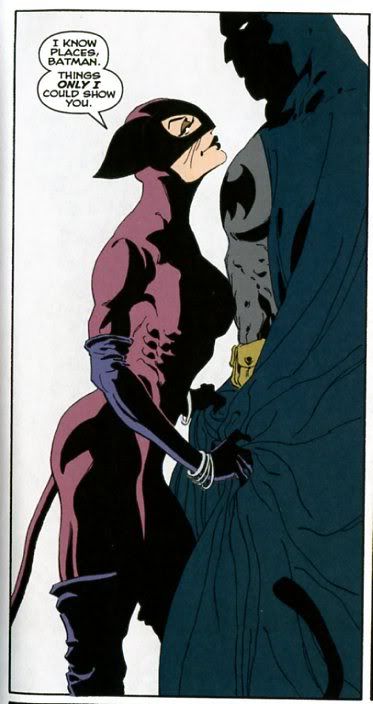
I’ve been sort of half meaning to read the Long Halloween for a while. I’ve seen some of Tim Sale’s art before…mainly when he did that Comics Journal cover a little while back, I think. Anyway, I like his work; he has a nice clean design sense, with good use of blacks and dark areas especially. His character designs are striking too; he manages to be cartoony in a way that doesn’t seem to come either from manga or from humor comics. Instead he seems more directly influenced by art nouveau…or perhaps it’s just Frank Miller. I don’t necessarily love everything he does. I find his Catwoman design kind of meh, for example; the purple suit seems overly angular and drab, and I don’t share his obsession with abs for all.

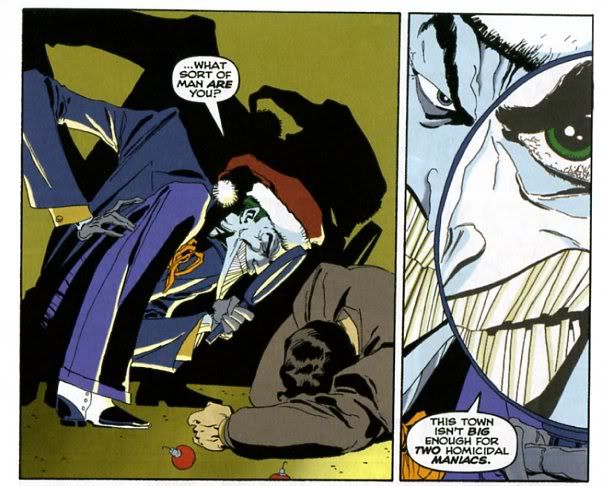
But even so, the panel is competently blocked and consistently stylized. It’s professional, damn it. And some moments are in fact inspired, like this Joker as Christmas- Grinch sequence…

The way the Joker’s body is all folded up in that first panel, and then the veins in his eye shot through the magnifying glass…that’s fine storytelling. It’s worth looking at.

And then there’s the story. I think that, maybe, if you really want to appreciate Dark Knight, you should read The Long Halloween. It’s easy to look back at Frank Miller’s writing and sneer at the grim and gritty Batman, the hard-boiled repetitive dialogue (“this would be a good death”), etc. etc. But, damn it, there was a ton of humor and energy there as well; his Joker, for example, was genuinely, viciously funny (dressing Selina Kyle up as Wonder Woman — what the hell? or calmly stating “I’m going to kill everyone in this room” — to which the David Lettermen analog gives the pitch-perfect response, “Now that’s darn rude!”) And his Batman had a real voice and inner life — stolen from all those pulp sources, of course, and over-the-top, but still, in part for those reasons, memorable and even nuanced. I loved that moment at the end of the book where he tells Robin to sit up straight for example; he’s both this grim avenger and this crotchety father figure. He’s perfect, and the perfection is played as a cantankerous tic. Certainly, the book is dark in that people get killed and there’s blood and it’s for grown-ups, more or less. But it’s not dark in the sense of being dreary. It’s filled with ideas and weird jokes and satire and a lot of love for the characters and for imaginative possibilities.

The Long Halloween, on the other hand, has no imaginative possibilities to offer. Forget Miller’s occasional forays into society and politics and mortality — Jeph Loeb doesn’t even have anything to say about Batman or his rogues gallery. Sale makes sure everyone looks great, but that can’t hide the fact that the designated writer has the proportional spunk and gumption of an actuary on quaaludes. The Scarecrow wears straw and the Mad Hatter speaks wiTh FuNny caPs — that’s about as much personality as Loeb can offer. They might as well all just stand around telling each other, “Um…die, Batman. I’m really nuts. No, no, I am. Die.” Except that would be marginally entertaining, wouldn’t it? Instead the Joker laughs and the Catwoman does her Catwoman ooh-I’m-ambivalently-evil thing, and Batman wanders around stiffly, sticking out his muscles, muttering the same few lines over and over (“I believe in Harvey Dent.”), and painfully clanking forth some insight from the old Frank Miller scripts he probably reads before going to bed (don’t wear the costume in the day — check. Got that in Year One. Thanks.) The mafia guys are similarly lackluster,the third-hand Godfather cliches played with so little sense of irony that the best joke in the book ( instead of the good-guy mafiosos refusing to move into drugs, they refuse to move into super-villains) just sort of sits there looking confused and pitiful.

Plopped down in the middle of such dreary, derivative schlock, the book’s iterated tagline, “I believe in Gotham City,” comes across as neither inspiration nor bittersweet aspiration, but as callow fanboy special pleading. Because you know what? This is going to come as something of a shock, but…Gotham City? It’s not real. You want me to suspend disbelief, you need to put in some effort and some genius. Because simply asserting that your little corporate fan-fic fantasyland has profound meaning makes you seem like some kind of aesthetic mosquito, battened desperately on the decaying carcasses of past minimally talented Batscripters. Suck mightily as you will, though, that juice is gone. All you can get out of those corpses is a dry slurping noise, which sounds mighty empty as it echoes about in your doddering edifice of piffle.

And of course since no character in the entire exercise has anything like an actual personality, the inevitable twist ending comes across as utterly gratuitous. Oh my God, the killer is — Harvey Dent’s wife! That’s so profound because, like, she was such an utterly boring, stereotypical whiny wife throughout the whole book, and now…she’s still an utterly boring, stereotypical whiny wife, but with a plot arc cribbed from Scott Turow.

Oh, wait, did I spoil the end? Sorry. Guess you won’t want to read it now.

Maybe you could just look at the art?

Face Down In The Mainstream: Batwoman Pt. 2

Eyecandy.

I like it. But it’s tough to have nothing but eyecandy. There needs to be a structure, a frame, a skeleton for the flesh to hang upon.

Unfortunately, the skeleton of this week’s Batwoman is sort of wimpy and dull. Which is too bad, because the art continues to be very very nummy.

In this episode (#855, Sept 09), Batwoman fights the loli-goth villainess, Alice. It should be tons of fun, but Alice is just regular old crazy instead of being interestingly batshit insane. The two tussle and Batwoman disarms her and then Alice slashes Batwoman with a razor hidden in her mouth. It’s laced with poison, which is also sort of boring, really, as villainous feints go, but it does give the artist a chance to do this, which makes is worthwhile:

Isn’t that pretty? I love the scrollwork and the design elements and the way everything becomes lush and strange.

So Batwoman has sad but very pretty insane imaginings and then we get to see Alice go back to her minions. Again, there’s some interesting play with the layout:


Then there’s another little tussle. It’s kind of stock and there’s a cliffhanger where what seems to be werewolves and octopus creatures show up. I had hoped that maybe they’d do something with the Alice theme, because I’m bored with stock weird monsters. It would be so much more fun if the werewolves were wearing top hats and vests with pockets and if the octopuses had to wear red and white livery. But oh well. Maybe things will be brought to an exciting climax in the last issue, but I’m not holding my breath.

In short: Beautiful art but boring story.

Bound to Blog: Wonder Woman #18

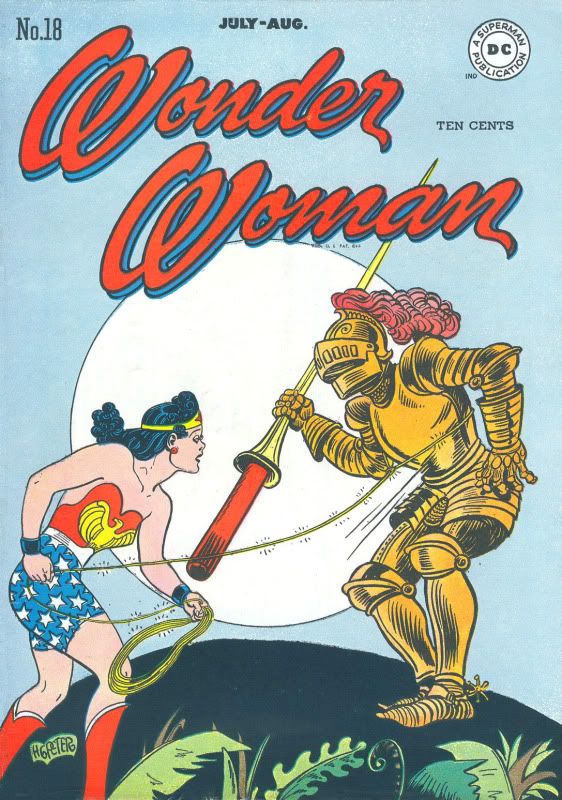
That’s a kind of generic cover for Peter; the knight’s certainly nicely drawn (love that plume), but overall it’s fairly static and boring by his standards. Part of that may be that it’s trying to be coy: Marston/Peter have a secret return villain, and they don’t want to give it away. But here I come spoiling it 60 years later: the villain in this issue is:

Dr. Psycho!.

Remember him from Issue #5? Little dwarf guy? Hated women so hypnotized them to cause them to send forth ectoplasm so he could take on different shapes? How could you forget, right?

Well, anyway, as so often happens with sequels, this one isn’t nearly as much fun as the original. No giant space kangas, for instance. No battle with Ares (who was originally using Psycho to prevent women from getting involved in the war effort.) Instead, there’s a much less convoluted plot involving Psycho trying to wreak revenge on WW and her pals. There’s as always some nice art, and Marston/Peter do seem committed to the wordless sequences now:
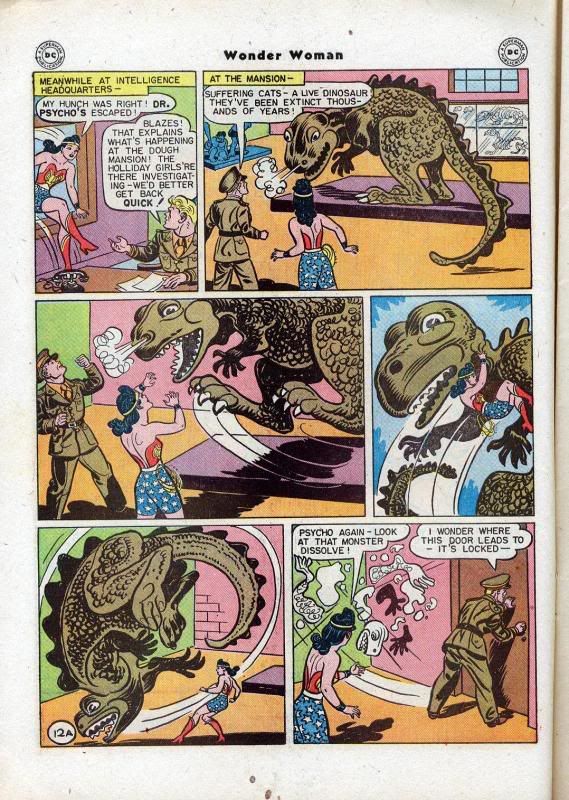
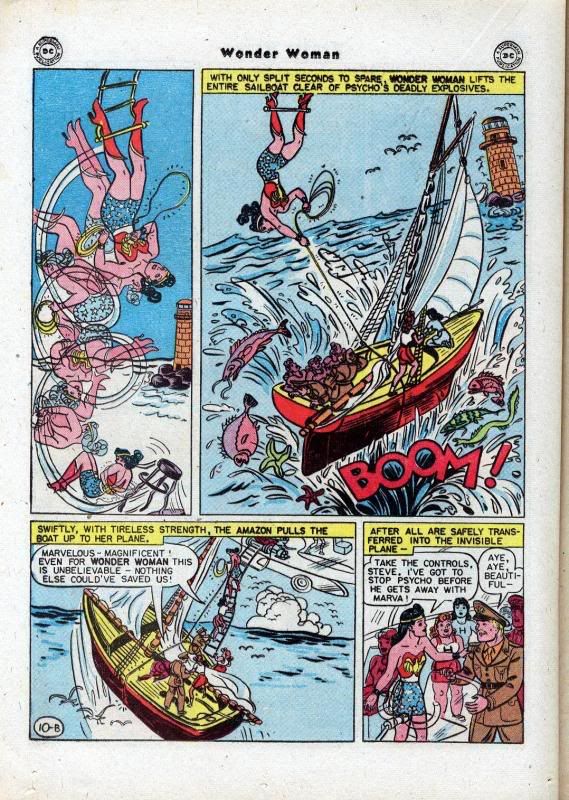
That last one, with Peter showing the movement through ghost images as WW throws herself into a backflip with her hands tied behind her back, is pretty spectacular. Despite such moment, though, this one isn’t the best of all possible Marston/Peter efforts.

But even mediocre Marston/Peter has some pretty interesting stuff going on. In particular, this one made me wonder about that all important question: Is the phallus female? (I know you’ve always wondered.) To answer that, we’re going to make a detour and talk about John Carpenter’s Christine.

Christine is about Arnie Cunningham, a nerdy, sweet high school kid who discovers a sentient car named Christine. The car possesses him, and he turns into a cool fifties greaser type, who’s attractive to girls and emotionally inaccessible and really dangerous. I talked briefly about Christine a ways back:

Christine the car is, of course, supposed to be a woman…but any car is obviously literally genderless, and the secretive nature of his relationship with her, plus her violence and the fact that, hey, she’s a car…if she’s a woman, she’s awfully, awfully butch, is all I’m saying. Arnie,of course, gets more and more manly and tough and evil the more time he spends with the car — which on the one hand suggests that, hey, he’s got a girl now, so he’s a man — but on the other hand suggests that he becomes more of a man by caring less and less about girls. Yeah; total agonized male fantasy of being simultaneously consumed by femininity and consumed by masculinity; the orgasmic collapse/reification of male identity — being castrated so you can turn into a penis (at the close Arnie is penetrated by a piece of glass from Christine’s windshield, caressing her one last time before he dies. Being violated by her, having her in control, is what makes him most male; emotionally inaccessible, commanding, finally murderous. Christine is ultimately masculinity itself, which possesses Arnie; but at the same time that masculinity is feminine — since it doesn’t reside in a particular body, and ambiguous genders are always coded feminine.

Christine in the movie functions as a phallus; before he gets her, Arnie is a typical feminized nerd; when he gets her, he becomes a manly embodiment of pitiless law, hunting down those who attack his car, or who steal his girl, or who just look at him funny, really. So Christine is what makes him a man. But she’s also, obviously, a woman, or at least feminized, which suggests that what makes you a man is a woman.

That’s not all that odd a concept…the whole point of the trophy girlfriend, for example, is that you demonstrate your manliness by walking around with a female status appendage. But Christine pushes the idea to an unusual extreme; Christine isn’t just a status symbol; she’s actually the source of power — not so much a sign of the phallus as the phallus itself. That’s part of the anxiety in the movie. Ta-Nehisi Coates has talked at various points about the idea that misogyny stems in part from male fears of being rejected, or being unable to deal with the emotional vulnerability inherent in having a relationship with a woman who can accept or reject you. I can see that…but at the same time I think there’s also an anxiety around the fact that women hold the keys to masculinity;men are forced to rely on women to prove that they are as men. Arnie puts himself in thrall to female power, and while that makes him a man, it also makes him a monster.

So, back over to Dr. Pyscho. As I mentioned, Psycho’s power, like Arnie’s, actually derives from women. The ectoplasm he uses to change form comes out of his female mediums. And you can tell it’s female, because it’s pink!
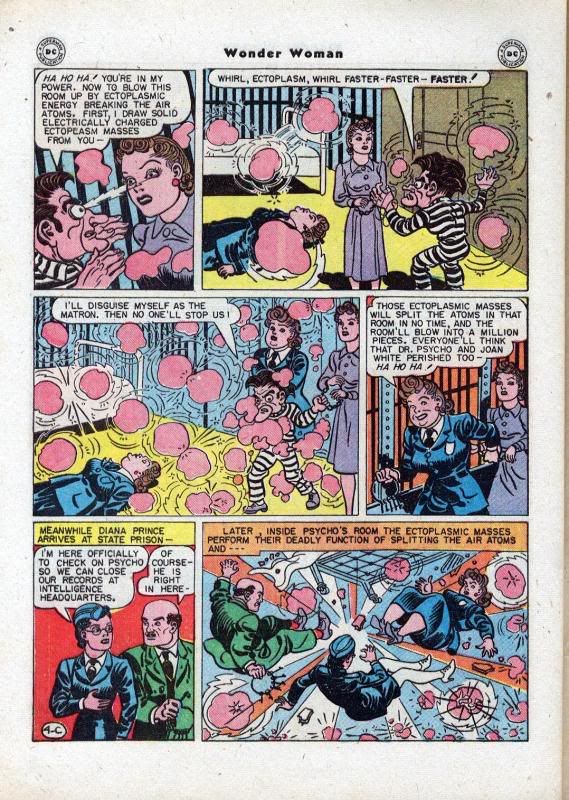
Psycho, like pre-Christine Arnie, isn’t very masculine. He needs to tap into female power to turn himself into a man’s man such as….Tyrone Gayblade, the great lover!
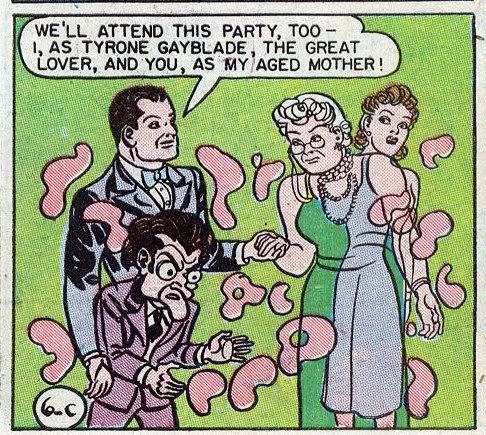
There’s a certain logic to that; if male power comes from women, then it should be queer (this is the case in Christine too, where Arnie’s secretive relationship with Christine reads as gay in certain ways, as I mentioned above.)

The kind of power Psycho gets from the women is also arguably female in nature. In the first place, he keeps turning himself into women, inlcuding the paragon of womanhood herself:
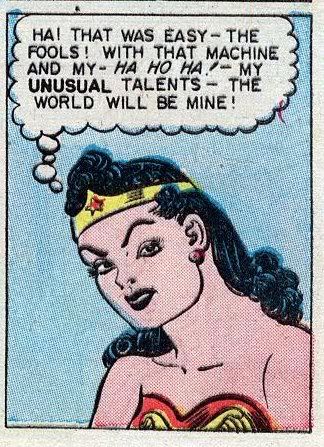
I bet that Marston really enjoyed the chance to write briefly about an evil WW…and perhaps especially about a man masquerading as an evil WW. (There’s another duplicate WW story here. At the same time, it’s interesting that the WW double didn’t show up on the cover. Duplicate WW clones of various stripes would become an obsession for Silver Age writers — a way, maybe, for creators to express their distaste and distrust of the character, or perhaps just their indifference by throwing oodles of generic clones into the plot. Marston, on the other hand, tosses the idea off and moves on to something else. There is a note or two about how the military brass mistrusts WW briefly because she appears to have stolen their secret weapon…but it’s treated as an aside, whereas in the Silver Age it would have been the main focus of the story. Marston isn’t interested in having people hate WW; she’s not Spider-Man. The point is everybody loves her! That’s what being a hero is all about, damn it.

Where was I?

Oh, right.

So Psycho gets to be a powerful guy by deriving power from women. Partly, that means that he’s more manly. Partly, it means he’s more queer. Partly it means he’s more female. But above all, it means he’s got the phallus:
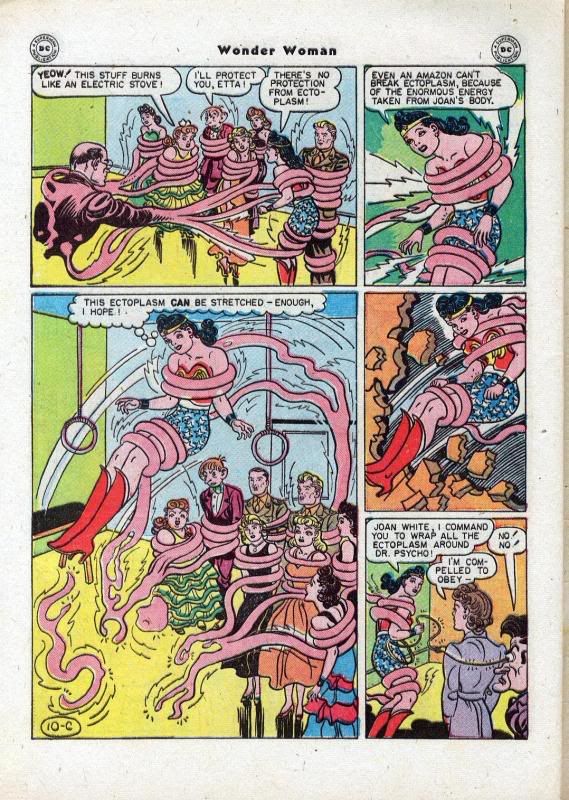
I love that; the pastor who is about to perform a wedding dissolves into pink, ropy, sticky tendrils, binding the wedding party in sticky bondage goo. Luckily, though, WW is more of a man, and more of a woman, than Psycho, so she can turn the phallus on him:
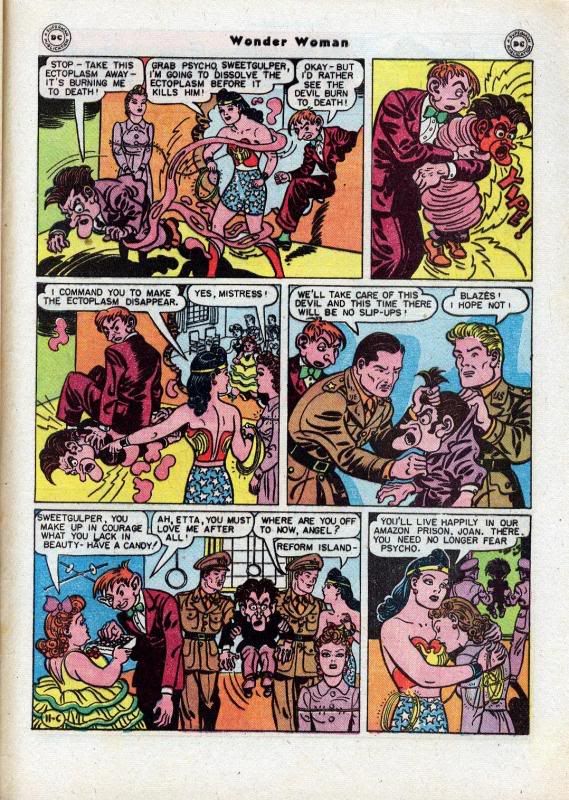
Great panel at the end: “You’ll live happily in our Amazon prison, Joan.” Joyful bondage, hooray!

As in Christine, there’s some anxiety here — but it seems more connected to male power than to female power. In Christine, the female power corrupts the man (turning him into an uber man); here, it’s more like the man corrupts female power (turning it into a phallus.) The wedding turns into an abject nightmare of goopy penis tentacle rape because the man is in control; once WW reclaims the ectoplasm for femininity, all is well.

You may be wondering who’s getting married, incidentally. Why, it’s…Etta Candy and Tyrone Gayblade!
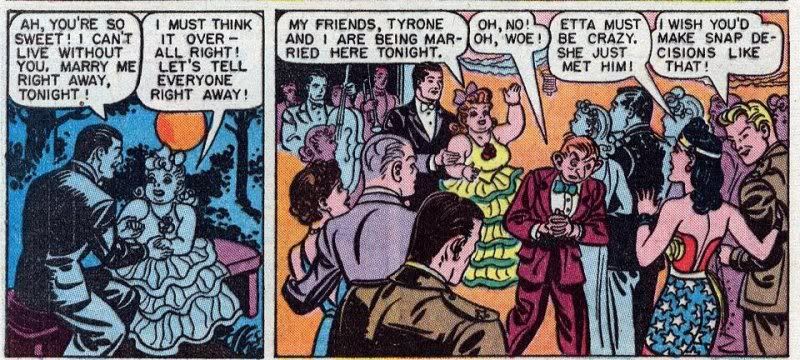
Who knew Etta was so eager to get married? It does seem kind of out of character for our butch, independent, entirely orally oriented comic relief. But on the other hand, Etta doesn’t seem especially distressed when things don’t pan out.
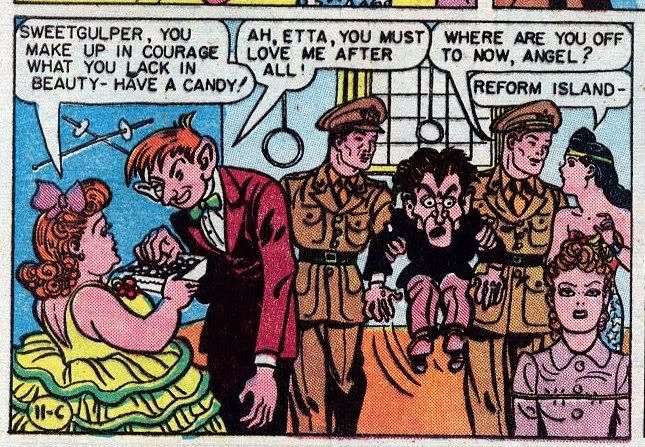
Easy come, easy go. And yes, her long-suffering, nerdy, dominated suitor is named Sweetgulper.

Oh, and I couldn’t leave this issue without showing you this:
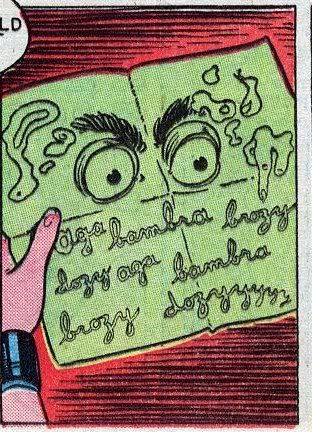
Psycho hypnotized one of his mediums by drawing his own eyes on a piece of paper and sending it to her. He really is tricky.

____________________

Just as a final thought: Greg Rucka used Dr. Psycho in his run on the issue. Basically, he turns Psycho into a mental rapist, controlling women with the power of his mind for sexual thirlls. The fact that Psycho’s power derives from women is entirely lost…making the character a lot more rote and boring, I think. Also, you know, there aren’t pink strands of ectoplasm everywhere. Which seems like a missed opportunity.

Music For Middle-Brow Snobs: Thrash by Thrash

Thrash and related bits, like the title says.

1. Slayer — Piece by Piece (Reign In Blood)
2. Slayer — Necrophobic (Reign in Blood_
3. Bathory — War (Bathory)
4. Testament — Do or Die (The Legacy)
5. Metallica — Whiplash (Kill ‘Em All)
6. Morbid Angel —Bleed for the Devil (Altars of Madness)
7. Napalm Death — Siege of Power (Scum)
8. Napalm Death — Control (Scum)
9. Celtic Frost — Suicidal Winds (Morbid Tales)
10. Wasted Youth — Bucket Head (Black Daze)
11. D.R.I. — War Crimes (Dirty Rotten LP)
12. Van Halen — On Fire (Van Halen)
13. Unexpect — Another Dissonant Chord (In a Flesh Aquarium)
14. Dead Kennedys — Forward to Death (Fresh Fruit for Rotting Vegetables)
15. Sepultura — Territory (Chaos A.D.)
16. Meshuggah — Vanished (Destroy Erase Improve)
17. Frost Like Ashes — Shattered Gods (Tophet)

Download: Thrash By Thrash.

For last weeks electrodisco download is available again for those who missed it.