Morpheus Strip: Impressions of Sandman #1-20

[Being a cursory reexamination of The Sandman #1-20 by a non-devotee]

The last time I read the first few issues of The Sandman was sometime in the late 80s as the individual issues were being serialized. I suppose it must say something about my appreciation for the comic that it was one of the few mainstream continuing series which I collected from beginning to end. While my interest in the series waxed and waned even as I was collecting the issues, it was these initial episodes which have stuck with me most over time. My general lack of interest in The Sandman is probably best demonstrated by the fact that I had completely forgotten that Morpheus had died towards the close of Gaiman’s tale until Noah brought it up in his roundtable entry. So little did this series mean to me at that point in time (I say this only in retrospect).

When Noah suggested this roundtable discussion last week, I decided to follow his lead and simply reread some issues of The Sandman to reassess my feelings towards the book. The consistent refrain in recent years is that The Sandman as a whole doesn’t hold up. This would suggest that The Sandman represented some high watermark at the time among the comics “cognoscenti” but I don’t remember it ever actually achieving such adulation among readers with a restricted diet of men in tights. I could be mistaken of course. Its reputation among the comics agnostic was and is immense, a fact which was perpetually enshrined by Gaiman’s honoring with the World Fantasy Award in 1991 for his tale with Charles Vess in The Sandman #19 (“A Midsummer Night’s Dream”)

The most surprising thing about my current reappraisal of The Sandman is how little my impression of these initials issues has changed. I’ve been impressed by the extensive planning involved from the very first issues, now confirmed by a review of Gaiman’s initial Sandman proposal at the back of The Absolute Sandman Vol. 1. He has a good feel for the material and has the right ear for the kind of dialogue required by his characters. These comics are clearly the receptacle into which Gaiman poured a multitude of his ideas. His script for the aforementioned Shakespearean story is precise and well planned, meeting its equal in his collaborator, Charles Vess. We see in these early issues the foundations for the various complexities among The Endless later in the series. The bricks from which Gaiman’s constructs The Sandman fall into place methodically and with great facility throughout these 20 issues. On the other hand, these perceived “virtues” would appear to be among Noah’s chief irritants with regards the series.

Of course, with the passage of time and some personal growth and development in taste, certain ideas have begun to appear more musty. Dr. Destiny’s path of violence and humiliation through The Sandman # 6 (“24 Hours”) no longer seems as viciously violent as it once seemed. “A Dream of a Thousand Cats” from The Sandman # 18 now appears much more simplistic and derivative. The damage frequently wrought to Gaiman’s ideas by Mike Dringenberg, Sam Keith and Colleen Doran is even more evident to my eyes than it was before.

Is Gaiman’s depiction of love as leaden and functional as Noah suggests? It’s entirely possible. Yet it must be said that it has never occurred to me to ask for anything more from Gaiman’s series if only because the comic never seemed to be more than a simple yet appealing entertainment. Perhaps this explains why the seemingly inexplicable nature of Nuala’s love for Morpheus and the reasons Noah posits for this seem more than sufficient in my eyes; these seemingly simplistic justifications being the very fabric of fairy tales and myths. Gaiman gifts are for plot and narrative (enlivened by a thorough immersion in his subject matter). Whenever he strays into the realm of heartfelt emotion, he almost always falls flat on his face. The Sandman has never moved me in the way it appears to have moved much of its audience.

Noah’s passion for The Sandman comes through in his piece. He wants more from it even when there is only so much to squeeze from this fruit. Even when he seems to be criticizing Gaiman’s pretentious depictions of repression, what comes through seems more like bitter disappointment with a beauteous love now tarnished. Yet even these grievances seem well worth exploring and reading if only because of the passion I detect beneath them. Similarly, Tom Crippen’s Sandman retrospective (“My Gaiman Decade”) in The Comics Journal #273 is worth reading precisely because he feels so deeply for the work. It reads like a love letter (tinged with regrets) to a high school sweetheart 10 years on.

For me, Morpheus and his sister, Death, have always remained cyphers and plot devices meant to push forward the narrative and communicate simple homilies – characters for which I have never felt any real warmth or affection. What I see in The Sandman is an intricate fireside story informed by fantasies both old and new. There are modern trappings scattered around the series but the overwhelming feeling is that of myth making and all the richness and sparseness this entails. In much the same vein, I remember the Death mini-series more for Chris Bachalo’s depictions of Death than any semblance of characterization. My memory of it after all these years is that it was rather poor reading. It’s a different matter when it comes to Jaime Hernandez’s depiction of Maggie and Hopey in his most recent comics. Maggie’s crushing depression and sense of loss is palpable when she revisits her old haunts in Ghost of Hoppers. Jaime’s chosen path seems almost like an oppressive hand on his characters lives. The situations in Jaime’s stories are meant to advance his characters while the reverse, more often than not, appears to be the case in Gaiman’s comic.

____________________________________________

These were never books of immense complexity but simply reasonably well told and plotted comics (two elements in short supply in mainstream comics both then and now) served fitfully and to varying effect by a few of the most respected artists in the field (McKean, Vess, Talbot, Craig Russell and Zulli). It’s still a good deal better than 90% of what you get on primetime television. And that’s the key to its success – accessibility mixed with a not insubstantial helping of intelligence and imagination to tickle the nerves of an audience used to much blander food. The richness in its textural references seem mostly skin deep (at least in these early issues). These reference are rarely integral to a clear understanding of the plot nor are they particularly useful as passageways to even greater insights. Evidently, Gaiman understood his audience well.

When I reread Gene Wolfe’s The Book of the New Sun every 5-10 years or so, I still find new things to marvel at and more mysteries to uncover. The series remains a continued source of pleasure for me whenever I find the time to revisit it. With The Sandman, I see an old friend who hasn’t changed much since I last met him over a decade ago – still amusing and entertaining in parts but a little shelf worn (though not drastically so). I remember much about him and of his personality even though he’s faded a bit with time. To spend a few hours in his company isn’t particularly painful.

____________________________________________

Notes:

(1) I recently had the chance to read an article by Matthias Wivel at The Metabunker about Gaiman’s work across all mediums with particular reference to Coraline. Wivel appears to have read most of Gaiman’s works including most if not all of his novels. He is of the opinion that the comics represent Gaiman at the height of his artistry. This would include parts of The Sandman I imagine but also his other works such as Mr. Punch, Signal to Noise and Violent Cases. I wonder if he’s right.

(2) Perhaps it would be of some interest to collectors and admirers of original art that some of the most famous pages and covers from the series can be found on Comics Art Fans (CAF). The cover to The Sandman #1 recently surfaced on CAF and is owned by a prominent art dealer who is also an avid collector.

______________________________
Update by Noah: As fascist blog overlord promoting gratuitous synergy, I feel it incumbent to add that my initial post in this roundtable on Sandman is here.

Morpheus Strip: Dream Lovers

This is the first in a roundtable on Neil Gaiman’s Sandman series. Suat, Tom, Vom Marlowe, and Kinukitty will be along later in the week with their takes on the series as well. (Update: And you can now read the complete roundtable)
______________________

I loved Sandman back when it came out in the late 80s/early 90s, and I’ve probably read the whole thing through at least a couple of times. However, it’s been a while…partially out of nervousness. I strongly suspected that the epic wouldn’t hold up on rereading.

And…yeah. It doesn’t exactly hold up. I reread the entirety of “Fables and Reflections” and skimmed through a couple of the other books (“A Game of You” and “The Kindly Ones” especially, I think.) Part of it is the art, which bounces around inconsistently and is often just not especially good. There are undoubtedly some very nice walk-ons — Bryan Talbot’s creepy take on the giant, cadaverous Persephone was memorable, and, as Suat recently pointed out, the P. Craig Russell “Ramadan” story is pretty spectacular. But then you’ve got atrocious efforts by folks like Kent Williams.

No wonder he looks startled; he appears to be improbably made out of rock. Maybe he’s related to the Thing?

Aside from the inconsistencies in the art, though, the real problem is that my former enthusiasm for Gaiman’s writing has dimmed a lot. I can still appreciate his cleverness and the care of construction…but after a while, both of those virtues are pushed so enthusiastically and unilaterally that they start to feel oppressive. After a while you start to almost want to plead — please, somebody, anybody, could you just once say something that doesn’t come back a panel, or a page, or several issues down the road with an ironically profound or profoundly ironic twist? Could we have a story end without a smug little O’Henry meets dumbed-down Borges twist? Could everybody just for a fucking second stop talking?

The thing that crystallized my irritation with the series was Nuala. She was a fairy with a glamor that made her appear as a beautiful woman, but in actuality she was kind of a dumpy elvish little thing. The fairy gave her as a gift to Dream for some reason or other (maybe to try to get him to give them the key to hell? I can’t remember exactly.) Anyway, she fell in unrequited love with dream, and ends up nervously and apologetically causing his downfall. She’s a sad, sweet character. I liked her.

But as I was sort of skimming over her story again it occurred to me that, while her unrequited love is certainly poignant, it’s also weirdly unmotivated. That is, we certainly do feel her pain and sadness to some extent…but we never really get much of a sense of her love. What about him appeals to her? Does she think he’s beautiful? Is it his (on again off again) kindness to her? His power? There don’t have to be individual or even clear answers to these questions, obviously, but they’re never even asked, much less answered. For Gaiman, Nuala’s love is an almost magical fact; it drops onto her and possesses her, and that’s all we ever really need to know about it.

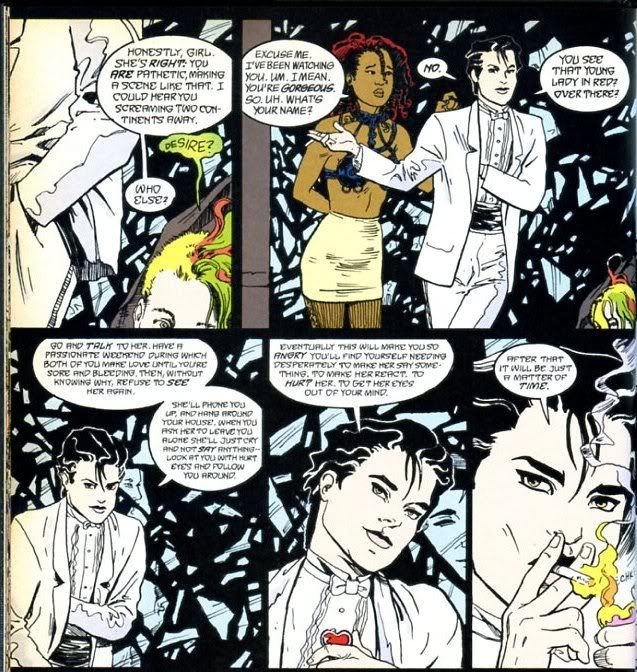
And that’s how love functions throughout the story. Gaiman almost never, that I can remember, actually bothers to show love as a functional, or even dysfunctional, relationship between two people. Instead, it’s just another plot device, a story element to push the action…or, more accurately, the words. In “A Game of You” the cuckoo casts a love spell by talking; in “Brief Lives” Desire does more or less the same thing.

That seems to be how Gaiman sees love; a verbal whammy that comes out of nowhere to make a clever point or set up a clever scene, rather than as an actual relationship which is maybe worth exploring in its own right. Destruction accuses Orpheus of loving the idea of Eurydice more than the actual person…but is that really Orpheus’ failing? Or is it Gaiman’s? Certainly, Gaiman never shows the couple in a tender moment — Eurydice gets more time with a Satyr in the narrative than she does with her supposed love. And the big love affair of the book, between Dream and Thessally, occurs almost entirely off-screen..ostensibly because doing it that way is clever and surprising, but maybe actually because Gaiman has no idea how to deal with an actual love affair and is scared shitless to try. Certainly, the hints of the romance we get sound deeply unconvincing — when they’re in love they walk about idyllically among the bowers prattling sweet nothings, making some of Dream’s attendants uncomfortable; when theyr’e out of love it rains a lot because Dream is throwing a tantrum. Gaiman is clear that these are cliches, and he’s making fun of them because they’re cliches…but that doesn’t change the fact that he doesn’t seem able to deal with love in anything but cliches.

There’s actually an analogy here with another, more recent tween phenomena: Twilight. In both, there’s a lot of darkness and angst, which gives an exciting frisson of danger even as it distracts from the things that an actual adolescent might really find dangerous or threatening. In Twilight, the danger of vampires and blood and werewolves and melodrama all stands in for, and obscures, the looming, oncoming reality of adult relationships and sexuality. In Sandman, similarly, the pretension and the cleverness and the angsty melodrama seems, at some points, like a magician’s trick; the left hand is bobbing and weaving and throwing out fireworks so that you don’t notice (except with a kind of unacknowledged satisfaction perhaps) that there’s not much at stake in the right.

Though that all sounds kind of harsh, I’m actually not against this kind of tween repression categorically; in the Twilight series ( which I’ve mentioned liking before) I think the sustained effort to avoid looking at the obvious ends up energizing the series; it’s both winning and squicky, a kind of pop sublime. In Sandman I’m not sure it works so well. On the one hand, Gaiman is in some sense obviously a better writer than Stephanie Meyer. Though, as I said, the cleverness is irritating, it is, nonetheless, often actually clever, and he does manage to come up with some genuinely creepy twists (the treacherous stuffed toys in “A Game of You”) as well as some moving ones (Nuala’s story for example, as I mentioned above.) Meyer is not as bad as she’s sometimes claimed to be, but I doubt she could have pulled off either of those things.

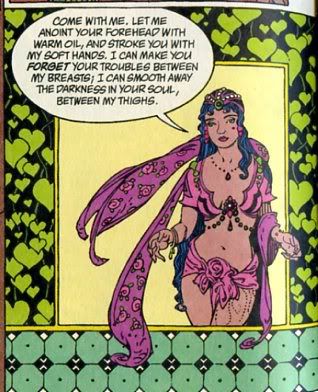
On the other hand…Sandman is way more pretentious than Twilight…and the distance between the pretensions and the delivery is sometimes painful. For instance, there’s this panel:

Ah, those harem maidens…so exotic! So poetic! So unaccountably possessed of the sweaty metaphorical unease of a randy 13-year old trying to look impressively sophisticated!

It’s significant too, I think, that the so-thoughtfully entreated king declines the request. In Twilight, the heroine and hero eventually do, in fact, after much deferral (and marriage) have sex. This is in itself problematic; the whole tension of the series rests on the balance between safety and desire which is more or less vitiated when everybody gets what they desire and ends up safe. Gaiman is more canny; Dream, elaborately and with much fanfare, refuses to alter the structure of the series. Rather than change he decides to kill himself. Gaiman makes the “change” in question specifically about responsibility; Dream is not willing to give up his duties as ruler of dream, and so his only way out is death. But one has to wonder — is it really his (quite amorphous) duties that are at stake? Or is it something else? His ex-lover and Nuala more or less engineer his final downfall, his realm is torn apart by the furies, a rampaging feminine archetype — and the way they taunt him at the end is borderline sensual. “We are destroying the dreaming. Can you not feel it?” “Yes I can.” But then interrupts the foreplay, and Dream scurries off into oblivion, leaving one more fraught relationship we don’t get to really explore. Like a cadaverous Peter Pan, he never grows up, never has to stay with Wendy, and never gets out of the dream.

_______________

Update: Suat’s post is now up.

Update: Vom Marlowe and Tom weigh in.

Update: And Kinukitty finishes up.

Mel Brooks

Matthew Yglesias says of Jonah Goldberg:

… holding captives in secret where they’re hung by shackles from the ceiling and occasionally beaten to death is fine by him, but efforts to curb smoking are “liberal fascism.” And now this line of thinking seems to have completely taken over the right.


The difference: dark foreigners are hung from ceilings, whereas white Americans are kept from smoking. Which reminds me of what Mel Brooks said about stepping into a manhole versus getting a paper cut: if the first happens to you, it’s comedy; if the second happens to me, it’s tragedy.
(I think the Brooks quote was about cutting your finger, not specifically a paper cut, but it’s the same idea.)
update,  TPM quotes a reader who jogged by the big gathering of angry people in Washington today:

Interestingly not a lot of American flags but a lot of other flags including the yellow don’t tread on me flag. 

I had a similar thought when I saw a photo of one of the demonstrators, a guy carrying a modified American flag: the old 13-stars-in-a-circle flag but with a “II” in the middle to indicate that the Tea Party movement is like the second American Revolution. Basically, an American flag wasn’t good enough for this guy; he wouldn’t settle until the flag had been made into an emblem of the Tea Party movement.
I’m indifferent to flags unless they represent something I find hateful (the usual suspects: Third Reich, Confederacy). But I think it’s worth noticing that you can no longer predict what flag the flag wavers will be waving. For decades we’ve heard them talk about America-love as the one supreme virtue, and about the American flag as the supreme expression of this virtue, and now their love has frittered itself away. These days they’re into novelty items. That’s a big change.
I don’t claim to know the reason, though I guess many of my fellow liberals would point to the election of a black president; my preferred explanation, for which I have no evidence, is just the schlockification and t-shirt-ization of modern life. 
Another TMP reader is quoted:

Some in the crowd appeared to be low functioning zealots suffering from serious mental illness and/or undisguised racial hatred. However, most of the people who marched by my vantage point appeared to be rather earnest but misled members of the lower middle class who were just regurgitating Fox News memes concerning imagined threats to America.


Okay — lunatics and dumb people. But where are the venal con men

Music For Middle-Brow Snobs: Sister Nepenthe

Here’s this week’s download. It’s more on the rock end of things:

1. T. Rex — The Slider (The Slider)
2. The Stooges — Little Doll (The Stooges)
3. Jesus and Mary Chain — Gimme Hell (Automatic)
4. The Stars — Double Sider (Perfect Place to Hide Away)
5. Cosmic Invention — Help Your Satori Mind (Help Your Satori Mind)
6. Necromandus — Nighjar (Downer Rock Genocide)
7. Saint Vitus — Dying Inside (Born to Lose)
8. Rolling Stone — Sister Morphine (Sticky Fingers)
9. Damon and Naomi — Beautiful Close Double (The Earth is Blue)
10. The 5th Dimension — Dreams-Pax-Nepenthe (Magic Garden)
11. The Observatory — Decarn (Dark Folke)

Download: Sister Nepenthe

And if you missed it, here’s last week’s download, featuring Chopin, Beyonce, Ol’ Dirty Bastard and others.

Utilitarian Review 9/11/09

A few people (well, okay, two) have mentioned that the blog is getting busy enough that it’s actually occasionally hard to follow everything. So I thought I would start trying to do a weekly roundup, both of business here and of my articles elsewhere. And, what the hey, I’ll throw in a couple additional links when I think of it. So here we go:

On the Hooded Utilitarian

I had two Wonder Woman related posts, one about WW creator Marston’s not very good novel, the Private Life of Julius Caesar and one about Bob Haney and Jim Aparo’s Batman/Wonder Woman team up

Tom proceeded with Wiki Trekand incidentally explained why on earth he’s doing this.

Kinukitty tried to figure out how squicked out she was or was not by the skeevy age differences in the yaoi manga Kiss All the Boys.

Vom Marlowe tried her best to like an X-Men comic with Rogue in it.

I reviewed the Andrei Molotiu editedabstract comics anthology (in which some of my work appears), and also wrote about the Japanese print series by Yoshitoshi 100 Aspects of the Moon

Finally, I posted my review of Mandy Moore’s album Amanda Leigh, which ran on Madeloud with some of its snark excised. And finally, I posted this week’s music download mix, featuring Chopin, Beyonce, Ol Dirty Bastard, and Johnny Cash, among others.

Utilitarians Everywhere

Over at the Comics Reporter, Suat has a lengthy and really entertaining article about how mainstream writers are overhyped while mainstream artists are underappreciated. I think this is my favorite bit:

Pia Guerra’s response to Brian K. Vaughan’s sparse and determinedly straightforward scripts (as presented at the back of the Y: The Last Man collections) are illustrations conveying as little mood or sense of place as is present in Vaughan’s instructions. The comic is left to succeed purely on the basis of Vaughan’s ideas and lively dialogue. That these ideas are at various times boring, nonsensical or just plain irritating is beside the point — I’m focusing purely on Vaughan’s mastery of the formal tools at his disposal. Vaughan’s stories in the early issues of Y are nearly bereft of devices unique to comics filled as they are with unsophisticated story structures, flat panel to panel transitions and the rote use of splash pages at the end of each issue. If anything, Y reads like an easy to understand sales pitch for comics-illiterate movie executives. Little wonder then that the words HBO and Y are so often uttered in the same breath.

I had a bunch of writing on music run this week. Over at the Knoxville Metropulse I reviewed the stellar new Raekwon album and the mediocre new album by the Vivian Girls. My essay about the greatness of Kitty Wells and the shittiness of Alison Krauss which ran on Culture 11 a while back, was reprinted over at a nifty site called Splice Today.

Splice today also ran an essay by me about Ukrainian nationalist black metal band Drudkh in which I explain why I like them even though they probably approve of burning my relatives:

I’m not trying to make the case that Drudkh is evil and should be banned. Rather, my point is that they seem clearly to be drawing from a nationalist milieu, which is proto-fascist if not actually fascist. And, moreover, it’s that milieu which gives their music its inspiration and its power. Microcosmos starts out with a Ukrainian folk tune on traditional-sounding instruments, and the whole set has a definite folk tinge-the riffing sonic blast on “Distant Cry of Cranes,” for example, is shot through with syncopation and melodic tinges that evoke traditional Eastern European music. This is made even more explicit halfway through the song, where the maelstrom falls quiet, and we get an acoustic guitar break leading into an almost funky dance segment. Similarly, the weird minor harmonics on “Decadence” (a thoroughly fascist-friendly title) point to folk sources. Even the classic rock soloing on “Everything Said Before” is under-girded by an odd, off-kilter rhythm, as if a village-full of toothless peasants had set upon and cannibalized Jimmy Page.

Finally, my comixology column is out today, in which I claim that Beyonce is really the best-selling super-hero of our time.

Super-hero comics are overwhelmingly made by, for, and about white guys. This is so thoroughly the case that you can actually watch the desperate, embarrassed scramble for a more multifarious façade whenever a property gets transferred to a different medium. Nobody gives a damn about John Stewart in those little pamphlet thingies, but on the tubes? He is Green Lantern, fanboy, because, hard as it is to believe, in the real world out there beyond the direct market people come in different shades and shapes and sizes, and gratuitous, pig-headed segregation is actually kind of bad for business.

Other links

Tom beat me to this one, but I really enjoyed Shannon Garrity’s article on the history of the Comics Journal.

Tucker has a great article on Cry for Justice, wondering why exactly DC thinks it’s an especially good idea to gratuitously murder scads of gay characters all at once.

Dirk dances on Paul Levitz’s grave as the latter is pushed out of the top job at DC.

And I haven’t read this, but am looking forward to it; the incredibly knowledgeable Jacob Austen writes about finding the first ever Michael Jackson recording.

So let me know if this is a useful innovation or not, and if so I’ll try to make it a regular thing.

Now With Free Checking: X-Men Legacy

X-Men Legacy issue 226
Carey, Weaver, Tadeo, Reber

You know those people who read just the words in comics and kind of ignore the art? Yeah, I’m the opposite. I like the pretty pictures and often ignore the words.

So I’d been wanting to read some American comics and I circled my options at the Borders. I wanted superheroes (including female superheroes), some action, not too much gore and no zombies. This episode looked promising: Rogue on the cover, decent art, explosions in the background. Neat!

I picked it up and read it over coffee at the Squid Cafe, and I was….disappointed. First of all, this sucker cost me four bucks. It’s full of ads for cheesecake statues and Spiderman toothbrush holders. There’s a large excerpt in the back for some other comic. All of which is fine, except–there’s only twenty two pages of comic. For four dollars! That’s seventeen cents per page.

Well, it seemed a bit steep to me, considering I can get nearly two hundred pages of manga for 8.95 (or 5.37 if I have my Borders coupon).

Regardless, I persevered and read the art. The story isn’t that complicated. There’s this sort of riot on Castro Street (no, I don’t know why it’s there–go with it), and Rogue and company are trying to stop it from being bad.

Some of the art is really fun. Check out this page below. The colors shift from earthy and dark to this sexy, girly pink. The woman’s pose is tough, hot, and feminine. Those earrings! That attitude! I wanted to know more about her right away.

Unfortunately, most of the pages are just not this good. And she’s not in the rest of this issue.

So we switch to another scene, where Rogue is supposed to battle the big female baddie. This should be a fun scene–the big payoff for the issue. Rogue gets to strut her stuff, the baddie gets to be tough, and….

It’s weird, is what. I wanted to mail the artists a copy of a simple anatomy book. Take a look at this page:

In the top right panel, the torsion is just wrong. Completely and utterly wrong. Yes, she’s moving through her body, but the arms and body don’t add up properly. Then there’s the competing speed lines in the next section. Speedlines go one direction from the punch–Rogue is thrown. And then we have speedlines from the opposite direction with a couple of sexy boots stepping into them like they’re supposed to indicate a slipstream. What?

The leg in the second to the bottom was it for me. The force lines go up (near the foot), the baddie is kicking up, not out. But Rogue is moving to the right. What?

Wrong. All wrong.

So they battle, Rogue gets in some hits, baddie gets in some hits, Rogue goes crashing through a window and then we get this:

Keeping it classy, I see. Thanks Marvel. Cause showing a woman’s bra when she’s been in a fight and lost is what cheesecake is all about! Frankly, I took one look at this and thought about mailing Rogue a nice brochure for Enell.

So at this point I’m kind of two minds: the Rogue bits were meh, but the Lady in Pink is hawt. The colors are gorgeous, but the drawing is irritating. (Also, whoever does the inks for the eyebrows keeps leaving out a chunk of Rogue’s left eyebrow. Weird.)

Then we come to this, the US Bank portion of the issue. We’re tooling along, having a massive street showdown with lots of yummy explosions and baddie fights on Castro street and we come to this page:

At first, I thought Well, the artist traced some photo of Castro and just included a building logo in the prime center top position for verisimilitude. And then, when the logo appears right next to the baddie’s head, I thought Huh, that’s odd. And then we get to the next page.

And my eyes rolled forever.

I slapped the poor issue shut and ordered myself a consolatory cappuccino. Fortunately, I wandered into a local small comic shop and they hooked me up with a much more promising title. Batwoman! Lesbian socialite by day and crime fighter at night. Sounds good to me.

A reason to get married

If my wife bought me a magazine, I could write stuff like this:

He’s tall, trim, with shaved head, a confident demeanor, wearing a dark turtleneck, kind ‘a funny and Yale Law School. Cool. Co-o-o-l. Or maybe even wow!

Then again I get to blog about people who played redshirts on Star Trek 40 years ago, so the hell with it.
(Yeah, I heard he sold the magazine, but apparently on terms that allow him to continue driveling. update, David Weman says in Comments that Peretz has now bought the magazine back. So, okay then.)