Bound to Blog: Wonder Woman #17

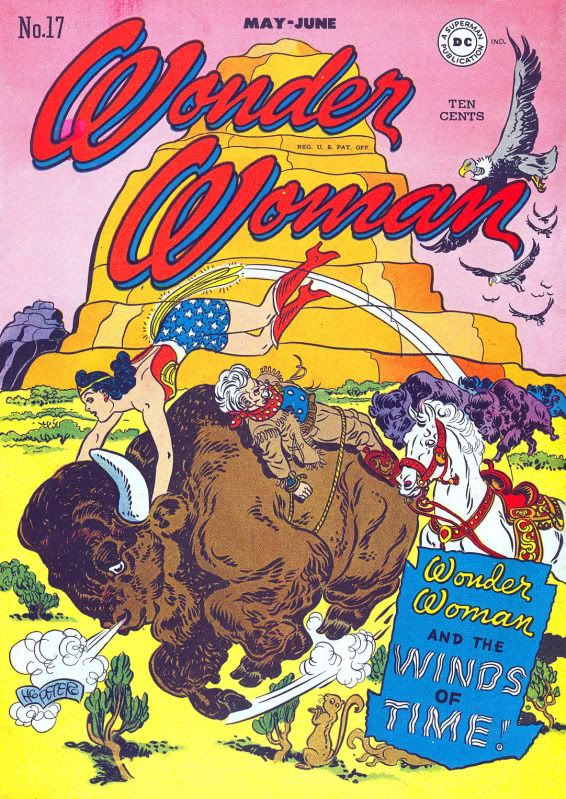
Marston and Peter’s Wonder Woman 16 may have been the best of the run so far, both in terms of the unusually ominous story and the adventurous art. #17 starts out well, with a marvelous cover.

Peter uses almost all of his favorite tricks here: the bison is out of scale, so WW looks almost like a doll, and even the horse seems bizarrely tiny. The motion lines are incredibly dynamic…in part because the circle is split up, I think. He also uses some of his scribbly linework for the bison’s breath…and that little cue cartoony squirrel is hard to resist. Plus, it looks like we’re going to get WW in the wild west, which sounds like it has potential. The last time travel episode, with evolving gorillas and dinosaurs and Steve turning into a cave man, was pretty great, so I was optimistic that a second might work as well.

Unfortunately, after that cover, the issue itself is pretty much…eh. Part of the problem is that the entire plot is built around a scientist Lana, her love for the no-good Carl, and WW and the Holiday girls’ efforts to cure her of same. Lana’s confusion is such that it causes her to whip up time winds which cause all and sundry to fall back into the past and relive former lives in roman and colonial times…but even such full-bore nuttiness can’t disguise the fact that this is a pretty staid man-done-her-wrong plot. Marston’s fetishes are kept mostly under wraps (as it were); Lana triumphs simply by getting rid of the bad guy in her life, not by teaching him the joys of bondage and loving submission. The feminism is less conflicted, but also a good bit duller. Or maybe the problem is just that pure, naive Lana is not a particularly sparkling protagonist; whether as modern scientist, Roman maiden, or pioneer daughter, her trust in her blandly evil boyfriend and love for her blandly gruff father are equally uninvolving. You can see why Marston didn’t care enough about her to even bother tying her up.

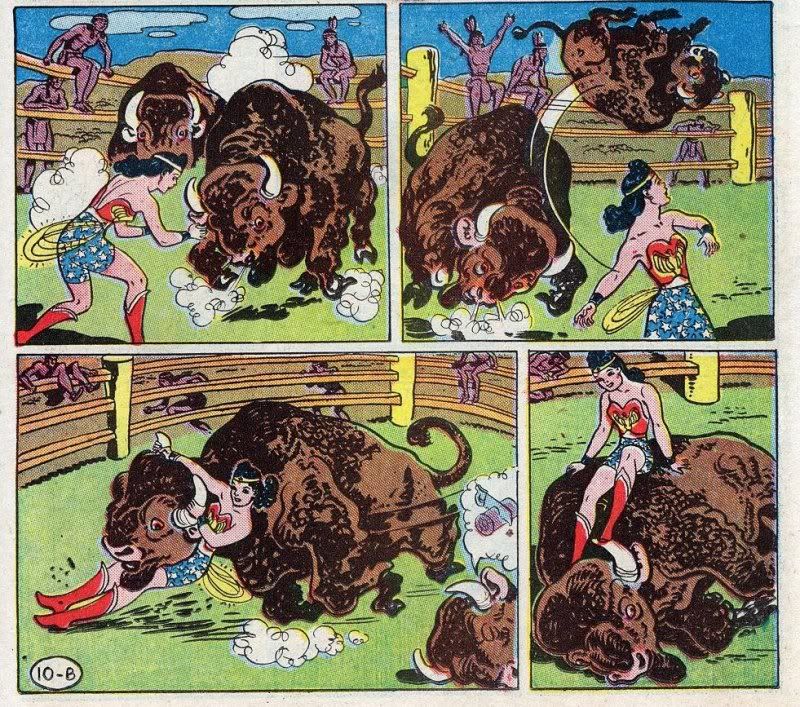
As is often the case in this series, as Marston goes, so goes Peter; the artist doesn’t seem nearly as inspired as in his last couple of outings. Still, there are a couple of moments. The duo does some more experimenting with wordless action sequences, and again the effect is lovely:

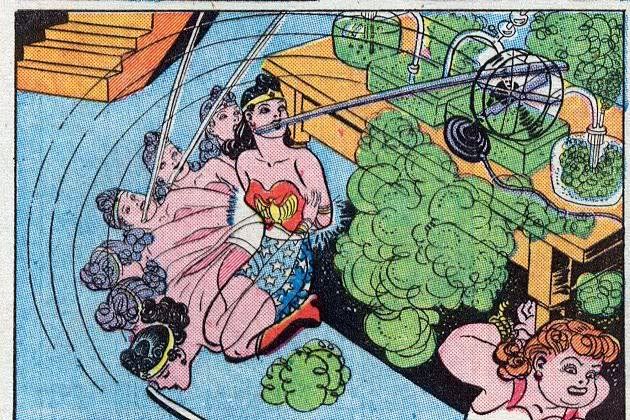
This is an interesting moment too.

Wonder Woman is using a pole to pick up a fan so the blades can cut the ropes tying Etta. I’m not sure the sequence entirely works; it’s hard to figure out whether WW is supposed to be moving up or down in that first panel, and the way the image is cropped, cutting off the end of the pole and the bottom two-thirds of Etta, seems awkward. But, again, I like the experiment with wordlessness, and the use of mutliple, Flash-like images of WW to convey motion is intriguing. Again, I wonder if this is something we’ll see more of in future issues. (I know we’ll see more of bound WW manipulating objects with her teeth — Marston lives for that.)

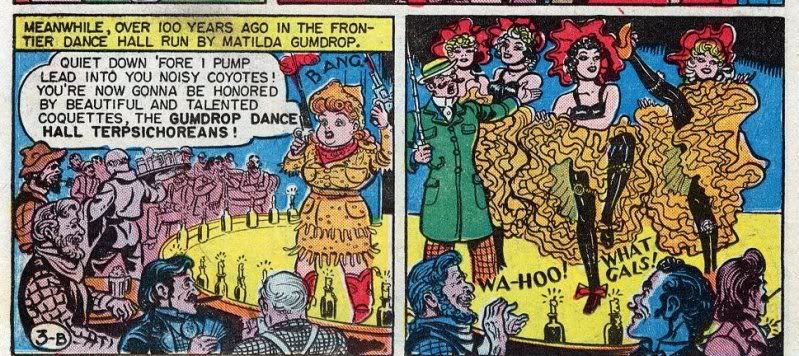
Going into the past also allows Etta to fully embrace her butchness:

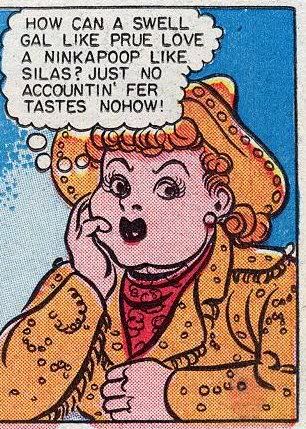
Yep; in a past life, Etta was a gun-toting madam…er, that is, cantina owner. I like this intimation of jealousy as well:

Peter also makes Etta rather handsome there. The borderline men’s attire suits her. (More evidence that Marston doesn’t necessarily see women in drag as evil.

And…yeah, I think that’s really about all I’ve got to say here. You can tell the issue wasn’t firing on all cylinders because I’m not having to stifle the impulse to reproduce every single page. Peter’s art is still worth looking at, but there’s little evidence here of the breath-taking double page layouts that made last issue so stunning. But that’s the way it goes sometimes. We’ll see hope for better on the next one….

Music For Middle-Brow Snobs: Discopolis

This week’s download, with lots of krautrocky electro bleepery:

1. Artur Rubinstein — Chopin Mazurka #15, Op.24/2 CT 65 (Chopin: The 51 Mazurkas)
2. Sun Dawei — Crawling State (Anthology of Chinese Experimental Music)
3. Nara — Dream a Little Dream (Anthology of Chinese Experimental Music)
4. Kraftwerk — Metropolis (The Man-Machine)
5. Yellow Magic Orchestra — Technopolis (Solid State Survivor)
6. The Two Tons — I Depend on You (Horse Meat Disco)
7. Aavikko — Computopia (Nov0 Atlantis)
8. The Juan Maclean — A New Bot (The Future Will Come)
9. Legion of Two — It Really Does Take Time (Riffs)
10. Raekwon — Baggin Crack (Only Built 4 Cuban Linx II)
11. Raekwon — Surgical Gloves (Only Built 4 Cuban Linx II)
12. Raekwon featuring Jadakiss and Styles P (Only Built 4 Cuban Linx II)
13. Gene Page— Blacula (The Stalkwalk) (Blacula)

Download: Discopolis.

Last week’s download, if you missed it, is here

Utilitarian Review 9/18/09

Goodbye

As folks have seen, the biggest and saddest news on the Hooded Utilitarian this week is the departure of Tom Crippen. Tom came onto the blog almost exactly a year ago, though it feels like he’s been here forever. He’s been a tireless blogger, about everything from comics to politics to Star Trek. While he’s been here, his lovely, thoughtful, and often mean-spirited (and I mean that in the best way) prose has really defined the Hooded Utilitarian.

If you haven’t read much of Tom’s work, I’d urge you to look back through the archives; there’s just tons of wonderful material. Some of my favorites:

-his description of an imaginary Sandman collaboration between Neil Gaiman and Jack Kirby.

-his paean to his days as a Marvel Comics collector

— his contributions to the Helter Skelter roundtable, both in his own posts and in comments.

—his attempts to understand Oliphant

-and maybe the gem of gems, his description of Michael Corleone as a Mary Sue. It’s one of the pieces of writing that made me feel like starting the blog was worth it.

Almost all of Tom’s posts, with the exception of a few at the beginning, can be found here. You can also read him semi-regularly in the Comics Journal, where he writes a stellar column called “The Post-Post-Human Review about super-hero comics. I believe he’s got a long essay on Alan Moore and Watchmen coming up there, which I’m eager to see.

I hope we’ll see Tom occasionally in comments still, and I really hope he finds more outlets for his writing, either online or in print. In any case, I feel very lucky to have had him here for as long as we did, both as a co-blogger and a friend.

On the Hooded Utilitarian

This week was devoted to our roundtable on Sandman. Some of us were disappointed, others still loved it, and lots of folks weighed in in comments.

There was also a long post on the inkdestroyedmybrush site in response which is worth checking out.

Utilitarians Everywhere

Vom Marlowe reviews Killer Unicorns over on her LiveJournal page.

Kristy Valenti catches me in an embarrassing error over at comixology. It’s like the Dave Johnson thing all over again…except this time, I really do kind of care.

I have a short review of Jennifer’s Body at the Chicago Reader.

An essay at Splice Today in praise of lousy art.

On the contrary, if any contemporary figure attains to Bataille’s ideal of pure sacrifice it is one particular kind of artist—that is, the failed artist. Note that by “failed” here, I do not mean the artist who has missed commercial success, but has underground cred or aesthetic bonafides, or who is discovered and lionized after his death. On the contrary. When I say, “failed” I mean “failed.” I mean an artist who profligately, copiously, obsessively works on creating objects that are, literally—by everyone and forever—unwanted. Creators of tuneless songs who never achieve dissonance; of ugly canvases too self-conscious to be outsider art; of doggerel verse too banal for even the high school literary magazine-in them, the excess of the universe is annihilated. Genius, love, life—they are exchanged for neither lucre, nor cred, nor beauty, but are instead simply thrown away. Failed art is permanently wasted, and it is therefore sacred.

I have a review of Observatory’s Dark Folke. It got kind of chopped down for space, so I thought I’d reprint the full version here:

The Observatory
Dark Folke
Self-released

Though this Singapore band may have placed the word “folk” on their album, that doesn’t really capture their sound. Certainly, there are elements of freak folk here; “A Shuffler in the Mud” has sparse lovely harmonies and a gentle acoustic sway that wouldn’t be out of place on a Devandra Banhardt album. Other tracks, like “Lowdown,” though, trip merrily etherwards, heading for the brainy, drony psychedlia of Ghost. For that matter, “Decarn” is almost heavy enough at points to qualify as metal, locking into a head-thrashing trudge while keyboards burble overhead and somebody shrieks from the pits of Hades for a couple of bars before handing it over again to the gentle-voiced harmonizers.

The album feels like a delicate arrangement of shifting textures drawn upon and then erased from a black canvas. Omicron, for example, starts with an acoustic guitar strum that is allowed to fade almost completely; then there’s a second strum, also followed by silence, and then a percussive keyboard figure takes over, building with other instruments and vocals, until again it fades almost to silence…and we go back to acoustic guitar. The track is built around changes in direction, but it’s not the busy post-modern bricolage of the Boredoms. Rather, it’s modernist, fetishizing space and silence. If The Observatory doesn’t adore Webern, I will cease staring at the hardbound liner notes, graced by Jason Bartlett’s Pus-head meets Virginia Lee Burton line-drawings, and eat the whole package instead.

Other Links

Alan David Doane reviews the abstract comics anthology and searches for Sentinels in my contribution. His son finds them.

Comics creator Dewayne Slightweight performs an amazing rendition of Were You There When They Crucified My Lord.

The march of the redshirts … is over

I’ve decided to leave the HU. My thanks to Noah, always a patient and generous host and the only man who could get me to look straight on at a page drawn by Harry G. Peter. I will also miss Kinukitty and her reviews of those comics about the skinny fellows who like to hang out together. Her jokes made me laugh, which is a rare thing.
The good news is that Wiki Trek, my personal adventure in OCD, will no longer drape itself over your long-suffering screens. The bad news is that I must sacrifice exposure to treasures of discourse that have brightened my life: the roly-poly prose of stately fangirls, the inane yipping of outraged fanboys, the plaintive truculence of the man who can’t draw necks (though he’s learning Photoshop), and the sheer stupidity of the clod who came stumbling along five months after the Watchmen movie to tell Noah and me we were Bolsheviks because we didn’t like that three-story cloud of stink. Wherever you are, sir, I sincerely hope you go fuck yourself — for you are the true voice of the Internet.

Morpheus Strip: Dream Is Dead (All Hail Dream)

This is the last in a roundtable on Neil Gaiman’s Sandman series. There’s lots of good stuff in the previous posts (too much good stuff, perhaps, but such is the danger of going last). If you haven’t already, take a look at:
Noah’s “Dream Lovers,” Suat’s “Impressions of Sandman,” Tom’s “Post-modern Something,” and Vom Marlowe’s “Revisiting Old Lives.”

****

Like everyone else in the world, I loved Sandman when it first came out. I have all the collected volumes but one (more on that later), and while I haven’t reread any of them, I do still think of some of the stories and characters sometimes. (Which would especially impress you if you had any idea of the mental chaos I fight daily just to remember to, say, eat lunch – although if you’ve followed Gluey Tart at all, you no doubt do have some idea.) So, I remember the whole thing fondly but was a bit worried that stirring it up again would just make everyone unhappy, like visiting my home town or listening to ‘80s Aerosmith (and ‘90s or, quelle horreur, ‘00s Aerosmith is obviously not even on the table).

Mostly, though, I was just excited about figuring out where the hell that enormous stack of Sandman books was and digging in. On top of a bookcase, it turned out, and not under a huge, dusty, towering stack of God knows what, like almost everything else I look for. And I realize that there are books on top of these stacks, and everything can’t always actually be on the bottom, but sometimes I wonder if they don’t migrate there on their own, trying to hide from me – something that could easily happen in Sandman, now that I think about it. I decided to look at the two Orpheus stories because I particularly liked those. (They’re in Fables and Reflections and Brief Lives, if you’d like to read them yourself.) Or maybe I’d pick something else – I didn’t know. (I often don’t; I prefer to think of it as being flexible.) But I flipped through the books in order and, good lord, that is some lousy-ass art. I mean, a jittery, shifting every few pages, unnervingly bad collection of art. A Game of You is the worst – that one doesn’t just make me just cringe but also makes me fucking angry about its really excessive badness. I kept thinking no, this is really so bad I can’t quite bring myself to spend quality time with it.

sandman

I remember having problems with a lot of the art in Sandman the first time around – the overall quality (by which I mean the lack thereof), but also the startling shifts in style and character design in mid-arc. Like these three consecutive pages:

sandman

sandman

sandman

No, of course it isn’t all horrible. (I like two of the those last three pages, and don’t mind the other.) But a lot of it is. And if it bothered me then, it freaks me the hell out now, having since discovered manga and becoming accustomed to the joys of consistency and artistic whatsit. So I riffled through every volume until I found one that I liked the look of pretty consistently.

Unfortunately, that volume was the second to the last, The Kindly Ones. This is unfortunate in several respects:

1) It is an endgame sort of volume that heavily references and wraps up a number of previous storylines, few of which I remembered as well as I needed to.
2) Morpheus fucking dies. I hate that.
3) See point 1. This collection isn’t boring, but it does feel like more of a settling of accounts than an exciting bit of fantasy, and you kind of have to read the whole thing – there isn’t a shorter piece that holds up on its own in this volume.
4) Morpheus dies. Did I mention that already? I loved Morpheus, in all his enigmatic, usually barely there but always wonderfully Goth manifestations. Morpheus dying is counter to my personal agenda.

Let us tackle these points in order, you and I.

1) Reading Sandman always reminded me of reading Ezra Pound, except that I like Neil Gaiman, while I always sort of wanted to kick Ezra Pound’s ass. What I mean is that Gaiman throws in all these allusions to various mythological and historical high points, and you won’t really understand what’s going on if you don’t get those connections – much like Pound, of course, but ramped down a couple hundred decibels. Gaiman doesn’t reference anything really obscure, and, you know, nothing’s actually written in Greek. So that puts it in a whole other and hugely more acceptable level of pretentiousness right there. Also, Gaiman has so much fun with it, you wind up having fun with it, too. It isn’t “See ye these literary allusions and weep in terror at my big old brain.” It’s more like, “Oh, my God, and then the ravens, the ravens are so cool, and wait, wait, Loki! See what I did there! Oh that’s so cool! And that could tie in with…”

2) I was, and remain, in love with Morpheus. He was written beautifully, if not always drawn beautifully. He is ambiguous – his relationships with the other characters aren’t often clear, or his motivations, or his intent. I often want to scream at writers to please shut up – stop telling me about the damned character. I don’t need to know everything. I want there to be some mystery in our relationship, just like in real life. It’s hard to retain the ambiguity and keep hold of the character, I know – too much information and you feel like a six-year-old has been tugging at your arm and filling you in on all the complexities of the Transformers for several hours; too little information and you don’t care because you never connected with the character in the first place. More people should try, though. Reading Sandman might help.

Morpheus talks a lot about the rules, and the following thereof, and the doing of what must be done. A beautiful example of this is the action that drives the last nail in his coffin. He gives Nuala a pendant when she leaves the Dreaming, telling her he’ll come if she calls him. To grant a boon of some sort. This is one of the many complicated plot points that lead directly to Morpheus’ death. I’m not saying much about any of them because who has the time? This one, though, might bear some explication. Nuala, a fairie who’d been given to Dream in an earlier story, loves Morpheus and mopes around a lot, pining for him. When her brother shows up unexpectedly to take her back to Fairie, she lets Morpheus decide if she stays or goes. He cuts her loose. As a result, later, when Nuala learns Morpheus is in trouble, she summons him – at the worst possible time – hoping to save him by getting him to stay with her. By asking him to love her. Well, who hasn’t had the impulse? It never works for any of us, and Nuala is no exception. This is all very poignant, etc. etc. What I love about it is that Morpheus comes when she calls him. The Dreaming is being pulled down around his ears, but he’d be safe if he stayed put. He tells her the timing sucks, but when she insists, he goes, knowing the furies will take the Dreaming in his absence. I don’t love this because, oh, it’s so romantic (wibble wibble). I mean, it’s hard not to be annoyed with both of them, on that level. I love it because I believe Morpheus when he gives his reason for doing it – there are rules, and they must be followed. Some might say, well, perhaps an exception might be made in this case. I see the logic, but I’m utterly charmed by Morpheus’ failure to compromise. I have a great deal of sympathy for that position. Of course, he sort of does become someone else in the end, anyway. But it’s all, you know. Ambiguous.

dream

3) The Kindly Ones isn’t the most exciting Sandman collection, but it is still fantastic fantasy. It’s the kind of thing you read on the train for fifteen minutes, and then you get off the train downtown and walk onto the dimly lit platform and start looking around for Norse gods or sentient crows or faeries or something.

4) Morpheus’ death comes as no surprise. There’s a lot of foreshadowing in all shades from really obscure to ham-fisted like an ultra-conservative Republican state representative, but it’s still a shock when it happens. I like the way it’s portrayed, too. A light flashes, and goes out. And Dream the Endless is gone. And everything else goes on. Which is just exactly how death works.

Whenever Death (the character) tells someone they got what everybody gets – a lifetime – I think of the Stephen Crane story, “The Open Boat.” The theme of that story being, basically, “it is what it is.” The tie-in is obvious: nature doesn’t care, and death does her job, because that’s what she is. In The Kindly Ones, Morpheus talked a lot about fulfilling his responsibilities, and many characters questioned his motives. Did you do this on purpose? Do you want to die? One of the many bits of foreshadowing comes via Loki, a divine trickster, but not in a fun, gentle, let’s exploit Native American legends and wear dream-catcher earrings sort of way. Morpheus is the reason Loki is out in the world and wreaking havoc (on Morpheus, as it turns out) instead of being tied by his son’s entrails under the earth with snake venom dripping down on him for eternity, where he belongs. The Corinthian (sort of the ultimate walking nightmare, which Morpheus recreates toward the beginning of this collection) steals Loki’s eyes and breaks his neck, and Odin and Thor take Loki back to the underworld to tie him back down. Loki tries to get the dim-witted Thor to kill him, but Odin intervenes, and Loki isn’t able to escape his fate worse than death. Because Loki is a god, and that’s what’s proper. Morpheus (who is not a god, but the distinction is – well, indistinct) is able to escape, though. What does that mean? I don’t know. That’s how death works, too.

I refused to read the last Sandman collection, The Wake, when it came out. At the end of The Kindly Ones, another character takes over the dreaming (Daniel, who’s never done anything to me, but I hate him anyway – see points 2 and 4 – even though he becomes basically a new version of Morpheus – but it’s sort of like reincarnation in Buddhism, where the flame goes out, and the flame is reignited, but it’s not really the same flame). Sandman was about Morpheus for me, and when Morpheus died, I didn’t want anything else to do with it. Which was really quite emo of me. But it’s also a testament to what Neil Gaiman did with this series, even saddled with a collection of crappy art he had to drag around behind him like the rotting carcass of a castrated ox (or some other foul, unwieldy dead ungulate of your choice). I hesitate to use the “t” word, but in Sandman, Neil Gaiman created something transcendent, in its way. Not “I’m going hire a lawyer to help me set up a religion” transcendent, but something that somewhat extends the limits of ordinary experience.

sandman

Morpheus Strip: Revisiting Old Lives

It’s ten years ago, and I’m thousands of miles from home, living in a teeny room with a bed that’s been lopped short to fit and a slanting roof, like some medieval scholar monk. I don’t know anyone and I’m spending my days, and my nights, reading cramped texts in Greek and Latin; so much so that my grasp of English is getting stilted and my voice cracks from lack of speaking. I can’t seem to read for pleasure anymore, the words zip past on the page, too fast to catch.

But I stumble into a comic shop, for reasons I no longer remember, and I buy Sandman, and I take it home. I curl up on my too short bed, where my feet stick off if I stretch out, and I read about Andros climbing up the hill. Aner, I think, genitive, Of Man, and keep reading. The beautifully drawn art slows me down and the stories feel familiar, rich and strange and interwoven with layers of meaning and metaphor, like a country garden’s roses gone wild.

*

Looking back, I’m sure I didn’t read Brief Lives first, despite this picturesque memory. If I rattle my brain, I can remember reading Preludes and Nocturnes, at my small and cramped desk, and being delighted and appalled and pleased, especially by Death. I read all the notes, too, and I’ve always wondered who Cinnamon was.

But let’s return to this me, this depressed and lonely grad student, steeped deep in Greek stories of destruction and desire told in lush rhythm with beats that seem inevitable and Latin tales of debauchery and conquest told in spare and elegant prose. I sat there and read through the book, a chapter a day, reading slowly and carefully, slowed down by the beautiful art and puzzling over each word.

Did you know that the Greeks had a word for ritualistically ripping people apart, limb from limb, and eating them while alive? (sparagmos)

They did. And you know what? It showed up in the Sandman. The Bacchae there were the Bacchae of my beloved Euripides, at least a little. A force of nature that is both benevolent and strange, cruel and violent, and at times nurturing.

Each week, usually on Sundays, I would walk to the comic store, down a long and forested road full of blind curves and no sidewalks but cut granite curbs. It almost always rained, since Pennsylvania rains a good deal, and eventually it snowed. I walked it anyway, buying, slowly and carefully, each volume.

Except that I didn’t buy them all. A friend told me that Dream dies in the Kindly Ones (and I certainly was wary, with a title like that) but this is not how the story ends. I know this in my heart. The story does not end with Dream killing himself. That never happens. And thus I never bought that volume and I haven’t read it and I won’t, because that plotline does not occur. I’m difficult, and stubborn, as, er, some of the readers of this blog have no doubt guessed, and I sometimes make a decision about how a story as itself should go. And that is the story that lives in my head. Thus it was with Sandman. Sometimes authors are wrong about how the story goes and it is better to live with the story’s own ending.

But what, you may ask (quite reasonably), is the point of a long tale about the sad girl who read Sandman except for skipping the end? How is this useful criticism? What the hell?

And so I will tell you.

Well, so you know that Sandman was a good friend to me, back when I needed one. A beautiful and difficult tale that I savored and cherished. And this week, I was, like many of you, afraid to reread this story lest it look dusty and crumpled and turn out to have atrocious art that could only appeal to the few, the proud, the naive.

But no! Due to a flood, I lost my personal library (about thirty boxes worth) and all my Sandman, so I wasn’t able to reread the whole opus. But I picked up a copy of my favoritest favorite of them all, Brief Lives, and I was pleased and cheered to discover that it was just as good, if not better, than I remembered.

Let’s start with the art, because I love art and I read comics for art, more than for words. This volume has Jill Thompson’s pencils and inks by Vince Locke and Dick Giordano, with color by Danny Vozzo.

Check out this page:

I love this. It’s so unabashedly emo Goth. The dark colors! The fuzzy black hair! The despair! It’s touching, but it’s also kind of funny, because who among us hasn’t had a love affair that felt like this?

After this, of course Morpheus stands outside in the rain. Of course he does! I hear a lot of people (here and elsewhere) complain about the art, and it’s true that there’s better art and worse art, but look at this and tell me that it doesn’t make you laugh:

The art is evocative, and speaks more than the words do alone, which is exactly its job. It conveys a feeling that you can’t get with words alone.

I’d like to turn now to a bit of plot. Delirium, one of the Endless and Morpheus’s sister, misses her brother, Destruction. She’s trying to find him, and she’s asking her siblings for help. She asks Desire first. Desire, ahhhh Gaiman’s Desire. What a tricksy character zie is. In this first piece, Desire is portrayed as petty and cruel, sending an adoring fan to a dire fate for no apparent reason and then behaving unpleasantly, if not deliberately maliciously, to hir sister. Desire decorates with a vivisected man grinning in ecstasy, sleeps on a squishy pink heart muscle, and floats in an eyeball. Ew. Desire, of all the Endless, is shown as the most scheming.

In some ways, this always bothered me, because the point of love is to be good and kind, but at the same time, that’s not really what Gaiman is about. This isn’t love, it’s Desire. Shown most explicitly as sexual Desire.

Now, Brief Lives is bracketed by the Greek temple and Orpheus. The Endless echo Greek deities, and those beings are expressly cruel and capricious in their behavior towards mortals. Aphrodite and Artemis, for instance, destroy lives left and right in the Hippolytus for no other reason than a sisterly grudge.

Gaiman’s Desire would have felt right at home.

So Desire behaves much as a Greek deity would do, and Delirium moves on to ask Despair, who is portrayed in beautiful accents and with truly horrific touches, as gray. (I’m not as OK with her being fat, though, because I am very tired of fat being shorthand for sad or evil.) Despair refuses to act, perhaps because she is afraid of Desire. And then Delirium goes to ask Dream, and we come to one of my favoritest pages in the entirety of the Sandman. Look at this art:
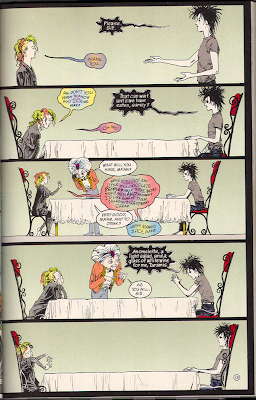
This is the shit. The body language is spot on. That’s a girl trying very very hard to be polite and adult, when upset and worried, and then perking up when the waiter asks her a question. By the end she’s getting confused and impatient, throwing her limbs around in wriggling social discomfort, The brother is absolutely rigid and offended, pretending to be polite while being very cold and insulting. The body language when he orders his meal is so pretentious—and insulting. Sibling slapfight. And the colors! Look at those colors. They’re so clean and reveal so much.

And because everything else is bog standard normal, the waiter is hilarious.

How is this not an awesome visual display of two different and competing siblings? When Morpheus’s body language changes (on the next page), and softens, all the previous panels’ repetition gives that change a huge amount of force.

And his small willingness to change, while he is clearly still despairing over his own heartache and while he is equally still completely embarrassed by his LOUD SHINY COLORFUL WHACKO sister, is endearing. If he thought, as Destruction thinks, that Delirium is fun or comfortable, his actions wouldn’t be nearly as sweet. No, it’s the fact that this trip is going to ruin his already bad day that the character Morpheus is humanized and thus lovable.

There are other fine pieces of art in this volume. The crazy sequences with Delirium turning colors, her jacket turned white, the frowning secretaries who look absolutely like secretaries everywhere, the fluffy and scruffy dog Barnabus, the strange sequence in the nudie bar, there’s a lot to like about this art.

And a beautifully crafted page that is striking with white and blue and a smear of blood blood red.

The pages between Morpheus’s granting of Orpheus’s wish and the page above are always hard to read. Morpheus hides his hands, and his pain, as he apologizes to the small fairy and is polite to his doorkeepers. He’s keeping the horror from others, as best he can.

The impact of killing his son is here in this page, where Morpheus’s despair and exhaustion are real and revealed with no words, just art. I think it’s beautiful and it always stops me in my tracks.

But in any case. I could talk a bit about the coloring (wonderful) or the inking (mediocre) but why? The art does many things well. It’s a whole. And this is a story I am glad to return to. I don’t regret my revisit of this tale. I hope those who haven’t been there in a while can return, too.

Is Morpheus a cypher? Yes and no. His family is rather difficult, let’s admit. Most of them are comfortable with who they are. Death is all-knowing and wise, but that is…not someone I’m going to be. I’m not all knowing and wise, but flawed and emo. Like Morpheus.

Morpheus is interesting because he’s deeply flawed. He’s got all this power and yet he just got dumped. There’s an annoying and embarrassing sister, who bugs him.

Unlike Desire, who is all powerful and using it the way a Greek god would, or Death who uses her power as we’d like the Greek gods to, or Destruction, who decided to leave the game, or Despair, who just isn’t around much, or Delirium, who’s lost it (literally), Morpheus has his powers and still can’t really cope. He does his best, though, and his muddling around is endearing to see and worth reading about. I like him. And he doesn’t die in the end.

_________________________

Edited to add: Since there’s a discussion going on in some of the other comments sections about the art, I thought I should note that I read the most recent printing of the regular trade paperback (ISBN 13: 978-1563891380) available here. That’s where the scans come from as well.
_________________________

Update by Noah: Other posts in the roundtable: Noah’s “Dream Lovers,” Suat’s “Impressions of Sandman,” Tom’s “Post-modern Something,” and, Dream Is Dead (All Hail Dream).

Morpheus Strip: Post-modern something

It looks like most of what I have to say will be in the Comments threads to Noah’s post, so go here if you’re curious. More important you’ll find Noah’s thoughts on Sandman, and over here is an illuminating discussion by the distinguished Ng Suat Tong.
In this post I’ll add a paragraph from an article about Gaiman that I did for TCJ (namely “My Gaiman Decade,” issue 273, January 2006). And I will add a one-liner that I took out for some reason. It goes like this: Gaiman is so temperamentally averse to big systems of thought that his idea of a cosmology is alliteration (Dream, Destruction, Death. etc.).

The TCJ article was about why I liked Sandman so much and why I felt let down by the series. A lot of me, me, me, which I think was an honest way to approach the subject. For a little while the series had somehow got into the center of my life, and I wanted to figure out why. But I put some ideas in there too, and the paragraph below has a couple.
For instance, wish fulfillment. Here are two secret little payoffs that I got from the series, and I suspect they’re hooks for other people too:

Gaiman’s universe is divided into a crowd of further universes, like folds in a paper fan, and the Endless can materialize in and out among them at will. That’s very comfortable; it suits me down to the ground. The characters can go anywhere, travel through any sort of story, change their surroundings like turning a knob. Not only are they superheroes, they’re media consumers; so am I. Go deeper and there’s a more embarrassing source of attraction. The Endless’s fundamental power is that they matter. Wherever they go, they count, and most often anybody else in the same panel counts for less. (The Endless are aware of this, as shown by Dream’s easy way with a high horse and Death’s ambling among the confused.) Superheroes beat each other up; Gaiman’s superbeings see who can matter the hardest. At their crudest, these contests are expressed through staredowns and well-seasoned rebukes. But what underlies the encounters is mana; to use Gaiman language, what underlies them is the fundamental stuff of mattering. [We have no idea what this stuff is, neither in the series or in real life.] Why some people have more self-possession than others is hard to pin down; so is why the universe cares so much about the Endless. After age eleven, fistfights are a lot rarer than simple contests in outfacing each other, in self-possession. If you’re nine years old and want to matter more, you’ll think of superhuman muscles. Past that age you’ll be thinking of other types of advantage, such as a superhuman source of mattering.

I stuck in the bracketed sentence, the one about “We have no idea what this stuff is,” because I still wonder if that section of the extract really makes its point. Ah well.
I’m going to break down the paragraph and expand on individual points.
1)  “Gaiman’s universe is divided into a crowd of further universes … and the Endless can materialize in and out among them at will … travel through any sort of story, change their surroundings like turning a knob. Not only are they superheroes, they’re media consumers …”
Kind of meta, I guess. These days most of us spend most of our lives being media consumers. Sandman is the only property I can think of whose characters act out a deluxe, all-power-is-in-your-hands version of same. Wotta hook!
A related point. As I read it, around about the early ’70s genre entertainment fans realized they could just pile all their favorite genres into any single work. Underlying the innovation was the idea that a story didn’t really have to take place anywhere, not even Middle Earth. The idea of a solid world was gone; instead there were just entertainment tropes, with nothing needed to house them but the ready-to-hand sf concept of billowing and necessarily undefined dimensions rolling one into the other.  The Man-Thing story that introduced Howard the Duck is the first example I can think of. The two issues had everything: pirates, space men, dragons, funny animals. If I recall right, Gerber shanghaied the idea of the multiverse, pioneered by Michael Moorcock, and refitted it from an assortment of sword-and-sorcery worlds into the broader sort of assemblage I have in mind.
It was part of Gerber’s sad life progress that, having wandered onto this rich territory, he then wandered off it again. Dave Sim took up the idea in the late 1970s, and he didn’t even need dimensions: pretty soon he was having superheroes pop up in Conan-land with no explanation, and eventually Oscar Wilde and Ernest Hemingway too. Terry Pratchett joined in during the ’80s with Discworld, again shoving disparate genre tropes into a place that didn’t really have to be any place. In the late ’80s Sandman came along and Gaiman hauled dimensions back into play as an explanation. To tie in with the paragraph just above: though all these works have settings that are less places than entertainment-trope warehouses, only Sandman simulates the all-powerful-media-consumer experience because the Endless get to flicker in and out pretty much anywhere they want to go. The people in the other series generally have to walk.
2)   “After age eleven, fistfights are a lot rarer than simple contests … in self-possession. If you’re nine years old and want to matter more, you’ll think of superhuman muscles. Past that age you’ll be thinking of other types of advantage, such as a superhuman source of mattering.”
I guess this in line with David Riesman and inner directed/outer directed. I say “guess” because I’ve never read Riesman, he admitted casually. But a muscles superhero gets his way thru straightforward physical instrumentality: he hits something and then it is no longer standing up, it’s lying down. The Endless, on the other hand, have a lot of big moments that rely just on how one person reacts to another, and these exchanges tend to be a matter of who can out-crust the other. It’s a bit like CSI, if you’ve seen that. Every damn episode has a moment where some poor guy has to swallow his gum and shift his gaze, look down and away in shame as a detective stares at him, and often enough these guys aren’t that important to the story. The episodes still make time for them because those moments are money shots. The audience loves the sight of a poor sap wilting in front of another because those are the moments people chase in their daily lives at the office. 
Put the two ideas together and you get, I don’t know, post-modern something. Physical reality downplayed, agreed-upon social realities played up. But to tell the truth, I’ve been up a long time and now I’m going to bed.