YKK part 3: A quiet inn late in the day ( post b )

Last post here. This new one started as a comment, but I decided to make a post out of it. 


So, down in comments, Noah and DerikB both assured me that Ashinano, as good as he is, is a long way from peerless. Japan has a lot of artists who would be exceptional over here, but over there they’re just very good artists. 

David Alex asked what I made of Akira. I liked it. This is going back to 1988 when I read 10 issues, probably because Spin mentioned the series in its comics-are-cool issue (white cover with Matt Groening’s Binky).  I bought the series a few issues at a time and felt like I was having a bit of a cross-cultural adventure. The story moved nicely, the panels were worth looking at — detail, as with YKK, but detailed undersides of flying vehicles, not detailed porch floorboards. Then I lost interest. Seeing the movie in, I guess, 1990, I told a kid on line that following comic book series in general was like following a tv show: after a few episodes you kind of got what they had to offer, and then pretty soon you were moving on.  Don’t know if that’s my philosophy now, but it seemed very exact and just at the time. 

Ok, in Comments Bill says the story really is unusual for Japanese comics but that Alpha herself is not — other strips also have a “fantasy girl.” Which brings up something that hit me about the series: yes, it’s beautiful, but it also finds time to be banal. Fulfilled fantasies tend to be banal and that goes for fantasy girls. Alpha’s a mannequin doll who’s there to make the old guys feel good. That’s not necessarily a bad thing, but it is a limiting thing.

Noah wanted to know how I put up with the shojo, uh, imagery, given the way I complained about googly eyes. I responded:
  
To tell the truth, I was getting to the faces/eyes issue just before the cafe shut down. So, to be stoic … I think the googly eyes are a drawback, but read manga and you’re going to find them. Not everywhere, but pretty often. Maybe I can adjust.

I do think YKK has a streak of banality that is right in tune with the googly-eye motif, especially in some of the isolated splash pages where Alpha is posing. The story itself I don’t mind, but I’m not tuned into it. It seems like an excuse for stringing together little exercises in atmosphere, like a Bolton-Wodehouse book is an excuse for its show’s score. The atmosphere bits work fine for me, though the smaller they are, the better. For instance, drinking canned coffee in the early morning worked better than Alpha discovering the different meanings behind tears.

Those mellowed-out roads and so on, the landscape’s details, take the principle the furthest. The moment is so small that nothing is happening, all you do is look at something being what it is. Those moments are the best thing in the series.


So, the banality again. But at this stage of my manga exploration I’m just getting used to what’s around me. We’ll see how I react down the road.

YKK part 3: A quiet inn late in the day

YKK, or Record of a Yokahoma Shopping Trip, ran for about 150 episodes. Here at HU we decided to read the first seven chapters and compare notes. Bill started here, Noah continued here. Miriam will talk tomorrow, and tonight I do my post.

This is the first manga I’ve sat down and read thru, not counting 10 issues of Akira back in 1988. It’s all new terrain to me. So I will treat this post as live blogging and just record my impressions.

Two things hit me right off:

1)  the drawing is excellent
2)  the story is close to nonexistent
A third realization hits me:
3)  the setting is the future and everything has fallen apart. But it’s pleasant.
That last one throws me a bit: a pleasant post-apocalypse. But we’re talking Japan, so whatever.
I read the pages fast. They’re printed out from my computer, one page per file, 150 total: the first seven chapters, published back in 1994 for (I gather) middle-aged Japanese men riding the train between office and home. My printer’s ok, and the art is all black and white, but the pictures still drop a notch from the originals. They’re in decent form but not at their best. Even so … that is some great art. A pile of it, just like that.
This is my first time around with right-left pages, but the layouts are huge and that helps. The series has got flow like crazy; every page has a gentle sway that starts in the linework and runs up into the panel arrangements, or vice versa. The detail work is splendid: look at that man draw a sack of rice or a porch’s floorboards or the mellowed, going-to-seed, post-apocalyptic motorways the characters travel along. And everything has life: bodies, trees, clouds in the sky. Page after page. Is this ordinary for Japan?
From Bill and Noah, and from Bill’s links to Dirk Deppey,  Jog, and Madink, [UPDATE: I just found out Madink is DerikB] I gather that this level of play is admirable but not exceptional. I would gather that Ashinano is respected but not held out as an outstanding master. Well, damn. That’s encouraging as to the state of Japanese art.
The story … well, the story’s title is Record of a Yokohama Shopping Trip, that’s for the whole series, and there’s just one shopping trip to Yokohama, in the prologue. When you’ve been gaslighted like that, it’s hard to think straight about story. You don’t expect to be in a frame of mind where you can make reasonable judgments about connections. Does the story make sense? Is it worth following? Yeah, I don’t know.
From the posts before mine, I gather that YKK is especially uneventful. Other Japanese comics aren’t this tranquil.
 The style of caricature … but the counter guy just told me they’re closing the Cafe Depot, so there goes my Internet. I will go now. Miriam can pick up tomorrow.

Future Shocks

I knew that Alan Moore had done some work early in his career for 2000 AD, but I’d never seen most of it (unless you count Halo Jones, which I think was serialized in 2000 AD first?) So I was excited to read through “Future Shocks,” compiling his work from the magazine.

In the event, the book was a little disappointing. Certainly, if you didn’t know the author, you’d be hard-pressed to guess that he was destined for future greatness. The stories are mostly three to six pagers, and they’re fairly rote, smug twist-ending sci-fi tales. A ravening race of conquerors heads off across the universe, destroying everything in their path…but space is curved, and they end up despoiling their own home world! A woman clubs an older lady and steals her car…but the car time-travels, and eventually it turns out that the women the younger lady clubbed was herself as an old woman! There’s even one that pulls the hoary old gambit of having the captions natter on about an invasion of disgusting aliens…and then at the end, you learn that the disgusting aliens they’re talking about are humans.

Not that the book is bad. The art — by folks like Ian Gibson, Dave Gibbons, and Alan Davis — is uniformly professional and enjoyable. And there are hints, here and there, of Moore’s future. You can see his facility in a couple of rhymed nursery morality tales, more reminiscent of Hillaire Belloc than of standard sci-fi fare. And in one or two places you can see his unusual (for pulp comics creators) ability to write non-stereotypical female characters. In “Going Native” for example time-traveler from the distant future goes back to study neanderthals. He becomes friends with one of the neanderthal woman, Murr. Like the other neanderthals, Murr’s appearance is apelike and animalistic. Nonetheless, over the course of the four page story, as the narrative mostly speaks of other things, we see her humor, her intelligence, and her strength. At the end of the story, the time-traveler falls in love with her, not despite her appearance, but because he has come to see her as beautiful…as, at least to some extent, has the reader. The story is both bizarre and touching, prefiguring the Swamp Thing/Abby, monster/human love story in some ways…though with the gender of the monster (and the human, for that matter) reversed.

Most of the best moments in the collection, though, come from Moore’s humor. I had always thought that his ABC joke strips, like Jack B. Quick, were a new departure for him, but, as it turns out, they were just a return to his roots. Most of my favorite gags in “Future Shocks” volume come from Moore’s Abelard Snazz stories. Collected at the end of the volume, they read like a more bitter Douglas Adams. In one memorable tale, Snazz (who is a professional genius with (literally) four eyes) — decides to help some down-on-their-luck gods gain new worshippers. So he updates their images; Demeter, for instance, becomes the God of organic foods, while Ares becomes the God of space invaders machines (“Hey!” as one bystander comments, “That’s my kind of omnipotent being!”) To Snazz’s horror, however, the old Gods haven’t shed all their past ways, and, soon enough, gamers are performing human sacrifices atop arcade machines in order to improve their scores. Other Snazz adventures involve spaceships powered by the good thoughts of particularly saintly worms, giant tennis players with the uploaded bio-brains of John McEnroe, and gigantic Rubik’s cubes that take six million years to solve. It’s all quite clever and bracingly mean-spirited; a nice conclusion to an uneven, though overall enjoyable, volume.

Just Saw Watchmen

It’s terrible. I’m just glad the thing ended; for a while there the question seemed touch and go.


I guess the film wins the award for biggest falloff from credits to movie. I loved the credit sequence. The movie itself … to quote a dispassionate observer, the movie is “hollow and disjointed, the actors moving stiffly from one overdetermined tableau to another.”  It’s like a well-meaning eccentric decided to tell the story of Watchmen thru parade floats, after which an absolute hack shot and edited together the parade floats using techniques made familiar by low-budget rock videos of the 1980s. The movie helps you appreciate how quiet the comic book is, not to mention understated, deft, elegant. The comic book is pretty much told in medium shot, without sound effects, and at a measured pace. The movie’s approach would be the opposite  of all those things.

No big problems with Malin Ackerman or her character. All the cast seemed pretty lame, lightweights chosen for their resemblance to the characters, then stranded amid the dioramas and looped dialogue. The Ozymandias chap was the feeblest all around, but the biggest disappointment was Rorschach’s voice.  He sounded like a cartoon dog.

Most regrettable switch from the movie: Rorschach’s business with the handcuffs and file is gone. Instead he just brings an ax down on the child killer’s head.

Stop Hating On Malin Ackerman!

Tucker jumps on the bandwagon

All in all though, if you go with the right people–like the people who can dissociate their desire to masturbate on Malin Ackerman from their desire to watch actors that can actually act in a way that isn’t fundamentally retarded, you can have a pretty good time.

This is fundamentally unfair. Yes, okay, she can’t act. And she did nothing with the role. But let me ask you this…what was she supposed to do? What did the writers and director ask of her? Did they not systematically rob the character of every nuance of characterization? They stopped her cursing; they took away her impatience; they smoothed over her conflict with her mother; they anglicized her last name; they even took away her cigarettes. And why? Because, clearly, they didn’t want silly distractions like personality or a brain to draw attention away from the main thing (or things.)

Ackerman stood there. She wore latex. She looked good. That’s all Zack Snyder wanted from that role. Because he’s a misogynist fanboy shithead.

I guess it’s the old Steppin Fetchit dilemma. Is the actor to blame for playing the part he or she was hired to play? Of course, Ackerman probably couldn’t play any other part. I guess I don’t really want to defend her all that much. Maybe we can just agree to sneer at her and Zack Snyder? Together? In a cuddly friendship circle of hate?

Update: I have a longer post on Laurie from the comic here.

YKK Part 2: The Past Will Drown the Future

We’re doing a roundtable on YKK. Bill provides some background and a slightly acerbic take here. My starrier-eyed view…written before reading Bill’s…is below.

___________________________

It’s an odd experience going into a series with no expectations at all. I read the first volume of YKK because Bill recommended it and provided scans. Before I opened it up, I’d never heard of it and had no idea what it was about. It was only when I got to the end of the first volume with its (very mild) cliffhanger ending that I even realized that there might be more than one book in the series (I kind of enjoyed thinking that the whole thing just ended on the cliffhanger, actually…but Bill assures me that it doesn’t.)

Anyway, that sense of disorientation — of not being sure what’s going to happen next — was certainly part of manga’s appeal to me initially. The first manga series I saw, I think, was Ranma 1/2, by Rumiko Takahashi. Everything about it caught me flat-footed. I know how romantic comedies work, and I know how action/adventure works, and I even have a sense of how they can be fit together in various ways. So Ranma looked familiar — but then the main character kept changing into a girl…and his adversary kept changing into a pig…and his Dad kept changing into a panda…and there were bizarre martial-arts-figure skating battles…or cooking fights….. It was all just vertiginously, gloriously wrong.

As I’ve read more manga that sense of giddy alienation has died down somewhat; manga has it’s own cliches and interests, and you do eventually start getting a feel for what they are. Ranma does remain fairly bizarre by any standards, though, and YKK does as well, though in a quieter way. Indeed, the determined quietness is itself the strangeness. The series is set (as Bill pointed out) in what seems to be a post-apocalyptic future. Much of the countryside is under-water; travel is difficult, civilization has devolved back to an at least somewhat pre-industrial level. At the same time, remnants of high-technology persist; one of the main characters, Alpha, is a human-looking android.

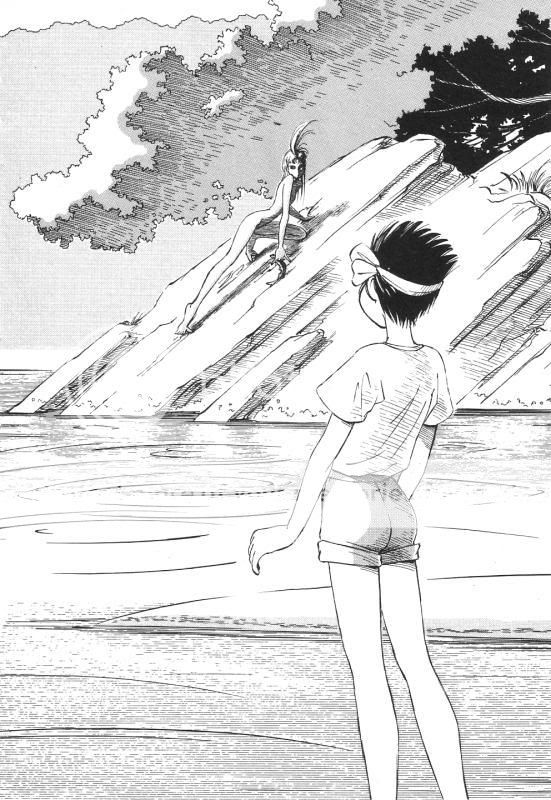
So…post-apocalypse, dying civilization, androids…we should strap ourselves in for pulp adventure, right? Well, not quite. Alpha, is an unassuming young women who owns a coffee shop; at least in the first volume, her robotness has almost no practical effect on her life (her biggest hurdle is that she effectively has food allergies because of the way her digestive system is designed.) The only gun in sight isn’t fired, or even loaded; Alpha keeps it as a token of remembrance. The narrative drifts forward through mostly mundane episodes; Alpha goes shopping and meets a gas station attendant; Alpha goes to a council meeting and dances and gets drunk. Even when there is something that could loosely be described as “action” it’s played down and smoothed out. Alpha is hit by lightning at one point…but a friend takes her to the hospital, and she’s fixed up in no time. A water spirit appears — but she’s harmless, a passing stroke of beauty, unattainable but mysterious.
Photobucket

I like especially the way that the boy’s stance does and does not echo the water spirit’s; on the one hand, he’s stiff and awkward, while the lines of her body are fluid, lithe, and animal…but on the other hand, his back is bent in a way that ends up being almost unconsciously graceful, while his hair blows to the right, slanting like the mountain and like the water spirit’s body. He’s watching her, and distanced form her, but he’s also part of the whole picture; integrated into nature and watching it, too.

The water spirit seems to encapsulate the book’s theme and it’s purpose; she’s a mythological embodiment of nature, seemingly unaffected by the cataclysm which has transformed the world. The book is suffused with a longing that goes not so much forward or backward in time, but outside it; a sense that human struggle will end in nought, where it began, and that that’s fine, or good even. Rather than an apocalyptic vision of man destroying the world, YKK presents a world that, at bottom, man can’t affect all that much. That sense of disempowerment doesn’t alienate man from the world, though; on the contrary, it makes him (or her, or it) more at home. And indeed, the water spirit comes, later, and on her own terms, to comfort the boy, before slipping away again.

It’s very difficult for me to imagine a book like this being created by an American; the relationship to nature, and the trust in passivity, just don’t seem like things that would come easily out of a Judeo-Christian culture. At the same time, the post-apocalyptic landscape and the android are clearly borrowed mirrored in lots of Western sources (Bladerunner springs to mind, for example). Again, it’s the familiarity and alienation together which make the work pleasurable and fascinating.
______________

In his review, Bill argues that YKK seems nostalgic and reactionary; using a utopian apocalypse to avoid the actual intricacies of living with nature. I think that’s a fair cop…though, on the other hand, I’m not sure that “reactionary” is always and everywhere a bad thing. Humanism —the mythologizing and aggrandizing of humanity — is part and parcel of progressivism. The mythologizing of a transcendence which isn’t human tends to be linked to more traditional, often reactionary ideologies; Christianity or, in this case, Buddhism (and perhaps a traditional pantheism?) YKK is certainly somewhat cloying in its conservative serenity — enough so that I’m not sure I’ll ever read the whole thing. Still, that serenity also has an appealing ruthlessness. Humans won’t fix anything, and the planet isn’t going to care. Not practical advice, exactly, but not a preposterous prediction either, as these things go.

_____________________
As I was writing, it occurred to me that the themes I’m discussing here (especially the implicit comfort in human disempowerment) are somewhat similar to the themes I discussed in my review of another backward-looking future, C.S. Lewis’ Space Trilogy. If you’re so inclined, you can read that essay here

New Wonderful Sentence

This one’s a corker. It’s by Thomas L. Friedman, and it reads like The Onion doing a parody of a dork journalist quoting The Onion:


Sometimes the satirical newspaper The Onion is so right on, I can’t resist quoting from it. Consider this faux article from June 2005 about America’s addiction to Chinese exports …


The rest of the column warns of ecological apocalypse. Well, all right. But I have a Friedman Reflex that’s viciously developed: whatever he says, I want him to shut up.
The Onion article interviews a Chinese factory worker (a “faux” Chinese factory worker, as Friedman might put it) who can’t believe the crap his factory turns out for the American market. Friedman doesn’t get that part of the joke is that the factory worker is saying exactly what western critics of consumption have been saying for years. The Onion does that kind of thing, takes language and ideas that are perfectly commonplace in one setting and transposes them to a different setting. Then Tom Friedman comes along, filters out the odd setting, and focuses on the commonplace sentiments, which he treats as his personal discovery.

I’m not saying Friedman is wrong or right about runaway western consumption and ecological crisis. But if he is right, he is right in exactly the same way as many, many others who have gone before him. And he thinks he’s doing everyone else a favor by getting on his hind legs and making his announcement. It’s official! (Over in Japan, ecological doom predictions are such a mainstay they’ve even generated a new form of pastoral, as Bill tells us.) 

Bonus: A classic piece of op-ed Slop Logic. Take two big issues, drop one top of the other, and figure you’re drawing a connection. As in:
 

What if the crisis of 2008 represents something much more fundamental than a deep recession? What if it’s telling us that the whole growth model we created over the last 50 years is simply unsustainable economically and ecologically and that 2008 was when we hit the wall — when Mother Nature and the market both said: “No more.”


I’m not against life in balance. But the US and Europe deregulated banking and let their financial sectors run wild. Canada, for example, didn’t. The US and Europe encountered market disaster; Canada didn’t, it just has to deal with the rest of the world sagging.
The global crisis didn’t happen because ordinary people like to buy stuff. It happened because rich financial professionals were allowed to make themselves richer by running the economy in a cackhanded way that generated profits for them.

Friedman, just do me a favor. Don’t think, okay?

(Footnote: a Friedman Reflex is similar to a Dowd Impulse, which is the urge to seal shut Maureen Dowd’s mouth as soon as she opens it, if not sooner.)