Ain’t That the Way of It

Garfield Minus Garfield voices a fundamental truth, again.

I was inspired to do the link by Noah’s review, in the latest Comics Journal, of a big Garfield book and a collection of Garfield Minus Garfield. As you know, a guy named Jim Davis creates (or oversees production of) Garfield and has done so for decades. Lately, a character named Dan Walsh has taken to Photoshopping out Garfield from the strips and then posting the results. Basically, what we see is the strip’s human character talking to himself, and it’s hilarious and sad. 
Noah brings in Jorge Louis Borges, and the two of them nail it:

The point is that the genius here is Davis’ — and it also isn’t. Borges has a short essay in which he argues that Edward Fitzgerald’s translation of Omar Khayyam’s Rubaiyat was greater than anything either could have done alone. “[F]rom the lucky conjunction of a Persian astronomer who ventures into poetry and an English eccentric who explores Spanish and Oriental texts… emerges an extraordinary poet who resembles neither of them.” Something like that seems to have happened here as well. Davis is an aesthetically dicey mainstream cartoonist; Walsh is a wannabe rock-and-roller who never hit it big. Together, though, they are, as Borges said, an extraordinary poet. Erase Garfield and you are left with a Davis who is just the same, only funnier.

American Psycho — Aids Parable or What?

Lawrence, one of my cafe rat buddies, just asked me if I had read American Psycho. (Answer: no.) He had just finished it and said he was puzzled. According to him, American Psycho‘s chief character is obviously gay and the business about his being a heterosexual serial killer is actually the fellow’s coded confession for being an irresponsible jerk who has spread AIDS to unsuspecting partners. Lawrence says that, page by page, the book makes little sense if you don’t read it that way. But he has turned up no one who agrees with his theory. Wikipedia, the movie version, googling “American psycho” and “AIDS” — all blank.

So, if anyone has read the book, what do you say? And if nobody has, whatever. 

Moral Power

I was just reading the collected X-Men and Power Pack series to my son. Having finished it, I do have a request for writers of kids comics:

Could you please leave out the morals?

Each issue of this has a tidy little message of wisdom for the kiddies…Don’t be mean to your sister! Science is fun! Face down your fears! Believe in yourself! It’s condescending and boring and pointless.

You know what kids learn from super-hero comics? They learn that it would be neat having powers and that stuff blowing up is cool. And they can learn to read, too. And you know what? That’s enough. Just leave it there. The other stuff is condescending and tiresome; kids are either going to ignore it, or….no, there is no or. They’re just going to ignore it. And for parents (or at least this parent) it’s annoying.

So forget the exhortations, would you?. Just tell a story, please.

Neo-Soul is *Real* Soul

Real boring soul, that is. In the last 20 years, R&B has been one of the most omnivorous genres around, eagerly consuming —in some cases wholesale — pop, rap, rock, Bollywood, and a long list of etceteras. In the meantime, neo-soul purists have been the elderly relatives with bad digestion, muttering darkly about moral decay and gas pains. Indeed, as R&B has methodically conquered the world, neo-soul fans have longed wistfully for a purer past, when rhythm was rhythm, blues was blues, and musical crossbreeding had not yet whelped its foul and mongrel breed. Never mind that Ray Charles opportunistically appropriated country, or that Prince loved the Beatles, or that R&B acts from the Coasters on up have been all about relentlessly gimmicky pop music. Since when has logic gotten in the way of righteous breast-beating about kids-these-days?

Sunshine Anderson’s sophomore album, “Sunshine at Midnight,” is as good an example of neo-soul’s wrong-headed crotchetiness as any. Sure, it’s listenable enough,. The lyrics are routinely sassy and strong-minded — without ever latching onto a quirky metaphor or inspired detail. The beats, melodies, and production are all professional — without ever turning into memorable songs. Her singing is strong — without being distinctive. There are one or two exciting moment (like the weird pseudo-classical chorus at the beginning of “Trust”), but they’re abandoned quickly, as if Anderson’s worried that the fogies might catch her having fun. This is soul music as cultural museum piece: tasteful, reverent, and ossified. If Wynton Marsalis did a musical interpretation of “Waiting to Exhale,” or Brian Setzer did an Aretha tribute album, this is what it would sound like (well, okay, maybe not *that* bad, but you get the idea.) It’s all yet more evidence that cred can be a millstone, which is why pre-fab, plastic pop R&B clothes-horses like Ashanti, Cassie and Danity Kane consistently make more innovative music than Mary J. Blige or Macy Gray — and, yes, more soulful music,too.
______________
This review first ran in Bitch Magazine a while back.

You Got to See This

Via Memeorandum and Wonkette, a 13-year-old named Jonathan Krohn addresses CPAC. It’s incredible. The kid is exactly like Al Franken imitating a wingnut blowhard, but miniaturized way down. He’s got all the authoritative hems and haws and the body language, but the bridge of his nose is such a tiny distance over the microphone. 


Huffington Post has an interview. “I got into politics when I was eight years old. Six years now. And I got involved because I started listening to talk radio. … Bill Bennett really became an idol for me. I listened to him every morning from 6 to 9 for, oh, years.”

UPDATE:  If he’s 13, why was he 8 six years ago? Fuck.

UPDATE:  I think this is him with Malkin. He’s got good body language.

Eagle Eyes (OOCWVG 8)

Previous posts on WW in this series: One Two Three Four Five, Six, Seven.
______________________

So yesterday I started talking about the first issue of Wonder Woman, then got distracted by Darwyn Cooke and Ms. and so forth. But we’ll try again.

So one surprising thing about WW #1 is that, in Moulton’s telling, WW’s mission actually makes sense.

As I’ve mentioned before in this series one of the perennial problems with Wonder Woman is that her mission to man’s world is always really stupid. Has she come here to lead us to peace? To be an international UN do-gooder? To hit lots of bad guys and flirt with Superman? Any way you look at it, none of it quite rings true.

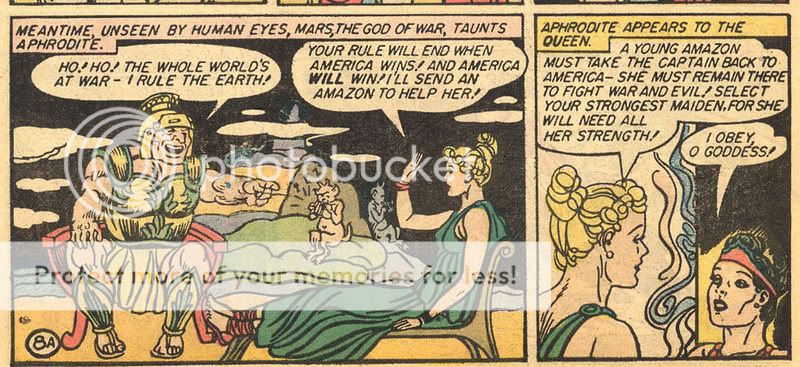
But in Moulton’s telling, her mission is pretty straightforward, as Aphrodite explains.
Photobucket

Wonder Woman is going to man’s world to help America win World War 2. That neatly resolves the peace/battle contradiction; the forces for war are the Axis; they must be defeated to restore peace, so an Amazon will journey to the homefront to restore love and amity by slugging evildoers. Niebuhr would be pleased.

This, of course, also resolves the difficulty of WW’s costume. If she comes from the back-end of the mythologicalverse, why is she wearing the stars and stripes? Well, logically enough, because she represents America not as the embodiment of national ideals, but as the embodiment of international and even universal ones. World War II was probably the one time in history where this could actually make sense; there was really a case to be made that America (whatever its own sins) was, at that time, the last best hope for civilization and peace.

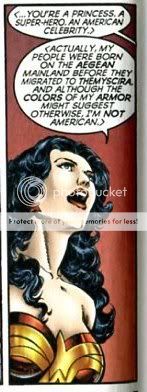
Since that moment, of course, it’s been a lot harder to argue that the interests of America and the world align — but WW has been stuck with that costume. Not sure how Moulton handled it after the war ended (I’ll have to look into that) but other creators have had difficulties. George Perez did some sort of utterly ridiculous retcon, if I remember precisely, where Steve Trevor’s mother had come to paradise….you know what, forget it. The point is you end up on the one hand, with moments like this from Phil Jimenez, which egregiously beg the question:
Photobucket
Please Keep Your Eyes Off the Eagles

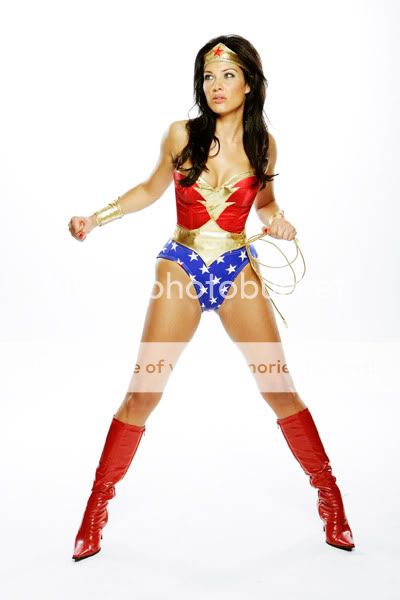
Or with efforts like this, from the Playboy shoot
Photobucket
Please Keep Your Eyes On the Stars

Playboy actually used these Wonder Woman photos to illustrate an essay on “American Sensuality” or some such. Not sure how sensual that image above is supposed to be exactly; it really looks more jokey or parodic than sexy; Fallon’s intense “I’m fighting for truth, justice, and the American Way” is pretty thoroughly contradicted by the (literally) painted-on costume, which is even more silly-looking in real-life than on the page. In fact, it seems likely that that’s the point; Playboy isn’t using Wonder Woman to make fun of feminism; rather they’re using trite misogyny to poke fun at America in a bland, we-lived-through-the-60s kind of way. For Moulton, a woman was the perfect representative of the U.S., since he saw the U.S. as engaged in a fight for peace. For Playboy, a sexy woman wearing the flag is just the level of edgy irony they’re looking for; they can claim a sort of jokey yes we do, no we don’t pride in America. It’s all more or less predicated on the idea that a woman being strong or representing America is in itself funny-quaint-snicker-worthy.

[Update: Matthew argues out in comments that this isn’t part of the Playboy body paint shoot; it’s just Tiffany Fallon wearing a Wonder Woman costume. I think that’s right; it was used to illustrate this article about Fallon and Playboy. I’m not sure if it was in the original mag or not, though obviously it’s somewhat related. More evidence for the ongoing “Noah doesn’t know what he’s talking about” thesis, though.]

Playboy isn’t alone though. Jimenez also tries to distance WW and America, as do most recent takes on the character. One of the (many) problems with Greg Rucka’s Hiketeia is that its all about WW’s Greek heritage and mythological connections, and she’s talking to the furies and agonizing about ancient ritual — and she’s wearing star-spangled underoos. It’s hard to maintain the profundity…unless, like Moulton, you are willing to link the U.S. to the mythological, and happen to live at a historical moment when doing so was at least somewhat defensible.

It’s interesting that Captain America has kept his close ties with Americanism, while WW has spent much of her career trying to avoid the implications of her costume. Probably it’s partly because Cap has a much less complicated narrative (he fights Nazis because he loves America, as opposed to because he loves peace.) I wonder if it’s also because, or related to, some difficulty in imagining, or figuring out what to do with, female patriotism. It’s also interesting that the (relatively) politically engaged Denny O’Neill is the one who took WW out of the stars and stripes. I mean, there are a lot of reasons to ditch that costume, but…did he dislike the patriotic connotations?

__________

Anyway, more next week, hopefully; magic lassos and why Moulton’s characterization of Diana is still the best….

Update: Last Wonder Woman post here.
