i warned you this day would come

… in the first post I made here. My long-ass con season has just started up again, meaning I’m gonna be at Wondercon in San Francisco this weekend, Artists Alley table 38, and everybody should come see me. It will be my first con as an internet snarkblogger, so it would be neat if someone came over and live-trolled me.

Also, you should click on my website in the sidebar, because it has been totally revamped and filled with new art, new information, and new financial instruments.

To tie it all together, I’m debuting a drawn essay at Wondercon, which you may also see and purchase at the website, and which I talked about here earlier.

Jack Hill at Reader

I have an essay about the new book about Jack HIll up at the Reader.

Hill’s female characters are both psychosexual props and real people. Cheryl “Rainbeaux” Smith, in an early stage of pregnancy, is an asset to The Swinging Cheerleaders both for the exploitation value of her massive breasts and for the incredibly winning, innocent-yet-skeptical way she watches as her klutzy boyfriend prepares dinner and then drops it on his pants. Hill’s vacillations between humor and sleaze, between affection for his characters and gratuitous abuse of them, are what make his movies such vertiginous romps—unexpected, delightful, and disturbing in a way that a straightforward gorefest, or for that matter, a mainstream movie, could never be. That’s why I’ll take The Big Doll House and The Swinging Cheerleaders over anything by Kubrick, Coppola, or Scorcese.

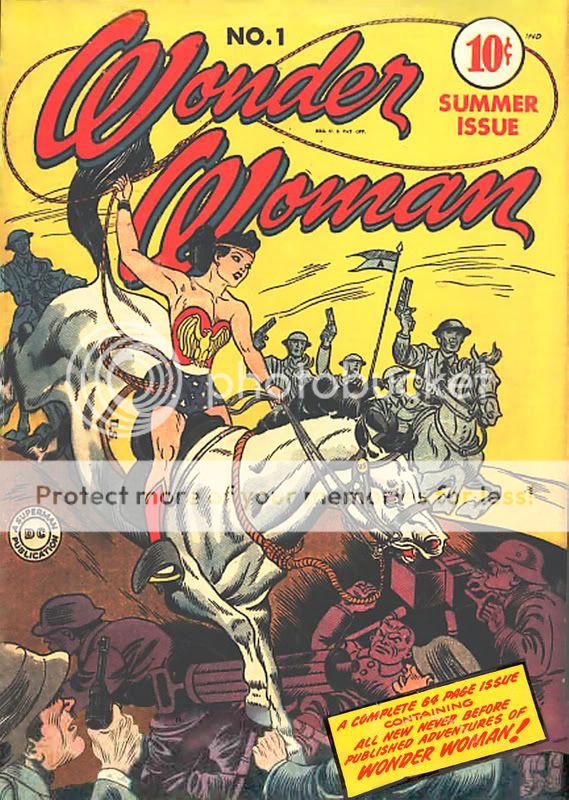
Wonder Woman #1 (OOCWVG Part 7)

Previous posts on WW in this series: One Two Three Four Five, Six .

________________

So I already expressed my growing enthusiasm for the original Charles Moulton/Harry G. Peter Wonder Woman comics. I haven’t read a ton of them, though, so I decided to start at the beginning with Wonder Woman #1, from 1942 (and yes, I know that Wonder Woman started a couple years earlier in Sensation Comics…but this is what I could get my hands on.)

Anyway, the first thing I noticed was, holy shit, comics were really long back in the day. 64 pages, pretty small panels, lots of text, four full Wonder Woman stories, plus a story about Florence Nightingale, plus a short prose story about something or other plus some random funnies, all for a dime. Even taking inflation into account, that’s some value for money.

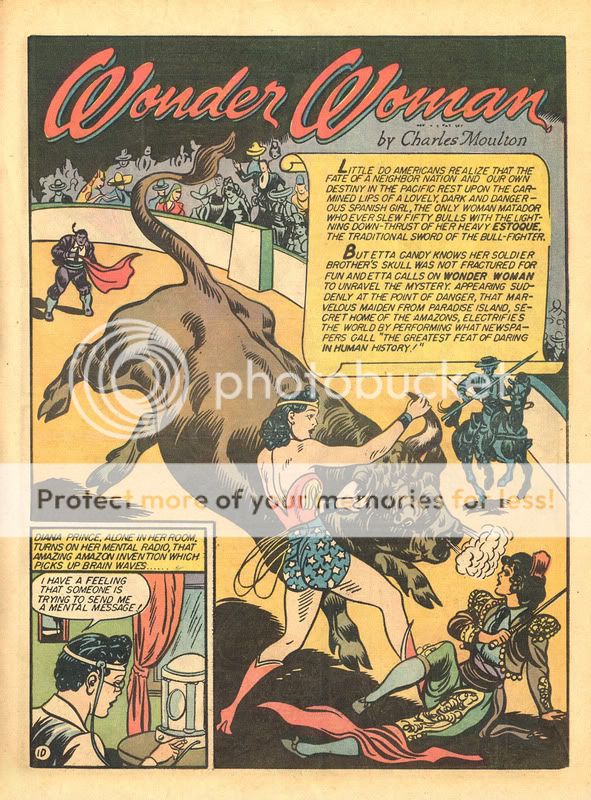
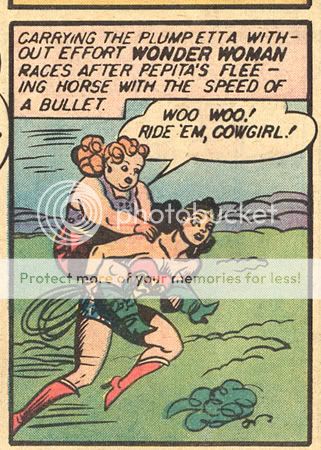
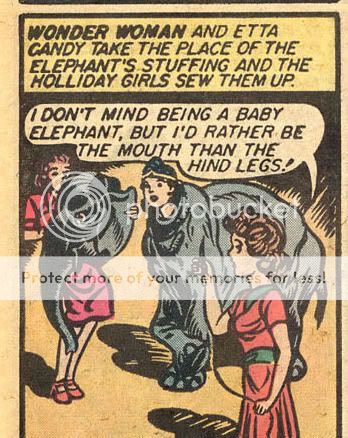
Of the four WW stories, three of them are…a little disappointing. Artist Harry Peter doesn’t seem to have quite hit his stride yet; his layouts and stylization aren’t as adventurous as his best work. The stories are all also set on the home front, with WW fighting Axis spies and essentially normal folk, so there’s less opportunity for some of the nuttier visuals (mystic fires leaping out of typewriters, attacking Seal Men, that sort of thing.) Instead, we’re treated to busloads of racial caricatures (not surprising) and an equal number of ungulates (which did take me somewhat aback.) And, of course, there’s bondage too.
Photobucket
Ungulate

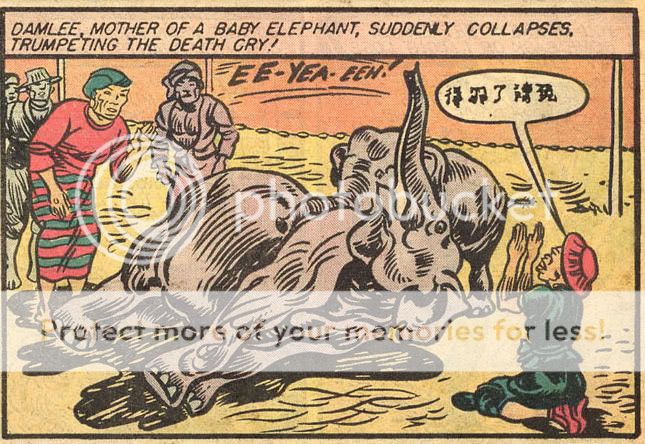
Photobucket
Ungulate

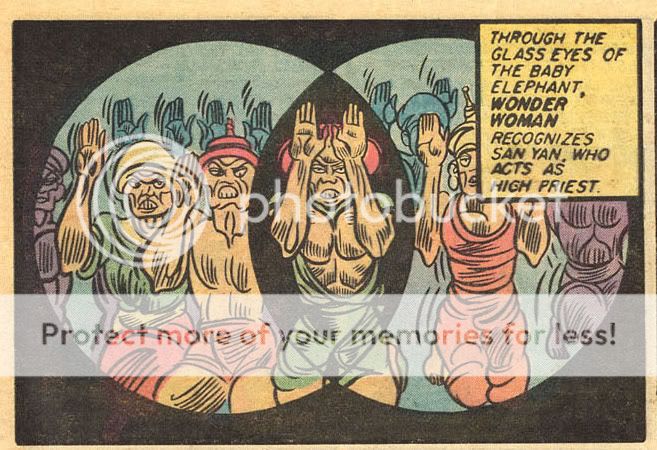
Photobucket
Racist Caricature

Photobucket
Ungulate with Racist Caricature

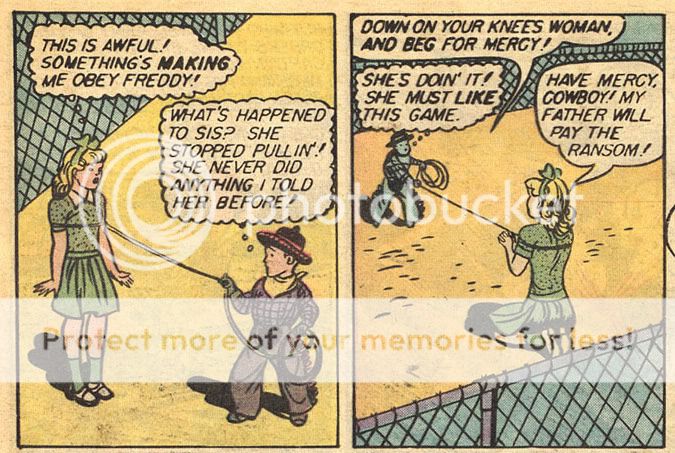
Photobucket
Playful Underage Bondage

Photobucket
Ungulate Role-Play

Photobucket
More Ungulate Role-Play

Looking at these, I’ve gotta say; even if it’s not his absolute best work, I still love Harry Peter’s art. That (obviously completely morally reprehensible) panel of the evil Burmese doing their unholy rituals while WW watches through the mask eyeholes, with the overlapping circles, the bizarre twisted faces, and the lovely colors…or the scribbly line-work on the elephant, with that misshapen shadow under it… or the weirdly stiff bondage children drawings, with the aggressive use of blank space; –those are all just beautiful drawings.

Another thing you notice on reading thorugh these; I’ve seen some commentary on the implied lesbianism on Paradise Island, but has anyone commented on WW’s relationship with Etta Candy. It is…strangely intense. Obviously, Etta’s oral fixation (she’s always eating or begging to eat candy. That’s her character. All of it.) seems suggestive. And I don’t think Steve Trevor ever got to ride on Wonder Woman’s back like that. Or to put his face in her backside — it’s Etta who is the hindquarters in that elephant costume (in the previous panel, WW comments “I’ve never dressed up as an elephant before!” As if someone would have assumed that she had.)

So…maybe I was underselling these stories. They’re pretty insane. But, for all their virtues, they pale in comparison to the first story in the issue, which I think is now one of my favorite comics stories ever. It’s just a delight.

I mentioned before that George Perez’s first issue was, by a fair margin, my favorite part of his run. I hadn’t realized the extent to which he’d cribbed it from this story. Most of the major plot points come from Moulton; the Amazons are created by the Gods to teach love and be stronger than men. Hippolyta, the queen of the Amazons is given a girdle which makes her invincible; Ares (who hates love and women), sends Hercules to fight Hippolyta; he fails, but uses treachery to get her girdle from her and then he and his men conquer them. But the Gods come to the aid of the Amazons, and show them the path to an island where they can live in peace. Hippolyta, inspired by the gods, crafts a image of clay which comes to life as Diana. Eventually the Amazons need to choose a champion to go to man’s world; after a series of contests, Diana wins, much to her mother’s chagrin, and so heads off to man’s world as Wonder Woman.

It’s a great story; as I noted in my discussion of Perez, it has a lot of the inevitability and — especially in Moulton’s telling — a lot of the weirdness of the actual Greek myths. Perez played the tale for drama and pathos; the Amazons are explicitly raped in his version, for example. Moulton’s tone is lighter — he’s writing for a younger audience — but the submerged violence is still there, just distanced and ritualized. It comes across as iconic rather than as soap opera.

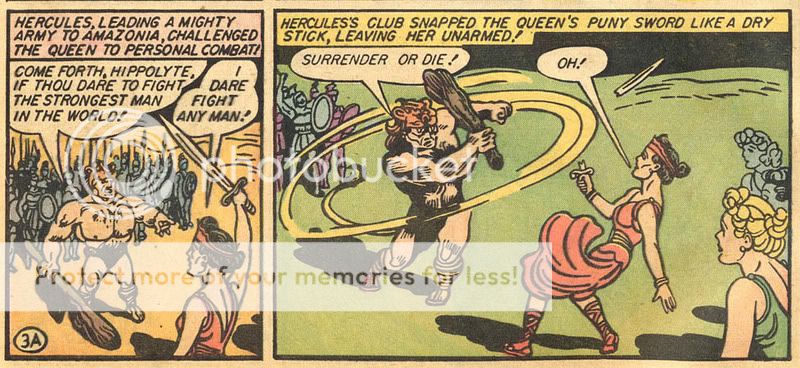
Perhaps the biggest difference between Moulton/Peter and Perez, though…or, actually, between Moulton/Peter and any later WW writer I’ve seen — is that Mouton and his artist are willing to just go ahead and hate men. It’s refreshing, both because you don’t see enough of that sort of thing in popular culture, damn it…and because it just makes so much sense for the story. No amount of whining about man’s world or man’s evil or whatever is going to be as effective as a good, vicious, scurrilous caricature:
Photobucket

There personified is the extreme feminist vision of ravaging masculinity; dumb, animalistic muscle-bound, wiedling a giant penis-substitute which, in Peter’s rendering, is bigger than Hercules’ entire body. (And again, what kick-ass drawings these are. I love the crazy motion lines, which are solid enough to actually stop connoting motion and end up as a still design element. And I love the way the stiffness of Hippolyta’s arm contrasts with the curves of her blowing dress. Her anatomy is deliberately out of whack, too; the legs and the torso couldn’t actually meet, I don’t think, which makes her look broken, like her sword.)

Making Hercules (and also the masculine God Ares) so thoroughly repugnant allows Moulton’s Amazons a coherence they never really got to have again.  There’s still not a logical philosophy, but there is a myythological one.  Moulton is a real gender essentialist; he believes in the idea of a male archtype and a female archetype. As a result, the exact philosophical content of the Amazonian code (do they represent love? do they represent strength in battle?) can be resolved by that appeal to essentialism. An Amazon bashing Hercules is different than Hercules bashing an Amazon because men and women are different, and their acts are disproportionate.  (This is, in fact, true, I think; at least percentage wise, for example, men murder women for quite different reasons than women murder men.)  The Amazons represent love — in comparison to men, which means that when they fight they fight for love, and when men love, they love as a strategem of battle (when Hercules loses the fight, he tricks Hippolyta by, as he puts it, making love to her.) Amazon strength, likewise, is a mystical offshoot of the power of love; the Venus Girdle, which means love, is their strength. And it’s weakness, too, since it’s her love or lust for Hercules which allows him to trick her out of the girdle, and so capture her.
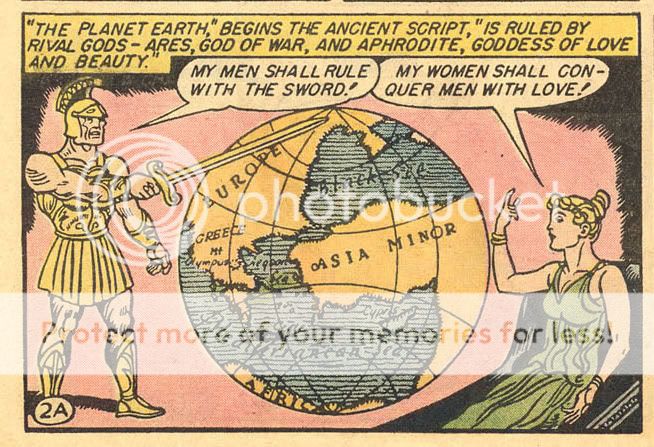
Photobucket

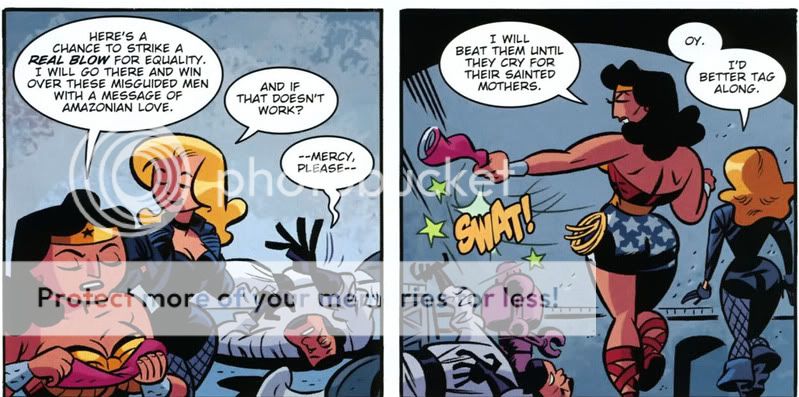
Moulton, in other words, believes in what he’s doing.  He’s kind of a crank, basically.  And if you’re not a crank, it’s hard to take the character seriously…which is why Darwyn Cooke’s frank satire from the New Frontier JLA annual, with very cartoony art by J. Bone, is about the best take on Wonder Woman I’ve seen outside of Moulton:
Photobucket

(Thanks to Bryan for tipping me off to this story, by the by.)

Cooke’s actually interpreting the character correctly: Moulton believes that love is best expressed by having a dominating woman with a perfect figure and a swimsuit beat the tar out of you. That’s funny; Cooke gets it — and he goes on in the story to make fun of WW’s supposed connection to feminism (she roughs up the guys at the Playboy Club, to the amusement of an undercover Gloria Steinem.)

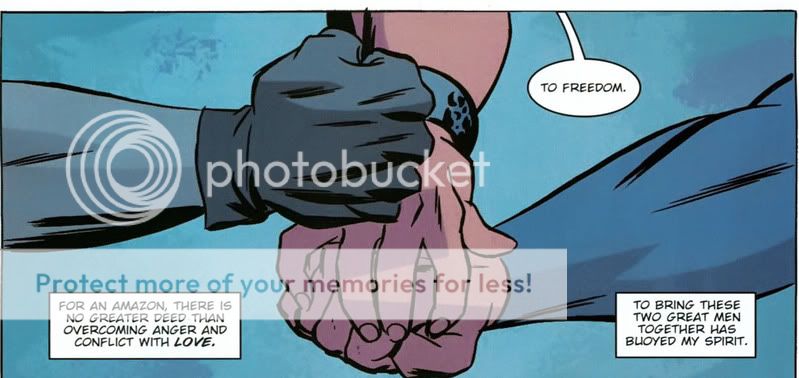
However, when Cooke tries a more sober take on the character in the first story of the annual (with art by Cooke himself, I believe) we get this:
Photobucket

She’s all about overcoming anger and conflict with love, and bringing men together…which means that in this here adventure comic, Superman and Batman get to have the big cool fight where they smack the snot out of each other, and WW has to be the peacemaker and talk about how happy she is to have her story be boring and subordinate. On the next pages she burbles along happily about how much darkness and pain there is in the Batman’s soul, and how “Kal” is to be the “savior” of them all. Fucking gag me.

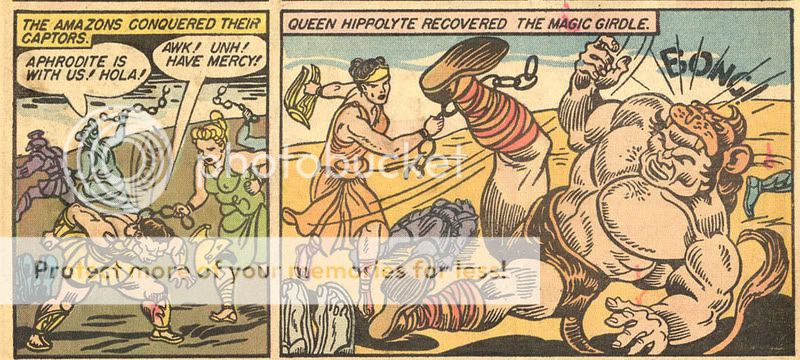
So yeah, Moulton’s a crank, but maybe you still, even now, in fucking 2008, need to be a crank to be willing to do this:
Photobucket

That’s a funny panel too…but it’s funny at the guy’s expense. Hercules is a bumbling oaf who gets beaten down; Hippolyta’s the hero — and still feminine (her power comes form Aphrodite, after all.) For Cooke, Wonder Woman is either strong and beating people up (in which case she’s a masculinized hypocrite and therefore amusing) or she’s standing around pacifically helping her men (in which case she’s feminine and boring.) Moulton doesn’t have to make that choice; his women are feminine even if they’re bashing the hell out of some brute (there’s even a nipple lurking in that first panel, if you look close.) Indeed, the women can do the bashing because they are feminine.

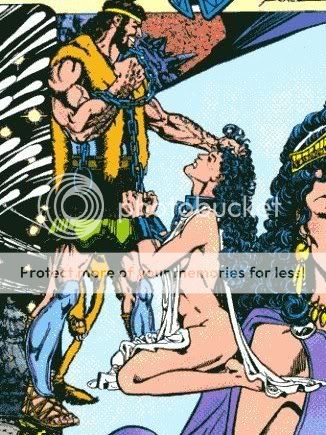
Cooke gets tripped up on the pacifist/violence dichotomy, but it’s just as easy to bump over the feminist/erotic one. George Perez, for example, made Hippolyta’s defeat more traumatic and realistic, and in doing so seemed to be trying to put across a a sincere feminist message about the evils of violence and rape. But Perez couldn’t resist the exploitation imagery, somewhat undercutting his stance:
Photobucket

It’s hard to take an anti-rape message seriously when it’s draped in classic cheesecake imagery; if sexualized violence is bad, you probably shouldn’t be sexualizing your violence.

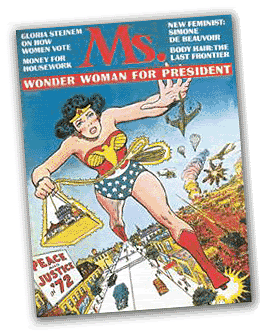
Or here’s a third way WW can trip you up:
Photobucket

I talked about this cover a bit earlier in the week Thinking about it more, I think that maybe what’s really messed up about this image isn’t that the eroticism undercuts the feminism (as with the Perez cover), but rather that the use of dominance imagery is very confused. The artist has made WW into a giant. Presumably this is to make her seem powerful and important. But making her into a rampaging Brobdingnagian doesn’t project authority (Wonder Woman for President!) Instead, it makes her grotesque…and, I think, along with that swimsuit, serves to sexualize her. Chaging scale this way emphasizes WW’s body and the manipulation of it…which is why “Attack of the Fifty Foot Woman” for example, has, and is meant to have, an erotic charge. Ms. is trying to show a woman in control, but instead they get sexualized, deformed femininity — femininity that is sexualized because it is deformed, and deformed because it is sexualized. (Again, when Moulton and Peter show Hippolyta beating up Hercules, he’s the sexualized monster, not her.)

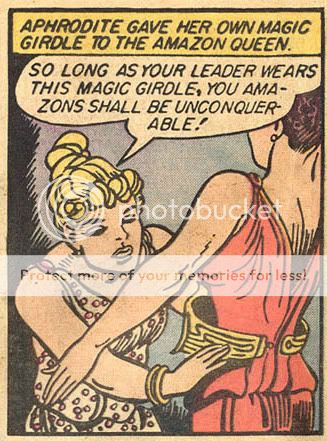
On the other hand, there’s this:
Photobucket

This panel is about women gaining power through a connection with each other.  At the same time, this is, and is meant to be, a sensual image; Hippolyta’s stiffness as she is bound, the intimacy between the two women, the fact that their outfits show a fair bit of skin, etc.  In Moulton, though, there’s no contradiction; eroticism, strength, and submission all make sense together, because they are all linked to femininity.  Bondage is made a metaphor, or a stand in, for close, (eroticized) female bonds, and so for feminist community.

I’m not saying that Moulton’s take on women is impregnable (if that’s really the word I want.) Obviously, you could critique as misogynist or just ridiculous the idea that feminine bonding is either (A) innately erotic, or (B) somehow akin to bondage. But, whether you like what he has to say or not, he’s aesthetically coherent; the eroticism and the bondage don’t work against his feminist vision; they’re integrated into it, creating a frisson of desire and devotion and political hope that’s both unique and sublime.

_________________
…and this post is really spinning out of control, lengthwise.  I’ve got more to say about Wonder Woman 1 (what is Diana’s real mission anyway, for example?  And what is the lasso really supposed to do?)…but I’ll have to put it off for at least a short while.  In the meantime, I’d recommend checking out Miriam’s post about why Rogue is a better feminist icon than Wonder Woman and Bill’s post about, among other things, whose fault it is that people keep writing WW stories.

Update: More on Wonder Woman 1 here.

many can wear the big 80s bomber jacket

[The following rant/reminiscence was prompted by Noah’s set of posts on Wonder Woman as a flawed feminist icon]

I collected most or all of the George Perez run of Wonder Woman when I was a bit younger than Vanessa, Wonder Woman’s adolescent pal. I was into it, especially the young-adult-lit stuff, like the Very Special Issue about teen depression and suicide. But seeing as how that was the first (as well as last) iteration of the character I experienced, I can’t say that Wonder Woman got me young enough to be my feminist superhero icon.

As I’ve mentioned, the mid-80s X books were really the foundation of my superhero (and beyond, if we’re being honest) worldview. There were plenty of well-rounded (by 80s Marvel standards) women in the New Mutants… I consciously identified with Rahne, the meek, pious good girl, but secretly identified with Illyana, because she was so full of rage for no real reason. But ultimately, I think my childhood feminist hero was Rogue.

Her power was, if she had contact with someone else’s skin, they would be knocked unconscious and she would get all their memories and powers. I guess it’s about the power and the loss of control and the terrifying vulnerability inherent in sex, or intimacy of any kind. Who can say what will be unleashed when you touch another person? I think, even as a little kid, I understood that awesome dread.

And the fact that Rogue had to protect herself against intimacy all the time, what did that mean? For one, it meant that technically, her costume was more in line with a man’s costume, skintight but covering head-to-toe, than swimwear/lingerie, like Wonder Woman. Her biggest fashion statement was an oversized brown leather jacket. It signaled both her toughness and her need to shield herself (and maybe as a kid growing up with religiously dictated dress codes, the consciously covering up felt like my reality).

It meant that no one ever ever got to touch her without her permission, or they’d be sorry. And you could say, being as she was created and written by men, that it’s all about straight male fantasies and fears, vagina dentata or whatever, but really. Think of how powerful that statement is for a little kid, who has no power over whether people she doesn’t know will muss her hair or pick her up or worse (I was never molested myself, but I really hated it when adults would be overfamiliar with me. But as a child, especially a female child, there was nothing I could do about it). Not even to mention all the fun when I grew up, where it would have been nifty if random-ass guys who groped me could have instantly fallen into a coma. How’s that for bodily integrity.

It also meant that all her romances were unrequited romances. Which is nice for kids, who know all about wanting, but have no reason yet to be modeling, you know, the actual identity compromises and icky sex stuff of settling down with a prince. That might just have been me, though.

It undoubtedly says something about my current female/feminist identity that the icon I think about is not all Girl! Power! Tough As A Boy! Her great powers were even greater vulnerabilities, and they were centred on her female body. Maybe a lot of the lesson of Rogue was the same lesson I’d pick up in other consciousness-raising works like Cerebus and From Hell: as a woman, you just can’t win.

Nana 13-14: Economic Catastrophe Edition

I originally wrote this for another publication, which went belly up before they released an issue. Sad but true….
___________________________

Nana, Ai Yazawa’s rock-and-roll manga soap-opera , has a fairly simple premise — two young women, both named Nana, head to Tokyo to seek their fortunes. The narrative quickly accelerates, though, with an ever-expanding cast of characters, all portrayed with a dizzying intensity and depth.

Which is to say that, though you definitely don’t want to start reading Nana with volume #13, you definitely do want to start reading now now now so you can get to #13. This far into the series, every relationship has layer upon layer of meaning, with every new detail causing the committed fan to flap and sputter spasmodically. For example, in #14, we learn that rock-solid, reliable Yasu engages in the occasional indiscretion — and we know him so well that we (like his bandmates) are left (literally, in my case) with our jaws hanging open. Yasu…it can’t be! There…there must be some explanation! Surely, surely, it will all be explained in the next volume….!

Or, a little more subtly: it’s been clear for some time that Nana Osaki, the tough rock star, has an intense (albeit nominally platonic) crush on the ditzy Nana (“Hachi”) Komatsu. And it’s also been clear that Hachi’s often-cruel-but-never-heartless fiancé Takumi treats Nana O. as, to some extent, a rival. But in issue #13, for the first time, we see, in a flashback, that Takumi actually consciously knows how Nana feels about Hachi — a revelation which makes him seem both sweeter (he touchingly reassures Hachi that she and Nana will remain friends) and more cold-hearted (because if he knows how much the two women mean to each other, why is he such a dick to Nana?)

Did I mention that the art is amazing? Stylish clothes, beautiful poses, and faces so expressive they’ll tear your heart out. Nana’s stricken expression at the end of volume #14, her body stiffened in shock, contrasting pitifully with her cheery giant-heart-over-the-bustier jacket, while Yasu sits beside her his face drawn in sympathy…. That — that — right there! is reason enough to start reading at #1, and keep reading until the sad, sad day when Yazawa decides to stop writing them.

New Favorite Quote

Just found this at the top of Talking Points Memo.  Jim Cramer, cable tv’s excitable money man, says of bank nationalization:


We must take the debate out of the hands of the dreamer academics, and into the hands of practical business people, no matter how much we despise them for getting us into this fix in the first place.


The thought is kind of beautiful, in its way. 

It’s! So! Super!

A while back I talked about All-Star Superman and why I thought the first 8 issues or so weren’t as great as they were cracked up to be. Several folks argued that I’d be more impressed if I finished the series.

So I just reread issues 1 to 12 and…eh. It’s not terrible or anything, certainly. I appreciated Frank Quitely’s art more this time around than I have in the past. The series has a nice, bright, striking color palette, and I like the clarity of the linework and layout; there’s a touch of Winsor McCay there, I think. I still find his figure drawings and faces off-putting; his women in particular often look like uncomfortably slender fetish mannequins, and facial expressions seem rubbery and oddly unexpressive. But as far as mainstream art these days go, this is about as good as it gets, I think.

The story is fine too…Morrison keeps things humming along; there’s no shortage of nutsy throwaway ideas — using a gravity gun to warp time; descendents of dinosaurs living underneath the earth; Jimmy Olsen dressing in Kryptonian garb for a lark; underworlds, overworlds, shrunken super-doctors — it’s all good. And, of course, there’s Superman’s approaching cell-death hanging over the series, giving it weight and pathos.

Except…man, how much do I care about these folks at all? Jimmy Olsen for example; he’s hip, he’s incredibly resourceful, he’s got this sixth sense which warns him of danger, he’s got his signal watch — he’s just so cool! And, well, irritating. Same with the endlessly chattering Lois who won’t believe Clark is Superman; or with Superman himself, always rushing off to save someone or other, constantly forgiving everybody; or with, say, Lex’s gratuitously fetish-goth-garbed niece. Everything’s just. So. Awesome! and. Inventive! and Cool! “No one but me can save the world Lois! My cells are converting to pure energy, pure information. And I only have moments to save the world.” Tum ta tum! You feel like you need to utter a little inspirational horn bleat after every panel; it’s all characters making preposterously pompous little speeches and the racing off to be heroic. Everything feels like it’s at maximum volume.

Morrison’s always written like that. In stuff like Doom Patrol or even the Filth, I always felt it was thrown off tongue in cheek; making fun of the immensity of super-hero stuff, and often undercutting it with pratfalls or ridiculousness (like the silly Brotherhood of Dada, for example.) But as he’s moved into more mainstreamy work, that deflation has gotten lost. And…it’s not that he’s not clever. It’s not that he doesn’t have good ideas. It’s not even that there aren’t touching moments. I just hate the feeling that he’s tapping me on the shoulder every page yelling in my ear, “This is soooo great! This is Superman, booooy! Go! Go! Go!”

I’ve said this before, but…it totally vitiates everything that’s best about Silver-Age storytelling when you try to tell a story capturing the brilliant innocence of silver-age storytelling. Because a lot of what was fun in those Silver-Age stories was that they were really off-hand and not at all pretentious. Sure, a Silver Age story might have Bizarro in one panel and evolved dinosaurs in the next and then an intelligent sun on the next page…but that would just be the story. There wouldn’t be the winking about, wow, this is so cool. I felt like Alan Moore handled it better in “Whatever Happened to the Man of Tomorrow” by slowing the pacing down and being somewhat more bloody minded; trying to think how the silver age stuff might work out if you looked at it from an older perspective. It was an homage to the era, not an attempt to recreate it. Morrison though seems to be trying to go back in time through sheer puffery and volume and frantic pacing. And I think it’s significant that Moore’s message was that the world doesn’t need Superman (which is, as it happens, true), whereas Morrison’s message is that we do need Superman watching over us forever, at least as a kind of beautiful ideal. Which is basic fanboy aggrandizement — and also not true, even if you bellow it.

Also, the end? I really thought, from all the foreshadowing and what people had said about the series that, you know, he dies. But he doesn’t quite. They still think he might come back. It just seems…I don’t know. It seems kind of lame, really, with all the build up.

Again, I didn’t hate the book. It’s entertaining. There are a lot of wonderful moments (Clark Kent bumbling around while interviewing Lex Luther is lovely; reminded me of the Chris Reeves Superman movie, which I still think was pretty great.) And of course, it’s hard to resist Luthor’s eyes checking out the superpackage:

Photobucket

I know everybody goes on about the freshness of the series, the way it rejuvenated the character, and on and on. But it feels really decadent to me; definitely part of the zeitgeist, rather than an answer or alternative to it. I’d way, way, way rather read this than Marvel Zombies…but I don’t necessarily think they’re different in kind.