Is the War Over?

We were talking about another series of theme posts and I suggested “Are Comics Respected Yet?” It seemed like an obvious choice since, as I read the world, comics are now just starting to be respected and therefore find themselves in a touchy in-between state like that of blacks in 1965. A lot of ignorant goodwill is directed their way in a fashion that can be a bit galling. And for every ounce of ignorant goodwill they also encounter at least an ounce of open hostility.

Or so I thought. But, going by my co-bloggers’ response, I might be behind the times. Beacuse they were indifferent to the idea, which suggests that the status of comics is way more secure than I thought.

So is that the case?
And why did comics have such a tough time getting this far? My theory is that public literacy has been a hard-won battle pushed along by shaming techniques similar to toilet training. Not that I have any data on the question.
If anyone wants to comment, I’ll note here that I realize comics have always had better status in Japan and France than they do in the US.   

Copyright Insurgency

One of Noah’s Wonder Woman posts elicited this comment from Cole Moore Odell:

…it shouldn’t be controversial that some characters simply don’t work, or they don’t work past the idiosyncratic spark of their original creators. There’s nothing wrong with limited shelf life. Yet this simple reality is warped by trademark holders who have unlimited interest in making money off of limited concepts, and by readers who refuse to let ideas go, even in the face of continued creative failure. … the same can be said for most superheroes. Most popular culture, really.

Reading the WW essays, I got the sense of an original vision both odd and personal; later attempts at the character, not so much. But it has enough cachet that people want to keep trying their own version. It could just be positioning (“the first female superhero”). Readers who won’t let go, I think, shouldn’t be faulted. They see untapped potential. (The Cubs could win the World Series; it’s not the fans’ fault for buying tickets.)

And the corporation’s a facilitator, never an author, no matter what the law says. The law’s the most interesting thing here, I think. Totally arbitrary and usually absurd, Odell’s right that it warps reality.

Without going into a laundry list of Boggsian aburdity, I’ll point to the English scrum over Lost Girls. Moore & Gebbie used Peter Pan characters still under copyright in the UK & EU. The hospital that owned the rights objected, so M&G waited to publish there until the copyright expired. An amicable solution, but still:

Why on earth does a hospital own Peter Pan?

(Yes, I know there are reasons. I could have my reasons to leave my fortune to a dog.)

So, my big question: at what point can a work be said to have reasonably escaped its author and been taken over by the culture? It makes less sense to say one person hospital owns & controls Peter Pan than it does to say Peter Pan’s just out there somewhere. I think this question especially important to comics works, which rely more on “characters and situations,” as at least one comics copyright has it, than on any particular story. Certainly, the superhero genre’s founded on the character more than the situation.

(Uninteresting side note: yes, lots of money is involved. So? Granite mining is a cutthroat industry.)

Finally, this is silly:

Screw you, Sonny Bono’s ghost. Say I want to make creative use of the culture I’m in, works speaking in the language I grew up with. For a lot of people, pop’s the only language they have. And that language is owned & operated by companies. So I’m left with parody, the collective unconscious of the 1860s, or the lawless Mississippi kids who didn’t know they couldn’t remake Raiders of the Lost Ark. (Better than the original in every way, you can only see it through pirate versions as a legit release is a legal tangle.)

In film criticism, David Bordwell and Kristin Thompson started the practice of using film stills without asking permission because studios routinely asked crazy fees for reprint rights. Now everyone reprints stills without permission, so a murky legal precedent’s set even if no case has been tried.

So, shouldn’t organized fan-unrest be able to destroy copyright? “24-Hour WW Fanfic Comic Day.” Or cosplay sit-ins, I don’t know. It might be worth it just to have thousands of people dressed as Amazons, going about their business. Maybe Moulton’s ghost would be pleased, if not as much for “24-Hour Hogtie Day.”

Only One Can Wear the Venus Girdle, Part 6 (Ms./Playboy)

Well, obviously, I’ve gotten completely obsessed with Wonder Woman. If you’re just checking in, you can find the rest of my posts on this subject here: One Two Three Four Five.

So far the basic thesis I’ve been arguing is that the original Moulton/Peter Wonder Woman was a very odd and original creation, and that nobody else has ever really figured out a way to use the character that isn’t ridiculous or offensive or boring or all three.
_________________

I’m going to take a slight turn here. I want to talk a little about Wonder Woman’s status as a feminist icon, and how that does or doesn’t really seem to make sense.

____________

I was aware that WW is generally thought of as a kind of feminist hero; an embodiment of strong, independent, heroic womanhood. I didn’t realize, though, that Gloria Steinem had actually put WW on the cover of the first issue of Ms. in 1972.
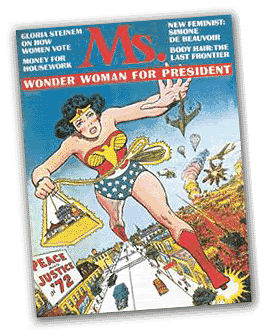
Photobucket

Steinem also wrote an essay about how strong and powerful Wonder Woman was, and about…well here’s a quote (taken from this very entertaining post on Comic Coverage:

“Looking back now at these Wonder Woman stories from the forties, I am amazed by the strength of their feminist message…Wonder Woman symbolizes many of the values of the women’s culture that feminists are now trying to introduce into the mainstream.” — Gloria Steinem

Anyway, because WW is supposed to symbolize feminism and female power, there was something of an outcry when this hit the stands, early in 2008

That’s Tiffany Fallon nude, with a Wonder Woman suit painted on her.

Greg Rucka, Wonder Woman writer, said “I’d rather have my daughter see this [the Ms. cover] than ever see that [the Playboy cover.]”  And he added “Bastards all.  You’ve no idea the damage you’ve done.  No idea at all.” 

I agree. The cover is a desecration. It goes against everything Charles Moulton believed; everything he stood for. How on earth could Playboy put Wonder Woman on the cover, and not have her tied up?

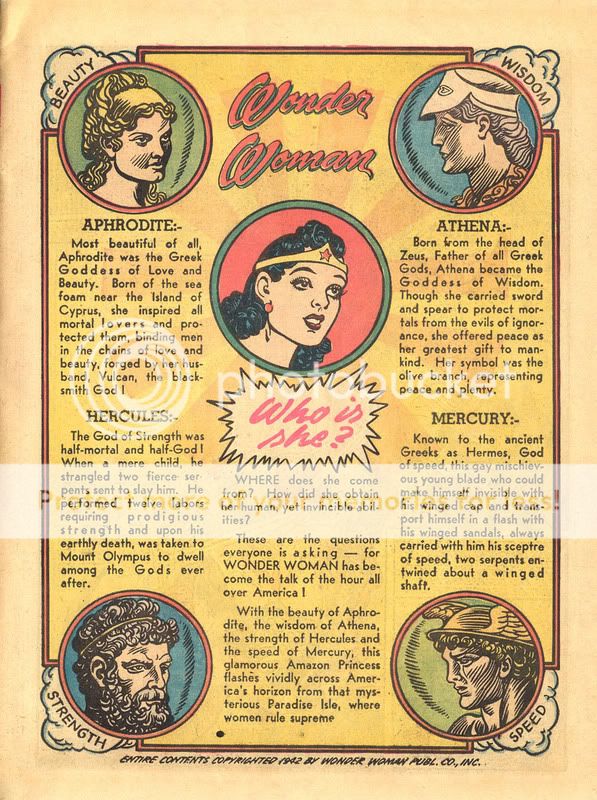
Slightly more seriously, I do have to wonder how, or what kind of, damage this sort of thing really does. In the first place…you really probably wouldn’t show Playboy to little kids anyway, would you?  And in the second, how is this out of sync with Wonder Woman’s image (other than that it’s not bondage, I mean?) WW’s costume is pretty thoroughly sexualized to begin with. I guess you could argue that WW is about her strength and heroism, not her shallow physical charms — but that’s just not true. In fact, shallow physical charms are one of her super-powers. This is from the first issue of WW:
Photobucket

Note all the stuff about Aphrodite? WW’s beauty is, like her strength or her speed, a divine gift (from the God of Love, no less). This has been pretty consistent down through the years, too; she’s still got super-beauty in George Perez’s reboot, for example, and even the dragon notices she’s hot in League of One.

Valerie D’Orazio makes more or less the same point:

As for me, like I said, I wasn’t surprised by the Playboy thing. It was a cheap shot by the magazine, to be sure. But I would be far more outraged if this happened to Batgirl or Supergirl. To me, Batgirl was always the true feminist superheroine — smart, independent, and under-sexualized. Supergirl was the virginal innocent — originally portrayed as your own kid sister or cousin.

But, Wonder Woman was created by a dude with really strong and weird opinions about women & sex — he referred to women’s vaginas as their “love parts” — and all that baggage couldn’t help but taint that character. Adventurous, resourceful Batgirl is the superheroine I wanted to be. Wonder Woman was half-naked. ….Which is not to say that WW can’t be/has not been redeemed and made into a character that women and girls can truly look up to. But I will finally believe this when she’s no longer drawn by cheesecake artists. I’ll believe it when she’s no longer half-naked.

And yet…though I agree with the argument up to a point, I think D’Orazio’s missing something. After all, Ms. Magazine didn’t put Batgirl on the cover. And that’s in part because nobody except hardcore comics geeks like D’Orazio gives a rats ass about Batgirl. Wonder Woman has more name recognition; she’s got more appeal. In fact, there’s some evidence that Tiffany Fallon is painted to look like Wonder Woman not solely because some guy thought “Wonder Woman is hot” but because, you know, Tiffany Fallon really likes Wonder Woman. As she says:

I’m obsessed with Wonder Woman. I grew up and I had the Wonder Woman Underoos, when Underoos first came out. And I was always a big fan of the show and Lynda Carter. And the older I got, the more I would get these comments like, “My god, you look like Lynda Carter in that picture!” And it doesn’t happen all the time, but I just grew to appreciate her and the character and the campiness of the project. I was Wonder Woman at one of the Playboy Mansion parties, and I just started getting all these comments, like, “My god! You would make a great Wonder Woman!” And I’m like, “You know, I would!” [Laughs]. And so I just have fun with it. And I heard they were starting to make a movie about it, and so I was like, “You know… Stranger things have happened in my life!” You never know. But that would be something I’d be really proud to be a part of.

In other words, WW’s on the Playboy cover for the same reason she’s on the Ms. cover — because girls like her.

Just because women, or some women, or a woman likes something doesn’t necessarily make it feminist or liberating, of course. Pictures of super-thin models are quite popular with girls of all age; does that mean they’re necessarily liberatory? Or is the popularity arguably, from a feminist perspective, perhaps a problem? 

Tania Modeleski in her second wave manifesto Feminism Without Women has a great little bit of snark where she points out that often cultural critics fall into a mode of thinking that goes something like: “I am progressive. I like Dynasty. Therefore, Dynasty must be progressive.” I think there’s more than a little of this going on with Gloria Steinem’s decision to put WW on the cover of Ms. I mean, your pilot issue of your feminist magazine, you put a young aggressively sexualized women in a swimsuit on your cover — a women who, moreover, is tricked out in bondage gear (that lasso doesn’t go away)? Yes…sub/domme for President! Especially if she’s been created and, even in this instance, drawn by a man!

(And, of course, the same goes for Fallon and the Playboy cover — she made have had input into the image, and the PR may have talked about how accomplished and wonderful she is, but that doesn’t mean that it’s especially empowering for women as a whole to have this image out there.

Though I’ve gotta say…there seemed to be a fair number of people who were shocked, shocked, shocked that Fallon would dare compare herself to Lynda Carter. I mean…Lynda Carter! I like Lynda Carter fine and all…but she’s a minor celebrity. Fallon’s a minor celebrity. It’s not like Fallon compared herself to Gloria Steinem or something.

Where was I? Oh yeah…)

Still, the question remains…granted that she’s a problematic feminist icon, why do girls like WW? Is it just because they’re all victims of false consciousness and propaganda and can’t tell that she’s an erotic tool of the patriarchal oppressor? Or what?

There are a bunch of reasons that girls might like Wonder Woman I think.

1. One of her powers is super-beauty. Girls are into being pretty. You can argue about whether this is cultural or biological (I lean towards the former) and about whether its unfortunate or not, but it is indisputably true

2. She’s got lots of strong female friendships and relationships. That’s not especially true for, say, Batgirl (except in more recent incarnations) but it’s always been true of Wonder Woman. (Trina Robbins talks about this here, in an essay I may discuss more at some point….)

3. She’s the star. Batgirl is Batman’s assistant; Supergirl is a secondary Superman; Storm’s part of a team, etc. etc., but Wonder Woman in those 40s adventures was the focus of the narrative. And that leads us to:

4. Moulton really did go out of his way to preach self-confidence and self-reliance to women. Say what you will about him, but he thought women were strong and that they should have confidence in themselves. He shows WW and other women beating the tar out of men, outwitting men, and generally overthrowing their oppressors (after being tied up, of course.)

5. She’s a princess.

6. She’s a princess. Duh.

All of the above can be summed up by saying that Moulton’s Wonder Woman really, truly, gratuitously, and effectively pandered to girls in a way very few other American super-hero comics have. Girls have traditionally liked Wonder Woman because it was marketed to them by someone who actually knew what he was doing.

Of course, Moulton was also pandering to his own fetishes. The genius of the character, if you want to call it that, is the way that she plugs into fetishes for men and women a the same time — whether it’s her beauty, or her relationships with other women, or her sub/dom/sub/dom flip-flopping. The story functions both as genre literature for girls and as “fanny” genre literature for guys. As a result, both the Ms. cover and the Playboy cover are logical places for the character to end up.

So where does that leave WW as a feminist icon? Well, about the same place it leaves her as stroke material, I guess. Because while it makes sense to use her in Ms. in some sense, Gloria Steinem still, still looks like kind of a doofus for putting her on the cover. And while Fallon certainly looks hot in those Playboy photographs, the magazine couldn’t resist puffing her as a champion of truth, justice and American Sensuality”, which is just dumb. And, it must be said again, it’s pretty lame to do a porn shoot based on a kid’s comic book and manage to be less kinky than the source material.

I guess we’re back at the thesis for this whole series of posts, which is that using Moulton’s character for your own purposes tends not to work very well (aesthetically I mean — commercially is something else, of course.) Putting WW on the cover made Playboy and Ms. look naive and clueless. You mess with the Amazon, you take your lumps.

Update: Fixed chronology error….

Update: the sage continues, with more on the Ms. cover, among other burblings…

How I Learned to Love the Wall

“…society secretly wants crime…and gains definite satisfaction from the present mishandling of it.” Photojournalist Susan Madden Lankford quotes this line from Karl Menninger in her book Maggots in My Sweet Potatoes: Women Doing Time, but she seems oblivious to the irony. Here, after all, is a giant coffee-table book filled with photographs and interviews with women in the Las Colinas jail in San Diego. Reading these women’s stories of drug use, molestation, neglect, prostitution, single-motherhood, and more drug-use; looking at into their weary faces — why would we do these things if there were not a “definite satisfaction” involved? As we flip through the pages, surely we are intended to feel not so much a guilty pleasure as a pleasurable guilt. Clearly the book is more upscale than, say Judge Judy, but with its fascinated voyeurism and its constant finger-wagging, is it really different in kind?

The target of the righteous indignation is, of course, somewhat different. Lankford is less interested in personal than in societal guilt. “How have we failed so many women?” she wonders. The answers she comes up with are familiar ones — basically, society doesn’t do enough to make sure that children are not neglected. The book is sprinkled with pull quotes from “Bruce Perry, M.D., Ph.D.” who rather gratuitously explains that being abused as a child tends to leave you fucked up. The conclusion is that these women need more attention – from parents, from society, from us.

Perhaps that’s true. But I can’t help thinking that maybe they could do with not more scrutiny, but less. Most of the women in Las Colinas are there on drug or prostitution charges. If drugs and prostitution were legalized, they would be…not happy, not healthy, but not, for the most part, in jail.

Lankford, of course, argues that the women actually enjoy jail on some level; she speculates that confined women secrete oxytocin, a calming hormone associated with sex and birth which may “make jail time more tolerable” and even “encourage recidivism”. It’s a telling foray into pseudoscientific balderdash. After all, if even the inmates derive subliminally sexualized pleasures from jail-life, can we be blamed for doing so as well?

Hey, Bartender! I Think You Kids Are Great

The comics hook is that I borrowed the title from an old Doonesbury, one dating to the distant era when the sight of a long-haired bartender at an old fogies function was worth a few gags. 

I spend a lot of time at the Cafe Depot and the Second Cup, two chain coffee shops with outlets here in Montreal. My message today: the kids working behind the counter are great. They’re hard working, cheerful, unflappable. They make shit, something like $8.50 an hour. The tips are worse. I’m one of the biggest tippers they’ve got, and I give them peanuts.
The schmucks get up at 5 in the morning, trudge thru Montreal snow and ice, clean toilets, deal with clowns counting out pennies to pay for a cup of coffee. Then the kids go off to study or play in their rock bands or whatever. I don’t know how they do it all; I wouldn’t have the energy. 
In the ’90s I worked at a newspaper in New York where kids the same age made $25 an hour and spent most of their time sitting around. And boy, did they bitch when there was something to do. (Yeah, Krajick, I mean you.) Maybe Montreal is better than New York, maybe constant work is better than idleness. Maybe, my favorite theory, the world is on an upward trajectory and the latest generation is the product of better child rearing than previous ones. Maybe not. But it’s nice to have something nice that you can take for granted. And now that I have written this post, that’s what I”m going to go back to doing.
One caveat: the pretty girls treat me like I’ve got a disease. But what else is new? 

Frontier Nursing Service

Marie Bartlett’s The Frontier Nursing Service takes a potentially fascinating topic and makes it — well, not exactly deathly dull, but not especially interesting either. The book focuses, as the title says, on the Frontier Nursing Service (FNS), a midwifery and nursing service established in the Appalachias in eastern Kentucky. In the 1920s the region was rural, isolated, and subject to some of the highest maternal death rates in the country. The FNS, under the leadership of Mary Breckenridge,rode in to save the day — literally. Nurse-midwives saddled horses and traipsed up and down pathless mountains to, as they said, “catch” babies. The care, subsidized by charitable donations, was virtually free, and it dramatically improved survival rates of both mothers and children in the region.

Midwifery remains an intensely controversial profession in the United States. Homebirths are only barely legal in many states, including Illinois. Moreover, the entire U.S. medical system is in a rolling crisis, providing ever more impersonal, ever more ineffective care at ever more exorbitant prices to ever fewer people. A study of the FNS — a group of midwives committed to cheap, effective midwifery and public health for all at rock-bottom rates — seems, therefore, like it should have something to say to a number of contemporary debates.

Unfortunately, Bartlett is more interested in hagiography than in analysis. She talks a great deal about how wonderful the FNS nurses were, and about the spirit and vision of their leader Mary Breckinridge. She relates many warm anecdotes, and discusses at length the personalities and quirks of various nurses — she mentions at least three times, for instance, that one of the nurses had the interesting nickname of “Thumper.” But ultimately all the feel-good high-mindedness just starts to feel gratingly saccharine — like a book-length public-service announcement.

It’s a truism that you can’t understand the present without understanding the past, but people tend to miss the fact that the inverse is true as well. The FNS had a vision of health care which has been abandoned. They are, in many ways, historical failures. Bartlett leeches their story of much of its drama when she pretends that we have honored, or have the right to honor, their memory.

Good Point

My mom and Joe Klein both like this essay Zadie Smith did about Obama. I just skimmed it and it seemed ok by me, but the one bit that stood out was the following:

 It’s amazing how many of our cross-cultural and cross-class encounters are limited not by hate or pride or shame, but by another equally insidious, less-discussed, emotion: embarrassment.

Which is nice to hear: I’m not the only one. In general, I suspect that the great passions attached to public issues boil down, on a person-by-person basis, to quite tiny little feelings that cling like lint to our tiny egos. Will I look silly? How can I feel important? What’s Johnny over there doing? Is Sally looking this way? See Mary McCarthy’s “My Confession,” if you can find it.