Alison Krauss anthology

This review originally ran in Bitch Magazine in 2007.

A Hundred Miles or More: A Collection
Alison Krauss
{Rounder}

Alison Krauss isn’t the first performer to transform bluegrass from a high, lonesome phallocentrism, filled with instrumental solos and sin, into a polished, gynocentric dream of New Age sentiment and tasteful accompaniment. Emmylou Harris did the same thing on 1980s “Roses in the Snow” — an album that combined matchlessly evocative singing, idiosyncratic song-selection, and a spirituality that packaged blissed-out hippies for God-fearing millenarians, and vice-versa.

Unfortunately, though Krauss’s version of bluegrass/folk/pop has been hugely successful, it has little of Harris’ charm. That is as evident on this collection of duets, movie soundtrack recordings, and bric-a-brac as it is on Krauss’s more coherent releases. When Krauss tries for high spirits ( “Sawing on the Strings”) she sounds like a public television talking head being interviewed about mountain humor. When she tries to mimic the frozen, keening vocal style of traditional singers (“Jacob’s Dream”), she just sounds politely disengaged. And when she tries for eclectic, she comes up with an egregious remake of the saccharine 80s lite country smash “Missing You.”

Worst of all, though, is the production. Mainstream pop uses its over-slickness as a hook, filling up its echoey spaces with layers of processed bleeps. But country is still (barely) wedded to its authentic past. As a result, all Krauss’s studio wizardry does for her is to make every acoustic “plink” sound like the product of a week-long focus group. It’s only when she simplifies — as on the acappella choral version of “Down to the River to Pray” — that she captures some of Harris’s old-timey grace and grandeur. There aren’t nearly enough of such moments, though, to justify this 76 minute slog.

Bill Monroe + Joni Mitchell =: Garrison Keilor

Bela Fleck X James Taylor =: Muzak, but without the conviction

———–

I have some more recent thoughts on Alison Krauss here.

Make Toys, Not Art

Tucker Stone has a column up on Comixology about marketing and managing the Bat-brand. It feels a bit like a continuation of our back and forth about Bob Haney’s Batman, so I thought I’d continue the continuing continuation. Or something like that.

Anyway, Tucker says in part:

Now, if The Shield had operated the way the Batman comics do—what would have happened to it? Say that Shawn Ryan only decided to write specific episodes of each season that had to do with his overall idea of a long-ranging “important” story, he’d only vaguely described it to the other writers, and they’d decided to just insert various one-shot stories that didn’t match up to the ones surrounding them—characters had sex and then never mentioned it, dead people showed up alive and well with no explanation (just an assumption that the viewer would “figure it out”) and each and every episode was directed by directors of varying talent and wildly divergent style, like Yasujiro Ozu for three episodes and Michael Bay for a couple of bookends…..

It seems to me that you can’t get to that point where you can create great art while operating in a controlled environment until you quit pretending that you’re in the same business that companies like Picturebox or Image Comics are in—super-hero comics, the ones the big two publish, aren’t what people crave when they go looking for art. You stop hiring big name writers and telling them they’re free to do whatever they want, and you instead figure out how you get to the point where you’ve got the people who go into the comic shop every week buying every new issue that has their favorite character in it. It might be fun to cater to the 40,000 of us who want to keep up with Grant Morrison or Paul Dini. But you’d be better off figuring out how you cater to the millions who just like Batman.

Basically, Tucker’s arguing that, if Batman comics are going to be either good or successful, you need to treat them as corporate product, rather than the genius effulgence of individual auteurs. Individual auteurs can do interesting stuff occasionally…but the relentless demands for more product, and the exigencies of a corporate character, mean that all-auteur-all-the-time is going to inevitably involve a lot of auteurs who don’t know their auteurish asses from a whole in the ground, and so you’ll get a lot of dreck. As an added problem, the inconsistency in the vision makes the stupdendously popular property unmarketable to everyone but a small group of cultish fanatics.

There’s definitely something to this. My son has been watching the Batman animated series with some eagerness…as for that matter has my wife. I’ve watched a few of the episodes too, and they do seem to be pretty much exactly what a Batman series should be. Each episode is self-contained; they do have very limited continuity — characters (Superman, Green Arrow, what have you) recur, but not in such complicated ways that you can’ t figure out what’s going on. The style is…well, stylish, and it’s consistent — Batman and Robin look the same in every episode, though I’d doubt it’s the same team of animators working on every single one. The villains are colorful and a little scary, but the episodes are definitively kid friendly — people aren’t getting killed or raped; Batgirl doesn’t get gut-shot and crippled. They’re clearly inspired somewhat by the TV series, somewhat by silver age stories…they’re nice. They’re professional. They’re well done. And you do look at them and say, these must have a larger audience than the shambolic, incomprehensible, bloody-minded comics. These are, overall, better than the shambolic, incomprehensible, bloody-minded comics. Why don’t they make comics like this (of course, there have been comics based more or less on the animated series…but why isn’t that the standard rather than a sort of bonus sideline?)

So there’s that. But then, on the other hand, you’ve got manga, which are each (generally) by one creator, but which often have spin-off which carefully follow the original vision. Nana for instance; the movie version is very faithful to the original, and I think there’s also a faithful anime, not to mention music and other marketing. Yet the fact that the series are, in some sense, often the basis of marketing empires, and the fact that the creators are auteurs, doesn’t put them in the same mess as American comics, either in terms of sales or in terms of aesthetic inconsistency.

One thing is for sure, though. American mainstream comics have somehow reached a point where they can neither effectively market the amazingly popular characters they own to a mass-market, nor can they figure out how to create appealing new products for a mass market. If they’re lucky, they can sometimes get a hit out of their back-catalog, like Watchmen, but that seems to be the extent of their powers. If they were deliberately choosing to forego mass success for individualistic aesthetic excellence, that’d be one thing — but I don’t think anyone would claim that that’s the case. As it is, you just have to shake your head and wonder how on earth they’ve arrived at this pass…and how much longer they can keep it up.

Fleming Dies, Ends Up in New York Times

UPDATE:  Apparently, Fleming had a good friend named Steve Cornfield who looked out for him and helped him in a lot of ways. Someone in Comments posts this:

Please, somebody locate this man because he has additional information about Fleming or contact “Butch” Parket o Oleg or the manager or assistant mgr of the Nyack Starbuck

 New York Times ran a column the other day about a man who died and how his old chair at the local Starbucks was covered by cards and gifts and other tokens of remembrance from the people who knew him.

I knew him too, his name was Fleming and he was a very sweet man. The article, of course, is pegged to the idea of his old Starbucks chair being decorated, so the piece covers Fleming’s death more as a Starbucks event and less as en event in the town where the Starbucks is located. That’s Nyack, N.Y., a very nice place where I drop by when down from Canada to visit my mom. Despite what the article says, you didn’t have to be a Nyack old-timer to know much about Fleming. He was a friendly man and just a year ago he had a daily circuit of drop-ins, with Starbucks being only one among them. I met him while reading newspapers at the public library.  We chatted away and he told me about his daughter in Atlanta, about his father, about working at the Journal-News.  From what I remember, Fleming said he had an apartment and a doctor, then a second doctor after the first one died. The second doctor was someone he’d known back in high school.
Fleming wound up spending all his time at Starbucks because his leg was getting bad and he couldn’t get around. In January he was complaining about the leg and told me his doctor had diagnosed something wrong with it (I forget the name of the disease). In June he needed a metal cane to get around. In November, the last time I saw him, he could barely get out of a chair. This was at Starbucks, and that’s where he now spent his whole day, just like the article says. 

Usually when I saw Fleming he was dozy and mild, a bit becalmed. Seeing friends made him smile, seeing kids made him smile. It was a pleasure to be around, but I wouldn’t say he was exciting. The last time I saw him, he seemed out of it.
Anyway, the seat decorating at Starbucks got the attention of the Times and wound up as the subject of a human-interest column about events in the counties around New York City. (Nyack is about 20 miles north of the city, on the west bank of the Hudson River.) And here we are:

A Shrine for a Friend Who Made a Starbucks a Village
by Peter Applebome

One by one, people made their own small contributions to the purple velvet shrine for Fleming Logan. Or was it Fleming Taylor? Everyone just called him Fleming, so we will, too.

There were red roses and modest bouquets, letters, cards and trinkets all left on the purple padded chair at the Starbucks on Main Street where he sat, chatted and took in the world every day for more than a year.

Some of the messages had the feel of letters to a child away at camp or a friend off on some long trip.
“Dear Fleming,” began one. “We all love you and miss you. It’s not the same without you here. You are a gem of a person. The joy you brought to our lives is incredible.”

Others were full of regret for words not spoken or things not done. “Dear Fleming,” began another one. “I wish you were here now because I never got to tell you that I enjoyed our conversation and that you had a warm, funny personality. I liked when you’d see me coming down the street and say, ‘There she is,’ that hilarious voice like I was some famous movie star. I wish I had taken the opportunity to buy you that coat you said you needed and to be a lot kinder.” It was signed, “Love in Jesus, Stephanie.”

They found Fleming’s body in a stairwell just up the street from the Starbucks at 10:45 a.m. on Nov. 26. The Rockland County Medical Examiner’s office determined that he died of a cerebral hemorrhage. He was 62. A week later, Nyack’s coffee drinkers are still coming to grips with the apparently homeless man who, it seemed, had found a home, at least from the time Starbucks opened at 6 each morning until it closed at 10 p.m.

He was hardly an unknown in this Hudson River town with a long history of deep appreciation for eccentrics and nonconformists.

He was the foster child of the Rev. William H. Taylor, pastor of one of the prominent black churches in town. (That’s why most people knew him as Fleming Taylor, but the police said his last name was Logan, hence the confusion.) He went to Nyack High School, and for years worked in production at The Journal News in Westchester County.
But if the old-timers knew some of that, Fleming’s new friends at Starbucks mostly knew none of it. And details of his personal life — the daughter in Atlanta from whom he was estranged, his relationship with the family who raised him, where he went when Starbucks was closed — those were secrets he kept to himself.

Instead, almost everyone from Jean Pardo, the village historian, who delighted in his spirited commentary about her hats, to the young college students who gathered around as he held court at Starbucks, knew Fleming as the compulsively affable, flirtatious guy with the cane, who loved to talk about everything but himself. Some assumed he was homeless, but few were sure, and most knew he wouldn’t want them to pry.

He showed up every morning with enough in his pocket to buy coffee (grande), and a sausage, egg and cheese sandwich or oatmeal, and spent most of the day there, chatting with old friends like Oleg Khaghani, who used to drive him to his job years ago, or new ones like Maria Giannattasio, who developed a Friday night ritual of coming with her boyfriend to listen to Fleming philosophize.

“He was a proud man — always cheerful, always smiling,” said Jen Weddle, the store manager. “He loved to talk, but he didn’t talk about himself.”

She added, “I guess we were kind of his other family and I think that meant a lot to him, and it meant a lot to us.”

People were moved by Fleming’s death for lots of reasons. Mostly, they mourned because he was a friend, a charmer, a character, a throwback to earlier village life when there was more of a cushion for people who fell off the main seating chart of life.

It mattered because of the elusive alchemy that went on at Starbucks, where his presence was just one of the factors that made it not Store No. 7449 in a giant chain, but a real local place and a reminder that places shape chains as much as chains shape places.

And in these dour times it mattered, too, as a reminder how fragile the line is between Us and Them, the comfortable beneficiaries of American bounty and those hanging on outside the tent.

So there was Fleming in our shared commercial living room, on his purple velvet throne, listening to soothing balm of the Starbucks musical canon — at this time of year Mahalia Jackson singing “White Christmas,” Aimee Mann doing “The Christmas Song,” Neil Young, Fleet Foxes — as comfortable as a creature can be until he limped out to sleep in a stairwell.

Gene Homicki, a retired math professor at Rockland Community College, said people had many thoughts. Should they have done more for him? Could they have? And there, but for fortune…

“There are a lot of people who are not far from being homeless these days,” he said. “There’s a lot of fear out there.”


The Cowardly and the Castrated: Part the Eighth, in Which We Are At Last Unmanned

This is it: the frightening and bloody end. Tucker Stone and I have waded through the entire Showcase Presents: Brave and the Bold volume 2. For the complete experience of the Cowardly and the Castrated, read part one, part two, part three, part four, part five, and part six.

Then read the first half of the final, pulse-pounding conversation about all things brave and a few things bold between me and Tucker at his blog, The Factual Opinion. Then, come back here and read the second half right below.

Whadaya want, it’s a crossover event. You’re lucky we didn’t have variant covers.
***********************
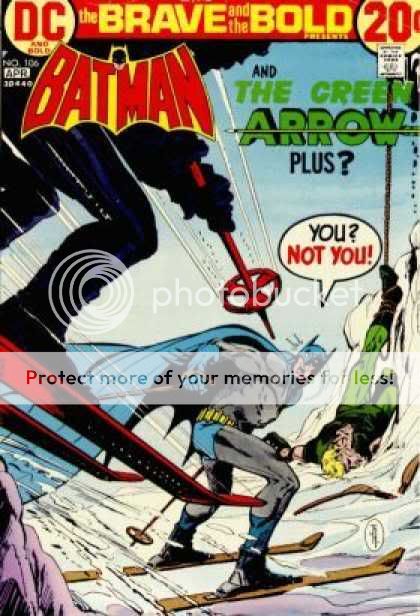

cover for Brave and Bold #106 by Jim Aparo

Noah: I did want to ask you…in your review of the Metamorpho one, at the end of it you mentioned that comics aren’t really made this well anymore. You’re way more tuned into the current mainstream stuff than I am, but I feel that way too…especially in regards to the art. I know that Aparo, Cardy, and Adams are all very highly regarded…but even Ross Andru and Bob Brown have a level of professionalism — they can put a story together in a way that’s easy to follow, at least, and which has some sense of consistent, workmanlike style. What happened to that? Or am I just being horribly unfair to contemporary mainstream illustrators?

Tucker: I think there’s a level of unfairness to that, sure–there’s plenty of comics I don’t particularly find enjoyable to read, but it’s not because of any particular lack of artistic consistency–but there’s something definitely missing. I don’t know what you can attribute that too–obviously, these Brave & The Bold’s were all bi-monthly, so it can’t be filed under the now-common complaint of missed deadlines. I’d argue that it’s more of a problem of scripts–there just aren’t that many scripts that hit all the beats well, and I think that’s what is most valuable about the best of these Haney stories. Each issue doles out some type of plot, some type of villian, some type of action, and some level of humor and emotional content.

Most of the stuff that’s out today–and this is “intentionality” again–relies on the longer arc to deal out all that sort of stuff. A six-issue mini-series delivers what might be a more heightened version of all of those things, but it takes so long to get to it–six months, if the team is on time–that everything depends on the reader caring about what is, at the core, a repetitive form of plot and story. Very few of these–even the bad ones, like that Wonder Woman thing–don’t move forward in consistent fashion, and that makes them easier to swallow.

I think guys like Stuart Immonen (Ultimate Spider-Man, Nextwave) or Dustin Nguyen (Detective Comics) have an interesting style that works with the script, makes it stronger, and helps to make it more readable.

But yes, there are people who just can’t. Tony Daniel–he’s responsible for most of the art on Grant Morrison’s Batman run–can’t draw a decent fight scene to save his life, he can’t pull off an iconic splash page, he can’t even make it look like somebody is talking to another person without a lot of work on the part of the reader. Ed Benes, who handles the Justice League, is just as bad.

Noah: Fair enough on the art…though is there anyone in mainstream you like as much as Aparo or Cardy or Adams? (You’re going to say Eduardo Risso just to irritate me, aren’t you?)

Tucker: Well, it’s a different skill set with Risso–I liked his run on Batman well enough, but Aparo’s work is far preferable. But yeah, I don’t think Aparo could pull off 100 Bullets–he has a problem doing male faces and making them look distinctive. Lemme think for a second! That’s a good question.

Alex Maleev–he did the art for Brian Bendis run on Daredevil–I loved that. It’s nothing like Aparo, but it’s fantastic stuff. Guy Davis–he does the B.P.R.D. series for Dark Horse. And I’ve really enjoyed keeping up with this lesser known guy named Tan Eng Huat–he did this Doom Patrol revamp years ago, and now he’s exaggerated his work even more, and is currently doing Ghost Rider for Marvel. He’s too weird to get a standard gig, but he’s got a style that’s pretty unique for super-hero books. Michael Allred/Cameron Stewart and Darywn Cooke also did this great tag-team work on Catwoman for a while, until DC threw that book into the toilet.
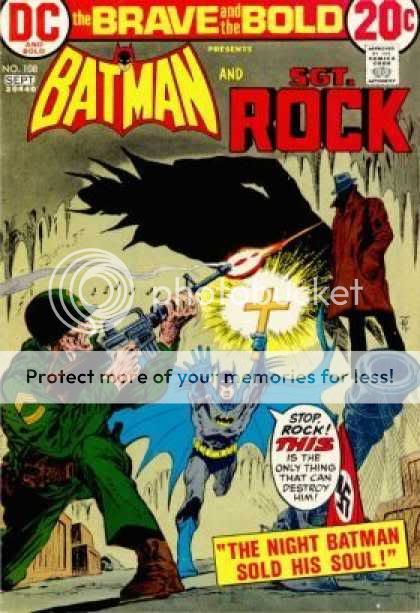

cover for Brave and Bold #108 by Jim Aparo

Noah: On the story; I think these are obviously aimed at a more general audience, right? I mean, there’s a sense in these that somebody who doesn’t necessarily define themselves as a comic-book fan might pick one up…say, from a 7-11 rack (which is where I got my comics way back when.) Haney clearly, clearly, doesn’t give a crap about continuity…which is pretty darn funny considering this is a team-up title. Today, I think writers tend to aim their work at people who they figure are already invested; if you’ve got the comic in the first place, then that indicates a certain level of knowledge about the DC universe, and a willingness to follow a series month after month after month. That makes it possible to attempt more complicated stories, which can be great at times (Swamp Thing, Animal Man, etc.) But I think though it can be great, there are diminishing returns at some point, mainly because super-heroes really weren’t ever originally intended for that kind of story. It’s a silly idea, when you come right down to it, and there’s only a certain amount of mileage to be gotten from debunking or complicating it. I think we’ve passed that point, myself.

I haven’t seen any of those artists you mention, alas…except for Darwyn Cooke…who I like all right…. Would you agree at all that contemporary mainstream art is generally not as good as the older stuff, or is my whole thesis misguided?

Tucker: ….off the cuff, I’d agree, sure–but then again, there’s such a massive amount of stuff that i’ve got zero relationship with. If it’s reprinted–and as much I’ll joke that everything is reprinted, that’s not really true–then it’s got to have some potential value to it. There’s a ton of comics that get mentioned in Haney’s interview that I’ve never seen available except in the quarter bins, and I’m sure there’s got to be a lot of crap there, you know? It’s sort of unfair to use some of Jim Aparo and Nick Cardy–while they were at work on a successful title, which B & B was–to showcase how bad the art is on Uncanny X-Men.

Noah: Oooh…here’s some Maleev. Very nice.

Tucker: At the same time, fuck comics. Old stuff > new stuff. I don’t think you have to go to the Library of Congress to figure out if that’s true or not.

Noah: All right; well a slightly different tack…what do you think the best stories in the volume were? We seem to be agreed Deadman was the best; I think my second favorite is probably that Black Canary one from #91, mainly because of the great Noir art…but the story was also pretty fantastically preposterous from beginning to end. After that maybe the insane Phantom Stranger one with the paranoid covens and Batman killing his godson and not really giving a crap. What do you think?

The evil Mormons and the crazy Adam Strange evil-future-Batman and the one with Flash where Batman becomes an obsessed, possessed paranoid nutjob were all great too…but the art kind of drags them down a bit….

Tucker: My favorite panel in the entire book was the guy going off the bridge “nononononon” in the Black Canary story. That’s my number two as well. After that, I’d probably go with the Sgt. Rock story–the violence, the Alfred kills the dude ending–I just loved everything about that one. It also had “Bat-Hombre” which is something I’d sort of like framed in my home. No love for Metamorpho? I loved that there was no real team-up, and that Metamorpho didn’t seem to have any interest in doing anything but saving his lady. Bad guys? Rex doesn’t care. Rex just likes saving that girl and punching that monkey.
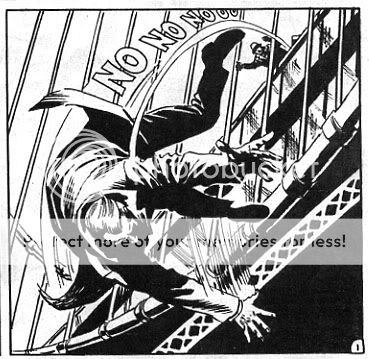

from Brave and Bold #91, art by Nick Cardy, story by Bob Haney

Noah: That panel is amazing. And the Dinah Lance cheesecake. The Sgt. Rock one didn’t do as much for me, though your review did make me appreciate it more. I think, though, that I liked the depressed Plastic-Man as noir avenger more than you did; that was just so, so wrong I had to love it.
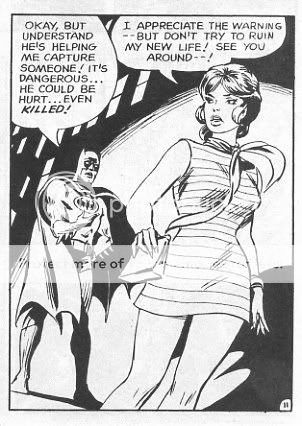

from Brave and Bold #91, art by Nick Cardy, story by Bob Haney

Tucker: Well, the Plastic Man went for that whole “hangs-on-a-spoiler” thing that just…I just can’t do it anymore. Keyser Soze, heads in boxes, that Shamalame guy and his dead people–I’m just tired of “you’ll never guess what comes next” kind of stuff. It wears me out, and while I had some appreciation for the weirdness of Plastic Man continuing to maintain his false identity months longer then sanity or logic required, that story was a spoiler end, and that part of me is just dead in the ground.

Noah: But it’s such a stupid spoiler…don’t you want to be meta? Sigh. I guess post-ironic irony is dead….

Tucker: I don’t know what those words mean!

Noah: Anyway, I wanted to ask you too what you made of the whole Haney-intentionality quandary I wandered into. Especially in relationship to that Deadman story. Is Batman in that supposed to come off as an unfeeling cad, do you think? Does it matter? It seems to me like he had several modes; one where the story was just completely off the wall and running in every which direction (Adam Strange, both Phantom Strangers, the beginning of the Sgt. Rock one) one where you basically get a fairly straightforward adventure story (Metamorpho, Green Arrow, etc.) and then the Deadman one, where it’s just a brilliant noir plot. It’s awfully hard to resolve all of that into some kind of auteur function. I wonder how much of the scattershot quality, in every sense, is the result of just having to grind out so much material….?

Alex Maleev is the Kabuki guy! I do like him…though possibly not as much as Aparo or Cardy. There’s a bit of slickness in his realism that sets my teeth on edge…I haven’t seen the Daredevil stuff though. He’s obviously extremely talented, in any case.

Tucker: It’s difficult for me to reconcile Haney into the category of a guy who was just working to finish product, just grinding out scripts to meet deadlines. At the same time, i think it’s difficult because I don’t want to believe that people go into the creative field–any creative field–and do that. (But that’s an optimistic, unrealistic fantasy, and it’s just as likely that comics writers end up doing the same kind of grunt work that people do when they work on Gray’s Anatomy, so on.) Of course, some of them go on to do good work–Shawn Ryan, who did the Shield, always talks about the time he spent on Nash Bridges as being an excellent writing/creative school. The thing is that with comics guys you’ve got evidence of their actual goal. Brian Azzarello (who i know you don’t like) did these really terrible Comico books, and then he did short stories for Vertigo, and then he got the freedom to do 100 Bullets.

Haney doesn’t have that in his catalog. He was a comics guy who did comics-as-product.

Sometimes he did them really well, but his limitations were vast. He couldn’t do a four-issue Noir Batman story, because that wasn’t what he was hired for.

He had to make do with a bunch of titles, different art teams, and an editorial group he doesn’t seem to have had much love for. So sometimes he could take shit and make it fly–like Deadman, where he made the story the primary engine–or he made do with letting the heroes carry the weight, like he did with the Bat-Metamorpho story.

I went a different way with your question: I think Haney felt that he was free to do with Batman whatever he needed to so he could fit his story. More and more, the problem is that comics writers seem to worry that they’ll “break” Batman, and they cater the story to fit in with his ridiculous “mythos” or whatever.

We’d be a hell of a lot better off if Batman was just left as more of a reactionary force, which is pretty much what he is throughout this entire series.

Noah: I don’t think grinding stuff out has to necessarily be a sign of bad art or anything. There’s not necessarily any correlation between how something is made and whether it’s good. Philip K. Dick basically wrote as fast as he could type, and that’s how his books read…but they use that, too, and they’re incredible. Haney sometimes seems to be doing something a little like what Dick did; all that amnesia, storylines that can’t stay straight for more than a panel, Batman going off the deep end again and again; it’s pulp crap as metaphor for the way the world falls apart if you look too closely at it. At the same time, you never get a moment where he manages to make that explicit, the way Dick frequently does.

Tucker: Don’t get me wrong–grinding it out isn’t indicative of bad art. But if we’re talking about what Haney’s intentions are, it’s hard to reconcile “intention” with “finish this comic and get it to the artist and get my paycheck for this comic.” There weren’t opportunities in comics for the kind of creative freedom that Image or some Vertigo titles allow. Haney was in a one-job market, and what he wanted was never going to be met by what was available.

Noah: I agree that the Batman mythos has become a problem. Again, it’s that comics cater more towards a specific community; consistency is much, much more important. Haney’s Batman is way more flexible; he isn’t just a reactionary force right? I mean, sometimes he’s a mad scientist, sometimes he’s an advocate for teens, sometimes he’s dumb as dirt, sometimes he’s a murderer…and my point is there’s something a lot more realistic there than having him be a consistent archetype.

Tucker: I couldn’t agree more. Having a flexible Batman opens the gates for more stories.

Just “more” though. Not necessarily “better.” Grim and dirty bludgeon for justice though–that’s getting old.

Noah: Which suggests that Haney did in some ways have more creative freedom than someone like Grant Morrison or Frank Miller, who, despite having more control over plot and length of story and so forth, have to fulfill these expectations for the character that are quite, quite strict.

Tucker: Yeah, I don’t think that’s what you’d be saying if you were reading Batman RIP. Grant’s got all kinds of freedom there, and wow. Not great. He’d be better off if he did have some type of Denny O’Neill controller making him hit some beats, deliver some payout. Haney though–I just can’t see the creative freedom thing. He could improvise, sure, but the level of improvisation was limited to this story, which is why so many of these stories are so widely divergent in level of quality. Guys like Grant and Frank–they have open contracts to do what they’d like. Haney was working in a shop where he knew he could lose his books, because he took those books from the guys who lost them. Did you read how Levitz ran him out of hte store? They clearly didn’t give a shit about him..

Nowadays, after the Alan Moore debacle, you know DC has to worry about burning bridges. They can shit on Chuck Dixon, but they know that Frank Miller, Jim Lee–guys like that could sell Aquaman. They have to keep them relatively happy, even though the real draw might be Batman.

Noah: Well, once again I will defer to your willingness to actually read all this stuff. Still…I don’t know. Frank Miller clearly doesn’t feel he can, or isn’t able to see his way clear to, or just doesn’t want to do anything else with Batman than what he’s done already. There’s a way in which…a small, focused, in-group audience — a real fan base — can be the ultimate creative trap. I mean, yes, you read that stuff about Haney was treated, and those people were obviously (at least in this way) evil corporate drones who didn’t care about him at all. But there is some kind of freedom in that. Nobody cared about him. He had to put Batman together with some other DC hero. After that…he could have Batman kill people. He could have him suffer a mental breakdown. He could have an entire robot liberation movement for an issue. He had to deliver payout, but if he did, it didn’t really matter much how he treated Batman, or even that the story made logical sense. There’s maybe a little bit of an analogy with exploitation films, where you had to have the T, you had to have the A, and you had to have the violence, but after that there was really a surprising variety of things you could do precisely because nobody was really paying attention. In comics now, people are really paying attention. Morrison and Miller can do what they want…but they write in a way and for an audience that brings a ton of expectations to their work. That’s part of why Alan Moore’s career has been so interesting to watch; he’s been desperately trying to jettison expectations. It hasn’t exactly worked, but I think the impulse makes sense. I think…it’s a little like why rock bands have trouble not sucking after the first couple of albums. There’s an intensity of attention which is strangling.

Just as an example…could you have Batman walking down the street in broad daylight admiring pretty girls in a comic today? That seemed totally like a personal touch by Haney…and I wonder if you could get away with it now.
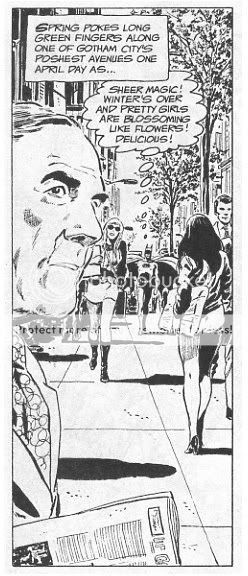

from Brave and the Bold #102, art Jim Aparo, story Bob Haney

Tucker: Again…there’s little there I can argue with. No, you couldn’t get away with a lot of what happens in these stories. (Of course, that’s part due to the popularity of those writers to meet expectations, like you said.) But still: is that all Haney wanted? One-shot stories?

Noah: Yeah…I mean obviously, the gig sucked. He was treated like crap. I would love to know what Haney would have done with the gloves off (Metamorpho is a taste I think.) At the same time, artistic freedom…there’s some sense in which it’s what you make of it. You look at alt comics autobio stuff, where personal vision is the buzzword…and then you look at Jack Hill’s women-in-prison movies where he has to hit trope after trope…and the one that seems more free isn’t that one where the creators are doing whatever they want.

Tucker: Oh, there’s definitely a lot of truth to that. I think improvisation language works well–the way guys like Meisner defined it was that it would always work best within a forced structure. My problem with painting Haney as a free spirit is just that he didn’t have the wide range of time to operate with–it was all these closed chapters. There’s a lot of horrible shit about serialized stories that never end–see super-hero comics as an example–but sometimes that long-form range works. Animal Man–Swamp Thing–to some extent, even something like Punisher MAX. Haney didn’t get that opportunity, and I’d kill to see what he did with it.

Noah: It’s funny we were talking about Haney not having any control over what he did or how…and here’s Morrison, who’s got all this creative freedom, and what he wants to do with it, is he kind of wants to be Haney. Bring back all the goofy silver age stories, nut-job plots, etc. etc. Except it’s all wrong precisely because he *wants* to do it, which means he’s reverent of the material in a way Haney never would be. I mean, Haney would never write a story just to say, “There will always be a Batman.” Why would it occur to him to do that? Batman’s not an icon; he’s a steady paying gig.
___________________

And that’s all she (or in this case, we) wrote. Thanks to all of you who read and/or commented; it’s been a blast.

One More for the Hood

Eagle-eyed readers will notice that we’ve added another blogger. Miriam Libicki (aka Miriam Beetle) is the creator of jobnik!, a comic about her experiences in the Israeli Army. She’s also a longtime reader of this blog, where her comments have, with some regularity, been more interesting than my posts. We’re very pleased to have her join us as a regular blogger. Good to have you aboard, Miriam!

Xoth — The Intro

Stefan Dinter, the man behind German comics company Zwerchfell Verlags, got me to write an intro for Xoth –The Unspeakable City, a new Lovecraft pasticheby Anna-Maria Jung. Here’s a bit of press info about author and book:

On ANNA-MARIA JUNG:

Anna-Maria Jung was born in Graz, Austria, where she started to draw comics during her teens. She started to study Multi-Media Arts, then went on to work at Bill Plympton‘s animation studio in NYC (for the short film
»Shut Eye«). Returning to Austria, she began to to write her master‘s thesis in Multi-Media Arts at the Fachhochschule Salzburg on the theme of »The Creation of a fantastic world, based on H.P. Lovecraft‘s Cthulhu Myth«. The Thesis deals with, amongst others, »background information on the author, the cthulhu myth and the meaning behind the stories, as well as examples of lovecraft-inspired media and a discussion of how these different kinds of work deal with Lovecraft‘s stories«. During the work on the thesis, Anna-Maria started to work on conceptional artwork for a fictional city named XOTH and its inhabitants, inspired by Lovecraft‘s creations. From this grew the idea for a comic book – XOTH, The unspeakable city.

On XOTH:

On one of his many uneventful, boring evenings, Jacop O‘Damsel, freelance nerd, drunkenly decides to fall asleep in a back alley. Bad timing, since an intergalactic Dimensional Shambler apears right there and then. And before Jacop gets the faintest chance to even be hung-over, the thing whisks him away.

Jacop awakens in XOTH, a strange world full of weird creatures – or are they unutterably blasphemous? Anyway, there are also the »Humanists«, a gang of stinky fisheads whor worship Humans and need Jacop for a certain – if unspecified – mission. And if that wasn‘t madness enough, Mayor Cthulhu orders his best killers, Nub and Shang to rub Jacop out of existence. Thanks be to the Old Ones, because Jacop finds Yen Niggurath,a nice goat-girl, who decides to help the hapless human. Together with
her, Jacop will get to the bottom of the »Ordus Humanus« affair, since – Cthulhu‘s fat ass! – he‘s in no mood to run for his life forever.

Set against the background of H.P. Lovecraft‘s Cthulhu Myth, Anna-Maria Jung tells a tall tale full of monsters, nerds, monstrous nerds and nerdy monsters. And the man from Angell Street is in there, too.

XOTH! Die unaussprechliche Stadt, an 80 page hardcover with a foreword by ill-tempered critic Noah Berlatsky is published by Zwerchfell Verlag. more on http://www.xoth-comic.net/ and http://zettgeist.blogspot.com/

——

…and because I’m a lame-ass American monoglot, and can’t read German, you now know about as much about Xoth as I do. Luckily, Stefan wanted the intro to be an intro to Lovecraft rather than to the comic per se. So anyway, the intro is below…and if you buy the book, you can see it in German too! (Which I think may be my first translated work!)

—–

Horrid Replication

H.P. Lovecraft loathed and feared degeneration with an intensity hardly distinguishable from lust. With obsessive, leering repetitiveness, his stories imagine man as a kind of vulnerable waxwork, constantly in danger of melting into a suggestively amorphous travesty of itself. In Lovecraft, there are no sexual references, no women, and virtually no dialogue. Every man is trapped in his own skull, quivering with impotent emotion as gaping atavisms engulf him, swallow him, have their way with him and discard him, leaving behind as progeny an animalistic cannibal, an undead zombie, a croaking brachian, a friable gray powder, or a slithering mass of protoplasm. Lovecraft in his actual life had very unpleasant racial views, and the spectre of miscegenation, of impure violation and alien congress, slithers through every page he wrote. Behind his constant use of adjectives like “nameless”; “unspeakable”; “inexpressible”; “indescribable” it is hard not to see a massive, leaden repression. Like the devolving narrator of “A Shadow Over Innsmouth,” Lovecraft’s horror shades ominously into fascination — a desire to slough off humanity altogether, and bathe in defilement for all eternity.

Whether Lovecraft actually desired such a fate, he’s certainly achieved it. Perhaps more than any other twentieth century writer, his work has inspired, not reverence or criticism, but twisted doppelgangers. All art tends to propagate itself, of course, whether in homoerotic Star Trek fan fiction or Jane Austen movie adaptations. But even by these standards, Lovecraft is something else. Whether you’re Stephen King, Alan Moore, or …well, me, in some of my earliest and most benighted prose efforts, the allure of Lovecraft is infinitely irresistible. Cthulhu pops up incongruously in comics, books, movies — for that matter, I’ve even got a plush Lovecraft monster doll (it’s starfish shaped, with too many eyes, and it kind of scares my four-year old.) To merely glance through one of the man’s unholy books, it seems, is to want to create a blasphemous imitation.

There are lots of reasons why it’s fun to steal from Lovecraft. His unwieldy vocabulary is addictive. Once you’ve been introduced to “Cyclopean,” “opalescent”, “bizarrerie”;” and “Archaen,” — all on one page, no less — you’re bound to start using them yourself. Similarly, his invented, unpronounceable neologisms — Cthulhu, Yog-Shothoth, Necronomicon — are both so instantly recognizeable and so ill-defined that you can’t help but want to make them your own.

Indeed, even in Lovecraft’s own stories, the names of these creatures are dropped with such forced emphasis that they seem borrowed — as, indeed, does most of the prose and plot. His tales are a glutted agglomeration of incoherent genres; faux anthropological treatises, swipes from Poe, shock-twist endings more hoarily ancient than his own Elder Gods; all tied together with looping strings of polysyllables, leaden pacing, and a keen disregard for characterization, narrative tension, or consistency. Original Lovecraft feels remarkably like pastiche, and the most perfect Lovecraft parody is simply Lovecraft — which is what makes Lovecraft parody so hard to resist.

And yet, despite their silliness, the best Lovecraft stories have a submerged emotional coherence — a deep pool of hysteria and anxiety which, at moments, overpowers the clumsy, plodding structure which seems designed more to contain than to explicate it. The narratives are filled with horrors unspoken, revelations half-revealed. In “At the Mountains of Madness”, Danforth looks back from the plane and sees something — we aren’t told what — which causes him to shriek aloud “Tekeli-li! Tekeli-li!” This is a decidedly goofy reference to Poe. And yet, at the same time, there is something meaningful and affecting in the glance backwards that causes madness. The nonsense noise and the literary reference almost seem designed to bury the core effect — the evocation of a mythical primal scene, that turns men to weeping children.

Or look at the following passage, in which, Lovecraft describes one of his patented monsters; a shoggoth.

Formless protoplasm able to mock and reflect all forms and organs and processes — viscous agllutinations of bubbling cells — rubbery fifteen-foot spheroids infinitely plastic and ductile — slaves of suggestion and builders of cities — more and more sullen, more and more intelligent, more and more amphibious, more and more imitative —Great God!

There just isn’t anything especially frightening about a rubbery fifteen-foot spheroid — I mean, what is it, a gigantic football? But preposterous as the start of the quote is, the end has an evil lyrical force in its nightmare vision of slave uprisings, of rightful rulers overthrown by indistinguishable, ungrateful, utterly unhuman underlings. It’s like a more repressed, more foaming version of Carlyle’s French Revolution.

Lovecraft (suggestively) hated Freud. But what is most compelling about his narratives is the sense that they are unavoidably Freudian — that the story’s thin, precarious consciousness is stretched above an unexplored abyss. Like Lovecraft’s characters, his readers and imitators are drawn on by the allure of undiscovered truths, unexplored passages, unnamed horrors. The stories resolutely refuse to explore their own implications; their meanings don’t reveal themselves easily or naturally, but rather slither out, half-formed, oozing a foetid miasma, before lurching back, half-seen, into the blackness which spawned them. Did you really see that? Did Lovecraft?

Perhaps…or perhaps not. Certainly, few writers have written so obsessively about the desirability of ignorance — and, especially, of self-ignorance. Anna-Maria Jung hits on something profound in Xoth when she switches the brains of Lovecraft and a Yithian. Not that Lovecraft’s work is especially alien, but it does sometimes seems written as if it’s author had deliberately asked his brain to leave the room. The stories seems disavowed by their creator — which is why so many other people have tried to claim them.

The result is invariably, to quote the master out of context, “degenerate work…coarse, bold, and wholly lacking in delicacy of detail.” But, as Lovecraft knew ( or, perhaps, tried not to know) degeneration has its own perverse attractions. So prepare to enjoy the debasement that is Xoth — and I hope it inspires you to explore the debasement that is Lovecraft as well.

——–

If you want to read more of me on Lovecraft, you can check out my review of the Eureka’s Graphics Classic comics adaptation of some of his stories. (I believe Stefan read this review, which is why he asked me to do the intro for Xoth.)

And if you’re unholy yearning is still not sated, you can see some of the art I did for an exhibit based on quotes from Lovecraft’s Commonplace book which is still shuttling around Europe as we speak:

More here and here and here. Oh, and also here.

Send Back Sendak! Boost the Seuss!

I find Donald Phelps’ writing style maddening; circumlocution is piled on parapraxis until all you can really see is the giant, rather desperate sign waving back and forth: “Kiss me! I’m erudite!”

Nonetheless, his new column in TCJ is tackling interesting subjects. Last time out he talked about the classic pulp occult novels of Manley Wade Wellman, which look pretty fabulous. In TCJ 294, he compares Maurice Sendak and Dr. Seuss, which is a fun topic to think about, even if, (to no one’s astonishment) I disagree with everything he says.

Phelps’ basic point is that Sendak is better than Seuss because Sendak is more of a formalist. In the selection below, he’s talking particularly about a 1934 comic strip by Seuss which is fairly chaotic and ignores panel borders.

An object lesson, I might suggest, in the liabilities of kindergarten chaos as practiced ad infinitum by Giesel. It involves the jettison of form, embodied, in the example just cited, in those ubiquitous panel boundaries: expandable (as Hal Foster and Billy DeBeck variously demonstrated) but very, very seldom, if ever, dispensable or, challengeable, at least, as obtusely as Seuss challenged them. Form: that which delimits, that which demarks, that which identifies, in children’s art especially — like that of Dr. Seuss and Maurice Sendak. Form entails a sense of the imagination’s geography and its component laws.

Such a geographic sense, along with the commitment it would appear to involve, has never been evident for me in the fantastical outpourings of Theodore Giesel. One recalls once more — somewhat querying — the little homilies embodied in some of the later books: How the Grinch Stole Christmas, Horton Hears a Who, Horton Hatches the Egg. Aren’t such sermonettes the occasional warning or symptom that the author, albeit with whatever benign and public-spirited sentiments — recognizes (make that: re-recognizes) the work of his hands as a Marketable Commodity. And one might observe: a symptom of the deficiency of form, one might say, the integrity of the artist’s work, as manifested in laws, not homilies.

Phelps then goes on to laud Sendak for being more restrained and controlled:

The stories of Sendak unfold themselves in gravely exact segments of action, by soberly defined anatomies, enacting the fables in compact but soberly graphic pantomime. The pictures as a rule are not enclosed save by the pages’ white margins, the concentrated imagery suggesting a dream’s flickering vignettes. Yet, I can not sufficiently mark the tone of earthy, almost prosaic reality that Sendak bestows on his visions.

So to sum up, Seuss is uncontrolled, overly commercial, and kind of gauche. Sendak is controlled, brimming with artistic integrity, and classy.

The difference between Seuss and Sendak, in other words, isn’t only, or primarily, that Sendak is more interested in form. Phelps can natter on all he wants about the link between homilies and formlessness,capitalizing “Marketable Commodity” just to make it look more official, but that doesn’t change the fact that the central claim is complete bullshit. An interest in neat moral packages doesn’t have jack to do with how much of a formalist you are. Hogarth and Grunewald have pretty solid formal virtues I’d argue; so does Art Young. And for that matter, as far as language goes, Seuss, with his strict doggerel rhythms and rhymes, is much more interested in form than Sendak, who works in much looser verse or in prose, and who includes frequent asides and narrative wavering. Phelps is merely the victim of a common modernist critical confusion; the assumption that if an artist is willing to put meaning in his work, then that work must be formally bankrupt. This is a pernicious doctrine, and it should be hooted.

No, what Phelps is really getting at, undercover of his muddled cry of “form!”, is that Sendak is — definitively, self-consciously — high-brow. Sendak references Winsor McCay. He fetishizes volk culture (folk tales, nursery rhymes, his own ethnic roots.) He likes tweaking the bourgeoisie with a little bit of nudity here, some impish rebellion there. His books thrive on an improvisatory cleverness akin to that now thoroughly high-brow music, jazz (as in, say, “Hector Protector”, where the nursery rhyme “As I went over the water”, where the most memorable image is of a sea-monster mentioned nowhere in the text.)

Seuss, on the other hand, is a big, fat, middle-brow. He doesn’t tweak the bourgeoisie; he embraces them, with long screeds about how great democracy is and what a wonderful thing it is to celebrate Christmas. The volk he loves aren’t ethnic; they’re the deracinated Americana, with their lovely rituals of high-school graduation and self-help rhetoric. He doesn’t bother with old, fusty nursery rhymes…why should he, when he can make up twelve of his own just as easily?

In other words, I think that, in choosing Sendak over Seuss, Phelps is just proving that which should come as a shock to no one who has read his prose; namely, that he prefers the pose of an aesthete to the pose of an entertainer. That’s certainly not always the wrong choice, but I think it is in this instance. Sendak has done a lot of great books, and is a wonderful artist, but for me, at least, his pretentions can start to grate — he certainly *is* clever, but I wish occasionally he’d spend less time pointing it out, and more time telling a story that my son actually wanted to pay attention to. Seuss, on the other hand, may reek a bit of greasepaint and the uplift, but he sets off so many verbal and visual fireworks that I find it impossible to take offense.

Plus, Fox in Socks is, hands down, not-even-worth-discussing, my favorite book to read aloud ever…with the possible exception of Seuss’ very entertaining tongue-twister follow up, Oh Say Can You Say.