PencilPanelPage is Transitioning

finallogo3
Due to increasing pressures of various sorts, the contributors to PencilPanelPage – Frank, Roy, Brian, Michael, Adrielle, and Qiana – regretfully are not longer going to be able to provide our lively once-per-week column on theoretical issues in comics.

squarelogoThis isn’t a goodbye, however, but merely a transition into a new, more flexible format. All of us plan to continue to post on The Hooded Utilitarian on a more occasional basis – as often as the ideas keep coming and the time to write them up is available. We’ll continue to use the PencilPanelPage imprint for our posts, and we’ll also stay on the lookout for exciting guest bloggers as well. PencilPanelPage has been an amazing, and educational, experience for all of us, and we won’t give that up entirely without a fight!

To mark this transition, the PencilPanelPage team put together a short list of some of our favorite PPP posts from the last few years (some hosted on The Hooded Utilitarian, others from our earlier incarnation as a WordPress blog before Noah was kind enough to invite us here). We had a lot of fun looking over dozens of past posts to compile this list, and we hope you’ll enjoy a quick glance at the past as well!

Frank: How do comics artists use speech balloons?

Roy: When are two comics the same comic?

Brian: Walt Kelly and me.

Michael: What do ‘silent’ comics teach us about the medium?

Adrielle: Finding the dynamic in the still: Paul Klee as comics artist.

Qiana: How do comics represent Ferguson?

We want to thank all of the readers of the blog , and especially Noah for making it all possible. It’s been a great fourteen months, and we hope to continue to contribute to the great atmosphere here at The Hooded Utilitarian for many more months, and many more years, to come!

Frank, Roy, Brian, Michael, Adrielle, and Qiana


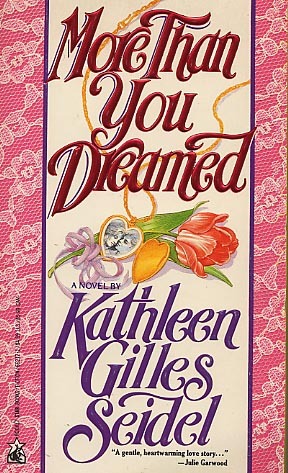
Can a Romance Novel Be Ambiguous?

2385082Multi-layered, ambiguous, nuanced, complex. That’s generally the sort of thing literary critics say when they are praising some important work of literary fiction for its importance, seriousness, and literariness. Great novels, or works of art, are supposed to have meanings within meanings, perspectives within perspectives. To be great is to be multiple. Pulp or genre novels, on the other hand, are often seen as being singularly utilitarian. A horror novel scares you; a spy novel gets the blood pumping, porn does what porn does.

In an interview with me last week, romance novelist Kathleen Gilles Seidel suggested that romance, too, was more singular than multiple, at least in some respects. As a writer, she says,

my relationship with my reader is a romance writer’s. I am not out to challenge her (or him), threaten her, or even change her. I am very controlling of her (or his) experience. The characters may be complex, and the judgment about them may be nuanced, but ultimately there is almost no ambiguity in the judgments. A reader is going to end up drawing the same conclusions that I have.

So for Seidel, romance novels are restrictive and, at least in some ways, unambiguous. Is this true?

There are buckets and boatloads of romance novels, and it’s hard to make any statement about them in general that would be true of every one. But it does seem to be true of one novel — Seidel’s own 1991 book More Than You Dreamed.

More Than You Dreamed is about an (extremely) wealthy director’s daughter, Jill Casler, and a basketball coach, Doug Ringling, who is the nephew of the famous actor Bix Ringling. Bix and Jill’s father, Cass, were both involved in the making of a 1948 blockbuster, Weary Hearts, a historical drama focusing on one Confederate family’s struggles during the Civil War. The making of the film is shrouded in confusion, and Jill and Doug work together to uncover the production mysteries. While falling in love. As you’d expect.

To repeat, that outcome is expected. You’re introduced to Doug and Jill on the first page, and you know what’s going to happen. That singular, predictable reading is mirrored, emphatically, in the film within the book. Just as the reader reads “Doug” and “Jill” and says, “aha!”, so Doug and Jill read various versions of the script for Weary Hearts — and those readings are always singular, immediate, crystal clear. When Doug and Jill find Bix’s original script, they both know it’s a masterpiece — and everyone else who sees it thinks exactly the same thing. When Doug and Jill see an early print of the film, they both agree it’s a failure, and for the exact same reasons. Art, in More Than You Dreamed, is unitary. It speaks to everyone with the same voice.

Or does it? Is Doug and Jill’s reading of Weary Hearts the only reading? Again, Weary Hearts seems based, at least in very broad strokes, on Gone With the Wind — another sweeping Confederate historical. Gone With the Wind, like Weary Hearts, was, and is, widely beloved. But it’s also extremely contentious. GWTW was a racist film; as a result, its tragically defeated white heroes can also be seen as awful, white supremacist villains. Instead of a romantic triumph, the film could be seen (and frequently is seen) as an ugly apology for evil.

And what about Weary Hearts? The film, as described, seems to be much less focused on race than GWTW — the characters are not landholders, but small farmers, and only one black character appears. But still, if you take seriously the idea that the Confederacy was a racist endeavor, the view of Weary Hearts has to shift. Is Pompeii, the one black slave in the film, really content to travel with the Confederate hero Charles as he wanders about fighting Yankees? Is that original print really flawed because of poor acting? Or does the early version lack power because it fails to confront the moral evil of the Confederacy?

There are clues in the book that perhaps support this alternate reading of the film. Doug, who looks almost exactly like the star of Weary Hearts, participates in a Civil War reenactment, during which he makes a passing joke about the South’s racist and sexist past. Later, and more uncomfortably, while he waits for a black basketball star friend, he quips, “I kind of like this, meeting him in a Confederate uniform. He can call me Massa, it will be good for him.” Jill replies that Doug should probably be the one calling Lynx master, since Lynx “could buy and sell you.” On the surface, it’s supposed to be a moment of fun banter. But it’s also an uneasy reminder of what the American South (and not just the South) was about. And though, again, it seems to be directly denying the continuing relevance of that history (Lynx has the power now) it could also be seen as a nervous suggestion that the past isn’t quite yet gone.

In researching Weary Hearts, Jill and Doug both want to prove that their relatives — Jill’s dad, Doug’s uncle — were good, thoughtful, brilliant, talented people. They succeed in doing so; that’s the message, and part of the happy ending, of the novel. But there’s ambiguity there too. Is it good, and thoughtful, and brilliant, to present a romantic Confederacy sans racism? The title line, near the end of the book (“…once you start to look, you may find more than you ever dreamed”) could be about the wonder of finding love. But it could also be an ironic comment on how dreams (filmic or otherwise) can ensure that you don’t look for, and don’t find, certain things.

Probably this isn’t the reading Seidel intended. But again, there’s some textual support. Jill, we learn in the novel, is an incredibly controlled person, terribly afraid that the people around her will become angry. “Jill’s goal in life was to get people to stop being angry. That’s what she did, calm everyone down so that things would get done”. Doug, for his part, lost his job at a Division I school; he is adrift throughout the book in part because he hasn’t let himself feel rage at the people who maneuvered him out of his position.

The book, then, is not only about the secrets of the past, but about repression in the present. And the two are linked. At the end of the book, Doug realizes that his uncle Charles, who played Booth the Confederate soldier in the movie, was a lousy actor. But he determines to keep that a secret: “He’s weak, he’s a coward, and he’s a quitter but he’s family.” Jill and Doug have connections, wealth, knowledge, and power; they can protect their own. In the name of family, history is altered, and myths promulgated. Does that refer just to Charles? Or does it implicate the film he was in, and it’s neo-Confederate romanticism as well? Jill and Doug’s happy ending also becomes a conspiracy about a happy past. Bliss in the present erases ancestral moral failings — which can be an exhilarating message, but which can also have less sunny connotations.

Seidel’s control, then, can itself be read as ambiguous. The characters in the novel find new scripts and scenes and perspectives on a classic story, and they refuse them — they push them away. The shelving of multiple meanings, though, can itself have more than one meaning. To reject ambiguity is itself ambiguous; to push aside a meaning is (multiply) meaningful. More Than You Dreamed settles on one romantic dream, but it also says, ambiguously, that there are more.
______
For those interested in the question of romance and directed reading, Liz McCausland hosted a lengthy discussion on the issue which is worth checking out.


The Accidental Nihilist

8144768_f520

 
“They had dug coal together as young men and then lost touch over the years. Now it looked like they’d be meeting again, this time as lawman and felon, Raylan Givens and Boyd Crowder.”

That’s the first paragraph of Elmore Leonard’s “Fire in the Hole” and the premise of FX’s Justified, which has entered its sixth and final season. The New York Times calls the show a “crime drama,” but the cowboy hat on Timothy Olyphant’s head says Western to me—that and the fact the actor had recently finished playing sheriff on HBO’s Deadwood when he took up the role.

Olyphant’s U.S. Marshall is named Raylan, but he borrows his DNA from another Leonard short story, “How Carlos Webster Changed His Name to Carl and Became a Famous Oklahoma Lawman.” Michael Chabon included it in the Thrilling Tales issue of McSweeney’s he edited in 2003, infusing a much needed dose of pulp into the quite realms of literary fiction. I assigned Leonard’s and a half dozen other Thrilling Tales to my advanced creative writing class this semester. The Justified writing team must have a copy too.  Olyphant voiced Carl’s dialogue on the pilot: “I want to be clear about this so you understand. If I pull my weapon I’ll shoot to kill. In other words, the only time Carl Webster draws his gun it’s to shoot somebody dead.”

Which Rayland Givens does too.  Many many times in the past five years. It’s his character’s most charming superpower, that good-natured indifference to moral quandaries. Raylan never hesitates before shooting and he never second guesses himself afterwards. The cocky smile never changes either. As Marshall Webster’s father says: “My Lord, but this boy has a hard bark on him.”

That’s standard gunslinger M.O., a cold-blooded willingness to step over the line and do whatever needs doing to keep the good folks of his community safe and sound. Or, as Richard Slotkin in Gunfighter Nation says of frontiersmen:

“Through this transgression of the borders, through combat with the dark elements on the other side, the heroes reveal the meaning of the frontier line (that is, the distinctions of value it symbolizes) even as they break it down. In the process they evoke the elements in themselves (or in their society) that correspond to the ‘dark’; and by destroying the dark elements and colonizing the border, they purge darkness from themselves and the world.”

So Raylan’s job is darkness-purger for the crime-swamped frontier of modern Kentucky. And he was doing a pretty good job in season one, and even better season two (one of my all-time favorite 14-episode arcs of any TV show). But then things started to shift. Not his smile, not his pistol grip, those are unflinching as ever—which, oddly, creates a kind of change in his character: the inability to change.

When E. M. Forster read Moby Dick, he saw “a battle against evil conducted too long or in the wrong way.” Captain Ahab—a once-valiant knight sailing in the service of good—devolves into the evil he thought he was fighting. That’s Raylan’s problem too. A hero can only spend so long in that darkness before he sinks in too far. Instead of purging the darkness, Raylan is wallowing in it.

His first two season, he at least theoretically was trying to complete his Ahab mission and retire into the domestic bliss of marriage and fatherhood. But then he watched his true love stroll off camera while he battled the next round of Kentucky gangsters. He picked up some more girlfriends, but his unflappable indifference applied to them too. After three more seasons of random acts of love and violence, Raylan’s emotional range never inched off the glib meter. Instead of a man with a well-armored moral center, all that manly bark looks like a facade papered over an abyss.
 

justified-season-3

 
Boyd Crowder, however, has aged much better.  Sure, actor Walton Goggins’ receding hairline is undermining the character’s crazy hair look, but otherwise Boyd is as paradoxically loveable as ever. I would call him an anti-hero, but he’s more a heroic villain, a guy of deep but unpredictable passions in struggle with his inner darkness. Unlike Raylan, he doesn’t know himself, and so each season has been a chaotic and inevitably corpse-ridden quest for self-discovery.

Frank Miller, the villain that provides Marshall Webster his origin story and plot closure, is as two-dimensional as his Batman-writing namesake (comics artist Howard Chaykin, even more coincidentally, illustrates the tale). The Boyd Crowder of “Fire in the Hole” is just an oddball Nazi thug there to give his Marshall Givens a character-revealing moral dilemma: can you put down a man you once dug coal beside? The answer is, of course, yes, and so the story has its ending. Justified, however, has been stringing out that last paragraph for five years, only now in the final season promising to complete the stand-off.

Both characters are caricatures of American masculinity, sharing the absurd ur-trait of psychopathic violence, but they spin that violence in opposite directions. Boyd’s search for meaning is almost proof enough that such meaning is possible. A universe of destructive hope pumps just under his skin. Raylan is nihilism personified. Peel back the bark, and the black hole of his heart would suck the world dry.

These aren’t the characters Elmore Leonard created. I’m not sure the writers of Justified created them either. This is just what happens when you drop short story characters into an open-ended serial form, extending their timelines far beyond the closure points they were designed to inhabit. As Forster says of Ahab, they get “warped by constant pursuit.”
 

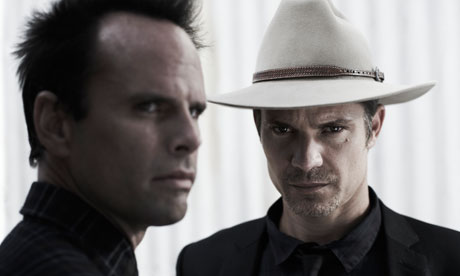
 Walton Goggins and Timothy Olyphant in Justified

World’s Best Cinecomic

World's Best Cinecomic

 
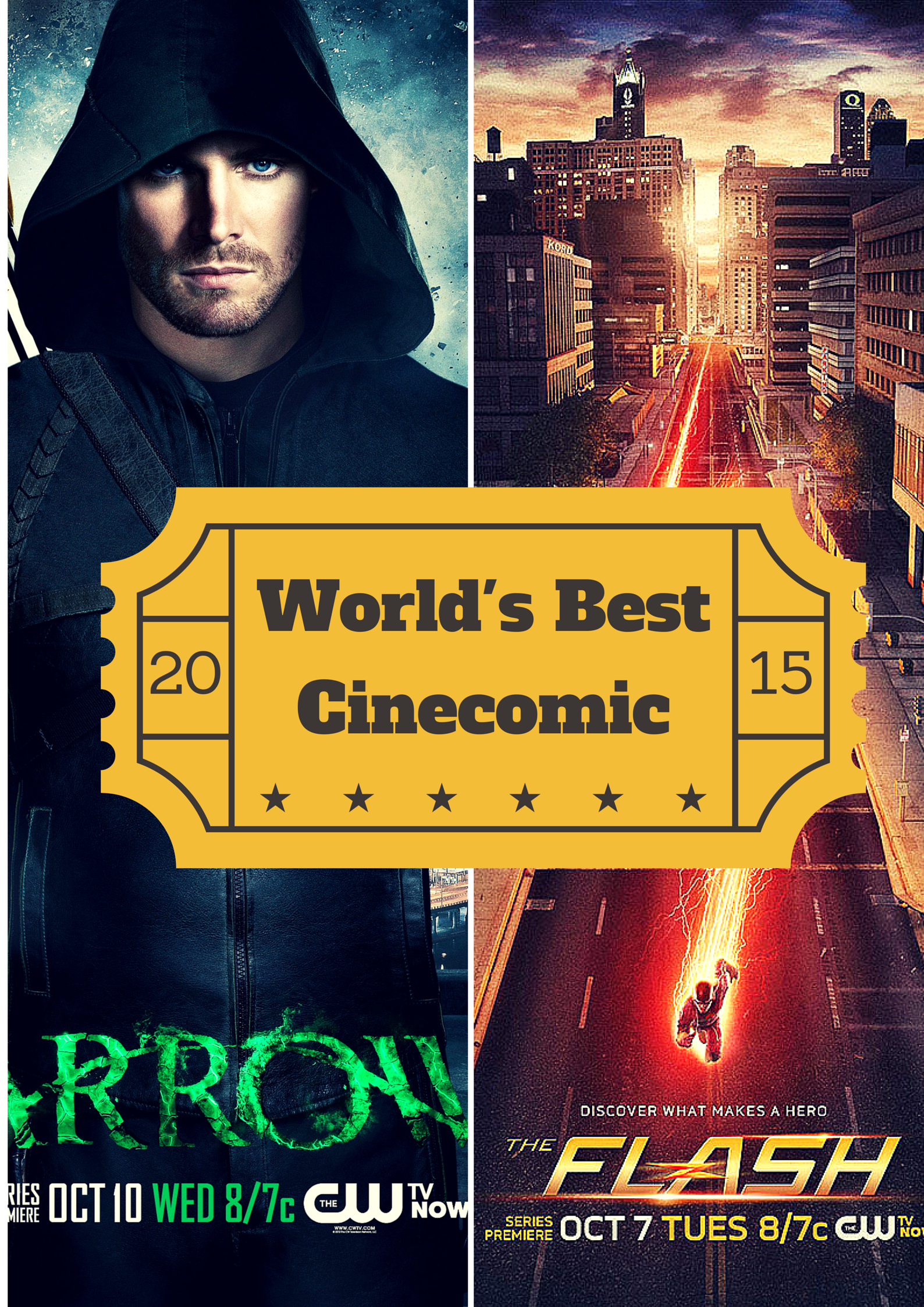
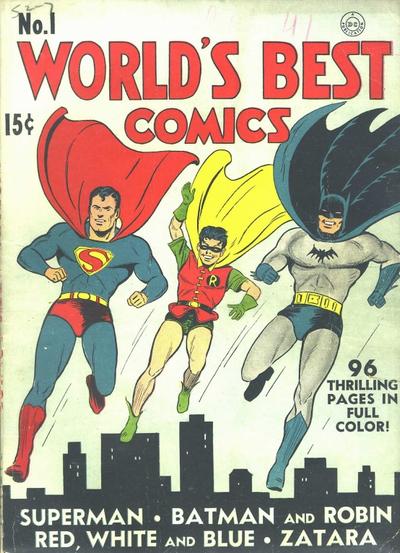
The return of Arrow and The Flash from their midseason break continues the love-fest each program has enjoyed with fans.  The CW’s dynamic duo (sorry) has sparked hopes of a DC cinematic universe by bridging the gap between diehard fans and casual viewers. Nothing illustrates this point more than this season’s semi-crossover event. Skillfully executed and action packed, each character visited the other’s show. Oliver Queen’s darker persona coming into contact with the “brighter” world inhabited by Barry Allen (and vice versa) reminded fans of World Best Comics #1 (Later World Finest Comics) that featured Batman and Superman in 1941. This comic hinted that Batman and Superman lived in the same world. Ironically, it was only the covers that placed the heroes together; they did not actually appear in the same story until 1952. Embellishing episodes that are already deeply informed by decades of stories and developed and produced by the same creative team, Arrow and The Flash deliver a better experience.
 

Worlds_Best Comic_v.1_01

World Best Comics Vol. 1 #1 (March 1941)

 
The shared universe idea that developed from the 1940s onward grew more complex drawing in fans and accommodating new characters and worlds. Creators hope this legacy means fan engagement with these cinematic adaptations will impact engagement on other platforms. Yet, as recent research about the transmedia idea explains whatever the technological tools and industrial alignments shaping storytelling, these products cannot escape the sociocultural context informing the audience experience.[1] While Arrow and The Flash are satisfying action adventure serials, this season’s crossover also highlight the historical burden linked to the superhero genre.

DC Comics characters inform the popular imagination about the superhero. For years adaptations of DC characters have served as vehicles for generational discourses. Batman’s 1960s television series and Superman’s 1970s film highlight this tradition. The Batman television series leveraged the Pop Art Movement to create an “exaggerated cliché” that delighted children and amused adults.[2] At the same moment, Roy Lichtenstein blurred the boundary between high culture and commercialism using comic book panels in his images.[3] Derided at the time, his work, like TV series, resonated with the public reflecting societal tension with the postwar conformist message in America. By the time Richard Donner’s Superman graced the silver screen in 1978 the United States had been disabused of its global preeminence by failures abroad and domestic politics splintered by protests from the left and the right. Americans were uncertain and as Jimmy Carter famously explained, a crisis of confidence casted a “…growing doubt about the meaning of our own lives” and the “unity of purpose for our nation.”[4] Donner’s Superman offered an affirmation of American ideas. Not surprisingly, Carter lost his re-election campaign and adjusted for inflation Superman remains the highest gross adaptation of the Man of Steel on film.[5]
 

Showcase_4

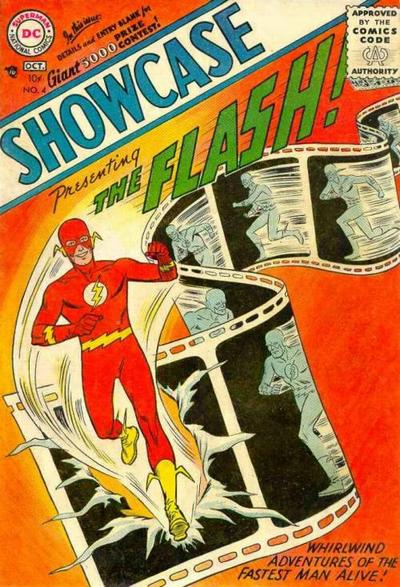
Showcase Vol 1. #4

 
The circumstances that shaped the pro-social mission in the original Superman and Batman reflected depression struggles and wartime triumphs. In a similar manner, the superhero comic book revival associated with Barry Allen’s debut as The Flash reflected the postwar experience. Created by Robert Kanigher, John Broome, and Carmine Infantino in 1956, Allen was the second Flash and sparked a superhero renaissance that re-imagined 1940s characters for the atomic age. Allen’s earnest commitment to family and community along with his civilian identity as a “police scientist” affirmed the moral standard established by The Comics Magazine Association of America (CMAA). The CMAA’s regulatory arm, the Comic Code Authority worked to eliminate corrupting images and ideas critics linked to comic books. Famously articulated by Dr. Fredric Wertham, comic books became seen as central cause of juvenile delinquency in the early 1950s. The resulting hysteria led to Congressional hearings investigating comic publishers in 1954.[6] Recent work by Amy Kiste Nyberg does an excellent job of demonstrating how Wertham was as much a symptom as a cause of Americans’ suspicions. The confluence of Cold War tension, postwar affluence, and youth culture provided ample opportunities for parents to worry and children to rebel. Those kids endangered by comics would embrace the disruptive rhythm of rock ‘n’ roll music and go off to college and protest…everything.
 

Hello My name is Green Arrow

 
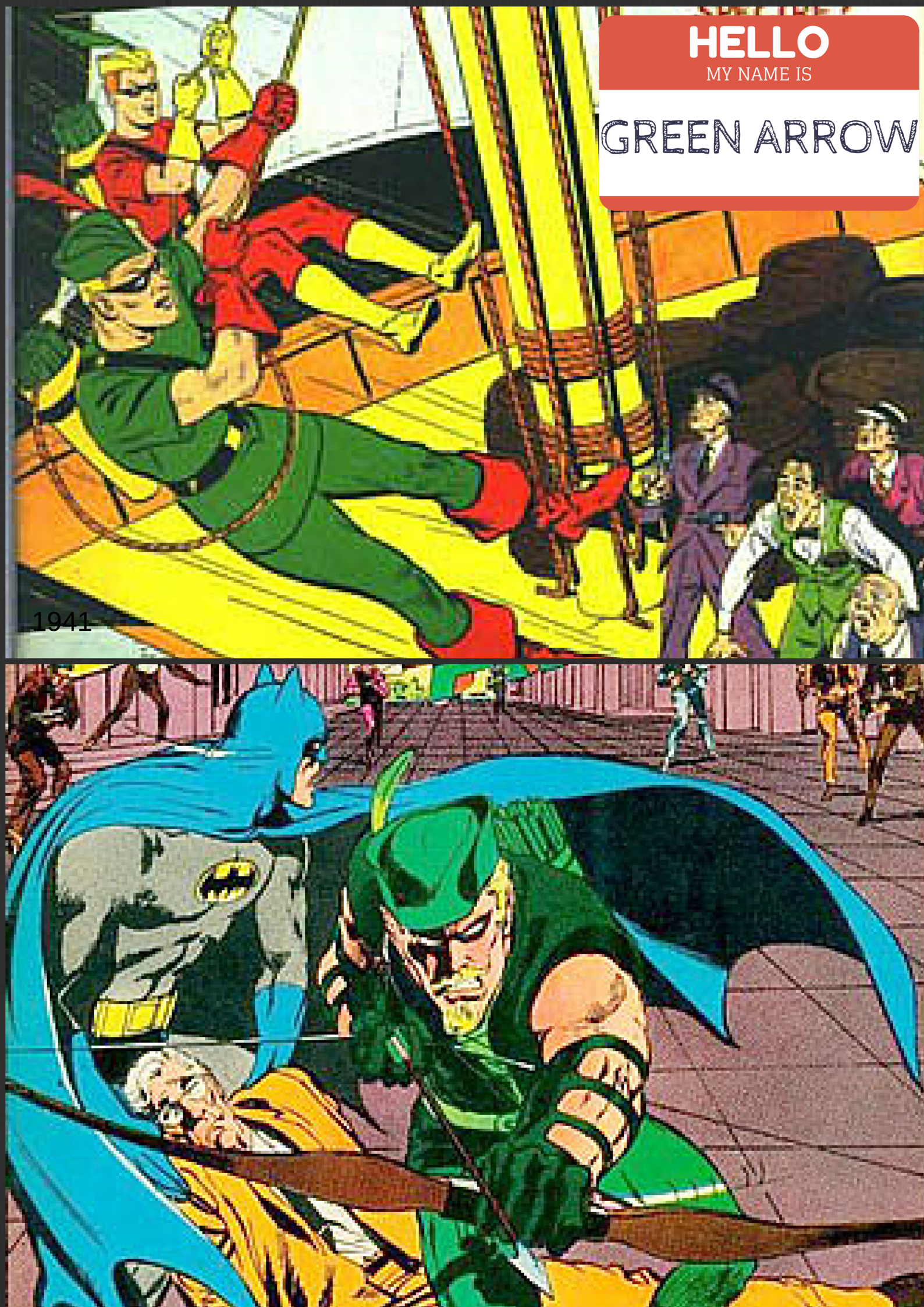
As comic book publishers strove to keep this dynamic youth engaged, they continued to revamp their characters to reflect changing time. Green Arrow, created in 1941, was more “Batman-lite” than an iconic character until Neal Adams and Dennis “Denny” O’Neil re-designed him in 1969. Oliver Queen had been a rich man with a teenage sidekick who employed trick arrows and worked from secret headquarters called the Arrow Cave (with an Arrow Car of course). The “new” Green Arrow lost his fortune, discovered his ward was a drug addict, and in the classic series paired with Green Lantern travelled the country in the early 1970s confronting crimes rooted in “real world” concerns like racism and environmental damage.[7] The link to ‘relevance’ in superhero comics has never left Green Arrow, but arguably his frustration with authority has shifted in recent years from the ardent liberalism of the 1960s to a disillusioned libertarianism today.
 

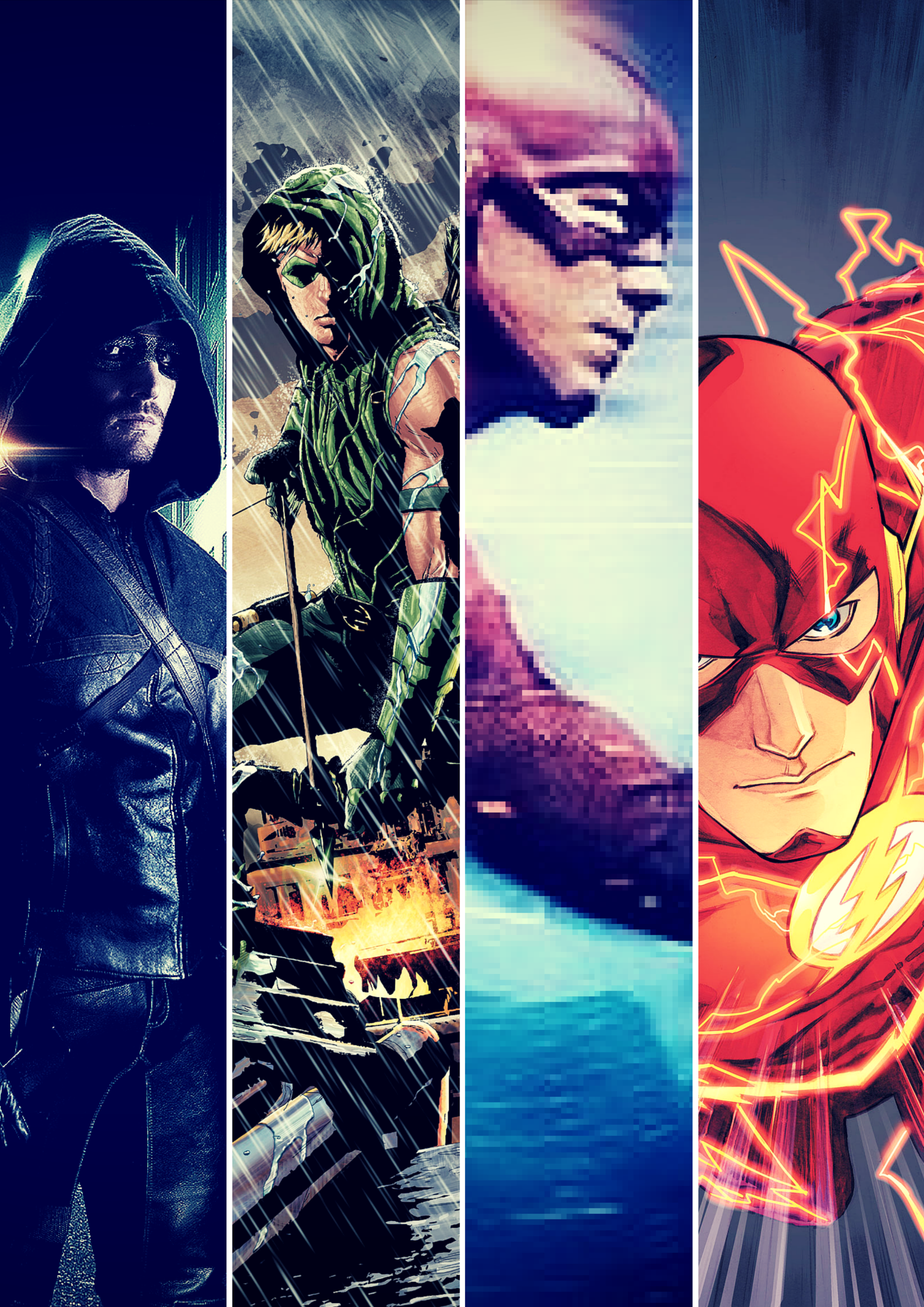
Arrow & Flash

 
In Arrow and The Flash this history informs the narrative world we see on the screen and shapes the shared universe they inhabit. Allen’s Flash and Queen’s Arrow approach their mission differently, a point made clear when each hero applies their methods in the other’s city. Allen retains the expectations and aspiration associated with postwar America, but slightly modernized. Despite the tragic circumstances he has faced, he is committed to making his world better. Arrow has taken Green Arrow’s social justice narrative and re-oriented it with a criminal justice lens. Like the country as a whole, his grievance with “the system” has grown at once more and less complex. He struggles with morally questionable actions in his past as he pursues a heroic future. Informed by contemporary culture, both adaptations are a prism on values inscribed in each character. As Arrow and The Flash continue to create a richer world, the evolution of their narrative legacy provides a roadmap of how the contemporary audience’s concerns about security and community contend with changing millennial realities. The popularity of the shows makes sense as a catharsis exercise. That the superheroes will triumph is not the question. Instead, how they win and remain heroic becomes the key. Queen’s Arrow doesn’t want to be a killer that relies on torture to protect those things he loves and Allen’s Flash doesn’t want to be so afraid he is unable to act. For all the fantastic excesses linked to superheroes, the broader questions they are in dialogue with matter to us all.
______________________

[1] Carlos Scolari, Paolo Bertetti, and Matthew Freeman, Transmedia Archaeology: Storytelling in the Borderlines of Science Fiction, Comics and Pulp Magazines (Palgrave Macmillan, 2014), viii–viii, http://www.palgrave.com/page/detail/transmedia-archaeology-carlos-scolari.

[2] Judy Stone, “Caped Crusader of Camp,” New York Times, January 9, 1966.

[3] Peter Sanderson, “Spiegelman Goes to College,” PublishersWeekly.com, April 23, 2007, http://www.publishersweekly.com/pw/by-topic/1-legacy/24-comic-book-reviews/article/14675-spiegelman-goes-to-college.html.

[4] “WGBH American Experience. Jimmy Carter | PBS,” American Experience, accessed December 26, 2014, http://www.pbs.org/wgbh/americanexperience/features/primary-resources/carter-crisis/.

[5] “Superman Moviesat the Box Office – Box Office Mojo,” accessed December 26, 2014, http://boxofficemojo.com/franchises/chart/?id=superman.htm.

[6] “1954 Senate Subcommittee Hearings into Juvenile Delinquency (Comic Books),” accessed October 26, 2013, http://www.thecomicbooks.com/1954senatetranscripts.html.

[7] Jesse T. Moore, “The Education of Green Lantern: Culture and Ideology,” The Journal of American Culture 26, no. 2 (2003): 263–78.

The Iraq War as Blogging Psychodrama

This first appeared at Splice Today.
_______

I Was Wrong: A Real Time Chronicle of the Iraq War, 2001-2008, Andrew Sullivan’s recently released ebook, is a compilation of his blogging on the Iraq war. As such, it begins with a post on September 11, 2001, a few hours after the attack on the World Trade Center. “When our shock recedes,” he writes in that first entry,

“our rage must be steady and resolute and unforgiving. The response must be disproportionate to the crime and must hold those states and governments that have tolerated this evil accountable. This is the single most devastating act of war since Nagasaki. It is the first time that an enemy force has invaded the precincts of the American capital since the early nineteenth century. It is more dangerous than Pearl Harbor. And it is a reminder that the forces of resentment and evil can no longer be appeased. They must be destroyed – systematically, durably, irrevocably. Perhaps now we will summon the will to do it. “

Sullivan’s initial reaction, is, then, a narrative — and a familiar one. It is a story of evil revenged, good triumphant, and violence unleashed. World War II is summoned up, through references to Nagasaki, Pearl Harbor, and appeasement. The accuracy of these past allusions (Saddam’s chemical attack on the Kurds in 1988 caused more deaths than September 11, to name just one post-Nagasaki example) is less important than the future they point to. That future is just war, and a new greatest generation, of which Sullivan (through that collective “we”) will be a part

Of course, it didn’t work out that way. I Was Wrong is the story of a story gone awry; it’s about how Sullivan thought he was in a book about good defeating evil, and instead discovers himself in a different tale altogether. The arc of that tale is traced clearly enough in the chapter subheads of the ebook: “Trauma”, “Doubt” and “Regret.” Shocked by 9/11, Sullivan hoped for, demanded, and was finally thrilled by the reality of war. As the Iraq quagmire deepened, and the extent of Bush’s “feckless” mendacity became clear, he began to re-examine his support. And finally, with the revelations of Abu Ghraib, he realized that the war should never have been waged, and that he had been complicit in an atrocity. “Those of us who supported this war cannot wash our hands of the blood of tens of thousands of innocents it has now claimed,” he wrote in October 2006. And he adds, in an epilogue, “Although my intentions were good, I feel ashamed of some of the sentences in this book.”

Sullivan’s recognition of his errors, and his willingness to admit them, are both extremely admirable. Yet, there are unsettling ways in which the story he thought he was telling in the beginning and the story he ends up telling fit together almost too well. In his second post on the day of 9/11, for example, Sullivan writes:

It feels – finally – as if a new era has begun. The strange interlude of 1989 – 2001, with its decadent post-Cold War extravaganzas from Lewinsky to Condit to the e-boom, is now suddenly washed away…. The one silver lining of this is that we may perhaps be shaken out of our self-indulgent preoccupations and be reminded of what really matters: our freedom, our security, our integrity as a democratic society.

In this story of 9/11, the fall of the towers becomes an awakening; a traumatic shock that erases the past and leads to moral and spiritual renewal. Though the specifics are somewhat altered, isn’t that also the story of I Was Wrong, with its path from benightedness to revelation to knowledge, awakening, and renewal? Sullivan here, waxing lyrical about America and freedom and democracy, doesn’t sound so very different from Sullivan at the end of the book endorsing Obama and “a new direction, a new statement that the America the world once knew and loved is back.” We always seem to be regenerating in one way or another, always involved in a never-ending American apotheosis of purification and renewal.

This is, perhaps, just another way of saying that Andrew Sullivan is still Andrew Sullivan; he may have reversed his opinions, but he’s still the same excitable, starry-eyed blogger in 2008 that he was in 2001. From this perspective, the most important part of the title I Was Wrong is not the “Wrong”, but the “I”. In his afterword, Sullivan says that “a blogger writing daily…has nowhere to hide,” by which he means that he can conceal nothing. But it also seems to suggest that he, himself, conceals everything — that he’s so close to the camera that you can’t see past him. Thus, September 11 becomes his revenge fantasy. Thus, I Was Wrong turns the Iraq war and its aftermath into the confessional, spiritual journey of one, Andrew Sullivan.

Blogging as a form explains a good deal of this self-absorption. You read Andrew Sullivan for news to get not just Andrew Sullivan’s take, or opinion, about the news, as you might find in an op-ed. Rather, you read Sullivan’s blog, or Sullivan’s book, to get Andrew Sullivan’s story of the news — an ongoing narrative about the world, filtered through his particular perspective. The fact that the Iraq War ends up being about Andrew Sullivan isn’t because Andrew Sullivan is a navel-gazing narcissist; it’s simply a genre default. In superhero comics, the superhero wins; in romance novels, the girl gets the guy; in blogging, the blogger is front and center. If you don’t like the trope, you read something else.

Whether you like them or don’t, though, tropes have meaning. In this case the narrative impulse to turn piles of dead bodies into a story by, and/or about, this one guy watching seems like it has more than a passing relationship to American policy. The invasion of Iraq, as Sullivan’s book painfully shows, was about a desire for revenge and for American renewal and goodness — it was about us, first and last, in other words, rather than about the WMDs that weren’t there, or about human rights which Abu Ghraib showed we didn’t much care about in the first place.   Sullivan can change the story about himself from revenge to regret, but he can’t stop making it about himself. One way or another, for us the meaning of Iraq is not Iraq, but us. The real moral error in I Was Wrong is not believing Bush or miscalculating the costs of war, but treating a country full of people as characters in one’s own psychodrama. That’s called imperialism. As this book shows, even for someone as honest and thoughtful as Andrew Sullivan, it’s a hard vice to break.
 

large_esq-andrew-sullivan-cave-1211-lg

Utilitarian Review 1/30/15

AphexSwiftReleasedOctober2014DavidRees

On HU

Featured Archive Post: Erin Polgreen wonders whether journalism comics can be funny.

Chris Gavaler on superheroes, billionaires, and his mother.

Me on blasphemy and Charlie Hebdo (and the most offensive cartoon you’ve never seen.)

Ng Suat Tong with a list of the Best Comics Criticism of 2014.

Em Liu examines Hollywood’s problem with the Asian male.

The spike from Jacob Canfield’s post has largely passed; we’re back to wending our quiet and mostly anonymous way through the internet. Sort of a relief.

Shonté Daniels with a short review of the stealth video game The Marvelous Miss Take.

Chris Gavaler argues that we are in the age of popularism (move over post-modernism.)

And finally I urged everyone tell Jonathan Chait to shut up.
 
Utilitarians Everywhere

At the Atlantic

— I interviewed Johnetta Elzie about women in the Ferguson marches.

—I reviewed Point of Honor, which tries to create a post-racial Confederacy.

At Ravishly

— I wrote about the gendered genre confusion of David Rees’ Aphex Twin/Taylor swift mashups.

—I interviewed Kathleen Gilles Seidel, one of my favorite romance novelists.

—I talked about Ms. Marvel fighting Islamophobia in San Francisco

—I explained why being lazy is good for your marriage.

At Splice Today

—I explained why liberals shouldnt’ want Palin to run.

—I advised Freddie deBoer to be a uniter if uniting is what he’s into.

At the Reader I talked briefly about Kaki King, guitar god.
 
Other Links

Katherine Cross on Jonathan Chait and toxic activism.

This Sady Doyle Chait takedown is maybe my favorite.

And I still really like this Angus Johnston piece about defusing conflict on the left (and in general.) I like the updates as well.

The CTA and Reverse Racism

This first ran on Splice Today.
___________
My wife is white, and she was taking the train to the Southside where we live. The train was crowded, almost entirely with African-Americans. One black man saw her sitting, and harassed her for the entire 20-minute train ride. How dare you be here when you know that this is a black train going to the black Southside, he told her. “Here’s this white women taking a seat. Are there any black women who need a seat? Or any black men. Or anybody?” He talked at length about how white people disrespect black people. He kept repeating, “You think you don’t have anything to do with it, but you have to pay.” It was that “you have to pay” that my wife found especially worrisome. Other people on the train punctuated his dialogue with laughter or shouts of encouragement.

She got home safely and was none the worse for wear. And nothing like this has ever happened to her before; she doesn’t feel unsafe taking the train as a rule, and not infrequently chats pleasantly with fellow riders. Still this incident was obviously very uncomfortable, and more than a little frightening. It also shows, I think, that the liberal default claim that “there is no reverse racism” is not entirely accurate. My wife was harassed, threatened, and told that she should not be allowed to use public facilities because of the color of her skin. It’s hard to imagine how you could define racism in such a way that her experience wouldn’t qualify. Certainly, if the reverse had happened—if on a train full of white people going to the Northside, a black person had been singled out and harassed on the basis of her race while other white onlookers cheered—it would be considered racism, and rightfully so.

There are a couple of possible takeaways here. First is the obvious point that black people, like white people, can be hateful if given the chance. That hatefulness can take a number of forms, but one is racial prejudice.

Racial prejudice doesn’t exist in a vacuum though. And in this case, the context, or the possibility, of black prejudice against white people is predicated on the context of white prejudice against black people. What happened to her only makes sense because of black history.

I don’t mean that the history of white oppression is an excuse for what happened to my wife. There isn’t any excuse for it, and treating people as if the sin of their skin color trumps who they are as individuals is simply a restatement of racism, not a mitigation of it. Rather, what I’m saying is that the black-on-white racism directed against my wife was made possible by the structural white-on-black racism that has shaped Chicago.

My wife’s assailant said that the train to the Southside was a black train. But it wasn’t African-Americans who decided that the Southside would be black. It wasn’t African-Americans who decided that Chicago should be the most segregated city in the country. For that matter, it wasn’t African-Americans who decided that people in the US should be categorized first and foremost on the basis of race in order to morally justify and practically facilitate slavery. My wife was visible as a white person going to a majority-black section of the city because her country and her city had made a systematic, centuries-long effort to mark and segregate black people. Without that history of racism, the reverse-racism my wife experienced would be impossible.

In a recent piece at Counterpunch, Tanya Golash-Boza argues that racism harms not just black people, but white people as well. She points out, for example, that when qualified people of color are passed over for advancement, less qualified white people get the jobs, so that “mediocre white people are teaching our children, leading community businesses, and fixing our telephones.” She adds that the structural concentration of wealth in the U.S. goes, not to all white people, but to a select few, so that racism is part of a system in which most black and white people “are fighting over the crumbs.”

My wife’s experience could be seen as another, even more direct way in which structural racism against black people can, in particular circumstances, result in harm to white people. The creation of racial difference and of segregation results in categorization on the basis of race.

Golash-Boza concludes: “Once we see the harm that racism causes all people in our society, it will be easier to form multi-racial coalitions to eliminate racism.” I’d like that to be true. But I think that when pointing out the harm that racism does whites, it’s important to realize that those harms are accidental—a kind of gratuitous fall-out of the hate and misery intentionally targeted at black people.

My wife’s story is the story of Chicago’s Southside, which is the story of America, which is in a lot of very important ways the story of racism. Doing a cost-benefit analysis on how and whether racism hurts white people can elide the uncomfortable fact that racism is entwined with the very existence of “white people” as a category, and for that matter with American (and certainly with Chicago) identity and history. Wanting to get rid of racism, then, isn’t so much about cost-benefit analysis. Rather it’s about no longer wanting hatred to be what we live with, day in and day out, what we see in the faces around us, and what we come home to every night.