Taylor Swift and the Zombie Apocalypse

So why have you never heard of all these great bands? Two reasons: 1) you and that band run in different rabbit dens, and 2) Taylor Swift.
 

262

 
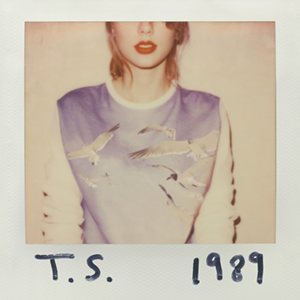
“If you chase two rabbits,” Swift told USAToday, “at some point you end up losing both.” By rabbits she means commercial markets, and for her maximizing revenues requires an allegiance to the larger bunny, pop, as her jilted country fans hop away. “I needed to pick a lane,” Swift said, criticizing her 2012 album, Red, because it featured “mandolin on one track, then a dubstep bass drop on the next song. You’re kind of thinking are these really on the same album?” So her new album, 1989, chases pop fans straight down the “80s synth-pop” lane. This, according to one of her collaborators, is evidence of Swift “relentlessly pushing herself to be unafraid of taking chances.”

Now I’m not seriously criticizing USAToday for its lack of cutting-edge journalism. The Taylor Swift article is an advertisement, and the soundbites are her corporate interests talking. Mixing mandolin and dubstep was taking a chance, the dubstep half of the album yielded Swift’s first No. 1 single, and so now she is “unafraid” to solidify that pop base. Even the year 1989 signals risk aversion. By the late the 80s, the pleasant chaos of the New Wave upheaval had been absorbed into predictable pop formulas. Devo and the Talking Heads had devolved into the Bangles and Tear for Fears.

Swift’s one-rabbit approach also runs counter to some of the best mandolin-dubstep fiction of the 80s. Margaret Atwood, then an acclaimed novelist of the purely narrative realism mode, published her first speculative novel, The Handmaid’s Tale, in 1985. Toni Morrison won the 1988 Pulitzer for chasing those same two rabbits, speculative and realism, with Beloved, a literary horror novel. And Alan Moore and Dave Gibbons’ Watchmen put comic books on the literary map for the first time in the 80s too. Superheroes, ghosts, dystopic futures–you’re kind of thinking are these really in the same genre?

Jon Caramanica in his New York Times rave of Swift’s new album provides one of the best working definitions of genre I’ve seen in a while: “It’s a box, and a porous one, but a box all the same.” Caramanica also calls calls 21st century pop “overtly hybrid” and country a “hospitable host body,” one that the body-snatching alien Swift has sucked dry and discarded. That’s a lot of genre metaphors to juggle at once, so I’m going to stick with cars and rodents for now. Despite Swift’s relentless push down the pop lane, the 21st century literary highway has seen some major additions to the two-rabbit playlist. My course, 21st Century North American Fiction (I know, not as catchy as any of Swift’s titles) features a list of authors straddling “literary” (meaning “artful,” not “set in the real world”) and “genre” (any of those formerly lowbrow pulp categories of scifi, fantasy, horror, mystery, romance, etc.).
 

41aiP5NNF4L._SY344_BO1,204,203,200_

 
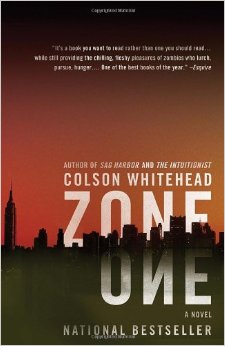
At first it sounds like a marketing wet dream: combine two genres and double your audience. You like zombies? You like literary fiction? We’ll you’re going to love Colson Whitehead’s literary zombie novel, Zone One! But instead of bringing two diverse readerships together, a two-rabbit novel often appeals only to that sliver-thin, Venn diagram cross-section of readers willing to straddle both categories. Instead of expanding your audience, the mandolin-dubstep approach can decimate it.

Before assigning Zone One to my students, I tried to get my book club to read it, but one of our group’s economics professors (we have two) despised it. In addition to his expertise in business, Professor MacDermott is a zombie aficionado (which has also resulted in our forming a Zombie Club splinter group). I asked him to write up his critique of Whitehead for my class:

“While it may have some literary merits, I don’t read zombie books for literary anything. Contrary to just about everyone’s opinion, the book did not strike me as terribly well written (unless well written = slog). I saw one review that said the “language zings and soars.” Criminy – that’s heavy handed. Perhaps I am a bit of a grunt when it comes to ‘good writing’ but I didn’t see it. The biggest knock against it in my mind is that very little happens and what does happen is all over the place. Most of the zombie / dystopian books I have read (and that is a shamefully large number) are stuffed with action … probably too much. This one had very little. . . .  So, I guess in the end my recommendation would be to not read this book because while some may find the writing compelling, there is not much of a story (yeah … blah blah blah social commentary … blah blah blah). I took a look at the reviews in Amazon and found I agreed with several of the 1-star reviews (those written by the troglodytes).”

In the end, he likened it to handing The Iliad to someone because they said they liked war books. “That,” he said, “is what it is like to hand Zone One to a zombie-phile.”

So much for droves of zombie fans flocking to Whitehead. And many literary readers are equally repulsed. Shenandoah recently published a Noir issue, opening the door to a blog discussion of the relative merits of genre and literary fiction and their hybrid love children. Editor R. T. Smith drew a line in the literary sand:

“Hard-boiled, thriller, mystery, crime – following the spoor of these labels will draw an investigator into the territory where I think noir simmers. It’s a somewhat different direction from super powers, paranormal events, zombies, weredogs, closet monsters, witches, alien storm troopers, time travelers. These are terms more likely to lead away from my noir zone, where characters who metamorphose don’t grow fangs, fly away, deflect bullets or sport tails with stingers. The gumshoe’s revolver may somehow fire eight rounds without being re-loaded, but it doesn’t spew bats or emulsify anyone. Neither physics nor metaphysics are problematized, though the emphasis may be on aesthetics and ethics. It’s an old personal preference – naturalism over supernaturalism, physics and metaphysics over hocus-pocus and the “black box” – a question of conventions and confidence.”

Poet and historical-mystery author Sarah Kennedy articulated the anti-zombie stance too:

“For me, the problem with a great deal of literature about monsters and other non-human characters is that they become formulaic or silly in their attempts to prove that they’re doing something “serious” when in fact they’re just retailing the old conventions. Zombies are horrible looking and they eat human flesh. Even if a writer gives a zombie a science-fiction virus or (ick) a heart of gold, the character is still going to have all the signs of the formula: scary, grisly-looking, flesh-eating. It’s probably going to walk a bit oddly (what with those bits and pieces falling off). It’s going to be hard ever to convince me to take that seriously.”

And this includes Whitehead’s cross-bred literary zombies: “I have tried Zone One but frankly found it both pretentious and tedious and couldn’t finish. There is no story there, at least not one that engaged me.”

Kennedy’s and MacDermott’s definitions of “story” may be opposites, but neither was satisfied by Whitehead’s mandolin and/or dubstep skills. Trying to satisfy both can mean satisfying neither. And it’s not just literary zombies getting run down by one-lane readers.
 

jane

 
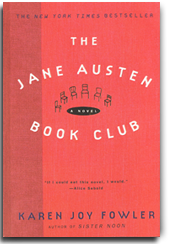
My class is also studying Karen Joy Fowler’s The Jane Austen Book Club, a literary novel that rode the “chicklit” wave up the best-seller charts in 2004. Despite Fowler’s winning the 2014 PEN/Faulkner (an award controversially denied Morrison’s Beloved), her novel still carries a non-literary taint. My department’s Austen expert hasn’t read it and looked at me suspiciously when I suggested she might. Another colleague, Professor Pickett, observed one of my classes for my tenure review and wrote in her evaluation afterwards:

“I had specifically asked Chris if I could observe a class devoted to this particular novel, both because I had started reading it myself over the summer and also because (as a result) I was curious about how he would handle the challenge of teaching a book I would unthinkingly have assigned to my own idiosyncratic genre of “airport bookstore” novel–one “light” enough to read in a distracting environment but “respectable” enough not to be embarrassed if caught reading–basically trade paperbacks for the 30-something female.”

Even my students are wary of the novel. One, Libby Hayhurst, wrote in a homework response:

“this is by far the most entertaining book we’ve read, which makes me instantly mistrustful. While literary fiction can entertain, this is surely not its point. I have found myself reading this book only enjoying the plot and the characters, and without the desire to even take a stab at the deeper meaning . . . I am not sure the Jane Austen Book Club falls under ‘literary fiction’ (although I AM hesitating, but is this just because I’m reading it in an English course?).”

This despite Michael Chabon opening the course with his appeal:

“Entertainment has a bad name. People learn to mistrust it and even revile it. . . . Yet entertainment—as I define it, pleasure and all—remains the only sure means we have of bridging, or at least of feeling as if we have bridged, the gulf of consciousness that separates each of from everybody else. The best response to those who would cheapen and exploit it is not to disparage or repudiate but to reclaim entertainment as a job fit for artists and for audiences, a two-way exchange of attention, experience, and the universal hunger for connection.”

Personally I don’t find Taylor Swift entertaining, but I am entertained by plenty of popular and non-popular music. I don’t have a problem with Swift, just her claim to chance-taking and her repudiation of albums that appeal to more than one kind of rodent. Mandolin-strumming and dubstep-dancing rabbits are more than roadkill on opposing lanes of entertainment traffic. I hope 1989 isn’t our only future.
 

Taylor_Swift_-_1989

Teaching the Invasion of Iraq 11 Years Out

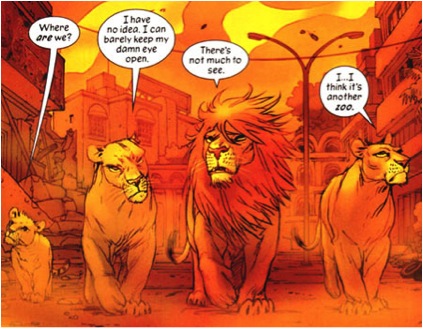
What people forget, of course, when they’re confronted with a graphic novel about four lions who look suspiciously like the characters in Disney’s The Lion King is that Pride of Baghdad is indeed based on a true story. It is a comic relatively free of humans, following four lions who escape from the Baghdad Zoo after the initial U.S. bombing campaign, tracing how they evolve in their understandings of freedom, place, and community. Their escape is a surprise (they are released when U.S. bombs blow apart their cages), but each lion reacts to this new-found freedom differently. Noor is delighted—she has been planning an escape for months—but worries that freedom that one doesn’t work for isn’t truly freedom. Safa, on the other hand, was a victim of gang-rape while she was still in the wild, and has no interest in returning to the chaos she perceives as reigning beyond the walls of the zoo. Zill, while he tells nostalgic stories about the sunrises in the wild, largely seems ambivalent about the prospect of freedom; he would like more control, but he also likes being fed regularly. Ali, the cub, is largely unaffected as well. What follows is how I approach explaining to students the relative use of Pride of Baghdad in understanding the variety of positions one may take in regards to the Iraq War.

polak1

Zill and Noor both long to return to the freedom they had as cubs, although they approach this in different ways. While Zill indulges in nostalgia, he doesn’t seek freedom, and their liberation seems barely to affect his attitude. Noor, on the other hand, is actively attempting to craft an escape plan. However, once they are free, Noor shows herself to be capable as a huntress, but is psychologically ill-prepared for freedom. Safa, unlike the other two adult lions, appreciates the zoo for the safety and consistency it provides. After the escape, Safa adapts back to the unpredictability of the larger world swiftly, but she is physically no longer capable of being the huntress she once was.

Each lion approaches the question of freedom from a different angle. Noor, while still inside of the zoo, thinks primarily of the physical bars on the cages as limitations on her freedom. For her, liberty is freedom of movement. Safa, in contrast, does not see freedom in terms of the ability to make choices about where she is. Liberty for Safa is defined by safety from outside threat. She sees the cages as protection, and a regular feeding schedule as safety. 

For example, Safa could represent “staying at home” (i.e. staying out of foreign wars) as a preferable political stance. However, she could also represent the idea that safety can only occur with the sacrifice of certain liberties. Furthermore, she could represent a recognition of the negative potential for foreign intervention, but through her actions, she nonetheless intervenes for the good of her pride.

When I teach Pride of Baghdad, I first approach it considering who the lions represent.

It’s worth considering how they might connect to Iraqi civilians. America was the force that came into the country. Saddam was a brutal dictator. However, under his leadership, there was relative peace and stability for the vast majority of Iraqi civilians. They may or may not have liked living under his regime, but they were relatively safe from threat—unless, of course, you were unlucky enough to draw Saddam’s attention or to be a member of a religious sect or ethnic group he despised.

Consider the lion that Safa and Noor find in the palace. In this scene, we see the lion in his death throes, wasting away while chained within a palatial estate. We of course come to find out that the bear had been stealing his food, but the bear isn’t the only bad guy here. What was removed from that lion that was a part of him?

Teeth and claws—the vehicles of a sort of natural violence, evolved in order to survive, to fight and to eat prey. The chain isn’t the only thing holding him to the wall. The chain signifies something much more basic that has been stripped from him: the right to feed himself and to defend himself. His calls for his Master, the man who did this to him (presumably Saddam or one of his sons), gestures towards the extent to which a dictatorship may remove the most basic freedoms from its citizenry in the name of a particular version of safety.

Noor is immediately willing to hypothesize that this is indeed the end result of their captivity: the removal of the ability to live without the master. Safa, however, emphasizes the distinction between the compassion that the keepers showed and the brutality with which this animal was treated.

But how do we understand the bear’s interruption here? “Ungrateful whores,” he says. What is a whore? Why would this particular insult be used? The bear draws a relationship between this insult and the distinction between a prisoner and a pet. His name, “fajer,” is probably a corruption of “fajr,” which means “dawn,” but also has a related term that means “whore.” Why would the bear have been allowed to keep his teeth and claws when they were removed from the lion? Think in relation to expressions of capriciousness, the whim of the master as a guiding principle, rather than a stable set of laws by which one abides.

In relation to Pride of Baghdad, the value most clearly explicated is freedom, but what does freedom mean in the context of war?

On the other hand, the lions could represent American civilians’ debates in the lead-up to the war. It’s worth thinking about the pro- and anti-war camps in relation to Safa, Noor, and Zill. When is Safa violent? When she is convinced that her family is under threat. Safa is mostly concerned with maintaining her own safety, particularly because of her past. However, she doesn’t shy away from the prospect of protecting those who are weaker. Safa can be regarded as a stand-in for the American public—horrified and traumatized by 9/11, needing to reassert control over their own bodies and on the world stage.

That said, Noor, our revolutionary who wanted nothing more than freedom, finds that to a great extent, the boundaries of the zoo are not that dissimilar to the boundaries of life in the wasteland of a bombed city. No freedom exists without responsibility and without personal sacrifice of safety. In the aftermath of 9/11, the Patriot Act and other legal frameworks were established to “protect” American citizens, but did nothing so much as create a transparent cage.

When is Zill violent? Consider the page in which he attacks the bear—distinction between a hunter and a fighter. Hunting, as “women’s work” within the pride, denotes a division of labor. Hunting isn’t perceived as violence, but rather as the procurement of food—a simple necessity. Fighting is violence, but it also springs out of necessity for Zill, in reference to defending the females from the bear.

Of course, when we’re considering the causes for violence, we have to consider how we justify violence within our own lives. What is a “justified use of force”?

In general, we think of violence as being justified when it serves to protect. Violence used in the service of protecting the self or another is seen almost universally as a moral exertion of force. This leads us into the question of what constitutes a “just war.” Just wars are based on a set of criteria that must be established to prompt particular action, including a cause celebré of the protection of the self (the nation) or the protection of a significantly weaker force. Just war may be employed only when other avenues have been exhausted. Of course, a part of what this means is the protection of the ideals and values by which we live, and the ideals and values we believe are basic human rights.

Fables are remembered because they filter into our consciousness and give us a series of rules to follow. However, Pride of Baghdad takes the structure of a fable and breaks down the possibility of a particular rule. The lions are killed at the end. This would seem to suggest that, given our sympathetic engagement with the lions throughout the text, that the invasion was wrong, and that we should feel angry at our government for invading. But precisely what do we encounter along the way to that final scene that complicates our understanding?

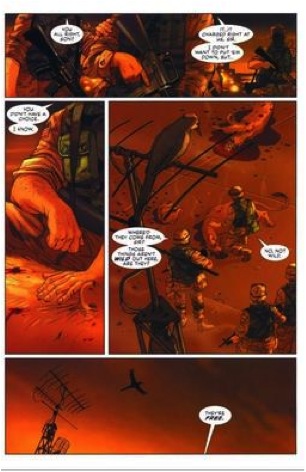
When the lions are freed from the zoo, is that not (aside from Safa), what they most desire? Who frees them from the zoo? American bombs. Bombs, for Vaughan and Henrichon, have at least as much power to liberate as they do to destroy. However, the final scene shows a fundamental misunderstanding by the troops of the lions. Zill is simply sitting there, watching the horizon with his family, until he is suddenly killed.

The pride’s reaction is very understandable. They turn in anger at the enemy who has suddenly shattered this moment of calm. In the scene following the lions’ deaths, what don’t we see? Faces.

polak2


When you have an icon, the more abstracted it is from reality, the more opportunity you have to identify with it. The flag and the faceless soldiers both are icons through which we’re meant to identify—these are our troops, this is our war. When the soldier stutters that “It…it charged right at us, sir. I didn’t want to put ‘em down, but…” we may feel angry, or we may have a surge of sympathy for the young man suddenly thrust into the position of shooting these animals; we may feel his fear and confusion.

In regards to this, I also think of the lions. When we look at the lions, we see ourselves—they are mimicries of humanity —adjacent to us, but not precisely like us. They are like the Iraqi civilians, but so much closer to our experience through this metaphoric lens. While they have a different perception of the world based on their culture and their expectations about how the world works, they’re still excruciatingly present in their deaths, in a way that most casualties of war are not. When we look at a photograph of a crying mother or a dead man, we see them. But when we look through the prism of the fable, we see us. And in this reflection of ourselves, we see no easy answers as to right and wrong.

Only Connect

Before I read The Hospital Suite, I was only vaguely aware of John Porcellino as a sort of folk hero. He packed up and left Chicago near the turn of the century (around the time I moved here myself), and some 15 years on still seems to be the patron saint of comics in this city, or maybe the Midwest in general. Cartoonist laureate of a Carl Sandburg poem. Any place where folks work hard and make the best of it.

Paul Bunyan had an ox. John Porcellino, a cat. Her name was Maisie. She’s been memorialized in no less than three Sufjan Stevens songs—more if you count the b-sides. I recently learned that a cabal of suburban mail carriers named her a minor deity. They want to get her on a stamp. They say that on clear winter days, at first light, you can feel the spirit of the cat making copies of out-of-print comics at the Wicker Park Kinko’s. I met some guy at Quimby’s who claims he communed with her there. Three beers in he admitted she had to correct his pronunciation of Kukoc.

I don’t know, I guess you read comics. You probably know the lore. But all I really knew up until I read The Hospital Suite was that Porcellino has a pure punk heart and a 90s-era webstore, and I confess that my more cynical side wondered if that wasn’t, on some level, super fucking ridiculous. I’d like to be the kind of person who buys mail-order zines, but the truth of my life is that I read celebrity gossip magazines and persist in ordering almost everything from Amazon even though I know it’s evil. I truly wish I cared.

In any case, I’m grateful to the good people at Drawn & Quarterly for publishing this work in a format that feels accessible to jerks like me. While I could see Porcellino’s appeal from page one, there were moments early on when I worried The Hospital Suite was another “good patient” story. I also found the current of what I’d reluctantly call spiritual comics to be a bit much—not a deal breaker, but always off-putting. (I love Ron Regé Jr, but there is no plane to which I could ascend where I would be inured to the hilarity of his wizard robe.) Slowly, though, it dawned on me that I was reading something rare and real and special, and not at all ridiculous, and by the end of The Hospital Suite I felt for Porcellino a sort of affection that is a rare sensation in reading comics, or really all of literature, or maybe life. I’d compare it to how I feel about David Foster Wallace or Lynda Barry. I mean to say he shines a light.
 

JP_1

 
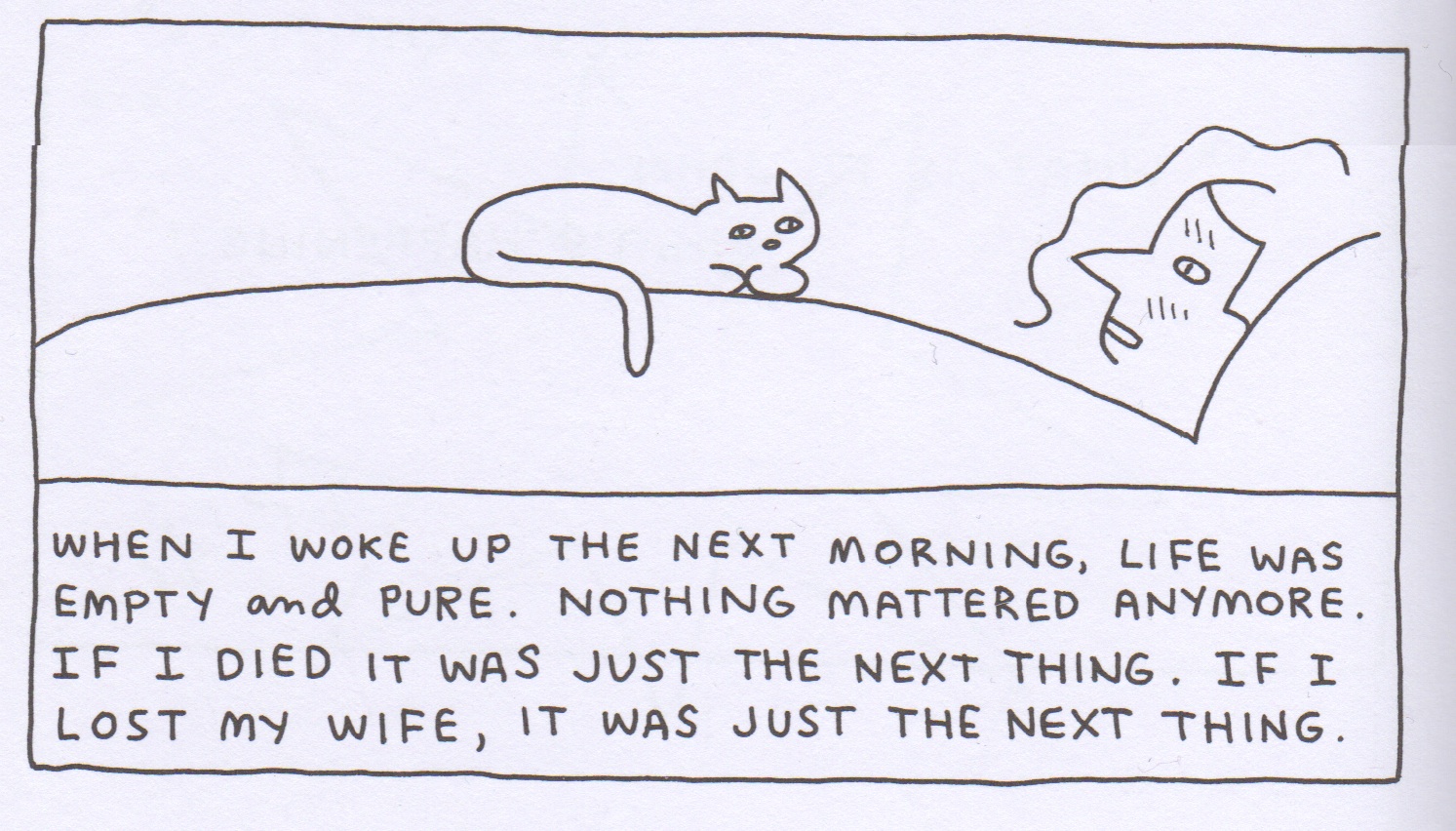
Autobio is a crowded category, not just in its number of practitioners but also in its sensibility. It’s often a jaundiced genre—frenetic, claustrophobic, uncomfortable. Neurotic. Obsessive. Tortured. Overwrought. Within The Hospital Suite, there are traces of all the classic themes: ambivalence toward the responsibilities of adulthood, depression, masturbation, being broke. The chief difference is, despite a grueling fight for his life and nigh on a decade’s worth of catastrophic diarrhea, John Porcellino somehow seems to be the least miserable bastard in comics. Of course—and this is critical—he’s not quite happy, either. He’s something else. And whatever you want to call it, it’s a breath of fresh air.

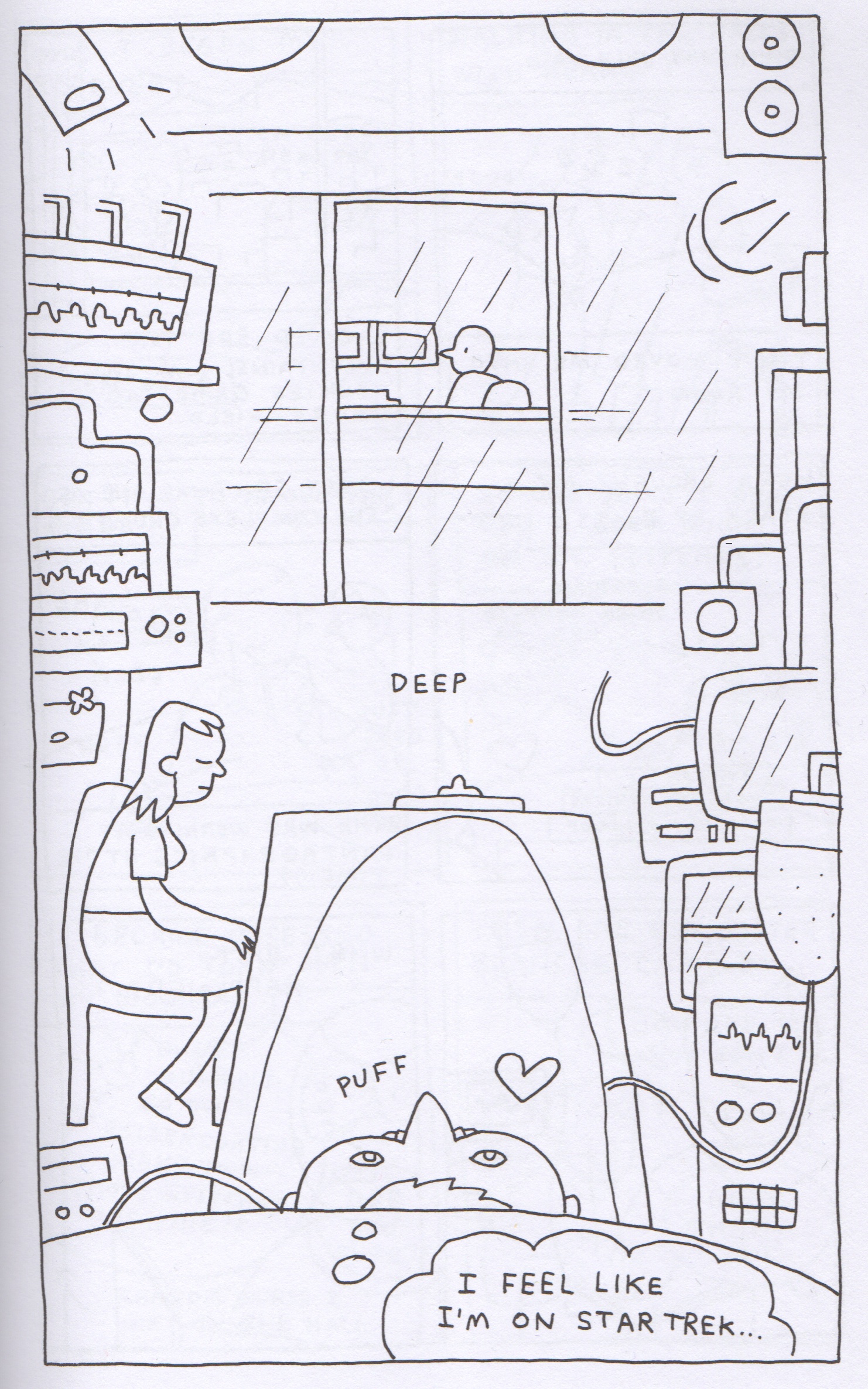
There is a palpable sense of calm conveyed by Porcellino’s simple aesthetic. I gather that’s just how he draws, but it suits the subject matter here very well, offsetting the intense distress he depicts throughout The Hospital Suite. I’ve heard him say that his drawing is sometimes referred to as bad. I find that astonishing, but it certainly sounds like something my dad would say. Of course anyone who has aspired to minimalism in any area of life, artistic or otherwise, will recognize the sophistication required to draw stripped-down pictures like these. It’s advanced iconography—a very high level of graphic design—and that Porcellino manages to pack so much charm into drawings this spare is remarkable, if not unheard of (cf. Allie Brosh). Occasionally he flashes his chops in a cool composition, like this scene from his sickbed that captures the whole Starship Enterprise vibe of being in the hospital.
 

JP_3

 
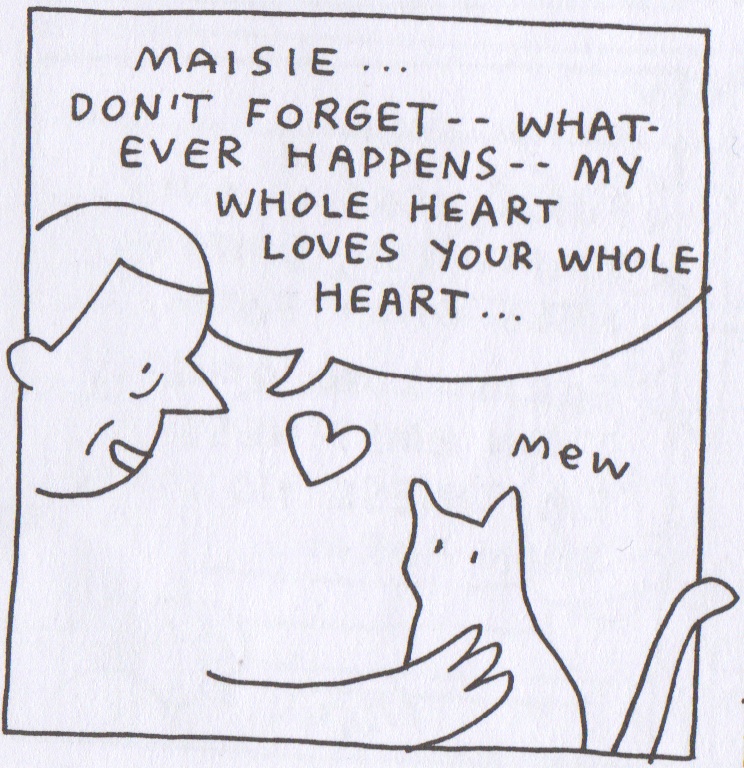
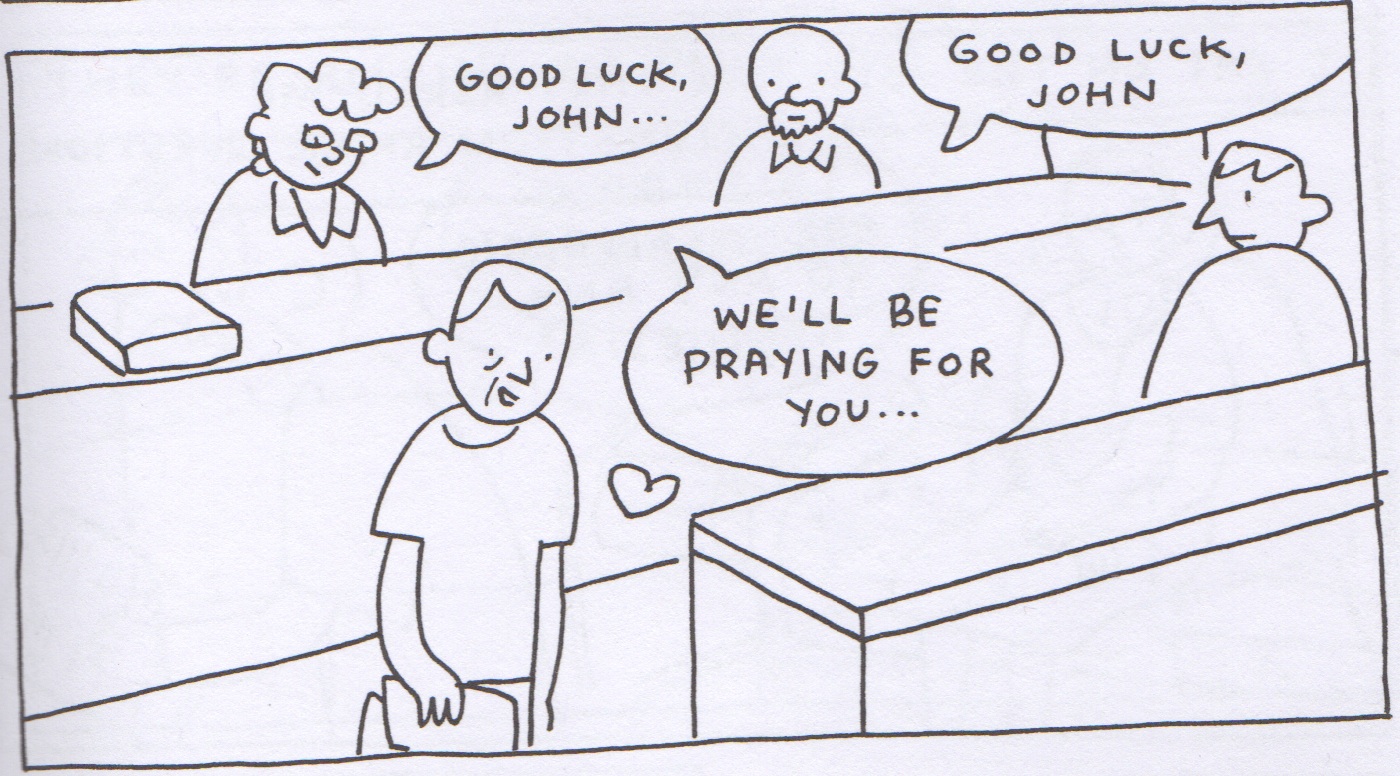
But I think Porcellino is at his best when he keeps things simple. He has developed an idiosyncratic shorthand to convey outsized feelings—the good, the bad, and even the ineffable. Probably my favorite thing about the book is the little hearts he draws to convey all the love he feels in the universe. He seems to tap into it almost everywhere, including the post office.
 

JP_2

 
Reader, I don’t know about you, but this does not even remotely resemble any interaction I’ve ever had with USPS.
 

JP_7

 
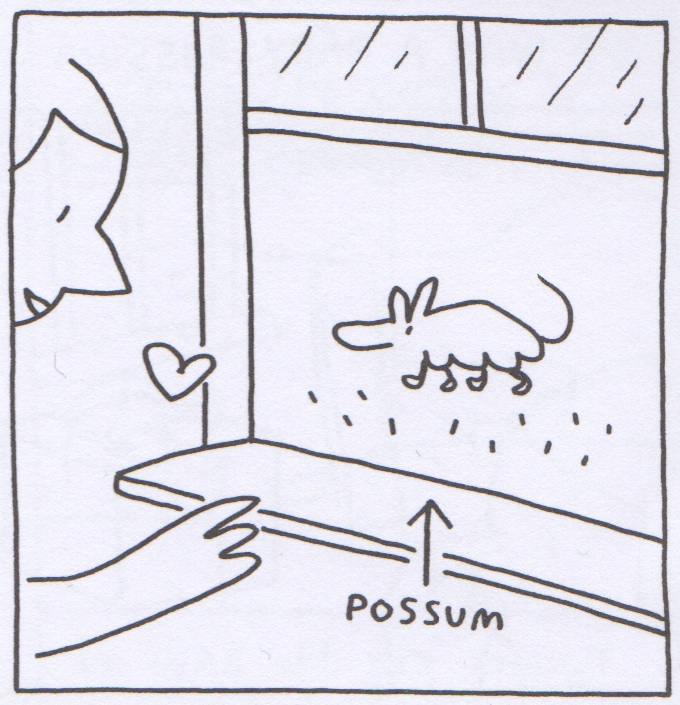
Or possums?     ~~oO{:>     ……..(/*o*/)

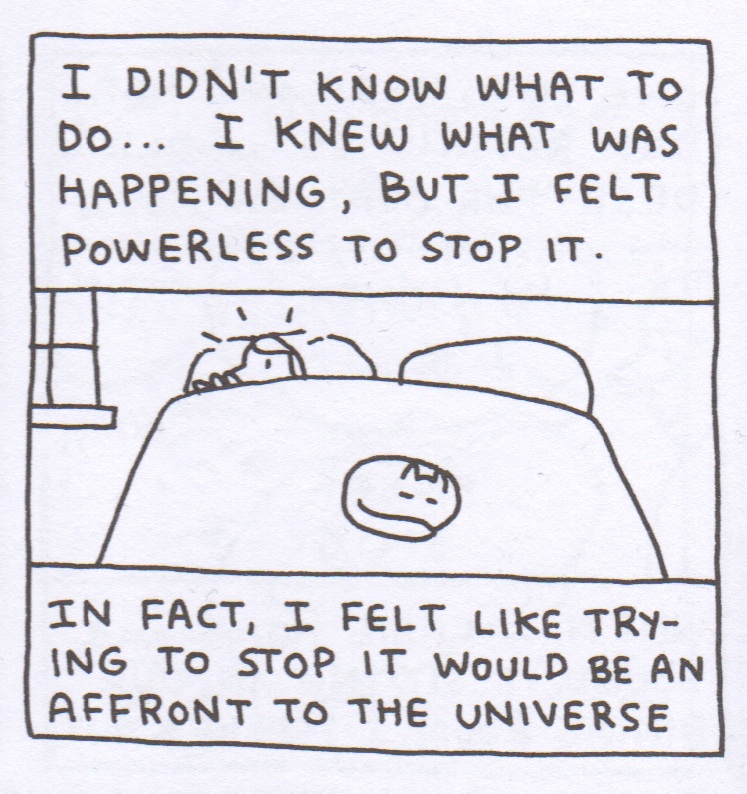
Structurally, The Hospital Suite isn’t quite sound. On one hand, Porcellino does an excellent job of distilling a narrative from an incredibly complex system of mental and physical illnesses that span a long period of time. On the other, we have the book’s clumsy division into three distinct, but overlapping, sections, plus several wholly unnecessary appendices. The central paradox of Porcellino is that his stories are very processed—aggressively reduced and refined—but feel entirely organic. Untouched. In sharp contrast, the section breaks feel artificial and distracting, and it messes with the magic just a little. One of the advantages of comics as a medium is the ease with which they can accommodate more than one timeline. These stories should have been stitched together with more care.

Overarching the structural concerns is the book’s lack of dramatic tension; the terror of the Mystery Illness is offset by the reader’s sure knowledge that Porcellino did in fact survive this experience. Even when emotions run high, the stakes feel low. Some stories are so engrossing that you feel “worried” even when you know the outcome, but The Hospital Suite never quite manages to transcend its own inevitability. I don’t know, it might be unfair to expect a Zen Buddhist to ratchet up the drama.

Admittedly, this is where we brush up against my limitations as a critic: the places in the text where I wondered if its “deficiencies” were areas in which there was real room for improvement, or just a different way of looking at the world. Often I admire Porcellino’s clear perspective. (Even when he’s talking about the shame spirals of obsessive-compulsive disorder, his gaze is cool and level.) But sometimes I get the sense that he simply hasn’t done the hard work of what Justin Green has described as presenting the self as a “specimen.” The world of The Hospital Suite is a place in which things happen to John Porcellino. There is no real sense that he assumes any agency in life.
 

JP_6

 
Whether that lack of agency is a personal problem, a spiritual belief, or a syndrome borne of years coping with a debilitating, unpredictable illness is difficult to discern. (Maybe it’s all of those things.) I’ve read that the events in The Hospital Suite span two divorces and three relationships—something that wasn’t quite clear to me from reading the book. It’s understandable that Porcellino didn’t want to delve into the particulars; these are real women in the world, after all, and in some ways the dissolution of those relationships seems tangential to the story he’s trying to tell. But I found myself giving him the side eye, hard, in some of the sequences about his first wife.
 

JP_4a

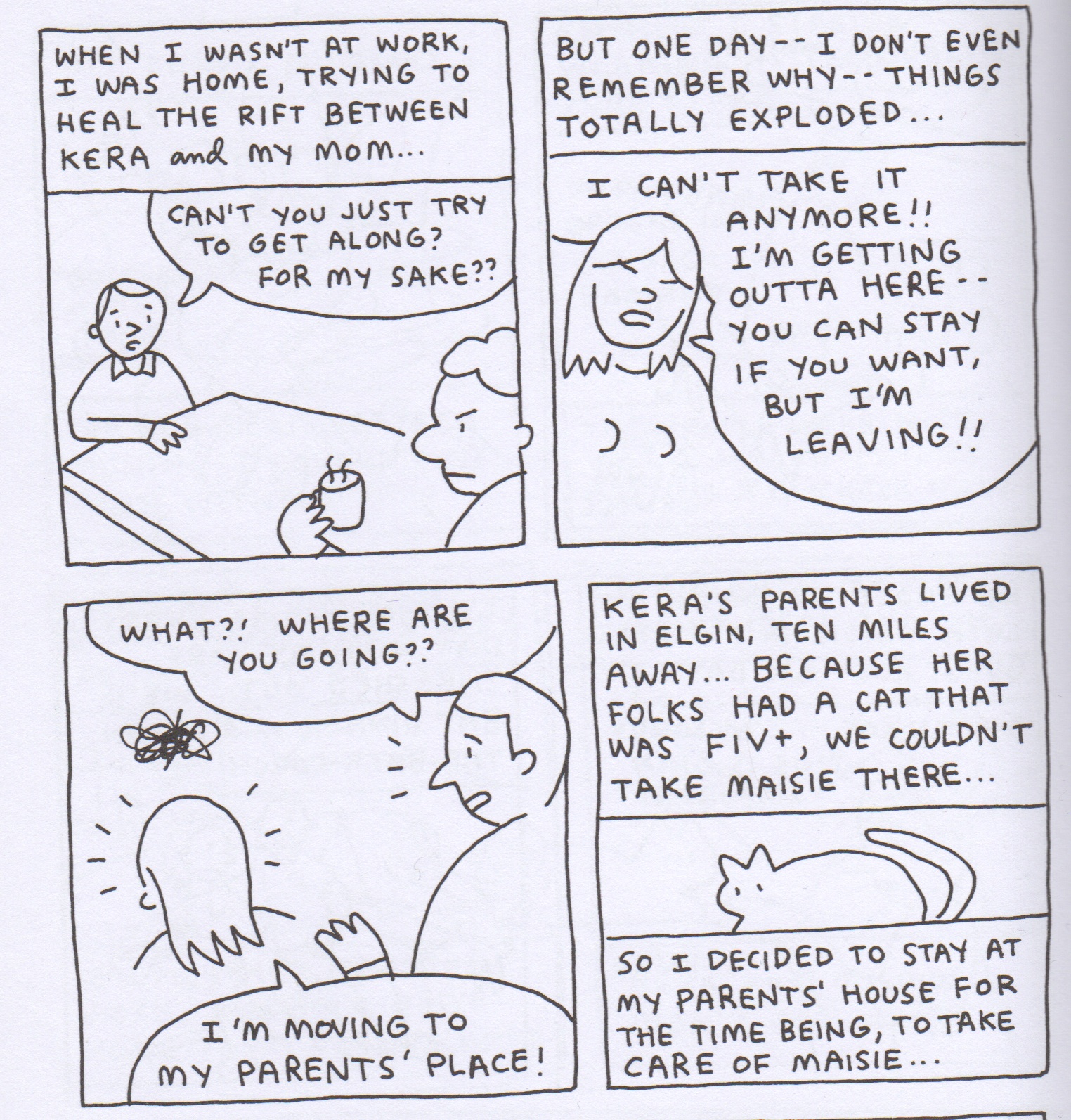
I wonder if, as an autobiographer, the decision to do what was best for his cat instead of his relationship was something that Porcellino could have delved into more deeply.
 

JP_5

 
But no one’s perfect, you know? And as much as I love autobiographical comics, they tend to celebrate imperfection in a way that’s slyly self-congratulatory. They relish rolling around in the shit. Whatever flaws are in The Hospital Suite, the author seems to come by them without ego or agenda. Which all sounds rather humorless, doesn’t it? He’s very funny, though.
 

JP_8

 
I’m not a spiritual person, or the kind of girl who has easy access to all the love in the universe. Frankly, I’m more disdainful and suspicious of those things than I’d like. As much as I wish I were a special disgruntled snowflake, this perspective is, increasingly, a cultural norm. From the milieu of autobiographical comics to television’s recent obsession with antiheroes, drama isn’t really about Good People right now. It’s hard to make them seem compelling, or even believable. As a creator, it’s all too easy to explore the nuance of being a garbage person. It’s also easy, from a reader’s point of view, to sigh in relief that someone else in the world is just as bad (or, better, worse) than you are.

It’s more difficult and brave, I think, to make art that takes people outside themselves and shows them something larger. More than craft or even sheer likeability, it is that reach that makes John Porcellino’s comics remarkable. It’s a quality I can’t quite hope to convey in these 1,500 words. This is where I’d draw the heart.
 

The Cruellest Batman of Them All

My family is happily watching our way through the newly released Batman TV 60s TV show DVDs; I think we’re up to 14 out of 120 episodes now.

For the most part the Batman TV show is remembered as goofy fun — and goofy fun it is. But the first two episodes (with Frank Gorshin’s Riddler as the villain) are unexpectedly…not dark exactly, and not grim, but cruel in a way that’s all the more shocking for being casually off-hand.

A couple of times in the show, Bruce Wayne, with little prompting, segues into a discussion of his murdered parents. It’s presented as pro-forma and, with Adam West’s tongue-in-cheek delivery, as fairly ridiculous. The show essentially sneers at murder and childhood trauma; they’re presented as ridiculous.

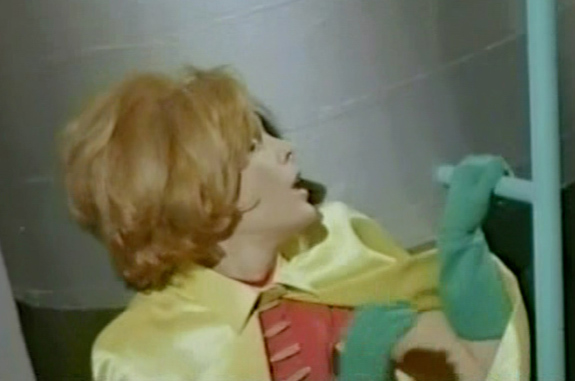
Even more egregious is the fate of the Riddler’s girlfriend, Molly (Jill St. John). Molly dresses up as Robin (insert disquisition on camp here) and tricks Batman into letting her into the Batcave. She then runs up to the atomic pile that powers the cave. Batman begs her to come down, but she mutters vaguely about being scared, and, overacting all the while, spins, staggers, and falls into the reactor even though Batman is standing like a foot away from her holding out his hand. Batman mutters something regretful about how he wishes he could have saved her (“Poor deluded child!”), and the show barrels on cheerfully. Molly’s death, like the Wayne’s, is viewed as a joke. Batman’s traumatic backstory and the tragic death of the villainness are both portrayed as glib narrative heart tuggers — cynical melodramatic boilerplate.
 

BatTV-SC-S1E02-Molly-68

 
The rest of the shows I’ve seen so far don’t engage in this kind of sneering; it seems like an early tonal blip. It’s interesting just how jarring that blip is, though. Grim and gritty in genre is usually seen as brutal, or tough — blood on the Batglove is a sign of unflinching viciousness, as is shooting Batgirl in the stomach. But I think in a lot of ways the Adam West Batman is actually meaner than Frank Miller or Alan Moore. Those guys took violence seriously, they treated bloodshed with reverence, at least in the sense that bloodshed was important to them and meaningful in their writing. But for the 60s Batman, violent, hideous death is just a punch line. Or maybe after all the 60s Batman just shows that violence in Batman is never anything but a punch line; in its cynicism, it reveals the callow cynicism of all that grim and gritty violence that. How many times can you shoot Bruce Wayne’s parents before you start to feel like Bat-trauma is just another disposable Bat-product?

Utilitarian Review 11/22/14

On HU

On Thai pop singer Pamela Bowden and why the world’s too big for best of lists.

I concluded our roundtable on the Best Band No One Has Ever Heard Of with a discussion of why some music (and some roundtables) aren’t popular.

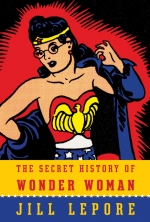
I argued that the secrets in Jill Lepore’s Wonder Woman history aren’t actually secrets.

Chris Gavaler on the history of transsexual supervillainy.

Jared Hill on Arthur C. Clarke, prognosticator.

Roy T. Cook wonders if a Batman comic in color is a different comic from the same(?) Batman comic in black and white

Kailyn Kent on how absurdity becomes conservatism in the film Snowpiercer.
 
Utilitarians Everywhere

At the Atlantic:

—I reported on We Charge Genocide how Chicago’s human rights violations were presented to the UN.

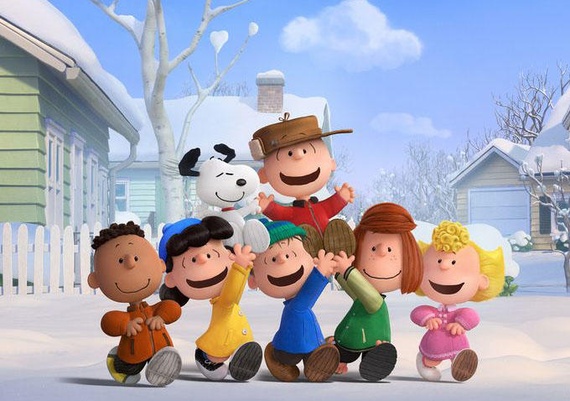
—I said that the new Peanuts film looks like cheery, ugly crap.

— I interviewed Martin Paul Eve about open access to academic work in the humanities.

At Comic Book Resources I argued that diveristy is a superhero tradition.

At the LA Review of Books I wrote about Sergei Lukyanenko’s The Genome and how the fault is in our genre, not our genome.

I got interviewed on the Irish pop culture show the Green Room about spoilers. (I’m towards the beginning of the hour.

At Splice Today

— I interviewed the wonderful psychedelic soul musician Jordannah Elizabeth.

— I point out that Hillary Clinton is really popular and is almost certainly going to win the Democratic nomination.

— I make fun of Paul Krugman’s pop culture writing.
 
Other Links

Laura Hudson with a fantastic piece on Twine and diversity in video games.

Greg Hunter takes down Fukitor at tcj; nice exercise in biting the hand.

Imran Siddiquee on how teen dystopias imagine everything getting worse except racism and sexism.

Emily Witt on Laura Kipnis’ bad book about men behaving badly.
 

lead

Peter Sattler on Jill Lepore’s Wonder Woman

lepore_wonder_woman_coverEarlier this week Jeet Heer and I had a long conversation about Jill Lepore’s Wonder Woman and it’s strengths and weaknesses. Comics scholar Peter Sattler weighed in with a long comment, which I thought I’d highlight here.

Just finished the book, Noah, and I hope you won’t mind if I use this as a place to write a few thoughts, which I think intersect with your conversation.

1. Lepore’s lack of engagement with more current Wonder Woman scholarship, at least in her notes, is striking, especially considering her attention to far more recent writings on such figures as Wertham (e.g., Beaty, Tilley). Nonetheless, I think that Jeet’s genre-based point speaks a bit to this: Lepore is not invested in the “secrets” of today, as much as the secrets of yesterday — the past that ends mainly with her narrative, in the 1970s.

2. That said, I take Noah’s point about how the issues of queer identities — and even the practices of queer life in mid-century America — is barely a topic for this book. Lepore actually spends little time talking about sex, sexuality, or theories of same (Marston’s or otherwise). Dramatically more space is given over to issue of suffrage, to the economics and power dynamics of women’s work, to the lie detector and its place in the juridical-military system, and to the shitty way that women are treated by men. The material on sexuality is there, but hardly dwelt on or analyzed. Indeed, with its New Age and Aquarian designations, Marston’s ideas about love and submission as much an object of fun as anything else.

3. But to be clear, the lack of a “queer” history or theoretical context is certainly intentional and not an oversight. The “secret history” of Wonder Woman, for Lepore, is not a secret of sex or love or the closet; it is a secret history of politics. It is a story of the deep roots of feminism: it’s about the fight for women’s rights. (Even the discussion of chains, for example, focuses far more explicitly on its ties to feminist imagery than to kink.) And the book’s commitment is to tracing those roots as thoroughly as possible. An alternate title might have been “the political origins of Wonder Woman.”

4. Pace Noah, I don’t think Lepore does much to privilege her own or her reader’s sleuthing skills. Unlike her New Yorker article, Lepore never puts herself into this story, trying desperately to break through the walls of silence. The “secret” framing — just like the academic framing — is actually pretty thin. It’s the intersection of documents and stories in the middle that counts.

5. When it comes to the “waves of feminism,” Lepore both wants and does not want to make the argument that seems to be promised. She definitely has a passage on the forgetfulness of the radical wing of the second wave, with Shulamith Firestone visiting Alice Paul and not being able to identify portraits of the nation’s most famous feminists (and the Red Stocking’s hatred of Wonder Woman). And she then paints post-Roe feminism as a process of in-fighting, with people trying to out-radicalize each other.

At the same time, I think her heart wasn’t really in this: the real story is over, and she seems to be looking for a quick rhetorical punch. As a historian, she’s just not that invested in her New Yorker claim that Wonder Woman is “the missing link” (ha!) chaining the suffrage movement to “the troubled place of feminism a century later.”

6. A telling moment: Lepore tell us that historians have tended to use the “wave” metaphor to imply that nothing much happened in feminism between the 20s and the late 60s. Here is the totality of that argument: “In between, the thinking goes, the waters were still.” The note to this passage, oddly, only refers to writers who have challenged the “wave” metaphor — which Lepore then does herself later, saying we should call it a river. Oddly enough, it is Lepore who then makes the claim that nothing much has happened in feminism between 1973 and today, characterizing the years as a series of generation of women, all eating their own mothers.

7. The book is the most exciting and well-researched piece of scholarship related to comics I have ever read. At the same time, I hesitate to call it “comics scholarship,” per se. And this isn’t simply a matter of guarding the field’s borders, keeping it safe from poachers. THE SECRET HISTORY OF WONDER WOMAN, in the end, just doesn’t seem particularly interested in Wonder Woman comics, Wonder Woman stories, or Wonder Woman art — except as “telling” and glittering superficialities of a much more interesting biographical and historical tale.

She does not spend much time looking at Wonder Woman as an artistic creation, giving shape to particular concepts or exploring certain obsessions. Rather, the links of the comics to history emerge in the book as series of equations, or even one-way vectors: Hugo Münsterberg => Dr Psycho; Appellate Judge Walter McCoy => the stammering Judge Friendly from the comic strip; Progressive Era fights and imagery => Wonder Woman’s fights and imagery; Marston later behavioral troubles with his children => Wonder Woman’s later stories with kids named Don and Olive.

Moreover, these claims are not so much supported as *revealed* — and very briefly revealed, in most cases — like when Lepore parenthetically discloses that Marston had written a story about Wonder Woman and rabbits after talking for a page or so about the pets at Cherry Orchard. Large passages of the book take this form: tell an exciting and detailed story about Marston or Sanger, then close the chapter or section by saying, in essence, “this happen in Wonder Woman too.”

8. This isn’t to say that the book doesn’t change the way we look at Wonder Woman. The comic, after one is done with Lepore, seems to just vibrate with historical energy: the last, unexpected explosion of Progressive Era feminism. But it is not really a book about Wonder Woman; it is a book about Marston and the world of women in which — and out of which — he made his fame.

Marston comes across, in the end, as a classic American charlatan and genius — and a genius due in no small part to his charlatanism. He is a huckster, a relentless self-promoter, an almost unending failure, and even (in my opinion) a misogynist. His heart, politically, is in the right place, but his ego and his loins are often someplace else.

9. Perhaps this makes the biggest secret of Wonder Woman the fact that she ended up existing in a such a potent and coherent form at all, coming as she did from the mind of a man who (after reading Lepore’s account) seems to have been a mass of contradictions, opportunism, and outright absurdity.

Luckily, the book seems to say, the women in his life and his world were strong enough, politically and philosophically, to counteract Marston’s personal weaknesses.

The book’s biggest secret: Women and feminism — not Marston — created Wonder Woman.

Severed From Reality

This piece contains spoilers, although I do not reveal the ending of the movie.

Some stories seem too smart to be symptomatic. Rather than try to suppress or exorcise the fraught, irrational elements that inevitably bubble up through the floorboards, some stories court the absurd directly. This instinct is the one truly smart thing about the movie Snowpiercer, the summer’s critical dark horse, recently released to a very positive reception on Netflix. The world’s audiences and film critics can be forgiven for projecting this intelligence upon the rest of the film, which doesn’t deserve it.

In Snowpiercer, the world’s governments attempt an easy-fix to climate change, releasing a cooling agent into the atmosphere. While this addresses an overly simplistic understanding of ‘global warming,’ (adding particles would enhance the greenhouse effect, if anything,) in the world of Snowpiercer, the cooling agents actually work. In fact, they completely freeze the Earth. The final survivors of humanity exist on a train, reputedly the only shelter designed to withstand the freezing temperatures outside. The train runs nonstop on a track that spans all of the Earth’s continents. Over the course of eighteen years, the original passenger assignments– first class, economy class and stowaways– become abstracted into a brutal caste system. The first class passengers live in a steampunk wonderland of galleria cars, beauty salons, mini mall arcades, swimming pools, greenhouses and aquariums. They worship the train’s inventor and unseen tyrant, Wilford, and the ‘immortal engine’ he tends. The economy passengers are barely seen (perhaps they’ve become the soldier class that oppresses the residents of the tail section?) The tail enders live in a windowless slum in the back, abused and barely subsisting on grotesque, gelatinous protein blocks. People are harvested for mysterious uses by the first class passengers, never to be seen in the tail again. The story follows the uprising of these passengers, who break through to the front of the train, witnessing the extravaganza car by car. Their forward movement mirrors a reel of film itself, the protagonists jumping from cell to cell, from set-piece to set-piece.  Snowpiercer gets to have its cake and eat it too, decrying the excesses of the wealthy while relishing them. Along these lines, its allegories sound smart on paper, yet bamboozle more than they enlighten.
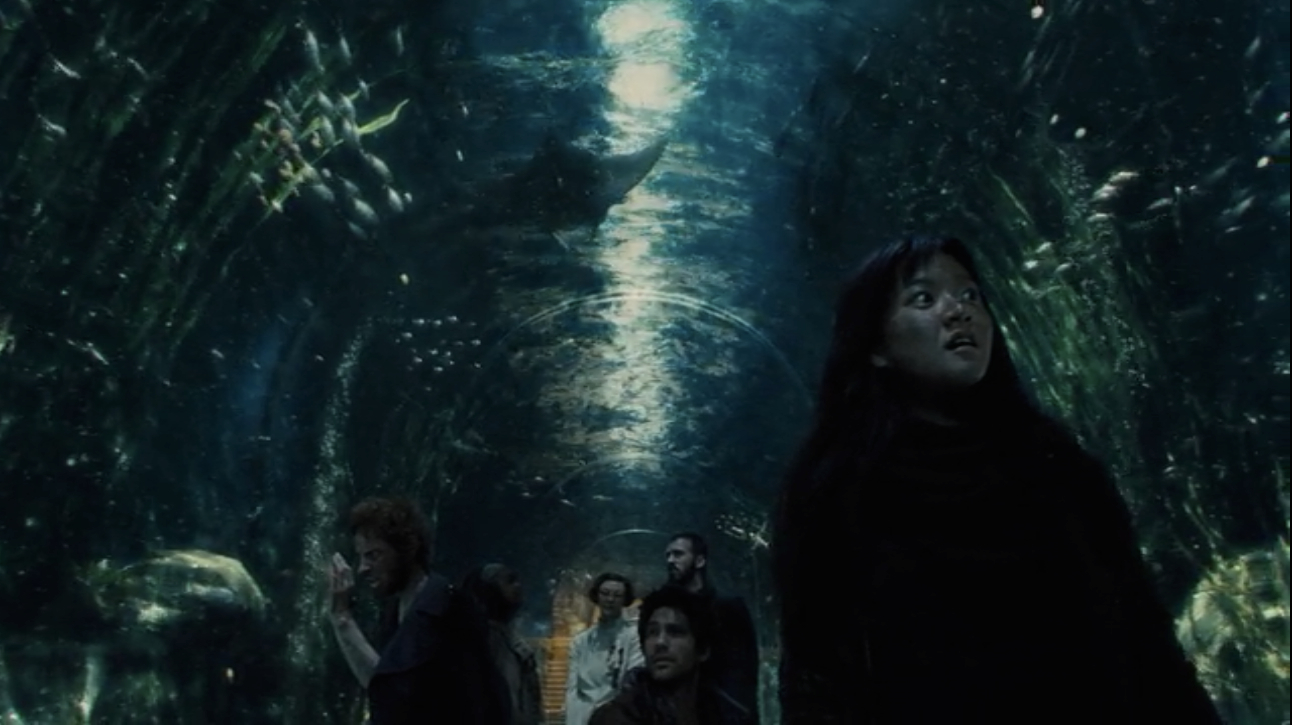
snowpiercer_aquarium2

The fun of the film lies in its rigorous application of the rules of the childhood ‘hot lava’ game, where the threat of ‘instant death’ confines pretend-play to a bed or jungle gym, which can then be re-imagined into a self-sufficient world. It also borrows from the nightmarish joys of Juan José Arreola’s The Switchman, an absurdist satire of the Mexican rail system from 1952. The Switchman smartly excuses itself of having a plot, and revels in its own bizarro world-building. Snowpiercer would have been a better film if it had done the same, perhaps witnessing the train through the eyes of the kidnapped children or violinist, spirited away into the forbidden first-class cars, than from the vantage of the ambitious revolutionary who forces his way into them. Snowpiercer-the-film stems from Snowpiercer-the-comic, yes, but as Ng Suat Tong shows in his earlier essay, Curtis’ rebellion dramatically diverges from Proloff’s misanthropic death-drive, and the film’s uprising is a invention of the director, Bong Joon Ho. Bong follows the accepted Hollywood wisdom that an epic setting deserves an epic storyline, yet to prioritize the absurdity and delicious visuals, this storyline must be kept as a barebones as possible. In the words of Jones of the Jones boys, commenting on Suat’s piece, “The script’s role in an action movie is to get the hell out of the way, and stay there.” I’d argue that Snowpiercer is a rather sloppy, if inventive, action movie: the choreography is unclear, the chain of action and reactions extremely garbled. Its not the action that pushes the script out of the way, but the insistence on dreamlike spectacle. The point is not the axe-fight, but that everyone pauses to celebrate New Years in the middle of it.
snowpiercer_photoshoot

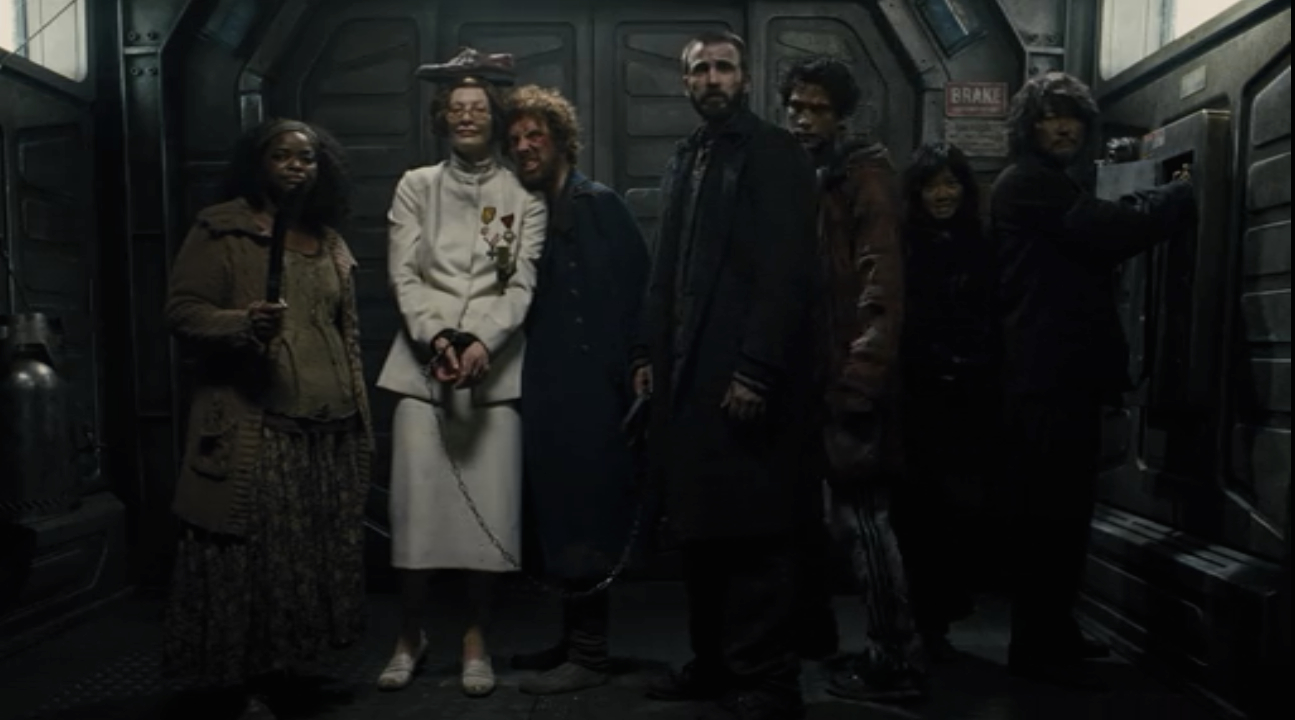
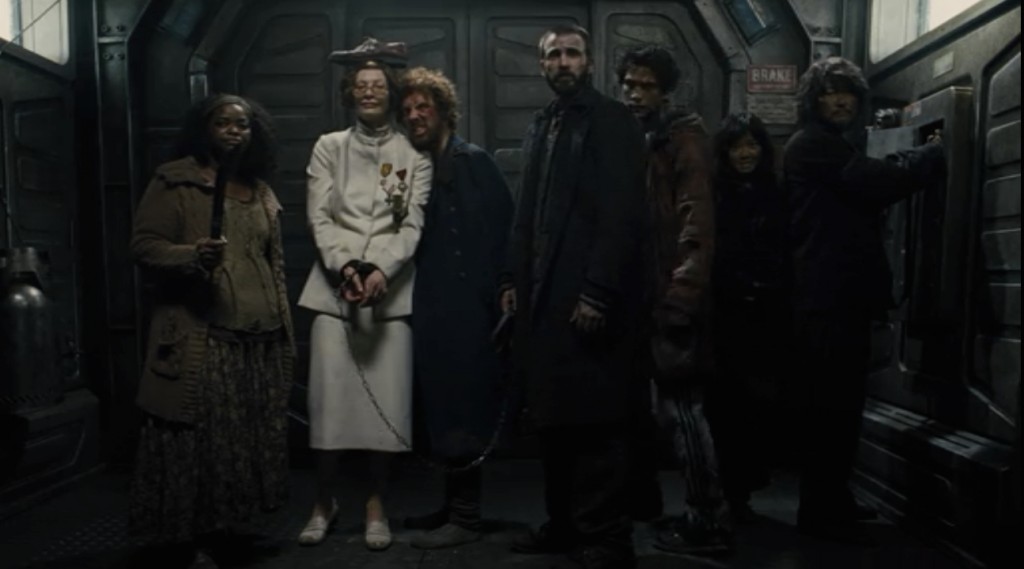
The characters  rehash the most generic ‘motley band of heroes’ tropes. A bland, angst ridden woodsman named Curtis leads the revolt. Curtis is guided by Gilliam, aka Gandalf/Trotsky, the aged leader of the tail section, and followed around by an eager younger-brother figure, Edgar, who chiefly serves to open up giant plot holes. (He has an Irish accent and misses eating steak, yet is an orphan raised in the tail section from infancy.) Curtis’ plan relies on a enigmatic, manic Korean engineer, long imprisoned in a jail car, who tows along his doll-like and inexplicably psychic daughter, Yona, (essentially River from Firefly.)* The engineer knows how to open the doors between cars, but must be bribed with drugs. We’ve got a gutsy black mother, and a mute, ethnic, martial arts kid. Bong likely suspected that these empty shells couldn’t generate much emotional investment on their own, so he falls back on trite parent-and-child melodrama. Cue the wistful soliloquys of grown-up orphans, and the desperate plight of the parents of the kidnapped children.

When Curtis finally reaches Wilford in the final car, the inventor breaks and tempts him with a bland, 50s caricature of fatherhood, calling Curtis “My boy,” and promising to make Curtis heir to his hallowed position. This exchange contains the pessimistic, political twist so critically beloved. Gilliam and Wilford turn out to be co-conspirators, encouraging tail-end rebellions so as to ‘decrease the surplus population.’ This twist, and its corresponding political allegory, seems to be the one time where Bong really cares about the storyline, (it is his invention, after all.) Bong even leads the audience away from this suspicion early on, when Gilliam requests Wilford’s minister to relay the message that he and Wilford “need to talk.” Wilford’s sneering, flippant report of his and Gilliam’s intimacy, especially considering the inhumane conditions Gilliam suffered as part of the tail class, undermines the reveal. Wilford must still be lying on some level, as Bong never connects why Gilliam would endure what he did, and care for the tail enders as he did, under such false pretenses.  It’s a twist alright, crossed off the list of what a good action movie plot should accomplish, but one that’s hardly believable. It counts as political allegory, but one deeply out of touch with its own humanity.

The character’s motivations and the political allegory must be dropped whenever they threaten to overshadow the dream-logic and dream-visuals themselves. For example, the tail-section people talk a lot about food, a basic necessity of which they are almost deprived. The revelation that their protein blocks are made of bugs is mined for horror, and ‘steak’ becomes a running symbol. When they first make it into the vacated economy class cars, a rebel protests that the residents had abandoned their food “on the table.”  Most horrifically, Curtis confesses that in the first month onboard the Snowpiercer, the stowaways came so close to starving that they resorted to predatorily cannibalism– not just eating deceased humans, but hunting each other for food.  Hunger, and outrage over hunger, is a useful and efficient way to flesh out these characters as oppressed and desperate people. Yet, this essential motivation must be dropped where it distracts from the film’s absurdist agenda. After sustaining massive losses of their people in battle, a small group of rebels finally makes it into the first-class section, and into a marvelous aquarium. At the end of the aquarium sits a sushi bar. The rebels sit down and begin to have sushi, which is prepared by a man in African dress. There’s no griping about the elitist luxury, the wait, the small portions. Tanya, the black woman, makes a quick jibe about their not being enough fish to have sushi all the time, but there’s no urgency in their hunger, or even to keep moving ahead. This is one of the strongest sequences of the film, where the dream logic completely dominates the action, and the disposability of the storytelling becomes most transparent. Its easy to miss Minister Mason’s explanation of the aquarium as a closed ecosystem, “where the number of individual units must be closely, precisely, controlled,” later reprised by Wilford in half-explaining why certain amounts of tail end people must be periodically slaughtered.

Deliberate absurdity, particularly in high budget films, communicates a kind of intelligence. The director and crew are “in” on the artificiality, the fictionality, the letter-box. They enjoy interrupting the audience members, who are busy putting together the pieces to understand what’s going on. Audiences enjoy these interruptions because they are surprising, and because it connects the audience and author, who can “secretly” recognize each other. (As long as the audience privileges aesthetic distance over emotional absorption in a film, something that is statistically more prevalent with the wealthy, and consciously resisted in working class audiences. Pierre Bourdieu covers this phenomena in his book, Distinction.) While absurdity, irrationality, and surreality are present in popular culture, they debuted as high brow developments in art and literature, and still carry a kind of ‘legitimizing’ earmark. “This action movie is smart, because it is so dream-like,” for example.

Frank Kermode, a scholar devoted to reading between the lines of popular and religious texts, finds high-brow literature to be less rife for analysis because of its intentional irrationality. ‘Weirdness’ arrives in the strictly popular text by accident, seeping through routine hackwork and cliché, and exposing period or authorial concerns. This weirdness often comes in the form of repetition and/or fetishization of inessential details or descriptions, or of strange sequences that have nothing to do with the plot, (called BLAMs on TV Tropes.) High-brow authors deliberately insert weirdness, largely to avert or disrupt literary formulas. Kermode writes that in high-brow literature, “there is much more material that is less manifestly under the control of authority, less easily subordinated to ‘clearness and effect’ more palpably the enemy of order, of interpretative consensus, of message.”

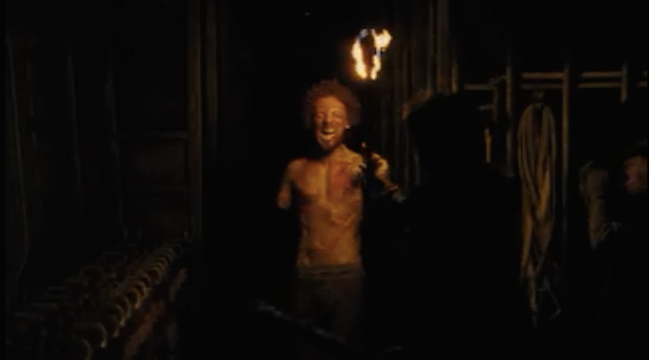
Bong repeatedly prioritizes surreality and effect over message and order in Snowpiercer, positioning it in Kermode’s reasoning as a high-brow text intended to be appreciated from a critical distance, (but still enjoyed for its tittilating battle scenes.) Yet Snowpiercer is not without its symptomatic fixations. Notably,  it betrays a fascination with amputation. Just before Curtis meets Wilford, he confesses that the tail-enders initially cannibalized each other to survive, and he hates himself because he knows “that babies taste best.” Curtis killed a woman for a baby, but before he could eat it, he was stopped by Gilliam, who cut off his arm for Curtis to eat instead. “And then one by one, other people in the tail section started cutting off arms and legs and offering them. It was like a miracle. And I wanted to. I tried, it’s… A month later, Wilford’s soldiers brought those protein blocks. We’ve been eatin’ that shit ever since.”

Snowpiercer purports that the tail section became a kind of dystopic utopia, a situation so horrible it brought out ultimate selflessness. Gilliam’s response is the Eucharist made real, and was not only presumably repeated with his leg, but by a whole assembly of amputated elders, who limp notably in the film’s present on crutches. When Gilliam appoints Curtis as his successor, Curtis struggles, replying, “How can I lead if I have two good arms?” Gilliam then reveals the scar from when Curtis ‘tried.’ Curtis’ character arc isn’t completed until he loses his arm between the gears of the engine, in order to rescue a kidnapped child. As if released from his earthly limitations, he then instinctively sacrifices themselves to save Yona and the child from a fiery explosion.

snowpiercer_amputeefire2

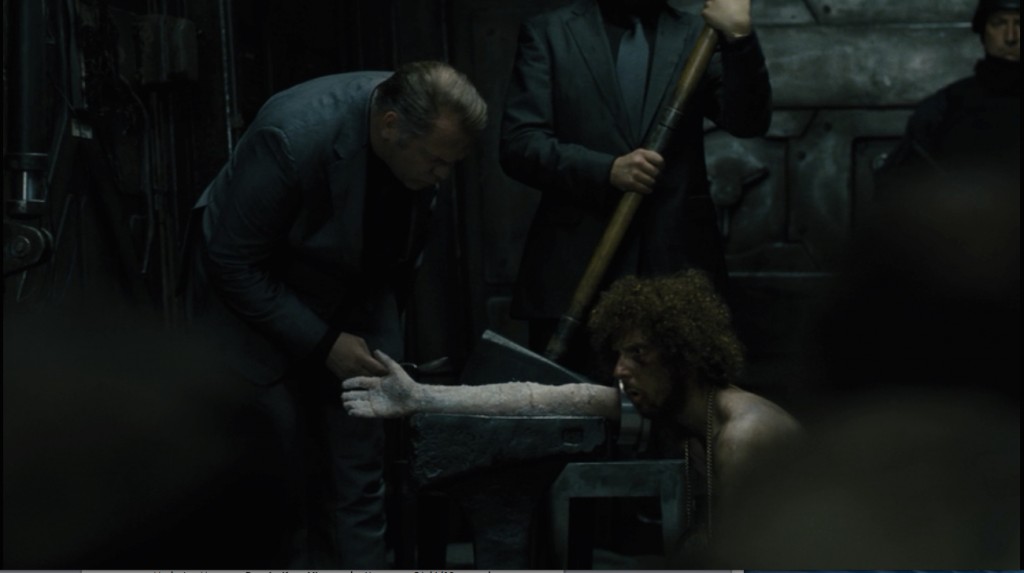
The obsession with amputation is not limited to Curtis’ realization. When two children are kidnapped at the outset, a father lurches out in rage and throws his shoe at an elite. In punishment, his arm is shoved outside of the train for seven minutes, and then pulverized by a sledgehammer. In the opening scenes of the film, an old man is also abducted by soldiers to play violin for the first class. At first he volunteers, thinking that he and his wife, another violinist, will both be able to go. A soldier demands, “Show me your hands… you follow me. Leave your belongings. We just need your hands.” The man, realizing he must go without his wife, asks, “Not both?” The soldier sneers, “Yes, both hands.” When the man resists, the soldiers respond by knocking the woman unconscious, and crushing her exposed hand underfoot.
snowpiercer_torture2

The lower classes have long been equated with their hands and manual labor. Its worth noting that the children are kidnapped because they are small enough to fit inside the train engine and remove grease by hand. According to Bourdieu’s ethnography of France in the 1960s, Distinction, this symbolism is understood at all levels of society, but, “At higher levels in the social hierarchy, the remarks become increasingly abstract, with (other people’s) hands, labour and old age functioning as allegories or symbols which serve as pretexts for general reflections on general problems.” When shown a picture of an old woman’s gnarled hands, working class respondents tended to respond to the picture intimately albeit conventionally, considering and personifying the photographed person, and the work she did. The middle class respondents are the first to routinely overlay ethical virtues and aesthetic comparisons onto this, and the highest classes tend to ‘amputate’ the woman entirely, with responses like “‘These two hands unquestionable evoke a poor and unhappy old age.’ (teacher, provinces.)” The upper classes also have a tendency to make highly aestheticizing references, such as in this representative remark from an engineer in Paris: “I find this a very beautiful photograph. Its the very symbol of toil. It puts me in mind of Flaubert’s old servant-woman… That woman’s gesture, at once very humble… It’s terrible that work and poverty are so deforming.” Its worth noting that Bourdieu’s class system is based more on educational level and inherited capital than earned capital, as these are not tendencies based as much on wealth as on the ability (both learned and afforded) to live abstractly.

Conflating the labor class with hands is so established that it can be found within Wikipedia’s basic definition of ‘synecdoche.’ This synecdoche also consists of the message and opening epigram of Metropolis, perhaps the most canonical caste-system dystopic film, when it says,  “There can be no understanding between the hand and the brain unless the heart acts as mediator.” Snowpiercer reiterates this in a baser, more pessimistic form, in the Minister’s speech during a torture demonstration:

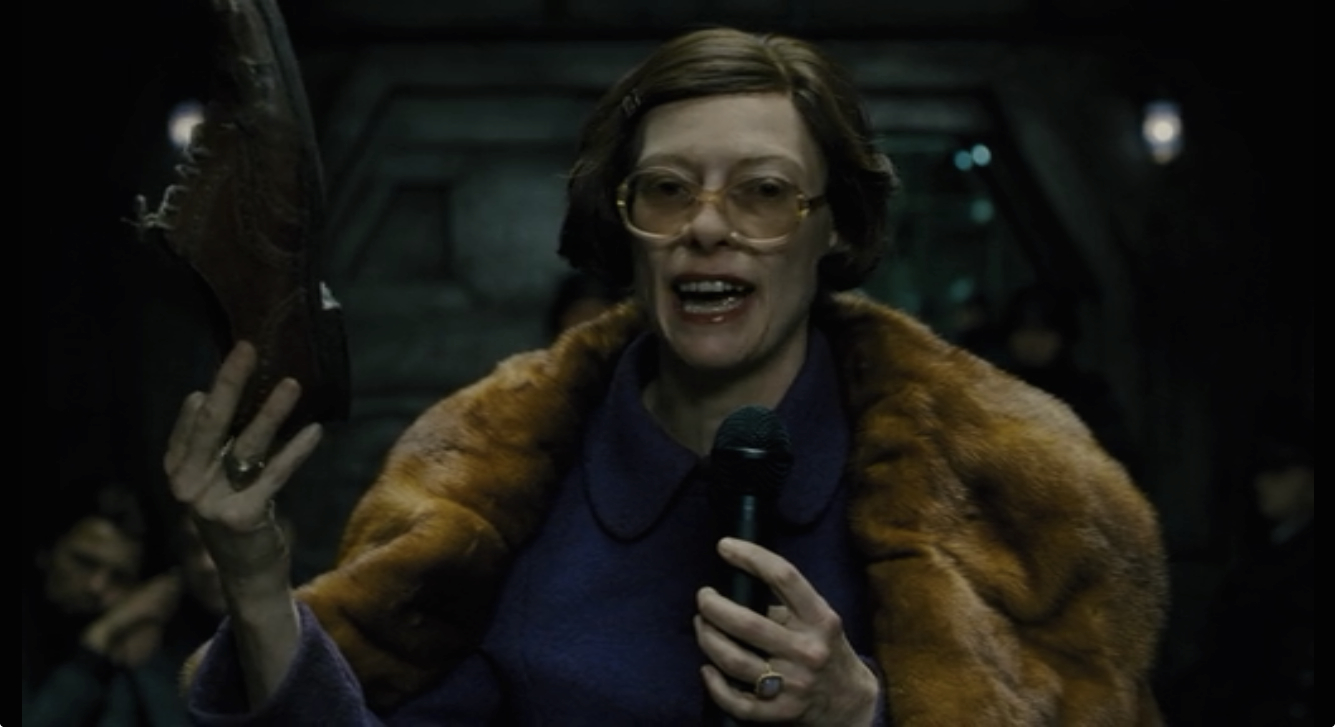
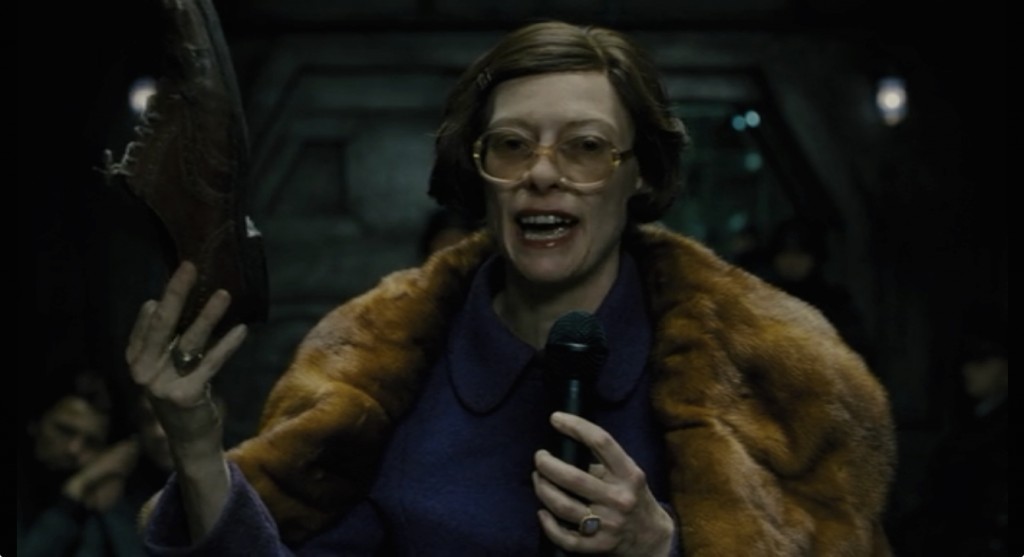
“Would you wear a shoe on your head? Of course you wouldn’t wear a shoe on your head. A shoe doesn’t belong on your head. A shoe belongs on your foot. A hat belongs on your head. I am a hat, you are a shoe. I belong on the head, you belong on the foot. Yes? So it is. In the beginning, order was prescribed by your ticket. First class, economy, and free-loaders, like you … Each in its own particular, preordained position. So it is. Now, as in the beginning, I belong to the front. You belong to the tail. When the foot seeks the place of the head, a sacred line is crossed. Know your place. Be your place. Be a shoe.”
snowpiercer_shoetalk

If Bong were simply interested in amputations, visually or conceptually, they might appear more frequently in the graphic battle scenes. Instead, they are explicitly connected to anxieties about the tail end people, particularly in their functioning either as leaders or workers. Also, while the amputations discussed or shown on-screen almost exclusively pertain to arms and hands, Snowpiercer alters the standard synecdoche, assigning the base class to feet. More than that, the relationship of the elite and lower classes is further abstracted to clothing from anatomy, as if the parts of humanity no longer constituted the body of humankind, but served a greater reality that could exist without them. In Snowpiercer, a train’s engine is abstracted into a god, and the caste system into a holy order. Perhaps the greater reality is the train, which people serve but do not constitute. Perhaps it is abstracted Order itself.

In Snowpiercer, the lowest class is no longer a labor class. That may provide one answer to these questions. Hands work. Unlike Metropolis, or the grand body of film dystopias that followed, the tail enders are not shown toiling in factories or industrial wastelands. They are explicitly a welfare class. Only the kidnapped children have jobs maintaining the train, but they are slaves, and the one mentioned janitor died seventeen years ago. The tail enders did not have a fare when they boarded, and by the accepted logic of train travel, can be kicked off at any time. The fact that they aren’t is then an act of charity. The fact that the elites manufacture and provide them with food and water becomes an act of charity.

The tail enders can decry the insanity of prejudice and poverty in a post apocalyptic world, but the problem is, reality has been replaced with an insane, man-made system where economic class is not arbitrary. The rebels rarely appeal to concepts of ‘justice,’ or ‘human rights.’ They know their treatment is despicable, but their ability to express why, or imagine an alternative social order, has shrunk with their horizons. The tail enders never ask a question that Bong never has to answer– what more is demanded of Wilford and the elite passengers, who have ‘legitimate’ passage on this train? As long as they keep the tail-enders alive, they could be said to do more than enough. The protection of ‘a closed ecosystem’ where the stowaways are essentially parasites, make horrific, horrible sense. By avoiding the consequences of this logic, Bong made a movie that only falsely champions the human spirit. In truth, Snowpiercer participates in the same conservative media effort to reconfigure the ‘labor class’ into a ‘welfare class,’ and redefining social services into ‘entitlements.’

On a gut level, Bong may be uneasy with the severing of labor from the ‘labor class,’ although I won’t try to assume the level of his involvement or awareness of American politics or journalism.  Amputation is a violent and disturbing image, and Bong does not shy away from its horror. It’s a fitting symbol, especially considering that conservative pundits sever labor from the labor class to drum up support and engagement from their political base, at the expense of real lives. Propoganda is entertainment. When Wilford discusses his perspective of the uprisings, he judges them based on their entertainment value, and the value of entertainment in quieting the masses. He says to Curtis,  “We need to maintain a proper balance of anxiety and fear, chaos and horror, in order to keep life going. And if we don’t have that, we need to invent it. In that sense, the Great Curtis Revolution you invented was truly a masterpiece.” A military class seems like an unnecessary expense, unless it’s to give the paying passengers a living video game.  All the first class passengers do is entertain themselves. The satire isn’t toothless, and the victimized tail-end have real-life counterparts in the working class. Still, the question stands– the logic that the tail-enders are parasites is never confronted, and thus never rebutted. The film envisions social service as dehumanizing, and the idleness of the base class as a given in an entertainment-based society. A labor-less lower class is the one great absurdity left unexplored. Violent entertainment may be an opiate, but the film itself is complicit in it.  Which is fitting for a high-brow treatment of an indulgent action premise, which sidelines the struggles of oppressed people for frivolous absurdities.