Lovecraft’s War Memoirs

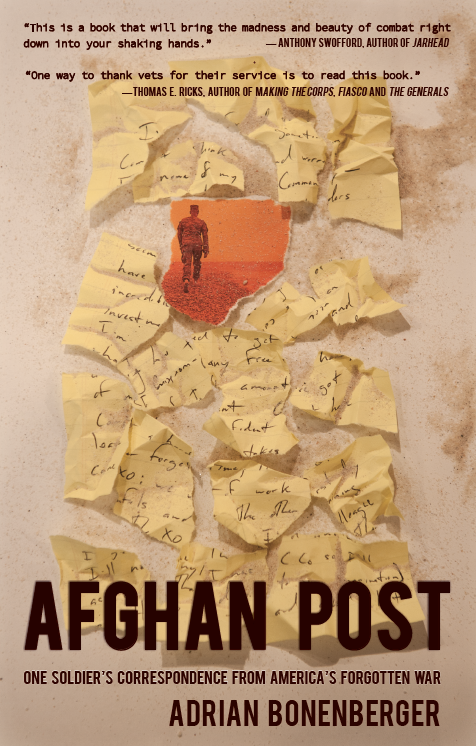
afghanpostcoverI made a strange discovery recently. Reading the Delta Green Call of Cthulhu RPG sourcebooks for a different perspective on the H.P. Lovecraft narrative (as well as to interact with and enjoy one of my favorite literary worlds), it occurred to me that a great deal of the current literature coming out of the forever war in Afghanistan and the Middle East are basically horror stories.

Much of the current literature on war comes to us in the form of memoir. Many of these accounts focus on special operations soldiers such as SEALs, Rangers, Delta, CIA, or mercenaries formerly employed by one of these groups. The bulk of the remainder of the memoirs are firsthand accounts produced by combat veterans from regular units. My own memoir, Afghan Post, is an epistolary account drawn from journal entries and letters to others during my time deployed. LTC Peter Molin, who reviewed Afghan Post for his blog Time Now (detailing war-themed literature) said that it reads like bildungsroman – a coming of age story.

Meditating on Lovecraft, though, I realized that my memoir makes a lot more sense as horror, and I suspect that this holds true for a great many of the war memoirs we’re used to encountering as non-fiction essay.

For those unfamiliar with H.P. Lovecraft it’s probably worth making a wild overgeneralization and claiming, briefly, that he was responsible for establishing the genre of modern horror as we know it. In Lovecraft’s stories, a protagonist who operates on the fringes of society (private detective, university researcher, scientist, a relative to some obscure and eccentric person) is presented with a mystery about the nature of the universe. The solution to the mystery is either some horrifying revelation about the nature of the universe that drives the protagonist mad, or a monster that kills the protagonist.

Given the frame of a universe wherein people are killed or driven mad by what they see and do, it’s not difficult to see how war memoirs or any trauma story could lend themselves to comparison and analysis. Most contemporary participants in war (who are, in America at least, all volunteers), elect to take part in state sanctioned violence. Whether they are shooting at enemies or being shot at, the emotional progressions moves in most cases quite naturally and predictably from some form of idealism to realism and, ultimately, to pessimism (and, frequently, to suicide as well).

I first encountered H.P. Lovecraft in a Borders in Evanston, in winter of 1996. A classmate of mine, Scott Richardson, introduced me to the author when I expressed an interest in reading short horror fiction, and fatigue with Stephen King (who has also produced an incredible body of short horror fiction, for which he should be always and best remembered). Lovecraft made effective use of the epistolary device in his horror stories –At the Mountains of Madness, for example, is a novella told through the journal of an explorer and scientist in Antarctica who makes a horrible discovery. Used appropriately, the frame allows readers to experience, firsthand, the dissolution of a mind, and undergo in hours what would otherwise transpire over a course of days, weeks, or more.

When people have asked me what my inspiration was for framing Afghan Post as an epistolary memoir, I’ve told them the truth: I’ve always enjoyed writing letters and journal entries, and I found the writing of difficult personal material to be easier if it were addressed to the friends and family with whom I’d actually corresponded during my deployments to Afghanistan. A friend had sent me a copy of Les Liasions Dangereuses shortly before I began writing my memoir, so that book – told through a series of letters between two French aristocrats – was also very prominent in my mind. It did not occur to me that, in telling the story of my psychological fracturing, and splitting, I was evoking Lovecraft.

That connection works both ways, broadly speaking – Lovecraft’s stories are filled with references to war, and especially World War I. Oftentimes a character will be revealed to have been a veteran of that conflict –not surprisingly, given the time during which Lovecraft was writing, but not often remarked upon in literary studies. And nowhere moreso than in his short story The Rats in the Walls, where the narrator’s son dies from a wound inflicted in World War I, and another World War I veteran is murdered under suitably terrible circumstances – in the earth, among the scurrying of rats, which were a powerful symbol of trench life, as well as life in the hellish, muddy wasteland between trenches.

The book I wrote is the story of an intellectual and artistically inclined young man, who encounters the terrifying reality of life outside the safe confines of the developed world, and endures the emotional consequences. Reading Afghan Post now, ten months after its release and nearly a year and a half since I last edited the text, I must admit that my journey concluded with a descent into madness, from which I have only partially recovered.

While it’s irresponsible to make generalizations about something as wide and all-encompassing as war literature, which runs the gamut from fiction masterpieces like Slaughterhouse Five to first-person memoirs like the controversial American Sniper, my own sense of the war narrative is this: there’s something to the process of going to war that undermines the confidence we veterans have in a naturally or passively just world. I’m surprised it took me this long to realize that I wrote a story that could honestly be described as “Memoir – Epistolary – Horror.”
Spare Them Our Good Intentions

This first appeared in edited form in the Chicago Reader.
_______

We tend to think of imperialism as motivated by greed and racism, but the truth is that it is just as often actuated by altruism. Whether it’s Rudyard Kipling urging the U.S. to take up the white man’s burden and colonize the Philippines or Christopher Hitchens urging the U.S. to take up the white man’s burden and occupy Iraq, humanitarian concerns and foreign adventure are inseparable. As counterintuitive as it may seem, in case after case, “empathy” turns out to be another word for “invasion.”

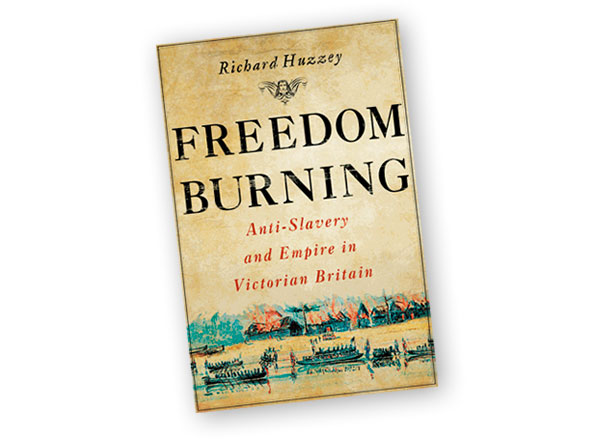
Of course, many anti-imperialists like to argue that the conflation of empathy and invasion is simply cynical spin. From this perspective, talk of democracy is just to cover up a real obsession with (or example) oil. Imperial altruism becomes, then, a kind of complicated conspiracy theory. It is this conspiracy theory which Richard Huzzey meticulously dismantles in his new book Freedom Burning.

Freedom Burning focuses on British anti-slavery in the years following the abolition of the slave trade in 1833. Though the topic is fascinating, and certainly relevant to our own imperial moment, Huzzey is not an especially engaging writer. His book is a dry read, as it winds its way through a maze of Foreign Office policy, Parliamentary politics and long-past controversies. In many cases, Huzzey seems to go out of his way to avoid telling a good story; he references the British Niger expedition of 1841 as a disastrous result of anti-slavery ideology, but he repeatedly eschews the opportunity to explain even the outlines of that disaster, in which more than a third of the 159 Europeans died from disease.

But Huzzey’s bland delivery only emphasizes the bitterness of his conclusion — which is that anti-slavery was not a cover-up for British imperialism. On the contrary, it was a central engine of expansion, and the coherent consensus which made that expansion possible.   British determination to search all shipping on the high-seas, for example, was motivated in large part by the desire to prevent the transportation of slaves. When the British torched a West African settlement on the Gallinas River in 1845, they were not enslaving the people, but fighting for emancipation by punishing local leaders who had allegedly had dealings with slave traders. They were, sincerely, burning the village in order to save the people. (18-19)

Anti-slavery, then, became not just the excuse, but the motive for extending and exercising British power. As Huzzey says, “anti-slavery was the popular aspect of imperial expansion,” and “Anti-slavery ideologies were one of the principal ways that commercial, spiritual, and moral objectives could be combined.” (190) This didn’t mean, or didn’t just mean, that politicians couched their policies in anti-slavery terms in order to appeal to the public. It also meant, as Huzzey shows, that politicians, like their constituents, thought about, and conceived of, foreign policy against the background of an anti-slavery consensus to which virtually everyone, politicians and public, had to conform. Huzzey notes that it was basically impossible “to be taken seriously in public debates if an author defended slavery.” (46)   Thus, for example, some Brits advocated against the naval suppression of the slave trade. But they did so on solidly anti-slavery grounds, arguing that forcing the trade underground could worsen conditions for transported slaves, and even caused slavers to throw their cargo overboard when a British ship approached. (133)

Anti-slavery ideology was so flexible that it could even exist alongside open and vicious racism. Indeed, as Huzzey depressingly chronicles, anti-slavery actually provided white Britons with a strong rationale for hating their black countrymen. In the first place, the prevalence of slavery in African nations, and the complicity of African leaders in the slave trade, were attributed by white Europeans to black racial inferiority and immorality. (192)

Even more damaging, though, was the coalescence of anti-slavery and racism in the West Indies. There, freed British slaves were reluctant to return to the plantation system, preferring instead to work for themselves. This understandable desire for autonomy and self-respect was interpreted by white Britons as laziness and backwardness, and solidified racist stereotypes of black people. Even the anti-slavery argument that slavery was catastrophically dehumanizing was turned against black people. If blacks were dehumanized, then they shouldn’t be treated as human, the reasoning went — and so anti-slavery provided the foundation for coercive laws forcing black people back into virtual slavery on the plantations. (192)

An ideology of freedom, then, did not lead to an ideology of equality. On the contrary, a belief in freedom ended up justifying and enforcing inequity. Not only did British anti-slavery ideology encourage racism — it arguably encouraged slave-trading. Even as the British boarded the ships of other nations in search of slaves, their own vessels carried hundred of thousands of Indian laborers across the empire. These Indians were not technically “slaves,” but were instead indentured servants or people working under debt bondage or contract. There was some outcry against the treatment of these workers, who were certainly coerced in many cases. However, this coercion was not necessarily seen as incompatible with anti-slavery. On the contrary, since ex-slaves were viewed as lazy and irresponsible, it was generally thought that some form of forced labor was needed to secure a stable post-slavery economy. East Indians were brought to the West Indies to make blacks work without slavery. Thus, again, anti-slavery required (wage or contract) slavery. (201-202)

Huzzey points out that one of the main contributions of anti-slavery to imperialism is simple attention. The suppression of the slave trade provided much early interest in Africa where otherwise there would have been little or none.” (191) Thus, the very energy and focus that had allowed for the abolition of slavery within Britain flowed naturally, once that slavery was abolished, into a continued focus on, and meddling in, Africa, with devastating long-term consequences.

Were those consequences worth the abolition of slavery? If slavery had been abandoned earlier, might there have been a more thorough and rapacious imperial presence in Africa? If slavery had been allowed to continue for longer — say, till after the American Civil War — would Africa have been subject to shorter and less crippling European colonization?

Huzzey raises these questions, but is too careful to attempt to answer them. Still, I wish every would-be do-gooder, whether of left, right, or center, would read his book — and not just because turning pages might briefly distract them from their violent schemes of world-betterment.   Huzzey’s book suggests not just that the road to hell is paved with good intentions, but that the road to hell is paved specifically with our good intentions. Freedom, democracy, empathy, even equality — all America’s ideals are WMDs waiting to be armed and detonated wherever our attention happens to alight, whether it’s in Africa, Kosovo, or Iran. U.S. humanitarian efforts throughout the world are, of course, laudable, and do enormous good. But even so, it’s hard to read Freedom Burning without wondering whether it might be better for everyone else if we cared about them a little less, and minded our own business a little more.
______

Freedom-Burning-cover-magnum

Utilitarian Review 10/17/14

On HU

Featured Archive Post: Subdee on Homestuck as metatext of doom.

Me on what happens when you take racism out of Gone with the Wind and H.P. Lovecraft.

Me on how Columbus was a genocidal monster.

Ng Suat Tong on how Snowpiercer the film is cheerier than Snowpiercer the comic.

Alex Buchet with a collection of his favorite TCJ covers.

Kim O’Connor on comics crit and solipsism.

Brian Cremins on curating a show featuring work by Edie Fake, John Porcellino, and Marnie Galloway.

Chris Gavaler on fictional Bath, past, present and future.
 
Utilitarians Everywhere

At Pacific Standard I wrote about the right-wing whackos who think Michelle Obama is a trans woman, and how black women are denied femininity.

At Esquire I wrote about Jose Alaniz’s book Death, Disability and the Superhero, and superheroes as disempowerment fantasy.

At the Atlantic I wrote about gender, race, and the Snoop/Iggy twitter beef.

At Splice Today I wrote about

— a great electronica/dance label, Soulection.

— politicians spouting nonsense and the press spouting more nonsense.
 
Other Links

Ambrose Bierce on Columbus.

Sean T. Collins interviewed Anita Sarkeesian.

Ben Casselman on why 538 doesn’t cover markets.

Victoria Law on the failures of carceral feminism.

Mary McCarthy on paying to buy twitter followers.
 

19flash

Right There, Only More So

rooftop_view_i_new

I visited Bath, England during spring break of my senior year in college. That was over a quarter century ago, so my memories are “historical” rather than “contemporary.” They may even shade into “speculative” since memory warps with each recollection, transforming real locations into alternate realities. I’ll be able to gauge the extent of my idiosyncratic warping when I return to Bath next June. I’m teaching a creative writing class for Advanced Studies in England, a study abroad program for U.S. college students.

My course is “Writing Bath: Historical, Contemporary, Speculative Fiction,” but I considered calling it “Right Here, Only More So.” There’s a Laurie Anderson song (also from a quarter century ago) that opens with the line: “Paradise is exactly like where you are right now . . . only much, much better.” And there’s an even older truism about science fiction: “The future is now, only more so.” That’s a particularly good definition of speculative fiction, and combined with Anderson’s spin on place, it sums up my approach to fiction writing.

I open my introductory course (the one I teach in Virginia, not England) with an observation exercise: list sensory details. Since we’re sitting in a classroom, the results usually include the ticking of a clock, the scent of chalk, the glow of fluorescent bulbs, the press of a chair back against your spine. If you dig a little deeper, those details get much, much better: the conch-shell murmur of AC vents, the convergence of shadows as a pen tip touches paper, the pendulum sway of an earring.

Any location can yield unlimited details. And though a classroom in rural Virginia is as good a place as any to dig down, imagine if the classroom is in Bath, England. Those are Roman ruins under the sensory top soil. So after exploring the contemporary, I’ll send my students off in time machines to land anywhere they like in the two thousand years of Bath history. And when they get back, we’ll spin the controls in the opposite direction and speculate about the city’s diverging futures.

Although historical fiction and science fiction seem like opposites—one’s in the past, the other the future—they’re both not in the present, and so, unlike contemporary fiction that borrows from immediate reality, they are alternate worlds that have to be imaginatively constructed. Contemporary fiction is an imaginatively constructed alternate world too, but you get to cheat a bit because readers will do more of the setting work by filling in familiar details themselves. But the past and future require more authorial effort.

The past of historical fiction isn’t the past. It’s an invented past. What are Roman sandals made of? How do they lace up? Where do they chafe? I have no idea. But my students will also take a course called The Romans in Britain, and combine that with contemporary interpolation (ie, it hurts to walk on a blister), and suddenly first-century Bath will be within strolling distant. The Triumph of Georgian Bath will give them enough architectural know-how to conjure other moments of history into equally concrete existence.

Speculative fiction at first seems comparatively boundless. History books are filled with verifiable events, while the future is unwritten. But the future is made of the same stuff as any historical story: the present, only more so. What does a hovercraft sound like when it’s landing? I have no idea. But I can pluck details from my world—the whir of my half-clogged lawn mower—because the mundane really is much much better for building something non-existent. And if you do your building in Bath, England, your range of the mundanely contemporary is also sunk deep in the paradoxically here-but-not-here historical. Three worlds, one place.

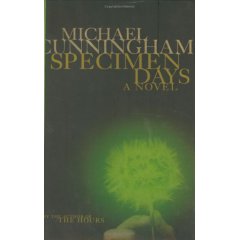
I get no points for creativity though. Michael Cunningham approached New York the same way for his 2005 novel Specimen Days.

Specimen_days

The first section explores the gothic past of the Industrial Revolution, culminating in the Triangle Waist Factory fire of 1911. The second is a contemporary police procedural plotted around a suicide bomber in the wake of 9/11. And the final part leaps into New York’s distant future of androids and lizard-like aliens. Deepening the interconnections of the three-in-one setting, manifestations of the same three characters appear in each version of New York, weaving a larger plot through the whole of the novel.

You can try this yourself at home. Any home. Everyplace in the world contains a world of plots just under its surface, and its pasts and futures are disguises for its own Right Now. Cunningham could have written Specimen Days in my hometown of Lexington, Va. But I’m glad he didn’t. I’m also glad my class and I will be digging into Bath, England for our inspiration. I hope to find a ghost of my twenty-year-old self wandering the Roman ruins.

[And if you’re attending one of the ASE’s affiliate or participating colleges, you might consider meeting the ghosts of Bath past, present, and future with us. More on that here.]

b_55_new

“Like Comics Without Panels”

“How are you with math?”

“What kind of math?”

Math math. Numbers.”

I have a standard response to this question: “I haven’t taken a math course since the original line-up of Guns N’ Roses was together.”

“How about a level?”

“No idea what you’re talking about right now.”

When I began work with my colleague Jason Peot on the comics gallery show that opened at Harper College this week, I had no idea I’d have to employ my rusty math skills. The show features beautiful work from John Porcellino, Marnie Galloway, and Edie Fake. Friends have asked me about my first experience as a co-curator. How do I feel about original comic book pages hanging from the white walls of a small gallery? How did Jason and I select the pieces? What are we trying to say about the relationship between comic book narratives and the fine arts? I find myself wanting to talk instead about dusting frames, centering images, and learning about Plexiglas and L-shaped nails. I even got to sandpaper the edges of the plex we used to cover pages from John and Marnie’s books. Actually, I’m pretty happy with myself right now for using the word plex in that last sentence.

>Gallery Show program cover copy

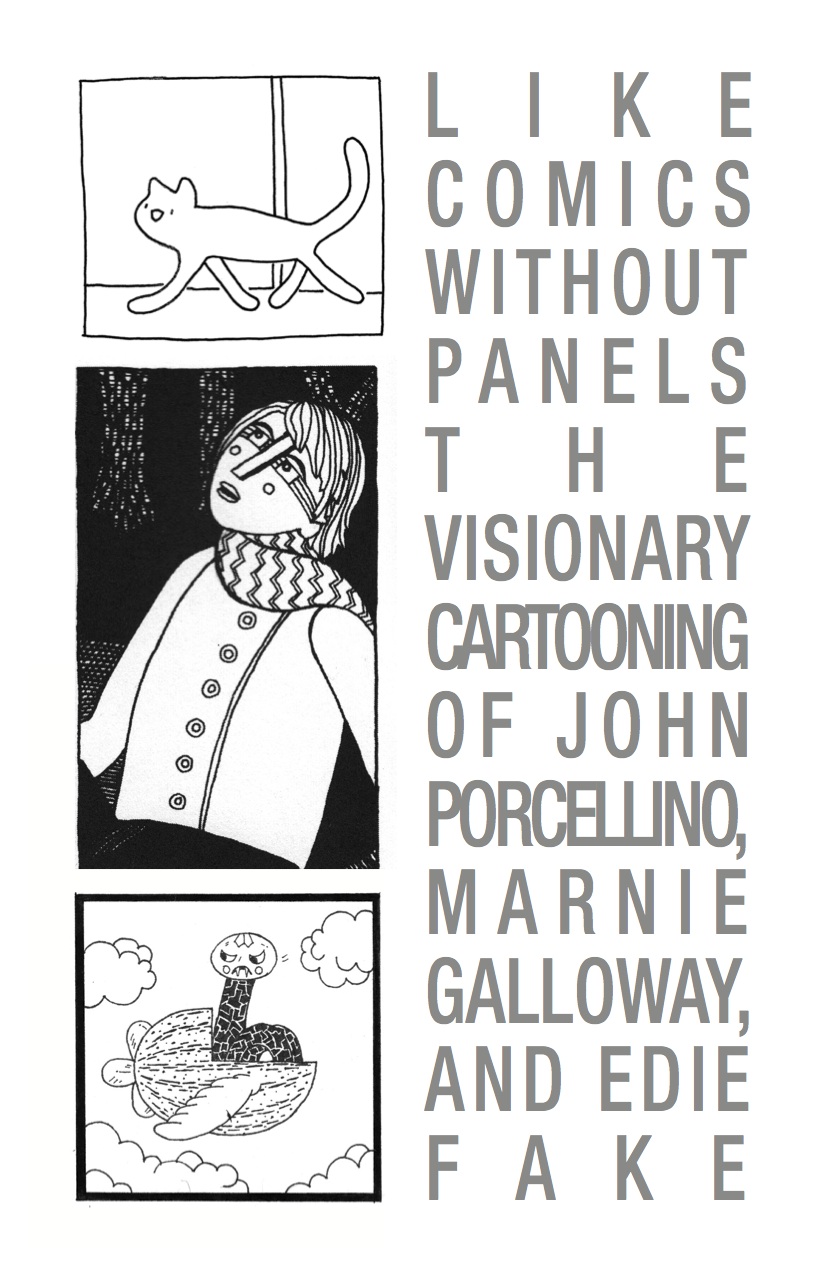
The cover of the program booklet for our show.

I’ll admit that I’m hesitant to call myself a co-curator. A couple of years ago, my writing students and I attended a lecture by two fairly well-known rock critics. One of them kept talking about “the curated experience.” The critic, he explained, is like a guide in a museum. Don’t we all look for a “curated experience” to know what’s good and what’s bad, especially in the arts? (I guess? Maybe? I don’t know.) He then asked the students in the audience how many of them liked the new Radiohead album. A room of vacant, late adolescent stares. “None of you listen to Radiohead?” Later that morning, one of my students confided in me: “Radiohead is music for old people.” I think she meant me, and she was right (right about the oldness but not about my favorite bands. I’ve never been much of a Radiohead fan. Or Wilco or Tom Waits or any of the music I’m supposed to like. I do enjoy the Radiohead song about the fishes, though). The phrase curated experience brought back a memory: my sister as a kid touching a Warhol on the wall of the Yale University Art Gallery in New Haven. The guard yelled at her. She withdrew her hand but she continued to stare at the painting. That image of her is fixed. In fact, it’s more durable than my memory of the Warhol. A brief gesture, a touch. I wondered if Jason and I might provide that moment of wonder for our students.

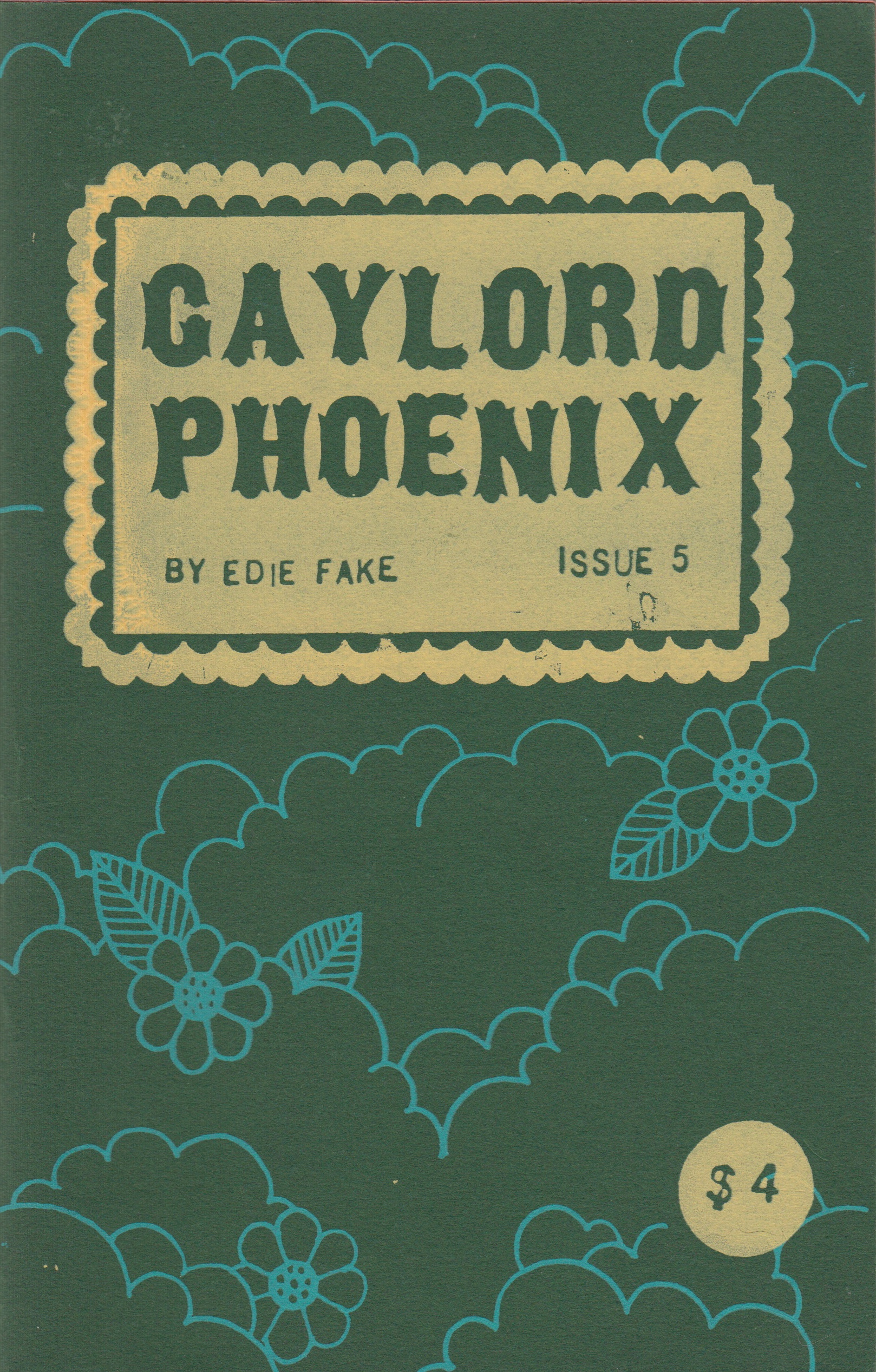
Our idea for the show is driven by two ideas Edie Fake has expressed in recent interviews. The title of the show comes from a conversation with Megan Milks published in Mildred Pierce in 2011, not long after Secret Acres released the complete Gaylord Phoenix. “I think I’m interested in space without panels, I guess, or things that are like comics without panels,” he explains. “I hardly use a space break on my pages. Things just kind of move from one thing to the next” (Milks 6). I picked up Issue #5 of Gaylord Phoenix at Quimby’s in 2010 because of the cover. The blue clouds and flowers reminded me of a still from a Jack Smith film. I carried Issue 5 in my messenger bag for the next several weeks. It was as magic and dear to me as that phantom memory of my sister and the Warhol. I wanted to live in the spaces inhabited by the book’s protagonist. If I carried it with me long enough, I thought, maybe the Court of the Gaylord would manifest itself, as lovely and ornate as it appears in the book itself. I also loved the colors, gold and orange and black and red.

Space without panels.” It could be a line in a poem, a note jotted in the margins of a commonplace book, or one of Brian Eno’s Oblique Strategies.

GP cover

The cover of Gaylord Phoenix Issue 5 (2010).

The second quotation that shaped our vision of the show is from another interview, this time from early last year. Edie’s show Memory Palaces, now also a book from Secret Acres, debuted at the Thomas Robertello Gallery here in Chicago last winter. In April 2013, Edie spoke with Thea Liberty Nichols about the show and about his artistic practice:

For as long as I’ve been an artist, I have felt part of communities where bartering and collaborating are critical parts of growth. Cross-pollinating is how ideas get spread and get expanded upon. Sharing what we can is how we help each other thrive on this messed up planet.

When Maryellen in our marketing office at school was editing the gallery program, she asked me for a quotation to introduce my essay, so I sent her a few choices. We both liked this one best. The community described here, the one Edie also talked about on the closing night of Memory Palaces when he discussed the influence of Samuel R. Delany’s Times Square Red, Times Square Blue on his art, is the community we’ve tried to imagine and celebrate in our gallery. A space of welcome, maybe a space of return. Always one of possibility and of love.

Before these possibilities could take shape, however, and before we could frame and hang each of these drawings, I had to bring a change of clothes. I started teaching when I was in my early 20s as a grad student at the University of Connecticut. I learned quick that to earn the respect of my students, especially the ones older than me, I’d have to dress up. This was ok. I’d gone to Catholic school for twelve years, kindergarten through college, so I was used to wearing a shirt and tie (my first day of college, I didn’t know what to wear. I felt overwhelmed. I decided to dress like one of The Replacements on the cover of Let It Be from 1984. Chuck Taylors and flannel. Cheap and simple). But, as I cleaned the frames for Marnie’s pages from In the Sounds and Seas, Volume I, I realized I’d made a mistake. My tie was getting in the way. I had plexi dust all over the place. I looked like an accountant or maybe (if I was lucky) somebody’s tour manager. The next day, I looked like Tommy Stinson (only not as cool, and only after I’d finished teaching my classes).

photo (21) copy 2

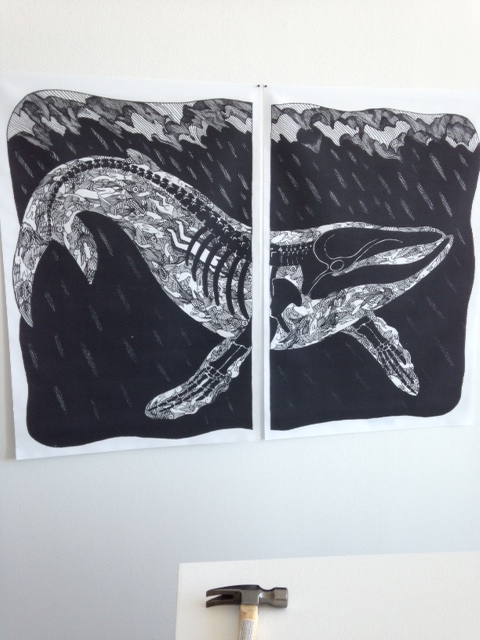
Two pages from Marnie Galloway’s In the Sounds and Seas, printed on large sheets of fabric (please note: hammer not included).

That was the day Jason figured out a system to frame and hang most of the loose pages, including selections from King-Cat Comics and Stories No. 73. I finally admitted the truth: “I’m not good at math.” He measured and leveled each image with meticulous care. We drilled pilot holes, a few of which were too wide for the thin, delicate L-nails that hold each piece of Plexiglas, each drawing, and each backing board to the wall. We had some wire left over from one of the frames. Maybe we could use that, wrap the nails in it? That would might give the nails some friction, Jason said. It worked.

Now John’s and Marnie’s images appear to float behind the clear, custom-cut pieces of clear plastic. Lights from the ceiling cast faint shadows.

A pedestal in the center of the gallery is covered with copies of Memory Palaces, In the Sounds and Seas, King-Cat. Leaf through the pages, read a few stories, but please return the books to the pedestal so other visitors can read them, too.

When I was in grade school my mom took a few art classes at Naugatuck Valley Community College in Waterbury, Connecticut, just a few miles from our house in Oakville. I’d sit and watch her draw still-lifes and perspective studies. I especially liked her portraits, drawn with Berol Turquoise HB pencils, each one so precise and perfect that, the next time I looked in a mirror, I saw more clearly the shape of my face, my ears, my eyelashes, my nose, my mouth. Maybe it was that sense of touch again—the feel of the sketchbook’s white pages covered in pencil and eraser shavings. These memories, like the one of my sister, flooded back as Jason and I hung the final set of drawings last Thursday.

photo (21) copy

On one wall of our show, you’ll see Edie’s original illustrations for Wallace Stevens’s poem “Floral Decorations for Bananas,” from the “Illustrated Wallace Stevens” roundtable right here at The Hooded Utilitarian, July 26, 2011. This series of drawings was also published as a zine in 2011.

And here’s the best part: for the next few weeks, when the gallery first opens in the morning, and before most of our students and other faculty have arrived at school (I commute from Chicago, so I’m on the road and in my office by 6 am to beat the traffic), I get to spend a little time with these precious and fragile works of art. If you find yourself in the northwest suburbs of Chicago in the new few weeks, look me up and I’ll give you a tour. But I don’t promise that I’m any better at math than I was two weeks ago.

Like Comics Without Panels: The Visionary Cartooning of John Porcellino, Marnie Galloway, and Edie Fake runs from now until November 13, 2014 in the Harper College Art Exhibition Space. Harper College is in Palatine, Illinois, just northwest of Chicago. All three artists will join Jason Peot and me for a Q&A on Thursday, October 30 from 12:30 until 2:00 pm. Contact me or visit this link for more details. The Q&A is free and open to the public. If you can’t make it to the show, email me and I’ll send you the program which includes images from the gallery and a short essay.   

>photo (21)

Another photo from the gallery: selections from Galloway’s In the Sounds and Seas, Volume I and Edie Fake’s “Stay Dead” (2007)

Work Cited: Milks, Megan. “Edie Fake’s Radical Bloodlust: The Comics Artist on Gaylord Phoenix, Queer Cartography, etc.” Mildred Pierce Issue 4 (February 2011): 6-10. Print.

Thanks to Allison for suggesting a way to approach writing about the gallery. Also, part of this post was inspired by Marnie Galloway’s fabulous essay on her dad. Read it here, and also pick up In the Sounds and Seas, Volume II, which was released last month.

Let’s Play Make Believe

Last summer, I wrote about a time I encountered sexism in comics. The piece received nearly 200 comments, most of which were some version of that didn’t happen. Funny enough, the one that stands out in my memory was left by another woman—one of maybe five or six who participated in a thread that was almost exclusively men talking to other men.

Even in the context of a blatantly sexist comment thread, her words really bothered me. That critic is unimpeachable, she wrote. I know because he’s been supportive of me. You’re inexperienced and you should toughen up. P.S. Comics is perfect!

Which: good for her. (Genuinely, I mean it.) But I still have no idea what her experience had to do with mine. What you’re saying about you isn’t correct because it’s not what happened to ME is a weird way to filter the world.

Yet people do it all the time. Her comment is a really mild example of an ugly problem I have seen elsewhere in comics: the inability to imagine that life even exists in someone else’s shoes. As a semi-casual observer who has witnessed this, this, and this—a small sampling against which my own experience literally pales in comparison—it’s clear to me that this industry is dominated by straight white men who are constantly finding new ways to discount the perspectives of people of color, women, and queer people just because they are different.

It is hugely important, now more than ever, to listen to those perspectives. One of the most respected publishers in comics is about to launch his new imprint with what he calls transgressive art, a comic that contains some of the most racist and misogynistic imagery I have seen anywhere, ever. That he is doing so in the name of “a publisher’s obligation to take risks” is not just a travesty; it is a crisis.

We talk about racism and misogyny in comics as though these are problems that belong to a bygone era. Meanwhile, in the last six months, The Comics Journal ran a column defending imagery that could have come straight out of a Wikipedia entry about black stereotypes, and Fantagraphics promoted its glorified white supremacist comic with folksy words like “innovative, quirky, idiosyncratic, oddball, experimental, [and] downright crazy.” It is no doubt a mark of my paltry knowledge about comics that I am so astonished by these incidents. My guess is that people much more involved in the industry aren’t even remotely surprised.

I was thinking about all of this as I watched a different crisis unfold in the literary world with regard to serial harasser Edward Champion. Some would call him a book blogger or a literary critic, and who knows, maybe he was those things once. In any case now he’s a person who says really despicable (and sometimes criminal) things under the banner of criticism. He has finally been denounced by the publishing world—a process that began in June, when he published a misogynistic nightmare screed against Emily Gould, and ended recently when he harassed another female novelist on Twitter.

One weird thing I observed as that scandal unfolded was how some corners of the Internet tried to dictate the terms of how people talked about what he did. In many ways, Champion served as his own chief of propaganda; his public suicide threats caused many people to privilege his mental health over the well being of his victims, which included women who have been afraid to attend their own book events or even leave their houses at all. Watch what you say about him, these people implored. He’s clearly not well.

From a diametrically opposed point of view, I confess I felt a similar urge to dictate the terms of the Champion conversation as I watched some critics place what I believed to be undue emphasis on the question of his mental health. We should focus on the known quantity, which is the abusive behavior, for both his sake and for the sake of his victims. That’s what I want to talk about. That is the story I see.

But the weirdest (and maybe the saddest) thing about the whole sick sorry spectacle was watching women that Champion harassed chastise each other for deviating from the narrative as they see it. The most jaw-dropping display of this was, of course, Sarah Weinman, Champion’s ex-partner, who publicly scolded (and maybe privately threatened) everyone from Porochista Khakpour to the entire population of Twitter for not responding to Champion’s behavior in a way she deemed appropriate. Laura Miller at Salon, who was once the subject of Champion’s ridicule, weighed in with a “don’t feed the trolls” take that downplayed the violent imagery and threats in his rants and implicitly blamed Gould and Khakpour for his harassment. And most recently, I saw Khakpour call people out for being tough on Weinman, minimize threats that were of a different nature than the ones she received, and even (tentatively, ambivalently) defend Weinman as on-the-record reports of her abuse of power began to trickle in.

I don’t mean to suggest that these three women’s situations are analogous (and am especially anxious to seem critical of Khakpour, who I admire, and who was the victim of a crime). Weinman, Miller, and Khakpour are all quite different from one another—and that is exactly my point. Not one of their stories can stand in for another’s, just as the woman’s story I mentioned at the top of this essay can’t stand in for mine.

It has been a few weeks since I wrote the bulk of this post—time enough for the Champion thing to have become old hat. Time enough, in fact, for an entirely unrelated literary scandal to have unfolded. Time enough for another woman writer to publish a truly despicable essay that is a much more flagrant example of the me-first phenomenon I’m describing. Time enough for all of that to have become old hat, too.

While those events already feel far behind us, you will see the same pattern elsewhere, if you look. It seems like an understatement to call it a lack of empathy. It’s more like a Tyra Banks-level solipsism. David Foster Wallace has described it as a default setting that has to be actively overcome:

Everything in my own immediate experience supports my deep belief that I am the absolute center of the universe; the realist, most vivid and important person in existence. We rarely think about this sort of natural, basic self-centeredness because it’s so socially repulsive. But it’s pretty much the same for all of us. It is our default setting, hard-wired into our boards at birth. Think about it: there is no experience you have had that you are not the absolute center of. The world as you experience it is there in front of YOU or behind YOU, to the left or right of YOU, on YOUR TV or YOUR monitor. And so on. Other people’s thoughts and feelings have to be communicated to you somehow, but your own are so immediate, urgent, real.

Please don’t worry that I’m getting ready to lecture you about compassion or other-directedness or all the so-called virtues. This is not a matter of virtue. It’s a matter of my choosing to do the work of somehow altering or getting free of my natural, hard-wired default setting which is to be deeply and literally self-centered and to see and interpret everything through this lens of self. People who can adjust their natural default setting this way are often described as being “well-adjusted,” which I suggest to you is not an accidental term.

A bold choice, I know, to quote extensively from someone’s commencement speech in a screed against “edgy” comics, but I find myself returning to these words all time. The central task of adulthood, DFW suggests, is to push past the boundaries of self. A lot of people will dismiss or diminish this enterprise with accusations of political correctness or pretentiousness or whatever, but the truth is a more stripped down and simple and fundamental to being human. And I’m pretty sure that a lot of us are failing at it.

It’s natural that we use our own life experience to relate to other people. (You may have observed this essay is itself an act along those lines.) But we should never wield those experiences as some sort of testimony that diminishes, discredits, or replaces some other person’s. The “my story is somehow more real and correct and relevant than your story” response is not just an act of ego and faulty logic; it is a form of sabotage, however well intentioned. This sabotage may be innocuous, like my example of that woman’s self-involved comment on my essay. Or it can be something much, much more serious and damaging, like discrediting a rape victim.

It could be, say, publishing gore so dim that Danzig himself wouldn’t touch it with a 10-foot demon dick. It could be dismissing the concerns of readers who clearly and calmly point out the blatant racism and misogyny in the work. (This narrative is not about them, after all. It’s about you and your bravery and your “obligation to take risks.”) It could be capitalizing on that controversy even as you’re dismissing it (as any savvy businessman would), hoping that your customers will buy the thin excuse that it heralds a return to your punk rock ethos, or something?

No need to think about that last part too hard! These wild and zany comics will practically sell themselves to other white men who will not recognize that this “return to your roots” masks a profound lack of imagination.

I think a similar lack of imagination fuels all those contentious comments threads that come up whenever the issue of diversity in comics is broached. Increasingly, I suspect that many, if not most, of those comments can be boiled down to solipsism more than hate. They represent a total failure to see past the self that is then reinforced by people who largely—and by no coincidence—look exactly the same. And to borrow a term from their Pale King, I can scarcely think of anything more square than a bunch of white guys quacking at each other about their own perceived edginess, a self-image that has relied on the same old shit for nearly half a century.

Are you a white man in comics who has received a critique regarding your treatment of a different demographic? Instead of merely reacting, try to step outside yourself.

Imagine for a moment that there are other people in the world whose experiences exist independently from your own. Imagine that those experiences are valid, and that the people reporting them aren’t just confused, or overly sensitive, or stupid, or lying. Imagine yourself as a person who’s capable of listening to what they have to say. This is our real obligation—not just as publishers, or cartoonists, or critics, or readers, but also as humans.

Or, hey, we can play a different game of pretend. Let’s make believe that Gary Groth is doing something noble by building his brand on some bigot’s stupid garbage art.

Up to you!