
We got a couple of really thoughtful comments on the Years Have Pants roundtable, so I thought I’d highlight them.
Tag Archives: Noah
The Roundtable Has Pants. And They Are Cranky.
I’d hoped to put this post later in the week and run more positive assessments first. But bumps occurred, and here we are. For Campbell fans, I’d urge you to read Suat’s preamble for a more loving assessment, or check out Robert Stanley Martin or Charles Hatfield for discussions of the Playwright. And of course the roundtable here runs all week.
__________________________
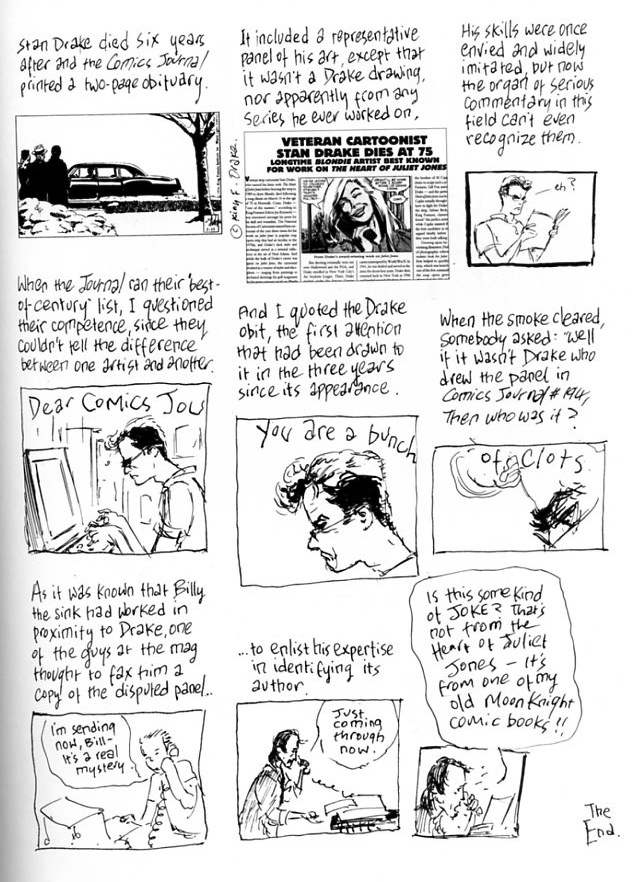
Eddie Campbell’s “How To Be An Artist” ends with Campbell writing an angry letter to the Comics Journal excoriating them for mistaking a Bill Sienkiewicz drawing for a Stan Drake drawing in the latter’s obituary.
Utilitarian Review 3/5/11— The Roundtable Has Pants Introduction
The Roundtable Has Pants
Next week we’re going to have a roundtable on Eddie Campbell’s Alec: The Years Have Pants.
Or at least, it was supposed to be on The Years Have Pants. We’ve had a slight bit of mission creep. Specifically, the good folks at have agreed to join us, and over the course of the week they’re going to talk about The Playwright and some other Eddie Campbell works. Also, Robert Stanley Martin writing here is going to talk about The Fate of the Artist.
So it should be a feats for Campbellphiliacs! Hope you’ll join us, both here and at The Panelists! (We’ll link to their posts as they go up, just so you don’t miss any.)
Here’s the ongoing roundtable.
And now for your regularly scheduled Utilitarian Review.
If Spiegelman Says It, It Must Be True
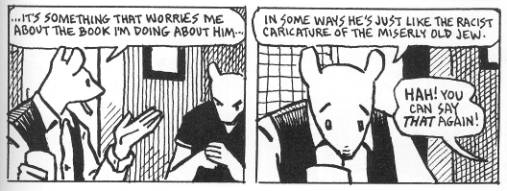
I’ve been tussling with a blog full of academics over at the Comics Grid (they even quoted my brother at me!) on the subject of Maus and metafictional conceits. Ernesto Priego in the post argued that Maus smartly employs self-reflexivity and irony, particularly in its use of comic-book tropes like caricature.
Don’t Bore the Children
This was first published on Splice Today.
_______________

I check Matthew Yglesias’ blog semi-regularly. He’s smart and a decent writer, and he hews close to the progressive party line. I’m a progressive myself, so that works out okay, and I happily click over to his place to find out why the United States isn’t as good as Scandinavia and why the Senate should be scrapped and why health care reform was a good idea.
Unfortunately, Yglesias also sticks to the progressive wisdom on education, where, as it happens, the progressive party line is now exactly the same as the conservative party line. This makes education that holy grail of punditry for progressives — a topic on which they can appear to buck conventional wisdom without offending anyone who matters. All the edgiest wonks agree: down with teacher’s unions; up with charter schools; and when in doubt, bore the kids.
Frazetta’s Barnyard Comics
HU alum Tom Crippen (who wrote with us in our blogspot days) sent us this piece. It’s good to have you back here, Tom!
____________________________
by Tom Crippen
Frank Frazetta (1928-2010) is probably the world’s best-known illustrator of fantasy adventure. He hit it big during the 1960s when his covers played a key part in the paperback boom that did so much for Conan the Barbarian and the works of Edgar Rice Burroughs. He stayed big all through the decades that followed. If you’re a dumb kid, or if any inch of you is a dumb kid, his paintings will overwhelm you. They’re like Led Zeppelin, premarital sex, or getting a driver’s license and driving fast enough to risk spinal injury. They’re as intense as psychedelic art but located at the other end of experience, the one where nothing matters but the juices flowing through your body. Look at them and your mind gets blotted out: there you are, hypnotized by muscle on muscle, shadow on shadow, detail on detail, and by the snakelike power that twists through his composition, because behind the whallop lies a superior degree of art.
Not With a Bang
I am sure that eventually, somebody within DC Marketing will envision a Grant Morrison Batman omnibus that collects his now historic runs of “Batman and Son” and “R.I.P.” (and its various preludes) along with his 16-issue Batman and Robin, the Arkham Asylum graphic novel, and even the tales collected as Batman Gothic.
That’s from Nathan Wilson’s review of Grant Morrison’s Return of Bruce Wayne up on the Comics Journal website.