Utilitarian Review 10/23/10

On HU

Kinukitty reviewed the yaoi manga How to Seduce a Vampire.

Andrei Molotiu examined how it changes our view of comics to see original comics art in a gallery context. (This is the first in a new series edited by Derik Badman reprinting academic articles and essays.)

Richard Cook examined 80 years of Asians on mainstream comic book covers.

I talked about Moto Hagio’s short story Angel Mimic.

Vom Marlowe talks about the novel Blackout by Connie Willis.

Caroline Small discusses Alexis Frederick Frost’s wordless minicomic Voyage.

Utilitarians Everywhere

At Madeloud I review doom metal band The Body’s album All the Waters of the Earth Turn to Blood.

Other Links
I quite like science blogger John Horgan.

This article, with Sesame Street appearances by Destiny’s Child, Stevie Wonder, and Paul Simon, is great.

Moto Hagio: “Angel Mimic”

I’m blogging my way through Fantagraphics’ Moto Hagio collection, “A Drunken Dream.” You can read the whole series of posts here.
_________________________________

Hanshin: Half-God and A Drunken Dream were both more plot hole than story; odd broken fairy tales with glimpses of trauma breaking through the prevailing aphasia. They’re unique, bizarre, and lovely.

“Angel Mimic” is, alas, much better constructed. There’s foreshadowing, thematic development, a final shock reveal — in short, all the elements of a traditional plot. As for what that plot is… Joe McCulloch over at Comics Comics has a good summary.

while a double-barreled blast of soap opera sees a suicidal girl hauled off death’s doorstep by a rough but handsome man who *gasp* turns out to be her new biology professor, resulting in detailed, evolution-themed educational segments (not unlike the learning bits in Golgo 13 or a Kazuo Koike manga) inevitably lashed to Our Heroine’s Dark Secret. “I wonder if humans will evolve into angels?” she muses, probably gauging the reader’s appetite for comics of this tone.

Joe’s a kinder man than I, so he doesn’t quite come out and say it, but — yeah, this is godawful. In her better stories, the fact that Hagio’s characters never for a second seem real gives her world an eerie air of unreality, like they’re pasteboard props erected to conceal an abyss. Here, though, more of the cracks are filled in, and Tsugiko ends up seeming less like a mask concealing wells of emotion and more like a hollow doll being pushed by rote towards the inevitable epiphany. There’s initial tension with the man who saves her — he wanders back into her life — they are thrown together by circumstance — they happen to meet her ex — they separate — they come back together — the secret is revealed — happy ending.

That secret (and hey, I’m going to spoil this crappy story now, so be alerted)….

Continue reading

Utilitarian Review 10/16/10

On HU

Matthias Wivel praises both pop and Popeye.

Sean Michael Robinson talks about his experiences making 24-hour comics.

Derik Badman has translated an article by French creator Fabrice Neaud about Aristophane’s Conte Domoniaque.

Ng Suat Tond discusses original art by Jaime Hernandez.

Vom Marlowe reviews Dungeons & Dragons #0.

Caroline Small discusses Frank Kermode, James Sturm, writing and reading.

And I started a thread to talk about what should and should not have been included in the Best American Comics 2010.

Also at HU, we’ve started using Read More cuts. I’m hoping this will make the blog a little easier to navigate. If you have thoughts on the change, please let me know in comments.

Utilitarians Everywhere

At The Chicago Reader I review the Neil Gaiman edited Best American Comics 2010.

Certainly there were loads of Sandman spin-offs. DC has, following Gaiman, shown some interest in fantasy-oriented series—the currently ongoing Fables for example—and independent titles like Gloomcookie and Courtney Crumrin followed a goth-oriented, female-friendly path. But these efforts were marginal. Overall, post-1990s, the mainstream comics industry first drifted and then scampered towards massive, complicated stories mostly of interest to a male, continuity-porn-obsessed fanbase. Gaiman moved on to writing novels (notably, sophisticated fantasies like Neverwhere and Coraline), and the formula he created was largely ignored. Instead of creating goth comics for girls, American companies chose to stick with insular cluelessness and let the Japanese have the female audience. Manga comics, especially those aimed at girls, exploded in popularity here. And that, in case you were wondering, is no doubt why the Twilight comic adaptation isn’t drawn by homegrown artists like Jill Thompson or P. Craig Russell or Ted Naifeh but by Korean illustrator Young Kim, in a manga style.

At his blog, Bert Stabler and I debate Funny Games, I Spit on Your Grave, horror and evil.

Bert: Everyone loves being blamed for their privilege, EXCEPT when it’s by someone who shares (and exceeds)that privilege. Basically, the beauty of Funny Games is that of a vulture feeding in the desert, not a cockfight. It’s not a guilty pleasure that excuses itself with self-awareness– it’s bloodthirsty pornography that reminds you that actors in pornography have actual lives.

At Splice Today I have an essay about Manny Farber and Paul Feyerabend and termites and Galileo. Unfortunately, they kind of chopped off my original ending, making me sound more sincere than I am. This is the original conclusion; imagine it’s there if you click over to read the essay.

Ultimately, Feyerabend concluded that his wish for a new insect view of the world was “just another example of intellectualistic conceit and folly.” Farber, too — in true termite-art fashion — disavowed his essay on termite art. Demanding an end to white elephants is a white elephant way to behave; ultimately termites to stay termites must eat themselves. What they leave behind them is, perhaps, a small space filled with meaning — the not-termite, trumpeting its victory.

At Comixology I write about Quentin Blake’s amazing children’s book, The Story of the Dancing Frog.

The picture of Gertrude picking up the frog is both moving and goofy. Gertrude is half in the water, her facial expression hard to read. The trees form an arch overhead, and her dress is pulled back by the water. It’s a ritual and sensual scene, like a rebirth or a wedding. The frog, on the other hand, is clearly not quite up to the role of Prince — it looks helpless and bizarrely cheerful with its googly eyes and gangly body, no more aware of the affection it’s inspired than an infant. Its obliviousness, though, only makes the moment more poignant. Without knowing it, it is both lost husband and child that never was, a lifeline that cannot possibly bear the weight put upon it.

And finally at Madeloud I have an article about musical guest stars on the 1960s Batman TV show.

Best American Kvetching 2010

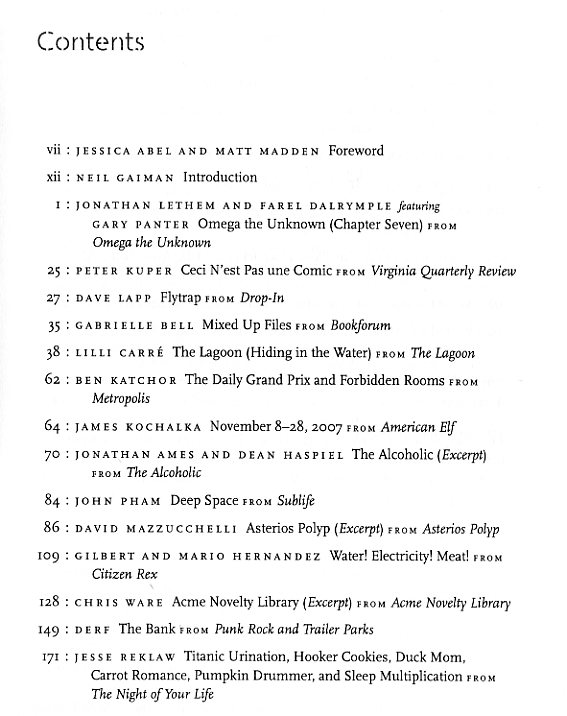
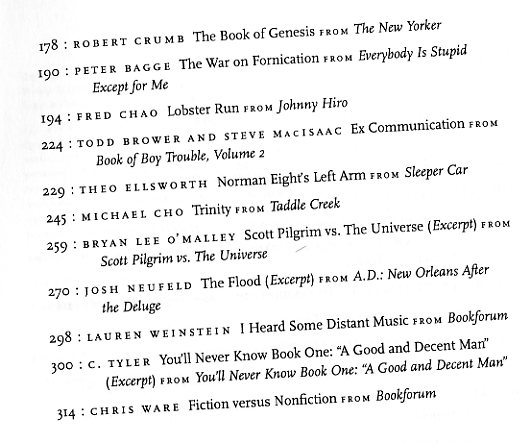
The Best American Comics 2010 edited by Neil Gaiman just came out a week or so ago. Here’s the table of contents:

My review of the book is here but I wondered…what do people think should have been included that wasn’t? And (since this blog abjures excessive positivity as bad for the soul) what do people think shouldn’t have been included that was? (Remember despite the title releases should actually be from 2009.)

I’ll kick it off — I think the worst piece in the book is probably Peter Kuper’s insipid anti-Bush boilerplate, “Ceci N’est Pas Une Comic. After that…um…Dave Lapp’s Flytrap with its mix of oleaginous condescension and crappy art is really bad…and the maudlin it-must-be-profound-because-it’s-about-9/11 excerpt from Jonathan Ames and Dean Haspiel’s The Alcoholic.

As for what I’d include: I definitely would have put in an excerpt from Johnny Ryan’s first issue of Prison Pit (which I reviewed here. ) I’d also have included an excerpt from one of Mo Willems children’s books, which are some of the most skillful comics around in whatever format (probably I’d have chosen something from the great Elephants Can’t Dance.) I’d definitely have chosen something from Kate Beaton too…and quite possibly from Garfield Minus Garfield.

The one piece in the book I agreed with down to my socks was the inclusion of an excerpt from Lilli Carre’s Lagoon, easily one of my favorite comics from last year. (I reviewed it here.)

So..use the comments to have at it. Feel free to include links to reviews of your own, too, if you’d like.

Utilitarian Review 10/9/10

On HU

This week started off with Erica Friedman talking about the Bechdel test and manga.

Alex Buchet wrote about fairy tales and silhouette art.

Ng Suat Tong reviewed Ma Li and Chen Uen’s popular Taiwan comic Abi Jian.

Richard Cook talked about gender in Final Fantasy XIII.

I discussed Alan Moore and the fans who hate him.

I talked about Moto Hagio’s short story Hanshin: Half-God.

And I reviewed Jim Collins’ Bring On the Books for Everybody.

Oh, and I think I’m going to stop with the music downloads. It’s been fun, but there’s not a ton of interest, and I spend too much time on the blog as it is!

Utilitarians Everywhere

At Splice Today I have an article encouraging gay teens to drop out of school.

Nonetheless, I find the message in the videos I’ve seen frustrating. Yes, it’s good for kids to know that things will improve. But high school isn’t a force of nature. It’s not a hurricane, or even acne. It’s not unavoidable. If high school is making your life miserable beyond all endurance—so miserable that you’re seriously considering killing yourself—then maybe you shouldn’t wait two or three years for your life to get better. Maybe you should just drop out.

Also at Splice Today I have an essay about the I Spit on Your Grave remake, feminism, the end of politics, and Funny Games.

The remake follows through on the group dynamics to some extent—the guys egg each other on; they bring Matthew along to lose his virginity, etc. But it abandons the effort to make the men appear like just folks. Ironically, the director Steven R. Monroe gives one of his characters a video camera, and we see some of the rape through the lens. This is an obvious effort to implicate the viewer, but in fact, this version of the story is much less accusatory than Zarchi’s original.

That’s because, instead of seeing the rape as a result of standard male group dynamics, Monroe tries hard to de-collectivize the guilt. In Zarchi’s version, the men were typical guys, and the rape, too, was therefore typical—a possibility for any man. In Monroe’s version, on the other hand, the rapists are individual monsters, a much less frightening idea.

At Madloud, I discuss 15 or so of the 15,000 covers of “Summertime.

This is fascinating, in a Hey! -that’s-Barry-Manilow-defecating-on-my-porch! kind of way. Philadelphia studio musicians turn Gershwin’s mournful lullaby into a giant lounge turd, complete with smooth-jazz intro and half-assed crappy disco cheese funk. For the full effect, imagine Paul Robeson dancing in a conga line with a white shirt open to his navel. Or, you know, don’t.

Other Links

Alex’s post reminded me of this awesome fairy tale resource.

I haven’t seen the Social Network, but the trailer looks terrible. I was pleased to see Jezebel buck the conventional wisdom and eviscerate it.

And this is several years old, but still an interesting article, on sexual harassment online.

Literature Will Eat Itself

An edited version of this essay first appeared in The Chicago Reader.
___________________________________________________

The last book but one I read was Jacque Derrida’s The Gift of Death, his late-career foray into deconstructionist theology.

To say that you recently finished reading a Derrida book for pleasure is obviously a fairly major throwdown (“Look at my brain!”) It’s also, though, somewhat uncomfortable — what sort of poseur reads Derrida for pleasure and then brags about it, anyway? In my case, the poseur-ness is only compounded by my motivations. I picked up the book because my brother (an English professor) had just mentioned his own Derrida reading, and I was feeling somewhat inadequate. Nor is this anxiety made any less shameful by the fact that the conversation with my brother occurred, not on the phone or in person, but in the comments section of my poncey comics blog. Said poncey comics blog being where I have most of my conversations with my brother these days. And yes, that’s embarrassing too.

Continue reading

Half-Drawn

I’m blogging my way through all the stories in A Drunken Dream, the collection of Moto Hagio’s stories out from Fantagraphics. You can see all posts about this collection here.
_______________________________________

Moto Hagio’s “Hanshin: Half-God” is about Yudy and Yucy, conjoined twins. Yudy, who tells the story, is ugly, shrivelled, articulate, and competent; her twin sister, Yucy, is a beautiful, mute parasite, who sucks away both Yudy’s nutrients and the affection of parents, relatives, and passersby. Yudy has to help Yucy walk and bathe and perform even the simplest tasks; in return, the simple Yucy gives Yudy frequent fevers and bothers her while she tries to study genetics. Eventually, doctors decide that the twins will die if they are not separated; the only choice is to cut loose Yucy, who will die, allowing Yudy to live. Separated from her twin, Yudy grows into a normal young woman. The end.

Sort of. If that was the story, it would be a fairly straightforward, even banal feminist parable about casting off gender expectations in order to find your true self. Yucy, the delicate, helpless, beloved beauty, has to be destroyed before Yudy can grow up into a competent, independent woman. QED.

In this reading, Yudy and Yucy are different aspects of the same person…and there’s plenty of evidence for that in the art. For instance:
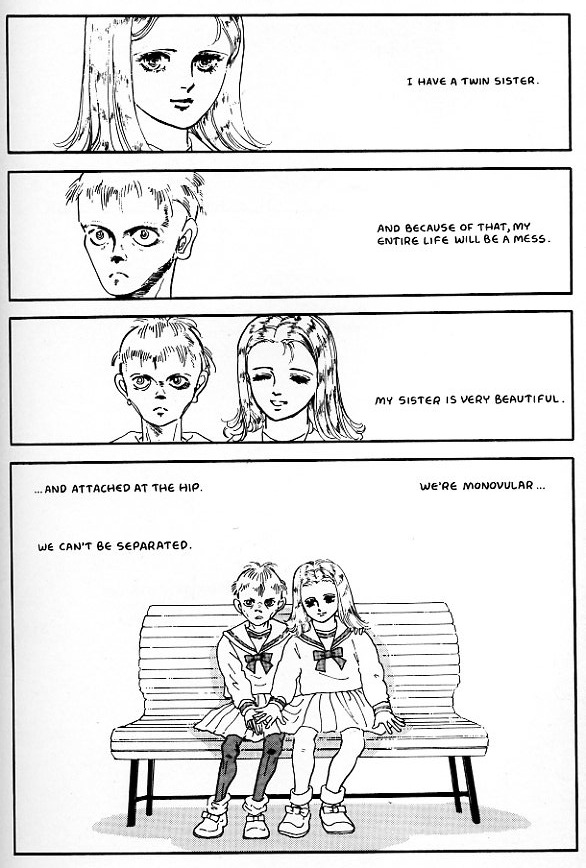
The first panel show Yucy off to the left against a blank background; then the second shows Yudy in the same position. In the third we see the two together…and only in the final panel on the page do we learn that they’re “attached at the hip.” The surprise reveal is, though, clearly rigged. If the two are attached, we shouldn’t be able to see them without each other. Particularly in the second panel, Yudy is placed so that we should see Yucy to her right — but all we see is blank space. The implication is that Yucy doesn’t exist except as metaphor…or perhaps, that Yudy doesn’t, since it’s Yucy we see first.

Again, just after the sisters have been separated, Hagio put in a tell.
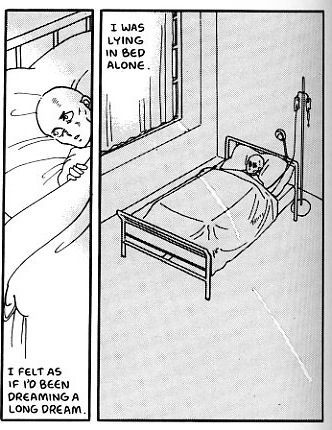
“I felt as if I’d been dreaming a long dream.” The twin is just a fantasy; only when she is separated is Yudy living real life for the first time. The perfect girl she is supposed to be doesn’t exist.

Except that she sort of does. Yucy doesn’t die immediately after being separated; instead she slowly wastes away. Yudy goes to visit her one last time, and is startled to see that her sister has turned into her own mirror image.
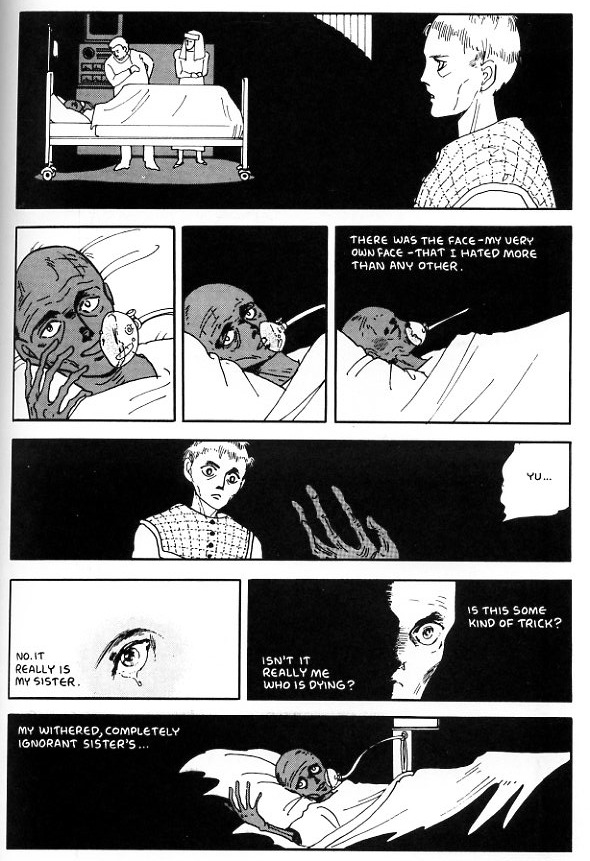
You could see this as still being about the escape from gender stereotypes — “Isn’t it really me who is dying? No it really is my sister.” Again, this could be a statement that the gender-normative self is not Yudy; that she has escaped other’s expectations. But the affect is off. Instead of joy or release, Yudy feels disorientation and grief. The self she has left behind is “really” a self; indeed, it now seems more like the real her than the her that has survived. As time goes on and she becomes healthier and healthier, Yudy begins to look like the sister who died, until finally she wonders which of them was killed:
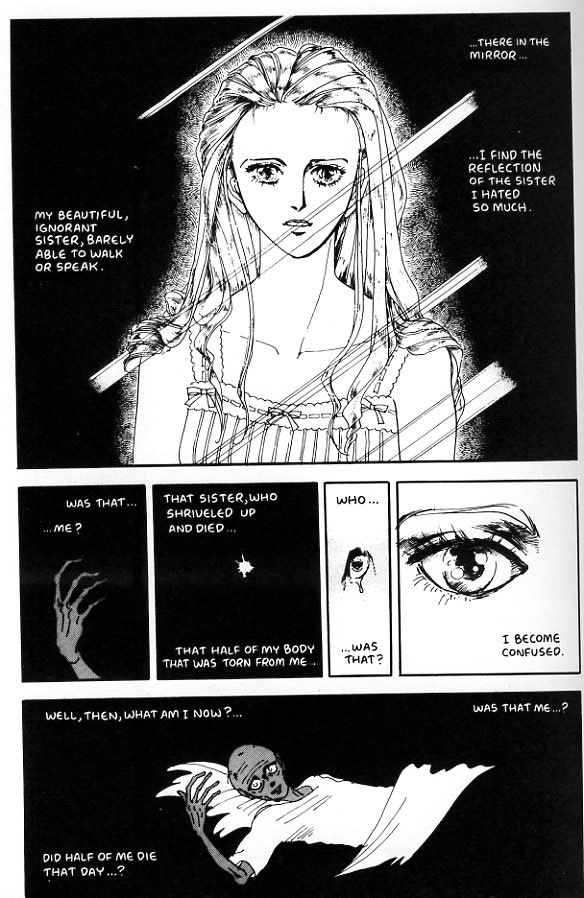
The story is no longer about casting off an oppressive femininity. Instead, it’s about…what? Betraying the self perhaps…but how exactly? Has Yudy betrayed herself by turning into the femininity she thought she was rejecting? Or was the rejection of that femininity — which also encompasses childlike innocence — itself a betrayal? Or is it the loss of her pain which is a betrayal; leaving behind the helpless, shrivelled, wretched self to become a competent adult? If so, the bind seems double and unescapable; to grow up, one has to abandon one’s attractive weakness, but doing so is always a betrayal of that weakness. The child is not the adult, even moreso because the child is still there in your face. Or, perhaps, the conflict is not internal at all. Perhaps the bond that holds together Yudi and Yuci isn’t sisterhood or self, but love, and it’s the abandonment of that love for femininity which causes Yudi to both become more feminine…and to be haunted by the conviction that she has lost herself.

There isn’t any one “solution” to the story, of course. This is emphasized by the fact that there isn’t one Yudy, or even two, but many. In a recent post about doubles in comics, Caroline Small suggested that comics can do doubling in a way that is less “labored” than prose. I was skeptical about this — but Hagio’s story may have changed my mind. Because in “Hanshin,” the metaphorical uncertainty around Yudy and Yuci becomes an actual, concrete ambiguity. That is, when Yudy sees Yuci lying on the hospital bed, and wonders, “Is this me or is this my sister?”, the narrative insistence on ambiguous doubling actually obscures the concrete doubling — Hagio is, in this sequence, drawing the same person twice — or more accurately, six times.

Yudi and Yuci in Hanshin are just names, assigned as Hagio wishes to different iterations of the same body. In her confusion about who she is, Yudi is more, not less, aware of reality — she senses the arbitrariness of Hagio’s choices, the way that names and identities are linked, not as absolutes, but through arbitrary decisions.
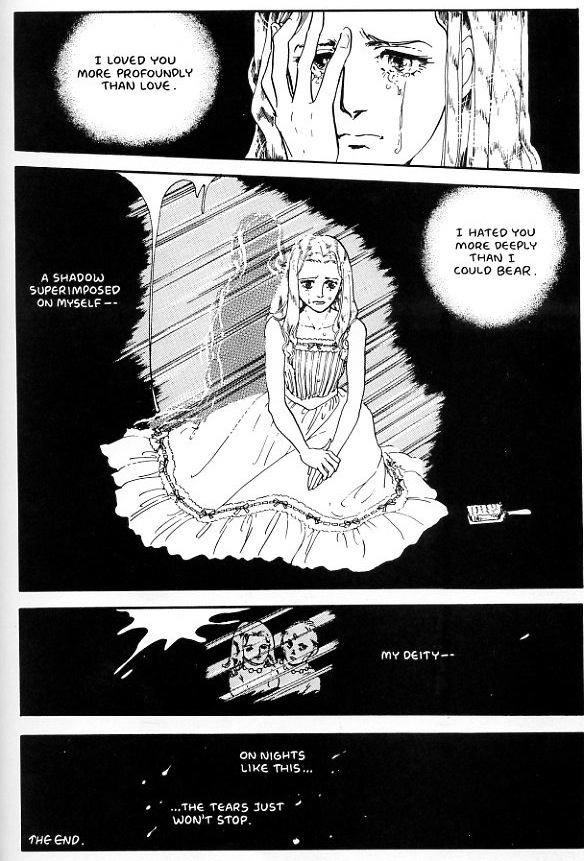
We “know” that is Yudi, but if Hagio changes the words, it could just as easily be Yuci who grew up. Which raises the question…who is talking here? Is that Yudi? Yuki? Or is it Hagio herself? “I loved you more profoundly than love. I hated you more deeply than I could bear. A shadow superimposed on myself….My deity —” Whose shadow? Whose deity? If one is drawn as two and two as one, who is doing the drawing? The same person who did the killing? Is the deity the one who is there or the one who is not, and how can you tell the difference? To create your soul is to split your soul; a god who has always already left half of herself behind.