Dirty Hippies Who Don’t Read Batman


Fucking freak.

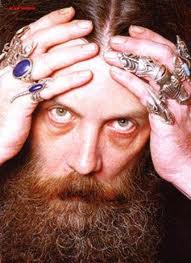
In case you missed it (as I did) Alan Moore gave a big interview a little bit ago to Bleeding Cool in which he talked about Watchmen and how he’s going to refuse to speak to various other of his collaborators because he’s a crank and, oh, incidentally, DC comics is run by what we would call disease-ridden rodents if doing so would not get us sued for defamation by capybaras with head colds.

As I said, I missed the interview, and didn’t actually read it in full until just now because, (a) I already knew that Alan Moore was a crank, and (b) I already knew that DC comics was a cess pit. So I felt I had the gist.

However, it turns out others saw some novelty there. Specifically, Tom Spurgeon has a really excellent discussion on his site.

So let me suggest that anyone that just throws their hands up and says “Oh, that Alan Moore is crazy” isn’t just operating from a dubious moral position, they don’t know their history. Forget 25 years of Watchmen shenanigans for a second. If I had had just the experience Alan Moore had with ABC, where I had this giant, multi-pronged project with a publisher not DC in part because they were not DC and then found out one day when I felt I was too far along to back out without screwing over all my friends that my projects were part of a big sale to DC, I would suspect that company of bugging my phone and poisoning my water. If I had had the subsequent experience of being promised certain protections from aspects of DC editorial and then that falling through in absolutely pathetic and super-aggravating fashion over the stupidest of nonsense, I wouldn’t trust them to keep their word on a single damn thing. And that’s just one set of experiences for Moore when it comes to DC. People get more worked up in many industries when someone bogarts their parking space or makes them turn down a paid-for week in Disney World than Moore does here about 25 years of systemic dickery.

Then, in response, T. Campbell argued that Alan Moore should be mocked.

I agree that throwing up our hands and saying “Alan Moore is crazy” does a disservice to Moore, and much more importantly, to the issues raised in his interview and the meta-issue of how a creative person should conduct himself in public. Unfortunately, that denies him the insanity defense, which could be a useful excuse when he airily dismisses both his old friends (ex-friends?) and every comics writer in the new generation, whose work he hasn’t read.

Your argument that other people are crankier with less justification seems a bit desperate. Other people are serial ax murderers; that doesn’t mean we need to set the bar of acceptable behavior low enough to make one-time-only murder okay. Yes, we have all had bad-tempered moments, but the reason comics people care about Moore’s behavior in the first place is that his talent and career have made him a role model. And when role models fail, we should pay attention, because what happened to them could happen to us.

No one’s even mentioned that Moore has also airily dismissed the entire medium of film, several times, but oh it turns out he really just meant all the films that are playing now, which he hasn’t seen, and please won’t you watch his new film project which gets it all right?

Campbell also says:

I’ve never entirely understood the comics community’s addiction to tales of corporate betrayal. When an boulder doesn’t fall on you immediately, but waits for a few minutes and then falls on you, is that a “betrayal?” Because it seems to me that corporations in general don’t have a set of values to betray. They like money. That’s all there is to it. They pursue ethical behavior when it is profitable for them to do so, and individuals at the company are sometimes moral people, but a company is about as moral as a boulder, because it is a group of people with sometimes-conflicting values and opinions brought together by common profit. The basic failure to understand this, the continued attempt to anthropomorphize companies as if they were individuals you could trust or talk to, strikes me as a common failing of the artistic imagination.

Tom Spurgeon supplies an able rebuttal, with which I pretty much agree. I wanted to point out a couple of things from a slightly different angle, though.

First of all, Campbell suggests that Alan Moore is crazy. His primary evidence for this is that Moore dismisses old friends, dimisses comics writers in the current generation whose work he hasn’t read, and dismisses today’s films without having seen many of them. This is not how a “creative person should conduct himself in public.”

One does wonder which creative persons Campbell is thinking about precisely. Not Kanye West or David Boreanaz, I take it — or even Lady Gaga, presumably. Really, is there anybody out there who expects creative people to be beacons of propriety? I thought the expectation was that, on the contrary, creative people would be unpredictable and sometimes not especially nice, what with the driving ambition and the money and the fame and all. Hasn’t Campbell ever seen Behind the Music?

Anyway, while he’s no Varg Vikernes, it’s true that in his own small way Moore is a crank, and from all appearances a very difficult person to deal with. He believes he’s an actual wizard, for goodness sake. His habit of dropping friends is infamous, and he talks smack about his co-creators in public like he’s a rock star rather than a comic book writer. He lived in a polyamorous relationship for some time, and he writes underage pornography and even uses his real name while doing it. He’s a big, dirty hippie with a strong conviction of his own genius, and he’s a lot weirder than the average comics creator or fan. This is not news to even a small degree. In fact, I think it’s safe to say that Moore’s highly unusual career, including its very substantial achievements, probably has something to do with the fact that he comes at comics from an idiosyncratic perspective.

But — how idiosyncratic is it, really, to sneer at contemporary film without really being especially up on it? Or how weird is it to say, “comics today suck” without having read a ton of them? People do that sort of thing all the time. And there’s no reason not to, is there? If you disagree, you disagree, if you agree, you agree. He’s shooting the shit, the way most people do when they talk about art. What’s the harm?

Campbell actually explains the harm in a second post.

Bottom line: I don’t see how there is anything “reasonable” about dismissing large bodies of work, and indeed entire media, that one claims not to have consumed. I can’t help but see a parallel between that kind of closed-mindedness and the closed-mindedness that keeps many people from reading comics.

“The closed-mindedness that keeps many people from reading comics.” It’s the ultimate insidery comics insult. You’re one of *them*, Alan! One of those evil people who doesn’t want to read comics, who thinks we’re a bunch of juvenile morons who don’t know that underwear is worn on the inside! Traitor! Traitor! Traitor!

The main infraction, the “bottom line” that makes Moore not “rational” is the fact that he basically doesn’t give a shit about the stuff he’s supposed to give a shit about. He doesn’t want to read contemporary comics; he doesn’t want to go to the movies. He just wants to crankily complain about them. He’s dipped his toe in once or twice at some point, presumably, he discovered he didn’t like it, and, instead of gripping tighter and tighter in nostalgic ecstasy while searching, searching, searching for the one piece of gold amidst the variant covers, he just said “fuck it.” He’s (gasp!) not a fan. And we all know that if you’re not a fan, you must be insane. And also a bad person. QED.

What’s especially interesting about this is that Moore’s criticism of the comics industry’s practices and creativity is actually tied to fannishness as well. Moore basically argues that DC is screwing him over in substantial part because they’re not creative; they just want to keep recycling the same old properties rather than coming up with something new.

This recycling is, of course, at the center of the current mainstream comics industry. Moore has, more than anyone, shown that said recycling can actually be creative and exciting. But for all his magic, he’s never been able to convince fans of that old dictum, “it’s the singer, not the song.” The mainstream audience remains much more interested in the old moldering properties than it does in the creators who reanimate them. And mainstream companies remain much more interested in what to do next with Batman than they are with what to do next with Alan Moore.

This is why Campbell’s pragmatic ode to the unculpability of corporations rather elaborately misses the point. Tom Spurgeon points out that, “Both DC Comics and Drawn and Quarterly are companies, but one has a mixed record when it comes to how it exploits people and one has an exemplary record,” which is true, but even that’s not exactly the issue. Rather, the issue is that mainstream companies act the way they do because of their history and because of their relationship with their readers and their creators. The music industry is a bastion of nightmarish evil, but they wouldn’t have fucked over Alan Moore in the particular way DC fucked over Alan Moore because you don’t treat creative talent that way in the music industry. And you don’t treat creative talent that way because the creators are more important than any individual thing they create. Fans pay attention to the creators; they care about the creators, not the individual album or the character. Beyonce can make up an alter-ego named Sasha Fierce for one album, but no industry exec is coming along to say, you know, we’re going to take this character and have it record polkas whether you want us to or or not. They don’t do that because it would be fucking ridiculous, and fans wouldn’t stand for it. But DC does it to Alan Moore and fans not only eat it up, they sneer at the man himself when he dares to suggest that the folks they plan to get to write the polkas are soulless, talentless hacks. (Moore even seems to be dissing Grant Morrison! Sacrilege!)

Tom writes that, “I think a lot of this comes down to the fact that for whatever reason, Alan Moore didn’t conduct himself in a way that suited comics fans.” I think that’s right, and I think the reason it didn’t suit comics fans is pretty clear. Namely, it didn’t suit comics fans because Moore is declaring that he is not one of the club. Further, he is declaring that the club screwed him over. His work has been bastardized and his pocket picked precisely because of the insularity, backwardness, and lack of creativity of mainstream companies, mainstream creators, and mainstream fans.

And how do the fans reply to this accusation? By declaring — Fuck you, you dirty hippie, you don’t even read Batman, why should I care what you think? And, oh yeah, how dare you be paranoid or bitter, huh? If you can’t smile and cheer for the latest crossover, then just take your beard and your polyamory and go suck on a snake demon or something.

But, hey, leave those IPs behind when you leave, damn it. I need a Rorschach plush toy for Christmas.
Utilitarian Review 10/2/10

On HU

Domingos Isabelinho discussed a critical essay by Bruno Lecigne.

Ng Suat Tong explained why Blacksad is pernicious and derivative.

Richard Cook talked about Marvel Comics published in September 1980 (including…The Death of Phoenix!

I discussed Moto Hagio’s story A Drunken Dream.

In a guest post, architect and cartoonist Aaron Costain talked about the similarities between comics and architectural plans.

And Vom Marlowe sneers at the motion comic Lost Girl and praises Benjamin Lacombe’s book trailer, Il etait une fois.

Utilitarians Everywhere

At Splice Today I reviewed some Chinese black metal and talked about the fuzzy unifying power of hate.

At Madeloud I reviewed the latest Shonen Knife album.

Other Links

Derik Badman has an interesting post about style in comics.

Tucker Stone talks about comics journalism.

This is a great post about make-up and fashion and the confusions straight men are prone to.

And I enjoy being reminded every so often that for all his virtues, Obama is kind of a soulless hack.

Incoherent Dreams

Last week I wrote about the first four stories in Moto Hagio’s “Drunken Dream.” All of those stories had coherent themes, recognizable characters, and linear plots with a beginning, middle, and end. They all also, and not coincidentally, sucked.

The title story of the volume, “A Drunken Dream,” is, on the other hand, an incoherent mess.

And thank goodness for that. As I said in the last review, Hagio is really poorly suited to telling stories that make sense. There are shojo titles I love that are predicated on strong character development, subtly observed relationships, and psychological acuity. But that is not at all where Hagio is coming from. At least in the work of hers I’ve read, her characters are conglomerations of stapled together clichés; her relationships are little more than heartfelt declarations and melodramatic gush; her psychology is (at least on the diagetic level) pop piffle and the occasional yawning absence. You get more realistic motivations and more subtle characterization in your average super-hero title — and that, true believers, is a fucking low bar.

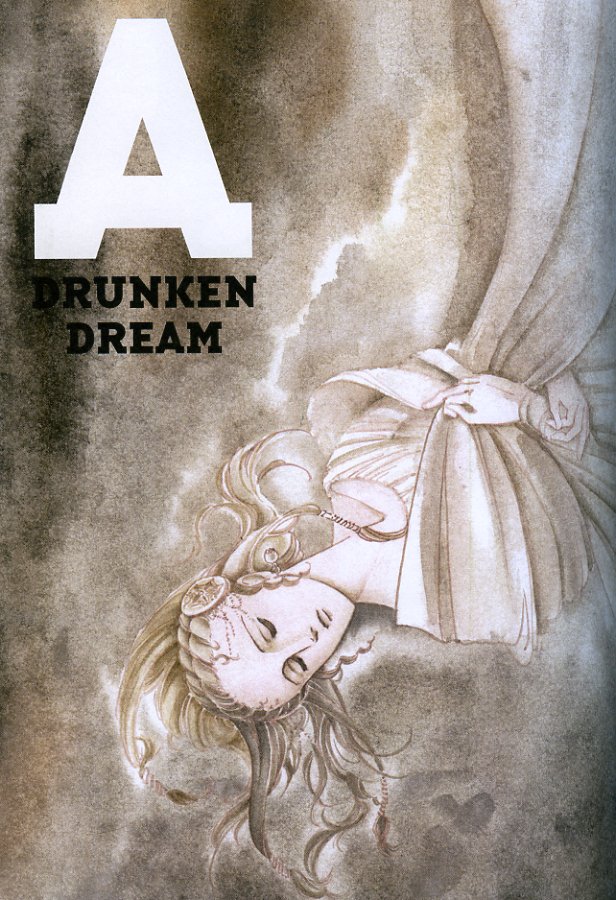
Which is why the best Hagio that I’ve seen is the Hagio that doesn’t even gesture in the direction of realism —unless you count thumbing your nose as a gesture. The story “A Drunken Dream” is a fine example. In fact, the narrative is a tour de force of non-specificity. The splash page shows a woman in some sort of traditional period dress upside down drifting through brownish-red n-space.

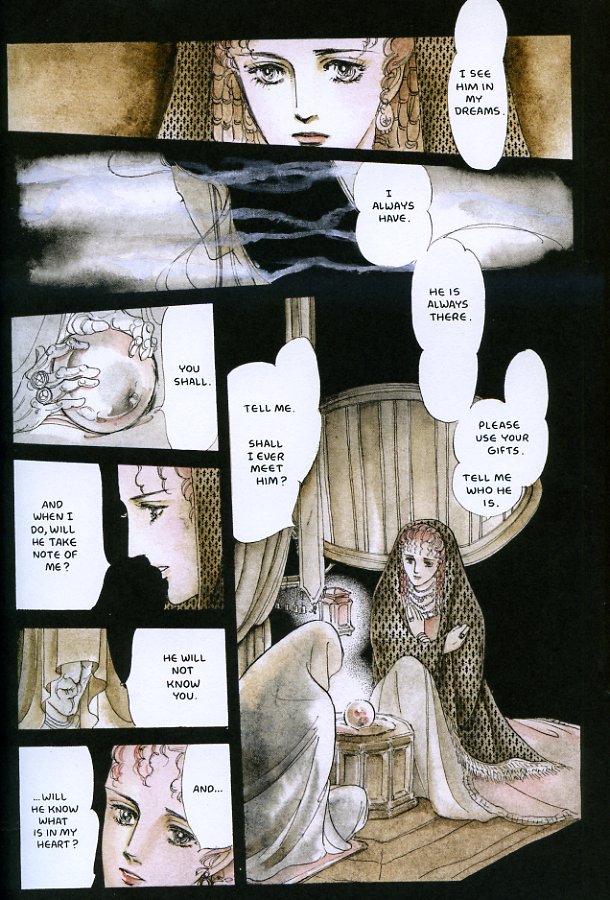
On the next page the same woman is upright, but no more located — in fact, the first image is a close-up of her thinking about her dreams, and the next is a hazy shot of the back of some guys head. In the next panel we do get some sense of where we are, sort of; the woman is talking to a standard-issue fortune-teller in a room which recedes into blackness.

Then for the next two pages we swoop into the crystal ball, seeing a vision again of the back of the man’s head as he stands over the woman, now dead, lying face down.

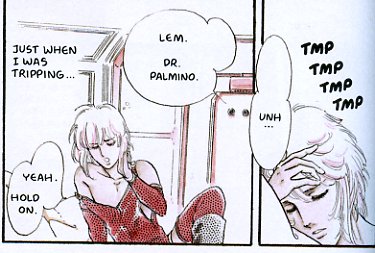
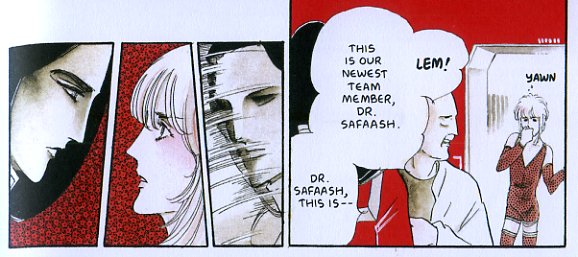
It’s the next page which pushes the refusal to tell us where on earth we are right over the top — not least because we’re suddenly not on earth. Instead, we exchange the generic fantasy setting for a generic space setting; the woman we saw before is on a space station, where she goes downstairs to meet back-of-head guy. The two recognize each other, as we do, from their dreams.

Again, from the perspective of a conventional, well-made story, this is a disaster. Both the fantasy milieu and the sf milieu are pure genre kitsch. The two main characters, Lem and Gadan Safaash, are equally ill-defined — we know nothing about them except that Gadan is literally the man of Lem’s dreams. Over the next couple of pages, Hagio does give them a little banter; Lem is a scientific rationalist, Gadan is a scientist but also a priest who believes in Spriritual Truths, blah blah blah. Trite new age nonsense joins trite sf and fantasy and romance clichés in a giant ridiculous ball of nonsense.

But…you get that much nonsense in half a dozen pages, and it starts to look deliberate. It’s one thing to have a bland fantasy setting; it’s another to leap from bland setting to bland setting like some sort of aphasiac, amphetamine-charged bunny. Contrasting the fantasy with the sf and both with the insistent discussion of romantic dreams and New Age gobbledygook — the world Hagio is setting up is so friable is starts to disintegrate as soon as you even think about touching it.

The tell, here, is Lem herself…or himself. After the switch from fantasy to sf, other characters refer to Lem, who initially seems to be the woman in the first pages, as a man. Shortly thereafter we learn that “while Lem manifests as male…he in fact has xx chromosomes.” The gender swap is keyed in part to the difference between fantasy (often coded female) and sf (often coded male). And it’s also enabled by the comics medium itself; because the drawings are iconic, cartoon representations, we can’t, in fact, know Lem’s gender until someone in the narrative tells us what it is.

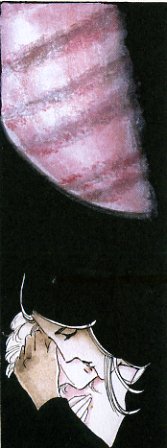
Thus, gender becomes both a function of genre and of artistic convention, pointing to and determined by shared fantasies and by Hagio’s individual artistic fiat. The universe and individual identity are linked, and both are arbitrary, not in the sense of being stochastic, but in the sense of being provisional. This is a world that is coming into being with each panel — and fades out in the gutters. Thus, when we finally see back-of-head guy’s face, you get the sense that it’s actually being created for the first time as you watch. This impression is only heightened by the way that Hagio cheekily uses the speech bubble to white his face out in the previous panel.

Over the next few pages, Lem and Gadan talk about their mutual dream, in which they both see Lem lying face down at Gadan’s feet. Gadan tries to explain it by arguing that “I think some kind of shock has created a wound in the space-time you and I occupy, forcing us to repeat the same experience.” Lem suggests this is “Like some kind of psychological trauma in space-time…” moments before the land-rover the two are driving falls into a pit. Luckily, though Lem is injured, he is not killed — and the two speculate that space-time is trying to heal its own wound by turning Lem into a hermaphrodite, breaking the cycle of repetition and death. The moral for Hagio couldn’t be much more clear — gender drift and same-sex desire comes out of trauma and heals it, the arbitrary universe of the psyche stitched together by unconventional love. Fade out, the end, as Lem and Gadan kiss each other.

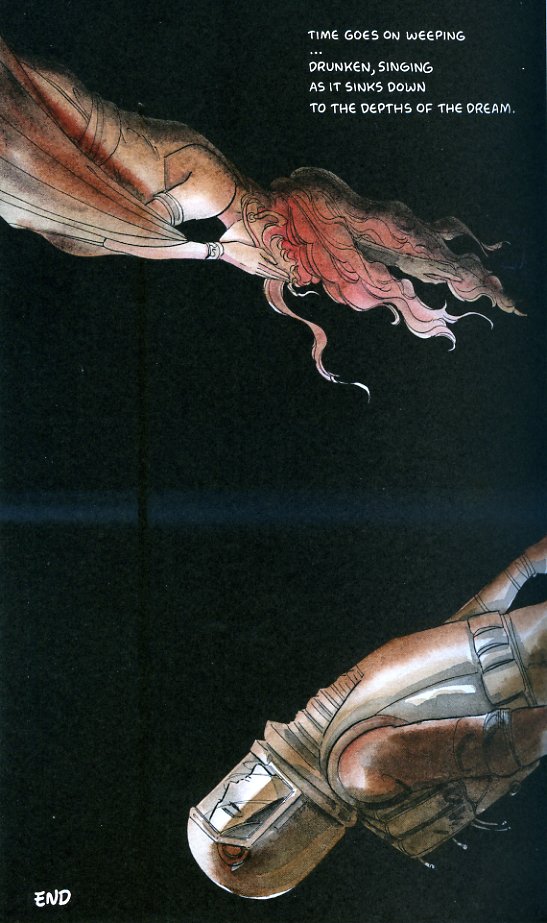
And then things get weird. Because the comic refuses to end. Suddenly, it shifts back to the fantasy setting. Lem is now Princess Palio, Driven by dreams, she saves a handsome prisoner (Gadan)…and said prisoner turns around and kills her for her pains. Except then Gadan from the future comes back as a spirit and kills his former self, who ends up lying face up before Princess Palio. And then we shift back to the sf setting, where Lem and Gadan are somewhere (falling into the same pit as before? in a different accident?), only this time Gadan is killed. And we end with Gadan in his spacesuit drifting through black space with Princess Palio above him.

There are so many ways this doesn’t make sense it’s difficult to count them all. In the first place, if the fantasy setting was supposed to be the beginning of the cycle of trauma, why is Palio already having dreams about back-of-head guy before he shows up? And is the bit where Gadan and Lem survive the accident itself a dream, or do they have a second accident, or what? And are we really supposed to admire and/or feel sorry for back-of-head-fantasy guy after he cruelly stabs his rescuer for pretty much no reason except that he’s a jerk?

The last is perhaps the most pertinent question if we accept that the story is about trauma and abuse, and that it’s characters are not characters at all, but stand-ins. The generic fantasy setting isn’t real; the generic sf setting isn’t real; Lem isn’t real and neither is Gadan. But the primal scene of trauma is real; the knot of love and violence that repeats and repeats, propounding different resolutions but never resolving. The story says, if I were a man he wouldn’t hurt me; if we were in a different world he wouldn’t hurt me; if he understood he would regret what he did and try to make it right; if we really knew each other, face to face, he wouldn’t hurt me. But the happy endings turn into nonsense; even the abuser’s change of heart doesn’t lead to love, but only to more pain. The end is not the kiss of reconciliation. Instead, “Time sees the same dream. It sees the same dream again and again. This dream shall never fade. Time goes on weeping…drunken, singing as it sinks down to the depths of the dream.”

In the first few stories in this book, Hagio deploys conventions and clichés clumsily. She deploys them clumsily here as well…but her drunken stagger is its own kind of grace. The trite wish fulfillment is so poorly constructed it disintegrates. The very glibness of the medium, the way that comics can so easily evoke genre with the image of a sword or a spaceship, is turned back on itself. We’re left with stupid tropes floating in emptiness, and the story we’re told, the face we see, drops away to reveal a space like a wound.

____________

My apologies for the places where the scan colors are screwed up, by the by. If you want to see the art the way it’s supposed to be, I’d urge you to buy the book!

Done

Hey all. It’s been 10 months since we moved over to out new home at tcj.com. I think that’s hopefully enough time for everybody to know we’re there rather than here, so I’m going to stop doing updates on this blog. If you’d like to see what HU is up to, please click thorugh the link. We continue to post every day on comics, culture and more. Hope to see you there!

Utilitarian Review 9/25/10

On HU

To start out the week kinukitty reviewed the yaoi manga Hiro Madarame’s Scarlet.

Ng Suat Tong discussed Jacques Tardi’s It Was the War of the Trenches in comparison to other war narratives.

Richard Cook looked at the DC comics that came out in the month he was born, September 1980.

Alex Buchet continued his series on comics and architecture with a discussion of comics creators who also did architectural projects.

Sean Michael Robinson wrote a lengthy article on the Choose Your Own Adventure series.

I explained why I didn’t like the first four stories in Moto Hagio’s Drunken Dream.

And for your download, a collection of torch songs.

Utilitarians Everywhere

At Splice Today I review Justin Townes Earle’s latest album.

At Madeloud I have a review up with Jake Austen about his work producing Chic-a-go-go, Chicago’s all-ages public access dance show.

On tcj.com, Matthias Wivel reviews Ulli Lust’s “Heute ist der letzte Tag vom Rest deines Lebens.

Other Links

Matt Seneca talks about a Gary Panter panel and the ways of realism.

Karen Green has a thoughtful article about what is and is not propaganda in comics.

Groovy Age of Horror is the best there is at what it does.

Die, Little Girls! Die!

I plan to do a number of posts blogging my way through n Moto Hagio’s Drunken Dream, released recently by our kind hosts at Fantagraphics. I’m a fan of Hagio’s work…or of as much of it as I’ve seen. (See my review of AA’.) And I have great, great respect for translator and editor Matt Thorn, (who was kind enough to facilitate the inclusion of this piece in an online project I did some years back.)

So basically I was hoping to be wowed by this book. And I don’t think that that’s entirely impossible even still — I skimmed ahead to reread “Hanshin: Half-God,” the one story here that was reprinted in TCJ #269, and that’s still awfully, awfully good (and I’ll discuss it in order in the next post or so.)

However, the first four stories do not live up to expectations. Because they kind of suck. And not just “suck in comparison to what I was hoping for.” They’re out and out crap — presuming you drew little hearts and flowers on your crap and maybe put a little schoolgirl dress on it, and then nailed it to a tree and sang to it odes about the transcendent power of art as it oozed with limpid bonelessness down the trunk to finally crunch ineffably on the leaf-strewn forest-soul.

Anyway. We’ll take them in order. (There are lots of spoilers here, if that concerns you. In fact, I pretty much spoil everything. Fair warning.)

Bianca

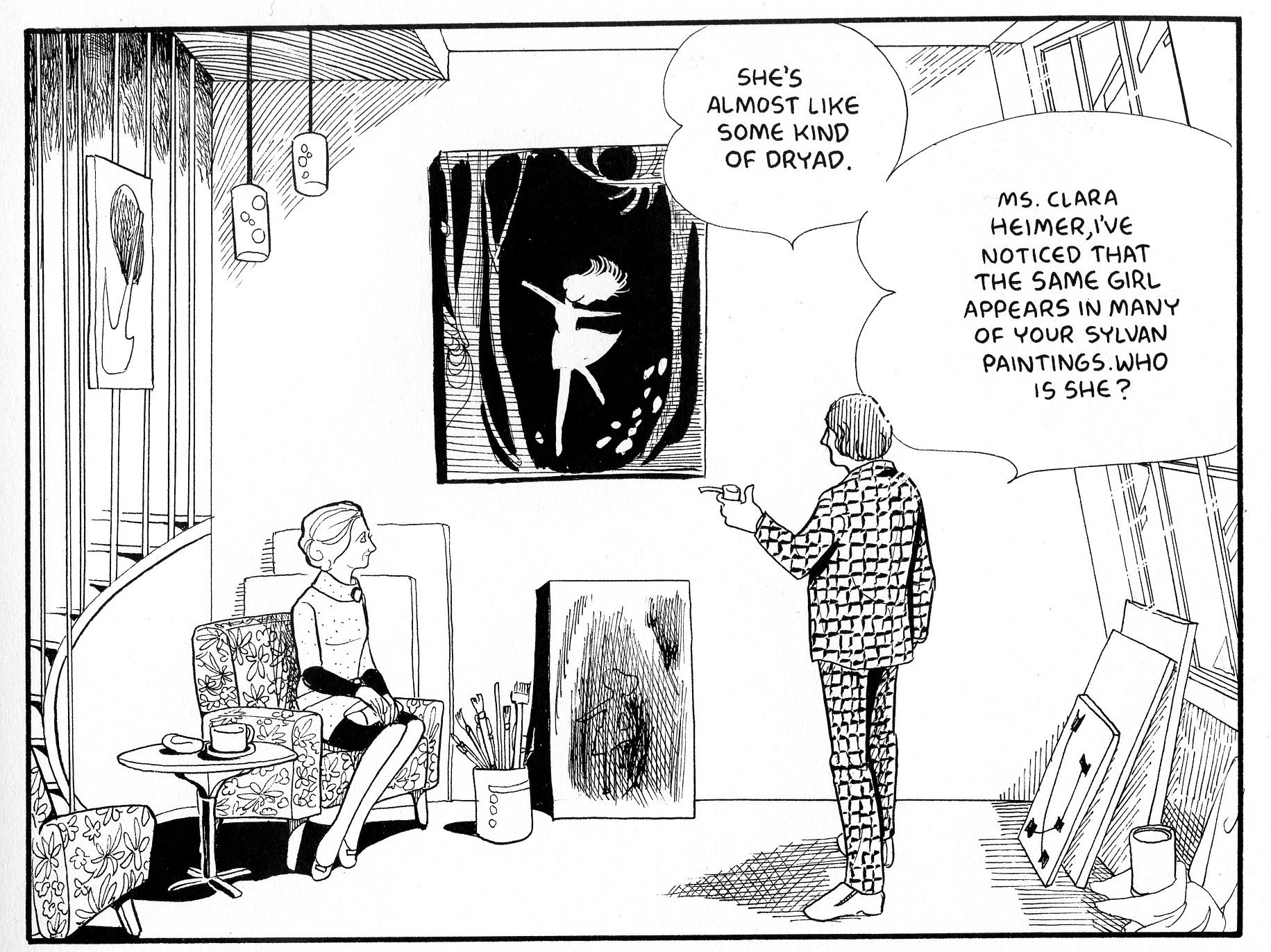
This is framed as a conversation between some guy with an aggressively patterned suit and the great painter Clara Heimer. Aggressive suit guy asks Heimer who that little girl is in all her paintings and she says it’s her lovely inner-child/nature spirit and then she looks up meaningfully as an infinite number of self-help books fall from the sky and crush her and the guy dead, leaving only the empty and aggressive suit to dance wildly, desperately, transcendently upon their moldering corpses.

I wish. Actually she says the girl in the pictures is the titular Bianca, a young ten-year old cousin Heimer met for the first time when she was 12. Said cousin is a free spirit who cannot be contained, which translated means that she likes to run outside and dance in the forest “like some kind of dryad” as aggressive suit guy says. Clara doesn’t understand her free-souled cousin and makes fun of her dreams, causing said cousin to lash out and go dance in the forest some more. But, hark! Free-souled cousin also has a Dark Secret, which is that her parents are breaking up. The final news of their divorce sends free-soul (you guessed it) back out into the forest, where she is so distracted that she falls off a convenient cliff, taking herself mercifully out of the story. But she has, alas, inspired Clara forever. Or as Clara says, “I saw the wind. I saw a dancer. I saw the world of a girl who became one with the forest.” So Clara goes on to spend the rest of her life drawing trite dryad pictures about the wounded child inside all of us and how the trembling spirits need to be free and how you shouldn’t make fun of people’s dreams no matter how clichéd and irritating they are. Let’s…let’s save all the children. Save the babies…save the babies…

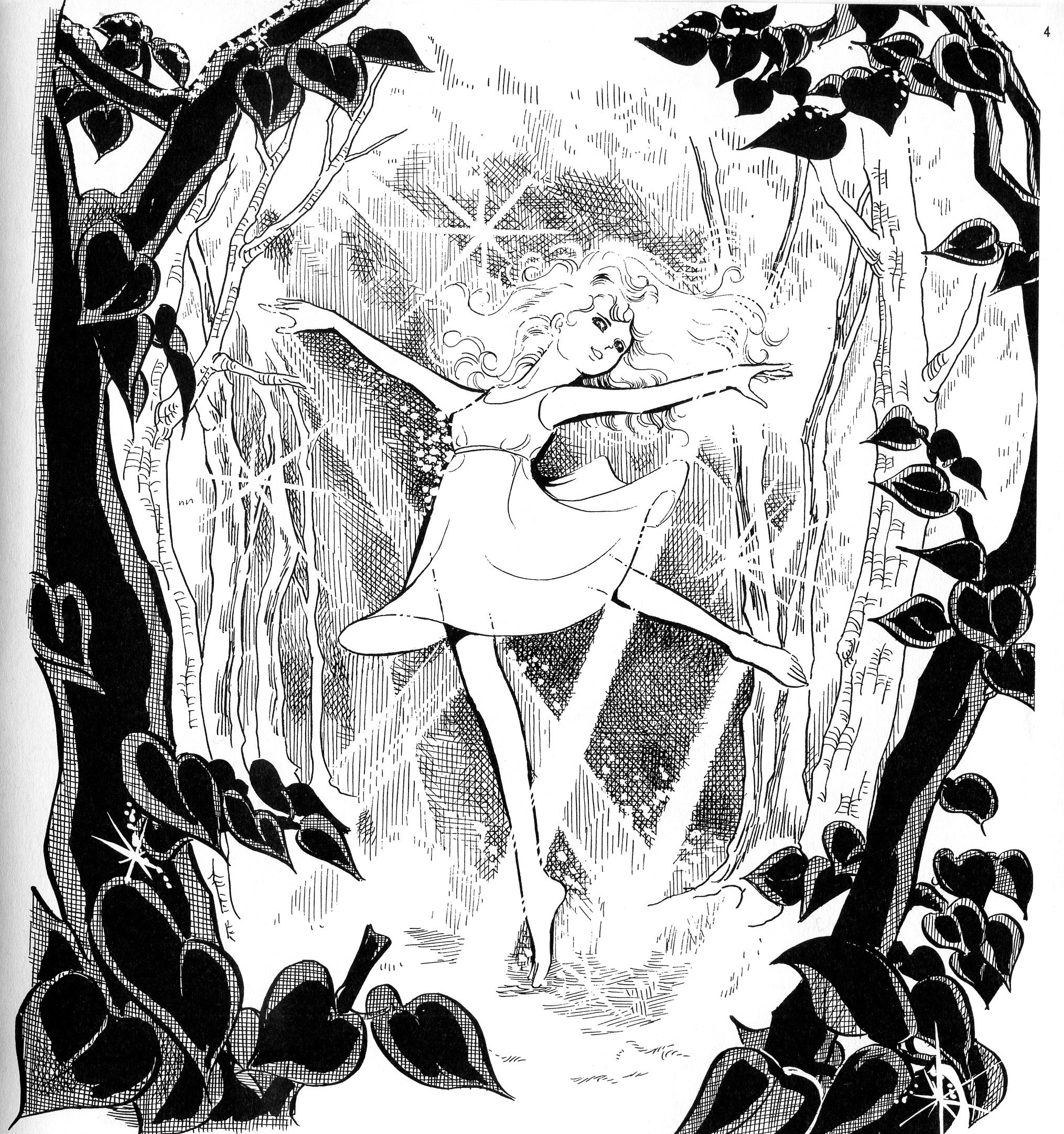
Here, look. Save this, damn it!

The light and trees criss-crossing; Bianca in the center with the airy thin lines of her dress — it’s impressively designed. But it also seems too perfect, with those trees at the side conveniently framing the imge, and Bianca herself stuck dead center. Her pose even makes her look like she’s a decoration on a cake. Hagio’s style is delicate and pretty; layered on this delicate and pretty narrative, it just makes the whole thing so precious it’s hard not to gag.

Girl on Porch with Puppy

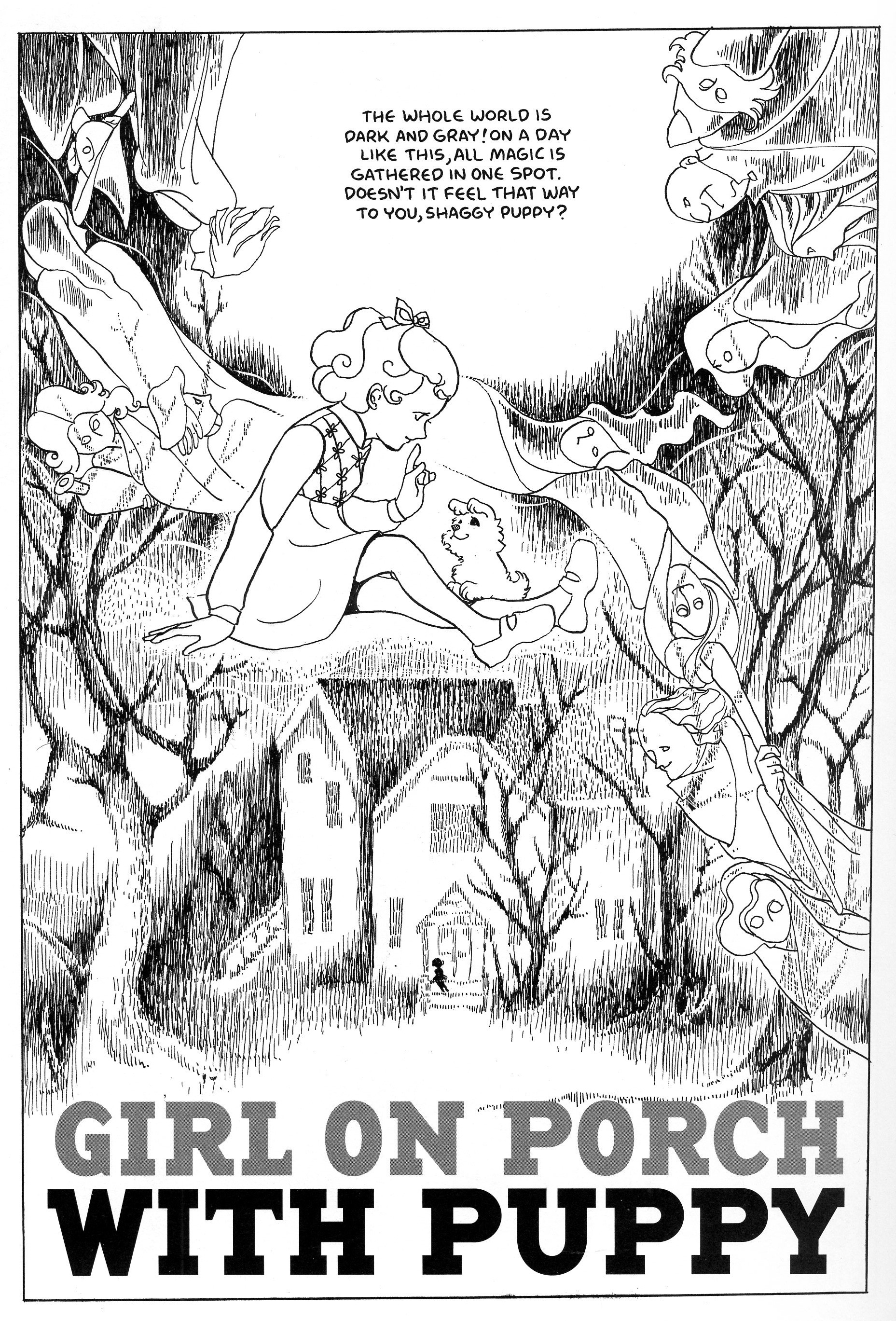
The opening visual here, on the other hand, uses pretty to contrast with creepy — which only makes the whole thing more disturbing.

I wish those weird, semi-faceless ghosts hung around for the whole story. Unfortunately they don’t. Instead, as far as narratives go, this is basically more “Bianca”, except worse. Like the title says, a sweet little girl sits on the porch and communes with her sweet little lap dog. Various adults (doctor, mother, father, etc.) wander past and wonder what’s up with her and/or express disapproval because she likes to sit outside in the rain. She muses self-consciously about vapidly trite saccharine hallmark card drivel and about how much more wonderful she is than boring old adults (“I don’t know what the doctor’s thinking either. But I don’t think it’s about the sky or windows or flower buds or the fairies behind the leaves”).

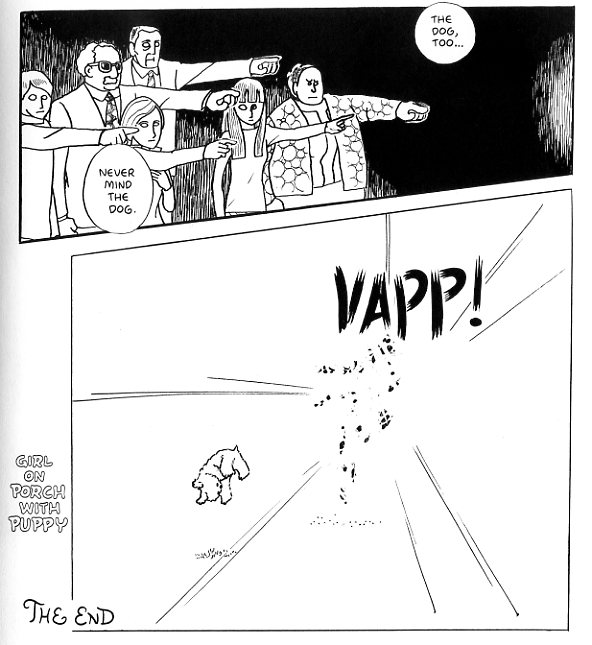
So the boring old adults get together and decide “we can’t have one person thinking differently from everyone else like that.” Then they point at her and she explodes. Admittedly, it would have been better if they did that on the first page rather than the twelfth. But beggars can’t be choosers: it’s an unexpected but welcome happy ending as far as I’m concerned.

Autumn Journey

A young boy named Johann sets off to meet his favorite author, Meister Klein. He ends up hanging out with Klein’s daughter, and there’s some romantic tension, until…she discovers Johann is Klein’s son, from a family Klein abandoned. Johann isn’t mad at Klein, though, because he read one of Klein’s books and realized that “He had lived so much longer than I, known so much sorrow, and yet he told his stoires with such warmth, such sincerity.” You can tell he’s sincere because…flowers!

In short, if you’re a great artist, you can’t be a complete asshole and moral failure — an insight flagrantly contradicted by everyone from Pablo Picasso to Ezra Pound to Kanye, but what the hell. Johann’s enormous eyes leave little room in the skull for grey matter, so I guess he can’t really be held responsible for lapses in logic. Anyway, at the end his father runs after him as he rides away on a train. That’s redemption, kiddies.

Perhaps it’s not fair, but I’ll admit this is kind of a pet peeve of mine. Maybe it’s because I have a number of friends whose fathers walked out on them; maybe it’s because I’m a dad myself. In any case, leaving your kid flat in order to go start a new life strikes me as one of the most contemptibly loathsome things a person can do, definitively worse than any number of minor felonies. The idea that all is well if you write good novels and shed a few tears a bunch of years down the road — that’s just not okay. I mean, is this guy going to start coming through with child support or what? I know, I know — Hagio doesn’t actually care about such mundane issues, or, for that matter, about the characters or the moral issues as long as she can have her final tear-stained moment of sentiment and reconciliation. And you know what? That’s not okay, either.

Marie, Ten Years Later

This is a classic love triangle; nerdy guy loves girl; hot guy loves girl; hot guy gets girl; girl dies mysteriously and conveniently; hot guy and nerdy guy get together and dance around the fact that they actually love each other and never really cared all that much about the dead girl; cue reminiscences about how happy they all were when they were young; fade out.

If this were by a guy, I’d definitely be pissed off by the way that the girl in question is reduced to a cipher for male (heterosexual and homosexual). But you know, since it’s by a woman — I’m still kind of pissed off actually. I guess maybe what saves it is the fact that the two guys are also utterly uninteresting, so even though we learn nothing about the girl except that the guys desire her, it doesn’t really feel like Hagio shortchanged her all that much. The insistent nostalgia by vapid characters for a vapid ill-defined past is irritating, but so empty it’s hard to get worked up about it. The first three stories really made me angry; this was just boring. So maybe that means this was my favorite of the four?
__________________

I’d like to think these were all juvenelia, but that doesn’t seem to be the case. The first three were from 1977 and the last from 1985 — Hagio wrote them in her late 20s and early 30s, by which time she was already an established and lauded mangaka. I’m forced, therefore, to conclude that Hagio is capable of producing dreck, at least some of the time. [Update: JR Brown in comments points out that the stories were actually printed earlier, before Hagio was established.]

Still, the kind and heft of the dreck are interesting. Sometimes you can get more insight into an artist from her failures than from her successes. Reading these stories it became clearer to me than it had before how much of Hagio’s work (or at least what I’ve read) seems to be about not just repression, but displacement. She’s obviously obsessed with themes of child brutalization and abandonment, the pressures of social conformity, and illicit love. But she explores these ideas through deliberate misdirection and metaphor, cutting the core of the stories loose from the material that inspired them so that the emotions suffuse the material, breaking through at unexpected moments or in odd ways.

For instance, in that first story, “Bianca,” the tragic dryad cousin who dies when her parents are breaking up — it seems likely that the break up problem stands in other problems, specifically physical abuse (which is much more likely than divorce to lead to a child’s death.) And, as I suggested above, Bianca is clearly meant to be the artist’s own traumatized childhood; a childhood linked, through the artist’s powerful feelings for Bianca, to repressed same-sex emotions. And love the can’t quite speak its name surfaces as a trope in virtually all the stories; the girl in the second is reprimanded for kissing her dog; in the third Johann is linked, teasingly but still, to a girl who is his foster sister; in the last, as I said, there are intimations of homoeroticism between men.

The point, for Hagio, then, are the buried meanings and how they resonate. This worked well in AA’, where the vague sci-fi setting turned everything into a metaphor; the world didn’t need to hold together since the world wasn’t real in any case. In contrast, the stories here are all too specfic; she doesn’t seem to have room to move around in them. “Bianca” and “Girl on Porch With Puppy” make their metaphors too straightforward, trilling “Flower Power!” over and over in piercingly crystalline tones. “Autumn Journey” and “Marie”, on the other hand, exist too firmly in the real world — they demand some sort of actual psychological insight on the level of character, while all Hagio wants to do is get to the darned emotional catharsis. Hagio is an artist who thrives on spaces and emptiness — she goes astray when, as in these stories, she tries to say what she means.

Utilitarian Review 9/18/10

Submit to the Hooded Utilitarian!

As regular readers have probably noticed, HU has been taking tentative steps away from group-blogness and towards kind-of-sort-of-magazineness. I don’t think we’ll ever abandon having a regular roster of bloggers, but I do hope to continue to get more guest writers.

Which is where you come in. I would love to hear from new writers. If you have an idea for an article, please contact me at noahberlatsky at gmail. The best way to get a sense of what sorts of things we write about is to look back through the archives…but if you don’t see the kind of thing you want to write about there, don’t let that discourage you. We probably just haven’t gotten to it yet!

Also, this seems like a good time to announce that we are planning to debut several new columnists over the next couple of months.

Sean Michael Robinson, a cartoonist and art teacher (who you may remember from this article) will start with a new monthly column next week.

Stephanie Folse (aka Telophase), a former columnist for Tokyopop (and author of this article) will also be joining us as a monthly columnist starting in October.

Artist and critic Derik Badman will also be joining us. Derik is going to be organizing a feature where we reprint academic articles or (if we’re lucky) excerpts from academic books that focus on comics. We hope to run this feature once a month, if we can find willing academics (if you are such an academic, and would like to see an article of your reprinted on HU, please contact Derik Badman: first name . last name AT gmail dot com (no spaces, all lower-case)).

In addition, Domingos Isabelinho, Derik Badman and possibly Alex Buchet are working on some translations of French comic criticism, which we should be publishing over the next few months.

And we’ve also got several interesting guest posts lined up, as well as some roundtables and, of course, our regular bloggers will keep doing our thing. Thank you all for reading and commenting!

On to your regularly scheduled Utilitarian Review….

On HU

We started off the week with a long post by Matthias Wivel about the great mangaka Yoshiharu Tsuge.

Ng Suat Tong followed up with a post focusing on Tsuge’s manga Red Flowers.

Richard Cook discussed his experience at SPX.

Alex Buchet continued his series on comics and architecture, including a gallery and a half of examples.

Vom Marlowe discussed an anatomy book from ImagineFX.

I wrote about Alex Toth, minimalism, and realism, inspired by a post by Matt Seneca.

And death, sludge, doom, and some mud in your weekly music download.

Utilitarians Everywhere

At Splice Today I got paid to write poetry! Only five haikus, but still. This is the best one:

Drat. I have no pants.
The days are cold; the nights, cold.
Here I sit. Help me.

At Madeloud I reviewed the new album by the electronica outfit Dead Fader.

At the Chicago Reader I recommended an exhibit of Chinese Buddhist cave art at the Smart Museum.

Other Links

Robot 6 talked to Dirk Deppey about what he read last week.

Melinda Beasi continued the discussion of gender and shojo manga.

I enjoyed Tom Spurgeon’s review of the latest complete Peanuts volume.

And I thought Nicole Ruddick’s review of A Drunken Dream at Comics Comics raised some interesting issues.