Too Much Toth

During our ominously metastasizing roundtable on R. Crumb’s Genesis, one of the big questions that kept coming up was about whether you should compare comics to other things. Is it fair to set comics next to your meatloaf and say, “You know — comics. Not so tasty”? Is it okay to put them on the wall next to a crucified copy of Kierkegaard and then complain because your cloned angst-ridden philosopher is dripping blood all over a perfectly good Walt Kelly original, and you can’t appreciate the witty swamp patois because of the agonized ratiocinating?

In any case, I was thinking about these issues (more or less) while reading this piece by Matt Seneca. The post focuses on a single panel from Green Lantern #171, drawn by Alex Toth.

Cartooning is a white-knuckle walk down a tightrope with no end. The point of departure is illustrative drawing — the presentation of images from life, as observed in life. Plenty of artists never make it out of that realm, and as far as comics go there’s no reason why that has to be a problem. From Hal Foster to Jim Steranko, this medium has seen some fine realist artwork. But the realists ignore a fundamental challenge of the comics form: the creation of true picture-writing. Making the visuals simple and iconic enough that they carry instant meaning for the reader, with no contemplation required and no illustrative details slowing down the story. This hieroglyphic ideal is one of the more frequently stated goals of comics, I’d imagine because it separates the form from its two closest cousins, prose and illustration. Pictures that tell stories without words put comics outside the realm of the literary; and images used to inform rather than immerse fall beyond the illustrative.

But for all the hypothetical advantages of this “ideal” mode of comics, there’s an aspect of the medium it fails to consider: the sheer beauty of illustrative artwork. Charles Schulz and Jules Feiffer, to name the two artists who’ve perhaps gotten closest to a pure-iconographic realm of comics, read better, more smoothly, than pretty much any illustrative artist you care to name. However, I personally have always found something to be missing from the experience of their work as compared to that of Alex Toth, a devoted minimalist who nonetheless took pains to keep an inoculation level of illustrative information in his panels. All three of these artists searched relentlessly to strip excess pieces from their staging, excess lines from their rendering, excess detail from their shaping of forms. But where Feiffer typically dropped his backgrounds altogether, where Schulz indicated setting with sections of rigid fence post or bits of scrubby grass, and where both essentially drew everything with the same lineweight, Toth (along with the rest of his ilk, Mignola, Crane, Yokoyama) put just enough illustrative variation into devices like line and camera angles to give his version of iconographic minimalism the added verve of pretty pictures, of the visual world’s beauty.

Seneca goes on to argue that the split here between iconic/illustrative can be mapped onto that old standby, mind/body:

Schulz and Feiffer’s works (and those of R.O. Blechman and Ernie Bushmiller and, at times, Chris Ware) are comics of the mind, whether they be emotionally-based wanderings or dialectic ideas or even simple sight gags. But Toth drew action comics — comics of the body, of landscapes, of things that wouldn’t make sense if we couldn’t see them. This was his reason for shying away from the final pare-downs that the great strip cartoonists made: without the scraps of illustrative-comics grammar Toth employed, the environmental richness and kinetic cutting and hyperbolic figurework and variated lines, the material he drew simply wouldn’t have worked.

So, at first glance, you might say that this is an example of comparing comics to other things — specifically, the illustrative tradition.

The initial sentence, though, leads one to doubt. “Cartooning is a white-knuckle walk down a tightrope with no end.” That’s a statement of comics exceptionalism which, to me, doesn’t make a whole lot of sense unless you’re trying fairly hard not to think about other artforms. Cartooning is more white-knuckle than, say video art, which is poised between film on the one hand and the drop into television on the other? Or more of a tightrope than doom metal, poised between easy-listening fluff and the tectonic obliteration of your worthless soul? Or than performance art, poised between buckets of cow urine and tragic self parody? Any art involves difference — not that choice but this one, not this one but that one. That’s because communication and meaning are made out of difference. You might as well say asking for peas at the dinner table is a white knuckle walk, since you might slip and ask for corn or intimate sex acts instead. Indeed, Freud would actually say that (the bit about asking for peas being a white-knuckle ride, I mean, not the intimate sex acts. Though perhaps that as well, on second thought.)

Seneca then, is seeing comics as special. To do that, you need to don certain kinds of blinkers. In this case, those blinkers prevent Seneca from seeing illustration except in its relation to comics. Specifically, he argues that “The point of departure [for cartooning] is illustrative drawing — the presentation of images from life, as observed in life.” Illustration here, then, is realistic drawings meant to capture the look of life. This makes sense if you are talking about the pulp illustration that is important to the kinds of drawing Alex Toth does. It makes less sense, though, if you look at, say, this.
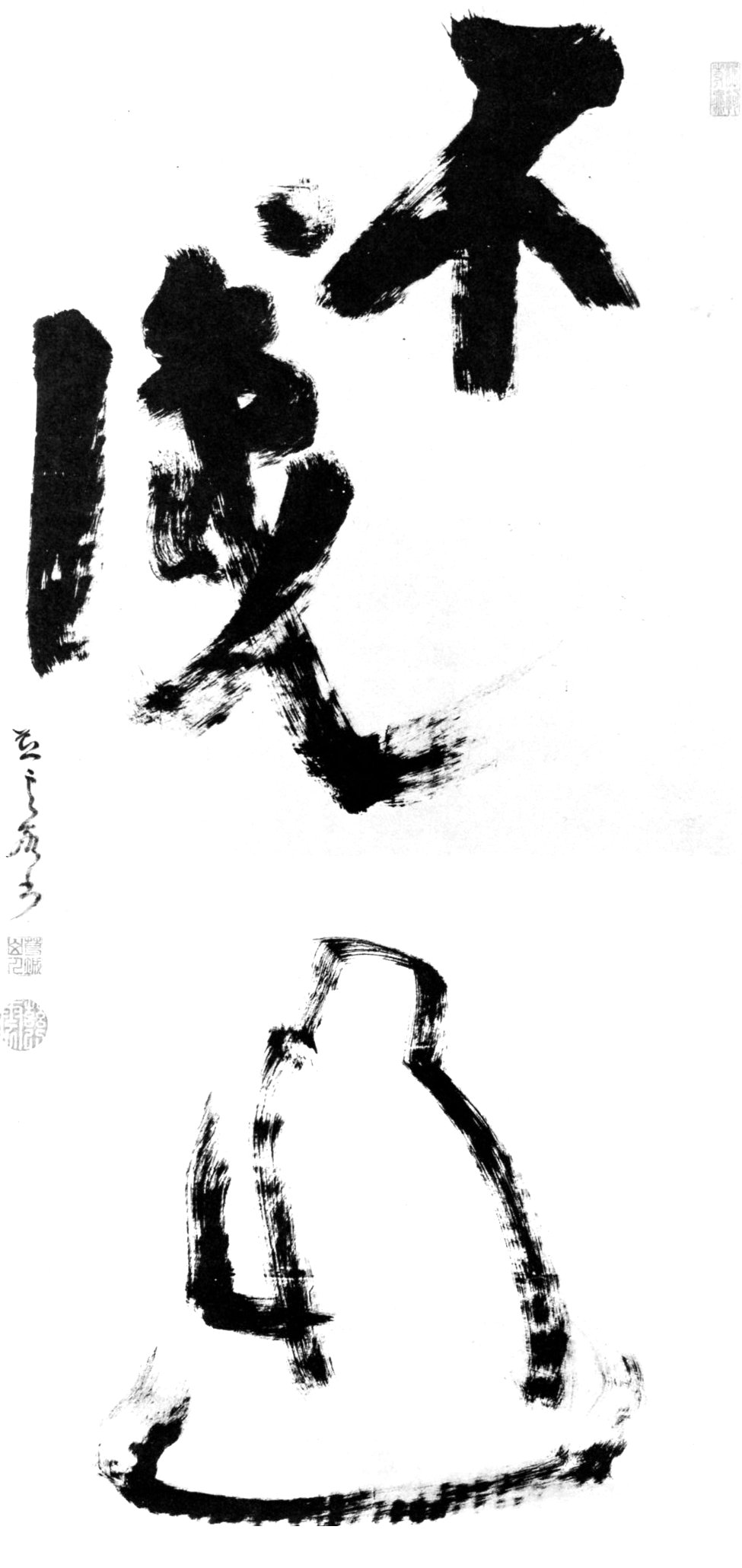
That’s an ink painting by Jiun Onko, an 18th century Buddhist priest. I wrote about it at length here. In this context, though, my point is simple…that’s an illustration.

Not only is it an illustration, but it’s a kind of illustration that is by no means marginal to the mainstream illustrative tradition. As you can see if you look at the below.
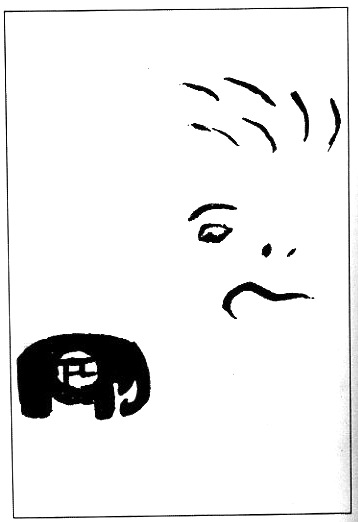
That’s Ooops! by Toulouse Lautrec, an artist who was consciously influenced by Japanese ink paintings…and whose drawings and posters, in turn, certainly seem to have been a forerunner of Toth’s style, even if they weren’t a direct influence.

So, if these are illustrations, then what does that do to the binaries Seneca has constructed?

First of all, it clearly calls into question the connection Seneca is making between illustration and realism. More than that, though, it upends the argument about the rationale for iconographic cartoons. Seneca is arguing that illustrative work is realistic and beautiful, but that cartoonists have to abandon that to make their pictures more readable. For Seneca, minimalism is chosen for ease of reading.

But if you look at the Jiun Onko and Toulouse-Lautrec drawings, it’s pretty clear that this is not a sufficient explanation. Jiun Onko, in particular, is more relentlessly iconographic than Schulz or Bushmiller; he provides less information. Indeed, he almost turns his image into a Japanese letter, or character. In that sense, his drawing is there to be “read” as Seneca suggests — but not in the interest of the sequential ease of information transmission. Rather, the image makes a connection between words, pictures, and reality — it’s an image which demands the reader/viewer/supplicant actively participate in constructing all three. Thus, the choice of an icon here is not utilitarian, but aesthetically meaningful. To draw iconically is not a default failure to incorporate the illustrative tradition. It’s an integral part of that tradition.

Drawings such as Toulouse-Lautrec’s and Jiun Onko’s also strongly call into question Seneca’s effort to make Schulz/Toth equivalent to mind/body. Look at this example of iconic artwork.
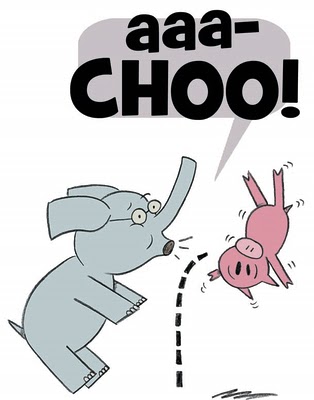
That’s a drawing by the wonderful children’s author and illustrator Mo Willems from Pigs Make Me Sneeze! Willems, as you see here, often includes dashed motion lines as part of his iconic, legible style. And what do you think my son often does when I’m reading him the book and he sees those lines?

It’s not hard to figure out; he traces them with his finger. If you look at the Toth panel up at the top there, though, nobody is going to trace that with your finger, because why would you? On the other hand, the Jiun Ito drawing or the Toulouse-Lautrec — you could see running your hand across those curves, in part because you can see the artist’s hand running across those curves. The same is true with a lot of early Peanuts; because the illustration is pared back and the linework is so instantly visible, you have the feeling of interacting directly with the hand of the creator.

On the other hand, slick illustrational work tends to place the viewer as an onlooker, rather than pulling you in for interaction. Take a drawing like Frazetta’s Cat Girl:
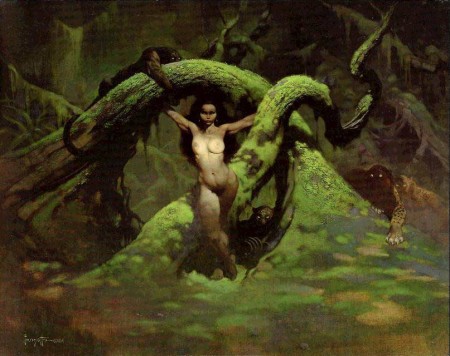
You are placed as voyeur; the flesh is on display. The image is a window, the surface the line between two separate worlds rather than the place where the creator and the viewer meet. In this sense, realism can be seen not as body, but rather as body exiled to mind, while the more iconic illustrational style can be seen as mind manifested, or embodied.

The point here isn’t that Schulz and Bushmiller are better artists than Toth, or that iconic is better than realism in illustration or cartoons. Realism can be great; I like Vermeer excessively, as just one for instance. But…well, here’s Seneca’s conclusion.

What’s illustrative is how much of this environment Toth sees, the amount of visual information packed into the panel borders, the panoramic shape of the frame itself. Toth gets to his place of realness, of beauty, by piling it on, adding subtraction to subtraction to abstraction until his minimal world holds as much as the real. As much shadow, as much light, as much texture, as much scope. It’s just arranged more subtly, seen more poetically, changed into something both familiar and strikingly different. It’s art, to make it simple.

Obviously, I disagree that illustration must mean a great deal of information. I also question the parallel made in the phrase “his place of realness, of beauty”, as if realness and beauty are one and the same thing. But the real (as it were) disagreement is that Seneca equates art with muchness. What’s great about Toth is that there is “as much shadow, as much light, as much texture, as much scope” as in reality. Moreover, this muchness is arranged even more muchly than in the world — “more subtly…more poetically…both familiar and strikingly different.” Toth’s art is about getting the whole world and magically turning less into more.

Surely, though, art’s beauty is as much about curtailment as replication; as much about emptying creation as filling it. The minimal is not beautiful because it manages to get all the essential and arrange it better; it is beautiful because of its absences. What makes that Toth illustration art is not that it gives us the big world sensitively arranged, nor that it fools the eye by packing in more than can possibly be there. Rather, the art is that it doesn’t fool the eye. Instead, the blocky shapes, the distant silhouettes, encourage us to participate in pulling something out of everything — the pleasurable act of creation, which is also the act of subtraction.

So now, having disagreed with everything Seneca said, I should, in theory, conclude by lambasting him for his too narrow vision; for relating comics only to comics, and so being confused about the nature of comics, of illustration, and of art. I’m not going to do that though because — well, I’ve just been praising subtraction, haven’t I? Seneca takes a small bit of the world, turns it over, cuts it down, and ends up with a panel of flatter, more circumscribed reality. The pleasure or art in his piece is not dependent on that flatter world including the whole of the real world. Rather, the beauty is in watching and engaging with the mind that moves within the arbitrary parameters. As I suspect Seneca would agree, the point is not just what you manage to include within the lines you draw, but how you draw them.
Utilitarian Review 9/11/10

On HU

Erica Friedman started off the week by interviewing Comic Fusion’s Stacey Korn about Wonder Woman Day.

We then had a series of posts on comics and architecture, of all things.

Alex Buchet began with the first of a multi-part look running through the month on a comics and architecture exhibit at the French national museum of architecture.

Ng Suat Tong followed up with a look at the role of architecture in Josh Simmons’ House.

Caroline Small wrote about Morris Lapidus, postmodern curves, and the boxy modernism of comics.

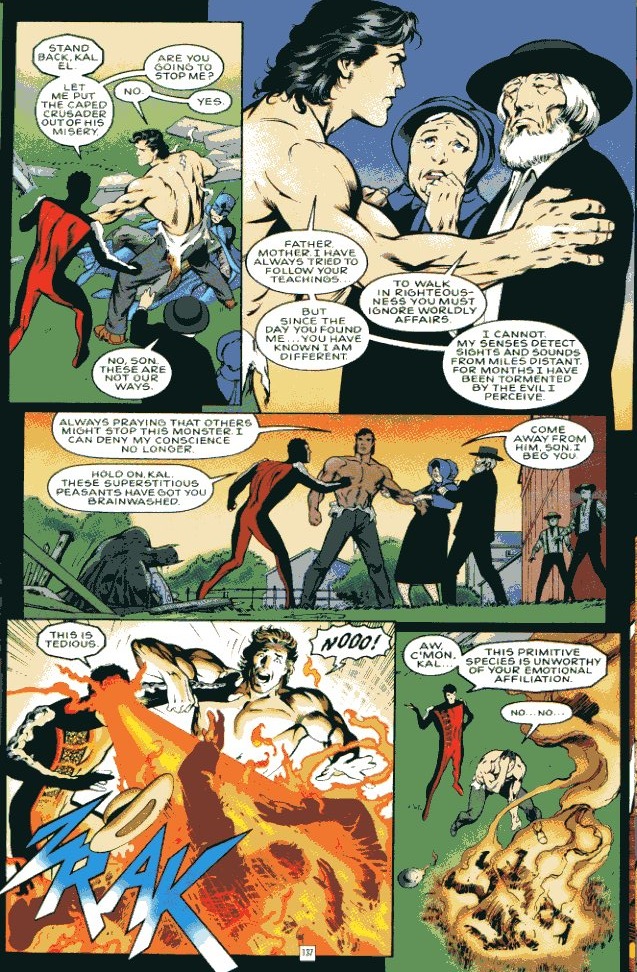
I wrote about Alan Davis’ The Nail and why superheroes hate the Amish.

And I disputed R. C. Harvey’s assertion that criticism and art are about making you happy.

Twilight, Shojo, Genre and Gender

Melinda Beasi’s post from last month on Twilight and the contempt for female fans has sparked a bunch of discussion this week.

David Welsh explains why he agrees with Melinda and Melinda adds some thoughts about why it’s wrong to group all shojo titles together. Brigid Alverson argues that the issue is that genre isn’t that good, not that women are held in contempt. And finally Erin Ptah says she dislikes Twilight for lots of reasons that have nothing to do with female fans.

Murder, Misogyny, Multimedia

I’ve got an article about murder ballads up on Madeloud.

And to celebrate, I’ve uploaded a murder ballad playlist including all the songs I mention in the article. Revel in bloodshed!

Utilitarians Everywhere

At Splice Today I review the boring George Clooney vehicle The American.

Shortly thereafter, though, I began to have suspicions. So, as I do when such suspicions occur, I leaned over to my wife and whispered low, “He’s going to be redeemed, isn’t he?”

She looked at me over her glasses with mingled disgust and horror. “If he gets redeemed,” she said sternly, “I’m going to be upset.”

At Madeloud I review Wovenhand’s latest record.

Other Links

I enjoyed this essay by Rachel Manija about why it’s okay to write negative criticism.

And R.C. Harvey has a fun article about Wonder Woman’s costume changes over the years. I love the eagle cartoon.

I don’t know anything about Ke$ha, but this is really funny.

Oh, and Caroline Small is going to be on the critic’s panel at SPX today at 3:00 PM eastern time. If you’re attending the convention, go say hi to her!

Dyspeptic Ouroboros: Critics Are Not Here to Make You Happy

In response to last month’s comics criticism roundtable, R. C. Harvey has a post up on the main site in which he lays out his philosophy of criticism.

But, seriously, a critic does what he does for what is a very shallow reason.
When I first set out to make a living in the world, I did it by teaching English in high school. Years later, one of my former students wrote and asked me why I chose teaching English as a profession. I thought about it and realized that I had no messianic purpose. I liked literature and I liked talking about it with others who liked literature and liked talking about it. I taught literature because that was a way of creating others who could talk about it in ways that were congenial with my own passion. It was a way of creating a conversation I enjoyed.

Harvey adds, “The other thing that criticism does, apart from gratifying the passions of the critic, is to enhance appreciation of the art being critiqued. In fact, I suggest that enhancing appreciation is the only legitimate function of criticism (beyond a critic’s self-indulgence).”

Logically enough, he then goes on to argue that the purpose of art, like that of criticism, is essentially to increase enjoyment.

The function of art, to pursue this topic into tedium, is to enhance enjoyment of life. A wise man once said, “The more things you like, the happier you’ll be.” Makes sense to me. Art—drawing, painting, music, and so forth—provide an assortment of things that one can choose from to like, thereby fostering one’s chances at being happy.

Harvey’s argument, then, as far as I understand it, is, first, that critics write for reasons which are shallow — because they happen to like things. Critics who claim to be writing for a higher (or lower?) purpose — such as, for example, to influence people, are fooling themselves. Or as Harvey puts it:

It would also be nice, and highly beneficial to mankind and civilization as a whole, if everyone would do exactly as I tell them—if cartoonists reformed and perfected their practices in accordance with my prescriptions, if other so-called critics started talking about comics as a visual art form as well as a narrative one, and if the Grumpy Old Pachyderm became the GOP of “Yes.” But—well, I, like most critics, may be self-absorbed, but I’m not delusional. Not yet.

The only legitimate purpose of criticism, then, according to Harvey, is to enhance appreciation of art. The purpose of art, in turn, is to make people happy. Thus, for comics critics, the goals are, (1) don’t delude yourself into thinking you have a deep and weighty purpose, and (2) make people happy.

_______________________

I’m going to take the second point first. Harvey presents this dictum (make people happy) as a common sense, non-weighty point (as he says, “Makes sense to me.”) I don’t think it’s either of those things, though. On the contrary, the rule-of-thumb that the goal of art and/or of life is to make people happy, and that making people happy can be tied to quantitative measures ( “The more things you like, the happier you’ll be.”) comes out of a very specific philosophical tradition: utilitarianism.

Utilitarianism is usually described as “the greatest good for the greatest number,” and while it may seem common-sensical, it’s implications lead to all sorts of crazy places. For example, if you take the logic of utilitarianism seriously, you could end up suggesting that starving parents eat their children. After all, the children would die anyway; if the parents eat them, the parents at least will live. It’s a common sense solution, right?

That scenario is, of course, a thumbnail paraphrase of Swift’s “A Modest Proposal.” Swift’s essay is art, in the sense that it is imaginative. It’s also criticism, or at least a critique. And what it’s critiquing is, in part, utilitarianism.

So…is Swift attempting to make us happy with his essay? Or is he attempting to make us — particularly if “us” means utilitarian thinkers of his time — unhappy? Does he want us to laugh at his cleverness, or does he want us to recoil in horror at the logic he puts forward, in the hopes that, by making us unhappy with the world, we may act to change it? No doubt there’s some of both in there — but surely it’s an oversimplification to say that Swift’s purpose, or his effect, is geared primarily, or solely towards making people happy.

And, in fact, art can have many goals other than happiness. Art can glorify god. It can be part of an effort to create community. It can criticize society in an attempt to change it. It can advance particular political interests. It can be intended as a moral lesson. It can try to sell us crap. And so forth.

Caro made some of these objections in comments, and Harvey responded

Art wouldn’t work to do all the things you say it does, Caro, if it didn’t also, and probably primarily, enhance our enjoyment of life. We expect it to do that, and in that expectation, we attend to art even when it is chiefly selling us something or promoting a political position.

The problem here is the problem with all monolithic definitions of complex phenomena — it’s reductive. A gospel song which explicitly tells you to turn away from enjoyment of life and embrace a glorious hereafter — is that meant to enhance our enjoyment of life? You could say “yes”, I suppose, and argue that the gospel singers are deluded about what they’re doing, or that believing in a hereafter actually enhances our enjoyment of life…but why go through all those tergiversations? Why, in short, does the “enjoyment” have to be the base, the real thing, while everything else is a secondary superstructure built on top of it? If someone says their art is intended to glorify god, or to pursue truth, or to change minds…why are those reasons less valid or legitimate or more self-indulgent? Why do they have to be transferred to a paradigm of “enjoyment” if they are to win Harvey’s imprimatur?

Or, to put it another way, whose enjoyment is enhanced, in short, by a definition of art which makes enjoyment the highest purpose? Is the enjoyment of devout Christians enhanced? The enjoyment of starving Irish peasants? Or is what’s at stake here the enjoyment of those of us who have come out modernity’s backside, for whom art is a commodity and commodity is a fetish?

“A wise man once said, “The more things you like, the happier you’ll be.” Who is this wise man? It’s not the Buddha, who would presumably argue that the fewer things you like the happier you’ll be. It’s not Moses, who told his people they’d be happier if they engaged in elaborate dietary rituals which certainly limited the number of things they could like. It’s not Kant, who believed true happiness was tied to not liking things. It’s not Marx, certainly…and not even, actually, Adam Smith, who believed fairly strongly that acquisition was not a simple game of numbers, but needed to be moderated by moral considerations. Indeed, it doesn’t, even on a commonsense level, seem to be the case that the more things you like the happier you are. Liking things can be fun, yes…but surely, liking and liking and liking in an acquisitive orgy of increase can, at times, get in the way of more important things. Like, for example, love.

I’m not saying here that Harvey is always wrong, or that it’s illegitimate to write criticism the goal of which is appreciation, or to create art the goal of which is happiness. My point is, rather, that these aren’t the only ways to approach art and criticism, and certainly not the only legitimate ways to do so. Aesthetics is about enjoyment in part, but it’s also about love, and faith, and even perhaps loathing and despair. To make it solely, or primarily, about enjoyment, I would argue, robs it of its enjoyment — turns it into a utilitarian and rather ugly machine.

So, again I ask, why does Harvey make this argument? Is he enhancing our enjoyment of life by presenting criticism as shallow and art as about happiness? Perhaps in part. But surely he also is doing exactly what he disavows; pushing an agenda, with at least some hope that it will affect or convince his readers. Humility can be a tyranny, too. “Shallowness” for Harvey is not just descriptive, but proscriptive —a stricture enforced by the waiting censure of “self-indulgence” and the accusation of “delusion.” It’s worth remembering, though, that another name for the self can be the soul, and that what one person sees as delusion, another may see as art.

The Amish Plot Against the Superheroes

I’ve been reading The War of the Lamb, the last book written by John Howard Yoder. Yoder was the most important theologian of pacifism in the last century or so, I think. Appropriately enough for a pacifist theologian, he was a Mennonite.

And, of course, the subject of Mennonite’s made me think again (mostly to my sorrow) of writer and illustrator Alan Davis’ 1998 JLA alternate reality exercise The Nail. For those fortunate enough to have missed the series, it’s high concept is that John and Martha Kent ran over a nail on day that Superman’s rocket ship landed on earth. As a result, the Kent’s didn’t find the ship. Instead (as we learn towards the end of the book) an Amish family found it. Since the Amish won’t interact with the rest of the world and since they are (like most Mennonite sects) pacifist, the fact that this family discovered Supes meant that he never became a superhero; he just stayed on the farm. Without his iconic presence, superheroes (and especially aliens) are distrusted, Lex Luthor becomes mayor, no one is tough enough to stand up to Kryptonian technology…etc., etc. In short, things go to the bad, and it’s all because of the stupid Amish.

Most superhero comics are stupid, and The Nail is no exception. Still, there is something of the idiot savant about it. Davis was looking for a way to neutralize Superman and, by extension, all of superdom. What is the opposite of the superhero? The obvious answer is, a supervillain. Too obvious — and, incidentally, untrue. Superheroes and supervillains are part of the same world, the same milieu. Superman being a supervillain doesn’t remove or negate him; it just puts him front and center in a different role (Earth 3! And god help me that I know that….but anyway….)

So, supervillain is no good. But…what if you make him a pacifist? Then he’s ineffectual, irrelevant — he’s nothing. Which is to say, it’s not supervillainy that’s the opposite of superheroics — it’s pacifism.

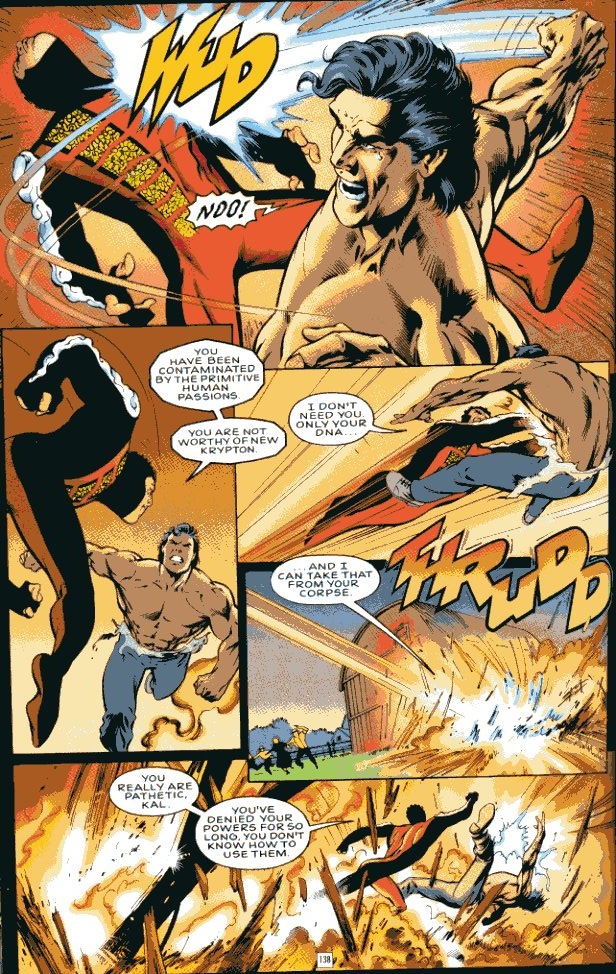
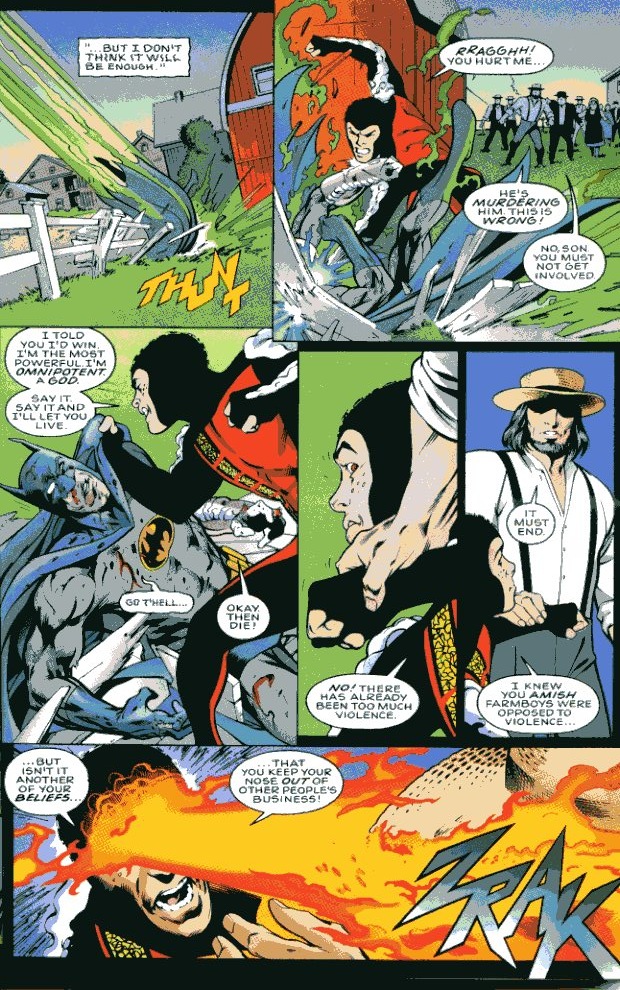
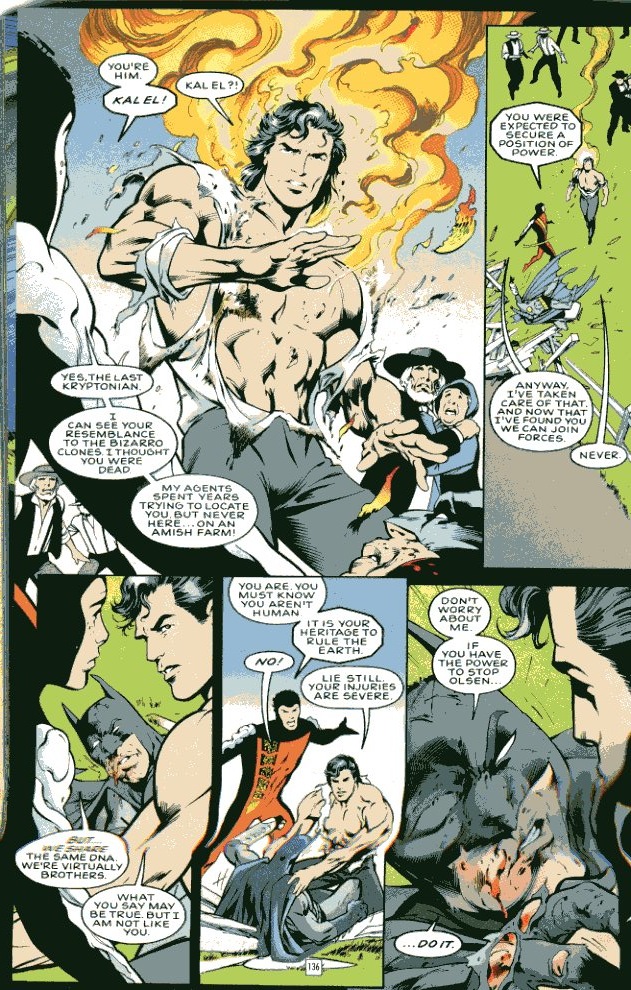
The book in its final pages, then, glorifies superheroness not primarily through derring-do, but rather through a thumbnail repudiation of non-violence. This repudiation is sealed by the gratuitous and gruesome obliteration of Superman’s Amish parents, who barely get a panel or two to express their misguided philosophy before Davis reduces them to ash. That’s what you get for keeping Superman down, you religious weirdos!

Yes, that’s Jimmy Olsen as the supervillain. Don’t ask.

Anyway, following this sequence in which Supes sees his (Amish) parents killed, and then attacks the evil Jimmy superOlsen, the Supes and Jimmy battle. Unfortunately, Supes (being Amish and not good at fighting) can’t beat him. Luckily, though, Olsen spontaneously disintegrates because his powers are unstable (again, not worth explaining why.) In the aftermath, Superman decides to become a standard issue superhero, and the implication is that his innate awesomeness will defuse the anti-alien hysteria that has swept the world.

So…parents killed, check; vengeance inflicted, check; dedicate life to superheroics to honor parents, check. Except that, from the point of both the drama and the plot, Superman’s repudiation of nonviolence is completely superfluous, and even, arguably, detrimental. Supes could have just as easily handled Olsen through nonviolent means — getting in his way, or holding on to him. Since Olsen essentially disintegrated on his own, the outcome would have been the same — except that Supes would have actually kept faith with his parents rather than betraying their beliefs for nothing. Similarly, if the world is terrified of malevolent aliens, the sudden revelation of an even more powerful violent alien in their midst seems unlikely to calm things down. On the other hand, had Supes revealed himself to the world as a superpowerful alien who embraced nonviolence and noninterference in the affairs of the world…well, it seems like that might have been a more effective statement.

The logic of the story Davis has constructed, in other word — with Superman as Amish — seems to lead naturally to a parable about the triumph of nonviolence. After all, if the greatest hero in the world is a pacifist, it makes sense that you’d end up with a story in which pacifism is heroic. Unless, of course, you see pacifism and heroism as mutually exclusive, in which case the heroism comes, not from the pacifist witness, but from repudiating your entire past in order to embrace violence in the name of your dead parents who would, undoubtedly, be appalled.

Davis’ story also resonates oddly with broader arguments about pacifism. The usual dig against pacifism is that it is foofy pie-in-the-sky nonsense. As an ideal, it’s all well and good, but in the real world, violence is sometimes necessary. Davis’ story makes this argument by, in part, going out of its way to make the Amish impractical to the point of callousness. Not only do they advocate non-intervention, but they argue that their son shouldn’t help Batman in any way, even though he’s being beaten to death literally on their doorstep. This is surely a bastardization of Amish beliefs; the Amish, after all, can vote; they can interact with outsiders. The depiction here is a caricature, intended to make their position seem ridiculous…and unrealistic.

But the irony is that the world where Superman stays in his Amish community and doesn’t interfere in the outside world is actually more realistic. Because, you know, Superman doesn’t interfere in the world. Because there isn’t a Superman. Nobody has to resort to violence to defeat supervillains, because there aren’t supervillains. The DC Universe is unrealistically violent. The opposite of the superhero is the Amish not just because the superhero is violent and the Amish are not, but because the superhero doesn’t exist, and the Amish do. What happens at the end of The Nail is not an eruption of realism into the Amish fantasy of nonviolence. It’s an eruption of fantasy violence into the Amish’s realistic pacifist community. Perhaps that’s why the Amish parents have to be so summarily dispatched; if they were allowed to stick around, they’re solidity would have made Davis’ entire farrago of nonsense dissolve into mist.

In The War of the Lamb, John Howard Yoder talks a little about heroism, specifically in terms of Martin Luther King and Che Guevara. Both men, he points out, were killed; both have, as a result, been viewed as martyrs. Yoder points out that following King’s assassination:

] Many leaped to the conclusion that nonviolent alternatives had thereby been refuted. At the same time, all over Latin America, the fact that Che Guevera had been gunned down in the Bolivian mountains did not mean that guerrilla violence had failed. Why not?

The inconguity is even more striking when we remember that King…had expected to be martyred. This was true both in the general sense of the knowledge that nonviolence will be costly, undergirded by the Christian readiness to ‘share in the sufferings of Christ’ and in the more precise sense that King gave voice to ominous premonitions in the weeks and days just before his death. Che’s defeat, on the other hand, was not in the Marxist scenario. On the general level, for the Marxist the victory of the revolution is assured by the laws, as sure as those of mechanics of dialectical materialism. In the narrow sense as well, Guevara, just before he was captured and killed, was still expecting to win as head of the violent insurgency in Bolivia.

Is there not some flaw in the logic here? Of a man who predicted his death, who explained why he accepted it, whose work did not perish with his death, the critics argue that his view is refuted by that death. Of the other man, who premised victory and whose campaign did collapse with his death, his faithful proclaim his resurrection…. The Marxist believe that their hero’s death is powerful on some other level than his military defeat. Whatever that reasoning may be called, it is not standard Marxist pragmatism, but some kind of apocalyptic myth.

The Nail suggests that, for “apocalyptic myth,” we might substitute “genre fairy tale.” The narratives that justify violence are, predominantly, not about realism, but about revenge or excitement or masculinity — which is to say, they’re pulp. Perhaps, The Nail suggests, nonviolence isn’t wrong because its unrealistic, but rather because it gets in the way of the really quite embarrassingly stupid stories we like to tell ourselves.
____________________
For more on superheroes and pacifism, here’s my essay about Spider-Dove.

Utilitarian Review 9/4/10

On HU

We started the week off with a guest post by James Romberger, who discussed the reasons for and the wrongness of the fact that artists often don’t get credited adequately in comics collaborations.

Melinda Beasi guest-posted about Twilight and the way some women try to distance themselves from fandoms that are too femme.

Richard Cook explained why The Girl With the Dragon Tattoo is lame.

Caroline Small reviewed comics and animation by Lilli Carré.

I talked about the eroticization of young Wonder Woman in Marston and Peters’ Wonder Woman #23.

I talked about class in Twilight.

And this week’s download is for Easy Lounging Hippies, featuring the Byrds, the Hollies, John Denver, and Italian soundtrack music, as well as other things.

Utilitarians Everywhere

At Comixology I talk about race and blackface in the work of R. Crumb.

In that sense, Crumb’s image for the song could almost be seen as parody; a vicious sneer at Joplin’s blackface pretensions, caricaturing her as both a wannabe black mammy and as the whining white entitled brat looking to the exploited other for entirely undeserved comfort. As I said, it could almost be seen as that — if Crumb hadn’t thrown in another entirely gratuitous blackface caricature in the bottom center panel, just to show that, you know, he really is exactly that much of a shithead.

At Splice Today, I talk about Raymond Williams and the apotheosis of advertising.

Williams notes “Advertising was developed to sell goods, in a particular kind of economy,” but, “Publicity has been developed to sell persons, in a particular kind of culture.” The two are related, the second an outgrowth of the first, and while advertising has (arguably) experienced some setbacks recently, publicity has gone from hulking behemoth to master of the universe. Once professionals organized advertising campaigns. Now those same campaigns are conducted by you and me and everybody all the time with our personal web pages and MySpace pages and YouTube videos and self-Googling. The media consumers have taken the means of media production, and they’ve used it to create a virtual world where identity and consumption are more indistinguishable than ever before.

Also at Splice, I talk about the disappointment that is Fumi Yoshinaga’s Ooku, volume 4.

For cultural goods, the analogue of planned obsolescence is called, as most everyone knows, “jumping the shark.” The phrase—which itself has jumped the shark—used to describe the moment when any serialized entertainment gratuitously abandons its dignity and begins to suck with an almighty suckage. Think of the episode of The Cosby Show where Cliff gives birth to a hoagie and a bottle of orange soda. Or don’t think of it. I’m trying not to.

At Madeloud, I reviewed the mediocre new album by Plants and Animals.

Other Links

Anne Ishii has a really funny interview with Johnny Ryan about the manga Detroit Rock City.

Tom Crippen has an excellent review of Alan Moore’s new Cthulhu mash-up project.

Via Dirk, Dan Raeburn’s classic comics crit zine, The Imp is now available online.

Tucker Stone and David Brothers continue their very entertaining look at the Black Panther.

Shaenon Garrity has a really superb essay about Cathy Guisewite’s comic strip Cathy.

And this is a fascinating essay about Netflix. I think there are some lessons there about digital for comics companies — not that anyone’s likely to pay any particular attention…..

Bite Marx

Since Melinda Beasi wrote about Twilight here earlier this week, I thought I’d follow up with this essay, which ran in an edited form at the Chicago Reader.
________________
Twilight fans always make a fuss about Team Edward versus Team Jacob, but they might as well be plumping for Team Effete Aristocrat versus Team Colorful Earthy Ethnic Stereotype.

As with all things Twilight, the tropes work not because of their subtlety, but because of the absolute ham-fisted earnestness with which they are deployed. Eclipse is the book where the Edward/Bella/Jacob triangle attains an apotheosis of melodramatic angst-ridden preposterousness. As such, it’s also arguably the book where the bone-headed stereotyping is most thoroughly exploited. What sets the tween heart racing is not that Bella has two boyfriends, but that she has two romance narratives to choose from — narratives of differing but equally venerable pedigree.

In this corner, there’s Edward Cullen. Edward is extravagantly cultured, and ridiculously wealthy. He composes classical ballads, writes in an immaculate hand, and buys his sister a Porche as an offhand gift. Like a real product of the upper crust, he lives with his brothers and sisters, who are all also paired up as husbands and wives. His family is, moreover, obsessed with blood, and has amorphous connections to Italy. He’s foreign, exciting, steeped in ancient traditions, and deeply, ludicrously white. He’s the noble prince come to whisk Bella out of her life and into a deliciously decadent life of luxury and romance. Meyer name-drops Darcy and Heathcliff and Romeo, but Edward has at least as much in common with Prince Charming.

And in this corner, there’s Jacob Black. Jacob is the opposite of upper-class. An Indian living on reservation land, he transforms simultaneously into a werewolf and a laundry list of invidious racial stereotypes. He’s literally hot-blooded — werewolves have higher than normal temperatures, just as vampires have lower than normal ones. Jacob also has massive self-control issues; whenever he gets angry or upset, he starts to shake violently and then turns into a giant deadly wolf. He’s also hairy, frequently bare-chested, and…good with tools! He also eats a prodigious amount — as opposed to the uber-cultured Edward, who doesn’t eat at all.

If Edward is the aristocrat who treats Bella like a delicate queen, Jake is the swarthy, sweaty working-class hero who won’t take no for an answer. Edward will barely allow himself to kiss Bella; Jake, on the other hand, literally overpowers her when he wants a smooch and she’s reluctant. With Edward, Bella always has to be careful; with Jake she gets to be a little bit wild — riding motorcycles, cliff diving, and generally getting in touch with her inner wolf/teen delinquent. If Edward’s the prince whisking away the scullery maid a la Cinderella, Jake is the virile commoner dragging the frigid aristocrat down into the sensual muck a la Titanic.

Romance as a genre has always been just about as obsessed with class as it has been with gender. Differences in social standing are both great drivers of plot (“I’ll never allow you to marry that piece of trash!”) and sexy in their own right. The boy next door (played in Twilight by Bella’s poor, ordinary, never-had-a-chance classmate Mike Newton) is dull — there’s nothing romantic about winding up with the person everybody expects you to wind up with. But a prince to pull you up to the castle or a gardener to drag you down in the muck — that’s an exotic tale to set the heart racing and the bodices ripping.

Meyer’s genius (if you want to call it that) is to have figured out a way to repurpose the same old clichés for an era in which not even tweens want to admit to fetishizing either those on the top of the social scale or those on the bottom. Edward is enchantingly attractive not because he has gobs of money and cultural capital, but rather because he’s an immortal mysterious vampire whose body goes all sparkly in the sun. Jacob is excitingly exotic not because Indians make better lovers, but because he’s an impulsive superstrong werewolf. And the two don’ t want to kill each other because of class or racial animosities (which would obviously be really distasteful), but because vampires don’t like werewolves. When Jacob calls Edward “bloodsucker,” it’s a literal description, not a Marxist critique. When Edward calls Jacob “dog,” it’s because he grows fur and runs around on all fours not — despite all appearances — because it’s a racial slur.

Ultimately, of course, the dog lies down with the bloodsucker; the alabaster prince and the dusky gardener both love Bella so much that they set aside their differences to defend her. Social harmony descends on a world which never had any class antagonisms to begin with. A triumph of tolerance and goodwill? Well, maybe not. Certainly, to see the same old idiocies revived and venerated under a thin PC patina is irritating. How many generations are girls going to be waiting for their prince, anyway? And when exactly are we going to stop shamelessly exploiting the minorities just so that we can tell ourselves how sexy they look down there on the dung heap where we have so summarily deposited them?

But, on the other paw…there is something to be said for that thin patina. If there are stupid fantasies to be disseminated, maybe it’s better to have them be clearly labeled as fantasies. Edward’s not a prince; he’s a vampire. Jacob’s not out of control because he’s an Indian, but because he’s a werewolf. That’s no doubt splitting hairs (as it were) — but those are hairs that I’d as soon see split as not. If there’s one thing that romance consistently tells us, after all, it’s that differences matter.

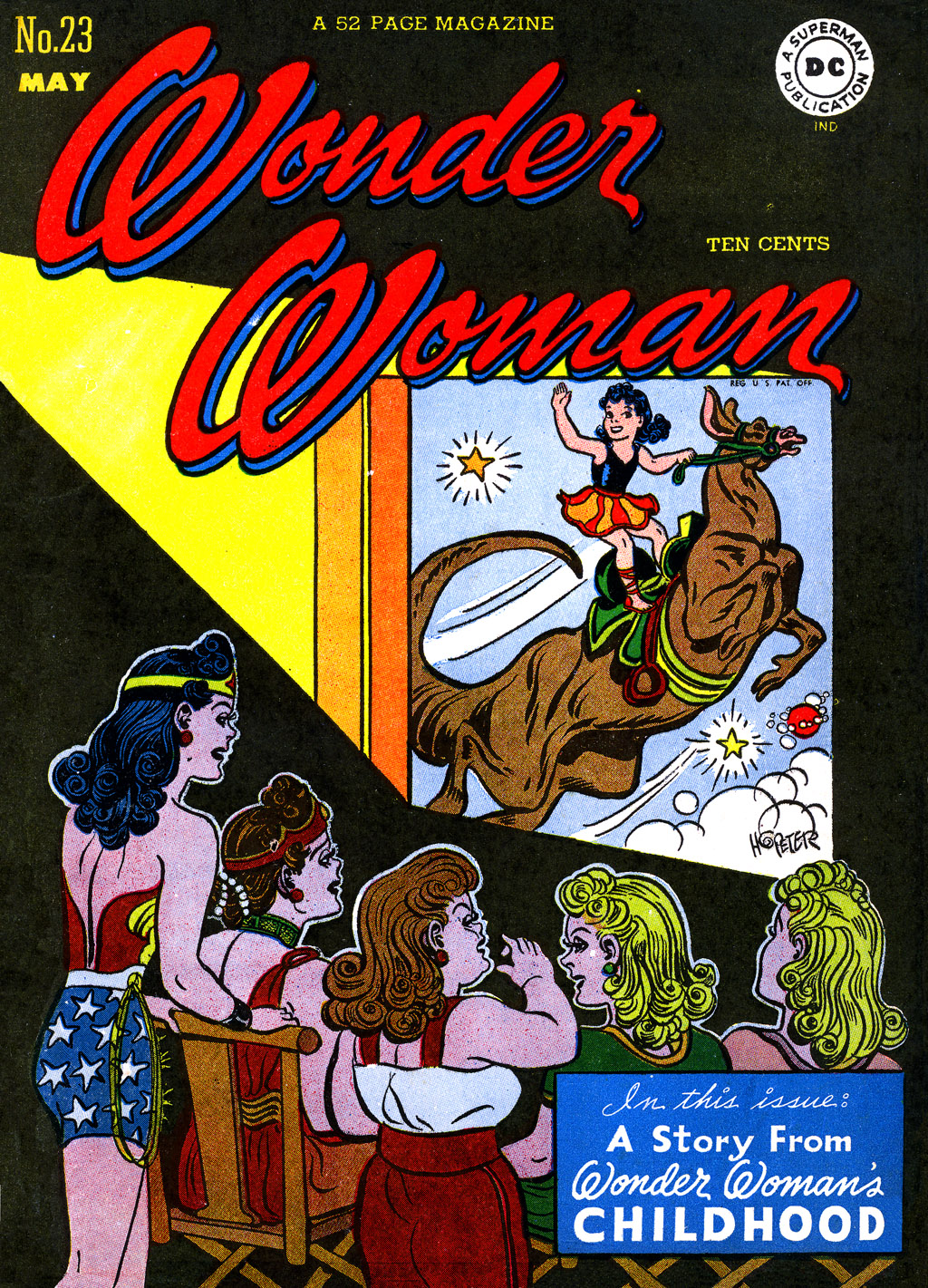
Bound to Blog: Wonder Woman #23

Wonder Woman #22 was probably the worst one of Marston/Peter’s run…so bad, in fact, that I wondered whether significant parts of it might not have been ghosted.

Issue #23 is much better. It’s not one of the series high points — and notably, like 22, it has three short stories rather than one long epic, a change which I presume must be related to Marston’s sickness (he actually died of cancer in May 1947, which is this issue’s cover date.) Still, whether Marston was writing shorter stories on his death bed, or whether these are leftover scripts that he had lying about unpublished (and they can’t be too old, because they’re post-war) the result is perfectly acceptable, if not great.

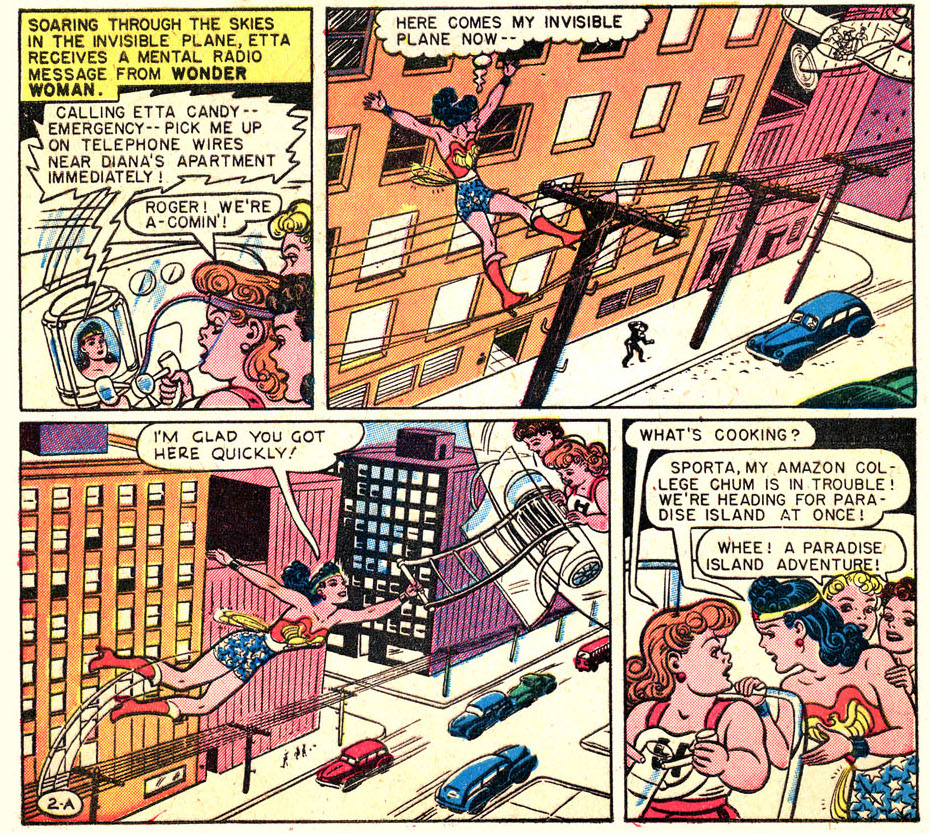
As the Holiday girl there in the lower right indicates, the first story is a paradise island adventure. All the more welcome since Harry Peter seems to be in fine form; that picture of WW sitting on the telephone wires waiting for her robot plane with the buildings slanting down vertiginously in the background is pretty fantastic.

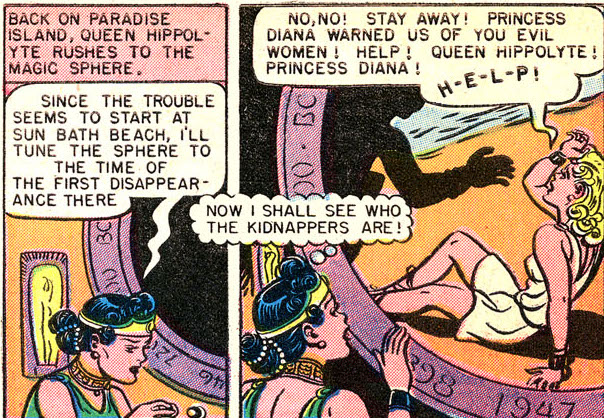
Anyway in this story Amazons are disappearing from paradise island’s beach. This gives Hippolyta a chance to watch as her viewfinder presents her with a Perils of Pauline moment:

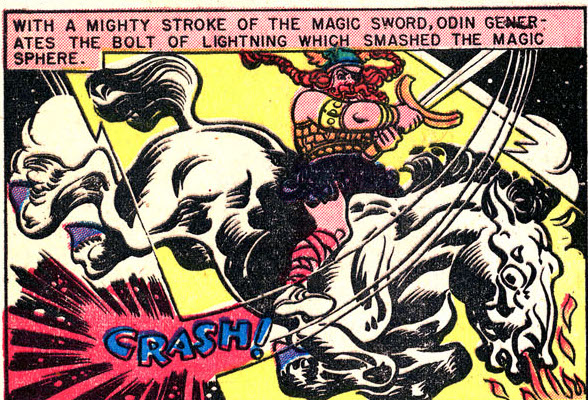
Anyway, the viewfinder breaks inopportunely, shattered by a bolt from Odin, whose Valkyries are flying down to Paradise Island to kidnap Amazons. Why you ask? Well….

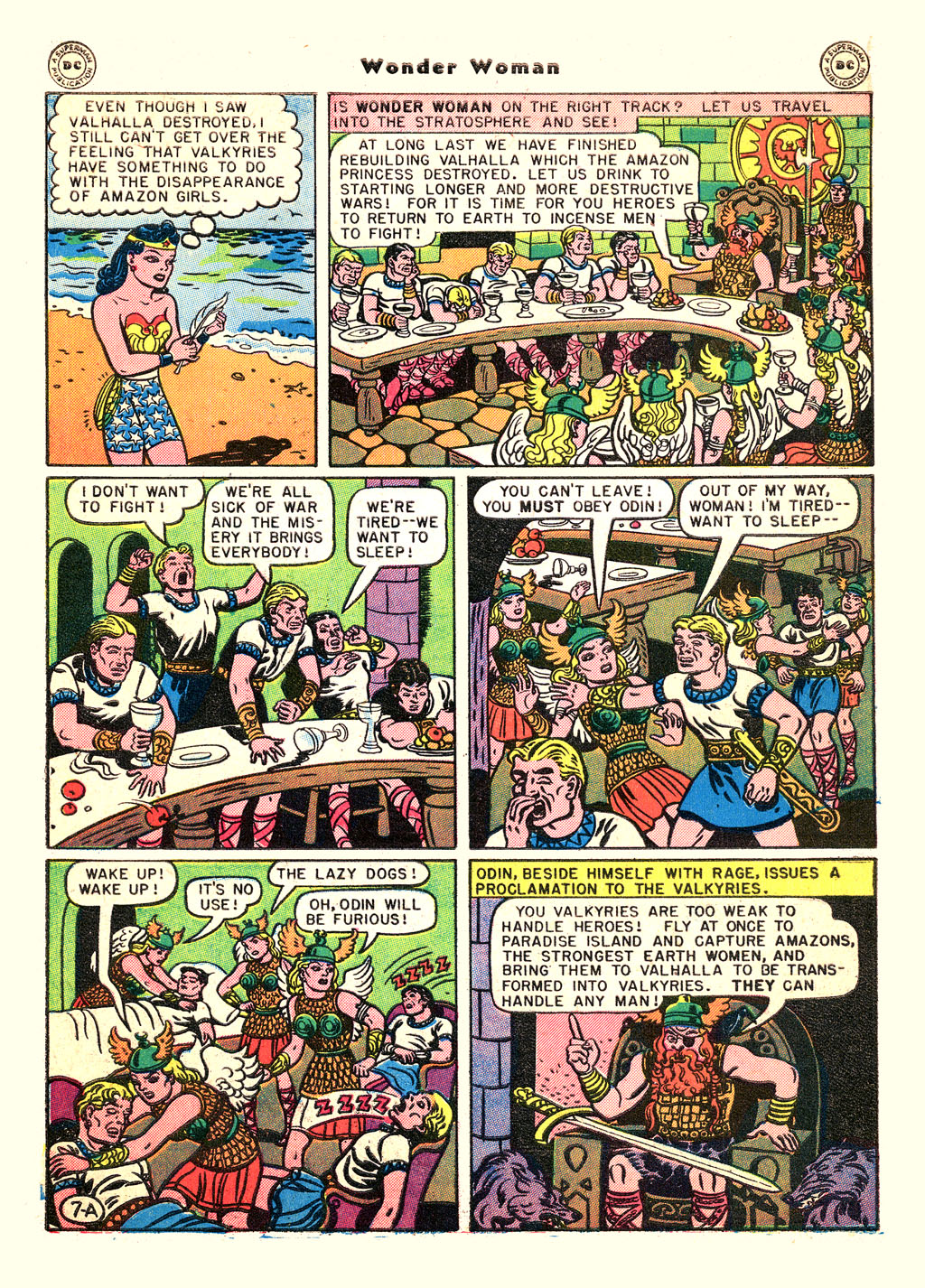
Odin has captured heroes (i.e. veterans) and wants them to go to earth to incense others to fight. But the heroes are tuckered out; all they want to do is sleep. Since his Valkyries can’t get the men to fight, Odin tells them to kidnap Amazons so *they* can get the heroes to go to war again.

As usual with Marston, the gender politics are delightfully convoluted. Obviously, the main instigator of warfare is the sadistic male patriarch, Odin. But the male “heroes” are shown throughout as being soft, manipulable, and not especially violent — they need a strong female hand if they’re going to be effective fighters. So in some sense it’s really women who are the embodiment of military virtues.

The funniest panel here is the bottom one, where the male heroes claim to be sick of being ruled by women “who want us to fight” — the implication being that they’re perfectly happy to be ruled by women who don’t want them to fight.

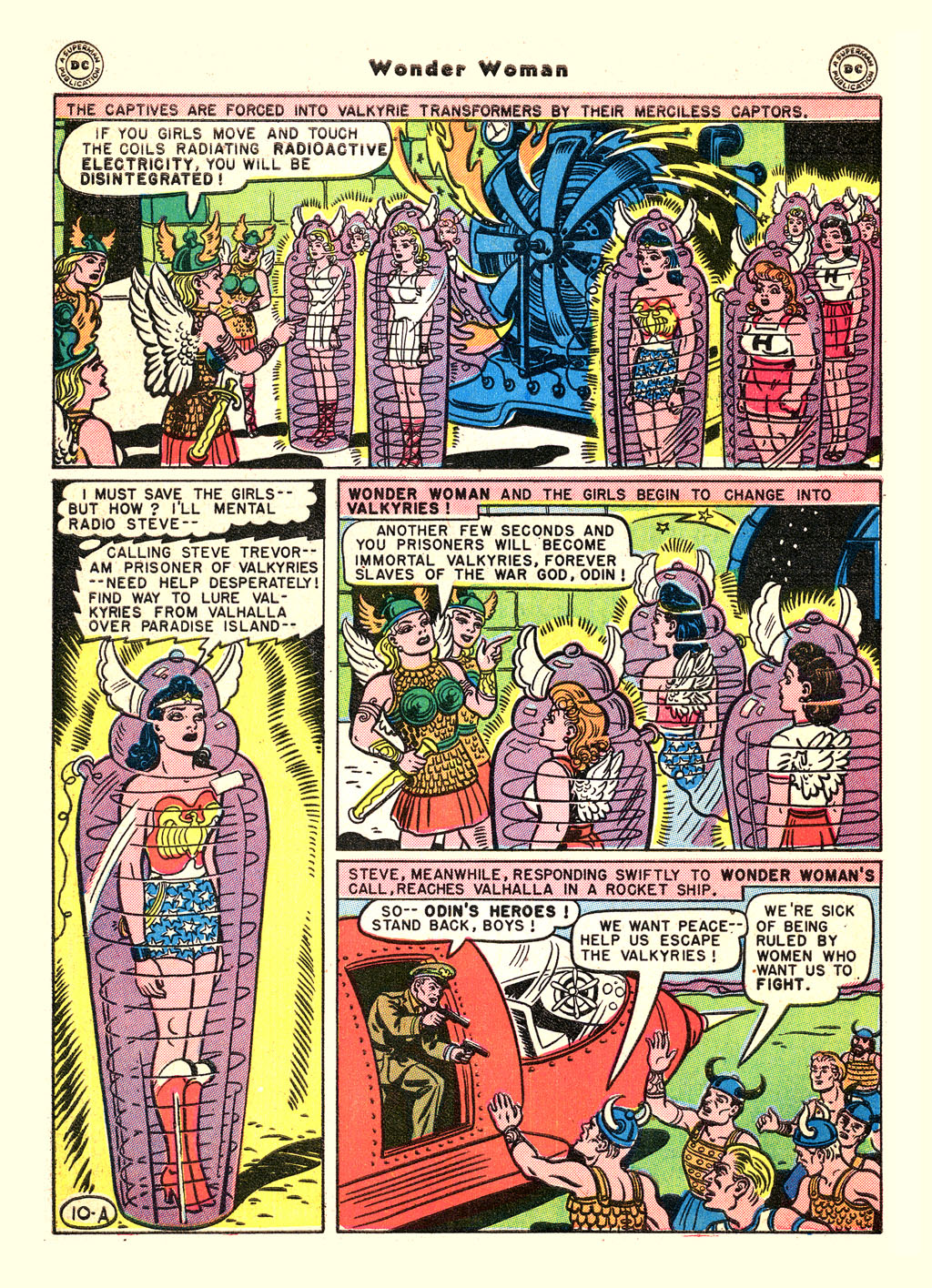
The rest of the page is interesting as well, though; the Valkyries have encased WW and Amazons and Holiday Girls in energy to trap them and turn them into Valkyries themselves. The purple energy happens in this case to look like the outline of Russian dolls…and of course, standing stock still in their various outfits, the transforming women look more than a little like dolls themselves (with special wing attachments!) I talked about the connection between Wonder Woman and doll stories before. In this case, the Valkyries eroticized dominance/appreciation of the Amazons is both about enjoying femininity *and* enjoying martial virtues. In fact, there’s barely an *and* there; for Marston, the more effectively militant you are, the more feminine you are (at least if you’re a woman.)

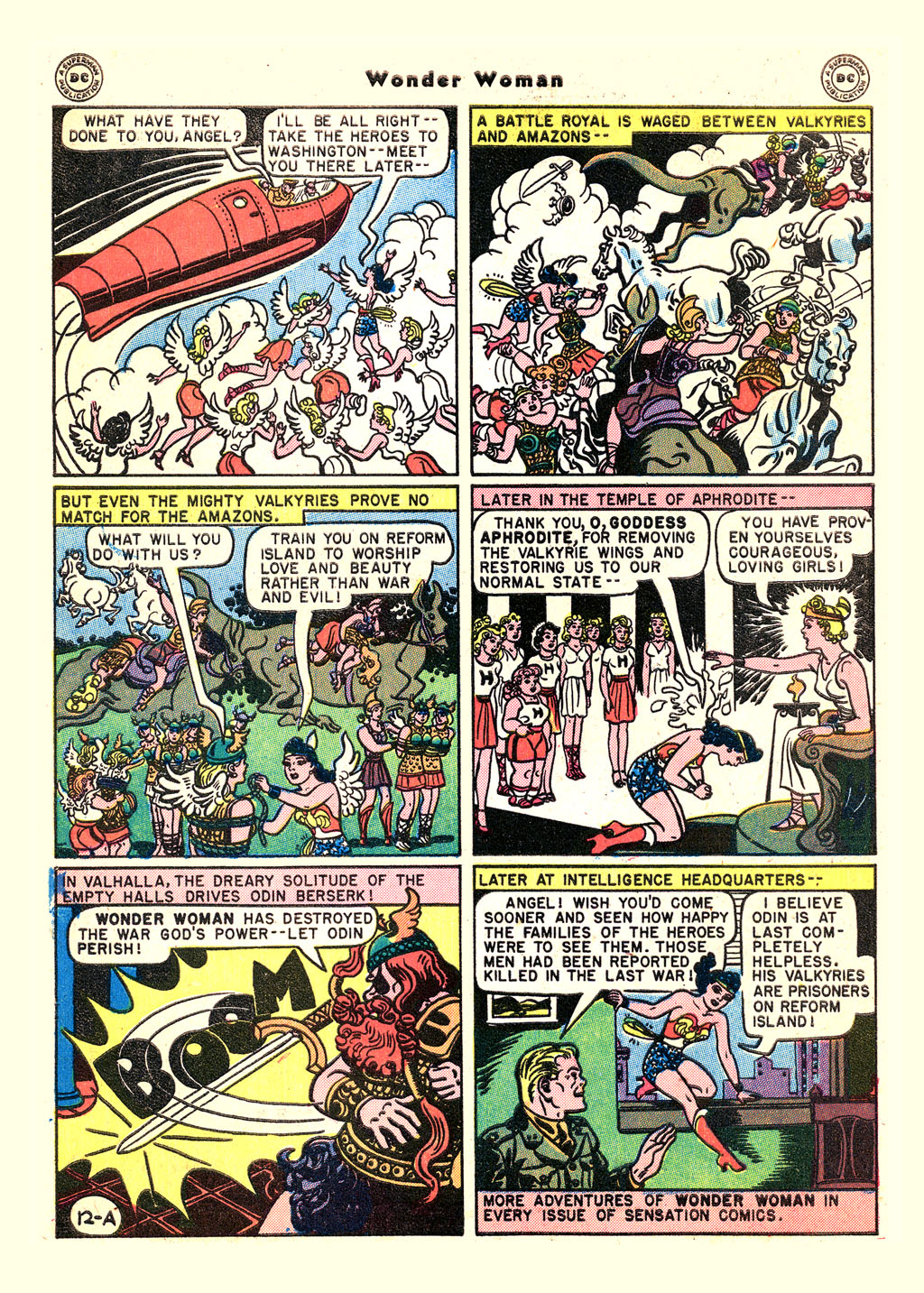
Which is why, in the middle right pane abovel, Aphrodite emphasizes that WW and the Holiday Girls are “courageous, loving girls” — the point being that courage and loving femininity go together. The natural conclusion is shown in the bottom left panel, where Odin, the supposed wargod, just gives up and offs himself (throwing down his phallic sword) when WW robs him of his Valkyries.

That page is pretty great in other ways as well, with winged Holiday girls and winged Amazons flying about with sky kangas and that magnificently phallic spaceship that Steve is piloting. I especially like the way the spaceship in the upper left panel mirrors the motion of the sky kanga in the upper right — as if the ubermaleness is just an image of, or subsumed within, the undulating sea of femininity. Maleness seems part of the harmonious whole of femininity rather than an opposition to it.

I also love that middle left panel; the scribbly sky-kangas and the valkyries being tied up here and tied up there, with scale all off-kilter so everybody looks like paper doll cutouts. This is definitely one of Peter’s most Henry Darger moments.

And as long as I’m gushing about Peter — check out this horse.

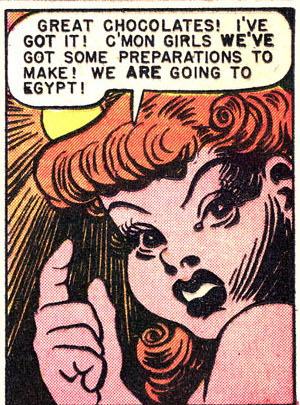
Or this bizarre backlit Etta as femme fatale from the second story.

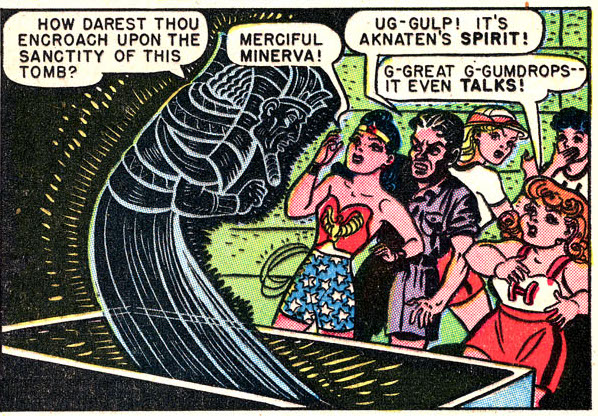
This weird Egyptian ghost rising from the tomb is pretty fantastic too….

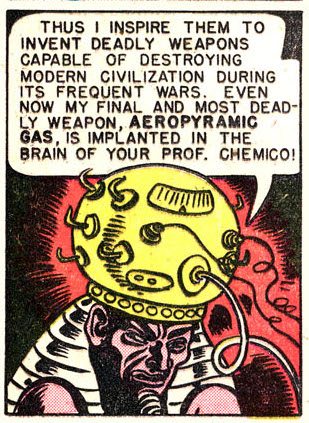
And how about this ancient Egyptian headgear?

Storywise there’s not a whole lot going on here; Marston makes some noises about the evil dangers of superweapons and generally suggests he doesn’t want the world to go to war again. It’s fine…but the art is definitely the main thing here.

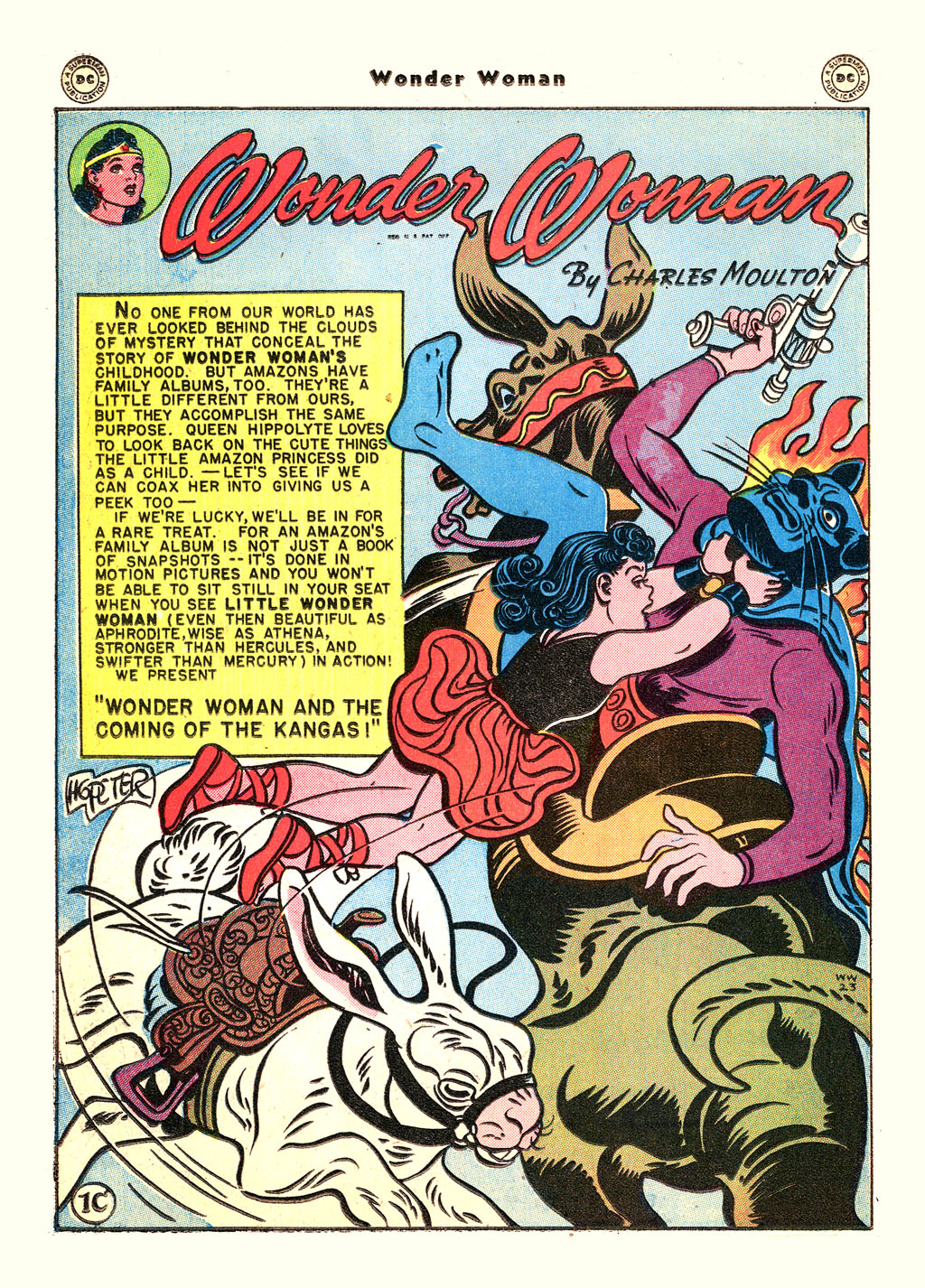
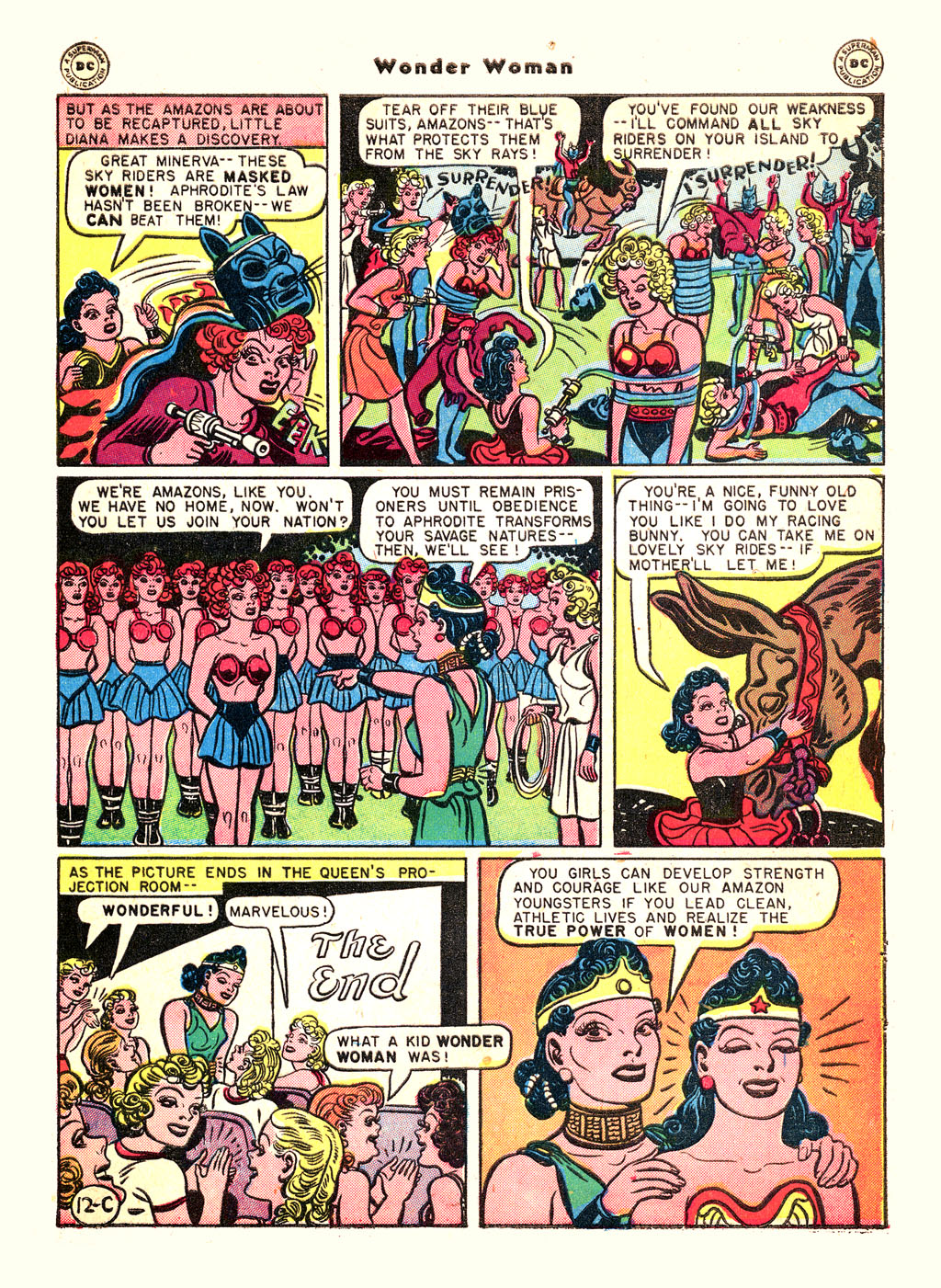
The third story is the most interesting of the lot. It’s a tale from WW’s childhood, explaining the origin of the giant sky kanga’s. Also, incidentally, it lets us know that before there were sky kangas, the Amazons rode on giant bunnies. What is the origin of the giant bunnies? That, alas remains a mystery….

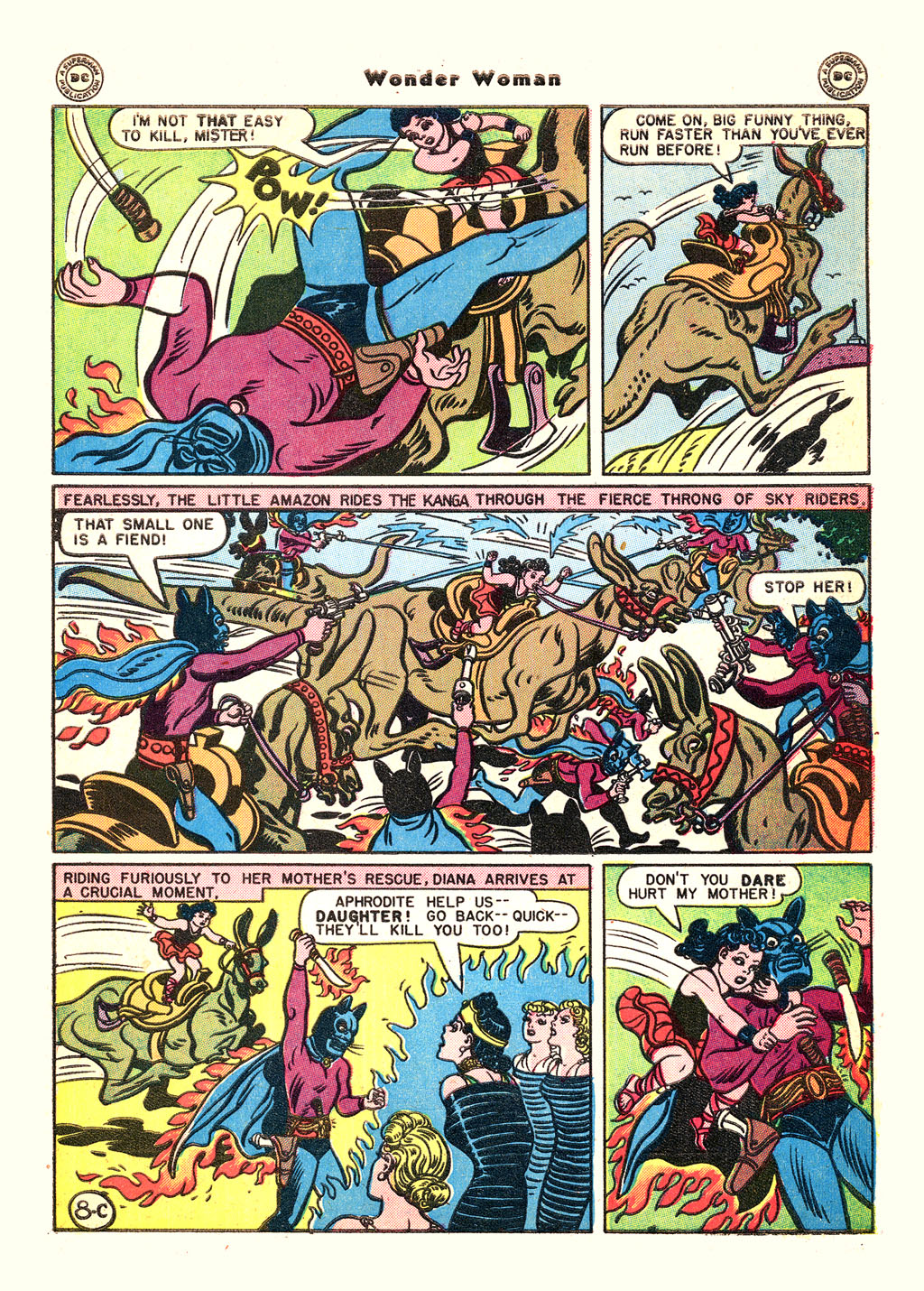
As always, Peter’s animal drawings are something special. The lines of the giant bunny and the giant kanga flow sensuously; the whole page is filled with sensuous curves. And the sensuousness adamently includes the prepubescent Wonder Woman herself; her short frilly flared red dress placed in the center of the composition.

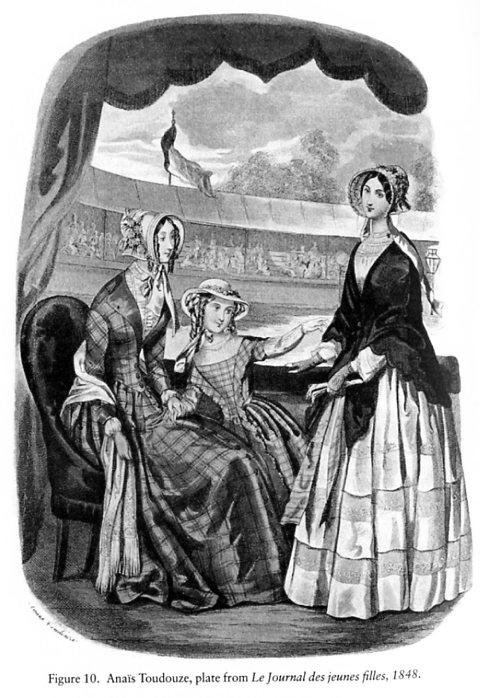
In Between Women: Friendship, Desire, and Marriage in Victorian England, Sharon Marcus argues that the eroticization of female children was a common iconographic trope of Victorian fashion illustration, as well as of Victorian society more broadly.

Victorian culture represented girls as epistemological paradoxes, so innocent that they could be intensively eroticized without raising comment. But unlike images and stories that eroticized girls for a mixed audience of men and women, fashion imagery displayed girls in erotic dynamics with adult women for the delctation of a female audience. In The History of Sexuality, Foucault argued that the intensification of family ties in the nineteenth century also sexualized them, and fashion plates show that in the process all cross-generational ties were eroticized, including those between adult women and girls…. Designed to be objects of an appreciative female gaze inside and outside the image, girls in fashion plates also embody a desire to look at and touch a woman, a desire figured as both self-abasing and self-important.

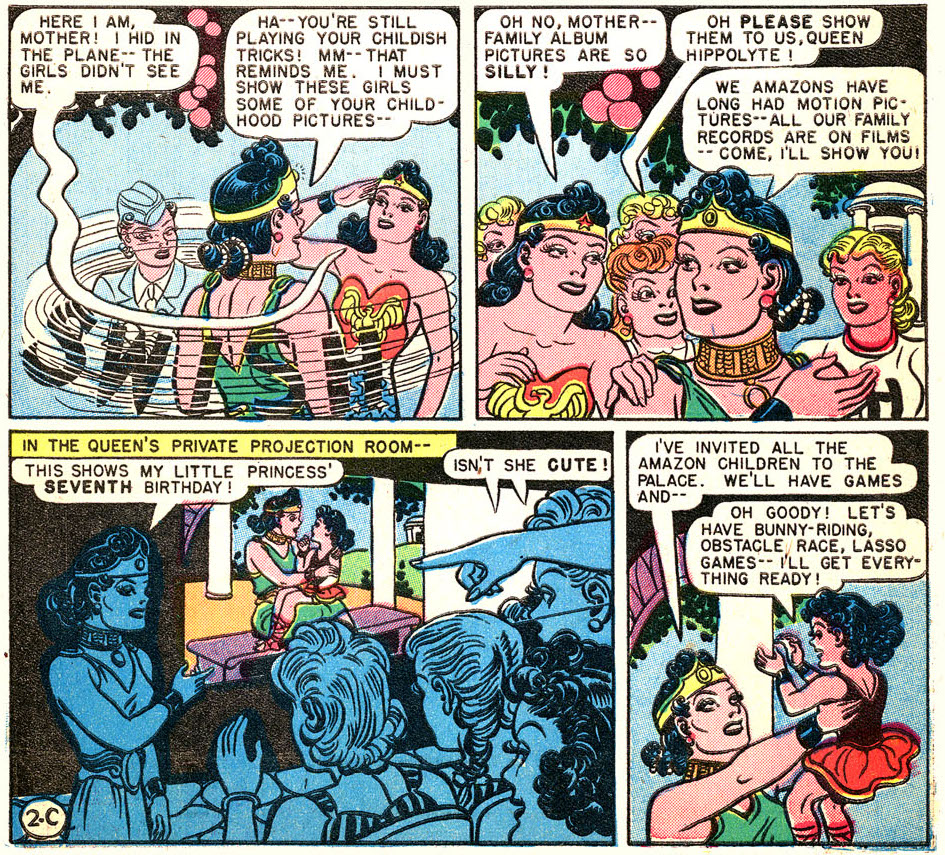
Marston reproduces this dynamic even more self-consciously than the fashion plates:

WW’s “childish tricks” (involving, essentially, disrobing at super-speed before her mother), lead Hippolyta to remember her daughter’s actual childhood. The eroticized affection between mother and daughter is then displayed (via film) for the delectation of an all-female audience.

In her discussion of the Victorians, Marcus follows her look at fashion illustration with an analysis of debates about corporal punishment in women’s magazines of the period. Said debates involved numerous women writing to the magazines to describe, in detail, their own experiences with corporal punishment — descriptions which dwelt on the removal of clothes, the physical sensations of whipping and being whipped, and other immodest details. All of this, according to one magazine editor “aroused…intense, not to say passionate interest.”

Here’s one letter which Marcus quotes.

I put out my hands, which she fastened together with a cord by the wrists. Then making me lie down across the foot of the bed, face downwards, she very quietly and deliberately, putting her left hand around my waist, gave me a shower of smart slaps with her open right hand…. Raising the birch, I could hear it whiz in the air, and oh, how terrible it felt as it came down, and as its repeated strokes came swish, swish, swish on me!

Marcus notes that “Corporal punishment is where pornography, usually considered a masculine affair, intersects with fashion magazines targeted at women.” She adds that “flagellation scenarios represented, interpellated, and excited women as well as men, and that the power differences inherent in scenes of discipline and punishment were erotically charged in any gender configuration.”

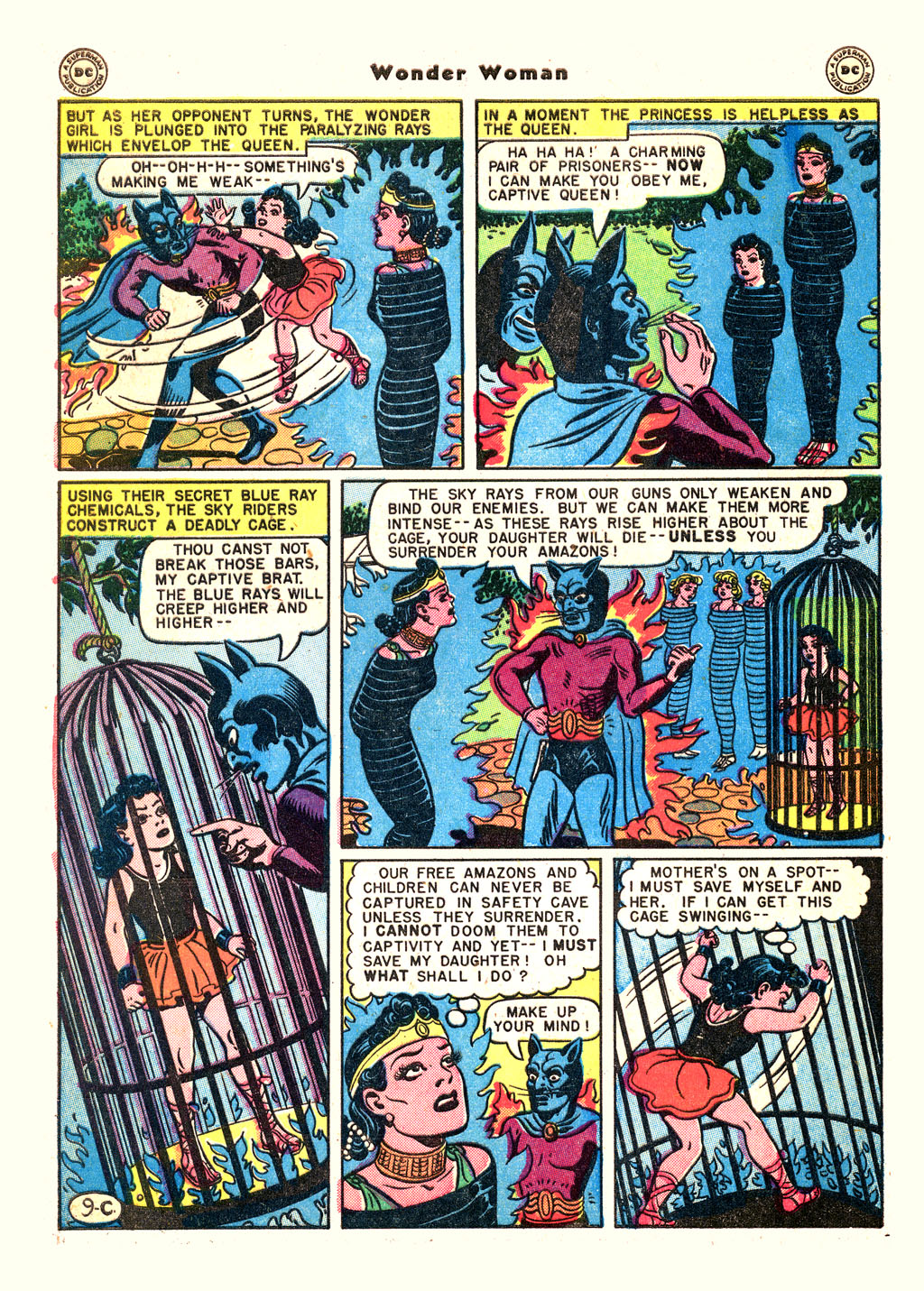
So here’s some scenes of the young WW being disciplined as little girls ought.

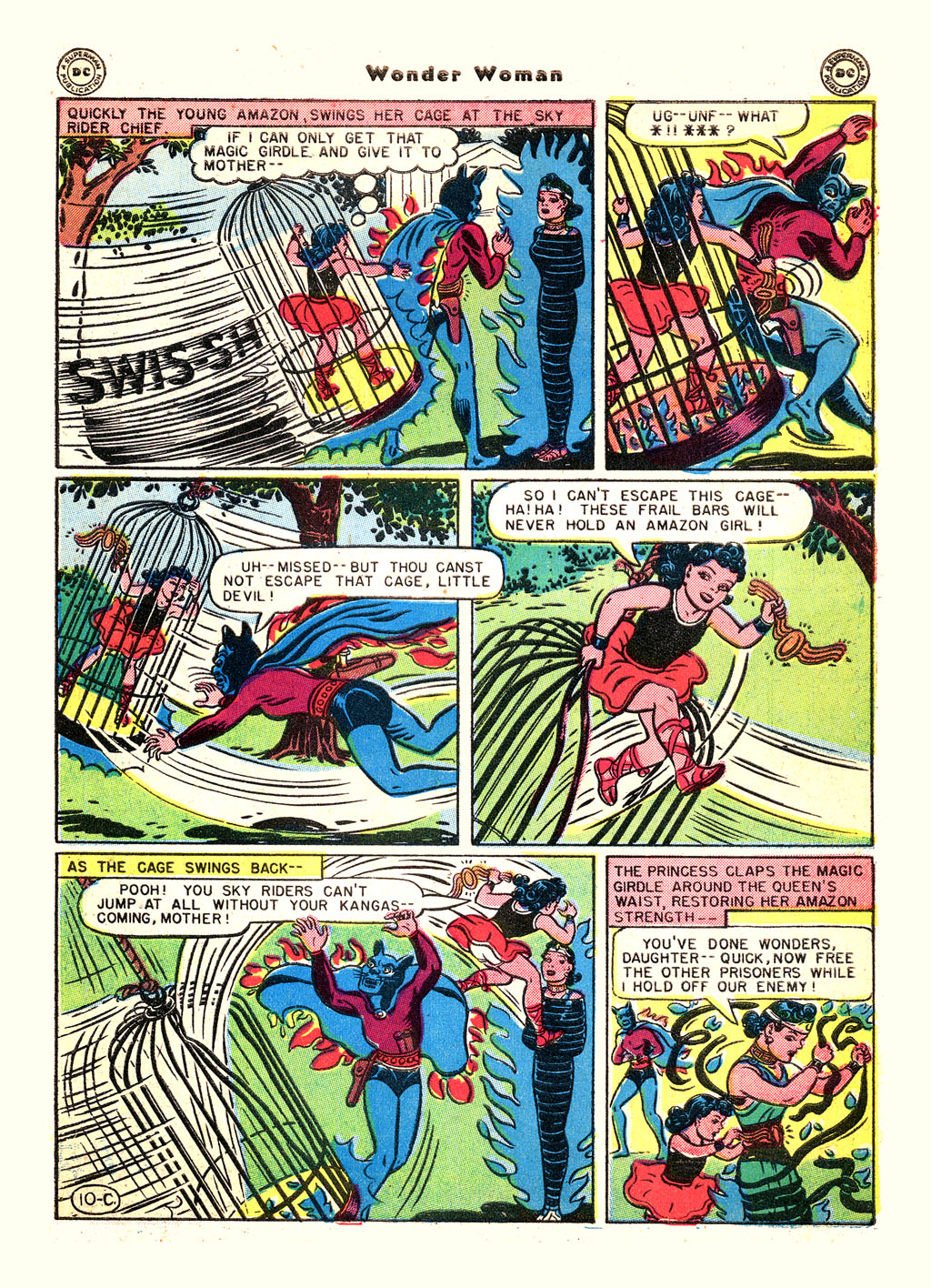
That upper right panel, in particular, eroticizes the adult mother and the child daughter in exactly the same way; both are bound side by side, with Peter’s stylized drawing and the wrappings deemphasizing the age difference; they look like different sized dolls rather than like mother and daughter.

Peter emphasizes the connection, and the parallel fetishization, of mother and daughter in other ways as well:

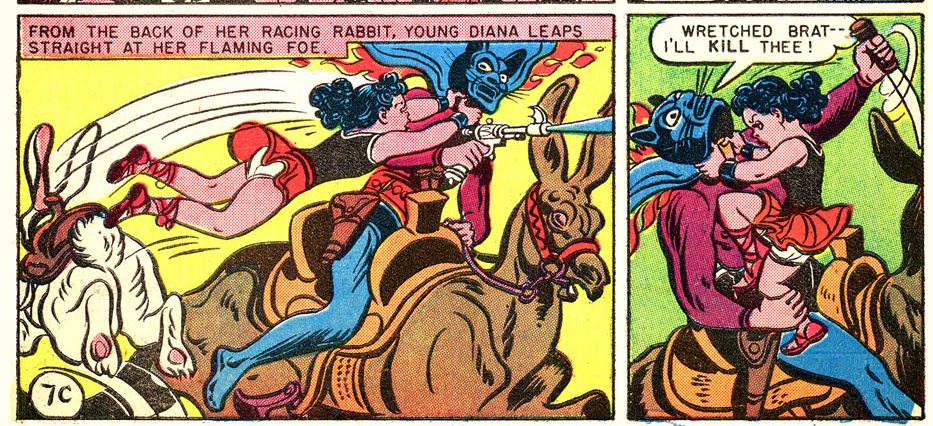
Mother and daughter both attack in the same way; leaping up to grab the antagonist by the neck. And in both cases, the attack is, I’d argue, fetishized; Hippolyta’s straight posed stiffness emphasizes the curves of her dress and of her breast. In the second sequence, Peter shows us, in both panels, WW’s underwear beneath that short miniskirt.

In addition, of course, any display of female power is eroticized for Marston, as is any display of female disempowerment. As with the corporal punishment fantasies Marcus describes, the woman empowered and the woman disempowered are both subjects of the fantasy. So it’s as exciting to see WW in the cage as to see her breaking out of it:

Note in the bottom left panel that we see her underwear again…and that her crotch is level with her mother’s face. The energized swoops of motion lines; the violent rescue of the damsel in distress — this is a typical erotic fantasy, not any the less so because it involves daughter/mother rather than hero/heroine.

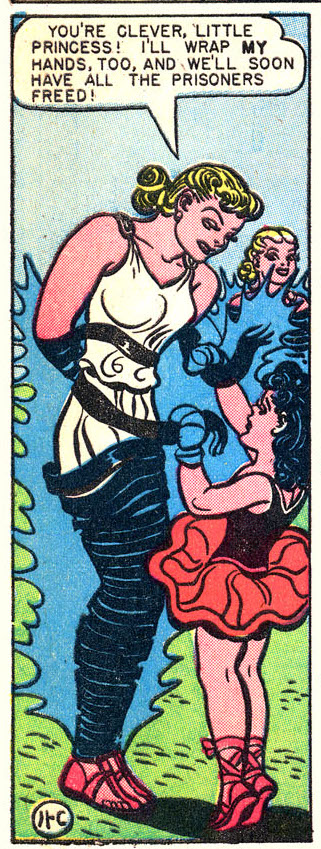
You see it again here; the Amazon being unwrapped is decidedly butch; her shoulder-width emphasized by the narrowing of her lower body caused by the wrapping. Young WW, with her dress flaring up as always, is decidedly femme. But in this case the femme is rescuing the butch, rather than the other way around — a role reversal which I’m certain Marston appreciated.

And speaking of role reversals:

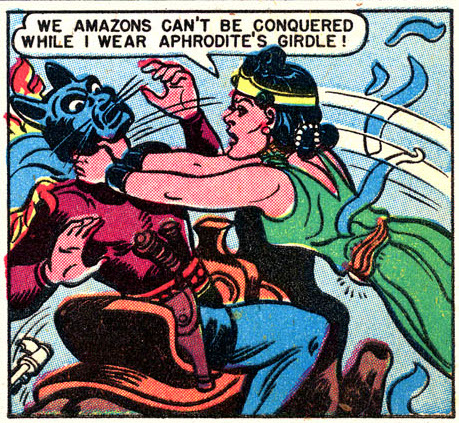
The sky riders who the Amazons initially assumed were men are, as it turns out, masked women. Thus Aphrodite’s law preventing men from setting foot on Paradise Island is not broken. Or, to put it another way, men are not the defilers of Aphrodite’s virgin soil — women are. Inevitably, the sky raiders are stripped to their underwear and bound under the watching eyes of the Amazon. In defeat, the powerful men are feminized — though, since this is Marston, the feminization is actually their triumph, as they will now (eventually) become reeducated and made Amazons (better than any man!)

Marcus notes that the Victorians created eroticized images of and narratives about women for women. The fashion plates allowed women to experience powers and pleasures around control and consumption of female bodies that were, in other areas, reserved for men. In a somewhat analagous way, it’s worth pointing out that the eroticization of children in WW is meant to be consumed primarily, not by adults, but by children. The hints of adult pleasure, power, dominance, and submission, leavened with childish adventure and playfulness — the very things that made Frederic Wertham choke up his soup — were, I’d guess, exactly the features which appealed to children of every gender.

Plus, of course, sky kangas.