
Utilitarian Review 6/19/10

Starting tomorrow, HU is going to host a roundtable on the marketing of art manga. We’re going to have a whole host of guest contributors…so click back through the week.

On HU

HU suffered a major outage and was down for 9 days. For a moment we thought we were going to lose about half our comments…but the folks at tcj, and especially blog admin Tom came through and managed to restore almost all the damage. More details here and here.

In less apocalyptic news; since the last link roundup, we completed our Asterios Polyp roundtable with posts by Caro, Robert Stanley Martin, me, and Matthias Wivel. Please note that all comments have not been restored to Caro and Robert’s posts; we’re hoping to fix that soon, but at the moment the threads may be a little disjointed.

Suat published a long two part discussion of The Times of Botchan. Part 1; Part 2.

Richard Cook reviewed Iron Man 2 the movie.

Vom Marlowe reviewed Connie Willis’ novel To Say Nothing of the Dog.

Suat discusses Walter Benjamin and comics criticism.

And finally, I have a cheesy country download available, and also a Scandinavian black metal download.

Utilitarians Everywhere

Both kinukitty and I participated in a roundtable about an academic collection of essays analyzing the Boys’ Love genre.

Kinukitty’s posts are here and here.

As it turns out, I was reminded of an observation by G.K. Chesterton. In a 1911 essay, he said (in his cheerful, racist turn-of-the-20-century British way) that he felt Japan had imitated many Western things — the worst Western things. “I feel as if I had looked in a mirror and seen a monkey,” he wrote. And, reading “Rewriting Gender and Sexuality in English-Language Yaoi Fan?ction,” I had a similar experience. I love yaoi. I love Weiss Kruez fanfiction. And, to be overly dramatic about it, this essay ground my longtime passion and obsession into dust and ashes. I looked in the mirror and saw a demographic slice, vaguely exotic, in a Dances with Manporn sort of way, and ready to be dispassionately observed.

My contributions are here and here.

This book really helped me come to terms with my past, my regrets, my desires. Speaking as a straight white cisgendered male, I occasionally regret my transgressive decision to drop out of grad school to explore the fluid, abject jouissance of the non-(i)voried and nontowered. But then I encounter a text like this, and in its quivering, jellylike prose I remember why, though riven by radical difference, still numerous numinous heterogenous communities speak with a single pleasurable speech-act when they utter: “academics fucking suck.”

Over at Comixology I discuss a classical Chinese Zen triptych featuring bodhisattva, crane, and monkey.

Kuan-yin’s calm here may be in contrast to these unenlightened viewers, who squat like monkeys or strut like cranes, curious but oblivious. Or, perhaps, the joke isn’t that the audience is unworthy of enlightenment; but rather that they are already enlightened. Because they are as undignified as the monkey or the crane, those who contemplate the picture have their own plain, contingent place within it, like cranes or monkeys who happen to be nearby when the bodhisattva comes.

At Splice today, I review new releases by Monica and Toni Braxton.

One of the more noticeable results of this transformation was that r&b semi-fused with rap, and the resulting homunculus took over the world. Less spectacularly, the change wreaked havoc with typical pop career arcs. In the normal course of things, you expect a pop act to release a few good albums, and then get progressively crappier until they finally attain a plateau of unlistenable awfulness and fade into oblivion. But after r&b as a genre exploded aesthetically, singers like Brandy and Mariah Carey found themselves doing their best work in their second decade rather than their first.

Also at Splice Today, I reviewed new albums by Christina Aguilera and black metal band Nachtmystium.

All of which leads me to conclude that, if given the choice, I’d rather hear Christina Aguilera perform black metal than listen to Blake Judd try his hand at pop R&B. Some musicians should stick to their roots; others can only get better the more thoroughly they betray themselves.

At Madeloud I have an interview with Norwegian black metal band 1349.

Many black metal musicians have been inspired by Satanism or alternately by traditional cultures or nationalism. Is that where you’re coming from at all? Or are there other beliefs and convictions you have which influence your music?

ARCHAON: For us this is about the art. But when that is said, it’s an artform coming from a background that had a great focus on such beliefs/convictions, and to a certain extent we are all believers of the individual being it’s own master – that’s where we would meet. Obviously, we are four individuals that would give you four different answers to this subject, but none of us are worshipers as such. And 1349 has never been a religious or a political band, and (most probably?) never will. Even though we’re all quite philosophical…I cannot see any of us going down that path, mate.

Also at Madeloud, I have reviews of two short albums by pop R&B group Allure, a review of 1349’s latest album Demonoir and a review of a new album by the dubstep duo Vex’d.
Back Up, Comments Restored

I think the work on the site is done for the moment. TCJ has managed to restore all our comments and post labels. I think there are probably a few blips here and there — most notably poor VM’s post from earlier in the day seems to have gotten torched (though I think it will be restored shortly). But considering what it looked like we were going to lose over the last couple of days, we’ve survived pretty well it looks like.

Many thanks to Tom, the tcj tech point man, who has worked very hard to restore the site and get our comments back. Also thanks to Dirk, Gary, and Michael for resolving this situation and taking many steps to make sure it doesn’t happen again. I was somewhat down on everybody earlier, out of what I hope was understandable panic and despair. So apologies for doubting, and my thanks again for everyone’s hard work. I’m very, very grateful to have our content back, and the site restored to working order.

Thanks too to all our readers for your patience with this, and to everyone who offered advice or sympathy. I’m very grateful Derik Badman didn’t have to do all the work he volunteered to do to get our comments back…but I still owe you, Derik.

Assessing the Damage

As readers can see, we are now back online. The blog was down since the 8th — so nine days.

Besides the downtime, we have also lost data. The comments of all those logged in at the time of the failure were lost. That includes all of my comments and all of Caro’s. Probably others were lost as well. Altogether, half of the comments on the site appear to have been deleted. There is some hope that these can still be restored, I guess, though the outlook doesn’t look that good.

All the labels on all our posts were also deleted. That means that clicking on roundtable links now gives you a blank screen. I doubt this will be restored, though we can hopefully rejigger at least some of it by hand.

All in all, this has been an immensely frustrating and disheartening experience. Our comments are a vital part of the blog; to lose large swathes of them like this is simply not something that should happen. Nor should the blog be down for more than a week at a time.

Part of the problem seems to be that znet, the hosting service, is not reliable. Part of the problem seems to be that tcj.com did not back up the blog correctly. Steps have been taken to resolve some of these problems in the future. Whether they will be sufficient is something I don’t know.

In any case, I have been left with a clearer picture of TCJ’s priorities, and where this blog fits in them. That’s been a very painful lesson, and one I’ll have to continue to mull on as we go forward. For the present, I’d like to apologize to our readers, our commenters, and our contributors. When you come to the blog, you expect your contributions, whether as a poster or a commenter, to be treated with care, respect, and professionalism. I fear that has not been the case. There are various people to point fingers at, but ultimately the blog’s my baby. I should have been more careful with it.

In any case, as we find out more about the update and recovery I will keep you informed. We have a full schedule over the next couple of weeks, including a roundtable on manga next week. Thank you for reading and for your patience.

Update: Michael Dean very politely suggests my version of events is a little out of whack; please scroll down to comments to get his correction.

Update 2: We got our comments back! More complete update here.

Hooded Polyp: Earthy Anecdotes

In Caro’s recent post she argues that Asterios Polyp fails to deliver a kind of literary complexity.

The result is the reiteration – on the level of performance if not assertion – of a hierarchical division between “the literary” and the “graphical”: a dichotomy that is aggressive and dismissive in precisely the same way as Asterios’ treatment of Hana. It is completely uninformed about how literary fiction works. It creates a destructive incoherence at the center of the book.

I’ve probably bashed Asterios Polyp enough for one lifetime at this point. But I thought it might be interesting to look at a couple of examples of works that I think demonstrate the kind of literariness Caro is looking for.

I’ve been rereading Wallace Stevens recently, and I’m quite taken with this poem, the first in his first collection:

Earthy Anecdote
Every time the bucks went clattering
Over Oklahoma
A firecat bristled in the way.

Wherever they went,
They went clattering,
Until they swerved
In a swift, circular line
To the right,
Because of the firecat.

Or until they swerved
In a swift, circular line
To the left,
Because of the firecat.

The bucks clattered.
The firecat went leaping,
To the right, to the left,
And
Bristled in the way.

Later, the firecat closed his bright eyes
And slept.

As with a lot of Stevens’ poetry, nobody seems all that certain what the fuck this means. I’ve seen various efforts to parse it as some sort of allegory (the firecat means “change” was one particularly painful example.) But none of them are very convincing. Even the relation of title to poem seems maddeningly obscure. How is this earthy? Is there some sort of bizarre sexual double entendre known only to Stevens? That seems fairly unlikely — and yet, no other explanation presents itself.

The confusion here is, I think, on one hand simply a result of looking too deeply, or of coming at the poem from the wrong perspective. A lot of Stevens’ writing seems to me to be inspired not by abstruse epistemological theories or Romanticism, but by children’s poetry. “Earthy Anecdote” makes most sense if read not as allegory or complicated symbol, but as nonsense verse. Dr. Seuss’ battling tweetle beetles aren’t symbols of the futility of martial endeavor. They’re just goofy fun for kids. Similarly, the clattering bucks and the firecat are entertaining images. It’s fun to say “bucks went clattering over Oklahoma.” (Go ahead, try it. I’ll wait.)

At the same time…Stevens was also, and undoubtedly, inspired by abstruse epistemology and Romanticism. And he was writing verse for adults, not kids. Starting his first volume of poetry off with a bit of extravagant silliness is a fairly dramatic line in the sand — even if the line is curved. It’s a certain kind of statement; an elliptical declaration of love for the earthy, clattering bucks rushing about in glorious, purposeless panic — metaphors in frantic search for a meaning. In that vein, perhaps you can see the firecat as Stevens himself, leaping here and there to goad his images (and perhaps his readers) into a lather, before closing his bright eyes in self-satisfied pleasure. Or, alternately, Stevens might be the bucks, thrashing this way and that in an effort to avoid a meaning which is always leaping to thwart them — and which, in lazy triumph, curls around the poem at the end despite every horse’s best efforts.

None of these explanations are “right”, I don’t think. Rather, the point of the poem is the pleasurable possibilities of the point of the poem. That’s how the modernist puzzle works; the poem is playing with its own interpretation. Form and content (buck and firecat?) aren’t separated, or even separable; the content of the poem is its own metaphors. The reader doesn’t so much understand the poem, as shuttle about inside it. It’s a joke where the punchline is that the form of the joke is the punchline.

There are not a ton of comics that play these kinds of shell games with meaning, form, and content. But one example that does spring to mind for me is Yuichi Yokoyama’s Travel. In my review on Comixology I wrote:

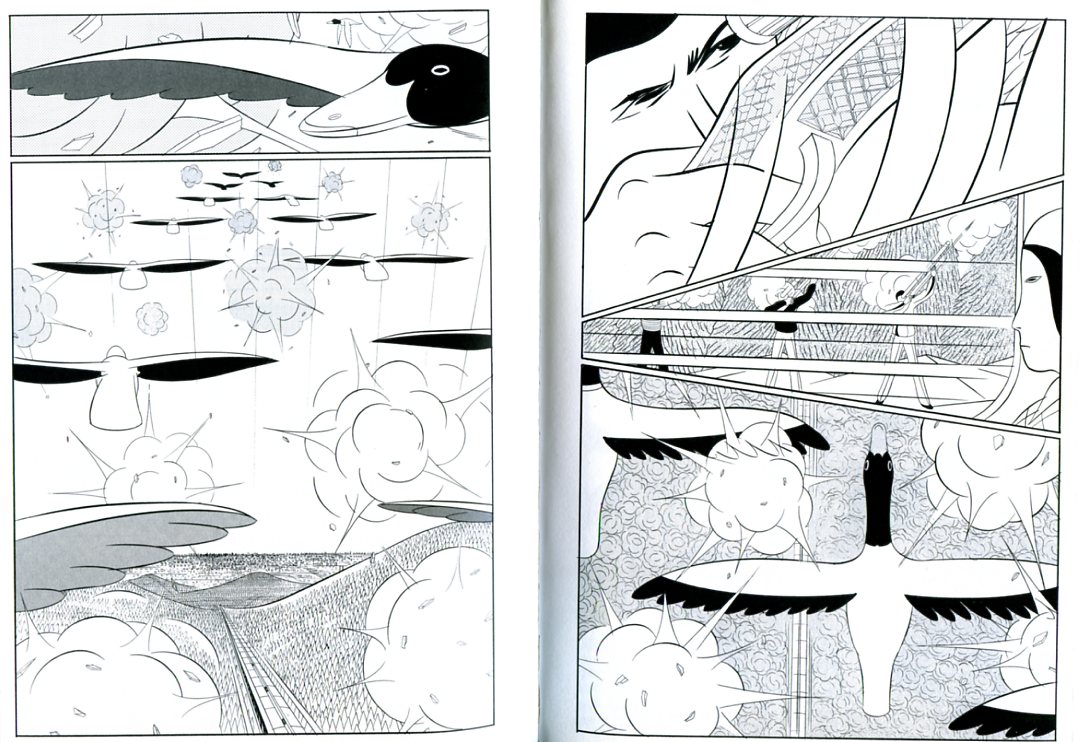
Yokoyama had wrong-footed me. I was looking for realism, and so I found the epistemological uncertainty frustrating. But the book isn’t realism — or not exactly. It’s pomo; Yokoyama’s tongue is in his cheek the entire time. Take the scene of ducks flying over the plane as hunters shoot at them. The footnote points out that the hunters all miss, and indeed, you can see the ducks traveling in a perfect V, not even disturbed by the shells exploding in pristine, regimented bursts all around them. The demands of narrative (somebody shoots, somebody hits) are sacrificed, with a wink, to the exigencies of layout. It’s as if the hunters and the ducks are not adversaries at all, but part of some single great mechanism, controlled by one guiding hand. As, of course, they are.

In Travel, as in Stevens, the sleight-of-hand manipulation of the tropes of the medium, the formal elements of the work, are themselves the content. As a result, modernist works like this are like two facing mirrors; absolutely flat surfaces leading into infinite depths.

I’m not saying that this is the only kind of worthwhile art by any means. I don’t want all art to be playful modernist puzzles anymore than I want all art to be slasher films or shojo. Still, Stevens and Yokoyama are great, and I wouldn’t at all mind seeing more comics that followed in their hoofprints.

Talking Polyps

I thought we’d take a pause in the middle of our Asterios Polyp roundtable to highlight some of the points that have come up in comments.

Craig Fischer had a fascinating comment on Mazzucchelli’s use of word balloons:

You can see how appealing and effective Mazzucchelli’s word balloons are by comparing them to the balloons in most contemporary mainstream comics, which look ugly to me: resolutely rectangular, filled with text that looks like it was generated by computer.

Mainstream creators have struggled with personalizing captions, especially when the text moves across panels and the speaker is unseen in the second panel.

Kurt Busiek will sometimes write one panel where a character says something like, “If we can’t stop that dinosaur…” This panel is then followed by another that (1.) visually eliminates the speaker (showing, say, only the rampaging dinosaur); but (2.) continues his/her speech (“…we’re all DEAD!”) in a caption.

Alert readers realize that the words in the second-panel represents the character continuing to talk. But Busiek and his collaborators have tried to insert other cues to eliminate any ambiguity about who’s speaking. One solution: characters are assigned different colors, and their captions are always in that color.

When Busiek wrote THE AVENGERS, he sometimes included the logo of the speaking character at the beginning of the caption box. For instance, a little shield appeared at the beginning of the caption if Captain America was talking but was unseen.

All of this really cluttered up the visuals, though–sometimes you’d have five different logos and colors for the captions littering a single page–and was nowhere nearly as elegant as the balloons in ASTERIOS POLYP.

Suat compares Asterios Polyp and Born Again (scroll down in comments for my response.)

What’s also interesting is that Born Again is filled with hoary cliches: damsel in distress, betrayal and redemption, the hero’s “rebirth” etc. Exactly the kind of thing which Noah decries in his review of AP. How many times have we seen the noir hero pull himself up from the gutter? (Darwyn Cooke’s Parker must be the most recent example/adaptation in comics)

And yet Born Again seems less tiresome in that respect when compared with AP which is similarly choked with cliches (or archetypes, whichever way you want to look at it). Does genre work at a different level than work of more serious intent? Does it appeal to some subconscious craving particularly in the male mind? I imagine that some of Born Again’s success must be put down to its pacing and the detailing of emotions(the later of which is lacking in AP possibly by choice). But is it only that extra twist of lemon in the plotting and the characterization?

Sidenote: You can actually see some of the dry brush work mentioned by Derik (re: the rocks in AP) in Born Again. I presume it became an even greater aspect of his art following his sojourn in Japan. Born Again would appear to be a steep learning curve for Mazzucchelli – you can see him improving as an artist right up to the final issue.

Robert Stanley Martin provides a choice Mazzucchelli quote

Here’s Mazzucchelli’s account of his collaboration with Miller on Born Again, from TCJ #194:

Frank was writing full scripts, but we were also discussing the stories. In fact, it was Frank’s idea to list our credits on the book as just reading “by Frank Miller and David Mazzucchelli,” not broken up into writer/artist/whatever. He asked me if that would be okay with me, because he didn’t want there to be any confusion. And as far as I was concerned it was perfectly acceptable, because the way we were working, there were ideas going back and forth where it would have been difficult to draw a clear line of demarcation–this came from one person, this came from the other person. Frank had the ideas for the stories, and he would call me up and we’d talk about it. And we’d hash it out and I’d have ideas of my own: “Well, what if this happens? And how about if we show it this way?” or whatever. And then he’d write a full script and then we’d have another long discussion about the script and then I’d draw from that. In fact, as I recall, everything that happens in the first three issues or so Frank initially wanted to put into the first issue. But because of discussions we had, we ended up expanding that, so that it was much slower, more densely packed.

And Daniel BT highlights the fact that the roundtable has been awfully cranky.

Anyways, one thing that bothers me about all this reviewing about Asterios Polyp is that nobody seems to ENJOY the comic. Rather than point out the innovations in the drawings, they’d rather point out how superficial the story is, how one-dimensional the characters are, and how unlikeable the main character is. I don’t like Woody Allen that much either, but I prefer Asterios better, since he’s not as neurotic, even when the spotlight keeps shining on him.

Lot’s more chatter in comments, and three more reviews to go (by Caroline Small, Robert Stanley Martin, and Matthias Wivel) before the roundtable winds down.

Utilitarian Review 6/5/10

On HU

Most of the week was devoted to the ongoing Asterios Polyp roundtable. Derik Badman, Craig Fischer, Vom Marlowe, Richard Cook, and me have all had our turns; Caroline Small, Robert Stanley Martin, and Matthias Wivel are still to come.

Also this week, Erica Friedman talked about condescension in comics.

Utilitarians Everywhere

On Splice Today I reviewed Prince of Persia.

So, okay, it’s true—this is a big, dumb, Hollywood action-adventure vehicle with nothing in its head except things blowing up, sword fights and pretty actors staring soulfully into each others eyes for a moment before more things blow up.

I’m okay with that.

Also on Splice Today, I talk about hook up culture, teens, and how the Atlantic Monthly is turning into an exploitation rag.

If you want to know whether girls have become more or less promiscuous, you don’t look at what they’re reading or listening to, or even at what big sex scandal occurred in which random college or prep school. You look at teen pregnancy rates. You can find out in less than 120 seconds that teen pregnancy rates fell in virtually every state between 1988 and 2005. After 1995, teen pregnancy rates nationwide declined every year for a decade, hitting their lowest point in 30 years in 2005, smack dab in the middle of Flanagan’s hook up decade. It’s true that the next year, in 2006, rates rose by three percent, and preliminary findings suggest they may have risen again in 2006. Even so, rates remain historically low; in 2006 teen pregnancies were only 71.5 per 1000, as compared to, 83.6 per 1000 in 2000, 99.6 per 1000 in 1995, and 116.9 per 1000 in 1990. To suggest, as Flanagan does, that teens were especially promiscuous in the past decade and a half is simply wrong. On the contrary, teen pregnancy has apparently declined for more than a generation, the growth of the Internet notwithstanding.

Other Links

Dara Lind explains why Facebook sucks.

Alyssa Rosenberg talks about MIA and Courtney Love.

Tucker Stone and Benjamin Mara have a long, thoroughly entertaining discussion about The Rise of Arsenal, of all things.