Hooded Polyp — Stupid Spaces

Asterios Polyp takes an impeccable sense of visual design and layer upon layer of sophisticated allusion to tell a clichéd, tedious, poorly imagined, ruthlessly uninsightful story. It’s like listening to a musically brilliant opera with the book taken directly from a TV movie of the week, or (to take an analogy perhaps closer to my heart) listening to classic Slayer perform a John Updike novel. You can’t but be impressed by the technical skill and control…but it’s hard not to feel that, skill and control notwithstanding, a person who could expend such time, energy, and passion on such vapid idiocy must be, on some level, a fool.

Of course, with a book this intricate and complicated, it’s always possible that the person who doesn’t get it is the fool. I know what I’m supposed to do with this book; I’m supposed to start googling all the names that have flagrant double-meanings; I’m supposed to read and reread looking for connections, following up secret paths. How is the theme of doubling worked through the book? How do the different styles link to different moods and themes? Why does the guy who pokes out Asterios’ eyes at the end seem to recognize him? When exactly did Asterios give up smoking and what does it mean?

I figured out a few of these answers despite myself — but, man, overall, I so don’t care. And I don’t care because, with all the twists and turns and clever games and beautiful drawings, this is, at bottom, a character study, and Mazzucchelli’s characters are all as tediously second-hand and tired as his designs are inventive and new. Asterios Polyp, the character, walks out of the massive towering edifice of literary fiction via rote Hollywoodization, and he’s as utterly devoid of interest as he was the first thousand times I saw him. Hey, look, it’s a Successful Professor Whose Intellectualism Has Disconnected Him From Life. And there’s his younger, also brilliant, but more tentative wife — and…wait! He’s driving her away through his callous self-absorption! Didn’t see that coming. And now he’s undertaking a spiritual journey which involves interacting with common people and/or ethnic minorities! And, look, he learns his lesson and spiritual renewal is his — and happy, happy love! Yay! The end. And if I want to see it all happen again, I can just rent The World According to Garp.

I don’t know. Here are a couple of moments of emblematic shittiness.
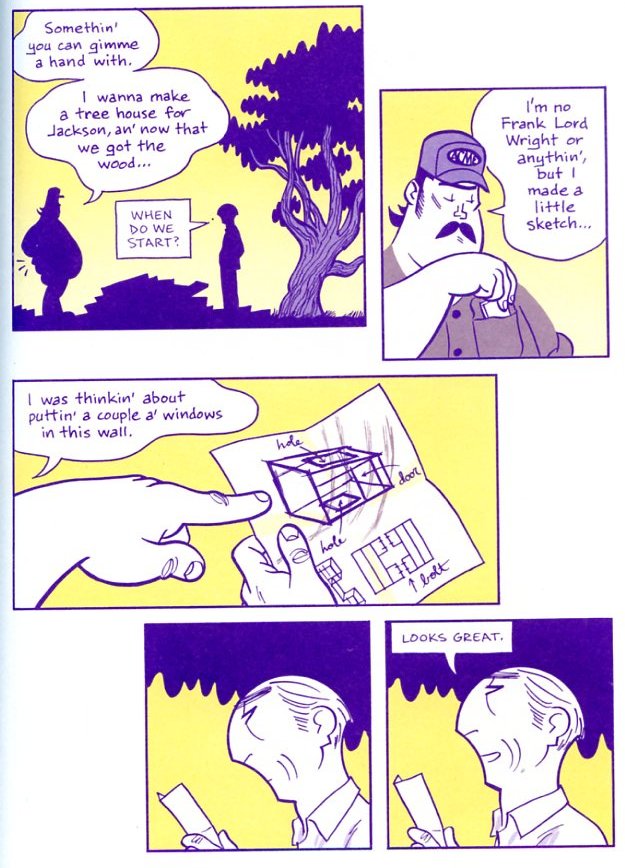
That’s our hero, Asterios Polyp, the great snobbish architect who has never built a house, committing himself to help his working-class boss and landlord build a rickety little treehouse for said boss’ adorable son. Can you savor the gentle irony? Do you feel the tear in your eye? Can you hear the inspirational music from various Kevin Costner vehicles welling up to play over the heartwarming montage?
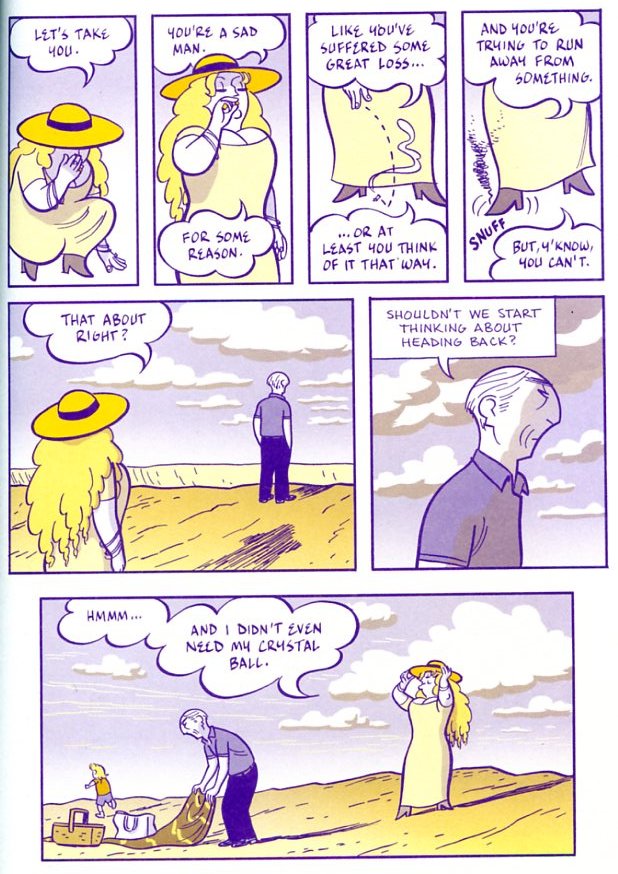
Here’s the boss’ wife, who is into new age nonsense (which we shouldn’t just reject as nonsense because we’ve already been informed that too much rationality is bad bad bad) looking deep into Asterios’ soul and seeing the wounded longing therein. It’s like his heart is just like that giant hole in the ground they looked at a few pages ago, which is a big ironic irony, because Asterios’ heart isn’t a hole at all. How could it be when he got it spackled over with moments of trenchant revelation borrowed from every half-assed rom-com script of the past quarter century?
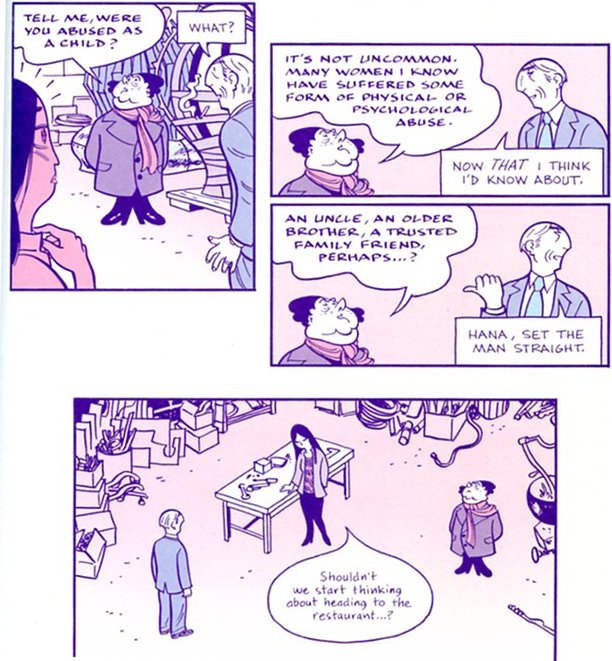
Look! His wife is the victim of sexual abuse! That adds emotional depth, doesn’t it! Hey, this book is really about something, damn it!

Matthias Wivel suggests that the story appears “reductive” because Mazzucchelli leaves out most of the connections; we don’t learn more about Hana and Asterios’ relationship because the point is that we’re to fill it in ourselves — figuring out the spaces in the architectual plan for ourselves. It’s a generous reading, and may well be what Mazzucchelli had in mind. The problem is that the plot and characters he’s given us — the frame in which we are to perceive the spaces — have little of genius, or even elegance. Instead, what he has erected is made out of shoddy, second-hand, thoroughly pissed upon fragments of mediocre pop culture detritus. Which is to say, the problem I have with Asterios Polyp is not, alas, that Mazzucchelli doesn’t give me enough. He gives me plenty.

__________________
This is the first post in a roundtable on Asterios Polyp. Derik Badman will weigh in tomorrow,(He’s now done so) and we’ll have various other Utilitarians and guests posting through next Monday.

Update: You can read the whole roundtable so far here.
Utilitarian Review 5/29/10

Asterios Polyp Roundtable

In the coming week (and a few days) we’re going to have an extended roundtable on David Mazzucchelli’s Asterios Polyp. Besides the usual Utilitarians, columnists Matthias Wivel and Domingos Isabelinho are also planning to weigh in — and we’ll also have guest posts from Derik Badman and Craig Fischer. So please check back!

On HU

I started off the week by explaining why I wasn’t that into Urasawa’s Monster.

Domingos Isabelhino devoted his first monthly column, called “Monthly Stumblings”, to Pierre Duba’s Racines.

Vom Marlowe pointed and laughed at the art in Brave and Bold #33. Several commenters protested, and I did a follow up post speculating on visual tropes in super-hero art.

Richard Cook provided a history of Wonder Woman’s panties in covers.

Caroline Small looked at Barbarella the movie and why it should not be a target for feminist ire.

Suat sneered at Gantz.

And finally Suat expressed some skepticism about the excesses of the market for original comic art.

Oh…also, here’s a download of some semi-schlocky country weepers.

Utilitarian Everywhere

Former Utilitarian and current comics creator Miriam Libicki has been doing some guest blogging over at Jewish Books. You can see her talk about her creative process here.

Columnist Matthias Wivel is over on the tcj.com mainpage talking about the Komiks.dk festival in Copenhagan.

At Splice Today I talk about the best super-hero movie of all time.

Why is it the best superhero movie of all time? If you saw the TV show you know the general outlines. Adam West does not have foam-rubber pecs like his bat-successors, but he does have a cute little paunch which is clearly outlined in his skintight bat-costume, said paunch sitting unashamedly atop his shiny external bat-underwear. It seems Robin has poured a quart of rabid bees down his green short-shorts and is bravely fighting the pain by punching his fist into his palm while imitating a (much) skinnier William Shatner. And, of course, there’s the Batmobile, Bat Repellant Shark Spray, Bat Knockout Gas, and all other kinds of Bat ephemera, each carefully labeled for those who otherwise might confuse the Bat Repellant Whale Spray with the Bat Ladder.

At Madeloud I provide an introduction to black metal.

Whiteface corpsepaint, church burning, ungodly screams, and the odd unpleasant foray into fascism — from the outside, black metal looks fairly foreboding. But while that image isn’t exactly wrong, it is a little misleading. Some black metal performers have really and truly been associated with extreme excesses and ugly ideologies (Varg Vikernes, we are looking at you). But, if you can put that aside, the music is in general quite accessible — in some cases, even pleasant. If you enjoy shoegaze or indie rock or ambience, a lot of black metal will sound like a slightly satanic twist on some familiar tropes. Here are some places to start for those ready to immerse yourself in surprisingly friendly evil.

Also at Madeloud, I review the latest releases from folk black metal horde Blood of the Black Owl and indie folk band The Clogs.

Other Links

This is an adorable illustration of Lovecraft’s Shadow Over Innsmouth.

I enjoyed this part of Kristian Williams’ massive discussion of Oscar Wilde illustrations.

Even though I have no idea what House of M is, this is still a great post about the X-Men by Tim O’Neil.

Feminist Hulk Smash Patriarchy on Twitter!

What’s Wrong With This Picture?

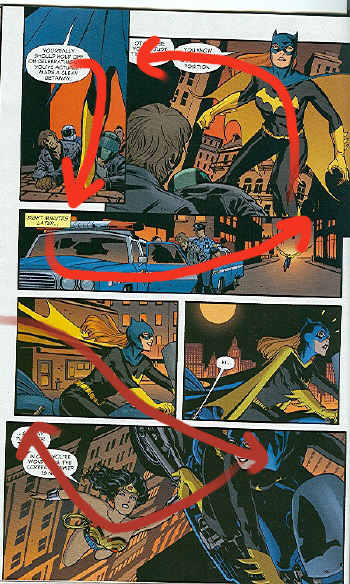
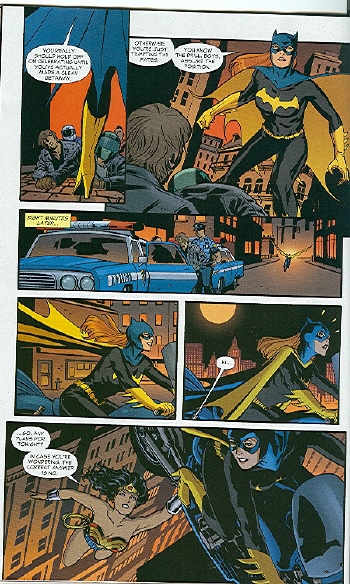
Vom Marlowe posted earlier today talking about the visual mess that is Brave and Bold #33 Among the pages she pointed out was this one:

Vom said:

I stared at this page and tried to figure out what the heck is happening. Finally, I decided that her bike flies between panel 4 and 5, although I don’t know why. Apparently so we can see Wonder Woman hanging onto the middle of the bike? I don’t even know.

David Brothers felt this reaction was disingenuous.

The Batgirl thing is similarly dishonest. We see street in the background, and then we see skyline. Two plus two: Batgirl is higher now than she was before. Next panel: the reason why.

This isn’t hard. This isn’t being steeped in continuity with no lifeline. This is basic stuff that is in almost every comic book ever made. You can find yellow pee lines in Peanuts. Done in Schulz’s style (thin lines, with maybe sweat marks around the lines), of course, but it’s the same effect. How did Wonder Woman lift the bike? By getting low to the ground and scooping it up, I assume, same way everyone has ever lifted everything.

I was talking this over with another non-superhero comics reader, and she said that she too couldn’t make heads or tale of the Batgirl sequence either. Whereas, I — who have read way too many superhero comics — parsed it instantly. I presume David’s experience was more like mine, which may be why he just assumed that others’ confusion was a put on.

This seems pretty interesting to me. I can’t necessarily point to anything in that sequence and say “well, this is why I followed it”, but I do wonder if there are tip offs you don’t necessarily even know you’re getting when you’re familiar with an art form or genre. I think things which “feel” natural and obvious can really not be at all.

In thinking about it more: the panel/panel/pull back and reveal move — that seems like something that’s done a lot in modern superhero comics. In this case, it’s done really confusingly; among other things, I think the horizontal movement of the panels works against the fact that the action is vertical. That is, from the panels, it looks like Batgirl is going side to side, but she’s supposed to actually be going up. I think this is in theory intended to make the reveal more surprising. In practice, though, it messes with the visual rhythms; it doesn’t feel from the panels like she’s going up at all, so even when you’re told (via the skyline) that she’s going up, you kind of have to convince yourself.

Rotating the angle of the bike messes with the rhythm too; the camera isn’t so much pulling back as it is swooping out and swinging around, though all in a single leap. It’s disjointed and clumsy; its like Cliff Chiang, the artist got to the bottom of the page and didn’t have enough panels, so he just cut out bits and hoped it would work.

And for me it does work — not in the sense of being a stylish or pleasurable progression, but in the sense that I can follow what’s happening. And I think I can follow what’s happening because I’ve seen it so often before. I mean, this is clearly somebody who loves Watchmen too, and who’s used to seeing comics imitating film movement more-or-less poorly, the way superhero comics these days tend to. I can follow the page better than VM not because I’m especially visually ept or because VM is pretending not to get it, but because it’s using tropes so familiar to me that I can parse them even when they’re not deployed very skillfully.

Another interesting thing about this to me is that, if I were reading this comic on my own, I don’t think I’d even notice that the tropes weren’t used very well. I’d read that page, understand it, and just go on. In some ways, being familiar with the tropes makes you see the comic less clearly. I can follow the images, but I wouldn’t have actually seen what they was doing if Vom (and David as well) hadn’t pointed it out to me.

Update: Telophase has a mess of fascinating comments (starting here) explaining the different ways in which manga and western readers read comics. Basically, manga readers look for clues in the art first, then if that doesn’t work go right to left; western readers go left to right first, and if that doesn’t work look for clues in the art. Telophase kindly marked up the page above to show how a manga reader (going left to right of course!) would parse the page.

The visuals at the bottom of the page end up to be particularly nonsensical, which might help explain why VM had such trouble figuring out what on earth was going on.

Monster and Paragon

I just finished the first volume of Naoki Urasawa’s Monster, and that’ll probably be the last one I read. Partly, I’m annoyed by the conspicuous and painful contrivances — I mean, how many times can simultaneous brain surgeries on a poor person and a rich person be required in the same German city in the same week, anyway?

But while the melodrama is over-determined, the real problem is that the book is glib in other ways. The point of the first volume is the various moral dilemmas faced by Dr. Kenzo Tenma, a amazingly accomplished Japanese brain surgeon living and working in Germany. The stumbling block is that the book never really contemplates for an instant presenting Tenma as anything but a moral paragon, which rather undercuts the efficacy of said dilemmas. Really, Tenma’s big bad sins in the first volume are to (a) be mildly ambitious, and (b) to spout off out loud to an unconscious person about how he’d like to kill the folks who wrecked his career and life. Those are barely even sins, and the rest of the time we see him running himself to exhaustion to save lives, neglecting his own career advancement and romantic life, and generally being a paragon of virtue.

Having such a strong moral beacon in the central role pretty much vitiates the ethical questions that appear to be the heart of the book. In Middlemarch, as a contrast, the doctor, Lydgate, is both really likable, morally upright — and actually swayed by money and romance to do some fairly awful things. Because Lydgate is a flawed human being, his choices are much more involving; the fact that he occasionally falls makes his occasional triumphs — and those of others — have an actual weight and beauty.

Tenma, on the other hand, comes across as a hollow prig; the dilemmas he faces have to be ridiculously contrived, because he simply, and improbably, isn’t subject to normal human failings. The result is sententious and irritatingly stupid; every demonstration of Tenma’s nobility just makes me want to say, “give me a fucking break.”

Adding to the annoyance is a fairly strong suspicion that part of the point of the manga is to allow the Japanese to pat themselves on the back for their purity and general moral superiority. The giant noses of all the Caucasians are fun to look at, but the standard noble-Japanese-struggling-to-retain-his-purity-in-corrupt-old-Europe thing is a lot less enjoyable. Nor am I all that taken with the hoary idea that serial killers have something important to tell us about the human condition/human morality/our inner selves. I’ve seen that film, thank you, and as far as I”m concerned Kevin Spacey and Anthony Hopkins can be sealed in a concrete container and dropped in the Mariana Trench where they can overact at each other and various species of deep-sea fish for all eternity.

I know lots of folks have liked Monster, and it’s certainly possible that things get less stupid at some point later in the series. And the art is quietly skillful in a Tezuka vein. But I think I’d much rather pursue the trashier Gantz, which manages to be a lot more thoughtful and truthful about morality by the simple expedient of not idolizing its central characters.

Utilitarian Review 5/22/10

On HU

Kinukitty started her monthly column by pointing at KISS lyrics and laughing.

I interviewed critic Tom Spurgeon about comics and criticism. In comments, he tells me what he really thinks of me. It’s fairly unpleasant.

Richard Cook contemplates the Ant-Man, She-Hulk, and Cable films on the way in 2013.

Art critic Bert Stabler does a guest post in which he discusses bodies, essentialism, and feminist performance art.

I review Michael Kupperman’s Tales Designed to Thrizzle.

And I talk about racism in my favorite terrifying Tintin dream sequence.

Also, we’re going to be using captcha words for comments from now on in order to try to cut down on the crazed deluge of spam. You can avoid having to type in random characters when you comment by signing up in the upper right corner of the sight.

Oh; and I’ve uploaded a classic Scandinavian black metal mix.

Utilitarians Everywhere

I talk to Bert Stabler about Kant and God and other stuff over at his blog.

Bert: A God that pursues us, that moves in and out of us, is not an abstract principle of wisdom, nor a form of primal electromagnetism, but something else that contains elements of both of those things. Our wanting and changing and experiencing and relating are the things that are most relevant to God and to faith. I’m not totally satisfied with the way Kant addresses this, but he certainly tries, and for faith after the death of God, that’s an important start.

I review a passel of reissues of Johnny Cash’s 70s albums over at Madeloud.

Still, the real standout here is the title track. Built around an irresistible banjo hook, swirling swings, and a cheesy but somehow still aching horn riff, the lyrics neatly invert the standard gotta-ramble-baby trope, as Cash laments the fact that his woman won’t stay with him. “I know she needs me about as much as I need someone else. Which I don’t,/ And I swear some day I’ll up and leave myself. Which I won’t,” he sings, with plainspoken helplessness. Cash has always had an admirable willingness to look like a fool, and here the overblown, foofy production seems to emphasize his emasculation. “I know the only reason that she ever has to leave me is she wants to.” The song is, like unequal love, both ridiculous and heartbreaking.

Other Links

This is one of my favorite of Tom Crippen’s reviews so far.

Robert Boyd has some interesting speculations about the impace of criticism on theater productions embedded in an (also interesting) discussion of Jules Feiffer.

New Comments Protocol

In an effort to stem the rabid tide of spam flowing into the blog, we’re going to try to fiddle with the comment protocol a little. My understanding is, if you aren’t logged into the site, you will now have to type a word (captcha) to show that you’re human. Hopefully this will not be too big a pain. Please feel free to try test comments on this post, and to tell me how it’s going. Thanks.

Update: Incidentally, creating an account just takes a second, so if you comment somewhat regularly, you might want to take a second to do that rather than filling in the captcha every time.

Tintin and the Racist Dream

Bert Stabler was talking over in another thread about imperialism, art, and taste and how the three interact. In that vein, I thought I’d reprint one of my favorite sequences from Tintin.

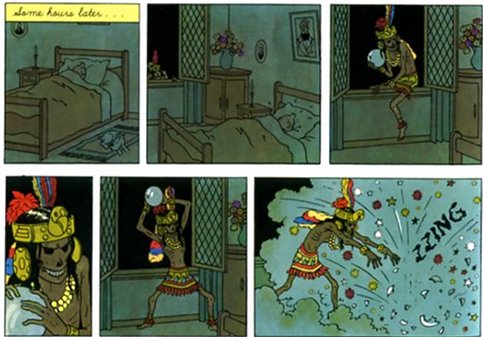
This is an avenging Inca Mummy, summoned by the conflation of ancient magic and the sacrilege of European explorers.

The moments I most like in Tintin are almost invariably the creepy, surreal ones. I find Herge’s humor repetitive and precious in general — and for me the clear line style only emphasizes the clean, scrubbed, antiseptic cuteness of the slapstick. The weird dream moments, on the other hand, are all the weirder for their pristine perfection. The clarity itself becomes frightening. In the second panel above from “The Seven Crystal Balls,” the Inca mummy’s face at the window, almost unnoticeable but still preternaturally distinct, seems more real than real, it’s perfect finish giving it an undeniability. Even though this is (sort of) only a dream, as it turns out, the dream looks as solid as the mundane window the mummy climbs thorugh. The fact that different content is presented so rigorously through the same form becomes in itself uncanny.

But what is the difference in form? Well, it’s pretty clearly racial difference. A lot of pulp narratives, from Sherlock Holmes to Fu Manchu, draw much of their spark from colonial fever dreams, and that’s certainly the case for Tintin as well. In “Seven Crystal Balls,” the Inca curse, and the mummy itself, are the parts of the story I remembered best from my childhood, and still find most compelling. They’re creepy and cool and unsettling, with an emotional depth that isn’t there, for me at least, in, say, the drawing room comedy of the Castafiore Emerald.

This, then, is really a case where I don’t like the sequence despite its racism and imperialism. As far as I can tell, I like it because of them. The fascination/repulsion Herge feels towards the strange gods of colonized cultures generates real creative frisson. Which makes me wonder if maybe that’s true of racism and stereotypes in general. It seems like, beyond their other uses, they sometimes have an appeal which might be called aesthetic. A certain amount of cultural creativity goes into shaping the person in front of you into a phantom monstrosity, and that creativity can itself be exciting and fascinating. The dream’s appeal is its vividly imagined ugliness; the exhilaration of imposing on the world the gothic products of one’s skull.