Girl, You’ll Be a Creature Soon

This essay ran in a somewhat different form in the Chicago Reader a couple years ago. I thought I’d reprint the original version along with some more pictures here.
_______________

Ever since the breakaway success of Neil Gaiman’s Sandman in the 80s, there’s been an indigenous niche for graphic fiction about brooding guys, languid girls, melodrama, the morbidly cute, and the cutely morbid. Titles like Gloom Cookie, Courtney Crumrin and the Night Things, and anything by Jhonen Vasquez exist in a parallel, twilight world, where super-heroes withered away from anemia and the American comics industry never decided to outsource all of its female genre fiction to Japan.

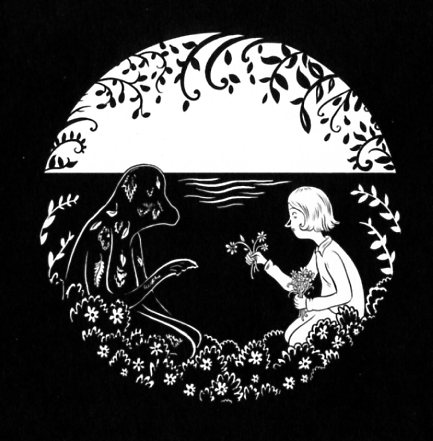
Chicagoan Lilli Carré’s debut graphic novel, Lagoon, isn’t genre fiction itself — it’s an art comic. But it’s aware of, and interested in, gothic fantasy to a degree unusual among alternative comics creators not named Dame Darcy. Indeed, Lagoonfunctions as a kind of meta-goth; an elliptical love letter to the genre and to its place in the adolescence of many young girls. The frontispiece drawing captures the affection and the distance — in a circular frame, Zoey, the tween protagonist, sits beside a lake passing flowers to a black, leaf-plastered, faceless humanoid thing. Flowers and tendrils frame the image, suggesting the overripe opulence of goth or art nouveau. But Carrés blocky linework is surprisingly sparse and even crude; it looks like something a precocious, motor-control-challenged Beardsley might have drawn when he was 6. The black monster is cute, creepy and mysterious in a very goth way, but the scene also has a sparse, modernist poignancy which is very different from tactile Victorian melodrama. Beauty is sketched out rather than embraced; the space between the girl’s hands and the monster’s is also the distance between desire and reticence, opening on a nostalgia which suffuses either the coming contact or its absence.
In fact, to the extent that Lagoon has a plot, it centers precisely around the deferral of the moment when the girl and the monster actually meet. The monster, or creature lives in an (ahem) black lagoon and sings. The girl’s family, and indeed, the whole town, is enraptured with the song; they go out to the lagoon to hear the music and dream and sometimes drown. Of all the characters in the book, only Zoey herself never, quite, sees the creature. When she goes to the lagoon, the black singing shape she finds turns out to be, not the creature, but her sleep-walking grandfather, waist deep in water. She sees the fire the creature sets in the woodpile, but not the monster itself; when she looks under her bed for monsters, it’s the wrong time and the wrong bed.

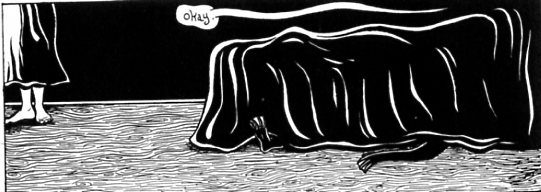
That’s because the creature doesn’t hide under Zoey’s bed, but under that of her parents. After the girl goes to sleep, her mom and dad have sex and then fall asleep. In the middle of the night, mom wakes up, opens the window, and lets the creature in. When the husband stirs, the creature slides beneath the bed, one rubbery, phallic limb poking out suggestively from under the frame.

Goth is always suffused with sexuality, of course. But what’s most creepy about this scene is not its gothic trappings — the woman in the dark, the vampiric monster at the window — but it’s mundanity. Zoey’s mother treats the creature with a banal casualness. She lights a cigarette (her husband doesn’t know she smokes) and offers to share it, then off-handedly mentions Zoey as if the monster knows her daughter well. The juxtaposition of small talk and amphibious interloper is funny, but it’s also unsettling. Vampire creepy is one thing; watching-your-mother conduct-an affair-while your-dad -sleeps-in-the -same-room creepy is something else.
Or maybe the two things aren’t so different after all. The solid blacks and blocky grotesquerie of Lagoon strongly recall Charles Burns’ Black Hole, a story in which adulthood is equated with monstrosity. In Lagoon, too, sexual maturity and horror are linked. But that link is mediated by a third term — a metaphor, a song. To be an adult is not to be a monster, but to follow one; not to be a horror, but to dream of one. Zoey, the child, is the one character in the book who doesn’t like (or who at least says she doesn’t like) the creature’s tune. Aesthetic response is sexual response; fantasy is for grown-up. Perhaps that’s why, when Zoey asks him to tell her a fairytale, Zoe’s dad is so thoroughly embarrassed —and Zoey simply falls asleep.

But if adult’s dream, the content of that dream is childhood. Sitting in the bog, listening to the creature sing, one of the townspeople comments that “A little sweetness can make you forget everything you want to forget for a little while.” But then he goes on not to forget, but to remember an incident from his boyhood. When first Zoey’s mom and then her dad sinks into the lagoon in pursuit of the creature, Carré draws a breathtaking sequence — bubbles floating through blackness, underwater fronds waving, and Zoe’s mother’s hair floating underwater. The beauty of the images and the dreamlike, wordless drift downward through the water, to the bottom, and finally to a completely black page, suggest sex, and death, and a return to the floating twilight of the womb. If the song is an initiation, it seems to lead as much backwards as forwards.

Where exactly it does lead in terms of the narrative is very difficult to say. After they sink, Zoey’s mother and father disappear from the story; we never find out what happened to them, if anything. Zoe may have dreamed the whole thing, or not. Her grandfather, though, is still there; he lies down with her and they go to sleep and a year passes. Then he cuts her hair, which, she notes with some exasperation, makes her look younger — as young as she looked a year ago, a couple of pages before.

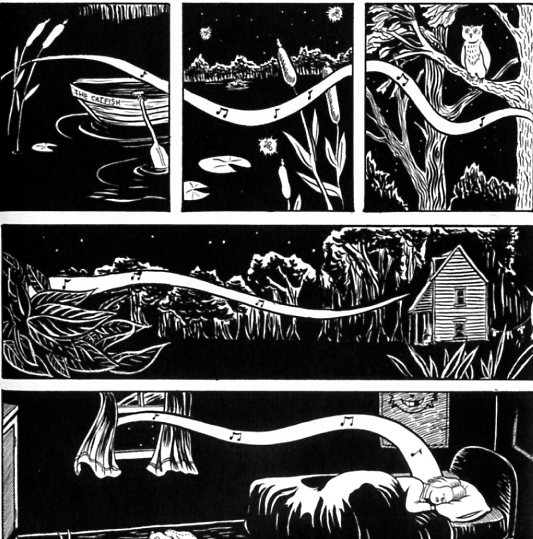
Carré binds these slippages in sequence and reality together by sound – or at least its visual representation. The click of a metronome, the squalling of cats, grandfather’s finger tapping, and most of all the creature’s song, all float through windows and across panel borders in fluid, looping ribbons, knotting together page and space and time. Childhood and adulthood are both bound or drowned in a single voice, each watching the other through a surface of dark water. Lagoon isn’t so much a coming of age as a coming and going. The girl dreams of the creature she will never see; the mother drifts downward towards a childhood that is gone. Where they meet, is, perhaps, in gothic fantasy: a girl dreams she’s a woman dreaming she’s a girl, and wakes not knowing which is which, or where the monster is.
Likely Changes

In his discussion of Ooku, Suat argued that the book was a failure because it did not accurately reflect gender relations in historical Japan. Specifically, Suat felt that, were some significant percentage of the male population of Tokugawa-era Japan to die of illness, women would not move into positions of prominence, and certainly would not inherit the Shogunate and take over rule of the country, as Fumi Yoshinaga has them do in this series.

In the comments to Suat’s post, I replied that, personally, I really couldn’t care less what would or would not have happened had Ooku’s alternate reality “really” come true. To me the series was about relationships, love, and exploring both in the light of shifting gender expectations and realities. It’s Ursula K. Le Guin, not Hal Clement.

After reading Ooku volume 3, I stand by that — I still love the series, and it’s plausibility as “history” has little effect one way or the other on my enjoyment.

But..at the same time…it’s not quite right to say that history is unimportant to Ooku. Obviously, the setting matters a lot — though I disagree with Suat that plausibility is necessarily the only, or even the main, way to think about how history figures in the book. Or, to look at it another way, I think Suat dislikes the book because he sees human nature as being only so flexible. Yoshinaga, on the other hand, chooses to write about an alternate history precisely because she is fascinated with the way that time can shape individuals. Suat says, “this is what Japan was like.” Yoshinaga says, with James Brown, “time will take you on.”

As an example:

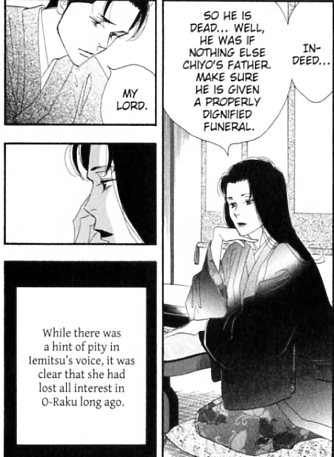
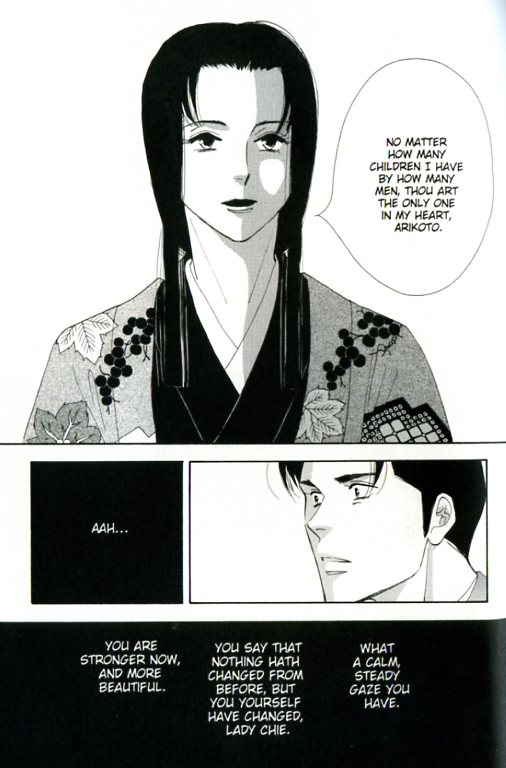
This is perhaps the emotional high point of volume 3. Iemitsu, the female shogun, is in love with Akimoto, but because he is barren and she needs a heir, she conceived and bore a child with another man. The sequence above is her declaration that her love for Akimoto will survive no matter how many other men she sleeps with; her heart will remain true forever. Akimoto is struck, not only by her devotion, but by her alteration. In volume 2, we saw Iemitsu as a desperately unhappy and bitter adolescent, prone to tantrums and rage; earlier in volume 3 we saw her as a passionate young lover. Now, though, she has mastered herself and found her heart; she’s changed, and it’s because she was something else that what she is now has resonance and meaning.

So this is in some sense a defining moment for the character. It’s, emphasized graphically by the way Iemitsu is placed dead center in the panel, and by the way the white background is contrasted with the all-black panels below.

But, despite it’s importance, this isn’t Iemitsu’s only defining moment, or the final defining moment. The story, like time, goes on, and as it does so it starts to be unclear whether Iemitsu’s pledge of eternal loyalty is really, or exactly, eternal. Arikoto asks his friend and former servant Gyokuei to serve as Iemitsu’s consort, and Iemitsu seems to develop feelings for him. And Arikoto’s importance to her also seems diminished as Iemitsu takes up more duties as a ruler, planning policy and finally being recognized as the lawful shogun despite being a woman. (Again, the gender-reversal implicit in having the woman be distracted from love by her career is surely intentional.) Iemitsu doesn’t actually turn Arikoto away, but there are signs that she might, or that’s it a potential. The most ominous of these is here:

Iemitsu has lost interest here, not in Arikoto, but in O-raku, the father of her child, and a man who looks almost exactly like Arikoto. Though she was never that enamored of O-raku, she did for a while look on him with some affection, and the fact that she has moved on so easily seems to bode ill for her devotion to Arikoto as well.

Yoshinaga certainly isn’t saying that all women are fickle, or that people can’t be trusted, or that no love lasts. It’s possible that the passion between Iemitsu and Arikoto could rekindle in later books. And there are certainly instances in the series in which people can’t or won’t change — most notably Kasuga, the longtime power behind the throne, who vowed long ago not to take medicine, and dies rather than break the promise. But even Kasuga is forced to consider, at the end of her life, the possibility of allowing a female shogun — and to reassess her longtime distrust and dislike of Arikoto.

In this sense, it seems to me like the alternate history serves to point up contingency, and the way that people are reshaped, or respond, to time and history. The fact that this isn’t the way things happened, and that gender roles are rearranged and reshuffled, emphasizes the ways in which individual characters negotiate with, or succumb to, or try to defy their fates.

One of the most memorable sequences in the book for me was this:

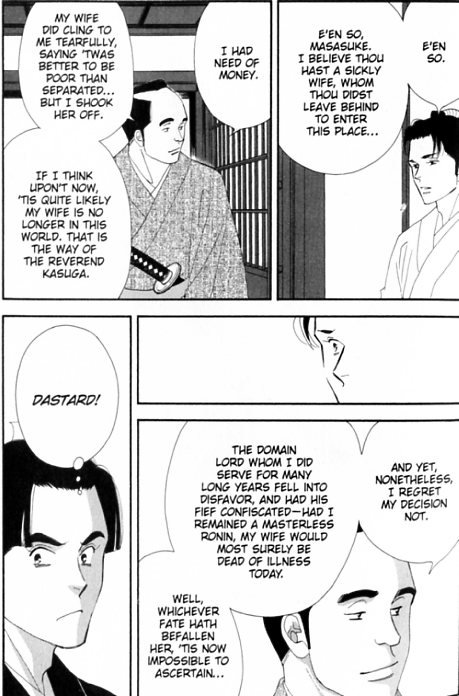
Masasuke here believes that his decision to enter the inner chamber led to the death of his wife. But he doesn’t regret his choice, in part through what seems to be simple coldheartedness, in part because he saw no other option. It’s hard not to agree with Gyokuei’s indictment of “Dastard!” — and yet, at the same time, Masasuke’s logic seems sound. I may not know enough about Japanese history to agree or disagree with Suat about whether Yoshinaga’s alternate history is or is not probable, but I can say that this particular mixture of callousness, resignation, and complacency is certainly painfully recognizable. When time and circumstance go up against love and honor…well, love and honor often don’t do so well. That’s not the only truth in Ooku or reality, but it is a truth. Ooku remains one of my favorite series going not because the stories in it might or might not have happened, but because there’s conviction in the way individual characters deal with the history they have.
________________________

It’s worth noting that Suat is often preoccupied with the intersection of history and fiction, and with how the latter betrays or misrepresents the former. Two places where he deals with these issues are in his review of Town of Evening Calm, Country of Cherry Blossoms and yesterday’s review of The Unwritten.

Everyone Gets Into the Fight

The Fiore vs. Berlatsky kerfuffle was so much fun other folks threw some punches as well. I thought I’d do a brief roundup of some of the more entertaining/enlightening blows.

Mike Hunter, in a comment over at the mainpage, did an extensive fisking of R. Fiore’s fisking of me. Here’s the first bit:

R. Fiore:
The reasonableness of the West is demonstrated by its relative freedom from religious warfare. It is a case where a problem that bedeviled mankind for centuries was solved by human agency. It is one of the greatest achievements of human history.
——————
Indeed a great achievement! But what we need here are more qualifiers, such as “The reasonableness of the West in this area“; for, does the West not indeed support the most corrupt and exploitative dictatorships for the most cynical of reasons?
That there are plenty of tyrants trampling their people without our aid hardly excuses our keeping others in power.
——————
R. Fiore:
The Danish Jyllands-Posten, lulled into a false sense of security by a period of reason and good fellowship in Europe dating all the way back to 1945, published their suite of cartoons featuring Muhammad on the assumption that no one was crazy enough to sacrifice their lives and liberty or commit horrible crimes over a drawing.
—————–
(?????!!!!) The Jyllands-Posten is a right-wing publication which wanted to show what a bunch of berserk nutsos all Muslims were by doing a deliberately provocative action which it knew perfectly well Fundamentalist members of the faith world predictably go apeshit over.

Caro, to no one’s surprise, had a really insightful take.

It seems to me the most telling sentence in the second piece is this: “The reasonableness of the West is demonstrated by its relative freedom from religious warfare. It is a case where a problem that bedeviled mankind for centuries was solved by human agency.”

This idea that social problems are ever “solved” is, at the risk of melodrama, dangerous. They go dormant, conditions obtain at a given period of time when the are less of a problem, but that doesn’t mean they are solved, like some utopian science fiction novel.

This is precisely where Fiore’s “cultural materialism” is insufficient: you might be able to explain the past in cultural materialist terms, but you will not be able to imagine how the past might “return” to inform the future, because by denying the dialectic you leave yourself no mechanism for examining how that past is immanent in the present.

Maybe the errors of fact arise from this too: how would the families of the victims of Srebrenica feel about the notion that the West has solved the problem of religious violence, or even that Europe and “the Muslim world” have diverged in the first place? (His use of the word “Europe” to mean “Western Europe” is really irritating.) Or the European religious philosophers of the 17th century feel about secular pluralism as the cause for the advancements of Western civilization, since it ignores the religious pluralism on which secular pluralism is based? (I want to include the statement “Radical…Islam is not a remedy” here but I can’t figure out what he’s saying it’s not a remedy for…)

Fiore thinks in terms of cause and effect rather than in terms of “conditions of possibility” and I think that’s why Fiore’s essay feels so wrong to us: he treats history as something completed, a riddle to be explained, rather than as a powerful immanent presence that we have to engage with. His inability to perceive religion as anything other than an adaptation is probably why he can’t perceive History in this way: immanence was originally a religious concept, and if you take a strict materialist approach to religion it’s hard to exhibit the forms of mind necessary for imagining things that are temporally infinite. Fiore, imagining history as as series of finite cause and effects rather than an ongoing process that he is part of, sets himself outside history. I guess that’s the binary that I see informing this piece the most.

And in what I think is the closest thing we’ve gotten to a defense of Fiore, Andrei Molotiu chastised me for my second response to Fiore.

Noah, whatever one might think of Fiore, this is not a response, it’s a trolling post. It makes you sound like JF Ronan in his prime. It’s the kind of post that makes me not want to check HU as often anymore.

I think Fiore may well be sick of the back and forth, so this may be the end of the brouhaha. Thanks to all those who read and commented…and to R. Fiore himself, for engaging as long as he did. I hope we’ll get a chance to fight again soon.

Utilitarian Review 5/1/10

On HU

Caroline Small started the week off by talking abotu ethics in Dr. Who.

Richard Cook looked at the current state of crime comics.

Blogger and Atlantic pop culture writer Alyssa Rosenberg did a guest post on pop culture and criticism.

I sneered at R. Fiore’s take on the South Park imbroglio once, and then again.

Vom Marlowe reviewed Junjo Romantic.

And I reprinted an essay on how Torchwood presages the manporn future.

Utilitarians Everywhere

At Madeloud I have an intro to death metal for beginners.

Death metal has to be one of the most inaccessible forms of structured noise ever to have passed itself off under the loose rubric of “popular music”. With vocals that are more growled than sung, drumming that sounds more like a jackhammer than a beat, a brutal insistence on lack of groove, and lyrics that embrace Satanism, decay, and being torn limb from limb — well, let’s just say that the genre isn’t everyone’s cup of steaming pus.

I have a death metal download here if the article inspires you.

At Splice Today I make fun of Walter Benjamin.

Yes, 80 years ago Benjamin was touting the newspaper, or at least the Stalinist newspaper, as a truly democratic voice. Newspapers were the bright new genre that would allow the people to take an active role in their culture and cease to be the stoned recipient drones of capitalist trash. The press (or “at any rate” as Benjamin says “the Soviet Russian press”) is changing everything; it “revises the distinction between author and reader.” The means of production are now in the hands of all, and the revolution is sure to follow.

And I have a brief review of an art opening over at the Chicago Reader.

Other Links

Sort of inspired by the R. Fiore dust up, Bert Stabler pointed me to this article arguing that Christians should dispense with questions of objective truth.

The Great Gay Future

Earlier this week Caro discussed the ethics of Dr. Who. In the course of comments, Torchwood came up…and I discovered that the article about that show I wrote for the Chicago Reader in October 2008 has mysteriously vanished into the dreaded vacuum-of-perpetual-redesign. So, since it’s gone there, I thought I’d post it here. This is my original version, slightly different from the one that was published.
___________________________

Sci-fi melodramas have long inspired narrative compulsions in their devotees . Every episode of these shows leads, not to resolution, but to heaving, endlessly provocative streams of quasi-licit online fan-fic. The (largely) female viewers of these shows don’t just want to watch the characters — they want to pick them up, strip them down — to possess them and be possessed by them. Trite storylines and gaping plot holes are forgotten, to be rewritten as devotion, inspiration, and the beauty of orgiastic metatextual romance.

On the surface, Torchwood looks a lot like its predecessors. The plot, based around a group of super-secret operatives who protect Cardiff, Wales from aliens, is in fact, a perfect hybrid of Buffy, the X-files, Star Trek, and Dr. Who.

And therein lies its distinction. Torchwood isn’t so much a TV show as a fan-girl wet dream. Star Trek and Buffy merely inspired fan-fic; Torchwood is inspired by it. Fan fiction creates new stories for established characters— Torchwood is a spin off of the revamped Dr. Who. Fan fiction rewrites series continuity — a process sometimes referred to as retroactive continuity, or ret-con. Torchwood characters rewrite history and cover up their mistakes by using a memory wipe drug called — you guessed it — Ret-Con. Fan fiction writers will often introduce a “Mary Sue”; an author surrogate who wins over the cannon characters with her depth and general wonderfulness. Torchwood’s first season focused on Gwen Cooper (Eve Myles), a normal, everyday viewer surrogate who stumbles into the world of alien technology — and wows all the other characters with her depth and general wonderfulness,

But all that’s just icing. The main link between Torchwood and the fandom is sex. Specifically, gay sex. More specifically, angsty, hot guys who indulge in tortured romance and witty repartee as a prelude to gay sex.

Everybody knows that guys love lesbian porn. The fact that many women like gay male porn is less well-established — but the evidence has been quietly mounting. Perhaps the biggest tween girl phenomena of the last 15 years is the spectacular success of shojo manga — romance comics from Japan, written by women for girls. Shojo narratives often center around romantic trysts between boys — there’s even an explicit sub-genre called yaoi, a word which is sometimes jokingly translated as “Stop! My butt hurts!”

There are huge fan-fic communities associated with almost every shojo title. But the obsession with gay sex is hardly confined to those fandoms. In the early 70s, female Star Trek fans started penning slash fiction, in which Kirk and Spock explore some of the repressed aspects of their relationship. With the Internet as a spur, slash fiction has metastasized. If you had a dime for every Snape/Harry Potter story, you’d be almost as rich as if I had a quarter for every Xander/Spike pairing.

Spike is, of course, the brutal, charismatic, ambivalently redeemed vampire who stole the show in both Buffy and its spin-off Angel. Not accidentally, the actor who played Spike, appears in the Torchwood second season debut as a brutal, charismatic, ambivalently redeemed time traveler named Captain John Hart. He and dashing series star Captain Jack Harkness (John Barrowman) have a history, and when we see them together for the first time in “Kiss, Kiss, Bang, Bang”, they stare soulfully at each other…then exchange blows…and then lock lips. The pounding rock music on the soundtrack is drowned out by millions of rapturous fan-girls flapping their arms and shouting “squee!”

The Captain Jack/Captain John relationship is definitely a series highlight, reveling as it does in the homoerotic elements of the hero/villain duality which most cultural products repress. When Captain John returns in the series finale, “Exit Wounds”, he declares that he wants revenge because Jack hasn’t spent enough time with him. It’s arch-villain as spurned lover — which gives you a whole new perspective on, for example, the Batman and the Joker, or, for that matter, George Bush and Osama Bin Ladin. Just get a room, guys.

For most male action heroes from Clint Eastwood to Martin Van Peebles to Keanu Reeves, masculinity equals emotional remoteness. Even the relatively effete Dr. Who (David Tennant) shows his nads by never quite being able to say “I love you.” In Torchwood, though, pretty much everyone is bi, and as a result the fear of feminizing emotional display is suspended. Captain Jack is a mysterious semi-reformed undying time-traveler with various tragedies in his past — in another show, he’d be all broodingly taciturn and repressed. Here, though, he’s flamboyant, flirting outrageously with middle-aged secretaries, babbling about his fetish for office spaces, and impulsively resurrecting his teammate because he can’t bear to see him go. He also cries when he’s sad and hugs those he loves and giggles when someone says something funny. And, in the second season at least, he’s in a stable, caring, and supportive relationship with his adorably dry teammate Ianto Jones (David Gareth-Lloyd.) In other words, because Jack occasionally engages in anal sex, he doesn’t have to constantly act like he’s got a pole up his ass.

This isn’t to say that Jack is always sympathetic. He’s often dictatorial, unpredictable…and, indeed, incoherent. If the best parts of Torchwood spring from its gender-bending roots in fan-fiction, its downsides also seem drawn from the fandom. The writers are way, way too enamored of drippy melodrama, on the altar of which they are willing to sacrifice even minimal consistency. Every episode, practically, ends in A Very Tragic Death — of a major character, a minor character, a space whale — it hardly seems to matter, as long as we can get everybody weeping. Even worse is the need to saddle every Torchwood member with a traumatic backstory. Jack’s past, which involves dead parents, lost brothers, and an ill-defined sepia-toned landscape, is hard to beat for idiocy. And yet, I think the prize has to go to Owen Harper (Burn Gorman), who, late in the season, acquires a never-before-mentioned, completely incongruous dead ex-fiancée.

The reliance on soap-opera tearjerker is especially frustrating because the cast is uniformly stellar. David Gareth-Lloyd as Ianto rarely has that much to do, but he really delivers — his deeply uncomfortable twitchiness when Jack first asks him out is one of the funniest things I’ve seen on television. Naoko Mori as the nerdy Toshiko Sato is also a gem; her subtle blend of innocence, eagerness and bravery, and her painfully unrequited crush on Owen, provide the series with most of its moments of real heartbreak. The best episodes — like the comic “Something Borrowed,” or “Adam,” in which Tosh and the assholeish Owen switch personalities — just draw into relief how great Torchwood could be if the actors weren’t so frequently saddled with duff scripts.

But that’s television, I guess. Torchwood isn’t quite great. But it is a watershed — the first show to take fan-fic to the mainstream . Unsurprisingly, Torchwood’s exploitation of a hitherto underserved fetish has resulted in excellent sales: its debut broke BBC audience records. With such success, there are sure to be imitators. “The 21st century is when everything changes,” as the Torchwood tagline says. The manporn deluge cometh.

Shorter Fiore

I am not world weary and cynical, I am just Machiavellian. The west is not more reasonable than Islam, except that it is more reasonable than Islam. You can see this because of the reason and good fellowship that has prevailed in European countries such as Serbia. Regimes like Iraq were openly hostile to us until very recently which is why we armed them when they fought Iran. Also, Noah Berlatsky coddles terrorists, nyah nyah. I understand how Christians ought to act better than Christians do, which is why I can say with assurance that if Martin Luther King Jr. were a real believer, he would have advocated nuclear annihilation for commies. The fact that atheists and believers sometimes act alike shows that faith is only relevant to someone’s actions when I say that it is. Also, I’m a fucking materialist existential hero; please join me in weeping aloud for me in my tough-minded tragedy.


And hey, let’s hear it for this gem:

“Cultural materialism is the theory that there is a Darwinian process in the selection of social forms, and that therefore for instance no religion that is adopted by large populations for generations can be arbitrary or irrational, but rather must serve some purpose for its adherents.”

Translation:
Look, I dropped Darwin’s name, and concluded that religion must serve some purpose! Unlike lame-assed, half-baked, clichéd, swaggering cultural materialism, which is handed down from God…whoops! I mean from my own pure, indomitable brainstem! Which by coincidence I pulled yesterday out of my own indomitable ass.


If you missed it, here’s Fiore’s original post and my response to it.

Worshipping Nothing

R. Fiore has a recent article up about the South Park censorship brouhaha in which he takes a brave, world-weary stand against cowardly corporations, crazy Muslims, and simplistic theists. As always with Fiore, it’s stylishly written…and as sometimes with Fiore, it’s pretty thoroughly vapid. He’s got that just-plain-common-sense-man-on-the-street approach, which involves repeating things everyone already knows, retailing banal prejudices as shocking insights, and patting yourself rhythmically on the back all the while.

Fiore’s argument is basically that we’d all get along better in this old world if we acted as if we didn’t believe anything. Or as Fiore says, “What the West has learned is that even if you do sincerely believe in God, if you want any peace you can’t act that way.” For Fiore, the South Park incident shows the eminent reasonableness of the Western world, and the fact that reasonableness is essentially useless in dealing with nutzo Islamist thugs:

The Danish Jyllands-Posten, lulled into a false sense of security by a period of reason and good fellowship in Europe dating all the way back to 1945, published their suite of cartoons featuring Muhammad on the assumption that no one was crazy enough to sacrifice their lives and liberty or commit horrible crimes over a drawing. The response of the fanatical end of Islam was, in effect, yes as a matter of fact we are crazy enough, and if that wasn’t sufficient please let us know and we’ll be crazier still. The position this places the would-be blasphemer in is that you can visually depict Muhammad, but only if you’re willing to see blood shed over it. Courage will allow you to express yourself, but it won’t prevent the violence. The net result is that the fanatics get their way and the only cost is to brand millions of completely innocent Muslims as murderous barbarians.

I think my favorite part of that quote is the nostalgic harking back to “a period of reason and good fellowship in Europe”, coupled with Fiore’s utter lack of historical or intellectual curiosity. Presuming that this period of reason and good fellowship did exist for a moment — why did it end, precisely? What caused the Muslims to suddenly jump the shark? Is it immigration into Europe that’s the problem — which would lead to certain policy positions that I strongly suspect the carefully enlightened Fiore wants nothing to do with.

Or…as an alternate possibility, could it be that, from the Muslim perspective, there was in fact no “period of reason and good fellowship,” but rather decade upon decade of Western-supported dictatorships, quasi-imperialism, repetitive humiliations, and (in the case of Afghanistan, at least) vicious, unending warfare? Fiore muses with an air of non-plussed good humor at what could have possibly led some Muslims to set themselves against South Park so:

The Mafia is an appropriate comparison because the threats made against South Park are in some ways more akin to extortion than conventional terrorism. A typical terrorist campaign attempts to achieve an absurdly ambitious goal with an absurdly miniscule amount of force. For example, in 40 years of terrorism after 1967, Palestinian terrorists managed to kill something like 2100 Israelis. No one is going to surrender their country to avoid this level of casualties. A modern army can kill that many non-combatants in an afternoon by mistake. The campaign against depictions of the prophet Muhammad on the other hand brings to bear an absurdly disproportionate amount of force to stop something most people in the West don’t have the inclination to do in the first place.

The Mafia analogy carefully obscures the clear conclusion — Muslims have little if any way to address their political grievances to the foreign powers that repetitively kick them in the teeth. Terrorism is largely, as Fiore quite rightly notes, useless. So when you can’t do anything about the big insults, you naturally focus on the small ones. Surely segments of the Muslim world sees depictions of the prophet by the infidels not as the first insult, or the fifth or the 200th, but rather as part of one, long, sustained insult by a bully who has kept his foot on their throat for half a century plus.

Threats against newspaper publishers or television networks are petty and stupid and despicable, obviously — but they’re neither incomprehensible nor evidence of some sort of disconnect between religious thinking and rationality. Given the relationship between the west and the Middle East, the threats are, on the contrary, entirely comprehensible. That doesn’t mean that they should be condoned. In the first place, as Fiore points out, the whole brouhaha definitely makes things worse, not better, for Muslims worldwide. Moreover, while it isn’t as bad as the Taliban’s systematic oppression of women or al Qaeda’s terrorist attacks, threatening to kill innocents for drawing pictures does seem to me to be a fair definition of evil. Still, we can take comfort in the thought that we’ll go tit for tat or better in the near future, whenever the next American drone strike takes out the next Afghani wedding party.

Fiore’s a lefty too, and I doubt he supports the Afghan war any more than I do. But he doesn’t want to talk about it in too much detail because to do so would mess up his nice little binary; rational west as powerless, peaceful victims; nutty religious dickheads as powerful, violent thugs. To give Fiore his due, though, he is willing to follow his simplistic analogy wherever it takes him, no matter how idiotic the end location is. And so in the last paragraph we get this gem:

What the West has learned is that even if you do sincerely believe in God, if you want any peace you can’t act that way. After all, if you truly believed that those who follow the wrong religion will be subjected to eternal torment then you’re doing them no favors by allowing them to do so. For instance, during the Cold War, if you believed as Jesus told you that death is an illusion, and the atheistic regimes of the Soviet bloc were depriving millions of even opportunity to save their souls from eternal damnation, then you would be honor bound to not only risk nuclear war but to engage in it. After all, eternal bliss would compensate the just for any suffering they endured.

To call this a strawman argument is to cast scurrilous aspersions on the structural integrity of straw. Which Christians exactly is it who want to start a worldwide nuclear holocaust for the sake of the souls of atheists? Would that be the many Christians who, on quite good scriptural authority, believe that Jesus enjoined them to pacifism? Would it be the Catholic Church — still the largest Christian denomination — which holds to a just war doctrine that declared the Iraq war anathema? The Niebuhrian realist tradition, which stresses a humane concern for human life and justice? Hell, even wacko Protestant Christian right-wing apocalyptic fantasies like the Left Behind series doesn’t advocate genocide-for-Jesus as far as I know.

There are nutcases everywhere, obviously, and I’m sure there’s the random Christian out there who wants everyone to die in a fiery man-made holocaust — but to suggest that this is especially a hallmark of religious thinking as opposed to the rational atheist philosophies of, say, Pol Pot or Mao or Hitler…it’s nonsense on its face. And that’s to say nothing of our own lovely, rational, harmless, hapless capitalism, which can’t stand up for South Park, but which has, nonetheless, shown itself capable on occasion of a certain ruthlessness, as Chileans, Cambodians, and, for that matter, Native Americans would no doubt be willing to attest.

“What the West has learned is that even if you do sincerely believe in God, if you want any peace you can’t act that way.” I’ve quoted that twice already, and I’m quoting it a third time because it’s central to Fiore’s argument — and, I believe, to his belief. Because it is a belief, right? It’s certainly not a fact. Where, after all, is this peace we’ve found by acting as if we don’t believe in God, precisely? The U.S. is more religious than Europe, certainly, but by world-historical standards we’re a pretty secular society — and, by world-historical standards, we have probably the biggest military of all time. China’s fond of playing with weapons too, and they aren’t noticeably religious last time I checked. And, you know, on the other side, I was under the impression that Martin Luther King, Jr. and Gandhi both drew the inspiration for their non-violent resistance movements from their faith. Or does Fiore think that MLK was somehow acting as if he didn’t believe in God?

Fiore ends with a really tiresome roulette wheel analogy which I don’t have the heart to quote. But it’s telling that such vacuous modernity can only end by seeing faith in terms of gambling, money, and yes, capitalism. Fiore believes that believing in nothing will save him…but the truth is that nothing has its own rites and rituals, its own insanities, its own cruelties, and even its own genocidal impulses. The world isn’t divided into believers and non-believers, or into the sane and the insane. The only ones here are us chickens — or, if you prefer, us poor sinners, a long way from home.
_________

Update: R.Fiore has an extremely long response here.

And my short reply to Fiore is here.