Dyspeptic Ouroboros: Alyssa Rosenberg on Pop Culture and Criticism

Alyssa Rosenberg writes on pop culture for the Atlantic and at her own blog. We met a while back when she wrote an article on Twilight, to which I responded snarkily, and she responded to my response with much good grace. After that auspicious start, I asked her if she’d be willing to talk about criticism and art for this blog. In response she wrote the essay below.

_____________________
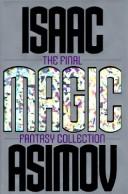
When I was in middle school, a prescient friend bought me Isaac Asimov’s Magic, a collection of the science-fiction author’s fantasy writing and essays. Some of that book’s lessons, have lasted with me for more than a decade: Overindustrialization is Mordor. Writing aliens is pretty hard. And perhaps I should have absorbed a third, delivered in the short story “The Critic on the Hearth”: “I have two of my own comments. The first is that every critic ought to become a garbage collector. He will be doing more useful work and he will have a higher social position. The second is that every critic ought to be thrown into the fireplace.”

But by the time I got to Magic, it was already too late. My first career as a pint-sized critic was already behind me–and unbeknownst to me, one of my future paths had been set.

To fill lingering hours after elementary school during a four-year stopover in Middlebury, Vt., my mother had convinced an editor at our local newspaper to give me space on the children’s page to write about books. The criticism, such as it was, that appeared next to a school picture of me in round glasses and a dress with an equally round lace collar wasn’t exactly sophisticated. At eight years old, I wasn’t up to doing much more than picking books that had something in common and explaining that I liked them. Or not.

The column ended when we moved away, and high school and college brought pleasures other than criticism: insanely competitive debate programs, hard-fought municipal elections, the ability to drink legally, writing classes, boys. Each time I felt as if I’d found the Next Thing. With the perpetual certainty of youth, I was alternately sure I was going to be the best high school debater ever, an activist professor, a local political fixer. There were a lot of possibilities that felt more important than journalism, much less something like writing about YA literature. And yet, by my senior year in college, I found myself sending off dozens of applications for journalism and publishing jobs, ending up at National Journal, a respectable and deadly-serious Washington, DC political weekly.

It wasn’t necessarily the platform from which to get back to criticism. But I arrived in Washington in a season when a thousand blogs weren’t just blooming, they were being transplanted into some of the best journalistic greenhouses in the city. And after several years at National Journal and then at Government Executive, a magazine for civil servants, I looked not to political bloggers, but to my eight-year-old self when I decided to start writing on the side and for fun, and wanted to find a meaningful subject. And after watching policy bloggers slug it out against the backdrop of an oft-deadlocked Congress, pop culture seemed more valuable than it had before, as both an escape, and as a field of play. I’ve become a somewhat more sophisticated consumer and observer of media in the last decade and a half. I can explain why I like or don’t like things now. But I’ve also found myself interested in a larger question: what does what we like say about us?

Noah and I met, in fact, because of a disagreement over what the Twilight phenomenon means for discussions about sexuality and gender. We never reached agreement on the merits, but it was clear we were working under the common assumption that culture, particularly popular culture, is a place where both creators and consumers work out real-life issues ranging from deciding whether to have sex before marriage to what would happen in a world with extremely large, well-equipped private armies.

Doing this kind of criticism doesn’t necessarily mean being deadly serious about things that are, after all, a lot of fun. Sometimes a Robyn song is just a Robyn song. But sometimes it’s also an argument for female artists about going independent rather than relying on and being shaped by a major label, just as the pop-rap fusions in collaborations between artists like Kanye West and Keri Hilson or B.o.B. and Janelle Monae are evidence for rap’s conquest and colonization of popular music. The Iron Man movies are fun because Robert Downey, Jr. is relaxed and having a great time playing a roguish industrialist, but they’re also action movies for people who feel ambivalent about the projection of American military power–even if it means they’re settling for an individual having tremendous power, fire- and otherwise, because he’s charming. Unlike in politics, in pop culture the choices don’t always have to be clear. Artists are blessedly free to explore gray areas without risking the career suicide that so often accompanies the impression that a government leader possesses less than crystalline moral clarity.

All pop culture might have larger implications, but that doesn’t mean that pop culture is weighed down or overwhelmed by its larger significance. That means that lots of Americans can murder prostitutes in video game worlds without feeling bad about it, but also that they can absorb relevant lessons about respecting the elderly along with a bunch of jokes about talking dogs. Critics are the people who can live in those tensions and contradictions, who interpret and clarify the meaning in jewels and in junk. Maybe for happily residing in the midst of those fractures, for seeing the value in a movie that involves a little girl beaten up, or a cowardly loan officer dragged to the netherworld by a demon, for balancing difficult aesthetic and political judgements, we still ought to be roasted. But I think in a world where culture has such freighted implications, there’s room for critics along with the garbage collectors.
_________________

Many thanks to Alyssa for her guest post. Please visit her blog if you get the change; she writes on comics, hip hop, television, movies, and lots more.
Utilitarian Review 4/24/10

On HU

We started the week with some Mary Sue links by Vom Marlowe.

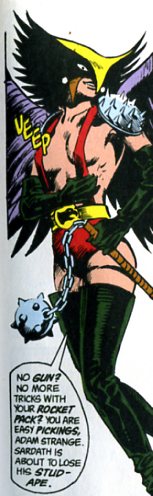
I had another Swamp Thing post about gender and hawk women.

Suat had a lovely tribute to one of Tony Millionaire’s Sock Monkey stories.

We highlighted some comments on the Swamp Thing roundtable from Andrei Molotiu, Charles Reece, and EricB.

I sneered at Kingyo Used Books.

We announced four (count ’em, four!) new columnists on HU.

And we’ve got some black and doom metal for download.

HU….Live!

You can hear audio of the C2E2 comics journalism panel in which I participated.

There’s also commentary on the panel by Matthew Brady; Johanna Draper Carlson, Michael May, and Heidi at the Beat.

Utilitarians Everywhere

I have an interview about copyright issues with songwriter Bill Ritchie over at Splice Today.

Bill: As it happens, there’s a silver lining to my problems with getting paid. I can always trump someone who’s ranting away about how downloading is stealing, it’s wrong, it’s immoral, all that stuff because I can always point out that even if downloading were theft (which it isn’t, it’s copyright infringement), it sure wouldn’t be me any downloaders were stealing from if they copied thus-and-such a song because I don’t get paid for the sales of the record it’s on anyway, somebody else has got the money. So, “Whom are you defending?” is a question that I’m happy to be able to raise in that sort of discussion, because I just want to put it out there to people that this isn’t all cut-and-dried. I’m a music rights holder and I’m fine with downloaders, and not okay with the hyper-righteous criticism of them, because, hey, I’m out actual dollars that were already paid for my work, so why are we sitting around debating whether or not someone who downloaded represents a potential lost sale for someone who’s not me anyway, right?

Also on Splice Today, I review the new Merle Haggard album.

Haggard had a lot of hits besides “Okie from Muskogee,” and as a singer, guitarist, and songwriter he remains hugely important, a major influence on everyone from George Strait to Alan Jackson. Still, “Okie” was a telling moment. Even though somewhat tongue in cheek (white lightnin’ is every bit as illegal as marijuana, after all) it was still a line in the sand. And though Haggard has recorded with Willie Nelson and was idolized by Gram Parsons, that line hasn’t ever really disappeared. Over the years, he’s added strings at various points, but he’s never put together a New Age album with Daniel Lanois, or written with Jack White, or recorded a cover version of a Trent Reznor song. His latest album title, I Am What I Am, pretty much sums it up. And what Haggard is, is country or bust. He doesn’t have an alternative career path.

I have a couple really mean-spirited short book reviews at the Chicago Reader (you need to scroll a bit to find them.)

And a review of death-doom band Hooded Menace at Madeloud.

Other Links

In response to our own Richard Cook’s question, Can Comics Be Scary?, Curt Purcell put together an all star panel, including Sean T. Collins and Richard Sala(!) Check it out.

I’d seen this letter before, but it remains a truly transcendent example of snark.

And They Shall Call Them…Hooded!

I’m pleased to announce that next month HU will be adding four (count ’em, four!) new monthly columnists to our regular roster of bloggers. Our new columnists are:

Erica Friedman of Okazu.

Matthias Wivel of the Metabunker.

Domingos Isabelinho of The Crib Sheet.

And our own kinukitty who will be moving from blogger to columnist.

All of these folks should be familiar if you’ve bounced around the blogosphere. Matthias and Domingos have written for TCJ at various points I believe, and Erica is the founder and organizer of Yuricon and ALC publishing. And of course, kinukitty has written on and off for HU. They’re all great writers and thoughtful people, and I’m thrilled to have them writing here.

For the moment we’re planning to have columns appear on Sunday, and the first should go up on May 3, if I’ve got my sundial calibrated correctly. (Update: I didn’t have it calibrated correctly! It’s May 2.) So please welcome them aboard, comment copiously, show them where we keep the snack food, etc.
___________________
And as long as I’m announcing things — I thought I’d mention that, if you have an idea for a post or an article that you’d like to write for HU, please don’t hesitate to contact me. We do have other writers pop up here occasionally, as you’ve probably noticed, and I would like to do more of that as well. You can contact me at noahberlatsky on gmail.

Also, do let me know, either in comments or by email, if you have ideas for improving the site, or features you’d like to see added. One reader pointed out that we should have a comments feed, and as you can see we have now added that up at the right. Suggestions would be especially welcome as I think there is a redesign coming down the pike at some point in the mid-future, which would be a good time to implement some changes.

So thanks for your feedback, and thanks again to our new columnists…who you will be hearing from in person shortly!

Give Yourself a Hug

“Kingyo Used Books” is the heartwarming tale of a guy who finds a used book shop that sells manga and it reignites his faith in manga which is also his faith in life. And, of course, you’re reading a manga too, and it’s a manga about how great it is that you’re reading manga, which makes your life double-plus good worthwhile with a cute manga storekeep thrown in into the bargain for you to start a meaningful flirtation with and perhaps “something more,” I wouldn’t be surprised. And that’s incredibly valuable because, after all, the book seems to say, the people reading this aren’t actually people at all — they’re glommed together homonculi made out of consumer enthusiasms and social networking software and smiley icons. Without the reassuring infrastructure of positive blogging, they’d experience buyer’s remorse and simply discorporate.

Until now! Because “Kingyo Used Books” kicks the critics to the curb and speaks to you directly. “Manga!” it says. “Manga’s great! Don’t let anyone tell you different! It’s good…and good for you!” So give that manga a hug. It likes you because you like it because it likes you — and there’s nothing more important than a beautiful relationship with the crap you buy.

Muck-Encrusted Comments

The Swamp Thing roundtable has shambled along a bit longer than I expected, and we’re still not necessarily done. But while we’re waiting for a last post I thought I’d pull some passing thought-bubbles from the muck:

Andrei Molotiu:

if issue 20 is damage control, it’s excellent damage control, taking a narrative that had rolled up around itself and tripped on its own loose ends many times, and resolving it elegantly within one issue. Furthermore, the art (especially the use of extradiegetic elements in the frames) does things that may be at least as, if not more, interesting as anywhere else in the run. Overall, though, I think it’s more interesting to think of it–and of the entire series too–as Moore working, in a nearly Oulipian style, with a complex set of constraints: what can I do with this ridiculous, gothic backstory I’ve inherited? What can I do with the purple prose that Pasko has used to set the tone of the series? What can I do with the complex panel arrangements that by now were already a trademark of the run? This actually challenges Moore (almost never again will he work with such complex panel shapes, as it is much easier for him, as writer, to control the art if he works with a set grid), and I do think he creates the most successful work of his career. Left by himself, in total control of the stories he can tell, he ends up falling in the same rut (and that is true of “From Hell” much more than of SOST). Yes, the American Gothic stories are the weakest of the run, but I disagree about the earlier stories. And if you simply use to judge them a measuring stick of taking individual stories and setting them up against comparable sci fi or horror pieces, you are really missing the forest for the trees. Again, reading the entire run as, first of all, a conscious taking on of constraints, looking at the specific troping that Moore engages in (it’s always amazing to me, for example, that nobody ever mentions the totally obvious “Master and Margarita” reference, which is not only cute in a limited way, but connects the larger themes of the two works), and looking simultaneously at the wider ark and at individual details, pages where Moore really shows his artistry, seems to me the much more appropriate way to go.

Charles Reece:

I like your S&M analysis, Noah. I think that’s why Swamp Thing doesn’t much work as a horror comic. I’m thinking of Silence of the Lambs versus Hannibal. The latter is actually something of a superhero tale, because the audience identifies with the superpowered Lecter.

If there’s any place where the art really contributes something extra to Moore’s story, it’s in creating whatever sense of horror the book possesses. But I’m one of those horror fans who believes movies do it best. Language, particularly the purple colored, is always too abstract for the genre, and ultimately a distraction from the emotive core. Horror is perceptual, the less said, the better. We can be morally outraged by reading a description of a rape, of course, but seeing it (say, in Irreversible) is on a whole other level, regardless of how well-written the description might be. Language alone allows for more of a sense of control than being submerged in sound and vision. Does that mean language is sadistic and perception is masochistic?

And EricB:

I would say that feminism is usually part of his project–but that there are different kinds of feminism and they don’t always get along. His “second wave” feminism–appreciation of, and celebration of, stereotypically feminine “values,” may lead to a lot of stereotyping (as you note here). He’s a self-conscious valuer of “feminine” principles—but this means defining some kind of “essential” version of gender, which is less comfortable for both first wave and third wave feminist thinkers. It can also come across as somewhat condescending coming from a man. Balloon-breasted castrating hawk ladies are not the high point of the series in terms of its representation of gender. I’m not sure it means Moore isn’t being “thoughtful” necessarily though– Strange’s idiotic blasting away at Swampy is clearly a critique of “typically masculine” behavior–The problem here is often in how the “typically” bleeds a bit too much into the “stereotypically.”

The immensely overwritten, but still kind of fascinating, “loving the alien” issue is more self-conscious in its manipulation of overly familiar tropes. There, the “mother” is machine, not Earth, is rapist, not potential victim–and Swampy (the man) has to take the stereotypically feminine position as rape victim–as “nature” being tilled by industry. It’s all a bit on the obvious side, I guess–except for its reversal of genders–”she” becomes the machine-like industrial rapist, and “he” becomes the “earthy” mother figure–even though neither of them, strictly speaking, is gendered at all (at least not in any traditional human way)–since one is a swamp monster, without functioning reproductive parts–and the other is a planet/machine.
Swampy himself vacillates between being a “feminine” “mother earth” figure–and a masculine foil to Abby.

So though we’re not quite gone, I’ll take this opportunity to thank all who read, participated and commented, and especially to our guest posters Jog and EricB (also known as my brother.) It’s been great fun — and not quite done yet!

Muck-Encrusted Mockery of a Phallus

In his post, Eric argued that Moore’s Swamp Thing is feminist, both because it presents Abby as a strong, heroic figure and because it critiques Swamp Thing’s own abusive use of patriarchal power.

I agree with Eric that power and gender are both important themes in the Swamp Thing series. I’m less certain that Moore always manages to be especially thoughtful about them, though. It seems to me, on the contrary, that in the marriage between Moore and his tropes, it’s as often the green, lumpy pulp that wears the jeans in the relationship as it is the feminism.

Having brutally murdered that innocent metaphor…I thought I’d look back at the same issues I discussed in my first post — the two-part story in which Swamp Thing goes to Rann.

This story is built around doubled couples: Swamp Thing, in exile from earth and Abby, is mirrored by Adam Strange, who is in a constant vacillating exile from Rann and his wife, Alanna. In both of these pairings, the male/female roles are apportioned in familiar manner. Swamp Thing and Adam are the seekers, questing across space, engaging in feats of daring-do, in order to return to hearth and home embodied by Abby/Alanna. Female means stability and civilization; male means adventure and rough virility. Moore is careful to tell us that the people of Rann are hairless, and that they see Adam as a kind of atavistic hairy monster. Alanna, then, is a (literally) smooth, perfect, (literal) princess in a tower; a fairy tale dream — just as Abby is referred to as a “Hans Anderson princess” at the very end of Moore’s run on the series.

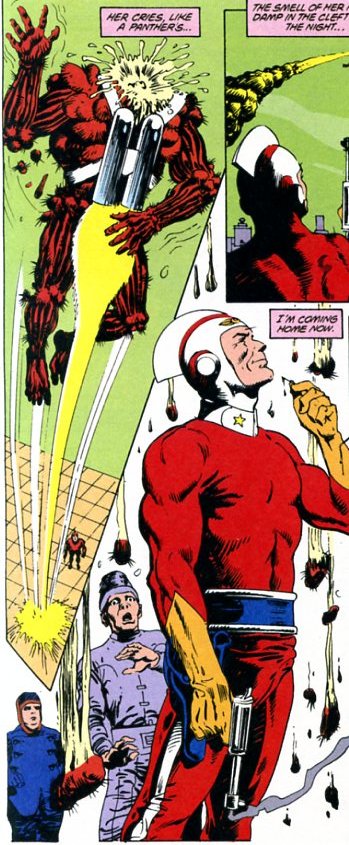
Moore, moreover, links his males questing nobly for the womb explicitly to phalluses and sperm. There’s one sequence where Swamp Thing gets transformed into a bulbous member spouting suggestive liquid…and look at that caption.

“Her cries like a panther’s” indeed.

Of course, that same page we’ve got Adam with that ridiculous headgear holding his smoking gun at crotch level. After that, it’s almost (ahem) anti-climactic when Swampy uses his powers to refertilize Rann…or when we learn that Adam has been brought to Rann because the “fierce vitality” of his sperm is needed to impregnate Alanna on a world where all the men are apparently sterile.

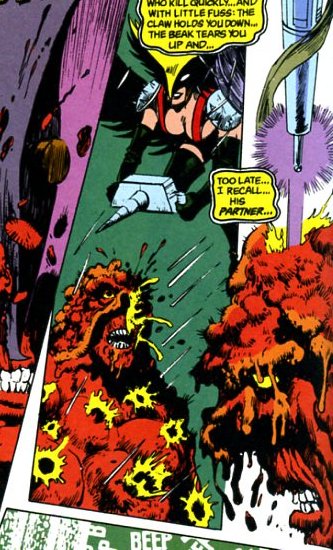
The person talking all up in Adam’s fierce virility is not his wife, but rather Keela Roo, a Thanagarian hawk warrior. Keela Roo is a very different kind of feminine. Instead of waiting at home in a castle, she sallies forth in spikes and skin and fetish boots. She wears a big flamboyant headress that stands in stark contrast to her male-subordinates unadorned helmet. She is, in short, a dominatrix and a castrating bitch; vital, animal, sexy, and unhealthily virile. Here, for example, she goes after Swampy by inserting her big phallic weapon into his split and oozing orifice.

As is generally the case in these pulp narratives, the dark queen is scary, but she’s also attractive — not least because she actually has a personality. Abby doesn’t exist (in these issues) except as a name and a desire. Alanna never speaks in English, and though her Rannian dialect isn’t entirely opaque,and though we do get to see her desire for Adam, keeping her voice from the reader effectively makes her seem distant, exotic, mysterious, soft-spoken, and unattainable. The princess in the tower again.

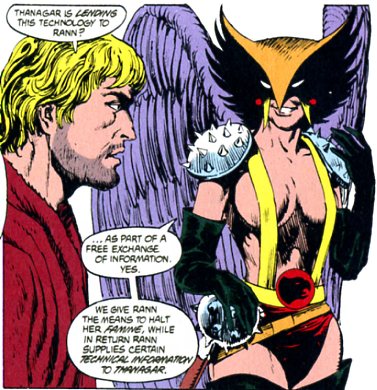
Keela Roo, on the other hand, has a universal translator thingee — she wants you to know what she thinks. Language is something she has mastered, and she uses it seductively. Several scenes between her and Adam have a not-very-subliminal sexual subtext. Here she is wearing that preposterous outfit while Adam talks to her in his bathrobe:

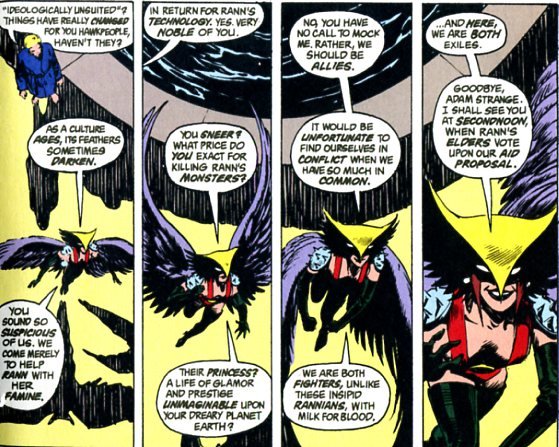
And this next sequence is a brazen come on (with Adam in a bathrobe again. Doesn’t he ever get dressed?)

That “aid proposal” seems very like a euphemism for another kind of proposal, especially as we’re getting a shot down her cleavage.

Keela Roo tells Adam, “We are both fighters,” and she’s right of course. The problem is that she’s the wrong kind of fighter. She’s a twisted fighter, a perverted fighter — in short, a cross-dressing, feminine kind of fighter, when the right kind of fighter is a male fighter.
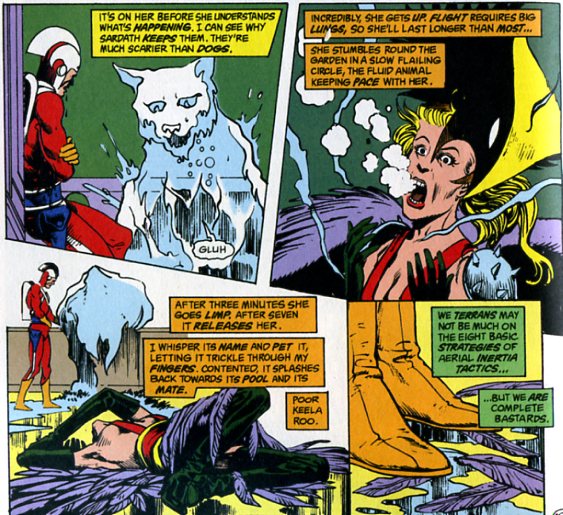
Thus, poetic justice demands that Keela Roo be killed, not in equal combat, but by domesticity itself. In battle, she manages to kick Adam Strange’s ass, but he fools her by leading her to his home, where his household guardian water creatures disposes of her. She is, then, not merely defeated, but humiliated — her fetish mask is torn from her, stripping her faux masculinity and leaving her as just a woman after all.

In the final twist of the knife, the creature who disposes of her is itself feminine (taking the form of a cat); a liquid female personification of hearth and home, which makes short work of that other woman Adam has been dallying with so that he and Alanna can be reunited again.

The point here isn’t that Moore is an irredeemable sexist, or even that this story’s handling of gender is particularly offensive. Rather, the point is that Moore, here and elsewhere, is using tried and true genre ideas (male quests; adventure vs. home.) And his main means for dealing with those concerns are received pulp tropes or DC comics ideas. Alanna is a princess not because Alan Moore made her one, but because some old DC writer steeped in Edgar Rice Burroughs and Flash Gordon made her one; the hawk woman is dressed like that because some pulp dc writer steeped in pulp cheesecake figured why the hell not.

Moore takes these ideas and runs with them…but though he runs pretty far, he doesn’t necessarily run to a different planet. In space opera, good women are beautiful paragons who sit at home being good and nurturing; bad women are aggressive and dominant and get killed off despite (or because of) their appeal. And that’s the way it is in Moore’s space opera as well.

Eric argues that at the end of the series, Moore undermines standard pulp narratives about revenge, domestic bliss and male power. But to me at least, reading back through some of these stories, Moore’s use of pulp in Swamp Thing seems less like undermining and more like assiduously and inventively cultivating.
__________________

You can read the whole Swamp Thing roundtable here.

Jog’s massive concluding Swamp Thing blowout post will be up tomorrow.

Utilitarian Review 4/18/10

On HU

This week was mostly devoted to our Swamp Thing roundtable which isn’t done yet! Jog’s got another post and I’ve got another post. Swamp Thing — he shambles on.

Also, I suggested that comics journalists might maybe want to get over themselves a little bit..

Utilitarians Everywhere

As Splice Today I talk about Zen ink drawings and why art is corrupt:

As it is, the painting seems to be a deliberate effort to unenlighten. A viewer can’t help but turn the Bhodhidharma from nothing—abstract lines on paper— into something; the Bhodhidharma, who is not there and then, despite his own parable, is. When the emperor asks, “Who stands before me?” the response “I don’t know” is not a statement of ignorance, but the declaration of a name. Similarly, the calligraphic message here twists back on itself. You cannot read, “not know” without knowing; the words inevitably convey the message that the wrong message has been conveyed. And even the broken strokes; do they really suggest a presence that is more ghostly than real? On the contrary, the gaps in the line serve instead to emphasize the hand of the artist; looking at this image, Jiun’s brush seems like the stiffest, most solid thing in the universe—more solid by far than the centuries he’s dragged it across. More solid, too, than the person looking at the image, who, along with the emperor, is less an individual than a dumb, appreciative foil—a blank, sympathetic page upon which the seer inscribes his own outline.

I have a conversation about Kant and evil over at Bert Stabler’s blog:

Bert: According to Zizek, the sublime thing in Kant’s Law is that it makes the individual responsible for her own decisions, since the Law does not give specific instructions– which addresses your idea of the Law being in one’s heart. But paradoxically (surprise!), that’s what takes the responsibility out of the person’s hands, since they’re acting in the name of this nameless, faceless injunction, in which all desire and pleasure is pathological, and pleasure comes from and desire reaches toward humiliation (punishment).

At Madeloud I interview artist and musician Matt Steinke of the band Octant.

Steinke: I have been making drum robots since I graduated from college in 1997. They seem glamorous when you talk about them, and they are often more complex than they appear and sound, but technically speaking, they are mechanical drum machines – acoustic electronically-controlled musical instruments. I have a mechanical toy piano, a mechanical bass guitar-like instrument, and a mechanically bowed zither. I use guitars that I have modified or customized, a toy guitar, a toy accordion, a music box that has magnetic pickups, and my sampler theremin watch. I also now have a homemade harmonium.

And I’m still posting stealth downloads for a friend or two if anyone is interested. Death Metal is here. And a folksy/country one is here.

Other Links

Shaenon Garrity had a couple of good articles this week, including this essay wondering where all the porn comics went and this hysterical cartoon version of Ken Smith’s philosophy.

Russ Smith at Splice Today has an acid take on Hank Williams’ belated Pulitzer.

And posts like this are why I continue to really like Andrew Sullivan.