Comics Journalism for Dummies

A while back Michael Dean wrote a now semi-infamous essay in The Comics Journal where he declared that there was no comics journalism on the web — just link farms, commentary, and event coverage. I thought the essay was quite entertaining — a fine example of Comics Journal snark and industry bashing.

I couldn’t help wondering though — presume Michael was correct, and there was no comics journalism on the web. Why should anyone care? Do we really need investigative journalism aimed at comics? Investigative journalism can be great when it exposes injustice, or provides the public with vital information: Seymour Hersch’s reporting at the New Yorker, or Andrew Sullivan’s twitter-aggregating from the Iranian protests seem like cases in point. But…you know, comics is a relatively minor entertainment subculture. In a world of limited resources and limited time, wouldn’t it be better for someone with a real talent for investigative journalism to do something — almost anything — else?

I was thinking about this again in light of a panel I was on last night at C2E2, organized by Heidi McDonald of the Beat. Other participants were Brigid Alverson of Robot 6 and mangablog, Johanna Draper Carlson of Comics Worth Reading, Ron Richards of iFanboy
Lucas Siegel of Newsarama, Rick Marshall of MTV, and a very funny and sweet young guy named Caleb, whose affiliation I sadly missed. [Update: It’s Caleb Goellner from Comics Alliance.]

Anyway, I’m not going to give an extensive recap because — well, I’m not a journalist, and I didn’t take notes. But I can report that, perhaps inevitably, there was a fair amount of talk about what boiled down to professionalism. Brigid talked about the importance of “not being an asshole”. (Brigid is to be fair, coming from a background as a political reporter.) Rick worried some about the implications of making deals to get exclusive info; several people expressed frustration that some folks think they can just start up a blog and get online and expect to be taken seriously.

So, what the hell, let’s look at the top stories at the moment on some of these sites.

IFanboy currently has an exclusive Fear PC Game Download.

Newsarama has a reported interview with Brian Bendis from C2E2 puffing some new series which I refuse to remember the title of for even a second.

Heidi’s reports on news stories from C2E2, said news stories mostly involving new comics series and Diamond speculating about changing its release day from Wed to Thursday.

Robot 6 has a news roundup that’s largely the same as Heidi’s, almost as if they were attending the same convention.

At Comics Worth Reading Ed Sizemore has a brief review of Yotsuba book 8.

And at mangablog there’s a review by Melinda Beasi of You’re So Cool.

Now, there’s nothing wrong with any of that. Personally, the only things I have any interest at all in reading are the reviews by Ed Sizemore and Melinda Beasi, but that’s me. Lots of people want what these sites have to offer, and that’s cool. Download that video game, speculate about diamond, anticipate some new series…it’s all good, if that’s your poison.

But while there’s nothing to be ashamed of in providing such services, I would submit that there’s nothing to be especially proud of either. Being a stenographer for Brian Bendis? Showing up at a panel and duly providing marketing services afterwards? Offering free samples? Even, you know, providing a short well-written review of a popular title…this is not rocket science. It’s not curing cancer. It’s not even a vital, unpleasant task like picking up the garbage or digging coal. It takes time and enthusiasm and maybe some level of professionalism, but lots of jobs that are really quite important require those things as well, big whoop. These stories, in short, define “trivial.”

I tried to make this argument on the panel more or less (I am less eloquent in person than in print, as Johanna kindly noted afterwards), and lots of folks disagreed with me. Johanna said that when people talk about how it’s all “just comics” (my phrase) it’s generally an excuse for their own low standards. Rick said that people make their living at comics, so it can’t just be dismissed. Lucas talked about how important comics are to people.

To which I can only reply, whatever. Sure, people care about comics. Sure, it’s better to do a good job than a bad one in some sense, even if your job is inconsequential. And yes, people make their living at comics. None of this changes the fact that what we’re doing as comics bloggers and journalists and news aggregators is really pretty meaningless in even the not-so-grand scheme of things. It’s for fun.

People care about fun a lot. They make their living off fun. And they draw lines in the sand delineating their little bit of fun and, not coincidentally, their little bit of lucre. Somebody on the panel I think actually talked about how some blogs undermine everyone’s reputation. I mean, come on. You’re basically providing a stream of marketing copy for a long list of crappy products based around nostalgia and indifferently-executed sex and violence. What sort of reputation are you defending?

I don’t exempt myself here; HU is a labor of love, and I’m very pleased that there’s an audience for it. Hell, I’ve worked hard for virtually no money to build an audience for it. I’ve been able to do that in large part because blogging has almost no barriers to entry. That same fact — the there are no barriers to entry — means that there are lots and lots of blogs out there that I don’t care about, that don’t seem to me very good, or that irritate me for one reason or another. And, you know, my solution to that in general is that I don’t read them.

But neither do I wag my finger at them and accuse them of failing to rise to professional standards or whatever (unless I have some vested interest in having them improve, of course.) Because to accuse random little blogs x, y, and z of failing to rise to professional standards would be (a) condescending and (b) kind of embarrassing for me. Even the biggest Poobah in comicsdom is a pretty penny-ante Poobah. To rear up on your back legs and start hectoring and/or kicking at those two steps below you on the child-size step ladder of success — you might as well just podcast your insecurities to the world.

___________________
For me the most fascinating exchange of the evening actually occurred after the panel, when Johanna explained how she makes money from her site. It’s too bad the question of how to make money off blogging wasn’t thrown open to everyone; I at least would have been curious to hear some of the nuts and bolts of how people are managing to make a living (or not make a living, in my case.)

In any event, many thanks to Heidi for inviting me. It was nice to be a real-live pundit briefly, to meet some folks for the first time, and to see Brigid and Johanna and lovely and talented Matthew Brady, who came out to watch. We’ll see if I’ve managed to convince everyone involved never to invite me again!
Muck-Encrusted Mockery of a Roundtable: Clever Is As Clever Does

Reading Richard’s last post I was reminded just how clever Moore was to put his vampires in the water. First of all, it allowed for some incredible visuals…and second it’s just a really smart idea. Vampires don’t need to breathe…so a pond would be a perfect place for them to form a community. Why didn’t somebody else think of that first? (Maybe they did…but even if that’s the case, Moore’s clever for lifting it. (Update: …and he lifted it from Marty Pasko’s earlier Swamp Thing story, according to Alex Buchet in comments — which makes it maybe a little more obvious a lift than I was thinking. Sort of invalidating the whole point of this post. But oh well…that’s blogging for you. Update to the update: no, apparently the idea of having vampires in the lake was Moore. Carry on then.))

One of the things about Moore that’s very unusual for horror writers and for certain kinds of pulp writers is how carefully he thinks things through. He’s got all these ideas about how stuff fits together — if you start here, then that means this, which means you get to that. Steven King, for example, doesn’t do that. His stories make no sense — or they sometimes make sense, but you definitely get the feeling that he’s making it up as he goes along (in Salem’s Lot, for instance, the vampires are sort of solid, sort of not — it just depends on what the story calls for.) Neither do Lovecraft’s, really — it’s all unnameable this and unmentionable that and you know he doesn’t care whether the Yog-shoggoth works or not so long as he can work in a Poe reference. Moore really does care about the mechanics, though — which can end up really badly when he tries to deal with gender anxiety (which Lovecraft, for example, manages to do a lot smarter by being a lot less aware/explicit about what he’s doing). But it can also give you a tour de force like the Anatomy lesson, where everything you think you know about the character gets turned inside out.

Basically, Moore seems like a very deductive writer — which seems like perhaps not the best fit for horror, which tends to work best when it deals with subconscious inklings and anxieties rather than with ratiocination. Moore really hit his stride when he moved towards works which had a greater focus on ideas rather than on the half-formed dream world of horror.

Though those vampire issues are still scary. And the monkey-king was pretty bad ass…. Moore could do horror if he put his mind to it, even if it did work against his strengths in some ways.

Update: The whole swamp thing roundtable is here.

Muck Encrusted Mockery of a Roundtable: I…Won’t…Stop…Talking

Suat notes acidly that any discussion of Swamp Thing is likely to be mired in nostalgia. I think we’ve actually got a couple of folks on the roundtable reading them for the first time…but Suat’s certainly got me pegged. In high school, I read and reread and rereread all the issues of Alan Moore’s run on more times than I can probably count. However, when we went off to college, it was my brother who got most of the issues (I got Watchmen) and, since I knew them so well already, I never did get the trades. As a result, it’s probably been 15 years since I’ve read last part of Moore’s run; issues #57 to #64, from way back in 1987.

So…contra Suat, are they as good as I remember? Well…no and yes. It’s certainly true that, as Suat suggests, they’re, massively, massively overwritten. I think as a kid I just skipped over most of the giant glaring gobs of text boxes. As an adult I’m more conscientious, or stupid, or some combination of both, and I actually tried to read them all — and, yeah, that really doesn’t benefit anyone. I think the interminable, tortuous extended metaphor comparing the emergency care ward of a hospital to a forest is probably the absolute low point of this volume— “in casualty reception, poppies grow upon gauze, first blooms of a catastrophic spring…a chloroform-scented breeze moves through the formaldehyde trees…” yeah, yeah, we get it already, you’re a poet, now would you mind shutting the fuck up?

The painful thing is that one or two of the images might actually work — “his body’s the grave of his mind” is nice; the idea of the EEG screen as “steep green hills”. But Moore’s entranced with the fertility of his own pomp; why stop with one sharp image when you can carry the thing through from too much to toweringly tedious to self-parodic and beyond. Moore’s road to hell is paved, not with good intentions, but with loose-bowelled facility. Rereading this, it becomes clear that Promethea’s self-absorbed cleverness isn’t a decadent falling off, but an unfortunate potential that Moore indulged, to some extent, throughout his career.

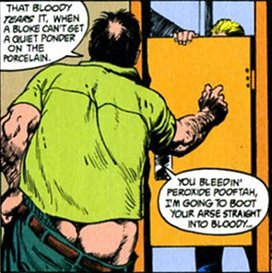
Still…Moore’s language certainly has an upside as well. He lets his sentences take over and run amok because he loves them; his self-indulgence is really in a lot of ways an indulgence of words, which he likes to stroke, and cuddle and giggle with in the back of the car seat. The first (two-part) story in this volume, for example, opens with a pound and a half of completely gratuitous Aussie dialogue, tossed in, it feels like, just because Moore couldn’t resist once the idea had popped into his head.

“bleedin’ peroxie pooftah” “ponder on the porcelain” — that’s enough goofy alliteration to make Bob Haney blush.

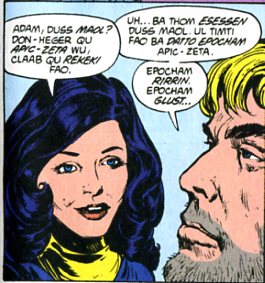
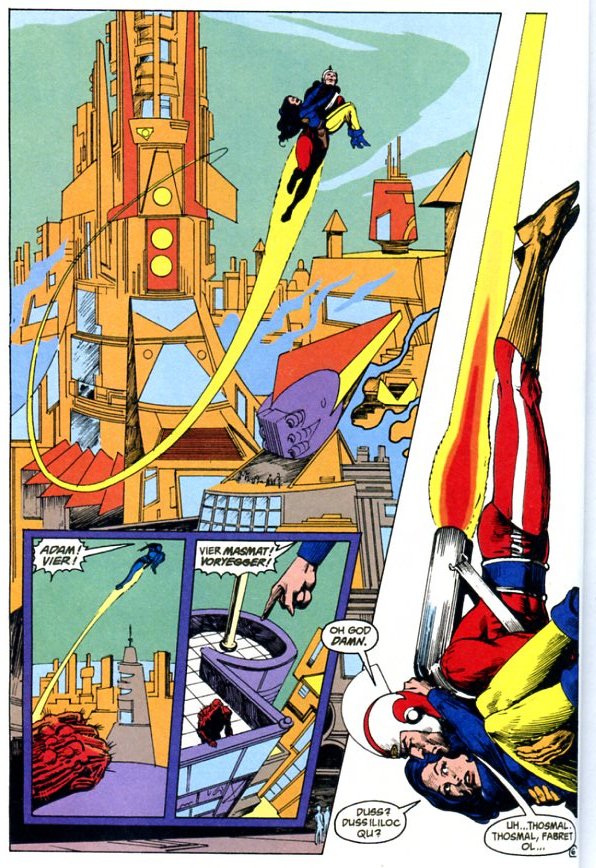
Once he gets started, of course, Moore just can’t stop…which is why, a couple of pages later, he just goes ahead and literally invents his own language:

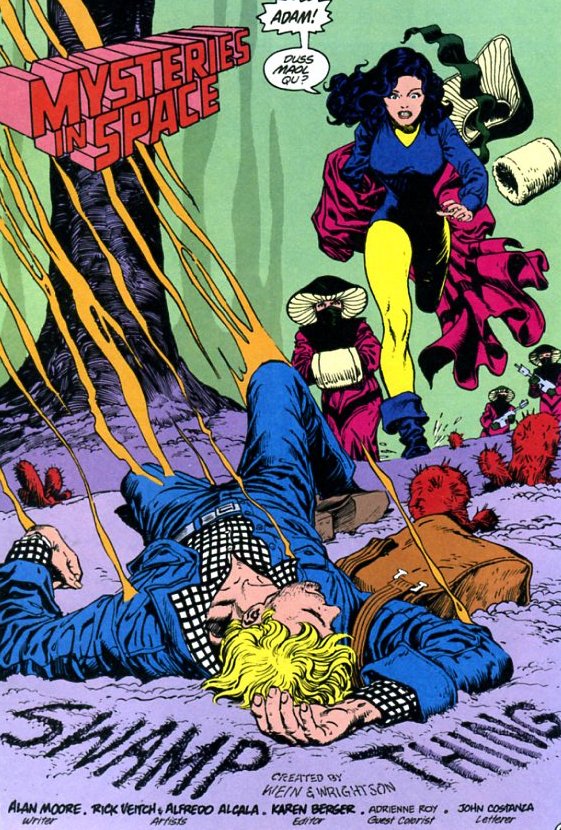
When you first look at this, it feels like a tour de force. Moore doesn’t just throw in a few words of dialogue; he keeps going for page after page in a consistent, invented language. You can understand just enough of it to tell that the language does work; Moore actually knows what these people are saying — and you could figure it out too, if you had just a little more information.

That’s Adam Strange talking to his wife Alanna. For those not in the know, these are both old, old dc space opera characters. Adam Strange is this random earth guy who gets hit by a “zeta beam” which transfers him across billions of light years to Rann, where he becomes a hero. But the beam wears off over time, so he’s always getting dumped back on earth, and having to run all over the planet to find the next zeta beam (they come with some frequency) to zap him off to the stars again.

Anyway, in Moore’s story Adam knocked up against swamp thing (whose consciousness has been forced off earth — long story) in the zeta beam and was injured, and has now recovered. That’s where we are with the panel above. And after a reread or two, you can translate that first sentence at least; Alanna is saying, “Adam, what happened?” And Adam I think answers, “Uh…I’m not sure exactly what happened,” or something like that. I especially like the “Uh…” there — I think Adam is pausing in order to shift into thinking in another language — these are the first words he’s spoken that aren’t in English (he says his wife’s name a couple panels up, but that doesn’t really count.)

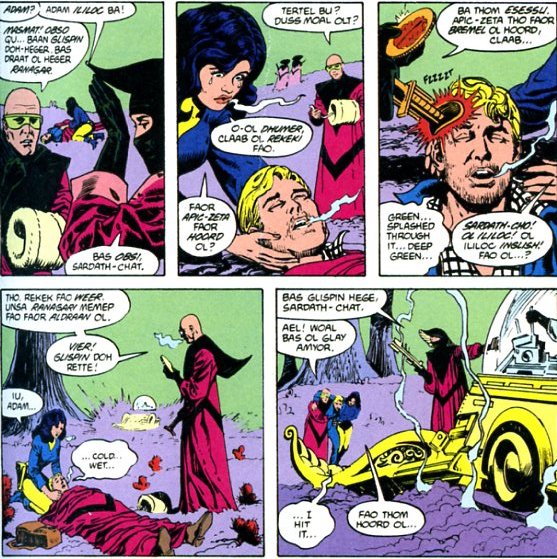
So, again, the effect initially is dazzling. But…think about it a second, and the whole thing seems more than a little ridiculous. This isn’t Tolkein spending a lifetime or thereabouts creating another tongue. This is Alan Moore pulling a language out of his ass…and that’s exactly what it looks like. It’s not Japanese, !Kung speech, or even German. Really, it’s not another language at all; barely more alien than the Aussie dialect we started with. It’s really just a kind of code. Moore seems to have written out his text and then substituted made-up words on a more or less one to one basis. In some sense, even more embarrassing than just having all your spacepeople talk English. Why try at all if you’re going to do a half-assed job?

And the answer to that, as Moore shows, is that sometimes, if the job is big enough, or original enough, or cool enough, it is in fact worth doing a half-assed job just to see where you end up. The language is nonsense — but then, this is a pulp space story, which means the whole thing is nonesense. After all, we’re in the middle of trackless space; why on earth (as it were) does everybody look human?

Besides, and what is the main point, having these silly out-of-place humans speak in silly out-of-place code allows Moore to do some things that he couldn’t have gotten any other way.

I think this page just brilliantly evokes the strangeness…not of another world or planet, necessarily, but of being far away, in a different culture. The best touch is that, after a couple panels of alien speech, Moore has Adam speak in English. Because at first you’re trying to figure out the alien dialogue, the moment when Adam talks “normal” comes as a small shock. For a second you get to see him, oddly, as the alien, the one out of place. It reminds me of a scene in C.S. Lewis’ space trilogy where Ransome, after spending some months with aliens, sees a bizarre creature and then a second later realizes that it’s himself in a mirror — he’s had the “privilege” (I think he uses that word) of seeing himself as the Malacandrians see him.

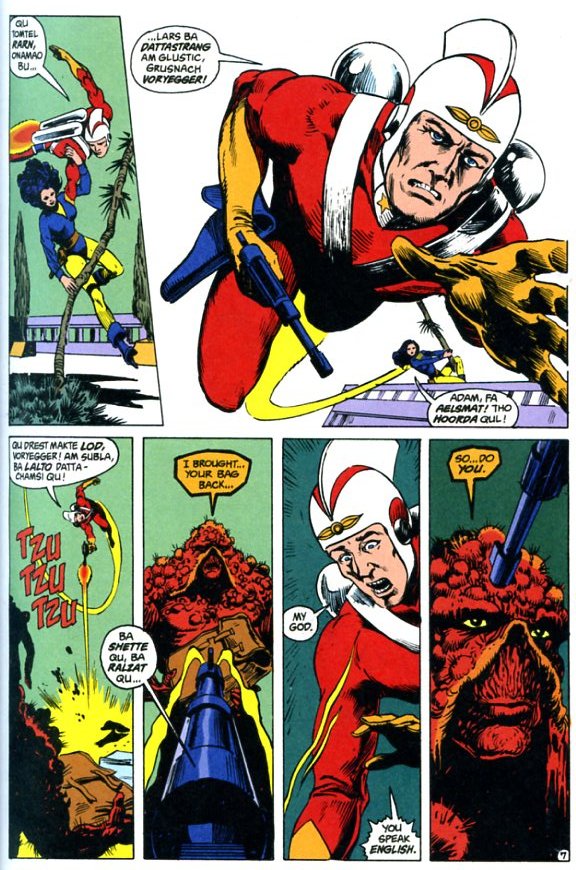
The way Moore uses his “language” in the sequence below is great too:

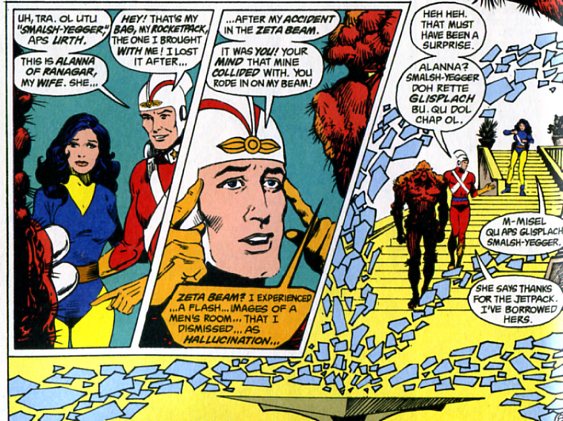
Again, the juxtaposition of the Rannian and English is basically the whole point of the page. “You speak English!” “So..do…you.” It’s such a hyperbolic ex-pat moment…and again, there’s that weird disjunction as you go from trying to follow the Rannian dialogue to realizing that everybody is suddenly speaking English. And then Moore switches the character’s positions, as Adam and Swamp Thing talk to each other, and Alanna is the odd one out:

I find that whole bit really charming. In the first place, I like the ex-pat camaraderie; Adam Strange wouldn’t necessarily have palled around with Swamp Thing on earth, but here they are infinite miles away, and suddenly (once they’ve stopped killing each other) they’re friends.

The other thing that’s hard to resist about the use of the Rannian language here is how much faith Moore puts, not so much in his reader, as in himself and in the comics form. Moore isn’t a high modernist here; he’s not Joyce or even Joanna Russ — he’s telling a pulp adventure story and he wants his audience to follow a pulp adventure story. But he’s still willing to write large swathes of his narrative in untranslated code, because he just thinks he’s bad ass enough to do it. And…hey, presto, he can.

Again, one of the best parts is that you can almost parse what they’re saying, even though, thanks to the clarity of the drawing and the clarity of the pulp tropes, you don’t really need to. In fact, one of the things the comic allows you to do that you might not be able to do as easily in a movie is teach yourself the language. The ability to stop and go back and reread means that you can recapitulate Adam’s immersion in Rann, and learn the language just as he did. Cross-cultural understanding becomes a kind of puzzle (though certainly an artificially easy one.)

I go back and forth on how much I like Rick Veitch and Alfredo Alcala…they don’t tend to send me, but they are certainly professional, and fully up to conveying action and even nuances of emotion without the help of dialogue:

That may be my favorite panel in the comic; it’s total cheesecake for girls, and Alanna’s half-proud, half-I’m-going-to-get-that-shortly expression is just priceless. It’s a pretty great thing to have in a comic aimed primarily at guys; you get to look at the main character form the perspective of his wife. It’s analagous (and somewhat deliberately so, I think) to seeing yourself as the alien sees you — the distance Moore talks about in the story is not just of place, but of gender and love.

That’s Swamp Thing’s narrative too; his separation from earth, like Adam’s sporadic separation from Rann, is more about being removed from his wife than about being away from a particular place. Language is wrapped up in love and identity; when Swamp Thing finds Adam Strange’s bag on Rann and sees the word “Seattle,” we know that part of the impact is that the word to him reads “Abby.” Words are how we know each each other…and yet, at the same time, as Alanna’s expression above tells us, theyr’e kind of not, or at least not solely. That’s a very appropriate ambivalence for comics to have, it seems like — to see words as the metaphor for our lives and loves while simultaneously drawing a bubble around them.

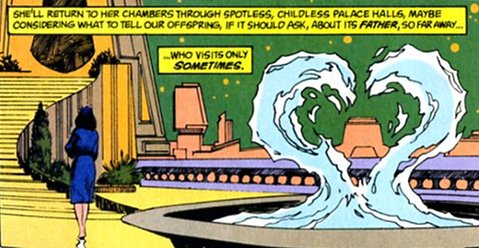
In that vein, the last panel has some of Moore’s loveliest writing (as Adam contemplates his inevitably distant relationship with his newly conceived child) and its most doofy symbolism (as Alanna’s water pets form the shape of a heart.)

It’s certainly heavy-handed — but so is caring for your wife or for your kid, or, possibly, for your own chattering. Moore’s too in love with his own imagination to worry about looking dumb, which means that Swamp Thing is filled with dumbness, but also with love. It’s not a bad trade-off.

__________________

You can read the entire roundtable thus far here.

For another take on the final volume in the Swamp Thing series, you can check out Robert Stanley Martin’s review.

Muck-Encrusted Mockery of a Roundtable

Just to give readers a heads up: we’re going to have a roundtable on Alan Moore’s Swamp Thing run starting tomorrow. We’ll have guest posts by Joe McCulloch and comics scholar (and my brother) Eric Berlatsky, as well as contributions from the usual utilitarians. So check back in throughout the week.

Dyspeptic Ouroboros: Matthias Wivel on Ware and Rembrandt

Matthias Wivel wrote an extended response to Caro’s post on Chris Ware and criticism. I hated to see it buried at the end of that long comment thread, so I thought I’d give it it’s own post. Hopefully Matthias won’t take it amiss. So here it is:

Wow, great discussion! I’m not sure where to pick up, but let’s see…

Your basic criticism of Ware seems to me somewhat beside the mark and fairly typical of a ‘literary’ point of view. But comics is a visual medium too, if not first and foremost, and there’s nothing ‘merely’ about concentrating one’s efforts, if that’s indeed what Ware does, in the ‘drawings’ — by his own rather sophisticated, if unacademic, analysis of cartooning, that’s precisely what cartooning is about; a visual language that one reads, rather than looks at.

At a more fundamental level, the whole idea of separating form from content in the way you suggest — in order to locate some intellectual premise — is false. It strikes me as a more advanced iteration of the familiar “the drawings are good, but the story sucks”-type criticism one reads so often in comics reviews. Form and content are one, and attempting to separate them is an abstraction that does not necessarily tell us much of anything about the work.

And even if you could separate them, why is it that works that have an intellectual premise are inherently better than ones that concentrate on emotion, as you say Ware’s do? And, by extension, why does the ability of the artist to articulate this premise independently of the work make it greater? I like Cocteau and Jeff Wall fine (Rushdie less so), but they strike me precisely as the kind of intellectual, ‘literary’ artists, whose work gains from this kind of intellectual parsing, while that of, say, Rembrandt doesn’t. And there is no doubt in my mind whose work is greater.

As to whether Ware has written a text like Wall’s very interesting one (thanks for calling attention to it!) — no, I’m not sure, but he has written and talked at length about his medium of choice, addressing as does Wall both his precursors and his practice. One may well disagree with his take on it, which as mentioned carries a non-academic bias in favor of his own approach, but it is hard to deny that it is an intensely analytical, not to mention sophisticated, one — clearly formulated by a highly experienced and self-critical practitioner.

Regardless, therefore, of whether Ware thumbs his nose at ‘criticism’ — and I agree that the Imp letter is dumb — he practices it himself. The Comics Journal cover tells us as much, it being a commentary precisely on the history and reception of his chosen medium. Reading it straight, as you did in your piece, seems to me to be missing its point; that he places criticism at the bottom of the ladder, along with pornography, is (besides being a dig at Fantagraphics’ livelihood) only natural: what else could he do when covering the a magazine whose stated purpose it has been to drag the still fledgling, and frankly impoverished, discipline out of its primordial state?

The reason I’m engaging your criticism, is because I’m struggling with some of the same aspects of Ware’s work that you seem to. I don’t think the emotional truthfulness of his work is quite as advanced or true to life as he would wish it to be — pace the tenor of his Datebooks — but at the same time I admire him for trying so hard to arrive at it. In this regard, he has matured considerably as an artist, and I find his latest work — especially the “Building Stories” series — promising in terms of presenting a more fully human point of view.

I disagree that he is unwilling to make a mess — I think that’s largely what he’s been doing, by hacking away at the same set of emotions for so long — it’s just that the mess he makes is so neat that one doesn’t immediately notice.

Ware seems to me to be using comics to convey a specific perception of time and space — a kind of visual epistemology that reflects his own inner life and that of his characters, and ultimately speaks to our experience of the world. The ‘premise’ is precisely the creation of ‘a sympathetic world for the mind to go to’ that you deride in your post, ‘however stupid that sounds’, and I believe that we are the richer for it.

Utilitarian Review 4/9/10

Utilitarian LIVE at C2E2

I’m going to be part of a panel on Old Media, New Media, Comics Media at C2E2 in Chicago, April 16, 7: 45:00 PM – 8:45:00 PM. Heidi McDonald is moderating, and other panelists are Brigid Alverson, Johanna Draper Carlson, Ron Richards and Lucas Siegel. It’s in Room E352.

This will not only be my first time on a con panel, it will be my first time at any sort of con ever, to the best of my recollection. So do come by if you’re not watching the simultaneous Dr. Who screening — or if you’re not seeing my cousin Ben Winters, author of Sense and Sensibility and Sea Monsters who is also, and improbably, on a different panel in the same con at the same time.

On HU

I didn’t like the Tintin adventure The Castafiore Emerald very much.

VM was confused by Song of the Hanging Sky vol. 2.

Richard wondered if comics can be scary.

Caro criticized Chris Ware for his poor handling of criticism, leading to a massive comments thread (some of it critical.)

And finally I killed off Music for Middle-Brow Snobs.

Utilitarians Everywhere

Kind of a ridiculous number of publications this week.

On Splice Today I have a long discussion of Terry Eagleton’s new book On Evil

Eagleton’s objection to the use of “evil” to describe Islamic fundamentalists or Mao or bank robbers seems, in the end, more pragmatic than theological. The word evil, he says “is generally a way of bringing argument to an end, like a fist to the solar plexus.” Eagleton, for reasons which aren’t entirely clear, (his Catholic upbringing? His own common sense?) doesn’t want to chuck the word entirely, but he does want to bracket it off. Evil does have “an intimate relation with everyday life,” he argues, but when it comes to defining what that relation is, he more or less punts, offering a laundry list in place of an actual mechanism. Envy, he says, is kind of like evil, schadenfreude is kind of like evil, Freud’s death drive is kind of like evil, and, hey, by the way, Adolf Eichmann looked like a bank clerk. Evil … it has something to do with us. But not much. Can we talk about something else please?

On Comixology I had an extremely snide review of Grant Morrison’s Batman and Robin.

What Morrison understands, through a Jungian intuitiveness born of years of intensively soldering corporate slogans onto the sacred flesh of his unnameables, is that crazy throw-off moments from the past gain weight and profundity by being repeatedly embalmed and disinterred. Every time Bob Haney hawked up a loogie, Grant Morrison was there, mouth open like a baby bird, ready to ingest, digest, and re-emit it for the sole purpose of waddling his sublimely stained Bat underoos over to the nearest university English Department for professional sterilization and veneration.

At the Chicago Reader I review Diane Ravitch’s new book about school reform.

Everyone knows that teachers have class—but which class that is, exactly, isn’t clear. As educated people working with brains, pens, and paper clips, they look white collar. Those indicators are superficial, though. In most ways that matter, teachers are working class. Charged with controlling a potentially dangerous population, they toil through a regimented workday at the butt end of a faceless bureaucracy. A teacher is a prison guard disguised as a college professor—a combination that gives nearly everyone some reason to despise them.

Again on Splice Today I talk about the confused class politics of the TV sitcom The Big Bang Theory.

The Big Bang Theory isn’t alone in pretending that brainworkers are evolutionarily disadvantaged beta-males. Everyone knows that Bill Gates is (a) happily married, and (b) the most powerful person on the planet, but no one seems to want to generalize from there even a little bit. The fact is, though, that scary-smart geeks are not just smarter than folks like Penny—they’re also in a higher social class.

I have an interview with mashup artist DJLobsterdust over at Madeloud.

Do the mashups have to be songs that are popular, or do you try to put together things that are less well known?

In the beginning I really didn’t care and I’d just use songs that I like. But since I find myself playing in front of crowds…I do mashups for myself, songs that I like, and at the same time every couple of weeks I put something out there that everybody knows just so people don’t forget about me. At the same time — I do this because I like pop music. So I have no problem mixing anything with anything.

I have a short review of the Numero Groups Good God: Born Again Funk compilation over at Metropulse.

And I have a review of the horror/fantasy manga Dorohedoro over at tcj.com.

Music For Middle Brow Snobs: Is Dead

We’ve got some changes coming to HU in the near-to-mid-term. More about those presently…but to start with, I think I’m going to put this feature mercifully to sleep. It’s been fun playing at being a dj, but all good things, etc. etc. Thanks to all the folks who downloaded and commented. You can still get all the earlier playlists for the forseeable future here.