
We’re going to take a week off here at HU. Thanks all for reading along with us through our change of address, and we’ll be back bright-tailed and bushy-eyed (or something like that) for the start of the new year. Hope to see you then!
Tag Archives: Noah
Utilitarian Review 12/26/09
A little quiet this week, what with the major holiday and all. Still, we blogged away…
On HU
We started out the week with a return to my halcyon days of writing scatological prose-poems.
Kinukitty posted about the joys of reading yaoi novels on the Kindle.
Vom Marlowe reviewed How to Draw Manga: Ultimate Manga Lessons Vol. 5: Basics of Portraying Action.
I sneered vigorously at Chris Ware’s Halloween New Yorker cover. If the comments to the post aren’t sufficient, there’s also a thread on the TCJ message board devoted to the topic.
Richard discussed his reaction to the first volume of Lone Wolf and Cub.
And finally this week’s download included no Christmas music at all.
Utilitarians Everywhere
Over on tcj.com, Suat reviews Suat on Carol Tyler’s “You’ll Never Know”
Written in 1994, Carol Tyler’s “The Hannah Story” was a tribute to her mother, Hannah, and her strength in dealing with her in-laws as well as the death of her daughter, Ann. Despite the intervening years, Tyler’s sensitive “voice” remains easily recognizable in her latest book, You’ll Never Know.
At madeloud I have up the first of a two part series on Thai luk thung music videos.
Even more flamboyant is “Arom Sia” by actress and singer Apaporn Nakornsawan. The title means “Sick of It All,” and indeed the performer appears to have become so disgusted at her romantic troubles that she has turned to super-villainy, luring the Justice League into some sort of catastrophic defeat at the hands of a gay pride parade.
At Splice Today I talk about the overcarbonated new dolphin show at Chicago’s Shedd Aquarium.
The most heart-tugging moments in the show, though, involve not the cute penguins, nor the noble hawk, but rather the trainers. Demoted from educators to props, they are ruthlessly dressed up in penguin suits or decked out like British hawkers or hoisted up on pulleys and dropped from a height into the water. Yes, they seem cheerful enough about it in general but good lord-it all seems like a rather cruel punishment for the comparatively minor sin of being a zoologist.
Over at Bert Stabler’s blog we continue our conversation about the book of Job, and discuss Stanley Milgram’s experiments, among other things. The quote below is from Bert.
Basically, if you lose everything for no moral or practical reason, whether it’s because God decides to destroy your life arbitrarily or because he can’t stop bad things from happening or because it’s part of some grand scheme for the betterment of the universe, we cannot ultimately hold God to account. He’s God, he’s not a limited being with petty motives. God is like a petty dictator, but he’s also not. He’s not a transparent, contingent demiurge– he’s a remote yet ubuquitous source of energy.
And at metropulse I contributed to a pretty entertaining best of music list.
Other Links
Tom Spurgeon’s been doing a bunch of interviews with critics about some of the best or most influential books of the decade. I think my favorite so far is his discussion with Kristy Valenti about Little Nemo.
Shaenon Garrity has an interesting discussion of manga translation issues on tcj.com.
And finally, I’ve mentioned a couple of times that I often disagree with Jeet Heer on most everything. I have to say, though, that this essay about representations of homosexuality in classic comics is pretty great from start to finish. The essay carries a lot of learning very lightly, and includes a number of zingers, most notably: “Like most professional moralists, Bozell has no real sense of history: he’s a traditionalist with no grounding in the past.” Andrew Sullivan linked to it, and deservedly so.
Music For Middle Brow Snobs: Sex Life of the Fern
A completely not-Christmas-themed music download for Christmas:
1. Edward Williams — The Sex Life of the Fern (Life on Earth Soundtrack)
2. Animal Collective — Graze (Fall Be Kind)
3. Suzuki Junzo — Ameria (Pieces for Hidden Circles)
4. Michio Kurihara — The Old Man and the Evening Star (Sunset Notes)
5. Isaiah Owens — You Without Sin Cast the First Stone (Fire in My Bones)
6. Amazing Farmer Singers — I Got a Telephone in My Bosom (Fire in My Bones)
7. Alice Keys w/Beyonce — Put It In a Love Song (The Element of Freedom)
8. Mariah Carey — Candy Bling (Memoir of an Imperfect Angel)
9. Ina Unt Ina — These Eyes (All Sides of Ina)
10. Antony and the Johnsons — Another World (The Crying Light)
11. Ulrich Schnauss — As If You’ve Never Been Away (Far Away Trains Passing)
12. Daylight Dies — Dismantling Devotion (Dismantling Devotion)
Download Sex Life of the Fern.
Happy holidays!
The New Yorker Hearts Luddites
I found myself reading this essay by Gorjus about Chris Ware’s Halloween New Yorker cover recently. In case you missed it, this is the cover:
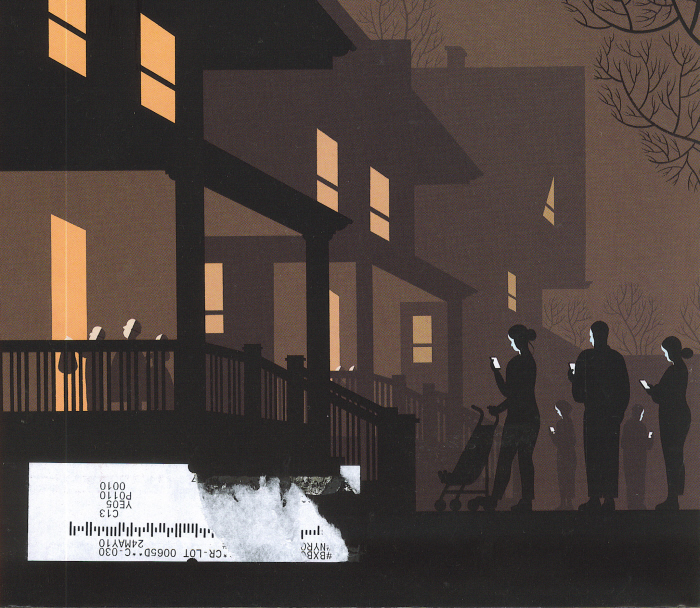
And here’s what Gorjus has to say about it:
The children are literally masked, yet still engaging the world—going forth into that terrible night, mashing down on the button at the house they don’t know, mumbling and punching each other to you go first. They are open to the world; the masks are meaningless, the toys of children, soon to be ripped off to suck in the sweet Halloween night…..
The parents of the children wear a different mask; while there is nothing physical upon their faces, the reflection of their email and RSS feeds and status updates smear across their features, shutting them off from the world more than any Wolverine® latex ever could. It is, in one still image, a surpassing and comprehensive look at American society in the 21st century: we send our children out with masks to play-act traditions that were shaky and hoary when we were young, forcing them to play outside and make friends with the neighbor girls, while shutting down ourselves via 3G and electrons and Cymblata and whiskey more then even our own parents could manage.
That Mr. Ware has evoked this without showing us a single costume, or a single face, or truly, anything other than basic shapes coupled with a flat-matte color palette, again validates the dozens of honors that litter his career.
I’ve been reading a lot of comics criticism recently, as it happens, and one thing I’ve noticed is that writing about super-hero comics is almost invariably better than writing about art comics. That’s because writing about art comics tends to be really unendurably sententious. I mean, “going forth into that terrible night”; “traditions that were shaky and hoary when we were young”; “Mr. Ware”; “again validates the dozens of honors that litter his career”…I mean, come on. It’s like we’ve stumbled into the back cover blurb of a volume of contemporary poetry. The stink of reverence is suffocating.
Again, I don’t blame Gorjus personally. This just seems to be how folks write when they write about art comics. It’s particularly unfortunate in this case, though, because…jeez is that cover a drearily cliched piece of crap. I mean, Chris Ware sure goes way out on a limb there, using the pages of the New Yorker to sneer at contemporary technology and those who use it! Boy, I bet that was a hard sell to Francoise Mouly, huh? Imagine…the stodgy old New Yorker being old and stodgy! Really shifts your paradigm, huh?
Obviously, Chris Ware is a talented designer…but I have to say that personally my patience for his antiseptic blocky buildings and antiseptic toy-like people is pretty much exhausted. And, just out of curiosity, where exactly are the Halloween decorations here? Oh, right…if you included those, the picture wouldn’t be quite bland enough. Yes, yes I know that he’s showing the antiseptic emptiness of contemporary life…to which I say “feh,” and also, “yawn.” The bourgeoise literary tradition where you excoriate the bourgeoisie for their empty, lifeless culture by creating empty, lifeless culture — it’s been going on for generations, and I presume it’ll continue as long as two bourgeoisie are alive so that one can sneer at the other, but I don’t see why we (bourgeoise or otherwise) need to pretend that it provides some deep and humane insight.
Because it doesn’t — it’s just glib. Which is what this cover is; overwhelmingly glib, with the self-satisfied glibness that is the inevitable adornment of a real New Yorker cartoon. You could get the same level of insight from the crank at your local bar. “Damn it, cell phones…they’re ruining the world! People just don’t talk anymore like they used to!”
You want to know the technology that actually affects the Halloween ritual? As somebody who went trick-or-treating in the quite affluent neighborhood of Hyde Park, I can tell you that the mechanical device at the end of everyone’s fingers was not the cell phone, but the digital camera — except for the moments when people were using their cell phones as cameras, I guess. Because everyone was taking pictures of their kids in their cute costumes, for even in this soulless, technology-ridden age in which we sadly toil, taking pictures of kids in costumes is still the sort of thing that parents do more or less constantly.
Gorjus finishes his essay by saying, in reference to both the cover and Ware’s interior story, “It’s bleak, this world; it’s rife with cynicism and misanthropy, as can be said of much of Mr. Ware’s work.” But this image, at least, isn’t bleak or cynical. It’s nostalgic and suffused with easy sentiment and easier moralism. It’s a big slab of maudlin hooey concealed under a thin veneer of urbanity. And it, and its critical enablers, deserve to be hooted.
A Poem For Sunday
And then I had a dream. And in this dream I was floating through the blogosphere and my brain was my asshole, and I was pooping, pooping wild and free, and my little floating gnome turds dribbled down from the heavens, and then they teamed up and battled evil. And then, because creation is destruction, they padded on their little shit
gnome feet up to every single fucking comics industry professional on earth, and they stuck their little shit gnome peckers in their comics industry asses, and then they ejaculated my shit brains into the whole comics industry, and when the comics industry exploded it was as beautiful as the boils gently erupting on Pol Pot’s shiny scrotal sac.
And so I was inspired. And who knows what I will create next? Who, I ask you? Who?
RSS Feed problems?
I have one reader who said he was having some problems with the RSS feed. Is anyone else experiencing troubles? Please let us know if so, or if there are any other technical problems you’re encountering. We’ve managed to get some things straightened out and are still struggling a little with others, but any feedback would be helpful.
Utilitarian Review 12/19/09
On HU
Our first week on the tcj.com has been busy. I started out the week with a post explaining why the tcj.com website design is problematic. I then went on to tell our proprietor, Gary Groth, that he doesn’t know what he’s talking about.
The main event of the week though was our lengthy roundtable on Dan Clowes’ Ghost World. There are some epic comment threads, where critics like Matthias Wieval, Mark Andrew, Bill Randall, and Jack Baney way in. Also special thanks to critic Charles Reece for guest blogging with us.
As an extra bonus, Shaenon Garrity wrote a response to the roundtable over on tcj.com.
Utilitarians Everywhere
Around the web, both Suat and I had a bunch of writing this week. I’ll start with Suat, all of whose reviews were on tcm.com.
Suat wrote a discussion of comics lettering.
Most people with an interest in Chinese brush painting realize that the calligraphy frequently found at the edge of such pieces form as much a part of the art as the image itself. Chinese calligraphy is of course a major art form in the Chinese cultural sphere.
The place of the letterer in the overall aesthetic of comics is less certain. Are letterers merely craftsmen, or are they artists in their own right? And if they are artists, what constitutes their contribution to the art of comics?
He also wrote a lengthy review of Richard Sala’s Delphine.
We are of course led to believe by the standard mechanics of comics that the rectangular panels represent reality and the hazy ones memories and fantasies. The reverse is often the case in Delphine where the more formless panels frequently represent painful reality while the rigid ones delve deep into the protagonist’s soul. These interconnected realities begin to meld beginning with issue 3 of the series.
He had a long review of How to Love, by the group Actus Tragicus.
With the dawning realization that doing comics in Israel was never going to be “profitable” for them, the founding members resolved to focus exclusively on their own interests and “stop trying to be commercial”. Actus has since become a staple on both sides of the Atlantic with a reputation for good production values, interesting formats, high technical skill and well told stories. How to Love is their first collection in four years and the five key members of the group namely, Mira Friedmann, Batia Kolton, Rutu Modan, Yirmi Pinkus and Itzik Rennert have all returned with a single guest artist in the form of illustrator David Polonsky.
And finally a shorter review of Takashi Nemoto’s gross out comics.
As for me, I had a review at the Chicago Reader comparing Craig Yoe’s Anti-War Cartoons to Kate Beaton’s “Never Learning Anything From History.”
I’m enough of a knee-jerk pacifist to entertain the suggestion that even the Union’s decision to fight the Confederacy and U.S. participation in World War II did more harm than good. But those are arguments you actually have to make. Lots of smart folks from Obama on down think you sometimes have to fight wars to maintain peace. You can’t just show me a picture of a skull or a fat industrialist and expect me to agree that we shouldn’t have blocked secession or stopped Hitler. Indeed, Yoe admits that many of the cartoonists represented in the book weren’t pacifists, but opposed particular wars at particular times (or, in the case of the many Communists represented, opposed all war except class war). By throwing all the artists together under the label “anti-war” without describing the particular issues that engaged them—by making their message universal—he’s made them irrelevant.
Another article at the Reader about the Thai pop singer Pamela Bowden and the thankful limitations of best of lists.
It’s December, which means it’s time for me, as a dutiful blogger, critic, and self-appointed cultural arbiter, to put together my best-of lists. I need to listen to that Raekwon album again to confirm that I really do think exactly the same thing everyone else thinks. I need to check back in with that Mariah Carey album to make sure I really do think exactly the opposite of what everyone else thinks. I need to compare Of the Cathmawr Yards by the Horse’s Ha with Grizzly Bear’s Veckatimest and Antony & the Johnsons’ The Crying Light to figure out which romantic, indie-folk-tinged work of idiosyncratic genius is the most geniuslike. I need to decide if I have to download the new Lightning Bolt album (legally, of course) and form an opinion on it, or whether it’d be safe to simply put it on my list on the assumption that it sounds like all the other Lightning Bolt albums.
Simultaneously, and ironically, over at The Factual Opinion I have a best of metal list of the year, or decade, or something.
I kept taunting Tucker and Marty for being wussy little twee indie rock/electronica/emo fanboys who’d hide behind their Mommy’s skirts if the Cookie Monster spoke to them too loud, or, you know, if the apocalypse occurred. “Oh I love Cut Copy because they’re so much fun.” Yeah, well, let’s see how much you enjoy dancing in hell with your feet torn off and your bloody stumps slipping and sliding in the shredded scraps of Cut Copy’s intestines. Huh?! How would you like that?!
Over at the Knoxville Metropulse I explained why Alicia Keys’ new album is lousy.
Over at Madeloud I explained why < ahref="http://www.madeloud.com/review/marduk_wormwood">Marduk’s latest album is great.
And finally my illustrations for the Flaming Fire Illustrated Bible project are back up after the site was offline there for a while.
Other Links
Danielle Leigh’s review of Ooku has more of the gushing enthusiasm I was looking for from other reviewers.
And Tom Crippen, formerly of HU, has a long post on tcj.com about Alison Bechdel’s Dykes to Watch Out For.
It’s a method and aesthetic based on control, dominance. In the old days, any good resident of Happy Vulva would have said dominance was a dick kind of thing — phallocentric. But for Bechdel this method and aesthetic work just fine. From the beginning, she says in the Essential introduction, her impulse was to pin down the girls she drew; check out the rod-like instrument her cartoon self has in hand when demonstrating this thought. For what it’s worth, the approach has a lot in common with the picture Fun Home gives of her father and his compulsive, unending attempt to nail down family and home into a tableau; Sydney and her father also look and act a good deal like Mr. Bechdel, what with their glasses, their bookishness and luxury, and their high-handed way with students.
And do check out the whole top 30 albums of the year list at the factual opinion. I write a brief blurb in there somewhere too if you can find it.