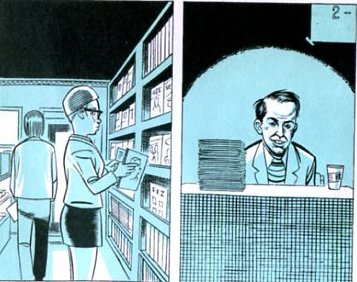
Enid Shylock (Ghost World Roundtable)

Shaenon Gaerrity weighs in on our Ghost World Roundtable. I’ll quote a couple of chunks.

Noah Berlatsky compares Ghost World unfavorably to Ariel Schrag’s coming-of-age trilogy, pointing out how well Schrag captures the intensity of adolescence: “Ariel’s difficulty wasn’t that her world was fading out, but that it was too sharply coming into focus, and there was too much of it. It’s the intensity of her emotions — her crushes, her attachments to friends, and, indeed, her attachment to her art — that makes her life a misery. Sometimes. And, then, at other times, that same intensity becomes a source of strength and beauty and excitement.” That’s an astute assessment of Schrag’s work, but I don’t know if it’s accurate as a sweeping assessment of adolescence. Yes, the intensity can result in the richness of experience Berlatsky sees in Schrag’s comics. But it can also inspire a bleak, apocalyptic, end-of-the-road feeling, which is why teenagers are so attracted to death and morbidity. Teach any writing class for teens, and you’ll have to wade through interminable whines about being numb and hopeless and “unable to feel anything anymore”–and, worse, you’ll probably recognize your own teenage writing in it. Adults feel more, or more easily, than teenagers do. Teenage writers like Schrag, who are able to dive into their lives and confront their emotions fearlessly, are rare and uniquely fascinating….

The one area where Ghost World does fall short, one that several folks on the roundtable have already noted, is Clowes’s failure to imagine any sexuality for Enid. Berlatsky writes that Enid is implausible as a teenage girl because “she’s uninterested in discussing her crushes,” which unfortunately comes off as a bit insulting to teenage girls: gee, if she’s not talking about love, how can you even tell she’s a girl? In fact Enid and Rebecca do talk about boys often, but Enid’s contributions to the discussion are, as Rebecca points out, either negative or disinterested. There are only the briefest hints of what Enid might find attractive: she describes her hipster ideal to Rebecca, then imagines Dan Clowes as the embodiment of that fantasy, only to be brutally disappointed by the reality. Meanwhile, she actively discourages Rebecca’s real-life romantic interests. It’s okay for a teenage girl to be timid about sex and hide it behind bravado and fantasy, but there should be some indication that she at least looks at guys.

It’s interesting that Shaenon accuses me of stereotyping teen girls…but in order to do that she kind of has to arrive at the point where she thinks Ariel Schraeg is somehow a less representative portrayal of teen girls than Enid Coleslaw.

Moreover, I think Shaenon’s point about Enid’s sexuality, or lack thereof, is astute…but I think it’s a more crippling problem for the book than she acknowledges. Specifically, I think Enid’s lack of sexuality is precisely why her whole existential dilemma rings so false. At least for myself as an adolescent, I remember quite vividly that my sense of alienation and despair were very much tied up in sexual and romantic impulses that I wasn’t prepared or able to deal with. I don’t think that’s atypical, and it’s why Enid’s alienation — which is tied up more in nostalgia for her past than in desire— seems so entirely wrong. Nostalgia is the fetish of the middle-aged, not the young.

I also wonder about this. “Adults feel more, or more easily, than teenagers do.”

I just don’t think that’s true. Teenagers may have more difficulty parsing social codes and sublimating their emotions in socially acceptable ways. But they certainly don’t feel less, nor do I agree that they feel less easily. I think it’s insulting to suggest they do, honestly. You know, “hath not a teenager eyes? Organs, dimensions, senses, affections, passions?” Teenagers aren’t all that much different than, you know, people. In that vein, I think kinukitty’s point is worth repeating

“I don’t recognize them as high school girls, but that is probably secondary to the fact that I don’t even recognize them as human.”

Somebody Else’s Ghost (Ghost World Roundtable)

I was interested in setting up a Ghost World roundtable because it’s a book I’ve had mixed feelings about. Well, that’s not exactly right. I’ve always pretty much hated it, actually. But I’ve had some trouble figuring out why I hated it. Which is unusual for me; as a rule my bile flows fairly glibly. I mean, yes, there are some loathsome aesthetic choices — the heinous blue-green spot color being the most obvious. Beyond that, though, I’ve never been able to quite wrap my head around what about the book so thoroughly irritates me.

In this regard,Kinukitty’s post Charles’ essay and Richard’s post have been helpful. Though kinukitty disliked the book, Charles liked it, and Richard had mixed feelings, their reactions actually have a good bit of overlap. For all of them, the book and its characters are defined in large part by absence. Kinukitty says of the characters “I don’t recognize them as high school girls, but that is probably secondary to the fact that I don’t even recognize them as human. They are not so much characters as collections of anecdotes that are intended to be cool and ironic… I think Ghost World is unpleasant in a way that winds up being pointless because there’s no there there.” Richard notes that Enid eventually heads towards adulthood, but that she displays “a maturity without content, which invites that the reader fill in the blanks with their own experiences.” Charles comes at a somehwat similar point from a different angle, arguing that for Enid, “Mass culture has even detached us from our detachment.” In other words, the book’s pointlessnes and Enid’s lack of a center is, for Charles, thematized; it’s an example of our modern, or postmodern dilemma. Ghost World is a world where there is no meaning; where you can’t even recognize others as human, where we’re all just collections of anecdotes, alienated from our own stories.

I think Charles has also made a very astute point — though not quite the one he intends — in linking Ghost World to the work of John Barth. Clowes is often discussed in terms of filmmakers like David Lynch, I think, but he’s always struck me as being more allied with contemporary fiction — not least because of his flatness. Lynch, for all his auteurishness, has a lot of pulp at his heart; he likes the flamboyance of horror or heist films or psychological thrillers. He may make films about emptiness and the break-up of identity, but the films themselves are filled with pyrotechnics and a weird kind of life. They’re not a blue-green blank.

Literary fiction, on the other hand, often is. “Middle-aged academic types” as Charles quips, abound; it’s a genre of mid-life crisis. And indeed, Barth’s The End of the Road, from Charles description, sounds very much like…well, here’s what Charles says about it:

Horner is a middle-aged academic type who’s managed to think himself into a hole, not seeing any potential action as better grounded than another – sort of an infinite regress of self. Thus, he’s sitting in a bus station in a state of existential paralysis, not able to even come up with a good reason to get on a bus and leave his former (non-) life behind.

That’s tricked out with intellectual filigree, but basically it’s a mid-life crisis, right? Garden variety despair at getting halfway through your existence and realizing you haven’t done all that stuff you wanted to do when you were a kid; you’re not on top of the world, you’re just some bourgeois scmuck like every other bourgeois schmuck, so you sit there, unable to go forward, unable to go back. Okay, now, hurry up and write a novel explaining that it’s not just you who’s lame — it’s a universal, existential condition!

So hold that thought, and let’s consider Enid for a moment. Enid is in almost every respect an extremely odd teenaged girl (as kinukitty points out). She seems acidly alienated from pop culture and music. She’s uninterested in discussing her crushes, or, indeed, discussing enthusiasms of any sort. She has an extremely guy-like instrumental approach to sex, based largely on scoring points and talking to her friends afterwards. And she turns for solace, not to booze, or drugs, or sex, or crushes, or pop songs, or movies, but rather to totems of her childhood; random theme parks she visited as a kid, random toys; half-remembered kids songs. Enid is desperately nostalgic for her youth — which is more than a little weird when you’re only, what? 17?

Oh, yeah, and she has a fascination with creepy borderline psychos. Who are older. And male.

Not that it’s impossible that a teenaged girl would act this way, of course — people are different after all — and certainly lots of young girls are fascinated with creepy older guys. But…well, for example, Ariel Schrag is more or less in Enid’s bourgeois demographic. And her adolescence, based on her autobiographical comics, was certainly filled with anguish of various sorts — her parents divorced, she went through a painful process of questioning her sexual identity and she had a number of extremely traumatic relationships.

But…Ariel didn’t live in a ghost world. She had lots of serious problems, but they were problems that you have when you’re young — which is to say they were problems caused by not being able to understand, or process, or sort out a cascade of emotions and desires. Ariel’s difficulty wasn’t that her world was fading out, but that it was too sharply coming into focus, and there was too much of it. It’s the intensity of her emotions — her crushes, her attachments to friends, and, indeed, her attachment to her art — that makes her life a misery. Sometimes. And, then, at other times, that same intensity becomes a source of strength and beauty and excitement.

Now, that second bit doesn’t have to happen necessarily, and doesn’t for a lot of adolescents. Youth can be great (which is why people romanticize it at times) but it can also really suck, and the sucking can easily outweigh the good stuff, and does for lots of people. But the point I think is, when adolescence is miserable (as it absolutely can be) it tends to be miserable the way adolescence is miserable, and not miserable like middle-age.

Ariel Schrag wrote her autobiography when she was an adolescent, and that’s how it reads. Dan Clowes wrote Ghost World in his mid-thirties…and that is so, so, so how it reads. Enid, it seems to me, makes most sense not as an accurate portrayal of a teen girl, but rather as an accurate portrayal of a thirtysomething man enjoying himself by pretending to be a teen girl.

And, indeed, as that, Ghost World is undeniably kind of brilliant. Most of the intellectual content of the book is little more than the clichéd crankery of the past it hipster, bitter that he’s no longer up on all the latest bands, pining for his youth while simultaneously loathing and desiring the young. Put those sentiments in the brain of a college professor and you’ve got just another novel by John Updike…or, perhaps, John Barth. But hand the sentiments off to young girls — that’s kind of genius. Have the girls sneer at Sonic Youth for you; have the girls moon after the detritus of their youth; have them say of each other, with just a touch of condescension, “You’ve grown into a very beautiful young woman.”

Perhaps the most emblematic moment in the book, in this respect, is when Enid meets (a thinly disguised) Clowes himself. This is, to the best of my recollection, the only time in the narrative that Enid expresses an unironic connection to, or enthusiasm for, any piece of contemporary pop culture. Yet, when she sees the “real” Clowes, she is disappointed because nobody else has come to see him and he is “like this old perv.”

Clearly this is supposed to read as self-effacement on Clowes’ part. But I wonder. Enid’s initial fascination (which is in part sexual) is certainly a fairly familiar creator fantasy (“she loves me for my art!”) But even more than the enthusiasm, it seems to me that the disappointment is a kind of sublimated self-aggrandizement. After all, Enid’s let-down is only really possible because her interest in Clowes, like all of her interests, is without content. We never learn what she likes about faux-Clowes, or what it is in his books that inspires her. Who is Enid? She’s no one, a ghost without purchase on her world or her culture. And why is she no one? Whose ghost is she?

enid and clowes

Surely it’s significant that, as this sequence suggests, while Clowes can imagine Enid, Enid can’t imagine Clowes. Indeed, the page reminds us subtly that it is Clowes calling Enid into being; we see her from his perspective first, and only then can she see him. Enid’s self isn’t there not because that’s the way it is for all of us in this sad state of late postmodernity, but simply because her self isn’t hers. She’s somebody else’s mid-life crisis, there to buttress another’s existential vacuum with the weight of her own nonentity.
______________

Update: Suat’s contribution to the roundtable is now up.

Music For Middle Brow Snobs: Black Dooms Droning

I was asked to contribute some metal recommendations to the ongoing end of year best of blowout at the Factual Opinion. I thought I’d do a playlist to go along with my choices. So here’s some of my favorite metal from the last year/decade.

1. Rites of Thy Degringolade — Totality’s Reign (An Ode to Sin)
2. Harvey Milk — We Destroy the Family (Fear) (Life…The Best Game in Town)
3. Marduk — To Redirect Perdition (Wormwood)
4. Funeral Mist — Anti-Flesh Nimbus (Maranatha)
5. Gallhammer — Endless Nauseous Days (Gloomy Lights)
6. Drudkh — Decadence (Microcosmos)
7. Xasthur — Soul Abduction Ceremony (Microcosmos)
8. Khanate — In That Corner (Clean Hands Go Foul)
9. Pyha — Song of Oldman (The Haunted House)
10. Lugubrum — Kadurha (Albino De Congo)

Download Black Dooms Droning

If you want to buy extreme metal (or any kind of metal) you can’t do better than shopping at Aquarius Records, about the most amazing online store I’ve ever had the privilege to visit.

Comment Delay

All right, the spam in comments is getting out of hand. I’m trying to take steps, but it may take a day or two. In the meanwhile, I’m going to have to start approving comments. Once one of your comments is approved, you should be able to post from then on without any delay, but your first comment after this may take a little bit to appear until I give it the go ahead.

Sorry about this. If people think this is more burdensome than being inundated with spam let me know and I’ll maybe go back. As I said, we should have some sort of spam filter in place sometime soon, so hopefully this will just be a stopgap measure.

Thanks for your patience all.

Yesterday Was Always Better

I promise this will be the last post for a while where I troll my proprietors. Unless they keep pissing me off, I guess.

In case you missed it, Gary Groth, the editor of the Comics Journal, has a Welcome to TCj.com post on the main page.

The essay is basically an unctuous exercise in self-hagiography. Gary reminisces about the good old days, slaps his knees, and bellows, “Eh! I just don’t get this new-fangled blogging! Why, I’m going to show those young whippersnappers how to criticize if I can only get my darned ear-trumpet out of my…eh, what part of me is that, anyway?”

I joke, but really, it’s a depressing spectacle in a number of ways. Most obviously — well, Gary really is somebody I admire, as I noted in my last post. He wasn’t a formative influence or anything, but he’s a good writer and a smart guy. His magazine took a chance on me when I didn’t have much of a name for myself, and while that was mostly Dirk, it was Gary who gave him the rope to do it, and I’m grateful to both of them. They took another chance bringing this blog here, for that matter, and I appreciate that as well.

Moreover, between the bouts of self-congratulation and maudlin reminiscing, Gary actually has a point. He and TCJ really do have a good deal to offer to folks who write and/or read about comics. There’s a roster of critics, like R. Fiore and Gary himself who haven’t had much of an online presence, and they’ll certainly be welcome. Having the Journal content free and online will be a boon to both casual readers and researchers. The long-term perspective on criticism and the comics industry which Gary has is not unique certainly (Tom Spurgeon and Johanna Draper Carlson have both been critics for a while, to name just two examples) but that doesn’t mean it’s not worthwhile.

So yeah, Gary and the Journal bring a lot to the table. But they will both offer less — and possibly a lot less — if Gary spends all his time online preening over his past accomplishments and sneering at everyone who doesn’t have the good luck to be him.

I doubt Gary noticed the irony, but at one point in his article he quotes this aspirational paen to comics, penned back in those days when Nobody But Gary And A Few Other Like Minded Visionaries Took Them Seriously. The quote’s by Richard Kyle.

The commonplace world is built of iron fantasies, a place where yesterday was always better.

In the commonplace world, all new arts are trash. In Elizabethan times, it was commonplace to say that Shakespeare’s theatre was trash. And then it was the novel’s turn: the novel, they said, was trash. And then the film came along. First it was the silent film, and the commonplace was that it was trash — until the sound film emerged. Then the silent film suddenly became an art, as the theatre and the novel had, and it was the sound movie that was trash. Today, all film is becoming art. What’s trash today, then? Comics, of course. But now that the newspaper strip is ailing, the commonplace is that it may be art. Those comic book stories, though, they’re surely trash…

As Gary says, it’s a nice quote. Though, you know, if Gary had actually read it, he might have been reluctant to write this a few paragraphs later.

Very little writing on the Web is of any real critical worth — or even pretends to be— and there is no journalism to speak of. I have never assiduously followed comics blogging, but so much of what I’ve read feels dashed off — amateurish, shallow, frivolous.

That web writing — that’s surely trash.

Not to go out on a limb to defend writing on the web or anything. There’s a lot that’s not very good. On the other hand…you know, virtually everyone who’s written for the sainted Journal in the past ten years is on the goddamn web. Not just Robert Stanley Martin and Bill Randall, but Jog, and Shaenon and Alan David Doane, and Sean Collins and Chris Mautner and Steven Grant and on and on. If you don’t know how to use google, that’s not the blogosphere’s fault.

On the other hand, if you’re talking amateurish, how about posting sixteen lines of tag-spam, completely filling the top of your new website’s screen with a list of boring crap, presumably because you simply don’t know what the fuck you’re doing? If you’re talking shallow, how about admitting that you don’t really read blogs, and then broadly condemning them on the basis of that? If you’re talking frivolous, how about an entire two-page post devoted to discussing how awesome you and your friends were back in the day?

Let me put it to you simply, Gary. If you’re in the room, you’re not cooler than the room. The Internet isn’t going to fall on its knees and worship your tag-spam just because you’ve been doing the comics criticism thing for a while and now you’ve blessed it with your presence. Which isn’t to say that you don’t have a lot of goodwill; you absolutely do. I don’t know tons of people in the blogosphere, but everyone I do know, even folks who are more or less your competitors, wants you to succeed. And, yeah, being a curmudgeon is part of your charm — don’t stop with that. But, for a moment or two, you might think about whether you, in fact, know it all, or whether it’s possible that, in this new venture you’re undertaking, you could, just maybe, have something to learn. With love, with respect, with hope even, I ask you, stop being a horse’s ass. We need you to do better.

Ghost World Roundtable

We’re going to kick off a roundtable on Dan Clowes’ Ghost World shortly. Our regular bloggers (that’s Richard, Suat, Kinukitty, Vom Marlowe, and me) will all weigh in. In addition, blogger and critic Charles Reece has very kindly agreed to join us. Charles blogs, mostly on film, at Amoeblog. You may also be familiar with his writing if you frequent the Comicon message boards, where he is a frequent poster.

So I believe Kinukitty will be posting shortly. Don’t touch that RSS feed, as they say.

TCJ.com/fail; (Or, Let’s See If I Can Get Myself Fired Right Off the Bat)

Note: This post was destroyed due to blog glitches. I’ve managed to replace the texts, but many of the links no longer exist. My apologies.
________________________

So, I should start off by saying that I have a ton of respect for everyone involved in TCJ. Dirk Deppey’s one of my favorite writers on comics; Michael Dean has been great to work for at the print Journal; Kristy Valenti is incredibly smart, pleasant, and hard-working, and a fine writer as well. I don’t know Gary personally, but I’ve enjoyed reading him over the years, and I greatly admire his work as an editor and a publisher. I’m very grateful, and, indeed, flattered, that such a smart and talented group of people found something of value in this blog, and were interested in hosting it. I’m looking forward to being here for a long time (I mean, presuming this post doesn’t get me fired.)

I also want to say that there are a lot of things that I think tcj.com has gotten right. Most notably, I think TCJ has done a great job in getting an exciting and interesting group of writers together. I’ve been a big fan of Shaenon Garrity’s for a while, and it’s great to see her blogging regularly. I wasn’t familiar with Anne Ishii, but she seems like a spectacular choice — and much-appreciated evidence that the Journal is taking manga seriously. Same with the addition of Roland Kelts. Eric Millikin is also a very smart and inventive pick. I’m looking forward, too, to promised essays from Tom Crippen (who I was lucky enough to have writing at HU for a while), Matthias Wievel, Charles Hatfield, Kim Deitch, and Ben Schwartz, great writers all.

In addition, it’s worth noting that the website really could be worse. TCJ has avoided the cardinal website mistake of being so cute that your page is completely unmanageable. The page isn’t dripping with mystery meat gimmicks; you don’t have to guess whether the link to the print edition is under Charlie Brown’s maudlin head or whether it’s instead under Enid Coleslaw’s. There are a couple of miscues, sure (”Blood & Thunder” isn’t going to mean anything to anyone who hasn’t read the print journal guys, which means it’s not going to mean anything to anyone. The link should just be to “Message Board”, okay?) Overall, though, things are labeled in a reasonable way. That’s definitely worth something.

So if I like all that, what am I complaining about? Well, let’s start at the beginning….

I’m probably just not imaginative enough, but I’m having difficulty coming up with ways in which the rollout could have been more botched. Johanna Draper Carlson has a good summary of the issue #300 mess, which I’m not going to harp on further here. But even setting that aside, the opening days of tcj.com have been…well, let’s call it unfortunate. Instead of an actual official announcement with attendant hoopla and excitement, the launch was spilled quietly by blogger Rob Clough. (Not that that’s Rob’s fault; I doubt anyone told him not to.)

In addition, the launch itself was made from Beta. This had a number of unfortunate effects.
First, excitement was somewhat muted, since the site wasn’t *really* ready — I saw at least one blogger (I can’t remember who) write that TCJ was “sort of” launching, which isn’t the kind of thrilling introduciton you want, I don’t think. Second, the fact that the site was in Beta meant that there were a lot of details to fix…and fixing them meant that portions of the site were going up and down and all around for more than a week. As of this writing, things are still pretty massively fucked-up actually. Thus, at the very moment when tcj was presumably hoping for a major influx of traffic, lots of stuff didn’t work. This was especially problematic in regard to Dirk’s blog Journalista, which, in theory, should have been able to direct lots of people to the new site but which instead was relegated to a kind of half-life on the tcj.com main page while it’s old tcj.com/journalista address went in and mostly out of service.

In short, tcj.com launched before it was ready to go. I can think of various explanation for why they might have done this (promises to advertisers seems the most likely), all perfectly reasonable, just as the decision to pull TCJ #300 because of vendor concerns was reasonable. However, the upshot of these reasonable decisions is that readers end up irritated.

And I think that that’s kind of a big problem. Not because the opening was fucked up; I mean, that’s bad, but the launch is just the launch; the website is hopefully going to be around long enough that people will forget that. But the psychology behind the launch worries me.

Basically, it’s not clear to me that tcj has figured out how to think like its readers. Or, to put it another way, it’s very unclear who this website believes it’s talking to.

The great thing about the internet is that it’s easy to find the stuff you’re interested in, and only the stuff you’re interested in. I can go to the Atlantic website, for example, and read Andrew Sullivan without having to even look at a whole range of other bloggers who annoy or bore me (I’m talking about you Jeffrey Goldberg.)

Again, this is the Internet’s strength. And so what does TCJ.com do? It puts all it’s bloggers and writers and essayists in a single, streaming blog, regardless of whether they’re likely to attract the same readers. There’s a ton of content, but it’s not focused content. It’s not catering to the super-hero crowd, obviously; it’s not catering to the manga crowd — but it’s not really resolutely snobbish like Comics Comics, either. And though there’s not a focus, it’s also not organized in a way that makes it easy to find the bits you want to look at. For just about everyone, I think, the noise to signal ratio on tcj.com is going to be very high. It’s great to have Anne Ishii writing — but are the manga fans who are presumably her audience even going to be able to find her in the scrolling wall of unrelated text that is TCJ.com? (And yes, you can click on her name on the side and get all her posts…but that presumes you know you’re looking for her. You want to be appealing to people who aren’t necessarily already familiar with your content, not just those who are.)

There is some recognition that this is a problem, I think. It’s why all the posts are cut off after a paragraph or so with that annoyingly automated “Read More” link. In theory, the idea is that if everything’s truncated you can just scroll past and find what you want. In practice…well. Many of the posts are fairly short, but not so short that they get in under the “read more” break. So you’re constantly going past stuff you don’t want to read to find the one thing you do, and when you get there you read down until the “Read More” snaps you off in the middle of a sentence, and then you click the link and you get, not a whole essay, but just another 20 lines of text or whatever. Add in the giant flashing ads on the side, and…yeah, it’s just not a how I want to read my Internet.

In addition, the website often presents things in a way that make sense to the writers and editors, but not necessarily to the readers. For instance, the homepage shows two lists, one of bloggers and one of essayists. Okay. But…what is the practical difference for readers of the site? As a writer for tcj, I know that these groups are treated differently in certain ways — but why do readers give a shit? It’s all content going through the same sluice.

_______________________

So…what to do? Well, in the short term I’d first try to see if I could tone down the flashing ads. I’d also see if I couldn’t figure out a way to make there be more of a clear visual break at the end of posts; as it is, the post text goes right into the little notation about RSS feeds and so forth, which is really and unexpectedly distracting. I’d also think about giving writers more control over the Read More placement, and I’d try eliminating it altogether for shorter posts. There’s just no reason to go to Read More when you’re only writing 300-500 words. (Robot 6 is one example of a group blog which seems to have figured out a better Read More compromise length — and to be just in general better designed for readability.)

In the longer term, I’d think hard about giving some folks separate blogs. Ken Smith is an obvious candidate, as his interests and everyone else’s are fairly distinct. A more or less manga-themed blog with Anne and Shaenon and whoever else fits seems like a decent idea as well.

And just overall, I’d separate bloggers out from essayists. Though as I said they aren’t clearly differentiated now, they should be. Blogging is really about self-publishing; the attraction of a blog, for readers and for writers, is the sense that you’re having a conversation, with little filtering. Having all the blogs go through the mainpage, and having them split up with essays, really dilutes and muffles the sense of individual voices and idiosyncratic interests which is what people go to blogs for. That’s especially the case if bloggers really are being asked to keep posts to under 500 words, as Rob said.

Essays, on the other hand, are ideally more formal and more curated…and, again ideally, should be teased and promoted rather than just dropped into a blog format. Splice Today, where I occasionally write, has a pretty good, no nonsense way to present essays which is somewhat bloglike, and could serve as a model. Or the Onion AV club, where you have a menu of essays could work. Basically, if you have an essay, you want to put it out there as a completed piece you’re proud of. And, you know, you want to keep it in one or at most two big chunks, grouped together, not in 5 scattered and dismembered segments.

And there should definitely be a menu of recent stories, or perhaps a scrolling list of popular stories (Splice Today does this) so that there’s some easy way to see what’s recent or important without going down the whole damn page.

Also, and finally, I’d think hard about how on earth I was planning to make money. Maybe tcj has cracked the code for surviving off of internet ad sales, but…well, I’m a little skeptical. The short-term goal needs to be upping subscription to the print Journal, surely. Don’t, then, for god’s sake, put your link to the journal subscription up in the ad banner. Put it down somewhere in editorial. And put it on our lowly subdomain too, for God’s sake. We want to help!

Even if, you know, we’re out on our collective ears tomorrow.