We seem to be experiencing various technical problems; comments and permalinks send you to 404 page not found, in particular.
I’ve contacted the appropriate authorities, so hopefully this will all be sorted out soon. Thanks for your patience.

We seem to be experiencing various technical problems; comments and permalinks send you to 404 page not found, in particular.
I’ve contacted the appropriate authorities, so hopefully this will all be sorted out soon. Thanks for your patience.
Utilitarian Review is a weekly round-up of post on HU, links to other things I or other bloggers have published this week, and some random links as well.
_________________________________
On HU
This week started off with my discussion of the great surrealist artist Leonora Carrington and her drawings for the novel “The Hearing Trumpet.”
Kinukitty posted a lengthy appreciation of Tomoko Hayakawa’s The Wallflower.
Richard Cook posted a review of Brian Azzarello and Victor Santos’ Filthy Rich.
Ng Suat Tong talked about the original art market for comics.
And finally Vom Marlowe reviewed the first volume of Adam Warren’s Empowered.
Utilitarians Everywhere
At Comixology I have a longish review of Yuichi Yokoyama’s Travel.
In Yokoyama’s work, too, the viewpoint swoops and swerves, now with a skier on a high mountain pass, now underneath the train. There is certainly a celebratory, joking tinge to Yokoyama’s impossibly mobile camera. But there is also something ominous. In one sequence from the book, our protagonists’ train passes another going in the opposite direction. A whole page is devoted to the faces on the other train. They are shown in four tiers of three blocks each; all are streaked with violent motion lines; all are the same shade of grey as the window frame, all stare intently outward at the viewer. The scene is oddly disturbing; the repetition of the faces, the repetition of the expressions; the lines going through them, the grid — it’s dehumanizing, as if the faces are not people at all, but manikins, or masks.
On the TCJ.com main page I reviewed Fumi Yoshinaga’s Ooku: The Inner Chamber.
At Splice Today I reviewed Arie Kaplan’s book about the Jews and comic books, from Krakow to Krypton.
Over at the Knoxville Metropulse I reviewed the new Animal Collective ep, Fall Be Kind.
At Madeloud I reviewed Miranda Lambert’s Revolution.
In the hidebound print-based media department, I have a couple of album reviews out in the latest issue of Bitch magazine.
And former Utilitarian Bill Randall has a review on the tcj.com main page of the hipster mess that is I Saw You.
Other Links
Matt Thorn has a withering essay about how much current manga translators suck.
Shaenon Garrity has a post on the Tcj.com main page about Power Girl’s explication of her boob window. I also enjoyed Shaenon’s post about Fumi Yoshinaga.
_______________________________
Hey all. We’re officially moving in today. Some of the boxes are still packed and they’ll probably be at least a few stubbed toes and muttered imprecations as we stumble around the new space…but hopefully the learning curve won’t be too steep.
For those who are familiar with us already, our content is going to be much as it always was. Currently, and hopefully for a while, our bloggers are me (Noah Berlatsky), Ng Suat Tong, Kinukitty, Vom Marlowe, and Richard Cook. We write, variously, long meandering essays on Wonder Woman and gender; enthusiastic manporn reviews; chronicles of a quest for mainstream titles that do not suck; musings on the original art market in comics.; your irritatingly named roundtables,; music downloads no one listens to, occasional Thai pop videos, and goodness knows what else. This week in particular, I’m going to try and get myself fired, and then, if that doesn’t work, we’re going to have a knock-down, drag-out roundtable on Dan Clowes’ Ghost World. So…click back often! Or even better, add us to your RSS Feed by clicking that little icon thingee in the corner up there.
____________________________
The old blogspot address will stay in place as an archive. I thought, to get things started I’d put up some links to my favorite posts from our archives. So…..
The first post I did to the Hooded Utilitarian was my long, complete interview with Johnny Ryan, an expurgated version of which ran in TCJ a ways back.
Also going back a bit is this gallery of cartoons by the amazing editorial cartoonist Art Young. From that page you can click around to some other images and my essay on the cartoonist, if you’re so inclined.
One of my favorite roundtables on the site (featuring Bill Randall, Tom Crippen, and Miriam Libicki) was our discussion of the feminist Japanese manga Helter Skelter by Kyoko Okazaki. That discussion also links up at the end to the Mary Sue roundtable, which is also one of my favorites, so you can click over there if you’re just not getting enough roundtableism.
Tucker Stone and I did a back and forth discussion of Bob Haney’s Brave and Bold.
Tom Crippen’s epic discussion of Marvel Comics and Civil War is the piece that really won me over to his writing when I saw it in the Comics Journal. It’s great.
Miriam Libicki’s post on Rogue of the X-Men is shorter, but also a favorite of mine.
I also love Bill Randall’s vision of manga as apocalyptic coccoon.
And Kinukitty’s even more obsessive than usual discussion of “In the End.”
And for more recent highlights check out: our Sandman roundtable; and Steven Grant’s great guest post on race and comics; and Richard’s very funny review of Image United.
So thanks for joining us. More soon!
______________________________
As we’ve mentioned a time or two, HU is moving bit, byte, and barrel over to the new! improved! Comics Journal website!
Though we’ll be at a different location, our content will not change; you’ll still have your long meandering posts about Wonder Woman and gender, your enthusiastic manporn reviews; your quest for mainstream titles that do not suck; your erudite explorations of comics classics.; your irritatingly named roundtables,; your music downloads no one listens to, your occasional Thai pop videos, and all the other fun features which you’ve come to expect when you click over here.
Also, coming up later this week at the new space, I’m going to try to get myself fired, and then (presuming that doesn’t work) we’re going to have a knock-down drag-out roundtable on Dan Clowes’ Ghost World.
All of which is to say, I hope you’ll follow us to our new location. And if you have a link to us on your site (and thank you!) I hope you’ll redirect it to where the new content is.
This address will stay in place as an archive. I thought, as long as we’re going, I would post some links to a few of my favorite posts from the past years. Feel free to just skip ahead to the new site if the maudlin nostalgia seems too intense.
______________________
The first post I did to this site was my long, complete interview with Johnny Ryan, an expurgated version of which ran in TCJ a ways back.
Also going back a bit is this gallery of cartoons by the amazing editorial cartoonist Art Young. From that page you can click around to some other images and my essay on the cartoonist, if you’re so inclined.
One of my favorite roundtables on the site (featuring Bill Randall, Tom Crippen, and Miriam Libicki) was our discussion of the feminist Japanese manga Helter Skelter by Kyoko Okazaki. That discussion also links up at the end to the Mary Sue roundtable, which is also one of my favorites, so you can click over there if you’re just not getting enough roundtableism.
Tucker Stone and I did a back and forth discussion of Bob Haney’s Brave and Bold.
Tom Crippen’s epic discussion of Marvel Comics and Civil War is the piece that really won me over to his writing when I saw it in the Comics Journal. It’s great.
Miriam Libicki’s post on Rogue of the X-Men is shorter, but also a favorite of mine.
I also love Bill Randall’s apocalyptic vision of manga as apocalyptic coccoon.
And Kinukitty’s even more obsessive than you’ve grown to expect discussion of “In the End.”
And for more recent highlights: our Sandman roundtable and Steven Grant’s great guest post on race and comics, and Richard’s review of Image United.
_________________
And…I think that’s it. I’m kind of reluctant to go; it’s a little sad to say goodbye to the place, even if we’re not really leaving the internets. Thanks to all the bloggers who have been kind enough to lend their talents here, to the folks who have linked to us, to our commenters, and to our readers. Hope to see you all soon on the flip side.
Vom Marlowe did a post last week about the virtues of the stick figure art in xkcd. She noted:
See, I think there’s a lot to be said for simplicity and humor and just plain getting the point across. The art needs to serve the point of the communication. Some of the, hmmm, shall we say overmuscled super hero comics seem to miss the idea that the art needs to communicate as much as the words do.
I have a lot of sympathy with that sentiment. Mostly that’s probably because…well, here’s one of my own drawings from my zine “The Adventures of Eustacia H. Cow.”
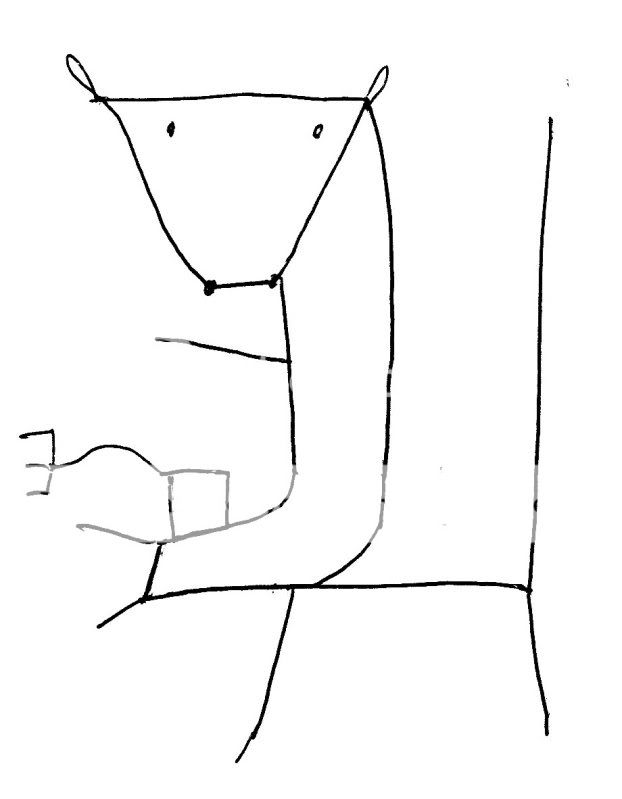
That’s a cow spanking a sentient toaster. Just in case it wasn’t clear.
Putting aside my own individual bias, though, there’s just a lot of great drawing that looks more or less like it could have been done by a 6 year old. One of the best examples I came across recently was the book “The Hearing Trumpet,” by Leonora Carrington. Carrington is best known as a surrealist painter; born in England, she had a relationship with Max Ernst, and then moved to Mexico, where she became good friends with the amazing painter Remedios Varos. (According to Wikipedia, she’s still alive, too! She’s 92, I guess.)
Anyway, “The Hearing Trumpet” as a novel is something of a mixed bag. It starts off as being about an elderly woman named Marian Leatherby. The everyday, mildly absurd details of Marian’s life, and of her friend Carmella, are thoroughly delightful, adn the writing has that distintively English low-key nuttiness that puts it firmly in the tradition of P.G. Wodehouse and Douglas Adams. Carmella’s explanation of why Marian needs a hearing trumpet in order to overcome her deafness and spy on her family is priceless.
“You never know,” said Carmella. “People under seventy and over seven are very unreliable if they are not cats. You can’t be too careful. Besides, think of the exhilarating power of listening to others talk when they think you cannot hear.”
“They can hardly avoid seeing the trumpet,” I said doubtfully. “It must be a buffalo’s horn. Buffalos are very large animals.”
“Of course you must not let them see you using it, you have to hide somewhere and listen.” I hadn’t thought of that, it certainly presented infinite possibilities.
A whole book of that would make me happy. Unfortunately, “The Hearing Trumpet” is a bit like Promethea; entertaining through about the first half, then the author gets distracted by tediously crankish alchemical meanderings and the temptations of religio-mystico profundity. So it goes.
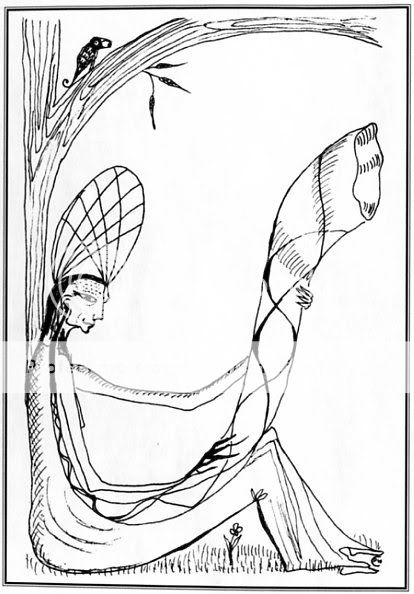
Anyway, I was originally talking about the art. Here’s a bunch of elderly ladies doing exercises, including Marian, who has set her era trumpet down off to the side.
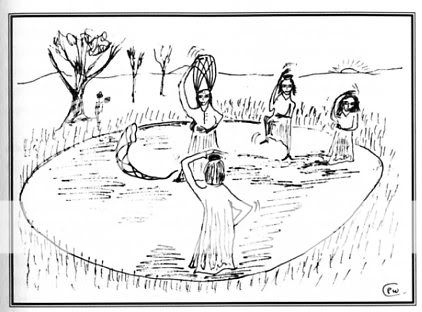
There’s some of Edward Gorey’s sketchiness there, but without his sophistication or elegance. Instead, the proportions seem to elongate or contract to suit the artist’s fancy; the woman with the turban (who I believe is Marian) has arms that are as long as her entire body. I love the little hint of motion lines as well; it makes the movements seem as scratchy and idiosyncratic as the figures themselves. And all the scribbles, on the ground, or in the tree indicating the leaves — it’s just very energetic and personable.
Or this is great too
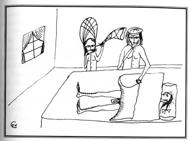
That has to be about the most economically rendered transvestite revelation scene ever. The reactions of the two women watching are cleverly differentiated as well, just by slightly changing the positioning of their hands against their faces. I love the way the room itself is sketched too; just three wavery lines to make the corner, and then the more detailed window, so flat and blank it might as well be a picture of a window.
Here’s another:
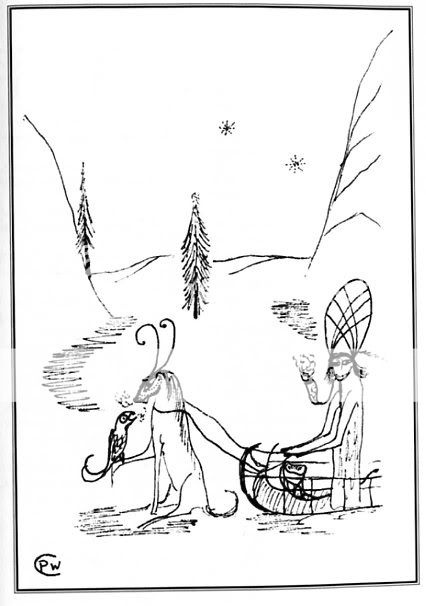
It’s all still very stick-figure, obviously, but you can tell she can really draw. The way the bottom of the sled curves up is elegantly done, and that bird is made up of some deceptively fluid lines. Even the little dots of breath coming out of the animals’ mouths are pleasingly arranged in half semicircles…and the small dots on the deer(?)’s face are very nice as well.
Of course, simple drawing doesn’t always work:
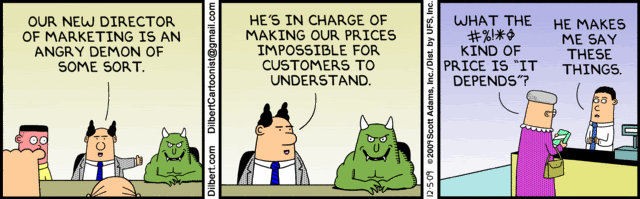
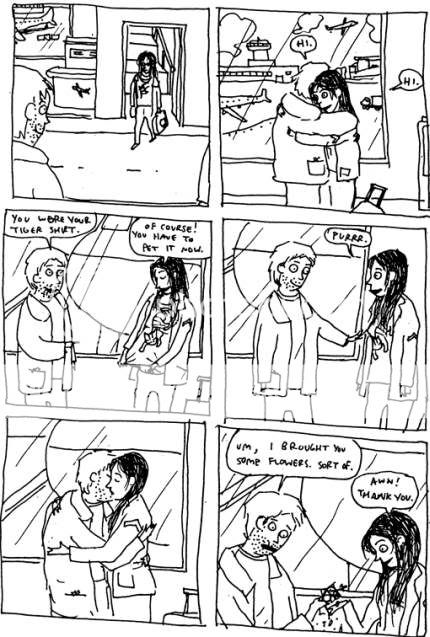
Dilbert’s a very simple strip — yet it’s also off-puttingly slick. There’s none of the sense of quick whimsy you get in Carrington’s drawings. You’d think if you were drawing a demon a little flair or wildness might be in order, but nope; it doesn’t even really have any expression, nor does it move from panel to panel. The characters look like they’re designed on computer…which maybe they are (no, I”m not going to research Scott Adams’ technique. I mean, for God’s sake, who cares?)
Jeff Brown’s work, on the other hand, doesn’t look slick— but it’s also just really ugly. I think, looking at it in comparison to the Carrington drawings, a lot of the problem is actually how cluttered this is. The shapes defining the window in the middle two panels for example. What do those add? It just makes it look like a mess. The linework also seems more labored than graceful. It’s like he’s trying to get everything in without thinking about how it looks. The narrative is driving the story, and his art is just struggling to keep up, rather than running with his sketchy style and trying to see where that can take him.
(To be fair, this is a somewhat older strip, and I think recently Brown has actually gotten better at both simplifying and at drawing; some of the more recent work on his site is…not great, but not terrible either. There’s nothing especially wrong with this Simpsons pastiche, for example.)
So, yeah, I guess I have to admit that, much as I might like it to be true, just because you can’t draw doesn’t mean you’ll make great art.
Leonara Carrington still kicks Alex Ross’ ass, though.
I’ve been doing a series of posts about superheroes and gender. In the most recent I talked about superdickery. Superdickery here refers to the way super-heroes tend to stand in for the uber-patriarch, both as benign law-giver and as evil ogre-father. In the post, I talked especially about how Marvel’s innovation was to shift more explicitly towards the idea of superhero as nightmare ogre-father (the Hulk! the Thing!) Ultimately, though, the ogre-father is still the father; Marvel comics are still about dreams of empowerment, rather than about denigrating or undermining those visions of absolute mastery.
Okay. So…if superheroing is all about superdickery, what happens when you have a female superhero? As the title up there says, can Wonder Woman be a superdick? And, if so, how, if at all, is that dickishness different when it’s attached to a woman?
There have been a couple of gestures at making Wonder Woman dickish. As I mentioned last post, Kate Beaton’s butch WW can be seen as dickish to some extent. And Greg Rucka’s WW in the Hiketeia might be considered superdickish in some sense too.
Overall, though, male writers have seemed distinctly uncomfortable with having Wonder Woman act as a superdick. I’m going to talk about some specific examples in a minute. First though, I want to discuss briefly why the superdickery meme is so hard (as it were) to apply to female characters.
In general, the whole point of the superdick is that you have some non-powered weakling (Bruce Banner, Clark Kent, whoever), and then the superhero acts as empowerment fantasy. Bruce Banner can’t lay down the law — but Hulk can smash. Peter Parker can’t replace Unlce Ben — but Spider-Man can! Bruce Wayne cant’ fight evil in his undies — but Batman will. Etc.
On the one hand, this is a pretty simple formulation. On the other hand, though, it is, I think, plugged into some fairly profound dynamics around male identity. As I discussed in this post, this post, and this post, male identity is built around a central incoherence. This incoherence can be seen as biologically Oedipal (with Freud), or as cultural (with Eve Sedgwick.) Either way, the point is that a male is both identified with patriarchal power (the father) and distanced from that power (the child.) To be identified with patriarchal power is to turn one’s back on femininity, and in some sense on humanity — so that the uberpatriarch is both a monster and, in some sense, unmasculine, since he rejects women (what gender is the Thing under those briefs, exactly?) But, on the other hand, to be a sniveling child outside of patriarchal power is to be feminized.
In short, the engine behind the super-hero split identity is the anxiety of maleness. Peter/Spider-Man is constantly vacillating between two people because neither one is stable. Peter is under pressure to take up the rod of superdickery and become a real man; Spider-Man is under pressure to cast aside the rod of superdickery and pay attention to the girls already so he can become a real man.
Women aren’t implicated in this psychodrama. Female identity isn’t incoherent — or at least, it’s not incoherent in the same way. A commenter on a recent article of mine at Reason put the point succinctly:
girls can think ninjas are cool without any blowback. Any man who likes sparkly emo vampires is probably sorting through some issues.
That’s exactly the point; a girl who likes ninjas doesn’t have her femininity called into question (on the contrary, butch women are often considered especially hot, as I argue here. Men who like romance, on the other hand, open themselves up (as it were) to the charge of not being sufficiently masculine.
So that means women have it easy compared to poor, conflicted men, right? Well, not exactly. It’s true that female identity is in some sense more stable…but there’s a certain amount of coercion which goes into enforcing that stability. Men are always defined by their lack of the phallus, always anxiously scurrying after the unattainable superdick…or dropping it like a hot potato and scurrying away when they get it. Women, on the other hand, aren’t supposed to have the superdick in the first place, so they’re just kind of supposed to sit there and be. Basically, for women, the ideal is more coherent, which means that individual slip ups (watching ninja movies) aren’t necessarily always as important. However, overall, a more coherent ideal can actually be more limiting. Always striving and failing is tiresome, but probably preferable overall to being stuck in prison.
Which brings us back to Wonder Woman.
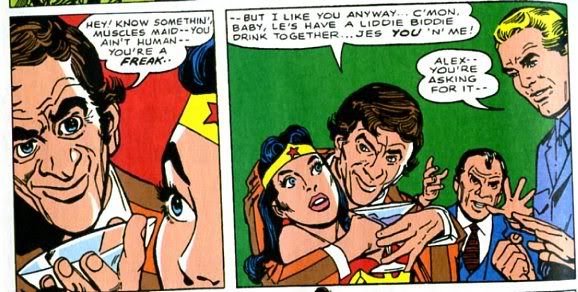
That’s from Denny O’Neil and Mike Sekowsy’s first issue on WW from 1968. And, as you can see, the creators seem to be of the opinion that WW is a freak. And why is she a freak? Not because she’s actually a monster like the Thing, but simply because she’s got “muscles” and is a woman. And, not coincidentally, in the following issues of their run on the series, O’Neill and Sekowsky actually depowered WW, turning her into a civilian spy — still a crime fighter, but one who wouldn’t necessarily scare the (male) kiddies.
O’Neill and Sekowsky are more blatant than most, but they’re hardly alone in their discomfort with the super-powered WW. Throughout “The Greatest Wonder Woman Stories Ever Told,” there’s a constant, insistent effort to evade the image of Wonder Woman as superdick — to domesticate her, if you will. In Robert Kanigher’s “Top Secret,” Steve Trevor engages in an elaborate plot to get Wonder Woman to marry him. His scheme fails…but it forces WW to create her Diana Prince identity in which (of course) she serves under Steve in the military. In this story, then, Wonder Woman isn’t Diana’s empowerment fantasy; rather, Diana is *Steve’s* empowerment fantasy. WW does get the better of Steve, but only by doing what he wants. She bows to his superdickery and relinquishes her own.
Similarly, in Robert Kanigher’s revealingly titled “Be Wonder Woman…and Die!” the emotional focus of the story is on a terminally ill young actress who impersonates Wonder Woman and then expires beautifully. It’s pretty clearly a Mary Sue story in some sense — a WW fan appears, is lauded by her idol, and then shuffles off the mortal coil to great acclaim. But you do have to wonder — if this is a Mary Sue, whose Mary Sue is it? Who exactly is getting off on a depowered and dead WW clone? Could it be the male writer,by chance?
One final example; Wonder Woman #230, from 1977. (Todd Munson very kindly gave me this issue when I visited his class at Randolph-Macon a few weeks back. ) This issue is by Marty Pasko, and it’s set in the 1940s to tie in with the then-current TV series. It’s also obsessed with doubling. The villain is the Cheetah, who suffers from multiple-personality disorder; normally she’s an everyday socialite (Priscilla Rich), but when she sees Wonder Woman she has a psychotic episode and turns into a supervillain. In this sotry, Priscilla accidentally encounters WW and has her transformation triggered. As the Cheetah she then manages to discover WW’s secret identity, and makes plans to use the information to kill her. However, Cheetah turns back to Priscilla before she can take action. Priscilla then contacts Diana Prince…and hypnotizes her into forgetting she’s Wonder Woman, figuring that if Wonder Woman disappears, Priscilla herself will never change into the Cheetah again.
So along the way here there are several suggestive incidents.
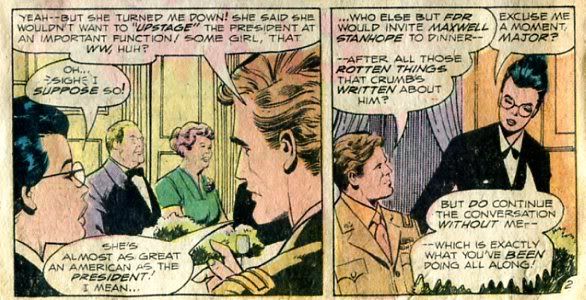
— Early in the issue, Steve Trevor is gushing on and on about Wonder Woman. Diana Prince is clearly quite pissed about this; she’s jealous of her alter ego. Thus, there’s a definite implication that Diana *wants* to get rid of WW, just as Priscilla wants to get rid of the Cheetah.
— There’s an erotic tension between the female antagonists. Priscilla’s repressed emotions are released whenever she sees Wonder Woman; it’s not hard to read a lesbian subtext into that. Moreover, the hypnotic encounter between Priscilla and Diana is framed as seduction; Priscilla even comments (lasciviously?) on how “naive” Diana is.
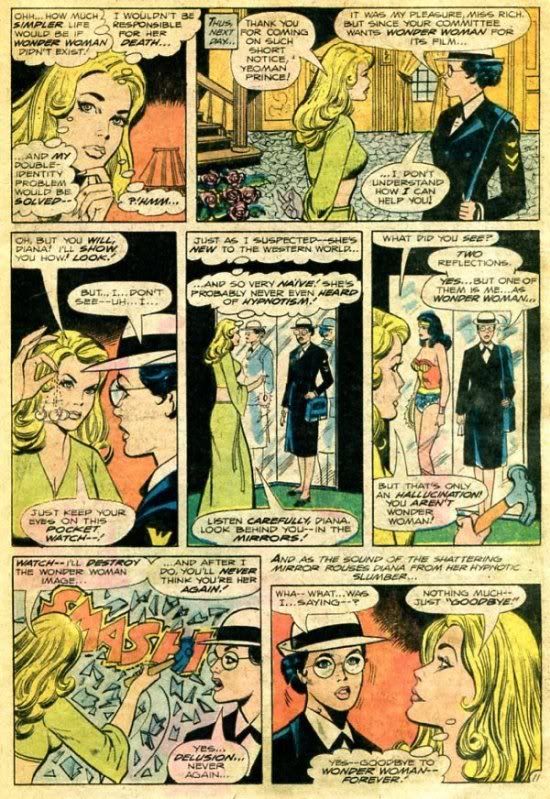
In breaking the mirror here, Priscilla is banishing both Wonder Woman and the Cheetah. Where agonized male-male tensions tend to lead to heroes hitting villains and hyperbolic violence, the female-female encounter/seduction does the reverse. It doesn’t redouble anxieties around female identity; it eliminates them. Priscilla is ushering Diana back into femininity. (I don’t think it’s a coincidence that in the last panel Diana’s face seems definitely softer and less butch than it does towards the top of the page.)
Priscilla can be seen, in other words, as patrolling the boundaries of femininity. This is actually a fairly common dynamic, I think; women are often harsher on (small) infractions against femininity than men are. My wife pointed out that Patti Smith in the 70s once commented that there’s nothing more disgusting than seeing some woman’s breast hanging over a guitar. The quote is interesting too, because, like this encounter, there’s definitely some not quite dealt with eroticism there; Smith is perceiving female guitarists as sexual beings; there’s a same-sex frisson. I haven’t quite worked this through, but it seems like there’s a parallel here with Eve Sedgwick’s ideas about male homosociality. That is, men form homosocial bonds (and repress explicit homosexual ones) as a way of cementing patriarchal power. Women might be seen as forming homosocial bonds (and repressing explicit homosexual ones) as a way of policing or reaffirming femininity — which again essentially has the effect of cementing patriarchal power. That seems like a good description of what Priscilla is doing here, certainly — she seduces/explains the error of her ways to Diana in order to prevent Diana from becoming a superdick, and so leading Priscilla herself into superdickery.
On the one hand this ends up being a false consciousness argument (women reinforcing the patriarchal order out of a mistaken fear of their own power/acceptance of their natural role.) On the other hand, it might also be seen as a not unrational risk assessment. Priscilla is worried that Wonder Woman’s escape from femininity will bring reprisals against Priscilla herself (she’ll become the cheetah, get herself in trouble, and end up being punished.) Similarly, Patti Smith, as a female rockstar, could be seen as covering her own ass — too many female rockstars might cause trouble.
I don’t know; not sure that that’s all thought through as well as I might like. But I think there is definitely a sense in which bonds between women are used to patrol femininity just as bonds between men are used to patrol masculinity. And the obsessively doubled relationship between Priscilla/Cheetah and Diana/Wonder Woman seems to get at that.
Though at the same time, of course, there’s a tradition of feminist sisterhood which is about confronting or challenging patriarchy. It’s interesting in that regard how, even though this is set in the 40s when the Marston /Peter stories took place, there are just a lot less women here than in Marston’s writing. The only woman who’s around is Priscilla, which is obviously an antagonistic relationship….
— Because WW has disappeared, Steve has to take her spot in a video. (The director comments “I’d rather shoot a war hero than some broad in a silly get-up anyway!”) The Cheetah has booby-trapped the camera, though. Priscilla doesn’t want to kill anyone…so she figures she has to remind Diana of who she was. She leads Diana off to the side (which looks again very much like femme/butch seduction)
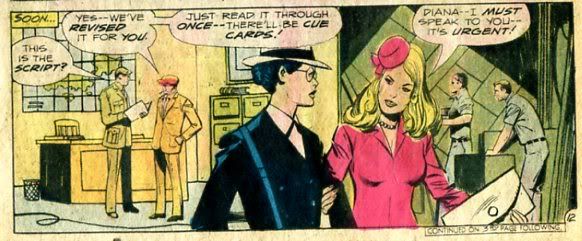
and this time the female/female encounter brings WW and the Cheetah both back.
Because we see this entirely from Priscilla’s perspective, though, this comes across more as sad necessity than triumphant victory. The return of female superpowers may be necessary, but it’s not ideal or normal. And, moreover, it really does result in bad news for Priscilla; she gets beaten up, captured, and sent off to Paradise Island for reeducation (where presumably she’ll be reintegrated back into femininity.)
—Soon after WW reappears we get this panel:
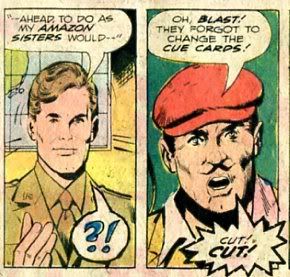
The reappearance of WW seems to humorously undermine Steve’s maleness. When a woman wields the superdick, men are less male. Not only can’t Steve take WW’s place, but even in wanting to he becomes ridiculous; less of a man.
— The comic ends with WW back in Diana Prince identity, talking to Steve. Steve is worrying about the possibility of WW disappearing again — and Diana suggests that if WW does disappear Steve should spend more time looking for her. There’s certainly a hint here that Diana would like WW to go away— she wants Steve to recognize, or respond, to Diana instead. Like Priscilla, Diana seems to in part want to lose her super-powers and her super-identity.
This isn’t that unusual a trope — as I mentioned in the last post, Spider-Man often wants to lost his powers, as does Bruce Banner, and so forth. The difference here is, perhaps, that when Diana is just Diana, there’s no indication that she wants to be anything else. She doesn’t wish she had her powers back, or think about WW. Instead, Priscilla has to remind her who she was. When Peter Parker, or whoever, is depowered, his identity remains incoherent; he still wants the superdick. But for Diana, the only tension is when she’s Wonder Woman. A feminized Diana, sans superdick, is perfectly happy — just as, presumably, a Priscilla without the Cheetah would be perfectly happy. There isn’t the attraction/repulsion for patriarchal authority that you tend to feel in male super-hero narratives. Instead, the energy of the story seems to push pretty firmly towards just turning superfemales into ordinary women and being done with it. Of course, it can’t end up there because, you know, Wonder Woman’s name is on the cover of the comic, and you need more stories with her. But that isn’t Marty Pasko’s fault. He didn’t create the character.
And next time we’ll talk about the guy who did create the character and how he felt about superdickery. Hopefully we’ll get to that next week.
In the meantime…this is actually part of a long series of posts on latter-day Wonder Woman iterations. You can read the whole series here.
A couple of weeks ago I posted a series of discussions about the way in which super-hero comics tend to be structured around homosocial desire and the closet. You can read the whole series here.
Just to resummarize quickly: the basic argument is that a character like Superman is a male power fantasy. That fits in with Freud and the Oedipal conflict. Clark Kent can be seen as the “child” who imagines himself supplanting the Father/lawgiver/god. You can also take this one step away from Freud and argue (via the theories of Eve Sedgwick) that what we’re talking about here is not, or not solely, an internal psychological desire, but rather a cultural/social formulation. Men turn away from femininity in order to identify with patriarchal power; or, to see it another way, to be patriarchal requires the denigration or hiding of weakness. That’s the closet; Clark Kent is living a lie, pretending to be powerful in order to be powerful, when his truth is actually a weak, wimpy child. And, again, the closet is powered by male-male desires and fantasies, making it homoerotic (though, as I argue at some length, it’s actually a straight person’s homoerotic fantasy — we’re talking about how straight men bond or interact with the patriarchy in particular, and arguing that that interaction is structured by ideas about, and within, gayness.)
Okay, so that’s basically where we left things. In the last few posts, I was mostly interested in pointing out similarities in the way this basic blueprint was used across different kinds of comics, from Superman and Batman through Spider-Man and Hulk and on to the work of folks like Chris Ware and Dave Sim. But, of course, there are differences too from case to case, and it’s interesting to look at some of those, and how they work.
So first, I’ve been thinking a little about the differences between some of the early heroes of the 30s and 40s and the later iconic Marvel heroes. Generally, I think, the argument is that Marvel heroes were different because they were more realistic; they faced everyday problems, made mistakes and so forth.
I wonder how true that is exactly, though. The fact is, none of the Marvel characters are all that realistic. Peter has girl troubles, sure, and he gets bullied — but Clark Kent had girl troubles, and he got bullied too. And Peter’s a genius inventor. And he’s drawn to look like he’s 40 even though he’s only like — what? 16?
Anyway, the point is, I don’t think the change had all that much to do with verisimilitude. We’re still in the world of preposterous fantasy, after all, with cosmic rays and gamma rays and super strength and defeating your enemies by punching them in the face. The difference, it seems to me, has more to do with anxiety. The Oedipal split is always somewhat agonized and anxious; the superfather for Freud is also the super-castrating ogre. And in those early Superman stories, Clark is despised and castrated; there’s a definite feeling of loathing.
However, the loathing is in these directed mostly towards the castrated, not the castrator. The problem, the thing to be ridiculed, is powerlessness, not power.
Over time, though, the faith in that image of absolute power started to waver. In the 50s and 60s there was a lot of more-or-less playful experimentation with the idea of superman as evil father. Thus, the aptly (and Freudianly) named Superman is a Dick website.
Here’s a particularly apropos picture:
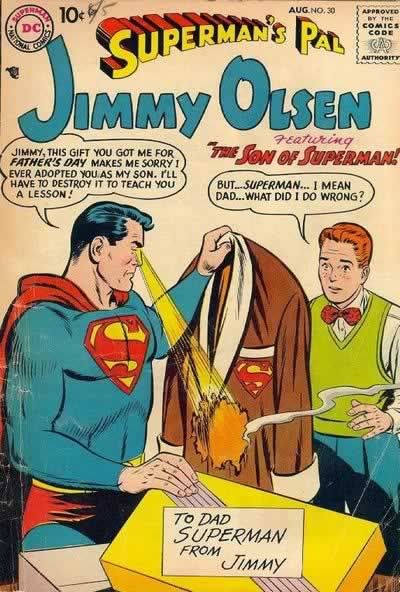
I don’t know that I can really add anything to that.
Of course, the stories here always resolved by showing that Superman was acting for everyone’s good; he may have looked like the evil father, but he’s still really the good father; patriarchy is still to be trusted, power is still great, and all the boys still want that super dick.
Marvel’s innovation was not that it gave us stories that were different in kind from Superman’s kid, Jimmy Olsen. Rather, the difference was that it was able to take exactly this story and treat it as tragedy rather than farce. The problems most Marvel super-heroes face is precisely that of the superdick. That is, they aren’t beset by normal, everyday problems — they’re beset by the Thing — the monster phallus itself. Peter Parker’s mega-problems (the death of his uncle in particular) stem from being Spider-Man; which is why, when he loses his powers, he’s acutely relieved. The early Marvel comics loved to portray super-powers as a crippling curse, a disaster. The Hulk is maybe the purest example; the uber-masculine ogre who hates and wants to destroy his weaker self. You couldn’t really come up with a more lurid Oedipal castration fantasy.
The Marvel stories, then, are about mistrust of patriarchal authority; they insistently question whether the great gay bargain — exchanging individual weakness for patriarchal strength at the cost of always hiding your weakness — is really worth it. In this, they’re not unlike exploitation films, which are from roughly the same time period and which were also obsessed, in various ways, with authority and changing ideas about masculinity and femininity.
But where exploitation films could, and did, revel in the perverse pleasures of fucking with authority, Marvel comics never (for various reasons) went there. As with Superman as Superdick, the stories always ultimately ended up affirming the worth of power as power. Peter Parker is relieved to lose his powers…but then his Aunt and girlfriend are captured, and he realizes how much he Needs to Be a Man and grasp the superdick in order to save them. And even though he’s an ogre, The Hulk, somehow, always ends up being a force for good (and eventually became childlike himself, neatly undercutting the evil-ogre-father aspect of the character, which was much more prominent in the first issues.) Moreover, Stan was hardly above indulging in some Superman style superdickery himself; Professor X and other father figures are always running the X-Men through this or that idiotic test for their own good. “Yes, my X-Men, I gutted Ice Man and used his bloody remains to lubricate the gears of my Cerebro computer, then let you think he was dead for weeks. But! The experience has made you stronger as a team! And Cerebro is working really well now! And besides, before I brutally murdered him, I created a perfect robot duplicate, whose powers work better and who doesn’t engage in annoying pranks. Say hello to you new teammate: Ice-Bot!”
Having just written that super-hero parody, I have to say…it’s interesting how much super-hero parody revolves around superdickery. Chris Ware’s Superman, for example, is essentially a brutal sadist destroying everyone who contradicts him; Johnny Ryan has a superman/god character who works in a similar way. And then there’s Kate Beaton’s bad-ass Wonder Woman. And a lot of the humor in Mini-Marvels is based on the kid heroes behaving like megaomaniacal uber-fathers (Reed Richards cheerfully sending the Hulk off into space for example.) And, of course, that’s the whole point of Marvel Zombies too, with the heroes turned into evil ogres and at last wholeheartedly embracing their inner superdickery.
In fact, the genius of the early Marvel comics is not that they undercut (as it were) the superdick, but rather that they reconsecrate it by more fully acknowledging its dickishness. Males (and especially adolescent males, the ones reading these comics) are always ambivalent about sadism and patriarchal power, both because the sadism and patriarchal power is likely as not to be directed against them (“go to your room!” go off to war!”) and because, you know, who wants to be always about to become the ogre raping and murdering their own loved ones? That very guilt and fear, however, function as a lever and a spur. Peter Parker kills his father….and his life is thereafter defined by the guilt that demands he himself become a monster/father to take Uncle Ben’s place. The Hulk, in his later incarnations, is not just the destructive phallus, but the wounded child as destructive phallus; the fantasy, both terrifying and fascinating, is to become the ogre-father while still an infant, eternally both torturing oneself and satisfyingly wreaking instant vengeance, on oneself and others, for the torture. Marvel figured out that you don’t need to deny the anxiety and guilt attendant upon the power fantasy; rather, you can harness them to make the green monster grow.
So a couple more comments about this.
— I think that, as others have pointed out, power fantasies (or superdickery) is really central to the super-hero genre. And I think that what that means in part is that the super-hero genre is — not always, or everywhere, but quite centrally nonetheless — sadistic. It’s about identifying with power — either for good, or for ill. It’s about being the beneficent god or the evil ogre father, or both at once. To the extent that you do identify with weakness, it’s generally as a prelude to releasing your inner hulk, or going out to websling, or whatever.
—This is a big part of why superheroics and horror (as opposed to goth) don’t mix especially well. You can certainly have gore in something like Blackest Night, because gore and violence fit perfectly well with sadism; you can be the ravening ogre father chomping on bones, hooray! And, yes, sadism does have a place in horror too — thus torture-porn — and to that extent it does make some sense to think of Blackest Night or Marvel Zombies as some kind of horror crossover. But the central mode of horror really is not sadism; it’s masochism. It’s about being the devoured child, not the devouring father — in horror, while you may cheer for the ogre at various points, you never actually are the ogre; you’re the victim, which is where the fear comes from. The whole point of Shivers or the Thing or the Living Dead movies is that the characters are consumed; they are destroyed, and then eaten up or filled up by the Other (which is pretty explicitly the phallus, in Shivers and the Thing, especially.)
But super-hero comics never do that; even when the super-heroes are evil, they have a recognizable personality, and are the stars with which you (more or less) identify. The two genres, super-heroes and horror, are simply diametrically opposed; they are committed to opposite goals. Super-hero comics are fun because they empower; horror is fun because it disempowers. You can’t do both at once. (Alan Moore’s Swamp Thing is an exception that tests the rule, perhaps…I found the Swamp Thing vampire story at least fairly scary. But Moore accomplished that by keeping Swamp Thing himself off screen for most of the story while various civilians are terrorized and slaughtered. When Swamp Thing did show up to do battle with a giant frog/lizard/vampire thing, the horror quickly dissipated.)
—Masochism is central to the way that exploitation films, such as horror, express their distrust of the status quo. Not that horror films are actually revolutionary, per se, or that I Spit on Your Grave is going to overthrow the patriarchy or anything. But, effectual or not, a film like Last House on the Left really expresses a visceral distaste for patriarchal authority. It sneers at good dads and bad dads alike, and at the war they perpetrated, and at the whole concept of justice and truth. And again, it does this through masochism — through identifying with victims and getting pleasure/excitement/terror through fantasies of disempowerment rather than through fantasies of empowerment.
Super-hero comics on the other hand, have a lot of trouble making that kind of perverse identification with the disempowered. This is the case even with parodies like Marvel Zombies or Ted Rall’s Fantabulaman or even Chris Ware’s Superman/Jimmy Corrigan strips, where there’s generally a kind of contempt for Jimmy’s weakness which echoes the distaste for Clark Kent or Peter Parker. In all these parodies, the focus is largely on the evil father doing the ogrish evil; the victims are much less personified or even visualized. Even if you have your tongue in your cheek while admiring the superdick, you’re still kind of admiring the superdick.
Grant Morrison’s mainstream work provides an even clearer example. In his Justice League and X-Men runs, he often has his villains launch fairly damning critiques of the heroes as egotistical, self-satisfied, godlike assholes. But then he always kind of takes it back; the heroes waltz on and show that they’re noble and good and they save the world and you’re supposed to be all enthusiastic, I guess. Obviously, Morrison identifies with the critique to some extent, but there isn’t any way in a super-hero comic to let it have the last word, or to have it be the point (as it is, to some extent at least, in the Invisibles.)
Another example is Greg Rucka’s Hiketeia. Rucka puts a certain amount of effort into making the story masochistic. The cover features Wonder Woman stepping on Batman’s head, and the plot is a rape-revenge, in which a young girl slaughters her sister’s killers, taking the knife to patriarchal notions of justice and fairness. Men get beat down by storng women. However…in the first place, this is a Wonder Woman comic, and a lot of the emotional oomph comes from watching her beat the tar out of Batman — you identify with her, which is sadistic rather than masochistic. Secondly, the story ends up being not about the girl and her revenge at all, but instead about the tragic rift that the girl’s rape-revenge creates between Wonder Woman and Batman; a rift the girl, rather inexplicably, sacrifices herself to heal. It’s like she hears all the genre rules yelling at her that she’s supposed to be the one getting castrated, not doing the castrating, and she finally acquiesces — perhaps just because she can’t stand being written by Greg Rucka any longer.
Again, Watchmen is perhaps an exception of sorts here, where the role of all-powerful father is both questioned and in various ways deflated. But it took Moore a number of false starts before he got there (Miracleman and V for Vendetta try to mount an anti-establishment critique via super-hero, but ultimately, I’d argue, end up defeated by the genre conventions.)
The point here isn’t that stories supporting status quo are necessarily bad. Dark Knight is pretty unabashed in its worship of the superdick, and it’s great. And, as the Dark Knight kind of suggests, the status quo has numerous benefits (stable currency and revolutionaries not stringing up me and mine from flagpoles = good.) It is interesting, though, the extent to which the superhero genre’s bias towards and fascination with the superdick makes it difficult for authors to tell certain kinds of stories (horror, anti-status-quo) even when they’re clearly trying to do so.
_______________________
Well, that was about twice as long as I thought it would be. I still want to discuss the question of whether Wonder Woman can be the superdick…but I think we’ll have to leave that for another day.
