Men, Women, and Virgins

Much of the discussion around the recent murders at Santa Barbara has centered around the fact that the killer, Elliot Rodger, was a virgin, and wrote a manifesto in which he linked his rage and violence to the fact that he had not had sex. Some media outlets have labeled him as the “virgin killer”, and others have talked about how virginity weighs on men.

As somebody who was a virgin into my late 20s, I agree that virginity can be painful for men. But I think it’s important to realize that it doesn’t just weigh on men. The idea that men, in particular, are diminished when they are virgins, or that men, in particular, are sad and lonely in their teen years, risks falling into Rodger’s warped view of the world, in which women are only important, or only thought of, in relation to male desires — as sexual objects who satisfy men or make men miserable, but don’t have any desires or problems themselves.

The truth is, there are many women, just like there are many men, who are virgins into their late teens and beyond. One of them was my friend, Megan (a pseudonym). She and I talked last week about virginity, gender, and miosygny.

Noah: So, I guess I thought I’d start by asking you why you don’t like the term “virgin”?
 
Megan: It’s just horribly binaristic. Women are this and men are that, women’s bodies do this and men’s bodies do that. What does “virgin” MEAN, anyway? One who has never had vaginal sex? That’s the common definition. But there are plenty of situations in which a person could be sexually active, sexually FULFILLED even, without vaginal sex being involved.

Basically, I feel like I “lost my virginity” 5 years before I started having vaginal sex.

At about 13-14 years old, I reacted to my first understanding of misogyny, and what it does, and how I didn’t do a fucking thing to deserve it, by thinking that I could slip the noose if I just distanced myself from femininity, as far as I possibly could. I think a lot of girls do that. Some women keep doing it their whole lives. I just tried as hard as I could not to be perceived as female. I remember something that happened when I was about 16–I made a comment about a guy, somebody I thought was cute, and a male friend of mine who was a couple years older was just horrified at the idea that I actually had a sexuality. So I guess I did a pretty good job going full tomboy. The end result was, I didn’t fuck anybody as a teenager, or in college. I went on a couple of dates. I let a guy see my tits once. He didn’t really like me that much.

Then, when I was 22, I went to get my first pap smear, and found out that I had a hymen that was basically made out of Teflon, and would have to be removed surgically, under general anesthesia, if I ever wanted to have vaginal sex.

So it was just as well I’d always been uncomfortable with my femininity and clueless about how to interest guys sexually.

I went ahead and had the surgery, when I was 22, but then–this sounds so stupid–it took me five whole years to actually figure out how vaginal sex worked. How to get it in, you know? I just had no experimentation period whatsoever before that point. I could never even wear a tampon.

So, the way I feel about it is, I stopped being a virgin when I was 22, pre-surgery, and had an orgasm for the first time with somebody else in the room. That’s basically my working definition of virginity. But if that’s the definition, then virgin birth is actually really common.

I mean, obviously we need words to explain our sexual history to each other. But I think “I have no sexual experience” or “I’ve done X but not Y” are perfectly good replacements for “I’m a virgin.”
 
Noah: Talking about how you feel that the term “virgin” doesn’t fit your experience reminds me of my own struggles with terminology around being a virgin. Specifically, through college, and into my 20s, I would wonder, somewhat idly, if I really counted as heterosexual, or if the term fit. I wasn’t having sex with anyone, it didn’t feel like I was every going to have sex with anyone, did I count as heterosexual? Obviously you look back and say, well that’s ridiculous, but I think it gets at the way that labels, and narratives about how identity works or what you should be can produce lots of anxieties in lots of different ways when you don’t fit into the mold the way you’re supposed to.

I was curious about that too, from your perspective. I’ve talked a bit in my pieces about this about how a lot of anxiety around being a virgin, for me, was less some sort of physical or emotional need per se and more about feeling like I just wasn’t doing things right, like I wasn’t being a man correctly. And I suspect that’s why it’s hard for guys to acknowledge often in these conversations that female virgins even exist. or that girls can’t have sex anytime they want, automatically. Failing to have sex in the right way seems like it’s so tied up with not being a man in the right way, so then, girls don’t have to be men, so how could they have a problem here?

I guess I’m curious what pressures you felt in terms of having sex. It seems sort of complicated, since you were saying that at least for a while you were actively trying to not be a girl by not being sexual, or by being a tomboy. Was there some point where that stopped and you felt like you weren’t performing femininity correctly? Or were you anxious or depressed about not having sex until your twenties?
 
Megan: Oh God, yeah, so anxious and depressed!

The whole thing about being a tomboy was that maybe it helped me avoid the gaze of some sexual predators in high school–I know they were there, they preyed on my friends–but I was still (mostly) heterosexual, and I wanted male attention, and femininity was all guys seemed to look at. I was invisible, for better or worse.

But I wasn’t completely invisible. There were a couple of guys who did look at me. They weren’t the guys I wanted. I think that’s the case with almost everybody, even the UCSB shooter–there’s probably someone in the world who’ll fuck you. You might not see them, for whatever reason. They might not be up to your standards. You might have completely unrealistic standards, like most misogynists do.

The unrealistic standards that the PUAHate crowd think women hold men to are nothing in comparison to the stringency of their own fantasy standards for women.

It occurs to me that the PUAHate crowd are projecting their own hatred of femininity onto women, by assuming that hypermasculinity is the only thing women desire. They have no idea what women want. How could they know? They can’t even hear us when we talk.

I never wanted an alpha male. I never wanted money or a nice car or great big biceps. I like smart guys who wear glasses and care about art and can make me laugh.

Noah: Ha! I don’t think that’s especially unusual.

I think for me at least it wasn’t just about the wrong standards. There was a woman or two maybe who was interested in me who I wasn’t interested in, but there were also a number of women who were interested, who I thought were attractive and would have been happy to date.

But I just couldn’t figure out the cues. Like, not with great frequency or anything, but a few times, a woman would ask me out, and we’d go out, and we’d have a good time…and that would be the end of it more or less because I was too shy to try to kiss them when I didn’t have any idea what I was doing. You sort of talk about this a little, but at some point the actual physical mechanics, and not knowing how they work, becomes this huge barrier. Which I think has a lot to do with the expectation (self-expectation as much as anything) that you’re supposed to know what you’re doing, and the fear that you don’t and will somehow make a fool of yourself if you give it a try and it doesn’t work.

So was there something of a double bind for you? You felt that if you were feminine, you’d end up getting stalked and treated as a sexual object only, but when you presented as a tomboy you became asexual and unwanted?
 
Megan: The double bind is a good phrase… I feel like that’s the essential state of being female within patriarchy, you’re always in a double bind.
 
Noah: Julia Serano in Excluded talks about double binds as the basic way that all prejudice works; you get marked as other, and then no matter what you do, you’re wrong because you’re marked. If you have sex you’re a slut, if you don’t have sex you’re broken or wrong.

I think for men it’s not really a double bind; more a measure against an impossible standard, where you always fail to one extent or another. Less about losing whatever you choose, and more anxiety about hierarchy.
 
Megan: I think women get a little more leeway in the “knowing what you’re doing” area… We’re allowed, culturally, to let men take the lead, sexually. But that was a moot point when I was invisible.

I don’t know if this is relevant to anything… The first experience I had with a guy who did look at me went pretty badly wrong. It didn’t amount to sexual assault, but he just kept touching me in ways I didn’t want. Even when I bluntly told him I didn’t want them. I wound up fending him off with a chair. He left me alone after that. This was when I was about 15.

He presented as a male feminist. Sometimes he wore skirts. He was Different From The Other Guys. Except not where it really mattered.
 
Noah: Christ. I think it’s really relevant to a discussion of virginity to think about the fact that for a not insignificant number of women especially, a first sexual experience is of some form of sexual assault. That can happen to guys too, but it seems much less frequent. I could be wrong, but my sense is that guys who are virgins can feel completely desexed and unsexual in a way that doesn’t tend to happen to women in the same way. But the flip side of that of course is that women are never quite desexualized in that way because they’re always objectified and seen as fair game for sexual violence.

I don’t know. Does that ring true to you?
 
Megan: I think there may be women who feel that way, desexed and unsexual, because they can’t get laid… But I may not be understanding you correctly.

I remember having a vague desire during my tomboy phase to have breast reduction surgery, not just because being a D-cup interfered with the way I presented, visually, or because of male reactions to my breasts, but because they didn’t feel appropriate to the state of my soul, in some way. I felt like I was meant to be an A-cup.

I also remember having a feeling that I was going to rot, curdle, go wrong inside, if I stayed a virgin. I wrote bad teenage poems about it.
 
Noah: The breast reduction surgery for the state of your soul kind of fits with what I was saying, maybe, though I probably went too far in talking about internal states — I’m sure as you say women can feel desexed too. I think it’s true though that femininity is seen as inherently sexual, so it makes sense that people’s reactions to being desexed, or feelings about being desexed, would be affected by their relationship to gender. Which sounds like what you’re talking about; feeling desexed and so wanting to be less stereotypically feminine physically as well.
 
Megan: Yeah, I guess you could look at that as an indication that the female body is always coded as sexual. Therefore, if I felt desexed, I needed to change my body. Did you ever feel a disconnect between the state of your body and the state of your sexuality?

Noah: That’s a good question. I think the answer is basically “no.” I wasn’t having any sex, and I felt like my body was awkward and hopeless and undesirable, so everything was as it should be, in that sense.

There was this one instance where there was a party (I never went to parties; this one was unavoidable for logistical reasons I won’t go into) and our very drunk female swim team assistant coach looked up at me and said, “you have really nice legs, Noah!” I was completely at a loss; being a sexual object was more or less utterly at variance with my self-image, so I just sort of ignored her. I don’t think she’d ever spoken a full sentence to me before, and I didn’t put myself in a position where she could later.

I’d imagine that that sort of drive by sexual objectification happens to women more frequently, and often in ways that are considerably less pleasant. Not that it was unpleasant; it was just odd, for me. Lord knows what I would have done if anyone ever actually tried to hit on me.
 
Megan: Oh man, yeah, I’m just thinking about that scene with the genders reversed. I think a lot of women would find a way to flee the scene as soon as possible if a male acquaintance they weren’t interested in suddenly complimented their legs while very drunk.
 
Noah: Right; she was older too; in her early 20s and I was a sophomore I think.
 
Megan: It might be useful contextual information for this whole thing that I grew up in a fairly liberated, feminist household. My father never made me feel less-than because I was a girl, not even once. I had a pretty crappy relationship with my mother but she was openly feminist and did manage to inculcate me with a lot of her values. When I was about 12 I even read through her copy of Our Bodies, Our Selves when she wasn’t around. I had plenty of information; I just never knew why the heck I couldn’t insert a tampon.

If nothing else, it illustrates that even openly feminist parents have a really hard time preventing internalized misogyny from developing in their daughters

Noah: In their sons too, I’d imagine.

I was wondering if you were at all affected by the idea of female virginity as valuable? There is some cultural weight there, and it seems like it could provide some sort of counterbalance to the feelings of worthlessness you talk about, but it doesn’t sound like it did?
 
Meagan: Re: female virginity and value: I never really felt that. I think, being raised feminist, I associated those ideas with the repressive olden days when my whole worth and function was as a vessel for some man’s heirs. It seemed pre-suffrage, pre-modern and I felt like I was beyond that. I definitely didn’t feel like there was any special allure or cachet in my being a virgin at 22.
 
Noah: What do you think about discussions of virginity related to the shooting?
 
Megan: I haven’t read very many. What I have read has been partly focused on male nerd culture. The thing about that culture is that a lot of people within it absolutely refuse to understand that there is such a thing as female nerd culture: “There are no girl gamers.” “Girls don’t read comic books.” They can’t imagine a woman who’s had experiences similar to theirs–rejection, persecution, humiliation. They can’t imagine empathizing with a woman. But every single one of my teen girl friends had a deep internalized sense of rejection, which they got from teen boys. Teen boys are vicious to the girls they don’t want.

That’s not exactly an answer to your question, sorry.
 
Noah: No; I think it’s an answer! You’re saying that virginity can be linked to male nerd culture in a way that excludes women, or that suggests that women can’t experience pain or sadness. So erasing female virginity becomes a way to erase women’s humanity.
 

Utilitarian Review 5/31/14

News

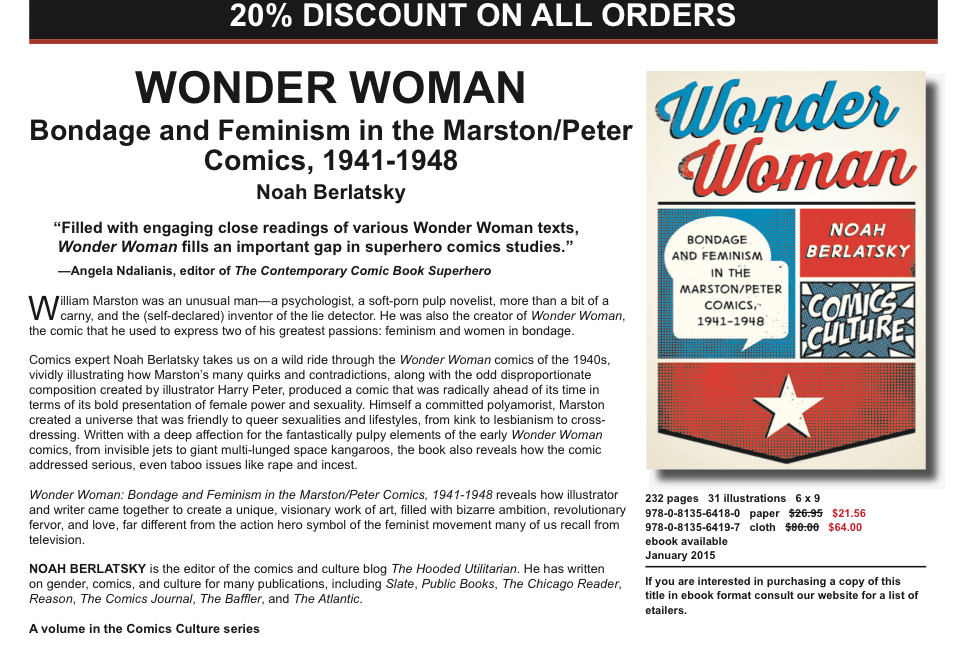
You can preorder my Wonder Woman book for 20% off! Bondage, cross-dressing, pink ectoplasmic goo…what are you waiting for?

On HU

Featured Archive Post: Subdee on Saint Young Men, hipster Jeuss and hipster Buddha.

Joy Putney on the Wicked Witch of the West as superhero.

Tyler Wenger on Superman and Christ.

R.M. Rhodes on Vasari, Kandinsky, narrative art and comics.

Isaac Butler on Laurie Anderson’s “O Superman” and 9/11.

Robert Stanley Martin has an exhaustive history of Steve Gerber’s struggles with Marvel over legal control of Howard the Duck. You can find documents relating to the post here.

Qiana Whitted on Joel Christian Gill’s Strange Fruit and the representation of racist speech in comics.

Chris Gavaler on poet Tim Seibles, Blade, and race.
 
Utilitarians Everywhere

At the Atlantic I had a post about the Elliot Rodger shootings and building masculinity on misogyny.

I was interviewed about the essay on HuffPost Live and also on Take Two.

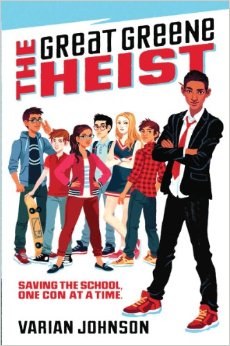
Also at the Atlantic I wrote about the Great Greene Heist and how we need more diverse mediocre children’s books as well as more diverse great ones.

At Salon I have a list to prove that 2000s R&B was the greatest music ever.

At Splice Today I wrote about:

— how the Orange is the New Black TV show jettisons the memoir’s political commitment for cheap thrills.

the cover of the Great Green Heist and seeing and not seeing race.

At the Chicago Reader

— I preview the CAKE Chicago Comics Expo, which is happening right now as you read this.

— I have a brief review of orchestral indie folksters Mother Falcon.
 
Other Links

Mary McCarthy on living out her stripper fantasies, very briefly.

Amanda Hess on how misogyny is bad for everyone.

Eloise James on the stigma against romance novels.

Jonathan Bernstein on why ideological political parties are a bad thing.
 

51sg34bMlCL._SY344_BO1,204,203,200_

Superman Will Seduce You to The Good

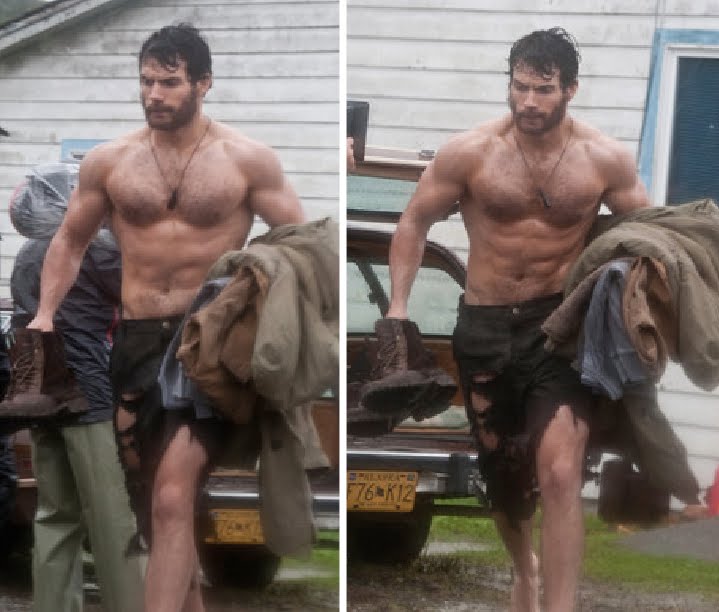
henry-cavill-superman-shirtless-1

 
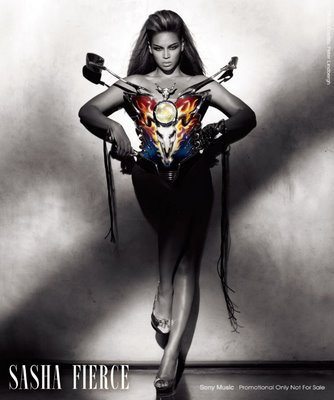
Sex and violence go together. Working fist in caress, they can help boost a film from PG to PG-13 and on up into R. They’re both adult, both corrupting, both potentially dangerous. That’s why it made sense when bell hooks looked at a Time cover with Beyoncé in her underwear and declared, “I see a part of Beyoncé that is, in fact, anti-feminist—that is, a terrorist—especially in terms of the impact on young girls.” Beyoncé’s sexuality is violent and damaging; it hurts people, especially young people. Sex is a weapon.
 

beyoncegoathead

 
So sex and violence, in media, are commonly seen as continuous. But should they be? A little bit back I was talking with a class at Lakeland College about superheroes and violence. The teacher (and sometime HU writer) Peter Sattler, showed some clips from The Man of Steel, and asked the students to talk about the treatment of violence in the film. But the first reaction when the lights came up had a different focus. Taylor Levitt, one of the women in the class, pointed out that Henry Cavill was something special. “Wow,” Julie Bender, agreed, “I didn’t know Superman was so fine!”

Henry Cavill’s fineness is widely agreed on (students weren’t even shown jaw-dropping image of him wandering about with his shirt off.) But what’s interesting in this context is the extent to which that hotness is superfluous to, or off to one side of, the film’s violence.

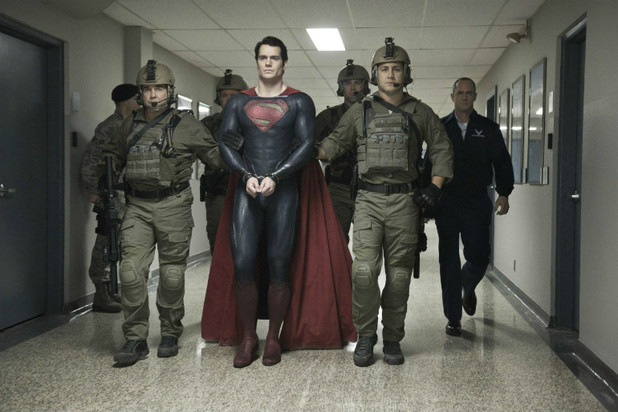
The genre pleasures of Man of Steel largely involve the usual action film devastation — things blowing up, cities being leveled, good guys hitting bad guys and vice versa. There is also, though, a line through the film about Superman restraining himself; gallantly refusing to use his powers, or refusing to fight back. And a lot of the energy, or investment in those scenes seems to come from Henry Cavill’s hotness; the pleasure of watching this perfect physique in spandex rendered all restrained and submissive. Superman even allows the authorities to put handcuffs on him, supposedly to reassure them, but perhaps actually for the pleasure of a clearly enjoyably flustered Lois Lane, acting as audience surrogate. You may go to the movie to see Superman commit hyperbolic acts of violence in the name of good. But you can also go, it seems like, to see Henry Cavill be sexily passive — to witness an erotic spectacle that is about seductive vulnerability, rather than destructive terror.
 

movies-man-of-steel-henry-cavill-handcuffs

 
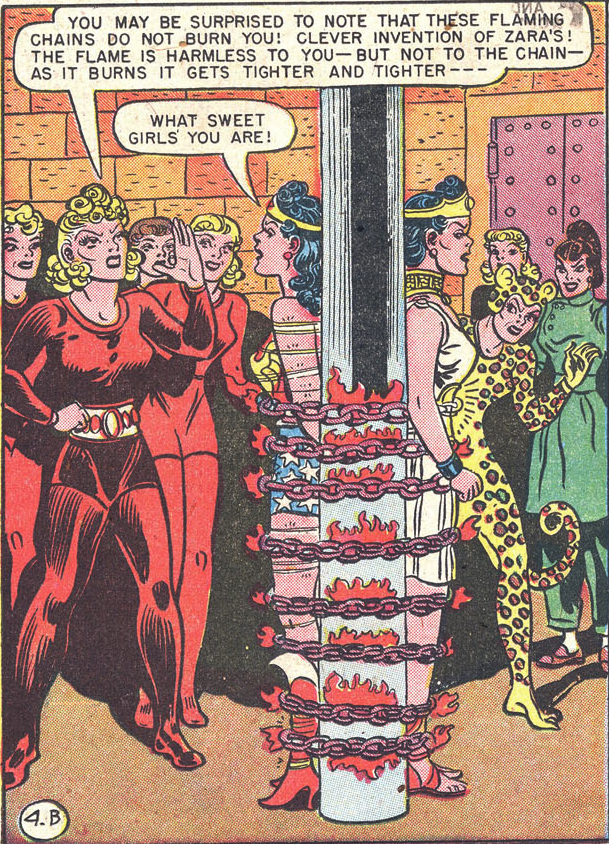
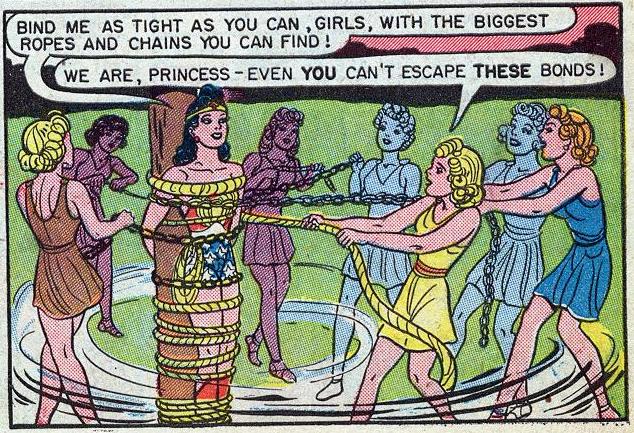
William Marston, the psychologist and feminist who created Wonder Woman, deliberately tried to exploit (in various senses) this tension between sex and violence. The original Wonder Woman comics are filled with images of Wonder Woman tied up elaborately with magic lassoes, gimp mask, and sometimes pink ectoplasmic goo. The point of all this, as Marston explained in a letter to his publisher, was to teach violent people the erotic benefits of submission

“This, my dear friend, is the one truly great contribution of my Wonder Woman strip to moral education of the young. The only hope for peace is to teach people who are full of pep and unbound force to enjoy being bound … Only when the control of self by others is more pleasant than the unbound assertion of self in human relationships can we hope for a stable, peaceful human society … Giving to others, being controlled by them, submitting to other people cannot possibly be enjoyable without a strong erotic element.”


wonder-woman-28-20-burning-chains


Marston believed women were better at erotic submission than men, and that therefore women needed to rule so that men could learn from them how to submit. In his psychological writings, Marston referred to the women who would erotically lead the world as “love leaders.” Love leaders would use their sexuality to seduce the world to goodness and peace — just as the soulful-eyed, bound Henry Cavill guides viewer’s thoughts away from the super-battle plot and towards gentler pastimes.

Of course, Marston was kind of a crank, and, in any event, it’s quite clear from Man of Steel that you can have eroticized submission and uber-violence both; you don’t have to choose one or the other. Still, you can choose one over the other if you want; it is possible, to use the erotic to undermine a narrative of violence. This is what happens in Twilight, for example — and it’s part of the reason that many people find the series’ ending so frustrating.

Stephenie Meyer wrote about super-powered vampires, and builds her series towards a climactic, brutal, all out battle. But the focus of Twilight is on the romantic relationship between Bella and Edward; on love, passion, and sex. As a result, Meyer doesn’t feel she needs to follow through on the genre promise of violence — the big all out battle never happens. The series has other interests, which makes a non-violent outcome possible. It’s not a coincident that Bella’s vampire power is literally to neutralize other violent powers, just as Marston hoped erotics could neutralize force. In Twilight, romance and conflict are set against each other, and romance wins. Sex trumps violence.
 

Vampire_bella_cullen

 
It’s tempting to conclude hyperbolically by calling Beyoncé a love leader whose command of the erotic will bring about world peace. But that’s no more convincing than calling her a terrorist. Sex isn’t going to save us anymore than it’s likely to doom us. Still, eroticism remains a powerful thing. It seems worth thinking about it not just as a danger, but as a resource — a way, at least, to imagine a world in which heroes don’t always end up hitting each other.
 

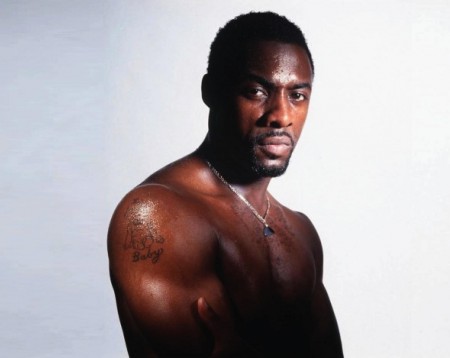
idris-elba-shirtless-163143647

You can keep your hammer, Thor.
 

Wonder Woman, Bondage, Feminism: All for 20% Off!

wwupanel4ww13

As many folks know, my book on feminism and bondage (and so much more) in the original Marston/Peter comics is coming out in early 2015 from Rutgers University Press. And this is your chance to get a discount on your preorder! Just call the number below and give them the code thingee down there. Or you can hop over to the website.

Still unsure? Wondering, is this for me, this Wonder Woman and bondage and feminism and cross-dressing villains and space kangaroos? Well, why not check out my multi-year effort to blog through every single issue of Wonder Woman. See eruptions of ectoplasmic bondage tentacles! See Seal Men and Mole Men saved by the love of a good woman! Revel in every variety of sorority spanking rituals! Wonder Woman will be implanted on your brain, and all of you (of every gender) will be more womanly and better for it.

So buy the book, damn it. Aphrodite commands you.

Oh, and if you do buy it, leave a comment and let me know if you feel like it. I remain uncertain that anyone will want to read the thing, so counter-evidence would be appreciated.
 

ww1

ww2

Utilitarian Review 5/24/14

On HU

Featured Archive Post: Nadim Damluji on imperialism and Mickey Mouse in Egypt.

Vom Marlowe with a Weiss Kreutz slash gender-swapping pregnancy fan fic for the gay utopia.

Hiba Ganta on femininism and Indian culture.

Isaac Butler on white peopel enslaved in Octavia Butler’s Fledgling.

Jones, One of the Jones Boys on Jack Kirby, touching, and the X-Men.

Me on wanting to be the one you’re with in 16 Candles and Nora Olsen’s Frenemy of the People.

Frank Bramlett looks at representations of Michael Sam in editorial cartoons.

Chris Gavaler on Tarzan and eugenics.
 
Utilitarians Everywhere

At the Atlantic I argue that critics of critics should be criticized.

At Splice Today I sneer at William Giraldi’s stupid article about 50 Shades of Grey.

At Salon I have a list of white covers of R&B before Elvis.

At the Chicago Reader I previewed a nice looking show of emerging artists in Chicago.
 
Other Links

Elias Leight on Nikki Lane, Sturgill Simpson, and contemporary country.

Ta-Nehisi Coates on the case for reparations.

Amanda Hess on 28 things that have been described as porn for women.

Professor Crunk on Beyonce and bell hooks.
 

images

I Want to Be a Boy for My Birthday

sixteen_candles_1984

 
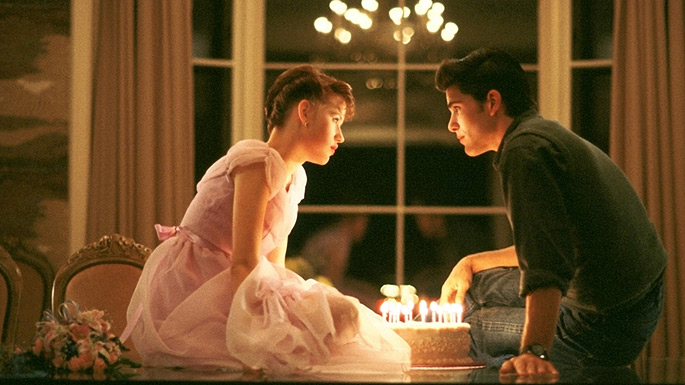
Sixteen Candles is thirty this year. It remains a beloved teen comedy; an iconic story of a young girl growing up to be a man.

All right, Sixteen Candles isn’t actually about a trans man, unfortunately; representations of trans people in media were even rarer two decades ago than they are now. But rewatching the film, it is surprising how obsessed this girl’s coming-of-age story is with manliness. Partly that has to do with the subplot involving the Geek (Anthony Michael Hall) as he tries to convince protagonist Samantha Baker (Molly Ringwald), or anyone, really, to have sex with him. His nerdishness and awkwardness is related repeatedly to a lack of manliness; Sam calls him a “total fag,” and he taunts his even geekier henchman by telling them “don’t be such faggots.” At one point, he even accidentally takes birth control pills, foisted on him by Caroline Mulford (Haviland Morris). He spits the pills out quickly, though…and soon thereafter, as if getting rid of those contaminating hormones is some sort of rite-of-passage, he finally manages his transition to not-womanly by having an unspecified but mutually satisfying intimate tryst with the seemingly way out of his league Caroline.

Like the Geek, Sam is trying to grow up — a process made no easier when her entire family forgets her birthday. Growing up for her doesn’t mean becoming a man, but getting one: in this case, the Robert-Pattinson-before-there-was-Robert-Pattinson hot, soulful Jake Ryan (Michael Schoeffling). Yet, getting the guy and being the guy are wrapped around each other in complicated ways. Sam (whose name is suggestively androgynous) is a sophomore; Jake’s a senior. Her eagerness to be older, then, is a wish to be like him, as well as a wish to be with him. Her desire isn’t just about romance, but about the desire to be acknowledged rather than erased — to get out of her beautiful sister’s shadow, and out from under the bleak school hierarchy. It’s not an accident that the film’s one glimpse of nudity is a scene in the girl’s bathroom in which Sam and her best friend stare at a topless Caroline in an excess of envy at her body and at her good fortune in dating Jake. The camera focuses first of all on her breasts before it pulls back; it’s an eroticized moment, in which the jealous sophomores’ desire to be Caroline (and so date Jake) is visually blurred with the desire to be with Caroline (and so essentially be Jake.)

Adulthood in Sixteen Candles, then, is in many ways coded as male — a patriarchal economy underlined by the viscious Asian stereotype of the quintessentially nerdy, iconically non-manly Long Duk Dong (Gedde Watanabe.) This link between adulthood and manliness isn’t a surprise; power in the 1980s, and still today, is generally coded as masculine. To grow up, to stop being a “fag” or (as one cruel upperclassman calls Sam) a “void”, is to grab hold of the male thing. Desire is not just about love, but about (male-coded) strength and substance and influence — thus the attraction of Bella to Edward, or of Anastasia to Christian Grey, or, for that matter, of Dorothea to Casaubon. Love isn’t just about wanting a man, but about wanting to be the man. Jake’s attractiveness , too, is not just his pretty face; it’s also his fancy cars and his place at the pinnacle of the school’s pecking order — and also the fact that he’s dating the desirable, visibly adult Caroline.

So romance is all about patriarchy? Well, not exactly. Or at least, the dynamic of wanting to grow up by loving and becoming the loved one isn’t restricted to heterosexual love stories. For example, it’s the basic premise of Nora Olsen’s wonderful lesbian YA novel, Frenemy of the People, out last week. At the start of the book, Lexie is the one out lesbian at the high school: she’s fiercely political, anti-bourgeois, and (in what I take as a deliberate Holden Caulfield wink) hates the smarminess and fakeness of her classmates. Clarissa, on the other hand, is a straight girl from a Conservative Christian family who rides horses and has tons of friends in the popular clique.

But then Clarissa suddenly figures out she’s bi (she has an epiphany where she realizes she likes pictures of Kimye as much for Kim as for Kanye) and she and Lexie begin a wary process of falling in love. That process isn’t just about learning to like one another; it’s also about becoming like one another — growing up both by loving and by turning into the loved one. At the end of the book, it’s the fierce Lexie who says, “It’s like Clarissa cracked me open, and all this tenderness spilled out of me that I didn’t even know I had” — and it’s the political Lexie who admits that “All I do now are bourgeois things, like horseback riding and lying around kissing my girlfriend.” Meanwhile, it’s the popular high school girl Clarissa who says that Lexie has “made me more fierce and brave,” and who gushes about the joys of property destruction. (“I can’t wait to do more things like that.”) The two girls have grown and found themselves — and the selves they’ve found are each other.

You could argue that the absence of patriarchal fantasies, not to mention the absence of stupid gay slurs and emasculated Asian stereotypes, makes Olsen’s coming-of-age story better than Sixteen Candles. And “Frenemy of the People” is in fact much superior to the film. Olsen’s a wittier and smarter writer than John Hughes, with a broader range of interests and sympathies than Hollywood formula can manage (the book tackles everything from the housing crisis to mental disability issues, all with an immaculately light touch.)

Nonetheless, I think reading Sixteen Candles through Frenemy actually makes me appreciate the film more, not less. Yes, the anxieties around masculinity are a bit off-putting. But at the same time, as Olsen shows, it’s natural for Sam to want to be Jake, because people, of whatever gender or orientation, often want to be, as well as to be with, their sweeties. If there’s some suggestion that she likes his status and his maturity — well, what’s wrong with loving someone because they have qualities you admire, and want for yourself? When you’re looking for it, you can even perhaps see Jake doing something similar himself — he gives an impassioned speech about wanting a serious girlfriend; he’s sick of partying. Growing up for him means putting aside the childish things that comprise being on top of that social hierarchy, and getting to be more like Sam, quiet and out of the spotlight. Maybe it’s Jake’s birthday too, there at the end of the film, and the gift he gets is to grow up to be the girl he loves.

Utilitarian Review 5/17/14

On HU

Featured Archive Post: Chris Gavaler’s students review Spider-Man 2.

Me on why it’s not morally wrong to send your kid to private school.

Ng Suat Tong on the subversive blandness and bland subversion of Ms. Marvel.

Sean Michael Robinson on Depeche Mode, Doré and the denigration of craft.

Sarah Shoker on the economics of fantasy and why nerds like stuff.

Roy T. Cook asks if Tong of the Fantastic Four is transgendered.

Kailyn Kent on why suggestions of lighting for wine are stupid.
 
Utilitarians Everywhere

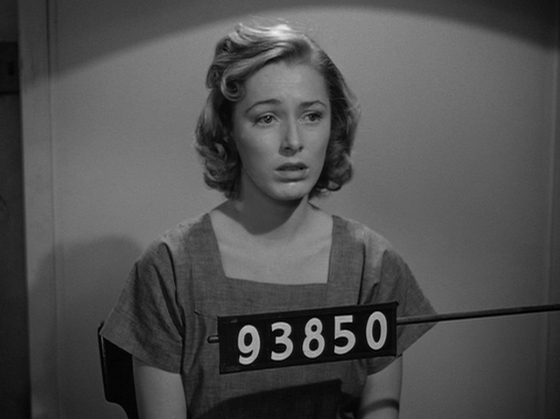
I contributed a piece to the Orange Is the New Black roundtable at Public Books, which really kicks the series satisfyingly. My piece is on the way that the series uses hoary lesbian tropes from the 1950 prison film Caged.

At the Chicago Reader I did a short review of Edie Fake’s wonderful Memory Palaces, which he’ll be reading from at Quimby’s tomorrow.

At the Atlantic I wrote about how Beyoncé critiques bell hooks.

At Salon I wrote about:

— the 12 greatest albumsof the 90s.

—how twitter has enabled sex worker speech.

—Comic Book Resources’ decision to revamp their comments in the light of sexist abuse.

At Splice Today I wrote about

Liberals for the Republican establishment

— why mainstream sites cover Game of Thrones even though no one watches it.

At the Dissolve I wrote about the mediocre documentary Next Year in Jerusalem, about nursing home patients visiting Israel.
 
Other Links

Rob Liefeld…what more can you say?

Dani Paradis on a camp for children to express whatever gender they want.

Jonathan Bernstein on why campaign finance reform isn’t worth the candle.

Linda Holmes on romance fiction and women’s health.
 

8f4b2bed-3a99-48b9-9ec6-3efe47958c2b