A Brief Post on Gender and Gun-Swords

I was playing Final Fantasy XIII recently, and I intended to write a straightforward review. Then I realized that was boring, so here’s a rambling essay instead…

The medium of video games encompass a broad range of entertainment, including puzzle games, racing games, musical performance simulators, and shooters. The latter category dominates American gaming in sales and typically boasts the most cutting-edge graphics.

Shooters are designed to appeal to a specific audience with fairly narrow tastes. That audience is heterosexual men between the ages of 14 and 35, the same audience that goes to see every summer action movie and (in much smaller numbers) buys every superhero comic. This audience, of which I’m a part, seems to enjoy stories about rugged men doing violent things. Video game heroes are quite similar to the heroes found in most action movies: muscular, laconic, and packing enough firepower to wipe out a small country. Given these characteristics, it’s no surprise that many of these heroes are soldiers.
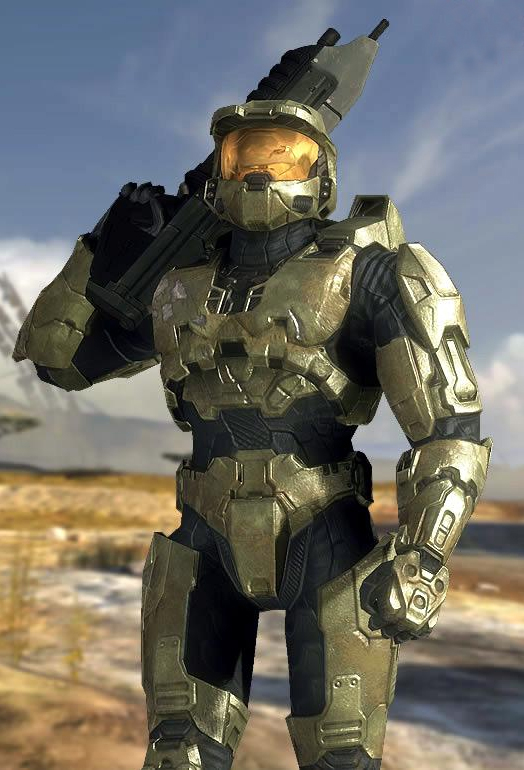
Master Chief of the Halo franchise
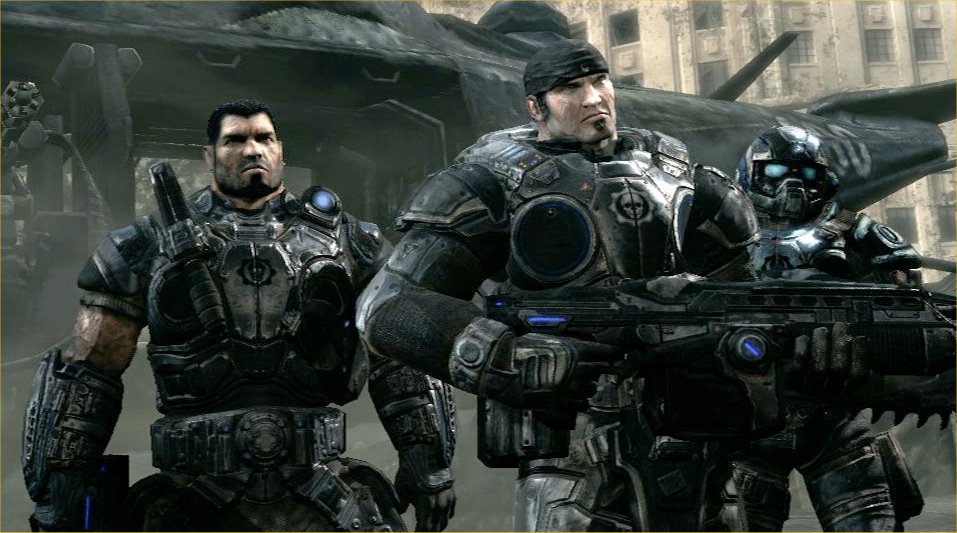
Dominic Santiago and Marcus Fenix from Gears of War
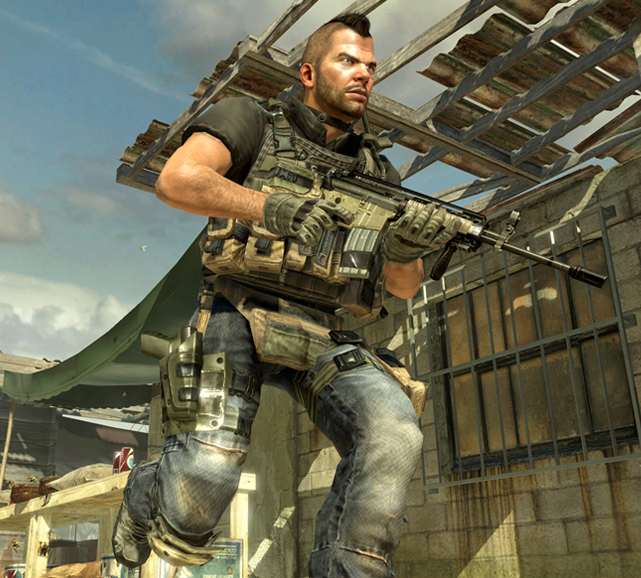
“Soap” McTavish from Call of Duty: Modern Warfare

The universes inhabited by these characters also reflect a masculine/military bias. Aesthetically, shooters often employ amazing technology to portray a very limited range of environments. It’s in the nature of shooters to take place in war zones. Whether the sterile, futuristic warships of Halo, or the urban battlefields of Modern Warfare, or the post-apocalyptic wasteland of Gears of War, these are locations for combat, not to admire the view.

Thematically, shooters also tend to focus on male preoccupations, particularly male-male bonding, strength-of-arms, and technological fetishism. Needless to say, love and relationships (besides straight male friendships) are secondary concerns at best. Women are present in some of these games, but generally in a supportive role, and they only rarely get to participate in the action. (I’m aware that there are plenty of counterexamples, but I’m not saying all American games are X so much as I’m simply noting a trend).

Things are a little more complicated in Japan. Japanese game developers create plenty of games just like Halo, but they can also create games that are so different it’s hard to imagine them ever being produced by an American company. And I’m not even talking about oddities such as “Nintendogs.” One of the most successful games to come out of Japan this year was, on the surface, a typical adventure about a group of heroes who fight monsters and enemy soldiers. The lead character is a laconic bad-ass who wields a gun-sword (it’s like a gun … but also a sword!). And she wears a skirt.
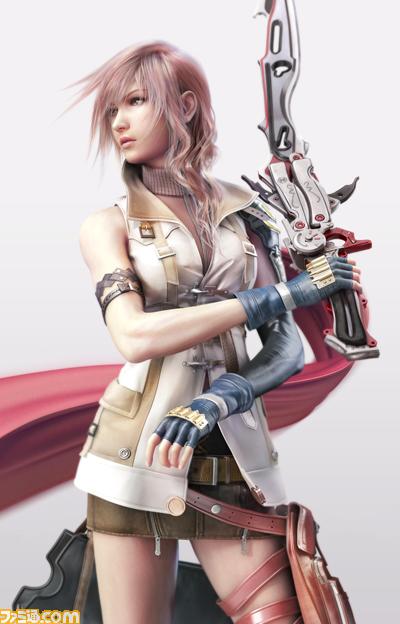
Lightning from Final Fantasy XIII

In a different game, Lightning (or you can use her far more awesome Japanese name, Raitoningu) could easily be dismissed as just another heroine who’s really a “man with tits.” But that criticism doesn’t apply very well to Final Fantasy XIII.

Unlike the bleak war zones of American gaming, the universe of Final Fantasy XIII is sparkly wonderland. The world is pretty for the sake of being pretty, and it demands that the player occasionally take some time to admire the view. And the characters don’t wear functional body armor. Their outfits are elaborate, colorful, and almost oppressively cute. They appeal to the cosplay crowd rather than military enthusiasts. In other words, this game is kinda girly.
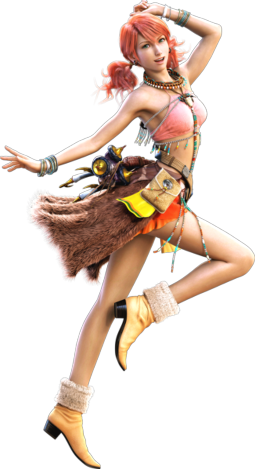
Vanille

Hope (who is a boy, just to be clear)
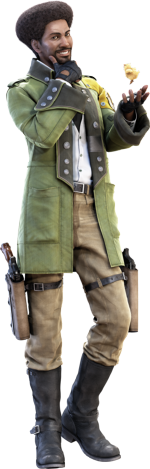
Sazh
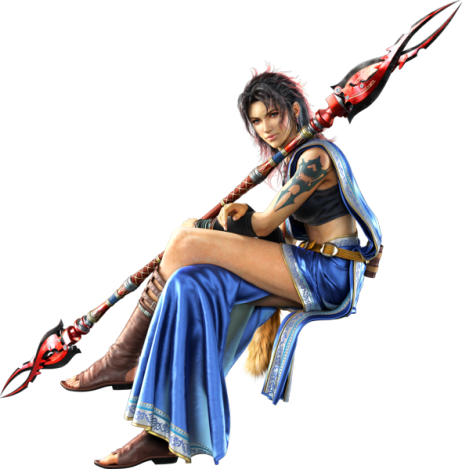
Fang
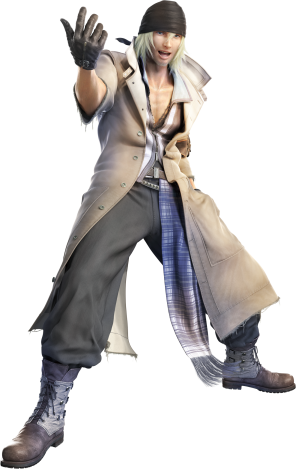
Snow

The gameplay in Final Fantasy is primarily violent conflict, but it doesn’t treat violence as a purely male/soldier activity. Women can kill monsters, men can kill monsters, cute girls can kill monsters, even a boy named Hope can kill monsters.

Violence isn’t gender-coded, partly because the cast is evenly split between male and female, but also because gender isn’t neatly defined. This is a universe where women can be named Lightning and Fang and men can be named Hope and Snow. But it’s more than just unusual names. Lightning and Fang are the most stereotypically male characters in the game: tough, aggressive, and, in the case of Lightning, emotionally distant. The men are actually more emotionally open. Snow is obsessed with rescuing his fiance, Sazh wants to save his son, and Hope is initially out for revenge (later he starts preaching the power of friendship). But the developers at Square Enix weren’t content to simply flip gender roles. The girliest character in the game, Vanille, is still a girl. Final Fantasy XIII doesn’t have bright line rules on how men and women are expected to behave.

The story is also quite different from the typical American action/adventure. The female characters don’t simply revolve around a male lead, they have relationships with each other. And the story actually focuses on the relationships between the characters and and their gradual development into a pseudo-family. None of this is meant to suggest that Final Fantasy XIII is brilliantly written. The plot is repetitive. The dialogue is clunky, and it’s made all the worse by an occasionally awkward Japanese-to-English translation. Character drama aims at being moving, but it often falls short. But regardless of its failings, it’s a story that’s about more than just conquest and killing the bad guy.

The genre is also worth noting. Final Fantasy XIII is a role-playing game (RPG), not a shooter. RPGs can be action-packed, but they also give the player the ability to control the gradual improvement (“leveling up”) of the characters. This control, as limited as it may be, gives the player a greater investment in the characters and their story. And since RPGs are about role-playing, they tend to emphasize the interaction between characters and their interaction with the environment. In shooters, story, character, and environment are typically just window-dressing for the action. Speaking from purely anecdotal experience, I’ve noticed that RPGs, and the Final Fantasy franchise in particular, seem to be very popular among female gamers. I’d wager that the reason for this is the the greater attention paid to relationships and character interaction. (And before someone accuses me of unfairly maligning all American games, there are plenty of American RPGs that offer gameplay similar to Final Fantasy XIII, though I would point out that many of them still embrace the techno-militaristic aesthetic of the popular shooters).

I wouldn’t go so far as to describe Final Fantasy XIII as a feminist game. For all it’s gender-bending, the game still adheres to a traditional view of feminine beauty. And just like American superheroines, none of the women get to wear pants. Nevertheless, it’s a game that actually has women front and center, and it passes the Bechdel Test (in case Erica is curious). More importantly, Final Fantasy XIII doesn’t treat femininity as something to be mocked or ignored. Instead, it’s an attribute that’s essential to the game’s appeal, and perfectly compatible with kicking ass.
 

Commercial Interlude: Abi Jian

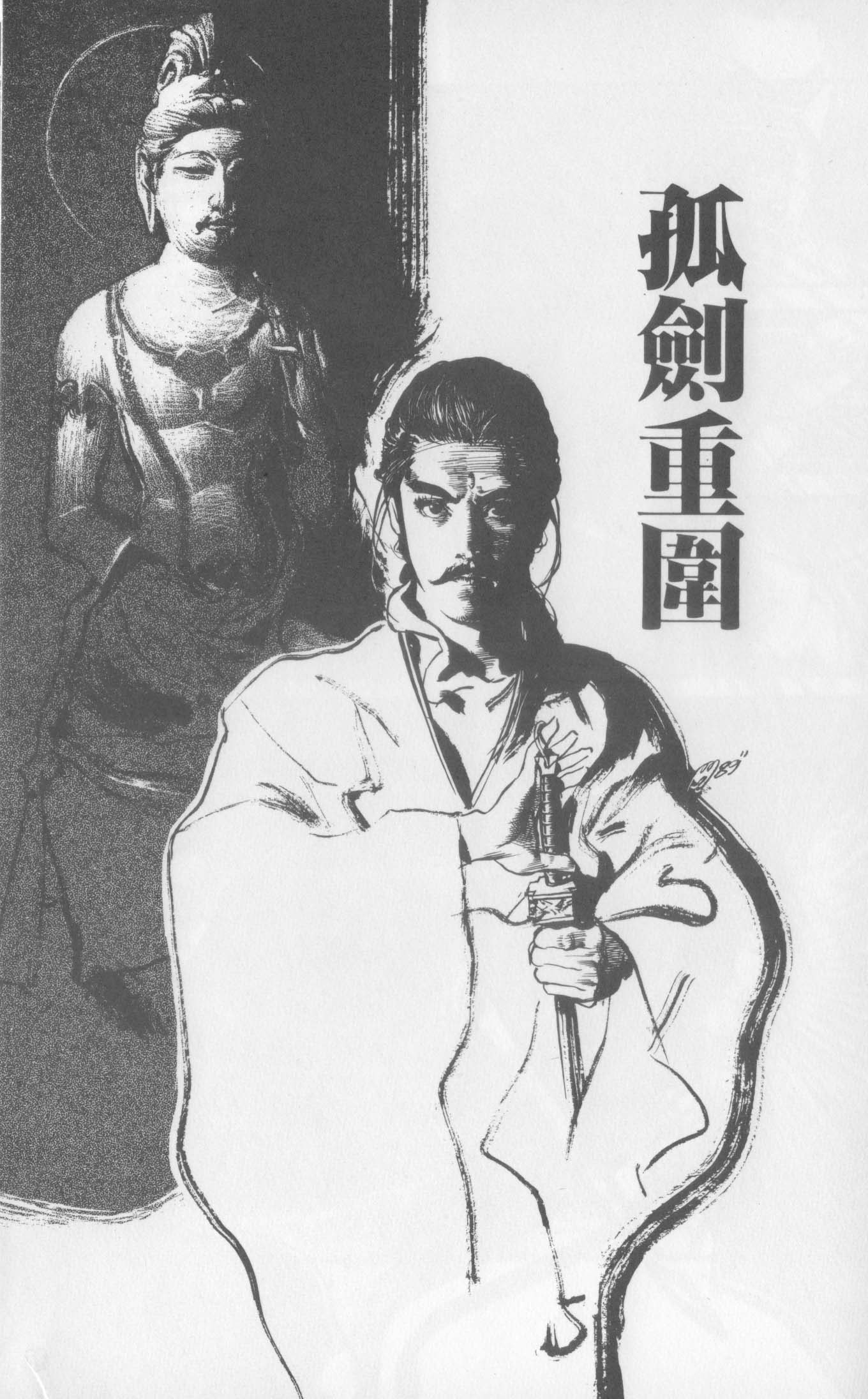
A few weeks ago, I came across a website advertising the “imminent” release of an English version of Ma Li and Chen Uen’s Abi Jian (literally Abi-Sword). It is sometimes forgotten that there exist a very commercial aspect to comics in countries outside the Americas, Europe and Japan.  This happens to be just such a comic, notable for being one of the most revered Taiwanese comics in the wuxia genre.

The comic (which in its collected edition of 2 volumes amounts to about 500 pages) was serialized between the years 1989 and 1990 is based on a story by the author, Ma Li. I haven’t read the original novels but on the basis of this two volume adaptation it is of a piece (though somewhat less distinguished) with some of the primary works in the genre.

Continue reading

Strange Windows:The Broonie, Silkies, Fairies & their Silhouettes

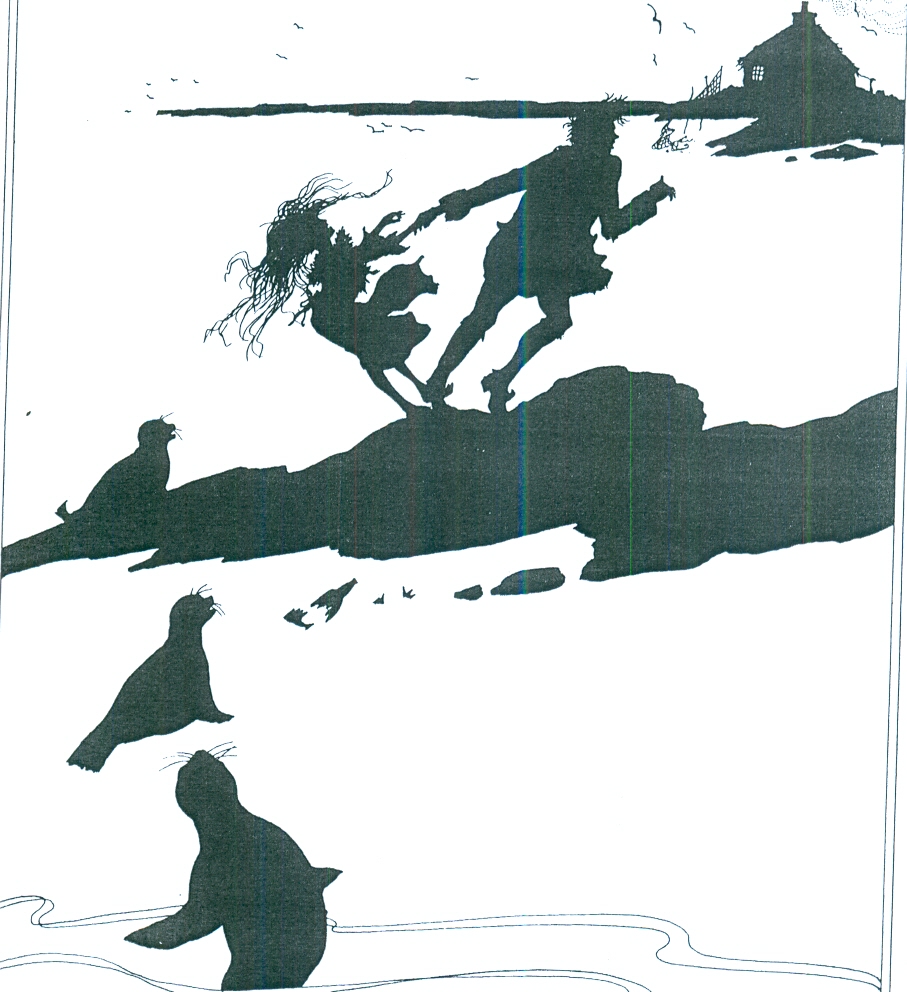
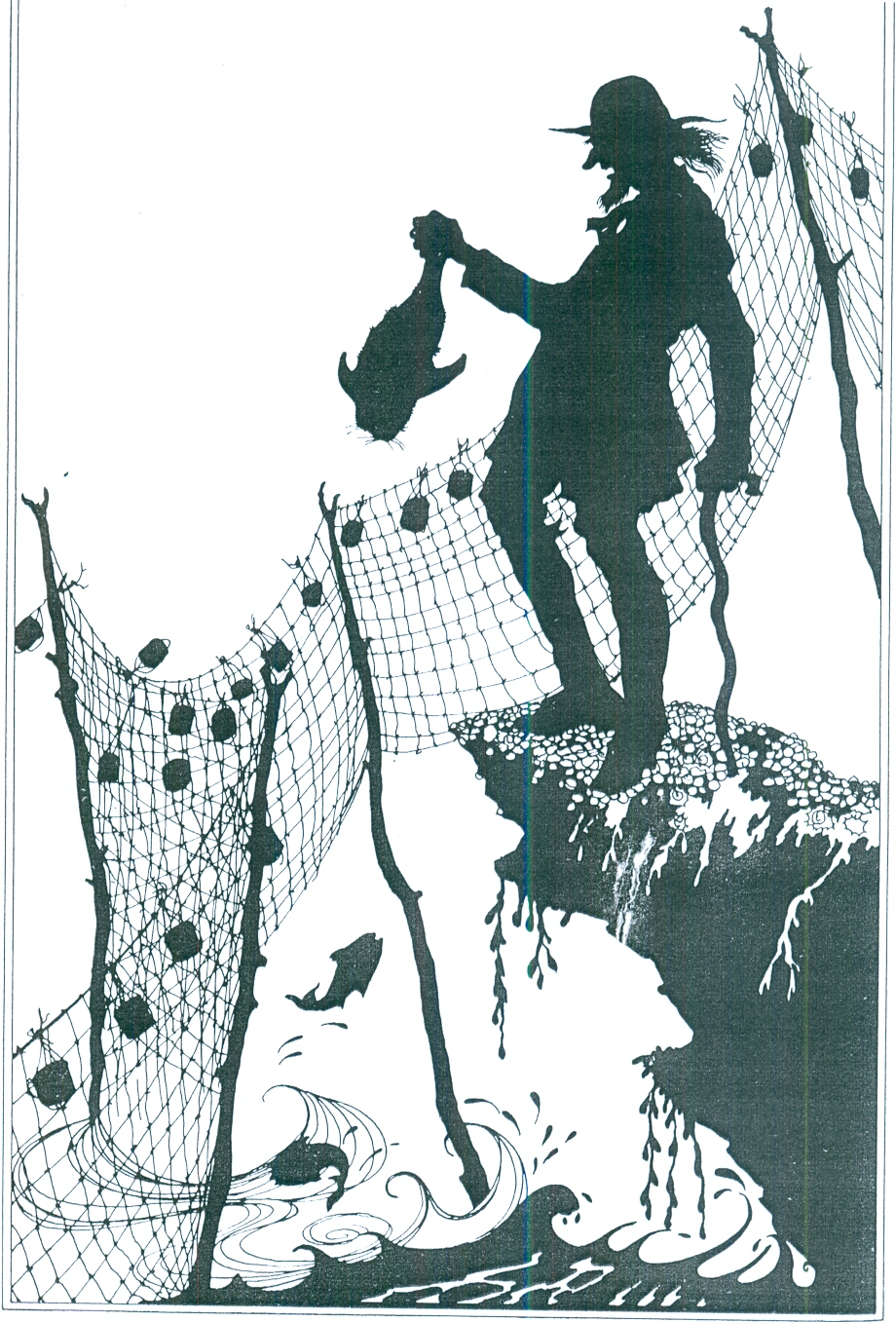
But he took the wee baby seal by the flipper. “You little rascal!” he said. “You’ll grow up some day to be a big seal and then you’ll destroy my net if I’m still here.” And he took the wee baby seal, hit its head against a rock, and threw it among the seaweed on the shore. —The Silkie’s Revenge

The pleasure of a library sale is that of a second-hand bookshop – the pleasure of serendipity, of finding what was unlooked-for. Thus I never miss any that are held at my beloved American Library in Paris.

“Come oot,” he said, “I want to show you something!” “What is it?” she said.

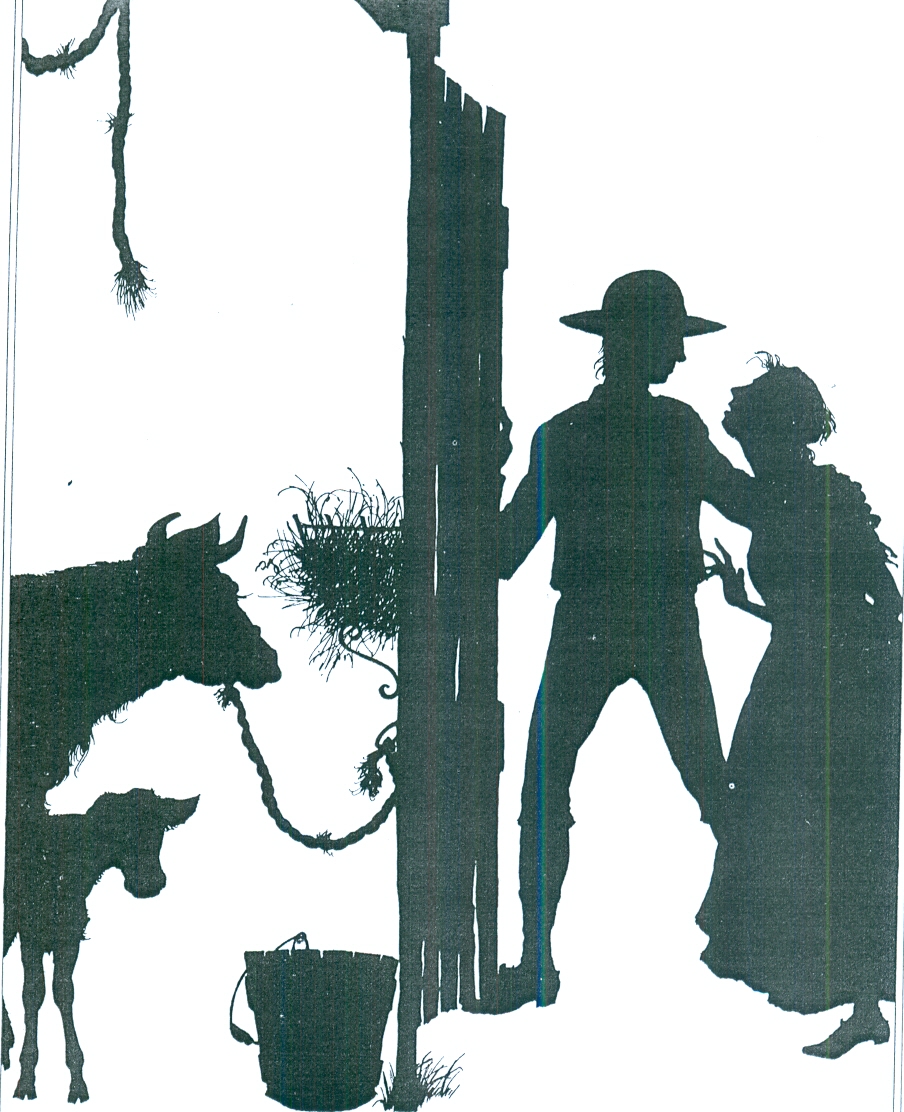
“Come here, come here. I want to show you something! Look!” he said to his wife. He opened the door of the byreand he showed her — there was the cow and there was the bonnie wee calf standing at her feet, there was the pail of water and there was the hay in her wee heck at her nose, and the cow was as healthy as could be and so was the calf! —The Broonie on Carra

At last month’s sale, I took in my haul the following wee book, paid for at the price of 1 euro– one of the better purchases I have made as a collector:

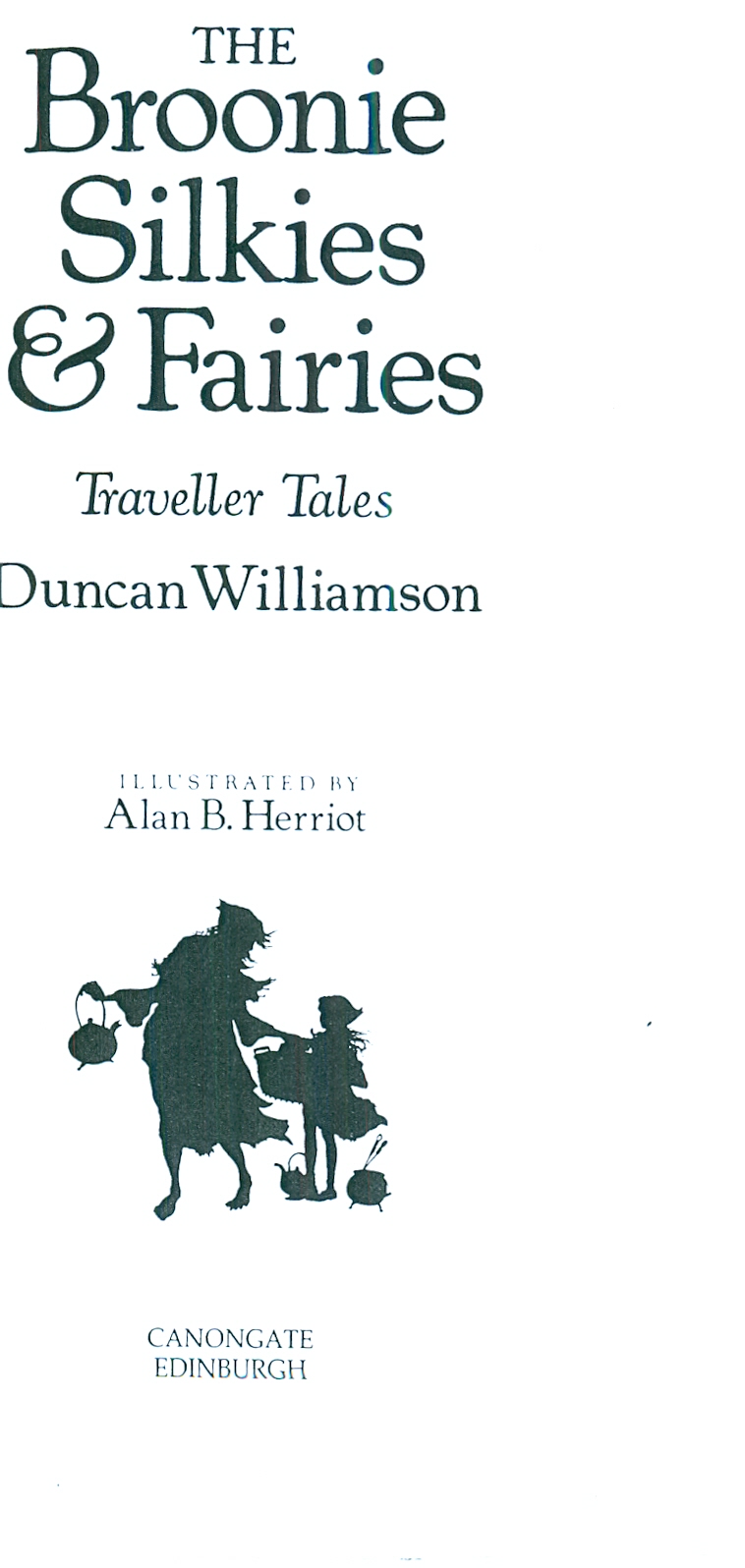
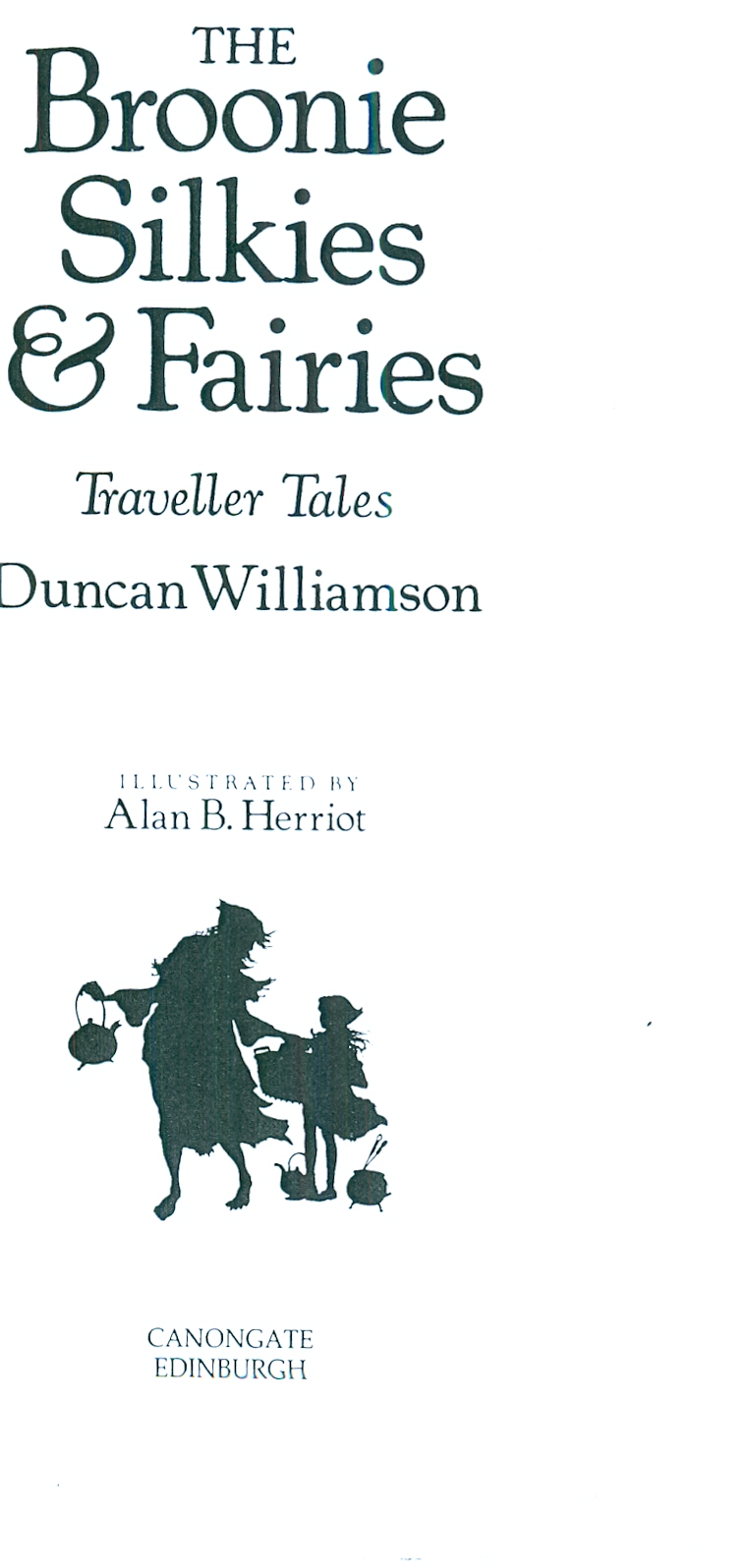
The Broonie, Silkies and Fairies is a collection of traditional oral tales from the travellers of western Scotland, a folk of nomads like the tinkers of Ireland or the Rom/ Gypsies, as told by traveller Duncan Williamson (1928–2007).

“I was reared, born and bred on stories. That’s all I had in my life.”– Duncan Williamson

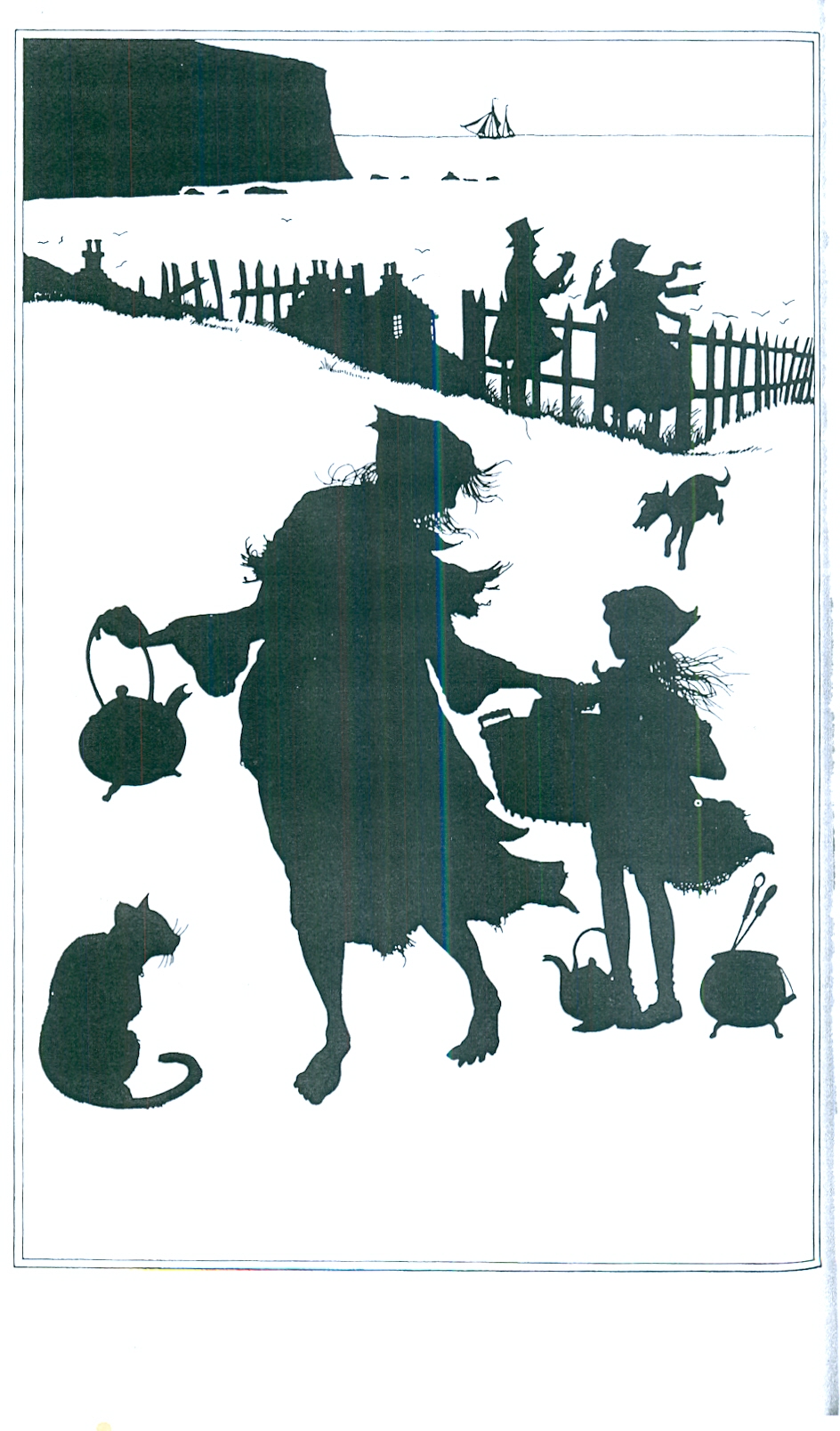
Every day she used to go hawking with the old woman too, selling her basket and tinware to the houses.

So one day she says, “Mother, dae ye never get fed up on the sea? Dae yese never go on the roads?”– Saltie the Silkie

From Williamson’s obituary in The Guardian:

Duncan was born in a tent on the banks of Loch Fyne, near Furnace in Argyll, the seventh of 16 children. Neither parent could read or write, but pipers, singers and storytellers on both sides of the family were testament to a rich oral culture. His father, a basketmaker and tinsmith, was determined that his children should get a basic education, and Duncan went to school in Furnace until, at 14, he was apprenticed to a stonemason and drystone-dyker, Neil MacCallum, who told him stories in English mixed up with words and phrases in Gaelic. A year later, he left home with an older brother, travelling all over Argyll and Perth. He worked as a farm labourer and became a horse dealer.

Duncan first heard stories and songs within the family, including a version of the classic supernatural ballad, Tam Lin, from his grandmother, Bet McColl. Duncan recalled his father’s storytelling in the introduction to his own collection of stories, Fireside Tales of the Traveller Children (1983). He knew his father was telling him something that “was going to stand us through our entire life”, and even though they may have had no food to eat, “we were full of love of our father’s voice”. He also recalled listening, at the age of 24, to an old man telling stories from 10 o’clock at night through to six the next morning. Such was the power of the storytelling culture of the Travellers. — Derik Schofield

It looked up and shook its fist. “Ye finally found the answer, but” it said, “many’s the night when I lay in your bosom and cuddled ye, I cuid have done terrible things to you– curse upon you! And curse upon your old postman!” Like that– he was gone. Gone, disappeared for evermore. — The Taen-Away

In the sixties, Williamson was discovered by folklorists, who recorded his tales for Edinburgh University; transcriptions of these stories were compiled into a series of books, such as the present one; it was published in 1985 by Canongate Publishing Limited, of Edinburgh, Scotland.

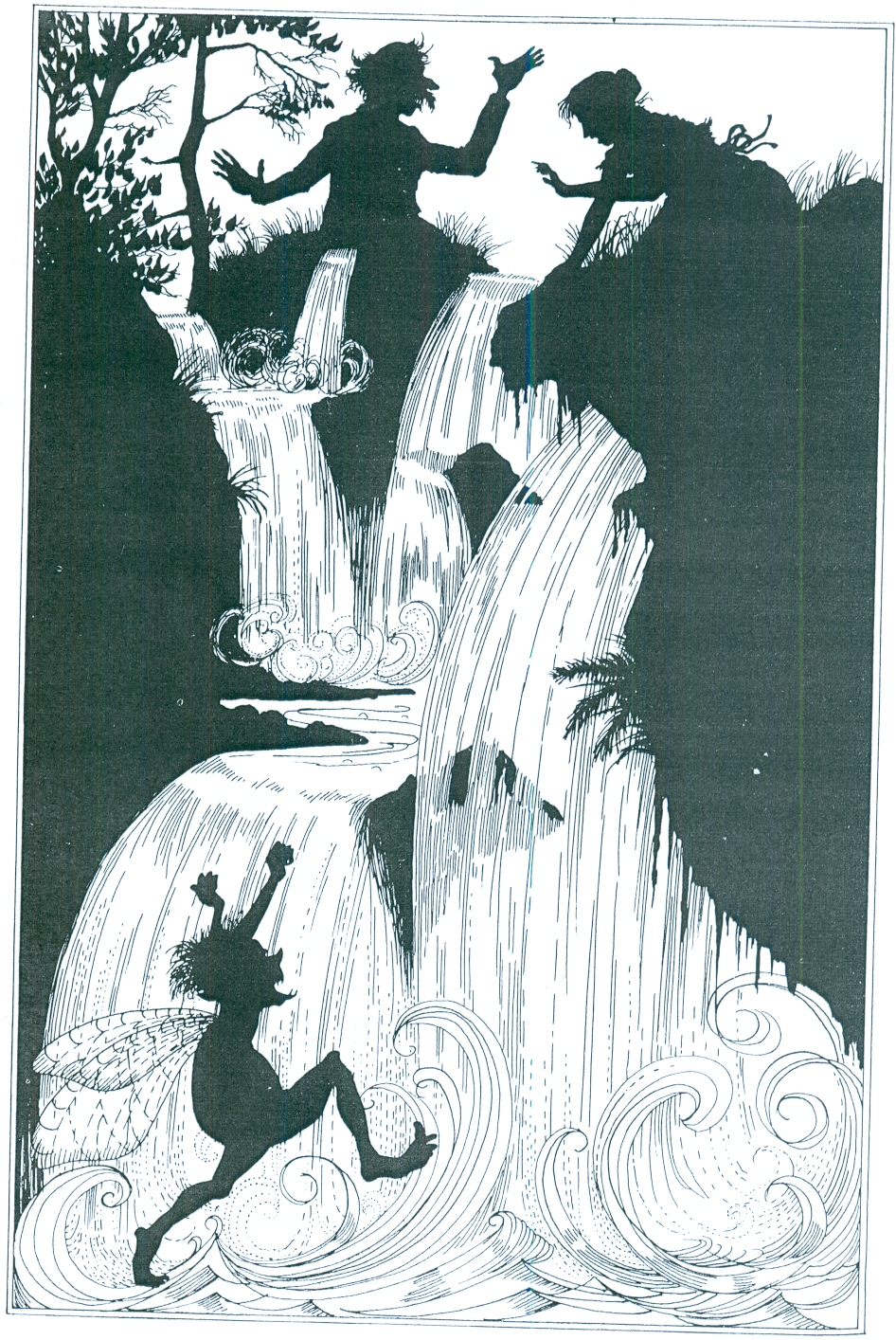
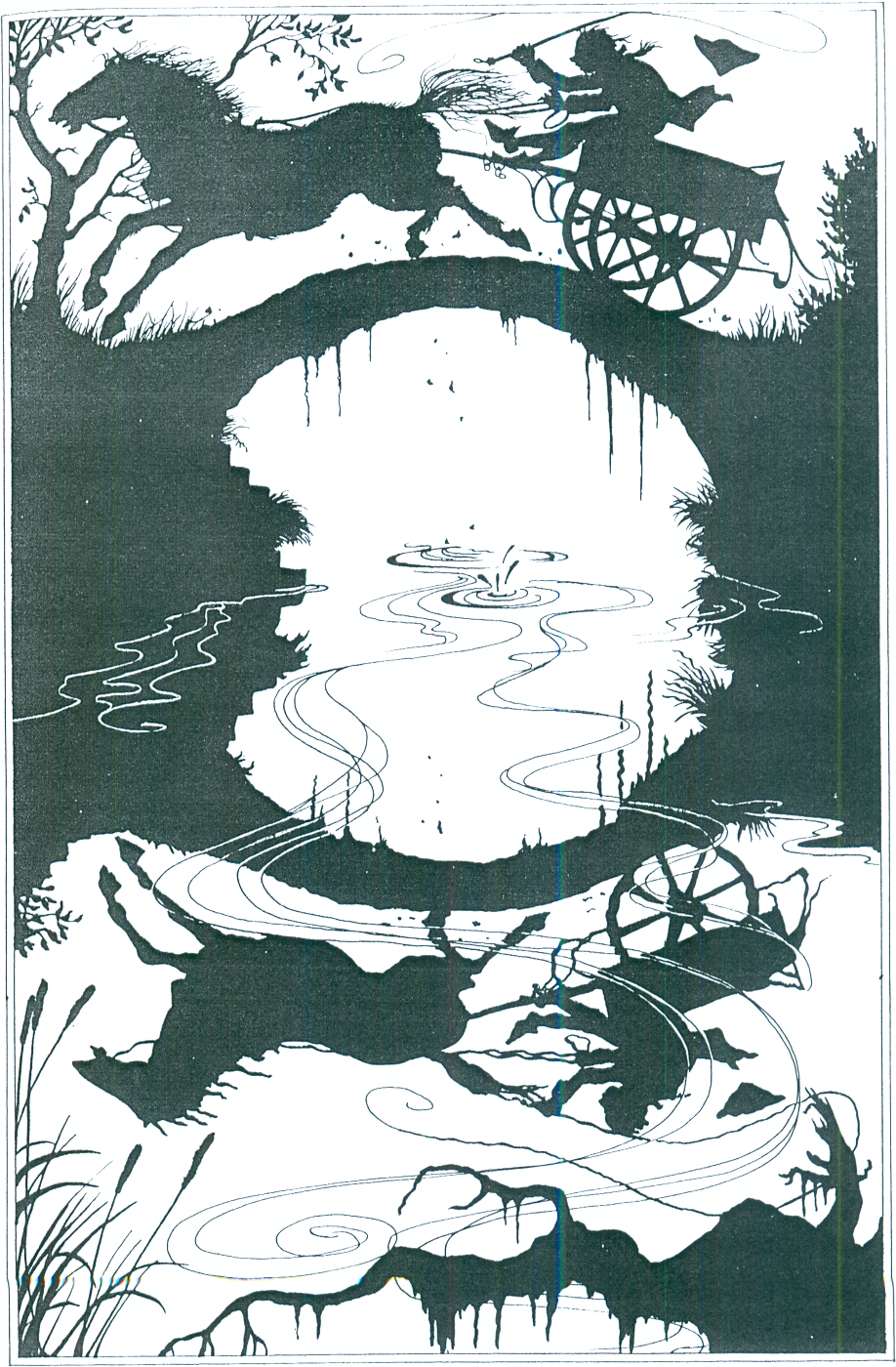
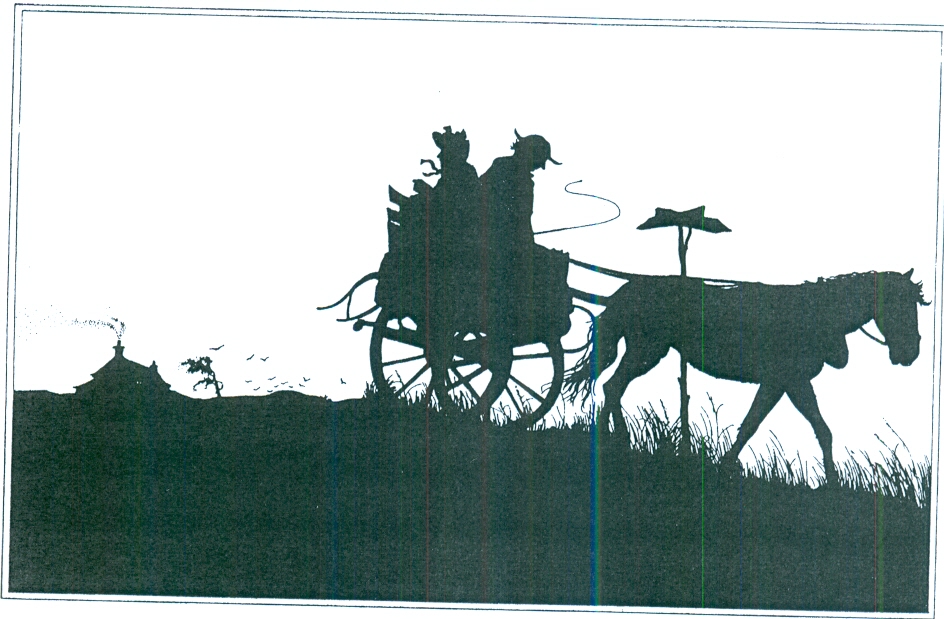
And the wee son used to say, “Daddy, why is it when you come to the bridge that you always push the pony past? I’d like to see the bridge and I’d like to see the river, I would like to see the steps going to the pool.’

“Son”, he said, ‘wheesht! You don’t know what I know… the Broonie lives in there! And these are his steps, he is in that pool — that’s why I hurry the horse past them.” — Torquil Glen

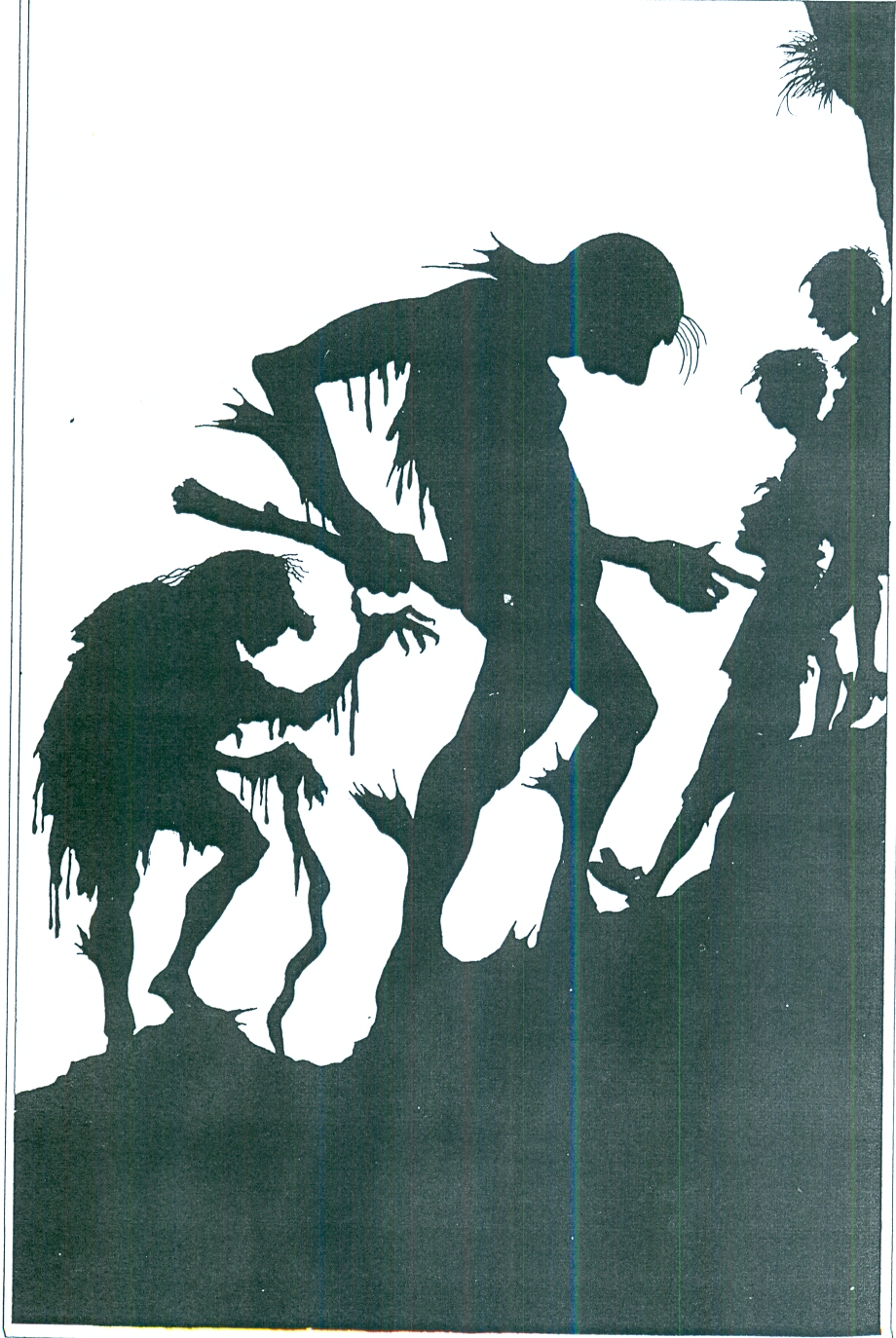
( The above drawing was printed upside-down in my copy!) These are tales of the supernatural– of fairies and the shape-shifting seal-folk, the Silkies; of changelings and sea-monsters; of the Broonie, the magical creature that rewards the generous and punishes the miserly.

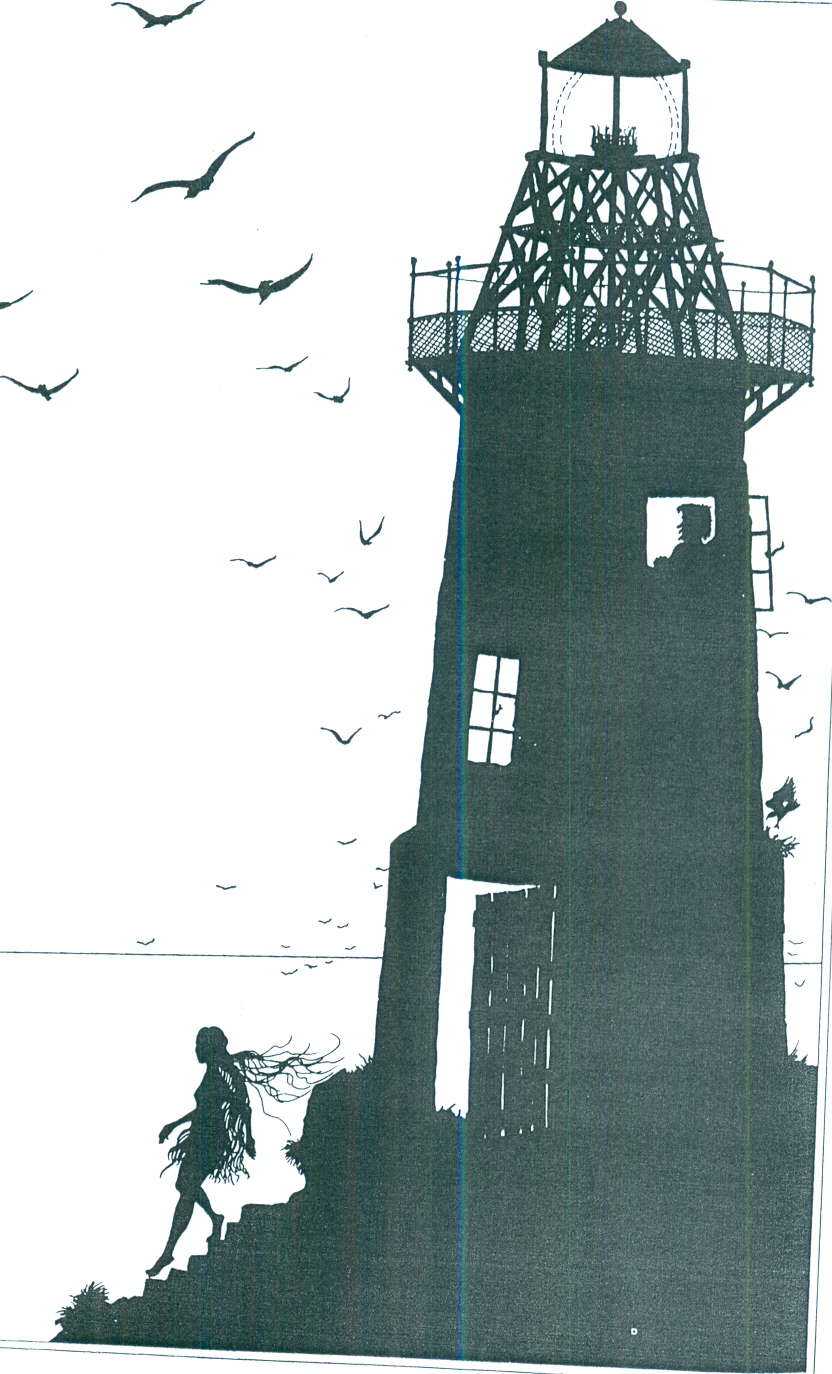
I had no time for breakfast, I was so sad. I said, “Prob’ly she went out swimming and she got drowned.” And I was so upset, I didn’t know what to do. I searched the island, I went down the steps, searched the lighthouse outside and inside. She was gone, there was no Rona. — The Lighthouse Keeper

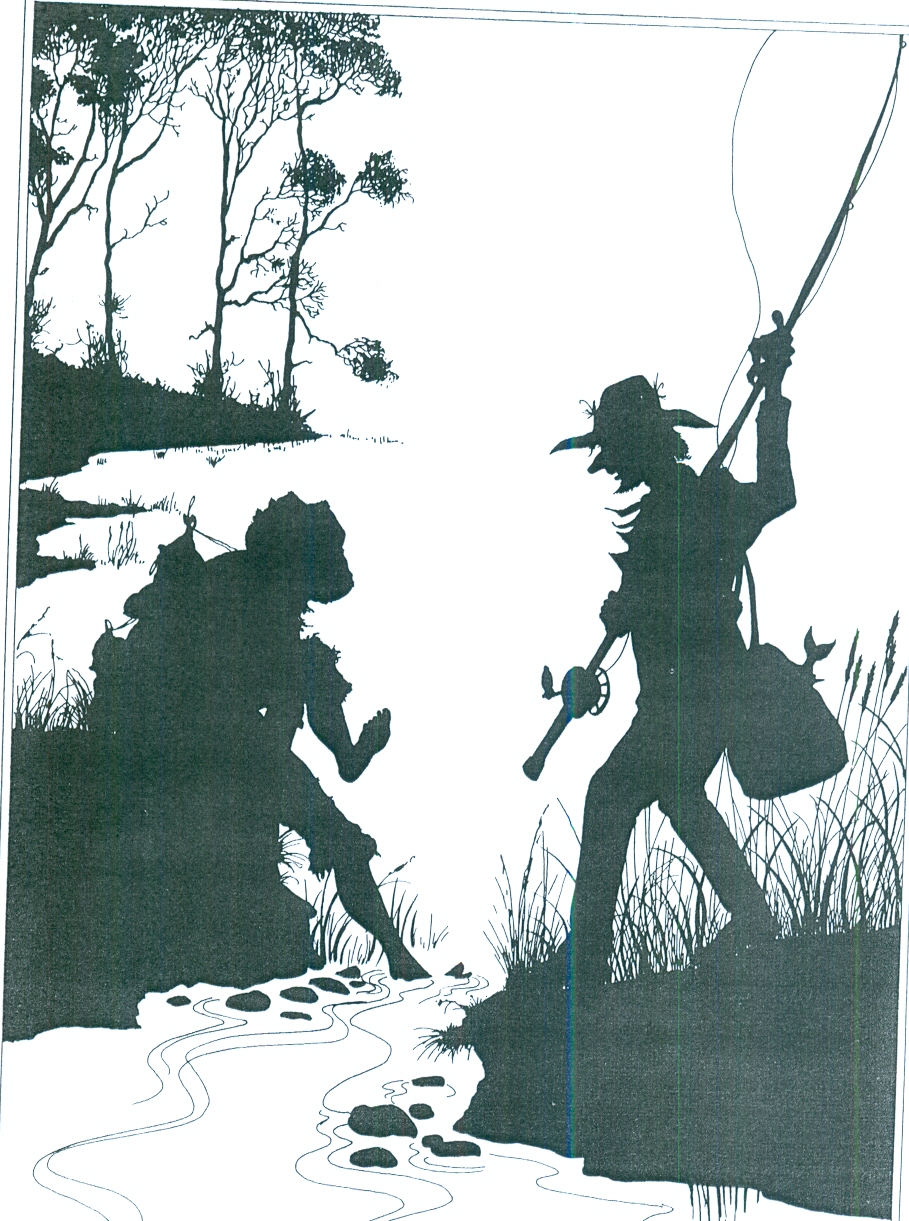
However delightful the tales, though, my purchase was prompted by the charming illustrations of Scottish illustrator Alan B. Herriot. And no small part of that charm is owed to Herriot’s masterful use of a now all-too rare illustrative technique: silhouette drawing.

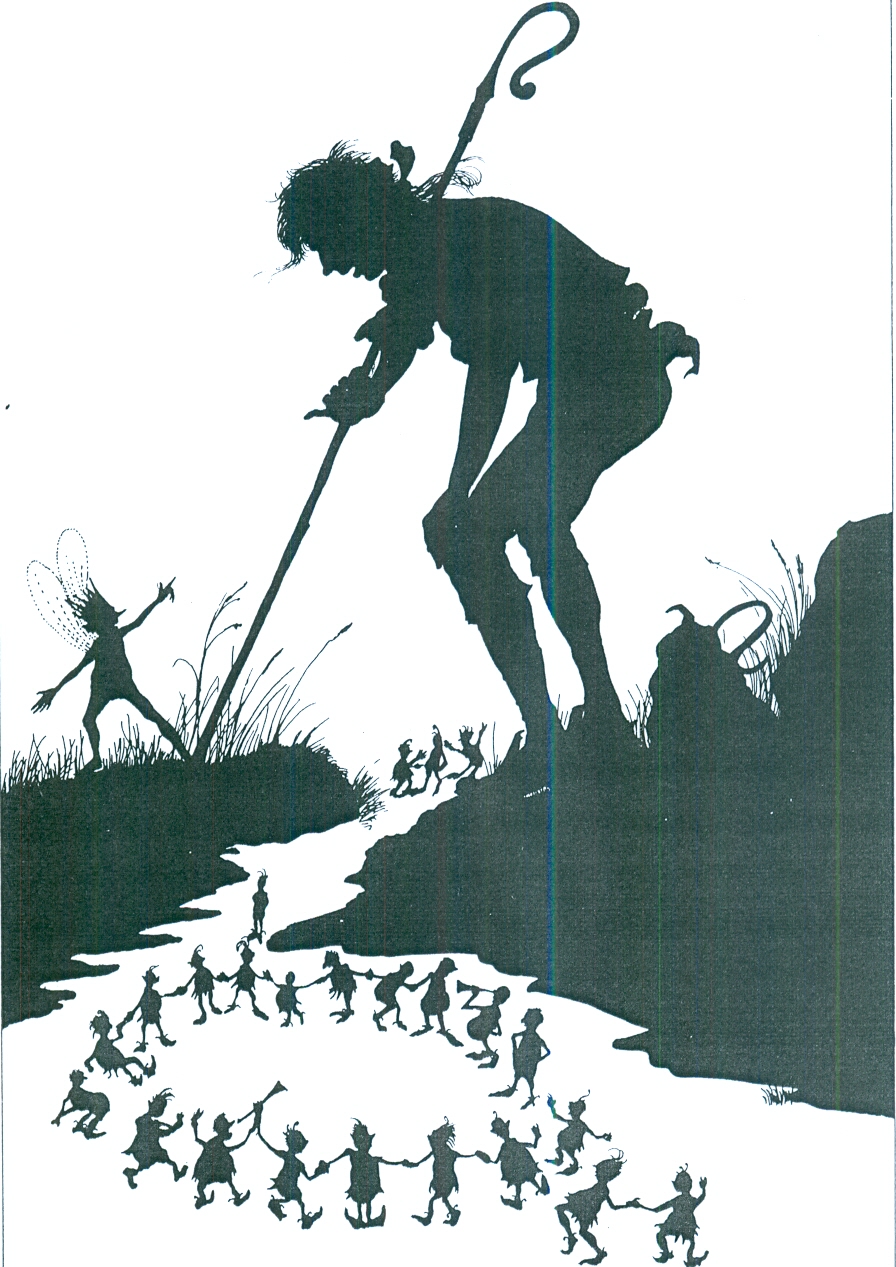
And the King stood before Archie. “Archie, I’m sorry. You’ll hev tae move away from here.”

And Archie said, “Why should I move away from here?”

“Well,” he said, “you can move or you don’t need to, because we are gaunnae have a party here.”

And Archie said, “Who are youse?”

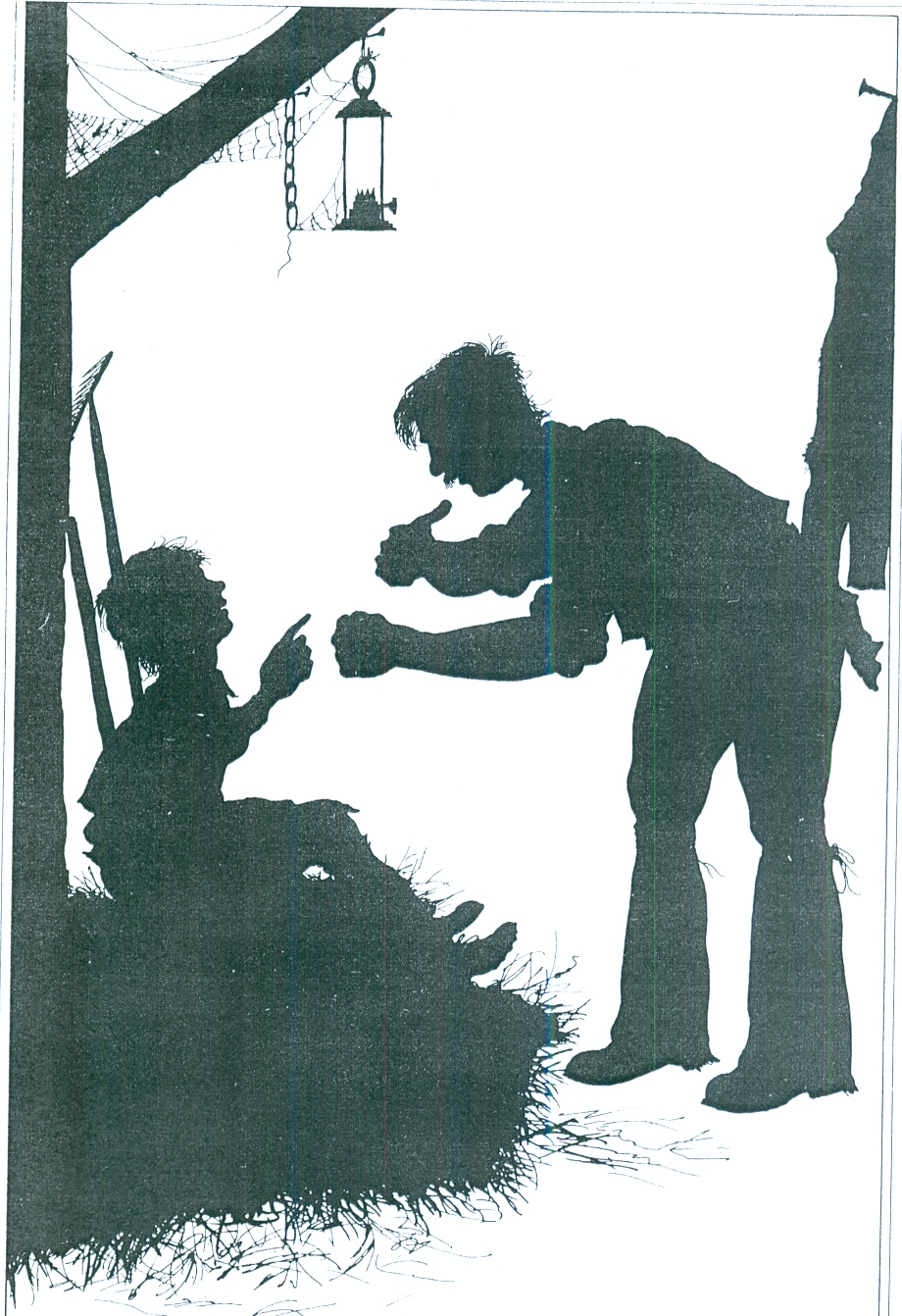
He said,”Archie, you ought to know who we are! Archie, we are the Little People, we’re the fairies! This is the day we’re going to have wir party here!” — Archie and the Little People

Nowadays, Alan Herriot is primarily a painter and sculptor in a naturalistic vein, author of several public monument statues.


Alan Herriot (right) in his studio

Worthy though these projects may be, one regrets the loss of the lightness and mystery, of boldness allied to delicacy, these illustrations from his youth so beguilingly set forth. Look again at the drawing of Archie and the Little People. The silhouette technique ‘sells’ the magic; by withholding visual information, the artist teases– and awakens– our imagination.

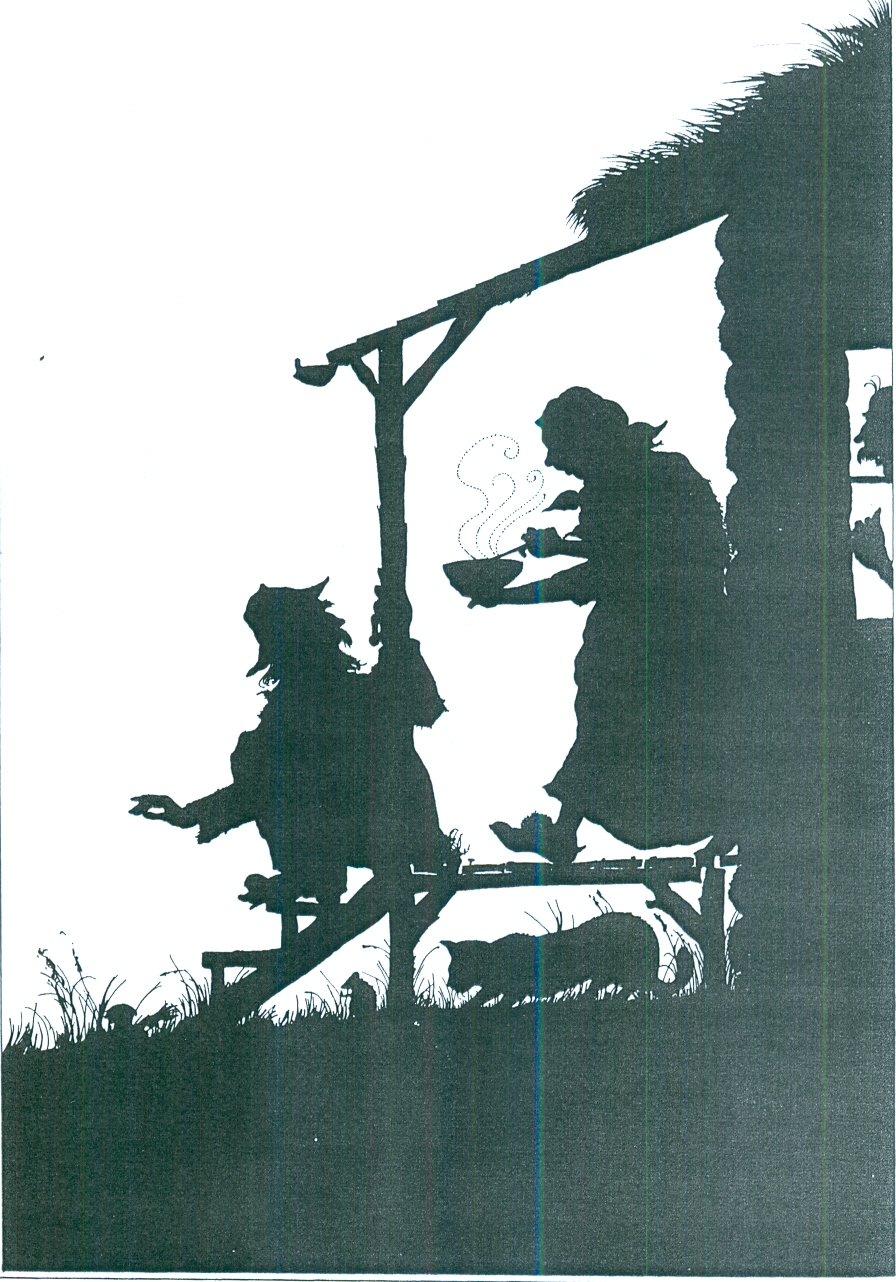
She said, “Auld man, my husband says ye’re hungry”

“Yes, my dear, I’m hungry.”

“Well,” she said, “would ye accept this bowl o’ soup?” —The Broonie’s Curse

Silhouette art goes back to the origins of human kind; it was found in the ten-thousand-year-old cave paintings of Lascaux; it was prominent in the murals of Pharoah’s Egypt; it reached a high degree of perfection in ancient Greek pottery. But its true apex came in the 18th century, when it was the commonest form of portraiture– as seen in the example below:

…occasionally involving quite complex group compositions :

This ascendancy declined in the 19th century with the coming of photography– although silhouette portraits by no means disappeared; below is depicted the poet Longfellow, by August Edouart:

And even today, silhouette portraitists ply their craft on seaside docks and at country fairs.


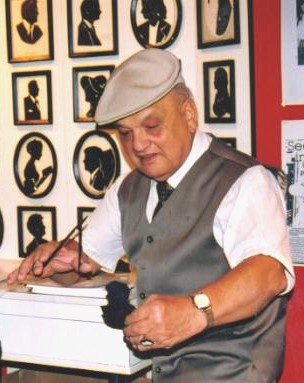
John Ross, a sihouette artist who employs the traditional technique of paper cut-outs

The silhouette has also been much used in the performing arts, whether in the Wayang puppet theatres of Java and Bali:

(French-language documentary and demonstration of Javanese Wayang) video here.)

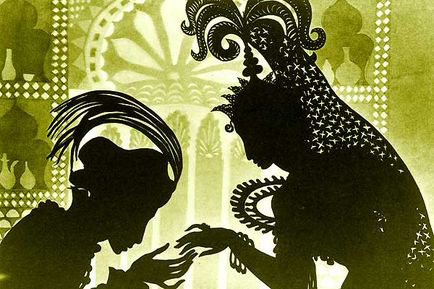
…or in the cinema, as in the animated films of Lotte Reininger; this still is from her Adventures of Prince Ahmed:

Here is a video extract from ‘Prince Ahmed’

And this man said, “You have come here to stone the seals– we are the seal-folk and you have come here tae destroy hus. Ye meant…everything ye intend tae do is upon hus. So we cam here tonight tae do the same thing tae you.”–The Fisherman and his Sons

Illustrators have always prized the delicate possibilities offered by the silhouette, with work by Aubrey Beardsley and Edmond Dulac among the choicest; here are two illustrations to Cinderella by the mighty Arthur Rackham–(thanks to Noah Berlatsky for supplying them):

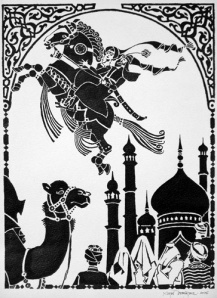
Below: Illustration for ‘Arabian Nights’, by contemporary artist Angel Dominguez

Today, this tradition is carried on by artists such as the witty Kara Walker:

In the press, silhouette vignettes were a useful design element in layout, for vignettes and colophons and headers; and examples can still be found in today’s New Yorker.

“Ye’re washin yir feet?” said the fisherman.


“Yes,” said the tramp, “I’m washin my feet. Because the day is hot.” — The Tramp and the Boots

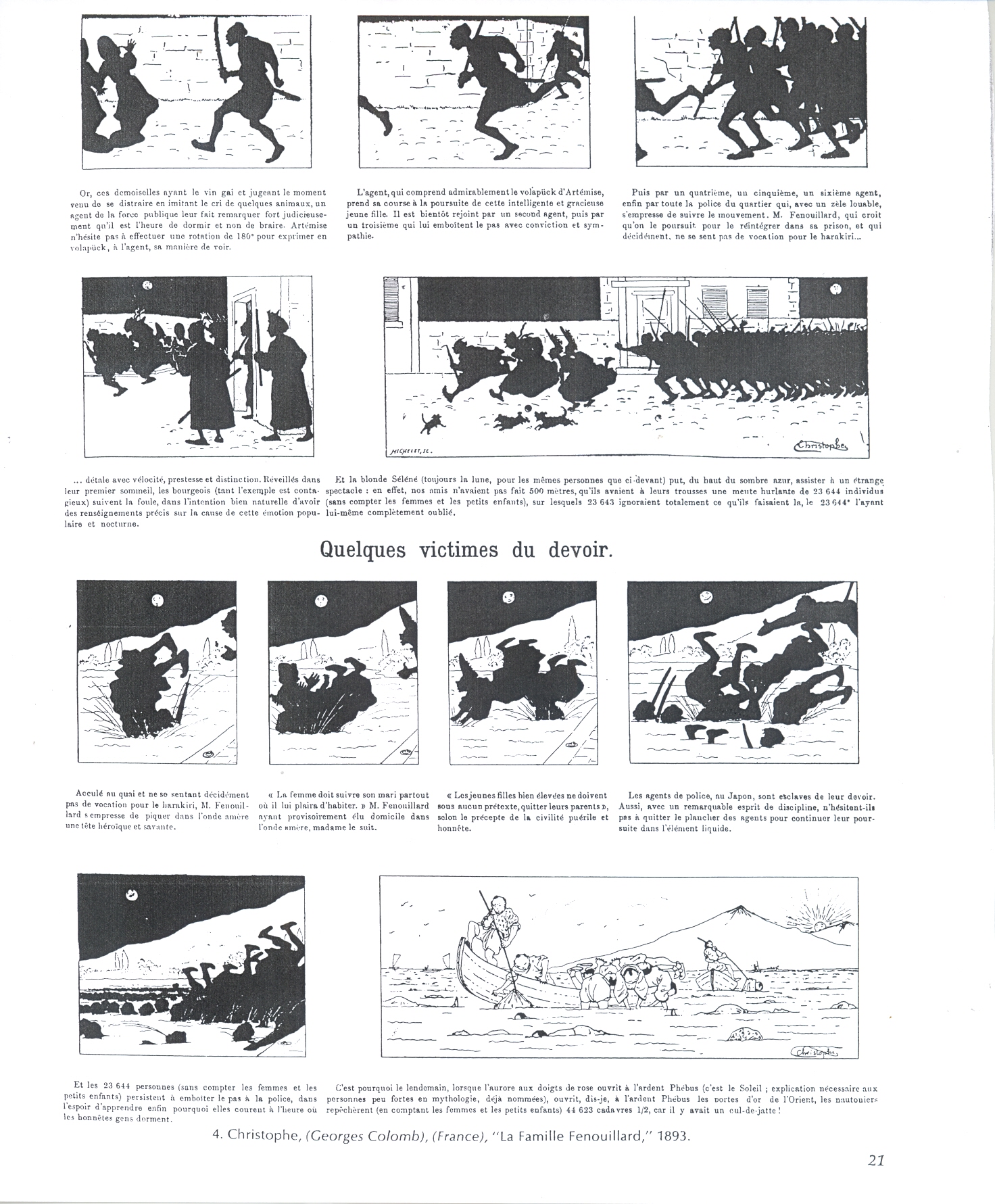
In comics, silhouette work is generally punctual– to show a character is in the dark:

Christophe, ‘La Famille Fenouillard au Japon’, 1893 (click to enlarge)

…or as a simple way to vary panels:

Wallace Wood, ’22 Panels that always Work’: a guide for his assistants


…or as a dramatic graphic device, as widely employed by Frank Miller:

Do we need more than this to know that Superman fights Batman?


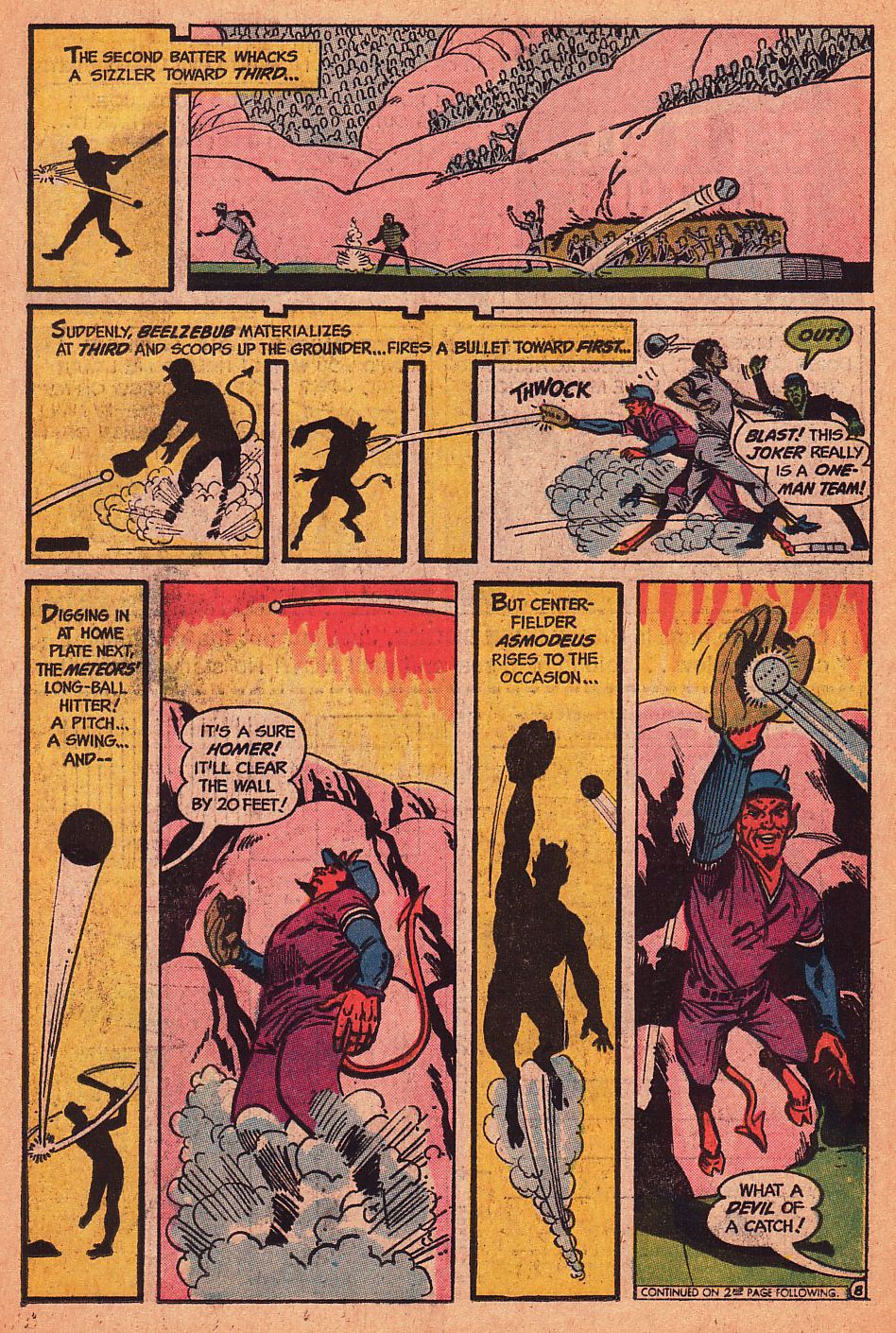
Silhouettes, which deliberately withhold visual information, work well with visually stereotyped images of the type superheroes provide. An interesting use of silhouettes was pioneered in the obscure DC comic Strange Sports Stories: they made excellently speedy transition panels:

It is a pity the sihouette is not used more, as its aesthetic is well compatible with that of cartooning; to my knowledge, the only contemporary cartoonist who regularly uses silhouettes in continuity is Stéphane Blanquet:

From Blanquet’s ‘La Vénéneuse aux deux éperons’

I would be grateful for any others the reader can point out to me.

He walked down to the beach, there she was sitting and about fifteen or sixteen seals were all gathered round her. He rushed down to the shore and caught her by the arm, he dragged her back to the house. — The Crofter’s Mistake

I love the use of negative space in the above drawing.

And remember: some day this farm will pass on tae you but promise me, as long as you own this place ye’ll never part with those breeches, or that coat or thae hose!”

“No, Daddy,” he said, “I never will.” — The Broonie’s Farewell

Duncan Williamson:

All my stories I’ve told you these past years belong to dead people– they’re all gone. And that’s why I want to tell them to you and to the world, because some day I’m not going to be around and I want people to remember and enjoy the stories that were passed down from generations of people, from the West Coast to Aberdeenshire, through Angus to Perthshire, down into Ayrshire, around the Borders, and all over– these beautiful stories that were not written down. All these stories are a matter of teaching, to show what can happen to you if you are evil and bad or good and kind. Because the travellers have met with so much badness, so much opposition and persecution along the way in their lives, even the thought of badness in their minds disturbs them. They believe that nobody in the world has any reason to be bad. They never hurt anybody. They live their own lives, do their own things and want to be left alone — like the seals.

As of October 2010, over 3000 travellers — ‘gens du voyage’ — have been deported from France…

(click to enlarge)
Extracts from The Broonie, Silkie and Fairies copyright the estate of Duncan Williamson
Illustrations for The Broonie, Silkie and Fairies copyright Alan Herriot
Alan Herriot’s Website. Duncan Williamson’s obituary from the Independent.
Two beautiful silhouette animations by Lotte Reininger:
The Little Chimney Sweep
Cinderella
They are well worth a wee peek , lassies and laddies.
Finally, the gifted young artist and cartoonist Eroyn Franklin deserves a look. Mark how she uses reverse silhouettes (I.E. white-on-black rather than black-on-white). Thanks to Sean Michael Robinson for finding her.

Overthinking Things 10/3/10

Me, Mo and Alison

The Bechdel Test. A thought exercise that consists of a series of three criteria applied to media.

Does the media have:

1) More than one woman

Do they:

2) talk to each other

3) about something other than a man

It’s pretty well-documented that Hollywood movies fail miserably at even these three very basic criteria.

However, (and possibly surprisingly,) a great deal of Japanese manga does *not* fail the Bechdel Test. A shockingly large amount of manga, both by and for women and by and for men, fulfills and surpasses these criteria. And it dawned on me that this would make a great topic here at Hooded Utilitarian. So, I threw it out on Twitter that I would be writing about manga series that met the criteria and what suggestions did people have?

Almost immediately, my Twitter feed filled up with…really, bad suggestions. Stories of magical elementary school girls, stories of gender-bent political bedroom politics, stories in which the hyper-competent, super cool, yet totally sexy lead female was, with the exception of a few “bad girls,” the only female in the series. (To be fair, I received good suggestions, too, but the bad ones were more interesting in a lot of ways.)

I found myself having to explain the concept of the Bechdel test over and over. I was accused of adding criteria when I explained that it really had to be something that someone like myself might read.

And, ultimately, someone I respect greatly suggested two truly excellent series (by which I mean that I consider them both well-written,well-drawn by masters of the craft; that I loved one and anticipate very much liking the other when I read it) that, in my opinion utterly failed to meet the spirit of the test. Why? Because *I am Mo.* I am an adult woman with an preference for stories about adult women which are not exclusively focused on their relationship with men. (Or women. I discounted almost all ot the Yuri I read, because the conversations are focused on romantic relationships with women.) There were some heated words on the topic on Twitter. And eventually, I decided to ask the source – Alison Bechdel herself.

Here was the meat of my email:

I have a question that really, only you can answer. I write about Japanese comics and I’d like to do a post that highlights some titles that pass the “Bechdel Test.” Japanese comics do this better than any other media I’ve ever seen. There are many female leads, many non-guy conversations between women. Even in romances. In conversation with other folks about this, two suggestions were made that I turned down. I have been challenged about them, but I believe that while they both meet the criteria literally, they fail at meeting the spirit of the test. And so, I’m asking you what you think.

The first is Emma (http://en.wikipedia.org/wiki/Emma_(manga)) – a story about a Victorian maid who falls in love (mutually) with a man from the upper classes. It’s a pretty realistic story. The women certainly do talk about things other than guys, because the main character is a servant and she has a lot to do, and tradesmen and other servants to deal with. There are other women – her mistresses, for instance. She discusses her love interest with almost none of them. However, the story is ostensibly a love story and while the conversation is not about guys, would Mo sit through that?

The second is Ooku, (http://en.wikipedia.org/wiki/Ooku) which is a story about Japan’s Edo period, in which many of the men have died and women take on men’s roles to keep the country going. The gender roles are flipped – the Shogun’s harem is now all men – but the women still maintain the facade of it being male rule.Both of these series are written by women.I know this is asking a lot, but I would really appreciate a note letting me know whether you think these pass or fail the Bechdel Test. I greatly appreciate your time.

Here is Alison’s answer:

I think I’m with you. I like your distinction between the letter and the spirit of the rule. Although whether Mo would sit through these stories is not, technically, a criterion of the test, I think she would not. Sit through them, I mean.

***

So, the question for me became not “what manga passes the Bechdel Test?” but “why is it so hard for people to understand what might pass the Bechdel Test?” Arrogant as this sounds, I have no problem at all coming up with titles that meet both the letter and the spirit of the test.

Is it that readers have *such* low expectations of female characters that them merely existing is enough? Is there some inherent difficulty in identifying a series that includes women in non-relationship conversations? Or are are female high school students in hopeless romances with the wrong guy, or sexy women wielding guns the only things being translated into English? It’s true that many of the popular action series for the younger crowd have the traditional one girl who is the potential love interest one day, when they all grow up and the lead male character isn’t focused on winning so much. But One Piece, a series that is arguably the most popular manga in the world right now (and is *still* under appreciated by most critics,) is targeted to that same age group, and passes the Test with flying colors.

Writer/reviewer Sean Gaffney says, “The Bechdel Test makes sure your characters aren’t dull. Who wants to hear women just talking about the same thing? It leads to well-rounded characters and better stories, and makes you THINK more. It also makes you want to step up your men.”

Melinda Beasi talked at length in her article here on HU about the way that women distance themselves from “girly” things, but it’s clear from the revenue generated by the Twilight franchise, that the fantasy of being the princess who needs rescuing and wants to be possessed by a man who is compelled by animal need, runs deep in many girls and women. I see much the same kind of thing in the Yuri/lesbian lit world, the only difference being that the “Prince” is female.

The default in western entertainment is that the female is the love interest, there for the man so, in the absence of the man, audiences will naturally assume the female has to be his replacement – that is, she must be the Hero (e.g., SaltAeon Flux, La Femme Nikita). Where there are multiple women, they will often  either be a team of replacement men, doing “manly” things (Set it Off, Resident Evil) or not doing anything and talking about the men they need to do those things (Waiting to Exhale ). Of these, only Waiting to Exhale does not pass the Test. The others have women in heroic roles…and therefore pass.

There are many manga that pass the Bechdel Test. Next month, I will review one of those that are available in English- a series that I think best exemplifies what the Bechdel Test stands for.

The Bechdel Test is a starting point, not a place to end. It’s a thought exercise the point of which, I have been reminded, is to make one think.

If I were to posit that women are still socialized to be needy, or that female fantasies of being swept off their feet are precisely because so many women are the ones to shoulder more responsibility to keep everything together in difficult times, I’m sure I’d be challenged to “prove” it, or chatised for either buying into it, or being sarcastic about it (or all three at once. ^_^)

So, I’ll ask you, the incredibly intelligent readers of Hooded Utilitarian – why do you think it’s so *hard* to conceive of entertainment in which a woman has a conversation with another woman, about something other than a man?

Utilitarian Review 10/2/10

On HU

Domingos Isabelinho discussed a critical essay by Bruno Lecigne.

Ng Suat Tong explained why Blacksad is pernicious and derivative.

Richard Cook talked about Marvel Comics published in September 1980 (including…The Death of Phoenix!

I discussed Moto Hagio’s story A Drunken Dream.

In a guest post, architect and cartoonist Aaron Costain talked about the similarities between comics and architectural plans.

And Vom Marlowe sneers at the motion comic Lost Girl and praises Benjamin Lacombe’s book trailer, Il etait une fois.

Utilitarians Everywhere

At Splice Today I reviewed some Chinese black metal and talked about the fuzzy unifying power of hate.

At Madeloud I reviewed the latest Shonen Knife album.

Other Links

Derik Badman has an interesting post about style in comics.

Tucker Stone talks about comics journalism.

This is a great post about make-up and fashion and the confusions straight men are prone to.

And I enjoy being reminded every so often that for all his virtues, Obama is kind of a soulless hack.

Moving books: a tale of two

I’ve been dipping my toes into new comic formats recently.  A friend told me about Lost Girl, saying that the premise resembled some of the tropes of one of my old favorite books, War for the Oaks.  War for the Oaks is an awesome early urban fantasy novel, and if you haven’t read it, I highly recommend it.  Despite its aging cheesiness and eighties pop music references, it’s a fun tale of fairy and rock and roll.

Lost Girl comes in two formats.  Mostly it’s a TV show.  Secondarily it’s a stop motion interactive comic.  It’s the comic part that I’ll be talking about.  I’ve seen some stop motion comics before but nothing memorable.  This was a much bigger budget production, with a clear script and real voice actors and sound effects and even cheesy choose your own adventure options.

Pity it sucked.

The premise is simple. Our heroine, Bo, is a succubus who fights crime.  Good and Evil are both watching her.  When feeling peckish, she kisses men in order to feed on their sexual desire.  Such feeding sucks out their souls (or whatever) and they wind up dead, dried husks.

I found the comic unbelievably creepy, for all the wrong reasons.  It’s clear to me, although it does not appear to be clear to the writers, that Bo is raping these men as well as killing them.  She chooses innocents as well as muggers (yes, it’s an interactive comic, but I went for the nicest options available and she still ate a total innocent).  The setting draws on the rape-fear tropes that plague society: pretty girl in tight clothes walking alone in a dark alley.  Talk about cliche.  She tells her victim to stop her if he doesn’t like it, she says it will hurt her more than it will hurt him, she says that once she starts she can’t stop.  Blah blah blah rape tropes 101.

I suppose it could be argued that by making the rapist a woman, this is somehow turning a story-trope on its head.  Except no, I think it does nothing more than increase the misogyny.  Here we have a strong, kick-ass woman.  And how does she get her power?  By raping men.  There is nothing good or strong or new about that.  Nothing.  She is supposed to be a gray character, but call me crazy, I consider rapists villains.  Weird, I know. But there’s no need for a Good Guy and a Bad Guy to fight over which side she’s on.  Stamp a E for Evil on her and move along, you know?

One of the oldest tropes in the book is that women gain power by using their sexual wiles to control or destroy men.  See, for instance, Aristophanes or Euripides.  It’s an insidious, nasty, icky approach to storytelling.  Blech.

But besides that, Mrs Lincoln, how did you like the play?

Well, it sucks.  The comic’s palette is absolutely dreadful.  For reasons which are known only to marketing deities everywhere, there has been a new resurgence of sepia-toned mucky brown and gray color schemes.  The new Sherlock Holmes movie is a good example.  Practically the whole damn movie was brown, presumably to tell us that this is Ye Olde Tyme History.  Nevermind the Victorian adoration for truly hideous bright colors.  This lousy comic seems to have felt that by moving every normal color down and to the right in the Photoshop box, they’d have made the comic edgy and urban.

I find cities to be ridiculously bright.  Much brighter than suburbs, where beige and tan predominate and brighter even than the countryside, where one finds greens and scarlets.  Cities, in my humble experience, tend towards lots of shiny surfaces and gaudy clothing and banners and neon window displays and advertising and art and graffiti and bright metal newspaper boxes with free papers.  The comic takes place during the rain, but oddly, there aren’t any silly umbrellas and no one is wearing the currently hot Hunter wellies in neon yellow.

Cities, in other words, are a lot more likely to be a jumbo pack of crayons dropped on a sidewalk than a country mud puddle.  But hey, what do I know?

The drawings themselves are angular and psuedo-edgy.  Not good, not dreadful, just…. dull.

Besides the victims, Bo talks briefly to a waitress.  The authors of the comic show that the waitress is dumb but nice by making her fat, freckled, and bedecked in a pink diner uniform.  Gee, I’ve never seen that before.

You know what I would like?  Just once I would like a fat woman to be portrayed as both smart and sexually attractive, dammit.  Not fat and therefore asexual.  Not fat and therefore Despair.  Not fat and therefore dumb.  Fat and sexy and smart.  Is that so much to ask?  Apparently it is.  (And yes, I may prefer my women a bit zaftig.)

Let us not even get started on how boring the composition was.  The poor damn comic only lasted a couple minutes and I’ve already wasted over seven hundred freaking words on the thing.

No, instead I wish to present something else entirely.  Because, see, at the point I watched Lost Girl the interactive comic, I began to think that motion comics just sucked as a medium.  Books are books and movies are movies and really, just move on because the two can’t be combined without sucking the soul out of the work, succubus-Bo-like.

Then I stumbled across something else.  A book trailer (worksafe):

Il etait une fois (Apologies for link instead of embedded video. WordPress isn’t letting me embed today.)

Benjamin Lacombe’s Il etait une fois.

It isn’t intended as a motion comic, but a book trailer, and yet it was far more effective to me than the comic above.  It’s a simple story, just the rabbit entering the pages of the book, but I found it moving and fascinating and a lovely work in its own right.

The colors are much more carefully chosen.  The rich red of the rabbit’s eyes are striking and the soft greens are dreamy.  Each movement flows smoothly.  The music adds instead of detracts.  Overall there is a cohesive feeling of fairy-tale creepiness that the old, dangerous fairy tales had.  Would-be-princesses might lose a toe here or there in their quest for the glass slipper, and monsters might just leap from those shadowy trees.

I found myself shivering in creepy delight, glad it was turning October, knowing that the nights are getting longer and the woods are getting darker.

The video is half as long, the story is twice as simple, and yet it has given me some glimmer of hope of what a moving comic might be.  I hope to see more stories told this way someday.