Utilitarian Review 10/30/10

On HU

Domingos Isabelinho looked at Otto Dix’s bookDer Krieg.

New columnist Stephanie Folse talked about the BBC crime drama New Tricks.

Ng Suat Tong talked about the accomplishments of the Comics Journal.

Ng Suat Tong compared the workings of the visual art market to those of the original comics art market.

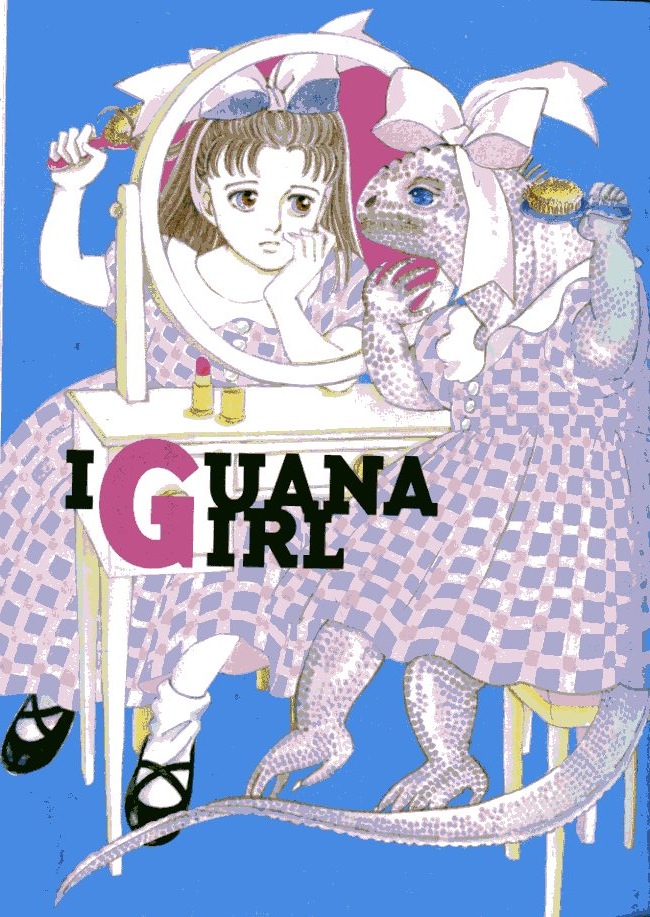
I wrote a longish essay about Moto Hagio’s story Iguana Girl.

Jones (One of the Jones Boys), did a two part guest post on visual aliens — characters drawn in a different style from their surroundings. Part One Part Two

Utilitarians Everywhere

For Splice Today I wrote an essay on Faith Evan’s new album and torch songs.

For Madeloud I sneered at Sufjan Stevens’ new album.

Other Links

A couple people pointed out this interesting post about where Marston and Peters try to figure out how to draw Wonder Woman.

Shaenon Garrity has a great post about Michael O’Donaghue’s over-the-top-exploitation comic Phoebe Zeit-Geist.

And I’m really into Rye Rye at the moment.
Visual Aliens Part II

In the first part of this post, I introduced the notion of a visual alien, an isolated unit which is drawn in a markedly different visual style from its surrounding. I also postulated that there were two basic reasons to include a visual alien: Distinctness (to underline the alien’s difference from everything else) and Virtuosity (to show off). In this post I will be illustrating with some examples of visual aliens by a single artist, drawn from American comics. In principle, a visual alien could be anything — well, anything that can be drawn, anyway. It could be a cloud, a table, a rock, a tiger. But in the examples that follow I will focus on characters that are visual aliens (although I would love to hear of non-character examples).

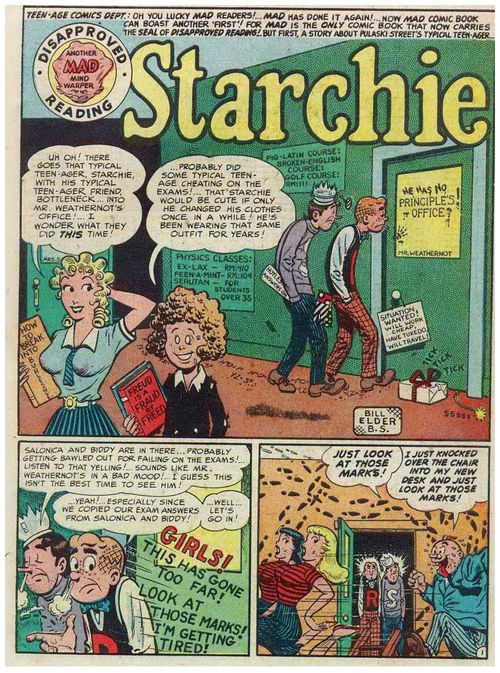
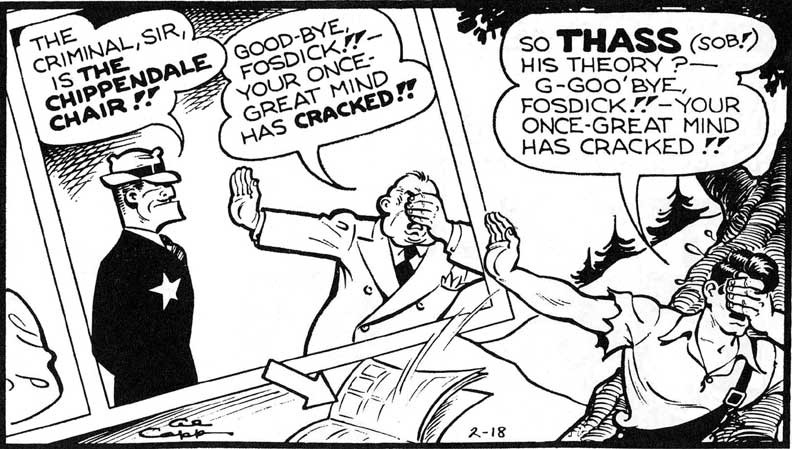
A natural place to look for visual aliens is in parody and pastiche, and in particular visual parody/pastiche, where one artist imitates the visual style of another. But in most visual parodies or pastiches (or at least the ones I’m familiar with), the parodist simply imitates the entire style of the parodied artist, drawing everything in the parodied’s visual style. This is the case with (most of) Veitch and Sikoryak, discussed in the last post, but also with (for instance) Al Capp’s parody of Chester Gould’s Dick Tracy (“Fearless Fosdick”) or Elder’s parody of Archie (“Starchie”). Fearless Fosdick is confined to his own strip-within-a-strip, which is drawn in Gould’s style throughout; in Starchie, all the characters are drawn in the Archie house style — except for a brief cameo on the first page by Little Orphan Annie, who is drawn in Harold Gray’s style. Here, as a visual parody within another parody, we have Annie as a visual alien.


Fearless Fosdick


Starchie

Continue reading

Visual Aliens Part I

Hi. The name’s Jones, one of the Jones boys. I usually blog  over at Let’s You and Him Fight. This here is the first part of a two-part guest post about a comics technique that I call visual aliens.

***

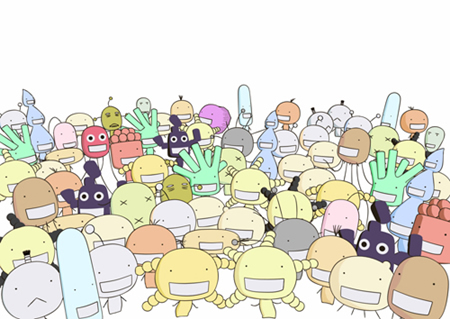
Moyasimon is a manga by Ishikawa Masayuki recently published in English for the first time. It’s about the misadventures of a young agriculture student at university; what makes this student special is that he can see bacteria with the naked eye. The bacteria, invisible to everyone else, look to him like cheerful little cartoon sprites, not a million miles from Larry Marder’s Beans.

Moyasimon Bacteria

It’s a clever conceit, and the bacteria are winningly cute. Unfortunately, that’s about all that’s winning in this manga. Despite generally positive reviews online, Moyasimon is simply not very good. The humour isn’t funny, the intrigue intriguing, or the character work engaging. A big fail, in other words, apart from the portrayal of the — admittedly adorable — bacteria themselves.

One thing did catch my eye, however about the series. Masayuki draws most of the non-bacteria characters and backgrounds in a fairly generic seinen style — a little bit realistic, a little bit cartoony. But there are two characters — viz. professor Keizo Itsuki and sophomore student Takuma Kawahama — who are drawn in a very different visual register, much more cartoony. The clearest illustration of this that I’ve found is this image here which features the main characters next to the actors who play them in the live-action adaptation.

Continue reading

Moto Hagio: “Iguana Girl”

I’m blogging my way through Fantagraphics’ Moto Hagio collection, “A Drunken Dream.” You can read the whole series of posts here.
_________________________________

In reviews of Drunken Dream, “Iguana Girl” is generally pointed out as the highlight of the collection along with Hanshin: Half-God. The two stories are similar in a lot of ways; both involve sisters, one beautiful, dumb, and beloved, the other (our heroine) homely, smart, and despised. And both are engaged with ideas about self-image, femininity, gender, and identity.

Hanshin, as I said in my review, is more a poem than a story. It raises questions deliberately to leave them unanswered — the narrator’s self is ultimately her lack of self. The identity she finds is that she does not know who she is: herself, her congenital twin, or the space left between her and her sister when they are separated.

“Iguana Girl”, while using a more arresting gimmick than “Hanshin,” ends up being a more conventional (and to my mind a less interesting) story. The plot focuses on Rika, a child whose mother sees her as an iguana from the moment of her birth. Rika’s perceived ugliness makes her mother hate her; she much prefers her second daughter, the lovely (and rather dumb) Mami. Rika sees herself as an Iguana too, though everyone else sees her as a beautiful girl (and eventually as a beautiful young woman).

The problem here is the same one that dogs many of Hagio’s stories — a lack of characterization resulting in glibness.

Continue reading

Original Art: Human Nature

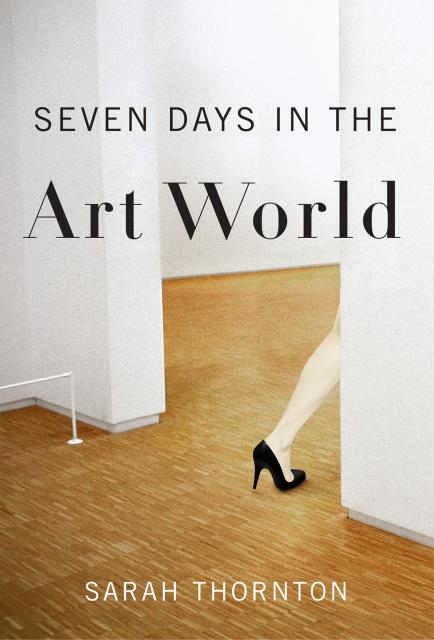
The differences between the worlds of comics and fine art would appear to be pretty obvious, but my recent reading of Sarah Thornton’s Seven Days in the Art World suggests that  these differences might be less than they would appear, the great leveler in this instance being human nature.

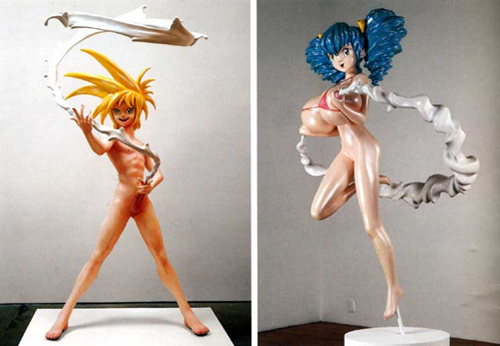
Taking in subjects like a high end contemporary art auction, self-absorbed art students at a “Crit” session, the strange world of Artforum magazine and a trip to Takashi Murakami’s studio, the entire experience of perusing Thornton’s book was not unlike reading about the decline of civilization (Western in this case but the values are universal); a kind of journal describing that surge of decadence which sometimes marks the end of empire.

Continue reading

Comics Journal Navel Gazing: A Short Comment

Caro recently highlighted an article by Craig Fischer at Transatlantica titled “Worlds within Worlds: Audiences, Jargon, and North American Comics Discourse”. I’ve decided to separate out this short comment on one particular section of Craig’s essay since it is only tangentially related to the bulk of Caro’s comments. The following comes from the middle of Craig’s taxonomy of comics writing called, “Essayists” (emphasis mine):

22    As a contributor to the Journal, my problem with Groth’s emphasis on evaluation is the absence of communal standards. In the editorial to Journal#100 (July 1985), Groth reprinted a commentary from the British fanzine BEM where Bernard Leak pointed out that despite the Journal’s commitment to excellence, “muscular standards-raising activity requires some kind of focus, some general agreement on what a good comic is; and there isn’t any such agreement, in the pages of the Journal or anywhere else” (Groth 12). Leak further argued that

“A general theory of comics, such as has been produced (in many conflicting forms, of course) for literary genres like novels and epics, is necessary before any dreams for the future can take on a definite shape and positive content. If someone doesn’t like any particular theory, he can supplement, modify or replace it; but until one appears all criticism of comics will be floating in the void, unsupported by anything more than a consensus of some readers’ uncontrolled intuitions. (12)”

Continue reading

New Tricks

Hello!  You may remember me from such insightful posts as Visual Languages of Manga and Comics and, er, well, just that one, really.  You shall all be subject to me on a regular basis for a while, as Noah has asked me to be a monthly columnist.  At the moment, I’m not sure what direction I’m going to go with this, but I’ll play it by ear.

This month, as I’ve just come back from a vacation to the UK and am still jet-lagged, I’m going to just blather on a bit about a current favorite TV show of mine and why I think one of the main characters is the most fantastic female character I’ve seen in a long, long time.

Continue reading