Dick, Empowered

Over the last few months I’ve been doing an occasional series on the feminist limitations of an ideology of empowerment. My argument has been that a feminism obsessed with power is a feminism that is indistinguishable in crucial respects from patriarchy. It’s also a feminism that tends to reject parts of women’s experiences out of hand. Domesticity, children, family, peace, selflessness, love, and even sisterhood can be tossed by the wayside in the pursuit of an ideally actualized uberwoman valiantly and violently staking vampires or what have you. And as for those who are not ideally actualized — well, for them, empowerment feminism often offers little but contempt and dismissal.

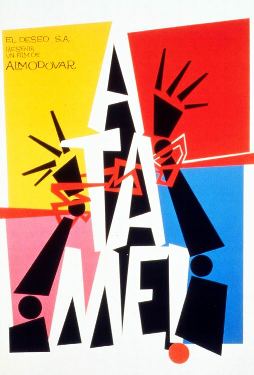
I still believe all that. But…well. If anything could convince me otherwise, I think it’s Pedro Almodovar’s “Tie Me Up! Tie Me Down!”. Mostly because, after watching it, I would like to see a passel of empowered feminists kick the director’s sorry ass.

As I am not the first to notice, “Tie Me Up! Tie Me Down!” is an intentional, sneering, anti-feminist provocation. Ostensibly, it’s a romantic comedy featuring Antonio Banderas as the adorably amoral ingenue Ricky. Ricky is released from the mental hospital at the film’s beginning, and immediately goes off to kidnap former porn star and drug addict Marina (Victoria Abril). After hitting her in the jaw, he traps her in her apartment and tells her that she is going to fall in love with him and that they’ll then go off and have lots of babies. At first she is incredulous, but then he steals painkillers for her and gets beaten up for his efforts and she realizes that he really does love her…and so she falls for him and they have fantastic sex and then they ride off into the sunset to live happily ever after. Aww.

Like I’ve said, I’ve written a lot in this series about how a feminist text does not have to present women as perfectly empowered, and about how building your life around love is a really reasonable choice. So Marina is not perfectly empowered, and she chooses love. What’s wrong with that?

What’s wrong with that, I’d argue is that I don’t believe Marina is actually choosing love. That’s first of all because I don’t believe in the love. In a good romantic comedy, you need to become a little bit infatuated — or more than a little bit infatuated — with the leads. I don’t necessarily want to marry Cary Grant’s bumbling doofus, but he’s vulnerable and, contradictorily, witty enough that I can see why Katherine Hepburn would. Darcy is almost lovable just on the strength of his having the good sense to fall in love with Elizabeth, but if that weren’t enough, his competence and determination to help not her, but her whole family, certainly seals the deal. Even that bone-headed drama-queen Edward, so desperately trying to be cool and dangerous and so obviously a raging mass of hormones and stupidity trying incompetently to impress and care for the girl he loves — I can see the appeal.

But Ricky? What is there to like about Ricky? I know Edward is supposed to be all stalkery and abusive, but Ricky is actually, literally a stalker and abuser, tracking down a woman he barely knows (they had a one night stand at some point, apparently), hitting her, and threatening to kill her. He constantly engages in petty crimes, shaking down a drug dealer or stealing a car, and while I guess that’s supposed to make him dangerous and cool, in truth it just makes him seem like an untrustworthy thug. Even his tragic backstory (he lost his parents young or some such rot) seems like rote, tedious whining. His bland confidence that he’ll get what he wants; his noxious self-pity (he constantly chastises his kidnap victim for her selfishness and for not seeing how hard things are for him; his vapid cruelty — I mean, I know he’s Antonio Banderas with movie star good looks, but come on. He’s a charmless cad.

Lots of women (and lot of men, for that matter) do in fact date charmless cads — though even the most charmless cad doesn’t generally begin the relationship with battery and kidnapping. But, in any case, I don’t believe Marina is one of those women who dates charmless cads, because, just as I don’t believe in her love, I don’t believe in her. She’s not a real woman — or even a representation of a real woman. She’s got more in common with Pussy Galore than with Hepburn in Bringing Up Baby or Elizabeth in Pride and Prejudice or even with Bella. She’s an instrumental fantasy of compliance — which is why her sexual dalliance with a child’s bath toy is what passes for character development. She is there to experience a conversion rape, and the conversion rape is all she is.

Almodovar is perfectly aware of this; in fact, he smirks about it. I mentioned that Marina is a former porn actor. She left porn to star in a exploitation film directed by the great director Maximo Espejo(Franisco Rabal) — roughly translated as “maximum mirror”. Maximo is aging, wheelchair bound, and impotent — he has hired Marina, the film makes explicit (literally in a sequence where Maximo watches one of her old films) because he finds her sexually attractive. The movie doesn’t find this icky, though, Instead, we’re invited to see Maximo’s impotence as a tragedy of genius. His crude comments, directed at both Marina and her sister, are supposed to be cute, just like Ricky’s naive egocentrism and sexual brutality is supposed to be charming. For the last scene of his film, Maximo orders Marian to be tied up and dangled from a window…a motif prefiguring her “relatonship” with Ricky. Ricky, then, becomes, and none too subtly, the director’s avatar, dominating and fucking Marina as Maximo cannot. It’s all just a harmless fantasy, isn’t it? Who are we to deny a genius his stroke material?

Almodovar is gay, of course, so his exact investment in the fantasy is a little unclear. You’re supposed to see him in part as Maximo the mirror, the watcher enjoying or manipulating the tryst. But even if what we have is a coded gay parable about embracing your forbidden love by fucking Antonio Banderas, the fact remains (and is even underlined) that Marina as a woman, and Marina’s desires, are, for the film, utterly irrelevant. It’s not a question of Marina being empowered or disempowered, or even a question of Marina being a blank (as Melinda Beasi recently said of Bella in the Twilight graphic novels.) In fact, it’s not a question at all. The movie simply doesn’t give a crap about Marina. She’s a marker in someone else’s story — which is maybe why she only actually seems to come alive during the film’s much-ballyhooed sex scene. Laughing and animated, she turns over and over with her lover/cad, begging him not to let his penis fall out of her. It’s like Almodovar can only imagine her as interesting, or human, when she’s got a dick.

I did just say in that last paragraph that it’s not about being empowered or disempowered — but I think that’s probably a cop out. The film is, after all, a two-hour paen to the joys of stalking and domestic abuse. It’s a useful reminder to me, perhaps, that one reason men advocate disempowerment for women is that they get off on it. Feminists have every reason to distrust them.

The Groove That Ended

This first appeared in The Chicago Reader.
______________________

Today fabulous divas and thuggy rappers use the same producers. They sing about the same things—mainly clubbin’ and sex. They date each other. And they appear not just on the same radio stations but on the same tracks. For all practical purposes, hip-hop and R&B have merged into a single commercial juggernaut.

Ashanti, who’s been out of circulation for four years, has already proven herself a diva, but her big comeback, The Declaration, is also her attempt to fully and finally embrace radio reality. It’s the album where she shakes off the influence of label owner Irv Gotti and hooks up with a bunch of megaproducers to prove she can rock the dance floors of the late aughts even harder than she rocked the bedrooms of 12-year-old girls in 2002.

That was the plan, anyway. But The Declaration is completely anonymous. It feels like it could’ve been put together by any second- or third-rate R&B diva—Christina Milian, say, or Lumidee. It’s not terrible, and there are some nice moments—the piano loop on the lead single, “The Way That I Love You,” works well, and “In These Streets” gets lodged in your head in that pleasurable/painful way certain pop songs do—but the moments of inspiration are fleeting. Even Rodney Jerkins, who’s been on fire these past couple of years, seems to be sleepwalking; his production job on “So Over You” sounds like he unearthed a duff Brandy track from ten years ago and remixed it while doing his taxes. “Girlfriend” is a dreary knock-off of Ciara’s “Promises.” And Akon’s contribution to “Body on Me” is just like every other one of his wack misogynist whines—the man is a one-trick blight.

Even more distressing, though, is the slide in Ashanti’s singing. She’s largely abandoned the slightly nasal burr that put a poignant catch in everything she did. Gone too are the smarts, which made her one of the most underrated pop singers in the business despite her thin voice. Nothing here matches the aching pause in “I’m so… happy, baby” (from “Happy,” on her self-titled debut), the clipped, funky stutter in “Focus,” or the jazzy phrasing that swings her sublimely off the beat in “Don’t Let Them” (both from 2004’s Concrete Rose).

On The Declaration Ashanti runs through a smorgasbord of vocal styles. On “You Gonna Miss” she vacillates between a hard-edged pseudo-Beyonce and a processed pseudo-Ciara. On “Things You Make Me Do” she seems to be imitating the sensual purr of her old rival Tweet. It’s like she desperately wants to be somebody else, or anybody other than herself. On the execrable faux show tune “Shine,” Ashanti insists that “They can’t shut out your light/ No matter how hard they try.” But this record is proof that, if you give them just a little help, they can in fact smother your inner beauty under a big, fat bushel of blandness.

Of course, negative reviews of Ashanti albums are par for the course. Except for the millions of tween girls who bought her CDs in the early aughts, pretty much everyone despises Ashanti’s music. Even contrarians who laud the virtues of disposable plastic pop tend to prefer Beyonce or Kelis or Mariah Carey. Ashanti, who was briefly as big as any of them, rarely merits a mention.

Ashanti’s problems—now and then—mostly stem from being on the wrong side of the zeitgeist. Specifically, she has a very uncomfortable relationship with hip-hop. Her 2002 debut included some of the most embarrassing faux-street skits ever committed to disc, with the pitiful Gotti incongruously bellowing profanities like some sort of Tourette’s-afflicted ungulate (“I’m feeling the shit out of you, you’re feeling the shit out of me”). A remix of her big single “Foolish” featured a sexually explicit rap by the deceased Biggie Smalls, with Ashanti cooing encouragement. Instead of buying her some cred, it just made her seem cluelessly ghoulish.

The trouble is that Ashanti came on the scene just as R&B and hip-hop were fusing. In the 90s hip-hop was certainly an important influence on R&B, but there was still some distance between them. When Aaliyah sings “One in a Million,” for example, it’s emphatically R&B—the music is groove based, and the lyrics are a straightforward tribute to perfect love. Timbaland’s beats function as an insistent but separate voice, so that the track becomes almost a duet, a love song from R&B to hip-hop with Aaliyah and the breakbeats trading endearments and vows.

The two genres consummated their relationship at the end of the decade. Acts like Destiny’s Child (with producer Kevin Briggs) and Kelis (with the Neptunes) moved away from grooves and toward more complex song structures, integrating beats and multilayered vocals. Lyrics also began to adopt a much more in-your-face hip-hop attitude—instead of agonizing over the men who done them wrong, Beyonce and Kelis come across as tough and angry, chewing out stalkers, cheaters, and parasites with gleeful disdain. On songs like “Bootylicious,” Destiny’s Child even slipped seamlessly from singing to quasi-rapping while boasting about their sexual charms.

Ashanti is a different story. The music on her debut was the last, gorgeous gasp of 90s R&B. Taking his cue from Butterfly-era Mariah Carey, producer 7aurelius didn’t so much write songs as pour glittery, translucent glop over beats and vocals. The result was a syrupy, trudging, pulsing drone—doom metal by Care Bears. Ashanti and her infinitely multitracked doubles often sound buried alive, desperately emoting from inside an echoey pink plastic prison, repeating and repeating R&B signifiers (“Baby baby baby baby baby”) until all meaning is squeezed out of them and they start to register as pure sound. It’s overwhelmingly, swooningly, gooily romantic, miles away from the invulnerable iron-bitch strut of Beyonce or the true-pain confessions of neosoul artists like Keyshia Cole. In other words, it’s neither tough nor real. There’s nothing hip-hop about it.

Ashanti’s next two albums kept the same format—lousy skits, ravishingly ethereal music—but fell off progressively from the massive commercial success of the first. Gotti’s legal troubles certainly helped sabotage 2004’s Concrete Rose, but in any case the space in R&B for artists with so little real affinity for hip-hop was shrinking. On 2005’s The Emancipation of Mimi, Mariah Carey proved she was flexible enough to adapt and still make good music, but Ashanti… well, not so much. On The Declaration, in order to fit in with the current state of R&B, she’s systematically erased all traces of her musical personality.

I’m not trying to say that everything was better back in the day. Though 90s R&B had its moments, overall I think the genre has benefited enormously from hip-hop’s influence. Still, there’s a price; pop is a zero-sum game, and when one style wins, another loses. That’s why today Ashanti’s early albums sound like a transmission from another world, a place where R&B never took that left turn but instead went straight on, stuck in one endless, shimmering groove.

Comics I Like Despite Themselves

As I contemplate what to write for Hooded Utilitarian every month, I find certain images float into my head on a regular basis. These are the comics I grew up with, and the comics I loved, despite the fact that the art quite often was cringeworthy, the writing was often excruciating and even the concepts were frequently embarrassing to consider. Nonetheless, these are the comics I think about the most. These were comics I bought with my meager allowance, off the spinner rack at the local newstand and everything, just like any stereotypical 70s comic reader. Frequently, even when I was collecting them, I thought they were trash, and it was my love of awful things that kept sending me back to buy these truly dreadful stories, until the comics companies killed them out of pity. Some of these are actually quite good, but that wasn’t why I liked them. ^_^


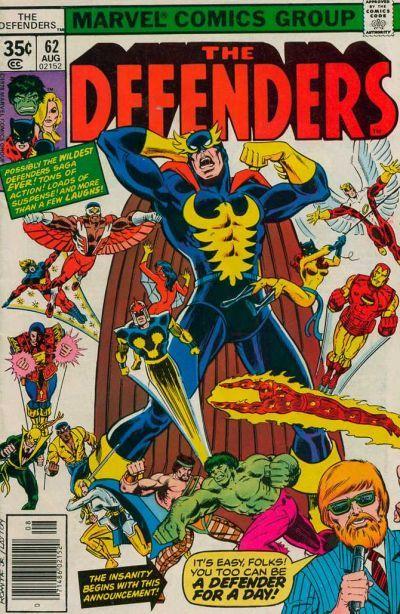
The Defenders – I liked this series because they were total losers as a group. “B”-team doesn’t cut it. Individually, they were only partially effective as superheroes, as a team, they were a joke…which was mostly the plot of the series, in between some personality switching, possession and, of course, fighting.

The key to enjoying the Defenders was to realize that each and every one of the individual members was significantly broken in some way and when they joined together to fight as a team, those problems were magnified, rather than minimized. In my memory, more of the story was taken up with them arguing with one another than ever effectively handling any problem they faced.

The Defenders became the home for all drop-out dysfunctional heroes who found it hard to play well with others, or who had argued with their real team and needed somewhere to go on a sulk.

My favorite character was Valkyrie (oh gosh, I’m sure that’s a total shock) but not because she was just a female warrior. She was a female warrior from Norse Mythology – that totally did it for me. In an early expression of cluelessness about feminism (that has now become so extreme that comics journalism is replete with articles and commentary on it) Val couldn’t hit other women, but happily beat the crap out of male chauvinists, which were, not all that surprisingly, all males, since obviously feminism=man-hating. To be fair, most of the men Val dealt with were pretty chavinist, and all the men were clueless. This does not appear to have changed much in recent years.


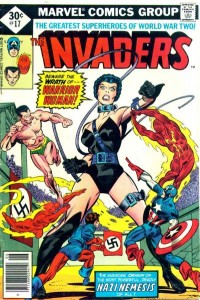
In high school, I discovered another deep love for a crappy comic. This time it was a retro look at the days when we were the good guys and the Nazis were the bad guys. The Invaders represented the Allies (well, the Allied countries and Submariner, because apparently the Nazis had it out for Atlantis too.)

I had this cover inside my high school locker. You’re probably assuming it’s because I found the idea of a leather-clad, giant female warrior physically attractive, but actually you’d be wrong.

My love for this cover has nothing to to with Krieger Frau herself, or the defeat of her and Master Man by the Invaders. My love of this cover has everything to do with a massive multi-media cross-over fanfic I wrote for about three years with a friend in high school. Krieger Frau just happens to looks a lot like the main bad guy in that fanfic. When I look at this cover, I see Snap Bar.

Nonetheless, there was joy to be found in the morality play that was a  look at the “good old days” of World War II. There is a freedom in knowing that we were right, and someone else was wrong and there were no questions about the ethics of clobbering bad guys.


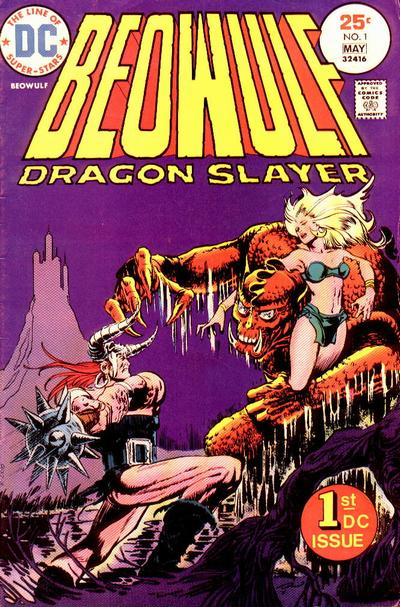
One of my prize possessions is a truly awful short-lived series by DC that was supposed to tell the Beowulf story, Beowulf Dragon Slayer. It didn’t. It strapped Beowulf into an uncomfortable-looking Michelin Man-esque costume, made of belts, and tortured a simple story beyond its own ability to tolerate. Many years later, I brought this series into my graduate class on Beowulf, and laughed while my classmates boggled that someone could get it so wrong.

This series really stands out for the inexplicable use of sentences written backwards as magical spells by the scop (who, in this series is a Druid-like wizard rather than a story-teller.) “Happy Birthday Caroline” becomes a  Lovecraftian incantation “Enilorac Yadhtrib Yppah!” Surely I wasn’t the only one to notice?

There were so many things wrong with this series, on every level – indifferent art,  incomprehensible story, that my reaction of loving it for its awfulness seems completely appropriate.


As I say, I love my awful comics. But there was one, finally, that I had to genuinely say was the absolute worst comic I ever read. It was killed at 13 issues, for which I was immensely thankful. Even I don’t know why it was created, except as a pathetic way to recreate the popularity of Spiderman, using all the wrong elements. Spiderman, you may remember, was a nebbish. He was a freelance photographer and a college student. He was a skinny, dorky guy. When the spider bit him, he did not suddenly become cool and suave – he was now a super-powered dorky guy. He cracked jokes to cover the fact that he was terrified. He now goes from dorky kid to cool dude in a matter of weeks, but that transformation took decades. In the 80s, he was still a dorky guy, a milquetoast by day, joke-cracking half-competent superhero in his free time.

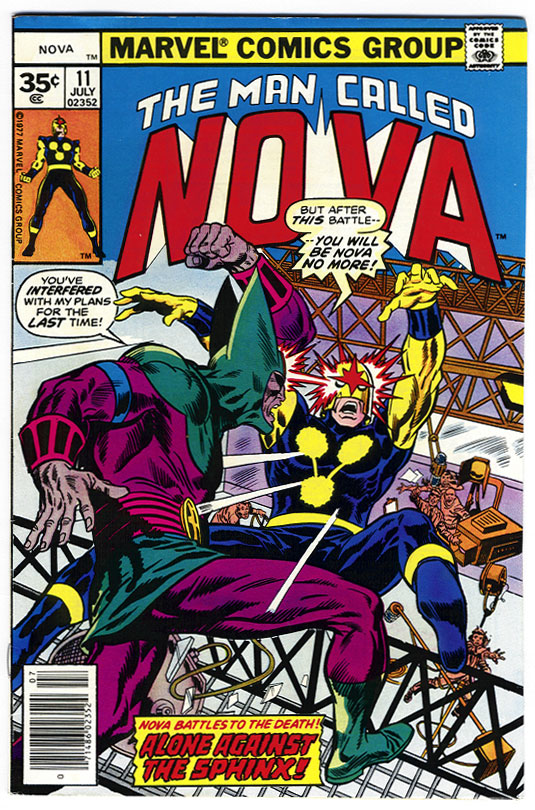
So Marvel, cognizant that this kind of character had a readership, decided to try again. They created The Man Called Nova. I know they rebooted Nova in the 2000s, but they really laid the dorky loser on with a trowel the first time around. If you have never read the original Nova, and want to see how bad a comic can be, see if you can find a copy and read this.

The main character, Richard Ryder, has all the awkwardness of Peter Parker, without any of his sincerity or charm. He’s supposed to a science student (I might be wrong in remembering it as physics) but shows no understanding of anything. The premise is similar to that of The Greatest American Hero, except that instead of losing the instruction booklet, Richard is given his suit by an alien and has to get used to the thing. The first several issues follow him picking fights with street punks. When he first encounters super-powered villians, he fails spectacularly. Maybe it was just the time and place, but when Nova wrapped up, I set it aside with a sense of relief.


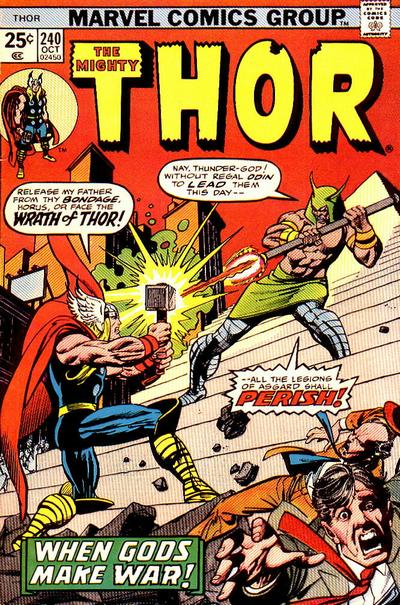
The one truly awful storyline that I adore with all my being from my American comics collecting days was when the ancient Egyptian gods kidnap and brainwash Odin into thinking he’s Osiris, in order to defeat Set. This storyline hit me in my weakest of weak spots – mythology as a hook. Could there really ever be anything sexier than Horus and Thor fighting on a pyramid, in order for Thor to retrieve his father? Yes, yes there could. There is a sequence mid-arc, where Horus and Thor fight together, on a giant causeway in space, against hordes of skeletons sent by Set, god of death (do not attempt to correct Marvel, they do not care about accuracy) while Jane beseeches Odin/Osiris to help his son.

Horus and Set fight one-on-one, while Thor protects Isis and Jane. Ultimately it is the human, Jane Foster, who awakens Odin from his trance, and so Horus is able to cast Set into the abyss of space and rescue his father, thus returning balance to the universe.

Now this is what comic books are all about.

It’s Nobody, Bitch

 
This first appeared on Splice Today.
_______________________

Of all the pre-processed, artificial, talentless pop blow-up dolls, Britney Spears is quite possibly the most processed, the most artificial, and the most talentless. Beyoncé can actually sing. Lady Gaga has performance art attitude. K$sha has rock and roll attitude. Rihanna has an accent. Even the relatively anonymous Ciara can dance.

In comparison, Britney is a cipher. Over the years, she’s mimicked a range of pop styles, from the faux-Beatles psychedelia of 1999’s “The Beat Goes On,” to the 2001 faux-Prince funk of “Boys.” But you never get the sense that those styles exactly influenced her, or that she even knows who Prince or the Beatles are. Without Michael Jackson, Justin Timberlake’s whole performance schtick would dissolve. Without Prince or the Beatles or even Madonna, Britney’s producers would just feed her something else. This is ludicrously illustrated in 2007’s Blackout, where whoever’s in charge decides to turn Britney into a confessional artist. On “Piece of Me” she coos and growls about her public meltdown and her kid and how unfair everyone is to her, and she sounds as engaged as if she’s reading someone else’s tax forms. When Christina Aguilera whines about her critics, she seems sincerely self-obsessed. For Britney, though, talking about her life is just another pose she can fail to carry off convincingly.

Which is absolutely not a bad thing. On the contrary, Britney’s utter lack of emotional investment in her own music has served her well throughout her career. The contrast with Xtina is instructive. Aguilera has 10 times the voice Britney does. But she also has at least that much more ambition, without any more discernible intelligence. Her increasingly desperate efforts to turn herself into something more respectable than a dumb pop singer—a classic diva! Lady Gaga! Anything! Help!—have resulted in one of the most embarrassing public careers in recent memory. For Xtina followers, her mangling of the national anthem wasn’t so much a horrible misstep as a logical culmination of her evolution as a singer. And I’m speaking as someone who liked Aguilera’s last album!

Britney’s had her own public disasters, of course. But they never seemed to touch her actual music, in large part because nothing touches her music. A Britney song has the perfect purity of an unwrapped Twinkie; it exists outside authenticity and time and art in an inviolable envelope of plastic. This has only become truer as her career as advanced. Way back on Baby, One More Time, Britney sounded almost human—on the first moans of that album she even came within a mortar shot of soul. No fear of that on the recently released Femme Fatale. Autotune was made for Britney and Britney for autotune. Her non-personality is systematically erased; she’s more herself than ever, which is to say she’s more no one.

Just because Femme Fatale is arguably Britney’s most characteristic album doesn’t necessarily mean it’s her best. The song selection overall certainly isn’t as strong as In the Zone, and I think Femme Fatale is a step down from her last effort, 2008’s Circus, as well. Still, there’s plenty to like. From the insanely catchy whistled hook of “I Wanna Go,” to the catchy and burpy low end on “Big Fat Bass,” producers Dr. Luke, Martin, Billboard and others pack the disc with enough gimmicks for an ABBA album or three. The sing-song girl-meets-bloop “How I Roll” does Robyn better than Robyn does. “I wanna go downtown where my posse’s at / got nine lives like a kitty cat,” turns streetwise posturing into music-box girl-group nonsense, an apotheosis of rapturously treacly yearning. But the highlight of studio fuckery may come on “(Drop Dead) Beautiful.” In the middle of casually objectifying some hot guy, Britney lets out a lascivious laugh which is almost instantly processed into a computerized squeal. It’s like the producers heard a flicker of sincere emotion and panicked. Drown it out! Drown it out! Where’s the confounded FX knob?

The totality of the self-effacement on Britney’s albums is definitely funny, arguably disturbing—and also, I think, kind of moving. For instance, at the beginning of “Inside Out,” Britney sings “gotta look my best if we’re gonna breakup.” It’s a wry, rather sad line, and it seems true as well—you want to impress the boyfriend more when he’s on the way out, though logically you should want to less. The lyric touches on a sense of being out of control, of trying to remake yourself to no good purpose.

I don’t think this is a glimpse of the real Britney. Someone else wrote it, and her delivery certainly doesn’t suggest she thought about it too hard. Rather, the lyric resonates with the fact that there is no real Britney. And that in turn points to a sometimes-neglected truth. Pop and love and life—they’re not just about swagger and personality. They’re also about disappearing into everyone and no one; about ominous, bitter, and sometimes sweet nothings. Britney is not the pop star as genius. But there is a kind of genius in the way she incarnates the pop star as nonentity.

Utilitarian Review 3/3/12

On HU

In our Featured Archive point this week, I talked about the sublime incoherence of Moto Hagio’s story, “A Drunken Dream.”

I discussed the bonus sexism of incompetent comics cheesecake.

I talked about war and masochism in Wonder Woman Chronicles volume 1.

Robert Stanley Martin discussed Anais Nin’s fiction of the 30s and 40s.

Kinukitty reviewed the manly assassin yaoi of This Night’s Everything.

I looked at Patrick Conlon and Michael Manning’s sci-fi fetish porn comic Tranceptor.

James Romberger looked at comics by Adrian Tomine, Steranko, Toth, Chester Brown, and more.

Joy DeLyria with a short history of long (and continuing) fiction.
 
Utilitarians Everywhere

At the Chicago Reader I review the magazine Midwestern Gothic. Neither Midwestern nor Gothic; discuss.

At Splice I argue that using children to make progressive points about schooling is not progressive.

At Splice Today I talk about how Sinead O’Connor hasn’t moved on.

 
Other Links

Virginia legislators stop being idiots.

Bad review bingo.

Tucker Stone has some almost nice things to say about Red Hood (plus other reviews.

Kelly Thompson explains that superhero women are not drawn equally.

Andrew Sullivan on the movie Bully and the MPA rating system. Linda Holmes on the same thing.

Alyssa Rosenberg expands on my thoughts on superhero cheesecake.

Depressing piece about sexism in the video game community.
 

To Make A Long Story . . . Long

People like long stories.  More than that, they seem to like stories that last a long time.

They also like short stories, and stories that take a short time, but people like massively long stories so much that sometimes they make the short stories into longer stories, which keep going, and going, and sequelling and sequelling, and rebooting and rebooting, and fanfictioning and publishing fanfictioning, ad infinitum.

As the rebooting and fanfictioning testify, it’s not necessarily the plots that people want to continue endlessly—or perhaps plots just aren’t sustainable over decades (centuries, in some cases) being discrete units, usually.  It’s the characters people want to live with, and the universes people want to live in.  They don’t just want to find out what happens next.  They want it to last.

Over time we have developed many, many ways in which to extend the life of universes and characters.  Those stories that are created with the intent to be lengthy, however, usually come in three main forms: the episodic narrative, the serial narrative, and—well, for lack of a better term—the episodic serial.

First, let’s get some definitions out of the way.  When talking about television, we use “episodic narrative” to refer to those programs in which entire plots are contained within an episode, and we use “serial narrative” to refer to those programs in which plots are comprised by multiple episodes, seasons, or the entire series.  Episodic narratives include I Love Lucy and M*A*S*H; serial narratives include The Wire and Deadwood. The main differentiation is continuity; you don’t have to see previous episodes of I Love Lucy to understand the plot of an episode; to fully understand an episode of The Wire, you need to see at least several episodes—and, for complete understanding, the entire series.

<“Episodic serial” refers to an amalgamation of the two; episodic serials may contain an A plot that is wrapped up by the end of the episode, with elements referring to the B plot, which lasts as long as the season or series.  Buffy the Vampire Slayer is a good example; some episodes contain the so-called “Monsters of the Week,” which are defeated by the episode’s end, but often bear some connection to the “Big Bad”—the villain Our Heroes spend the season fighting.  This means that you can watch an episode of Buffy and understand most of what is going on, but you wouldn’t get the whole picture unless you watch a whole season.

Although these days these terms are generally used to refer to television, we have always had all three forms throughout the history of narrative—though rather than three distinct forms, there has usually been a spectrum between serial and episodic.  Different societies and the media used to convey narrative have often favored one end of the spectrum or the other, often shifting fluidly from one end to the other and back again over time.  These shifts, rather than marked by changes in preferences or changing ideas regarding the quality of either form, seem mostly marked by the two factors that shift everything: money and technology.

Oral tradition contained all three forms, but the most prevalent fall on the episodic end of the spectrum.  This is most likely due to ease of memory.  Episodic narratives keep a constant universe and characters (and sometimes tone), but do not require memory of plot.  While serial narratives were (and are) common in oral tradition, it seems less likely that there were as many.  You can still add to an oral serial narrative, which is the beauty of it—you can make it last as long as you want.  However, you have to juggle lots of threads, if you want to write the next episode of The Iliad.  The next myth in which Zeus Gets Laid Again, not so much.  Without the technology of movable print, the narrative form that was easiest to recreate from memory was the one that was most common.

Movable type, invented in China in the eleventh century C.E., made works easier to reproduce, but it was still a pain.  As a result, many of the texts written after movable type and before the printing press are still episodic.  For both those using labor-intensive movable type, and those copying—rewriting, passing around, copying again, dictating, and rewriting again—works initially produced by hand, an episodic text would feel more manageable.  You don’t need every segment to make the story “work,” you could just distribute the segments you preferred, depending on your agenda, or only copy down the ones you thought worthwhile.  Again, it all comes down to ease.  In this case, it’s not that episodic narratives are easy to memorize, but they’re easier to produce.

With Gutenburg’s invention of the printing press, it was possible to get a long narrative, in its entirety, into someone’s hands with relative ease.  And thus marks a strange kind of bubble in the serial-episodic spectrum—because this is a strange kind of bubble in the history of Making Stories Last (A Long Time).

Works before the printing press, from The Iliad to The Canterbury Tales, were all stories produced and distributed over time.  Many of them could be added to—either by readers or the original authors.  The Tale of Genji, written over three hundred years before Canterbury Tales, and argued by some to be the first novel, was written by installments as the author distributed the stories at court; The Canterbury Tales were likely distributed a tale at a time.

While post-printing press romances or epics like Le Morte d’Arthur and two centuries later, Paradise Lost, are a lot more episodic than modern novels—or indeed, Enlightenment era novels—they were still published as single volumes.  Within, they were split into “books,” but they could all be read at once (if that’s even possible).  The intent was that they be sold at once.

So, while it can be argued that these works fall somewhere on the spectrum between serial and episodic, the works themselves mark a departure in the amount of time the consumer spends in the universe and with the characters.  A consumer may spend just as long inside the work, if she desires to do so; it certainly can be argued that these works are just as lengthy as many narratives produced before.  However, the consumer is not forced, as she once was, to wait (aka Make It Last).

The bubble burst with the invention of the steam press at the beginning of the nineteenth century.  The steam press allowed for quicker, cheaper printing, and the invention marked the newspaper boom.  Before this time, the printing press had certainly allowed for a democratization of knowledge, just like all our textbooks say.  Still, a book was a relatively large expenditure—and not the most practical one, as compared to say, a loaf of bread.  And in the past fifty years or so before the steam press, publishers were thinking up the genius scheme to “divide books for publication”—making one book three times as expensive, by splitting it into three volumes.

Newspapers, however, were cheap, and people who couldn’t afford books could often afford newspapers for a narrative fix.  Thereby, newspapers allowed for a revival of a time honored tradition: making you wait for your stories.  It began with episodic stories, probably due to the uncertainty in the early days of the newspaper boom—would this newspaper last?  Would people pick it up, and try a new one the next day, or would it earn a loyal following?  Could a serial narrative really work in this format?

Dickens’ first novel, The Pickwick Papers, isn’t actually really a novel.  It’s a series of shorts about a group of characters, set in a particular universe.  When it proved to be popular, publishers decided they could make money off of it by compiling the stories and selling them as a book.  Probably a three volume set.

As Dickens and episodic narrative-constructing contemporaries gained in popularity, and some newspapers stabilized, the serial form took a firmer hold in the Victorian era.  Most scholars mark a turning point between Dickens’ episodically structured novels and his serially structured ones; the serially structured ones still have distinct installments, but they also have tighter plots that depend on continuity to drive the plot forward.  Many of the most famous Victorian novels were written in installments, for which the Victorian audience had to wait.  Only later were these novels bound and sold in volume form.

By the end of the nineteenth century, however, the serial novel was going out of fashion.  One reason may have been continued improvements to presses, which allowed novels to be cheaper and cheaper.  Perhaps publishers realized they could sell more novels by producing works in one of volume and just demanding that they be shorter (Henry James didn’t listen).  Perhaps people decided following a story in a newspaper was too difficult—and yet, while the evolution of modern novels spelled the end of serial novels, it didn’t spell the end of Making It Last.

Newspapers, after all, were still in production, and concurrently with the growth of the single volume novel we know and love today, came the rise of comic strips.  Comics had always existed, of course, in various forms; some scholars would argue they existed before the written word.  However, the nineteenth century newspaper boom caused the comic to take great leaps in terms of both commentary and story-telling, and by the turn of the century, we had the antecedents to what we know today as the Sunday funnies.  Eventually—sort of like Dickens’ stories—strips were combined into books and sold as volumes.

As the serial novel started dying out and comic books started rising up, another medium that is engineered to Make It Last was on the rise—radio.  Radio had both episodic and serial forms, and episodic serial forms, but when we traded it for television, narrative went mostly episodic.

The first television shows were televised plays, but once the technology evolved, and a lot of the middle class and up had them in their homes, people were getting Lassie, Leave It To Beaver, The Andy Griffith Show.  Continuity on these shows would have been impractical, because unlike a newspaper, people couldn’t just pick it up and put it down.  No one was going to stop their day every day at five to watch a program on television, producers thought, so most consumers couldn’t “follow along.”

Then, instead of television shows being produced live, they were recorded, and there could be reruns, and then reruns began to show in syndication.  This made a little more continuity possible, because people could catch up with stories in reruns during hiatuses—or even enjoy the show the whole way through after its initial run on television, even if producers weren’t exactly writing to that possibility.

Next came the VCR, and suddenly people could tape things off television.  We start getting shows like The X-Files and later, Buffy—no longer episodic.  Serial episodic.

With the invention of the DVD, though, there’s another paradigm shift.  Suddenly, it’s possible to do an eighty episode show on HBO that is just as reliant—some would argue more so—on continuity as some of Dickens’ later works.  These suckers basically almost work like eighty hour movies, because you can go buy the whole set for fifty bucks—and isn’t that kind of just like Guttenburg; before, things are doled out in these small pieces, and then whammo—I can get all of The Wire and I can buy Paradise Lost right off the shelves.

Of course, there are a lot more threads to this, because there are a lot more media than books and television, and a lot of things going on in those media in particular.  Why the serial narrative torch was mostly carried by comic books, and was completely dropped by serial novels, for a large part of the twentieth century is a mystery.  While—since their emergence—comic books have always dwelt on a myriad of subject matter, it’s also a mystery as to why the superhero genre became so popular in the United States, when it was less so, for instance, in Japan.  There are no doubt cultural reasons, as well as coincidences of timing and circumstance—and, as always—technology and money.

While comic books have always been popular in the United States, in Japan, manga emerged as a prevalent media outlet.  From that emerged anime, which was making serial narrative a long time before HBO.  As for American television, there have also been soap operas longer than there has been shows like The Wire, and soaps are for more reliant on serial structure.  The reason for soaps probably has to do with audience.  The target audience was a group that could be in the same time, same place every day, so they evolved on a different arc than much of the rest of narrative television.

Though shifts in preferences along the serial-episodic narrative spectrum seem motivated by money and technology, the undercurrent to all of it could be something deeper (or it could be the same thing, really).  It’s all about Making It Last versus Getting It Now.

With Gutenburg’s invention, humans all seemed pretty happy with Getting It Now, and yet the first thing they did with the steam press was Make It Last.  This was motivated by money, as I described—people who could not afford novels could afford newspapers.  And yet, many people who could afford novels were reading serial installments in the papers—and then going to the extra extravagance of buying the book after it was all done.

These days, we watch the whole show as it airs and then go buy it on DVD.  Maybe we do this because serial installments and daily programming are just the way it’s done.  The first thing we did with television, after all, was Make It Last, but again, as I said, that seemed to be motivated by marketing decisions, and what technology made possible.  After all, I, for one, don’t prefer watching television week to week.  I would always just rather watch a whole show on DVD; I’m a Get It Now sort of person.

However, the Victorian style serial novel died out.  Our novels became lean, and along with Hemingway, quite mean (in the sense of lacking excess; Hemingway is only sometimes unkind).  Now that it is so easy to get a longer story on DVD, does that mean our television shows will become leaner—more like novels, or like movies?

The internet is our newest technology, and what are people doing with it, but writing Facebook and Twitter novels?  Oh, sure, people are doing all sort of things with it—they’re serially blogging, and breaking things up into installments so that they’re easier to read day to day, and Twitter novels don’t seem to have much at all to do with money or how to rope in a consumer to buy a higher volume of products.  They seem to be about wanting to spread things out, Make It Last.

After all, despite the economic reasons behind Making It Last for the consumer, there are plenty of narrative points in its favor.  Victorian novels are famous for their length and wandering pace, but their method of distribution made it possible to lay out a hundred different threads.  With each installment, these threads could slowly be picked one at a time, or put down, tied together with another thread, or unraveled a bit at a time (or dropped completely, as sometimes happens).

There seems to be no room for that, in many modern novels.  There is very little room for people sitting around talking; there is very little room for mutants sitting in the mansion talking about how life sucks.  There is very little room for Xander to go on his own adventure while Buffy, Willow, and Giles try to save the world, thanks.  There may be room, in a blogged novel, to do these things.  (I’m still not sure about Twitter, though.  There doesn’t seem to be room for anything.  Even this parenthetical is probably too long.)

Of course, there’s no way to draw any absolute, causal conclusions about the kind of narrative people want.  They want all kinds; when they Get It Now, they want to Make It Last.  When they get episodic, they want serial.  All of these different elements are in such a mish-mash of what is possible with current media, that in the end, it always seems to me that writers and creators are always going to find a way to do something different with it.

And publishers and producers are always going to find a way to make money off it.

Clarity and Intent

A few books by some of comics’ (male) best and brightest of several eras. Some of these have been out for awhile, but I only just got around to them.

_____________________________________________

Jon Fury in Japan

Alex Toth’s only extended stint on a continuity strip was done for his post newspaper when he was stationed in Tokyo in the Army in 1955. Jon Fury was his first effort writing for himself. While he could brilliantly interpret the scripts of others, Toth faced nearly insurmountable difficulties to construct his own. He tried to emulate Milton Caniff’s narrative mastery, but he certainly didn’t “get” one of Caniff’s greatest assets: his use of female characters of depth and agency. Toth is strictly old boy’s club, but truthfully his male characters are not much better defined. The storylines feel forced and they are riddled with overlong exposition to the extreme.  Despite these drawbacks, his art is highly developed and constrained only by the sheer weight of text; these are dynamic, elegantly designed episodic pages in the Caniffian Sunday format. More than any of his contemporaries, Toth reached for clarity of comics expression and here he exhibits his mature style in a serialized form, where weekly deadlines dissolved the hesitations dictated by his perfectionism.

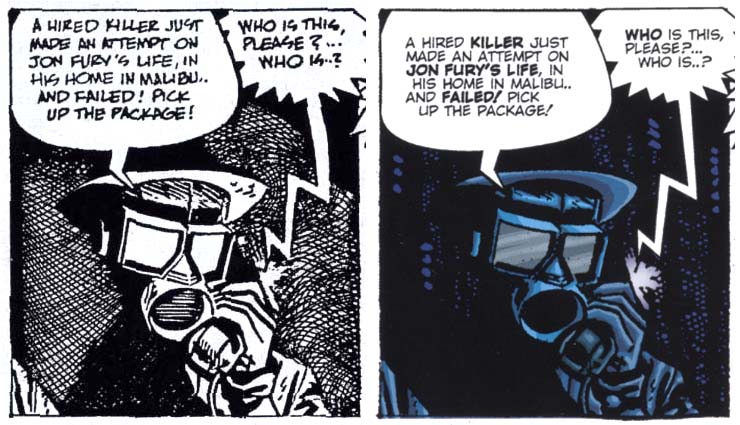
The late Toth did the work for black and white reproduction and so that is how it is seen in IDW’s recent Toth bio Genius, Isolated. The original art  was done in a process similar to mimeograph, basically drawn directly on waxy plates, which quickly begin to degenerate in the process of printing, even in such a small print run as these strips had, with the result that a complete pristine set is probably impossible to put together. The art restoration in the panel below from the slick color comic book version, Jon Fury In Japan, is definitely better than it is in IDW’s hardcover bio. In both recent versions, there are many minute amendments to the drawings by other hands; these are more pronounced in the color comic.


One panel’s restorations: left, from IDW’s version, right, from the comic.

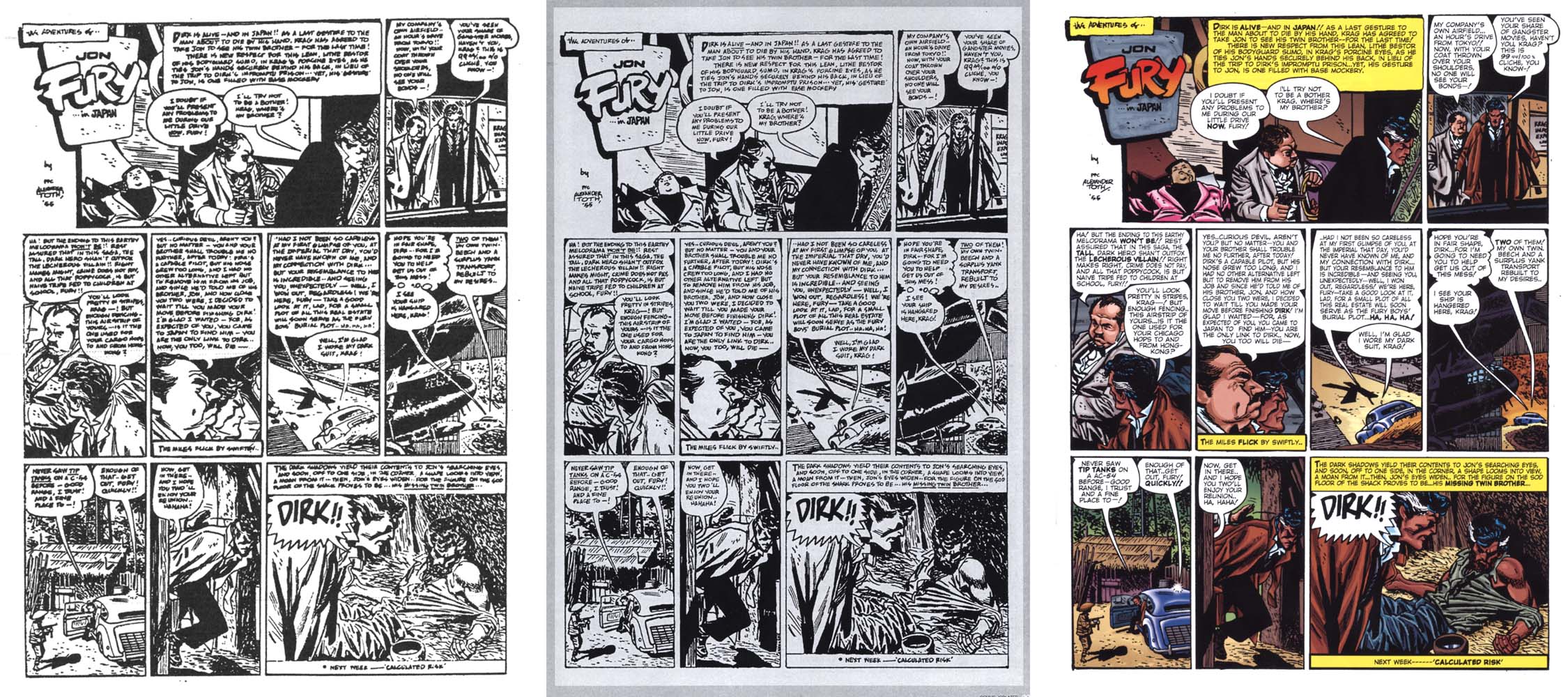
IDW’s reconstruction of Toth’s original lettering of the later pages is readable, but in the comic book version, Toth’s lettering has been removed on most of the pages, which are re-lettered with a cold and inconsistently scaled digital font. This may read easier, but the artist’s hand is lost. And, emphasis via bold type has been added to Toth’s dialogue. As well, if art done for black and white must be colored, Toth’s is better suited to flatter hues, a four color comic book or Sunday strip-like color. The example shown above is atypical; overall, the too-plastic fades and color modeling feel anachronistic to the period piece. Plus, although effort is made to color the protagonist as a native American, many color decisions are counterintuitive, for instance in the pink jacket of the thug also seen on the cover.

Left: xerox from the original printing. Center: IDW version. Right: color comic version.

Granted, the pages needed repair, but work so pared to its essence is subverted by overt interference, much less the overkill of the comic package. Fortunately, Jon Fury in Japan also contains Toth’s final interview, significant for its emphasis on his animation career. Other than a few questionable photos, this has a good selection of panels by Toth and his influences and the coloring imposed on these is more appropriately restrained. (Paul Power, $11.00)

_______________________________________________________

“Red Tide” in Dark Horse Presents #3

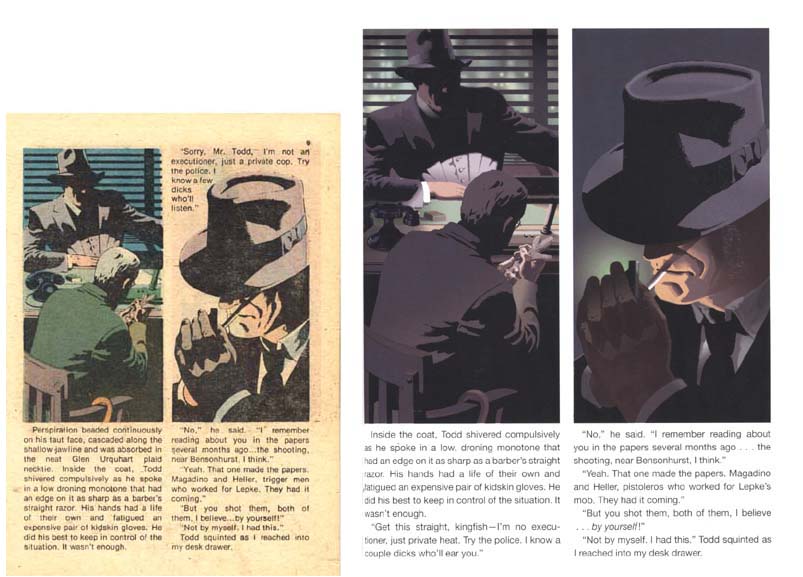
Chandler: Red Tide was released to the  book trade in 1976 as the first American original full-color mass-market graphic novel. It represents Jim Steranko’s longest, most ambitious auteur effort in the comics medium to date. The two-panel-a-page layout with dual type blocks underneath is constructed in such a way as to be unusually immersive; in the act of reading, the obviously separated art and text come to simultaneous apprehension. The art was drawn in pencil without feathering and with minimal holding lines; Steranko’s excellent comics-like color separations often define the forms. The original book has a pulpy chiaroscuro feel that echoes the great noir films to which the story effectively pays homage. The representations are likewise mostly typical of the hard boiled dick genre; for instance, the protagonist and the leading lady have a prior history and her passion is reignited when she senses “something more than anger behind” his slap. On the other hand, there are appearances by a lesbian cab driver.

A reissue of Red Tide enhanced by the author has been looming  for years and now here’s a taste with an excerpt of the first chapter, in Dark Horse’s slick house anthology title. Steranko expands the possibilities of digital color while reiterating that cartooning devices like holding lines, heavy outlines developed to contain badly-registered color inks, are no longer essential with tight full color printing. He transforms and rebuilds his images into layered digital paintings that greatly resemble the airbrushed Art Deco graphics and advertising art of the period depicted. There is an impressive depth to some of the images that far outstrips what he was able to do in the method of the first printing.  He is able to amplify the visual connection to Chandler’s milieu with contemporary tools while exploring the intrinsic qualities of those tools with imaginative verve.

Perhaps this new version puts undue emphasis on the images, in terms of the time involved in the readers’ perception of them relative to the reading time of the text. The expanded density of the art as well as the altered justification of the type blocks conspire to disrupt the 2/1 art-to-type ratio which is key to Steranko’s immersion formula, one of the most important virtues of the book.

Still, any new (or newish) comics by Steranko are welcomed. What he did with these pages is very interesting and no doubt the completion of the augmented edition will be impressive. I can see the amount of time and effort he has to put in to finish the whole book to the level of this excerpt though, and so perhaps in the meantime, Red Tide can be put out in a nice facsimile edition so it can get the attention it has long deserved and he can finish this new enhancement as he will, without pressure. (Dark Horse, $7.99)

_______________________________________________________

Is That All There Is?

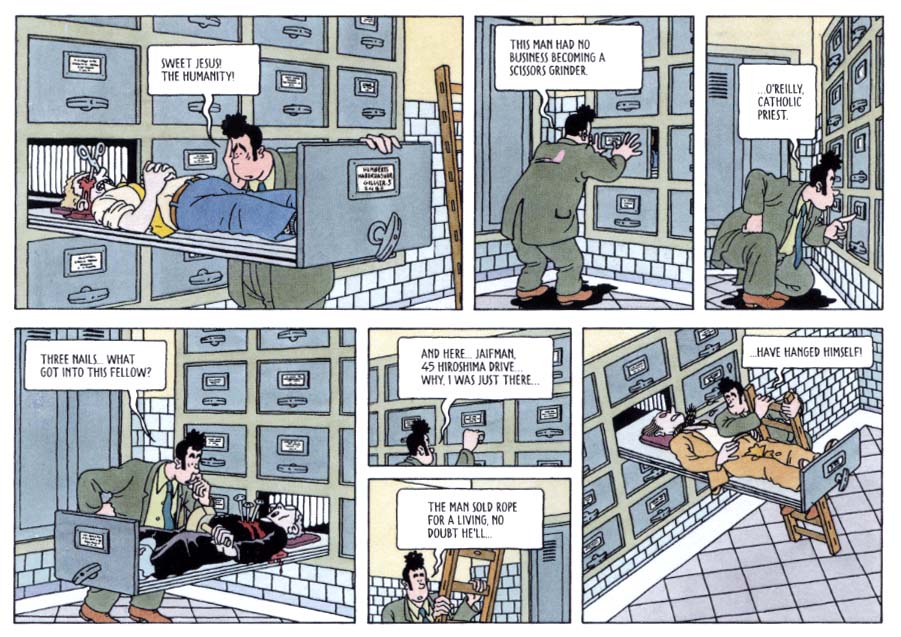
I recently read a review of Joost Swarte’s collection of most of his comics work that complained of the scale of this small hardcover, but I think it has a jewel-like quality. It is a beautiful little book that one can delve into periodically to simply enjoy Swarte’s exactingly rendered, beautifully colored comics pages.

The art is the thing here. While there are some engagingly animated sequences, the stories seem mostly clever, sometimes flimsy cause-and-effect variations created as supports for Swarte’s meticulous cartooning science. As with Toth, the more interesting aspect of the work is the way that the art manifests the ideas, such as they are—Swarte is a master of page architecture and image construction and he also has a tendency to reflexively expose his practice, which is why he is so revered by comics structuralists such as Art Spiegelman. The Franco-Belgian clear line derived from Herge and his forms of representation have their most refined outlet in Swarte’s short absurdities, reprinted from his Modern Papier and a host of other comics periodicals here and abroad including Metal Hurlant, Charlie and Raw. (Fantagraphics,$35.00)

_______________________________________________________

Madwoman of the Sacred Heart

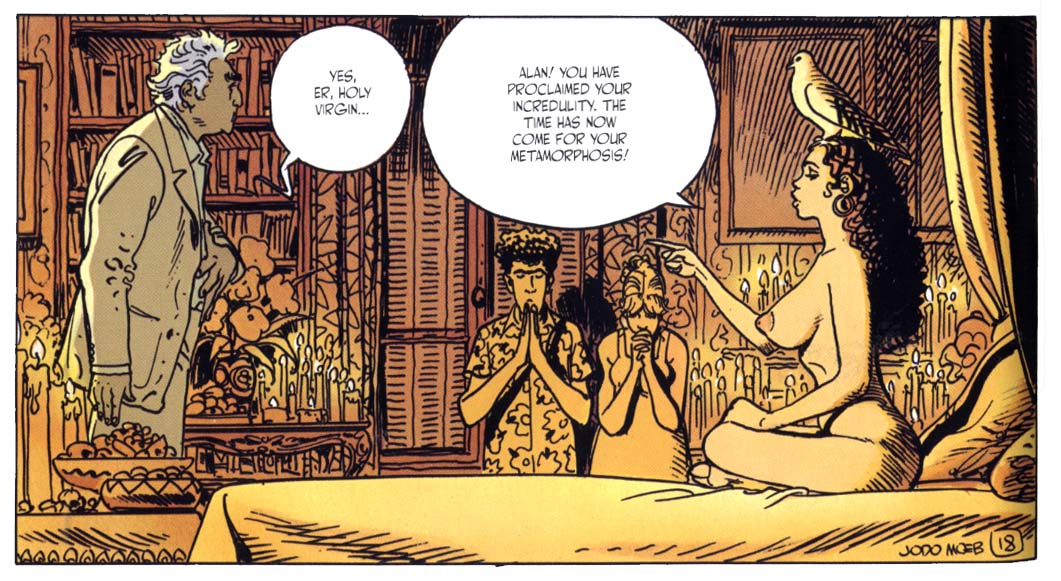
I love the recent translation of Alexandro Jodorowsky and Moebius’  Madwoman of the Sacred Heart. A black and white version published in the USA in 1996 contained only the first two parts (it was completed in 1998). This  full color trade paperback of the complete Madwoman shows the best efforts of both men, far outstripping their earlier collaborations on The Eyes of the Cat and The Incal trilogy. Jodorowsky’s scenario is hilarious, an incisive and compulsively readable satire of sex and religion, for starters, that offers Moebius the opportunity to draw his single most immersive work of comics storytelling. The seemingly effortless flow of Moebius’ panels here rivals the reduced clarity of the best of Alex Toth’s 1950s Dell comics.

The book is a prime example of text and art reading together as equal forces at the service of the narrative. There are plenty of places for writer and artist to shine, but one is rarely brought out of the narrative to marvel at the construction, even when it frequently veers to philosophical discourse or transcendent visualization. I usually complain if Moebius does not do his own coloring, but here several colorists did an effectively punchy but tasteful, organic job of it; even if it is digital, most of the color looks like painted bluelines.

My first impression was that it takes some considerable suspension of belief to accept that the Heinleinesque protagonist (who is apparently an amalgam of the authors) holds such sexual magnetism for beautiful young women (and men), but Marguerite informs me that the French have such high regard for their intellectual heroes that an elder philosophy professor from the Sorbonne might indeed be considered quite sexy. At any rate, Jodorowsky and Moebius’ trangressively libidinous epic is played out so beautifully, without ever feeling forced, that the ride is taken willingly and has many rewards. (Humanoids,$24.95)
_______________________________________________________

Paying For It

Chester Brown has represented freedom to me for such brilliant improvisations as his original complete version of Ed the Happy Clown and The Little Man and I also admire his Biblical adaptations and Louis Riel—but Paying For It is a constricted,  joyless business. As a comic by Brown this has a certain mastery of form and the art is technically as good as ever, but the reader barely notices it, because to a large degree the art serves only to drive the reader through the book. It is primarily a reading machine and one is driven to focus on what is being said in Chester’s voice in the form of a memoir.

I would have little interest in reading such a john’s-eye view in prose form and as johns go, I am not made to feel sympathetic to Brown. He frets briefly about the possibility of an undercover sting, but where prostitution is a crime, it is one that prostitutes are prosecuted for, not johns. He worries a lot about being robbed and the expense, the money. He is concerned about girls that look too young, but for his  liability alone, one assumes, because he can hardly tell if they are of the age of consent, or not:  he declines to have sex with any women above a very young age, although he himself is forty and stretched a bit tight, at that. I’m no oil painting either, but really, it can’t be much of an aesthetic experience for the women that have to deal with him and they could be his daughters.

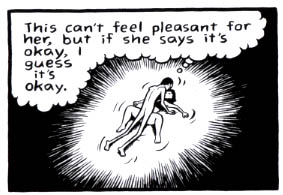
The exhibitionism here is similar to his ruthlessly honest explorations of his teenage years in the later Yummy Furs, but here, the whole gives off an aura of creepiness on the part of its author. Sex is to Brown reduced to a physical function, it’s all about him and his pleasure or release. Brown doesn’t draw the faces of the prostitutes he visits—well, except for panels such as those I scanned. Ostensibly for the reason of preserving their anonymity, his ploy effectively dehumanizes and reduces them to 3-dimensional versions of the bodies of the Playboy playmates he masturbated over in his youth. He essentially jerks off with real people! Actually, drawn as cartoons, they again become 2-dimensional and there is little variation to distinguish the progression of faceless women at all.

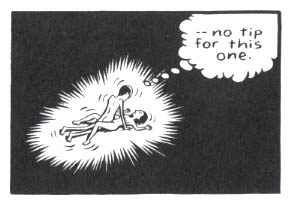
I don’t dispute the case he makes in his comic and annotations for the escorts, but the show of concern he makes for their circumstances. One gets the sense that Brown wouldn’t care about or do art about any of it, if he wasn’t trying to justify his involvement. In practice he seems devoid of empathy or affection. We are treated to many panels drawn from an overhead, Brueghelesque perspective of Brown banging away hell-bent for leather, getting his money’s worth. He can motivate himself to solicit prostitutes and then do the years of work involved in a graphic novel and share himself with the world, but he can’t get it up to fight for love. All the effort that goes into a relationship…who needs it?  In this case, listening to his friends might have helped; they all try to give him good advice. But, as his pal Seth says, “Chet’s a robot.”

He’s also a cheapskate:  he’s not the one “paying for it.” We who buy the book are and in addition, this thing was subsidized by generous grants! It’s fucking depressing. (Drawn and Quarterly, $24.95)

_______________________________________________________
“Amber Sweet” in Optic Nerve #12

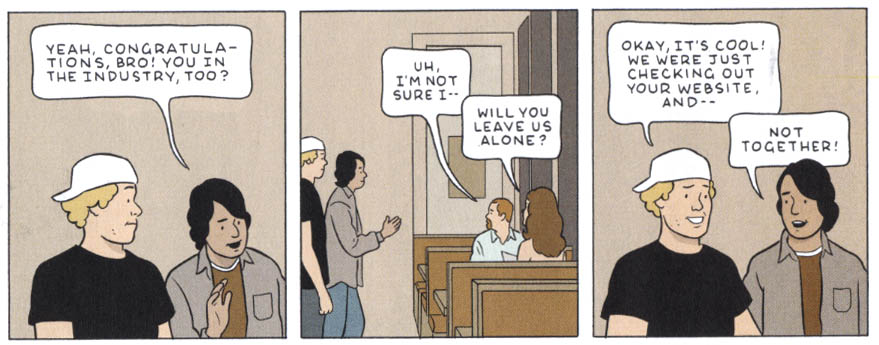
Adrian Tomine uses his work to thoughtfully explore multicultural and  interpersonal relations. His work exemplifies the reader immersion and simultaneous cool remove that a refined visual orchestration can lend to a narrative.  “Amber Sweet” is an expanded version of Tomine’s great piece from the massive Kramer’s Ergot #7. His concise and elegant drawings and color give a measured, airy tone to his ironic tale of the torments endured by a young woman because of her resemblance to a well-known porn star. When they meet, the contrast is telling: the real Amber is self-possessed; she handles her admirers with a blithe “Hey! What’s up?” or poses with them for a picture, butters them up a bit and then brushes them off. It is her choice to do what she does, but her choice has inadvertently isolated her doppleganger, who is continually harrassed by aggressive men. This destroys the relationships of “not-Amber,” whose eventual distrust of all men is often justified. This is underlined by Tomine in the scene below, in which two young men impose themselves upon her, denying the implications of their simultaneous wanking while assuming her companion’s complicity in their homosocialism. (Drawn and Quarterly, $5.95)