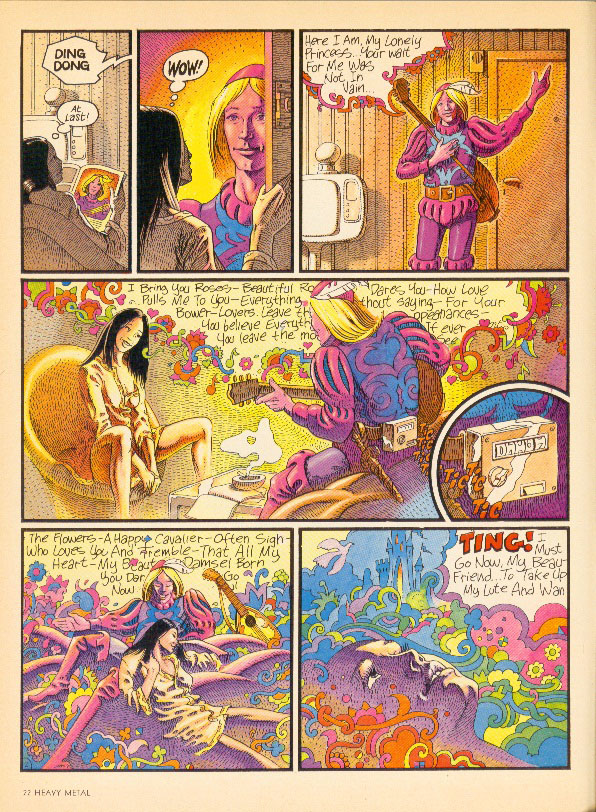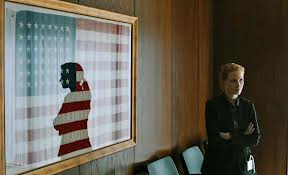
Did You Steal Your Eyes, I Wonder?

We’re all drunkards here. Harlots.
Joylessly we’re stuck together.
On the walls, scarlet
Flowers, birds of a feather

Pine for clouds. Your black pipe
Makes strange shapes rise.
I wear my skirt tight
To my slim thighs.

Windows tightly shut.
What’s that? Frost? Thunder?
Did you steal your eyes, I wonder,
From a cautious cat?

O my heart, how you yearn
For your dying hour…
And that woman dancing there
Will eternally burn.
— Anna Akhmatova, 1913, trans. from the Russian by D.M. Thomas

The meaning in words is hard to find, and some say the meaning’s not the art. So watch the images, I guess. Flat concupiscence on the page — scarlet openings. The sin in your head you can’t wash out; a thought bubble scribbled around the edge gets you off like a child. Put that smoke in the pipe, father, and up it goes — a border for those thighs. Tight together the windows like panels squeeze; one furry cat for a close up, cute marketing genius. And then the picture that moves and doesn’t move; time’s a space — a sequence in hell or melodrama.

I’m not sure how not to think of harlots, nor the drunkards staggering and never saying “drunk”. Stay in the lines, words, and we’ll look over here, at the icon that sings and will save us if only we gouge out our eyes.
 
_________
The entire roundtable Attack of the Literaries is here.
 

Utilitarian Review 2/22/13

On HU

Featured Archive Post Kathryn Van Arondonk on metaness and Fringe.

Me on Ke$ha and the new man of rock (massive comments thread featuring Charles Reece.)

James Romberger interviews Tom Kaczynski.

RM Rhodes on Ted White’s year as editor of Heavy Metal in 1980.

Joy Delyria on how Captain America is real (plus fan art by my son.)

Isaac Butler on reality, torture, and Zero Dark Thirty.

music sharing post featuring Miranda Lambert’s “Me And Your Cigarettes.”
 
Utilitarians Everywhere

At Reason I’ve got a piece on public diplomacy and advertising imperialism.

This week at the Atlantic I wrote about:

Superman, Orson Scott Card, and the KKK.

Star Wars’ timid approach to gender.

—The awesome eco-apocalypse metal of Botanist.

—Boring parenting stories and some that are less boring.

This week at Splice Today I wrote about:

Whatever happened to Brooke Valentine.

—Why liberals should learn to love the sequester. (It’s because we hate America.)

And as a bonus, I join the long list of people who have been trolled by Jpod.
 
Other Links

7 Miles a Second by David Wojnarowicz, James Romberger, and Marguerite Van Cook was at number 5 on the NYT best selling graphic novels list.

Dan Kois on the morality of tilting your seat in an airplane.

Mary McCarthy on how her vagina hates spin class.
 
This Week’s Reading

I reread D.M. Thomas’ “The White Hotel”, which I think I liked even more this time round. (Has anyone ever read anything else by him?) Started Ursula K. Le Guin’s Left Hand of Darkness (also a reread from long ago.)
 

images

Friday Utilitarian Music: Me and Your Cigarettes

images

I have conflicted feelings about Miranda Lambert, but I do like this song quite a bit. There’s something about that high-gloss production and her twang that gets me, I’ll admit it.

 
And…let’s see if this works…I believe you should be able to download the file here:Me and Your Cigarettes

So what have you all been listening to this week?

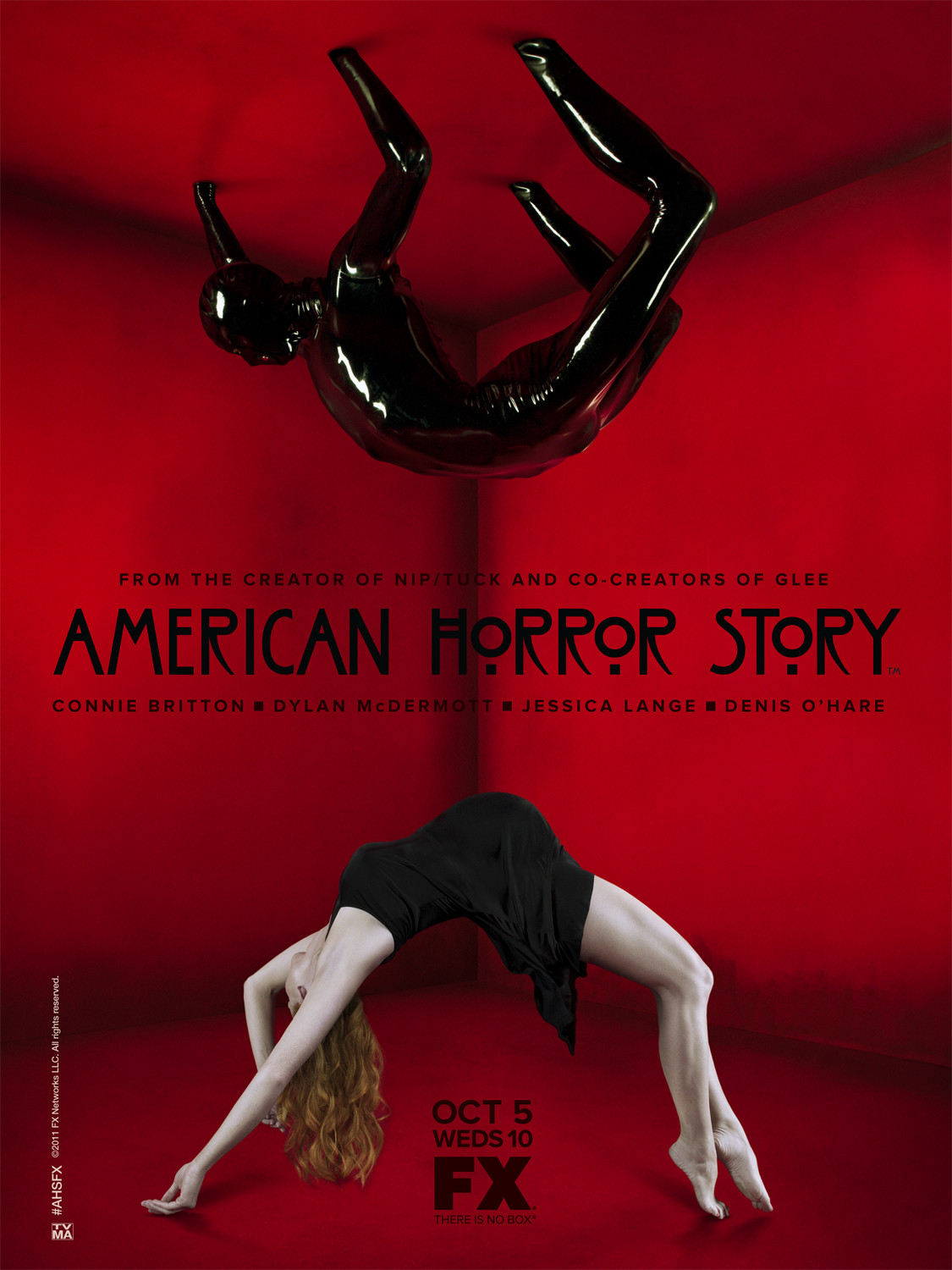
American Horror

american-horror-story-poster-01

American Horror Story, Season 1, 2012-13

Produced by Ryan Murphy and Brad Falchuk
Cast:    Dylan McDermott
Connie Britton
Jessica Lange
Evan Peters
Taissa Farmiga

“American Horror Story” begins with Vivien Harmon (Connie Britton) discovering her husband, Ben (Dylan McDermott), in bed with one of his patients. To keep the family together (and move the plot forward) Ben convinces his angry wife and sullen daughter (Taissa Farmiga) to move to California and start over. They manage to purchase an old mansion at a bargain price, but soon discover that the reason the mansion was such a steal is due to its unpleasant history – most of its former residents were murdered. Even worse, “murder house” is filled with so many ghosts that they’re practically tripping over each other – a mad doctor from the Jazz Age, student nurses from the 60’s, a sexy maid from the 80’s, a psychotic teenager (Evan Peters) from the 90’s, and the gay couple who owned the house prior to the Harmons. And there are freakier residents, including a monster baby and the show’s most recognizable figure, the “Rubber Man,” who dresses in a skin-tight bondage suit complete with gimp mask. Rubber Man is the show’s main trouble-maker, and in one of the early episodes he rapes Vivien and impregnates her with a demonic baby. If that weren’t bad enough, the Harmons’ next door neighbor is Constance (Jessica Lange), a schemer who knows far more about the ghosts than she initially lets on.

The horror genre on television does not have an illustrious history. There are many people who get nostalgic for “The Twilight Zone” or “Tales from the Dark Side,” though those people have terrible memories because 90% of their episodes were crap. And those shows preferred the “anthology” approach, where every episode was a discreet narrative. Serialized television (where every episode is part of a single, larger narrative) has an even worse track record. For every hit like “The X-Files” there are ten flops like “The River.” Unfortunately, “American Horror Story” continues the long trend of shitty television horror.

Which is not to say that it doesn’t have its charms. Unlike “The River,” “American Horror Story” is not an complete debacle. While hardly innovative, it is a polished and professional-looking TV series. The basic premise – troubled family moves into a haunted house – is a simple but effective setup for a horror story. The series is also deliberately campy, which helps offset its tendency towards soapy melodrama (more on that below). The cast is quite impressive for basic cable, and the acting is generally good. The one weak link is Connie Britton, who responds to every situation with a look of dim-witted confusion. But Jessica Lange more than makes up for any other actor’s poor performance. Recognizing the show’s campiness and its debt to Southern Gothic horror, she plays a character that combines two archetypes: the Faded Southern Belle and the Evil Bitch Mama. Constance is by far the most entertaining character in the series, motherly one minute and crazy, narcissistic, and cruel the next. And she’s completely unafraid of the ghosts, treating most of them with barely concealed contempt.

But the series has many failings. Some of the ghosts, like the mad doctor, are entertaining in a goofy way. Others, like the the Rubber Man, are genuinely creepy (at least at first). But most of the ghosts are forgettable or annoying. Another problem is that death doesn’t seem like a big deal, which removes much of the potential tension. Sure, the ghosts are trapped in the house (except on Halloween), but otherwise they’re free to continue their un-lives however they choose. Plus, they don’t age, they can’t be permanently injured, and they can even have sex with the living or each other. The show also has a bad habit of raising interesting issues, and then addressing with them in a glib manner. For example, the psychotic teenager, Tate, killed other kids in a school shooting before he died. It’s a big, important “hot button” issue … that just kind of sits there. I might be offended if I weren’t so bored. The show also bills itself as psychosexual horror (according to the description in Netflix), but while there is sex, the psychology is absent. Rubber Man is obviously a BDSM monster, but there’s very little actual BDSM in the series. So after his initial appearance, Rubber Man becomes just another mystery villain whose identity will be revealed … during sweeps!

For all its other problems, “American Horror Story” largely fails at being horror because it has to be a TV series. This means soapy sub-plots, because TV producers believe that every show must have them. The teenage daughter must fall in love with one of the ghosts, and there must be drama and tears because Ben is an adulterer. In a soap opera, these plots might be relevant, but in a show called “American HORROR Story” they’re distracting at best, mind-numbing at worst. And the critical flaw in the series is that it both wants and needs the viewers to care about the Harmons, who are the lead characters and the emotional core of the series. The problem is that the Harmons are a typical middle class family on television, which is another way of saying they’re obnoxious assholes. In any halfway-decent horror story, the audience would get to relish the horrific punishment meted out to the Harmons. But this is prime time television in America, so we’re supposed to root for the family to overcome all odds and live happily ever after. [Spoiler alert!] To its credit, the season did not end with the family walking off into the sunset. Instead, all three Harmons died in the house and continued on as a ghost family. A surprise twist, and a clever show might have turned that into a truly horrific ending. Imagine spending the rest of eternity with the most tedious and/or annoying members of your family, with no one ever able to grow, change, or move out. But in this series, were supposed to find it bittersweet and touching that the family will be together forever. In the end, they even decorate a Christmas tree! Or maybe it’s the ghost of a Christmas tree.

Once again, a horror series has let me down.

Based on a True Story: Thinking About Talking About Watching “Zero Dark Thirty”

images

 
(1)  Even before you see the movie it seems like you’ve seen it. This isn’t only because Mark Boal’s screenplay is so sparse—under 10,000 words, apparently—that almost all of its memorable lines and moments are in the previews, largely in chronological order. No. Before you’ve seen Zero Dark Thirty, it’s likely that you already have some knowledge of and feelings about the film, thanks to a wide-ranging debate about whether or not ZD30 endorses torture.

(2)   “As a moral statement, Zero Dark Thirty is borderline fascistic. As a piece of cinema, it’s phenomenally gripping — an unholy masterwork. The first masterstroke is the first thing you see — or, rather, don’t see. Under a black screen, the sounds of 9/11 build: a hubbub of confusion, reports of a plane hitting the World Trade Center, and then, most terribly, the voice of a woman crying out to a 911 operator who tries vainly to assure her she’ll be okay. She won’t be. That prologue looks like restraint — there are no sensationalistic images — but it’s cruel: The recordings are genuine. You want revenge so much it hurts, but you’ll have to live with the pain because the ­sonovabitch bastard Muslims who killed that poor woman are elusive, and when you catch them they won’t talk. The next scene, a brutal interrogation at a CIA “black site,” is unpleasant but not unwelcome. To paraphrase Dick Cheney, you sometimes have to go to the dark side, and the big, bearded Dan (Jason Clarke) has made the trip…” – David Edelstein, New York.

(3)  “Portrayal is not endorsement.” – Kathryn Bigelow, director of Zero Dark Thirty.

(4)  Kathryn Bigelow didn’t actually say that. She said something similar to it and I summarized it. I conflated her words into other words, to make her argument simpler and clearer. I’m actually owning up to that here. The creators of Zero Dark Thirty, Mark Boal and Kathryn Bigelow, do not do the same with their film. Instead, it begins with a title card saying that it’s Based On A True Story.  “Just like The Texas Chainsaw Massacre!” I thought to myself.

(5)  We live in a time inundated with “true” stories that are also “good” stories. Many of these stories turn out to not be true in the sense of factually accurate, even as their creators will claim that they are true in the sense of “getting to an emotional/personal/spiritual/political/etc. reality.”  Ultimately, true can have a lot of meanings.  So, it turns out, can good.

(6)  Right after the title card, the film cuts to a black screen with audio of real phone calls from inside the towers on 9/11. Whatever emotional purpose this serves—I was in New York on 9/11, and was so horrified by this sequence I nearly left the theater—there’s a signaling purpose here. This Is Real, the phone calls attest.  This Happened. In a way, the phone call sequence abrogates the hedging of “based on a true story.” It sets up a tacit contract that we’re getting at something close to the truth. This was only reinforced by the misguided and self-important pre-release decision on Boal and Bigelow’s part to portray the movie as somehow a just-the-facts-ma’am depiction of the hunt for Bin Laden derived from their exclusive “journalistic” access to people involved.

(7)  I should probably just note here that several characters in ZD30, including its protagonist, are composites. In other words, they don’t exist and stand in for groups of people.  This is in line with other Based On A True Story narratives, but also worth noting.

(8)  It seems in ZD30’s case that the multiplex and not the newspaper is going to be the first draft of history. Many more people have already seen Zero Dark Thirty than will ever read Mark Bowden’s The Finish, an actual-nonfiction prose account of the same story. Does this increase the film’s obligation to get the facts right? Or is its higher obligation to be a compelling work of quality cinematic entertainment? Or art, for that matter? Without the pre-release interview blitz on Bigelow and Boal’s part, would this obligation have changed? What, in other words, is the value of the truth here?

(9)Creative Nonfiction, the genre of writing I largely work in, is an odd beast, engaging with complementary, occasionally competing, systems of worth.  On one level, there’s the aesthetic worth of a particular work, and on the other there’s its truth value. The truth is a difficult beast. The work we create is both enhanced and restricted by it. Audiences and readers are far more forgiving of narrative structure issues (for example) in true stories because they are true, because on some level we recognize that fictional narratives are able to “cheat” in order to satisfy us. Works with a high level of truth value can often get away with being on some level aesthetically unsatisfying, while works that are exquisitely crafted are often able to elide some of the problems of the truth, be they gaps in memory, or conflicting accounts, or a baggy structure, or what have you. Part of what is at work with Zero Dark Thrity’s first five minutes and with Boal and Bigelow’s publicity tour is an attempt to sell you on the work’s truth value prior to your having any experience of its aesthetic one.

(10)Were it not for this, I do not believe the debate over the use of torture in the film would be occurring. Were the film about a CIA agent pursuing, say, Homeland’s Abu Nazir, with a 9/11-like terrorist attack in the first shot, I don’t think anyone would care, not really. More importantly, they wouldn’t be so sure that they were so sure about the film’s stance towards torture, as ZD30 isn’t nearly as cut and dry as everyone seems to be pretending it is.

(11)The case against torture—one I find persuasive, to be clear—rests on two arguments: morality and effectiveness.  Simply put: Torture is wrong and it doesn’t work. These aren’t completely separate. While we’re all fond of the expression the ends don’t justify the means, the truth of the matter is we often make decisions about morality and ethics based on whether or not a specific end is worth a specific mean. So one of the reasons why torture is wrong is because it doesn’t work. The ends—shoddy intel, innocent people destroyed, the dehumanizing effect on the torturer, the cost to our moral standing etc.—aren’t worth whatever crumbs we’d get from torturing people. It’s helpful then to think about Zero Dark Thirty in terms of both of these standards. Does it portray torture as effective? And how does it portray it morally?

(12) The answer to the first question is complicated, but I believe that the movie has its thumb on the scale in favor of torture’s effectiveness.

(13) ZD30  is divided into roughly two halves, one about the CIA’s failure to find Bin Laden, and one about its success. The torture takes place entirely during the “failure” half of the film, and there are many moments in this half where it’s made at least tacitly clear that the CIA isn’t getting anywhere with torturing people.  Also, the one piece of important intel—the name of Bin Laden’s courier—comes as the direct result not of torture but rather from an old interrogation room bluff: Jessica Chastain’s Maya and Jason Clarke’s Dan convince a detainee that he has already helped them and he gives them the name.

(14) It’s easy to point to this and say “see, the film is showing that old school law enforcement tactics work and torture doesn’t,” and, indeed, some have. The problem is that this bluff only works because the detainee has been waterboarded, starved, sleep deprived, beaten, walked around like a dog and shoved in a small wooden box until his short-term memory has disintegrated, allowing them to convince him that he has forgotten helping them. Later on, Maya interrogates a different detainee who says without prompting, “I don’t want to be tortured anymore, I’ll tell you whatever you want.” He provides no useful information, but he provides the next moment of narrative satisfaction to the audience, by intoning the ominous line “he is one of the disappeared ones.” Torture is thus narratively effective in the film regardless of how effective it is as an intel-gathering tool.

(15) Oh yeah, there’s also the glaring fact that torture did not, in real life, get us the name of the courier.

(16) “‘The film creates the strong impression that the enhanced interrogation techniques that were part of our former detention and interrogation program were the key to finding Bin Laden,’ acting CIA Director Mike Morell wrote in a letter to employees in December. ‘That impression is false.’ The Senate intelligence committee, which last month completed a 6,000-page report on the CIA interrogation program based on its examination of 6 million pages of CIA records, was more definitive: ‘The CIA did not first learn about the existence of the UBL courier from CIA detainees subjected to coercive interrogation techniques. Nor did the CIA discover the courier’s identity from CIA detainees subjected to coercive techniques.’ Yet in their film, Bigelow and Boal depict the exact opposite.” – Adam Serwer, Mother Jones.

(17) “Torture may be morally wrong, and it may not be the best way to obtain information from detainees, but it played a role in America’s messy, decade-long pursuit of Osama bin Laden, and Zero Dark Thirty is right to portray that fact.” – Mark Bowden.

(18)  The film also contains many moments where characters go to bat for the efficacy of torture and not one moment in which anyone repudiates it.  This would be excusable by the dictates of realism (it’s doubtful CIA torturers would sit around talking about how it doesn’t work) were it not for the film’s inclusion of a scene where Mark Strong’s “George” argues that torture works to Stephen Dillane’s “National Security Advisor”—a guy who is fairly clearly based at least in part on White House Chief of Staff Rahm Emmanuel, by reputation the most argumentative man alive—and NSA/Rahm doesn’t argue about it.

(19) Regardless of its view on torture’s effectiveness, there is the question of ZD30’s take on the morality of torture. And it is here that the movie is at its most troubling, if most interesting. For Zero Dark Thirty has absolutely no moral perspective on torture.  It’s an essentially amoral film.  It’s not immoral. It’s view towards torture is not, say, 24’s, where it always works and is always awesome and the people who get tortured deserve it. Nor is it, say, Man on Fire where torture is the hilariously over the top and necessary path that Denzel Washington must take to find Dakota Fanning.

(20) In Zero Dark Thirty, torture is simply shown, generally in a filmic style we associate with “objectivity”: no underscoring, documentary-like cutting and camera movement, few POV shots, etc.  Much has been made of a few quick shots of Maya wincing, folding her arms, or otherwise seeming to disapprove of the interrogation she’s seeing. Yet, given that we later learn that in these first scenes she is at most 22 years old, and given that eventually she embraces torture, these moments can also be read as the squeamishness of the Rookie Cop who is about to become the Lone Crusader Who Works To Buck The System, Jimmy McNulty with better bone structure.

(21) Does Zero Dark Thirty have some kind of obligation—moral, political, ethical—to take a stance on torture, to be a “good” story in a moral sense? How would we treat a mainstream Oscar-nominated thriller that treated the Holocaust or slavery in a similarly “objective” and amoral way? Or a film that did the same with rape?  Why doesn’t torture, a very recent part of our history that is still being debated, belong in this group?

(22) Ultimately, these questions are far more interesting than the film itself, which may be why the debate over torture has obscured discussion of the actual film. The script, alas, is a clunker, filled with tin-eared lines, containing characters that lack even one dimension, and riddled with clichés, while the acting—particularly the dialect work from the film’s many British actors—is deeply uneven.

(23) Despite this, the film has a power, thanks in part to Kathryn Bigelow. Zero Dark Thirty is expertly, even brilliantly, directed. Each sequence in it is riveting in its construction as Bigelow uses her keen sense of color, light and rhythm to pull the audience through the film’s decade-long story.  Its second source of power is, of course, that it is true. Or rather true-ish. Or truthy. From the moment those phone calls start in, you can’t help but think that everything they’re showing you really happened, even when a part of you screams that it didn’t. This is Zero Dark Thirty’s trick, and it’s a good one. It can justify its weaknesses through claiming a level of access to the people involved in the story that you the viewer will never, can never, have, while also changing things when necessary for the sake of being a good story. The end result is something neither particularly true nor particularly good that somehow feels like both. And if feeling is a kind of truth, maybe, at the end of the day, it is both of these things.

Yes, Virginia, There Is A Captain America

cap_america037


“Dear Reporter,

I am 29 years old. 

Some of my friends tell me Captain America doesn’t matter, because he’s just a comic book character.  Please tell me the truth; is there a Captain America?

Virginia”

Yes, Virginia, there is a Captain America.  If you look in history books, you may not see him, but what does that prove?  The most important figures of history are not written and recorded with facts and figures to support them.  Captain America exists as surely as this country exists, and this country could not exist as such without his righteousness and courage.  He exists as certainly as compassion and respect for fellow men, and we know that these qualities abound and give our land its highest grace and virtue.

Not believe in Captain America!  We have always believed in Captain America; only think how different the world would be if we did not believe in him.  How could we have won the second World War without Captain America’s fortitude and bravery?  He would lay down his life in order to uphold liberty and justice.  He believed in these things even though he could not see them—how can we then not believe in him?  Men have died because they believed in truth and the pursuit of happiness—because they believed in Captain America.

Do you think that men would go to war for purple mountains, or fruited plains, or even gasoline?  You may think these things are real, but if you took these things away, you would still have bigotry and exploitation, avarice and hatred, just as you would still have love and honor.  Are they real?  Ah, Virginia, in this world there is nothing else real and abiding.

Of course Captain America exists.  Without Captain America, we would never have had the courage to hold fast to our convictions!  We also would never have had the hubris.

Without Captain America to sanctify our actions, we never would have believed that we know best.  Without Captain America’s super-strength to support us, we never would have believed that we would win.  Because we believe in freedom, we have sought to impose our version of freedom, even if it makes people less free.  We have sought to impose our versions of justice and fair play, when it is not just and not fair.

Virginia, your little friends are wrong.  Your little friends have seen little men do horrible, atrocious things, and therefore the believe that Captain America must not exist because he did not stop him.  Your little friends have seen our country act not out of justice, but out of fear.  They have seen us act not out of compassion, but out of pride.  They have seen us abuse power and trample the already downtrodden, but what your little friends don’t know is that we have done so because we believe in Captain America.

In the sixties, plenty of people didn’t believe in Captain America.  Some thought others took the name; other people thought he was sleeping in ice; others thought he was dead, and some believed that he never existed, just like your little friends.  There was a reason Captain America slept: we didn’t believe in him anymore.  I don’t think anyone stopped believing in what he stood for, but we began to doubt the fact of this super hero, because we realized he was just a man.

We realized he was just a man, because he has a face.  Even if you have never seen this face in person, you know what it looks like: fair, blue-eyed, blond.  Captain America is tall and white, heterosexual and Christain, male and middle class, and we know that he exists because that is not what America looks like.  That is what a man looks like, just one man.

We have not been honest with other nations; our leaders have not been honest with us, and we have not been honest with ourselves, because for so long, we didn’t face the fact that Captain America was real—and just a man.  Because Captain America exists, he can lie and cheat and kill just like the rest of us—and he did.  Captain America is a killer; at times, Captain America has been a war-monger.  Captain America told us his enemies were evil, and we believed in him just as we believed in evil.  Captain America, among other things, can lie.

You may have written me today because recently Captain America seems more alive than ever.  Maybe your little friends are wondering, “Is it the same Captain America?”  This is where your little friends might be onto something.

Let me tell you about a friend of mine, Virginia.  His name is Steve Rogers.  Steve woke up one day, and found out the world had gone on without him, and it had changed.  Steve believes in all those things that Captain America did: freedom, justice, compassion, honesty, but he doesn’t know how to act on them anymore.  The world is not as simple as it once was.  It is no longer acceptable to help one person by punching another in the face, and the worst part is—maybe it never was.

What does Steve Rogers do in such a world?  How does he help people now?  How does Steve Rogers go to a third world country and say, “I want to help you,” without being Captain America, the man who caused so many problems in the first place?  How does Steve Rogers extend a hand of peace, without those former foes remembering that that hand once punched them in the face?  I know that Steve Rogers exists because he has asked me these questions.  Maybe you have too, Virginia.

Captain America exists.  Maybe he has changed, or maybe we look at him differently now.  Perhaps this is why your little friends think he isn’t real.  Maybe Steve Rogers thinks Captain America isn’t real either.  Maybe for all of us, just like for him, the important part isn’t the dreams we have, but what the world looks like when we wake up.

____________
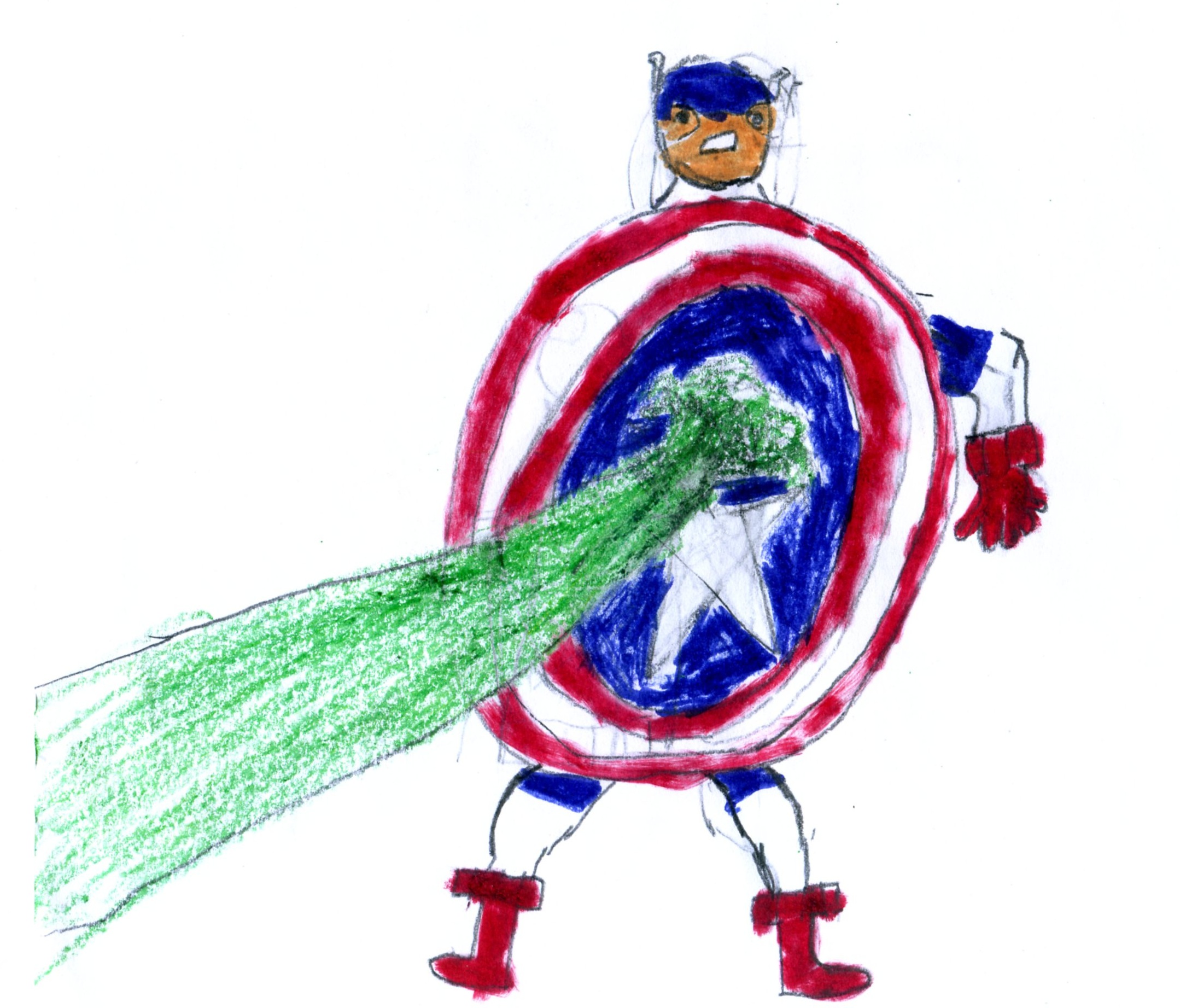
The illustration for this post is by editor Noah Berlatsky’s 9-year-old son.
 

The Year of Ted White

august1980p96

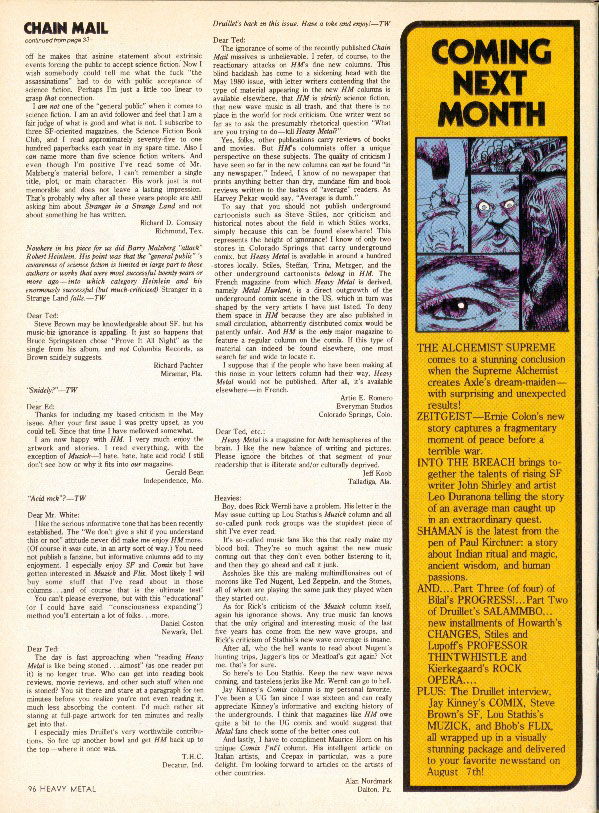
August 1980 – Page 96 Chain Mail

If you ever get the opportunity to look at a copy of the August 1980 issue of Heavy Metal, flip to the letters column on page 96. On the bottom left corner of the page, you will find a letter that I feel perfectly captures the mood of the average Heavy Metal reader during that year. It reads as follows:

Dear Ted,

The day is fast approaching when “reading Heavy Metal stoned is like being stoned… almost” (as one reader put it) is no longer true. Who can get into reading book reviews, movie reviews, and other such stuff when one is stoned? You sit there and stare at a paragraph for ten minutes before you realize you’re not even reading it, much less absorbing the content. I’d much rather sit staring at full-page artwork for ten minutes and really get into that.

I especially miss Druillet’s very worthwhile contributions[1]. So fire up another bowl and get HM back up to the top – where it once was.

T.H.C.

Decatur, Ind.

august1980p53

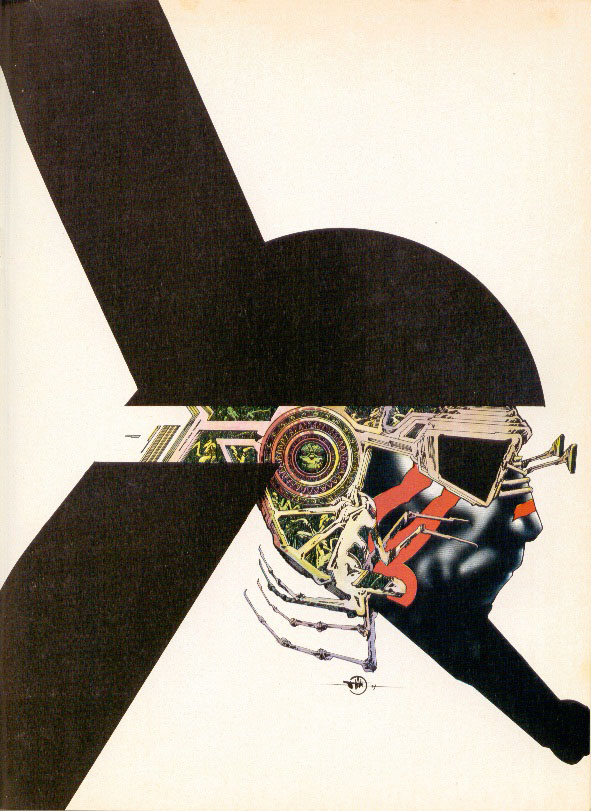
August 1980 – Page 53 Salammbo by Druillet

If online message boards, forums and/or Usenet had been widely available in the late 70s, the one(s) dedicated to discussing the content of Heavy Metal magazine would have exploded in controversy in 1980. This is obvious from the content of the letter columns during this year. The usual approach was to print a page of positive responses with an equal number of negative responses, followed up in later months by reactions to the responses. The printed responses were obviously just a drop in the mail bucket – I can only imagine what would have happened if it had played out in real time.

So what happened in 1980 to cause so much wailing and gnashing of teeth? Short answer: they got a new editor. Not quite two years after the inception of the magazine, the first editorial team of Sean Kelly and Valerie Marchant was replaced by Ted White, who had spent ten years editing Amazing Stories and Fantastic. At the time, it was felt that his success on those publications made him a good choice to take Heavy Metal in a new direction. It’s also interesting to note that the entirety of his comics-related work to that point was a Captain America novel he wrote in 1968.
 

The biggest (and most controversial) change that White brought to the pages of Heavy Metal were four columnists, each writing about a different topic – Lou Stathis, Jay Kinney, Bhob Stewart and Steve Brown. Original fiction pieces were dropped entirely and the volume of art pages was reduced to make room for column inches. To the editorial staff’s credit, they did play with the layout considerably, often presenting pages that were half text and half comic. Regardless, the huge blocks of text were easy to skip over and doubled the amount of time it took to read each issue.
 

may1980p57

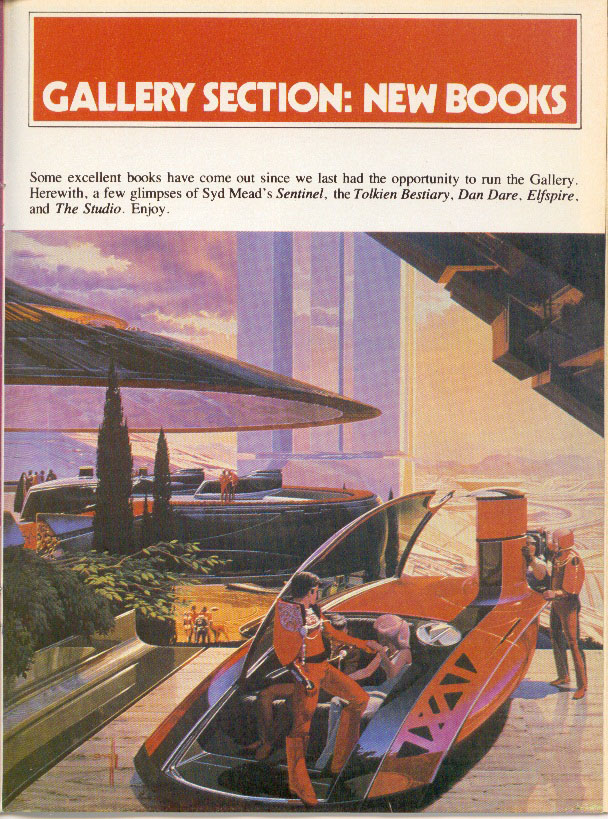
May 1980 – Page 57 Gallery Section: New Books

 
Of the regular columnists, the most controversial was Lou Stathis (who was an editor at Vertigo later in life). He insisted on referring to rok musick, an affectation that looks amusing now, but was probably seen as very progressive at the time. In his first column (January 1980), he starts by claiming that the only two acts that were any good during the 70s were the Sex Pistols and Roxy Music. This probably came as somewhat of a shock to the readers of Heavy Metal, who were mostly in the Led Zeppelin camp (a band that Stathis doesn’t even deign to mention in that first column)[2].

Stathis presented interviews of bands he enjoyed and did a review of a whole slew of debut singles at one point – up-and-comers like The Cure, X, and Gang of Four. Later columns included an homage to Brian Eno and a long examination of Ultravox, which ran next to Ted White’s review of an Ultravox performance written under the pen name of Dr. Progresso – a name that White still uses for his prog rock radio show. White wrote additional articles on occasion and the contrast in approaches is very striking. Stathis wrote from the hip, in his best Lester Bangs sneer while White’s articles were about sharing the love of an artform that he deeply respected.

In hindsight, it’s easy to make the case that Stathis’s attitude and contempt for what he considered to be the mainstream of music had the potential to severely alienate a portion of the existing Heavy Metal readership. Unfortunately, audiences tend to take criticism (real or implied) of the bands they like as criticism of themselves. After all, if you tell me that the music I listen to sucks, aren’t you also insulting my taste in music? As jazzed as he was about The Residents, Stathis was just as scornful of “the tuna fish that you get on your radio” and he constantly read like he was trying to pick a fight.

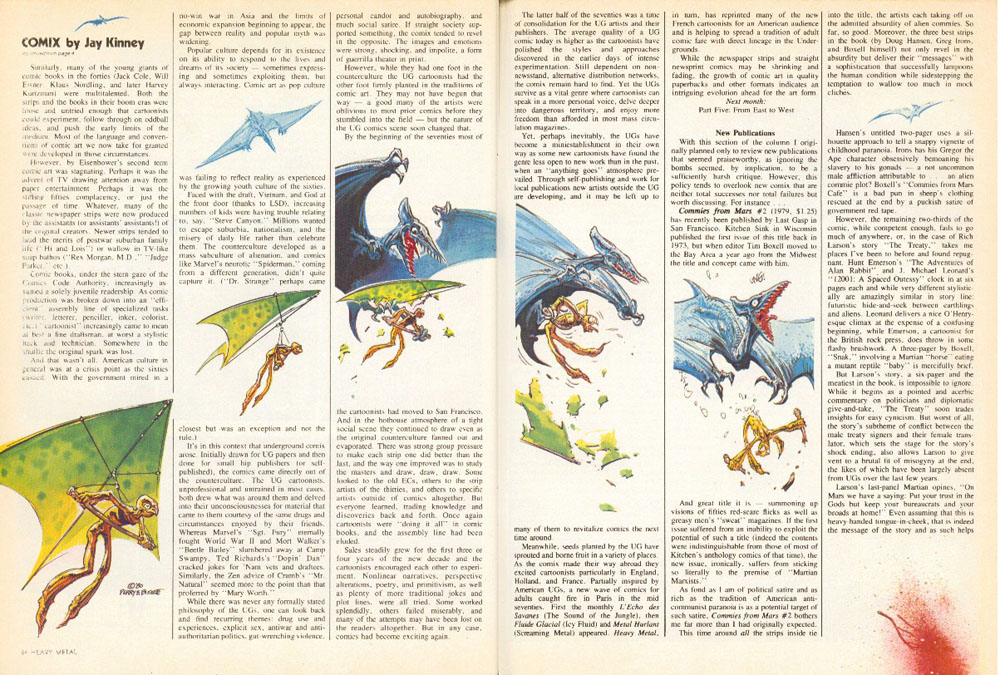
Jay Kinney’s running history of underground comix was nowhere near as controversial as Lou Stathis, but some readers still managed to find time to complain about it. Kinney started with one of the main influences of Crumb and company – EC – and sketched biographies and bibliographies for most of the big names in subsequent months.  He only managed to get as far as 1971 with his history before his column was cancelled along with the rest of them in December 1980. Along the way, he provided a fairly good blow-by-blow account of the various underground cartoonists migrating around the country, looking for more reasonable markets (San Francisco and New York were favorite destinations). It’s a collection of columns that would form the good backbone of a definitive history of the period – as a companion to Dez Skinn’s book, maybe.
 

may1980p5485

May 1980 – Pages 84&85 First Love by Bissette and Perry/Comix by Jay Kinney


Bhob Stewart’s Flix column was dedicated to film. His first three columns featured an extended interview with Stephen King, whose novel The Shining was being made by Stanley Kubrick at the time. Later columns focused on animation festivals, weird films that would now be put into the “psychotronic” bucket and a story about the time he met a background artist from Fantasia. He also did a long write-up of the upcoming Heavy Metal film, which was deep into production at the time.

Steve Brown’s SF column aimed at bringing news of contemporary science fiction and fantasy books to the readers of Heavy Metal. He reviewed David Brin, Samuel Delaney, Ursula K. Le Guin and a slew of other authors. Despite the occasional bully pulpit rant about how the science fiction genre deserved better, it was easily the least controversial of the columns because it was ostensibly aimed at a demographic that liked science fiction. Unfortunately, it was lumped in with the rest of the columns as a waste of space because those column inches could have been used for more art.

There were guest columns as well. Maurice Horn provided a quarterly international comics column. The April issue featured a write-up of Guido Crepax’s Valentina (Crepax’s thank you letter was published in July, alongside photos of a van that was painted with the Heavy Metal logo), August was dedicated to Herge’s Tintin and Tezuka was in November. April saw a hysterically ironic Sidebar column from Norman Spinrad that panned both the first Star Trek motion picture and Disney’s The Black Hole as being more about the special effects than the story – a criticism that has been leveled at Heavy Metal on more than one occasion.

During this period, Heavy Metal also ran interviews with certain key creators – Jeronaton, Enki Bilal, Moebius, Philippe Druillet and Guido Crepax. In most cases, these were the first English-language interviews with these creators and exposed the readers of Heavy Metal to more than just their art. Jeronaton was all over the place, but the Druillet and Bilal interviews are excellent insights into the artistic and creative influences that shaped them and their productions.

Scattered among the columns were some top-notch comics work. Berni Wrightson, Spain Rodriguez, Joost Swarte, Guido Crepax, Howard Cruse and Matt Howarth showed up in Heavy Metal for the first time during this period and a lot more of Rick Veitch and Steve Bissette’s work was also evident. Several of Caza’s pieces from Pilote appeared, as did a lot of older Moebius material – including a great strip from when he was going by Gir. Ted White even did a few strips with Ernie Colon. Chaykin didn’t show up, but early Corben did – from the period before he discovered the airbrush.
 

may1980p24

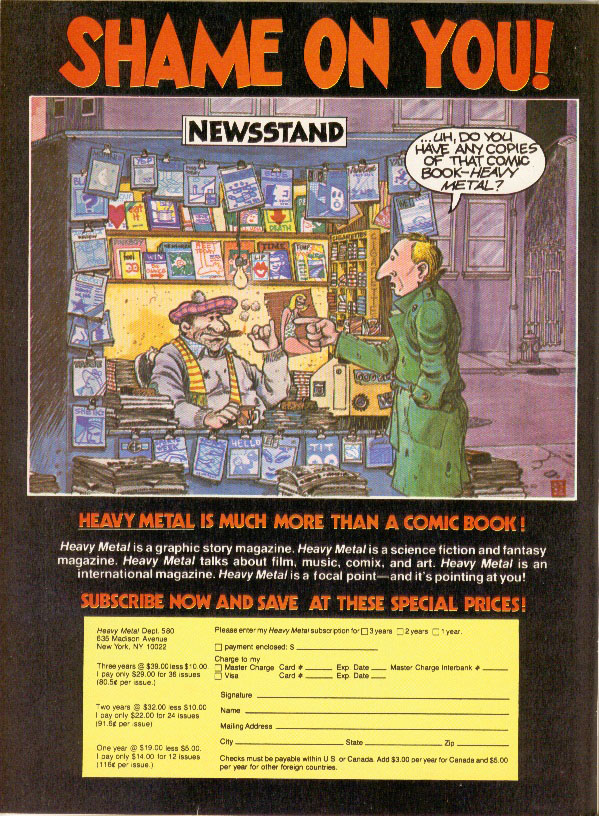
May 1980 – Page 24 House Ad

 
Despite the fact that he oversaw one of the best issues of Heavy Metal ever produced – the Rock Issue, October 1980 – Ted White did not make it to the end of the year. The last issue he edited was November 1980, but the columns made their last appearance in the December issue, which makes me think that his departure was fairly abrupt. Controversy may be good for raising awareness of a publication, but when the self-identified long-term readers[3] start complaining about the format of a magazine that they have grown to love, it’s time to make hard decisions.

After acknowledging that “[s]ome of the ideas worked, others didn’t,” the editorial in the December 1980 issue laid out the new status quo and claimed that White “is now relinquishing his duties as editor to devote his time to two novels and his new record company.” He was scheduled to do a tribute to Will Eisner in an upcoming issue and wrote a few follow-up comics, so the split wasn’t entirely acrimonious.

Some of the changes that came out of 1980 were subtle– the overt drug references didn’t go away, but the rolling paper ads were replaced by ads for stereo equipment and science fiction book clubs. Guest editorials and commentary continued in later issues, as did interviews. White introduced a portfolio section, which showed off samples of art books by Syd Mead and HR Giger. This was later resurrected as a general presentation feature called Dossier that ran for years.
 

July1980p22

July 1980 – Page 22 Romance by Caza

 
If you were to cleave the history of Heavy Metal into distinct periods, the Year of Ted White makes a neat dividing line between the fast and loose production values of the early years and the more professional publication that was eventually given to Julie Simmons-Lynch. It’s a shame that it was only a year, though.


[1] Druillet had an excellent piece published in the same issue.

[2] A letter in the May letter column starts by asking the rhetorical question “What is the most useless person in the world?” and answering it with “A rock critic” then goes on to argue that New Wave music is terrible by citing the complete lack of talent exhibited by Devo, Elvis Costello and the Talking Heads.

[3] Of a magazine that’s just over three years old