Yearning for Space: a conversation with Tom Kaczynski

I first encountered Tom Kaczynski’s work while delving into the substantial collection of comics-related materials in Columbia University’s Butler Library stacks, where there is a run of Fantagraphics’ anthology title MOME. I very much liked Kaczynski’s deliberately drawn short stories such as “100,000 Miles” and then, when I was lucky enough to get a story of my own in the final issue of MOME (#22)—and having an certain amount of thespian training—I greatly admired his piece “Music for Neanderthals”, an account of an actor who takes his method a bit too far to go completely native. His work often gives the impression that it spans the entire history of the planet, which reminds me a little of another Polish-American I worked with, the late David Wojnarowicz. I definitely feel sympatico with Tom’s use of the potentials of the comics medium to go beyond entertainment and impart information of a philosophical nature, which is not to say that his stories aren’t entertaining, but that they touch on deeper issues as well. He began Uncivilized Books to publish first his own and others’ minicomics and now it produces critically acclaimed hardcover collections by luminaries of alternative comics such as Gabrielle Bell and Jon Lewis. So, at the Brooklyn Comics and Graphics Festival last year I approached Tom at his table and a year later, he published my comic book Post York. Now Fantagraphics has released a collection of his short stories, Beta Testing for the Apocalypse. For HU, I talked with Tom via email.

________________________________________________________________________
CLICK ON IMAGES TO ENLARGE
________________________________________________________________________
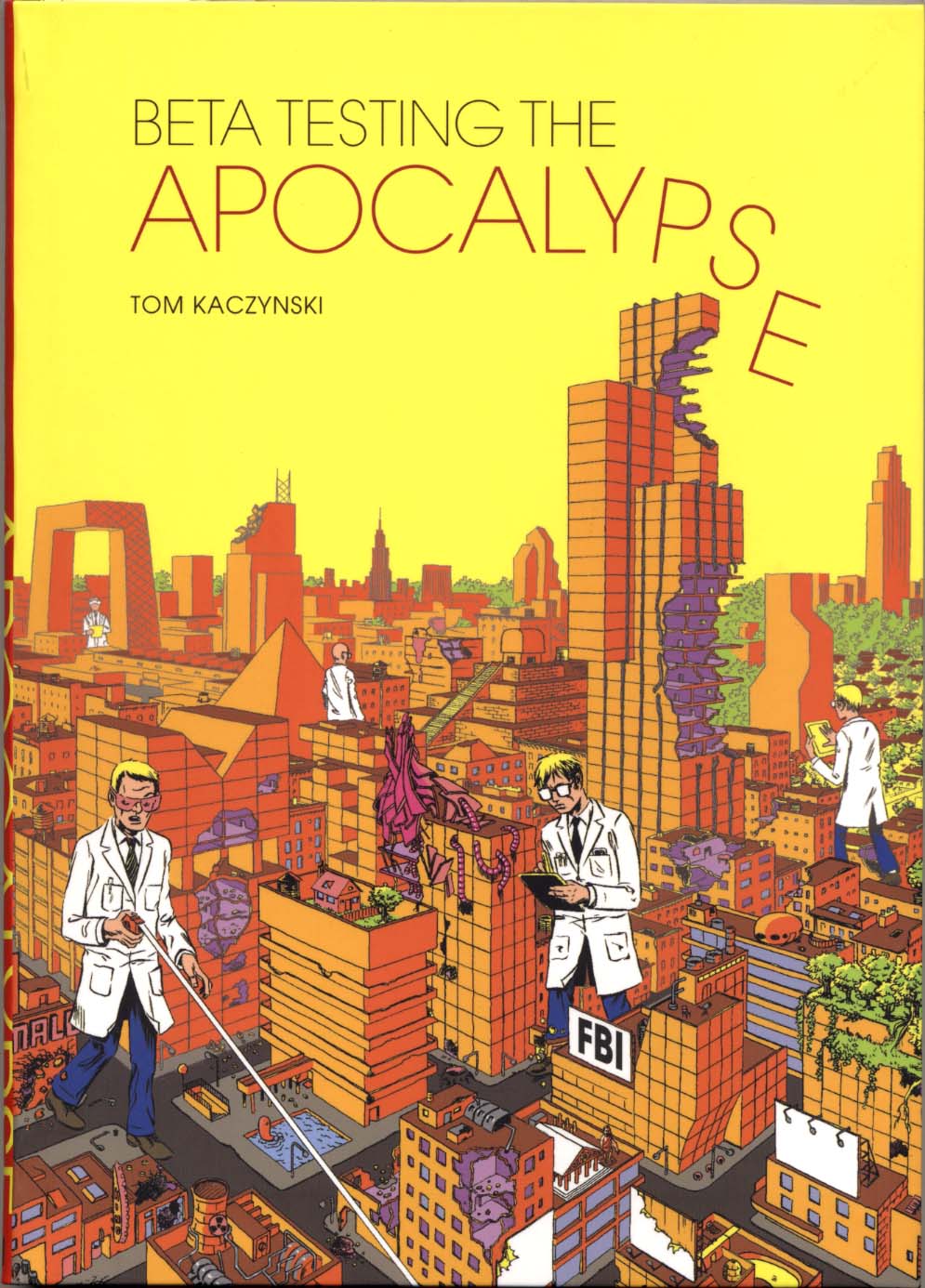
Tom K cover

James: You use a single color besides black in the stories, often to great effect. To my eyes, the limited color in your work has a strange feeling, removed from the ostensibly similar use of a single color in a lot of alternative comics, a trend that I think was initiated by Daniel Clowes, Seth and David Mazzucchelli et al. In other words, it is not just for indicating lighting or to hark to old book illustrations. Instead, your single color use at its best is really intrinsic to the storytelling…the color holds or overlays add depth to some images or highlight specific parts of a given drawing to draw attention to something that is going on in the image. Outstanding examples are seen in “100,000 Miles”, “10,000 Years”, “976 Sq. Ft.” and “Million Year Boom”. The color separations can add qualities of delicacy of articulation, or of diagramming, or extradimensional elements. The colors you chose in different stories have varying levels of emotional impact as well. Now, I have to note that in a few of the stories, like for example “Phase Transition” or “Music for Neanderthals”, the color seems to only add lighting, it is almost an afterthought or it isn’t as intrinsic. But in most of the stories, for instance in “The New,” it is absolutely part of how the story is constructed—–and that story may be the most advanced use of the technique, besides being your most ambitious piece to date. Can you articulate why using two colors might sit your purposes more than doing full color artwork, or leaving it in black and white?

Tom: I tend to use color as a storytelling device where in certain instances I can focus-in on certain object or characters. I feel I’m still struggling with color in general. Overall I can cite 3 primary ways I use color in the book.
1. Color as a naturalistic element (as lighting, depth, etc.)
2. Color as pure design element.
3. Color as information.
The three sometimes mix in a single panel, sometimes they don’t. “The New” and “Million Year Boom” are the only two stories that were conceived (and published) with color from the get go and as such work the best for me in that respect. That said, it was fun to go back-in and re-imagine the stories with an added color. Now that I’ve seen the results, I would probably push it a little further next time I have a chance to do that.

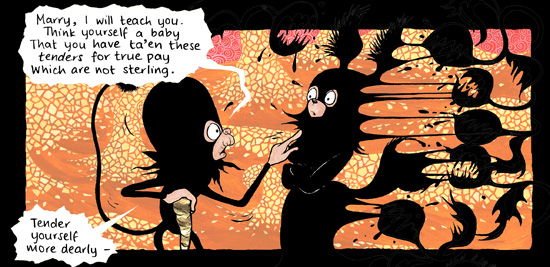
James: I note some variations in the stories in Beta Testing the Apocalypse from the way they were originally presented. In the collection, the story “100,00 Miles” has a green overlay that is considerably lighter in shade than the more olive color it is run in in MOME 7.
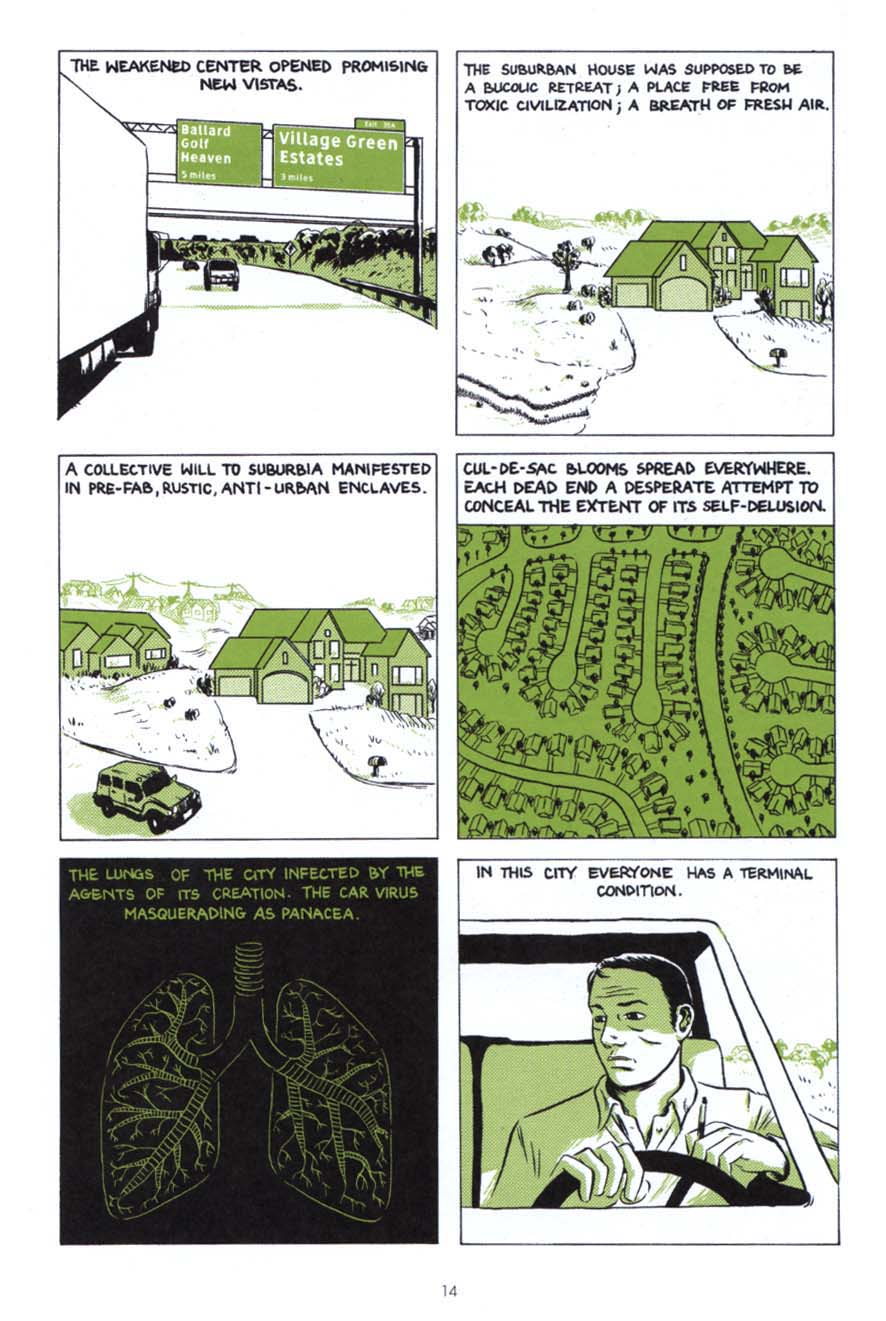
From "100,000 Miles"

From “100,000 Miles”

The stories “Phase Transition” from MOME 10 and “Music for Neanderthals” from MOME 22 did not have a color in their original printings. In Beta Testing the first page of “Phase Transition” is still black and white, perhaps because it is part of a signature that has pink pages. I see that the olive color goes over zipatone in the other three pages and that the toning is slightly different in the Beta Testing version—on page 4 panel 6 you mottled the tone. I wonder if the color is imposed on some of the stories to unify them for this package, or if, as you suggest in your interview in MOME 10, the lack of color in some stories was a result of not having enough time to do a color separation for them?

Tom: The MOME stories were always vaguely conceived as two-color pieces. But because I often handed in art at the last possible minute ([MOME editor] Eric Reynolds can attest to that!), there was often no time left to think about the color in any meaningful way. I generally focused on having the stories work as black & white pieces (with gray tones) and if there was time, I would add color information. The color changed on the MOME 7 story because the original green wasn’t quite what I wanted. I changed it to the color I originally envisioned, but didn’t get right the first time around. The first page of “Phase Transition” is indeed b&w, partly because it falls on the pink signature (as opposed to the yellow one), but I found that it worked storytelling-wise. The color doesn’t come in until the 2nd page of that story and gradually takes over more of the strip.

James: One of your self-published pamphlets is in full color—-do you think you might do an entire book in full color at some point?

Tom: Maybe… I found full-color very time consuming. I may find a good use for it in the future. I don’t want to rule it out. In the near term I don’t have any specific plans on doing any full color comics.

James: From the example shown in the interview that Gary Groth did with you in MOME 10, the strips from The Drama magazine look to be of a similar level of quality as the work here, along similar lines of subject matter and are also 2-color jobs. Is there a reason why you didn’t include them?

Tom: I didn’t think those strips would’ve worked in the book. They were done at least a year before the 1st MOME story, and they are much more ‘gag’ strips. There are some ‘gag’ strips in the collection (the four 1 page stories from MOME 12) but they work with the larger themes of the book.

James: I also see in that interview that you acknowledge J.G. Ballard as an influence, even if Gary didn’t do any follow up questions about him. I noticed the influence immediately in reading your work.

Tom: Yeah, Ballard is pretty big for me. His earlier books like The Drowned World, Crash, High Rise and The Day of Creation were huge for me. I love a lot of his short stories; “The Ultimate City” may be my favorite. I’ve also come to love his later, post-Empire of The Sun (one of the few I HAVEN’T read) work like Super Cannes and his last novel Kingdom Come.
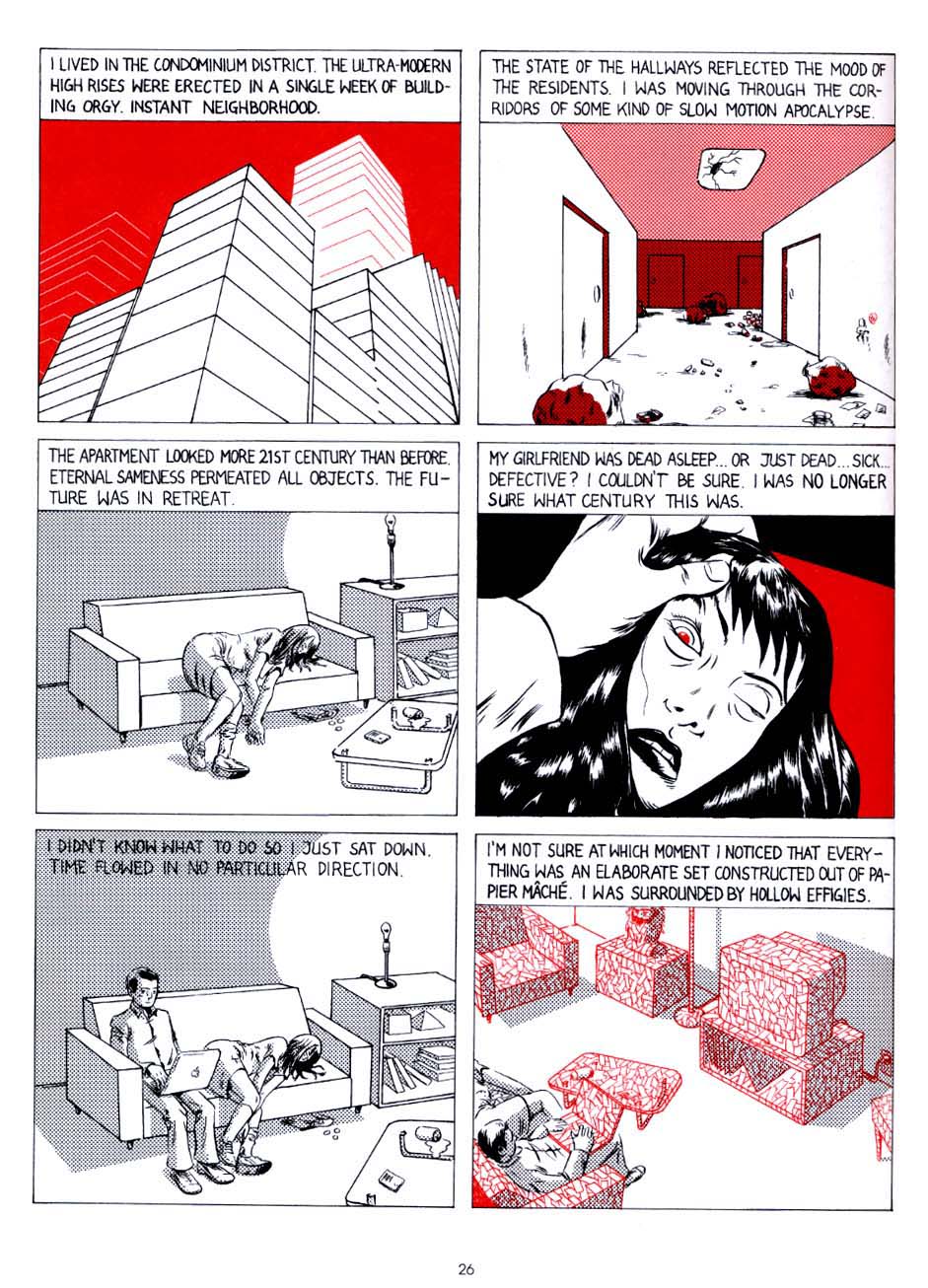
From "10,000 Years"

From “10,000 Years”

James: There are the obvious correspondences in “100,000 Miles” to Crash, but some of your others like “Million Year Boom” and “976 Sq. Ft.” remind me in particular of a few of his perhaps less-known works such as High Rise and Concrete Island. Both of those books depict protagonists who become subsumed in the constructs of a society that in supposedly advancing has actually broken down, that has taken on the quality of an intolerable new “normalcy”. Is it perhaps that, like Ballard, in transitioning between disparate societies at an early age, you have a unique perspective and are able to remove yourself and see where you are in an overview of sorts, or to see around the corners, so to speak?

Tom: I definitely think that the experience of emigration gives you a different perspective on the idea of society. When you are born into one world (Communist Poland), and then are transplanted into another (USA), and then witness the utter transformation of the first (collapse of USSR & the Eastern Bloc), the idea that society can radically be changed (for better or worse) is not that far fetched. That is one reason that the US (a country of immigrants) has been such a successful and dynamic society. The recent political/economic climate in the US feels like an attempt to freeze and define the US as a specific unchanging idea. History is catching up with us, the US is no longer a ‘young’ undefined country. Even many European countries (not to mention countries in Asia, Africa, the Middle East and South America) have political & economic structures that are more malleable, that may better cope with future challenges (I got away from Ballard here… but it seemed in the end the question was less about Ballard but about ‘society’).

James: I just read another interview with you that Kent Worcester did, where you cited a specific Jack Kirby image from his 2001 comic, a panel of a man walking up to a building that is just a huge wall of windows—it freaked me out because that is one of my favorites of Kirby’s and it is part of a passage that I had actually thought of mentioning to you! The Earth Jack depicts is so polluted and crowded, a world where pure air can only be breathed out of bottles that one must purchase as we do water, an existence so dehumanized that the protagonist feels he must join the space program, to escape in order to realize any sort of life for himself.
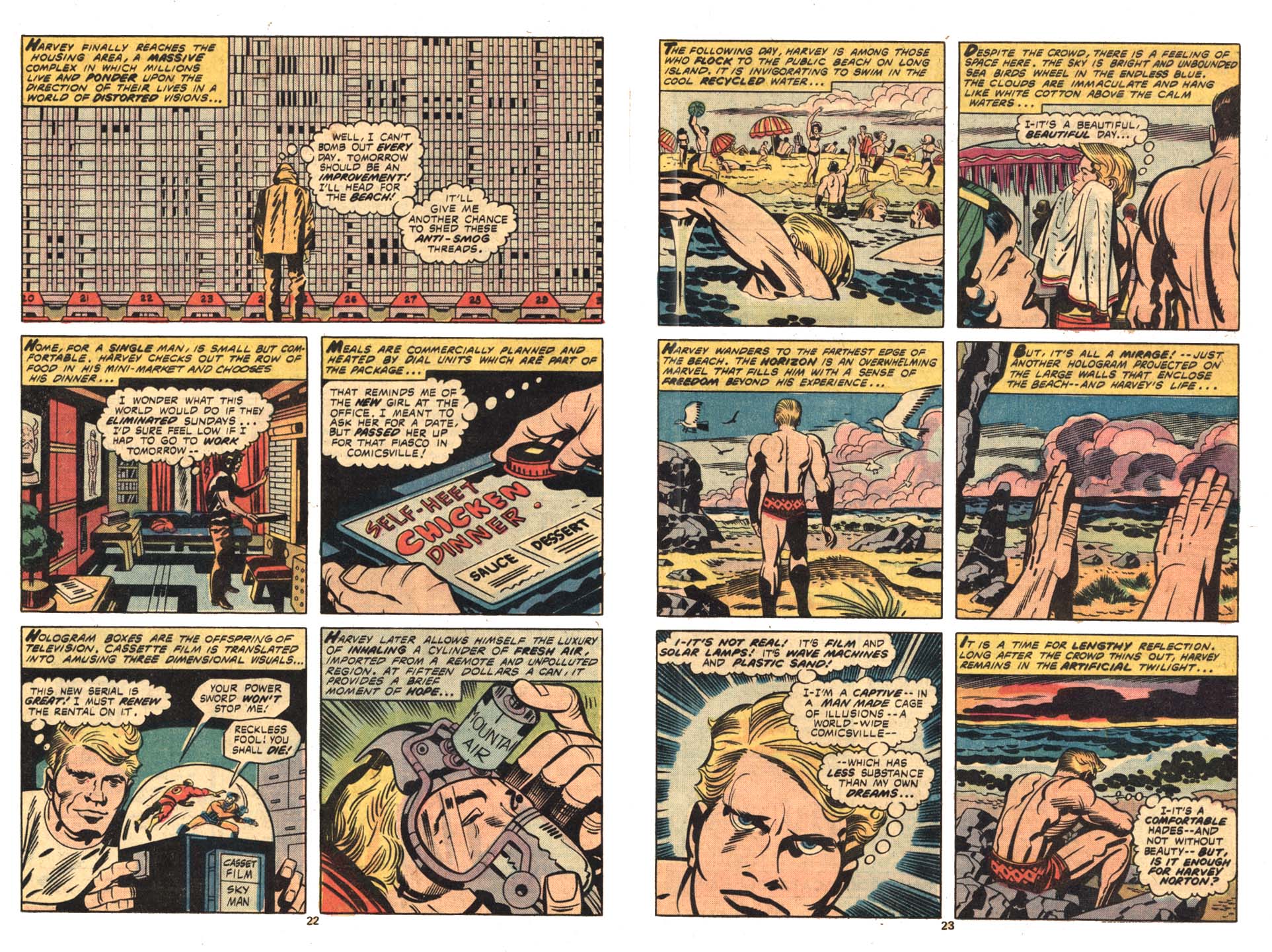
Jack Kirby, from "Norton of New York, 2040 A.D.", 2001 #5, Marvel Comics, 1977

Jack Kirby, from “Norton of New York, 2040 A.D.”, 2001 #5, Marvel Comics, 1977

Your work gives me a similar feeling, as if you are dealing with expressing what it is like to live in a world that has gone beyond the point of no return, but with no escape possible, as if all we can do is construct semblances of sanity for ourselves, that work within the insane structures that we must fit into.

Tom: I love that Kirby image! I believe that was from 2001 #5? I agree with what you’re saying here. One of my favorite J.G. Ballard stories is “Billenium” about an overcrowded world where everyone basically lives on top of everyone else. The protagonists in that story find a hidden room and all that new space is an almost unimaginable luxury. They proceed to share the new space with some friends and family until it fills up and becomes indistinguishable from the rest of the world. We need to find these spaces (whether real or imagined) and inhabit them; to create germs of possible and impossible new worlds… hopefully better ones. There’s a danger in that. Things could get worse… but sometimes not doing anything at all, is worst of all. One thing I hesitate doing in my stories is to destroy the world. If “Billenium” was an Italo Calvino story, that room could be a germ of a new city; an invisible city growing in the midst of the old one… and eventually it would grow to replace it. I think we need a better imagination, one that goes beyond wishing for the apocalypse.

James: I appreciate the format of Beta Testing and the way you have manifested your work so far, because I personally have always preferred to work on short stories, at least partially because of the labor intensive nature of comics—-I like to work on things where I have the opportunity for more variety—for instance, it can get very awkward trying not to be repetitive in the angles and compositions when one is drawing the same characters and backgrounds for many pages.
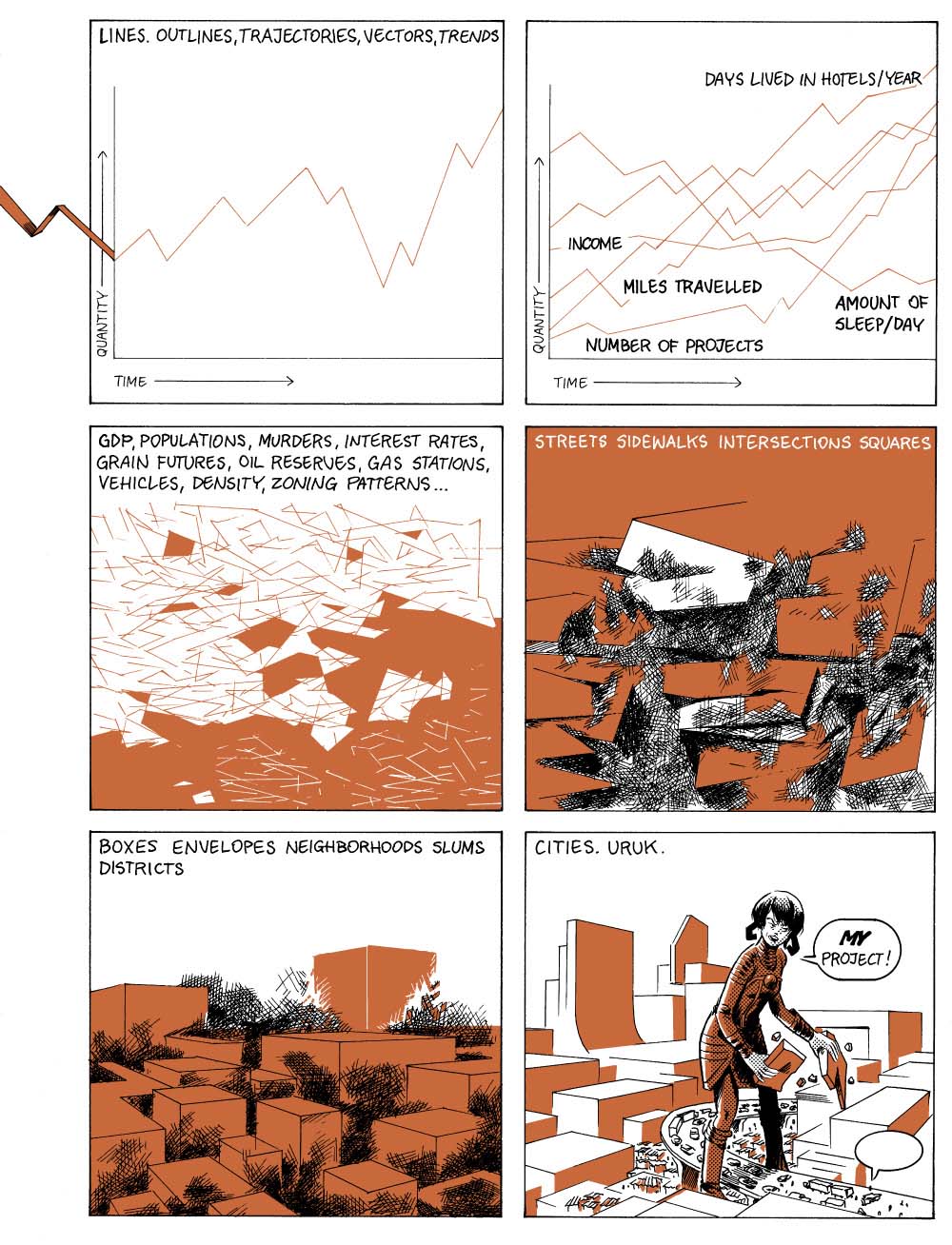
From "The New"

From “The New”

The last story in Beta Testing, “The New”, is the longest and probably the most ambitious story I have seen you do so far. Do you prefer to work on short pieces or are you working your way towards longer stories?

Tom: I really like the short story (in comics and in fiction) and it’s something I’d like to keep doing in the future. There is something satisfying about a good short comics story. There are more opportunities for a tighter structure… it’s easier to get that certain density of narrative. Dan Clowes’ shorts from Eightball (post-Like A Velvet Glove Cast in Iron), the ones that ran concurrently with the serialized Ghost World, are the pinnacle of the form for me. “Blue Italian Shit”, “Caricature”, “Immortal Invisible”…they all have tight structures, a satisfying density of narrative. They’re just perfect comics. That said…

James: Can you see yourself writing and drawing an entire graphic novel eventually?

Tom: I’m often frustrated I can’t get all my ideas into a short piece… In fact I almost always wish my stories had a few more pages to develop this or that germ of an idea. So, I’d like to do longer comics at some point. My upcoming book TransTerra is probably the closest thing to a novel-length narrative, but that was still constructed episodically. I don’t mind repetition so much. I think it works well in comics… whether it’s a 4 panel gag, or 300 page GN. It’s almost necessary to set up a kind of visual/narrative rhythm. It was nice to be able to stretch a bit in “The New” and not have every page be crammed with information. After doing a bunch of short pieces in a row, I’ve been yearning for a bit more space…like the character in that story “Billenium”!

James: I’ve never seen an index that alphabetically listed every sound effect in a comic before. And Ballard’s entry leads to a highway sign in a panel for “Ballard Golf Heaven”, and I liked how the table of contents is figured on a greater timeline, but isn’t much help in locating the stories. Such details play with the new climate in comics where we should try to accommodate future scholarship, by ensuring that page numbers are included, etc.—-you certainly left a lot of room for examining this thing through different “lenses”….we’ve come a long way!

Tom: Ha! Well, it’s something I’ve always wanted to do with comics. Indices, notes, and glossaries are some of my favorite things in books and I didn’t want my book to be left out! This all comes out of lots of conversations I’ve had with cartoonists and writers over the last few years. In the end I wanted the index to be another story in the book. One that comments and explicates the other stories. Some entries are in there for fun. Like the sound effects, or cars. Others alert the reader to concepts or phrases that have been quoted, mutated or just plain stolen. One thing that is often left out of comics criticism are the images. They are often examined in terms of plot or composition, but rarely do writers get into the complex visual references that often show up in comics. One of my favorites pieces of writing on comics is a Ken Parille piece on Clowes’ David Boring that excavated the connections to Hitchcock’s Vertigo among many other things. I hope in some future edition, the book can be published with an index. Other cartoonists have played with this kind of material. Kevin Huizenga comes to mind with fake indices & glossaries. In fact I was just working with Kevin (& Dan Zettwoch) on the index to their next book, Amazing Facts & Beyond. It’s amazing and goes way beyond my index! In fact they called it the beyondex! Maybe we can start a trend! Index wars!

The idea for the table of contents come about organically. A lot of my stories were titled after some kind of measure… “100,000 Miles”, “976 sq. ft.”, “10,000 Years”, etc. when time came I wanted to create a unifying design & organizing principle. Also, I saw all these stories taking place in the same world… in my mind for example, “The Cozy Apocalypse” is a prequel to “976 sq. ft.” In his famous book, SMLXL, architect Rem Koolhaas begins the book with a multipage series of charts that detailed his life: time spent flying, swimming, eating, etc. over a period of a few years. In some ways my chart is much more immodest, spanning from the big bang into the far future and covering vast distances.

James: You wrote and laid out a story that Dash Shaw finished in MOME #17. You also collaborated to some degree with me on Post York—we came up with the cover together; and then at one point you suggested that I delete a few panels on the page with the initial ending and leave white space. I wasn’t sure, but I thought on it for a while—and then I decided to take that idea a lot further. I ended up jettisoning multiple panels on nearly every page that didn’t seem needed and those omissions greatly expedited the storytelling and improved the design of the book. It was great for me to be able to break away from the way that DC, for instance, works, where every inch of what they call the “real estate” of the page must be filled. How do you feel about collaborating with other artists, and do you think you might do more in the future?

Tom: I would love to collaborate more! Too many cartoonists are antisocial! I understand the need to sit alone in a room in absolute focus and work on something. But we’re social creatures and being able to collaborate with someone who’s on the same wavelength is very satisfying. It was really eye-opening to see Dash execute one of my stories. His approach is just so different from mine. I’d love to draw someone else’s story.

James: Your first few full hardcover books have gotten a very encouraging response; Gabrielle’s book was picked as a book of the year by Publisher’s Weekly and both her The Voyeurs and Jon Lewis’ True Swamp were reviewed favorably in PW and elsewhere. Is this resulting in an influx of people wanting to work with you?

Tom: I’m grateful I was able to work with amazing cartoonists almost out of the gate. I’ve admired Gabrielle’s & Jon’s work for a long time (and your work too!) and being able to publish them is an honor. I’ve definitely had an influx of submissions and I have a hard time staying on top of them. At the same time, Uncivilized Books is still a very tiny company and I can’t publish everyone. That also means I have to be very picky and reject projects that I really like. I’m still trying to find my specific publishing groove. I just finished figuring out my third season of books and I think I am maybe getting closer.

James: I know that besides doing your comics, you teach. Do you find that the publishing takes even more time away from your already full schedule, or how do you deal with that issue? I mean, I asked this of Sammy Harkham as well; one can get quite involved in promoting other people’s careers and have to fight to find time to do one’s own work. Particularly when one is young, one is developing in leaps and bounds and so one needs to direct one’s energies carefully.

Tom: This year I had to put teaching on the back burner. I still mentor some students and attend critiques and seminars, but I’m not teaching a full class this year. There just isn’t enough time. My own comics tend to be more esoteric and have made me very little money… So, I’ve always had to have some other job to support my cartooning. I’ve never had the luxury of just focusing on my comics, and I’ve always had to claw back time from other endeavors to create my comics. I pretty much assume I have to do something else… if my comics ever make enough money, I may have to re-evaluate my use of time, but for now I try do projects that are interesting. Uncivilized Books has been very rewarding. I’ve learned so much already and I know there’s a ton of learning left in the future.
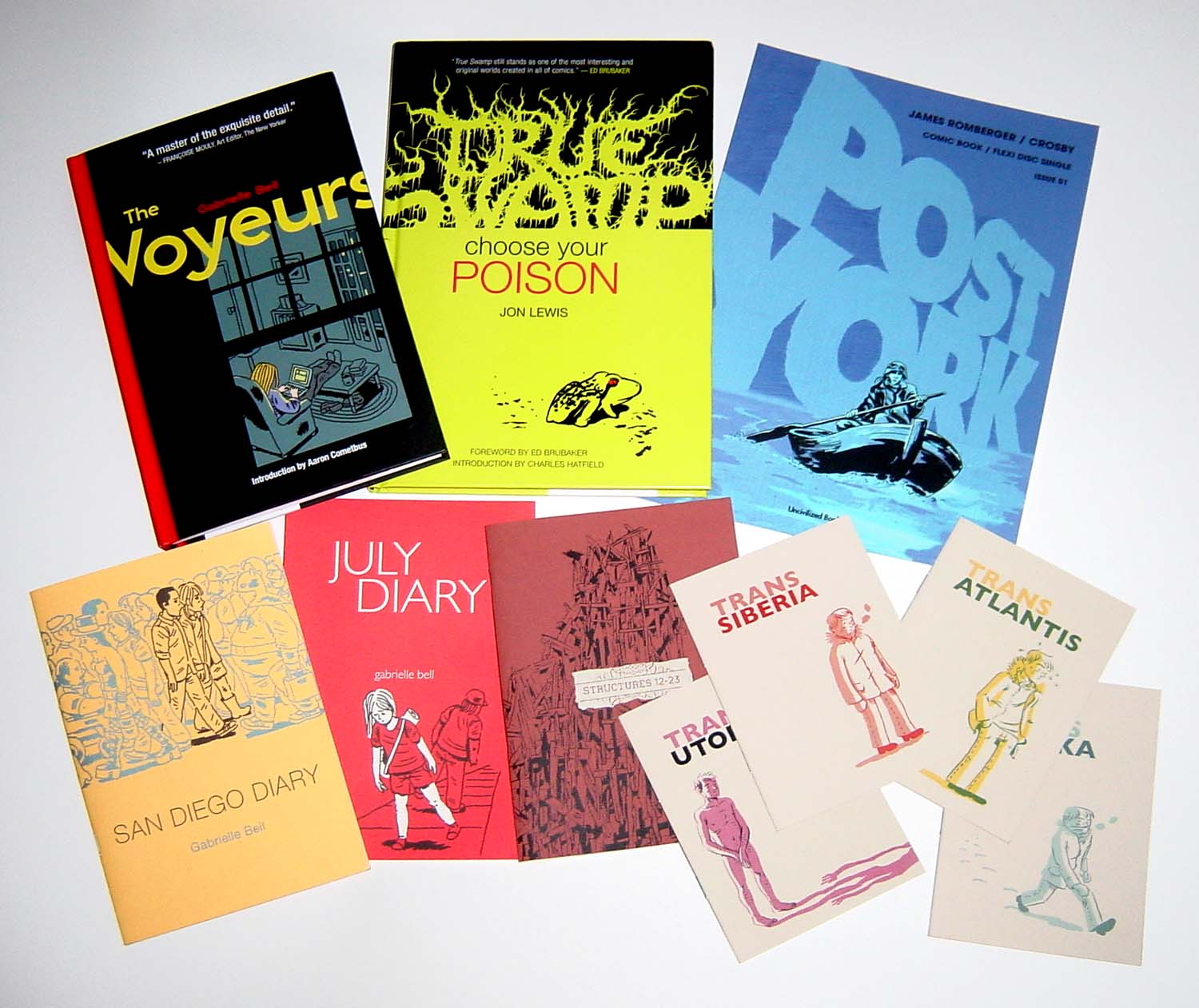
Some of the output of Kaczynski's publishing imprint, Uncivilized Books.

Some of Kaczynski’s publishing output via his imprint Uncivilized Books.

James: Can you give a rundown of the upcoming projects for Uncivilized Books?

Tom: This is the next season of books:
Incidents in the Night by David B. and translated by Brian and Sarah Evenson.
Amazing Facts and Beyond by Kevin Huizenga and Dan Zettwoch
Sammy The Mouse Book 2 by Zak Sally
Over the Wall by Peter Wartman

James: Will you continue to produce minicomics and “floppy comics” such as the one I did for you?

Tom: I want to! I really see mini-comics as my research & development department. I can work with artists on a smaller scale trying out formats and media like flexi-discs [Post York includes a flexi-disc by my son Crosby–JR] that may be more difficult to do in larger quantities. I wish there was a better distribution network for these formats. I think they are vital formats that I hope will live on.

James: How do you see comics developing in the future? I am encouraged to see people like Joe Sacco using comics for journalistic purposes, or you using them to what I would call philosophical ends.

Tom: I certainly hope comics will embrace a variety of genres and formats. I listened to an interview with Gary Groth (disclosure: he’s our publisher) recently (on BoingBoing) and he said that the boom of comics in the wider book market was a strange thing. He said that most people read comics, not because they are ‘comics’ but only because they deal with some subject matter they’re interested in (like Maus by Spiegelman, or Palestine by Sacco, etc.). They’re not interested in comics ‘as comics.’ I think he’s right, but that’s not necessarily a bad thing. We need those people! We need the reader who is interested in a subject, and chooses to read about it in comics form. They may not be interested in them ‘as comics’ but some of them will grow into that ideal reader… especially if there are many good comics on lots of different subjects. I think the same could be said for books, movies and other media. Most people want something very specific from movies: a blockbuster spectacle, something funny, gory, or emotionally engaging. But only a minority is interested in film ‘as film.’ There’s just a lot more of them because there are more movie goers overall. Books…literature in general is an ancient art form that has gone through many of its own crises and mutations over millennia. Comics as such have been around for only a fraction of that time. Comics emerged from an ephemeral medium. All those floppy comics were not supposed to be kept and written about. Comics in service of something other than commercial entertainment have been around for even less time! It’s going to take sometime to develop and find an audience that appreciates them for what they are. We’ve made great strides over the last decade and a half. We need to be patient and keep producing better and better work. I’m pretty hopeful.

_________________________________________________________
Voices From the Archive: Steven Grant on Comics Writing and Fletcher Hanks

This seemed like a nice, non-confrontational way to finish off our Eddie Campbell inspired roundtable on comics and literariness. Below is a comment Steven Grant left on one of his own posts.

I would suggest the approach I describe is the unromantic one. The romantic notion is there are a million hidden geniuses out there who would’ve outflowered Shakespeare if only someone had given them a kind word. I’m not suggesting needless cruelty, & I am possibly romanticizing by assuming the critic in question knows the difference between bad writing & a radical but fruitful shift in approach, but there really is a difference between people who want to write & people who want to be writers. The latter are the ones who stop. It’s not that hard to tell bad writing, & even good writers are more than capable of it. Everyone gets feedback, & the only feedback that’s any good for you is honest feedback, positive or negative. You’re not under any obligation to accept any of it, but a writer doing something really wrong (by which I don’t mean wrong in a “mainstream writing” sense, but wrong in that it undercuts their purpose) will not be helped by someone being “nice” about the work. Being negative & being cruel are not the same thing, but if you can’t take being negative you’re probably better off doing something else anyway, because negative is largely what the world at large rains down on writers. Unless they happen to be at the rarefied heights where the slightest criticism unleashes a torrent of virulent defenders. And y’know what? That’s often not that good for one’s writing either.

It’s a strange, strange business.

Frankly, no matter how good your writing is, approbation is usually so hard to come by that anyone who writes for approbation is an idiot.

imagesAs for Hanks, Noah, we began this discussion on email. Leaving aside reservations about “outsider art” (having watched its inception/invention contemporaneously, it always struck me as more politically than artistically motivation, since it played on many political themes of the day) I question whether Hanks fits the category. Just because he was largely unknown to our generations doesn’t make him an outsider. A guy who worked steadily for several years (I’ve no idea of the circumstances of his departure from the field) at a circulation considerably larger than any I’ve ever enjoyed, in framework (artistically his style isn’t even all that different, though I’m more than happy to accept his art is better – prettier, certainly – than many of his contemporaries) essentially identical to what surrounded him. But it’s never been his art I quibbled with. It’s his writing that’s the house of cards. Yes, I understand the auteurial approach to Hanks’ work, & that’s fine, but imagine Hanks’ stories if they were drawn by, say, Paul Reinman. How fascinating would you find the writing then?


Rock and the New Man

This first appeared on Splice Today.
___________________
 

images


“If I could find a white man who had the Negro sound and the Negro feel I could make a billion dollars.” Elvis’ discoverer Sam Phillips denies ever having said it, but the quote keeps getting repeated because, apocryphal or not, it resonates like truth. Folks like Jackie Wilson and Junior Parker and Mama Thornton were performing in Elvis’ style before Elvis was. But they weren’t white, and so they didn’t have access to the same kind of mainstream success that Elvis did. The quote underlines the extent to which Elvis was a product not just of his own individual genius (which was considerable), but also of America’s conflicted history of segregation and racism.

You could argue that Elvis’ success is built on cultural theft — and many people have. But you could also argue that it’s built on a particular kind of performance. That is, the excitement, the sexiness, and the thrill of Elvis isn’t just that he’s performing in a black idiom, but specifically that he was a white man performing in a black idiom. The charge wasn’t just the styles being appropriated, but the appropriation itself.

The soul of rock, then, is not its authenticity, precisely, but its fakeness. Elvis is edgy because he’s adopting a persona that isn’t his. His success/failure in passing for black is what makes him rock n’roll, and the failure is every bit as important to the mystique as the success. Similarly, middle-class Jewish Zimmerman is rock because he is pretending/failing-to-pretend to be an earthy Okie hillbilly. Mick Jagger’s charisma is a function of the fact that he is pretending/failing-to-pretend to be a working class American (of vacillating races), rather than the art school snob he is.

Elvis and Dylan and Mick Jagger are all performing differences of race or class…but those performances are all also about gender. When Elvis wiggles his hips, or when John Lennon declares “you better run for your life if you can, little girl,” they’re not just pretending to be (respectively) sexy black performers or sexy American performers. They’re also pretending to be men. The pretense of authenticity is also a pretense of manliness — of greater sexiness, swagger, violence, and danger. And, again, the fact that the pretense isn’t perfect, that the façade is an aspiration and in part a failure, is an aspect of the excitement, not a negation of it. Rock gives you the chance to be someone you’re not; to feel the giddy rush of swapping up for a better race, class, nationality and/or phallus. If the mask was too perfect, you’d think it was real, which would make it not sexy but stodgy, like parents who can’t be bothered to put on a costume for Halloween. Thus, David Bowie’s flirtations with androgyny (not to mention Elvis’ flirtations with mascara) were a logical fulfillment of rock rather than a queer twist on it. The music was in part about the sexiness of mimicking a man; but it was also about the sexiness of micking a man.

All of which helps, perhaps, to explain rock’s decline, if not entirely as a commercial force, then at least as a libidinal, barbaric yawp. As Jonathan Bogart says,

Rock has been undergoing something of an identity crisis in the past several decades. Its position as the dominant sound of youth culture has been usurped by hip-hop and dance music. Its reputation as the voice of rebellion has been co-opted by three generations of advertising and corporate culture. Its claims to righteous authenticity and working-class grittiness have been undermined by a multimillionaire celebrity culture and the rise of of a blue-collar generation that’s a lot less white and male than previous ones. It has only managed to retain any cultural capital in the world of indie rock, where its original vulgar aggression and sexual drive has been replaced by the kind of patient sensitivity, faithfulness to tradition, and self-conscious artistry that rock was once a reaction against.

Rock’s edge is gone. And the edge that’s gone is, I’d argue, not its truth, but its falseness. Rock hasn’t lost itself; its found itself, which is worse. A performer like Jack White isn’t pretending to be Howlin’ Wolf or Woody Guthrie. He’s pretending to be Led Zeppelin or Aerosmith. That can be entertaining to listen to, but it’s not enough of a lie to be either dangerous or shocking or sexy. Instead, it ends up looking more like nostalgia. Decades of history mean that, as a rock star, White can only claim to be more or less the man he actually is — and where’s the fun in that?

Which is why, as Bogart says, Ke$ha, despite her dance-pop roots, is able to pull off the rock-star pretense in a way Jack White can only dream of. That is, she’s able to pull it off precisely because it is a pretense. Ke$ha — because she’s dance-pop, and even more because she’s a woman — has a distance from the (mostly) male history of rock. And that, makes her appropriation of that style — like Elvis’ appropriation of black styles —sexy, daring, irritating, and charged. When on “Dirty Love” she shouts at Iggy Pop, “You’re not my daddy/baby I’m full grown,” the gleeful lasciviousness is in the brazenness of the disavowal. Iggy Pop is her daddy; she’s lifting his attitude, his moves, and his mojo.

And yet, as the insanely catchy bubble-gum chorus charges ahead, she nasally insists that she’s not imitating the man, but is instead inside his very pants. The flirtatious byplay isn’t just skeevily intergenerational; it’s incestuous and cross-dressed, inasmuch as Ke$ha is adopting Iggy’s masculinity in the interest of getting it on with herself, or himself, or whichever self it may be. It’s not convincing; Ke$ha is a far cry from the Stooges, just as Iggy was a far cry from the blues. But the distance is the point — which is why, these days, it takes a woman to rock like a real (i.e. fake; i.e. real) man.

Utilitarian Review 2/16/13

On HU

Featured Archive Post: Jason Michelitch on Eddie Campbell’s After the Snooter.

Me on how Peter Jackson is too twitchy and so made Frodo paranoid and stupid.

Alex Buchet with a survey of the cartoons of G.K. Chesterton.

Ng Suat Tong on how the EC Comics are still not very good despite Eddie Campbell’s protests.

I compare Billie Holiday and Jack Kirby since Eddie Campbell asked me to.

Christopher Gavaler on the original Iron Man and other war machines.

Eddie Campbell on plot summaries and Nicki Greenberg’s graphic Hamlet.

Robert Stanley Martin explains why he prefers Eddie Campbell as a cartoonist to Eddie Campbell as a critic.

Jones, One of the Jones Boys pisses on Eddie Campbell from the heights of Mt. Parnassus.

Our weekly music sharing post features Uriah Heep’s Bird of Prey.

 
Utilitarians Everywhere

Bunch of articles at the Atlantic this week:

I confess that I’m a lazy parent.

I stage a cage match between Betty Friedan and Anne Bronte.

I ask why no one calls Beyonce is a genius.

I review Hitler’s Children, a documentary about the descendents of notorious Nazis.

At Splice Today I compare the shaming of Minami Minegishi of AKB48 to the shaming of Ann Wilson of Heart.

Also at Splice I review the soundtrack to Berberien Sound Studio.
 
Other Links
Apparently Wertham fudged his data.

Tom Spurgeon with a nice brief review of a T.Rex gag book.

Alan Jacobs on why he doesn’t like Watchmen.

Phoebe Maltz Bovy on rich girls and unpaid internships.

Laura Hudson on the (lack of) women in Star Wars.
 
This Week’s Reading
Kind of a crazy week; I didn’t manage to read much. Read this mediocre book about US involvement in Afghanistan that I’m supposed to be reviewing. And just started a collection of Anna Akhmatova’s poetry.
 

images

Lunch Hour on Parnassus

toga

[this critic] while[s] away his lunch hour with the immortals on Parnassus

Eddie Campbell

What comics give us most of all is the experience of comics. What I mean is the way a given cartoonist portrays the world- the particular kind of subjectivity that is the cartoonist’s special privilege- and the way the cartoonist tells his story from panel to panel. You can get this experience from comics whose intellectual content is fairly negligible.

R. Fiore

Waitaminnit!! This isn’t a normal library…it’s a graphic novel library!!! NOOOOOOOO!!

Sinus O’Gynus

Part One: Cicero Speaks

So there I was on Mount Parnassus, eating the usual lunchtime fare of cheese, honey, meal and Pramnian wine. Most of the Literary Greats throughout  history were there — yours truly of course, as well as Aristophanes, Plato, Dante, Shakespeare, Stan Lee, and so forth. Herodotus had just started on what he promised would be an especially salacious anecdote about Darius, when in sailed Rabelais, or Big Rab as we call him at the club. Strictly speaking, he’s not one of the Greats — one of the Moderately Larges, at best — but we let him hang around anyway, out of the sort of pity one might feel towards a chap born without any arms or legs, or somebody who writes about comics on the internet.

“What ho, chaps,” he cried.

“What ho,” we replied as one.

“You’ll never believe what a frightful brouhaha there’s been down amongst the plebs. It seems that some fellows or other have dared to label the majority of EC comics mediocre qua literature, which has made them, the fellows I mean,  a bit of an m. among all the nations. Now tons of other fellows have been sharpening the slings and arrows of fortune against them, the first fellows that did the daring, not the second lot.”

“Bit hard to ‘sharpen a sling’, I should think,” I said. “One of yours, Rab?”

“What’s an ‘EC comics’?” asked Cicero, who, being an old-fashioned type, had not kept across the exciting developments in modern mass media.

“Sort of a Grecian urn in papyrus form,” said Rabelais.

I was struggling inwardly with the temptation to begin a Pat and Mike routine about the identity of a Grecian urn, when Cicero burst forth again.

“Then let’s give these other fellows what for. Let us crush them; let us smite them; let us grind their bones to dust. For, just as Ulysses, the wily one, the Ithacan, the decade-wanderer, did, his boat at long last having reached home, with many ruses the suitors of faithful Penelope deceive, lest one amongst them, having known him for who he was, should cast his affairs into confusion, so too should we

Part Two: Lo, There Shall Cometh a Straw Man

But let’s cut the great orator off there, and get right to the heart of the issue: what’s wrong with “the literaries”? Eddie Campbell’s written  a combination j’accuse and manifesto against them, naming in particular Chris Mautner and Ng Suat Tong as exemplifying the type in their harsh criticism of EC comics. It’s far from clear, however, who’s really being j’accused and which manies are supposed to be fested.

Now, one way to proceed here would be to closely analyse Campbell’s piece and the reviews by Mautner and Ng, to analyse them all and tease out the different claims under contention.

That’s one way to proceed, but it would be incredibly boring for all concerned. Who cares what so-and-so said, and whether what they said was foolish under the natural interpretation, and whether their words have been taken out of context, and all the usual blah-de-blah crap that inevitably results from an internet back-and-forth?

So: let’s not try to score points or win the internet; let’s just try to figure out what’s the most reasonable position here.

With all that by way of elaborate throat-clearing, I’m going to offer a limited defence of the practice of measuring comics — at least some of the time and in certain respects — against the yardstick of literature, and, further, of sometimes judging some of them to fall short. I’ll do this by listing a set of aesthetic propositions, stated as clearly as possible, that seem to me either undeniable or at least highly plausible.

(One more throat-clear: I have zero expertise in philosophical aesthetics; I hardly know my Ars Poetica from my elbow. So what follows, the work of an arrogant dilletante, no doubt contains many fallacies and stupidities. If you know better, please rip me a new one in comments)

Here goes.

(1) Different artforms cover a cluster of different features.

Duh. Music has rhythm, melody…film has cinematography, editing…video games have playability, control schemes…and so on.

(2) Nonetheless, some of those features are shared across different artforms.

Narrative literature and film have plots, characterisation, &c. Film and painting have visual symmetry (or asymmetry), &c. &c. &c.

(3) To some extent, however limited, we can evaluate some of the features of any particular artwork independently of one another.

Thus, it makes sense to say of a comic: “the colour washes are great, but the lettering is terrible”. Or of a film: “the performances deserved a better script”. As I say, we can evaluate these features individually only to a limited extent, but even a limited extent is some extent.

Let’s now add:

(4) Some comics share some features with literature.

Specifically, narrative comics share narrative features with narrative literature — and, thereby with other narrative forms such as epic poetry, theatre or film. The Fourth World saga has a plot, as does As You Like It. Doonesbury has dialogue, as does Tristram Shandy. Lost Girls and Tropic of Cancer both have people fucking. Let’s just call these features “Narrative Features”, by which we’ll mean specifically “features shared between narrative comics and narrative literature”; and let’s call the other features of comics (wait for it…) the “Other Features”.

What counts as “narrative”?You know it when you see it, but we can perhaps say a little bit more than that. How about this: narrative content is stuff that you can describe verbally to create the same experience you would have in experiencing the artwork directly, and without losing important information. So I can say of a Fantastic Four comic that it’s set in a fictional European country called Latveria, that it features a guy in a metal suit called Dr Doom, ruler of Latveria and nemesis of the leader of the Fantastic Four.  I can also say that Jack Kirby draws Latveria as a sort of comic opera European country, complete with guys in lederhosen and those funny little hats with a feather stuck on the side. This is all narrative content.

What I can’t describe verbally are the specifics of exactly how Kirby designs and draws Latveria, its people or its architecture. I can’t describe verbally the cumulative effect of Kirby’s rhythmically steady layouts, or how the placement of word balloons and narration boxes contributes to, or detracts from, the way our eyes scan the page. And so on. It’s not that I can’t say anything about these things; rather, it’s that whatever I say will be inadequate to capturing the experience of reading them for yourself. So all this stuff is non-narrative content.

This is obviously far from water-tight, but hopefully even a leaky boat will be enough to sail on with.

(5) We can evaluate to some extent, however limited, the Narrative Features of a comic, independently of the Other Features

Again, to me this seems like a duh. We can evaluate the dialogue, plot, narrative suspense, psychological plausibility…of a comic to some extent independently of, say, overall page design, colour scheme, suggestion of movement from panel to panel, and all that. Certainly, the Narrative Features are expressed through the means of the Other Features, but the same is true, mutatis mutandis, for (e.g.) film. (That is, things like plot, dialogue and character — common to film and literature — are expressed in film through means specific to film, such as actors speaking the dialogue or shots showing the action and setting.)

Note that nothing I’ve said so far entails that the Other Features of comics are merely a means to an end. The Other Features are, certainly, the means through which Narrative Features are expressed, but we might also take to them to have intrinsic value as ends in themselves. Indeed, I think they have intrinsic value, and the reason I think that is because they do have intrinsic value.

Nor does anything I’ve said entail that the Narrative Features are more important than the Other Features.

Nor does anything I’ve said entail that the Narrative Features are more important than the features that comics shares with, say, non-narrative visual art.

All I’ve said is that…well, shit, you can read (5) again for yourself.

Now, everything that I’ve said seems to me to be incontrovertible — bearing in mind that, to borrow a line from the old windbag Cicero himself, there’s nothing so stupid but that someone has said it in a comments thread, especially at The Hooded Utilitarian or comicbookresources.com. So if you want to controvert any of what I’ve said so far, go right ahead. But, anyway, if (1)-(5) were the only things in play, there’d be no “controversy” or disagreement.

The controversy comes in, I think, with the following claim, or something much like it:

(6) The Narrative Features of a comic are really important

Here’s where I’ll repeat — it would be totes omg booooring to perform an elaborate hermeneutics on who  thinks what, and whether they actually think that or I’m merely putting sentiments into their mouths, or zzzzzzzzzzzzzzzzzzzzz…  But I do think it’s clear, from Mautner’s and Ng’s reviews, that they would agree to (6). And, if not, then I’ll put up my hand for it — I agree to (6). The Narrative Features of a comic are really important.

But of course, the question immediately arises: what the hell does “really important” mean?

The answer is: it depends, and what it depends on is who you’re asking. We can distinguish between stronger and weaker versions of “really important”.

(6.1) The Narrative Features of a comic are the only ones that matter

Another way of putting this: having good Narrative Features is a sufficient condition for being a good comic. Pretty much no one, I take it, will would sign on for this very, very strong claim.

(6.2) The Narrative Features of a comic are so important that they outweigh the Other Features — “outweigh” in the sense that a comic with average or below-average Other Features but very good Narratve Features is thereby a very good comic

Another way of putting this: having good Narrative Features is a sufficient condition for being a good comic, unless everything about the comic is really, really, really, and I mean really horrible.

Again, it would be hard to get anyone to admit to this somewhat weaker, but still quite strong claim. But, if you wanted to build some straw men, you might speculate that that’s what’s going on when certain middling comics get a lot of praise from the non-comics press and public: they’re judged as great comics because the stories they tell are decent (say) memoirs like other literary memoirs, never mind whether they’re good comics or not.

(I totally chose the example of memoir at random, and not at all because there are a bunch of best-selling comic memoirs that are, nonetheless, really shitty comics. I could also have chosen, again as a totally random example, just about every webcomic ever)

(6.3) The Narrative Features of a comic are so important that a good comic must at least have good Narrative Features.

Another way of putting this: having good Narrative Features is a necessary condition for being a good comic. Or: having a shitty plot, dialogue, etc. disqualifies you from being a good comic. Good Narrative Features aren’t enough by themselves, but they do have to be there.

This is finally something somebody might explicitly avow. But I want to throw in one more option, closely related, which seems still more reasonable.

(6.4) The Narrative Features of a comic are so important that a good comic with poor Narrative Features has to have really very good Other Features

I’ve saved the best for last, for this to me sounds exactly right. If a comic has a stupid plot, paper-thin characters, zero ambience and banal dialogue, relies on cliche, is pretentious, panders to its audience…and so forth, then it better be one hell of a good-fucking-looking comic, you know?

I’m almost inclined to just it at that, because it seems so obviously commonsense. Surely at least part of what makes a good comic are Narrative Features, and so comics that have  bad Narrative Features — in the very broad sense outlined above, where “Narrative” stretches beyond plot to include characterization, dialogue, etc. — need to have a lot of other good stuff going for them, or else they’re just crap.

So what goes on when someone like Ng or Mautner disses various EC comics? Again, I don’t want to get into hermeneutic disputes, so rather than putting words into their mouths, I’ll put myself forward as someone thoroughly unimpressed by at least the first two EC reprints in Fantagraphics’ new reprint series. These two are Corpse on the Imjin, a collection of Harvey Kurtzman’s war comics, drawn by himself or other artists, and Came the Dawn, a collection of Wally Wood’s horror and crime comics, and most of them, IMO, are claptrap unredeemed by visual virtuosity.

The main exceptions, for mine, are the two Kurtzman stories illustrated by Alex Toth, which are minimalist masterpieces. And what makes them such is precisely that the narrative elements are entirely superfluous. They might as well have no story whatsoever; indeed, in one sense they do have no story. These are comics that don’t need a plot or characters or anything else; they’re elevated into greatness through Toth’s design sense for the bare, the stark, the absence of everything but the absolute essential. But most of the other comics in these two volumes just don’t compare; whatever their many other virtues, the banal narratives drag them down.

Let me stress: the position here isn’t that a comic needs to have a great plot, dialogue etc. The position is that all stuff sure helps and, if you ain’t got it, then you’d better have everything. And it also implies that, when two comics are otherwise equal in all Other respects, the one with better Narrative — the one, in other words, that’s better “written”, whether that means written by a scripter or plotter independent of the cartoonist, or by the cartoonist herself — is the better comic.

Who could disagree?

But, if this is right, then it’s perfectly appropriate to measure a comic — at least in part — by the yardstick of literature and, perhaps, to judge it as falling short. I don’t care what you say, Kingdom Come just isn’t as well-written as The Brothers Karamazov.

Part Three: The Wet Fart Heard ‘Round the World

“But,” you might ask, “how could you possibly think that Narrative Features are so important? You like lots of Kirby’s comics, and he hardly wrote with Proustian modulation. You like Little Orphan Annie, which deals in the hoariest of crowd-pleasing coincidences, comeuppances and characters who barely have one dimension, let alone two. You like Little Nemo, which…dude, have you ever even tried to read the speech bubbles in those strips?”

Okay, first, you’re right. Second, it’s, um, a little creepy that you know that much about what I like and what I don’t like. I’m starting to feel uncomfortable here. Third, where did my underwear go, it was just here last night in the dirty clothes hamper, did — did you steal my worn underpants? Did you break into my house in the middle of the night, steal my underpants, and then go home to ask me mildly confrontational questions on the internet? Fourth oh shit the calls are coming from inside the house

Now, the natural response to this would be something along the lines of “don’t try to change the subject”.

All right, so yes — I like lots of comics that don’t have good Narrative Features, on a very impoverished and simple-minded notion of what counts as “good Narrative Features”.  But the relevant comparisons for Kirby are not Proust or Henry James; they’re, among others, Ariosto and  Homer; the comparisons for Annie are, among others, the great Middle English morality plays . There isn’t a single measure of what makes a great work of literature a great work of literature. Some of the greats are great because they’re XYZ, some are great because they’re ABC, some are great because they’re AQZ, and so on ad if not quite infinitum then at least ad quite-a-lot-of-um.

So we shouldn’t suppose that a comic needs to mimic Shakespeare or whoever to be great, any more than we should suppose that a novel or play needs to do the same. There’s lots of different ways for a Narrative to be great, and (say) depth of theme, or sophistication of dialogue — or whatever you think Austen and Trollope have that Kirby and Grey lack — are only one way to greatness.

Here’s where I really do feel the need to turn to Eddie Campbell directly. Forgot all that shit I said at the start of Part Two, about being all reasonable and all that baloney. Let’s win us the internet!

Campbell writes, a propos of Ng unfavourably comparing Kurtzman’s MAD to Aristophanes:

would we want to be stuck in [a room] with some guy who would ask: Since we already have Aristophanes, who needs Kurtzman? Since we have Erasmus of Rotterdam, why would we want Steve Martin? With Wagner still available, who cares about the Firehouse Five? Furthermore, would we let that guy organize the party music?

Granted, that build-up and punchline are lolworthy — S.J. Perelman would be proud. But, apart from that, this is an astoundingly dunder-headed characterisation of how “the literaries” feel — that, or astoundingly disingenuous. Does Campbell really think that this is why “the literaries” have come to think that, say, much of EC’s output was mediocre and a poor representative of “great comics”? Does he really think that it’s, essentially, because they’re all dickheads with a stick jammed up their arse?

To judge by his own fine comics, Campbell is no dunder-head, so this looks like it’s just an underhanded rhetorical flourish. Campbell is painting himself here as those fun-loving guys from Delta fraternity, and the “literaries” as the stuffed-shirt Dean; himself as Ferris Bueller and the literaries as the school principal; himself as Kevin Bacon and the literaries as John Lithgow. Why does the Man want to stop us having fun, man?

As self-appointed devil’s advocate for the literaries, let me say that I don’t, personally, care for Steve Martin, but: I think PG Wodehouse, and Johnny R., and Borat, and Dan Harmon’s Community, and John Stanley, and the golden years of The Simpsons, and EC Segar, and Eiji Nonaka, and Kiminori Wakasugi are as funny, if not funnier, than Aristophanes or Apuleius or, yes, Erasmus of frickin’ Rotterdam — and I think that they are therefore at least as great, as capital-G with bells on Great, as any of those guys or anything they ever did. But I also think that Ng is correct: most of MAD falls far short of that. And that’s not because I’m some snooty, hoity-toity, pointy-headed, nose-in-the-air, hifalutin, pretentious (&c. &c.) snob. It’s because, judged by the same standards that we apply to any work of comedy, it’s not that funny, nor is its satire as pointed.

Similarly, the reason I don’t think, say, Police Academy 4: Citizens on Patrol is a work for the ages isn’t that it’s too low-brow, too populist, too plebeian. My favourite comedies include gags about Eastern Europeans not understanding toilets, scat metal, and homosexual anal rape. Hell, let’s repeat this, with extra emphasis:

My favourite comedies include gags about Eastern Europeans not understanding toilets, a music genre called “scat metal”, and homosexual anal rape.

[Hello federal investigators monitoring the internet for potential sex offenders! SWM, 35, in search of SWM police officer pretending that he knows what a One Direction is and that he can’t remember September 11 because he wasn’t born yet. Must be disease/drug-free, BYO rubber chicken. No weirdos!]

[Also: toilets, scat metal and anal rape…do I detect a theme here?]

No, the reason I think Police Academy 4: Citizens on Patrol sucks is, well, that it sucks.

The issue is not high-brow versus low-brow, however much Campbell tries to make it into that. Granted, Kurtzman’s war comics and Wood’s preachies were created by not terribly well paid cartoonists in a profession whose prestige in the broader art community ranged all the way from middling to none, to be printed shoddily and sold to children of average intelligence and education, using their meagre disposable funds. But suppose instead those comics had been created by an incognito team of Ezra Pound, Max Ernst and, on inks, the ghost of Voltaire, lettered by 72 artisanal manuscript illuminators descended in a direct line from the great medieval illuminators and bred for that sole purpose, printed on priceless antique palimpsests in inks made from crushed caviar and truffles, to be sold only to MENSA members who could pass an eight-hour exam on the topic of Wagner’s use of minor chords in Die Meistersinger, at a price of seven million dollars apiece or the equivalent street-value in blood diamonds.

They’d still suck.

They’d still be dopey, ham-fisted, banal and simple-minded.

Certainly, you can disagree. About EC comics,  I mean, not Police Academy 4: Citizens on Patrol — there’s no room for disagreement on that one. But if anyone does want to step forth and defend [insert any strip from, say, the first dozen issues of MAD that is generally agreed to be weak tea] as a rib-tickling, thigh-slapping laugh riot that’ll leave you in stitches, go for your life. But to defend it, you have three options:

i) Defend the Narrative Features — that is, argue that I’m making a mistake when I say (for example) that its satire is unfunny and ineffective. But this is just to accept that Narrative Features matter.

ii) Defend the Other Features as redeeming the comic –that is, argue that the rendering (for example) redeems the lack of humour or bite. But, again, this is to accept that Narrative Features matter, and thus that the comic needs more in order to compensate

iii) Argue that we — the “literaries” shouldn’t value Narrative Features as highly as we do

Campbell seems to me to circle around this option without quite crossing that line. It sometimes gets insinuated — particularly in the comments thread after Campbell’s piece: the literaries aren’t comicky enough, that we don’t love comics for what they really are, that we’re phonies. To which I say: pffft. Is this really what it comes down to, that the literaries are just a bunch of fake geek girls? Really?

Part Four: Advertisements For Myself

I’ll close with some remarks about my own artistic efforts of late, inspired by R. Fiore’s account of what makes comics great, which Campbell approvingly cites. Over the past few years, I’ve pioneered a brand-new artform to be performed for an audience of one; it involves me smashing them in the face with a cricket bat, urinating on their trousers, blasting into their ears a 300 decibel recording of a million crates of beer bottles being smashed, tattooing obscenities on their genitals, and finally I take a dump on their mom’s grave while watching Police Academy 4: Citizens on Patrol. I call this new artform “smashing them in the face with a cricket bat, urinating on their trousers, blasting into their ears a 300 decibel recording of a million crates of beer bottles being smashed, tattooing obscenities on their genitals, and finally I take a dump on their mom’s grave while watching Police Academy 4: Citizens on Patrol“, or STITFWACBUOTTBITEA300dROAMCOBBBSTOOTGAFITADOTMGWWPA4:COP for short.

(I wanted to call it “The Aristocrats”, but apparently that was already taken)

Now, some critics don’t understand this new artform, this Tenth Art; they claim it cannot measure up to the artistic heights of something like The Big Bang Theory or Curb, the debut album by mainstream grunge superstars Nickelback. They say that it has no artistic merit; it’s not funny, or interesting, or clever, or illuminating, or skilful, or anything else that any work of art in any other medium has ever given us.

But these critics — the “Artistics” — miss the point entirely of STITFWACBUOTTBITEA300dROAMCOBBBSTOOTGAFITADOTMGWWPA4:COP.

STITFWACBUOTTBITEA300dROAMCOBBBSTOOTGAFITADOTMGWWPA4:COP cannot be reduced to its bare parts as if it were a mere combination of being smashed in the face with a cricket and having your trousers pissed on and the rest of it. STITFWACBUOTTBITEA300dROAMCOBBBSTOOTGAFITADOTMGWWPA4:COP is an alchemy of all those things to create something new under the sun; STITFWACBUOTTBITEA300dROAMCOBBBSTOOTGAFITADOTMGWWPA4:COP provides that ineffable something, the je ne sais quoi that is the BYUWACBUOYTBTSOAMBBBSA300DIYEAFIJOOYMGWWPA4COPist’s special privilege, the experience, most of all, of BYUWACBUOYTBTSOAMBBBSA300DIYEAFIJOOYMGWWPA4COP.

Besides, if I might borrow one last line from Cicero:

Your mom was totally into it.

…there, is that literary enough for ya?

Image attribution: John Belushi in Animal House. Image taken from here, although I don’t think they created it.

The entire Attack of the Literaries roundtable is here.

Eddie Campbell on How the Literaries Turned Hamlet Into a Plot Summary

This week we’re running a series of replies to a piece Eddie Campbell ran in The Comics Journal. Eddie Campbell himself was kind enough to post an interesting series of replies in comments. I thought I’d highlight them below…so here’s Campbell’s further thoughts on the literaries.

Jaelinque wrote: “The original Campbell’s piece is perplexing. Or am I the only one seeing confusion between ‘literary quality’ and complexity/sophistication of the plot there? As if a ‘literary’ element of a work of art equals the retelling of its plot. This… is not how literature works. True, you can’t explain the value of Casablanca by its plot, but it’s not like you can do it for Anna Karenina either.”

You are very right. A couple of years back I was asked to write a blurb for Nicki Greenberg’s comics adaptation of Shakespeare’s Hamlet. I wrote succinctly about the ways in which Nicki’s cartoons added to, enhanced and decorated the original, to the best of my ability. When I later saw a dummy of the book I was surprised to see that my blurb had been replaced by a plot summary. I got on the phone and argued the matter, saying you wouldn’t put a plot summary on the back of Shakespeare’s Shakespeare, why are you doing it on the back of Greenberg’s? In the end my original blurb was reinstated in an edited form.
A quick check on the internet shows that they are back to using the plot summary:
“Denmark is in turmoil. The palace is seething with treachery, suspicion and intrigue. On a mission to avenge his father’s murder, Prince Hamlet tries to claw free of the moral decay all around him. But in the ever-deepening nest of plots, of plays within plays, nothing is what it seems. Doubt and betrayal torment the Prince until he is propelled into a spiral of unstoppable violence.”
source:
http://www.thenile.com.au/books/Nicki-Greenberg/Shakespeares-Hamlet/9781741756425/?gclid=CNr7iuDHsrUCFUE3pgoddiAAew

You are right to say this is not how literature should work. But a book publisher seems to think it’s how comics should work. Is this a depressing sign of the times, or a depressing sign of the relative esteem in which comics are held?
_____
In that online ad for the book, there is little about it being Nicki Greenberg’s graphic rendition of the play. It is presented as though it was, not even just the words, but just the plot, which is less than everything. Anybody with half a brain can get the plot in an instant google. The space allotted to that summary is surely wasted. It should have been a clever lure, if not mine then somebody else’s. Or am I overestimating ordinary people?
____
Before anybody goes making stuff up again, my original blurb went like this (from the back of the book, as finally published):

“The finest thing about Shakespearean drama is that the work can be restaged for every generation and in so many different ways. In Nicki Greenberg’s version, Hamlet is played by an inkblot with a crowquill in his scabbard. The settings sparkle; the interior of the castle has a decor of suspended clock parts, curious only until we realise that “time is out of joint.” Polonius pops in and out of a sheet of paper as he reads Hamlet’s letter to Ophelia, and Ophelia walks us physically through the botanicals so we don’t need opera glasses to follow the symbolism of the flowers. Greenberg’s adaptation of The Great Gatsby was entirely in monochrome and it’s exciting this time around to see her unpack a palette of riotous colour.”

I didn’t think of it at the time, but this is a precise example of my original argument. Book publisher doesn’t quite get comics and wants to replace apt description of the work, from an artist and former self-publisher of comics, with a potted plot summary. And we’re talking about Hamlet.


hamlet_panel01
From Nicki Greenberg’s Hamlet (more images here.

)