The Original Iron Man and Other War Machines

Eisenhower warned about the War Machine. He called it the military industrial complex, and three days before handing the Oval Office to Kennedy, he said we must guard against its acquisition of unwarranted influence and the disastrous rise of its misplaced power.

Stan Lee wasn’t listening.

Or if he was, he took it as a challenge.

“I gave myself a dare,” says Lee. “The readers, the young readers, if there was one thing they hated, it was war, it was the military. . .  So I got a hero who represented that to the hundredth degree. He was a weapons manufacturer, he was providing weapons for the Army . . .  I thought it would be fun to take the kind of character that nobody would like, none of our readers would like, and shove him down their throats . . .”

Thanks, Stan.

Marvel later retooled Iron Man into a literal War Machine with James Rhodes, a high tech soldier taking orders in the military’s chain of command, something Tony Stark weapons manufacturer steered clear of.

But Tony wasn’t the first Iron Man.

Neither was the 1939 Bozo the Iron Man. George Brenner built him for Quality Comics. Originally a mad scientist’s robot minion, he was dubbed “Bozo” by Hugh Hazzard, the playboy detective who ended his crime spree and reprogrammed him into a sidekick. DC pulled his plug in 1956 when they bought Quality.
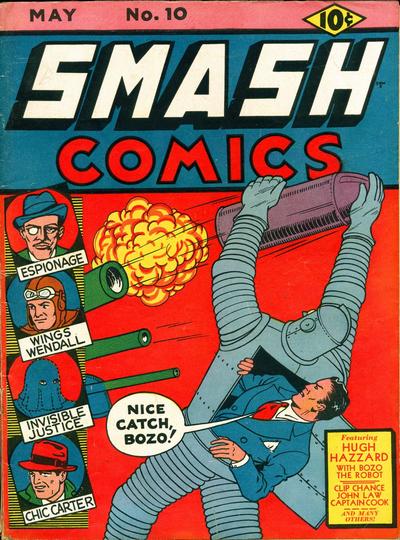
Bozo the Iron Man

Stan Lee pulled the name off the scrap heap and handed it to Marvel second-string artist Don Heck in 1962. Bozo was big enough for Hugh to crawl inside, but Heck drew a modern-day knight in a suit of electromagnetic armor. Like the Tin Man of Oz, he also has heart problems. Remove the chest plate, and Tony’s stops. Heck liked to draw the playboy industrialist sitting around hotel rooms, plugged into wall jacks as he unglamorously recharged.
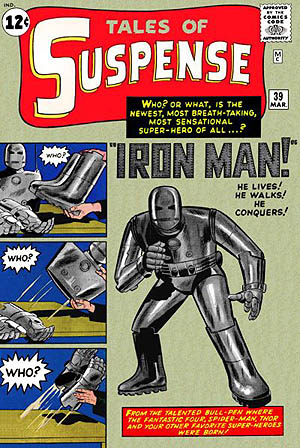
 

Tales_of_Suspense_39

 
He eventually upgraded to an implant, which makes him a cyborg too. Like the Automaton.  The first movie cyborg, from Harry Houdini’s 1920 silent serial The Master Mystery. A mad scientist removes his brain and wires it into a robot. It was supposed to be a scary, Frankenstein-like monster, but based on the photo stills, the costume designer could have worked for Sesame Street.

Also, the cyborg thing is a hoax. The Automaton is just a clunky metal suit, same as Heck’s, before Steve Ditko refurbished it.

If the 1920s seem like a long leap to find the original Iron Man, then charge your rocket boots. Next stop is the 1590s.

The first Man of Iron was soldered by Edmund Spenser in his epic poem The Faerie Queene:

“His name was Talus, made of yron mould,
Immoueable, resistlesse, without end.”

If you’re rusty on Renaissance English, that’s “iron mold,” “immovable,” and “resistless,” all War Machine synonyms.  Talus’ other superpowers include speed (“him pursew’d so light, / As that it seem’d aboue the ground he went”), invulnerability (though a bad guy “streight at him with all his force did go,” Talus was “mou’d no more therewith, then when a rocke / Is lightly stricken with some stones throw”), and strength (“But to him leaping, lent him such a knocke, / That on the ground he layd him like a senseless blocke”). And that’s just from his first adventure.

Like Bozo, this yron man is also a sidekick. The executive half of Spencer’s dynamic duo is Artegall, the Knight of Justice. Talus originally worked for his mentor guru Astraea, “to execute her stedfast doome,” before she “willed him with Artegall to wend, / And doe what euer thing he did intend.” She also gives Artgall a nifty sword “Tempered with Adamant,” same as Wolverine’s claws. Together “They two enough t’encounter an whole Regiment.”

But Art prefers words over swords. He’s a diplomat at heart. He throws a Solomon-like puzzle at a serial killer squire to expose his guilt, and talks a tyrannical Gyant into recognizing the flawed logic in its false hero rhetoric. Of course all this word-mincing is made possible by his trusty page who carries “an yron flale,” the proverbial big stick for Art’s foreign policy.

It’s the dogged Talus who has to hunt down and retrieve the rogue squire (“Him in his iron paw he seized had”), and then “forced him” to obey Art’s punishment: to wear the murdered Lady’s head around his neck like an albatross.

Thanks, Talus. Good boy.

Pages of Justice are also handy for castle storming (“at the length he has yrent the door”), mob dispersal (“hid themselves in holes and bushes from his view”), and executions (“And down the rock him throwing, in the sea he drouned”). He has no qualms dispatching women either (“Over the Castle wall adowne her cast, / And there her drowned in the durty mud”). In fact, he has no qualms of any kind. It doesn’t matter if his target offers prayers, cash or sex, “he was nothing mou’d, nor tempted” and “Withouten pitty of her goodly hew.”

Basically the guy is a drone.

Like our Commander-in-Chief, Artegall just has to give the lethal nod. Talus, “swift as swallow” and “strong as Lyon,” is well-suited to Obama’s “light footprint” military strategy. “At the end of the day,” writes David E. Sanger in The New York Times, “Mr. Obama’s favorite way to use force is quickly, secretly and briefly.” The yron drone is his perfect war machine:

“And lastly all that Castle quite he raced,
Euen from the sole of his foundation,
And all the hewen stones thereof defaced,
That there mote be no hope of reparation,
Nor memory thereof to any nation.”

But drones are under fire themselves. In the Showtime series Homeland, they convert a loyal U.S. marine into a Muslim suicide bomber when collateral damage includes 72 children.

Since “for no pitty would he change the course,” a drone like Talus has a tendency of “burning all to ashes,” and so can, according to Ben Emmerson, cause “disproportionate civilian casualties.” Last month, the special investigator for the United Nations Human Rights Council started looking at “drone strikes and other forms of remotely targeted killing” to determine “whether there is a plausible allegation of unlawful killing.”

This could be bad news for Obama, Artegall, Hugh Hazzard, Tony Stark and any other Knights of Justice using heartless Bozos to do their dirty work.

Meanwhile, the rest of the Avengers aren’t wild about Iron Man either. General McChrystal says drones are “hated on a visceral level” and create a “perception of American arrogance.” New Secretary of State John Kerry wants to make sure “American foreign policy is not defined by drones and deployments alone.” Dianne Feinstein, chair of the Senate Intelligence Committee, wants a court to oversee targeted killings. Commentator David Brooks, even while lauding Obama’s not so “perfectly clean hands” as a Machiavellian necessity, wants the same. I’m not sure how John O. Brennan, our new CIA director and the man who’s been holding Talus’ leash for the last four years, feels, but protesters shouting at his confirmation hearing were very clear: “Drones Fly Children Die.”

Feinstein puts the annual number of accidental drone deaths in “single digits.” The war machines have been at it since 2004, so you can do the math. The Council on Foreign Relations counts over 400 total strikes, with a death toll over 3,000, most of them Al Qaeda.

Ed Craun, a colleague in the W&L English department, tells me Talus represents the Law of Retaliation, lex Talonis, the biblical eye-for-an-eye. The merciless shove-it-down-their-throats mentality you would expect from a military industrial complex. So Artegall spends Book 5 learning to temper that unwarranted influence. By the end, Artegall still employs his Iron Man for military operations (Ed likens one adventure to a search-and-destroy mission in the caves of Afghanistan), but when the War Machine wants to attack an insolent hag, Artegall reins him in:

“But Talus hearing her so lewdly raile,
And speake so ill of him, that well deserued,
Would her haue chastiz’d with his yron flaile,
If her Sir Artegall had not preserued,
And him forbidden, who his heast obserued.”

Artegall knows when to listen to General Eisenhower.

Does Obama?
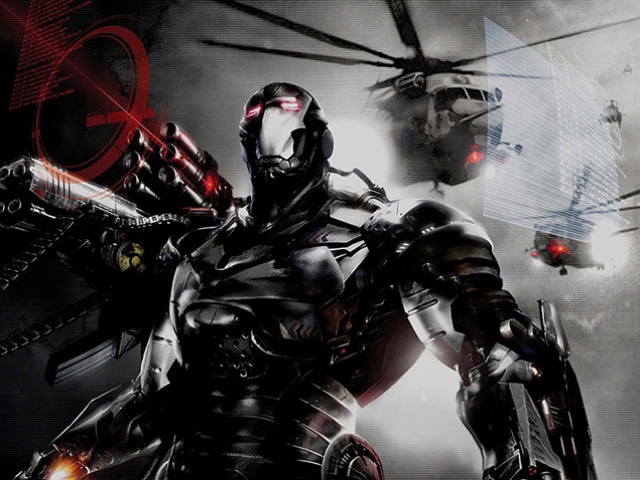
 

War Machine

Batroc! Fights! Billie Holiday!!!!!

In his recent piece decrying the comparison of comics to literature, Eddie Campbell, somewhat surprisingly, argues that it might be better to compare comics to jazz.

By way of a comparison, think of the great Billie Holiday singing “Strange Fruit”. It is a fine literary poem, set to music, and its author could have found no better singer to put it across. But a die-hard fan of Billie Holiday, the kind who has most of her recordings, is more likely to put on something from her earlier Columbia series of recordings, like “You’re a Lucky Guy” or “Billie’s Blues” (“I ain’t good looking, and my hair ain’t curled.”). A good number of the songs she had to sing during that period weren’t particularly good songs by high critical standards, and she didn’t have much choice in the matter, but the important thing is the musical alchemy by which she turned them into something precious. That and the happy accident of the first rate jazz musicians she found herself playing with, such as Teddy Wilson and Lester Young. Every time she sang she told her own story, whatever the material she was working with. I’m not talking here about technique, a set of applications that can be learned, or about an aesthetic aspect of the work that can be separated from the work’s primary purpose. The performer’s story is the essence of jazz music. The question should not be whether the ostensible ‘story,’ the plot and all its detail, is worth our time; stories tend to all go one way or another. The question should be whether the person or persons performing the story, whether in pictures or speech or dance or song, or all of the above, have made it their own and have made it worthy.

The truth is that this analysis is a little garbled. “Strange Fruit” is a mediocre song in no small part because the lyrics are lugubrious — the song’s lurid imagery and emotion sink into a clogged and ponderous earnestness. On the other hand, while it’s true that some of Holiday’s early sides weren’t especially great lyrically, many of them were. She sang “Summertime,”by Gershwin, arguably one of the greatest lyrics in the American songbook. She sang “A Fine Romance,” which means you get to hear Billie Holiday declaim, with great relish, “You’re calmer than the seals/In the arctic ocean/ At least they flap their fins/To express emotion.” She sang “St. Louis Blues” and “Nice Work If You Can Get It”. And, again, even a piece of fluff like the song “Who Wants Love?” is, in its simple unpretension, a good bit better lyrically than the overwrought “Strange Fruit.”

In other words, Campbell takes one of Holiday’s worst written song, declares it one of the best written, and then says that other tracks were better despite the writing rather than because of it.

But be that as it may. Let’s take Campbell’s contention at face value. We can look at “Who Wants Love?” which, as I said, doesn’t have especially great lyrics. “Love is a dream of weaving moonbeams in patterns rare/Love is a child believing/Stories of castles in the air” — that could be worse, but anytime you’re comparing love to moonbeams and having children build castles in the air, you’re not exactly in the realm of great poetry. So I think it’s fair to see this as an instance of a great artist trying to make mediocre material her own.


Campbell in his discussion seems to be suggesting that the content of Holiday’s songs is entirely beside the point; that the story, or lyrics, can be put aside, and the song can become purely about the artist’s achievement. But the achievement isn’t separate from the content…and Holiday doesn’t ignore the lyrics, or their slightness. Rather, her performance is in no small part about acknowledging and using the nothing she’s given. In her first words, she draws out that title, “Who wants love?”, putting more weight on it than the offhand phrase can bear — and so suggesting an intensity that can’t be contained in the song. That’s continued throughout; her exquisite sense of timing — swinging phrases so they stretch out against the beat — doesn’t ignore the song so much as emphasize her distance from it. She doesn’t mean what she’s saying, because what she’s saying doesn’t have enough meaning — not enough joy,not enough sorrow, not enough life.

The slightness of the song, then — its weak writing — becomes, for Holiday, a resource. And, as such, the weak writing is no longer weak. Holiday makes the writing mean more than the writer meant; it is not, as Campbell says, that she is telling her own story whatever the words say, but rather that her interpretation of the words is a great story. Campbell suggests that the song is not literary, but that Holiday makes it great anyway. What I’m saying, on the contrary, is that part of how Holiday makes the song great is that she transforms the words into great literature. And again, she does that not by ignoring what the words tell her — not by eschewing the literary — but by paying closer attention to what the words are saying and doing than the writer did, or than almost anyone can. Holiday’s triumph as a singer is in no small part her triumph as a reader — and as a writer. To deprive her of her literariness is I think in no small part to denigrate her art.

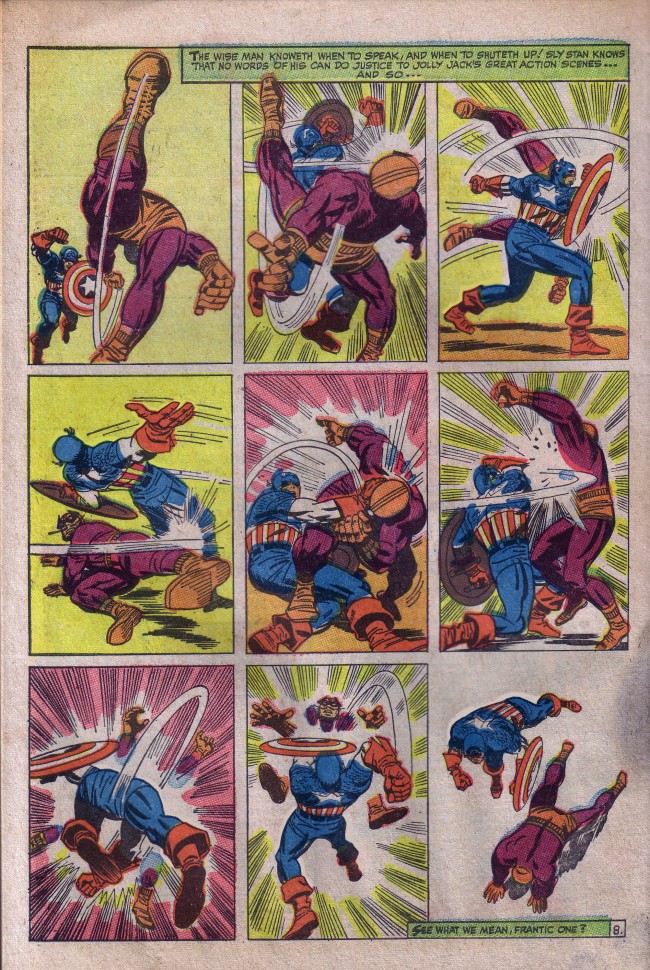
So let’s turn now to the Stan Lee/Jack Kirby page that Campbell presents as an example of counter-literariness and “improvisation” — a word that, coming as it does shortly after the discussion of Billie Holiday, can’t help but suggest jazz.

image005-650x970

Campbell argues that this page is shaped importantly by the fact that it used the Marvel method. The art came first, and then the writing was done afterwards. Thus, Campbell argues, the Lee/Kirby collaboration “tends to elude conventional literary analysis.” For Campbell, the anti-literariness of the page is a result of process, and so the most important aesthetic content of the sequence, its most essential comicness, is dictated not by the creators, but by what are basically commercial logistics.

As I said,Campbell’s fear of, and misunderstanding of, conventional literary analysis reduced Holiday’s achievement. By the same token, his eagerness to place comics formally beyond the bounds of the literary denigrates the conscious artistry of Lee and Kirby. That’s in no small part because the conscious artistry in this page is precisely about addressing the literary.

Like the Billie Holiday song, the page’s narrative is pretty much empty genre default. Holiday used nuance and subtlety to explore the distance between her and her tropes. Kirby, on the other hand, employs stentorian volume to belligerently bash down the distinction between speech and noise altogether. The fight scene occurs nowhere in no space; the actors throwing themselves together in a series of almost contextless poses against a background of expressionist, blaring lines.Towards the end, Batroc starts to disappear altogether into the sturm und drung; his hands floating in an explosion of purple, his body returning to the white space that bore it.

Lee’s captions here, are, then, not mere filligree — they actually show a remarkable attentiveness to what Kirby is doing. As Campbell says, the captions establish additional characters — not just Cap and Batroc, but Jack and Stan, as well as the reader as audience. Moreover, Lee’s winking text boxes present the page not as a narrative about the battle between Cap and Batroc, but as a performance by Kirby (and, indeed, by Lee himself.) Thus, the heroic narrative is not about Captain America’s victory, but about Kirby’s Ab-Ex dramatic self-assertion — not about the triumphant outcome of battle, but about the triumphant rush of forms across the page.

Campbell, then, is right that Lee and Kirby are sidelining the superhero narrative. He’s wrong, however, to see that sidelining as formal or default. It isn’t that the comics form naturally or automatically eschews literariness. It’s that Lee and Kirby on this particular page are, very consciously, eschewing the literary. Campbell is in effect taking the particular achievement of Lee and Kirby, and ascribing it to comics as a whole. It’s like reading Moby Dick and concluding that literature is awesome because it has whales in it.

Moreover, while I think it is right in some sense to say (as I do above) that Lee and Kirby are turning away from the literary, it’s pretty important to realize that that turning away presupposes and requires a quite thorough investment in, and understanding of, the literary and how it functions in their art. In fact, I think that you get a better sense of what they’re doing if you see it, not as pushing aside the literary entirely, but rather as substituting one story for another.

Specifically, Lee and Kirby substitute for the story of Cap the story of Jack. The page is not about Cap’s feats, but — deliberately, insistently — about Kirby’s. Thus, the story Campbell tells about this page — that it is about Kirby and comicness rather than about Cap and his story — is itself a story. And it’s a story that Lee and Kirby are quite aware of, and which they deliberately chose to tell.

Which, since Campbell has raised the issue, brings up the question — how does the story Lee and Kirby are telling compare to the story Billie Holiday is telling?

For me, at least, the answer is clear enough. While the Lee/Kirby page has its virtues, the Holiday song is a much greater work of art. This is again, in large part, because Holiday and her band accept, understand, and then work with, the inconsequentiality of the song. Listen, for example, to the Bunny Berigan solo — all bright, brassy good spirits, until that final, wavering, hesitant dropping note reveals the cheer as a bittersweet facade. Berigan isn’t using words, but he’s absolutely telling a story — and that story is about how what the pop song can’t say is a song in itself. Tied up in the vapid tune, Berigan slips free by acknowledging that he can’t get free — his capitulation, his vulnerability, is his triumph.

Kirby’s insistent triumph, on the other hand, is his capitulation. There is no space in the Batroc battle for vulnerability or vacillation. Instead, the art booms out the greatness of Kirby without qualification — which is a problem inasmuch as the greatness is thoroughly and painfully qualified. The story Kirby is telling may be about his own mastery of form, but that mastery can’t escape from the stale genre conventions — and, worse, seems oblivious to its own hidebound inevitability. If Kirby is truly such a heroic individual, why does the individuality seem to resort to such half-measures? The art seems to boast of its thoroughgoing idiosyncrasy and extremity — but when it comes down to it, it won’t and can’t abandon the by-the-numbers battle for full on abstraction. Why can’t we just have bursts of colored lines in every panel? Why not turn the forms actually into forms, rather than leaving them as recognizable combatants? In this context, Lee’s captions almost seem like taunts, praising “Jolly Jack’s great actions scenes” as beyond words, when they are, in fact, perfectly congruent with the hoariest narrative clichés. The hyperbolic indescribable fight scene is, after all, just a fight scene. Holiday knows and uses the fact that her pop song is just a pop song, but Kirby the uncontainable doesn’t even seem to realize how thoroughly he has been contained.

You could certainly argue that the Batroc battle is more successful than I think it is. You might insist, for example, that Kirby’s struggle with the stupid superhero milieu is a kind of tragedy, and that the interest is in seeing him pull something worthwhile from the dreck. Again, that’s not exactly what I get out of it, but if you wanted to do a reading that told that story, I’d be willing to listen.

Whatever one’s evaluation of Kirby, there does in fact have to be an evaluation. If the point of art is to reveal whether the artist performing a story has made it their own and has made it worthy, then there has to be some possibility that the artist in question has not done either. But Campbell’s refusal to countenance comparison, his insistence that (following R. Fiore) comics are comics and that that is there main virtue, comes perilously close to making the comicness of comics their sole virtue. Comicness becomes the all in all — so that the production method of the corporate behemoth in whose bowels Kirby toiled becomes more important than whatever Kirby was doing within those bowels. In an effort to put Kirby beyond criticism by bashing literariness, Campbell paradoxically ends up elevating the genre narrative, with no way to praise Kirby’s efforts (successful or otherwise) to leave those narratives behind. If literature has nothing to do with comics, then Kirby’s efforts to blow up genre narrative into abstraction and form become meaningless. If Kirby can’t fail, then he can’t succeed, either.

The truth, of course, is that art simply isn’t segregated the way Campbell wants it to be. There is literariness in comics, just as there is rhythm in prose and imagery in music. Artists — even comics artists — don’t fit themselves into boxes. Why shouldn’t a singer or an artist tell stories and think about narrative? What favor do you do them by pretending that they can’t or won’t react to and use the words and the narratives that are part and parcel of their chosen mediums? I like Kirby less than I like Billie Holiday, but both of them are greater artists than Eddie Campbell will allow.
_____________
You can read the entire roundtable on Eddie Campbell and the literaries here.

The Comics Journal and Eddie Campbell: In Defense of Shit and Poor Logic

Once upon a time, there was a bastion of comics criticism which, it has been opined, stood against the hordes of barbarians trumpeting the works of John Byrne, Todd McFarlane and assorted other idolaters of caped beings. But time withers all, and like Saint Gregory of Rome, the rulers of that holy organ negotiated a separate peace with the hordes — the “empire” surviving but now a rotten shambles and a mockery of what it once stood for. It has been said that the purported ideals of that magazine never existed in the first place. That past is debatable, the present less so.

What was once a hotbed of disagreement and debate has now become one of affirmation and boot licking acceptance. The rallying cry heard last week was a sermon to the converted, an affirmation of the god-like status of various revered cartoonists — that their comics remain untarnished by dint of an indefinable comic-ness

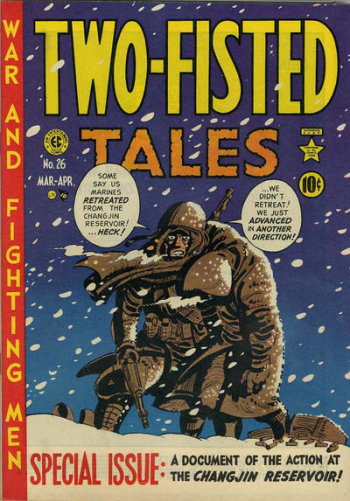
Like many rallying cries, Campbell’s piece is long on rhetoric but short on substance. His primary example as to the brilliance of the EC War line is the cover to Two-Fisted Tales #26.

Two Fisted Tales 26

“Some say us marines retreated from the Changjin Reservoir! …Heck!…we didn’t retreat! We just advanced in another direction!” – Harvey Kurtzman

“Let me fix the Kurtzman war comic in the reader’s mind before moving on. Here is the cover of Two-Fisted Tales #26, March 1952. There is a whole story in it and the way the story is told is quite sophisticated. A soldier in the middle of a historical action is already referring to it in the past tense. The first time I saw Kurtzman’s war comic art I wondered how on Earth he was able to get away with something so radical as that choppy cartooning, so far removed from what one would expect in war art…”  – Eddie Campbell

Now Campbell gives my name quite a bit of play in his article. He mentions it again here as if I was denying Kurtzman’s skillful storytelling in certain stories done for the EC war line — as if no juice could possibly be pressed from mediocre fruit. I would ask interested readers to read the article he cites to see for themselves if I have denied Kurtzman’s talent for cartooning as Campbell’s hysterical pronouncements seem to suggest.

Readers not predisposed to give Campbell carte blanche might be slightly confused by the logic of his arguments. The second half of his article assails us with an example of a superior comic-ness which deserves praise, but his half-hearted readings of the EC war comics don’t match this aesthetic appeal and simply revert to typical descriptions of the narrative and the art—Kurtzman’s “choppy cartooning” and the questionable narrative genius of the cover illustration in question:

 “…there is a whole story in it” with “a soldier in the middle of a historical action […] already referring to it in the past tense.”

The first question one should ask is why this is especially notable or the mark of a great talent for comics. Are the soldier’s words a prophetic utterance which lodges itself into the entire fabric of Kurtzman’s Changjin Reservoir issue, or is it a philosophical discursion on the paradoxical nature of time and fate?

For those not inclined to read the comic or use their brains, let me just say that the answer is “no” to both these possibilities  My suggestions seem utterly ridiculous because the answer is plainly obvious to any reader who regards the cover as a whole. There can be little doubt that the illustration and narrative communicate the language of cover advertising and propaganda.

The disheveled fighting man carrying his wounded comrade; the brilliant brush work twisting and turning—melding the two into one single beast straggling across a snow swept battle field; defiantly disabusing all non-combatants and the foolish crowd of onlookers (journalists and naysayers) of the possibility of any lack of bravery or incompetence. This is not a place for cowards or laggards but one for heroes (misunderstood, at the bottom of the chain of command, injured, or dead), who are not fighting for any abstract concept but just to survive.

What Campbell’s statement suggest is a solitary interest in technicalities, and how this differentiates him from the fans who flocked to superhero conventions during comic’s early years, I’m not entirely sure. When it comes to the spiritual content of Kurtzman’s work, he seems quite deaf or purposefully blind.

Lodged within Campbell’s thin description are other questions —whether we should judge a piece of art as a whole or by its parts; and if we accept that art can achieve greatness purely on the basis of its narrative skill or artistry, is that artistry of a level that we can forgive almost everything else (McCay’s Little Nemo comes to mind immediately).

Kim Thompson latches on to this in the comments section and I quote:

“Complaining that a comic is no good because the story is no good is like complaining that water isn’t a good liquid because oxygen isn’t wet. Bravo, Mr. Campbell.” – Kim Thompson

Thompson’s metaphor is of course thoroughly imperfect since oxygen is frequently found in its “wet” state in our modern world but let’s see what he’s getting at here. In Thompson’s comment, comics are likened to water, which every elementary school kid is taught is composed of hydrogen and oxygen atoms.  In other words, through the combination of art (hydrogen) and story (oxygen), a new, fastidious, and fabulous art form is created known as comics (water). This art form bears only a cursory relation to those things which constitute it and is neither art nor story but something entirely new which obeys no “laws” of aesthetics except those which are conjured up in the rectum of Eddie Campbell (and, maybe, his editor Dan Nadel).

Of course, this line of thought is irrelevant if one assumes that a cartoonist-critic is interested purely in the utilitarian aspects of the art in question. If one simply wants to emulate Kurtzman’s drawing line or his almost extradiegetic storytelling, the absolute quality of the art in question is extraneous.

If we mean to be “critics” interested in the formation (or reassertion) of a canon, then the absolute aesthetic appeal of a comic takes on more importance. This was certainly one of the motivations behind The Comics Journal‘s Top 100 comics list (where the EC line plays a prominent part) — a list mired in the concept that as the roots of comics reside in degradation and populism, they should conform to and be judged by those criteria only.  As such, when The Comics Journal Top 100 comics list was produced, it was not so much an exercise in choosing comics of artistic merit but a process of choosing the best smelling shit — shit which, presumably, has no relevance or connection to the world at large.

Campbells’ other argument for the genius of the EC war comics comes at the close of his piece:

“If comics are any kind of art at all, it’s the art of ordinary people. With regard to Kurtzman’s war comics, don’t forget that the artists on those books were nearer to the real thing than you and I will ever be. Jack Davis and John Severin were stationed in the Pacific, Will Elder was at the liberation of Paris. Maybe we should pay attention to the details.”

In this, he trots out an age old argument in buttressing these comics — their authenticity. And who can doubt this? For participation in war and killing (voluntarily or involuntarily) is self-legitimizing — the only truth when it comes to battle. The entire fighting corpus is like a single amoeba with a single mind and a single all-encompassing viewpoint. And why even consider the enemy, the dead, the relatives of the dead, or those who oppose war? Can a cartooning genius ever be limited in his vision or politics? Can he ever be sentimental and derivative? Can a cartooning genius ever be wrong?

_____


The other points in Eddie Campbell’s article will be dealt with in the rest of the roundtable.

“The human race, to which so many of my readers belong…”

Gilbert Keith Chesterton (1874-1936) was one of those prodigious artistic polymaths the last two centuries brought forth. He was the author of 80 books, 200 short stories, over 4000 essays, and several plays; today he is chiefly remembered for his ‘Father Brown’ stories, still widely considered to be some of the greatest detective tales of all time, and his Christian apologetics; his novel The man who was Thursday is a masterpiece of fantasy, hailed by writers ranging from Jorge Luis Borges to Neil Gaiman.

G.K.Chesterton

However, his original training was as an artist, at London’s prestigious Slade school; and though he shifted his ambition to writing, Chesterton continued to produce drawings for the rest of his life.

Chesterton was a large, imposing figure in his great overcoat and  floppy hat, a favorite target of caricaturists — the latter  including himself, as the next four drawings show:

His sense of humor often tended to the macabre:

Others also felt his satirical lash, for instance his ideological foe and personal friend George Bernard Shaw:

Where Chesterton was famously portly, Shaw was all but skeletal; which explains this exchange between these two sharp wits:

Chesterton: “To see you, one would think there were a famine in the land.”

Shaw: “And to see you, one would know who caused it.”

His personal drawings show a like playfulness:

“Catching a Train”

“Enraged Gentleman and His Victim”

Chesterton also illustrated the work of others. Below are three illustrations forBiography for Beginners, the 1905 collection of biographical quatrains — or clerihews — by Edmund Clerihew Bently.

The Art of Biography
Is different from Geography.
Geography is about Maps,
But Biography is about Chaps

Sir Humphrey Davy
Abominated gravy.
He lived in the odium
Of having discovered sodium

What I like about Clive
Is that he is no longer alive.
There is a great deal to be said
For being dead.

The people of Spain think Cervantes
Equal to half-a-dozen Dantes;
An opinion resented most bitterly
By the people of Italy

Chesterton extensively illustrated- in color- a collection of whimsical fables and tales, The Colored Lands.

The wit and whimsy of Chesterton’s writing — as evinced by this article’s title, taken from the opening line of The Napoleon of Notting Hill– is neatly echoed in these entertaining illustrations: he thus earns the title of cartoonist!


Utilitarian Review 2/9/13

On HU

Featured Archive Post: Monika Bartyzel on Bella, Buffy, and Katniss.

Me on Jack Hill’s Switchblade Sisters and the feminist revolution.

Voices from the Archive: I express some skepticism about the excellence of Eddie Campbell’s prose.

Jacob Canfield reviews a bunch of student-run college comics publications.

Brian Cremins on the end of the Comics Buyer’s Guide and Matt Levin’s Walking Man comics.

I talk about gender in comics by Lilli Carré and Derik Badman.

Jog on why he writes the comics criticism he writes.

Bert Stabler asked folks to help him out with recommendations of comics for his high school art class.

Vom Marlowe reviews Lunch Lady and the League of Librarians.

Our weekly shared music post features Wax Audio’s amazing mashup “Stayin’ Alive in the Wall.”
 
Utilitarians Everywhere

At the Atlantic I wrote about Azzarello’s violent, man-pandering Wonder Woman.

Also at the Atlantic I talk about noir and misogyny and Steven Soderbergh’s Side Effects.

At Splice Today I explain that Matthew Houk is not as cool as Johnny Cash, and that he should really shut up.

Also at Splice I write about the ambience of pop and the pop of ambience.

Other Links

Alyssa Rosenberg talks about video games and the violent fantasies of the gun lobby.

Carly Lewis suggests that men stop writing celebrity profiles of women.

Helen Rittelmeyer on less sex and more God at Yale.

Russ Smith speculates on personnel changes at TNR.

A short piece on the state of video games.

Jadehawk on whether there will be sex work in the feminist utopia.

C.T. May sneers at House of Cards.
 
This Week’s Reading

Finished Carol Ann Harris’ Fleetwood Mac tell-all memoir; read Franklin Einspruch’s Comics as Poetry anthology; read the Azzarello/Chiang second volume of Wonder Woman; just started Anne Bronte’s Agnes Grey.
 

images

Frodo, Drama Queen

images

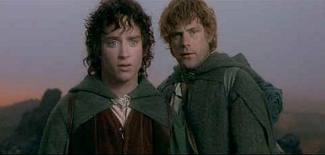
We’re rewatching the Peter Jackson LOTR films with my son, and I’m also reading him (much more slowly!) the novels. So I’ve been comparing and contrasting a little.

I’d say that I still quite like the films. Peter Jackson is especially good at bringing home the terror and pain of impending battle…and of course the war set pieces are also quite spectacular.

There are definitely problems in the parts that don’t involve overwhelming dread or out and out carnage, though. You can see the problems that sank Jackson in the Hobbit — those being that he basically doesn’t trust the audience to pay attention unless he’s shouting at them.

In the second half of the trilogy, Frodo, Sam, and Gollum are supposed to travel wearily across Mordor with basically not a whole lot happening except the traveling and the weariness. It’s not clear why this has to be a problem precisely; there’s plenty of fighting and mayhem and tension going on elsewhere, after all. But Jackson and his writers just freak the fuck out, turning Faramir into an unmotivated antagonist here and having Frodo become a paranoid nutcase and mistrust Sam there.

The Faramir thing is stupid, but not crippling. Making Frodo turn paranoid, though, seriously undermines the heart of Tolkien’s story. Frodo is certainly weighed down by the ring, and it is certainly a corrupting force. But in the novels, he also stands firm against it; he suffers, and is bowed, but does not break. In fact, the suffering is, I think, seen as purifying — the ring wastes Frodo, but what is left behind is, as Gandalf says, a light, not a darkness.

Frodo is supposed to be, in other words, a Christ figure. Suffering, undertaken for others, ennobles him. The journey and the burden make him, not evil and weak, but wiser and more gentle.

Jackson, though, needs conflict; and so Frodo has to turn mean and really quite, quite stupid so that he can mistrust Sam and there can be fallings outs and coming back togethers and drama, drama, drama. As a result, it’s not really clear in the film why Frodo was chosen to take the ring in the first place; surely, after all, any random ringbearer could have turned into a paranoid nutcase. And with Frodo sidelined as a moral guide, the place of suffering and sacrifice in Tolkien’s world is also largely sidelined. The quiet nobility of the meek is central for Tolkien. But it’s something Jackson doesn’t understand or care about, and so, in his version of the story, and almost as an afterthought, he left it out.