Reach for the Prehistoric Stars, American Comics!

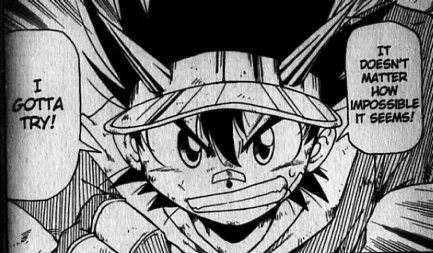
There should be more American comics like Yohei Sakai’s Dinosaur King volume 1.

Not that this is a great comic. Or a good comic. Or a comic that in any way makes you not want to seek out Yohei Sakai and force-feed him every Happy Meal in your local McDonald’s emporium, including the special toy Alvin and the Chipmunk figures, until his colon is completely encased in plastic, opening an anal fissure in space/time into which you can chuck him in the desperate hope that he, in turn, will be devoured by a fire-breathing Tyrannosaurus Rex, or, preferably, by a non-fire breathing Tyrannosaurus Rex so that he can confirm that no, really, Tyrannosaurus Rexes did not breathe fire, you shithead.

And then, as he’s torn into bloody, un-flaming gobbets, you can point out to him cheerfully that even if you grit your teeth and really, really try while simultaneously proclaiming your love of dinosaurs and whimpering softly about how you lost your mother at a tender age, encountering a T. Rex is still really fatal.

Where was I?

Oh right.

Yes, this book is bad enough that I wish hideous and improbable constipation and death on its creator and its distributor and its protagonist and, indeed, on dinosaurs, if, in their case, the death was not somewhat redundant and the constipation unlikely given the widespread absence of fossilized intestines.
But for all its manifest, egregious, bottomless badness, this book has something to teach American publishers. If you’re going to be bad, why not cater to the poor taste of the broadest possible herd? Fuck the decadent costumed multi-colored lantern corpses with the 30 years of repeatedly retconned backstory (no, not literally. What is wrong with you people?) Fuck the Forever Ultimate X-Claremont McKenna that 12 people want to read. Yes, Dinosaur King seems to say, those things suck like Youporn inhaling a vacuum cleaner. But I suck too, and I have cute baby dinosaurs and spunky young protagonists who have the amazing ability to talk to dinosaurs, and also I have full-sized dinosaurs with special ninja attacks. And, hey, I’ve got trading cards too. My artwork is even entirely decent in a stereotypical over-carbonated shonen kind of way. There are lots and lots of kids clamoring for just this kind of badness, and I aim to deliver it directly to their malleable, sugar-spasming adrenal glands and long-suffering parents.

Stop your elitist, clubby, insular dreck, American comics! You too can make dreck for the masses! I just know you can! There’s nothing you can’t do if you just try!
______________
This review first appeared on tcj.com.

Utilitarian Review 6/18/11

News

The deadline for submitting lists for our Best Comics Poll is June 30! Please check out the guidelines and submit a list!

On HU

Featured archive post: Derik Badman’s translation of Fabrice Neaud’s essay on Aristophane’s Conte Demoniaque.

James Romberger on some of the most underrated Kirby comics ever.

I talk about DC’s stupid flashpoint map.

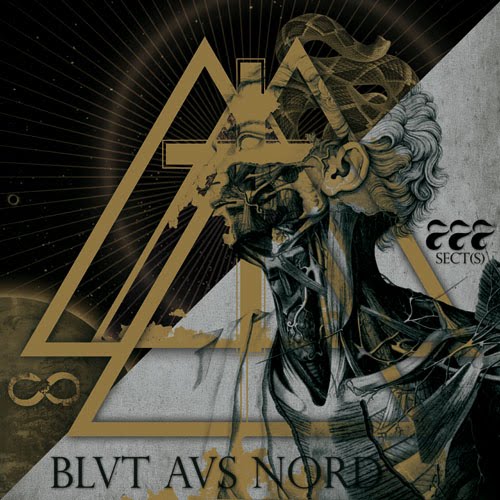
I discuss French black metal horde Blut Aus Nord and Caroline Pickford’s liturgical philosophy.

I talk about the emptiness of Ghost in the Shell, the manga.

Joy DeLyria discusses the feminist problems with Bewitched.

Sean Michael Robinson argues Samantha of Bewitched is a slumming immortal, not a trapped housewife.

Utilitarians Everywhere

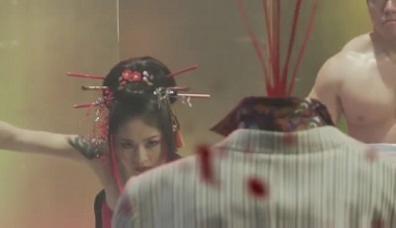
I review the Japanese gorefest Psycho Gothic Lolita at Splice Today.

And also at Splice I look at the recent Republican debate so you don’t have to.

Other Links

The folks at Savage Critics talk Paying for It.

Charles Reece disagrees with me about Priest.

June 30 Deadline for Best Comics Poll!

Just a reminder that we’re coming up on the deadline for you to submit to the Best Comics Poll, organized by Robert Stanley Martin. We already have over 120 lists from comics creators, bloggers, academics, and journalists. We’re really excited about how the poll is shaping up, and we hope you’ll contribute!

Here is Robert’s announcement of the details:

Would you like a break from all the incessant, pretentious squabbling here at The Hooded Utilitarian? Well, so would we! And we’re going to have a party!

We’ve already started sending out personal invitations to comics creators, members of the comics press, and various others to participate in a poll. We want to know their favorite comics of all time. In early August, we’re going to start counting down the top vote getters until we get to the winner of our little popularity contest. We will then publish all the submitted lists so everyone can see who voted for what. You may find your taste in comics is simpatico with people with whom you never thought you agreed.

The specific question of the poll is this:

What are the ten comics works you consider your favorites, the best, or the most significant?

We want lots of participants, lots and lots of them. We want more than we can ever hope to think of inviting. So we’re making a public announcement. If you can make any real claim to being a member of the comics press or comics academia, to being a professional creator in the comics, cartooning, and illustration fields, or an owner or employee of a comics-related business, you’re eligible to participate as long as we can easily verify your status. If you’re a comics blogger, no problem! A web-comics creator? No problem! An English professor who has assigned comics in your classes? An employee of a book publisher that handles comics? No problem! We want your list. And please pass our request on to eligible people whom you think might be interested!

If you send your list, and you are interested in writing a short appreciation of one of your favorites, we ask you to let us know. However, please remember that The Hooded Utilitarian is a not-for-profit writers cooperative and cannot pay for published submissions.

Here are the submission guidelines:

Send your list in an e-mail to bestcomicspoll@gmail.com.

Please don’t send your list in an attachment. E-mails with attachments will not be opened.

If you haven’t been sent a personalized invitation, please include a brief note explaining who you are and a website where we can go to confirm your status. If you send your list from an employee e-mail account from a comics-related or otherwise suitable employer, that should be sufficient. (Though don’t do anything that might get you into trouble with your boss.) Please keep in mind that if you have not received a personalized invitation, we cannot guarantee you will be participating in the final vote.

Please send your list by June 22, 2011. If you have received a personalized invitation, and we haven’t heard from you by June 15, we’ll send you a reminder notice asking you to please get it in by June 30.

Here are the guidelines for preparing your list:

First, here’s a sample list:

Barbarella, Jean-Claude Forest
The caricatures of Victor Juhasz
Curtis, Ray Billingsley
The editorial cartoons of Bill Day
The single-panel magazine cartoons of Rowland B. Wilson
The Mystery Play, Grant Morrison and Jon J Muth
Samurai Executioner, Kazuo Koike and Goseki Kojima
X-Men, Roy Thomas and Werner Roth
X-Men, Chris Claremont, John Romita, Jr., and Bob Wiacek
The Zap Comix stories of Robert Williams

Your list may include any newspaper strips, comic-book series, graphic novels, manga features, web comics, editorial cartoons, and single-panel magazine cartoons. These works can be from any country of origin. Please do not include an entry that has yet to be published.

Each of your list’s entries should consist of the name of the work and its author(s).

With newspaper strips and corporate-owned comic-book features, we ask that you list runs by different creative personnel as separate entries. Do this in the manner of the two X-Men entries in the sample list above. If your list includes an entry like “X-Men, Roy Thomas, Werner Roth, Chris Claremont, John Romita, Jr., and Bob Wiacek,” we will print it as part of your list, but it will not be counted as a vote towards the final one.

In the case of features in alternative-comics series that were later published as distinct graphic-novel collections, please use the graphic novels when preparing your list. For example, if you would like to vote for work by Daniel Clowes that was originally published in Eightball, we ask that you vote for Ghost World, Ice Haven, or Caricature & Other Stories, etc. as separate entries.

With a manga or graphic-novel series by a single author (or author team) that stars continuing characters, please vote for this as a single work instead of for individual volumes. If you vote for multiple volumes, it will only be counted as one vote for the feature.

With caricaturists, editorial cartoonists, and single-panel magazine cartoonists, we ask that the entry be for the cartoonist’s body of work in that mode.

Please do not vote for anthology publications. Please vote for an individual piece or a continuing feature in the anthology. Voting for a single author or author team’s body of work in the anthology is fine, such as the entry in the sample list of Robert Williams’ body of work in Zap Comix. The rare anthology in which the editor played a primary creative role in the featured material, such as Harvey Kurtzman’s Mad, is also fine.

While you are free to rank your lists (we will show your rankings when we print your submissions), your rankings do not weight your votes in the tally for the final list. Each of your entries will be counted as one vote.

If you send a list with less than ten entries, all will be counted towards the final tally. If you send a list with more than ten entries, we will likely write back to ask that you restrict your entries to ten. If you do not reduce your list to ten, we will count none of your entries as votes in the final list, although we may print your list with an explanatory note in the submissions posting.

We reserve the right to count votes towards the final tally as we see fit.

Don’t get stressed preparing your list. The point is to have fun!

If you have any questions, please e-mail them. We’ll do our best to help.

Please feel free to reprint this, link to it, and otherwise pass it around.

Empty Shells

A little while back, Anja Flower wrote about gender identity in Ghost in the Shell. At the conclusion of zir essay, Anja argues that Ghost in the Shell, in its multiple marketing iterations and incoherence, can be read as undermining the idea of an essential gender.

Even laboring under the assumption that Motoko Kusanagi is bound by an underlying essence, we must admit that this binding essence is fictional – that in fact “Essential Motoko” is a construct we amalgamate out of images and ideas accumulated from consuming the Ghost in the Shell franchise in its various forms. Abandoning this idea, we are free to focus on the Major as she in fact is: a series of images and text snippets juxtaposed. Seen this way, gender can be read into just about everything: into the whole book, into whole characters to be sure, but also into scenes, pages, panel sequences, environments, color/tone palettes and individual colors/tones, outfits and items of clothing, poses, facial expressions, speed lines, patterns and symbols, inking techniques, even single lines. The changes in gendered expression from line to line, color to color, face to face, panel to panel are often tiny, but they are important because they provide an entirely different image of gender in comics. This image is not one of an immutable essence limited to characters and rarely or never changing, but as an everpresent jumble of tiny shards of signification, only semi-coherent at best and only even pushed into appearing as constant (if fluid) by the reader’s ability to imagine the gaps in information between panels – the device of “closure” described in Scott McCloud’s Understanding Comics. Gender overgrows in every direction, abundant shards of it popping up wherever the particular reader’s subjectivity allows it; it is subjective, certainly, and also cumulative and temporal, agglutinating and morphing as the reader reads and re-reads, consumes new additions to the franchise, looks at new pieces of fan art, comes to greater understanding of plot points, digests criticism. Each of these experiences provides an abundance of these shards of gendering for the reader to plug into their gender-concept of the entire franchise, the individual story or character, the individual page. The reader is selective in doing this, and the shards from which they select appear different as the reader acquires different sets of eyes.

I hadn’t ever read Ghost in the Shell, but Anja’s essay intrigured me. My wife happened to have bought the manga, so I thought I’d read it and see what I thought.

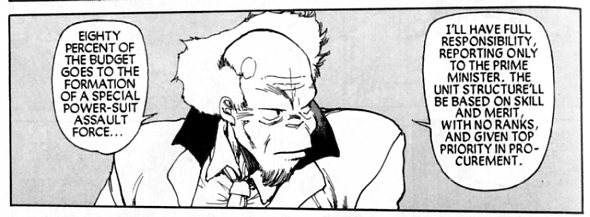
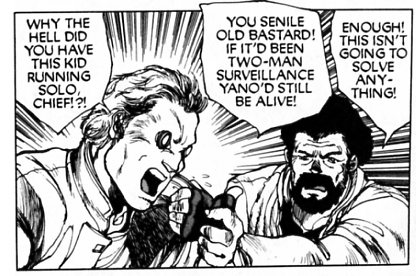
And what I thought was…well, to be honest, I kind of felt weird thinking anything about it. Here’s an example of why.

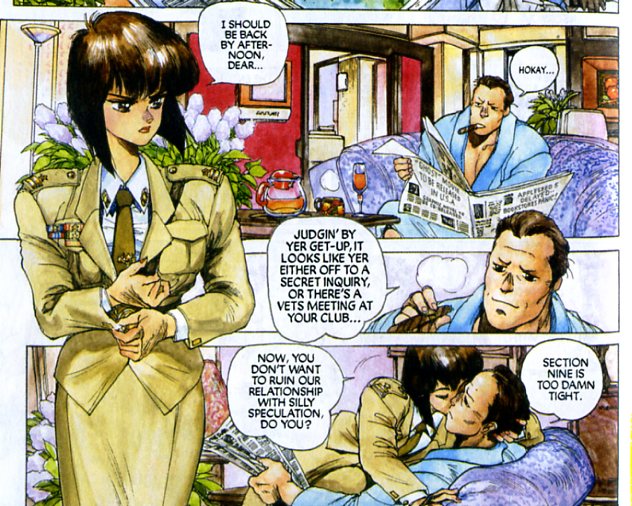
And here’s another:

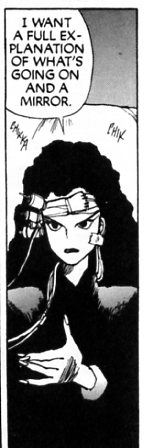
Or here’s one more:

Just looking at those panels, you might conclude that they were utterly anonymous genre fodder. The crusty but tough team leader fulminating hard-assedly; the ultra-competent fighter grieving through bluster hard-assedly; the sexy-tough couple bantering sexily but hard-assedly. You might think that there is nothing going on in this manga that you haven’t seen before; that character, plot, and atmosphere are little more than a half-hearted scrambling of tediously familiar topes.

You might think that. And you would, in fact, be right. Ghost in the Shell is, from beginning to end, an uninspired, barely stirred sludge of half-digested clichés. The plot is complicated, twisting, and aggressively irrelevant, bearing the characters along in a rush of technobabble from one uninvolving violent set-piece to another. The hyper-competent Major Motoko Kusanagi is a medical miracle, managing to fight, wise-crack, switch brains, and flash cheesecake without ever acquiring even the hint of a discernible idiosyncratic personality. When the mysterious, artificially generated Puppeteer merges with Kusanagi’s consciousness at the end of the volume, you wonder how on earth anyone is supposed to tell the difference. I guess Puppeteer/Kusanagi makes more speeches than Kusanagi alone did? That’s something I guess.


Kusanagi/Puppeteer — Still talking tough, still saying nothing.

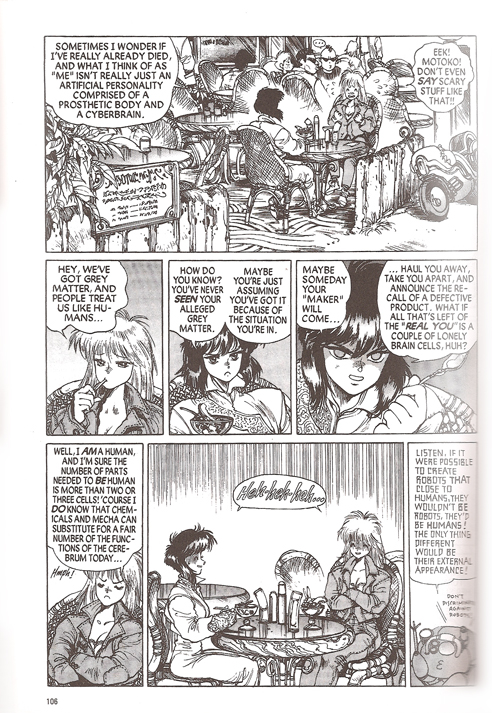
The thing is, the fact that Ghost in the Shell is kind of lousy doesn’t necessarily undermine the points Anja makes. In fact, it’s lameness can in some ways be seen as thematic. The book, as Anja notes, is about the fracturing and fluidity of human identity; the characters are a mix of human, robot, cyborg, and combinations thereof. The page below from the manga (reprinted by Anja) lays out the theme — how can you tell whether you’re human or not? What does it mean to be human, anyway?

“what if all that’s left of the real you is a couple of lonely brain cells, huh?” Kusanagi asks.

The irony is that there aren’t even a couple of lonely brain cells here. No brain activity at all appears to have been expended on creating these characters. They speak and interact, but they have no real history or personality; they’re just sci-fi cyberpunk cyphers, mechanically running through their tropes. They wonder whether they’re real in the most artificial manner possible. Are they pasteboard cliches dreaming that they’re robots, or robots dreaming that they’re pasteboard cliches?

Genre’s inherent emptiness can often be an excellent way to look at the way the world doesn’t work. This happens in Gantz, where the incoherence of the genre elements fits into a supposedly cynical, but arguably terrified nihilism. It happens in Moto Hagio’s story A Drunken Dream, where the standard narrative warps and fractures before an underlying trauma.

For Anja, I think something analogous happens with Ghost in the Shell. The fact that Kusanagi is a blank slate emphasizes the narrative’s half-denied intimations of open identities. The book claims that inside every body, of whatever sort, there is a ghost or essence. But despite this, Kusanagi is, for practical purposes, no one — the Puppeteer takes over an empty puppet. The self is not a fixed core nailed to a single gender; it’s a series of shards that come together in this way and that. For Anja, that lack of essence is (at least potentially) freeing.

For me, though — I mostly find the implications of Ghost in the Shell depressing. I don’t have anything in principle against fluid identities…but in Ghost in the Shell, those fluid identities seem to be not so much liberating as claustrophobic. You can be anyone you want…as long as the person you want to be is a stereotypical tough-talking government agent, scrambling blandly through some bone-headed plot. To give up your essence in this context doesn’t open up infinite possibilities. It just makes you generic. Abandoning your self doesn’t let you escape social conventions and expectations; on the contrary, it means you have no choice but to embody them.

Liturgy of Blut

This first appeared on Splice Today. I’ve been talking about black metal and Christianity in comments recently, so I thought I’d reprint it.
_____________________

“The images of art,” theologian Caroline Pickstock asserts, “offer us visions of the good, new possibilities of human self-realization that lie, as it were, just out of sight.” Pickstock, writing in the collection Paul’s New Moment, is thinking here specifically of liturgical art. But the ease with which she generalizes suggests strongly that — safely ensconced in the swaddling ivory of Cambridge — she has not heard a lot of black metal. Because, I have to say, when I listen to 777-Sect(s), the latest album from French avant-black-metallers Blut Aus Nord, I am not exactly seeing new possibilities of human self-realization lying just out of site. Unless new possibilities of human realization lying just out of site include charred corpses being pulled across jagged metal by slowly decaying ungulates.

Obviously, black metal, is not into “visions of the good”. If there’s any liturgy here, it’s the Black Mass. 777-Sect(s) is a single, 6 part suite of bleak, dissonant hammering. The music staggers and lurches between black metal fury and despairing trudge, veering back and forth as the quasi-industrial drumming lands repetitive robotic blows on its oozing cranium. The album never reaches the pure pagan fury of old-school Scandinavia, but it doesn’t descend into pleasant tripped-out trance the way the contemporary American scene sometimes does. Instead, Blud Aus Nord draaaaagggggssss, all minor scraping and abject failure — the hapless, despised hero crawling out of the pit only to be pulled back again and again by the inexorable, shapeless talon. At the very beginning of the album, in fact, the rough distant screaming/vomiting almost sounds like you can hear our hero being devoured by the stinking maelstrom.

So…black metal is not uplifting. No one is surpised. Though philosopher Slavoj Zizek, also writing in Paul’s New Moment, does actually find something liturgical in the horror movies for which 777-Sect(s) seems to want to serve as a soundtrack. According to Zizek:

the good guys think they’ve destroyed the possessing alien, but some slimy residue of the alien is left lying around. Then comes the standard shot, where the camera slowly approaches the residue, and what we thought was just a bit of squashed alien starts to move and organize itself. We leave the film with the alien organizing itself. This is the divine element. I think horror movies are the negative theology of today…. It is as if the good guys in such horror movies are like Roman soldiers: they thought they had destroyed everything in Chirst, but that little bit of alien residue remained and started to organize itself into the community of believers.

In this reading, you could see the way 777-Sect(s) is pinned between anger and dissolution as a long struggle for becoming, an effort to pull together its bloody gobbets into a shambolic whole, the better to parasitically feed upon the body of the state/hegemony/pop music. Blut aus Nord will possess Britney as the spirit of Christ will possess the world. The apocalypse will come when Rihanna’s head turns around and she starts spitting metal bile.

I love Zizek’s unkillable Terminator as unkillable Christ analogy…but I have to admit that if you think about it too long, it starts to seem a little unsatifying. Reading Jason or Freddy back from the dead as the miraculously risen community of believers — I don’t know. It seems a little too cheery, doesn’t it? Is The Thing really more enjoyable if you read it as It’s a Wonderful Life? Is Blut Aus Nord really just Perotin for the 2010s?

The thing Zizek seems to be missing here is the Thingness. As an atheist, he’s eager to metaphorically transubstantiate that risen body into a supposedly materialist, but actually more foofily non-present spirit of lovingness and community. Which is clever, but doesn’t really map onto Blut Aus Nord. Blut Aus Nord does not do lovingness and community. The physical bodies of these musicians excrete, not spiritual bliss, but ropy tendrils of hate.

Which brings us back to Caroline Pickstock:

…liturgy fulfills the purposes of art as imaging according to the modern Russian filmmaker and photographer Andrei Tarkovsky. The image should displace the original because the original thereby becomes more itself, if what a created thing and especially the human creature is, is after all “image,” the image of God. So when in the course of liturgy we are transformed into a wholly signifying — because worshiping — body, we are at that moment closest to our fulfillment as human beings.

Art as liturgy does not provide a metaphor of the dead God becoming the human community. Instead it shows the body as created thing; self as manufactured cyborg, which rises only because its putrefying husk is dragged upwards by an insistent and alien power. Art shows us ourselves as the image of God. And in this case that image is the brutalized Christ on the Cross — God as dead body as Thing. Blut Aus Nord figures us as struggling, debased monstrosities: a kind of human self-realization that even Caroline Pickstock would have to admit is eminently Christian.

Brave New World

This was supposed to run at Comixology as my monthly column, but given their partnership with DC, they felt it was too mean-spirited. So I’m running it here instead.
_______________________

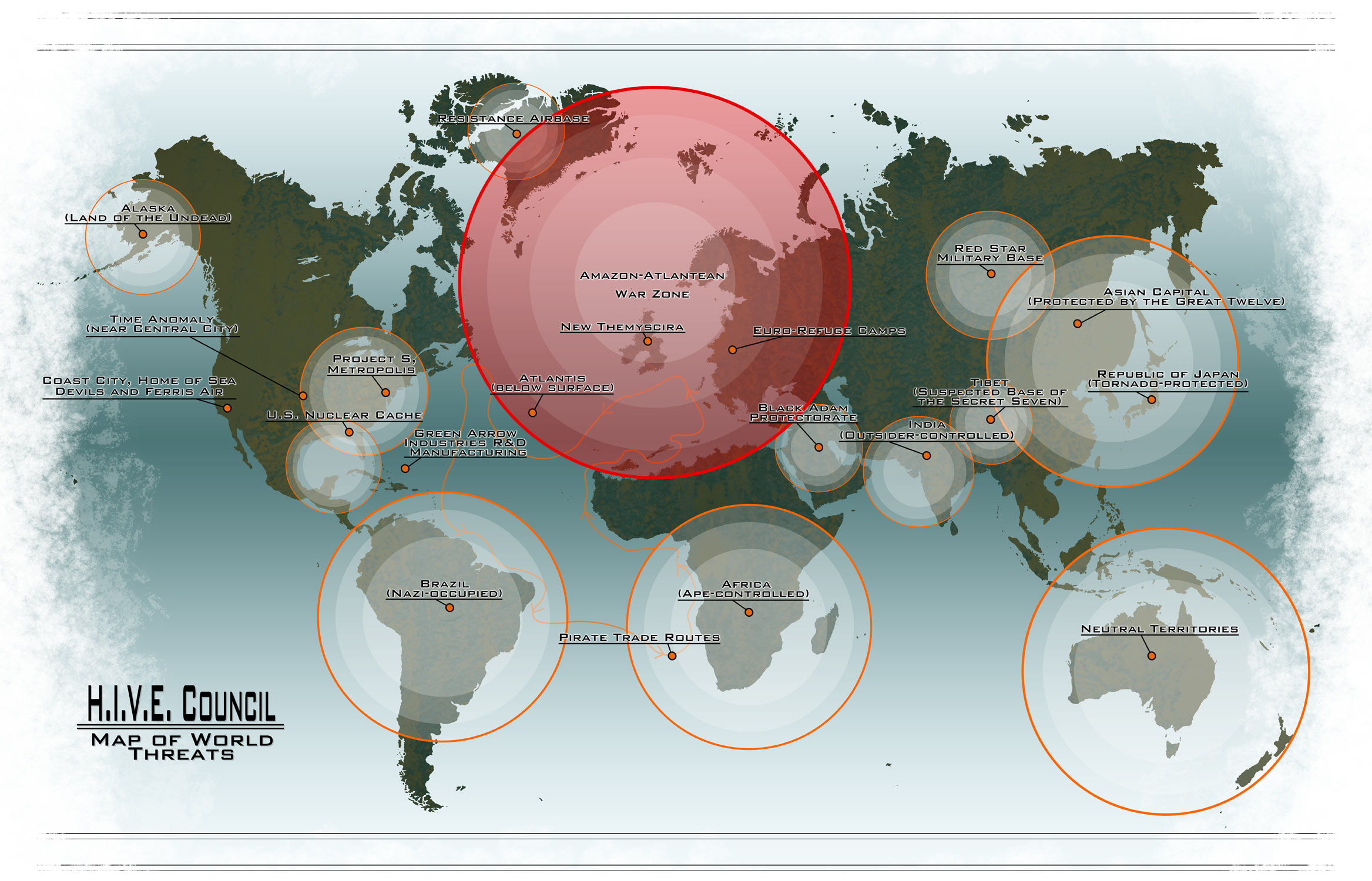
As everyone knows (and by “everyone” I mean “the 12 people who still read DC comics and the 350 or so who still comment about said comics on blogs,”) DC released a map of their alternate reality Flashpoint universe last month. Here it is:

Part of the map is dedicated to the kind of fanboy-tease insider “surprises” that always suggests someone’s mother’s basement and dim, sad, lurching figures dressed only in sweatpants and stale cheetos. Oooh…Project S! In Metropolis! What oh what could that mean! And a time anomaly in Central City huh? Chuckle, wooo! What won’t they think of next! And Green Arrow has a whole island from which he can resist the Man! Fight the fight, Ollie! I bet you got just the one arm, same as you did in Dark Knight!

So, yes, it’s the sort of tired property-scrambling that makes you want to dash your brains out against the nearest wall in the vague hope that your carefully horded nerd-knowledge will dribble out with your cranial fluid and that, while you’re lying there in the hospital with a feeding tube down your throat and man-diapers on your shitter, you at least will no longer have the embarrassment of knowing about Flash’s cosmic treadmill, and/or about the necessary impurities in Dan DiDio’s ethical system.

But hey, that’s comics. You interact with DC, you expect to be humiliated and to crave for death. You’re going to ask comics fans to get angry at something like that, you might as well ask them to stop stabbing themselves in the eye with the blunt end of a compass. I mean, if they could find the sharp end, they would have done it years ago, right?

But! This map is not satisfied to just be another example of shitty superhero comics ephemera! This map has dreams, baby. This map wants to climb out of that basement; it wants to emerge into the light of the great American continent, blink twice, and retch up its vile id like a glorious fountain of rancid Atlantean fish-heads.

It’s fascinating, really. What is buried there, deep in the collective doddering hindbrain of the swollen fanboys who call themselves (in delightful self-parody) the “creative minds” at DC? Look! Over here! They have vague memories that some Nazis ended up in South America, and someone told them that Brazil is in South America…and so they put the two together! Isn’t that cute? And they know that Tibet is mysterious, so they’ve made it the home of the Secret Seven! Get it? Secret! And…Asia! It’s out there somewhere, like the truth, but less differentiated. Surely it has a capital. Probably called something clever like, oh I don’t know — “Asian Capital?”

And then there’s Africa which, as you will observe, is “ape-controlled”. If you are in the know, you of course realize instantly that “ape-controlled” means that Gorilla Grodd, the giant psychic ape, has conquered the entire darn continent. It can’t have been too difficult for him, since Grodd has effectively been the only inhabitant of Africa in the DC universe for the past 30 or 40 years. Which is why, if you’re a DC comics fan, it’s natural to think “ape” whenever you think “Africa,” the same way you think “pneumatic ta-tas” whenever you think “woman.” How can you say that’s offensive? They don’t mean anything by it. And if they did, well, it’s only comics. If racism was good enough for Winsor McCay and Herge, why shouldn’t it be good enough for DC? (This is in no way meant to imply that anyone in charge at DC has heard of McCay or Herge.)

All of which ignores the main point, which is that there are zombies in Alaska. Zombies are hip and happening and cool, and, of course, in Alaska they will be even cooler — sub-zero even. It’s comforting to know that DC is paying attention as the world changes around them. Zombies. That’s progress.