Dirty Projectors: Stillness Is the Move

The earnest retro soul vocals on this Dirty Projectors song fill me with irritation, not at all mitigated by the soulful-flower-children video. I can appreciate that it’s well-crafted, but its egregious effort to inspire me just makes me want to kick things. It’s like “Wind Beneath My Wings” for idiosyncratic indie rockers. Bleh.

I just realized…I think they want to be Sly and the Family Stone a little bit. It’s a worthy ambition, but the comparison is not beneficial.

But the Factual Opinion hive mind says it’s the best song of the year, so go figure.

Utilitarian Review 1/9/10

On HU

Lots of bytes through the sluice on HU this week.

To start off, I sneered at the Yeah Yeah Yeahs and wondered about Fantagraphics’ marketing policy (Fantagraphic marketers showed up to explain in the comments.)

I denounced Lady Snowblood, movie and comic, on the grounds that they are evil. Suat came back with a lengthy defense

I defended blogging and even got all emo about it. In another meta moment, I defended my right to think Ganges is boring and sneer at other comics critics and spit bile more or less indiscriminately, damn it.

Kinukitty reviewed the yaoi Dining Bar Akira.

Richard kicked off a new series, Anything But Capes, in which he looks at genres other than super-heroes. He started off by looking at the state of Barbarian comics.

Suat reviewed Ooku, which he doesn’t like as much as me.

I explained what my son has and has not learned from Peanuts.

Vom Marlowe drew a comic expressing her disinterest in X-Men Forever.

And this week’s music download features lots of doomy drones and other metal. (Last week’s, if you missed it, features Thai country music (Luk Thung.)

Utilitarians Everywhere

My enthusiastic review of Dokebi Bride is up on Comixology this week.

That departure, I think, points to the core knot at the heart of Dokebi Bride. The book, like many ghost stories, is about grief and dislocation and how the two circle around each other like black, exhausted smudges. The first volume opens with Sunbi’s father carrying her mother’s ashes back from the grave; that volume ends with the death of Sunbi’s grandmother, who raised her and cared for her. The central loss of a parent, and therefore of self, returns again and again through the series, a literal haunting. Sunbi can’t function without putting the past behind her, but the past is everything she is — she can’t let it go. When a fortune teller offers to read her future, Sunbi rejects the offer angrily. “No, I don’t want to know about my stupid future!” she bites out through her tears. “Just tell me what all this means to me! Tell me why they’ve all died and left me, why they’re even trying to take away my memories!”

On Tcj.com I reviewed Strange Suspense: Steve Ditko Archives Volume 1.

Did you read that whole thing? If you did and you enjoyed it, you’re a hardier soul than I. “I got my letter and then I thought about my letter and then I thought about my letter some more and then I used a metaphor: ‘leaden feet’!” That’s just dreadful. And, yes, that’s the one romance story in the book, but the horror and adventure comics are not appreciably better; there’s still the numbing repetition, the tin ear, and the infuriating refusal to finesse said tin ear by leaving the damn pictures alone to tell their own story.

Bert Stabler and I talk about Zizek and art over at his blog Dark Shapes Refer.

I like the idea that you need a transcendent background in order to appreciate, or even allow for, multiplicity. I’m thinking about this a little bit in terms of culture and art, and the impulse that I think most everyone has to want people to consume/listen/read/whatever the right thing. It seems like that’s coming from a place where the transcendent is material; that is, your worshipping the art itself, therefore moral choices become essentially consumer choices. Alternately, you just cut culture and morality apart altogether, and argue that neither has anything to do with the other. Whereas if you have a transcendent ground of some sort, you can say, well, culture connects up to morality and or important things in various ways, and you can talk about it in those terms, but choices about art are not in themselves good or evil.

On Madeloud, I review the soundtrack to the BBC miniseries Life on Earth, which profoundly affected my life when I was, like, 8.

Over at Metropulse, I have a review of avant Japanese guitarist Shinobu Nemotu’s Improvisations #1.

At the same site there’s also a review of the slab of black doom that is
Nihil’s Grond.

At the Chicago Reader I review the fairly amusing gimmick book Twitterature.

Other Links

I enjoyed Tucker Stone’s Best of at Comixology, especially since he picked the right thing for book of the year.

Ta-Nehisi Coates explains why he wants to be able to check “Negro” on his census form.

And finally, Johanna Draper Carlson has a nice summation and round up of links relating to the devil’s bargain between MOCCA and Archie Comics.

Music for Middle Brow Snobs: Angherr Soda

Doomy/drony, plus some prog.

1. Angherr Shisspa — Koenjihyakkei (Angherr Shisspa)
2. Rimfrost — The Raventhrone (Veraldar Nagli)
3. Drudkh — Eternal Turn of the Wheel (Forgotten Legends)
4. Nadja — Dead Skin Mask (When I See The Sun Always Shine on TV)
5. 22:34 14 Jan 2009 — Shinobu Nemotu (Improvisations #1)
6. Gui Boratto — Atomic Soda (Take My Breath Away)

Download Angherr Shisspa.

And if you missed it, you can find last week’s Thai music download here.

Spiritual Enlightenment from Peanuts

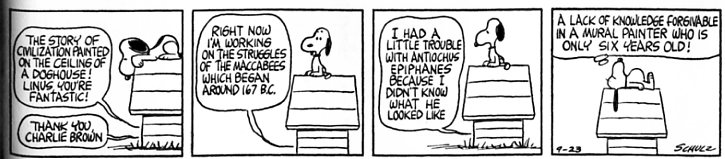
I was reading the 1963 Fantagraphics Peanuts collection to my son (now on sale!) he’s gotten really into them recently. Anyway, there’s one fantastic series of strips where Linus paints a Biblical mural on the ceiling of Snoopy’s doghouse. In perhaps the best, Linus comments that he isn’t sure what Antiochus Epiphanes of the Maccabee story looks like— a lack of knowledge which, Snoopy comments, is forgivable in a six year old.

My son is very curious about how old the Peanuts characters are exactly, so I pointed to the end of the strip and said, “Look, Snoopy says Linus is six, just like you.”

“Linus is six?” he said.

“Yes,” I said. “But he doesn’t act like he’s six really does he?”

“No,” he said. “Because he carries a blanket around and sucks his thumb.”

“Um, right.” I said. “But he also does things that seem older. Like painting a mural on the roof of a doghouse. Could you paint a mural on the ceiling of a doghouse?”

“I could if the doghouse was big enough.”

“I don’t…”

“I could. I can paint. And I could paint a mural about the Hanukkah story.”

As is the way of my Semitic people, I have, of course, done absolutely nothing to further my child’s religious education, prompting my wife, who was sitting nearby, to ask the obvious question.

“How do you know that the Maccabees have anything to do with Hanukkah?”

He looked at us like we were crazy. “Because,” he said, “I saw it on Krypto the Super Dog.”

I Think Ganges Is Boring

Apparently, this means that I should just give up writing about comics altogether and, I don’t know, join a monastic order of geeks and castrate myself with a rusty center-staple according to Sean Collins, who broke all the bones in his hands and found one of those funny fedoras just so he could call himself the Mr. A of random critical comics pronouncements.

Some of you are no doubt asking yourselves — what the hell is Ganges? Who is Mr. A? Who is Sean Collins? Who cares?

If you asked yourself all, or any of those questions, or indeed, any question at all, ever — you sir (or madam) are beneath contempt. Find an entire run of comics journal back issues, liquify them through the power of your lameness, do a zombie ritual to resurrect the lower intestine of Art Spiegelman’s sainted father, and then use the latter as tubing to rectally partake of the former until first-rate poorly-edited critical prose gushes from your newly erudite nose hair like wisdom from the Internet or brilliant babies from your mama.

Let’s have some other, lesser people talk then.

Hey, here’s Tucker Stone. He likes Ganges. Fuck him.

There’s a temptation to label mainstream fans as being lazy for not caring about Swallow Me Whole or Blankets, to call them “bone-ignorant” — that’s just a bunch of horseshit. It’s an attempt by boring assholes to assign an overall meaning to a bunch of personal choices made by a group of people that those boring assholes don’t know anything about. On an individual level, I’ve heard a couple of people say they don’t want to read comics that focus on the mundanities of regular life, but I’m more often exposed to people who just like what they like because it’s what they fucking like. Besides, the attitude you’re describing — that’s not coming from real sampling of readers. It’s coming from the internet’s sampling of readers, it’s coming from small publishers (and most small publishers are readers with credit problems), and the internet and small publishers are pretty much wrong all the time about why people like the things that they like, because most of the people who write blogs, read blogs, leave comments — they aren’t the majority opinion. They’re the minority opinion. If the comics internet was an accurate representation of what comics mattered to people, it would be shitloads of articles about Bone, Y: Last Man, Crumb’s Genesis — and it’s not. And thank God it’s not! But what you’re talking about — why people react the way they do, and what does that mean — hell, the internet isn’t going to answer that question. It doesn’t know either.

Yeah, yeah, yeah. You don’t know, the Internet doesn’t know…cry me a river, fanboy. You know who knows? I know. And what I know is that the river Ganges is filled with floating turds just like your taste, asshole. “Oh, why can’t this Robin comic be more like Glenn lying next to his wiiiiiiffffeee? Why are abstract comics so difficult to understand? What’s this critical discourse doing in my pants, and why’s it feel so good when I touch it?”

Hey, here’s Sean Collins. He likes Ganges too. Fuck him.

I mean, if you met someone who only watched superhero movies, you’d think that was weird and dumb, and you’d be right, and saying so wouldn’t make you a boring asshole, it’d make you a person who was right. Moreover, saying so does not mean you’ve extrapolated that they’re some horrible CSI Miami-watching mouthbreather or anything else about “who they really are” or whatever. You’re just a critic, addressing what people are saying about specific comics, which is a valid thing for a critic to do.

Finally, Tucker’s coup de grace is the fact that most of the audience doesn’t really care about critics or critical approaches to what they enjoy reading anyway. But so what? Most of the people in the theater with us at Up in the Air yesterday have never read Pauline Kael. But criticism is not therefore an egomaniacal waste of time, any more than making art that most of the audience for that art form doesn’t really care about would be. Kevin Huizenga shouldn’t hang it up just because he’s not Jim Davis; similarly, we shouldn’t crumple up the idea of analyzing art and arguing for standards and throw it in the trash because many people would just rather read/watch/listen and then do something else.

If you met a person who only watched superhero movies, that person would be fucking dead, Mr. Genius, because if they only watched superhero movies that would mean they weren’t doing things like eating and breathing and and even if you really like Heath Ledger you’re not going to make it through Dark Knight like that. So, yeah, go ahead and make fun of the corpse on your couch, Mr. Collins, and pat yourself on the back for maintaining standards and analyzing art and rejecting egotism by dressing just like Kevin Huizenga. Bravo for you!

Here’s Tom Spurgeon. He likes Ganges. You know the drill.

In broad terms it’s not that MOME readers should be suggested to read Tiny Titans, but that a hugely presumptive, distorted dismissal on their part should be as open to criticism, especially when it risks the industry being shaped according to those presumptions.

I’d like the industry to be shaped like the Comics Reporter’s tiny distorted titan rearing up to declaim “Happy birthday! I am sorry I cannot attend your promotional event!” Then watch those fuckers who only read one kind of comic scatter like inferior third world populations. I love the smell of eclecticism in the morning.

Also, if you’re a Mome reader, you should just give up. I mean really people. Talk about no self-respect.

Happy To Be Here

As I mentioned a week or so back, I’ve been reading a bunch of comics criticism recently. One essay I looked at was by Marc Singer. (I don’t know Marc personally, though we have some mutual acquaintances making it feel really weird for me to refer to him as “Singer”, which is why he appears here under his given name.) Anyway, the post I linked to is a pretty fabulous discussion of what went wrong, and what could have gone right, with Grant Morrison’s Final Crisis. It’s extremely entertaining, and is more or less grist for my thesis that writing about super-hero comics tends to be better than writing about art comics.

That isn’t exactly what I was going to talk about here, though. Instead, I wanted to comment on the end of Marc’s post, which is basically his farewell to blogging. I’ll quote it at some length.

One of the nicer things about comics blogging is that you don’t really have to do it every day; as long as Tom or Dirk links to your post, it doesn’t matter how badly you’ve let your readership atrophy. But that can be a trap, too. Comics blogs offer a guaranteed (if tiny) audience and absolutely no standards other than the ones you and your chosen peers set for yourselves. Not exactly a recipe for great writing, which makes the great writing it has produced that much more remarkable. But once you fall out of the habit for a while it begins to look a bit too cozy, a bit too comfortable.

The problem is not the subject matter, even when a subject disappoints as deeply as Final Crisis does, severing that last tether to the weekly conversation. The problem is the medium itself. If blogging is daily it is also ephemeral, yet the ephemera cling to life with embarrassing persistence; even the best-kept archives reek with the overripe tang of long-forgotten controversies that never mattered in the first place. (Paul O’Brien thinks comics are boring! Micah Ian Wright lied to me! How could CrossGen fail?) Not long after I started this blog I made an effort, haltingly at first, to purge it of such ephemera, to write only pieces I thought I could be proud of later. I’m still proud of many of them, but the consequence was a blog that rarely updated and still took more effort than a blog should take.

Some folks are able to turn their blogs into part of their professional development or, better yet, make blogging a profession unto itself. More power to them. Writing this blog has been incredibly valuable, as a laboratory for developing ideas and as a motivation to push my style in directions it otherwise wouldn’t have taken. But after a while it’s time to apply all that work to formats and venues that aren’t measured chiefly by their frequency. No matter how much time and energy I sank into it, blogging has always been a hobby for me. Time spent blogging is time not spent writing for some other format that demands better work and offers something more durable in return.

Obviously, Marc is a lot more positive about blogging than Gary Groth. But the two do share general attitudes in common, I think. Both argue that blogging is less rich than print (Gary says “shallow” if I remember correctly; Marc uses the less pejorative “ephemeral”.) Blogging, they say, is caught up in petty controversies and rushed judgments; print is more thoughtful and more durable. If you’re serious about writing about comics, more or less, you should probably write a book (or at least write for a magazine).

I sneered fairly vigorously at Gary, largely because he didn’t know what he was talking about. Marc, on the other hand, does know what he’s talking about. I still think he’s basically wrong in his evaluation of blogging, but he’s not being unfair or outright ignorant. Which means that to respond to him I can’t just sneer. I actually have to try to defend blogging.

So here goes. The main thing, maybe, that separates me from both Gary and Marc is that I don’t necessarily think that writing about comics in any venue is actually serious or durable or especially worthwhile from any objective perspective. Indeed, it’s a rare, rare, rare book that can be said to matter in the sense that the world would be a measurably better (or a worse) place if said book had not been written. Needless to say, most of those rare books involve theology or politics, not commentaries on sequential pictographs.

Now, that’s not to say that writing books is worthless. There are other perspectives than the objective one, and you don’t have to measure a work of art (which is basically what a work of criticism is) by its utility. You can measure it, for example, by the love that was put into it, or by the small group of people who are touched by it. Or you can measure it by its insight, or its formal competence, or its poetry, or what have you. But none of these criteria, it seems to me, necessarily privilege books over the Internet.

Now, it’s true that you can do some things in a book that you can’t do in a blog. They’re different genres of writing. If you want to write a lengthy study, and want to engage with an academic audience — for career reasons or just because that’s what interests you — it’s probably best to publish a book. I understand that. One of my regrets for this piece is that, while I read a lot of academic writing to put it together, few of those academics are going to read what I have to say and respond to it. It’s just in the wrong place to become part of the discourse. Which is unfortunate, but, you know, that’s the tradeoff I get for not finishing my Ph.D.

But because academics aren’t paying attention to it, does that mean that a piece of writing is more ephemeral, or less durable, or less good? I just don’t see it. I mean, yes, blogs deal with passing controversies and issues of the day. So did Shakespeare. So did Shaw. So did Swift. So did St. Paul, for that matter. That’s what writers do; they deal with issues of the day because, you know, your day is where you live. You don’t reside in some universal Platonic n-space, where you can write about only matters of broad import and forget the rest. I mean, Alexander Pope’s writing is almost entirely made up of petty sneers at literary rivals who have long since ceased to matter to anyone except those graduate students reading Alexander Pope’s poetry. Does that mean that Alexander Pope’s poetry is inferior to, say, a determinedly non-political poet like, say, Mark Strand? Not necessarily; it just means you have to read different footnotes.

I mean, if Marc didn’t want to get into blog troll battles, that’s certainly his right; there’s no reason to engage in such things if they don’t interest you. But, on the other hand, I don’t think it’s right to say that such controversies are less worthwhile than writing about the end of Final Crisis in some absolute sense. Four hundred years from now, are you sure anybody is going to recognize Grant Morrison’s name any more than they’re going to recognize Paul O’Brien’s or Colley Cibber’s? Write for yourself and the audience you’ve got, because that’s the *only* one you’ve got. Certainly, folks like Derek Walcott think that they’re writing for generations to come — which is one among many reasons why Derek Wolcott’s writing sucks so thoroughly and so consistently.

Another way people often denigrate blogging, I think, is by suggesting that it’s not as concentrated, or thoughtful, or ambitious as writing a book. Again, it’s true that ambitious blogs don’t look like ambitious books, but I don’t think the difference is necessarily one of quality or thoughtfulness per se. As a blogger, I’m currently in the process of writing at length about every single issue of the Marston/Peter Wonder Woman run. Economically, that’s simply not something you could do in print. Similarly, a collaborative work of criticism like Tom Spurgeon’s massive series of holiday interviews on comics of the decade would be much, much more difficult to organize in a print magazine than online.

The point here is that there are a lot of projects that are feasible in the blogosphere that aren’t possible in books, just as there are things possible in books that aren’t really doable online. It’s not, at least for me, a question of honing my skills in blogging so some day I can get down to the real work of writing books. Rather, blogging’s like any other artistic endeavor. You put in the genius and the time and the effort and the love that you’ve got, and that’s exactly what you get out of it. If Marc, or anyone, has other passions or other interests, or if the particular demands and concerns of blogging don’t line up with your own, then, of course, he or they should go do something else. There’s no shame in that. But, on the other hand, I don’t think there’s any particular shame either in staying with the blogosphere and what it has to offer. I know that, at least for me, blogging has been an incredibly rewarding experience — a chance to work with other writers I admire; to write and publish any number of pieces I’m proud of; to interact with a sometimes receptive and sometimes critical audience. I have gotten a couple of gigs out of it, too, but that’s really just been an added bonus. Whether I ever write a book or not, blogging has very much been its own reward.

Update: Corrected various embarrassing errors — proving the superiority or inferiority of blogs, depending on how you look at it.

Torturing Children for the Honor of the Nation

A little while back I read the first volume of Koike and Kamimura’s Lady Snowblood and was impressed with the craft but repulsed by the content. Basically it seemed to me that the work contrasted a nostalgic code of honor with a decadent modernity, and used that contrast as an excuse for vicious and racialized murder, rape, and the general fetishization of force and death. It made me understand more clearly than I had done before what strands of thought in Japan might have allowed that nation to reach an agreement with Germany during World War II.

A commentor encouraged me to try the Lady Snowblood movie from the early 1970s, suggesting that it avoided many of the problems of the book. So I’ve finally seen it…and the commenter was correct to some extent. Lady Snowblood doesn’t force a man to rape an innocent girl at knife point. The racial subtext — the positing of decadent Western modernity as a crime itself worthy of vengeance — is sort of, kind of still present, but it ends up way down in the mix.

But nevertheless…even for somebody like me who finds a lot to like in rape revenge films like “I Spit on Your Grave,” this movie is awfully hard to get behind — at least for a pansy liberal Westerner like me. The plot is built around the idea not of individual revenge, but of generational honor killing — the protagonist Yuki’s father was killed by a gang in front of her mother’s eyes; they then raped the mother. Mother then set out to revenge herself, but ended up in prison for life. So sheset about getting herself pregnant by sleeping with anyone she could, so as to have a child who would carry out her vengeance. Mom dies in childbirth, and Yuki ends up with a friend of Mom’s and a foster dad. Step-dad eagerly takes up the task of preparing the child for vengeance, explaining to her that she’s an inhuman monster devoted to killing and sets up a rigorous training program from the time she’s like 6 or 8 or something, putting her in barrels and rolling her down hills and beating her with sticks. So eventually Yuki grows up to be an inhuman killing machine just like her daddy and mommy wanted and we get to watch her chop a bunch of bad folks up. Whoo hoo.

The thing that really stuck in my craw here wasn’t the killing or the spurting blood, all of which is standard fare for rape revenge films and/or horror films and/or lots of movies I rather like. Instead, what disturbed me most was the treatment of Yuki by her parents (biological and foster). The idea that you would actually create a child solely and specifically to take care of your own random shit — as a parent I’m perhaps identifying overly here, but I just can’t support that. People aren’t things, or as Kant would say, people are ends, not means. Yuki always shouts “an eye for an eye” while doing her dirty work, but the actual economy of the film is one person’s death for somebody else’s unrelated life. The worst act of injustice here is not what is done to Yuki’s mom or dad — horrible as that is — but rather what is done to Yuki.

I guess you could argue that that’s the point of the movie — that is, it’s supposed to make us sympathize with Yuki and see the pointlessness of her honor and her revenge. I don’t think that’s what’s really going down, though. Nobody in the film ever even suggests to Yuki that maybe the revenge thing is not what it’s cracked up to be. Instead, everyone seems to more or less happily accept the idea that spending your life taking care of your broken mother’s unfinished business is a really good idea. Even the voice over narration gets into the act, telling us what a wonderful person Yuki really is beneath that unrelenting mask. And then there’s Yuki’s own internal monologue, in which Yuki says she actually remembers her Mom from when she was like five minutes old, and it’s those personal memories which drive her revenge.

The point ultimately seems to be that honor, and particularly family honor, is the only self you have. Your honor is your psychology, your personal motivation, your soul — that’s all there is to you. As such, the individual is, in fact a means, and the end is the family or the collective or, ultimately, the nation. And, again, that seems a fair approximation of fascism. As a mealy-mouthed liberal relativist embarrassed about his own Judeo-Christian heritage it’s hard for me to come out and say this, but — I think that’s evil, damn it.
_________________

For a more positive take on Koike and Kamimura, you can read Richard Cook on Lone Wolf and Cub here.

Update: Koike yes, but not Kamimura, as Richard explains in comments.

Update 2: Suat defends Lady Snowblood here.