Utilitarian Review 7/18/15

News

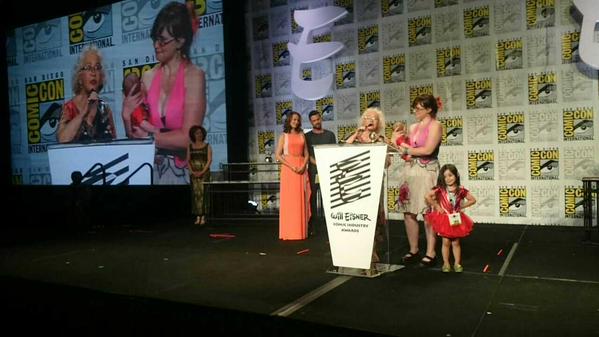
Graphic Details: Jewish Women’s Confessional Comics in Essays and Interviews edited by Sarah Lightman won the Eisner for best scholarly book! I wrote a little blurb about Ariel Schrag for it, so I sort of not really just a little won an Eisner too. Below’s a pic of cartoonist Miriam Libicki (former HU writer!) and her daughter accepting the award.
 

CJmxW5bWIAEGI5Y

 
On HU

Featured Archie Post: Cartoonist Jason Overby vs. Godard.

Robert Stanley Martin provides on sale dates for comics from early 1944.

Kate Polak on Hannibal, Laura Kipnis, and power.

RM Rhods explains to Grant Morrison that Heavy Metal Magazine isn’t punk.

Chris Gavaler on the swampy Heap and his thingy off-shoots.

I wrote about Ta-Nehisi Coates and the way of white critics.

I wrote about the first appearance of John Stewart and black superheroes saving white self-esteem.
 
Utilitarians Everywhere

At Playboy I reviewed Go Set a Watchman, which is kind of a racist piece of crap.

At Splice I wrote about the establishment media’s embarrassing response to TNC’s “Between the World and Me.

At Quartz I wrote about:

—how POC don’t talk in films, and why Her and American Hustle are awful.

—the tradition of anti-country country music.

At the Guardian I wrote about Wesley Chu’s Time Salvagers, a sci-fi novel that cobbles together old tropes into an uncertain future.

At the Reader I wrote a short review of fuzak folk band Little Tybee.
 
Other Links

Arielle Bernstein on Rihanna, Taylor Swift, and female revenge narratives.

Julia Serano on how pseudoscience harms trans women.

Dianna E. Anderson on bisexuality and Christian ethics.

Michael Sonmore on feminism and his open marriage.

Lux Alptraum on funding research on sex and sex workers.

Beware My Ambivalently Black Power

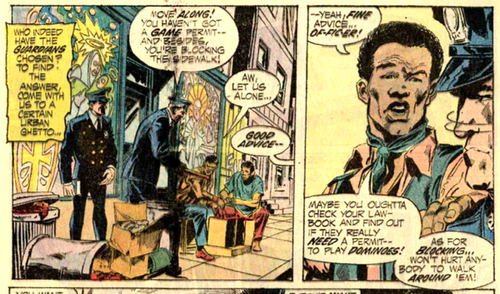
John Stewart’s first appearance in comics, in 1972, involves him challenging a police officer. Some blond cop is harassing two guys playing dominoes on the street, and Stewart tells the pig to back off. “You want trouble,” the cop sneers, and Stewart replies, “I kind of doubt you’re man enough to give it—even with your night stick!” The cop is about to do something more…when another cop comes up and tells him to back off. “Fred, respect has to be earned. The way you acted, you don’t deserve a nickel’s worth!” End of parable.
 

3071108-4012217273-30341

 
That parable strains credulity even more than a magic wishing ring—and perhaps for that reason, it needs to be retold, on a broader scale. Denny O’Neil and Neal Adams want to talk about racism—but they need to do it without in any way implicating systems. Racism is caused by bad people like Fred the cop, who fail to act respectfully. It is thwarted by individual bravery (a la Stewart) and by the forces of law and order themselves (like that second cop.) The forces of authority and justice, the folks with the uniforms, are the good guys. Doubt them not.

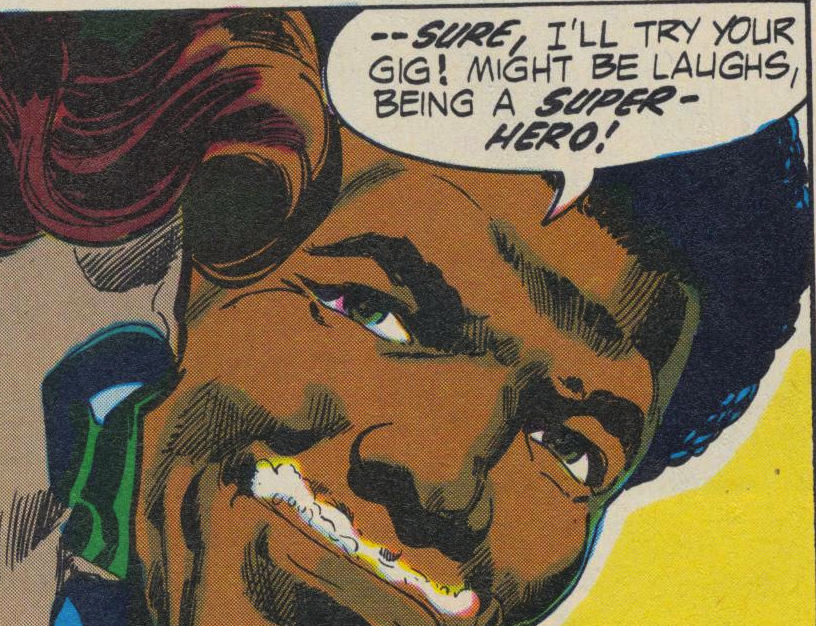
And so the plot grinds on. John Stewart learns he’s to be the back-up Green Lantern to Hal Jordan, and, in the space of a page, he goes from defying cops to being a super-cop himself.
 

neal-adams-perfect-jon-stewart

 
A new bad apple authority figure is quickly introduced in the person of a racist Senator. Stewart (like that bad cop) disrespects the Senator, and is punished by good cop Jordan, who insists that Stewart become the Senator’s super-bodyguard. Stewart is also reprimanded for calling Jordan “whitey”. “Something in that reminds me of that bit about “he who is without sin casting the first stone” Jordan huffs testily. On the next page, Jordan says that the Senator’s racist diatribes are protected by free speech. Mild epithets against white people are anathema; but the black guy has to be told that the Constitution ensures politician’s ability to encourage actual racist violence.

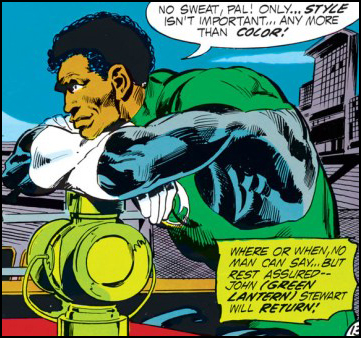
A black person tries to assassinate the Senator, and Stewart refuses to stop him, which pisses Jordan off. But then it turns out Stewart had deduced that the assassination plot was a false flag operation; the shooter was meant to miss, and then another shooter was going to shoot someone else, and the Senator would use the ensuing chaos to bring about race war. Jordan admits that he was put off by Stewart’s “style” but he now recognizes that the back up Green Lantern is a good egg. “Style isn’t important any more than color!” Stewart says, couching the lesson in terms which carefully dance around the possibility that whitey Jordan’s initial prejudice against Stewart might have something to do with race.
 

john3

 
Not coincidentally, the plot here precisely mirrors that of X-Men: Future Past. In that film, the heroes must save the establishment officials who threaten them in order to prevent a backlash in the form of a race war. And so too John Stewart has to act to prevent a guard being shot in order to prevent the racist Senator from starting a second “Civil War.” In both cases, the stories are about marginalized heroes threatened by the establishment. And yet, the plot tergiversates about in order to allow those superheroes to do what superheroes always do — protect the status quo.

And what happens to the Senator himself? He is implicated in attempted murder, but the heroes don’t even bother to arrest him. “I’m certain your colleagues in Congress will bounce you back where you belong!” Jordan declares. Stewart, who you’d think would have to be somewhat skeptical, tacitly endorses this naive and surely extra-legal approach to criminal accountability. But ensuring equality before the law is less important than assuring the reader that the people in power aren’t all bad, whether they be police, congresspeople, or the white Green Lantern. There can be a black superhero, it seems—as long as his main focus is saving white people’s self-image, and not black lives.

The Ways of White Critics

Why is it when critics confront the American as Negro they suddenly drop their advanced critical armament and revert with an air of confident superiority to quite primitive modes of analysis?”

—Ralph Ellison, “The World and the Jug”

Ta-Nehisi Coates’ latest book Between the World and Me has prompted the critical establishment to embarrass itself even more than is its wont. As I wrote earlier this week at Splice Today, the Economist and the NYT both wrote the same review of Coates’ book in which they flapped anxiously at his lack of respect for 9/11 firefighters and assured him that the world was getting better all the time because of nice establishment folks at the NYT and Economist, why oh why must he be so bitter? To follow that, Freddie de Boer spoke up for the anti-establishment establishment to insist that he did like Coates but only within limits—which is to say, he didn’t like him as much as he liked James Baldwin. DeBoer then went on to insist that the rest of the media overpraises Coates, thereby implying (in line with the anti-establishment establishment playbook) that he alone is telling it like it is and everyone else is blinded by something that sure sounds like liberal guilt, even though deBoer assures us that’s not what he means. (Posts are here and here.)

DeBoer on twitter suggested that objections to his minor critiques of Coates demonstrate his point—i.e., that Coates is overpraised. But I don’t think the resistance deBoer is meeting is because he criticized Coates. Because, as lots of folks have pointed out, there’s tons of criticism of Coates. Again, reviews in the NYT and Economist — two of the largest profile venues around—were both mixed to negative. There have also been a number of criticisms questioning his treatment of black women, notably Shani O. Hilton’s piece at Buzzfeed and a really remarkable essay by Brit Bennett at the New Yorker. I also saw Coates being taken to task in no uncertain terms earlier this week on twitter for alleged failures to reach out to black media with advanced review copies. The idea that Coates is somehow sacrosanct is simply nonsense. Though as Tressie McMillan Cottom pointed out on twitter, it might be easy to miss those critiques if you’re not reading, or considering the words of, any black writers.

And I think that’s really the frustrating thing about deBoer’s argument here. The discussion of Coates’ work, and the reception of it, is framed almost entirely in terms of the health and thought of a left which is figured as implicitly white. In an earlier piece on online media, for example, deBoer made a glancing sneer at folks who frequent Coates’ lovingly moderated comments section at the Atlantic. DeBoer characterized them as a “creepshow” and sneered that they were “asking [Coates] to forgive their sins.” I don’t know how to read that except as a suggestion that Coates’ commenters are actuated by white liberal guilt. Which assumes that none of the commenters are black. Which is a mighty big assumption to make, it seeems like.

Presumably deBoer would say that he wasn’t talking about all the commenters, just the creepshow white ones. But then, why are white commenters the only ones who get mentioned? Why is the criticism and the conversation always focused on white people? Why does a discussion of Coates’ work, turn, in deBoer’s second post, into an embarrassing paen to deBoer’s own righteous consistency? “They used to say I was leftier-than-thou, that I always wanted to be left-of-left. Now they say I’m anti-left. I guess that changed. But I didn’t change,” he declares. Coates’ book isn’t a chance to talk about Coates’ book. It’s not even a chance to respond to Coates’ criticism, exactly, since deBoer doesn’t directly acknowledge in his second piece that one of the people calling him out is Coates himself. Instead, the post is an opportunity for deBoer to declare himself, again, the one righteous man, stuck in the same righteous rut as ever.

I wish deBoer weren’t trapped in quite that impasse for various reasons, but the most relevant one here is that there really is a worthwhile discussion to be had about how white critics can, or should, approach black works of art. On the one hand, I think it’s important for white critics to engage with work by black artists because those works deserve serious consideration by everyone, of whatever color. Creators like Ta-Nehisi Coates, or Rihanna, or Jacob Lawrence, are not in some marginal genre, to be considered as footnotes. They’re at least as important as Harper Lee, or Madonna, or Picasso, and they should be treated as such by whoever happens to be sitting down at the keyboard.

But at the same time, when white critics write about black artists, they often bring with them a lot of presuppositions, and a lot of racism — both personal and structural. White people have been defining and criticizing black people for hundreds of years, and mostly that process has ended up with white people declaring, in one way or another, that black people aren’t human, not infrequently as a prelude to killing them. “Too often,” Ellison writes, “those with a facility for ideas find themselves in the councils of power representing me at the double distance of racial alienation and inexperience.” There’s a brutal, relevant history there that you have to think about before you as a non-black critic blithely insist a black author is too bitter, or start spiraling off at random to discuss your own career prospects.

Too easy praise can be as condescending as too easy sneering, of course. There’s no easy route to truth, though an awareness of the difficulty of the task should probably be balanced with the recognition that the trials of the white critic are not the most difficult trials ever devised. In any case, it’s worth keeping in mind, when that piece takes shape in your head, that out there in the world black people exist, who have been known to criticize black art themselves, and even, at times, white critics.

“So will my page be colored that I write?

Being me, it will not be white.
But it will be
a part of you, instructor.
You are white—
yet a part of me, as I am a part of you.
That’s American.
Sometimes perhaps you don’t want to be a part of me.
Nor do I often want to be a part of you.
But we are, that’s true!
As I learn from you,
I guess you learn from me—
although you’re older—and white—
and somewhat more free.”

—Langston Hughes, “Theme From English B”

Utilitarian Review 7/11/15

On HU

Featured Archive Post: Robert Jones, Jr. on why he gave up reading superhero comics.

Robert Stanley Martin on on-sale dates for comics in late 1943—Wonder Woman, Captain Marvel, and Crockett Johnson.

Ken Derry on L. Frank Baum and genocide (or the lack therof) in Oz.

Chris Gavaler on H.G. Wells in thigh boots.

Donovan Grant on Superman fighting for Ferguson, and why it doesn’t work.

Nix 66 with thoughts on Bree Newsome and the nonexistence of the law.

Jimmy Johnson on how cop shows believe in black criminality even when they present white supremacists as villains.
 
Utilitarians Everywhere

At Quartz I wrote about the doc Mama Sherpas and how midwives can lower national Cesarean rates.

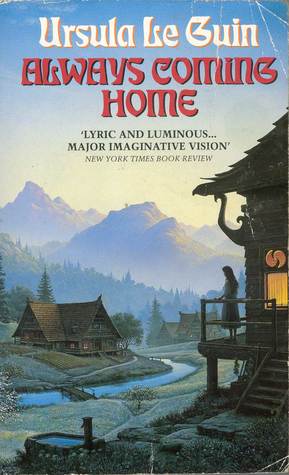
At the Awl I wrote about Ursula K. Le Guin’s Always Coming Home and how dystopia requires narrative, and vice versa.

At the New Republic I wrote about

—how Rihanna is a depoliticized Pam Grier.

Self/Less and the dream of a rich guy everyman who will save us all.

At Playboy

—I reviewed Chauntelle Tibbs’ Exposed and discussed sociology and porn.

—I wrote about Miley, Captain America, Rihanna and how everybody is empowered by kicking someone else.

At Splice Today I wrote about the realness of country radio, and how poptimism will eat itself.

At the Reader I did a little review of Atlanta rapper Father
 
Other Links

Athletes allege racism at U of I, Urbana.

Jonathan Bernstein on how Obama’s been a crappy manager of the executive.

This is Ta-Nehisi Coates’ favorite review of his forthcoming book.

Indian studies scholar Andrea Smith responds to accusations that she has misrepresented her identity.

The Dissolve (where I wrote for a bit) has sadly gone out of business.
 

1562365

Utilitarian Review 7/4/15

On HU

Featured Archive Post: Our complete Joss Whedon roundtable.

Robert Stanley Martin with on sales dates of comics from June-August 1943, including Wonder Woman, Carl Barks, Plastic Man, and more.

Me on the fact that Joss Whedon doesn’t exist.

Phillip Smith on Indonesian comics’ representation of the May 1998 riots.

Kristian Williams compares Mad Max and Fury Road.

Me on how gay marriage changes marriage for everyone.

Chris Gavaler on Thomas Jefferson, the 4th of July, and zombies.
 
Utilitarians Everywhere

At Playboy

— I wrote about The Wind Done Gone and why removing Confederate symbols matters.

—I argued that sex can be radical (or at least political)

At Vice I wrote about Terminator: Genysis and being colonized by robots.

At Splice Today I wrote about why David Brooks is confused about Robert E. Lee.
 
Other Links

Arthur Chu on Dollhouse as Whedon’s self-parody (inspired by our Whedon roundtable.)

Nix with an open letter to Meghan Murphy from the other side of feminism. (Nix says some kind things about me in the piece.)
 

terminator-genisys-script-matth-smith-character-620x350

Gay Marriage for Straight People

This was first published on Splice Today. I thought it seemed like an opportune moment to repost.
_____________

A couple of days before North Carolina voted for officially sanctioned homophobia and Barack Obama voted against it, Maggie Gallagher recorded a video making the case that gay people marrying each other are a deadly threat to the institution of marriage.

I realize that many people disagree with me, but if you ask me why am I involved in this, it’s because the framing ideas of marriage are the most important and the most powerful thing about it, and you cannot get to same-sex marriage without denorming and changing and really transforming the basis of marriage in the public square. And I think it’s really frankly going to lead to a marriage that is weaker and weaker and less and less coherent… I think it is the end of the project of trying to revive marriage as a public institution.

For Gallagher, then, gay marriage threatens the “framing ideas of marriage.” She doesn’t quite say what those ideas are, but presumably they have something to do with marriage as a bond between one man and one woman, husband and wife, and (ideally) father and mother.

Folks like Andrew Sullivan (on whose blog Gallagher’s video appears) generally counter these arguments by arguing that, in fact, the “framing ideas of marriage” are not one man, one woman, and certainly not the rearing of children. Rather, marriage, they argue, is about love, not gender roles. From this perspective, gays and lesbians getting married doesn’t hurt the core principals of marriage. On the contrary, it solidifies them. That’s why, for Sullivan, gay marriage is a conservative movement. It simply includes gay people as equals in one of the organizing institutions of our society—an institution designed expressly to integrate individual love and relationships into society. Thus, for Sullivan, marriage is a way for gay people to learn from, and become like—the same as—straight people.

Here, for example, is Sullivan in 2008, reflecting on his own marriage.

The wedding occurred last August in Massachusetts in front of a small group of family and close friends. And in that group, I suddenly realized, it was the heterosexuals who knew what to do, who guided the gay couple and our friends into the rituals and rites of family. Ours was not, we realized, a different institution, after all, and we were not different kinds of people. In the doing of it, it was the same as my sister’s wedding and we were the same as my sister and brother-in-law. The strange, bewildering emotions of the moment, the cake and reception, the distracted children and weeping mothers, the morning’s butterflies and the night’s drunkenness: this was not a gay marriage; it was a marriage.

In a lot of ways, then, Sullivan and Gallagher, while diametrically opposed in their conclusions, are working from very similar presumptions. Both of them think that marriage, as it is, has fundamental principles, and both of them think that it is important to preserve these principles. Or, to put it another way, both of them think marriage is swell, and that it should keep on keeping on.

I like marriage too. I’ve been married 12 years, as a matter of fact. Marrying my wife was probably the single best decision I’ve made in my life; the only real competition is the decision we made to have our son. Moreover, as it happens, just a few weeks ago I got one of those online ordinations and was, as the theists says, blessed to preside over the wedding of two of my dearest friends. So… marriage. I’m for it.

I think, though, that it’s worth recognizing that, wonderful as marriage can be, it also has some serious downsides. If marriage can be the best thing in the world, then it can also be the worst. If you doubt it, I suggest you read Judith Herman and Lisa Hirschman’s 1981 book Father-Daughter Incest—undoubtedly one of the most depressing tomes I’ve ever read.

Herman and Hirschman reveal marriage as an institution not of love, but of dominance, cruelty, violence, and, above all, of rape. Moreover, they argue that rape is not an accidental, perverted result of traditional marriage—rather, it is the logical culmination. Through their work with incest victims, the authors conclude that father-daughter rape occurs most often not in perverse or abnormal marriages, but rather in hyper-normal ones.

Specifically, incest is most likely in families where the father takes the traditional role of a dominant, authoritative (not to mention authoritarian) patriarch. Incestuous fathers are generally competent workers, good providers, and respected in the community. Mothers in these families, on the other hand, are almost caricatures of feminine disempowerment. They often don’t work outside the home, and may be ill, depressed or exhausted; in large part because their husbands abuse them physically and emotionally.

According to Herman and Hirschman, the emphasis on traditional sex roles within marriage—a strong father little involved in child-rearing, a weak mother unable to effectively protect those in her care—leaves children vulnerable to rape. The father sees the daughter as essentially a perk of patriarchal power—patriarchal power the mother cannot effectively counter. The authors conclude, “As long as mothers and children are subordinated to the rule of fathers, such abuses will continue.” They add that this is a tragedy not just for children and mothers, but for fathers as well, who “As long as [they] retain their authoritarian role… cannot take part in the tasks or the rewards of parenthood.”

Of course, most marriages do not have much to do with the caricatured gender roles that Herman and Hirschman identify as typical of incestuous families. But still… those caricatured gender roles do have something to do with marriage. They are one distorted image of marriage’s essence—of marriage designed not as an outgrowth of love, but as an outgrowth of patriarchy and rigorously codified gender roles. Many radical queer activists have opposed gay marriage for just this reason. For them, marriage is, at its core, oppressive and inequitable.

I think they’re wrong—marriage isn’t inequitable at its core. But Sullivan and Gallagher are wrong, too, when they claim that the essence of marriage is beneficent. The truth is that marriage doesn’t have an essence, any more than it has a core. Certainly, marriage is an institution, but institutions aren’t immutable. They shape us, but we shape them, too. Marriage has been, and can still be, a way to oppress women, to enforce particular gender roles, and even to abuse and torture children. It has also been, and can still be, a way to link family and community in love.

Gallagher is correct when she suggests that gay marriage will change the institution of marriage. Marriage has, in the past, been about one man/one woman, just as Gallagher says; it’s been an assertion that gender and gender roles are as important as, or even more important than, what you feel in your heart.

Gay marriage is a final, absolute refutation of that logic. If two men can get married, or two women, then marriage must really be not about power, but about love. Gay marriage, then, is radical in the best sense, in that it offers equality and hope not just to gay people, but to children, women, and men of every orientation—even to Gallagher, resist it as she will. Gay marriage is not just about straight people accepting gays into our institutions. It’s about gay people teaching us what those institutions mean. The gay community has given straight people a lot over the years, but surely gay marriage is one of the greatest gifts it has offered us. Despite North Carolina, despite Maggie Gallagher, I still believe, as I believe in my marriage, that we will, someday, humble ourselves enough to be worthy of it.

There Is No Joss Whedon

hqdefault

Is that a person there?

 
Dollhouse could perhaps be seen as Joss Whedon’s most personal statement in that it’s about the absence of personality—or more precisely, about personality as almost-absent, but never fully destroyed, trace. In Dollhouse, Echo (the impressively unresponsive Eliza Dushku) is a shell, robbed of its original self, Caroline. Through the first season (all I could bare to watch) Caroline is mostly gone; we only see flashback glimpses of her as Echo is filled with various other personalities — a dominatrix, an outdoorswoman, a perfect girlfriend, another perfect girlfriend. The first season ends with a future vision of a world in which individual brains are erasable, plunging the world into dystopic chaos. Everyone is a replaceable cog. This provokes dramatic visible terror on the one hand, and the usual genre comforts on the other, as the main plot focuses on a group of entirely forgettable actors being picked off one by one in the usual manner of the post-apocalypse, complete with predictable tricky unpredictable betrayal and surprise reversal at the end.

Whedon famously had only sporadic control over Dollhouse; the network messed with and compromised his vision. But does that mean that Dollhouse isn’t Whedon? Or does that make it instead all the more Whedonesque? Reading through our lengthy Whedon roundtable, what’s most striking is how utterly generic, in every sense, Whedon’s output seems to be. Tim Jones identifies Whedon’s cardinal virtue/sin as cleverness—but the iconic line of dialogue he uses to illustrate that cleverness probably wasn’t Whedon’s at all, but a Robert Downey Jr. ad lib. Philippe Leblanc points out Whedon’s obsession with military conspiracies…but that’s an obsession he shares with every other media property ever (“Orphan Black” comes immediately to mind, as just one example.) Lisa Levy praises Whedon’s embrace of non-conformity, and Megan Purdy criticizes his unthinking racism. But enthusiasm for non-conformity and thoughtless racism are hardly unusual in pop-culture generally. Perhaps most tellingly, Ana Cabral Martins singles out Whedon’s ability to keep all the moving parts of the Avengers films moving. Whedon, Martins suggests, is most Whedon when he’s smoothly assembling corporate product. He’s the Mussolini of pop culture, making the nerd content run on time.

Again, whedon, like most people in television and film, always works in collaborative contexts. If there’s not one, distinct, Whedon vision, it’s probably in part because Whedon’s almost never working by himself to begin with. My single favorite Whedon project may be the last-season episode of Angel in which our hero is changed into a muppet—and how much did Whedon even contribute to that? He has a writer credit, but who knows what that does or doesn’t mean. Similarly, episode 3 of Dollhouse, in which a suicidal pop star is cured of depression by being told to suck it up, is one of the single worst episodes of television I’ve ever seen. But again, is that Whedon’s fault? Maybe he would have made an only moderately crappy episode if he’d had creative control. Who knows?

But Whedon’s selflessness goes beyond the usual difficulties of attribution in collaborative work, I think. David Lynch, David Cronenberg, Quentin Tarantino, even Jenji Kohan all seem to have distinctive interests, themes, visual styles, rhythms. Does Whedon? As I said, I don’t think the roundtable has unearthed any. Whedon likes strong female heroes, sticking it to the man, and playing with geek toys. These are not individual interests. Instead, they put him smack center in the mainstream. He’s into the same things everyone else is into. His success isn’t because he has an individual vision, but because he doesn’t—or more generously, perhaps, it’s because his individual vision is everybody’s individual vision. He sees what everyone sees, and everyone loves it.

That’s not to say I hate Whedon; I’m part of everyone, after all, I enjoy strong female heroes, clever dialogue, and Hulk smashing, at least intermittently. In fact, hating Whedon, or loving Whedon, seems largely beside the point. What’s there to hate or love, anyway? You might as well loathe the dolls in the Dollhouse, in all their interchangeable vacuity. There’s nothing there to hate or love. I’m forced to admit that Joss Whedon does exist, but even so, it seems odd that anyone bothered to take the time to invent him.
______
This concludes our Joss Whedon roundtable…I think! Unless someone else sneaks in at the end. But it’s probably over. Click on the link to see all our posts! Thanks to everyone for contributing, commenting, and reading.