Pajama Boy and Anti-Semitism

This first ran on Splice Today.
_________

large_pajamaBoy

Last week [when this first ran], the right’s five-minute hate was directed against pajama boy, a guy in an ad encouraging young people to sign up for Obamacare. I usually don’t pay much attention to the right’s five-minute hates, but I happened to click through on this one, and was somewhat startled to discover that this random guy looks kind of like me. I’ve even got a onesie that looks a big like that (my son calls it a sleep-skirt.) And the curly hair, strong features, prominent nose, sharp eyebrows, glasses…yep. He’s younger and handsomer, but there’s a similarity. Which is to say that he, like me, looks Jewish. And just to drive the point home, some anti-pajama-boy memes apparently post a “How did you know I went to Oberlin?” tag across the picture. I went to Oberlin, which is known both for being a very liberal school, and for having a sizeable number of Jews in its student body.

Rich Lowry sneers that pajama boy is “so nerdy he could guest-host on an unwatched MSNBC show.” The slur isn’t exactly surprising; Jewishness and nerdiness are often conflated, or equated (see Woody Allen or Howard Wolowitz.) Assimilated or model minorities are generally seen as unmanly or womanish; what happened to Jewish males is now happening more or less to Asian males.

I guess I could go on now to accuse Lowry and the right in general of anti-Semitism here. But the truth is, I don’t think that that’s exactly what’s happening. In the same paragraph where Lowry sneers at pajama boy’s nerdiness, he writes that the guy is “probably reading The Bell Jar and looking forward to a hearty Christmas meal of stuffed tofurkey.” He’s plugging into stereotypes around Jewish appearance (nerdishness, Oberlin), but those stereotypes adamantly don’t for him link to Jewishness. He knows pajama boy is nerdy, he’s catching the cultural signs rooted in ethnic difference, but he doesn’t link those signs to ethnic difference in any way. It’s not even clear he knows where they come from.

Again, you could see this as indicative of the persistence of anti-Jewish sentiment and stereotypes. But to me it seems more like a sign of just how marginalized and defanged anti-Semitism has become in an American context. We’re beyond a dog whistle here; the prejudice and vitriol has been basically completely severed from its original ethnic target. Lowry and the right literally do not see that this man is Jewish. The fact that he may well not be Jewish simply underlines the point. Prejudice creates a stereotyped view of what Jews look like. That’s gone. So when confronted with a guy who looks (like me) Jewish, Lowry doesn’t immediately think he’s Jewish, which he may not be. Stereotypical Jewish features still provoke a shadow of prejudice, but they don’t any longer link to “Jewish”. People who say, “I don’t see race,” are pretty much full of crap — but it’s different when you talk about Jews. People really don’t see them. They don’t have preconceptions about what they look like; they don’t assume that someone who looks like a Jew is a Jew. At worst, they see somebody who is kind of nerdy. But the original ethnic basis for that nerdiness is gone.

On the one hand, it’s not especially pleasant to realize that some not insignificant number of people think that my looks alone make me an object of ridicule. I’d thought I’d stopped having to deal with that when I got out of high school. But, on the other hand, I basically did stop having to deal with it. Even these folks who clearly are trying to be as unpleasant as possible aren’t able to figure out what my looks mean, much less connect them to an actual systematic program aimed at making the lives of people who look like me miserable. As pajama boy, I face no prejudice. I can work where I like, marry whom I like, even make policy at a conservative think tank, if that’s my bliss. Hate lingers, but it loses a lot of its sting when it can’t remember who its hating.
Fear of a Beyoncé Think Piece


Art exists in culture. By the same token, culture is represented in, and influences, art. That seems like a pretty obvious and irrefutable point. And yet, to talk about the links between art and culture consistently leads to panicked, even apocalyptic denunciations from those who otherwise occupy little intellectual common ground. Rather than being seen as complementary, or continuous, art and society are seen as matter and anti-matter; bringing them together, it is feared, will cause the end of all things.


Freddie deBoer fears, in particular, that the confluence of art and society will cause the end, or at least the decay, of society. In a Beyoncé think-piece calling for the end of Beyoncé thinkpieces, deBoer raises the familiar lefty fear that interest in art is a deadly form of false consciousness, distracting the intellectually flaccid from the real business of ridding the world of hegemons.
 

As I’ve said for a long time, a lot of progressive educated white types have essentially replaced having a politics with having certain cultural attachments and affectations. Really aggressively praising the Wire becomes a stand-in for “I am not racist.” Complaining that Selma was robbed becomes a stand-in for having done the necessary work to understand the history of race in America. Telling anyone who’ll listen that you think all of the creativity and risk are in hip hop now becomes a stand-in for advancing a meaningful political platform that could actually improve the lives of actually-existing black people. White people are so weird about Beyonce because Beyonce has become an all-purpose floating signifier, a vessel on to which bourgie white folks project all of their desires for how other people should see them. These vague associations with arts and media are intended to send a message that, if voiced explicitly, we all know by now to ridicule: some of my best friends are black.

It’s easy to get distracted here by the sweeping assumptions of bad faith — but that’s just standard deBoer being deBoer. What’s more interesting is the way that the typical Marxist/Frankfurt School mistrust of the popular arts is retooled in terms of racial justice. “Bourgeois” pops up rhetorically as it might have for Khruschev (who rather gloriously characterized an exhibit of experimental art as being equivalent to what you would see if you looked up from inside a toilet bowl at someone’s ass descending.) But the main sneer for deBoer is not directed at the middle-class, but at white people. DeBoer’s argument (with the unfalsifiable ad hominem mind reading taken out) is that white people care about Beyoncé, and that talking about her is (therefore) self-indulgent and decadent. Real revolutionaries should talk (all the time?) about income inequality, not pop music.
 

OLYMPICS BLACK POWER SALUTE

 
The problem for deBoer here is that black people have an incredibly long, rich, and important history of caring about art, and seeing it as central to their struggle for freedom and justice. Zora Neale Hurston, Langston Hughes, Miles Davis, Sam Cooke, bell hooks, James Baldwin, and many many more, would all be surprised to hear that their focus on cultural expression and representation was misguided and antithetical to the civil rights movement. Even if you’re just talking about Beyoncé, there are no shortage of black folks who have debated her as a political and cultural force (as just a sample, here’s Janell Hobson, Ebony Elizabeth, bell hooks and Janet Mock, Sydette Harry…the list could go on and on.)

DeBoer leaves himself some wiggle-room; you could read him as arguing that it’s only white people whose Beyoncé thinkpieces are awful. Perhaps he thinks, not that Beyoncé thinkpieces are bad in themselves, but that only African-Americans should be able to write about black popular music. But then you end up in a place where Beyoncé is a specialist, marginalized issue. Black people can talk about this thing that doesn’t matter; white people like deBoer will be over here analyzing matters of authentic importance, like the failure of the left, or the failure of the left (deBoer’s repertoire is somewhat limited). The need to separate trivial discussions of art from important discussions of social issues ends up effectively erasing black voices and black expression, either by suggesting those voices don’t exist, or by assuming that what they say is of only marginal importance to a struggle which is (in theory) centered on black people’s lives. (HT: Sarah Shoker for explaining this issue to me.)
 

60151

 
Sarah Horrocks comes at the issue of art and culture from a very different place. DeBoer is worried that discussions of art will distract from the important work of social change; Horrocks is concerned that the battle for social change will distract from the particular, transcendent importance of art.
 

I do not believe that art has societal power. I believe art creates the sacred. What I mean by that is that, for each individual that experience a piece of art, a space exists that only that person experiences, that can be profound and moving, based upon what they have projected out as their perception, and how that filters back to them with this thing called art. But that experience is not something you can translate to another person. Two people can see the same piece of art, but the experience they have is never wholely translatable to the other. You take that shit to your grave. I know this because as a critic, I spend tons and tons of words trying to explain the power of my experience–but in the end, all I can convey is just that…the power of my experience. But even if you think you experience something similar–it is still different.

So what that means is that art can be extremely powerful to the individual, but because it is not translatable to society as a whole, it’s power is isolated to each individual that perceives the work.

It’s popular to say that art is this super powerful thing. This notion that a great work of art can crack the world in half. It is a moronic idea, and I say that as an artist, who absolutely believes in the creation of the sublime experience. But if art was so powerful–then why couldn’t Godard stop Vietnam? Why couldn’t Ralph Ellison end racism? Was their art not powerful enough? And if their art isn’t powerful enough–how can a bullshit issue of batman be that powerful?

 
Horrocks’ piece is much more careful, and much more generous, than deBoer’s. Partially as a result, she says directly what is implicit, or danced around, in his piece. Ralph Ellison (or those Beyoncé thinkpieces) have not ended racism; therefore Ralph Ellison (or Zainab Akhtar criticizing Horrocks) are socially pointless; they don’t matter, and cannot matter. The fact that neither the Civil War nor Martin Luther King ended racism is an conveniently ignored (by deBoer as well). Art can affect people individually Horrocks says, and is valuable for that reason. But it can’t have any social or political effect — a truth witnessed by the fact that great art with social commitments has not created a utopia.
 

790329-3108ad96-82fc-11e3-90a9-2f6f5b597dd3

 
Which leaves you, with deBoer, wondering why all those fools like Ralph Ellison and bell hooks bother to try to deal with political issues in their art or criticism. It seems like you should either be creating individual AbEx yawps, or organizing protests. Mixing the two is dumb — and dangerous. For deBoer, it leads to decadent bourgie white people congratulating themselves rather than overturning capitalism the way they should be. For Horrocks, writing still in the shadow of Frederic Wertham, “A society where art is considered powerful is not a safe one for art to be created in.” If people think art matters, there will be censorship, and even violence, against artists. The problem with censorship is not that voices for freedom are silenced, but that the state and those creating political art both collude in a silly but tragic error. If only Paul Robeson had realized that political expression was irrelevant, he needn’t have bothered with all those songs about racial and class justice, and he never would have been blacklisted.


This isn’t the conclusion that either Horrocks or deBoer wants to arrive at, of course. Rather, Horrocks hopes that separating art and political expression will leave the world free for purer, less constrained artistic expression. DeBoer hopes that separating art and society will lead to purer, more effective politics. But if you stipulate that art can’t change the world, you end up with art made only by people who don’t care about changing the world — which makes much of the art by marginalized people irrelevant or incoherent. And similarly, creating a politics walled off from discussions of culture or aesthetics ends up with a politics of struggle oddly divorced from the emotions, or thoughts, or interests, or feelings of those on behalf of whom you’re supposedly speaking. #BlackLivesMatter is a movement, but it’s also a poem — which is why, with the power of art to mean more than it means, it can, and has to, apply to black women (and men) at the Grammys, as well as to black men (and women) targeted by police.

Horrocks loves art, and wants to see it protected. DeBoer is committed to creating a better world, and doesn’t want that struggle debased. I love art and want a better world too. But I don’t think you can have art without the impetus, or hope, of change, and I don’t think you can get to a better world by denying the power of dreams. Surely if the African-American experience in this country has demonstrated anything, it’s that you can’t take the struggle out of art, nor the art out of the struggle.
 

An Interview with Jordannah Elizabeth

-1
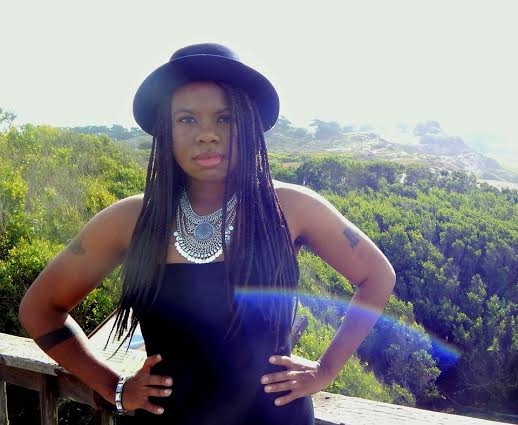
Photo Credit: Matthew Fowle

Jordannah Elizabeth is one of my favorite contemporary musicians; I picked her “Bring to the Table” as the best album of 2014.Her new album, “A Rush” is going is streaming on Bitch now; Jordannah let me interview her about it.

Noah: Your last album, “Bring to the Table” was mostly in a folk music vein, but there are a couple of tracks here — “A Rush” and “14 Minus 13” — that seem almost like left-field R&B pop, like FKA Twigs perhaps. Why did you decide to move in that direction? Was it listening to different music, working with different collaborators…?

Well, Bring to the Table was a clean folk album because my drummer missed his airplane from Baltimore to the studio in San Francisco. He was the ace up my sleeve that was going to bring a unique spin to the sound of the music. I rejected Bring to the Table for several months because it was a really structured album. I put it out because I had an open night at El Rio in San Francisco, and I thought, “Well, why not throw an album release party?” With that said, for Bring to the Table, I was inspired by a Bob Dylan – Lightenin’ Hopkins and Etta James vibe…so that came across in the sound.

Breck Brunson and Steve Kille [producers on the new album] appeal to different aspects of my musical persona. Breck is an experimentalist. He’s a beat maker and a visual artist. With him, I wanted to do some experimental trip hop stuff. I love Massive Attack, Portishead, Shabazz Palaces and FKA Twigs. In fact, I discovered FKA in Breck’s kitchen…so yes, that stuff was an influence, but I really just sat in Breck’s studio and let his work inspire me. Some of those beats are several years old, so “14 Minus 13” and his remix for “A Rush” are strictly him. You have to ask him who his personal influences are.

Steve did the live studio songs. His goal was to capture me in my true element. He wanted a raw live look at my songwriting skills. I didn’t record the original version of “A Rush” until I sat with Steve because I knew I could just sit down, have some whiskey and let myself just exist and play. I think Steve understands people in a way a lot of people don’t. He’s empathetic and patient. Baltimore came out because I’d been itching to rerecord a demo version I did. We had some time, do he encouraged me to just sit down and freestyle the a folk cover of the track. Breck and Steve lived in DC and I am from Baltimore, so we all had that bond as well.

A Prayer for Black America” has a lot of gospel touches, it seems like. I was curious if you had sung in church?

Breck made the music for “A Prayer”. But yes, my father has been a preacher for 35 years. I grew up in the Baptist church. I went to church often until I was about 15 years old. I sang in choirs all through grade school and in college. I am classically trained, so I sang classical church cannons for my education along with traditional black gospel music in church. I love gospel music. I love African American spirituals… I also love Ave Maria. It is all a part of me.

I was very broken and saddened by the Travyon Martin and Mike Brown killings. As a journalist, I made the choice not to make a statement through writing. Writing is what I do, but I felt a facebook post, a short message, or a letter was not enough. I am a spiritual person, a sister of three brothers, a daughter and a Black woman before I am a writer.

I wrote this song as an intrinsic message of comfort to my community. I am praying for us all. -When I saing “Hold us down…” in the song, I mean “hold down our fort.” When someone in the Black community says “I’m holdin’ it down” it means “I have things under control.” “Keep us clean, keep us lean” is 70s jive talk (old school Black slang). To be clean and lean, means you look together and healthy. Our language- it bonds us.

There are a number of live solos at the end of the album — you usually perform live is that right? But you collaborate in the studio? Do you have a preference? Or what do you enjoy about performing solo vs. working with other folks, and vice versa?

Well, the live solo songs are live studio recordings. Steve Kille produced them. I think it is important having a good producer whether you are singing over their beats or if you’re in their booth alone, with just you and your guitar.

I play solo shows, yes, but I am never completely alone when I’m making an album. It takes a village to do anything. I’m never alone in the room when I am playing a solo show either. Music is collaborative even if it just means vibrations are hitting ear drums… it takes at least two for it to exist.

I know you’ve said you’re planning on giving up your music career after this album. What’s led you to decide to stop? And are you going to stop all together? Recording, playing live, playing on your own — the whole thing?

I got really sick, and I was scared when I said I was going to stop. I am getting better now. I don’t think I am going to stop. What I meant was that I want these album to really sink into people’s hearts. Bring to the Table started picking up momentum months after I recorded and released it. I’m realizing that I should let these two albums exist. Now, I got through this sophomore indie album (A Rush). I will promote it and play some shows, but yeah, I want to slow down. I want to travel for pleasure. I also have a journalism and writing career that I enjoy and a personal life that needs tending to.

When I put out an album, no matter how many people I have on my team, on my side, in my band, it all ultimately falls on me. I pay everyone and for everything out of my pocket. Indiegogo takes care of maybe 20% of my expenses (thanks to my kind contributors. I love you!) I’d like to put my money into a savings account.

I have had a couple of major illnesses during this process as well. I lost a loved member of my family, lovers left, friends got weird and doing a press tour and working full time is just hard. I am human…

But you know, if a label were to pick me up and help me with the work load, I’d make another record sooner than later. It’s just intense being 100% indie. I’m blessed to be able to do it and do it well, but I think it’s time I have management and a label to support my work load.

Holy Unstable Hierarchy, Batgirl!

tumblr_nfs19bTSnS1s2wio8o1_500

 
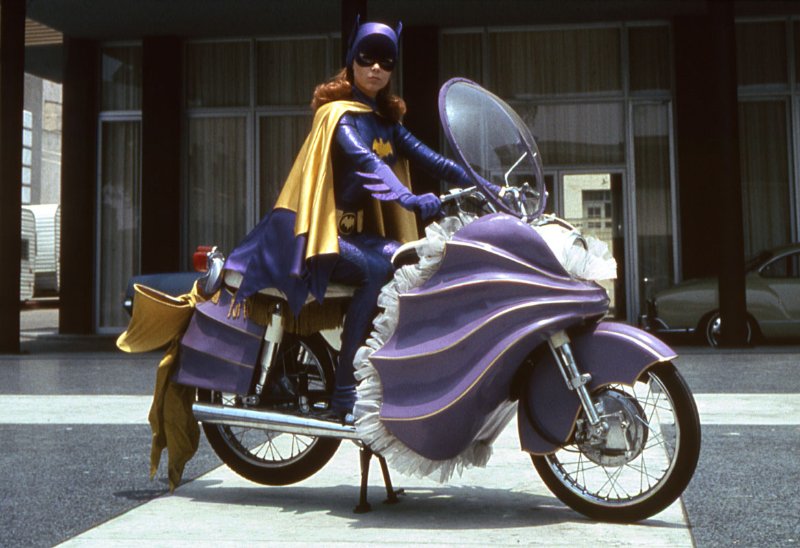
In his study of the Batman TV show from last year, Matt Yockey argues that season three’s introduction of Batgirl (Yvonne Craig) carefully maintains patriarchal norms. Batgirl is always subordinate to Batman, Yockey says, and/or to her dad, Commisioner Gordon — or even to Alfred. “The implicit threat of the female crime fighter is contained by Alfred’s knowledge of her dual identities.” Batgirl gets to be somewhat heroic, but ultimately some guy in Gotham is always the boss.

This analysis fails to take into account one small fact. Namely, Season Three (or at least the first few episodes I’ve seen) is not an ordered hierarchy. Instead, it is a huge, staggering, lurching mess. The second episode in particular, with Frank Gorshin returning as the Riddler after a season long absence, teeters on the verge of utter incoherence, before plunging gleefully over the edge.

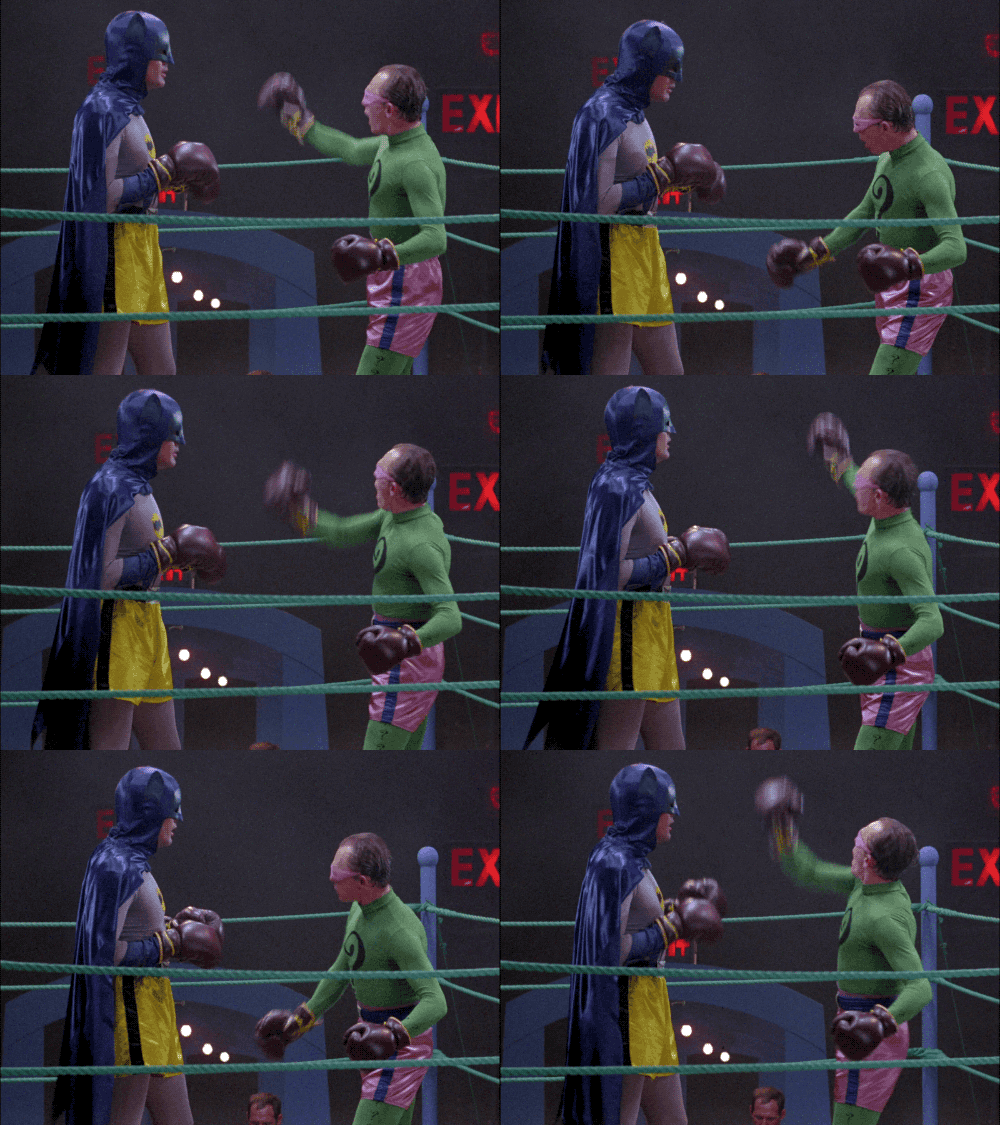
Seasons 1 and 2 followed a regular two-episode formula arc, from the introduction of the villain to the meeting with the commissioner through the cliffhanger to the escape and on to the defeat of the bad guy. But season three exchanges the two-parters for single episodes, and throws in the addition of Batgirl as an extra bonus crimefighter. The result is a plot that see-saws widely every which way. The Riddler pretends to be the prizefighter Mushi Nebuchudnezzer, drugs various prizefighters, wheels Joan Collins out as a super-villainness who sings a high-pitched note to mind-control other prizefighters, calls Batman a coward to lure him into a fight, uses magnets, tries to mind control Batgirl, fails, and connives with a sports reporter as the narrative veers back and forth between Batgirl running around and Batman and Robin running around, with a brief interlude for Dick Grayson’s aunt Harriet Cooper to explain that she’s been traveling abroad. The winking, knowing humor of the first two seasons dissolves into manic idiocy, summed up by Frank Gorshin bouncing and bobbing around the prize-fighting ring, looking punch-drunk one moment, walking into Batman’s fist the next, gleefully punching the magnetized Caped Crusader from behind in the third.

I guess it’s possible that the show’s creators were nervous about the threat of a female crime fighter and were trying to carefully maintain patriarchal order. But that’s not what happens. Instead, the introduction of Batgirl coincides with a show going utterly off the rails. Batman, who in earlier seasons has every answer at his bat-gloves’ finger-tips, now seems to be almost drowning in the whirlwind of plot. He doesn’t know who Batgirl is, and barely seems to know what he’s doing as he thrashes around in the ring with the Riddler until Batgirl demagnetizes him. In the next episode, (featuring Joan Collins again in a skirt so short it’s amazing it got past the censors) Batman, who has been resistant to the blandishments of all other villainnesses, has his Batbrain scrambled, and has to be rescued by Batgirl and Robin.

I wouldn’t say this is some sort of programmatic feminist message. But the first two seasons of Batman always carefully balanced celebrating the superhero as all powerful fuddy-duddy force of order and mocking him for being an all powerful fuddy-duddy force for order. In season three, the female crimefighter arrives, and the fuddy-duddy force for order experiences some sort of apocalyptic bat seizure. System disintegrates; super-villains profligately flock together, Bruce Wayne’s will, heretofore inviolable, is mushed by the exigencies of plot and the power of Joan Collins.

Most of the mix up is no doubt a simple the failure of capital, as cratering popularity and slashed budgets undermined the Wayne fortune and the shows’ shooting budget. But part of it is, too, the addition of that Domino Daredoll. Spending narrative time with the Batgirl-cycle may not topple the patriarchy, but it at least leaves it in massive disarray.
 

5339L

Utilitarian Review 2/7/15

On HU

Featured Archive Post: Darryl Ayo on public readings of comics.

Me on reverse racism and segregation in Chicago.

Me on Andrew Sullivan and the Iraq war as blogging psychodrama.

Julian Chambliss on Flash, Arrow, and the history of the world’s greatest crossovers.

Chris Gavaler on Justified and how if a series goes on too long you end up with nihilism.

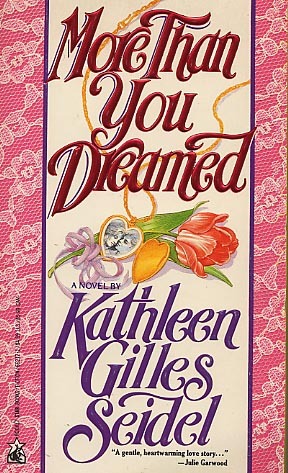
Me on Kathleen Gilles Seidel’s “More Than You Dreamed” and the how romance novels can be ambiguous.

Roy T. Cook with a transitional post for PencilPanelPage — they’re going to be posting irregularly rather than weekly. Check the post out for their votes for the best posts they’ve done so far.

Jog on Aamir Khan’s PK and gentle religious satire, Bollywood style.
 
Utilitarians Everywhere

At the Atlantic I talked about the possibility of suing people who don’t vaccinate their kids.

At Ravishly I:

— wrote about how the original Ghostbusters is a sexist piece of shit.

—wrote about This One Summer and adults being teens and vice versa.

—interviewed Julia Serano about making left spaces more inclusive.

— talked about Black Sea and hating men (unless they’re dead.)

At Splice Today:

— I wrote about P.C., Charles C.W. Cooke, and purity politics.

— I wrote about Andrew Sullivan and the hubris of humility.

At the Chicago Reader I reviewed stoned behemoths Drug Honkey.
 
Other Links

Kevin Carson on Watchmen and why you shouldn’t let the neoliberals have a monopoly on hating the government.

You don’t get much better than X-rated LaVern Baker and Jackie Wilson.

Shea Hennum expresses skepticism about Scott McCloud’s The Sculptor.

Kelly Conaboy on the disastrous 50 Shades press tour.

And hey, Feministing gave away copies of my book.
 

mqq1yl2bgliqqqyi

Can a Romance Novel Be Ambiguous?

2385082Multi-layered, ambiguous, nuanced, complex. That’s generally the sort of thing literary critics say when they are praising some important work of literary fiction for its importance, seriousness, and literariness. Great novels, or works of art, are supposed to have meanings within meanings, perspectives within perspectives. To be great is to be multiple. Pulp or genre novels, on the other hand, are often seen as being singularly utilitarian. A horror novel scares you; a spy novel gets the blood pumping, porn does what porn does.

In an interview with me last week, romance novelist Kathleen Gilles Seidel suggested that romance, too, was more singular than multiple, at least in some respects. As a writer, she says,

my relationship with my reader is a romance writer’s. I am not out to challenge her (or him), threaten her, or even change her. I am very controlling of her (or his) experience. The characters may be complex, and the judgment about them may be nuanced, but ultimately there is almost no ambiguity in the judgments. A reader is going to end up drawing the same conclusions that I have.

So for Seidel, romance novels are restrictive and, at least in some ways, unambiguous. Is this true?

There are buckets and boatloads of romance novels, and it’s hard to make any statement about them in general that would be true of every one. But it does seem to be true of one novel — Seidel’s own 1991 book More Than You Dreamed.

More Than You Dreamed is about an (extremely) wealthy director’s daughter, Jill Casler, and a basketball coach, Doug Ringling, who is the nephew of the famous actor Bix Ringling. Bix and Jill’s father, Cass, were both involved in the making of a 1948 blockbuster, Weary Hearts, a historical drama focusing on one Confederate family’s struggles during the Civil War. The making of the film is shrouded in confusion, and Jill and Doug work together to uncover the production mysteries. While falling in love. As you’d expect.

To repeat, that outcome is expected. You’re introduced to Doug and Jill on the first page, and you know what’s going to happen. That singular, predictable reading is mirrored, emphatically, in the film within the book. Just as the reader reads “Doug” and “Jill” and says, “aha!”, so Doug and Jill read various versions of the script for Weary Hearts — and those readings are always singular, immediate, crystal clear. When Doug and Jill find Bix’s original script, they both know it’s a masterpiece — and everyone else who sees it thinks exactly the same thing. When Doug and Jill see an early print of the film, they both agree it’s a failure, and for the exact same reasons. Art, in More Than You Dreamed, is unitary. It speaks to everyone with the same voice.

Or does it? Is Doug and Jill’s reading of Weary Hearts the only reading? Again, Weary Hearts seems based, at least in very broad strokes, on Gone With the Wind — another sweeping Confederate historical. Gone With the Wind, like Weary Hearts, was, and is, widely beloved. But it’s also extremely contentious. GWTW was a racist film; as a result, its tragically defeated white heroes can also be seen as awful, white supremacist villains. Instead of a romantic triumph, the film could be seen (and frequently is seen) as an ugly apology for evil.

And what about Weary Hearts? The film, as described, seems to be much less focused on race than GWTW — the characters are not landholders, but small farmers, and only one black character appears. But still, if you take seriously the idea that the Confederacy was a racist endeavor, the view of Weary Hearts has to shift. Is Pompeii, the one black slave in the film, really content to travel with the Confederate hero Charles as he wanders about fighting Yankees? Is that original print really flawed because of poor acting? Or does the early version lack power because it fails to confront the moral evil of the Confederacy?

There are clues in the book that perhaps support this alternate reading of the film. Doug, who looks almost exactly like the star of Weary Hearts, participates in a Civil War reenactment, during which he makes a passing joke about the South’s racist and sexist past. Later, and more uncomfortably, while he waits for a black basketball star friend, he quips, “I kind of like this, meeting him in a Confederate uniform. He can call me Massa, it will be good for him.” Jill replies that Doug should probably be the one calling Lynx master, since Lynx “could buy and sell you.” On the surface, it’s supposed to be a moment of fun banter. But it’s also an uneasy reminder of what the American South (and not just the South) was about. And though, again, it seems to be directly denying the continuing relevance of that history (Lynx has the power now) it could also be seen as a nervous suggestion that the past isn’t quite yet gone.

In researching Weary Hearts, Jill and Doug both want to prove that their relatives — Jill’s dad, Doug’s uncle — were good, thoughtful, brilliant, talented people. They succeed in doing so; that’s the message, and part of the happy ending, of the novel. But there’s ambiguity there too. Is it good, and thoughtful, and brilliant, to present a romantic Confederacy sans racism? The title line, near the end of the book (“…once you start to look, you may find more than you ever dreamed”) could be about the wonder of finding love. But it could also be an ironic comment on how dreams (filmic or otherwise) can ensure that you don’t look for, and don’t find, certain things.

Probably this isn’t the reading Seidel intended. But again, there’s some textual support. Jill, we learn in the novel, is an incredibly controlled person, terribly afraid that the people around her will become angry. “Jill’s goal in life was to get people to stop being angry. That’s what she did, calm everyone down so that things would get done”. Doug, for his part, lost his job at a Division I school; he is adrift throughout the book in part because he hasn’t let himself feel rage at the people who maneuvered him out of his position.

The book, then, is not only about the secrets of the past, but about repression in the present. And the two are linked. At the end of the book, Doug realizes that his uncle Charles, who played Booth the Confederate soldier in the movie, was a lousy actor. But he determines to keep that a secret: “He’s weak, he’s a coward, and he’s a quitter but he’s family.” Jill and Doug have connections, wealth, knowledge, and power; they can protect their own. In the name of family, history is altered, and myths promulgated. Does that refer just to Charles? Or does it implicate the film he was in, and it’s neo-Confederate romanticism as well? Jill and Doug’s happy ending also becomes a conspiracy about a happy past. Bliss in the present erases ancestral moral failings — which can be an exhilarating message, but which can also have less sunny connotations.

Seidel’s control, then, can itself be read as ambiguous. The characters in the novel find new scripts and scenes and perspectives on a classic story, and they refuse them — they push them away. The shelving of multiple meanings, though, can itself have more than one meaning. To reject ambiguity is itself ambiguous; to push aside a meaning is (multiply) meaningful. More Than You Dreamed settles on one romantic dream, but it also says, ambiguously, that there are more.
______
For those interested in the question of romance and directed reading, Liz McCausland hosted a lengthy discussion on the issue which is worth checking out.

The Iraq War as Blogging Psychodrama

This first appeared at Splice Today.
_______

I Was Wrong: A Real Time Chronicle of the Iraq War, 2001-2008, Andrew Sullivan’s recently released ebook, is a compilation of his blogging on the Iraq war. As such, it begins with a post on September 11, 2001, a few hours after the attack on the World Trade Center. “When our shock recedes,” he writes in that first entry,

“our rage must be steady and resolute and unforgiving. The response must be disproportionate to the crime and must hold those states and governments that have tolerated this evil accountable. This is the single most devastating act of war since Nagasaki. It is the first time that an enemy force has invaded the precincts of the American capital since the early nineteenth century. It is more dangerous than Pearl Harbor. And it is a reminder that the forces of resentment and evil can no longer be appeased. They must be destroyed – systematically, durably, irrevocably. Perhaps now we will summon the will to do it. “

Sullivan’s initial reaction, is, then, a narrative — and a familiar one. It is a story of evil revenged, good triumphant, and violence unleashed. World War II is summoned up, through references to Nagasaki, Pearl Harbor, and appeasement. The accuracy of these past allusions (Saddam’s chemical attack on the Kurds in 1988 caused more deaths than September 11, to name just one post-Nagasaki example) is less important than the future they point to. That future is just war, and a new greatest generation, of which Sullivan (through that collective “we”) will be a part

Of course, it didn’t work out that way. I Was Wrong is the story of a story gone awry; it’s about how Sullivan thought he was in a book about good defeating evil, and instead discovers himself in a different tale altogether. The arc of that tale is traced clearly enough in the chapter subheads of the ebook: “Trauma”, “Doubt” and “Regret.” Shocked by 9/11, Sullivan hoped for, demanded, and was finally thrilled by the reality of war. As the Iraq quagmire deepened, and the extent of Bush’s “feckless” mendacity became clear, he began to re-examine his support. And finally, with the revelations of Abu Ghraib, he realized that the war should never have been waged, and that he had been complicit in an atrocity. “Those of us who supported this war cannot wash our hands of the blood of tens of thousands of innocents it has now claimed,” he wrote in October 2006. And he adds, in an epilogue, “Although my intentions were good, I feel ashamed of some of the sentences in this book.”

Sullivan’s recognition of his errors, and his willingness to admit them, are both extremely admirable. Yet, there are unsettling ways in which the story he thought he was telling in the beginning and the story he ends up telling fit together almost too well. In his second post on the day of 9/11, for example, Sullivan writes:

It feels – finally – as if a new era has begun. The strange interlude of 1989 – 2001, with its decadent post-Cold War extravaganzas from Lewinsky to Condit to the e-boom, is now suddenly washed away…. The one silver lining of this is that we may perhaps be shaken out of our self-indulgent preoccupations and be reminded of what really matters: our freedom, our security, our integrity as a democratic society.

In this story of 9/11, the fall of the towers becomes an awakening; a traumatic shock that erases the past and leads to moral and spiritual renewal. Though the specifics are somewhat altered, isn’t that also the story of I Was Wrong, with its path from benightedness to revelation to knowledge, awakening, and renewal? Sullivan here, waxing lyrical about America and freedom and democracy, doesn’t sound so very different from Sullivan at the end of the book endorsing Obama and “a new direction, a new statement that the America the world once knew and loved is back.” We always seem to be regenerating in one way or another, always involved in a never-ending American apotheosis of purification and renewal.

This is, perhaps, just another way of saying that Andrew Sullivan is still Andrew Sullivan; he may have reversed his opinions, but he’s still the same excitable, starry-eyed blogger in 2008 that he was in 2001. From this perspective, the most important part of the title I Was Wrong is not the “Wrong”, but the “I”. In his afterword, Sullivan says that “a blogger writing daily…has nowhere to hide,” by which he means that he can conceal nothing. But it also seems to suggest that he, himself, conceals everything — that he’s so close to the camera that you can’t see past him. Thus, September 11 becomes his revenge fantasy. Thus, I Was Wrong turns the Iraq war and its aftermath into the confessional, spiritual journey of one, Andrew Sullivan.

Blogging as a form explains a good deal of this self-absorption. You read Andrew Sullivan for news to get not just Andrew Sullivan’s take, or opinion, about the news, as you might find in an op-ed. Rather, you read Sullivan’s blog, or Sullivan’s book, to get Andrew Sullivan’s story of the news — an ongoing narrative about the world, filtered through his particular perspective. The fact that the Iraq War ends up being about Andrew Sullivan isn’t because Andrew Sullivan is a navel-gazing narcissist; it’s simply a genre default. In superhero comics, the superhero wins; in romance novels, the girl gets the guy; in blogging, the blogger is front and center. If you don’t like the trope, you read something else.

Whether you like them or don’t, though, tropes have meaning. In this case the narrative impulse to turn piles of dead bodies into a story by, and/or about, this one guy watching seems like it has more than a passing relationship to American policy. The invasion of Iraq, as Sullivan’s book painfully shows, was about a desire for revenge and for American renewal and goodness — it was about us, first and last, in other words, rather than about the WMDs that weren’t there, or about human rights which Abu Ghraib showed we didn’t much care about in the first place.   Sullivan can change the story about himself from revenge to regret, but he can’t stop making it about himself. One way or another, for us the meaning of Iraq is not Iraq, but us. The real moral error in I Was Wrong is not believing Bush or miscalculating the costs of war, but treating a country full of people as characters in one’s own psychodrama. That’s called imperialism. As this book shows, even for someone as honest and thoughtful as Andrew Sullivan, it’s a hard vice to break.
 

large_esq-andrew-sullivan-cave-1211-lg