Utilitarian Review 1/30/15

AphexSwiftReleasedOctober2014DavidRees

On HU

Featured Archive Post: Erin Polgreen wonders whether journalism comics can be funny.

Chris Gavaler on superheroes, billionaires, and his mother.

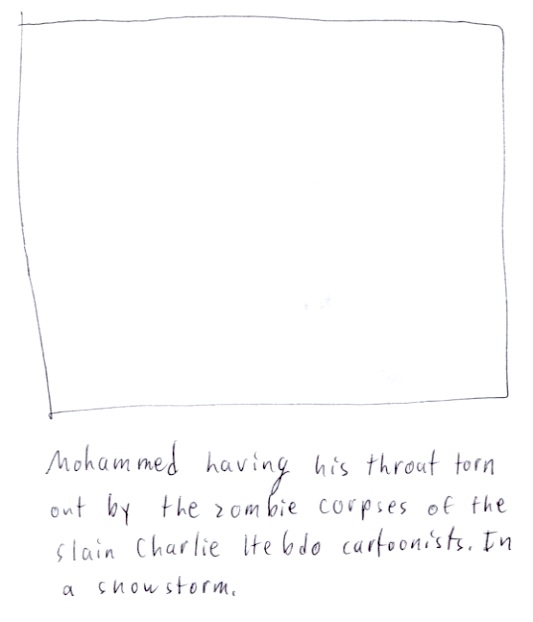
Me on blasphemy and Charlie Hebdo (and the most offensive cartoon you’ve never seen.)

Ng Suat Tong with a list of the Best Comics Criticism of 2014.

Em Liu examines Hollywood’s problem with the Asian male.

The spike from Jacob Canfield’s post has largely passed; we’re back to wending our quiet and mostly anonymous way through the internet. Sort of a relief.

Shonté Daniels with a short review of the stealth video game The Marvelous Miss Take.

Chris Gavaler argues that we are in the age of popularism (move over post-modernism.)

And finally I urged everyone tell Jonathan Chait to shut up.
 
Utilitarians Everywhere

At the Atlantic

— I interviewed Johnetta Elzie about women in the Ferguson marches.

—I reviewed Point of Honor, which tries to create a post-racial Confederacy.

At Ravishly

— I wrote about the gendered genre confusion of David Rees’ Aphex Twin/Taylor swift mashups.

—I interviewed Kathleen Gilles Seidel, one of my favorite romance novelists.

—I talked about Ms. Marvel fighting Islamophobia in San Francisco

—I explained why being lazy is good for your marriage.

At Splice Today

—I explained why liberals shouldnt’ want Palin to run.

—I advised Freddie deBoer to be a uniter if uniting is what he’s into.

At the Reader I talked briefly about Kaki King, guitar god.
 
Other Links

Katherine Cross on Jonathan Chait and toxic activism.

This Sady Doyle Chait takedown is maybe my favorite.

And I still really like this Angus Johnston piece about defusing conflict on the left (and in general.) I like the updates as well.

The CTA and Reverse Racism

This first ran on Splice Today.
___________
My wife is white, and she was taking the train to the Southside where we live. The train was crowded, almost entirely with African-Americans. One black man saw her sitting, and harassed her for the entire 20-minute train ride. How dare you be here when you know that this is a black train going to the black Southside, he told her. “Here’s this white women taking a seat. Are there any black women who need a seat? Or any black men. Or anybody?” He talked at length about how white people disrespect black people. He kept repeating, “You think you don’t have anything to do with it, but you have to pay.” It was that “you have to pay” that my wife found especially worrisome. Other people on the train punctuated his dialogue with laughter or shouts of encouragement.

She got home safely and was none the worse for wear. And nothing like this has ever happened to her before; she doesn’t feel unsafe taking the train as a rule, and not infrequently chats pleasantly with fellow riders. Still this incident was obviously very uncomfortable, and more than a little frightening. It also shows, I think, that the liberal default claim that “there is no reverse racism” is not entirely accurate. My wife was harassed, threatened, and told that she should not be allowed to use public facilities because of the color of her skin. It’s hard to imagine how you could define racism in such a way that her experience wouldn’t qualify. Certainly, if the reverse had happened—if on a train full of white people going to the Northside, a black person had been singled out and harassed on the basis of her race while other white onlookers cheered—it would be considered racism, and rightfully so.

There are a couple of possible takeaways here. First is the obvious point that black people, like white people, can be hateful if given the chance. That hatefulness can take a number of forms, but one is racial prejudice.

Racial prejudice doesn’t exist in a vacuum though. And in this case, the context, or the possibility, of black prejudice against white people is predicated on the context of white prejudice against black people. What happened to her only makes sense because of black history.

I don’t mean that the history of white oppression is an excuse for what happened to my wife. There isn’t any excuse for it, and treating people as if the sin of their skin color trumps who they are as individuals is simply a restatement of racism, not a mitigation of it. Rather, what I’m saying is that the black-on-white racism directed against my wife was made possible by the structural white-on-black racism that has shaped Chicago.

My wife’s assailant said that the train to the Southside was a black train. But it wasn’t African-Americans who decided that the Southside would be black. It wasn’t African-Americans who decided that Chicago should be the most segregated city in the country. For that matter, it wasn’t African-Americans who decided that people in the US should be categorized first and foremost on the basis of race in order to morally justify and practically facilitate slavery. My wife was visible as a white person going to a majority-black section of the city because her country and her city had made a systematic, centuries-long effort to mark and segregate black people. Without that history of racism, the reverse-racism my wife experienced would be impossible.

In a recent piece at Counterpunch, Tanya Golash-Boza argues that racism harms not just black people, but white people as well. She points out, for example, that when qualified people of color are passed over for advancement, less qualified white people get the jobs, so that “mediocre white people are teaching our children, leading community businesses, and fixing our telephones.” She adds that the structural concentration of wealth in the U.S. goes, not to all white people, but to a select few, so that racism is part of a system in which most black and white people “are fighting over the crumbs.”

My wife’s experience could be seen as another, even more direct way in which structural racism against black people can, in particular circumstances, result in harm to white people. The creation of racial difference and of segregation results in categorization on the basis of race.

Golash-Boza concludes: “Once we see the harm that racism causes all people in our society, it will be easier to form multi-racial coalitions to eliminate racism.” I’d like that to be true. But I think that when pointing out the harm that racism does whites, it’s important to realize that those harms are accidental—a kind of gratuitous fall-out of the hate and misery intentionally targeted at black people.

My wife’s story is the story of Chicago’s Southside, which is the story of America, which is in a lot of very important ways the story of racism. Doing a cost-benefit analysis on how and whether racism hurts white people can elide the uncomfortable fact that racism is entwined with the very existence of “white people” as a category, and for that matter with American (and certainly with Chicago) identity and history. Wanting to get rid of racism, then, isn’t so much about cost-benefit analysis. Rather it’s about no longer wanting hatred to be what we live with, day in and day out, what we see in the faces around us, and what we come home to every night.

Everyone Tell Jonathan Chait to Shut Up

Last summer, I wrote a piece for the Atlantic in which I argued that Orange Is the New Black (OITNB)fails to effectively critique prison as an institution because prison as an institution in the United States is directed mostly at men, and OITNB presents prison as bad because it victimizes women. The piece went semi-viral as a hate read, and was widely denounced. Jezebel wrote an article with the very Jezebel title “Writer Doesn’t Understand Why Show About Women’s Prison Has So Few Men.” Music critic Brandon Soderberg called me as a “clueless cracker pedant” on Twitter. Folks I liked and respected told me in no uncertain terms that what I had written was unfeminist and generally awful. There was a massive comment thread with people lining up to tell me I was stupid and should shut up. The left, the damn left, in all its insular self-righteousness, would not tolerate brave dissent such as mine.

Or at least, that’s the conclusion I would come to if I were Jonathan Chait. Chait has written a long article for New York magazine in which he bemoaned the return of political correctness and the toxic culture of the left. Chait points to Hanna Rosin, who wrote a book about the current plight of men, and was ridiculed with a hashtag; he also singles out an invitation-only Facebook group where people argueloudly with each other. My experience could be another data point for him, yet one more example of how “swarms of jeering critics can materialize in an instant” terrifying the heterodox leftist or liberal into silence.

There’s a couple of problems with Chait’s thesis, though. First of all, there’s just nothing in his article or in his examples that makes a case that discourse on the broadly defined left is somehow nastier than discourse on the right, or in the center, or out in directionless space. The first controversial piece I wrote for the web was for The Comics Journal. I reviewed Art Spiegelman’s In the Shadow of No Towers and my piece was headlined “In the Shadow of No Talent.” TCJ readers lost their shit and at least one person wished for the death of me and my family. It was exactly the sort of intemperate lashing out at dissent that Chait denigrates — but it didn’t have anything to do with political correctness or a culture of Marxist intolerance. It had to do with comics fans not wanting to hear me tell them that the thing they liked wasn’t any good.

Since then I’ve been told that I am stupid and that I should shut up by lots of Men’s Rights Activists, some feminists, some romance fans, many comics readers, fans of Breaking Bad, fans of The Hobbit, some leftists, and many right-wingers. I’ve even been abused by a fair number of supposedly free-speech-loving liberals and libertarians, who, when it comes to online behavior, aren’t any more tolerant of dissent than anyone else as far as I can tell. In a recent discussion of Charlie Hebdo, one First Amendment lover told me that if I didn’t like America, I could leave it — because free speech means exiling folks who say things you don’t like. Maybe, as Gawker’s Alex Pareene says, the liberal Chait is especially thin-skinned when it comes to criticism from his left. But one thing’s for sure: In terms of yelling at each other online, there are no red states and no blue states. There are only states of intemperate ire, and lots of them.

Chait is right, I think, that social media has changed the way social pressures work when it comes to speech. It used to be that conversations in the public sphere were limited and controlled by institutions. What you could say was controlled by what magazines (like, say, The New Republic, where Chait used to work) would print. That’s still true to some degree. But it’s also true that social media has made it possible for people who didn’t have a platform to speak loudly, astutely, randomly, continuously, profanely, violently—and often right there, just under an author’s prose, in the comments section. The roar can be deafening, and sometimes frightening.

I use the word frightening advisedly. Chait in his piece does that odd thing free-speech advocates sometimes do, and downplays the importance, or dangerousness of talking and expressing opinions. ” Mere expression of opposing ideas, in the form of a poster, is presented as a threatening act,” Chait sneers, denigrating an academic who found a pro-life sign on a college campus offensive. But speech is threatening, often, and aggressive. You could argue that a professor physically grabbing a sign from a student is an escalation, and I’d agree with you. But it’s not an escalation from zero

Chait is telling people on the left that they’re totalitarians; I’m telling him that he’s a fool. The intent, in both cases, is to cause a reaction, to disturb, to mock, to change the world, in some small way. If speech were utterly inconsequential, if it had no power, there wouldn’t be any point in defending it. The argument for free speech, surely, has to be built on the notion that speech does in fact have power. It’s because speech is worth listening to that you defend it, not because it isn’t.

And the cacophony of the internet is, contra Chait, often worth listening to. It’s given a voice to many folks who didn’t have one before. Chait takes a swipe at the 1990s’ anti-sex work policies of Catherine McKinnon, but he doesn’t mention that the social media he sneers at has been a huge boon to sex workers themselves, who can finally create their own platforms after decades of being silenced by both the right and the left.

Similarly, black women and other women of color have a major presence online, and are able to talk back to folks like Chait (or like me) in a way that wasn’t possible even twenty years ago. Chait doesn’t always like what these people tell him — he seems particularly disturbed by Brittney Cooper’s argument that reason is not always a useful tool against racism. But that’s how free speech works; people will sometimes say things you don’t like.

There are downsides to all this roiling speech, too. Chait seems to think the most serious problem is that white men and white women are sometimes told that their whiteness disqualifies them from speaking. “Under p.c. culture, the same idea can be expressed identically by two people but received differently depending on the race and sex of the individuals doing the expressing,” Chait moans.

And sure, as a white person, I find it unpleasant when my brilliant, beautiful ideas are dismissed because I’m white or male. But that problem pales (as it were) next to receiving actual death threats, being doxxed, or having SWAT teams sicced on your house — none of which Chait mentions, because none of those things are regular occurrences on the left. But other communities haven’t been so lucky. Being white on the internet may be a hard, sad, road, but it’s nothing compared to being a feminist video game developer. For that matter, being white on the Internet is not generally anything compared to being black on the Internet. As Ferguson activist Deray Mckesson told me, “the death threats aren’t fun. They put my address out there, that’s not fun. I get called a nigger more than I’ve ever been called that in my entire life. I’ve blocked over 9,000 people, so I don’t personally see it as much anymore, but my friends do.”

The Internet makes it possible for more people to speak more effectively than ever before in history. That also means it allows more people to issue death threats, shout obscenities, and harass others than ever before. Free speech, and for that matter democracy, has always been a balancing act between the polis and the mob — between unleashing speech to empower people, and trying to figure out how to prevent the power of speech being used to oppress, to terrorize, and even (through that call to the SWAT team, for example) to kill.

The Internet, and social media, have exacerbated these tensions; they increase the potential of speech, for good and ill. Those are problems we have to wrestle with. Jonathan Chait isn’t up to the task, in part because his obsession with the left leads him to focus on ideologies rather than methods; on who he wants to shut up, rather than on figuring out which kinds of speech, whatever the content, should be allowed, which shouldn’t, and how to deal with the difference. Fortunately, the Internet is full of talking people who, civilly and less so, can tell him where he’s wrong, and that he should shut up.


Blasphemy and Charlie Hebdo

The complete roundtable on Satire and Charlie Hebdo is here.
_______

The terror assault which killed twelve people, including many prominent cartoonists, at the offices of Charlie Hebdo occurred two weeks ago now. It has been largely replaced in the news, at least in the Anglophone press, by other atrocities and other controversies. The news cycle is brief and vicious, and old blood, no matter its quantity, soon gives way to new.

Still, the response to the tragedy has at least some lasting lessons for the comics community in general, and for comics scholars in particular. I’d point particularly to a piece by Mark McKinney, a professor at Miami University and co-editor of European Comics Art.

McKinney, in a clearly heartfelt piece, denounced those who responded to the cartoons without sufficient context or understanding. “[W]hen many analysts see the cartoons, they simply lack the artistic, cultural and linguistic frameworks for interpreting them,”he says. He then goes on to argue that the magazine was anti-racist, and to point out that it is a determinedly French, and “even Parisian” magazine. He discusses, in laudatory terms, its commitment to scandalous and offensive imagery. And then, after several paragraphs of general background, he presents his rich, contextualized conclusion.

Through their cartoons, comics and news articles, the journalists of Charlie Hebdo courageously carved out and defended a space for dissent from religious extremism and censorship. Their joyful mockery of religious dogmatism is viewed as insensitive at best, and even blasphemy, by some clerics and their followers, and, as we now know, by terrorist murderers.

The nuanced, scholarly conclusion is, in other words, exactly the same as the broad, knee-jerk, uninformed conclusion reached by large portions of Anglophone social media. The Charlie Hebdo cartoonists were free speech martyrs fighting against religious extremism. The only people who disagreed with their cartooning or editorial policies, were, in McKinney’s informed assessment, either “clerics” or their (blind? stupid?) followers, and terrorists.

“Scholarship on comics and cartoons can help us understand the meanings of Charlie Hebdo in important, vital ways that simply skimming over a few cover images from the magazine will never do. To the dead and the wounded, to the grieving survivors of those massacred, we owe at least this: a genuine attempt to understand what the cartoonists of Charlie Hebdo did, and why,” McKinney declares in satisfaction. Fair enough; who can disagree with that? But his article is not such a genuine attempt. It analyzes no images. It discusses nothing in depth. Instead, it invokes the name of scholarship not in order to create more understanding, nor to perform a more subtle reading, but merely to lend the imprimatur of the academy to one side of a debate. There is no effort in McKinney’s piece to engage with French or Francophone critics of Charlie Hebdo, nor any effort to discuss the reasons why many French Muslims felt that the magazine targeted them. There is no recognition that there might be, not one context, but multiple contexts. There is no effort to think about the history of caricature and the history of racism, or to think about how intent and reception may diverge. McKinney’s piece is not scholarship. It is polemic.

I don’t have anything against polemic per se. It’s a venerable genre, and, like any aesthetic endeavor, can be done well or poorly. I find it troubling, though, that McKinney attempts to cloak his polemic in the mantle of academic rigor, and portrays those who disagrees with him as either ignorant or ill-intentioned. Poorly defended, entirely banal opinions are presented by McKinney as interesting and true simply because a comics scholar happened to put them forward.

Since McKinney urges context, I should say that the context of his own remarks is clear enough. At least since Frederic Wertham pointed out that comics were often racist, sexist, violent, and kind of crappy, the comics community has been exceedingly sensitive to any criticism that calls into question the moral or social content of cartooning. On top of that, comics have long been seen as childish, largely aesthetically worthless pulp crap; comics scholars have waged a long, difficult campaign to get them recognized as complex artistic expression, worthy of study. McKinney, then, is not really trying to add nuance to the Charlie Hebdo discussions, which is why he adds none. He is instead repeating (under the validating mantle of scholarship) the same arguments that comics has used for decades to defend itself against hostile critics. To wit, comics are complicated and moral, and if you disagree, you’re a Puritan thug and a fool.

The murderers of Charlie Hebdo prove that Puritan thugs (broadly defined) do in fact exist. However, this does not mean (contra McKinney and his supporters, educated and otherwise) that all those speaking out against Puritan thugs are beyond reproach. Nor does it place a seal forever upon the righteousness of comics creators or comics scholars. Is comics scholarship an academic field devoted to the understanding and discussion of comics, bringing a wide range of knowledge and approaches to a complicated, sometimes beautiful, sometimes flawed, sometimes undervalued, and perhaps sometimes overvalued medium? Or is comics scholarship to be devoted to boosterism, advocacy, and sacralization? If Charlie Hebdo’s accomplishment was to fight against all priesthoods, then surely it does them little honor to try to set up a priesthood in their name, handing down stern pronouncements about how their work must be read and understood. You can’t venerate blasphemy by venerating blasphemy. And comics scholarship, whatever its accomplishments and advantages, does itself no favors when it attempts to set itself up as an unquestionable authority in the name of free speech.
 

CH snow

Utilitarian Review 1/24/15

Wonder Woman News

This Wednesday, at 6:00PM, I am going to be signing books at the lovely First Aid Comics, 1617 East 55th Street, Chicago, IL 60615. If you are in Chicago, come on by and chat about space kangaroos!

Lauren Davis did a really fun interview with me; we talked about Steve and castration and Etta Candy and love leaders, which haven’t come up in other interviews so much.
 
Other News

Jacob Canfield talks about the depressing and overwhelming response to his viral internet piece on Charlie Hebdo which ran on HU.
 
On HU

Featured Archive Post: Subdee on Britpop and Phonogram.

Josselin Moneyron looked at a year of Charlie Hebdo covers (most of them aren’t about Islam.)

Folks asked me questions about Wonder Woman, and I answered.

I interviewed Andrew Hoberek about Watchmen and neoliberalism.

Sarah Shoker on whether science fiction will lead us to a better future.

Naphtali Rivkin on Junot Diaz, Isabel Allende, and superbildungsromans.

Kim O’Connor brings you fables from your comics industry.

Michael Carson on American Sniper as authenticity kitsch.
 
Utilitarians Everywhere

At the Atlantic:

— I wrote about Bart Beaty’s new Archie book and the advantages of no continuity.

—I explained that the point of The Man in the High Castle is that the Nazi dystopia isn’t that dystopic.

At Ravishly:

— I talked about why Beyonce and Wonder Woman are alike (they will save the world through sex.

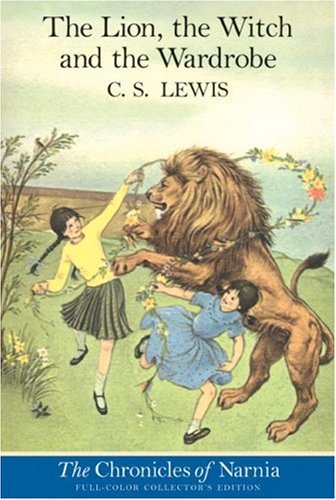
—I argued that Lucy in the Lion, The Witch and the Wardrobe can be seen as a feminist character.

At Pacific Standard I reviewed Edward Struzik’s Future Arctic, about practical responses to climate change.

At Splice Today I wrote about

— why you can write about a trailer without seeing the movie.

— how my cat does not want to be cozy.

At the Chicago Reader I did short reviews of

— a nifty Posada tribute show

—woozy loungey hipsters Woo Park.

 
Other Links

Forrest Wickman on how women don’t get credit for their music.

Anthony Failola on the French Muslim community and Charlie Hebdo.
 

LionWardrobe12

Watchmen and Neoliberalism: An Interview with Andrew Hoberek

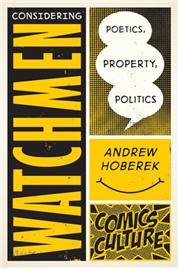
ProductImageHandlerAs I’ve said before, my book, Wonder Woman: Bondage and Feminism, came out last week. It’s published in the Comics Culture series at Rutgers University Press. My book is the second volume to be published; the first, released in late 2014, was Andrew Hoberek’s Considering Watchmen: Poetics, Property, Politics, focusing on Alan Moore and Dave Gibbons’ Watchmen.

Andrew’s book is appreciative but not reverent; he’s especially skeptical of the political stance in Watchmen. HU has talked a lot about Alan Moore’s politics over the years — so I thought it would be interesting to talk to Andrew about his take as the last post in my book release roundtable. Andrew and I spoke by email.
_______

Noah: Your central argument about Watchmen’s politics, as I understand it, is that Watchmen is based in Moore’s sweeping distrust of institutions. For Moore, that connects to 60s anarchism and progressivisim, but your point is that it’s also the basis for the neoliberal attack on government institutions. So when Moore rejects political collective action, he ends up on the side of Reagan and Thatcher, who he hates. Have I got the argument right there? And maybe you could talk a bit about where or how you see Moore rejecting collective politics?

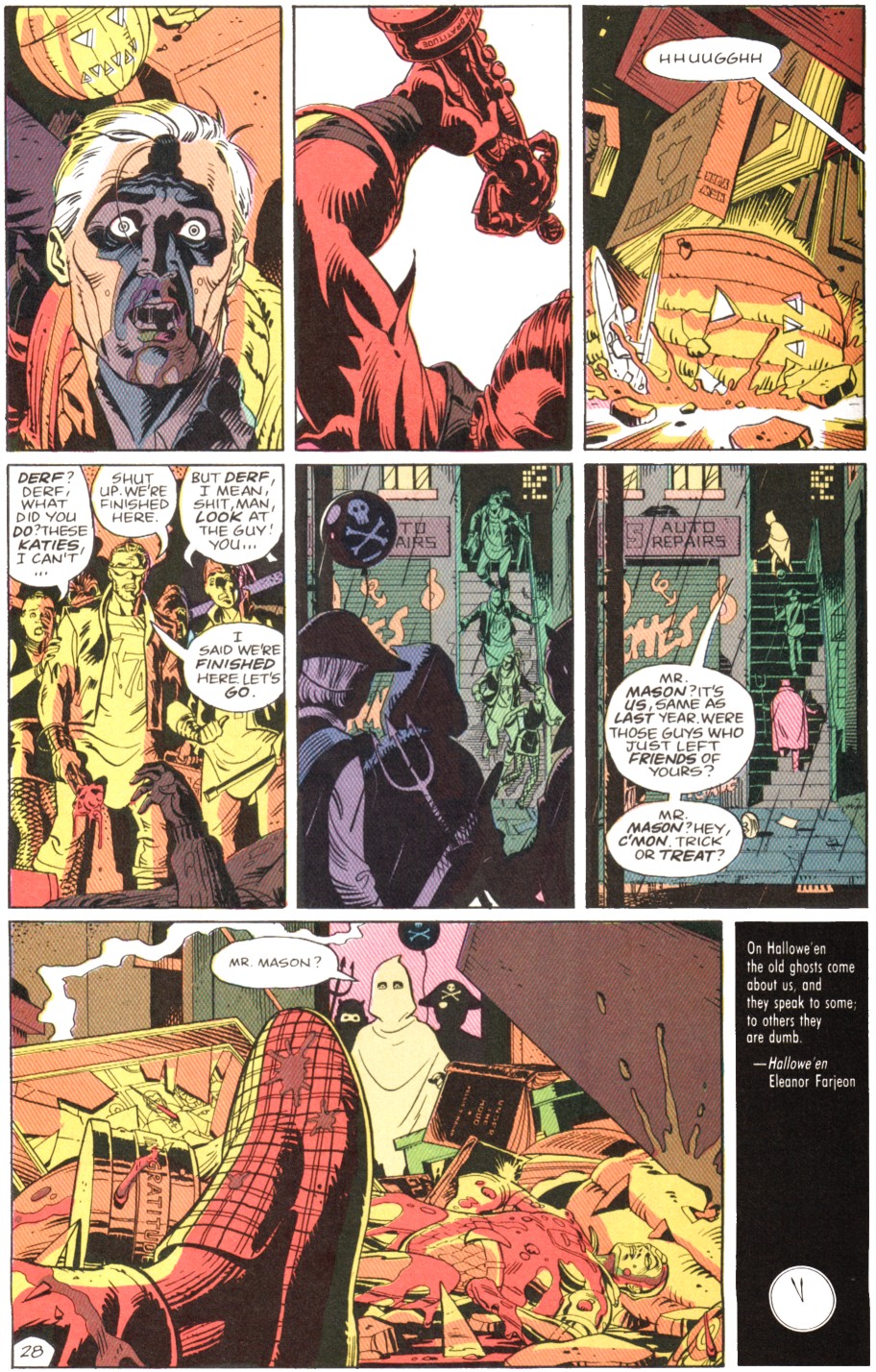
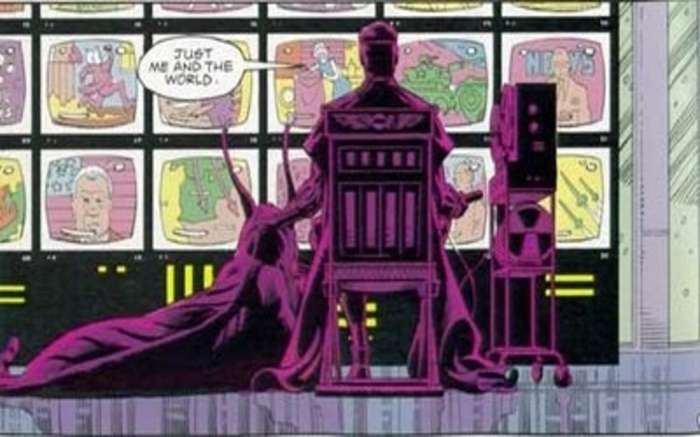
Andrew: I think one example, perhaps relevant now, is the protest against Nite-Owl and Silk Spectre freeing Rorschach from prison that spills over into a group of skinheads killing the original Nite-Owl, whom they confuse with Dan Dreiberg.
 

watchmen-08-28

 
Another way to think about it is the fact that Moore’s respect for individualism transcends actual political stances, to the extent that the rightwing Rorschach is a much more sympathetic character than the liberal Ozymandias. Ozymandias is a classic totalitarian figure, someone who (like Stalin) wants to impose plans from the top down and who doesn’t care if literally millions of people have to die in the process. This is very much the kind of figure that Reagan or Thatcher deployed to justify both their foreign policy and their domestic cuts, and that we still have with us in the form of the (absurd) assertions that Barack Obama is a socialist.

That said, I think “ends up on the side of Reagan and Thatcher is strong.” It’s probably more correct to say that he shares an anti-collective stance that hadn’t yet become totally the property of the neoliberal right at that point (It was still central to the sixties left from the Port Huron Statement to the anti-Vietnam movement), but was on its way to doing so.

Noah: So, do you think it’s possible to see Ozymandias as in some ways a critique of neoliberalism, or as trying to think through the connections between liberalism, capitalism, and authoritarianism? You say that Veidt is a classic totalitarian figure, but he’s awfully pro capitalism. And it’s not industrial Nazi-era capitalism either; it’s way more late capitalism, consumerism of the image, it seems like (part of his evil plot is essentially to make a movie.) Casting Veidt as the villain seems like it’s at least in part casting big business as the villain.
 

25796

Andrew: That’s a good qualification. As I was writing the book I had my eye on the way that Veidt’s portrayal exemplifies a general distrust of institutions that has gone from being a shared feature of both the left and the right in the cold war period to a hallmark of neoliberalism. But another way to think of Veidt is as a figure who embodies Moore’s distrust of large-scale capitalism–a thing I associate in the book with the way he stands for the big comic book companies who exploit the intellectual property of work-for-hire creators. At the same time, it’s when Ozymandias steps outside the profit motive, and attempts to perform what he believes is an altruistic act, that he becomes the villain of the piece. Moore’s thinking about the comic book industry and his general politics remain entwined here, in that the celebration of individual comic book creators remains entwined with a kind of romantic ideology of small property ownership (in this case intellectual property) that’s long been central to American thought, and in some ways has facilitated or served as cover for the rise of neoliberalism. We think of Reagan and his successors as champions of small business–in part because they continuously tell us so–but their policies have largely benefited big capital.

Noah: Veidt’s capitalism doesn’t end though. And in fact he takes advantage of his knowledge of the change in the world situation to switch his investments around and make even more money. Liberal one-worldism and neoliberal corporation seem to fit together seamlessly.

I guess I wonder in part whether the critique of institutions you point to, or the sympathy for Rorschach and the distrust of Veidt — the assumption in your book seems to be that that’s politically retrograde or problematic. But— I mean, for myself at least…if the book is anti-Stalinist, and anti-violent revolution, which I think it is, I’m kind of on board with that. I feel like Moore points out that revolutions are really bloody, kill real people, and don’t necessarily actually change all that much, or can’t be counted on for real transformation. Those all seem like reasonable points — and stand in contrast to V for Vendetta, for example, where V seems infallible and revolutionary violence and torture result in Evey’s personal transformation rather than in the kind of pointless pile of corpses you see in Watchmen.
 

watchmen12

It also seems prescient in terms of our current political moment. Obama’s not Stalin, obviously, but like most of our Presidents he’s happy dropping bombs on people in the name of a better world. He really doesn’t look all that different from Veidt in a lot of ways (he’s even a successful creator of intellectual aesthetic content, right?)

Andrew: The Obama-Veidt comparison is a fascinating one, although I guess an even better comparison would be Veidt and Mitt Romney, since Romney too made a lot of money and now seeks to turn his attention to public service. (Of course he didn’t make it all on his own after starting from the bottom, the way Veidt and Drake did.) For my money, though, I think the things that are problematic about Obama actually have to do with his very Reaganesque dislike of large organization. For all the flak that he takes for his past as a “community organizer,” this is a figure whose commitment to ground up consensus building reflects a sixties left critique of big government in an era when anti-government sentiment has become a major tool of those in power. Obama’s missteps (including, one imagines, those with the security state, although we’ll probably never know the details there) seem to me to be a property of his desire to compromise and build consensus with everyone. To my mind I’d prefer a Lyndon Johnson who knows how to work within organizations and who isn’t afraid to strong arm opponents to get what he wants. I actually think Lyndon Johnson is–mistakes with Vietnam aside–an unacknowledged hero of the twentieth century. I’m getting a bit away from Watchmen here, but these days you don’t see too many celebrations of institutions on either side of the political fence: Spielberg’s Lincoln is one of the few I can think of, and a great, unheralded film for that fact.

Noah: Hah; I loathed Lincoln. Part of my broader loathing of all things Spielberg. I don’t think it does actually celebrate institutions, exactly. It celebrates Lincoln as white savior hero genius. Barf.

Andrew: My defense of Lincoln’s would be Adolph Reed’s, which is simply that it portrays politics and dealmaking as valuable and even dramatic activities, in contrast to a movie like Django Unchained which seems racially progressive but which actually personalizes both the critique of and solution to an institutional problem like slavery.

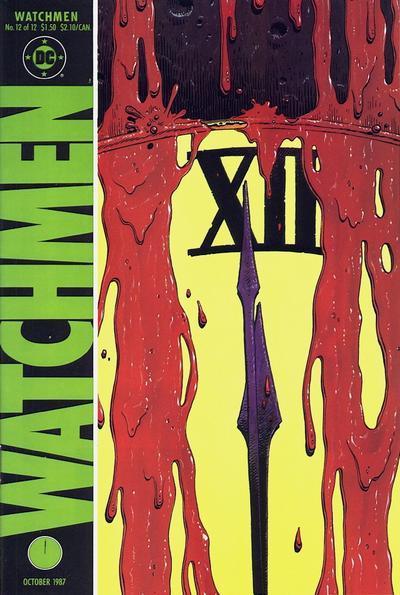
But to return to Watchmen in conclusion, I think this whole political question has a lot to do with the history of the superhero in which Moore and Gibbons play a key role. The pre-Watchmen history of the genre runs from 1938 or so to 1986, precisely the period in which Americans believed in the potential of government to make things better. In that respect, I tend to see the superhero as a figure for the New Deal state itself–a figure of extra-ordinary power committed to doing good in the world. The post-Watchmen idea of the superhero (in which Moore and Gibbons participate, even though they later come to bemoan it) as an obsessive or self-interested figure who claims to do good but in fact makes things worse nicely parallels, by the same token, neoliberal accounts of government.

Wonder Woman Questions

This is the week my book, Wonder Woman: Bondage and Feminism is released. I’ve put together a week-long roundtable to celebrate.

Earlier in the week I asked folks to ask me Wonder Woman questions and I’d answer them here. A few people responded. So here’s my answers. If you have other questions, ask in comments and I’ll try to answer as best I can. (Questions about my book would be great too, if you are one of the few who have read it!)

Figure 30

____________

Andrew

Is there someone that you think could channel H.G. Peter?

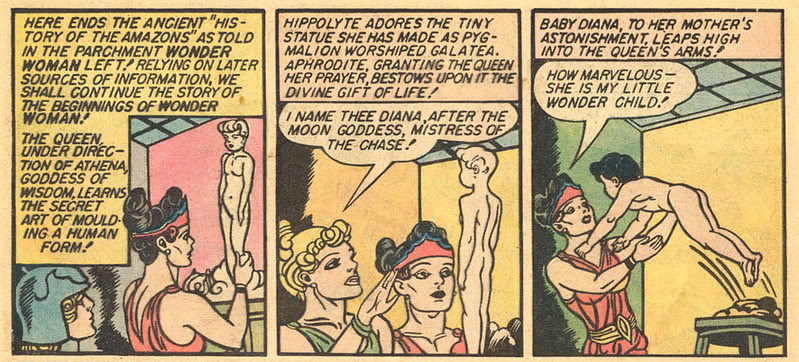
I love Harry Peter too! His style is very different from current mainstream superhero art. He looks back to a Victorian illustration tradition in a lot of ways; stiff figures, fluid linework, just very different than the muscles-on-muscles pin-up style you get in Marvel and DC nowadays.

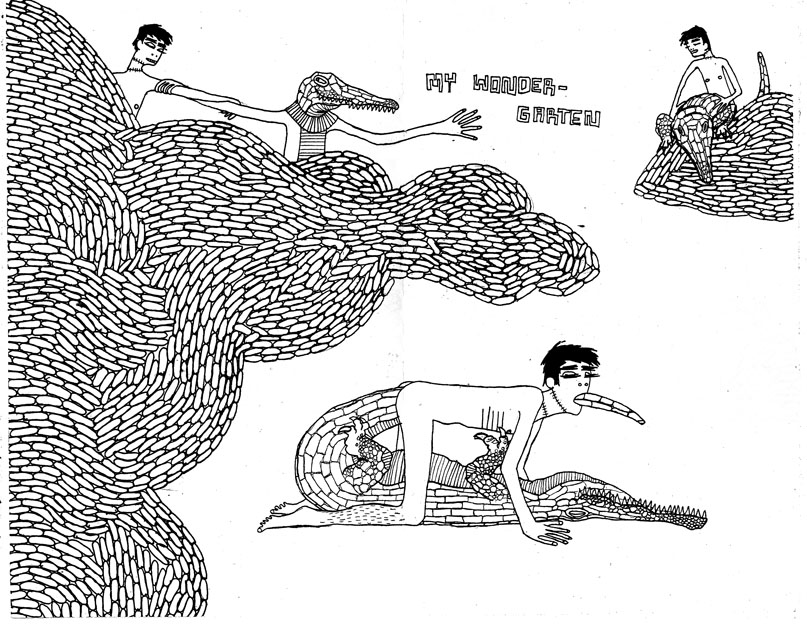
So, if you were going to have someone approximate that, I think you’d need to look to alternative and indie creators probably. I’d love to see Edie Fake do a Wonder Woman story. Edie’s fascinated with gender and sexuality in a way that’s reminiscent of Marston, and he’s really into fantasy landscape as well. It would be different than Harry Peter, of course, but I think he could get some of the same sense of overripe wrongness/rightness that Peter did.
 

v-2

 
Leah

How do you think Wonder Woman has informed the portrayals of other women superheros. And why do you think there there not more leading lady superheros. Most of the well known ones these days seem to be part of teams (ex. XMen, Fantastic Four) rather than stand alones.

That’s tricky; I don’t think the original Wonder Woman comics have had much influence at all on other female superheroes, as far as I can tell. Marston’s mix of bondage and feminism isn’t something that many other mainstream creators have been all that interested in. There have been a few direct lifts, like Alan Moore’s Promethea, or Winged Victory in Kurt Busiek’s Astro City, or Wonder Girl. But for example Storm, from the X-Men, whose one of the higher profile superheroes, doesn’t owe much to Wonder Woman. Buffy and Sailor Moon, two very popular female superheroes, don’t look back to her much either.

And I think that’s part of the answer to your second question. There are stand along female superheroes, like Buffy and Sailor Moon. They tend not to come from Marvel and DC (the big two superhero companies). And that’s just because Marvel and DC have historically featured male characters by male creators mostly packaged for me. That’s changing somewhat as the movies create a more diverse audience, and so maybe we’ll see more stand alone superhero films featuring female heroes from those companies in the future.

Matthew

It seems that people are clamoring for a Wonder Woman movie, but do you think an interesting film could actually be made with the character in her current state? Or are her bizarre origins, years of retcons, constantly fluctuating characterization, and general difficulty to handle by modern comics writers too much to overcome?

Anything’s possible I guess. Somebody could just go back to Marston and Peter and make a movie with gorilla bondage and space kangaroos, if they wanted. I suspect though that the movie will be boring not because anyone is confused by years of indifferent comics, but just because most superhero movies are boring and unimaginative, and there’s no reason to think this will be different. In other words, the Wonder Woman movie will be bad because the Avengers and Superman and so forth are bad, not because Wonder Woman comics are bad. They’ll write a script where she hits people and has angst and things blow up, would be my guess.

I suppose they might try to incorporate feminism in some way. That could be bad, as the animated feature showed. For an actual feature there’s too much money at stake to screw around with trying to be true to the character or the comics fanbase, though, would be my guess.
 
Eric

What did you think of the David Kelly pilot?

I didn’t see it!