Geek-O

This first appared on Comixology.
__________

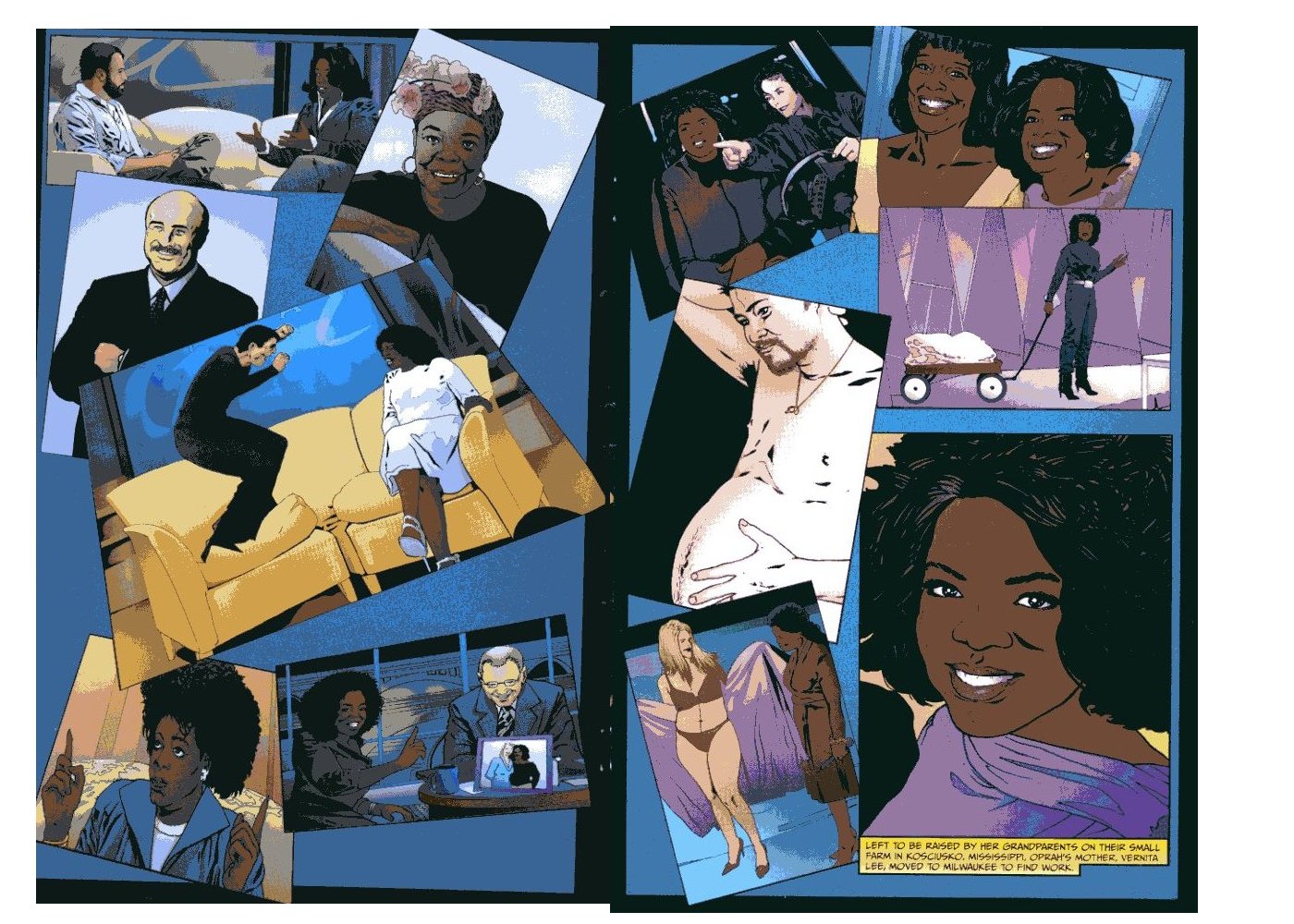
BlueWater Comics’ Female Force: Oprah Winfrey is in a hurry to start sucking. You can feel it squirming and fidgeting impatiently on the first page, with the so-clichéd-it-hurts movie-zoom into the eyes of child-Oprah. But it’s only on page 2-3 that it triumphantly frees itself from banal badness into the realm of the transcendentally awful:
oprah2page

We’re obviously trying to reproduce the effect of a video montage here — a mediocre idea executed with no particular flare. But…check out that center panel on the left depicting the moment on Oprah’s show where a guest transformed into a zombie manikin, causing Oprah to scream and scream and scream in terror as said flesh-eater leapt across the couch to devour her intestines in an orgy of blood that the Church of Scientology vigorously denied could have been prevented by psychiatric counseling. You remember that, don’t you? Good times!

Or perhaps it didn’t happen quite that way. It’s difficult to know, since writer Joshua Labelle hasn’t provided any captions — and artist Joshua Labelle isn’t, alas, technically capable of providing us with interpretable visual clues. I’m aware that the evil zombie manikin who ate Oprah’s intestines was Tom Cruise — but that’s only through the power of the fact that my wife buys US, not through anything Labelle (in any capacity) has offered me. Through a similar process I’m able to identify some of these other moments (the trans pregnant man, for example…and I guess that’s supposed to be Michael Jackson in the upper left of page 3…driving Oprah around in a tractor? I honestly don’t know.) But…why is Oprah wheeling a wagon? Who’s the woman flashing her in the lower left, and is that supposed to be a surgery scar, or is it some sort of plastic seam indicating that this is a life-size doll, or is it just a mistake?

Obviously, I’m supposed to know the answer to these questions, or at least to vaguely care. This is, in other words, a comic aimed at true-believers. The intention isn’t to introduce Oprah to a new audience, or even to tell us anything in particular about her life. It’s to provide more Oprah-crack for the legions and legions and legions of Oprah-crack addicts. This impression is solidified by the fact that the last third of the book cuts the biographical pretense altogether to wallow in the gooey trough of earnest uplift. (“It’s about achieving your dreams but not stopping there. It’s about fighting for what you believe in. It’s about obtaining untold millions by marketing vacuous feel good rhetoric and then using those millions to prove the efficacy of vacuous feel good rhetoric. Or something.”)

None of this is especially surprising. A shoddy piece of shit comic designed to shamelessly exploit a massive marketing phenomena? Shock, horror, etc. But what’s weird is…well, look at this:
 

toys

 
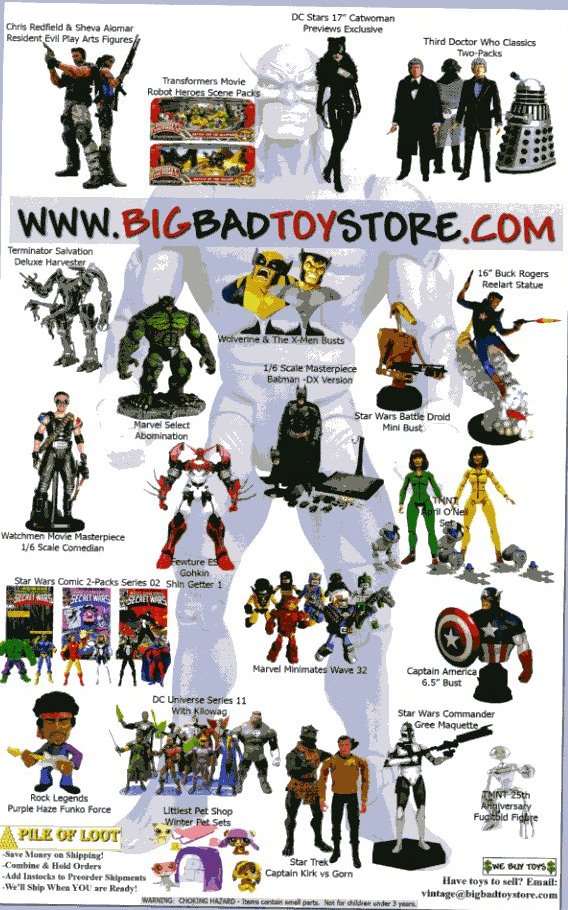
That’s an ad from the Oprah comic in question. There’s also an ad for Geek Magazine, for the action film Crank 2 and for Play Magazine, which I assume is some species of videogame publication, but the ad doesn’t really tell me anything and my browser won’t go to their website. And there’s also (wouldn’t ya know!) an ad for Comixology’s iphone apps.

Admittedly, there are also ads for things that you’d expect to see advertised in an Oprah comic, like the Pink Project charity photo book and PETA . But that doesn’t change the fact that you’ve got here a comic that seems to be aimed at hard core Oprah fans which is advertising the kind of nerd detritus (nerdtritus?) you’d expect to see being hocked in a super-hero title. Based on both story and ads, the average reader of this comic is a 25-40-year-old woman who turns into a 15-25 year old boy whenever s/he goes to the store. Sort of an updated Ranma ½ with consumption replacing water.

Not that I’m saying that Oprah fans can’t like action movies, or vice versa. I’m sure some do. But advertising, not to mention shallow band-wagon product generation, is all about demographics. You’ve got your Oprah comics, you sell ads that target the people who love Oprah. This isn’t rocket science. You don’t expect to see adds for shoes and kitchenware in Superman.

With comics, I’m never taken aback by lousy quality. After all, most things are lousy — maybe comics are a little worse than everything else, but not enough to squawk about. But the marketing confusion in even comics that have no point other than their marketing: I can never get over that. Why churn out this horrible Oprah Winfrey piece of dreck if not to make money? And how can you make money if you don’t even know who you’re trying to sell to? I mean, I bought this in a direct market store. What are they doing even selling it through the direct market? What venue could they find where folks would be less likely to pick this up?

I don’t know…maybe Oprah’s face will just cause bills to adhere to the cover through the mystical epoxy of branding. But if they turn a profit on this thing, it sure won’t be BlueWater Comics fault. Comics won’t be a mature art form until the day that the form’s bottom feeders learn to be competently venal.

Addendum: I thought I’d heard of BlueWater as being a particularly problematic company. And yep, here’s Tom Spurgeon and Chris Butcher teeing off on them. I guess the chances of making money on this Oprah Winfrey comic increase exponentially if you kind-of, sort-of don’t necessarily pay your creators. Maybe comics are mature after all.

Utilitarian Review 5/18/13

On HU

Featured Archive Post: Adam Stephanides begs you not to rearrange the manga.

A commenter named Alexander on why as a trans man he loves Sailor Moon.

Me on sequence in Satoshi Kitamura’s children’s book “When Sheep Can’t Sleep”.

Chris Gavaler with an appreciation of Austin Grossman’s novels.

Ng Suat Tong on the selections for the best comics criticism of 2012.

Me on Gay YA and Nora Olsen’s Swans and Klons.

Jacob Canfield on his choices for best comics criticism of 2012.

Me on the advertising campaign for the Yves Saint Laurent Touche Eclat make-up pen, and how capitalism will eat the self (for better or worse.)
 
Utilitarians Everywhere

At the Atlantic I talk about

— how the recent Gatsby film erased Nick’s gayness.

David Bowie’s glib, stupid anti-Catholicism.

At Splice Today I talk about

— the great jazz trombonist Bill Harris honking.

Angelina Jolie, mastectomies and femininity.

—The Julianne Moore rom-com The English Teacher, and how it’s supposed to be set in my hometown.
 
Other Links

Matthias Wivel on the best comics criticism of 2012.

Barack Obama sucks.

Mary McCarthy on the joys of embarrassing your kid.

Monika Bartyzel on why the Disney princesses suck.

Tucker Stone urges you not to tighten up your Berlatskys.

Elissa Strauss provides a manifesto for lazy birthing.
 

picture-uh=836d77b233892f9e5dcbcdcbeebab17-ps=78a6b548836c59d689636f61ffbb2a4b-95-W-Vaughn-St-Kingston-PA-18704

A house down the street from where I grew up. Significantly less chic than any of the houses in the rom-com The English Teacher

The Radiant Touch of Commerce

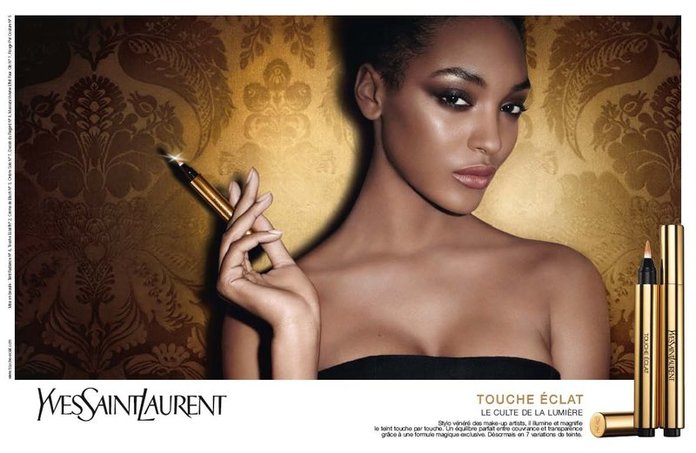
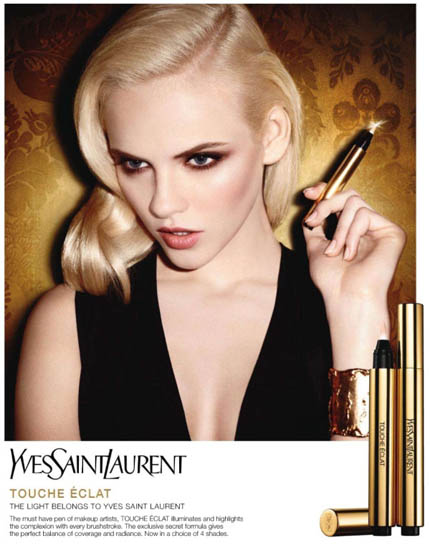
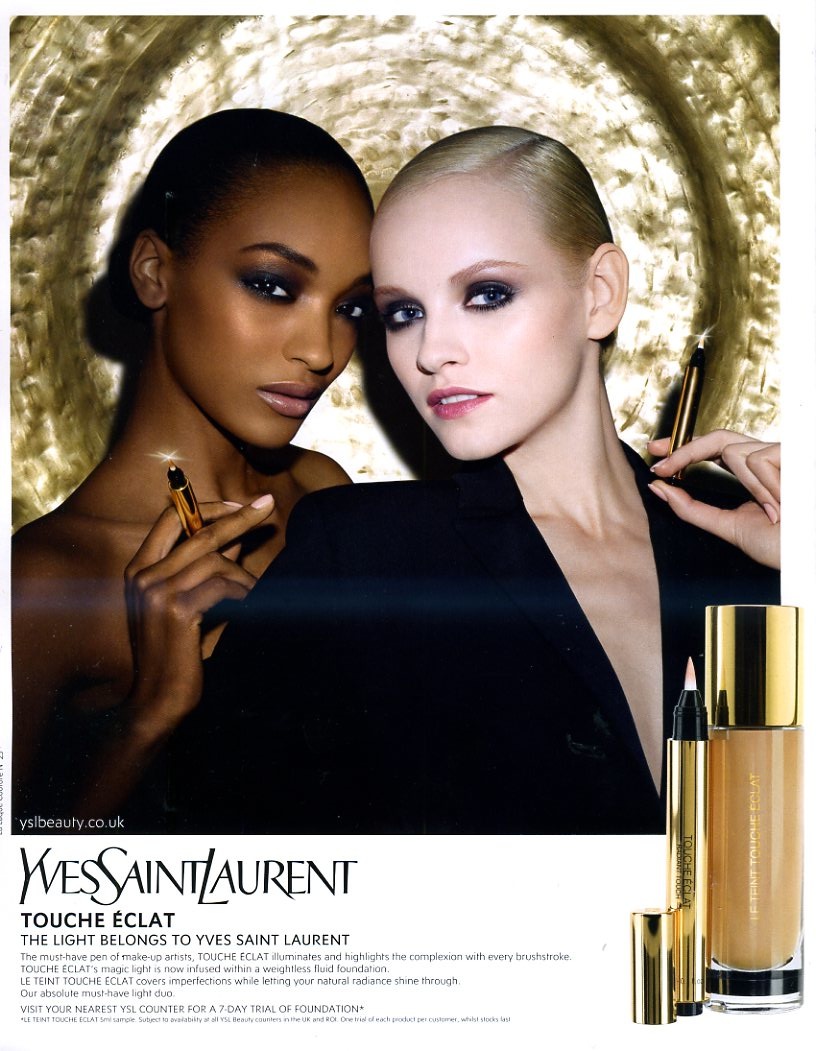
Last week Charles Reece, Sarah Shoker and I had a conversation in comments about authenticity, plastic surgery, commerce, make-up and other things. Along those lines, I thought it might be interesting to talk about this back-cover ad for from the May issue of Vogue for the Touche Éclat make-up pen, featuring models Jourdan Dunn and Ginita Lapina.
 

vogue back

 
“Le Tent Touche Éclat covers imperfections while letting your natural radiance shine through,” according to the copy.

As that suggests, the ad, like a lot of fashion, is deliberately playing with tropes of naturalness and artificiality. The make-up pens stand in for cigarettes — which in turn stand-in for phalluses, so that applying make-up becomes, all at once, socially (not to mention physicaly) dangerous, a tease for a male(?) viewer and an assertion of sexual power. Moreover, the two women — with their similar smooth styling, poses, head tilts, and standard smoldering stares — double each other, artificially cloning the others’ look. White becomes mimicking of a (natural?) black, while black becomes a micmicking of a (natural?) white. The doubling creates a standard (everyone is doing it) and suggests there is no unitary standard (doubling is uncanny.) Similarly, the weird gold nowhere against which they pose contrasts with the simplicity of their outfits; Dunn’s black dress is so low cut that she’s au natural for all practical purposes, while Lapina appears in unadorned black (with plunging neckline.)

IN part, the ad uses the natural/artificial binary as a lever to commodify naturalness. Dunn and Lapina become multiplied, deindividualized icons — carefully arranged compositional elements in someone’s, or everyone’s, golden dream. The repetition of their diverse natural, individual selves tends to make those selves, in their naturalness and diversity, replicable, and therefore available and purchaseable. With makeup, you two can be as individual as them.

You need this individuality, or uniqueness, or (if you prefer) authenticity if the transaction is going to be appealing or exciting. It’s not just being able to purchase a replicable thing; it’s the sense that the replicable thing purchased is special. That’s the appeal of the interracial models. But it’s also the appeal of the inevitably controversial cigarette imagery. And, for that matter, of the connotations you set up when you put a black woman and a white woman together, each wielding a penis substitute — cultural discourses around prison butches and interracial lesbianism are buried, but not, imagery like this suggests, utterly forgotten. As Tom Frank has pointed out over and over, controversy and rebellion sell; nonconformity is the most exciting conformity of all.
 

JD_YSL_Touche_Eclat_SS_2012.jpg.scaled696-1

 
The market, then, takes any form of authenticity or individuality, and turns it into an image of itself, so you’re buying back your own natural radiance to be applied artificially, or purchasing markers of rebellion (interracial mixing, lesbianism, cigarettes) just like everybody else.

touche_eclat_2

Capitalism’s de-authentification of everything can certainly be depressing and constricting, demanding that women conform their real bodies to impossible standards (I’m sure the image here has been extensively photshopped, like all images in fashion mags.) On the other hand, though, it’s hard not to see some appeal in the artificiality as well. Where is this world we are being shown, where race is interchangeable, where deviant sexuality is glamourous and fabulous rather than marginalized and persecuted, where beautiful bodies float free of social stricture or even — as cigarettes become mere style icons — fear of cancer? It’s easy to say, well, interracial fraternization and even hints of lesbianism aren’t scandalous any more — but that “any more” is pretty recent. Forty years ago, this image would probably have been unprintable in a mainstream publication. Today, it’s being used to sell cosmetics.

If the problem with capitalism is that it makes rebellion conventional, then the upside of capitalism is that it makes rebellion conventional. And the way it does that, in part, is through a relentless assault on authenticity.There is no norm but the market, before whom the only differences that matter are desires, and all desires are equal. Everything is surface and style, which means that every proscription — against blacks, against gays, against smoking — is waved away as long as you are beautiful enough and have the right products.

That gold, glowing background, then, can be seen as capitalism itself — the mystic n-space that turns bodies and individuals into their own perfect replicas. The only morality there is that little bit of glowing glamor you can grab, the only pleasure the thrill of letting that glamor swallow the self in its brightness. Is disappearing into the brightness freedom, or is it nothing left to lose? It probably depends on what you had to lose in the first place, ow what you think you can get in exchange for your soul. Or maybe, as Waylon Jennings said in an authentic, wise song you can purchase in replicable digital form on I-Tunes, “Sometimes it’s heaven, sometimes it’s hell, sometimes I don’t even know.”
 

JDunn_GLapina_YSL_Touche_Eclat.jpg.scaled696

Gay YA: Harry Potter, Twilight, and Nora Olsen’s Swans and Klons

51arZc21phLYA fiction often has a complicated relationship with gay content. On the one hand, writers for young readers are often leery about presenting homosexuality.  J.K. Rowling, for example, has famously said that Dumbledore was gay  — but that revelation came at a Q&A with fans, not in the books themselves.

But while gay characters tend to be closeted or simply absent in YA, the gay experience is oddly and insistently prevalent. YA is, for obvious reasons, often focused on the process of growing up; it tends to be structured around the division between adults and children. And one of the main ways that the division between adult and child is explored, or dramatized, is by making more or less explicit parallels with the division between straight and gay.

In Harry Potter, for example, Harry’s move from childish oppression to magical power and fulfillment is accomplished through the discovery of a secret subculture living hidden in plain sight, recognizing one other through secret signs and rituals.  In Twilight, similarly, the world of the vampires and werewolves is a metaphor for the passage to adulthood.  But it’s also a queer closet which contains both pale, effeminate Edward’s refusal to have sex with Bella and hyper-masculine werewolf Jacob stripping his clothes off in front of Bella’s father.  Even in the Hunger Games, the Capitol’s Roman wrongness is visible mostly through the effeminate styles and carriage of its inhabitants. Katniss’ too-quick adulthood in the games is also a too-quick introduction to decadence, partially defined (as decadence often is) through gay tropes.

The point here is not that these series are “really” gay. Rather, as critic Eve Sedgwick argued, the point is that the queer/straight division has huge cultural power and weight. YA books tend to be about marginalization, about identity formation, about the way that you can occupy one social category one day and another the next without feeling or even looking any different. With such themes, YA authors almost can’t help using queer tropes, or being used by them.

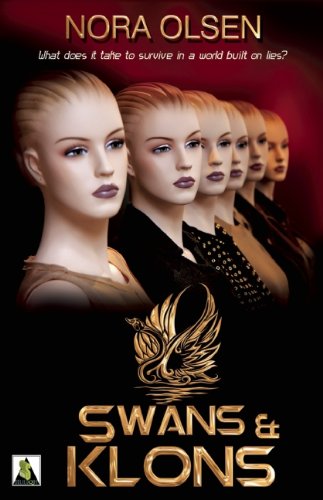
In this context, it’s interesting to look at an actual honest-to-God, openly queer YA novel.  Nora Olsen’s Swans & Klons is set in a future where a plague has killed all the men. Women form pair bonds with each other, but reproduction is handled by the ruling doctors, who supervise the cloning of a few hundred established genotypes (or Jeepie Types.)  Some of these clones are humans, who spend devote theirs lives  to art or science or intellectual pursuits.  Others are Klons, genetically manipulated to be a docile, strong, loyal servant class.

The novel focuses on two girls — Rubric and her girlfriend (schatzie) Salmon Jo.  They’re both about to move out of the children’s dorms and onto their apprenticeships.  They are, in other words, on the cusp of adulthood, with all its queer secrets.

There are a lot of those secrets. Virtually everything you first learn about the plague and men and Klons turns out to be a lie. (Spoilers coming up, if you care about that sort of thing.)

It turns out that the Klon are not genetically different from humans after all.  They aren’t engineered to be happy servants. They just have a different tag put on their toes when they come out of the vats. They don’t lack human “intelligence and emotional development”.  The “humans” are simply taught to think they do.  Moreover, Klons are, again, drawn from the same genetically identical Jeepy Types as everyone else.  There are Klons who look exactly like Rubric, who think in much the same way Rubric thinks, who have the same genetic aptitude for aesthetics that Rubric has.  But Rubric gets to spend her  life making art, while the Klons that look just like her toil in factories or clean up filth.

The drama in Olsen’s book, then, doesn’t come from elaborating differences, or even from bridging differences, as it does in Harry Potter, or Twilight, or The Hunger Games. Rather, the plot is propelled by the realization that differences, and for that matter similarities, are arbitrary.  They’re not magic truths we understand when we become adults, but categories we impose. They may determine us, but we’re also responsible for them. To be an adult, or a child, or queer, or straight, isn’t as important as how we live in those categories, and, even more, how we make others live in them.

Rubric and Salmon Jo, horrified by their discovery, eventually free a Klon and escape from their city across the border into the wilderness. There they find that not all males have died. The Barbarous Ones (as they’ve been labeled) still bear male children, though the genetic plague causes those children to be mentally and physically deformed. Though these males will never, in some sense, become adults, the  Barbarous Ones raise them with great affection and love,

Rubric finds the males repulsive; she argues that just as her own society has bought into the delusion that Klons are nonhuman, the Barbarous Ones “have just bought into a mass delusion that Cretinous Males are really glam.”  Salmon Jo replies:

“Maybe every place has their own delusion. But I think the one here is better, kinder. You know how before we left home I said I didn’t know what human was? I know now. The Sons taught me what it means to be a human being. Even if they’re sick or not brainy, they’re just as human as us. I think they make you learn more about yourself, and that’s why the Barbarous Ones think they’re such an asset.”

It may seem odd for a lesbian novel to locate humanity paradigmatically in males, or for a Bildungsroman to find its most eloquent moral experience in perpetual childishness. But both choices are, I think, a measure  of Olsen’s refusal of easy categories. Perhaps because her queer themes are more acknowledged and controlled, she’s able to tell a YA story that isn’t about growing up to know the truth of difference (“Vampires are real!”  Magic is real!”) Instead, Swans & Klons urges its readers to define humaity as broadly and generousy as possible, so that it includes adults, and children, and everyone on the margins.

22 Ways of Looking At a Sheep

This first appeared on Comixology.
__________

Comics are sequential art, I’m told.  So how do you get art into a sequence?  The usual answer is through narrative. Superman helps a little old lady across the street in that panel; fans get older and creepier in this panel; Superman feasts on the blood of innocents in the third panel; Frederic Wertham weeps silently in the final panel.  Sequence.

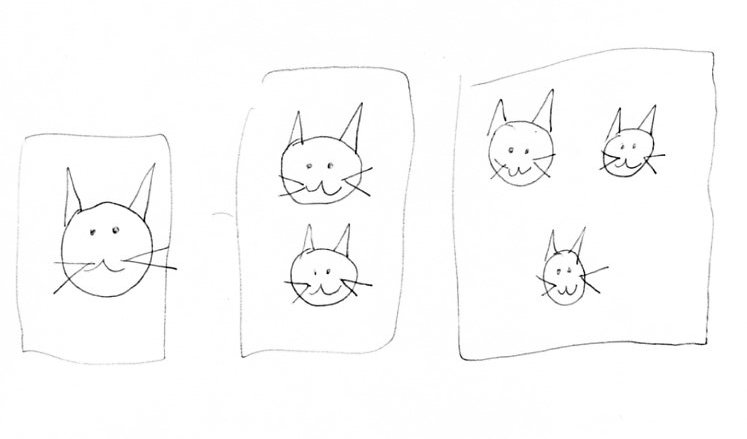
There are other ways to organize images in a sequence though.  For example:

countingcats076

There’s an obvious, instantly recognizable progression there.  But it doesn’t use narrative.

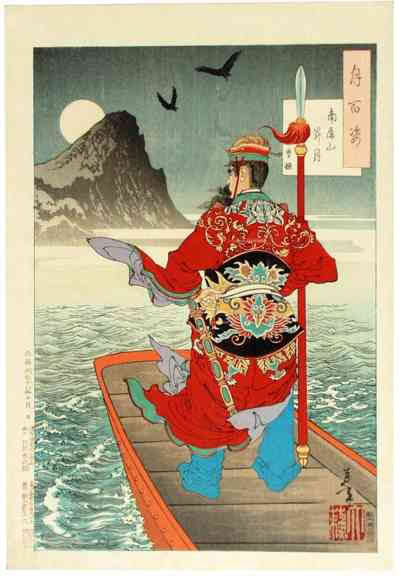
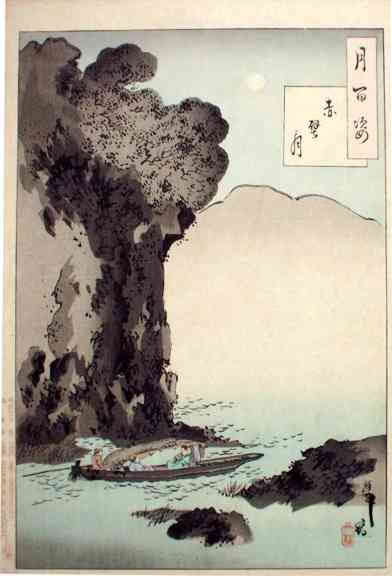
On the one hand, putting images in a simple numerical sequence seems…well, simplistic. And it actually is simplistic— this is how children’s books are organized, after all. At the same time, breaking away from narrative, however it’s done, is a step away from traditional structures and towards modernism. Wallace Stevens’ “Thirteen Ways of Looking at a Blackbird” is the Western referent that leaps to mind. But perhaps even more apropos are classic ukiyo-e Japanese print series. In Yoshitoshi’s 100 Aspects of the Moon, for example,  a central theme approached from a set number of angles creates the opportunity for unity, rhyme, and even sequence without narrative.

chinesewarrior

In this print from 100 Aspects of the Moon, a great Chinese general Cao Cao crosses the Yangtze river on the day before his defeat.

redcliffs

And this is the same place, eight centuries later. Su Shi, a poet, composes a verse by moonlight about, or inspired by, Cao Cao.

The two images aren’t contiguous in the series…they were made four years apart. But you have to think that Yoshitoshi remembered the first while he made the second, and that they’re meant to nod back and forth, at least. Certainly, they complicate or expand on each other; in the first Cao Cao, in full glorious color, sails towards a tragedy he doesn’t know. But the poet (in a much less elaborate, less brighter image) does know it; the boat in fact seems to be sailing back, returning in the opposite direction from Cao Cao’s voyage. You can almost see Cao Cao and the poet looking at each other, one not seeing (turned away), one seeing…but both transient compared to the ever-cycling, singular moon (and it is singular, since the moon in the first print actually seems to provide the moonlight for both images.)

(I discuss some other images from Yoshitoshi’s series  here,for those who are interested.)

A more recent series working in the number-rather-than-narrative vein is Satoshi Kitamura’s When Sheep Cannot Sleep: The Counting Book, published in 1986. Kitamura — a Japanese expatriate living in London — splits the difference almost exactly between simplicity and sophistication.  The volume is, as the title makes clear, actually a children’s counting book; the protagonist, a sheep named Wooly, sees one butterfly on the first page, two ladybugs on the second, and so forth. At the same time, though, the way in which Wooly’s adventures are presented is suggestive and elliptical in a way that recalls the Japanese print series. For the most part, and unlike in most counting books for kids, the book does not specifically list the number of objects Wooly encounters. Instead, the counting theme is unspoken; unifying the series silently, the same way the Chinese general’s goings and comings form a clear but unstated link between the Yoshitoshi drawings above.

owls077

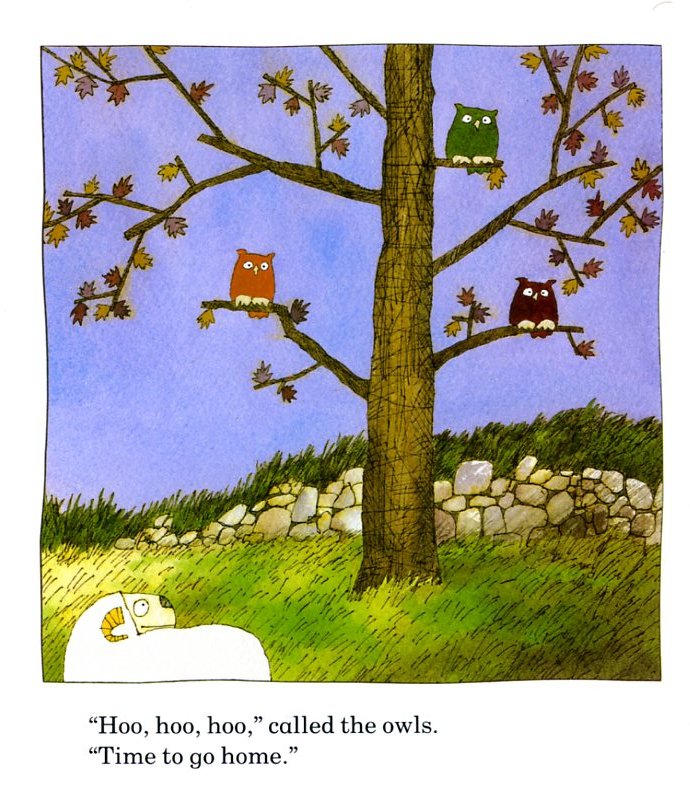
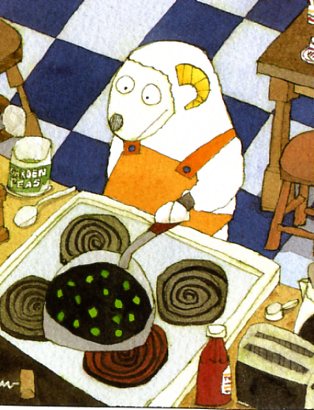
Kitamura’s book reads like a Japanese print series in a number of ways, from his off-center compositions, to his subtle use of blank space, to his lovely color palette, all the way to his clever, intentionally humorous use of visual puzzles. You’re always wondering from page to page what you’re supposed to be counting and where it is, just as in Yoshitoshi’s series you’re always looking for (and not always finding) the moon.

peas079

There is a significant difference in approach, though, between Kitamura and Yoshitoshi: Kitamura has a narrative. His lumpy sheep is having trouble falling asleep, and the book follows Wooly as he wanders through a nighttime landscape, in an effort to escape insomnia. Eventually he finds a house and starts performing the usual children’s nighttime rituals of eating, bathing, and finally getting into bed. In short, it’s a story familiar to reader’s of kids’s books; a child going to bed.

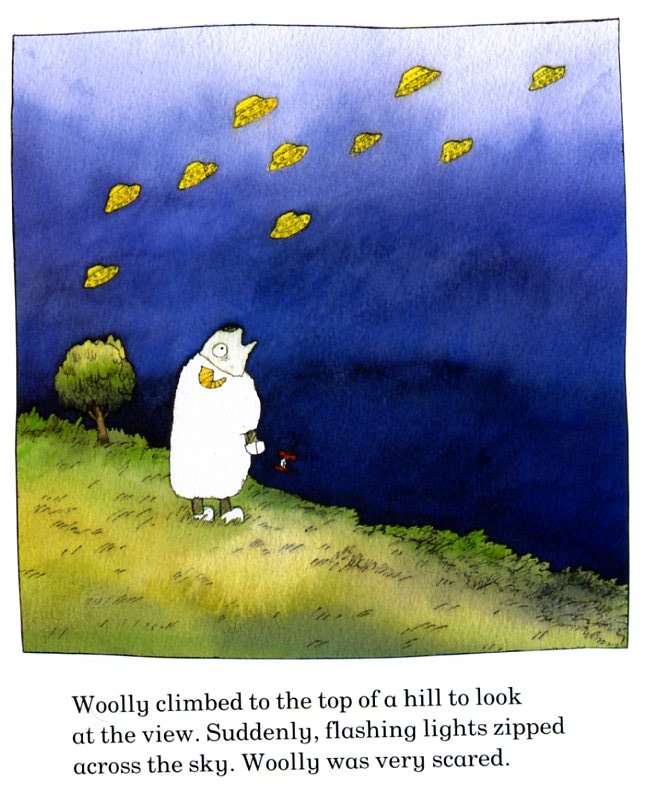
Except, that, again, it isn’t.  Though the narrative is there, it doesn’t control or guide the book. It’s counting that moves the book forward; narrative is a bonus rather than an engine. As a result, Kitamura can let his mind and paintbrush wander, and the story and images float free, almost unconscious of where they’re supposed to be going.  When Sheep Cannot Sleep has a dreamlike aura entirely appropriate to the subject matter; each of Kitamura’s vivid watercolor images seems like a quietly disconnected, hyper-real moment.  Mysteries — what are those UFOs doing? whose house is that? who put out the pajamas? —don’t ever resolve . They’re meaningful not because of the narrative closure they set up, but because of how their humor, or poetry, or eeriness resonantes within an individual image.

ufo078

When Sheep Cannot Sleep isn’t hard to follow, and it’s certainly not avante garde. Wooly is an unassuming creature, and his needs are straightforward; he just wants to get into bed and dream.  Not much happens, and the book is too simple to allow for a complicated plot. Or, alternately, it’s too complicated to allow for a simple plot, depending on which, of various ways, you look at it.

A Trans Man on What Sailor Moon Means to Him

A writer named Alexander left this comment on Erica Friedman’s post about Sailor Moon. I thought I’d reprint it here.

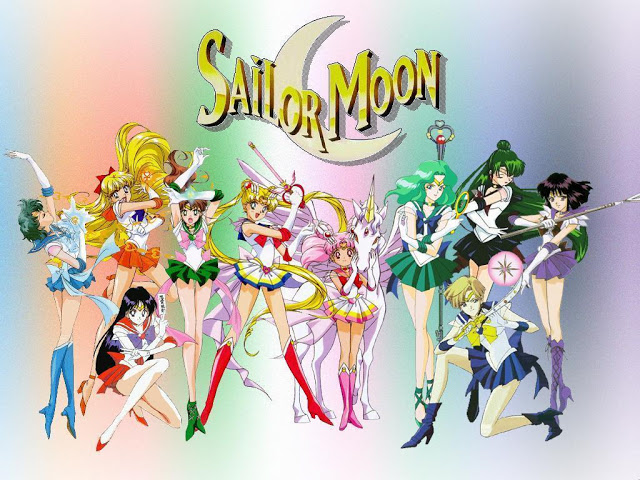
Sailor Moon, for me, really gave me the foundation to learn how to be strong as I got older. As a transgender male, it was extremely difficult to come to terms with who I was and stop trying to force myself into believing that my body made me a girl despite the sinking feeling that it was all wrong, and I doubt I ever would have come to accept myself as quickly as I did (though it did take years), had I not had the values of believing in oneself, staying strong, and speaking out for what was right embedded in my heart by this beloved series, a series who also offered a collection of strong, brave mentors and role models. All of the characters breaking through the typical gender binaries really encouraged me in a time I couldn’t find it in myself to accept who I was or what I was going through. Sailor Moon also helped me significantly in dealing with others’ perception of me due to the fact that my boyfriend of two years (and best friend of six) are both transgender males and ridiculed for it on both sides(those who think we’re in a lesbian relationship, those who realize we’re both guys in a relationship.) Characters like Uranus (who, as a transman, I looked up to enormously growing up and felt my heart glow for when Neptune said in a scene in the manga that Uranus shared both male and female traits) and Neptune who, though oppressed by censorship and paranoid parental figures, loved so fearlessly and beautifully that it was impossible not to see its depth, characters like FishEye, who, though he or she was often rejected or taunted, continued to dream and aspire and express them self, characters like the Starlights, who broke all rules in regards gender, particularly during the anime (though manga Seiya will always be dear to my heart)… They were all characters who reflected aspects of who I was that I would never be able to accept in myself, but who allowed me to accept and even respect through their brilliance and inspiration. There we also the others. Hotaru, who, though abused, mistreated, and abandoned by so many for her differences, continued to strive to be a good person and to love. Minako, the leader who struggled to live up to the pedestal she had been placed on by her duty to her princess and friends. Rei, whose fierce personality taught me that it was alright to actually speak up for yourself. Makoto, who was often misjudged and seen as a bad person due to childish rumors and misunderstandings, and yet never fell into the persona others had attached to her. Ami, whose quiet demeanor often left her to toil with her emotions and insecurities alone, and yet made her mature. Setsuna, who saw the possibility of doom ever-present on the horizon, and yet continued onward with hope for a better tomorrow. Chibiusa, whose innocence never faltered, and whose love was unconditional and everlasting, even when bittersweet. The Amazon Quartet, whose wish to hold on to their childhood and fear for what dangers becoming an adult held for them led them into darkness in the anime, and finally, Usagi, whose love was never severed by hate or rage, who fought for all, even if it meant her own suffering or even death, whose experiences made her even warmer rather than bitter, who held no bias in her heart even for those who had wronged her, and who taught me that being mature didn’t mean letting go of your inner child. Honestly, I can go on and on, but I know I’m talking too much. My point is that I truly do believe that Sailor Moon played a significant role in making me who I am today, and without it, I’d probably be pretty lost. I love Sailor Moon. I am a transguy, and I am not afraid nor ashamed to proclaim that.


Sailor+Moon+characters

Utilitarian Review 5/11/13

On HU

Featured Archive Post: Matthias Wivel on high art, low art, and Popeye.

Me on Minami Minegishi of AKB48, Ann Wilson of Heart, and cross cultural bullying of female pop stars.

Me on Shakespeare’s Juliet and aging.

Sarah Shoker on the politics (not always conservative) of epic fantasy.

Alex Buchet on what Neal Adams drew when he wasn’t drawing super-hero comics.

Ng Suat Tong points out that the critically acclaimed Hawkeye isn’t actually all that good.

Chris Gavaler on Iron Man 3, the Iron Giant, and laffs.

Jog on Bollywood sci-fi spectaculars.
 
Utilitarians Everywhere

At the site Every Public School Is My School, I wrote about the closing of Crispus Attucks elementary.

At Reason I reviewed Jal Mehta’s fantastic book about the depressing history of school reform.

At the Atlantic I wrote about:

—the inclusive utopia of Cory Silverberg’s children’s book What Makes a Baby?

D.H. Lawrence, misogyny, and women readers.

—Cinderella, feminism, and Ella, Enchanted (book not movie).

At Splice Today I wrote about:

Little Boots and the blank unface of pop.

why the GOP isn’t addressing jobs.
 
Other Links

Russ Smith on hook up culture back in the day.

Rod Dreher thinks I am coming for his uterus.

James Romberger interviews Micheal DeForge.

Rex Reed on the crappy new Gatsby film.

Nicole Ruddick interviews James Romberger and Marguerite Van Cook about 7 Miles a Second at tcj.

Nanette Fondas on how mothers need time.

This Week’s Reading

I reread Ian McEwan’s Atonement. Also reading Stephanie Coontz’s “Marriage, A History.”

images