The Tragedy of Juliet

I wrote this recently for something else, but liked it, and it turns out I can use it here, so what the hey. It’s something of a companion piece to this.
_____________________
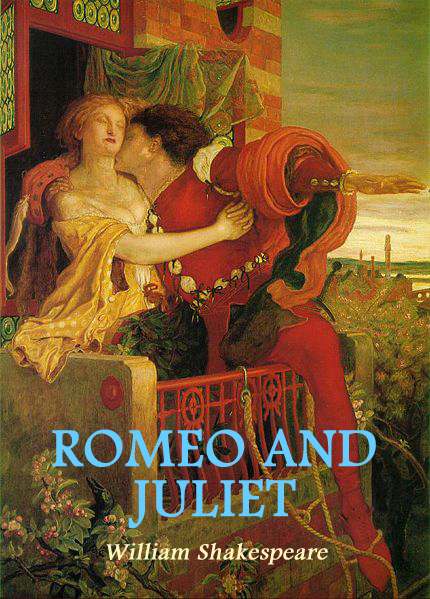
ROMEO-AND3-COVERJuliet, maybe the single most famous and influential romantic heroine in all of literary history, is 14.  She’s 14!  Today, that would mean she’d be in 8th grade.  She’s younger than Bella in Twilight. She’s younger than Katniss in The Hunger Games. If you’re reading this for high school, she’s younger than you.  And yet, she finds true love and marries and defies her father and has a series of improbable, desperate, and ultimately, tragic adventures and generally packs enough event into her 14 years to wear out folks two, or three, or four times her age.

You may think that Juliet is so young because people in the past got married earlier. This isn’t exactly right, though. Women in Shakespeare’s London generally married in their mid-20s. It’s true that Romeo and Juliet is set in Italy, and that Lady and especially Lord Capulet are eager to wed their 14-year-old daughter to a wealthy guy named Paris. But Shakespeare’s audience would probably have found that as unusual, and perhaps as distasteful, as we do.

Juliet may be young, but that doesn’t mean she’s innocent. On the contrary, the first time she meets Romeo, their flirty banter is wicked enough to light dry tinder and make small woodland creatures fan themselves. Romeo tries to get her to agree to kiss him by pointing out that even saints have lips. To which Juliet replies, “Ay, pilgrim, lips that they must use in pray’r.” ( I.V)  She’s teasing him — and he gets his kiss, or two.

The conflict in the play is, famously, because Romeo and Juliet are from feuding families, and so they can’t declare their love openly.  But the tragedy also comes from Juliet’s character, and from the way that she’s a grown-up in some ways and not in others.  Sometimes, she seems careful, and even wise. She demands that Romeo pledge to marry her or “cease thy suit and leave me to my grief.” (II. II) That seems like a precaution even her mom would approve of.

On the other hand, though, there’s the scene in Juliet’s room after she and Romeo have secretly married. When Romeo gets up in the morning to leave the room, Juliet tries to convince him, and herself, that “Yond light is not daylight,” and that he’s still got plenty of time. (III.V.) Since Romeo is under threat of death for murdering Juliet’s cousin, her effort to detain him is a really bad idea, to put it mildly.  She comes across as a child wheedling to get her way — until Romeo reminds her that he might get killed. At which point she suddenly reverses course completely, and bustles him out of the room.

In the end though, it’s not Juliet’s sometimes youthful temperament that undoes her.  Rather, it’s her youthful powerlessness. As a 14 year old, and especially as a 14-year-old woman, her ability to act, or even to move about the city, are very restricted. For example, when she tells her father she doesn’t want to marry Paris (because she’s already secretly married to Romeo), Lord Capulet completely freaks out. He shouts insults at her  (“”green-sickness carrion…!”  “baggage!” “tallow-face!” “disobedient wretch!”) and tells her he’ll drag her to the altar himself.  (III.V.)  When she asks her Nurse for help, the servant tells her to just go ahead and marry Paris, since Romeo is exiled and can’t protest. And when she goes to Friar Lawrence, who married her and Romeo, he comes up with a preposterous and risky scheme which ends, predictably, with the stage groaning under piles of bodies (though Friar Lawrence himself comes out of things all right).

Juliet not only dies young, then. She dies in a lot of ways because she’s young, and because the adults she relies on are idiots. She’s funny, passionate , dedicated, brave, and even wise. She would have made a much better grown-up than her dictatorial father, or her air-brained Nurse, or the incompetently crafty Friar Laurence. But we never get to see old Juliet. Which is the tragedy of the play.

Girl, You’re a Product Now

This first ran on Splice Today.
——————-

rsz_minami_minegishi_akb48_large

Japanese pop star Minami Minegishi, member of the pop-band-cum-walking-reality-show AKB48 was caught leaving the home of Alan Shirahama, a member of the boy-band Generations. In the US this would be gossip fodder and a boost for both their careers. In Japan, though, it was a scandal—Minegishi had signed a contract promising not to date, and the apparent tryst with Shirahama violated her agreement with management. Facing the prospect of being kicked out of the band, Minegishi recorded a video for the band’s official channel in which she tearfully begged to be forgiven… and explained that she had shaved her head in penance. (The official video seems to have been taken down, but a sample is here.)


As I noted above, AKB48 is not just a band; it’s a kind of American Idol reality-show performance-art extravaganza, with 88 members, different teams, and a cast of aspiring wannabe singers. Fans are encouraged to follow individual performers as they try to get into the band and then move up the ranks, eventually graduating as they get older.

The performers are banned from dating because having boyfriends would interfere with the fantasy of virginal purity and availability which drives the male fan investment. In this context, Minegishi’s tearful apology is itself a packaged dramatic moment in the band’s marketing; the singer’s deference and pain are, and are meant to be, consumable entertainment. Which in no way means that her tears or desperation aren’t real, it just means that real tears are extremely valuable to her employer. It’s possible that the management miscalculated somewhat on the extent of the international push back, or, perhaps not. Scandal is rarely bad for business.

All of this is fucked up, as Ian Martin points out in an excellent article for the Japan Times. Different cultures are different, and I’m as wishy-washy as the next liberal relativist, but still. Forcing young women into the closet and then raking in money based on their emotional distress is evil, whether it happens next door or overseas.

In this case it did happen overseas, and it’s hard not to in part react by saying, “Those Japanese are crazy!” There’s certainly something to that—the individual giving up her rights to the collective, and the ritual apology both seem quintessentially Japanese. It’s impossible to imagine even a pre-fab pop star like Justin Timberlake or Britney doing anything like this, not least because their images and marketing are partially based on rebelliousness.

Still, if mores are not the same in the US, the underlying dynamic is perhaps not necessarily quite different enough from comfort. I’m thinking of Ann Wilson, the force-of-nature vocalist for the 1970s rock band Heart. Wilson was allowed to date—the hit song “Magic Man” is about her then-relationship with band manager Michael Fisher. Nor was she not a contractual employee of her band. And her appeal to fans was not her virginal fantasy persona, but her amazing singing.

Or so you’d think.  And yet, over the course of Heart’s career in the late 70s and 80s, Wilson started to gain weight. As the VH1 “Behind the Music” episode makes clear, this became a serious problem. Music critics were vicious, incessantly focusing on Wilson’s appearance rather than on her phenomenal singing. The band’s label was just as bad. They harassed Wilson constantly… and tried to cover up her weight in videos by piling her hair higher and higher and by focusing more and more obsessively on sister and Heart guitarist Nancy Wilson’s breasts.

In the “BTM” episode, Nancy notes that the management kept saying that if Ann would lose weight they would make more money, which was kind of ridiculous since they all were, as Nancy said, making plenty of money. Similarly, it’s difficult to believe that AKB48 would actually stop being successful if it allowed its performers to date. The issue, then, seems like it’s less dollars per se than a kind of ideological capitalist rage for totalizing commodification. The product must be the product; the product shall be the product; that’s the logic of the market, and if there’s some human over there with desires or a body, then that human needs to be erased.

Sometimes the erased humans in question can be male… but women, in our society and in others, are more enthusiastically objectified than men. Thus, in Japan, Minegishi’s boy-band boyfriend didn’t face any repercussions for having a girlfriend. And in America, there’s Meatloaf. Guys aren’t expected to be fantasies, or products, the way women are in Japan, or were in the 1970s—and the way they still are, in many ways, in the US today. In that sense, Minegishi’s video doesn’t seem odd or foreign at all. On the contrary, it seems quite, depressingly, familiar.

Utilitarian Review 5/4/13

On HU

We finished our epic Comics and Music roundtable. It was really great fun; a chance for folks to talk about things we don’t get to chat about here too much. Thanks to all for participating, reading and commenting!

Featured Archive Post: Kinukitty on the mangled sexual metaphors of Kiss.

I draw a comic while listening to Kraftwerk.

Ng Suat Tong on how Daredevil stole Bob Dylan’s girl.

Russ Maheras on Kiss and comics fandom.

Subdee on Phonogram and the magic of pop.

Me on the album art of Led Zeppelin’s Presence.

Domingos Isabelinho on Pamplemoussi by Genevieve Castree

Sean Michael Robinson on making music rather than comics.
 
Utilitarians Everywhere
At the Center for Digital Ethics I talk about the ethics of fashion photo manipulation (with a shout out to Rubens.)

At the Atlantic I talk about:

the awesomeness of the Melvins (even if their recent album isn’t so great.

what men get from books by women.

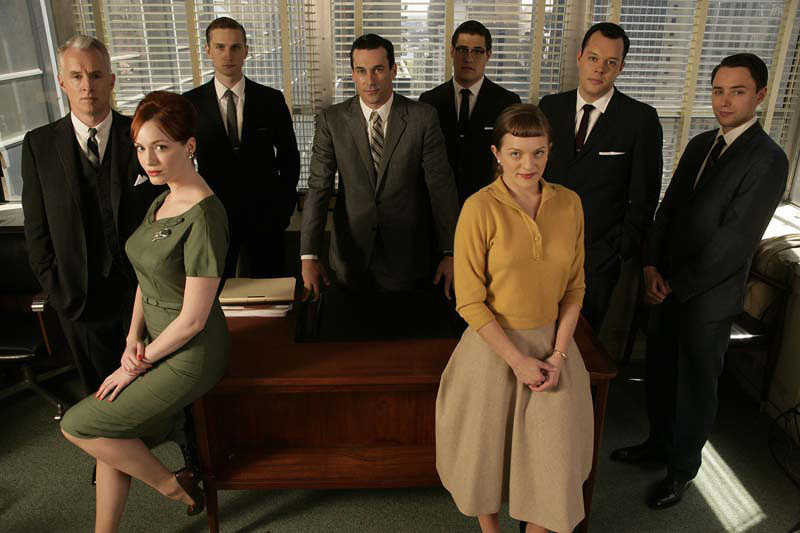
wishing Game of Thrones and Mad Men would leave me alone.

At Splice Today I talk about —

men and the male gaze and my history with crushes.

Jen Kirkman’s condescending take on motherhood.

 
Other Links

Sarah Jaffe on care workers and organizing.

Peter Frase sneers at wonks.

Scott Benson with an animated sneer at MRAs.

Ken Parille on the surprisingly good comics criticism of Frederic Wertham.

C.T. May sneers at Dear Prudence.
 
This Week’s Reading

Read the Great Gatsby, a short story by D.H. Lawrence, started Ian McEwan’s Atonement and started Stephanie Coontz’s Marriage a History.
 

mad-men-promo-poster

Presence

The index to the Comics and Music roundtable is here.
______________________

presence_0
 

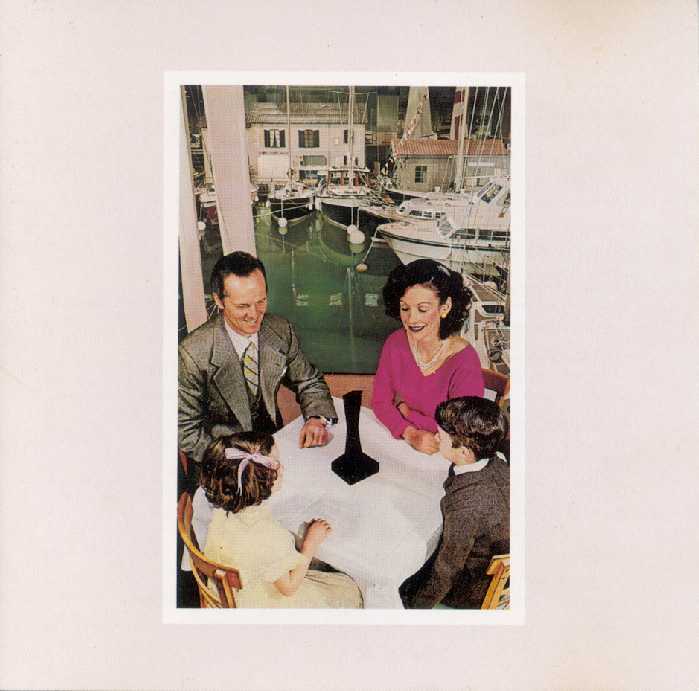
“There was no working title for the album. The record-jacket designer said `When I think of the group, I always think of power and force. There’s a definite presence there.’ That was it. He wanted to call it `Obelisk’. To me, it was more important what was behind the obelisk. The cover is very tongue-in-cheek, to be quite honest. Sort of a joke on [the film] 2001. I think it’s quite amusing.”

-Jimmy Page

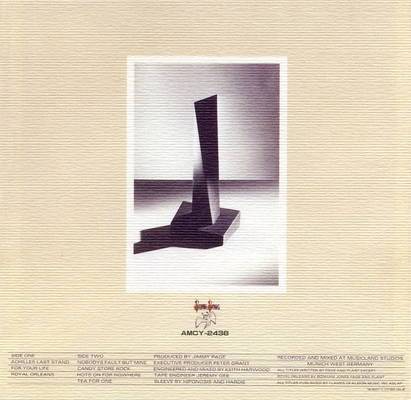
On the one hand, the black object there in the center of the bourgeois family may indicate Zeppelin’s power and force, as Jimmy Page suggests — the God’s uncanny presence. The happy family dinner, the smiles, the upper-crust yachts in the background; the black finger in the center, with its calibrated, meticulous wrongness, reveals the cheerful 50s nuclear family as paper-thin pasteboard. Zeppelin’s mere presence reveals and knocks apart their uncanny inanity.
 

led-zeppelin-presence-1976-inside-cover-51262

 
Robert Plant was in a car accident on the Greek island of Rhodes before the recording of Presence, and ended up in a not especially sanitary hospital. He recalled:

I was lying there in some pain trying to get cockroaches off the bed and the guy next to me, this drunken soldier, started singing “The Ocean” from Houses of the Holy.

Led Zeppelin was the Beyoncé of its day; ubiquitous and omnipresent. Page doesn’t sound quite like he’s reveling in that omniPresence, though. On the contrary, with the cockroaches and the pain, there’s something decidedly Gothic about this encounter with a drunk foreign ventriloquist doppelganger. A broken has chased him down across the globe in order to mirror, with pitiless vacuity, his broken self.

Isn’t there, then, also a kind of vulnerability, a diminutive interrogative, in the way the object twists itself around, bending its non-face, half coy, half nervous, to the giant mannequins who loom above it? The smiling, cheerful normality of the adults and the blank featurelessness of the children, all captured in high focus, suggest a certain feral threat — a hungry falseness. Perhaps that hungry falseness is ours, too, when the family is gone and we replace them around the Object.

Zeppelin may be that object itslef, but its objectness has passed out of Zeppelin’s control. It is now a public totem, doomed to ingratiate even at its most idiosyncratic, and individual — or, as Tom Frank would have, especially at its most idiosyncratic and individual. Like Plant regaled by his own tunes at the butt end of noplace, celebrity and self wait everywhere, mouths open. The Object is not crushing all around it. It is simply surrounded.
 
led-zeppelin-presence-3
 
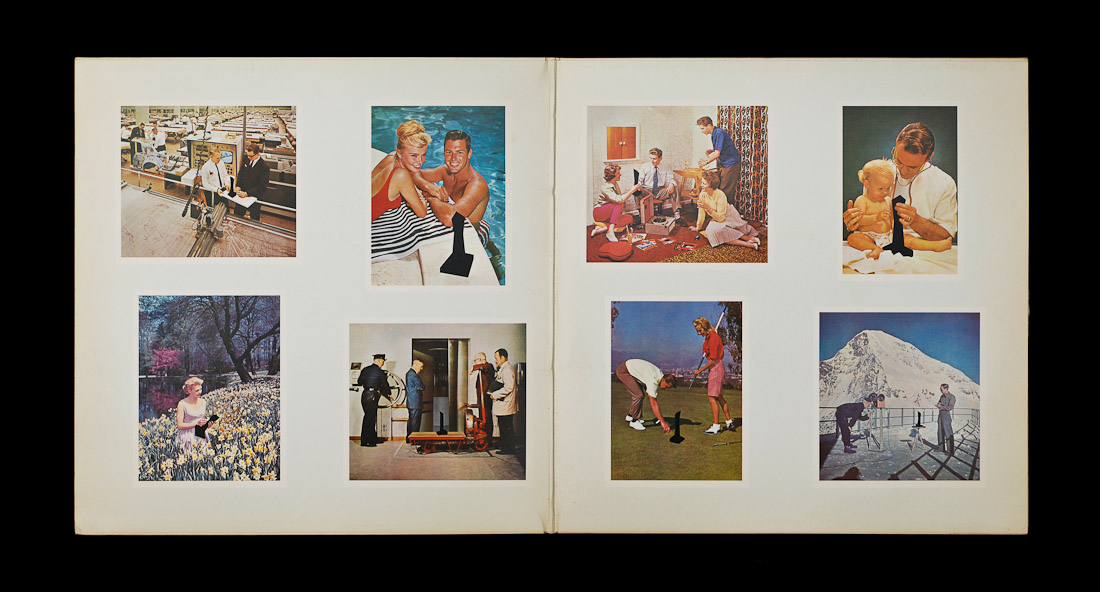
Perhaps, though, Zeppelin isn’t the black Object — or at least, not just the black Object. After all, the images chosen for the album art — the cheerful, healthy couple at the pool; the immaculate golf green; the serious researchers investigating — all seem picked in no small part not just for their blandness, but for their bland non-blackness. The normality on offer, the default scrubbed cheer, is white — insistently so in the dress of the woman amidst the flowers, or the snowy peak of the final image.

The photographer, though, is not filming the snowy peak, but the black Object, just as the happy family is turning from their dull (Pat Boone?) records to the new twisted, exciting thing.

Again, that new twisted exciting thing could be Led Zeppelin itself. But the tableaux could also be seen as a kind of re-enactment, or parody, of Zeppelin’s own relationship to racial performance. Plant’s weirdly abstracted, soulless moans at the beginning of “Nobody’s Fault But Mine” as the sturm und drung flatten the gospel humility under towering psychedelic mannerisms, just as the miniaturized and humble object disappears into a warehouse of cerebral study in the upper left hand image. Plant’s eager I’m-James-Brown-no-really emoting on “For Your Life” seems to reach for swagger and cred in the same way that the baby reaches for the black object phallicly positioned between its legs in the upper right. And given the Elvis-shake on “Candy Store Rock,” the doctor there, carefully handling the Object’s tip, might be seen as representing an older generation of borrowers, passing on the appropriation to the curious but willing infant acolytes.

From this perspective, it’s not the Object which is uncanny, nor the aggressively smiling giants looking down on the Object, but rather the juxtaposition of the two. The weird funk funeral march of “Achilles Last Stand,” with its drifting hippie lyrics and Plant howling like a ghost being scraped across steel girders, is a kind of photonegative of that smiling couple looking at the thing; satyrs running through the iron city, rather than warbots dancing in a midnight glade. Zep’s distance from its sources is figured in the images, and perhaps in the music, not as authenticity but as wrongness. The black Object haunts the mountain and the white mountain haunts the Object, in the iterated symbiosis of the dead.
 

led_zeppelin_presence_inside_the_object

 
Comics generally represent motion through repetition; the same body or figure is drawn in one space and then another to show the passage of time. Music, on the other hand, seems to fill space; it’s everywhere and nowhere. Its repetitions through time are both insistently present and invisible.

The Object seems to ambivalently take part in both these structures. It could be seen as moving from location to location; starting the week with dinner at the yacht club and finishing up in a schoolroom. Or it could be seen as inhabiting all paces simultaneously; a broadcast received at once by the poolside, the bank vault, and the golf course. Or perhaps it could be seen as inverting both these options. Maybe it’s the Object that sits in one place, while the smiling people and their hollow world flicker and hum around it.

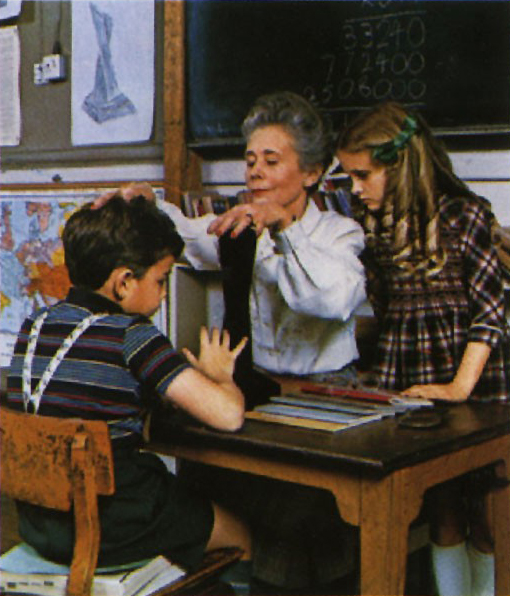
The image above is the only one where there are two objects, or an object and its image. The teacher seems to be trying to hear or see the boy’s mind; the drawing on the wall could be his thought bubble, or hers. In either case,or neither, it’s someone’s duplicated representation of a thing which is not a thing, sort of like a comic about music.

Utilitarian Review 4/27/13

On HU

So we’ve had another week of our Comics and Music roundtable Individual posts are below, but it’s kind of fun to skim through the ever-growing list as well.

Featured Archive Post: Hating and loving the end of Nana.

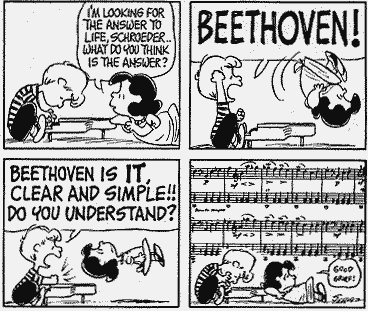
Me on Beethoven and Charlie Brown.

Chris Gavaler on Two-Face and the bad (and good) of chaos.

Kailyn Kent on soundtracks for comics.

Marc Sobel on Reinhard Kleist’s comics biography of Johnny Cash.

Michael Arthur with a black metal/My Little Pony mash-up. Sort of.

Ng Suat Tong on the opera adaptations of P. Craig Russell.

Chris Gavaler on the top 5 Superman songs of all time.

 
Utilitarians Everywhere

At the Chicago Reader, I reviewed an anthropological study of Hello Kitty and globalization.

On the Atlantic, I wrote about

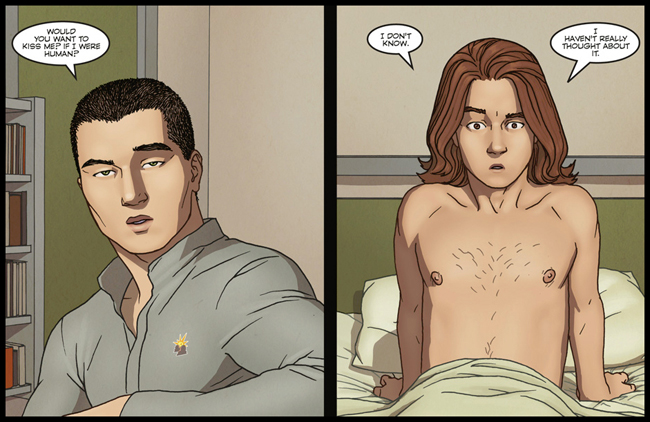
Alex Woolfson/Winona Nelson’s gay romance android sci-fi comic Artifice

Oneida, where men learn to have sex without orgasm by practicing on menopausal women.

quitting, women, and the workforce.

the George Jones/Tammy Wynette duets, since George ones died this week.

At Splice Today, I wrote about:

Abortion and violence.

the temptation to waterboard George Bush.
 
Other Links

Ashley Fetters on why Ke$ha’s autobio-doc is better than Beyoncé’s.

Amanda Marcotte on prosecuting prostitutes for carrying condoms.
 
This Week’s Reading

I’m having some freelance job turmoil, which is stressful and playing havoc with my reading. But I finished Nora Olsen’s Swans and Klons which I’m hoping somebody will pay me to review, and am rereading Heather Love’s Reading Backward. And finished the Two Towers with my son; started on Return of the King.
 
berlatsky_artifice_post

The Unheard Peanuts

The index to the Comics and Music roundtable is here.
_____________________

schroederbeethoven

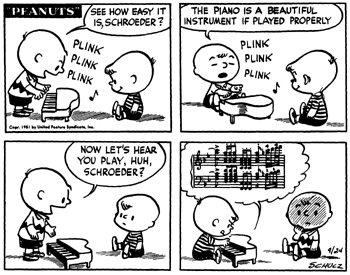
Charles Schulz famously loved drawing (or writing?) musical notation. Schroeder was always playing “real” measures of Beethoven in the strips.

In part, the notes are there simply as a design element, the same way Schulz draws lots of inky slashes of rain. They’re intricate and pretty and fun to look at; they add visual interest. Often, though, the notes also become a visual joke; their presence as design or as visual is incorporated into the visual narrative. So, above, the notes dangling over Lucy hang over her like an oppressive cloud.

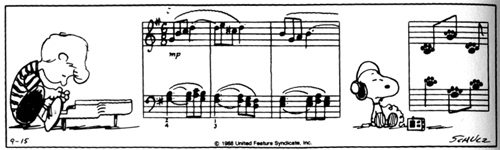
1794988844_ddece300d7

In this image, the joke is even simpler. It’s a visual pun that barely rises to narrative — though the subtext (that pop music is paw music for dogs) is cute.

whistle

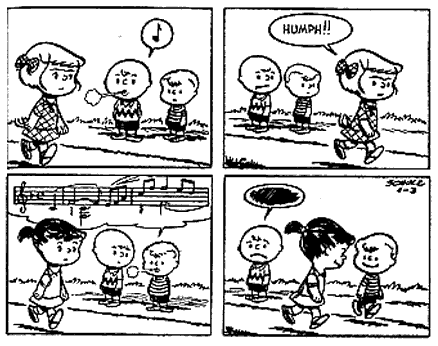
Part of the point for Schulz is surely the simple virtuosity of the drawing. Schroeder wowing the girls here can’t be that far removed from Schulz wowing his audience; another reminder, perhaps, that Charlie Brown is not necessarily, and often not really much at all, the Schulz analog in the comic. This gag can be seen as a kind of extension of this one — both play with the gendered potency of high art virtuosity. That look Violet gives Schroeder at the end has maybe more intent behind it than is entirely comfortable in a six year old.

If the musical notation is a metonymy for high art, to be contrasted, in many cases, with low art insufficiency, then that high-art signalling functions in various ways.

schroeder-strip-2

On the one hand, Schulz, as I said, is the high art creator — he’s the one making the notes, after all. On the other hand, though, the high art gets contrasted with the low art of the comics strip — Snoopy’s paw music, or Charlie Brown (the older boy) still plinking away at kids’ stuff, as all those younger high artists pass him by. In this sense, Schulz again collapses into Charlie Brown — locked out of high art virtuosity and romantic opportunities, disappointed in art as in love.

Another reading, though, might be to see the use of musical notation not as a way to contrast high and low art, but rather as a way to show their similarities. Musical notes, like comics, are pictures that carry a message. They are images you read — as made especially clear in Linus’ whistled stanzas, where speech bubble and notation are literally fused into one. High and low art, music and comics, function as sequences of images, running in parallel across the page.

Those parallel messages, though, are different from each other in at least one important way for me, as a particular reader. I can read the comics; I can’t read musical notation. With comics, you have the ease of pictograms; with musical notation you are confronted with a code requiring specialized knowledge, which either shuts you out or ushers you into the inner circle with Schroeder.

Again, you could see this as a high-art/low-art distinction — though, after all, the high art isn’t outside low art, but in it. Schulz has, perhaps, found a way to invert Lichtenstein. Instead of low art providing content and energy and accessibility by being incorporated into high art, high art provides content and energy and, perhaps, validation, by being incorporated into low art. Beethoven’s the inverted pop in Peanuts for those who can hear it…and maybe even more for those who cannot.