You’ve Lost Your Way, Charlie Brown

This essay first appeared on Splice Today.
______________________

Conventional wisdom would have it that Peanuts fell off precipitously as the strip entered the 80s. On the evidence of the latest volume of The Complete Peanuts, covering 1979-1980…well, conventional wisdom may have a point.

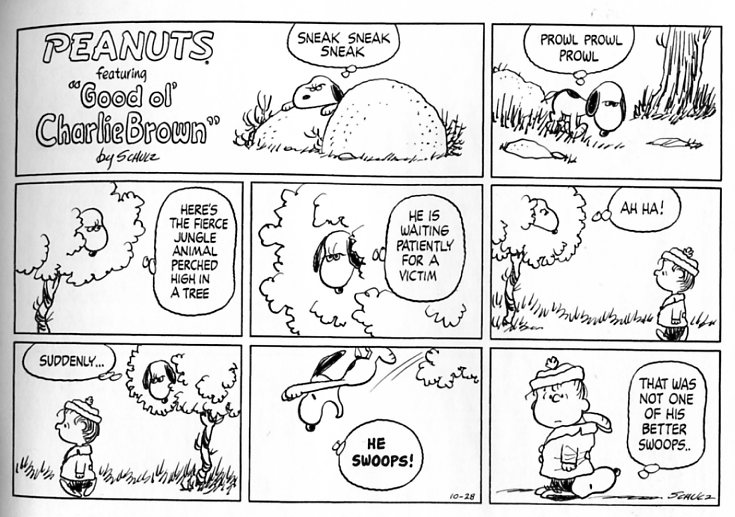
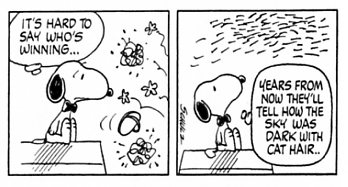
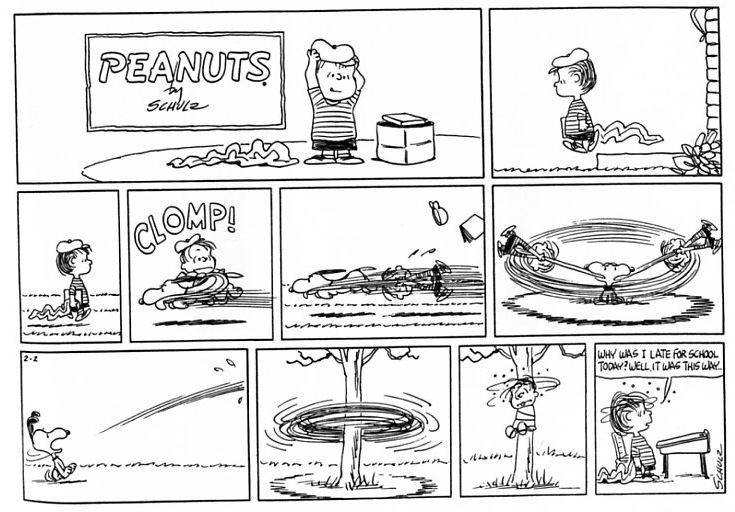
The art in Peanuts had by the 80s long since declined from it’s early heights. Over the decades Schulz’s line had lost much of its nimble dexterity — so much so that it’s easy to forget how good he was back in the day. The whole point of this sequence from February 1964, for example, is the kinetic elegance of the motion lines.

By 1979, though, the battle between Snoopy and Linus has been robbed of its energy; all that’s left is a couple of almost apologetic motion scratches and an anti-climax. The fight has gone out of the art.

In the mid-70s, Schulz made up for the relative tameness of the illustration with some of his most adventurous narratives. For example, one storyline which stretched through September and October of 1976 began with Peppermint Patty’s relatively innocuous effort to go to private school. It then quickly spiraled into escalating heights of absurdity, as Patty went to the Ace Obedience School for dogs and finally the tale ended in an epic battle with a cat which Patty had mistaken for her attorney, Snoopy. In fact, at the end of the story, Schulz seems almost to be taking advantage of his reduced drawing skills, moving the most frantic action off-panel to suggest a spectacular conflict which can only be imagined, not rendered.

In 1979-80, though, the long meandering narratives have gone the way of the exciting line work. There are still some extended stories, but they lack the snap of the sequences from just a few years earlier. A storyline where the kids end up at an Evangelist camp has an unfortunate air of hesitant moralism. Schulz’s world is too small to even fit adults, much less adult opinion, and his hesitant jabs at the Moral Majority seem like they were faxed to him by a focus group. Berkeley Breathed would soon wed something of Schulz’s aphasiac genius to political commentary…but whenever Schulz himself tried for relevance, the results were ugly (*cough* Franklin *cough*).

One muffed storyline could happen to anyone. But Schulz increasingly relies on recurring gags which simply aren’t that funny. The chief offender here is Snoopy’s Beagle scout troop. Snoopy leads Woodstock and several other birds over hill and dale, up mountain and down, making cute little quips about angel food cake. It’s not that it’s horrible, exactly — I chuckled at many of these strips. But, at the same time, the conceit really plays against Schulz’s strengths. The birds are all visually interchangeable, and because they speak in bird language which only Snoopy understands, they don’t have the strong distinctive personalities of Schulz’s other players. And without those distinctive personalities striking off each other, it’s hard to generate much conflict or interest. You basically end up with Snoopy talking to himself in front of a bunch of ciphers. A little of that goes a very long way.

And yet….while there’s no doubt that this volume is an inferior work of genius, there’s also no doubt that it is, still, the work of a genius. In some ways, the genius shines through even more brightly when the general level is lowered. In the 50s and 60s, Schulz operated at such a consistently transcendent peak that you could start to take him for granted. Here, though, there are dull patches to remind you just how good the good parts are. Without the distraction of the motion lines, for example, this Sunday strip we looked at before:

attains a purity of fuddy-duddiness. The whole comic comes down to that last panel, where everything has misfired. There’s no glorious rush, just a stumbling, thumb-fingered, doofy perfection.

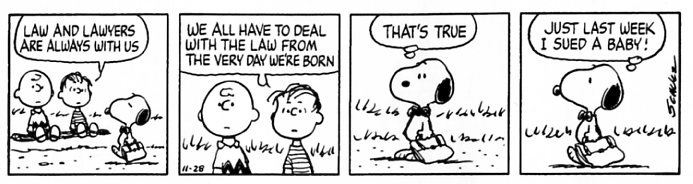
And then there’s this:

That left me laughing helplessly. It’s a platonic Peanuts joke; that last line doesn’t even rise to a pun. Instead it’s simply flat, unexplained surreal nonsense, delivered by a dog with a giant nose and a blank expression.

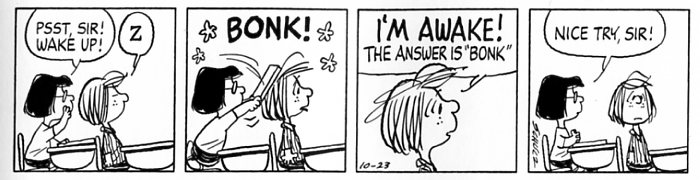
There’s no doubt that Schulz lost his way in the 80s. But his strip was always about losing its way. As he grew doddering and inconsistent, he moved closer to the doddering inconsistency at the core of his art. The pleasures in this volume are fewer, but, for fans at least, when they come they have a special bonk.

Wednesday Geek Notices: Rushdie’s Rolls-Royce

There’s a fairytale about 2/3 of the way through Midnight’s Children that begins by recounting the good things possessed by a particular Pakistani prince:

Once upon a time, in the far northern princedom of Kif, there lived a prince who had two beautiful daughters, a son of equally remarkable good looks, a brand-new Rolls-Royce motor car, and excellent political contacts. This prince, or Nawab, believed passionately in progress, which was why he had arranged the engagement of his elder daughter to the son of the prosperous and well-known General Zulfikar; for his younger daughter he had high hopes of a match with the son of the President himself. As for his motor-car, the first ever seen in his mountain-ringed valley, he loved it almost as much as his children; it grieved him that his subjects, who had become used to using the roads of Kif for social intercourse, quarrels and games of hit-the-spittoon, refused to get out of its way. He issued a proclamation explaining that the car represented the future, and must be allowed to pass; the people ignored the notice, although it was pasted to shop-fronts and walls and even, it is said, to the sides of cows. The second notice was more peremptory, ordering the citizenry to clear the highways when they heard the horn of the car; the Kifis, however, continued to smoke and spit and argue in the streets. The third notice, which was adorned with a gory drawing, said that the car would henceforth run down anybody who failed to obey its horn. The Kifis added new, more scandalous to the poster; and then the Nawab, who was a good man but not one of infinite patience, actually did as he threatened. When the famous singer Jamila arrived with her family and impresario to sing at her cousin’s engagement ceremony, the car drove her without trouble from border to palace; and the Nawab said proudly, ‘no trouble; the car is respected now. Progress has occurred.”

At the time of first reading this, I took the Rolls in its everyday Western sense as a simple symbol of wealth and luxury, and the idea of a car as “progress” to symbolize, in typical fairytale muddling of historical temporality (the episode is set in Pakistan after independence), the role of Britain and of elites more generally in the political history of the subcontinent – even the suggestion that the power once held by Britain is now held by this local prince. But it turns out the Rolls-Royce as a symbol is more specifically loaded in the subcontinental context. (Click on images to enlarge.)

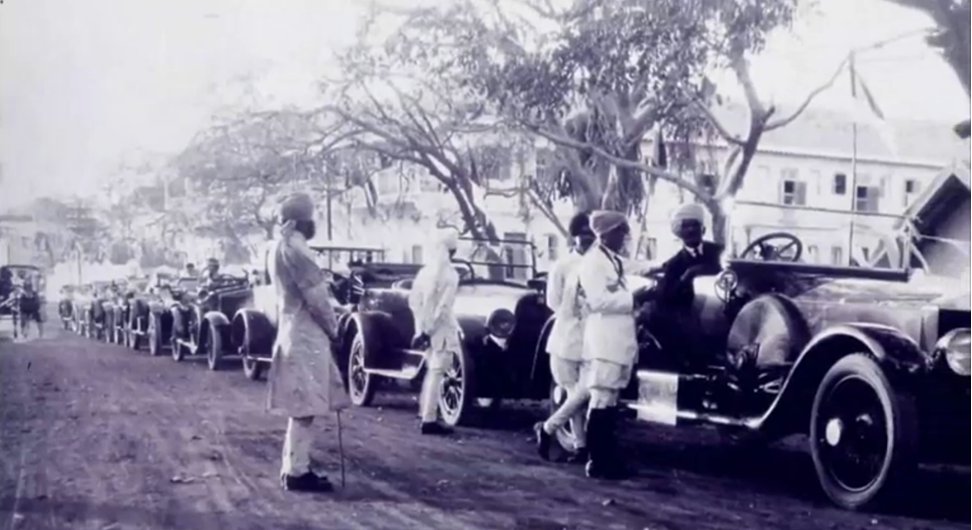
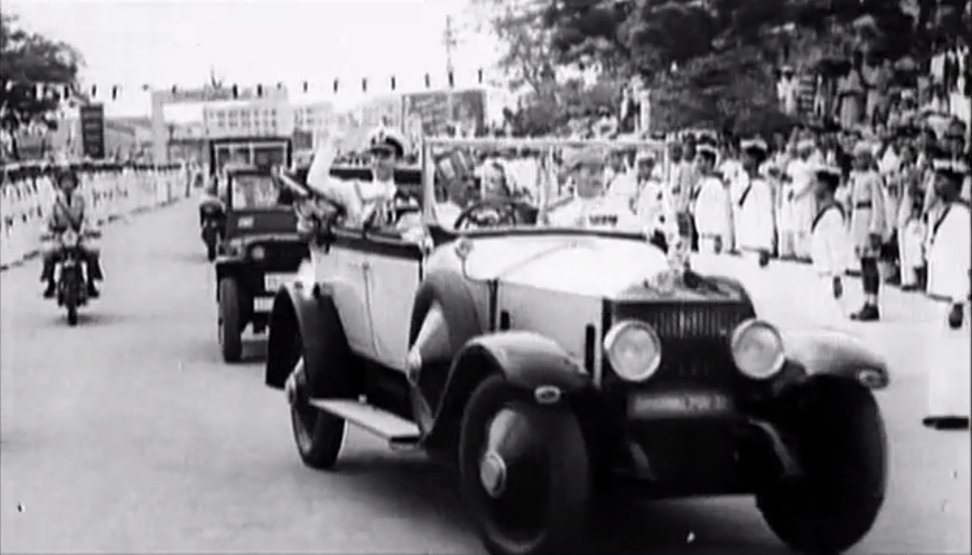
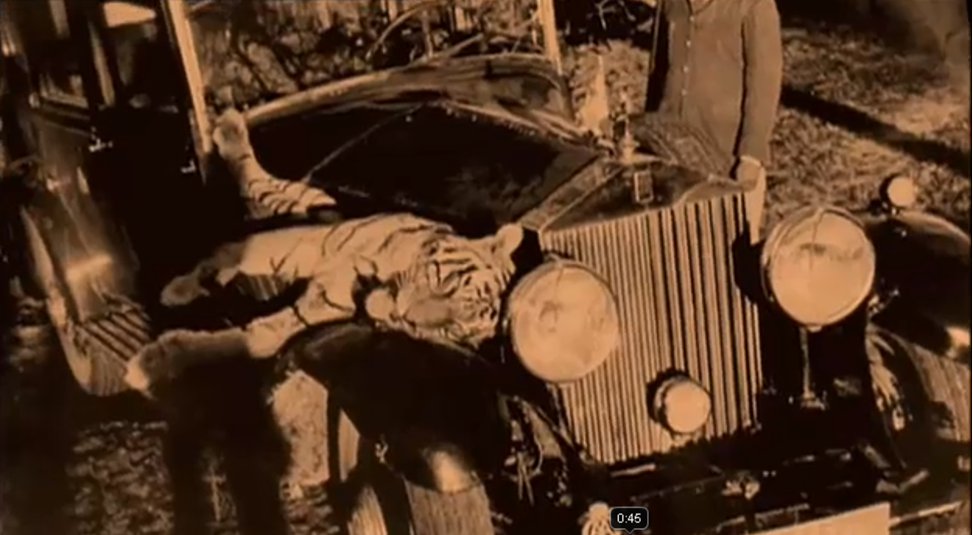
Over 800 Rolls Royce motor cars were imported into India from the UK between the early nineteen-teens and the Second World War. They were not, contrary to what pictures like the below suggest, owned by the British government or colonial officials who drove them around as a display of Britain’s wealth and power – they were rather owned by the Maharajas themselves, the princes who ruled those portions of India not directly under British control, and loaned to the British as a display of India’s wealth and power, thus serving as a poetically convoluted symbol of the cooperation between the Raj’s elites, regardless of nationality.

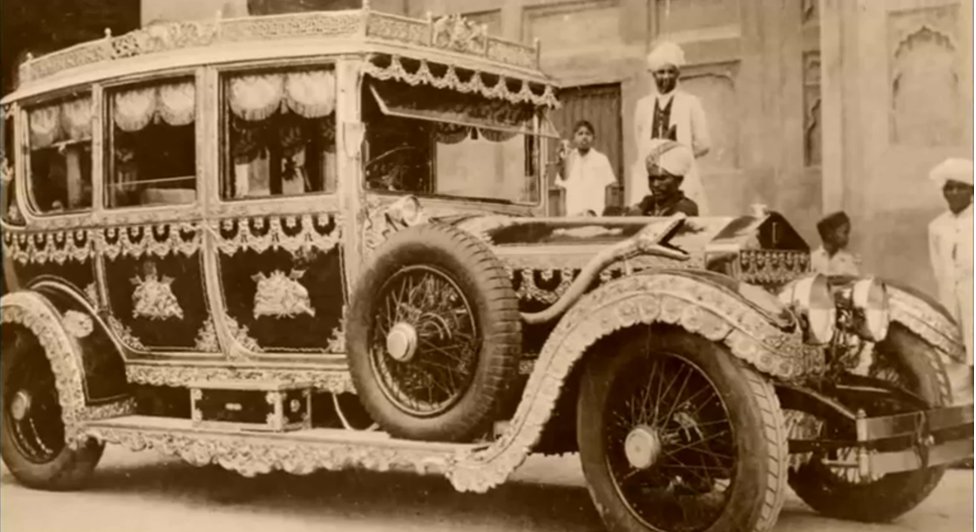
Purchased in quantity – sometimes as many as 12 at a time – the cars were an explicit measure of the Maharajahs’ wealth. In the nineteen-teens, some of the custom-designed cars cost as much as a townhouse in the city of London.

Apparently a Rolls-Royce from the 1920s could go for over 600 miles across ridiculously rocky terrain without breaking down. This was pretty unusual for cars at the time. So the Maharajas bought them and used them not only for lavish transportation and ceremonial events, but also for hunting…

…for transporting cricket teams, and for carrying garbage away from their lavish palaces. (Ok, that last was intended as an insult to Rolls-Royce, when a Hyderabadi prince was unhappy with the customer service at the local dealership.)

So when Rushdie’s Pakastani Nawab purchases the first Rolls-Royce anybody in his northern state has ever seen, it not only establishes him as a wealthy consumer of Western luxuries, appropriate for a prince of any place or era — but casts him as an imitation of Indian princes during the Raj. Throughout Midnight’s Children, Rushdie explores the permeability of the boundaries between India and Pakistan, socially, familially, culturally, politically. Turns out even this little detail works in the service of that conceit as well. Neat.

(Images and factoids about the Rolls-Royce in India are from the BBC Four documentary “The Maharajas’ Motor-Car: The Story of Rolls-Royce in India”.)

Best Writing About Something Else

“Music itself is a call that demands response,” editor Ann Powers writes in her introduction to Best Music Writing 2010. That may be true, but it’s not exactly the message of the book she’s put together. She might have been more accurate if she had said, “Musicians are a call that demands response.” Or even, “the music industry is a call that demands response.”

There are some exceptions, but overall Powers and the writers she’s selected seem much more interested in how musicians dress, where they hang out, and in how they make their money than in how their music sounds. The first selection — an oleaginous piece by Michelle Tea about her fabulous life going to fashion shows with her friend rock star Beth Ditto and how she was poor and oppressed for queerness once upon a time and so that makes it okay for her to be ruthlessly stupid and self-absorbed now — is unusual in shittiness, but typical in the way it spends page after page on Ditto’s fashion sense and success and only about a paragraph on her voice. (That voice is, apparently, authentic.)

Not that there’s anything wrong with writing about fashion or success or celebrity per se. In fact, many of the essays here are engaging and entertaining. Barry Walters’ coming-out interview with Prince-alums Wendy and Lisa is riveting in a high-quality celebrity gossip vein. Randall Roberts’ feature about LA latin/punk/hip hop band Ozomatli’s state department tour through Burma casts an interesting (unusually positive) light on the Bush Administration. Josh Kun’s piece about the importance of local Mexican bands to the ringtone market and Timothy Quirk’s polemic about digital download royalties are both fascinating nuts-and-bolts looks at the music industry’s money mechanisms. I probably didn’t need both an essay on the career prospects of Drake and an essay on the career prospects of 50 Cent, but individually neither of them is especially objectionable. And, to be fair, essays that focus on the music qua the music aren’t guaranteed to be all that, as Philip S. Bryant’s warmed over beat poet jazz nostalgia makes clear. (Memo to wannabe slam poets; commemorating original, individual, technically accomplished art in staid, half-assed free verse does not make you part of the tradition. It makes you a parasite.)

So the point here is not that Powers should have included more music writing that actually talked about music. Instead, it’s just to note that this particular collection made me realize, in a way I probably should have before, how small a part of music writing music criticism really is. The old “cliché about writing/music/dancing/architecture” as Powers calls it, rather obscures the fact that most writing about music is in fact not dancing about architecture, but rather writing about celebrity, or sex, or performance, or news.

That last is especially well-represented in this volume; Powers includes not just two essays about Michael Jackson’s death (which seems justifiable); but two about the Chris Brown/Rihanna scandal and one aggressively unnecessary effort about the Kanye/Taylor Swift brou-ha-ha. There’s even an Atlantic essay by Hua Hsu which uses hip hop as a relatively minor prop for its demographic change/post-racialism/Obama just got elected boilerplate.

The choice to include the Hsu piece seems like a particularly egregious genuflection to the zeitgeist…but, in general, I get where Powers is coming from. Music writers are often at least partly journalists, and what journalists do is write about things that are important. Obama’s election, or Michael Jackson’s death, or Rihanna/Chris Brown and its implications for young girls of color and domestic violence clearly matter in a way that, say, the production choices on Rihanna’s latest album don’t. Similarly, David Bazan’s struggle with his Christian faith is more important, more consequential, than what his music sounds like, which means that Jessica Hopper is justified in discussing the way his lyrics reveal the first at length while saying little about the second. One of his bands, she mentions, employed “fuzzed-out guitar hooks”; one of his songs includes a “keening falsetto;” some of his shows were “intimate acoustic sets.” There may be more detail than that, but not much.

There are pieces here which are more directly writing about music itself: a brief interview with composer Maria Schneider; Sasha Frere-Jones’ slight but smart take on The Dream; Chris Willman’s slight but smart (if inevitably hagiographic) essay about Bob Dylan’s could-have-been-worse Christmas album. Perhaps Sean Nelson’s “Let’s (Not) Get It On” qualifies too. It doesn’t precisely describe any particular song, but it’s thesis is based on the differences between the stance and sound of aggressive ’80s rock versus the stance and sound of ’90s indie fare. Nelson concludes that the less swaggering attitude of indie created a subculture which was, perhaps, more ambivalent about sex. What people were listening to affected the flavor of concupiscence — and so, even though he talks mostly about the concupiscence, you could argue that he’s talking about the music too.

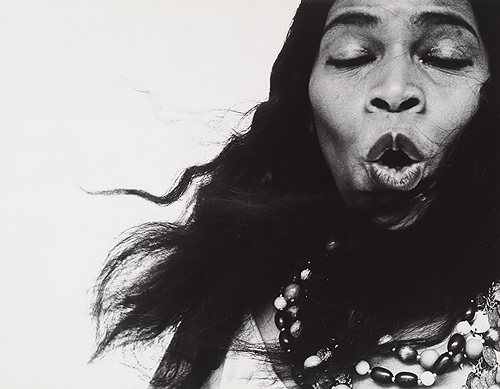
The displacement, though, is a little…not depressing exactly. Maybe melancholy. At least, that’s what I took away from my favorite piece in the book, Alex Ross’ lovely meditation on Marian Anderson’s 1939 concert at the Lincoln Memorial. The piece talks both about Anderson’s remarkable voice and about her place as an ambivalent political inspiration (for, among others, Martin Luther King.) Ross finishes his essay by noting that, while Anderson must have been proud of the Lincoln Memorial concert, it was “an ambiguous triumph — marking a great moment in civil-rights history but, on a private level, intruding on her dream of a purely musical life. An artist became a symbol. Her happiest memories, one gathers, were of those international tours in the thirties, when the European critics declared her a singer to watch, and the Finns went wild, and Toscanini blubbered his praise, and she became nothing less — and nothing more — than one of the great voices of her time.”

That made me tear up. And, of course, what I was tearing up at was not her voice, but her life — specifically, at her lifetime dream to be recognized not for her life, but for her voice. Ross can’t describe that dream without betraying it. What breaks your heart in that last line is the beauty of being unable to capture beauty. It’s the sweet ache of a tune that can’t quite be heard.
_______________
This essay first appeared on Madeloud.

Strange Windows: Monumental

“Seven cities contended for Homer when dead, Where Homer living had to beg his bread.”

At least three towns are contending for Popeye.

Above, this statue of Popeye was erected in Crystal City, Texas, in 1937.
Below, this six-foot-tall bronze statue stands in Segar Memorial Park in Chester, Illinois.

[…] whose frown
And wrinkled lip and sneer of cold command
Tell that its sculptor well those passions read
Which yet survive, stamped on these lifeless things,
The hand that mocked and the heart that fed.

Ozymandias, Shelley
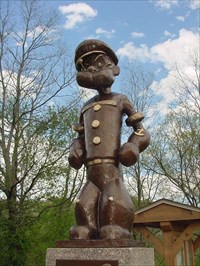
Chester was the birthplace of Popeye creator E.C. Segar, as recorded on the statue’s plaque:

Now, let’s examine another Popeye statue in  Universal Studio’s  Island of Adventure, in Orlando, Florida:
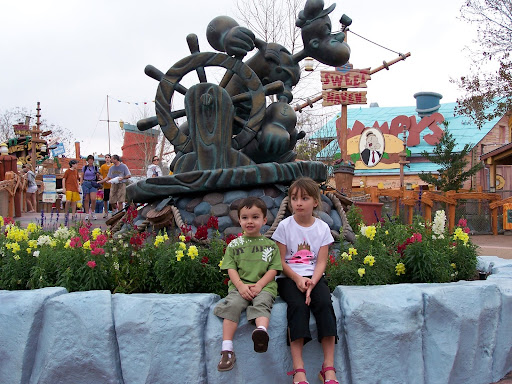
…where Popeye’s arch-foe Bluto is also menacingly present:
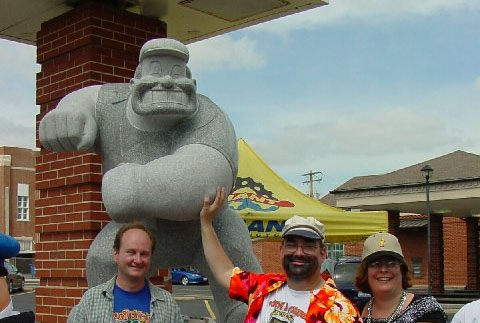
What differentiates these statues from the ones in Crystal City and Chester?

The Florida Popeye is set in an amusement park. It’s a prop, part of the scenery in a hundred-acre show set.

The Texas and Illinois Popeyes aren’t props. They have a weightier function, civically and semiotically. They are monuments.

Chester is obviously honoring a native son, who went forth into the vast world and achieved renown. This tradition goes back millenia; thus the Greeks of Antiquity would perpetuate the glory of a successful warrior, of a victor at the Olympic games, of a winner at the great theater festivals: that glory was also the glory of his city.

What, then, of Crystal City’s statue– considered so important that it stands sentry before City Hall?

Popeye is credited with saving the town.

Crystal City has long billed itself as the World Spinach Capital. The leafy crop dominates the agriculture of the region. But spinach has always been a hard sell, especially to children — it is bitter. Compound this dissatisfaction with the withering effects of the Great Depression, and Crystal City found itself facing disaster.

Along came Popeye, his great strength attributed to his consumption of spinach (less so in the strips, conspicuously so in the animated cartoons.) Kids all over America — over the world– internalized the sailor’s profession of might:

“I’m strong to the finish, ’cause I eat me spinach; I’m Popeye the Sailor Man!” (Toot toot!)

…and they devoured their spinach with gusto. (I, too, fell for the propaganda. In fact, spinach is, of course, no builder of strong bodies– it isn’t even particularly rich in iron, the oft-cited source of its potency.)

The spinach industry was saved. The grateful burghers of Crystal City, thus, put up their statue as a votive thanksgiving– another monumental tradition.

( That statue outside City Hall isn’t, contrary to its plaque’s assertion, the one inaugurated in 1937; it’s a modern copy, while the original is inside the building.

So it’s a simulacrum of a sculpture of an animated cartoon character based on a comic strip character inspired by an acquaintance…I’m getting situationist vertigo, here.)

Crystal City is by no means alone in its gratitude to this cartoon character. Alma, Arkansas, also claims the crown of World Spinach Capital, and celebrates Popeye in bronze:
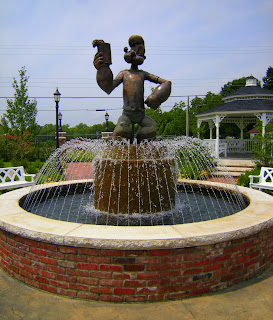
According to one report:

Popeye Park, built in a former vacant lot, is a big part of Alma’s image makeover. It is a place where people can get out and look at things. The centerpiece statue is glorified atop a fountain, and according to Mark the park will soon have two kiosks with flat screen monitors that will relate the history of Alma and Popeye. A large mural is planned for the wall of the adjacent water company building, with hidden Popeyes to engage children (and maybe the tour bus drivers).

This is getting out of hand, some may think. And why Alma, anyway? Because it’s the site of the Allen Canning Company, producers of Popeye Spinach:


…at one point producers of 63% of the world’s canned spinach.

So the livelihood of many Alman households depend on this brand– this cartoon. What’s wrong with a little sculptural homage?

Yet one might find this unsettling.

As the semioticians remind us, we live in a world of signs; some overt and loud, some whispering, some in the dog-whistle domain of the subliminal.

A monument is a bellowing, gigantic voice in this landscape; it aggressively forces its meaning on us; small wonder monuments are the favorite markers of tyrants’ rule.

Prudence, thus, traditionally presides over the choice and placement of public monuments. Commissions debate them, the public is consulted; they are scrutinized for glorification of the unworthy, or for partisan agendas. Often they are isolated from the city proper, as in cemeteries.

The subjects of monumental statuary tended ever to be divine: gods and saints, the Christ; or heroic– gallant soldiers, philanthropists, poets and other writers. One might legitimately question the sculpted exaltation of corporate cartoon characters. In contrast to the Orlando Popeye, those in Crystal City, Alma, and Chester are free of irony– indeed, almost of playfulness.

Perhaps we should judge these statues by their function. This image of Garfield stands just outside a children’s hospital:


Who can object to an attempt to make a sick child smile, or to allay his fears with a familiar old “friend”?

But it’s still troubling when an online search for ‘Garfield statue’ returns more results for the cartoon cat than for the effigies of James A. Garfield (1831– 1881), America’s 20th president, felled by a deranged assassin’s bullet:

We shall later show sculpture inspired by the strip Peanuts.

A different Peanut can be seen below–‘ Mr Peanut’ , the corporate mascot of the company Planter’s.

Such commercial images are already omnipresent in our visual ecology, so it is not over-curmudgeonly to hope their monuments do not proliferate, unless it be with the wit of an Andy Warhol or of a Jeff Koons:
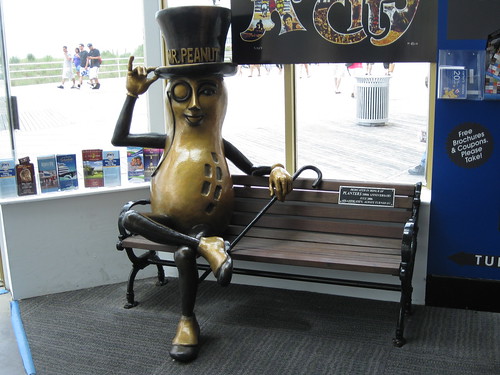
Well, at least he offers you a seat.


Travel to Metropolis, Illinois, and you find monumentalism tipping slightly towards idolatry.

As readers of the Superman comic know, the mighty hero makes his home in Metropolis– a booming city modeled on Cleveland and New York.

Metropolis, Ill., is a far more modest place. But in 1972, D.C. Comics and the state of Illinois officially declared it to be the hometown of Superman. This was a prelude to a titanically hubristic enterprise: The Amazing World of Superman.

Concept Art by Neal Adams. For more, click here

There were to be a museum and an amusement park dedicated to the ur-superhero,  the whole dominated by a 200-foot-tall statue of Superman. The entire venture collapsed.

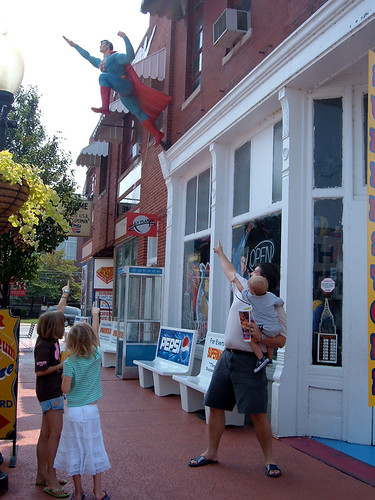
Today, Metropolis’ exploitation of Supes is much more modest, but definitely there… as evidenced by this fifteen-foot bronze polychrome statue:


Metropolis celebrates  the Man of Steel every way it can. The local bank is “home of super financial services.” The town newspaper calls itself The Planet. A sign in the grocery store informs customers: “Just as Superman stands for truth, justice and the American Way, Food World stands for quality, convenience and friendly service.”

Below, Bill Griffith‘s pinhead clown Zippy pays the statue a visit:
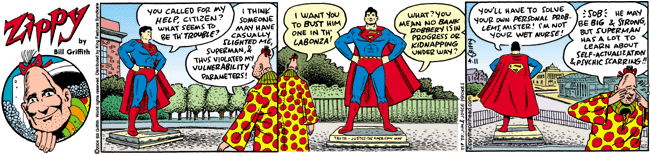
It’s a typical absurdist Griffith gag, but he makes a larger point: it’s wrong to invest your hopes in a fake idol. There’s no Santa Claus, no Tooth Fairy, no Superman– even metaphorically.

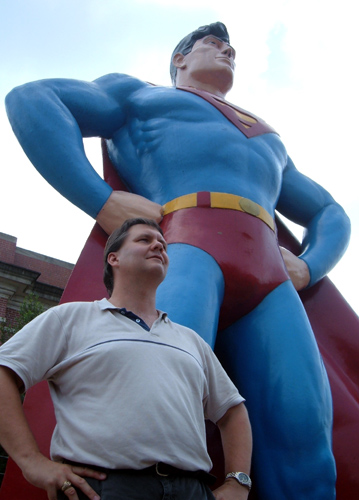
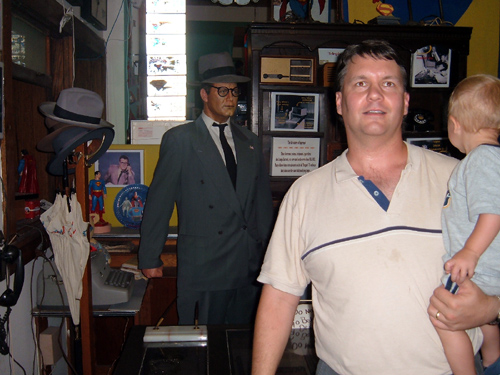
Metropolis seems to have learned this lesson from the 1972 fiasco. Its exploitation of Superman is mostly limited to photo ops for tourists:
 

…or Supes collector George Hambrich’s ‘Super-Museum’:
 

… or the annual Superman Celebration:


Special guest star at the 2010 Celebration:

Yep, U.S. President and lifelong comic book fan Barak Obama.

Incidentally, this wasn’t the first Superman statue erected in Metropolis. First came a fiber-glass 7-footer.

Problem was, the locals took to testing the hero’s noted bulletproof powers, resulting in a sorry Swiss cheese of a statue. It was replaced by the current bronze colossus.

Ah, yes, the Colossus. The need to extract awe from sheer size alone, as Emperor Nero did with the giant gold statue of himself in ancient Rome. All over America, you’ll find colossi of another kind: celebrating the folk giant lumberjack, Paul Bunyan:


Bunyan, however, is a prominent example of  ‘fakelore’– artificial modern folklore; in fact, the giant’s tales were all spun by a copywriter for a lumber company. A visual simulacrum (the statue) to represent a conceptual one (the fakelore.)

And the size of the colossus seems to validate this manufactured myth.

In Blue Earth, Minnesota, stands a towering figure drawn from one of our other modern sources of pseudo-icons, advertising:

“Good things from the garden,
Garden in the valley,
Valley of the Jolly Green Giant!
Some are green-snappin’ fresh
Kitchen-sliced to taste the best
Tender beans are comin’ from the valley! (From the valley!)

Good things from the garden,
Garden in the valley,

Valley of the Jolly (‘ho, ho, ho’) Green Giant!”

— Leo Burnett

The Green Giant is the mascot of a vegetable canning company belonging to agribusiness behemoth General Mills.
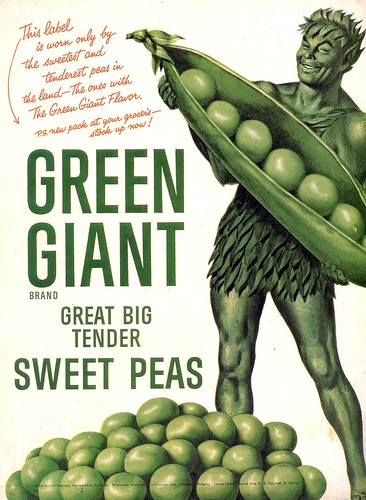
As with Popeye, the locals in Minnesota show pride and gratitude towards a symbol of their livelihood.
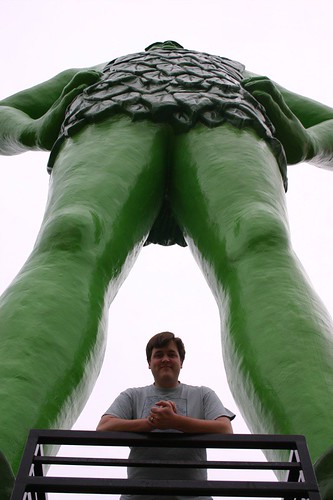
 

Why, man, he doth bestride the narrow world
Like a Colossus; and we petty men
Walk under his huge legs, and peep about
To find ourselves dishonourable graves.

–William Shakespeare, Julius Caesar

Perhaps popular enthusiasm goes too far, though, when the locals adopt the name of a mass-media character. This has happened at the town of Idaho Springs, when the residents of its Squirrel Gulch district renamed it Steve Canyon, after the comic-strip adventurer created by Milton Caniff.

In 1950, they persuaded the federal government to commission a giant limestone sculpture of the cartoon aviator for their town. Its plaque reads, in part,

“The United States Treasury salutes Steve Canyon and through him, all American cartoon characters who serve the Nation.”

Say what?

Ah, well, perhaps I’m merely indulging in cultural snobbery.  It’s true that a lot of the statues above are way cool, after all.

And at least they don’t celebrate tyrants:
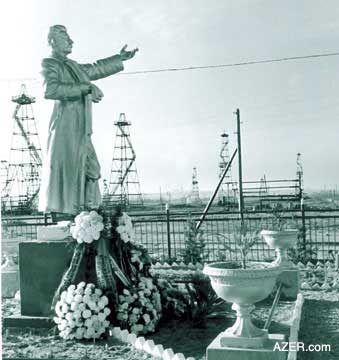
Stalin


Lenin
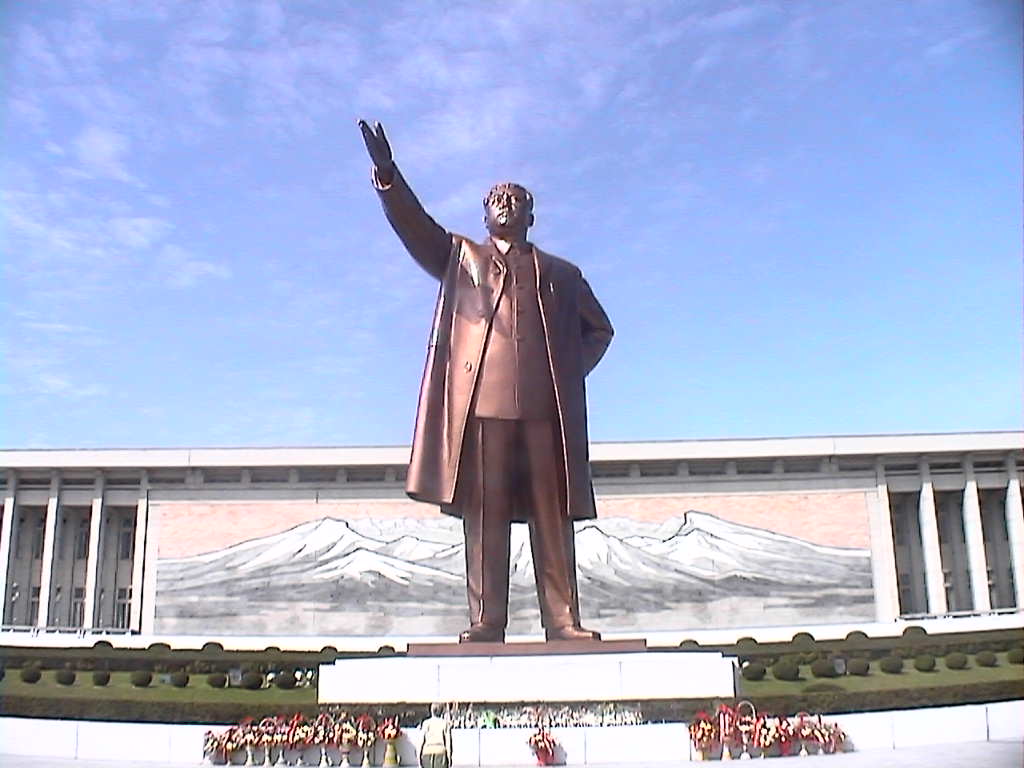
 

Kim Il-Sung


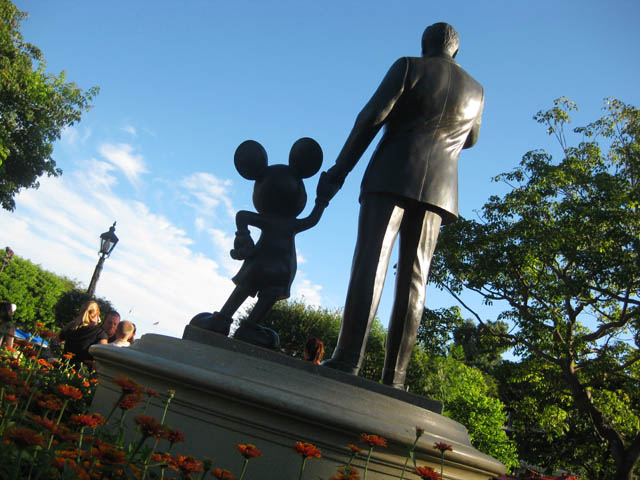
Walt Disney

All right, that was a cheap shot… but the juxtaposition of  similar images makes one think.

Disneyland bills itself  “the happiest place on Earth”.  Happiness is mandatory. Well, in what other sort of place is happiness mandatory?  The “workers’ paradises” of Communist countries.

Disneyland also resembles them by its degree of control. The entire park is a panopticon. It even has a ‘secret police’– the security guards are there, but not in uniform.

Disney headquarters, as designed by Michael Graves: the cartoon as slave to the corporation

All four statues show the same gesticulation towards… what?  The glorious future?

Let’s hope Walt and Mickey’s statue doesn’t suffer the same fate as Saddam Hussein’s:

A final farewell to the colossus…with the fearsome effigy of cloud-gathering Zeus in the French ‘Parc Astérix’ amusement park:

;

Yet, pass humbly between his divinely titanic legs and look up:

<

Tch! This is the Underwear of the Gods?    Feh.

Meanwhile, in Philadelphia, we find this effigy of Sylvester Stallone— sorry, of Rocky Balboa:

Bronze, neoclassical pedestal-mounted kitsch or celebration of the human spirit? Celebration of Hollywood, certainly.

And along those lines comes another bad idea.  Detroit will see a statue of Robocop.

What are they thinking over in Motown? The city is depicted in the Robocop films as a hellhole, a behavioral sink rancid with corruption and violence.  (Well, okay, but they don’t have to dwell on it.)

But I suppose such masochism is to be expected. Kneel to our media overlords.

Wow, I’m getting grouchier by the second. Don’t I see any place for public statuary? Actually, I do, as I shall note in my appreciation of the St.Paul Peanuts statues.

St. Paul, Minnesota, is another city that honors a famed native son– Charles Schulz (1922– 2000), creator of the comic strip Peanuts — with a series of bronze sculptures.

But these are anything but monumental: they were specifically designed to be kid-friendly. They exude charm allied with modesty, which was also the case for the strip and its author.


Along these lines, in Hartlepool, England, we find a statue of their own native son Reg Smythe‘s comic strip hero Andy Capp:

The statue was controversial, actually, as Andy was a wife-beater among other things. And note that his ever-present cigarette was censored.

Now, note the proportions of head-to-body in the statue and compare them to those of the drawn Andy:

About three heads tall for the cartoon, about five for the statue.  Why?

So that people can do this:

That’s right– they can hug it, clink glasses with it… interact with it!  People want to be pals with the cartoons!

Note, too, the absence of a pedestal. The character is on the same footing as us.

This is key: people have strong affection for “their” cartoon characters; they literally take them into their homes, with the newspaper or through the tv screen. So the best cartoon sculptures will promote a feeling of affectionate intimacy.

Here, in Dundee, Scotland,  are Desperate Dan and Dawg:
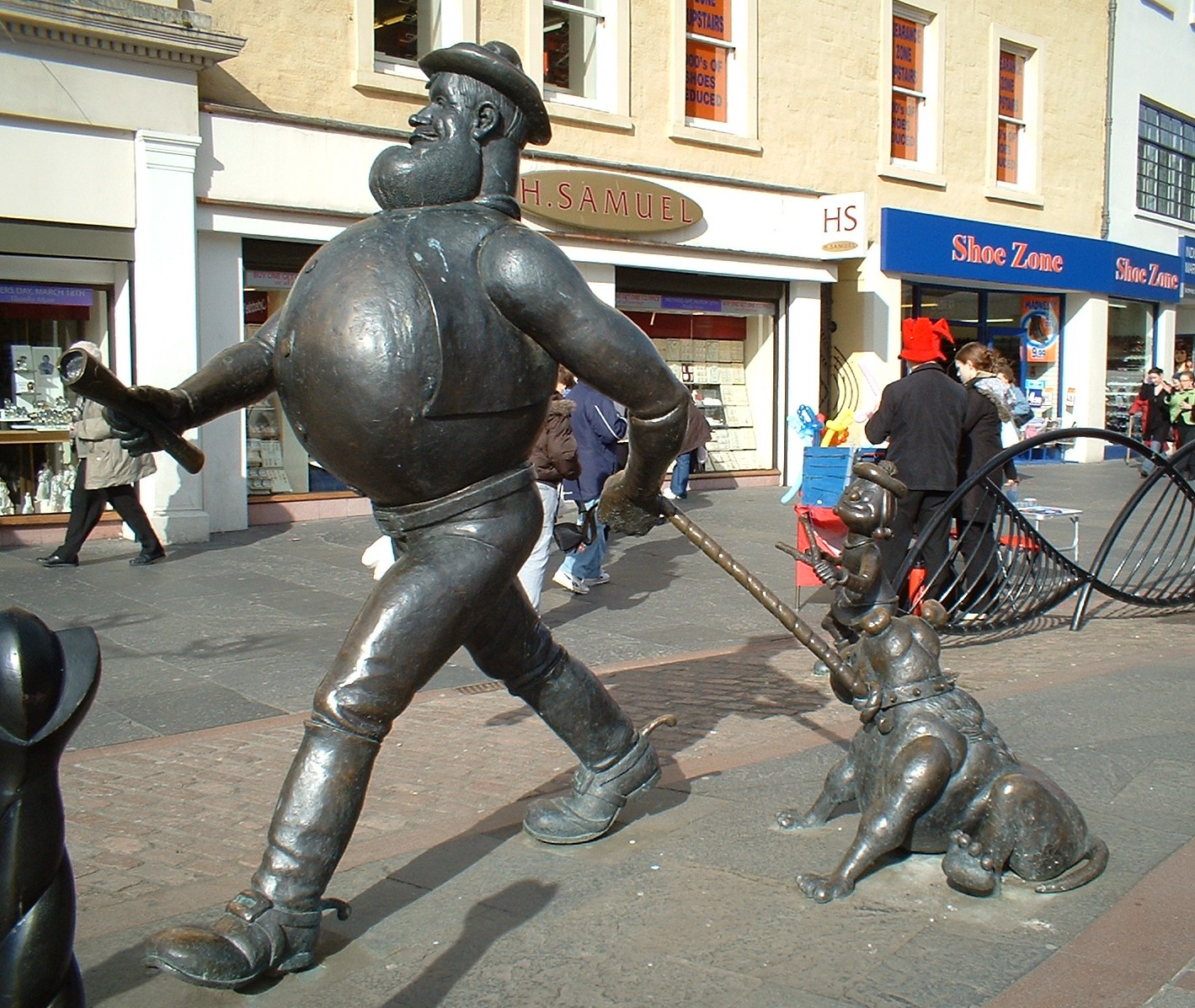
… and Minnie the Minx:

Again in England– in Ipswich– Carl Giles‘  beloved Grandma character:

But my favorite interactive cartoon sculpture is this one of Mort Walker‘s Beetle Bailey: you can actually sit and have a drink with him.


And my favorite non-cartoon interactive public sculpture is in London. A Conversation with Oscar Wilde is designed as a bench; you’re supposed to sit and tell Oscar the latest gossip:

The statue of Tintin in Brussels used to be on a pedestal in a park; when it was moved to a city street, the pedestal was removed, and you can now have a playful chat with the globe-trotting boy reporter:


This more intimate, anti-monumental style seems to be catching on. Here’s James Joyce in Dublin:


As a final example of interactive statuary, consider the much-beloved Alice in Wonderland group in New York’s Central Par, over which I scrambled as a child– a tradition that continues, it would seem:
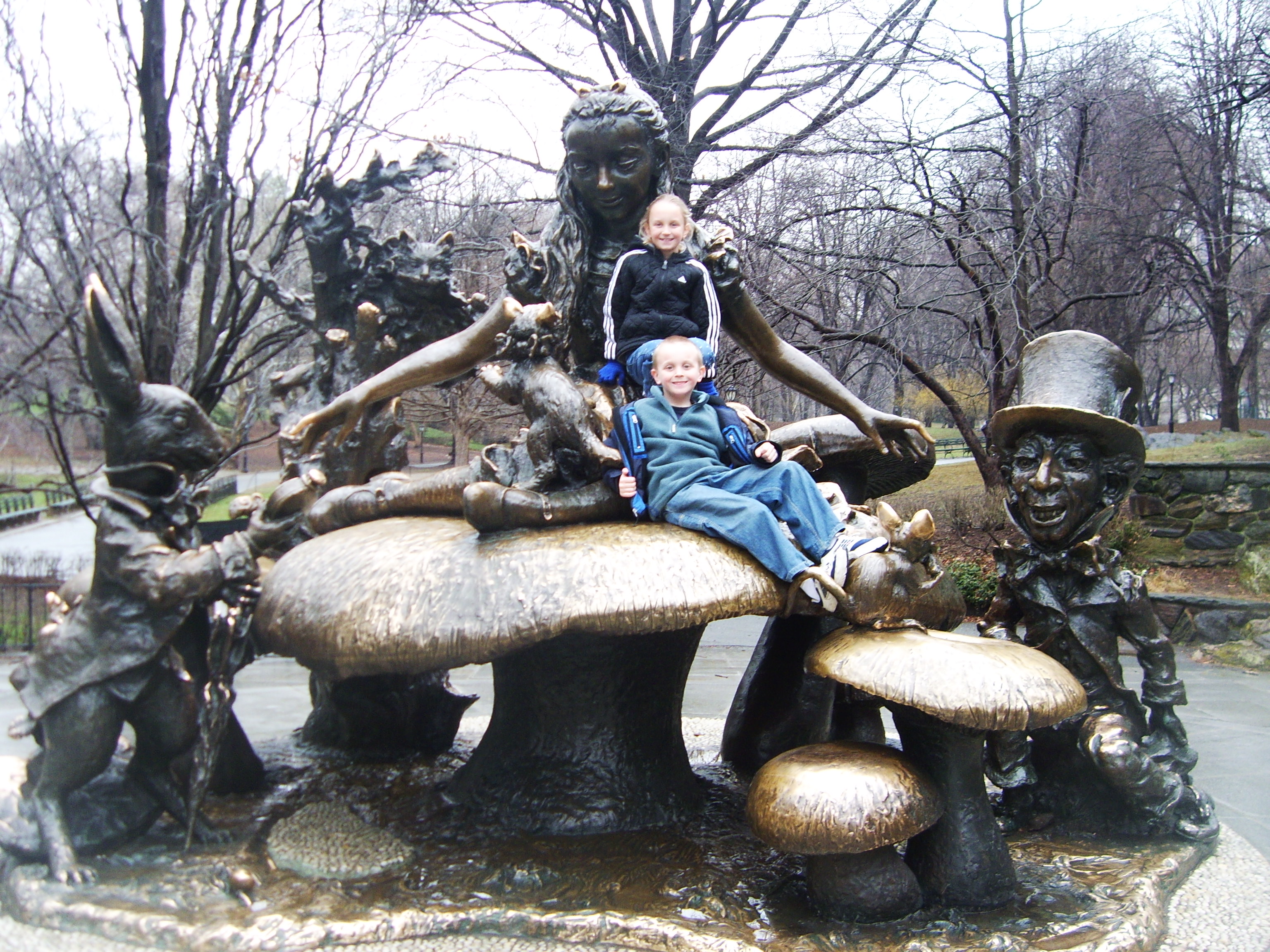

There is more to be said about the curious class of cartoon sculpture; about its polysemic ambiguity, about the colonisation of public space by corporate imagery,about kitsch and irony, about ….
But :

Now its time to say goodbye
To all our company.

Em-eye-cee-

“See you real soon !”

Kay-ee-wy-


“Why? because we like you!”


Em-oh-you-ess-ee
–signoff song for the Mickey Mouse Club
A great guide and source of information about similar curiosities is http://www.roadsideamerica.com/

Utilitarian Review 4/3/11

News

Well, the giant to Sean Michael Robinson and Joy DeLyria’s Victorian Wire post has mostly died down; we’re back to twice our usual traffic rather than thirty times our usual traffic.

Fans of that post, though, will be pleased to hear that Joy is going to join us as a regular columnist. You can read more about her here. We’re very excited to have her aboard!

In other news…if you notice over on the right we’ve got a new Donate button. If you enjoy reading us, we hope you’ll consider putting a few bucks in the tip jar. Money will go to pay Derik for his work in keeping the site running…and in the unlikely event that there’s enough, we’ll put the remainder towards the web hosting.

Utilitarians Everywhere

I have a review of the Britney album at Splice Today.

And I review an art exhibit on global warming at the Chicago Reader.

Overthinking Things 04/03/2011

40 Years of the Same Damn Story, Pt.1

I call it “Story A.”

I wasn’t very clever that day; tired, maybe a little worn to the nub by reading yet *another* story that felt awfully like all the other stories I had read recently.

Sometimes Story A is a genuine delight to read – other times it’s a chore.

“Story A” is the story, the basic setup that defines a genre. Every genre has a Story A. Suspense stories have psychotic serial killers who stalk and kidnap the investigator (if she is a woman) or the female dearest to the investigator (if he is a man.) Fantasy stories have (or at least had for many years) long journey-quests with teams of ill-suited partners. We all know Story A in our genres.

In my chosen area of saturation, Yuri, Story A looks like this:

There is a girl, she likes another girl. The other girl likes her. They like each other. The end.

Sometimes “The end” is signified by a kiss, more often it is signified by holding hands and perhaps looking each other in the eyes. Recognition of mutual affection is as likely to be the final scene as riding off with the Prince to live happily-ever-after is in a fairy tale.

For those of us reading Yuri manga, Story A is the same damn story…and has been for nearly 40 years.

The roots of “Story A” can be traced back at least as far as 1919, with the publication of Yaneura no Nishojo, by Yoshiya Nobuko.

In this book, introverted Akiko meets and falls into passionate, one-sided love with Akitsu. In what was a remarkable ending for its time, the two girls decide to leave school to make a life together, independent of their families or of husbands. In the end, the love was not so one-sided after all, perhaps. (Although some critics have dismissed the idea that they were in love, and instead insisted that Akitsu was leading Akiko into the idea of a politically aware adulthood.) More importantly for our purposes today, this novel has given the manga world any number of tropes that underlie much of “manga for girls” and a whole truckload of Yuri manga tropes, such as life in a Catholic school dorm, intimate piano duet, room in the tower, and others.

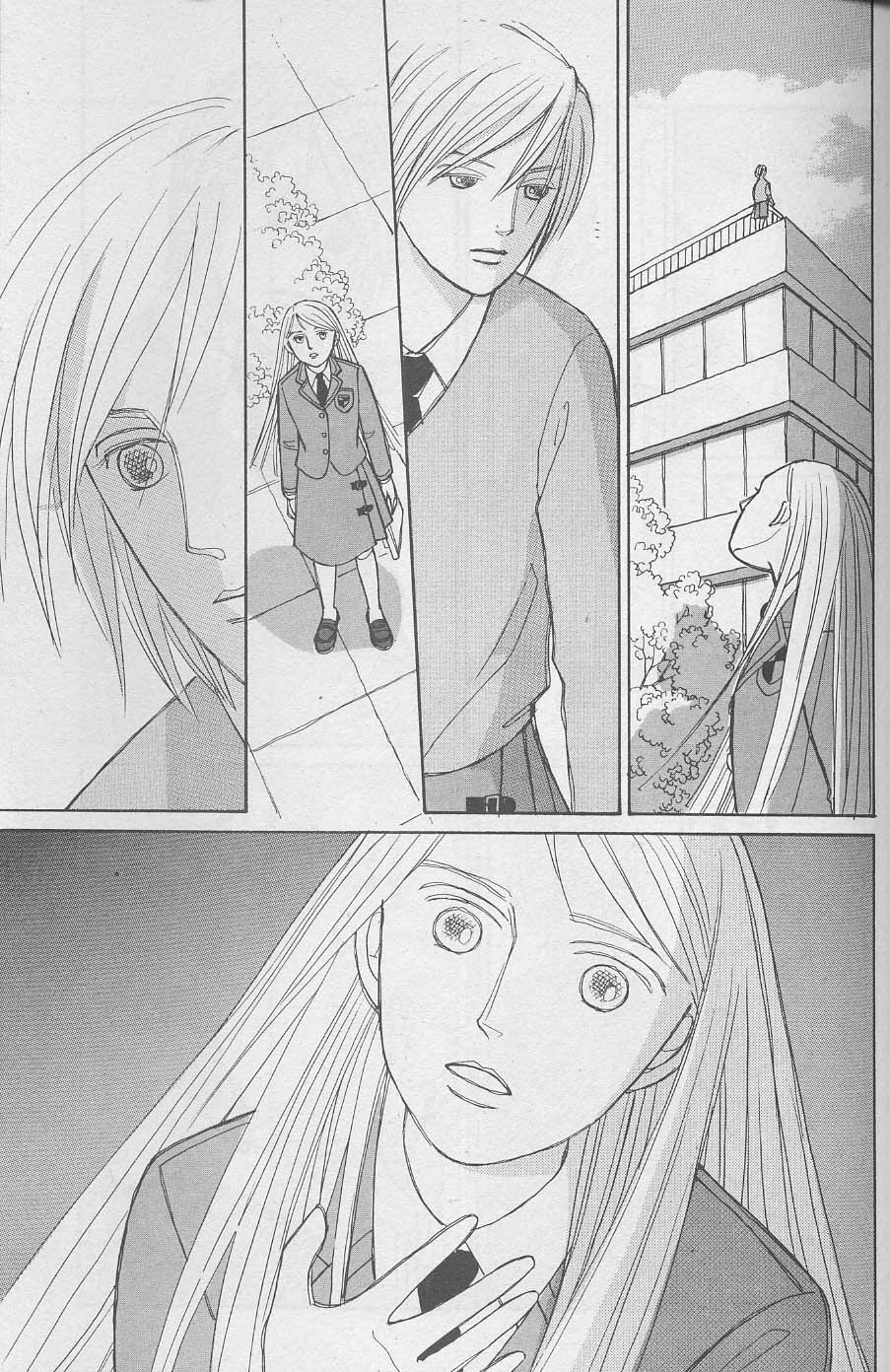
Not quite 40 years ago, a manga appeared on the scene which took these themes and wrapped them in a melodramatic love affair…and “Story A” was born.

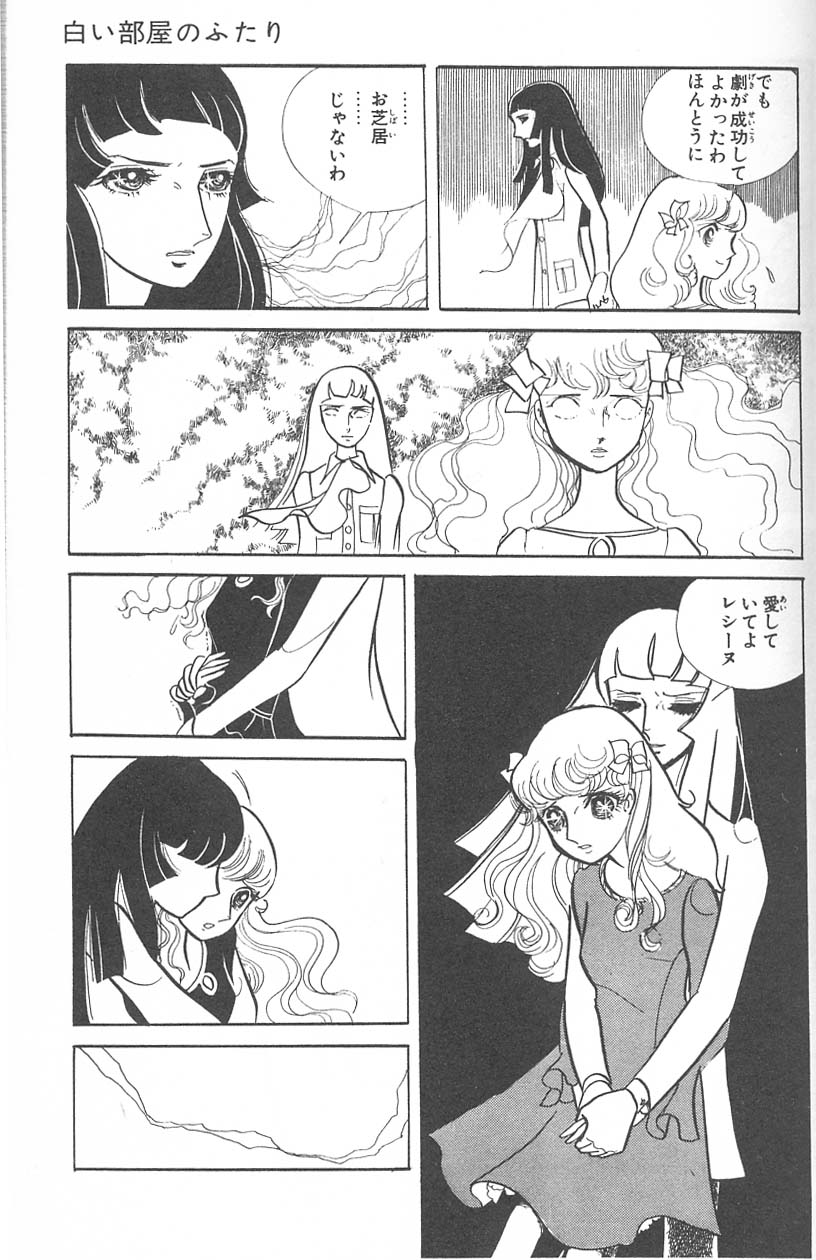
This prototype “Story A,” Shiroi Heya no Futari, also cemented the idea of a tall “Yamato Nadesico,” a traditional Japanese beauty with long black hair, and a shorter, energetic/cheerful girl with blonde or brown hair as the tropiest of Yuri couples.

In the beginning, “Story A” rarely had a happy ending. This is not because of the same-sex love, very few romance manga in the 70’s had happy endings. The typical couple were doomed to never be together for one reason or another. In the case of “Yuri” couples, the options were mostly one partner died or left to get married. In Shiroi Heya no Futari, we get to enjoy one, with a premonition of the other.

The 1980s were not good years for Yuri. The sexual revolution of the 1970s passed, leaving shoujo manga too tired and commercial to take risks. In the 1990s, however, something happened that changed everything…Sailor Moon. I won’t get into how it revitalized manga and anime for girls, but suffice to say that it left a strong impact on many. And it brought same-sex relationships between girls back as a potential manga topic.

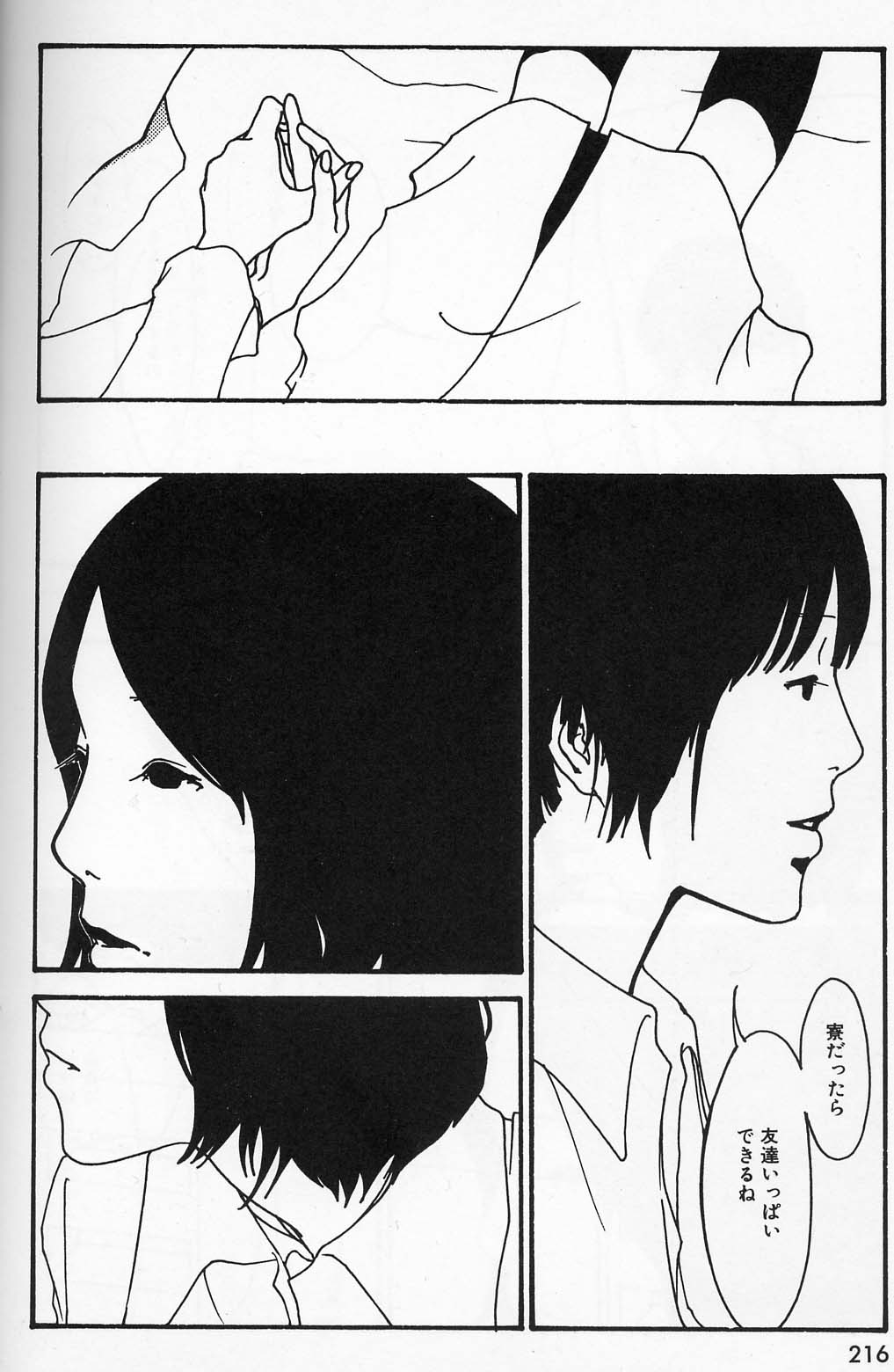
In 1995, Nananan Kiriko drew a very realistic version of “Story A” called Blue, which has been translated into English by Fanfare/ Ponent Mont.

In Blue, we are treated to an alternate version of the “go off to get married” ending, in which Kayako goes “off to Tokyo,” leaving Masami behind.

Blue does not have the Nadesico/cute couple stereotype, but in every other way it fulfills our expectations of “Story A.” If anything, it’s more of a throwback to Yaneura no Nishojo, with a more realistic vision of life in a girls’ school and the resulting drama.

Masami and Kayako meet and find themselves attracted to one another. It’s easy enough to categorize this story as akogare, a Japanese word that means feelings of admiration that are tinged with desire – what we would probably call a schoolgirl crush. Even if one interpreted their feelings as “real,”  we can have no real expectation of a “Happily Every After” ending here.

Shiroi Heya no Futari had a profound impact on many series that came out in later years. Not just manga, but Light Novels were also influenced by the Yuri couple trope.

Maria-sama ga Miteru began in 1998 as a serialized “Light Novel” and it continues to this very day. The couple to the right, Yumi and Sachiko, are instantly recognizable to any fan of Yuri and the series, at least at first, is a set of “Story A”s among the students at a private Catholic girls’ school.

Most of these relationships are platonic romance, but within the initial few volumes at least one story went beyond the confines of “Story A,” to tell what can only be seen as a “lesbian” narrative. However popular that story, Ibara no Mori, was, the bulk of the relationships in Maria-sama ga Miteru sit well within the confines of “Story A.” As much as we might wish for it, Noriko and Shimako, Yumi and Sachiko, Rei and Yoshino, will never go running off  to make a life together, outside the confines of family or husbands.

The meme of “love between girls in private girls’ schools” which was initially set by Yaneura no Nishojo, really gained traction in the late 90’s with the success of Maria-sama ga Miteru and, for the next dozen years, it has been a main component of our definitive genre story. “Story A” was to take place in a girl’s private school. Exhibit 4376, this page from Pieta from 2000.

The school was not “St. Whoever’s”, but the hothouse atmosphere of an all-girl school is still the setting, allowing Rio (boyishly attired here in sweater and tie,) to be a school playgirl, while “good girl”  Sahako is close to the traditional Nadesico type.

Pieta also contained a common trope for its time – that of linking lesbian romance with mental illness. Rio has a history of hysteria and suicide attempts…all of which have a perfectly excellent explanations and have almost nothing to do with her romance with Sahoko. If anything, their feelings for one another are what redeem Rio and pull her back from the brink of insanity. Nonetheless, it was very fashionable for manga of the time period to have unstable lesbian characters.

When male manga artists started to pick up what had mostly been a meme in girls’ manga, a distinct “checklist” of tropes became a common feature of  “Story A.” Absurdly luxurious private school? Check. Nadesico-type with wealth, power, athletic and scholastic prowess? Check. Genki blonde who is poor, but sincere and inexplicably the object of desire for everyone in the series? Check. Breast-highlighting tight uniforms? Check. In the mid-2000s, Kannazuki no Miko created a whole new wave of Yuri fans, with an action riff on the couple from Shiroi Heya no Futari. Instead of 70s melodrama and partying, we were given giant robots and apocalyptic prophecies.

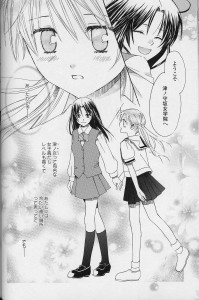
At the same time Kannazuki was recreating “Story A,” another series that was playing with the same key elements fooled a whole generation into thinking it was telling an original story, by stealing from *every* Yuri story that had gone before it. Strawberry Panic! added a new twist to “Story A,” – a pretend glimpse past the gauze boudoir curtains of an all-girls, no-guys-allowed world. This concept quickly became a typical feature of Yuri “Story A”s aimed at men. (Presumably to heighten the sensation of forbidden love they enjoyed in Yuri.) This added thrill has retroactively invaded popular girl’s series, such as Maria-sama ga Miteru. The radio and live shows – the audience of which are mostly men – now begin with a warning that boys are not allowed. And many Yuri anthologies that target a male audience provide that same warning on the cover, just so the audience knows it’s getting a glimpse of some forbidden women’s mystery.

Where Strawberry Panic! really excelled was as an homage to “Story A” through the ages.

The manga riffed on series like Card Captor SakuraHimitsu no Kaidan and Maria-sama ga Miteru, while the anime stole openly from Kannazuki no Miko, the above series and even Western stories such as The Graduate and Wuthering Heights. (Amusingly, it wasn’t even the first Yuri anime to borrow from Wuthering Heights. That honor would probably have to go to Cream Lemon: Escalation.)

Take a moment to compare this page with the page from Shiroi Heya no Futari. Do not think that this was accidental.

By 2005, the Yuri ball was rolling well. Not coincidentally, in 2005 I held a Yuricon event in Tokyo, and was able to be there at the formation of a new Yuri-focused magazine, Comic Yuri Hime. Now manga was being created explicitly for readers of “Yuri” as opposed to being one fetish in a series for men, or a schoolgirl crush in a story for girls. But, “Story A” was safe space, where no political, social or emotional commitments had to be made, which made it an attractive “space” in which to create a Yuri story.

The emotions might be real, the attraction may or may not be physical, but the implicit understanding of “Story A,” is that this is not forever – it is for now. As long as we are in school, as long as we are protected from the pressures of our duty to family, friends, jobs, society, we can be together.

What Yuri Hime could do – and has, in recent years done – is give us something that, like Akiko and Akitsu in Yaneura no Nishojo, escape the confines of societal pressure, to create a more realistic “Happily Ever After.”

However, many of the initial Yuri manga that ran in Yuri Hime fell solidly under the auspices of “Story A.” Some hit all the  buttons. Hatsukoi Shimai managed to cover exactly “Story A” territory and not too much more. Compare Haruna and Chika here  to Sachiko and Yumi in Maria-sama ga Miteru.

Private girls’ school? Check. Nadesico beauty who is smart? Check. Cute energetic girl who is sincere, but not smart? Check? Impossible to understand feelings? Stupid plot complications that keep us apart for no real reason – including, but not limited to interfering seductive person; poor communications issues, and; horrible secret? Check.

In the late 2000s, Yuri took a major jump from elements in various stories to distinct category of its own. Comic Yuri Hime had split into two magazines, each targeting a specific gender audience with some distinct elements, and other manga magazines began running more Yuri-themed manga, many of which continued to follow previously established “Story A” tropes.

In 2007’s Sasamekikoto, the Nadesico beauty Sumika retains her superiority not by wealth and status (as did Sachiko or Chikane,) but by being an accomplished student and good at sports.

The cheerful, energetic girl, Ushio, now is also the doofus-y, somewhat clueless girl, a quality that we see back in Shiroi Heya no Futari with Resine’s lack of awareness of Simone’s feelings – even after they have been explicitly expressed.

Sasamekikoto is on-going, and thankfully for readers everywhere, Ushio has moved away from cluelessness, as the story itself has shifted out of exploration of Yuri tropes and wallowing in “Story A”-ness to having actual lesbian awareness and identity. (I sometimes define “Yuri” as lesbian content without lesbian identity.) By making the characters aware of the impact of their relationship on the people around them – and how it might affect their future – this story has ceased to be purely “Story A.”

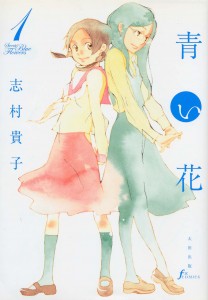
Aoi Hana was another mid-2000’s series that has now become an iconic series for Yuri fans, in part due to stellar writing and characterization and in part due to a not financially successful, but very beautifully made anime in 2009.
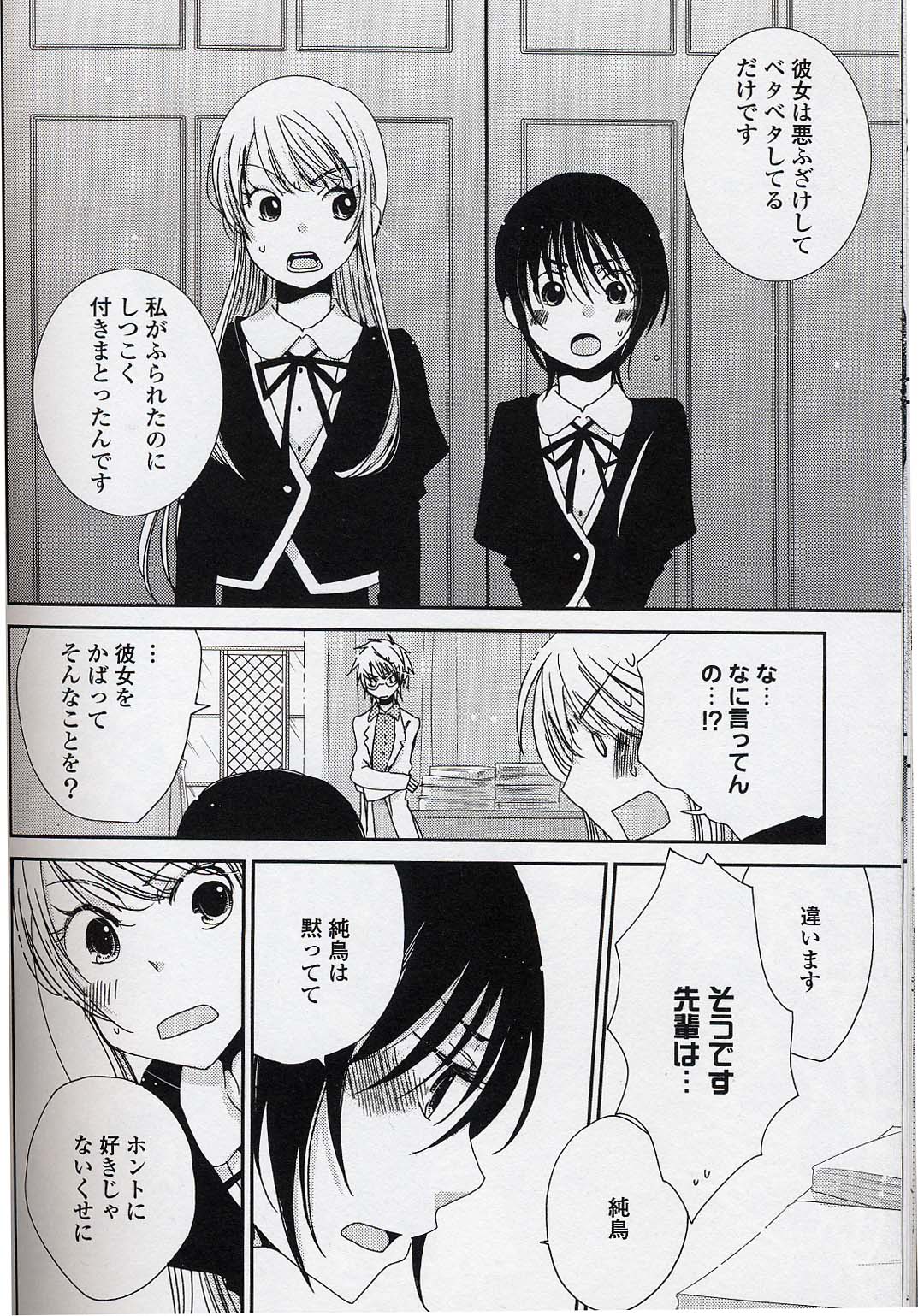
As you can see, even in color, Fumi fits the Nadesico type, this time with the added attraction of “shy glasses girl,” and Akira is the by now quite-stereotypical energetic, cheerful pig-tailed girl. Don’t let the fact that it appears to be a typical “Story A” fool you – this is a top-notch manga. It is “Story A.” It just happens to be a best of breed.

Like Sasamekikoto, Aoi Hana has some recognition of  what it might mean to “be lesbian” and how one’s decisions about one’s self can impact the other people in a life. And, while there are more stories being written now with this awareness, Aoi Hana also shows Fumi coming out, which is still extremely rare in “Yuri” manga.

Story A doesn’t always look exactly the same.  In many cases, it looks different…it just feels the same. The characters’ heights may change, their hair color and length may change. Their backgrounds, their previous relationships, their feelings about having these feelings at all. The private school might have a legend of two girls that ran off or attempted suicide together. There may be a tapestry or stained glass under which whispered vows become lifelong committments.

But in the end, there is a girl, she likes another girl. The other girl likes her. They like each other. The end.

And, even though nearly four decades has passed since Shiroi Heya no Futari began, sometimes it just feels like we’re reading the same damn story over and over again.

Sometimes. Every once in a while. We’re not.

But mostly, we are.

Comments Become Posts – Yesterday’s Thoughts on Literary Comics

Long-time and frequent readers of HU will recognize the ongoing friendly disagreement I have with Matthias Wivel about the degree to which literary things — literary theory and its literary lessons, literary experimentation and its literary insights — are important for comics. I almost said for “literary” comics, but that of course would have begged Matthias’ question, which is in part why comics need to be literary at all.

Toward the end of the lengthy theoretical discussion that erupted in the comments section to his remarkably rich interview with Eddie Campbell (much of which we unjustly ignored in the comments!), Matthias wrote:

I don’t dislike Krauss; in fact I think some of her work is pretty great, but yes, I have at times found her unneccessarily laborious, caught up in linguistic issues that may have been relevant at the time, but now just get in the way of her otherwise good observations.

Is there a way of applying her method to less obviously linguistic insights in visual art? Probably, but my point all along has been: why is that so important?

Caro, you have a real preference for whatever theoretical insights any given work of art may give you, and I am not at all opposed to that — I find that stuff as fascinating as the next man, BUT there are so many other equally valid and compelling ways of experiencing and talking about art, ways that you can frame in exact theoretical terms, but which to my mind don’t necessarily benefit from it.

Art isn’t theory.

In the question about the importance of literary methods and insights to comics (I’ll limit myself here to the discussion of comics, rather than art in general, which Krauss herself has addressed quite often!), there’s more at stake than theoretical answers to ontological/epistemological questions, as interesting as they are. There are practical issues of the artistic scope that comics can and has engaged with as well — and scope not only has implications for understanding — and imagining — the potential of the art form but also for appealing to broad audiences with diverse artistic tastes. I wrote a lengthy response to Matthias about the importance of engagement between comics and literature/literary theory, and Noah asked me to move it from a comment to a post. So here it is (with only minor edits from the comment version).


Matthias, I remember that you’ve made this same basic argument before with regards to literature itself — in the same way that art isn’t theory, comics aren’t literature, and so on and so forth. It’s a sort of medium-specificity that insists on boundaries — and while I GET it, I think those boundaries may be more limiting than they are valuable, for any purposes other than pedagogical.

For my own purposes, as you say, there’s certainly an aesthetic preference at work here — but there’s also an aesthetic agenda for those boundaries to become more permeable. Not permeable so that there’s no possibility of ever deploying the distinction to good effect, but permeable so that there’s more possibility of deploying the mixture to good effect.

It’s partly, as I think we’ve discussed, the fact that theory isn’t a “way of experiencing and talking about art” it’s a way of experiencing and talking about the world — one to which visual art has yet to make its fully evolved contribution. I believe that’s a contribution that needs to be made, considering the impact and reach of theoretical vantage points not only for “talking about art” but also for talking about all kinds of other things, including politics, and identity, and the politics of identity. If the vantage point of art is insufficiently represented there, that is an exclusion — even if it is one that’s largely self-inflicted. Participating in that conversation should in no way prevent all the other ways from experiencing and thinking about art from continuing on apace, as not everybody will be inspired by theory in the same way that not everybody is inspired by aesthetics. Surely there’s room for all of the above?

But it’s also that such an engagement with language/linguistics/literature in particular is more important for comics and important in a different way than it is for visual art. It becomes, to me, a question of broadening the field of comics sub-genres — in English-language comics, at least, currently there are a) a couple of unique genres, the fully visual-narrative and visual-metaphorical ones; b) the comics versions of genre fiction, SF, romance and heroic stories; c) plenty of autobiography and memoir; d) biography; e) journalism; f) children’s stories. Then, there are those few cases that qualify as literary short stories (although those trend toward the visual-narrative and visual-metaphorical genres, for various reasons many of which, I think, are subcultural). There are also a handful of experimental comics (which, as you know, I’m extremely fond of, but that is a very new and nascent genre.)

But there’s very little in comics that’s comparable to — let’s call it “Booker fiction,” the kind of fiction that gets nominated for and wins the Booker prize. (Although Booker books are not really homogeneous and my bias against current American letters is showing; “Pulitzer fiction” just suggests a somewhat different scope and approach to me.) Booker fiction is very engaged with theory — not just contemporary theory but traditional poetics. It also tends to care deeply about literary aesthetics and a range of pleasures that come from prose.

You’ll probably come back with the argument — as you have before — that Booker fiction is a literary genre and that comics doesn’t need to model itself on something so outside. But the question “why shouldn’t it take that genre as a model?” is equally valid. There’s no consistent argument that Booker fiction shouldn’t serve as a model for comics — unless comics is also going to reject all the other literary genres right along with it: popular genre fiction, the literary short story, biography, memoir…

I find the possibility of comics engagement with fiction at the Booker level especially compelling considering that Booker fiction’s engagement with theory and form — both questions and the mechanisms for getting at those questions — is at a point where it needs fertile new terrain, and “the illustrated book” is extraordinarily fertile. Books like Fate of the Artist point in that direction for me, and I think it’s tremendously inspiring. It’s a different direction from the one folks like Warren Craghead and Jason Overby are exploring, and — as marginal as experimental comics is — truly ambitious, truly literary comics are vastly more rare.

At this point, though, I generally have the sense that there are several pressures working against comics producing a work that’s really truly comparable in scope and ambition to a Booker novel. The biggest obstacle is auteurism and the DIY insistence on self-expression, which lead people who don’t have a lot of literary background to resist collaborations drawing on varied expertise (the kind of fecund collaboration, for example, that Anke F. has with Katrin de Vries). Hipster ennui — that classic mix of self-importance with complete and utter lack of seriousness — saturates art comics culture and generates a contempt for complexity and intensity that works against any meaningful engagement with literature. (The hipster problem also severely damages American prose letters and is to some extent at fault in the problem Elif Batuman identified in the LRoB essay we talked about here.) Hipster-fic generally ends up being either irony or what Mike called “me-comics”.

But I also don’t think we should discount the role of disciplinary distinctions here. Art education plays into this as I’ve mentioned before: because English is more valued at the middle and high school level than art, literary people often have much less drawing training than art people have in writing. But this can also lead to a lack of understanding among art people about the differences in the way a trained literary reader will approach, say “The Fortress of Solitude” from the way that same reader will approach “Midnight’s Children”, or the fiction of, say, Umberto Eco. It’s a failure of American education that we don’t equip our students to read those books the way they’re meant to be read before the time when students have to specialize, so that those reading protocols are such specialized protocols. But it nonetheless remains true that those books do demand reading protocols that only highly trained readers have — most people writing comics and writing about comics, even the best writers in comics, aren’t highly trained readers. There are precious few people in art comics who are palpably sophisticated readers by the standards of fiction readers — because a lot of those protocols just aren’t mastered, if they’re even taught, until graduate-level study in literature.

Similarly, the academic art world sometimes seems hermetically sealed: unlike literature departments which (at the graduate level) embraced their “cultural studies” sister departments to the point that traditional literature almost vanished entirely, the “department of art” is very separate — methodologically and institutionally — from departments of visual culture (which tend to be, really, part of that greater diaspora of literature).

But this separation of the disciplines becomes a problem for comics which draws on the media and discourses specific to both. One response has been to claim comics exceptionalism — the only discipline you need to know anything about is comics themselves. But that’s obviously bullshit: comics scholars tend to know art or they tend to know literature, and each enriches their insights in different ways. This is why I brought up Noah’s oft-expressed annoyance at the banal content of many comics: it’s just exasperating to hear people make “literary” claims for a book like Asterios Polyp. It’s a perfectly good pedagogical tool and an interesting experiment in visual device, but by even the middlin’ standards applied to literature, it’s pretty run-of-the-mill as fiction. It’s equally exasperating to read comics criticism that examines a really pedestrian, obvious narrative, something that’s probably intended for diversion and fun, in lofty formalist, new critical terms — the type of review that explicates literary devices which are completely on the surface of the work. It’s like someone writing a piece of student criticism about a student essay. This doesn’t happen nearly as often in professional and semi-professional reviews of prose books. The expectation is that people who read Bookforum understand literature and there’s no need to spell out, or often even point out, the formal devices at work in a book. (And of course, here I’m talking about the semi-professional comics critics, not random people writing about books they love or hate on their personal blogs.)

A great deal of the writing in (and about) comics is — at its absolute best — BFA-level writing. And I’m not talking about prose-craft — I’m talking about the sophistication of the engagement with ideas.

So when claims are made about comics-as-literature, the impression is often that comics people don’t know very much about literature, let alone theory. But the bias against theory seems to be part and parcel of this dual belief that literature and literary structure basically work the same way that art does but just in a different medium, and that what you learned in college is all there is to know about literature. That’s a misperception due almost entirely to these overly-strict boundaries. I do think it’s extremely important for comics that those walls come down.