Before They Were Famous

Joy and Sean’s bricolage Victorian Wire piece has netted us many new readers,most of whom probably have not yet realized that this blog is usually less about Omar and clever homage/parody and more about comics and post-structuralism and flame wars.

But! I am hoping to fool them at least a little longer, so I thought I’d reprint this piece which ran in Poor Mojo’s Almanac a little while back. It reimagines famous people in different eras/situations. It’s not about the Wire, but it’s what I’ve got.


What Were They Like Before They Were Famous?

1. Franz Josef

For the science fair, Franz Josef Haydn constructed a working castrato. No one expected it because the school was underfunded. So he had to use an abacus instead of a Bunsen burner, plus it was made out of rusty glass condom wrappers. But he tried hard and learned important lessons broadcast on television like “don’t be poor” and the Western cultural tradition. His teacher, Ms. Friedrich Nietzsche, gave him stickers with assertive slogans. She had a cave to go into for the Jedi Mind Trick, but when she came out she was just Aquaman, which doesn’t usually help.

Haydn didn’t understand what he had done wrong. “Doesn’t anybody like beautiful music?” He kept shouting that. The judges were stupid movie stars and people like that. First prize would go to growing bean sprouts like always. And all he wanted was to be able to look at his college pictures sometimes without being sad forever.

I think the problem is that there is too much creativity in the world. It means rich people can feel good about themselves too easily. Also everybody talks and nobody shoots them. If we really want to stop floods and starvation, a better way would be a lot of robots doing math in the dark. Without Oprah.

2. Christina

So it was in the car and we said who has the best memories? So the Little Mermaid was in the Holocaust and learned important lessons about personal growth, and Buffy had a sad marriage to Raymond Carver but with moments of real quirkiness. And everyone else was Asian. But Christina Aguilera kept saying, gee I don’t have any memories, isn’t that funny? They told her to make some up but she wasn’t inventive in that way, so they felt bad for her but wouldn’t talk to her anyway.

She tried to tell people about a dream where she met herself and was different. Buffy said, “Oh, right, you must be a creative writing major.” I guess that’s a memory, Christina thought. I’ll just listen to this song for the rest of my life.

Luckily there’s happiness and you’re more famous than some people. If you have cheerful slogans and make others say them then they will be depressed and you win. Even if that doesn’t work, someday high school will just be a place you read porn about.

3. Duke

It is underwater and the guidance counselors are puffy and fat like some kinds of fish. Duke Ellington is sort of a savior so he comes through security and down, down, down. It is pretty because it is green and no one has any clothes or penises.

The littlest teachers have lights in their tails. You are never more than fifteen feet from one and you accidentally eat them while you sleep. That happens to Duke Ellington too, which is why he ended up so creative just like most people. If you shut your eyes you can see their skulls because they glow and bob where the water is dark. That is all the teachers people swallowed making that possible and I think we should thank them for it.

Duke Ellington’s cell phone rings. It is Hollywood and they want him to be in a movie where he will listen to music and then be inspired to listen to better music. “When I do as they wish, even the eels sing of love.” He would cry a single tear but nobody would notice underwater. There are a lot of beautiful things and terrifying things where you can’t see them here, but if you really study them closely they become boring.

Technical Difficulties

As you may have noticed we’re really very slow here. Sean and Joy’s article has been linked by boingboing, the HBO twitter account, Jezebel….everybody basically. It has trashed our server.

We’ve redirected people to the google cache version of the article, but the site is still only semi-functional. We’ll see if we can resume regular service tomorrow.

Congratulations to Sean and Joy. This is the latter’s first publicly published piece I believe, and it has become a meme. I’m thrilled to have published it, even if it did crash my little blog.


This Blog Has Improved by 13.6%

Around the end of the 19th century, Progressives celebrated the dawn of rational government. Public policy was to become a social science, and like all sciences it was to be based on quantitative facts. Every aspect of humanity and all possible outcomes would be assigned a numerical value, and then these numbers could be crunched into a thousand equations that would give us perfect governance. No more trial-and-error, no more dishonesty, no more messy emotions getting in the way of sound policy. It was salvation through statistics.

The faith in scientific government may seem absurd today, but much of our public policy is still built around the statistics game. Partly, this is because quantitative measures are generally easy to analyze and explain. If the police report that crime rates rose by 5%, we all understand what that means, and we can draw general conclusions on how to respond. Plus, statistics just seem so damn rational and authoritative, not like those touchy-feely qualitative observations. Decision-makers, bureaucrats, and the public all crave certainty, or at least a close facsimile.

But numbers can be wrong. Or to be more precise, people are lying liars who make up numbers to “prove” whatever they want to prove. In “The Wire,” the public institutions of Baltimore are constantly “juking the stats,” a term referring to various methods by which they falsify statistical data to show progress where there is none, all while the city continues to crumble around them.

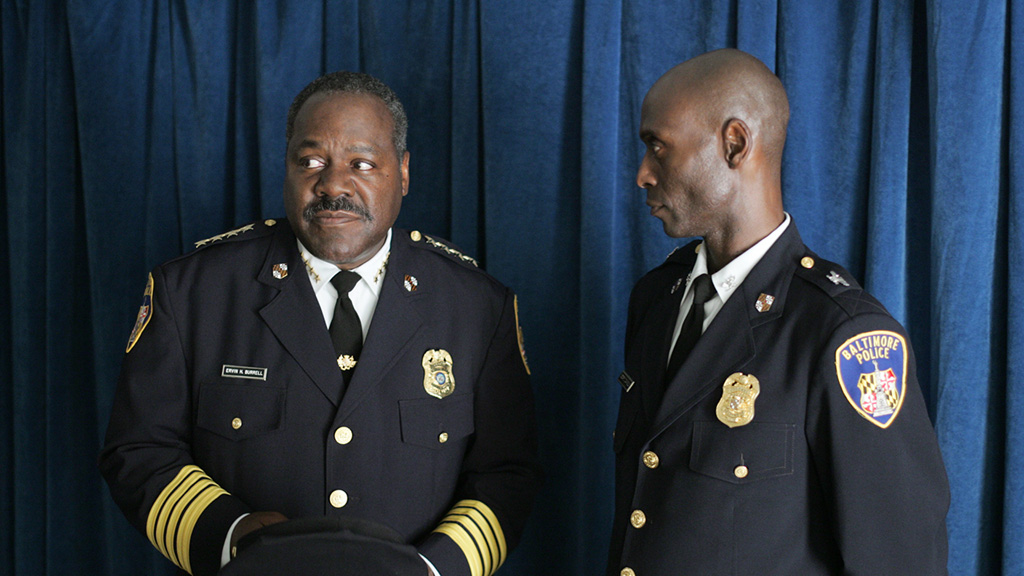
While the series creators have plenty of bile for every aspect of Baltimore’s government, none of the institutions are criticized as thoroughly as the Police Department. The Department is portrayed as the apotheosis of public sector dysfunction, and juking the stats is hardwired into its institutional DNA. On several occasions, Commissioner Burrell alters statistical data so as to gloss over the embarrassingly high rates of violent crime. The simplest way that police departments juke the stats is by re-classifying reported crimes as less serious offenses (as an example, aggravated assaults become assaults). The only crime that can’t be downgraded in this manner is homicide, for obvious reasons. This was why Burrell and Rawls were obsessed with the “clearance rate” (the number of murders solved), and homicide detectives concerned about their clearance numbers looked for ways to avoid investigating a (potentially unsolvable) murder, such as by dumping the bodies on another jurisdiction (as with the bodies of the dead prostitutes in season 2).

Baltimore’s school system does not escape scrutiny either, especially during season 4. The public schools are dependent on federal funding,  and juking the stats is necessary to show improvement on the standardized tests administered under the federal No Child Left Behind Act (there are unpleasant consequences for a school and its faculty should their students repeatedly under-perform on the tests). As shown on “The Wire,” one common method of improving the scores is to teach to the test. Students are given rote lessons on how to answer specific questions. This can lead to modest improvements in aggregate test scores, but the students are not really learning anything except how to take a test, and so the scores do not accurately measure the students’ mastery of basic academic skills.

For both the police and the schools, much of the problem arises from a conflict of interest: the institutions responsible for reporting the stats are the same institutions that will be judged on them. Few people are willing to admit failure, especially when the consequences include losing your job. Thus, Police Commissioners have every incentive to paint a rosy picture of the city’s crime rates. Nor does auditing by an outside agency solve the problem. An agency tasked with analyzing statistics from the police department would still be dependent on the department for crime data, which means they would likely get the same juked stats. The only alternative would be an independent means of detecting crimes and collating the data, which would be prohibitively expensive, especially for a cash-strapped city such as Baltimore.

Statistics were supposed to give us scientific government, one where the ideal public policy would be crafted in accordance with hard data. This was implausible even in the best case scenario, but when data is falsified, statistics actually grant further authority to the lies of public officials. And without trustworthy stats, how is the public supposed to the judge the performance of public institutions? How are voters supposed to hold their elected officials accountable when we can’t be sure if their policies succeeded or failed miserably?

“The Wire” doesn’t offer any solutions to this dilemma. Rather, it suggests that the nature of our political system, particularly the never-ending electoral cycle, creates irresistible incentives to lie. Mayor Carcetti, for example, initially forces Burrell to resign when he lies one too many times about the crime rates. But when Carcetti begins his gubernatorial campaign, his staff pressures incoming Commissioner Daniels to juke the stats so that Carcetti can claim that crime rates fell during his term as mayor. When Daniels refuses to compromise his morals any further, he’s forced out of office and replaced with a more compliant lackey. The public, by and large, is ignorant of the mayor’s deceit, because the city government controls most of the data collection and analysis.

So how should the public deal with juked stats? One alternative would be to provide more resources to non-governmental organizations that compile and analyze their own data, but NGOs have their own agendas and are equally capable of lying. Or we could abandon our stat-based approach to public policy entirely, and rely more on qualitative observations, such as in-depth news articles. For many reasons, this is highly unlikely to happen, but even if it did, qualitative accounts can also be fraudulent, and they are more often anecdotal rather than reflective of larger social trends.

I was hoping to end my post on an upbeat note. But this is a roundtable on “The Wire,” so maybe it’s appropriate that I throw my hands up in frustration.

_____

Update by Noah: The entire Wire Roundtable is here.

The Wire Roundtable: Season 1, Episode 1, Again

At the end of the first episode of The Wire, the homicide detectives turn over a dead body. As we see the victim’s face, there’s a flashback to an earlier scene. The writers are letting us know that this body with a hole in the head is what’s left of a witness who testified against the Barksdale drug gang at the beginning of the episode.

This sequence is semi-infamous because it is the only flashback in the entire five-year run of the Wire. It was, according to David Simon’s commentary, urged upon the creators by HBO, who were concerned that viewers wouldn’t be able to follow the story without the extra nudge. Simon admits it might have been the right thing to do for the first episode, where they were still setting the stage and trying to hook an audience. After that though…never again. The Wire went forward, and if you missed a plot point, you were stuck until it got reshown or you bought the DVD with its miraculous rewind technology.

The Wire, with its labyrinthine plot and characters piled on characters, is definitely meant for rewatching. That first courthouse scene, for example, is almost entirely different the second or fifth time through, when all the players —nervous D’Angelo Barksdale, the oleaginous lawyer Maurice Levy, the cheerfully dangerous Wee-Bay, the not-at-all cheerfully dangerous Stringer Bell — are known quantities. The first go round you watch a bunch of unknowns; the second it’s all old friends.

The increased familiarity allows for some new surprises. For example, the first time we see Stringer, always the businessman, he’s making notes on a pad. Detective McNulty tries to see what he’s writing. Stringer looks up at him over his glasses and turns the pad around…revealing that he’s been drawing a superhero with what appears to be Africa on his chest insignia. The superhero in the drawing raises his fist and declares “Fuck You Detective”.

Stringer the smart-ass project kid isn’t a Stringer we get to see much — not least because Stringer himself tries to bury that kid more and more thoroughly as the show progresses. In the second season, Stringer probably would have been too cautious to have a note pad; by the third, he wouldn’t have been anywhere near that courtroom. We never see any of Stringer’s drawing again, either. So the second time through, that scene seems more like an end than a beginning.

Rewatching though doesn’t always add layers. Sometimes it points out holes, or roads not taken which might have been better explored. One of my favorite moments from the first episode occurs a little later, after D’Angelo Barksdale has beaten the murder rap. The judge in the case calls in McNulty to find out (a) why a key witness changed her story, and (b) why McNulty was in court, since it wasn’t his case. McNulty explains to the judge that D’Angelo is the nephew of the current West Baltimore drug kingpin,. The gang has beaten a number of cases in court, including a past case of McNulty’s. The judge finally asks, “If it’s not your case, why do you care?” To which McNulty replies, “Well who said I did?”

Again, that’s one of my favorite lines of dialogue probably from the series: McNulty (Dominick West) sells it nicely, looking flat at the judge, with an expression somewhere between slightly amused and blandly unconcerned. The point is emphasized later when McNulty chews out his partner Bunk for picking up the phone on a murder call when another squad was up. “This’ll teach you to give a fuck when it ain’t your turn to give a fuck!” he says.

The point here for rewatching is, of course, that McNulty actually does give a fuck — way, way too much of a fuck as it turns out. He cares so much that, over the course of five seasons, he destroys his marriage, his career, and almost/maybe a second committed romantic relationship.

Which is all well and good as irony goes. But the thing is…I liked it the first time through better. David Simon on the voice over natters on incessantly about how different the Wire is from other television cop shows — and it is different in many ways. McNulty doesn’t really care about doing right, for example, as he would if he were on, say, Bones. He cares about being the smartest guy in the room and about being smarter than the crooks. It’s not about good and evil for him; it’s about ego. Which is a useful corrective to a lot of cop-show nonsense, as Simon says.

But whatever he cares about, the point is that he does…and that is not especially new in a cop protagonist, on television or elsewhere. There was something really refreshing for me about having our hero declare, boldly and apparently in earnest, that it really was nothing in particular to him if the West Baltimore drug gang beat murder number four, or twelve, or whatever. I kind of like that potential McNulty, that callous decoy McNulty, more than I like the funny, smart, but ultimately perhaps more predictable McNulty that we got.

So we have revealed depths, roads not taken…and finally, maybe a dropped ball. Two thirds of the way through the episode, D’Angelo Barksdale’s crew catches an addict, Johnny, who’s been trying to buy drugs using counterfeit money. The scene is presented as a dilemma for D’Angelo, who (as Simon says in commentary) is not a brutal man, and clearly doesn’t want to order Johnny beaten. But the boy’s ripped him off and there’s little choice; he turns away saying nothing, and walks into the camera, his face held still. Over his shoulder, and from a distance, we see Bodie, Wallace, and Poot start to beat Johnny. We learn later that they hurt him so badly he ends up in the hospital, where he had to undergo a colostomy operation.

The reason this is a missed opportunity is because of Wallace. Later in the season, the D’Angelo crew is robbed; 16-year-old Wallace provides information that leads to the brutal torture and death of one of the robbers. Seeing the torture victim upsets Wallace so badly that he falls apart. His disintegration eventually leads to his own murder at the hands of his friends, Poot and Bodie.

Wallace’s execution is perhaps the grimmest, most emotionally wrenching moment of the entire season. In retrospect, his character is almost as important as D’Angelo’s. And, as a result, the second time through this scene of the beating should be telling us something, not only about D’Angelo, but also about Wallace. The Wallace we know later is so upset by brutality that he first becomes an addict and then turns his crew in to the police. The Wallace here, on the other hand, is so comfortable with brutality that he enthusiastically joins in beating a young man almost to death.

The point isn’t that the characterization is inconsistent. People are capable of different levels of brutality at different times, and there is, after all, a line between “beaten almost to death” and “beaten to death.” Still, if you’re going to talk about that line, you probably do in fact need to talk about it, and the Wire doesn’t. For that matter, Simon doesn’t mention it in his voice over. Rewatching here doesn’t so much add resonance as reveal that there isn’t any. The creators didn’t link what Wallace does here to what Wallace does later. As a result the the possible connections just sit there, looking a little lost.

People often argue that the sign of great art is that you can go back to it again and again and find new depths and meanings. I’m not entirely sure I agree with that. First impressions have their own aesthetic worth; a song that sounds amazing the first time you hear it has achieved something, even if it doesn’t bear up to repeat lisening.

The Wire doesn’t collapse under repeat viewings. Still, seeing that first episode again and again was not entirely beneficial. When I finished watching this episode the first go round I think I was ready to call it great. After seeing it a few more times, I still like it, but I’ve got more reservations.

____________

Update: The entire Wire Roundtable is here.

Utilitarian Review 3/18/11

Actually…I think I am no longer going to list the week’s posts, unless there is an outroar or upcry. It is a bit of a pain, and I think the new format keeps pieces visible long enough that the recap is not necessary.

And as I’ve noted before, when I have links to provide I usually just tweet them. So sign up there if you want those.

I’ll still use this for publication announcements, I think. So!

Bert Stabler and I talk about whether or not god is artificial.

At Splice Today I talk about Neil Gaiman’s Neverwhere.

And also at Splice I explore my Irish roots.
___________
Also, please use this space to tell us how the new site is going. Derik has fixed a bunch of things this week, but if you find something else please let us know.

With Liberty and Report Cards for All

This was on the Bridge Magazine website and then on Eaten By Ducks, and now hopefully here for the duration.
________________________________

In a school…you are forced to read a hideous imposture called a school book, written by a man who cannot write: a book from which no human being can learn anything: a book which, though you may decipher it, you cannot in any fruitful sense read, though the enforced attempt will make you loathe the sight of a book all the rest of your life.
— George Bernard Shaw, Parents and Children

In America today, the emotion most associated with children is not love or tenderness, but righteous indignation. Indeed, now that it’s no longer acceptable to refer to “our women” or “our darkies,” the phrase “our children” has become the preferred shibboleth of reformers, therapists, politicians, pundits, and other petty dictators. Anti-gun, anti-porn, anti-drug, pro-life — we may not have a chicken in every pot, but at least we’ve got a child on every poster.

Enter Diane Ravitch, education policy wonk in the Herbert Walker Bush and Clinton administrations. One day, Ravitch was going her happy, wonkish way, advocating national tests and excellence for all, when she had an epiphany: standardized tests, she realized, were fucking boring. Soon after, she discovered that textbooks weren’t any good either. She was, of course, shocked, shocked, and also appalled. As she herself noted, with touching naivete:

Like others who are involved in education, be they parents or teachers or administrators or journalists or scholars, I had always assumed that textbooks were based on careful research and designed to help children learn something valuable. I thought that tests were designed to assess whether they had learned it.

I don’t know about parents or teachers or “scholars,” but most students are perfectly aware that textbooks are stupid and that standardized tests are pointless. Ravitch does claim to have children of her own and was once, presumably, a child herself. Like many professional educators, however, she seems to have had those memories surgically removed.

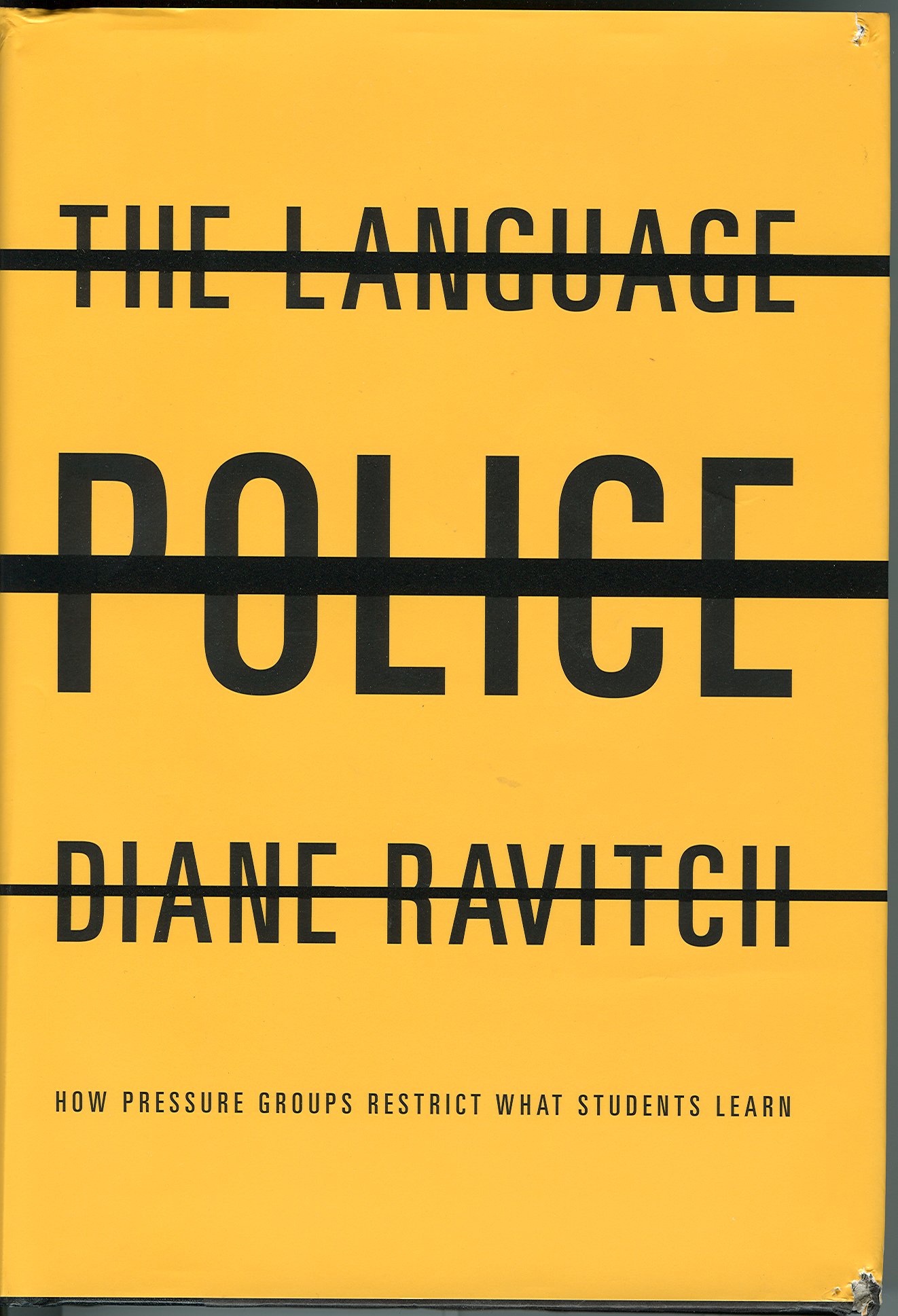
Be that as it may, beneath Ravitch’s innocent veneer lurks a PR juggernaut. Reviewers have reacted to her latest book, The Language Police, with all the grim, self-satisfied enthusiasm of a school counselor diagnosing ADD. Ravitch boasts that she has yet to receive a negative notice, and she must be one of the few authors ever to earn accolades in both Mother Jones and The Wall Street Journal. This unanimity becomes more comprehensible once you realize that Ravitch’s book contains both numerous paeans to free speech and an ostentatious lack of bias, two qualities that appeal strongly to every journalist’s reptile hind-brain. Thus, The Language Police blames the failure of our schools on censorship, and goes on to argue that this censorship has been put in place by two of the most hated groups in our society — the politically correct left and the radical religious right. Meddling east coast do-gooders and ignorant southern Bible-thumpers have apparently formed an unholy alliance to scuttle plans for a rationalized curriculum.

As conspiracy theories go, this one is actually rather plausible. The far left and far right do have a strong negative influence on educational materials, with unfortunate, not to mention bizarre, results. It is in chronicling these that Ravitch is at her best. She explains how, in a national reading test on which she worked, a passage describing owls was rejected by a “sensitivity review panel” on the grounds that some Native American cultures view owls as taboo. A passage about dolphins was rejected because not all students live near oceans. The content of textbooks faces similar restrictions: Houghton Mifflin’s influential 1981 bias guidelines, for example, require writers to give equal representation to men with beards and men who are bald. And both textbooks and tests must avoid any mention of abortion, cockroaches, death, criminal behavior, evolution, politics, religion, etc. etc. etc. According to Ravitch, “Our nation prides itself on the principle of freedom of speech contained in the First Amendment…. Yet the practice of censorship…has been widely accepted for many years within the educational publishing industry as the normal way of doing business.”

Being outraged at this sort of thing is fun for everyone, and certainly the educational publishing industry routinely produces materials that combine the deft prose of appliance instruction manuals with the piercing analysis of a USA Today article. Still, fair is fair, and denouncing these companies for practicing censorship is ridiculous. Anybody who actually writes educational materials – as I do — knows that textbooks aren’t works of art. Nor are tests personal expressions of religious beliefs. They’re work-for-hire, like greeting cards or advertisements. Now, you can argue that forcing someone to read a greeting card for six hours a day is a monumentally inane thing to do. You can point out that making children memorize advertising copy is a fair definition of sadism. But you can’t very well cry “censorship!” because a greeting card is boring, nor can you blame the inanity of an advertisement on a violation of its creator’s Constitutional rights. As millions of Americans discover every time they turn on the Internet, free speech is not necessarily interesting or informative speech. Or, to put it another way, if given the opportunity to say whatever they want, people, and especially corporations, often choose to be vapid.

All of which is beside the point, since nobody actually believes in freedom of speech anyway. Certainly Ravitch doesn’t. As she puts it, “Clearly there must be some commonsense limitations on what people — especially schoolchildren — see and hear.” Ravitch’s caveats are more or less what you might expect: nothing “obviously pornographic,” no scenes of battle-torn bodies, no “sectarian readings,” no vicious racism or sexism. Ravitch justifies such strictures on the grounds of “good taste, judgment, and appropriateness,” and points to daily newspapers as a possible model for our educational materials. The suggestion that our nation’s famously ignorant, mercenary, and cowardly press should be touted as a blueprint for anyone or anything is worth a passing chuckle; even if journalists were in fact the paragons of disinterested wisdom that Ravitch seems to think they are, however, “commonsense” censorship is still censorship, precisely because one person’s “good taste” is another person’s abomination. Fundamentalists see much sex ed as pornographic; on the other hand, pacifists might argue that students should, in fact, be shown graphic images of what happens to the human body in wartime. The question, then, is not one of free speech vs. censorship, but of which career meddlers get to test their theories on the young folk — conservative yahoos like Jerry Falwell, liberal yahoos like bell hooks, or centrist government apparatchiks like Ravitch.

It should come as no surprise, therefore, that, despite Ravitch’s claim that she “trusts teachers,” she recommends tighter state and national learning standards, and more government-sponsored testing: all practices which would limit options and stifle creativity far more effectively than do crappy textbooks. Still, it is a little hard, given the frantic jerking of Ravitch’s right hand, to figure out exactly what it is she thinks she’s doing with her left. If free speech isn’t what she’s got there, then what exactly is at issue?

Ravitch seems ignorant of the answer herself, which has the inevitable effect of making her pronouncements somewhat muddled. Often she conveys nothing except a desire to have her bipartisan compromise and eat it, too — as when, for example, in the same paragraph, she demands that history texts condemn human rights violations and avoid moralism,. At other times she is handicapped by not having any idea what she is talking about, as in her blithering, knee-jerk attacks on all of popular culture; or in her belief that our segregated, stratified school system would become an engine of social equality if only students learned more about the Founding Fathers; or in her dewy-eyed assertion that the blandly inaccurate Eurocentric textbooks of yesteryear were somehow superior to the blandly inaccurate multi-cultural textbooks of today. Still, there are moments when Ravitch does rise to rhetoric, if not to a rationale. Check out, for example, the moving statement of faith below, complete with swelling strings and a slow dissolve to the flag:

Not only does censorship diminish the intellectual vitality of the curriculum, it also erodes our commitment to a common culture. It demands that we abandon our belief in e pluribus unum, a diverse people who are continually becoming one. The common culture is not static; it evolves to reflect the people we are becoming. But even as it changes, it preserves the memory of ‘we the people’ in song and story; whatever our origins, we too become part of the American story, neither its first nor its last chapter. We are not strangers, and we do not begin our national life anew in every generation. Our nation has a history and a literature, to which we contribute. We must build on that common culture, not demolish it. As our common culture grows stronger, as we make it stronger, so too grows our recognition that we share a common destiny.

Beneath the overwrought, overfamiliar stump-speech, Ravitch is laying her cards on the table. Education, it seems, is not, ultimately, for the good of the individual student, but for the good of the “common culture.” We make it stronger, not the reverse. And for what purpose are we spending our time propping up this strangely feeble culture? Why, to better appreciate our “common destiny” — a sunlit, democratic future, presumably, in which every American will have the right to answer multiple-choice questions about Silas Marner and feel good about it.

Ravitch, then, is a visionary: as she says sneeringly of the Puritans on right and left, she wants to create a “perfect world.” Unfortunately, like many utopians, Ravitch loves humanity but doesn’t care much for human beings — at least not when they’re under 18. Despite her emphasis on the unhampered interchange of ideas, it never seems to occur to her that a student might have something interesting to say. Thus, she scornfully dismisses the practice of including student essays in literature textbooks, since, of course, no student writing could possibly be as accomplished as that of, say, a hack writer of clumsy thrillers like James Fennimore Cooper. So much for high expectations. Even more invidious is Ravitch’s assumption that each student is an interchangeable, hollow vessel, into which the state must pour expert-approved content, lest the student instead be “molded by the commercial popular culture.” Thus, Ravitch solemnly intones, “A child who is suffering because of a death in the family is likely to gain more comfort from reading a poem by John Donne or Ben Jonson or Gerard Manley Hopkins than from reading banal teen fiction about a death in the family.” To which the only possible response is, says who? And furthermore, is it really the goal of our educational system to proscribe how a child responds to tragedy? Are we now going to start grading our students on how they grieve? If that’s not a totalitarian idea, I don’t know what is.

Schools are, of course, totalitarian places. Ravitch and teachers everywhere always talk about “opening doors,” but it doesn’t take an overly bright child to observe that the doors of the school building are shut. We claim we want students to be creative and intellectually curious, but when they draw graffiti designs in their notebooks, or write about drugs or sex or suicide in their literary magazines, they are compulsively censored and often punished. There is a contradiction at the heart of our educational system between teaching children what to think and teaching them to think. Are we providing students with skills to pursue their interests and think critically about their culture and their lives? Or are we trying to make them think the way we do — to make them into Christians, liberal humanists, or Hemingway enthusiasts? This is one instance where there is no “moderate” position — we can’t have it both ways. If we want our children to be intellectually free, we need better-paid, more qualified teachers who have the time and resources to treat students as individuals with differing interests, aptitudes, and opinions. And if we want our children to be obedient drones, then the least we can do is stop our hypocritical whining about “freedom of speech.” The only thing worse than being managed by a bureaucratic functionary is being managed by a bureaucratic functionary who claims to have your best interests at heart.


Strange Windows: The Suck Fairy will get you if you don’t watch out!


You come across it while cleaning out your attic: a book, a CD, a VHS cassette.

My God, you think, that was one hell of a novel/song/movie! Nostalgia mixes with anticipation as you prepare to savor it anew.

But what’s this? It seems to have gone rotten! Phaughhh! Retch! Ptooey!

How on earth were you ever taken in those long years ago by this foulness that sucks like an electrolux? Was your taste that abysmal?

Worry not. You are the latest victim of a virulent virtual vampire: the Suck Fairy.

Jo Walton revealed all about the little monster in a blog post on Tor.com. Go read the whole thing (and the many comments that amplify it); this extract gives us the gist of her warning to mankind:

The Suck Fairy is an artefact of re-reading. If you read a book for the first time and it sucks, it’s nothing to do with her. It just sucks. Some books do. The Suck Fairy comes in when you come back to a book that you liked when you read it before, and on re-reading—well, it sucks. You can say that you have changed, you can hit your forehead dramatically and ask yourself how you could possibly have missed the suckiness the first time—or you can say that the Suck Fairy has been through while the book was sitting on the shelf and inserted the suck. The longer the book has been on the shelf unread, the more time she’s had to get into it.

I, too, have suffered her bite. The superhero comics I loved as a child count some of her sorriest victims.

These old comics I class into four categories.

The first comprises work that still holds up, mellowed like old port.  Examples would include  Ditko and Lee‘s  Spider-Man, Kirby and Lee’ Fantastic Four and Thor; though I prize them more now for qualities less appreciated by a child, notably humor.

The next category covers those comics that only interest me through nostalgia, or that tickle my camp funny bone, or that still please me for purely formal reasons such as good draftsmanship: 1960s Curt Swan-drawn Superman,  Steranko‘s S.H.I.E.L.D, Gil Kane’s Green Lantern.

A third category consists of work that simply disappoints today, with no strong redeeming features, entertaining enough for a young boy but without interest for the adult me;  say, Sal Buscema-drawn Marvel Team-Up.

And then, the dread fourth category:

The Spawn of the Suck Fairy.

Suck Fairies casting their curses at ComicCon


My library recently acquired a copy of Marvel’s Essential Iron Man, part of that publisher’s welcome line of cheap, phone-book sized black-and-white reprints.

I decided to check out the strips I so enjoyed at age eleven.

Cover art by Bruce Timm

Oh, dear God in Heaven. Zut alors.

After reading a few stories, I felt like gouging my eyes out. That fey bitch had infected every single page with suckiness of a cosmic level.
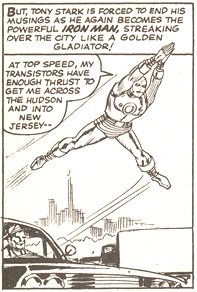
Ahhh, shut the “!@#§!* up. Take the  Holland Tunnel like everyone else, you douche. Art by Don Heck.


I was mystified by how sucky this printed turd was.

I mean, I certainly have a high tolerance for mediocre comics. Here was far from the worst comics art I’d ever seen. (The most atrocious story in the collection isn’t drawn by the series’ regular, the oft-derided Don Heck, but by the excellent Steve Ditko.  Actually, Heck’s art was better than I remembered.)

The scripts were probably no more moronic ( with their Cold War Commie-bashing and brainless plots) than other non-sucky comics of the time (the mid-60s).

Well, thank you, Ms Walton, for revealing the culprit:  the Suck Fairy.

How that destructive little vermin has blighted literature — blighted my most precious books!

When I was 12, in 1966, I had just finished reading The Lord of the Rings, by J.R.R Tolkien. I lived that book as one can only at that age.

I was jonesing for more, and Ballantine Books (Tolkien’s publisher) was canny enough to offer me the following:
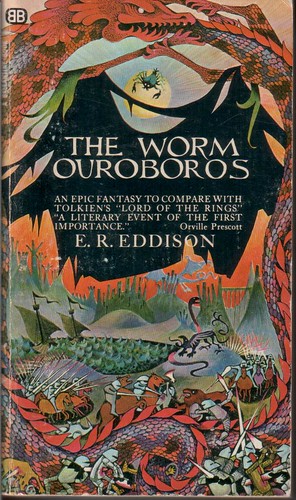
The Worm Ouroboros is an odd duck of a novel.

Written in 1922 by E.R. Eddison (1882–1945), it chronicles the war between Demonland and Witchland on the planet Mercury. Its prose style is a pastiche of Jacobean writing, gorged with archaism that I found near-impenetrable; but I doggedly forged on with frequent recourse to a dictionary, much to the improvement of my vocabulary:

But a great wonder of this chamber, and a marvel to behold, was how the capital of every one of the four-and-twenty pillars was hewn from a single precious stone, carved by the hand of some sculptor of long ago into the living form of a monster: here was a harpy with screaming mouth, so wondrously cut in ochre-tinted jade it was a marvel to hear no scream from her: here in wine-yellow topaz a flying fire-drake: there a cockatrice made of a single ruby: there a star sapphire the colour of moonlight, cut for a cyclops, so that the rays of the star trembled from his single eye: salamanders, mermaids,  chimaeras, wild men o’ the woods, leviathans, all hewn from faultless gems, thrice the bulk of a big man’s body, velvet-dark sapphires, crystolite, beryl, amethyst, and the yellow zircon that is like transparent gold.

The book enthralled me.

Jump forward ten years to 1976. I was 22, doing my military service after three years of university, and I picked the book up again. This time I found it easily readable, but rather slight; an enjoyable fantasy.

Cut to the year 2006. Once again, I plunged into the Worm — and stopped after 50 pages. Her Dread Suckiness had struck again.  The book was now a plodding, cardboard-thin gallimaufry of tushery, Wardour Street pretentiousness and outright plagiarism.

Yet, lo,” she said, as a sweet and wild music stole on the ear, and the guests turned towards the dais, and the hangings parted, “at last, the triple lordship of Demonland! Strike softly, music: smile, Fates, on this festal day! Joy and safe days shine for this world and Demonland! Turn thy gaze first on him who walks in majesty in the midst, his tunic of olive-green velvet ornamented with devices of hidden meaning in thread of gold and beads of chrysolite. Mark how the buskins, clasping his stalwart calves, glitter with gold and amber. Mark the dusky cloak streamed with gold and lined with blood-red silk: a charmed cloak, made by the sylphs in forgotten days, bringing good hap to the wearer, so he be true of heart and no dastard.

Thou suckest, o purple prose. Fie upon thee, sirrah!

(Ah, well, at least the illustrations remain lovely. Here are the Lords of Demonland:)

Art by Keith Henderson

The King of Witchland conjures diabolic forces: art by Keith Henderson


To be fair, over the end of the ’60s and the first half of the ’70s, Ballantine Books (thanks to their crackerjack editor Lin Carter) revived many wonderful classics of fantasy in paperback: Hope MirleesLud-in-the-Mist James Branch Cabell‘s Jurgen, Lord Dunsany‘s The King of Elfland’s Daughter, William Hope Hodgson‘s The House on the Borderland and The Boats of the Glen Carrig… all masterpieces immune to the Suck Fairy’s kiss!

(Touch wood…)

I used to re-read The Lord of the Rings every five years , but haven’t done so for the last two decades; you can guess why I am afraid to.

But the Suck Fairy’s master-stroke was her demolition of one of my most cherished loves:
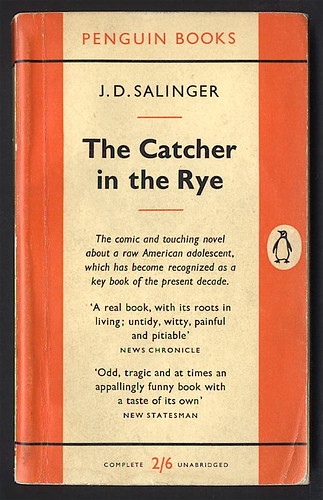
Like millions of 16-year-olds before and after me,  I read J.D.Salinger‘s novel The Catcher in the Rye and knew– KNEW!– that it was about me, me, ME;  its hero, young Holden Caulfield, was me.

All my adolescent longings and heartache and rage against the goddam phonies of the grown-up world were here. I fell in love with a book.

But the Suck Fairy was lurking, biding its time with demonic patience.

J.D.Salinger

I next read Catcher when I was 34.

I was repelled and enraged.

That little preppy brat  Holden– I’d  kick his snotty rich-kid ass all over Manhattan.

What a nasty, arch, supercilious volume of egotistic peacockery– compounding its silver-spoon ugliness with a bathetic display of mawkish sentimentality.

Damn you, Suck Fairy! Leave me alone with my illusions and my bottle.


*********************************


David L. Ulin, in his reflective essay-book The Lost Art of Reading, is troubled by this phenomenon:

I had lost books by rereading them. Flannery O’Connor’s Wise Blood, for instance, which I had loved in college but not so much later, when I began to see it as a young writer’s pastiche, less about life as it really is than a naïf’s projection about how life might be.

He is afraid to reread The Great Gatsby– and is relieved to find it as superb as he’d remembered. (I, too, find Gatsby to be better at each fresh reading.)

He finds a possible explanation in Anne Fadiman’s 2005 book Rereadings:

The former [reading] had more velocity; the latter [rereading] had more depth. The former shut out the world in order to focus on the story; the latter dragged in the world in order to assess the story. The former was more fun; the latter was more cynical. But what was remarkable about the latter was that it contained the former: even while, as with the upper half of a set of bifocals, I saw the book through the complicated lens of adulthood, I also saw it through the memory of the first time I’d read it.

Anne, Anne, Anne… that’s all true, all very well and good…

…but it doesn’t protect your literary treasures against the relentless despoiling of the vile, gloating Suck Fairy.

Is there no hope, then? As we all age, our personal troves of culture age, too.

And the evil Suck Fairy grows mightier.


Yet… is she so wicked? Doesn’t she serve an essential function in our intellectual ecology…culling the herds?

Let’s end with the heartening words of Demetrios X, commenting on Ms Walton’s blog:

There is also an extremely rare counterpart to the Suck Fairy, the Anti-Suck Fairy. It’s only happened once or twice, but I have encountered books that I was very disappointed in the first time I read them, and then found I quite liked them on a second reading. That’s not a matter of growing up or being older either. It’s happened to me with books I’ve read as an adult with a gap of only a few years.

Yes,  indeed. The Suck Fairy and the Anti-Suck Fairy are locked in constant struggle, and in the course of a reader’s life may, turn by turn, conquer a book.

Suck and Anti-Suck, in gentler days before their all-out war


Like so many children, I was enamoured of L.Frank Baum‘s  Oz books.
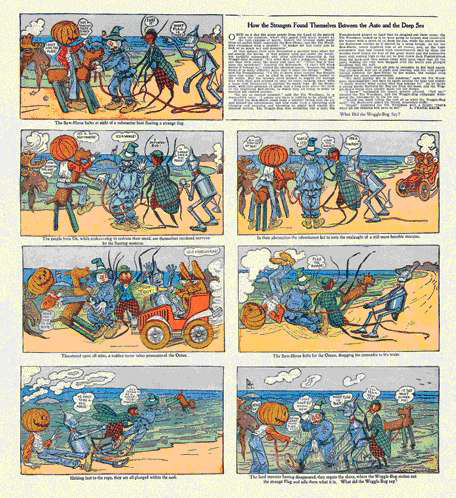
An Oz comic strip by its original illustrator, W.W.Denslow


But as an adult, I put them behind me, finding in their simple prose little of the cleverness and charm that keeps Alice in Wonderland or the nonsense verse of Edward Lear so beguiling to grown-ups.

But the Anti-Suck Fairy was on the job! Now I delight again in the Oz books, discerning satire and shrewd political commentary behind the fairy-tale façade.

Likewise, the Edgar Rice Burroughs books I devoured as a teenager seemed unreadable in later life; tedious, racist hackwork.

Art by Frank Frazetta


But good ol’ Anti-Suck showed me the wit and liveliness that ERB masters  at his best.

I particularly recommend Carson of Venus and Tarzan and the Lion Man. Among other pleasures: the former for its sly attack on eugenicism, the latter for its genial self-parody and savage send-up of Hollywood.

Time to give Catcher in the Rye another go? You bet!

So take heart, my fellow culture vultures, the S.F. is not invincible.

Can you tell me of your own encounters with the Suck and Anti-Suck fairies in the comments below?