

all images copyright JCorp Studio and are licensed for commercially-sponsored guru seminars ONLY
Category Archives: Blog

Better a Dull Memoir
This first appeared on Splice Today.
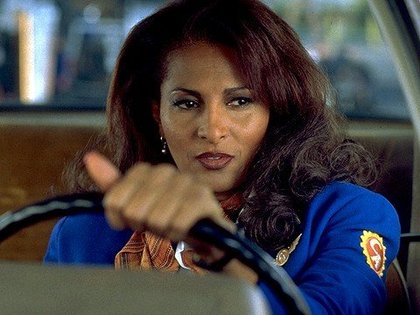
You’d think Pam Grier’s life would make for a fascinating memoir. Raised working class and rural, subjected to racial discrimination throughout her childhood and raped twice, she nonetheless, through sheer determination, smarts, and astonishing good looks, managed to carve out a career as an actor. Her iconic presence in some of the most successful and influential blaxploitation films made her perhaps the screen’s first female action hero. And along the way to semi-stardom, she dated luminaries like Kareem Abdul-Jabbar, Freddie Prinze, and Richard Pryor, survived breast-cancer, and hobnobbed, it seems, with everyone who was anyone, from Sammy Davis Jr. to Fellini.
So, like I said, there seems to be a lot worth reading about there. And the book certainly is affecting in parts. As the father of a six-year-old, I found Grier’s account of being raped at that age actually nauseating. Less somberly, Grier’s discussion of one of her visit’s to the gynecologist has to be one of the top gossip anecdotes of the year so far. In her account, Grier explains that the doctor discovered “cocaine residue around the cervix and in the vagina” and asked Grier if her lover was putting cocaine on his penis. “ Grier responds, “That’s a possibility…. You know, I am dating Richard Pryor.”
Then she admits to the doctor that during oral sex her lips and tongue go numb because, apparently, Richard Pryor did so much coke that it made his semen an opiate.
And yet, despite such moments of interest, the memoir overall is surprisingly flat. Anecdotes are dutifully hauled out — here’s Grier with her church choir at ground zero of the Watts riots; here she is singing with a drunk John Lennon. But the memoir stays on the surface; you get little sense of Grier’s inner life, ideas, or passions. Her discussions of racial and sexual prejudice are for the most part innocuous boilerplate. There are some hints that she has ambivalent feelings about the exploitive elements in her early roles, but those issues are never really explored. She’s politely reverent towards most of the stars she comes across, from Paul Newman to Tim Burton.
Part of the failure here is no doubt the fault of co-writer Andrea Cagan, whose prose never rises above competent. But the main problem is Grier’s personality. In a couple of places in the book Grier notes that she’s a “private” person — which is, like much in the memoir, a significant understatement. Grier is not merely private; she is fiercely, even remorselessly, adamant about protecting her personal boundaries. When one of her first serious romantic interests, the sexy, talented, wealthy, Kareem Abdul-Jabbar, tells her he loves her and asks her to become a Muslim so he can marry her, she takes her time…thinks about it…and finally says no. When the sexy, talented, wealthy, but frighteningly coked-up Richard Pryor wants a serious relationship with her, she takes her time…thinks about it…and eventually walks. In 1977, Freddie Prinze — with whom she’d broken up two years previously — called her to say that he had bought a gun, was thinking of using it on himself, and needed her to come help him. Though she was staying only a few blocks away from his hotel, she refused to go see him. Three days later he committed suicide. Grier notes that she was “heartbroken” and, for a while, guilty, but ultimately concludes “I wanted to save his soul, but I knew that only he could help himself, and he hadn’t really wanted to.”
My point here isn’t to condemn Grier for callousness — on the contrary, all the decisions above seem absolutely reasonable. Abdul-Jabbar, while possessed of many fine qualities, seems to have clearly been a controlling asshole. Similarly, Richard Pryor was, clearly, one of the most catastrophic train wrecks of the decade, if not the century. And even the phone call from Freddie Prinze — your ex with a megacocaine problem calls you up to tell you he’s got a gun and is feeling paranoid, please come over? I don’t think you can be faulted for saying, “you know what? No.”
A U.S.A. Today blurb on the back of Foxy declares “Pam Grier is a survivor.” When you read that, you think of her fierce characters in Coffy or Foxy Brown — fighters who took on incredible odds and beat the system. The thing is, though, in real life, survivors aren’t like that. If you take on incredible odds, you usually lose. Somebody who is going to survive has to pick her battles very carefully — and realize that usually, the best defense is actually just defense. Again and again throughout the memoir, Grier protects her safety and sanity not by embracing violence or revenge, but by refusing to do so. When she is date-raped at 18, she doesn’t tell her family because she fears that if she did, her male relatives would kill her attacker and end up in jail. As an adult, when her cousin and best friend, dying of cancer, asks Grier to read out-loud in church a manifesto attacking her abusive husband, Grier refuses. “I couldn’t open so many wounds and deal with the aftermath,” Grier writes. “I refused to be the one to read the letter and stir the pot — a decision I regret to this day.”
Again, I’m not judging — these are incredibly difficult choices, made under extreme duress, and I don’t think anyone but Grier is in a position to decide whether she did the right thing, or whether there was even a right thing to do. The point, though, is that in most every instance, Grier’s instinct is to avoid stirring the pot — and stirring the pot is exactly what you want to do in a book like this. The most successful celebrity memoirs — such as Jenna Jameson’s riveting and surprisingly insightful 2004 How to Make Love Like a Pornstar — are shameless both in their self-revelation and in their skewering of others. Pam Grier, despite all those exploitation films, doesn’t appear to have a shameless bone in her body. The qualities that allowed her to get where she did — her reserve, her poise, her dignity — are the very things that make Foxy so underwhelming. Still, even though as a reader I was disappointed, I can’t really find it in me to wish that the memoir was better. If you have to choose one or the other, after all, a successful human being is surely preferable to a successful book.
Elfquest Re-Read: Issue #5 and Journey to Sorrow’s End
In which I blather on at length about the five-act structure and complain about a prologue. Plus a craft tip! You can follow along with the comic at http://www.elfquest.com.
You’ll have to forgive my lousy photos, as I’ve recently upgraded to 64-bit Windows 7 and Epson hasn’t put out a driver for that version suitable for my scanner yet, so a point-and-shoot camera it is. Continue reading
Jared Or Somebody Like Him on Fate of the Artist
Jared Gardner or a replacement has written about The Fate of the Artist over at the Panelists.
It is hard not to see the irony. No sooner does Eddie Campbell come out from behind the cover of his autobiographical persona, Alec, then he disappears. Perhaps it was “Alec” who was preserving Mr. Campbell through all those misadventures and mundane tragedies recorded in such excruciatingly blissful detail in the volumes collected in Alec: The Years Have Pants. If so, I daresay he lived just long enough to regret the decision to cast off his shield.
This is the end of our cross-blog Eddie Campbell foofarah…at least for now.
Forests and Trees
(Update: Should have noted this earlier: you can read a pdf of Moto Hagio’s Bianca here.
1.
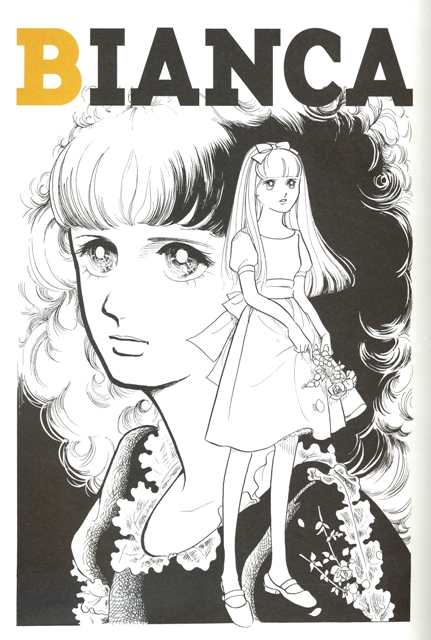
In his first column for the new tcj.com, Ken Parille discusses Moto Hagio’s story Bianca. Ken says that the first time he read the story he was not very impressed. However, he says, he decided to try reading it over and over to see if it grew on him. And so it did.
What’s most interesting to me is the way Hagio carefully sets up the story to appeal to child readers, in this case, young girls. The central tension that animates “Bianca” is found throughout children’s fiction, especially fairy tales: hostility toward authority figures, such as parents, other adults, and even older children or siblings. Within the logic of such tales, the young child is often an innocent under assault by the actions and beliefs of manipulative older characters. Such stories dramatize a wish-fulfillment fantasy for the reader, who is imaginatively allowed to punish an authority figure, occasionally even committing fantasy patricide or matricide. We see this in tales like “Hansel and Gretel,” in which the evil step-mother, who had abandoned the title characters in the forest, mysteriously dies at the end, just in time to be deprived of wealth the children had taken from the witch, the step-mother’s doppelganger. Identifying strongly with the abused child characters, the reader (who likely resents authority figures who control her) might experience the death of both women as a fulfillment of a kind of revenge fantasy. In “Bianca” revenge is the real theme, enacted, as we will see, on Bianca’s cousin Clara.
Ken goes on to work through the structural contrast between nature (child) and civilization (adult). He concludes (as the above indicates) that Clara, the narrator, is on the side of civilization, and that Bianca is on the side of nature. Where other readers (like Kate Dacey) have seen Clara as allied with Bianca, Ken sees them as opposed. Or as he says:
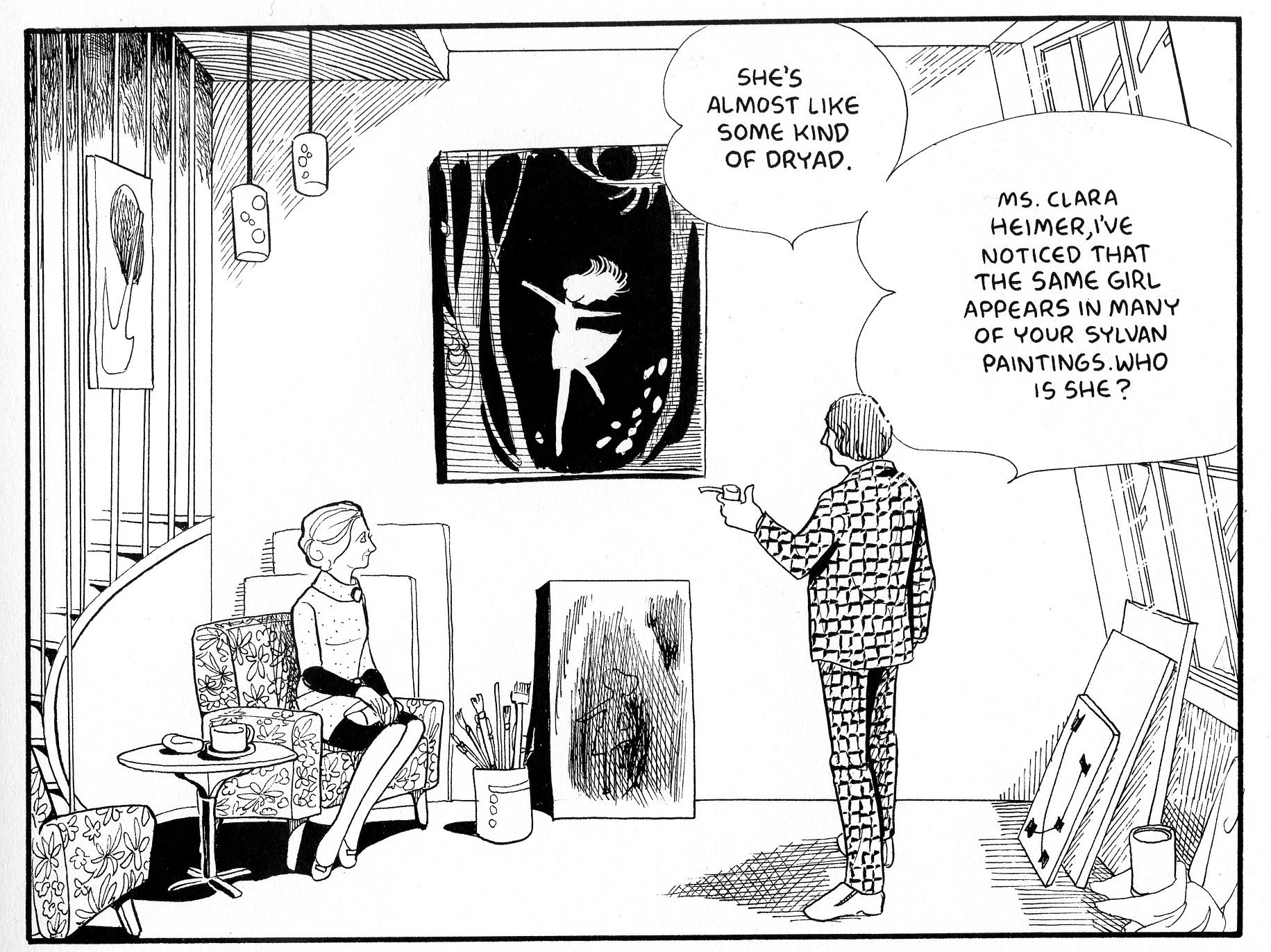
Yet Clara’s paintings also seem false: every one idealizes Bianca, turning her into a cliché: a perfectly posed dancing ballerina. Clara caused her cousin pain, but she avoids representing this pain in her art. Perhaps Clara learned nothing from her short time with Bianca. Decades later, she still sits in the house (an imprisoned gothic victim?), creating paintings that are a whitewash, that erase all signs of her guilt and complicity. Is Hagio aware that Clara’s art shows none of the complexities and none of the darkness that “Bianca” does? As an artist of the child psyche, Clara is a charlatan compared to Hagio.
This is a stimulating and thoughtful review. I still disagree with it though!
In fact, Ken’s essay is an interesting object-lesson in the dangers of academic criticism. You can find tension and structure in any narrative. The longer you look, the more structure you’ll see; we’re meaning-making creatures. So then, is the point of criticism just to see whether you can play with that structure? Is the goal of evaluation to declare that you have done so? Ken does relate his structure to other ideas (childhood paranoia, fairy tales — lots of things) but his evaluative criteria pretty much all come back to, “look! structure!” Or as he puts it at the end of his essay:
It’s a sentimental-gothic fantasy that plays into a child’s paranoia about elders. And it’s fascinating.
Sentimental-gothic fantasies that play on paranoia aren’t all that original or special. Ken admits elsewhere in the essay that the handling of those themes here is “straightforward” rather than more ambivalent or complex (as Nicole Ruddick had argued). So by Ken’s own admission, we have a familiar binary between nature and culture presented in a straightforward way. Why is that interesting? Nothing in his essay really answers that question.
2.
I’d also argue that Ken’s binary take on the story leaves a lot out. For example, Ken overemphasizes the tension between Clara and Bianca. For Ken, as noted above, Clara is civilization, Bianca is innocent nature. But are they really so separable? They’re cousins after all…and Ken notes that they’re difficult to tell apart visually. They’re parallel. Indeed, it’s possible, without too much difficulty (and in light of Hagio’s story Hanshin) to see them as the same person. Bianca, who becomes adult Clara’s soul and inspiration, could be seen metaphorically as simply Clara’s youth — her younger, freer self. Certainly, she’s an aspect of Clara; her complement, not her antithesis.
In that vein, I don’t see anything in the story that undermines Clara as strongly as Ken wants her to be undermined. Ken above insists that Clara’s paintings are empty and trite. From this Ken concludes that Clara does not understand Bianca’s true conflicted nature.
There’s another, simpler explanation for why Clara’s paintings are cliched and saccharine, though. It’s because they look like Hagio’s drawings! In fact, Clara’s paintings seem more ambivalent than Hagio’s, if anything.
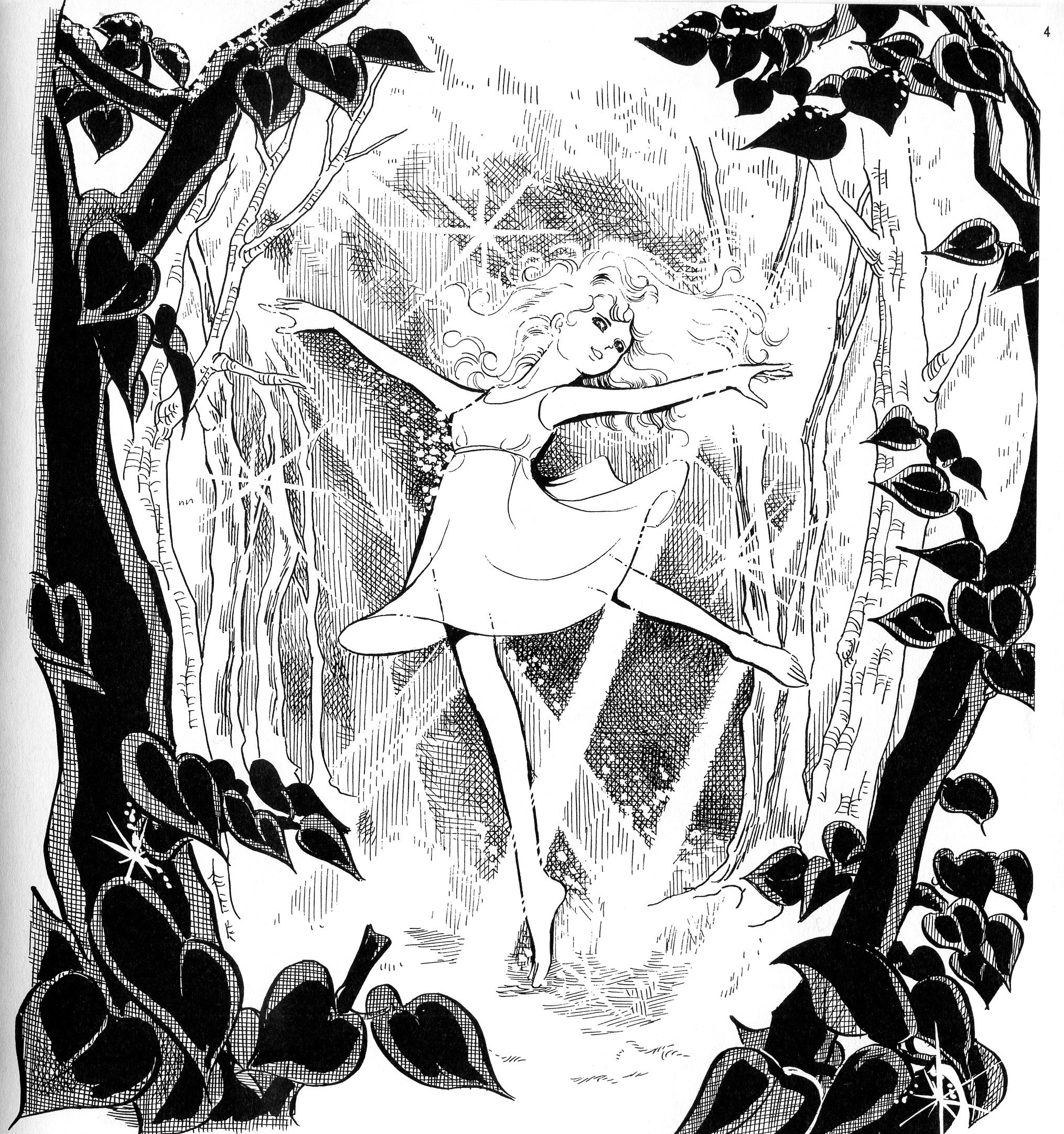
This picture below is by Hagio as herself.
And this is Hagio drawing as Clara.
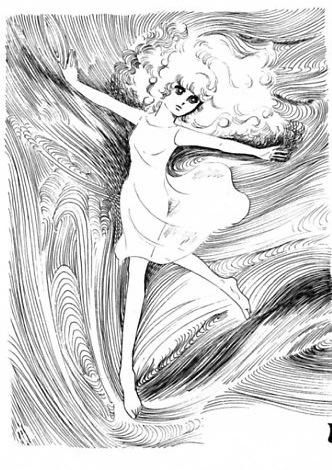
Contrary to Ken’s suggestion, it’s Clara’s picture, with its swirling backgrounds, stiff pose,and staring eyes, which seems (marginally) more haunted. Hagio’s version of the “real” Bianca is a straightforward confection. I really see no evidence (and Ken, despite his close look at many images, provides none) that Clara’s paintings consistently convey a less nuanced vision of Bianca than Hagio’s drawings do. It’s Hagio, who, as Ken says, “idealizes Bianca, turning her into a cliché: a perfectly posed dancing ballerina”. Both pictures are cloying; Clara’s is maybe marginally less so if you squint at it.
The main takeaway, though, is that Clara draws Bianca just like Hagio draws Bianca. Both idealize the child, and both are, in the logic of the story, right to do so. Again, Clara’s insight and artistry are not an antithesis to Hagio’s; they are (such as they are) one and the same.
3.
Similarly, I think Ken’s focus on binaries causes him trouble here:
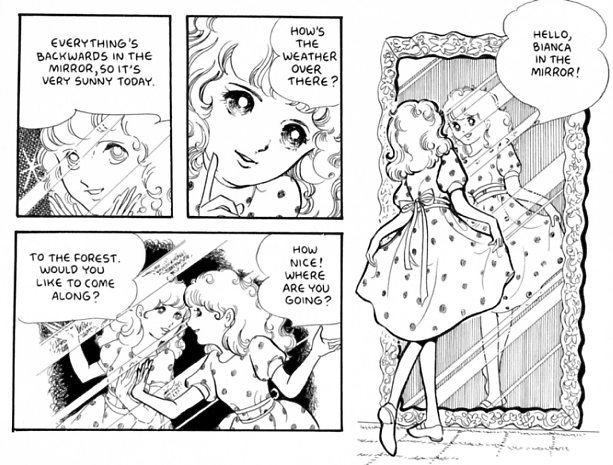
Ken says of this sequence:
When Bianca looks into the mirror, she looks into an adult-free utopia in which the soul always sees its eternal sunshine reflected back at it. To look in the mirror is to look backwards, a nostalgic glance to the soul’s original perfection. The mirror tells us, “The world would be a child’s paradise if only all of those old people would stop screwing it up.”
Ken thinks Bianca is delighted by the mirror because there are no adults in it. But (in a panel Ken doesn’t reproduce) Bianca doesn’t say, “Hello no adults in the mirror!” She says, “Hello, Bianca in the mirror!” What’s delightful and exciting about the mirror has to do with Bianca herself. The sunshiny day is obviously a (very, very tired) symbol for a world with no troubles…but the playfulness here, the emotional charge, is in the flirtatious doubling.
The flirting with the mirror image reproduces the flirtation between Bianca/Clara. From Bianca’s first coquettery:
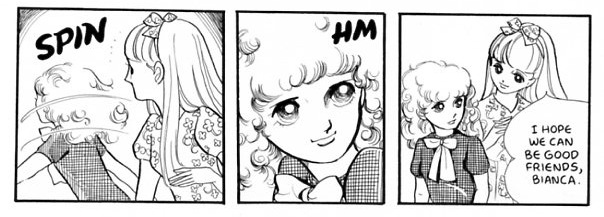
to the lover’s quarrel.
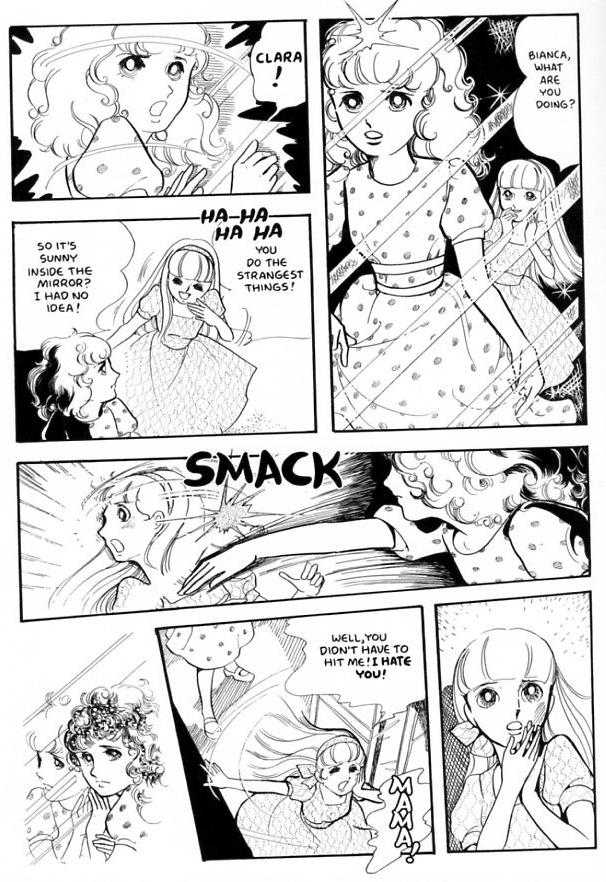
This ambivalent relationship between Clara and Bianca mirrors the relationship between Bianca’s parents, whose break-up diagetically accounts for Bianca’s volatility. Notably, it is Bianca’s mother who has left her father. Similarly, in the sequence above, Bianca rejects Clara — the implication being that both mother and daughter are free spirits escaping domesticity. Thus, it isn’t Clara who is acting like an adult; contra Ken, it’s Bianca.
4.
For Ken, the story is about punishing adults. Whether or not that’s the case, there’s not doubt that “Bianca” is more effective at punishing Bianca than it is at punishing Clara. Clara grows up and becomes a successful artist. Bianca suffers death by landscape.
The creator and manipulator of this particular landscape is, of course, Hagio herself. And so it is Hagio who, in an extremely contrived fashion, off the little darling. After which, Clara faints, and her mother swoops in to grab her:
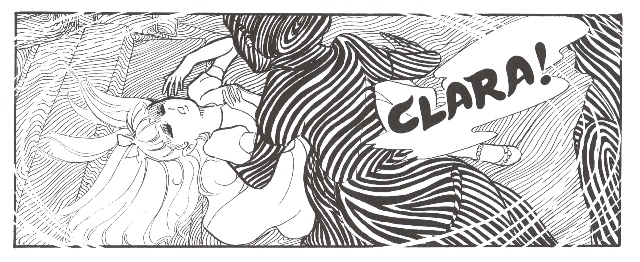
Ken reads this through his familiar binary. It shows adults are bad.
On an interestingly composed page that employs many shading styles, Clara faints after learning of her cousin’s death. Hagio draws Clara’s mother as a series of swirling lines of different weights, and I assume this visual style mimics Clara’s impaired perception: we are “seeing” the mother through the eyes of the fainting girl. Yet these thick black lines give the mother a demonic aspect—and demonic is the deep nature of adults in Bianca’s world, who only appear to be friendly. Coming at a key moment, this visual approach amplifies my reading of the story’s intense antipathy to ageing and adult culture.
But how ominous is this? Clara looks like she’s in raptures. The swirling lines intensify the sense of orgasmic disorientation; it’s one of the loveliest pictures in the story. Moreover, the swirling obscures identity; the mother becomes someone else. Leaning down with her back to the reader, she’s not only a mother, but Hagio herself, protecting — or is that ravishing? — her creation. Bianca drops out of sight and leaves in her wake an ambivalent, melancholy ecstasy.
Clara goes on to spend the rest of her life making an aesthetic fetish of the girl who once rejected her and was then more or less instantly destroyed. For Ken, the fact that this is disturbingly morbid indicates that Hagio is criticizing her character. This rather ignores the fact that Clara and Hagio are doing the exact same thing. Hagio killed Bianca in order to turn her into an aesthetic fetish. Killing children to turn them into aesthetic fetishes is not an especially pleasant thing to witness. And this is why the story is, I’d argue, ugly.
5.
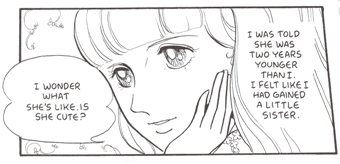
Hagio does not identify as a lesbian. Nonetheless, like almost all of Hagio’s work, Bianca is powered by its queer subtext — emotions unspoken, longings that grow and metastasize like faces in a funhouse mirror. The story desires Bianca, but that desire is not articulated, either by Clara or by Hagio. Bianca is freedom, but what freedom exactly — what emotions, what desires — can’t be named. So Bianca is safely done away with, at which point her image can be retrospectively and safely consumed.
Ken is somewhat stumped as to why Bianca is killed in the forest when (by his binary) civilization should kill her. She should logically die by falling downstairs or some such, if indoor/outdoor is really what matters. But of course that isn’t what matters. The issue isn’t civilization vs. the forest. The issue is getting rid of Bianca in a way that makes her ripe for mythologizing. Having her vanish into her nature —neatly eliding all the issues raised by having an actual, real nature, rather than a picture of one — works perfectly. One with the forest, she embodies freedom, a formulation which conveniently gets rid of her body and of any suggestion as to what in particular she would do with that freedom if she had it.
The point here is emphatically not that Hagio has to tell “Bianca” as a coming out story. But it does seem like there needs to be some acknowledgment that Bianca’s tragedy is not the destruction of her innocence, but the failure to destroy it. After all, Bianca doesn’t grow up. Clara and Hagio prevent her from doing so; they conspire to keep her the perfect, frozen ballerina on a cake so she will never become a friend, a sister, or a lover.
In Hanshin, in Iguana Girl, in Drunken Dream, Hagio is able to make art from an acknowledgement — rather than a refusal — of specific bodies and individual desires. In the story AA’, she confronts the bleak, frozen downside of innocence — of not knowing what you want or who you are —as well as its smiling surface. In all the best work of hers I’ve seen, she explores the queer knot at the heart of identity and love. But “Bianca” is not so courageous. It shakes its finger at the mean repressors for silencing the inner kiddies, while surreptitiously devoting its resources to putting those kiddies quickly and safely underground, so they can be either transformed into treacly images and ignored.
Ken looks at the structure of the forest, but he misses the thing dancing there under the trees. “Bianca” seems trite not because readers haven’t looked at it sufficiently closely. It seems trite because it’s a lie. “Bianca” is a story that celebrates freedom by embalming it. As a result, it’s an emotional and aesthetic failure, hiding what could have been its real concerns with shallow moralism and weak allegories. What’s left is only a shadow of an art that wasn’t; a false picture of a false picture.
____________________
This is part of an ongoing series on Moto Hagio’s Drunken Dream.
New Hood
So as you’ve probably noticed things look different. For this, we thank (and thank and thank) Derik Badman, who has not only worked his butt off to make this happen, but who has also had to deal with my incessant obsessive carping, a fate that no self-respecting web designer should be forced to endure. So thorough was said carping that Derik has in fact disavowed all design input, and insists he was only responsible for tech. I will abide by the letter of his wishes in this regard…but I still feel strongly that if anything looks good, you should give him credit, and if anything doesn’t, you should blame me.
Also, I want to extend groveling appreciation to the incomparable Edie Fake, who designed our new banner just as he designed our old one. If you pine for the old one, I thought I’d put it here, where the nostalgic can still visit it as they wish.
And since this is HU, we will now move to the cranky criticism portion of the post.
Whyyyyyyyyyyyyyyyyyyyyyyyyyyy!!!!!
Or as my dear friend Bert Stabler put it:
Ugh. Crowded, confusing, clashing colors. Maybe I would like it if I liked reading magazines, which I distinctly do not. But on web pages, less is emphatically more. The TCJ design (which I think carried over from pre-TCJ) was perfect.
I’m sure Bert won’t be the only one displeased. I’m quite happy with our new format, but obviously some people are going to pine for the simpler, more streamlined days of yore.
So…why’d we do it?
Well, basically we were outgrowing our old digs. HU has been moving fitfully towards a magazine format with more contributors and more content. As a result, long ambitious articles get knocked off the top of the page by shorter (albeit still brilliant!) chatty, bloggy pieces. That doesn’t seem fair to either readers or writers. The new design will help us feature the bigger pieces for longer…and should give us room to grow and put out more content if it should come to that.
A ton of people were kind enough to look at the new design in various stages and offer advice and guidance. The site looks and works much better thanks to their input. Many, many thanks to Melinda Beasi, Ng Suat Tong, Kinukitty, Bert Stabler, Derik Badman, Sean Michael Robinson, Kate Dacey, Bill Randall, Robert Stanely Martin, Caroline Small, Craig Fischer, Erica Friedman, Jared Gardner, and Tucker Stone. (And if I’ve forgotten you, please email me to tell me I’m an ingrate/remind me to thank you publicly.)
Despite the help of so many folks, I’m sure there are bound to be bugs and bumps as we get used to the place. Let us know what they are and we’ll try to fix them and/or ignore them, as the case may be. In the meantime, I hope you get a chance to look around. We’ve got a bunch of exciting posts coming this week — and we’re also pleased to welcome a new temporary blogger, Anja Flower, who’ll be writing regularly with us for at least a couple months. Also, scroll down to the right and you’ll see we’re going to be featuring some posts from the archives. This week, we’ve got Caro’s post on Anke Feuchtenberger.
Also, we’re now enthusiastically social mediaing. You can follow us on twitter, or on facebook. Or you can get our RSS feed.
We haven’t managed to do quite everything I’d hoped. Enabling editing of comments turned out to be harder than I thought; I still need to put together a blog roll, damn it…and I really want, sometime, to move our old blogspot material over here….
But for now this is what we’ve got…and not so bad, I hope. Thanks again to Derik, to everyone who helped with the design, and of course to all of our regular writers, commenters, and readers. If you have a compliment or complaint you can email me at noahberlatsky at gmail. Or leave a comment!