Noah: Not Drowning, Just Waving

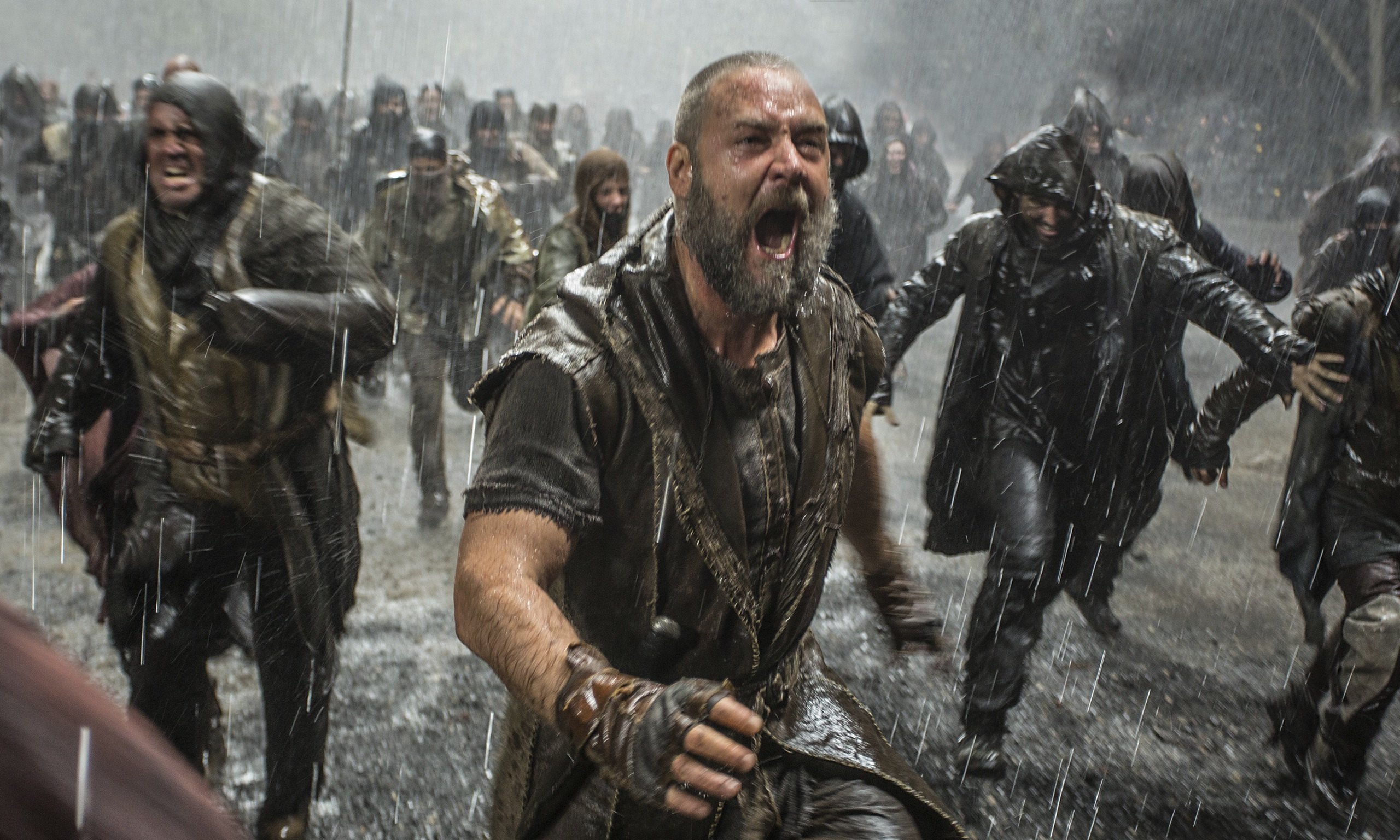
Russell Crowe as Noah

 
I saw this with a co-worker at the end of a long work week (I’m now working 8-4 every weekday and 10-5 every Saturday, plus commuting time, which is why I haven’t been posting here much). I thought it was going to be a stupid three-hour blockbuster, like Apocalypto or 10,000 B.C., and it was in a way, but it was also WAY weirder, so when Darren Aronofsky’s name came up in the credits I was like oh yeah that explains it.

The main thing that makes the movie weird is that it completely lacks the three-act structure of a modern blockbuster movie, or really any sense of cinematic pacing at all. Many individual scenes do have a dramatic build, especially the ones that develop Russel Crowe/Noah’s puritanical zealotry*, but there was also a tendency after about the halfway point to try to wring maximum melodrama out of EVERY domestic scene, which leaves you-the-viewer with no sense of which scene is a “climax” and therefore no sense of when the movie is going to end.

(After the Ark reaches land, presumably – but then the movie continues for another half-hour, RoTK style.)

Spoilers ahead!

Overall the old-school chronological pacing style makes an already long movie seem even longer, but personally I’m glad that Aronofsky didn’t attempt to fit a biblical epic into a structure that couldn’t have fit it. It’s not that he lacks a sense of how long each scene should be – the opening voiceover about The Fall of Man and The Curse of Cain is mercifully short, about the length of the opening of the Avatar TV series, for instance, because we already know how those stories go. But the movie is faithful to its source material in this way: it follows all the events and doesn’t leave anything out, not even the genealogy bits. Biblical epics are SUPPOSED to seem long because the idea is that we should get to enjoy them for the maximum length of time – sort of like how you might prefer American comics over Japanese ones because the dense writing and lack of visual flow means they take longer to read. I’m completely sick of Saves the Cat style blockbuster pacing so I thought this was a nice change.

In other ways Noah is not faithful at all, LOL, and personally I really enjoyed all of the movie’s attempts to take a story that doesn’t make sense (it rains so much that the world floods instantly, the Ark is big enough to house two of every animal, five adults build the whole thing, etc) and to invent ways to MAKE it make sense. It was kind of like Chris Nolan’s Batman in that way (and just like Batman, there’s still that one thing the movie doesn’t even attempt to explain). The stop-motion-ish Guardians were cute, and the human King was a good foil.

Personally, though, my favorite change was the thematic shift from ALL DESCENDANTS OF CAIN MUST DIE BECAUSE THEY ARE IMPURE – ONLY SETH’S LINE IS WORTHY (ugh) to ALL OF HUMANITY, INCLUDING OUR OWN LINE, MUST DIE BECAUSE WE AREN’T ANY BETTER. By making that change, in a single stroke you remove the racism/tribalism/determinism/whatever you want to call it of the original story, turn Noah into a more interesting character, and provide the drama that powers the rest of the movie.

Though speaking of drama, as a gay person the emphasis on how Noah’s kids HAD to find a Faithful Wife and Have Kids to be happy seemed kind of misplaced to me, like for instance a lot of the conflict in this movie could have been averted if Shem and Ham had only shared the barren Emma Watson** between them. The film’s unquestioned assumption that heterosexual monogamy is The Way Things Are seemed odd especially considering the incest themes in the biblical Noah story, which the movie didn’t get into, but did kind of imply (Emma has twin girls, Mom says Hurrah The Creator has given us what we need for our other two sons!). But I’m sure for many people this wouldn’t even have pinged.

There’s a scene of doomed humans dying on a rocky outcropping as the stormwaters raged on that I thought was a nice touch, like something out of a Goya painting. Apart from that one (brief) scene, Russell Crowe’s visions of death and destruction were probably the most visually interesting part of the movie, which for a “blockbuster” action movie looked pretty shockingly low budget at times (for instance it’s hard to make a couple of raggedy actors in a totally barren, untouched-by-human-hands landscape look like anything but a way to keep costs down). But since I thought I was watching a popcorn-blockbuster for a Christian audience, I kind of enjoyed that cheapness too. I’m easy, I guess.

*Russell Crowe is not only starting to get typecast as a zealot after his role as Javert in Le Mis, he also sings (badly!) in this movie, too! I personally was happy to see him characterized as a zealot – one of the frissons of “Noah” is that Noah is clearly not wrong that humans are going to mess up the planet again and therefore the only permanent solution is to wipe us out – the radical environmentalism of some Japanese anime directors – but at the same time, his horror at humanity is clearly also at least partially psychological, f’rinstance when he visits the human camps outside his own settlement and decides humans are venal and weak based on a half-real-and-half-dream interpretation of what he sees there.

**Emma Watson is too good-looking and too charismatic and has too much chemistry with everyone, including Russell Crowe. In fact she might have MORE chemistry with Russell Crowe than with the actor who plays Shem, although we could also put that down to the fact that her scenes with Noah are a lot more emotionally intense. The chemistry between her and Crowe reminds me of how John Cusack is drawn to teen-popstar Hillary Duff in War, Inc, resists because he’s old enough to be her father, and later finds out that he really *is* her father! The moral of the story: don’t sleep with anyone who’s young enough to be your own daughter because you just never know. Anyway, Russell Crowe is working with Jennifer Connelly again in this movie, whom he also worked with in A Beautiful Mind, and would (probably) never go there.

***

To sum up, I personally enjoyed this movie, despite all its shortcomings. It made a well-known story from the Hebrew Bible seem bizarre, which as a Jew I’ve also felt was the case. Maybe my expectations were low, maybe the movie was just stupid enough at the end of a long work week, maybe I’m so sick of formulaic dreck that I’ll happily take idiosyncratic dreck instead, but I’d say it’s worth seeing.
The Romance of Dystopia

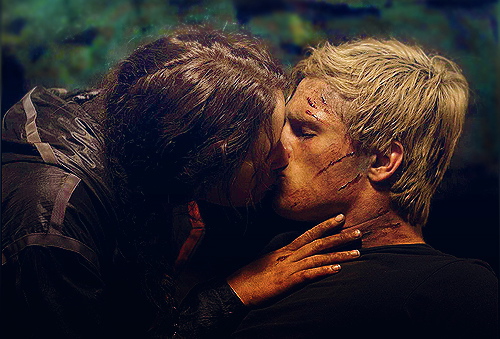
katniss-peeta-kiss

 
The Hunger Games and Divergent may have romance elements but they’re not romance novels. Katniss and Tris don’t, for the most part, have time to focus on boyfriends; they’re too busy trying to stay alive and fighting their oppressors. Romance is about love; the most popular YA dystopias are about freedom. That’s a fundamental difference.

Or is it? When you actually read romance novels, it’s not so clear. Especially in historical romances, the parallels with YA dystopias can be startling. For example, Laura Kinsale’s 1993 classic For My Lady’s Heart is set in Medieval Europe — a setting as alien, and in many ways as authoritarian, as Tris’ future Chicago or Katniss’s District. The Princess Melanthe, like her peers in YA, is hemmed in by rules and proscriptions, her every move monitored and enmeshed in plot and counterplot. Born in England, Melanthe married into an Italian house, and her husband’s death set off a cascade of political intrigue as various suitors vie for her lands and power. One of her husbands’ Italian rivals has forced her to travel with his son, a castrated assassin who sleeps in her bed to make sure she doesn’t betray his father even in her sleep. Her entire life is devoted to concealing her real feelings under an icy veneer of calculation. Her husband “had trained her to trust no one and nothing, to lie of everything to everyone.” That’s how you live under totalitarianism. Katniss pretending to love Peta;  Tris concealing that she’s divergent; Melanthe pretending to marry a man when she has no intention of doing so — they’ve all learned to dissemble in the face of power.

Rose Lerner’s recently published Regency romance Sweet Disorder is less grim — no one is threatened with death — but there are still parallels. Phoebe Sparks is a poor widow whose sister has become pregnant out of wedlock, and faces exile and shame As a woman without much money, Phoebe’s options are constrained by rules which are both arbitrary and cruel. There’s a local election, and both sides are willing to provide her with much needed cash since her vote is needed — except that it’s not her vote, but her husband’s. should she remarry. Because of the elaborate mores of a strange society, she has to sacrifice herself to save her sister…which is exactly the dilemma which faces Katniss in the Hunger Games.

All of these books, then, are devoted to dystopias, past or present — they all involve women trying to live their lives in the shadow of repressive power. Or, to look at it another way, they all concern women trying to negotiate between patriarchy and love.

It’s true that the exact nature of that negotitation is somewhat different in Hunger Games and Divergent than it is in For My Lady’s Heart and A Sweet Disorder. Most obviously, the YA novels involve significantly more guns. Katniss and Tris protect their loved ones, or try to, through violent political action; the response to exploitive power structures (which, significantly, aren’t always run by men in either book) is revolution. Romance novels, on the other hand, tend to look for non-violent, personal solutions to political problems. Pam Rosenthal’s Regency The Slightest Provocation, for example, concludes with the protagonists, an estranged husband and wife, reconciling and declaring their love as they work together to prevent agent provacateurs from goading laborers into a demonstration that the government can bloodily quash. Injustice is undermined by peace and love, both personal and political. YA responds to patriarchal dystopia with violent political resistance; Romance with nonviolence abetted by personal affection .

Again, though, the binary is less clear than it appears. The Hunger Games, for instance, is acutely aware of the limitations of violence as a response to violence. Katniss’ embrace of revolution ultimately destroys the sister who she was fighting for in the first place. The rebellion in The Hunger Games, led by a woman, doesn’t challenge the patriarchy. It just replaces one boss with another, cosmetically different, but every bit as vicious. And for its part, For My Lady’s Heart doesn’t exactly forswear violence; Ruck, the hero, fights for Melanthe on a number of occasions, and while the tourneys aren’t to the death, the novel still unequivocally glories in his prowess, and in might asserted on behalf of right.

Rather than seeing YA dystopias and historical romances as opposed, then, it makes more sense to see them as thinking through related questions in complementary or overlapping ways. Can you use the tools of patriarchy, such as violence and paranoia, against patriarchy? Does forswearing those tools leave you defenseless? Is love a weakness, which gives patriarchy a hold on you, sending you to the Hunger Games (like Katniss), or into an arranged marriage (like Phoebe, in A Sweet Disorder)? Or is love a strength,  which gives you the heart to resist oppression?

Despite the similarities, I wouldn’t necessarily insist that YA dystopias should be shelved with, Romances. Genre markers are fairly arbitrary. But as in YA and historicals, that arbitrariness is itself indicative of lines of power. YA isn’t generally seen in the context of Romance novels because Romance novels simply aren’t seen; mainstream conversations about genre fiction include sci-fi and mystery and children’s lit and YA, but the genre with the largest sales and readership is almost entirely ignored.  Seeing Hunger Games and Divergent as future historicals is a way to see them as not just about the dystopia to come, but about the dystopias we’ve already (and continue) to have. And it’s also a way, perhaps, to grant Katniss and Tris their love along with their violence, and to see that they aren’t the first to wrestle with those options. They have many sisters who came before them.

Unmasking the Joker

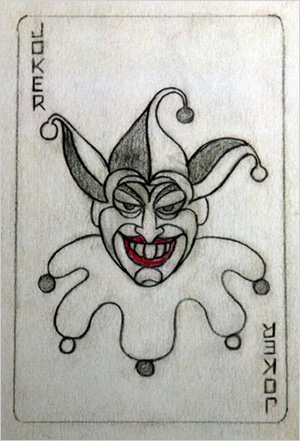
Jerry-Robinson-Joker-Sketch-Card

 
Who created the Joker?

Standard answers boil down to some combination of Bob Kane and his assistants, writer Bill Finger and artist Jerry Robinson. According to Kane though, Robinson “had absolutely nothing to do with it” because Robinson’s contribution—the Joker playing card used in Batman No. 1—was added after Kane and Finger already thought up the character. Robinson, however, claimed “the concept was mine,” including both the playing card and the “outline of the persona and what should happen in the first story.”

They were both wrong.

The Joker was Finger’s idea, and I know because he stole it.

Kane and Robinson agree that Finger handed Kane a photograph of Conrad Veidt from the 1928 film adaptation of Victor Hugo’s The Man Who Laughs which Kane used to draw the Joker. A clown-faced ad for a Coney Island attraction has gotten some credit too. But Finger’s kept his primary source hidden.

The Joker’s first appearance begins with a death threat: “Tonight at precisely twelve o’clock midnight I will kill Henry Claridge…”

Henry Claridge, frantic with fear, calls the police.

CLARIDGE: “You’ve got to protect me!”

POLICE CHIEF: “Don’t worry, Mr. Claridge.”

Time drags on—seconds minutes— then the fatal hour twelve o’clock.

CLARIDGE: “I’m still alive! I’m not dead! I’m safe! I’m SAAAAGH! Aaghh!”

The Joker has fulfilled his threat. Claridge is dead!! Slowly the facial muscles pull the  dead man’s mouth into a repellent ghastly grin. The sign of death from the Joker!

CHIEF: “It’s—it’s horrible!”

OFFICER: “Grotesque! The Joker brings death to his victims with a smile!”

The Joker repeats the pattern a page later:

“At ten o’clock that fiend will kill Jay Wilde!”

The toll of time—the fatal hour!

BONG! BONG!

WILDE: “Ten! It’s going to happen now! The clock is ticking my life away!”

A strangled scream—death!

JOKER: “Are you so happy that you smile for joy, eh? I’m glad I have brought you so much cheer!”

My son was ten the first time he flipped through my Batman Chronicles reprint, half the age of students in my superhero class who looked equally disturbed. It struck a nerve in 1940 too. Kane’s DC editors rescued the Joker from death to keep a recurring character—one who would become the most famous supervillain in comic books.

But he wasn’t new to pulp fiction. His first joke was published a quarter century earlier:

Cocantin had just noticed that Favraux held in his hands a yellow envelope similar to the one that contained Judex’s earlier message.

The banker unsealed it. Scanning every word, he read it aloud:

If before the stroke of ten tonight, you don’t relinquish half of your ill-gotten fortune to the Public Assistance, it will be too late. You will be punished mercilessly.”

And it was signed: JUDEX!

“The joke continues,” emphasized Cocantin with a humorous smile.

“It has lasted for too long,” scolded the banker while raising his eyebrows.

“Don’t be upset, Monsieur Favraux,” implored Cocantin. “. . . .This sinister joke will soon collapse due to my efforts. . . . I reassure you, Monsieur. I will look after you!”

. . . The monumental clock on one of the room’s panels displayed two minutes before ten o’clock. . . . Instinctively, his eyes sought the clock. The hands had almost reached the time foretold by Judex. . . .  Fear shook his mortal frame. . . .

The clock struck ten o’clock. Favraux’s face contracted in a hideous convulsion. . . . As a frightful moan escaped his throat, he collapsed. He had been struck down!

Judex had kept his word!

In the commotion, guests ran to Favraux’s side. . . . The facial features of the gilded banker were frozen in a grotesque grimace of superhuman fright.

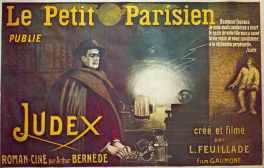
Swap a few names–“the Joker” and “Judex,”“Favraux” and “Claridge” or “Wilde,” “Cocantin” and the Police Chief—and the scene is the same as the ones in Batman No. 1. Except it was written in 1916 when Bill Finger was only two years old. It’s by Arthur Bernéde from his novelization of director Louis Feuillade’s film serial Judex. The French magazine Le Petit Parisien published installments with the theatrical release of each weekly chapter.

Feuillade’s previous serial had brought the villain Fantomas to screen, but the title character of Judex—often cited as an influence on the cloaked and slouch-hatted Shadow who in turn influenced Batman—is the hero, a “judge” taking revenge on a corrupt banker (who, we later learn, isn’t really dead). When Finger supplied his boss with the Veidt photo, he was filling in details for “the joker” of Bernéde’s text.

It’s possible Robinson drew his playing card independently—stranger coincidences happen. It’s a greater leap to think Robinson handed it to Finger first, triggering Finger’s memory of the “joke” in Judex. Either way, Bernéde’s contribution outweighs all others. Kane even drew him with Judex’s hat and white face of the 1916 magazine illustration.
 

JudexbJoker

 
I have no idea if Bill Finger ever saw Judex, but according to Robinson he was a voracious reader “who spent lots of time doing research.” Robinson also called him his “cultural mentor,” describing him as “extremely well read” and a “student of pulps and radio drama” as well as “Dumas and Shakespeare.”

Bernéde and Feuillade, avid researchers themselves, read Alexander Dumas too. Judex’s destruction of Favraux’s ill-gotten fortune as well as imprisoning him until he acknowledges his wrong-doing—that’s the  Cliff Notes version of The Count of Monte Cristo, the fate suffered by one of the three men who falsely imprisoned Dantès before he assumed the guise of the vengeance-seeking Count.

But neither Dumas nor Feuillade originated Bernéde’s joker scene. The silent picture includes little of the banker and the detective’s dialogue (neither of the “joke” references) and when Favraux collapses on screen, Feuillade supplies no close-up.  The “grotesque grimace” exists only in Bernéde’s novelization, the version of Judex Finger could have easily accessed.

Bernéde figures in Batman’s origin too. When Kane needed an explanation for his hero’s “lone battle against the evil forces of society,” Bill Finger retconned a pair of murdered parents and a vow of vengeance. “I swear by the spirits of my parents,” cries the kneeling Bruce Wayne, “to avenge their death by spending my life warring on criminals.” The young Judex kneels before his own father’s body, as his surviving mother demands the same vow: “your father was murdered by a crook named Favraux. Swear before him that you will avenge his death . . . .”

This isn’t the first time Finger borrowed heavily from another writer. Will Murray details Finger’s use of Theodore Tinsley’s 1936 Shadow novella, Partners of Peril, for Bat-man’s first adventure in Detective Comics No. 27. “Finger did not simply draw inspiration from this thunderous tale,” writes Murray, “he adapted it outright! It’s the same story . . . . Only the character names have been changed.”

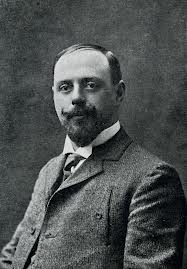
The Joker’s real name is Arthur Bernéde.

Arthur Bernéde

Overrated Man and The Sea

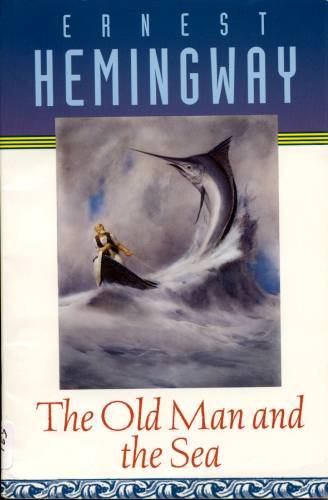
Underrated/overrated 20th century lit? Hemingway gets my vote for overrated; he’s treated like a god and I find most of his work fairly puerile. “The Short Happy Life of Francis Macomber” with its boys’ adventure misogyny is a particular low point, but the manly men doing manly things with fish narrative also seems like Jack London without the hyperbolic preposterousness which makes London fun.

Underrated I’d say James Baldwin. His essays are maybe the best essays in the English language, but he’s mostly seen as a specialist interest, as far as I can tell. I wish folks would read him in high school rather than the Great Gatsby.

So what do you folks think? What 20th century writers are underrated or overrated?

41aAU9FYX3L

The Grand Budapest Hotel’s Lost Pouilly-Jouvet

andersontrain grandbudapesttoast


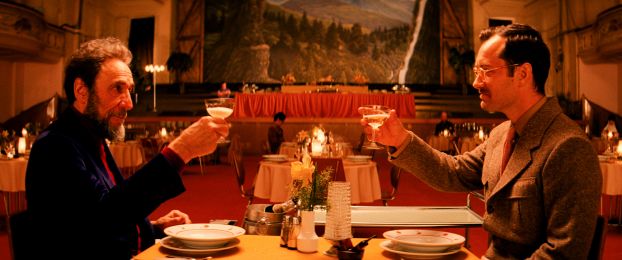
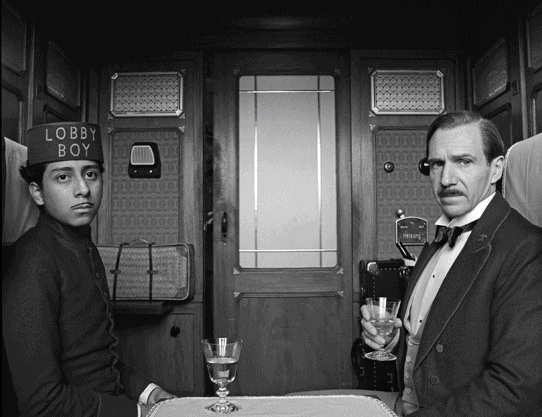
“Do it—and bring a bottle of the Pouilly-Jouvet ’26 in an ice bucket with two glasses so we don’t have to drink the cat-piss they serve in the dining car.”

 It should not be surprising that a film about a luxury hotel features a few wine cameos. Nor should it be surprising that a comedy should make a joke of them. Wes Anderson’s The Grand Budapest Hotel more than delivers on both counts, and his characters’ stilted dialogue seems tailor-made for subtle wine farce. Characters pronounce wine names ridiculously, with baroque flourishes, only to quickly bury them under more talk. You have to be fast enough to catch the name, and faster still to catch that the name was actually a joke. This quirk makes Grand Budapest an oddly respectful film about connoisseurship—a certain amount of taste is required to comprehend what’s funny in the first place.

In Grand Budapest, Anderson rarely mentions a wine directly. He instead creates his own kind of ‘wine talk,’ fragmenting the obscure jargon of wine names, regions and styles, and stringing together passwords comprehensible only to the initiated.  In an early scene, the owner of The Grand Budapest orders a red wine whose name I was not quick enough to catch, and then “a split of the brut.” Not a split of Champagne, nor a half-bottle of  Pol Roger, Billecart Salmon Rosé, or Whatever Whatever. The former would have been obvious, and the second amateurishly showy. ‘A split of the brut’ delights in the absurdity of the language, its implied, abstracted violence (to cleaver a beast?) that can hardly be linked to that tiny bottle of dry Champagne. The server even brings a comically itty-bitty sample glass. Most sparkling wines are made dry, or ‘brut,’ and say so right on the label. As we rarely refer to a wine this way, (“I’ll have the brut”) the term slips under the surface of the cultural consciousness, its use reserved for eccentric experts.

andersontrain

A little later in the film, I wondered if Anderson had started to make things up. M. Gustave, the film’s intrepid concierge, demands a bottle of Pouilly Jouvet. I’m sorry—of Pouilly-Fuisse? A world-class Chardonnay from Burgundy, in Northeast France? Or Pouilly-Fumé, the renowned Sauvignon Blanc wines from the Loire river valley a little to the west? Is that what he meant by cat-piss– are they serving a cheaper Sauvignon Blanc in the dining car, maybe from South Africa or New Zealand? (Of course not, this is a period piece!)  Going back to the script, he does in fact call for a Pouilly-Jouvet. A quick Internet search returned an answer that nicely fits Anderson’s nostalgic phantasmagoria.

At Allexperts.com, ‘John’ posted an inquiry to a ‘wine expert,’ asking if he knew of a Jouvet Pouilly-Fuisse, “an excellent wine but did not Bankrupt the vault [sic.]” In the mid seventies, it was about $10-15 dollars in a restaurant, and $9 to $10 in a store. Presumably restaurant mark-ups were much tamer then, although according to inflation calculators, a $10 bottle of wine would cost equivalently $43 now. The expert responds that Jouvet disappeared in the ‘80s, much like the Grand Budapest Hotel is supposed to have closed, sometime after the author-character visits in the late sixties, but before he wrote about the hotel in the mid eighties.  Which is about the time young couples enjoyed bottles of Jouvet Pouilly-Fuisse in New York, an affordable luxury recalling a lost, less-modern Europe. The Tenenbaum children had probably just been born.

The Pouilly-Jouvet namelessly re-emerges near the end of the film, when M. Gustave, the owner’s younger self, and the owner’s wife repeat the train trip where they had first brought it. Before, police thugs hindered the owner and M. Gustave, but this time the scene is shot in black and white, there are real SS, and M. Gustave is arrested and assassinated off-screen. But not before the script directs him to throw his glass of wine into the face of his executors.

In Anderson’s world, wine is flamboyant but innocent, like M. Gustave, and the hotel itself. As M. Gustave and the hotel owner dually put it, “there are faint glimmers of civilization left in this barbaric slaughterhouse that was once known as humanity.” Wine is an absurd protest against militarism, modernism, and whatever else you can say Anderson’s Nazis represent. Yet its absurdity makes its resistance all the more potent. A happy indulgence, fine wine can neither integrate with modernity nor its mercenary expediency, and is lost to time instead.

————————-

This post is the first in a continuing column, What Were They Drinking?!, featured on  The Nightly Glass, and occasionally co-posted here on The Hooded Utilitarian. I also wrote a longer piece on service in The Grand Budapest Hotel here

Contemplative Strolling: How do Comics Represent this Type of Subjective Time? (Part 2 of a 3-part Series)

walking_cover

To continue my February 13, 2014 musings on time, I’d like now to focus on one particular type of perceived time: the subjective experience of the stroller, the old literary archetype of the flâneur.

memory

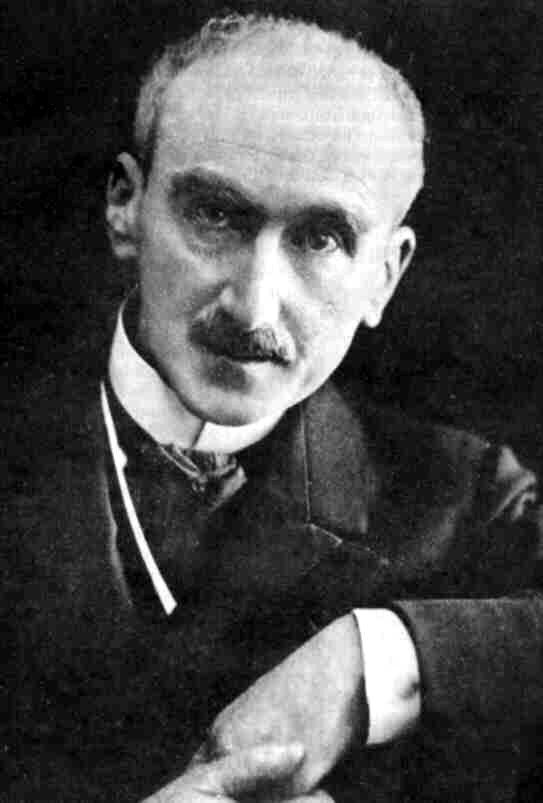
We can situate this exploration in the larger domain of subjective time experience, and I am still using the crutch of “Duration in Comics,” Sébastien Conard and Tom Lambeens’ fine exploration of Henri Bergson’s notion of durée as it can be applied to narrative comics such as Kevin Huizinga’s Ganges and Chris Ware’s Jimmy Corrigan: Smartest Kid on Earth, as well as abstract comics, including Ibn al Rabin’s Drame de la non-communicabilité chez les phylactères [A Drama of Inability to Communicate among Speech Balloons] and Lewis Trondheim’s Bleu [Blue]. (European Comic Art 5:2, Winter 2012: 92-113). The reason I write “crutch” is that their article convinced me that there was sufficient cause for me to return to Henri Bergson’s thought in the original, and so I planned to engage in the usual literary scholar feint: hastily peruse relevant works over a weekend, select meaningful quotes, tear them out of context, insert into own train of thought, ignore larger framework of assertion—only to run into the following subtle shaming:
 

Me: Philosophy Colleague, do you have Henri Bergson’s works in your office?
Philosophy Colleague: Oh yes! He’s wonderful. Which ones are you interested in?
Me: I need Time and Free Will, just over the weekend. Working on a piece on time.
Philosophy Colleague: (furrowed brow) Just Time and Free Will? Surely, you need Matter and Memory?
Me: Ummm, yeah, I guess I do…. Thanks!
Philosophy Colleague: Have you read his Introduction to Metaphysics?
Me: Errr, no, I haven’t.
Philosophy Colleague: Well, you’ll really want to read that first; it’s a rather necessary introduction to Bergson’s thinking, and quite clear, too.
Me: Ahhh, yes, of course. (thin voice) I’d better borrow that, too. Probably going to need more than a weekend…
Philosophy Colleague: (chortles) Indeed. Keep them as long as you’d like. (Hands me tomes)

 
Not the first time I’ve perceived this difference between the two Humanities subjects: it seems that literary scholars have a bit in common with the avian family, Corvidae (crows and jays), as well as Ptilinorhynchidae, the Bowerbirds, in that we collect shiny objects torn from their contexts, arranging nifty new collections where, in the case of the bowerbird, tin can tops can sit in aesthetically pleasing juxtaposition to a spray of lilies and a bit of moss.
 

bb408ebae9

Philosophers, on the other hand, and to continue the bird analogies, carefully and systematically arrange their environment as the avian family Ploceidae, aka weavers, do: starting an elaborate hanging nest with an outer foundation of pliable fibers, and layering it with leaves, feathers and other soft things that will cushion the nestlings, stay round or tear-shaped, never get blown off the substrate, etc.

Anyway, back to the crutch issue. Philosophy Colleague, initial readings of An Introduction to Metaphysics and a bit of Time and Free Will, and my professional guilt have all convinced me to spend more time with Bergson, and this can’t happen until summer. So, I’ll continue to poach Conard and Lambeens, and you should keep Bergson in the back of your mind as I do so.
 

Henri_Bergson

 
“Duration,” they write, paraphrasing Bergson, “is not a fixed representation of perceptible reality but changing reality itself. It is through intuition that we get a sense of duration and leave behind the everyday perception of things.” (96) [Hmmph…Philosophy Colleague was right, dagblast him; Lambeens and Conard are quoting not Time and Free Will here, but An Introduction to Metaphysics!] They mount a credible argument for the recognition of multiple types of time in the reading of a sequence of panels: the time it takes to read, which isn’t exactly the same as linear clock time in that the reader can slow down, speed up, reread, etc.; the number of panels [space] used to suggest time’s passage (which is why both comics critics and the sci-fi community often prefer the term spacetime: e.g. Noah Berlatsky speaking of “time and identity flattened out across space” in his April 13, 2013 Hooded Utilitarian post, “Flatland,” with Domingos Isabelinho adding in the comments section to this post, “I prefer the concept of spacetime….[T]here are images that Gilles Deleuze calls crystal-images in which more than one time continuum coexist as in the Watchmen examples above. Some comics panels are more sequences than frozen moments in time.” [April 15, 2013]).

Spacetime – highlighting the spatial aspects of the fourth dimension—works beautifully for comics, I think, as we are always moving across and around space (within single panels, across a page, splash or spread, non-contiguously across the pages of a comic as Thierry Groensteen and Pascale Lafèvre help us to understand in their theoretical works) to build up a sense of narrative. Narrative is, of course, a conceit of time. Reading time, diegetic (story) time, and perhaps the most fascinating of all: the interweaving of reading time with story time. Lambeens and Conard note that “…when reading, we live time very personally, in a tied bond with [the] main character.” (104) Though they do not cite Roland Barthes in their article, I do think that Conard and Lambeens operate off a similar distinction between readerly and writerly texts as that used by Barthes, where the “writerly” text demands high-level engagement, a kind of completion of the story by the efforts of the reader. Conard and Lambeens assert that it takes a special kind of relationship between comics reader and narrative, one that “keeps us immersed in a diegetic universe by actively letting a specific space-time emerge.” (106)

So, naturally, it would be fruitful to explore this relationship between reader and story in myriad ways; you could, for example, look at the way time slows down if the affective domain is engaged. I am thinking of Michael Johnson’s last Hooded Utilitarian/Pencil Panel Page post on comics that bring one to weep. I would imagine that panels that move us in this way also slow us down, if not to study them more carefully, then certainly to wipe away tears, snurfle, have our own memories/dreams/reflections for a moment…. Why, isn’t “slow down” a major tenet of our instruction to students—if we teach comics—as we alert them to the necessity of working with the comics text on its own terms, treating it as a rich word and image-based work that demands effort from readers?

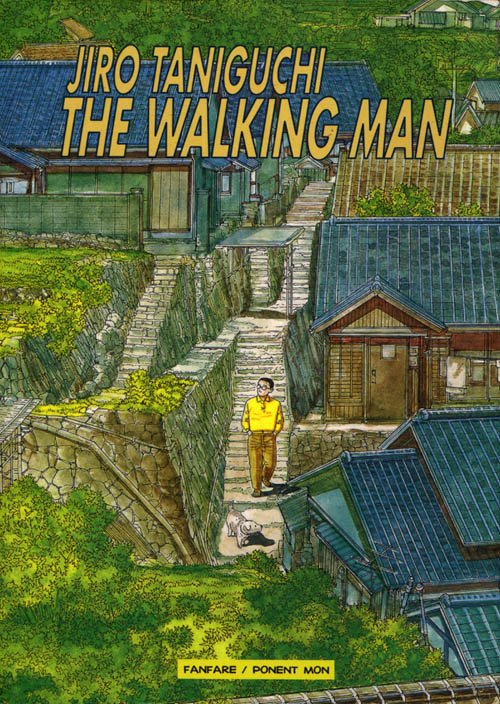
Okay, enough context. So, why do I choose to examine the flâneur in comics? First of all, they are everywhere: Ghost World, Jimmy Corrigan, Palestine, Batman, Little Nemo, Carnet de Voyage, Tintin. Second, their leisurely movement down a street, lane, trail ideally depicts contemplation as it allows the comic artist to break up the slow walk into contiguous panels that move aspect-to-aspect (in McCloud’s words), sometimes following the gaze of the walker, and at other times, allows the artist to overlay the scene with panels that are, or might be, memories of the same place at another time, another place, even an odd, seemingly unrelated connection. The flâneur also becomes the perfect vehicle for sustained internal monologue that can be captured in rather text-heavy balloons (as is sometimes the case in Seth’s It’s a Good Life if You Don’t Weaken) or without them, as in Jiro Taniguchi’s mostly silent The Walking Man.

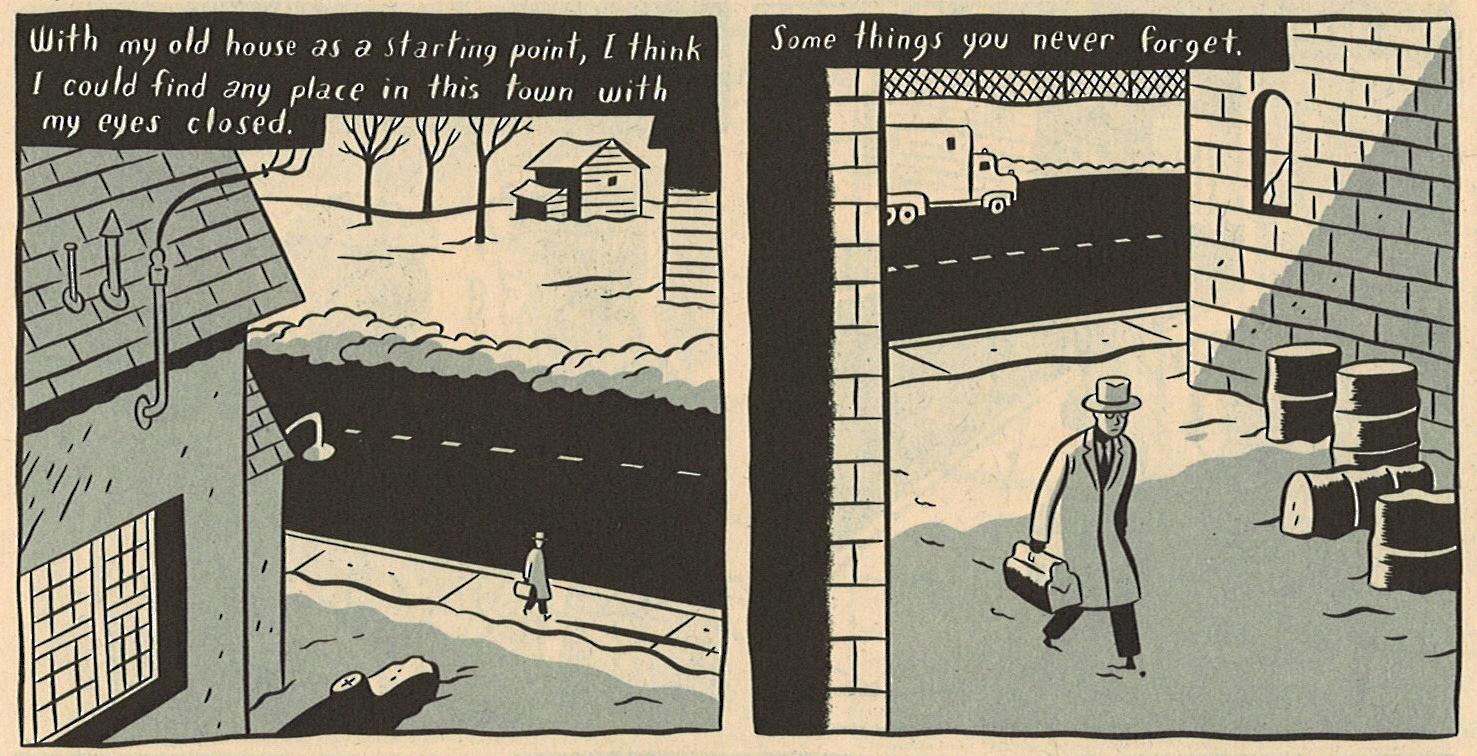
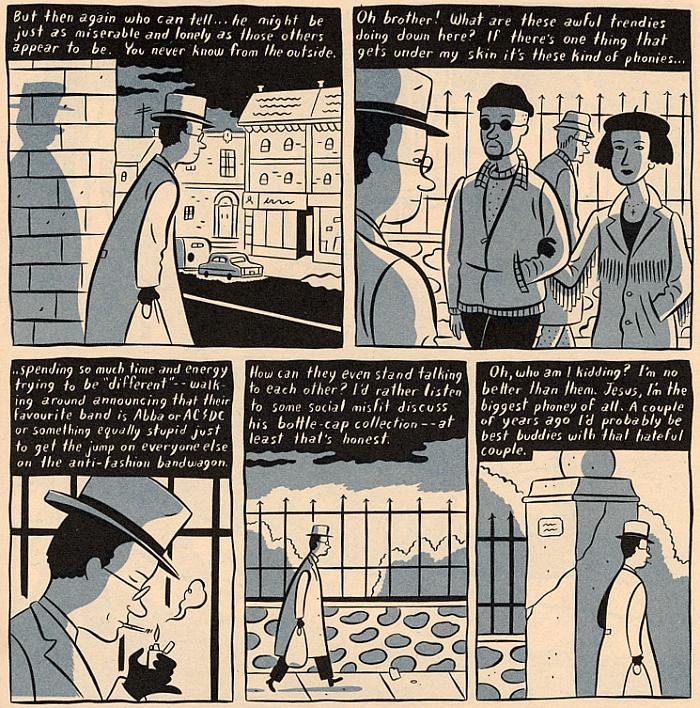
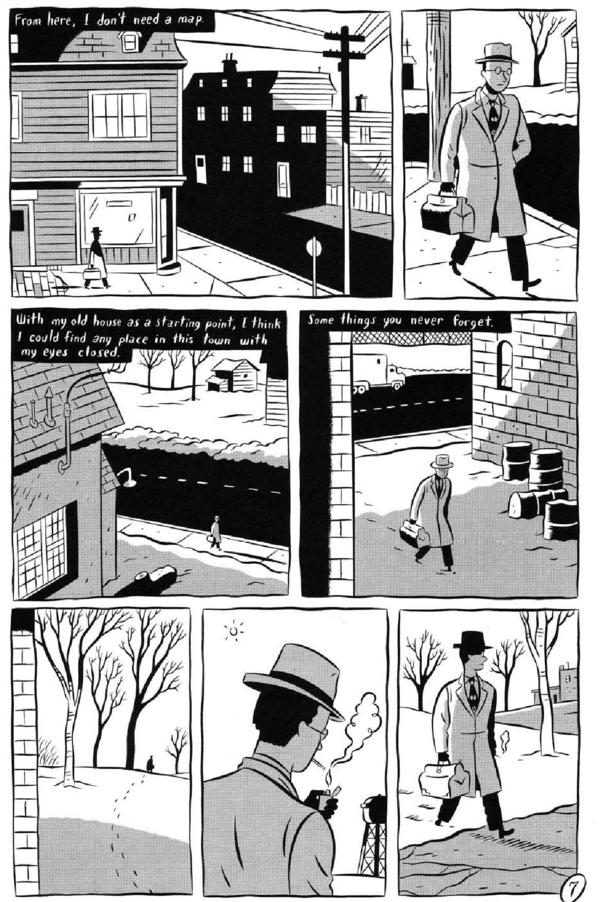
Seth’s and Taniguchi’s flâneurs are not the urbane, hyper-performative types you might find in late 19th century French literature or Djuna Barnes’ Nightwood. They are closer to Jean-Jacques Rousseau’s self-depiction in Reveries of a Solitary Walker and Alfred Kazin’s thoughtful Spaziergänger in A Walker in the City. These strollers animate their thought by walking, as Kant did, as Kierkegaard did; they are within the philosophical tradition of reflective walkers. In It’s a Good Life if you Don’t Weaken, the seemingly autobiographical figure (we’ll call him Seth for convenience) makes his way around the small town of Strathroy in the province of Ontario, Canada, flooded with memories, but also critically observing what is actually around him:

goodlifeint2

The panels work us around the scene, but also slow us down to look at Seth, engaging in the cigarette lighting process that often occupies the penultimate panels of a page that presents a sequence of mobile thought. Such a set of images calms and quiets the reader (as aspect-to-aspect often does), and puts him/her into the optimum state to reflect along with the protagonist. The duration here is lengthened just so; the number of panels, views, aspects determines—at least in part—the length of time we will devote to the page. Slowed down, unstimulated by overt action, we can enter into the shared subjective time theorized by Conard and Lambeens above, “…liv[ing] time very personally, in a tied bond with [the] main character.” (104) This process works even more effectively when the main character’s thoughts are sketchy, occluded, hinted at, as in this page from Seth:
 

Its_a_good_life_inside

Though “Some things you never forget” aptly summarizes the preceding panels, it also opens up into a more liminal space in the last three, silent, panels, as we consider both what Seth might also be remembering, and as we, perhaps, start our own sequence of memories, triggered by the non-accidental use of the second person: Some things you never forget.

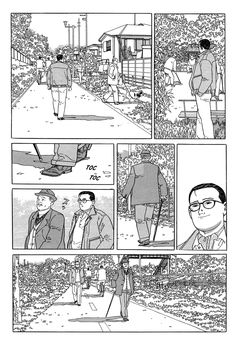
This scene from Jiro Taniguchi’s The Walking Man (just a reading note: though this is a Japanese comic, it is read left to right in the Western manner) may not significantly reveal the walker’s thoughts, but it does present a human-to-human connection that is fleeting, non-verbal, and non-reciprocated:

06b764380be2cc5f002e323f592def9c

Watching the protagonist notice, gain on and pass the old man gives us insight into his character (he is interested in those he passes, he notices them), and if the page were parsed further, would probably lend itself to a valuable study of panel-to-panel changes in both diegetic action time (he appears to speed up), and duration.

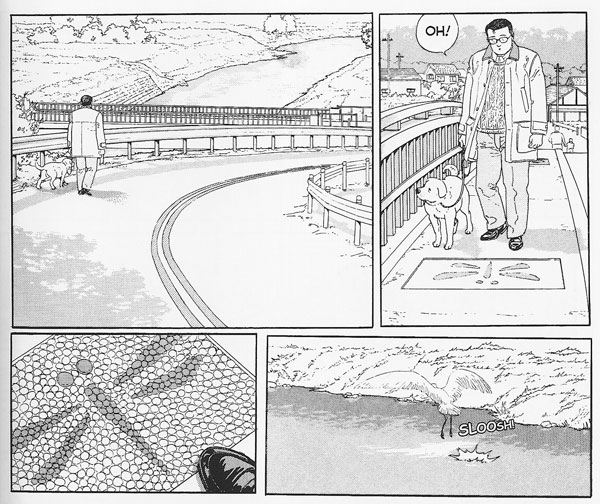
The walker in Taniguchi’s comic is also equally interested in animals, weather, objects: everything he sees, hears and feels (rain figures prominently in a later sequence of panels) appears to bring him pleasure:

taniguchi_walkingman_17

As we take this stroll with Taniguchi’s walking man, we see the world with him, learn about his character, walk vicariously, think our own thoughts, experience—maybe—rapprochement with him, and with the world itself. Can you remember other meditative strollers in the comics you know best, or do you have something to say about duration/subjective time more generally?