Walt Kelly and Me


“The true picture of the past flits by. The past can be seized only as an image which flashes up at the instant when it can be recognized and is never seen again. ‘The truth will not run away from us’: in the historical outlook of historicism these words of Gottfried Keller mark the exact point where historical materialism cuts through historicism. For every image of the past that is not recognized by the present as one of its own concerns threatens to disappear irretrievably.”

 –Walter Benjamin, “Theses on the Philosophy of History” (English translation Harry Zohn; Illuminations p. 255)


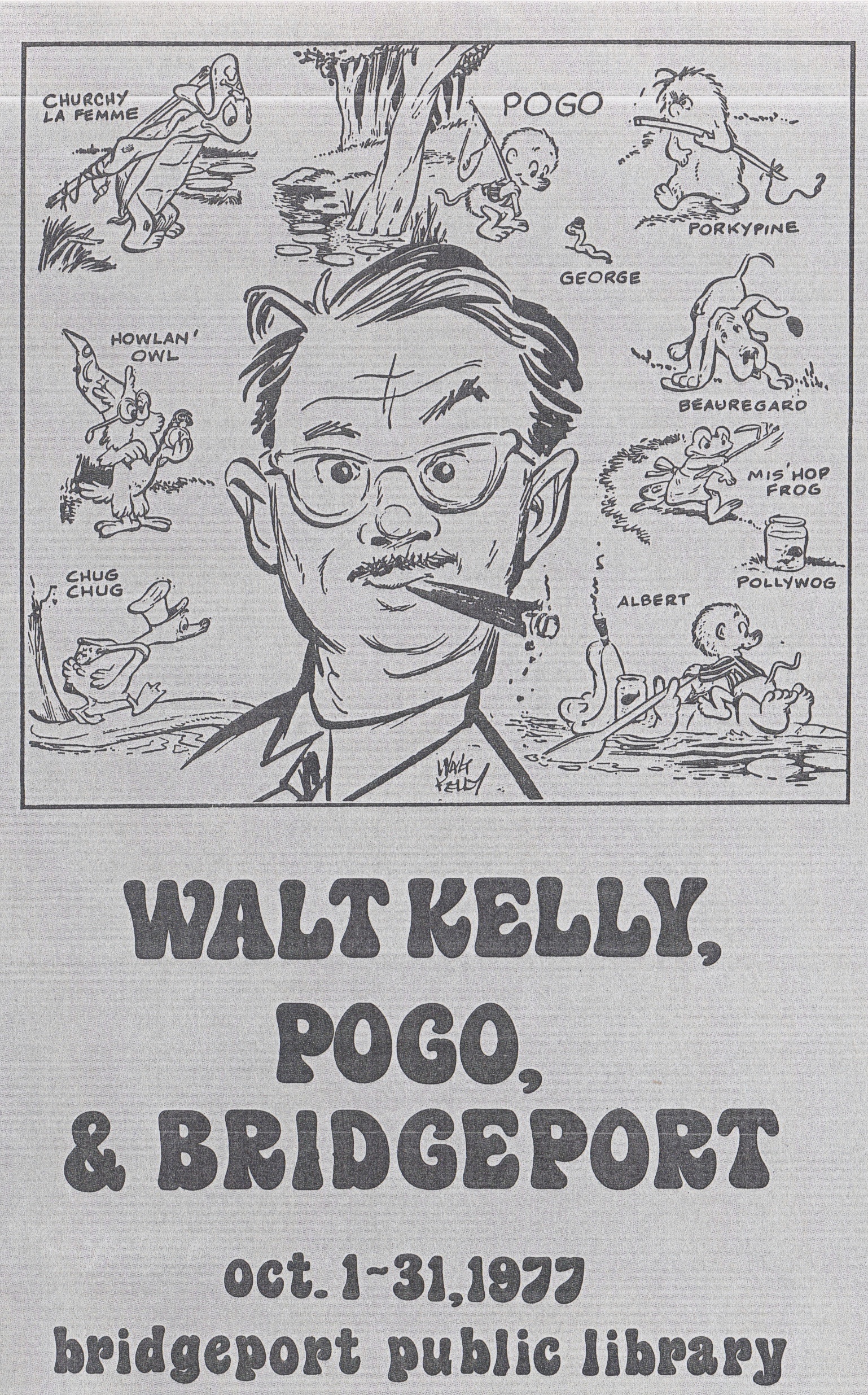
 Fig. 1

Fig. 1: Clipping courtesy of the Bridgeport History Center at the Bridgeport, Connecticut Public Library

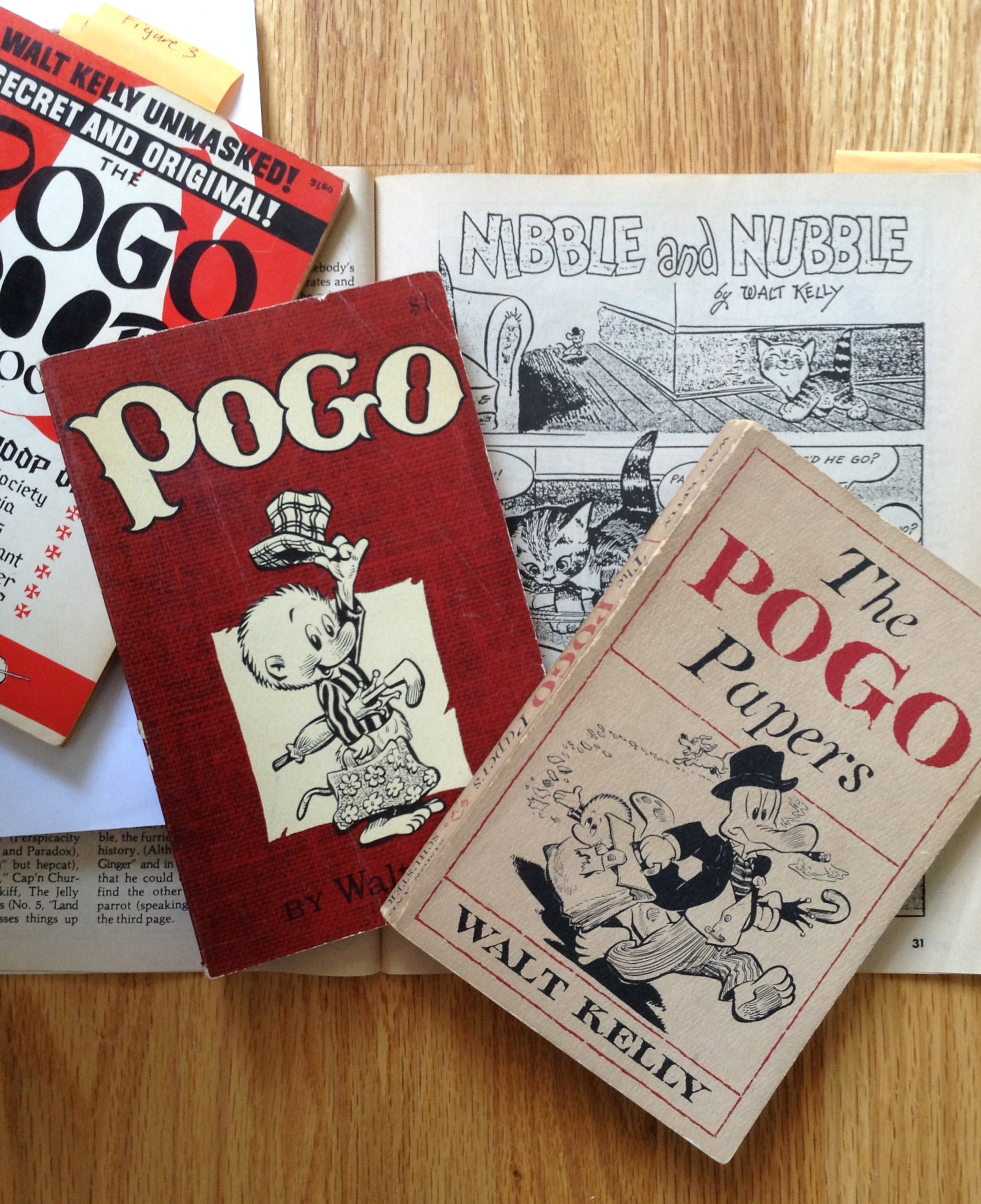
I wonder sometimes if I’m being followed. I can’t seem to escape from Walt Kelly. R. Fiore’s recent TCJ review of the new Hermes Press collection Walt Kelly’s Pogo: The Complete Dell Comics Volume 1, compels me once again to consider the cartoonist, who died in 1973 and lived his formative years in Bridgeport, Connecticut. The Park City is about thirty miles south of Oakville, my hometown, and Oakville is just outside of Waterbury, where the Eastern Color Printing Company began producing comic books in the 1930s. Of course, I’d heard of Kelly long before I’d read any of his work. He’s on a short list of Connecticut luminaries, along with Nathan Hale, Rosalind Russell, Paul Robeson, and Thurston Moore, but I didn’t read Kelly’s celebrated strip until I was in my mid-thirties. Several years ago, one of my students gave me copies of two of her late father’s beloved Pogo collections. I know you enjoy comics, she said, and you teach them, too, so I think you might like these: Pogo, the first Simon and Schuster collection from 1951, and The Pogo Papers, from 1953. Covers creased, paper tan and brittle, bindings cracked. Her dad, I know, loved these books, returned to them, left them behind for his daughter, for me. I thanked her for this kind gift, but even then, in the summer of 2007, I neglected them. A year later I was asked to contribute an essay to a collection on Southern comics and I remembered what my student had said: You might need these. I think that’s what she said. I’d like to think so, anyway.

I begin with what is probably more than you need to know about me and Walt Kelly because, like Fiore, I, too admire the artist, and, in the years since my student handed me her father’s Pogo books, I’ve written about his work twice: first, in an essay on Bumbazine for Brannon Costello and Qiana Whitted’s collection Comics and the U.S. South (UP of Mississippi, 2012) and again last year for a paper presented at the Festival of Cartoon Art at the Ohio State University’s Billy Ireland Cartoon Library and Museum. In the first essay, which Tom Andrae cites in his introduction to the new Dell Comics collection, I discuss the two scenes Fiore addresses in his review— the watermelon panel from “Albert Takes the Cake” (Animal Comics #1, dated Dec. 1942-Jan. 1943) and the railroad sequence from “Albert the Alligator” (Animal Comics #5, dated Oct.-Nov. 1943). You can read that 2012 essay, “Bumbazine, Blackness, and the Myth of the Redemptive South in Walt Kelly’s Pogohere or from your local library; the Google Books version does not include the illustrations.

Fiore takes issue with Andrae’s analysis of the black characters who appear in “Albert the Alligator.” While he begins with the suggestion that “Andrae is on firmer ground in denouncing the characterizations in the story from Animal Comics #5,” Fiore then asks that we consider other readings of the narrative:

Once again, however, [Andrae] is sloppy in characterizing [the characters] as “derisive minstrelsy stereotypes.” The conventions of the minstrel show were as formalized as the Harlequinade, and the characters in the story at hand don’t fit them. Further, I believe a more sophisticated and context-conscious reading would come to a different conclusion.

As I read these remarks, I began to wonder, what would a “context-conscious reading” of this sequence look like? And is Fiore correct? Would it reach a different conclusion than the one in Andrae’s introduction?

I attempted just that sort of contextual reading in my Bumbazine essay, in which I trace the impact not only of minstrelsy but also of the rhetoric of the South as redeemer, a concept Kelly inherited from the Southern Agrarians. But any reading that hopes to place Kelly in historical context must take into account the tensions and fractures that exist in his body of work. Kelly is a significant cartoonist not because he was more progressive than other artists working in the 1940s but because he records for us the contradictions in his own thinking and practice.

 Fig. 2

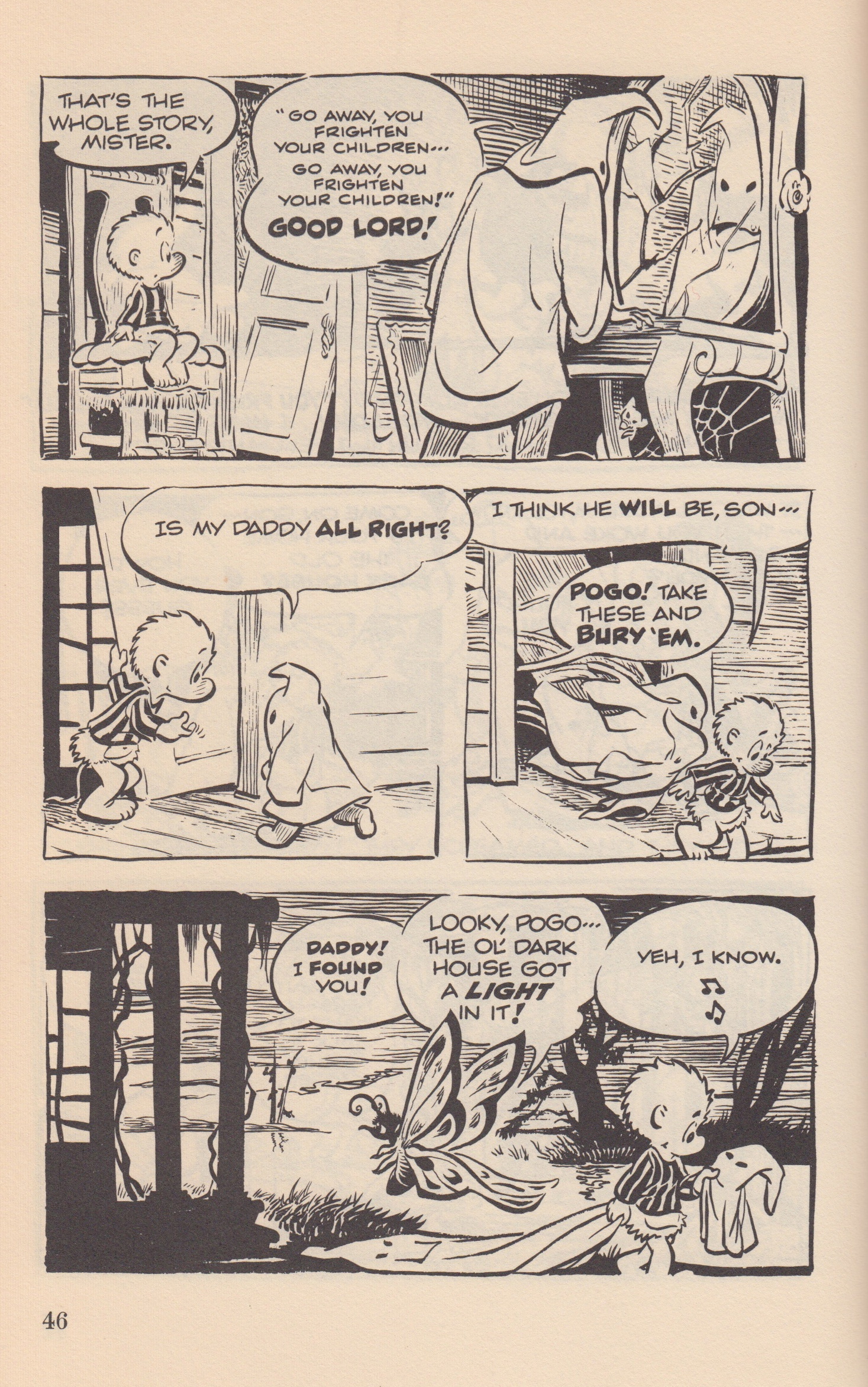
 Fig. 2: Pogo takes on one of the Kluck Klams in a story from The Pogo Poop Book, 1966

Kelly, the child of working-class parents, a left-leaning, often progressive autodidact who, later in his career, would challenge Senator Joseph McCarthy, the Ku Klux Klan, and the John Birch Society, demands our attention because he forces us to ask another question: given his reputation as a cartoonist beloved by students and liberal intellectuals of the 1950s and early 1960s, how could he also have produced works such as “Albert the Alligator,” stories that clearly owe a debt to the conventions of the minstrel stage, and that traffic in derogatory stereotypes? To answer this question, I believe we need to understand Kelly’s nostalgia for his hometown of Bridgeport, Connecticut. One of the flaws in some of Kelly’s early work was his inability or unwillingness to interrogate the images and ideas he’d inherited from childhood artifacts such as, for example, Joel Chandler Harris’s Uncle Remus stories. As Andrae reminds us in the introduction to the Dell Comics collection, Kelly’s father enjoyed readings those stories to his son.


 Fig. 3

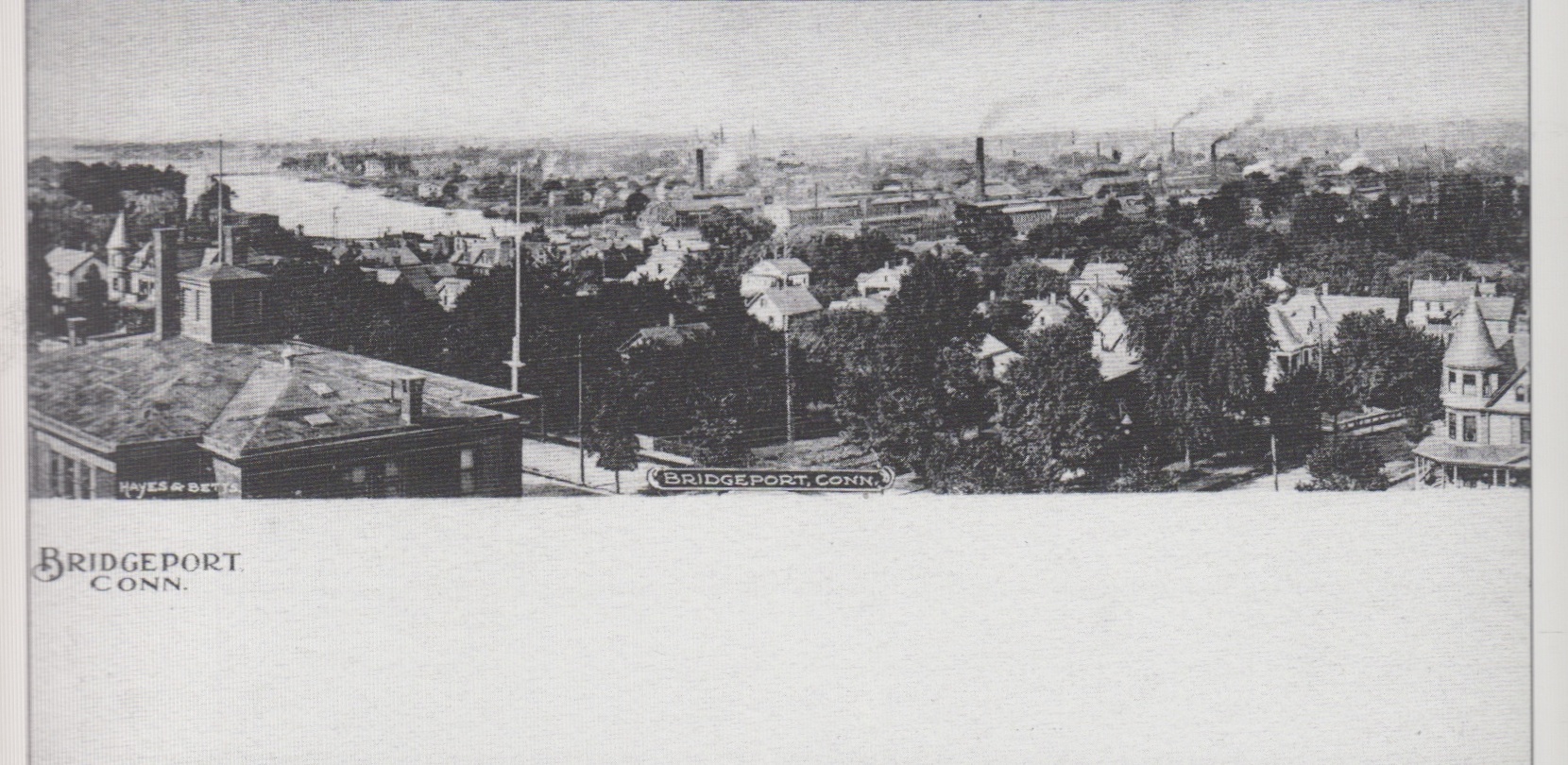
Fig. 3: Image of Bridgeport from Andrew Pehanick, Bridgeport 1900-1960, p. 124

What effect does nostalgia have on us, as writers, as artists, as critics—as fans? When I speak about Kelly, I find it difficult to separate my nostalgia for home from Kelly’s fondness for the Bridgeport of the late teens and 1920s. When I read Kelly now, I am reminded of my childhood in Connecticut, not because Kelly’s comics played any role in it, but because the setting he describes in his essays, for example—the industrial landscape of the Northeast—is also the world of my imagination. By the late 1970s and the early 1980s, however, the brass and munitions manufacturers that had attracted so many immigrants from Europe and migrants from the South were fading. The only traces that remained were signs with names like Anaconda American Brass on redbrick walls of abandoned factory buildings. And the stories, of course, of the men and women who, like Kelly’s father, like my grandparents and great grandparents, worked in those mills.

Fig. 4

Fig. 4: My grandmother, Patricia Budris Stango, second from left, at work in 1941 at the United States Rubber Company, later called Uniroyal, in Naugatuck, Connecticut

As I argue in my essay on Bumbazine, Kelly did not write about the U.S. South. Rather, he told stories in a setting that, for all its southern trappings, looked and felt more like New England. The city of Bridgeport, Connecticut, was, in the early twentieth century, as Kelly describes it, “as new as a freshly minted dollar, but not quite as shiny. The East Bridgeport Development Company had rooted out trees and damned up streams, drained marshes, and otherwise destroyed the quiet life of buttercups and goldfinches in order to make a section where people like the Kellys could live.” In this essay from 1962, Kelly might be describing Pogo’s Okefenokee Swamp: “Surrounding us was a fairly rural and wooded piece of Connecticut filled with snakes, rabbits, frogs, rats, turtles, bugs, berries, ghosts, and legends” (Kelly, Five Boyhoods, 89).

 Fig. 5

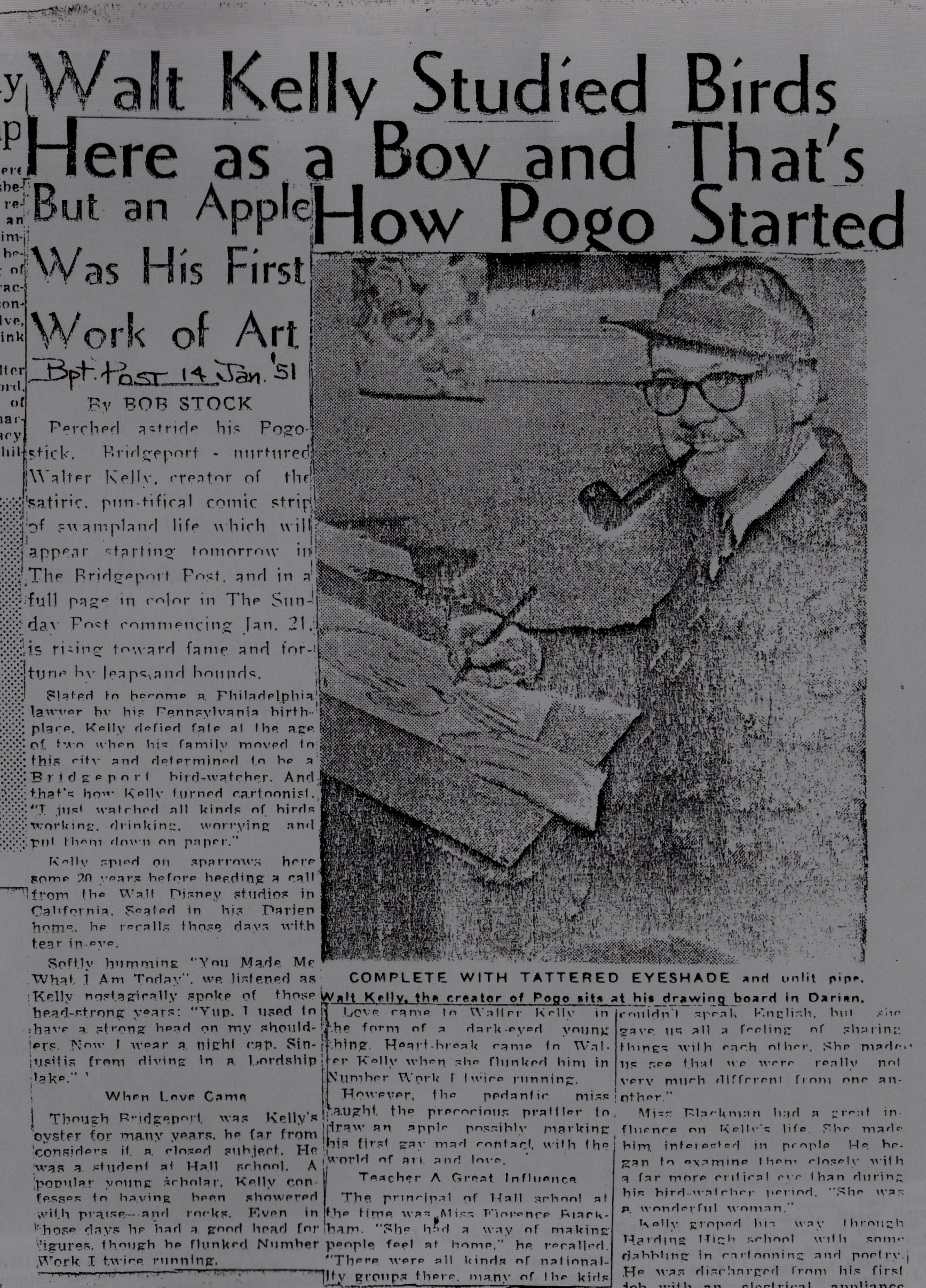
Fig. 5: Clipping from the Bridgeport Post, January 14, 1951. Courtesy of the Bridgeport History Center.

Kelly scholars from Walter Ong to Betsy Curtis to R.C. Harvey to Kerry Soper and Tom Andrae have since the 1950s been looking closely at some of these legends. In his essay “The Comic Strip Pogo and the Issue of Race”—along with Soper’s We Go Pogo (UP of Mississippi, 2012), one of the best academic analyses we have of Kelly’s strip—scholar Eric Jarvis points out that Kelly often referred to “his elementary school principal in Bridgeport as a rather nostalgic model of how society should approach these issues with ‘gentility’” (Jarvis 85). Jarvis then includes passages from Kelly’s introduction to the 1959 collection Ten Ever-Lovin’ Blue-Eyed Years with Pogo in which the artist again remembers the Bridgeport of his childhood and that principal, Miss Blackham: “Somehow, by another sainted piece of wizardry, she sent us off to high school feeling neither superior nor inferior. We saw our first Negro children in class there, and believe it or not, none of us was impressed one way or another, which is as it should be. Jimmy Thomas became a good friend and the young lady was pretty enough to remember even today” (Kelly, Ten Ever-Lovin’ Blue-Eyed Years, 6).

As Kelly biographer Steve Thompson reminded us at the OSU conference, however, in other interviews Kelly describes the racism and ethnic tensions in the Bridgeport of the 1920s. So, like Jarvis, I am fascinated by the role nostalgia plays in Kelly’s art and in his essays because, after all, as Svetlana Boym reminds us, nostalgia is a utopian impulse, a desire not so much to recover the past as it was lived but to recall the life we wish we’d lived, in a world that never was. But, if it had existed, what would that world have looked like? “Nostlagia (from nostos—return home, and algia—longing),” Boym writes, “is a longing for a home that no longer exists or has never existed. Nostalgia is a sense of loss and displacement, but it is also a romance with one’s own fantasy” (Boym XIII).

When Brannon Costello asked if I’d contribute an essay to Comics and the U.S. South, I hesitated. My first thought was to write an article on Howard Cruse and Stuck Rubber Baby. Already taken, Brannon told me. Then I asked, What about Pogo? You can’t publish a book on comics and the South without Pogo. A friend later remarked, Why would you write about the South? You lived there for less than a year, and the whole time all you talked about was New England. That’s not exactly what she said. What she said was something closer to this: You hated it there. But, more recently, when I told my friend that I’ve now written two essays about Kelly and the South, she smiled and said, Of course. The more we resist something, the more we are drawn to it. The more I resisted Kelly’s comics, the more I found myself drawn to them and to the South and to the myths of Kelly’s youth—my youth—that I had ignored

So, in reading R. Fiore’s review of the new Pogo collection, I again find myself face to face with Walt Kelly. And I keep returning to Walt Kelly’s early comics not because they transcend discourses of race; rather, I return to them because they include these stock figures and because I believe these early stories, like my student’s gift, offer an opportunity to think and to reflect on how these discourses—how these racist stereotypes—have shaped my life, my thinking, my conduct in the world. I am writing about Kelly because, to borrow a phrase from Walt Whitman, he and I were “form’d from this soil, this air,” and I turn to him because he invites me to dig through that soil, to breath the air again, to remember.


 Fig. 6

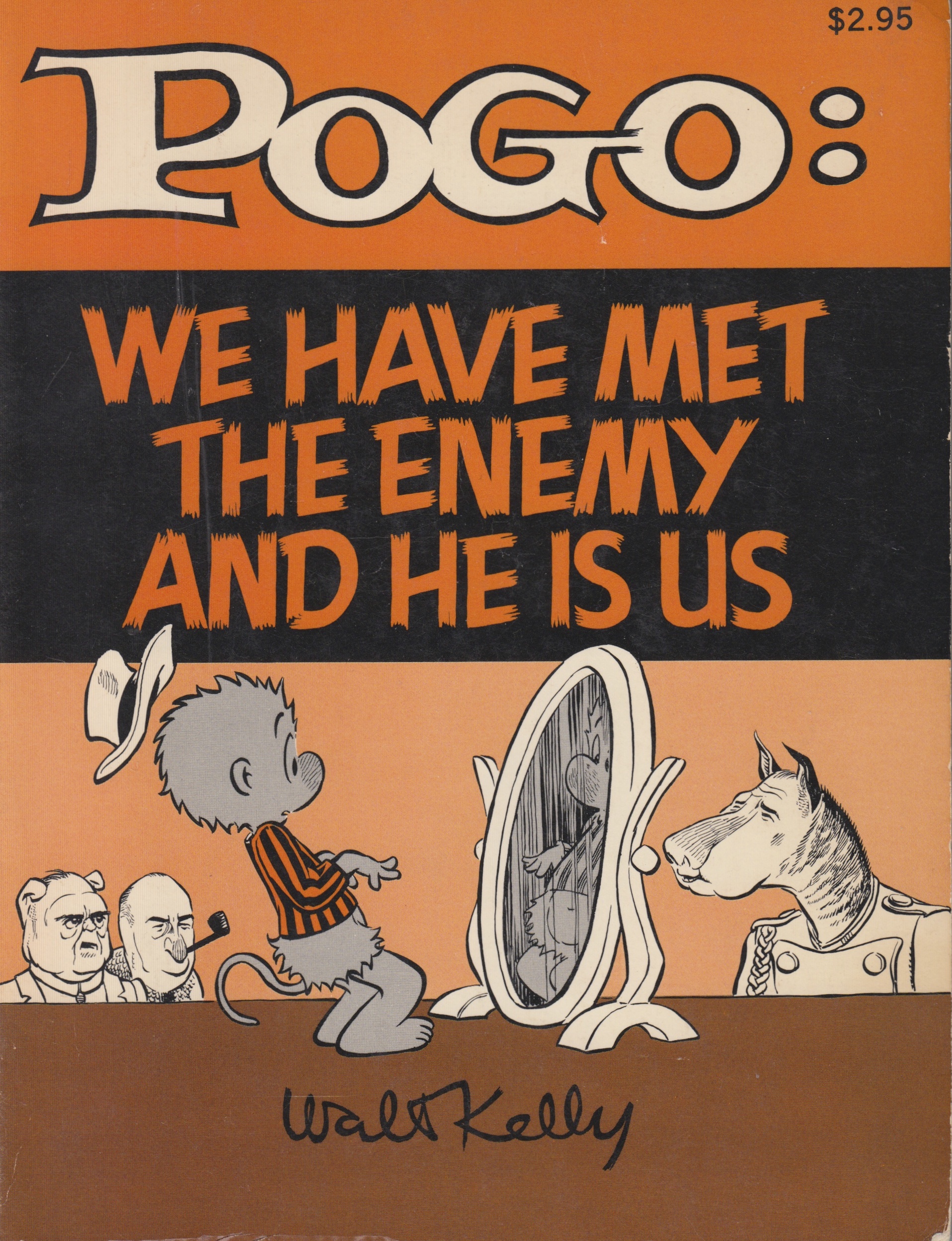
Fig. 6: The final Pogo collection Kelly published in his lifetime (1972)

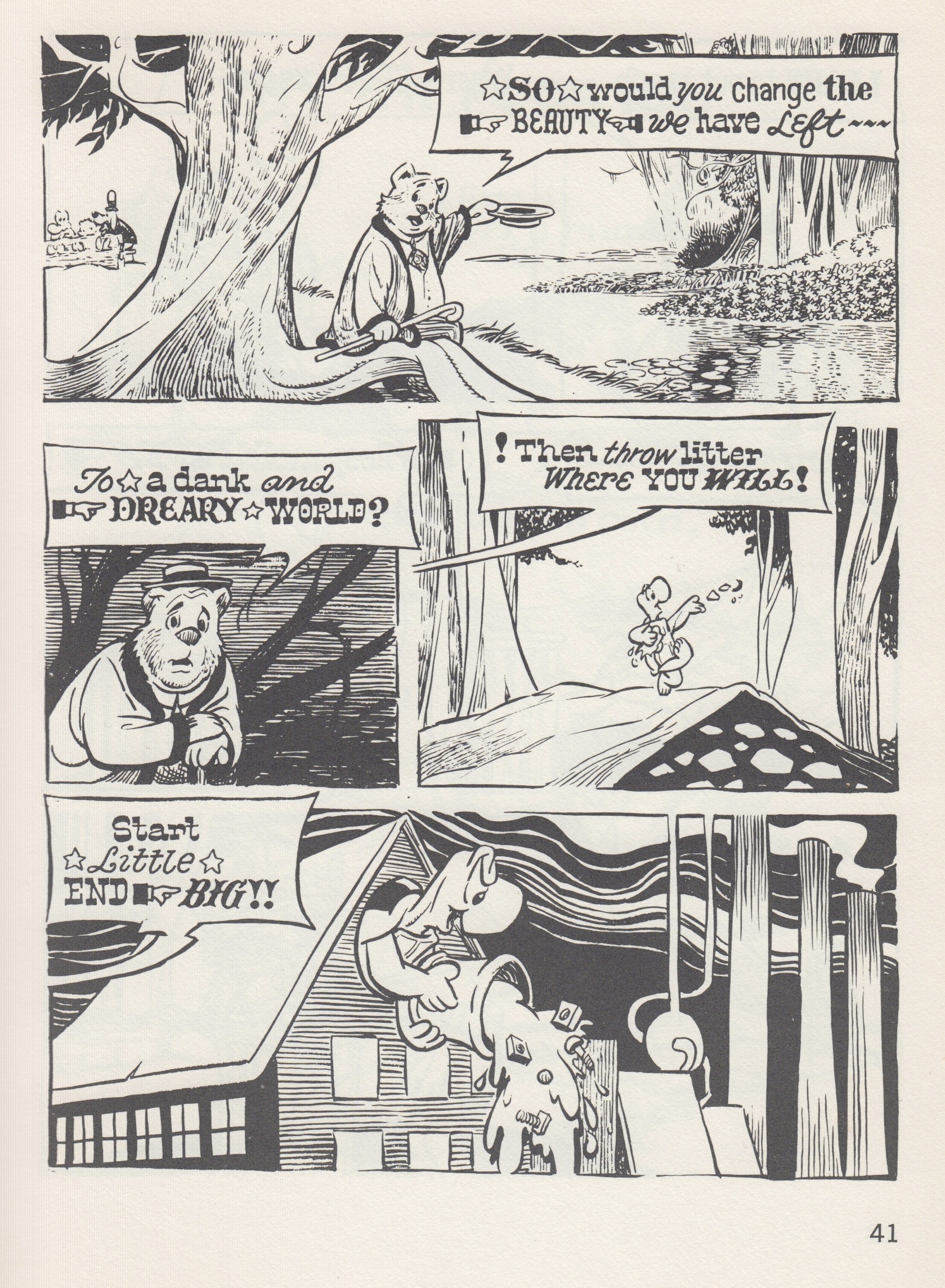
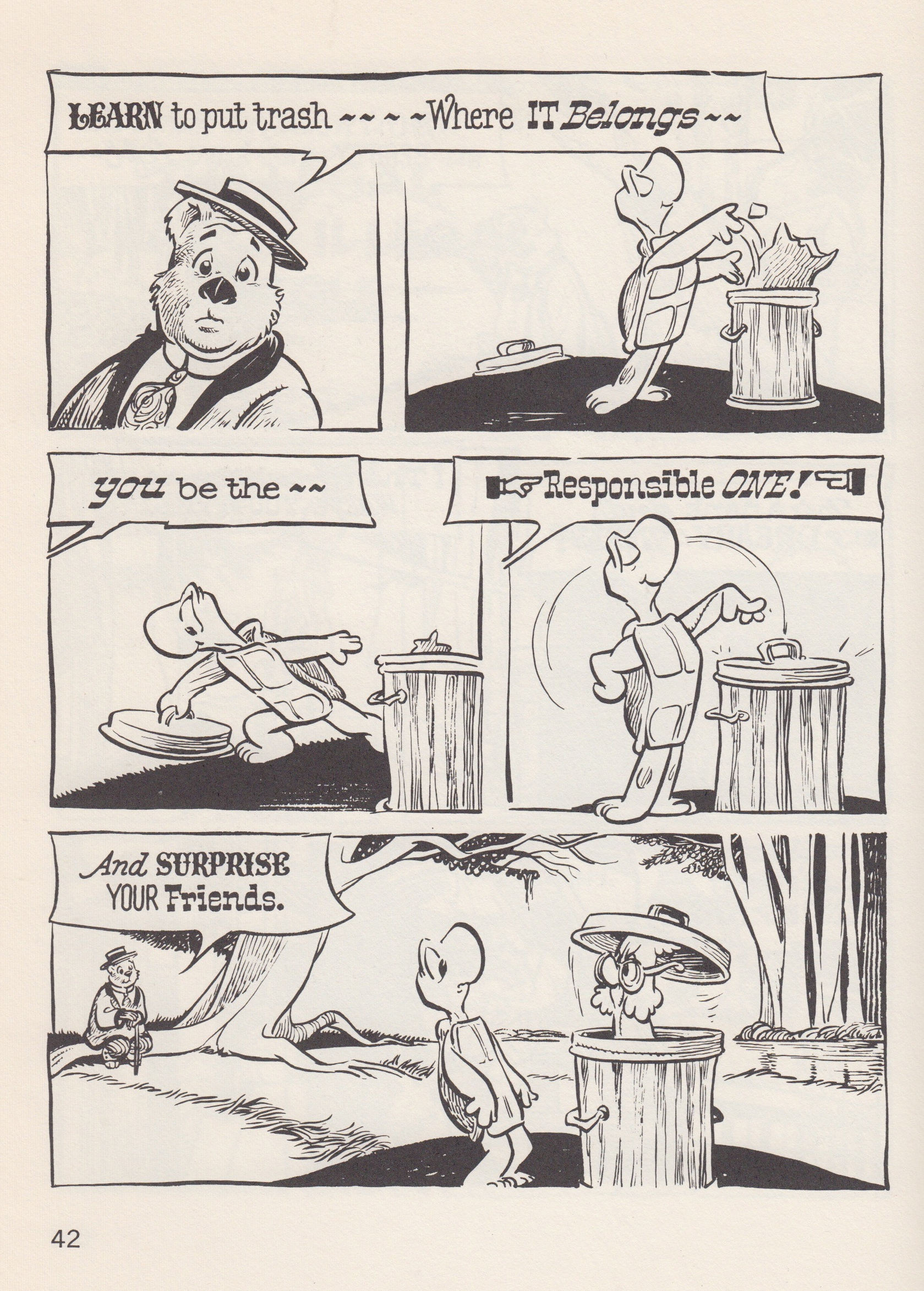
It is perhaps too easy to say that these early comics are a record of their time. They are, of course; they demand that we investigate and reconstruct the discourses of the era that produced them. But to deny the hurtful and derogatory nature of the images in Kelly’s early work, I believe, is also to deny his power as an artist. The images in these early issues of Animal Comics are ugly, but there is something in them that will not be ignored. In his mature work—read, for example, Ten Ever-Lovin’ Blue-Eyed Years with Pogo, or The Pogo Poop Book, or Kelly’s final collection, We Have Met the Enemy and He Is Us—Kelly breaks with these conventions. And the image he leaves behind is this one: P.T. Bridgeport, the circus bear, the character who was, in many ways, the real soul of Pogo, now old, tired, but more real and true as he stares at his beloved swamp and sees not a pristine wilderness but a wasteland of junk.  But even here we find a possibility of hope and renewal:

 Fig. 7

Fig 8.

Fig. 7 and Fig. 8: From the last two pages of the title story of Kelly’s We Have Met the Enemy and He Is Us (1972) (pages 41-42)

I started this post with a quotation from Walter Benjamin (translated into English by Harry Zohn) not for you but for me, as a way to remind myself of the value of interrogating images like the one of Pogo and Bumbazine sharing the slice of watermelon. If we fail to recognize images from the past as part of our “own concerns,” Benjamin argues, we run the risk of losing them, and their meaning, entirely. But here again I have left something out. Benjamin adds this final parenthetical statement to his fifth thesis: “(The good tidings which the historian of the past brings with throbbing heart may be lost in a void the very moment he opens his mouth.)”

So, a paradox: we must look carefully, search for these “flashes,” but we also risk negating them and their meaning when we speak or write about them. But to remain in watchful silence offers no real alternative. We must speak of these things, although, as we do so, we are not speaking about the past, not really. We are instead addressing the pain of what it is to live here, now, with each other and with these discourses that continue to blind and disorient us.

 Fig. 9


Fig. 9: Two gifts.


References

Andrae, Thomas. “Pogo and the American South” in Walt Kelly, Walt Kelly’s Pogo: The Complete Dell Comics Volume 1. Neshannock: Hermes Press, 2014. Print.

Andrae, Thomas and Carsten Laqua. Walt Kelly: The Life and Art of the Creator of Pogo. Neshannock: Hermes Press, 2012. Print.

Benjamin, Walter. Illuminations. Trans. Harry Zohn. New York: Shocken Books, 1968. Print.

Boym, Svetlana. The Future of Nostalgia. New York: Basic Books, 2001. Print.

Curtis, Betsy. “Nibble, a Walt Kelly Mouse” in The Golden Age of Comics. No. 1 (December 1982). 30-70. Print.

Fiore, R. “Sometimes a Watermelon Is Just a Watermelon.” The Comics Journal. April 3, 2014. Web Link.

Jarvis, Eric. “The Comic Strip Pogo and the Issue of Race.” Studies in American Culture. XXI:2 (1998): 85-94. Print.

Kelly, Walt. The Pogo Poop Book. New York: Simon and Schuster, 1966. Print.

Kelly, Walt. Ten Ever-Lovin’ Blue-Eyed Years with Pogo. New York: Simon and Schuster, 1959. Print.

—. “1920’s.” Five Boyhoods. Ed. Martin Levin. New York: Doubleday & Company, Inc., 1962. 79-116. Print.

Pehanick, Andrew. Bridgeport 1900-1960. Charleston: Arcadia Publishing, 2009. Print.

Soper, Kerry D. We Go Pogo: Walt Kelly, Politics, and American Satire. Jackson: UP of Mississippi, 2012. Print.

Thanks to Mary Witkowski and Robert Jefferies at the Bridgeport History Center for their assistance in locating materials included here from the Center’s Walt Kelly clipping file. Also, I talk a little more about the Walt Kelly panel a November’s OSU conference here.

Captain Allegory: The Winter Obama

captain_america__the_winter_soldier_movie_poster_by_ancoradesign-d6lrrfl

Hollywood used to keep its political allegories in the subtext, especially when it comes to fanboy franchises with scifi premises and blockbuster budgets. It’s a smart policy. A little political subtext gives a mass consumer product a twist of relevancy while maintaining plausible deniability should some rightwing commentator accuse Hollywood of promoting a liberal agenda. Fanbases can be even touchier, preferring their escapism untainted by cultural context.

I’m not sure how anyone who saw John Carter of Mars (and I know that’s a small subgroup) could not acknowledge its all-but-overt parallels to the war in Afghanistan and global climate change—and yet when I mentioned these at a fan site, I was accused of imposing a political agenda on an innocent Disney movie. Iron Man 3 fans couldn’t pretend that a soldier dressed in a metallic flag didn’t bear at least some relation to the U.S. military—but that didn’t require every viewer to see Tony Stark blowing up his armada of remote control suits as a condemnation of U.S. drones policy. Ditto for Star Trek Into Darkness. Not only do you have nefarious drones run by a secret and unregulated government agency, but a rogue Starfleet ship named Vengeance reenacts 9/11 in a CGI orgy of collapsing skyscrapers.

That’s what used to pass as subtle in Hollywood. But now Captain America: The Winter Soldier pulls off the allegorical kid gloves. As Michael Phillips of the Chicago Tribune points out, the movie “bemoans America’s bloodthirsty, weapons-mad impulses” and, according to the Washington Post’s Zade Rosenthal, it taps “into anxieties having to do not only with post-9/11 arguments about security and freedom, but also Obama-era drone strikes and Snowden-era privacy.” Both reviewers are right, but since they each afford only a sentence to those political messages, a reader might think we’re wading into the gray zone of interpretation. We’re not.

The latest Marvel Entertainment installment is about the head of a massive government agency struggling to the do the right thing for his country. His name is Nick Fury, and the fact that Samuel Jackson and Barack Obama are both black is the film’s only coincidence. Robert Redford plays the Bush-era neocon on Nick’s rightwing shoulder while on his idealistic left Captain America still believes in American values like freedom and honesty and not shooting people because surveillance software predicts they’ll commit a crime.

The plot mechanics pivot on three mega-drones and their promise of Absolute Security. They lurk in a shady labyrinth beneath an innocuous government office building, and when they come alive all of America will finally be safe. At least that’s what Fury-Obama wants to believe. But Redford was beamed in from a Cold War espionage film to provide an internal Evil Empire. It’s not just that the NSA-SHIELD has been infiltrated; the organization was corrupted from its founding. That’s what President Eisenhower warned back in 1960.  He called it the Industrial Military Complex. Marvel calls it HYDRA. When those three mega-drones go online, they’re going to combine into a Death Star that only the rebel alliance of Captain America and his kick-ass sidekicks can stop.

It’s a familiar formula. Peter Weller played Redford’s role in Star Trek Into Darkness, and both platoons of secret thug agents wear black and neglect to shave. Instead of a villainously superpowered Benedict Cumberbatch we get a villainously superpowered Sebastian Stan, both of whom emerge from cryogenic suspension. Which is not to say directors Anthony and Joe Russo and screenwriters Christopher Markus and Stephen McFeely lack all subtlety. I quite like how the nefarious HYDRA hangers rise from beneath a cement pool that echoes the Lincoln Memorial reflecting pool that Captain America sprints around in the opening shot. And the film’s use of the Smithsonian Museum should win Best Exposition Gimmick of the year. Costumer designer Judianna Makovsky scores points too. When the Captain finds cause to go rebel, he morphs into a white t-shirted, motorcycling James Dean, and when Nick sees the error of his ways, he trades in the leather of his Matrix wardrobe for a hoodie and shades.

That’s how Hollywood would like Obama to dress now too. Like his alter ego, the President needs to recognize that all his well-intentioned spying and droning violate the freedoms he’s trying to safeguard. That’s the film’s overwhelming message. And the fact that it’s being shouted by a massive, profit-hungry corporation says even more. Marvel Entertainment doesn’t represent the liberal left or the libertarian right. They shoot straight down the middle at the bottom line.

I doubt Obama will follow in Samuel Jackson’s footsteps and gut the NSA, but the film’s overt political commentary is drawing votes at the box office, earning over $10M its opening night. Marvel is literally banking on the new anti-surveillance alliance of liberals, conservatives and independents. It’s almost enough to make me long for those innocent days of apolitical, escapist entertainment.

obama and c a shield

Robocop (1987): Chianti in the Rock Shop

29Wine is a great accouterment for villains. Aristocratic and impenetrable, a glass of red can suggest that its drinker lounges about, sipping the blood of his enemies and chuckling evilly from the shadows. White wines code the airy disconnect of the elite, aestheticized and cruelly indifferent of everyman struggles. Hannibal drinks Chianti and eats people, and the merciless denizens of Elysium drink whites at garden parties in space. Wine conveys authority, but it’s a fairly obvious power-play. And a better villain can out-power that power-play. Enter Clarence Boddicker.

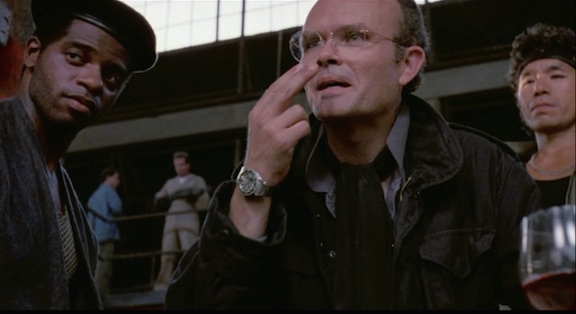
Kurtwood Smith’s performance in the original Robocop is one of a kind. Boddicker’s smile is vicious, but disturbingly sweet.  One moment he squirms with glee, only to be still and deadly the next. He’s the ringleader of a hysterical, trigger-happy gang, which more than anything resembles a group of bros gone wrong. Which is a great reminder for the goonish underbelly of many male-bonding narratives.

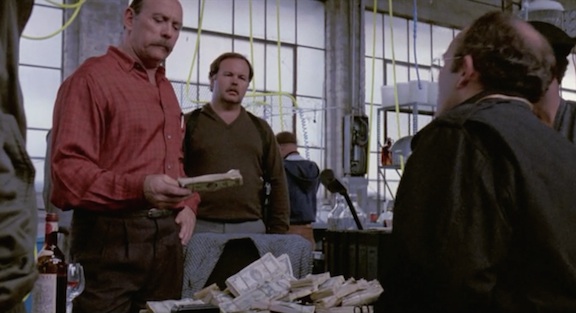
But Boddicker doesn’t dominate as much as destabilize. He’s balding and bespectacled, yet emotes childishly.  He throws tantrums. He unpins a grenade with his tongue, peering down at his quarry with an odd, come-hither look in his eyes, practically miming to his employer’s recorded assassination statement. Boddicker’s interaction with the one glass of wine in the film is no less subversive. When demanding a cut in the price of cocaine, Boddicker sticks two of his fingers into a drug lord’s glass of Ruffino Riserva Ducale, and then snorts the drops from his fingers. Even better, the drug lord then picks up the glass, and in a bizarre act of social facilitation, takes a sip.

It’s interesting that the wine appears here, in a cocaine factory, and not in the hands of one of the privileged board members of the evil corporation OCP. While it would have been ridiculous for wine to be served at their meetings, its equally absurd for it to appear in Sal’s rock shop. Not to mention that Ruffino Riserva Ducale is prestigious. Karen McNeil deems it a ‘must’ to try in The Wine Bible, “One of the leading producers of traditional Chianti… its Ruffino’s Chianti Claissico riserva called Riserva Ducale that is the jewel in the crown.” Sal’s bottle looks to be contemporary to the ‘80s; a current vintage Riserva Ducale would cost about $25 retail, and about $50 or more in a restaurant. Not a rare or overly expensive wine, but not cheap either, and Sal seems to be drinking it casually.  Which is a power statement in itself—Ruffino Riserva Ducale is his house wine, even when it can be barely tasted over the wafting powder.  Drinking Ducale in a cocaine factory reduces the wine to an empty signifier of prowess and sophistication. Snorting it is a more honest admission of what it is—a power trip.

ruffinotableruffinocloseup


riserva-ducale


ruffino1980ororuffino-riserva-1953

Ruffino Riserva Ducale Vinages: 2001 (Standard label), 1953 (Standard label), 1980 (Gold label)…The packaging in the still is definitely from the 80s. 

A quick dip into the history of Chianti reveals a stranger layer at play. Up until the seventies, Americans knew Chianti as a cheap, barely palatable wine in a straw bottle. While Chianti must be primarily made with the black grape Sangiovese, misguided Tuscan wine laws permitted—then required– the inclusion of Trebbiano and Malvasia into the blend, which are (usually) characterless white grape varietals that are easy to grow. This stretched the Sangiovese a little further, but watered down the quality significantly. While there had always been a tradition of making Chiantis for cellaring, like Riserva Ducale, their reputation was harnessed to the low esteem for the basic Chiantis.

strawbottle

In the early seventies, Ruffino was one of the first producers to do away with the straw bottle, and presumably decrease the amount of white grapes in the mix. Other producers created “super-Tuscans,” highly lauded, heavy-weight Cabernet Sauvignon blends that often, but not always, included Sangiovese. As these didn’t conform to existing wine laws, they couldn’t be labeled Chianti, and their popularity mirrored the success of the renegade wineries in Napa, California. In order to compete with these non-Chiantis, a “Chianti Classico” designation was created in 1984, which required 80% or more of the blend to be Sangiovese, harvested from only the most traditional growing areas, and the final 20% comprised of black grapes like Cabernet, Merlot, Canaiolo or Colorino. However, the use of white grapes wasn’t completely outlawed until 2006.

Chianti’s reputation progressed enough for Hannibal to name-drop it in Silence of the Lambs in 1991. Parallel movements occurred at the same time in Piemonte, with Barolo and Barbaresco, and throughout the whole of Italy by the late 80s.  Italy attracted the attention of American wine critics and their high scores—and a preference for large, fruity wines. For better or for worse, Italian wines changed to fit American palates. In turn, America replaced fantasies of France with rustic Italy, for a variety of reasons ranging between changing kitchen habits and Reaganism. As covered by Lawrence Osborne, in The Accidental Connoisseur,

“Unlike the French, Italians were spontaneous, unsnooty, casual, unpretentiously friendly, and family-oriented—that is, much more like Americans themselves….The huge success of Italian-sounding wines like Gallo and Mondavi had much to do with this commercialized idea of Italy: the Italian family seated around the Mediterranean banquets in golden sunshine. Somehow Italy… had the innocent energy of nature. Like fruit-and-veggie-packed wine itself, that sun-kissed land had about it a whiff of the health food store.”

Meanwhile, Mayor Giuliani was patching broken windows and gentrifying Manhattan, with its heavily Italian heritage, into a safe haven for the wealthy. Film experienced the renaissance of the Italian mob-boss, who took hold of the American imagination with Coppola’s The Godfather in 1972, and was a mainstay by Scorsese’s Goodfellas in 1990, about the time Italian wines went from plonk to paragon.

Sal, wine glass in hand, registers this transformation. Authoritative, barely accented and dressed in a khaki suit, Sal is the image of late-eighties self-indulgence. He barely registers as a bad guy in comparison with Boddicker, who derisively calls him a ‘wop.’ Sal is the image of elevated crime, with a mob pedigree, which he signals not with course stereotypes, but with his enlightened, Italian wine habits. Boddicker’s gesture calls his bluff, replying that crime is always a kind of perversity.  By not relying on racial signfiers, and instead including this vinous conceit, Verhoeven can satirize mob movies, and the thuggish indulgence of Reaganism and the eighties, while avoiding actual racism against Italians.

Boddicker might be crazy, but he’s honest about who he is.  Robocop attests that crime is chaos, twenty years before The Joker’s declares this in The Dark Knight.  Boddicker and the titular Robocop oppose each other like order and anarchy, yet they exist on the same ethical axis, and importantly, are both revealed to be corporate puppets in the end. Sal floats off in cloud-cuckoo land, where there’s honor amongst thieves, or at least a hierarchy. Unfortunately for him, Robocop guns criminals down rather indiscriminately.

This post is the second in a continuing column, What Were They Drinking?!, featured on  The Nightly Glass, and occasionally co-posted here on The Hooded Utilitarian. 


fingerslifted2

fingerslifted2

Fear of Wertham. And Possibly of a Black Planet.

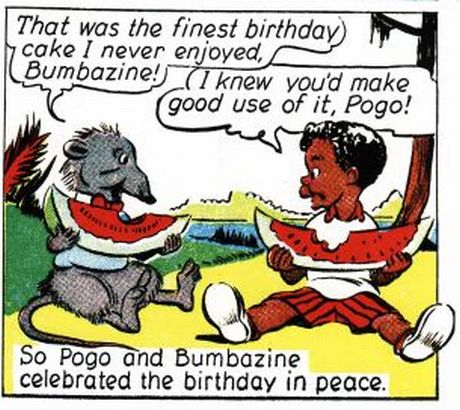
Earlier this week R. Fiore wrote a post at The Comics Journal defending the honor of Walt Kelly from the suggestion (made by Thomas Andrae in the introduction to Walt Kelly’s Pogo The Complete Dell Comics: Volume One) that maybe, possibly, you could see something slightly racist in the fact that he used blackface caricatures.
 

Pogo2

 
Fiore’s piece is a graceless performance. He spins and sneers, insisting that this image of a black child with a watermelon is not playing into racist jokes about blacks and watermelons because Kelly isn’t malicious and the black kid is portrayed positively so the watermelon must have ended up in there totally by accident, really, it could just as easily have been grapes. There’s no substantive engagement with, or really even mention of, the fact that Kelly’s cartoon blacks are based in blackface iconography, nor any effort to grapple with what that means.

The really depressing thing is that there’s an interesting article struggling to get out from behind Fiore’s special pleading. Jeet Heer, in the comments to the post, argues that (contra Fiore) Kelly did use blackface iconography but that (as Fiore says) Kelly’s depictions of blacks were in fact better than those of some of his contemporaries. Brian Cremins, who has written in an academic context about Kelly, also suggests in comments that the minstrel tradition was very important to Kelly’s art and humor, and that that’s something to be investigated rather than denied or fled from. I’m not a fan of Kelly’s especially, and haven’t read many of his comics, but it’s clear that there’s a discussion worth having about his relationship to race and racism. It sounds, in fact, like Andrae was engaged in such a discussion.

But Fiore isn’t having it. Kelly cannot have been touched by racism — or, if he was, that only goes to show how utterly awesome and virtuous he really is.
 

At the outset, we must presume that Walt Kelly was more enlightened than Thomas Andrae, or you, or me. This is because unlike Walt Kelly’s, our enlightenment is socially assisted. Walt Kelly had to come upon his all on his own. Now, any of us might have been one of the enlightened people in those days, and all of us think we would have been one of the enlightened persons in those days, but the odds say otherwise, and in the actual event Kelly was. We simply embrace the conventional wisdom of our time. Kelly swam against the tide.

The suggestion that you or me or Fiore have reached some level of enlightenment which puts us beyond the touch of racism, and therefore beyond moral censure or praise as regards racism, is perhaps the least of the idiocies in this paragraph. The vision of Kelly as great artist, achieving his goal of perfect equality and watermelons without any input from anyone, inventing anti-racism out of whole cloth, without the intervention or help of any actual black people anywhere, is, for its part, familiar in import. Anti-racism here isn’t really a goal in itself; reading Fiore’s piece, it seems fairly clear that Fiore couldn’t possibly care less about racism, or about black people. Anti-racism is just a accoutrement of (white) genius, like a punchy prose style or a pleasing ink line. Fiore admires Kelly’s humanism; if that humanism is compromised, so is the admiration. Ergo, the admiration being fulsome, no racism can exist. QED.

Fiore’s a longtime TCJ hand, and here he manages to embody some of the least enlightening aspects of old school comics fan culture: its hagiography; its crippling insularity (racial and otherwise); its smug distrust of academia; and most of all its defensiveness.

The last couldn’t be more counter-productive. A critical establishment that reacts with panic and dyspepsia to the suggestion that obvious blackface iconography is obvious blackface iconography is not a critical establishment that anyone beyond the most hard-core nostalgists is going to find welcoming. Join Team Comics! We were using watermelons in a totally non-racist way 70 years ago, pat us on the back! If you want to make your art form look clueless, ridiculous, and not a little repulsive, this would be the way to do it. Fiore’s handwaving doesn’t so much distract from the racism of comics’ past as it raises embarrassing and painful questions about the racism of comics’ present.
________
Update: Brian Cremins has a lovely piece about Pogo, race, and nostalgia here.

The Glory and the Hole

This is part of the Gay Utopia project, originally published in 2007 . A map of the Gay Utopia is here.
_______

C79-19r

 
Blessed are they who have wives, as though they had them not.

I had my most memorable argument over the worldview of the new aesthetic left after seeing the movie adaptation of Alan Moore’s V for Vendetta with a good lesbian friend, who was a better friend than I to the orthodox conception of “the gay utopia.” I was fairly repulsed by this cardboard morality play, in no way thickened by the sub-cardboard acting of Natalie Portman. In this pathetic tale, a loquacious clown-faced humanist “revolutionary,” who is supposedly lent some kind of soul by — what else? — his appreciation of Billie Holiday, magically overthrows the corrupt police-state overlords in a largely bloodless (not to mention classless and raceless) revolution. As the reader may infer, I was rabidly contemptuous, and felt that Billie Holiday’s grave deserved no more desecrations. My companion, whose intelligence I did not and do not impugn, was resentful of the wet blanket with which I spoiled the warmth she had felt from viewing a movie with such an upbeat and morally agreeable conclusion (certainly a rare event in Hollywood). Aside from the likelihood of such a remarkable series of events as those depicted, I wanted to know what the results would be of this groundswell of goodwill. What system were they ushering in? Who would take power? Where would the money flow? Never mind picking up the trash or fixing the streets, what the hell WAS this revolution? For who and by who and to result in what? She wasn’t interested in answering. But I think one reason I succeeded in being so thoroughly irritating that evening was that I was perceived as badmouthing the dewy-eyed hope for liberation, power source of the gay utopia.

What does V for Vendetta have to do with the gay utopia? For one thing, its flaccid message of tolerance has its most tolerable moment when Natalie Portman’s character is in prison being tortured, and is given strength by reading the letters of a lesbian former prisoner. However, when it turned out that this whole prison scene had been some kind of growth-experience fabricated by V, our anarchist Paliacci, I completely lost any sympathy for his nebulous agenda. That’s just me. But the nebulous nature of the program, parsed on the movie poster as “Freedom! Forever!” is, I believe, a key to why this shitty film, and many another campy ode to personal rebirth through social adversity, is unassailable to followers of the new politics of sentiment. Struggle is to be transparently a romance. The humanism of our era has but one virtue, truth, and thus only one true romance, authenticity. But even this truth is viewed from outside, and thus becomes contingent, like the transparent naiveté of cinematic empowerment (cf. Dirty Dancing, and many another nostalgic slumming-liberation romance). To me, Natalie Portman’s character being duped by the radical ethos-bearer into revolutionary loyalty through manipulation of her deepest terrors and desires was not just a deal-breaker, but inevitable. To my friend, who saw the big picture, I believe it was a metaphor for the traumatic journey of self-knowledge required of all seekers after justice, the individual contributing to the great collective uplifting/leveling of humankind. Again, no wonder Billie Holiday sings their anthem.

I had opportunity for pause the next day when watching the gallery for a show my inner-city high-school art students had created in response to the displacement of public-housing residents (I lay that bare in order to establish my progressive cred). The local erudite fascist wacko, who comes to every event at this solidly left-leaning art space in order to beat do-gooders about the temples with quotes from Wyndham Lewis, returned to engage me in an uncomfortably long discussion of how the coming environmental Armageddon would require every man to cleave to his family and affirm his race loyalty. I adhered to my position that race was obviously a consideration in the allocation of misfortune worldwide, but if the bell tolled for anyone, it tolled for whitey. Strangely, his story lacked the shining poetry of Goebbels, just as my friend’s response to the movie lacked the analytical acumen of Hannah Arendt. When he finally left to go attend to his weirdo fascist diet, I washed my face and hands vigorously, and tried to figure out what I was supposed to glean from two such opposed yet parallel experiences of perverse alienation. The conclusion I’ve now reached is that my friend’s shimmering fairy-tale has the certainty of eventual success. My eugenicist nemesis is possibly dangerous, especially if he gets hired by Fox News, but his attempt at post-Nazi policy proscription is ultimately irrelevant.

But nothing could have seemed more irrelevant in the early 19th century than the ideas of Charles Fourier. Though he was hardly the first post-Renaissance visionary of planning, his is the name I associate more than anyone with the concept of “utopia,” an engineered paradise in the here and now. Like Jeremy Bentham, he was an ardent feminist and utilitarian. He was, of course, a socialist, an early adherent of the concept Marx and Engels would come to name “the labor theory of value,” but a socialist who despised government, an early anarcho-syndicalist of sorts. He also believed in a vast array of familial and coital configurations. And that planets were bisexual and carried on some kind of intergalactic erotic communication. As a mystic of humanism, applying to society the anthrocentrism of hermeticist philosopher Giordano Bruno, Fourier more than anyone may have envisioned our cultural evolution as a rational-magic techno-pantheistic totality. Society is composed of freely-chosen collectives (“phalanxes”) of freely self-constituted monads. This is the legacy of the charismatic Left, but where can it be found in today’s world-weary world of cynical realpolitik?

It can be found everywhere. Mahmoud Ahmadinejad doesn’t have any homosexuals in his country, and so our expansionist pro-life President would seek to send our military, in which gays are certainly represented in a generous proportion, to violently overthrow this un-gay utopia and give its women the right to vote for an American shill. My contention is that the gay utopia is already here — except that sexuality has turned out to be a cage rather than a key. Regardless, barring a global bloodletting, the Middle East is yet another frontier for the humanist assault of the West, in which the boundaries of abjection, on which the patriarchal walls of our civilization were erected, are doomed to corrode. Ahmadinejad can be in denial about homosexuality, but he cannot ignore the rhetoric of human rights. All he can do is lie and dodge accusations. He is incapable of answering directly to the power which cannot be acknowledged. His magically pure Iran is no match for the magically post-pure fantasy of the gay utopia. Faith will be crushed by identity.

Inevitability is a hallmark of the landmark theoretical utopia of modernity, Marxism. A strong utopia is not a romance. It is a statement about history. Lockean democracy is a utopia — it promised freedom for all, and delivered it to the professional middle classes of the industrialized world, while pushing its refuse to the margins, Slavoj Zizek’s un-flushable Real. The fluidity of capital has outmaneuvered any consciousness-raising among the proletariat, quickly finding new markets for suffering. But the limit of these markets is that, sooner or later, all that’s left are the things that cannot be property, and cannot be liquidated. Ironically, water is a prime example. At that point, the giant disparities in global resource access will manifest a verdict on Marx’s prophecies. Humanism, the basis of the gay utopia, has its Real as well. That ineradicable underbelly of the desire to liquidate boundaries of identity is the persistence of hierarchies. This is why it matters who is in charge of the gay utopia — who takes power without being acknowledged. If it’s academia and the global entertainment industry, then the power has been consolidated. The revolution is constantly being televised.

Paraphrasing Julia Kristeva, the existence of the boundaries of purity are what keeps sacrificial violence at bay. It’s easy for me to see holy war as the result of the Western attack on purity, just as Christian and Muslim fundamentaists would have it. I think that, in response, there is a need to elaborate the gay utopia much more completely, but in art and magic, its true voice, rather than theory, for which it has no use — V for Vendetta being the case in point. Kristeva quotes the rabid anti-Semite Celine, who rails against the technocracy thusly, “There is an idea that can lead nations. There is a law. It stems from an idea that can rise toward absolute mysticism, that rises still without fear or program.” The universal abjection of gender indeterminacy, purified by a new ideal of immanent boundless love, needs to be raised to the transcendent state it deserves.

Sexuality, on the other hand, is something I’ve barely touched on, because it is time to shake it off as a talking point. In fact, as the V for Vendetta anecdote illustrates, ideology far more than proclivity is really the point. For now, in this society, gay people need to be free of harassment and assault, and visibility is necessary. There is a need in the long term, however, to diminish sexual habits as a primary public signifier, much like the social importance of one’s race or income. Race distinctions will continue to diminish. Income differences, and attendant credit gambles, on the other hand, eventually may cause cataclysmic upheaval, but art can’t do much about that. The vast straight majority doesn’t need to embrace homosexuals; they need to stop monitoring sexual behavior. The fear of continuity, of lost individuality, is tied to gender, and a new romance of gender must emerge.

Quoting gender-essentialist feminist Helene Cixous: “One can no more speak of ‘woman’ than of ‘man’ without being trapped within an ideological theater where the proliferation of representations, images, reflections,… invalidate in advance any conceptualization.” For this reason, the morbid pedantry of much art about gender/sexuality does not point in a promising direction, no more so than the failed abstract jouissance of androgynous modernity that the pedantic art aimed at reforming. My version of a gay utopia is a gendered communitarianism, in which gender manifests in flesh and art, not subordinated to sexuality and the Deleuzian striving, after Artaud, for a “body without organs.” Lots of “body artists” I like create work that is admired for its undeniable power, but marginalized insofar as that power is gendered, and thus provides an obstacle for polite humanist discussion.

I’ve just about reached my limit of patience with male artists who more or less share my upbringing. Most of us seem to have nothing more on our minds than regurgitating the comic-book narcissism of our youth and mobilizing our raging insecurities against the alleged “politically correct” conspiracy against our once-proud cultural standing, or donning the signifiers of fashionable androgyny, and using their theory bookshelf as their dildo-bludgeon. I am part of this historically highly privileged group, and, while our fantasies of persecution and sensitive genius are disabling and unseemly, I would argue that rabid masculinity has a place in art. Just as feminist art has been hamstrung by negative, fearful work, shrilly extolling an insular platform, the face of serious art about maleness has been twisted into a permanent sneer of ironic defensiveness or a permanent grimace of pedantic clenched-ass sincerity.

Chicago artist Paul Nudd is most certainly a member of my demographic. His drawings, collages, sculptures, and videos share a signature style, a design sensibility clearly informed by the 1980s thrasher aesthetic of Zorlac and Santa Cruz skateboards, abstractly but directly referencing viscera, bacteria, orifices, and wounds, nebulous cartoons signifiers of abjection. I’ve always been a fan of this work, but never more so than when I saw him speak at the Vonzweck space this August. Nudd shared his homemade mead, and the small crowd, entirely white and including only one woman, was certainly on his side. I was not inclined to judge him harshly, but my fraternal admiration was balanced somewhat against some uneasiness I’ve been feeling towards the group shows he’s been associated with of late, shows that feature mostly rather bitter, frustrated white-guy work. But my best suspicions were met by a presentation that did anything but massage his reputation or preach to the choir.

The mood was set by turning off lights in order to run the slide projector, which was eventually only briefly employed. It ended up that the only source of light, along with one slide that ended up dwelling on the wall for a time, came from Paul’s latest video of fluids silently surging in and out of a palpitating opening. The dominant color was red, which gave the proceeding an impression of flickering firelight. Nudd is currently collaborating with another local shock-jock artist, Patrick W. Welch (not in attendance at the lecture), who is best known for his works and shows around the idea of the “Micromentalist Manifesto.” Paul gave out photocopies of some of their collaborative drawings, intricate tableaux of vivisectionist pornography and general Armageddon. Paul spent the first 45 minutes or so of his presentation praising Walsh’s drawing skills and joyfully relating largely self-deprecating anecdotes of their collaboration. After this he passed out more free artwork, a photocopied booklet of drawings with a silkscreened cover, and reluctantly went through some of his slides, which, blown up from their modest scale, only emphasized his delicate, gracefully articulated linework, and his subtle palette. He was eager to answer my questions about influences from female biomorphic artists such as Lee Bontecou and Inka Essenhigh, and he moved on to passing out a series he had done of covers of books he loves, and gleefully read aloud from grossout passages, stopping frequently to make sure he wasn’t upsetting anyone.

Like the most exciting and inspiring “gay utopia” performances I’ve experienced, this lecture had a thick sense of atmosphere, a heady delectation of the body, and communal generosity. What separated this talk from matching up with the gay utopia “look” was the fashion aesthetic (metal band shirts instead of thrifted blouses and tank tops), a cosmetic distinction, and, more importantly, the lack of any affirmational bacchanalian exhortations. Now, while I have greater admiration of queer hippie fashion than of thirtysomething dudes in black, and I appreciate the hippies’ exultation in magic, much of the utopian fantasy rings so hollow (lacking hallucinogens, or at least fantastic music). The part of Paul’s presentation I found preferable to the latter-day Happenings I’ve attended is a sense of quiet, and laughter not weighed down with pretensions of Dionysian sensuality. And beatification found through a healthy dose of repulsion, rather than a program of forced cosmic optimism.

Echoing the insights of my heroes Georges Bataille and Julia Kristeva, I want to emphasize that such repulsion is essential to transcendence (now more than ever), and there’s no lack of it in the work of strong gay and female artists. Photographer Cindy Sherman comes to mind as one of Paul’s favorites, but an artist I could not help but think of during the presentation I described is the gay Canadian artist Daniel Barrow. Barrow creates small, precious multiples, such as trading cards and balsa-wood airplanes, but his best-known work are his performances in which he “puppets” his drawings on a transparency projector, to the accompaniment of a recorded spoken narrative. A fan of the bemused world-weariness of Quentin Crisp, Barrow’s apocryphal stories of gay celebrities feature sickly children, magical animals, and a decidedly perverse fixation on the body — i.e., more than a little tainted with disgust and outright horror — all illustrated in romantic brushstrokes and rococo pastels.

The darkened room, the evocation of boundaries of pure and impure, the highly male fear and fascination with (Mother’s) exposed innards… Barrow and Nudd have so much more in common than, in my opinion, do Nudd and the attractive but mean-spirited work of John Currin, or do Barrow and the equally lovely orgiastic porn assemblages of Scott Treleaven. The wonderfully wanky psychedelic collages of Fort Thunder, Lightning Bolt, and other Providence products, however, strike me as pretty heterosexual, and yet are visually consonant with much aesthetic output of the pegpants noise-rock freak-folk kids of the early ‘Oughts, LTTR and/or otherwise. And I maintain that the magic of Animal Collective’s music comes from the scent of Wicker Man and Charles Mansen, the hint of sacrifice, moonlight murder, the protean anarchy preceding the legalism of Leviticus. Which, if it wasn’t repulsive, would have far less appeal.

On the topic of symbolism outside the phallic Law, Carolee Schneeman and Louise Bourgeois are two of the more prominent artists to have taken up the representational torch for the re-ascendence of matriarchy in the capitalist era. Multiplying bodies and their organs with a horrible joy, a simple inversion of the male joyful horror described above, Bourgeois’ mutant sculptures and Schneeman’s visceral performances claim a new kind of female power, a “phallus” of sorts, but a female phallus, formless, interior, and possessed of numerous eyes. Even more than in the work of Paul Nudd and Daniel Barrow, who also swim in shadow through a hallucinogenic sea of (inevitably) gendered bodies, vision for these women, and the artists who follow them, is occluded and questioned. Whether it’s Schneeman writhing in processed meat with kinetic umbrellas, or Bourgeois’ pillars of breasts, their emphasis on intuitive and haptic responses jar the visual supremacy of the Renaissance tradition, and the humanist grid does not burst into flowers of rational tolerance, but rather begins to creak and buckle down its own universal anus-eye in the absence of any faith to hold knowledge together.

Two thinkers that have contributed a great deal to my perhaps equally unstable worldview are a pair that would hardly have many kind things to say to one another, but controversial thinkers on gender who illustrate strong archetypes of the old male order and the new female order, both equally relevant in making sense of the post-humanist future. C.S. Lewis, vilified by liberals for Christian children’s stories opposing Islamic imperialism (Ahmadinejad anyone, again?), wrote profoundly in essays as well as fables on the structure of the natural order, as he saw it. In The Problem of Pain he opines that genders are not realized in individuals, but are metaphysical ideals subsisting throughout Creation. Gender is far more a matter of power than genitalia, and all of humankind is feminine in comparison to the grandeur of God — in this significant sense, all humans are women. Gender is found in an interior space, the place where a Christian faces his Maker. Essential gender difference is foundational as well to the revolutionary feminist writer Shulamith Firestone, who would end the nuclear family, end compulsory education for adolescents, and end pregnancy as we know it, turning reproduction over to technology and ushering in an era beyond rigid boundaries, in which women once again take control of society. Given the situation in which the world finds itself, it seems unlikely that all will fit the “feminine” stereotype of nurturance and inclusion. But, in an era of want and upheaval, it is appropriate that our trust be given to women (not masked jackasses a la V for Vendetta). Even if supporting Hillary does seem a bit too cynical for my taste at the moment.

Belief in gender power rather than atomistic “mere tolerance” is a direction that I wish to see pursued in art, and a direction that the “gay utopians’” magical stunts could aim at. That is, if performed in humility before divinity rather than affirmation among equals. Colonial appropriation of indigenous practices, the secular mysticism of phenomenology, are no replacement for the absolute amazement and anguish we must feel at the bodies we inhabit and the world we have destroyed. Contingency and democracy are realities of our daily life, and necessities of our group situation. But they are a poor replacement for the awe we must feel before a greater power, the Big Other outside of our reality, that has made it possible and worthwhile to work and love, though never to the point of even beginning to fulfill the infinity of desire.

So, if the gay utopia isn’t really about being gay, what about being gay? John Boswell, who wrote about the history of tolerance for homosexuals in medieval Catholic Europe — quite widespread before the 12th century — makes a number of strong points in defining the problem of what gayness or homosexuality is and how hard it is to locate in history. On one hand, there are sources that suggest that gay sex in highly tolerant societies (like classical Greek and Roman cities) is engaged in openly by a large proportion of the populace, whereas intolerant societies (like Persia in the Crusades or Iran today) proclaim no homosexuality whatsoever. This goes along with the conclusions of Freud and Kinsey (separately) that the split between heterosexuality and homosexuality is a highly questionable one. Of course, neither term existed before the bastard Greek-Latin term “homosexuality” was coined by Havelock Ellis at the end of the 19th century. Many people who have had homosexual feelings or experiences do not acknowledge themselves to be gay (such self-affirmation is still significantly tied to class status). Many people are attracted less to genitalia and more to eye color, curly hair, feet, humiliation, etc. Gay utopian scholar, artist, and activist Gregg Bordowitz phrases it evocatively: “all sexuality is queer sexuality.” Which is easily confused with the homophobic shibboleth about homosexuality being a choice. It is, in a sense — if hetrosexuality is a choice too. Sex is a vast array of thoughts, words, and deeds; desire is a shadowy cave; sexuality is an assumed identity, a lifestyle. Many people who are sexually repressed have severe problems both causing it and resulting from it — ditto for many people who are oversexed.

Managing one’s identity is a way of navigating between desire and sex. Sexuality relates a person to a social order. A gay person signals by their identity that they relate to a social order of diversity, cosmopolitan values, political rather than familial affiliations — a worldview that does, in fact, resemble a great deal of contemporary First World social milieux, and the forward-looking politics of globalism and hybridity. But being “straight,” heterosexual, as normative as it is, is clearly defined in relation to its supplement, homosexuality. Socially, (though not for persecuted individuals) heterosexuality is an identity just as fraught with anxiety — anxiety, as Eve Kosofsky Sedgwick explains, about being gay. A straight person often uses their sexuality as a way to hide any number of flaws in their normality. In post-industrial societies, the institutions of heterosexuality (like marriage) evoke a bygone era: the rural past, when kinship affiliations were key to the survival of the wider group. Just like the straight person who uses “normality” as a mask, the culture uses nostalgia as an ideological front– in part, to cover up the non-rural present, the regime of individual control that Foucault famously termed “biopower,” a society where, despite the humanist dogma of personal liberty, everyone’s private habits are in fact a matter of public scrutiny — and individual self-hatred.

Sexuality is a modern necessity. It is involved with policing the murky infinity of desire within, and confronting the infinite policing of behavior without, but nonetheless, it is something we construct. Gender is often confused with sexuality — they are both concepts tangled up in discussions of modern identity. But I would argue that sexuality is the part that is presented, both to oneself and the world, for approval. Gender (not genitalia) is how our minds and bodies fit in with everything we perceive. Gender is the stable power that generates all instability. Hovering indeterminately between two eternal poles, our gendered mind experiences sexual desire, but this is a result of our gender, not the cause of it.

The perception of gender as a ramshackle hodgepodge of hegemonic proscriptions is the thin philosophical gruel served up by the legacy of cultural studies. Because intelligent American academics like Judith Butler, Elizabeth Grosz, and Donna Harraway borrowed from eloquent French thnkers like Georges Bataille, Jacques Lacan, Julia Kristeva, and Michel Foucault, and talented French writers like Jacques Derrida, Francois Lyotard, and Gilles Deleuze, feminists and queer theorists have followed the pull of gravity, moving further and further from explicit politics and into a stale rhetoric of endless dynamistic analysis and personal exploration, buying up blurry platitudes and hoping for cred at the margins of banality. A famine, a technological innovation, an orgasm, are all intriguing crises, equivalent affirmations of flux. Though these writers have articulated important points, they are seriously hampered by their inability to theorize their unacknowledged utopian aspirations, and thus their ideological location. The ideas of queerness that underlie the gay utopia resonate with such a stochastic worldview, as do the ravenousness of capital, the force of the feminine, and the amorphous violence of sexual desire generally. These certainly cannot all be the same thing. Or can they?

There are reasons that this shapeless political-poetic cluster applies with equivalent intuitive resonance to gender, sexuality, and economics. It is the case that technology mediates law and flesh, tending toward the specialization of tasks and replacing bodily strength, seemingly obviating the barrier between manual work (for men) and biological work (for women), as Shulamith Firestone proposes. Openly gay men are effeminate if only by definition — traitors to the masculinity they admire and reflect. But, precisely owing to the fear of betraying the fragile brotherhood, masculinity is an ill-fitting jockstrap for everyone. On the other hand, despite mulleted caricatures, lesbians lack this anxiety, and thus do not resemble men in the way that gay-appearing men resemble women. Slippery female sexuality detaches the phallus and multiplies the vulva.

The indigestible remainder of capitalism is hierarchy, the deepening of divisions in the erasure of differences, speculative liberty moved by the compressing force of its own iron limit. Hierarchy is not unique to capitalism, but it is synonymous with capital of all kinds. Monosexual situations often result in expressions of sexual violence to create order — schools and military organizations come to mind; conversely, Kristeva points out the way in which strict hierarchy in Indian society reduces emphasis on sexual and gender taboos. Desire cathected as dominance is a basic expression of power, from rape to the scintillating Freudian analysis of Woodrow Wilson’s spiteful and pedantic Messianic delusions.

Which brings up my preoccupation with the way in which Christianity and power are misunderstood, both liturgically and historically. Christianity is filthy with responsibility for many things, including some portion of transmuting classical humanism into our current “culture of life.” But we can see now that, through constantly agonizing over its history, the religion remains outside of its consequences, like the body which is eternal and the body which disintegrates. Transmuting, recall, is alchemy, a neo-Platonist animism, a non-Christian form of magic. Rather, thanks to Saint Paul, Christianity is not an experimental method, but a mystical resolution of cosmic impossibility — including the contradictions within Judaism that once alienated him. John Boswell avers that Paul, a central founder of the Church, did not condemn homosexuality, but rather child molestation, and excessive gratification generally. Elaine Pagels and others argue that the “pseudo-Pauline” passages marginalizing women were added later. Paul advocated a missionary approach that was humble and heartfelt, not a “cloak for greed.” His approach adopted the rhetorical approach of the Greeks in the service of revolt and revelation, not to subjugate populations in the service of power.

Despite their often honest intentions, perhaps the only significant favor American Christians have done the world, though it is quite significant, is not to free the hearts of men, but to secure the place of faith as an alternative to an instrumental materialistic worldview. Paul advocated the restraint of celibacy to inflame faith, prevent unwanted children, and protect the body, not to encourage the bigotry and repression of affect that Christianity is now known for. The emotional condition among Americans is not hope, faith that our lone trickle of love can fill the expanding endlessness of Creation — though this sounds a lot like the gay utopia — it is rage, resignation, anxiety, and despair in the face of unfilled “fulfillment.” Mannerisms adopted to intimidate, bluff, and seduce our comrades have the studied insincerity of a smile in a sickroom. This abject submission to unreason we see in advertising, in Hollywood, in Broadway, is too easily incorporated into queer irony.

Christianity strove to replace cold, abstract classical values (the forerunner of our progressive rationalized city), and the ancestry-bound, corporeal insularity of Judaism (conservative by the standards of any era) with an inward-looking practice that dwells forever just on the edge of infinite love, the border between humankind and everything we are not, unitary particularity and ultimate vagueness, the body with numerous organs.

The only boundary of humanist philosophy is the shadow the philosopher casts on his work, a shadow constantly swatted at ineffectually by subsequent philosophers, popping up like spring-loaded gophers in the grid of interchangeable positions. But boundary in religion is foundational. In Christianity we have not a marginal shadow but a central body, the crucified Christ, blood that becomes wine, meat that becomes bread, wounds that become windows on the infinite. Sacrifice and cannibalism are not reintroduced by Christ, but transubstantiated into an effort at mutual restoration. Miraculously the limp body of apassive man (the pariah of both pagan and Jewish society) becomes the phallus of the world’s hope. A Moon-Pie can be a blessed sacrament, our conduit between hunger and beasts, emblem of continuity with the world. We eat what we kill, and thus kill what we eat, far more than we copulate. From what we eat we derive energy, heat, shit, tears, and a rotting leftover, the body. “The body” might be a provisional site of intersecting discourses, or whatever, but the body is not. What we share with life we share with our kind the most, and with nobody completely. moving from ultimate newness and organization, ascending through levels of grace, facing the impotence of God in the impossibility of resurrection, and the glory of God in the impossibility of Creation.

Holy S/H/E/IT is the magic that allows us to reflect the many-tentacled thing-object of our unspeakable affections into a universal secret triumph over suffering through suffering, through law to go beyond the law. But this does not mean that Christianity is not crushed by the evil done in its name. Spreading love and peace was a vehicle for genocide and on a scale matched only by our contempt for ourselves. But no doomed private pride can match the grandeur of the Interior Castle. The Kingdom of God, like the gay utopia, is a paradise of orifices — the wounds of the suffering Christ. But unlike humanism, Christianity does not resist criticism through absorbing it and feeding from its energy. Some part of it resists the pale professional conversations in academic cloisters; rather, it exposes itself to the light of the world, and constantly cracks and crumbles into dust through publicly interrogating its aporia, under the weight of the hypocrisy it condemns. Is there any point in even trying to talk about it?

My feeling, however, is that the aim of the postmodern project to somehow correct the excesses of the Enlightenment has noticeably failed. If calculus teaches us anything metaphysical, it’s that change and volatility are far from unquantifiable. Deterritorialization, Deleuze’s concept of the tendency of social forces to multiply and disperse, is nothing new. Unity has had its fragility officially exposed ever since Galileo and Luther publicly flaunted the Church, and Thomas Hobbes was soon and forever after a black sheep of humanism for critiquing both democracy and the scientific method. The gay utopia champions both the autonomous uniqueness and the egalitarian interchangeability of all, and, with millions of people now living in deprivation and peril, it’s not clear what or who has yet to be freed through the rethinking abstractions of the West. I would like a reterritorialization to oppose but also to redirect the many reactionary reterritorializations that promote intolerance and imperialism, rather than merely leaving things to the inevitable ongoing deterritorialization, which continues blithely managing citizens, property, and information through a rhetoric of legalistic ethics and endless evolutionary growth. International law and multi-lateral treaties cannot be expected to yield equality and improvement. Like St. Paul our civilization has lived through the law in order to die to the law. Our culture is a culture of freedom. What remains to guide us?

The art of the body, rather than the theory of the body, has a lot to say about the potential of repulsion, the only curb of desire. Thresholds in monotheism exist to sustain purity and resist sacrificial violence. Such thresholds must be preserved, and this provides art with a small but meaningful role in the world. Violence against gays, women, and racial minorities are not wrong because they supersede the autonomous self-policing of Deleuze’s desiring machines, but because violence is wrong. Spreading our products, litter, and worldview to every corner of the world is not wrong because of the sacredness of freedom; it is wrong because we are not living up to our responsibilities to our communities and our nation.

Colonialism is the crisis of our time, as in sci-fi writer Octavia Butler’s Xenogenesis trilogy. A profoundly eco-aware species that deplored hierarchy includes a facilitating semi-shamanic third gender, known as ooloi. But despite their vast knowledge and capacity for nurturance, this species moved from world to world, sucking its resources dry. The freedom of capital is the freedom of desire, the freedom of a raging destructive conflagration. It can be deflected through voluntary boundaries. We must find a way to create a peaceful fortress. We cannot let the fluids of power flow without restriction in and out of our country. Christianity makes it possible to love our neighbor in isolation from her. National sovereignty, not individual fulfillment, is the only hope for the great mass of people.

Body art reminds us that we have physical boundaries that leak, just like the boundaries between sacred and profane. Transgressing these boundaries is a religious act, or a sin. Imperfection is universal, and not everything in nature is ours to touch, but art can touch it — this can be seen in the colonoscopy videos of Mona Hatoum, or in Annette Messager’s crocheted sweaters on taxidermied birds. These works are viewed in shadow because twilight dissolves boundaries. Twilight is therefore both holy and evil. The strong response I feel to art like this reminds me that the place of art is, in some sense if not literally, outside of the everyday world. This is why the magic of the gay utopia is so inspiring, but also so deceptive. A utopia is not a place for people to live. It is a place to look through a dark hole and imagine. Which might be, in a good sense, kind of gay.

School for Alter Egos

Equinox

 
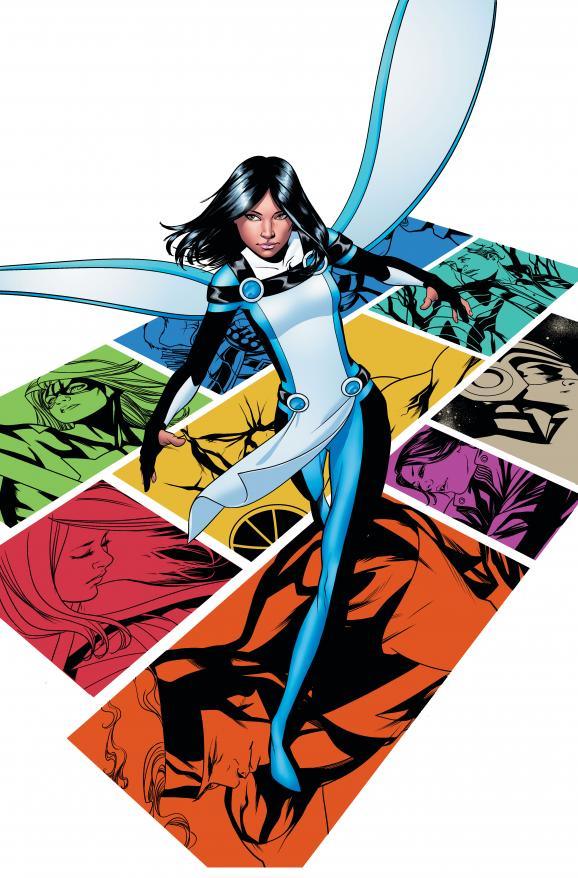
I’m looking at DC’s newest character, Equinox, a teen superheroine based on Cree activist Shannen Koostachin. She’s a member of Jeff Lemire and Mike McKone’s Justice League United. Like Marvel’s Alpha Flight, the team is Canadian, so the character continues the U.S. publishing tendency to place Native America outside of U.S. borders. But I see some promise here: Equinox is from an actual tribe, her costume isn’t red, her features aren’t cartoonishly “Indian,” and she’s not showing any thigh or cleavage. That helps offset the “her power stems from the Earth” cliche, and I actually like the idea of a character who will have different abilities as the seasons change–never heard that one before.

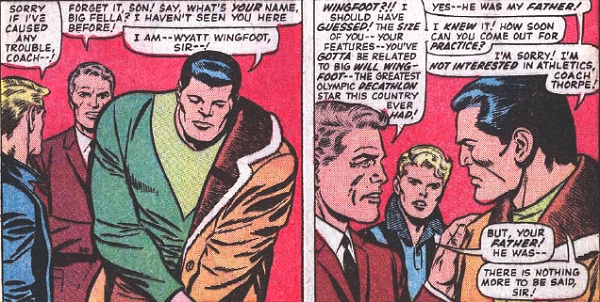
But will she be better than Wyatt Wingfoot? He was born in Fantastic Four No. 50, cover-date May 1966 , on newsstands a month before my June-issued birth certificate. Wyatt’s dad is “Big Will Wingfoot – the greatest Olympic decathlon star this country ever had!”Here on Earth-1218, that’s James “Big Jim” Thorpe, gold medalist for the 1912 Olympic pentathlon and decathlon. Stan Lee even gave his name to the college coach trying to draft Wyatt: “I’m sorry! I’m not interested in athletics, Coach Thorpe!”
 

FF51_WyattWingfoot

 
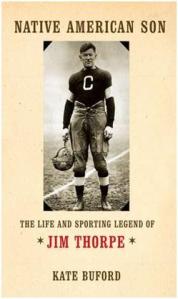
Jack Kirby penciled the issue, but I prefer Sante Fe painter Ben Wright’s Thorpe rendering. I picked “Jim Thorpe in His Carlisle Indian School Football Uniform” for the cover of my novel School for Tricksters. Wright’s website says he “draws from Native American ceremony, symbolism, and tradition” and identifies him as “part Cherokee,” rarely promising signs. But I like the painting because the old-timey helmet sets the period, plus his slightly stylized Thorpe looks really cool. The big “C” on his chest could be a superhero’s. Carlisle Man!
 

kate buford thorpe bioschool for ticksters cover

 
Biographer Kate Buford later told me Wright got it wrong. The cover of her Native American Son: The Life and Sporting Legend of Jim Thorpe features the original photo with an inside caption: “Jim Thorpe with the Canton Bulldogs, c. 1920, Canton, Ohio.” So the “C” is for Canton, a team Thorpe played for after his career peaked. Ben painted over the facts—the way lesser-known inker Joe Sinnott thickened Kirby’s lines for FF 50.
 
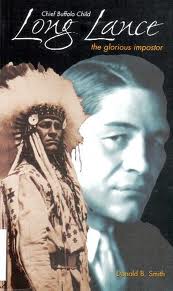
School for Tricksters is a historical novel, so I paint over a shelf of facts too. My daughter’s 11th grade history teacher capped a recent Carlisle Indian School lesson with “Oh, I’m sure those kids must have wanted to be there,” so my daughter grabbed a row of books from my office to write a rebuttal for her research paper. I recommended Chief Buffalo Child Long Lance: The Glorious Imposter. I used to exchange emails with the author, Donald Smith, up in Alberta. Thorpe is the School’s most famed student, but I prefer the adventures of Chief Buffalo Child, AKA Sylvester Long. He’s the real Carlisle Man.
 

sylvester long lance bio

 
The School railroaded children from their western reservations to the middle of Pennsylvania to be transformed into working class mainstream Americans. According to Long’s autobiography, he was born a full-blood Blackfoot in a great plains teepee, and so an ideal student for the program. Except that his birth certificate says Winston-Salem, NC, and both his parents were ex-slaves. Which still makes him the ideal Carlisle student, since Carlisle was all about painting over facts. The real-life dual-identity Long graduated to Hollywood, where he played another version of himself–until the movie exposure lead to his unmasking and suicide.

Sylvester, a mild-mannered library janitor, longed to be exceptional—a supeheroic dream for a mixed blood Clark Kent in the Jim Crow South. But did he just doodle over his real self or did he become his disguise? When Dean Cain proposed to Teri Hatcher on the season two finale of Louis & Clark: The New Adventures of Superman, the network shot three answers: “Yes,” “No,” and “Who’s asking, Clark Kent . . .  or Superman?” They were trying to prevent the “real” answer from leaking before the show aired. Smith documents at least a dozen Lois Lanes in Long’s adventures, but no marriage proposals.  His identity wasn’t stable enough to settle down.

I ask my students the same question when analyzing superhero texts: what is the character’s core identity? I suggest four options: A) the superhuman, B) the human, C) neither, or D) both. For decades, Superman’s answer was “A.”Clark Kent is just the pair of fake glasses he wears around humans (David Carradine gives this a great monologue in Tarantino’s Kill Bill). But that flips to “B” after the 80s reboot. Clark lived a perfectly normal childhood until his superpowered puberty made him hide behind a cape and tights.

Sometimes students go with “C,” arguing that both Clark and Superman are public faces worn by an inner Kal-El. It’s a common idea outside of comics, that we all have a secret private self who transforms according to context: home, work, frat party. It fits the standard master-of-disguise trope too. Long could have wandered downtown any of his free Saturdays and leafed through a copy of Nick Carter Detective Weekly at a Carlisle newsstand in 1912. The old banner illustration is a row of heads, “Nick Carter In Various Disguises,” with the largest and literally central self right there in the middle.

But “D” is the most daring choice. What if the center doesn’t hold and we’re all just a series of shifting performances? Zorro admits as much when he unmasks himself as the languid Don Diego. The costume wasn’t just a disguise; it made his whole body come alive—something Bruce Banner and the Hulk understand too. Are any of us really the same person when we’re angry? And is the goal to find a “golden mean” as Don Diego promises his fiancé? Like Teri Hatcher, Lolita is no polygamist. And yet who is the Scarlet Pimpernel’s wife married to? If Sir Percy is just a foppish disguise, why does he keep laughing that inane laugh even after he unmasks?

All that is too complicated an answer for early 20th century America. When they unmasked Sylvester they only saw a dual-identity fake. Except then why did a private detective have to write over the facts, claiming he fingered rouge and hair-straightening gel from the corpse? Long’s alma mater championed the dual-identity model too, doctoring “before” and “after” photos of graduating students. Sometimes you have to white-out a shirt collar to keep the world savage/civilized.

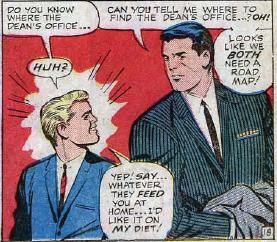
Big Jim’s white/not-white wife was a Carlisle student too. She and Jim lost their first child, James Junior, their only son. Kate Buford and I give dueling banjo readings ending with the death scene, proof that narrativized facts and fact-based fiction can get along just fine. Kate and I live in the same town too, and our books came out just weeks apart—coincidences even most comic book readers wouldn’t believe. Stan Lee invented the Keewazi Indian reservation for the Wingfoots and dropped Wyatt into the Human Torch’s college dorm. Johnny looks up at his hulk of a roommate: “Say, whatever they feed you at home, I’d like it on my diet!”

Wyatt is still wandering the borders of the Marvel multiverse. I think he’s tangled with the Kree a few times too–an alien race Lee and Kirby created a year after Wyatt and who have only a phonetic resemblance to Equinox’s tribe. Equinox’s alter ego, Shannen Koostachin, was only fifteen when she died in 2010, but Canada’s House of Commons unanimously celebrated her superheroic achievements:

“In her short life, Shannen Koostachin became the voice of a forgotten generation of first nations children. Shannen had never seen a real school, but her fight for equal rights for children in Attawapiskat First Nation launched the largest youth-driven child rights movement in Canadian history, and that fight has gone all the way to the United Nations.”

And now she’s made it to Justice League United.
 

FF50_Wyatt

Is She-Hulk a Superhero Comic?

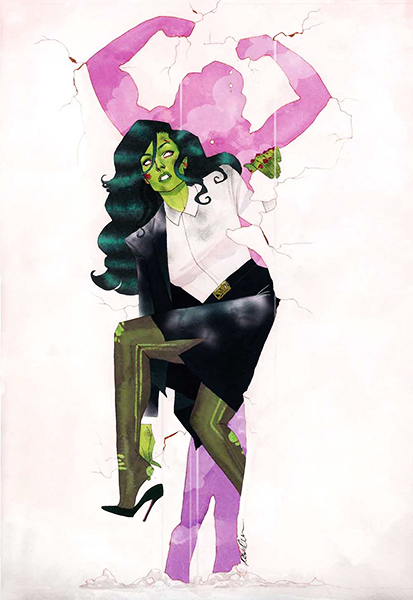
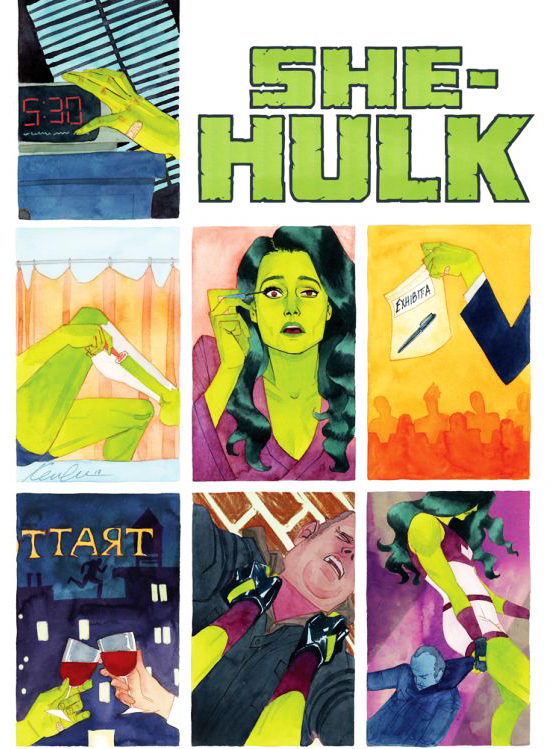
SheHulk1VarSo I’ve been reading Charles Soule and Javier Pulido’s new She-Hulk title, and really enjoying it. But it got me thinking about comics and genre a bit, and puzzling over the question that makes up the title of this post: Is this comic a superhero/superheroine comic? I think it isn’t (and, further, that is a good thing!)

Some background: The new She-Hulk series focuses on Jennifer Walters/She-Hulk’s legal career. Of course, some superheroing does occur (it has to – the She-Hulk is an Avenger, after all!). But even when it does, it is in service to aspects of the plot directly tied to the She-Hulk lawyering activities (for example, she is attacked by automated robots when attempting to contact Tony Stark regarding a case) or social activities (at the end of a night out, Patsy Walker/Hellcat convinces the She-Hulk to cheer her up by helping her raid a Hydra facility). In short, the comic is about a superheroine. But it doesn’t seem to be about the fact that she is a superheroine.

SheHulk1Now, the term superhero comic is a genre term – it refers to a type of comic that contrasts with war comics, romance comics, crime comics, funny animal comics, etc. Although I don’t want to tie discussion to any single theoretical account of genre, it seems clear that particular works of art get grouped together into a single genre based on having certain, aesthetically and narratively relevant, characteristics in common – these might include setting, theme, plot, style, etc. Further, once a genre exists, other works (both within and outside the genre) can be fairly interpreted not only in terms of their inherent characteristics, but also in terms of how those characteristics relate to the characteristics standardly associated with the genre in question. As a result, not every comic with a superhero or superheroine in it is necessarily a superhero comic in the relevant sense (just as not every story with a cowboy in it is a western). And given this understanding, the new She-Hulk series just doesn’t seem to be a superhero comic: it lacks too many of the standard characteristics associated with the genre (even the John Byrne and Dan Slott runs with the character, for all their metafictional weirdness and their development of the working lawyer side of the character, still revolved primarily around the standard sort of hero-versus-villain superhero plot). Of course, given the presence of a superheroine as protagonist, proper interpretation of the comic will likely benefit from comparison, and contrast, with more run-of-the-mill superhero comics, but that doesn’t mean that it is one.

SheHulk2All of this points to a rather illuminating observation regarding the comics industry. Until the rise of a number of upstarts in recent years, DC and Marvel jointly had a near-monopoly on recognizable superheroes (and between the two of them still own the majority of this particular narrative resource). As a result, however, they seem to have concluded that, since they had a lot of superheroes in their stable, they should only make superhero comics. It is not only that they don’t publish very many comics that don’t feature superheroes. In addition, for the most part they have failed to publish any comics that feature superheroes/ heroines in anything but the generically-bound sort of stories we are used to seeing superheroes/ heroines appear in. This might not seem all that weird or short-sighted at first glance, but imagine a similar (imaginary) scenario in film: MGM signs Charles Bronson, Clint Eastwood, James Garner, and John Wayne to exclusive, long-term deals, and then decides that it had better make westerns, and only westerns, from then on.

As a result, the new She-Hulk series is notable for two reasons. The first is that it is, if the first two issues are any indication, one of the coolest comics being published today (of course, people that know me know it is likely that I would say that about anything with Shulkie in it, so take with a liberal dose of salt if necessary). More importantly in the long run, perhaps, is that the new She-Hulk might signal Marvel’s willingness to explore different sorts of stories, and different sorts of genres, with their characters. If we are lucky, then maybe we will get all sorts of new stories, utilizing new perspectives, that explore all sorts of aspects of our favorite superheroes, superheroines, supervillains, and supervillainesses, and not just their ability to beat each other up or get all angsty about how hard it is to beat each other up. While battling-super-people stories are great (it is what got me into these comics in the first place), stretching a bit in this manner would be welcome too.

But maybe I am wrong, and the difference between this comic and previous mainstream superhero stories isn’t as vast as I think. So, is the She-Hulk a superhero comic?